



Abstract
Greg Clarke, former Chairman of the English Football Association, made several racist remarks during a 2020 appearance before a UK Department for Digital, Culture, Media and Sport Select Committee, claiming British South Asian people prefer to pursue careers in computing rather than football. Clarke’s ill-founded beliefs were poignantly well-timed given they came just as we were beginning our fieldwork, which involved interviewing 21 British South Asian senior leaders and executives across the football industry. Clarke’s comments crystallised what emerged from our interviews about battles to overcome institutional racisms and biases of co-workers. Drawing on over 36 hours of testimony – working at the nexus of economic sociology, critical race theory and the field of sport business management – we identify factors that regulate the openness/closedness of senior leadership and executive levels of employment in football, namely the role of exclusivity, closed networks, White allies, racial framing and exploitative temporality of non-executive boards.
Keywords
Introduction
During a 2020 appearance at the Department of Digital, Culture, Media and Sport (DCMS) Select Committee, former Chairman [sic] of the Football Association (FA), Greg Clarke, made several racist remarks. Via video link, Clarke claimed that if ‘you go to the IT department at the FA, there’s a lot more South Asians than there are Afro-Caribbeans. They have different career interests.’ While Clarke later apologised for his remarks and resigned his position, evidence of a racialised ‘common sense’ functioning to police British South Asian people’s opportunities within football is not new. Football has long been the favoured sport of British South Asian people (Bains and Johal, 1998) – despite enduring myths regarding their preference for cricket – yet this popularity has not naturally translated into proportional representation across the game’s many vocations. In response, a critical corpus focusing on the racialised barriers into coaching and playing employment has emerged over the last three decades (Bains, 2005; Bains and Patel, 1996; Burdsey, 2004a, 2004b, 2006). However, seldom has research attempted to undertake the enterprise of this article, which is to understand the issue empirically in the context of broader employment debates about the lack of ethnic diversity at senior leadership and executive (SLE) levels of the game.
Only weeks before Clarke’s faux pas, the FA had sought to take a lead on inclusion within SLE employment by launching the Football Leadership Diversity Code (FA, 2023). The Code, convened to improve diversity across ‘coaching’ and ‘senior leadership’ positions, and despite its positive intent, has drawn several critics – including equalities organisation Kick It Out – who expressed significant concerns (Burnett, 2023). Only 60% of professional clubs are signatories, no sanctions are in place for those clubs who do not comply and there is no official requirement to make workforce data public. What is perhaps most important for our purposes, however, is that not only do the categories of measurement used by the Code collapse all new senior leadership hires of ‘Black’, ‘Asian’ and ‘Mixed Heritage’ into one metric, signatories are free to define what ‘senior leadership’ means within their organisational context. While the FA (2023) offer guidance to clubs and recommend that ‘senior leadership’ should apply to the ‘top 25%’ of an organisation’s earners, they also permit ‘middle management’ to be included as part of data return. Therefore, it is not possible at present to define accurately senior leadership in football – given existing data include a heterogeneous mix of professional and voluntary positions – nor quantify its ethnic diversity, other than to note that 7.4% of senior leaders – as reported by the Code – across elite football are ‘non-White’ (FA, 2023). This indeed poses methodological considerations for us, which we consider below, but more immediately it underscores how little we know about SLE employment in football.
Taking the body of work that constitutes the sociology of sport, work and employment into full consideration, SLE employment in football is somewhat an elusive scholarly phenomenon. Such a review reveals that relatively little has considered football as a place of work, other than for ‘on-field’ roles (e.g. playing, coaching and on-field support staff) (Gilmore et al., 2018; Roderick and Schumacker, 2017) and even less has extended its focus to the executive tier (McLeod et al., 2020) or recruitment at this level (Bradbury, 2013; Parnell et al., 2021). Therefore, not precluding any discussion of ‘race’ and ethnicity, existing scholarship of any disciplinary persuasion has failed to engage extensively with individuals occupying SLE roles in football.
The lack of literature focused on SLE employment, and the subsequent failure to explore its racialised dynamics, although notable, is not exclusive to football. In their work into race and racism in investment banking, for instance, Prasad and Qureshi (2017) argue that the sociology of work and employment tends to be limited to the lived experiences of individuals doing ‘socially undervalued’, ‘dirty’, ‘stigmatised’ and/or ‘invisible’ labour (p. 353), situated at the bottom of organisational hierarchies. Such approaches have limits in aiding our understanding of how power and privilege coalesce to reproduce powerful social groups within work hierarchies (Umeh et al., 2024). Thus, Clarke and Smith’s (2024: 911) approach, which ‘examines how senior white [police] officers managed their career journey’, represents a paradigm shift in studies of work and racialisation. That is because they have shown that the volition afforded to specially sanctioned individuals by a racially homogenous social network is worthy of further enquiry. Still, such work is not at critical mass and, furthermore, where it does exist it tends to focus on White people. Thus, it fails to engage critically with the lived experiences of British South Asian people in SLE employment who, despite clear evidence of the existence of institutional racism within football and other labour markets, have attained SLE positions in ‘prestigious industry’ (Prasad and Qureshi, 2017: 353) contexts (such as, elite football), which themselves are under-researched.
Evidently, there is a need for critical analysis of SLE cultures in football, and how ‘race’ inflects the lived experience of SLE career trajectories. Through the adoption of a unique approach, one that exists at the nexus of economic sociology, sociology of work and ‘race’, and the field of sport business management, this article advances the current literature on British South Asian people’s experiences of football, as well as broader debates within work, recruitment and SLE employment. We unfold such an approach throughout the rest of the article, by documenting some of the racialised challenges and structural barriers faced by those who operate at SLE levels of the game, namely: the role of closed networks, White allies, racial framing and non-executive boards. Before we do this though, we now turn to a brief overview of current literature on football governance and the broader socio-legal and policy context.
The football industry, governance and ethnic diversity
Economic sociologists have contributed much to our understanding of governance cultures and practices, how executive boards and committees are shaped and remade by networks (Clarke and Smith, 2024; Prasad and Qureshi, 2017; Swedberg, 2009) and opportunity hoarding (Kramarz and Thesmar, 2013; Muzanenhamo and Chowdhury, 2022). As key decision-making entities, it is important, therefore, that principals of an organisation are equipped to represent stakeholders who belong, or may later be attracted to, the organisation and its activities (Kilvington et al., 2024). This imperative is underlined further by the hastening of a cultural tailwind propelled by a growing body of research that has shown diverse boards are key instruments for enacting meaningful change that can benefit all stakeholders attached to an organisation (Kim, 2023; Lawrence et al., 2024; Nash, 2022; Umeh et al., 2024). Such developments are captured succinctly in The Parker Report (2017), which positions fairness, meritocracy and social inclusion as necessities of sustainable public organisations.
This need is articulated commonly in three different ways. The first is the social justice case: addressing discrimination and inequalities in the workplace and developing inclusive policies to tackle discrimination derives from a moral imperative (Ahmed, 2012). Traditionally this has been the motivation for much sociology of sport and leisure literature (Long et al., 2017). The second is the legal case: as per the Equality Act 2010, everyone has the right to be treated fairly in the workplace, regardless of sex, age, disability, gender reassignment, race, sexual orientation, religion or belief, marriage and civil partnership, and pregnancy and maternity (Barnard et al., 2023). The final one is the business case, which avers greater organisational diversity, and is associated with improved financial performance, better corporate governance, openness to change and an openness to recruiting beyond traditional silos (Sang, 2018).
These three cases have slowly gained traction across sport, in part due to broader policy changes at Sport England, during the 1990s and early 2000s, which saw funding of national sports associations become tied to the development and implementation of legal equality and discrimination legislation (Carrington et al., 2016). A Code for Sports Governance (Sport England and UK Sport, 2021: 34), which mandates, ‘[e]ach organisation . . . to ensure its leadership represents and reflects the diversity of the local and/or national community’, is therefore a natural evolution of equity, diversity and inclusion (EDI) policy to monitor the same in the context of governance at those sport and physical activity bodies who are recipients of public funding. However, while many national governing bodies have attempted to comply, the extent to which equity measures are, or can be, implemented differs from sport to sport and, often, within sports (Sporting Equals, 2022).
Against this backdrop, the football industry in England, notably the FA, has moved to deploy EDI directives and policies and, indeed, some British South Asian people (especially men) have started to gain employment at senior leadership and (non)executive levels of the game (Kilvington et al., 2024). The Football Leadership Diversity Code, for instance, was quickly followed by The Premier League Equality, Diversity and Inclusion Standard in 2021; hence, key footballing stakeholders have been at least unified in their policy rhetoric to facilitate greater diversity in sports governance. Arguably, such a shift has been in part down to, and a reflection of, a small number of Black and British South Asian people, leading legal, commercial, hospitality and medical departments across the game. However, who these people are (beyond football club owners and the very top-level executives), what they do, and how they have become involved and progressed their careers in football is unresearched.
What we do know, after two decades of research into football’s major entry points for British South Asian people (Bains, 2005; Bains and Patel, 1996; Burdsey, 2006; Kilvington, 2019; Lawrence and Davis, 2019; Ratna, 2011), is that it would be disingenuous to overstate the instrumentality of historically cited barriers preventing British South Asian people embarking on an upward ascent through footballing hierarchies, such as: a lack of interest or parental support, cultural and/or religious deterrents to engaging in sports, a preference for gaining education over investment in football and/or a desire for working in professions such as medicine, law or information technology. While these are factors for some, there is also significant evidence of British South Asian grassroots participation, FA qualified coaches and professionals working in sports administration. Thus, it cannot be the case that football does not have a sufficient pipeline of interested, qualified, ambitious and talented British South Asian people to draw upon.
Furthermore, it would also be problematic to suggest British South Asian people are not properly qualified to arrive from outside of the football industry to gain SLE employment. The Social Mobility Commission (2016), for instance, reports that despite British South Asian people having increased educational attainment – outperforming other ethnic groups – a significant number are not finding equivalent employment (Kim, 2023). Heath and Di Stasio’s (2019: 1793) meta-analysis of field experiments on racialised discrimination in the British labour market between 1969 and 2017 points to one worrying explanation: they ‘found no significant diminution in risks of discrimination over time . . . for South Asians as a whole or for Pakistanis in particular’; however, they did note ‘discrimination against Indians may be in decline’ (Heath and Di Stasio, 2019: 1792). While this research indicates that racism is alive and well across UK labour markets, importantly, it also begins to reveal the complexity of recruitment networks (e.g. Clarke and Smith, 2024) and the challenges historically underrepresented groups face when navigating workplaces. Such racialised challenges mean that it is crucial to consider this in the context of the football governance literature, which we outline below.
Brown faces in high places? Recruitment at senior leadership and executive levels of the football industry
Football, precluding any consideration of ‘race’, is well documented as a hyper-competitive industry in which to gain paid employment (Parnell et al., 2023). Its enduring popularity as a truly global sport creates a surplus of labour willing to work across the sector, much of it is willing to accept little or even no remuneration. Achieving SLE employment represents an even more arduous task due to (a) the scarcity of these roles, and (b) the existence of a series of closed networks. The industry also stands apart from most others in terms of the rapidity with which job performance is assessed and the intensity of market pressures that emanate from fans’ deep and enduring emotional attachment to the sport (Gilmore et al., 2018; Roderick and Schumacker, 2017). Such an environment fosters an abnormally high rate of staff turnover, meaning that individuals who successfully navigate the sector’s volatility may find themselves abruptly out of work soon after a bad run of results or a change in club ownership.
Despite such a challenging context, it would be remiss not to acknowledge a small rise in the number of British South Asian people working at SLE levels of football (Lawrence et al., 2022, 2024). However, it is necessary to exercise caution and avoid overstating any perceived successes. That is because, first, the Football Leadership Diversity Code 2022/23, despite its catchall metrics discussed above, reports the code’s 56 signatories collectively missed ‘new hire’ targets for senior leaders from historically underrepresented ethnic groups by 5.6%; second, British South Asian people remain underrepresented across the major facets of the game – playing, officiating, coaching – and so opportunities to utilise prior social networks to help access and move through to SLE employment are significantly diminished (McLeod et al., 2020); and, third, it is one thing to enter a space and quite another to have an ‘undisputed right to occupy the space’ (Puwar, 2004: 1). Some seemingly progressive and incremental moves vis-a-vis representation at SLE levels of the football industry then do not and cannot signal the absolute removal of racialised barriers to employment.
A key study to which we seek to ‘add colour’ is that of Parnell et al. (2021) who report that there is an ‘over-reliance on closed networks’ at SLE levels of the football industry, which, they claim, ‘may constrain the flow of information and innovation and ultimately limit the potential performance of the organisation’ (Parnell et al., 2021: 1370). Granovetter’s (2017) theory of economic embeddedness – a seminal work in economic sociology – is key for their analysis and one we also use to enhance a ‘race’ conscious analytical frame. It foregrounds four key pillars: (1) density and cohesion within a network structure impacts on the instrumentalism of shared norms and conventions; (2) the strength of weak ties provides access to different perspectives not always available within an actor’s or organisation’s usual professional network; (3) those actors or organisations occupying structural holes (Burt, 1992, 2005) that link otherwise disparate networks retain a distinct advantage in brokering and arranging economic transactions; and (4) temporal embeddedness emphasises the historicity of economic interactions and how, if they endure, they crystalise over time into a culture, institution or organisation.
For Parnell et al. (2021), football leadership is a curious case for scholarly enquiry because ‘normally in recruitment, weak ties are essential for getting a job’; however, ‘in football, trust and knowing people is the most critical aspect in recruitment, and recruiters rely on strong ties’ (p. 1370). Although they do not label them as such, SLE networks in football have elsewhere been named as consisting largely of White men and/or being performatively constituted by cultural practices of Whiteness, masculinity and social class (Bradbury, 2013). Inclusive Boards (2019: 4), for instance, report that the existence of such monocultures is not particular to football, given 93% of board members across Sport England and UK Sport-funded bodies are White, despite 18% of the UK population not identifying as such (Census 2021; Sport England, UK Sport, & Inclusive Boards, 2018). Omi and Winant (2002) suggest that the existence of such ‘snowy White peaks’ at the top of large-scale organisations and across sectors, must be viewed critically as outcomes of institutionally racist systems. Thus, despite the football industry’s ‘snowy White peaks’ making it prime for critical analysis, there remains a lack of sustained, ‘race’-conscious research in sport business management and, more broadly, in work and employment studies. This gap includes critical inquiries into processes of racialisation, which are often overlooked due to the seminal work in mainstream economic sociology – widely adopted by scholars in the field – bypassing the analytical utility of ‘race’ (Hirschman & Garbes, 2019).
Verily, Ray (2019) argues that the sociology of ‘race’ too has its own blind spots. Despite sharing a common interest in exploring the reification of social hierarchies and a penchant for investigating resource inequality, it has been slow to adopt the insights afforded by economic sociology. Where critical race theory (CRT) has been used in the study of work and organisations, for instance, it has mobilised analytical tools such as Whiteness and White supremacy (Clarke and Smith, 2024; Ray, 2019) and interest convergence (Clarke and Smith, 2024; Hylton, 2008), which we consider in our analysis below. To this end, the following section sets out how we design a methodology and analytical frame that extracts value from bridging economic sociology and the sociology of ‘race’ and work, thus advancing the growing discipline of the economic sociology of ‘race’ (see Hirschman and Garbes, 2019) and the field of sport business management.
Methodology
The omission of ‘race’ as an analytical vehicle from mainstream sociological methodologies (Bonilla-Silva and Baiocchi, 2008) and economic sociology (Marks, 2008) is not uncommon. As Hirschman and Garbes (2019) note: ‘[r]ace is central to economic life, but race is not central to economic sociology’ (p. 1171). To sharpen our analytical approach, we utilised conceptual tools from CRT in conjunction with a more traditional approach in economic embeddedness (Granovetter, 1985, 2005). CRT is a ‘race’ conscious framework that originated from the critical consciousness of scholars who are racialised as Black (Lawrence and Hylton, 2022), and thus its guiding principles force us to elide the socially scientific study of economic transaction, with its central axioms that pivot around the unmasking of Whiteness discourses, a recognition that economic transactions are racialised, and the amplification of voices of historically unrepresented ethnic groups, including British South Asians.
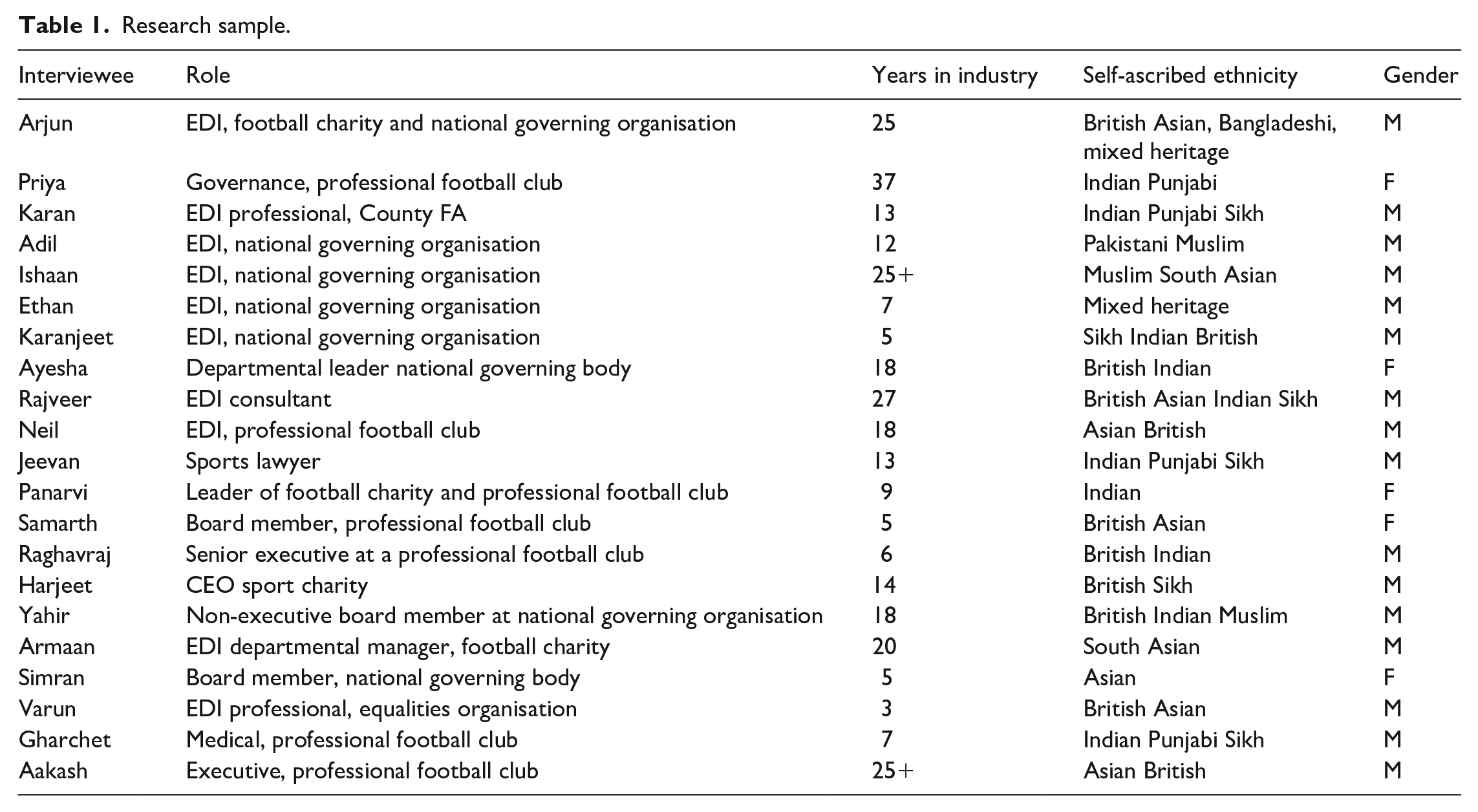
Solórzano and Yosso (2002: 26) explain that the gathering of ‘lived experiences’ is key for any approach that draws on CRT since it values experiential and embodied forms of knowledge, which in turn textures the forthcoming observations made via the lens of embeddedness. Thus, we gathered testimony from 21 semi-structured, dialogical interviews with people (five women and 16 men), all of whom identified as ‘British South Asian’, were British citizens and actively claimed a birth and/or historical familial link to India, Pakistan and/or Bangladesh. Further inclusion criteria used to identify suitable participants, and to bring the unveiling polymorphism of current conceptions of SLE roles in the football industry under some control, was provided by the National Statistics Socio-Economic Classification system (Office for National Statistics, 2021). This meant that only those people who were, or who had been employed in, ‘lower managerial, administrative and professional occupations’ and/or in ‘higher managerial and professional occupations’ within football were suitable for interview. In our context, the former refers to, for example, specialist managers with line management responsibility and/or input at executive board level in, for example, marketing, human resources, commercial, community, player/coach development and recruitment, legal and medical departments, while the latter refers to, for example, executive and non-executive members of boards of directors at county level, national governing bodies and professional clubs. Table 1 illustrates important biographical information on each participant.
Research sample.
Ethical clearance was gained from Birmingham Newman University. Upon contact, all participants were provided with an information sheet and consent form, which clarified that their participation was voluntary, all responses would remain anonymous and confidential, and they had the right to withdraw, without penalty. Once recruited into the study, an appointment was made to participate in an interview carried out via Microsoft Teams or Zoom. A semi-structured interview guide was developed to facilitate exploration of the participants’ journeys into working in football, their experiences of role progression and their perspectives on diversifying football’s senior leadership. Questions were tailored to be relevant to the specific role or organisation of the participants and to allow deeper exploration of important topics as they arose.
The interviews were circa 60–90 minutes long and transcribed verbatim. This amassed circa 36 hours of recorded testimony. Transcripts were then analysed by all authors. A six-phase model of thematic analysis (see Braun et al., 2016) was used to analyse the data, and a deductive CRT approach was taken to guide the thematic analysis. All interviews were transcribed and read through several times by all authors, which allowed for prominent themes to emerge ‘through careful reading and re-reading of the data’ (Rice and Ezzy, 1999: 258). Systematic coding of the entire dataset and the subsequent organising of codes was done with NVivo 14. These were reviewed by all authors to ensure they were a proper reflection of the larger dataset. Once all data were coded, the themes were revisited for coherence, refined and operational definitions developed to describe each theme. In terms of quality assurance, attention was paid to the 15-point checklist described in Braun et al. (2016).
CRT was ubiquitous throughout the process, especially how it emphasises the foregrounding of voices of racially marginalised people in research methodologies (Alemán and Alemán, 2016). However, this principle influenced our methodological design in two significant ways. First, as a team of White male researchers, it required reflection on our positionality and how it shaped the research process and the presentation of our findings (Lawrence and Hylton, 2022). To address this, we worked with contacts across the football industry and with charitable organisations specialising in ‘race’ and ethnicity in sport to identify and access our sample. We also employed a snowball sampling technique for several reasons: (1) to empower our participants to shape the research by including the voices of those they believed should be heard; (2) to prevent our sample from simply reflecting our existing professional networks; and (3) given the lack of publicly available data documenting ethnic diversity in football, snowball sampling was essential in helping us to gather a purposive sample. When no new recommendations for interviews were forthcoming and no new themes were emerging, we reached theoretical saturation.
Second, after interviews had taken place and major themes identified, we engaged in a further co-production stage of our research, in which we shared preliminary findings with a purposively constructed audience via Zoom to involve them in the research process and facilitate their agency. This approach aligns with the idea that by ‘stand[ing] back and suspend[ing] researcher assumptions’, we can co-create research findings that empower the researched rather than over-determining their experiences (Mac an Ghaill and Haywood, 2021: 465–466). The event was advertised to our interviewees (via email) and a learned public (via Twitter and LinkedIn). The event then consisted of colleagues from a diversity of ethnic backgrounds with a personal or professional interest in work, governance and ‘race’ – and took place digitally over the course of 3 hours. To ensure that the audience was composed of individuals who were invested in advancing anti-racism, we required delegates to register in advance and permitted entry only to those who could evidence a personal, academic or professional interest in ‘race’ equality. The event was attended by 32 people, 10 of whom were interviewees; however, the number of those online fluctuated over the course of the event. After a short presentation of preliminary findings, translated into lay terms, each of the authors then led breakout groups of no more than 10 people to record feedback and discussions on the emergent themes. Notes from each breakout group were then collated and used to further shape and inform the research discussion. This iterative process is illustrated in Table 2.
Results of thematic interview analysis.
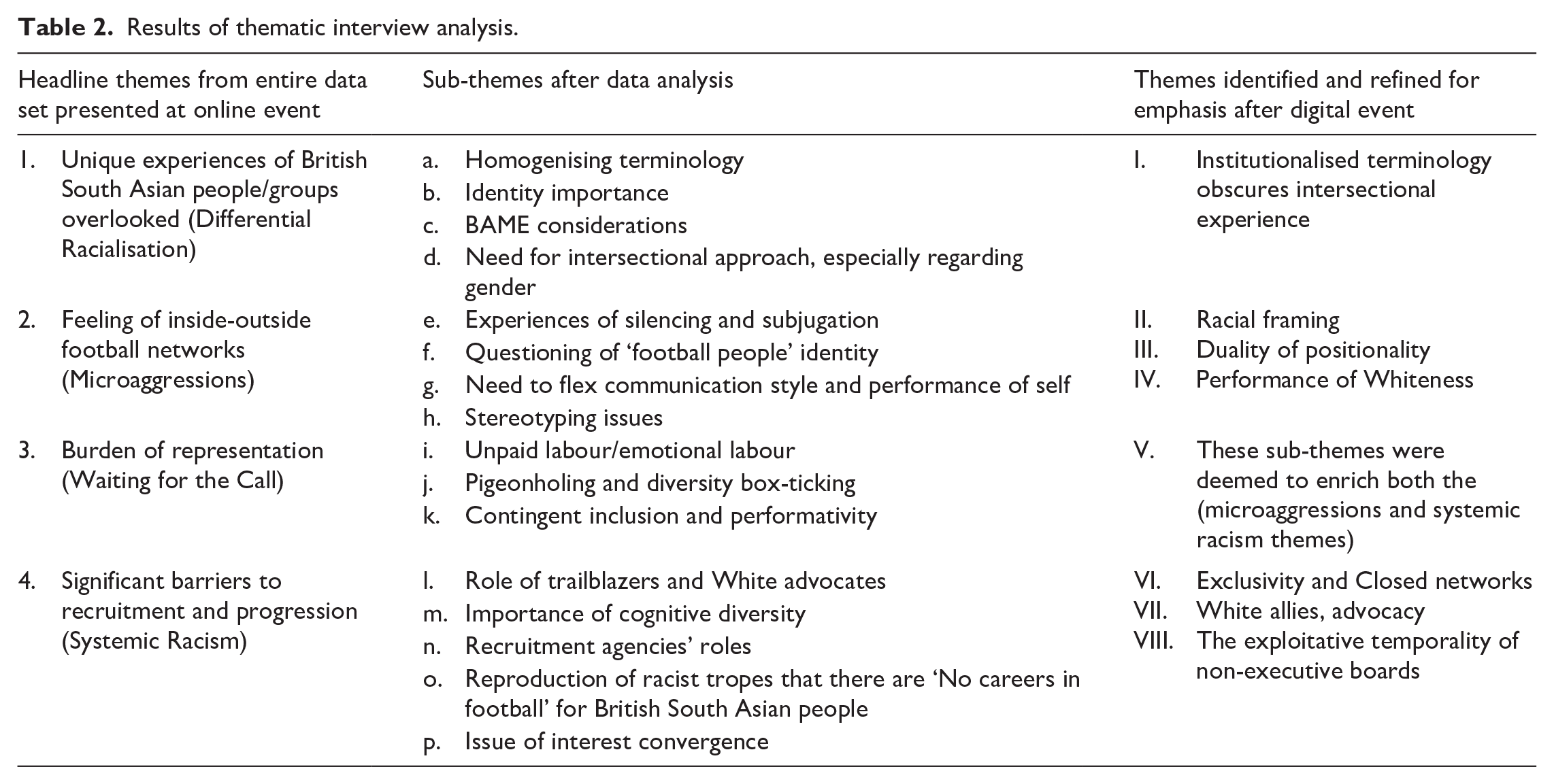
The interviews and online event were not only enlightening, informative and rich with detail, but they also showcased common experiences, which we present to challenge the dominant colourblind, canonical principles of mainstream economic sociology, as a form of counter-hegemonic data (Delgado and Stefancic, 2012). The remainder of this article is produced by the spirit of co-productive research and explores sub-themes related to the headline theme of recruitment and career progression. These sub-themes include: (1) the role of exclusivity, closed networks and recruitment agencies; (2) the impact of White allies, advocacy and racial framing; and (3) the exploitative temporality of non-executive boards. To this end, the following is an ode to our participants and the most pressing topics they wished to be foregrounded.
Exclusivity, closed networks and recruitment agencies
The first collection of sub-themes that emerged from our fieldwork pointed to the importance of networks and the possession of the right kind of social capital to access and secure SLE employment in the football industry (McLeod et al., 2020; Parnell et al., 2021). Participants in this research also echoed previous research into ‘race’, work and organisations by referring to specific racialised challenges (Clarke and Smith, 2024; Muzanenhamo and Chowdhury, 2022; Prasad and Qureshi, 2017; Ray, 2019). As Yahir observes, access to people and organisations in structural holes are vital for British South Asian people – more so, according to him, than other ethnic groups – to navigate notoriously closed networks: . . . people weren’t talking to the right people and therefore you were excluded, so local Asians I was working with didn’t know what a County FA was. I know that sounds absurd to a lot of people but that was the case. These organisations can be quite difficult to get a hold of if you don’t know the right people and it’s still very much the case, I think in some respects . . . I would like to say it’s a meritocracy, I know that’s not always the case. Football can be very parochial in its recruitment and it’s more who you know rather than what you know.
In addition to the scarcity of institutional roadmaps that signpost pathways in and through the industry – via County FAs for instance – participants, such as Raghavraj, identified ‘nepotism’ as a critical feature of recruitment networks in football. Such views echo other employment sociologies that claim principals favour recruiting relatives, close associates and those with whom they had strong ties (Clarke and Smith, 2024; Parnell et al., 2021). McLeod et al.’s (2020) theoretical constructs are relevant here to further our emphasis, specifically the ‘relational’ (i.e. levels of dependability bestowed on an individual) and ‘cognitive’ (i.e. the breadth and depth of values an individual shares with the principal) components of social capital and their ability to build trust. ‘Trusted people’, often those with strong ties to existing networks, were afforded volitional support, from entry-level jobs to SLE roles. As Aakash notes: In football it just mattered on whether people liked you or not, it really mattered on what your relationships were like with people who could either enable it to happen or they could block it to happen.
For McLeod et al. (2020), having a common vision and/or being ‘liked’, was often derived from one actor’s belief in shared experience with another. In turn, this leads to the development of trust – the lifeblood of dense and cohesive networks (Granovetter, 2005). Considering this within the purview of CRT, given ‘race’ remains a central organising principle of society, perceptions of who can claim ‘shared experience’ and with whom are very much inflected by one’s perception of their racialised self and how this relates to the racialised identities they ascribe to others (Delgado and Stefancic, 2012). ‘Trusted’ people, as we will see below, are often those with strong ties to existing networks, are commonly racialised as White and are afforded volitional support, from entry-level jobs to SLE roles.
To this end, we propose the theoretical concept of ‘homophilic safety’ to capture a specific kind of relational-cognitive capital, which goes beyond mere trust (or homophily). That is, when trust is achieved between actors, it fosters a feeling of ease and comfort, imagined sameness, psychological and emotional security, and, importantly, the absence of the (racialised) Other. Crucially, as Raghavraj and Aakash evidence above, while ‘race’ is not an insurmountable barrier to enabling a sense of homophilic safety to endure in what are predominately White male networks, one’s ability to build homophilic safety is certainly less arduous if SLE actors are identified as being from dominant racialised and gendered groups or are able to discursively perform subjectivities allied to the institutional orthodoxy.
To elaborate further, Aakash identified the importance of a professional playing career as a homophilic resource, which he believed affords kudos and trust within SLE networks. The retort he recollected, aimed at him by a senior colleague, is applicable, here: ‘Well, you never played the game so what do you know?’. Which is true, I’ve never played the game at the highest level . . . if I had not been Asian, I don’t believe that this would have been thrown at me.
Given British South Asian people are underrepresented as players at elite level due in large part to the myth that they do not hold sufficient cultural capital to ‘know’ football (Burdsey, 2004a) – an assumption tacitly embedded in the testimony above – their ability to build homophilic safety with others is constrained. British South Asian people are thus disproportionately affected by ‘ex-player privilege’, as Aakash continues: . . . football likes to hire people who’ve already worked in lots of football clubs and have a brand name or have been ex-players, and the head-hunters, they circulate the same people round and round so you’ve got to try and break into that system . . . but if you’re not a player and we know . . . there’s just not that many Asian people that play [professionally] . . . your ability to build a brand name is really, really complicated and the system works against you in that regard.
Further corroborating Aakash’s point is the English Premier League’s (EPL, 2023) Player to Executive Pathways Scheme (PEPS), which purports to equip non-White ex-professionals with the skills needed for SLE positions. However, by way of a lack of qualifying enrollees, British South Asian people are stymied from SLE recruitment innovations, like PEPS, which otherwise could act as a resource of volition. For Ray (2019: 40), it is in this way that such (often well-intentioned) schemes help reify the effects of ‘race’ through an uneven ‘distribution of economic and social resources’, meaning racist economic systems are permitted to endure without the need for racist actors.
Further evidence of the reifying and closing effects of existing systems, comes from several participants who identified the exclusionary influence of recruitment agencies. Executive recruitment is the process whereby specialist agents serve as intermediaries between employers and potential candidates (Baldo et al., 2019). While common in many industries, these practices are insidious in football. Priya explains: . . . now it’s slightly different, the higher you go up in executive jobs you’ve got the recruitment agencies . . . you might be missed out because you don’t get that opportunity to go directly to show what you can do.
Recruitment agencies, according to classical and neoclassical paradigms, are tasked with bridging the structural holes that exist in markets between employers and talented candidates. However, some participants’ testimonies, vis-a-vis their negative experiences of recruiters, compound key criticisms of economically reductive traditions, or what Granovetter (1985: 483, emphasis in original) calls the ‘undersocialized conception of human action’ in employment networks: I’ve given up with recruitment agencies . . . In fact there was one recently, in the last year . . . obviously unsuccessful . . . I had a nice conversation [with an agent]. I said, ‘I’ll tell you what, I’ll send you my CV, can you have a look again and just give me some feedback?’ . . . that recruitment agent was very, very positive about how committed he was to race equality, the clubs he’d worked for, the changes that he’d made at all these clubs . . . Never ever heard from them again. (Yahir)
Such agencies, far from functioning in a rational and meritocratic manner, play a hegemonic role in maintaining hidden mechanisms of employment, which (maliciously or otherwise) disproportionately and unduly dissuade Black and British South Asian talent from engaging in recruitment processes. In worst case scenarios, as in the case of Priya, she decided ‘it’s not worth applying [for two executive level jobs] because it’s going to go a recruitment agency’, which caused her to withdraw from football labour markets altogether.
Clarke and Smith (2024: 913) refer to this as the ‘processual racial filter’, which actively maintains and reproduces networked positions of power and status. According to our respondents, this filter is further pronounced by and contingent upon agents’ commercial vested interests. Those recruitment agents, whose fees depend on successful placements, are incentivised to recommend candidates that are likely to remain in post for an agreed period, otherwise they may forfeit their fee or future commissions. Recruiters then are likely to recommend candidates with strong ties to pre-existing networks, who enable a sense of homophilic safety in a network to endure, and who are calibrated with the norms and conventions of what is a predominantly White masculine space.
White allies, advocacy and racial framing
Given the perceived fallibility of current recruitment systems (Ray, 2019), White allies and advocates were identified by several participants as strategic but atomised actors that could help build a sense of homophilic safety within football’s SLE networks by way of trust transfer. Clarke and Smith (2024) identify similar homophilic practices in their study of the London Metropolitan Police service, wherein White people are often embedded as gatekeepers to SLE employment. Their notion of ‘the club’ goes further still, as an act of White supremacy, which refers to the power of an informal, hidden and atomised support group that acts in the interests of preferred and/or potential members. White supremacy then is not simply a reference to neo-Nazi politics (Gillborn, 2005); it is better understood as ‘a political, economic, and cultural system in which Whites overwhelmingly control power and material resources’ (Ansley, 1997: 592).
Likewise, our participants asserted the value that they placed on influential network actors who were racialised as White, especially when these were willing to bridge across structural holes. Such advocacy enabled them to circumvent flawed recruitment structures. Aakash explains: I was able to, I guess, build a little bit of a rapport with both [named contact] and [named contact] in particular. I just said, ‘Can you give me 20 minutes of your time one day? I’d like to work in sports, I’m in the process of kind of managing a career trajectory, a life trajectory towards that goal, I’d love to pick your brains’, and they were very kind. [named contact] gave me some perspective and gave me his views. [named contact] invited me to his office, we spent time talking about it, he put me in touch with some head-hunters . . . he literally went out of his way to make introductions and it went from there.
These testimonies allow us to theorise the ‘action[s] and decision[s] carried out by atomized actors’ (Granovetter, 1985: 485) – in this case, White allies in football SLE networks – as evidence of White supremacism. That is, there is an economic imperative for British South Asian people to engage in interracial social relationship formation, a requirement not universally demanded of all network actors. Raghavraj explains: [White male colleague] has been a godsend, I’ve not given up hope, there’s a lot of good people out there that are White people that are supporting me in football and helping me and phoning me . . . Football can galvanise people and people that have helped me have been White, so I want to say that genuinely and I want that on record, my mentors are White so let’s balance this.
Notwithstanding such challenges, our participants, by definition, had ascended to SLE employment across the game. A critical race approach, however, prefigures a deeper reflection on the types of SLE employment participants represent, pointing to the omnipresence of what Feagin (2010) calls the White racial frame (a racialised worldview that shapes how racialised bodies are perceived, read and policed – often held by those who subscribe to dominant Whiteness discourses). Such a frame is nominally tied to understanding racialisation and stereotyping; however, it can also be applied as a form of economic analysis to problematise the notion that ‘once we know [an] individual’s social class or labor market sector, everything else in behavior is automatic’ (Granovetter, 1985: 486).
Gharchet, for instance, identifies the economic consequences of the oversocialising and racialising properties of the White racial frame, when he observes the commonplaceness of ‘South Asian doctors’ in accident and emergency departments and general practice, and how this has normalised their employment as medical directors and club doctors. Aakash, too, recounts being subjected to a particularly egregious but well-rehearsed perversion of the White racial frame. His story is of a rumour circulating after he left SLE employment in football, which placed him erroneously with a job ‘working in cricket . . . I mean, how much more stereotypical can you get?’. Here, we identify the instrumentality of the White racial frame guiding not just social categorisation but economic transaction. Several of our participants, for instance, reported having their capacities to be, and to do, evaluated against racialised epithets of the British South Asian doctor, ICT expert, or equality practitioner. Simply put, while some British South Asian people have obtained the ‘right’ (or ‘White’) economic passport, this passport is conditional, and is sponsored only when job roles validate the prejudices and perversions of the White racial frame. We go on to expand on this finding in the next section.
The exploitative temporality of non-executive boards
According to Bell (1980: 523), ‘[t]he interest of blacks [and other racialised minorities] in achieving racial equality will be accommodated only when it converges with the interests of whites’. The concept of ‘interest convergence’ posited by Bell will become useful for us when exploring the final sub-thematic finding, pertaining to British South Asian leaders’ experiences of non-executive boards. While ideally functioning to ensure the conduct of the executive board is scrutinised by qualified external actors, those in our research, including Karanjeet, who were, or have been, non-executive board members, cited their frustration at what they deemed to be co-optative inclusion: . . . so I kind of worked with them [Board] but I soon realised that it was very tokenistic. I was there as just a brown articulate face when there wasn’t many brown articulate faces. I know that sounds quite brutal but that was the reality.
Noon (2018) and Sang (2018) aver that racial and gender diversity, when utilised effectively, positively affect organisational innovation and reputation. However, as Karanjeet and Yahir told us, there is a tension that exists between the need to engage in recruitment processes that can yield favourable public relation outcomes, as well as better metric scores to report to governing bodies, and the ‘diversification of goals and objectives’ that result from ‘simple changes in the demography of board members’ (Booth-Bell and Jackson, 2021: 75). To this end, there was a discernible fear that a convergence of interest in promoting ‘Brown faces to high places’ hinged primarily upon the betterment of metric and commercial outputs (Ahmed, 2012; Noon, 2018), as opposed to the onboarding of new information and insight that emanates from weak social and economic ties (Parnell et al., 2021).
Not only were positions of non-executive roles believed to be given to British South Asian people, as Yahir puts it, to ‘tick boxes’ and leverage football organisations’ reputations as progressive and socially responsible, but they were also rarely salaried. Samarth, for example, reported that they had ‘donated over 150 days of [their] time’ to a particular professional club over the course of a year. Yahir also furthers this point: How many [British South Asians in football] have actually made a career out of it in terms of paid roles? That would be telling in terms of full-time executive positions . . . There was a need on this journey for the governing bodies and whoever else, wherever else we’ve all been, there was a need for them to tick boxes and to work with people for them to get where they wanted to or what they wanted . . . So while it may seem that the likes of [unnamed contact] have been successful, have they? Because how many have transferred that experience into a career? It’s largely been voluntary.
That roles are unpaid, implicitly devalues them; a finding that apes CRT work that observes a stubborn trend of maltreatment of historically underrepresented racialised groups across labour markets (Joseph, 2020). Indeed, findings from this study show that British South Asian people are often recruited to take on these roles, without remuneration, and in addition to their full-time jobs (which may or may not be within football).
Although they were knowingly exploitative, they were nonetheless deemed to be viable routes into paid employment, illuminating the oft times forgotten racialised power imbalances that exist at the nexus of economic interest convergences between the commercial and sporting goals of football institutions and the career ambitions of our participants (Bell, 1980). Panarvi, furthermore, questions the extent to which her presence on (non)executive boards was producing social dividends beyond what she suspected was an atomised position, for other ‘Brown Asian wom[e]n’ (Alacovska et al., 2022). She points to a lack of investment in networked infrastructure preventing upward mobility from grassroots through to county level and beyond, for historically underrepresented groups: . . . you’ve got me on the Board, but what are we doing to encourage more [Brown Asian women] then? If I’m that role model we need to show people the way in; how to come forward, and that’s mainly at County FA level. That’s where there is a huge roadblock at the moment. You’ve got say [County FA] or other areas where the local community is densely Asian, but yet there’s none at County FA Board level, and you think, ‘why is there this disconnect then?’ . . . There’s no point in just placing people at the top level and saying, ‘here you go, here’s your role model’, but you don’t show the pathway.
Panarvi’s racialised and gendered frustrations are usefully viewed through the lens of ‘temporal embeddedness’, which, for Granovetter (2005), is a concept that acknowledges the temporality and historicity of economic transactions. While the short-term effects of greater ethnic and gender diversity at SLE levels are no doubt important, our research illustrates the need to reinforce popular aphorisms, such as ‘if you can’t see it, you can’t be it’, with concrete action that enables historically underrepresented groups to endure and thrive in SLE employment. Otherwise, the ‘incremental gains’ – as CRT would describe them – made by individuals will result in stagnation, at best, and regression, at worst.
Discussion and conclusion
Throughout this article we have adopted major conceptual tenets of CRT – namely White supremacy and interest convergence – with economic embeddedness to challenge the supposed neutral, calculative, meritocratic, functioning of football labour markets. That is, we have not only challenged liberal assumptions about the dynamics of late modern economies, which suppose a predominance of objective and colourblind rationalities (Bonilla-Silva and Baiocchi, 2008), but we have supported other work that has shown how ‘race’ shapes the experience of SLE recruitment and employment (Clarke and Smith, 2024), and the kinds of career opportunities that are afforded to British South Asian people. Indeed, despite legal changes and broad support across industries to embrace EDI mantras, ‘if more covert forms of bias persist in contemporary workplaces’ little is likely to change (Tolbert and Castilla, 2017, cited in Clarke and Smith, 2024: 913). Not only is economic activity across footballing SLE networks often value-laden, irrational and complicated by social and racialised relationships, but enacting the phraseology of EDI is not sufficient to evoke meaningful change (Lawrence, 2017). To this end, our work invites a reframing of economic actors and relations as agents of racialisation that colour how work and recruitment structures function, which, in turn, results in a multiplicity or racialised experiences of the same workplace (Clarke and Smith, 2024; Hirschman and Garbes, 2019).
As Clarke and Smith (2024: 911) note, in institutions where White supremacy is embedded within social relationships and structures, a ‘social network volition’ is identifiable, whereby an ‘invisible guiding hand . . . identifies, pursues, advises and sponsors’ those actors who perpetuate the institutional orthodoxy. We too have found that favoured individuals who enjoy network volition, like Raghavraj, move forward, while those without – who are disproportionately from a breadth of historically underrepresented groups – are ‘told to look to their own volition to move forward’ (Clarke and Smith, 2024: 915), which was especially true for Yahir. A lack of networked volition, of course, is not an absolute monolith preventing upward mobility; invariably, however, it does make career progression decidedly more arduous.
Similarly in our research, we consistently encountered the observation that White men were disproportionately located as the gatekeepers of volition; thus, interviewees reported they sought strong ties to such people. Such testimonies are empirical evidence of the institutionalisation of a performative racialised homophily that shapes economic transactions, such as recruitment and career advancement (McLeod et al., 2020). As critical race theorists, such as Youdell (2012: 145) argue, ‘race’ is a ‘feature of our institutions, our social practices, our everyday life, our discourses and our unconscious investments and attachments. Together these produce and reproduce race and race hierarchy.’ Here we are encouraged to avoid the pitfalls of colourblind economic sociologies that otherwise tend to overlook the racialised dimensions of gatekeepership, homophily and economic actors in networks (see also Ray, 2019), seemingly and simply because White allies and advocates might be liberal, well-intentioned and enabling. CRT, rather, invites us to trouble liberal assumptions by recognising the imperative of White allies for recruitment and career progression as a racialised outcome of institutional, economic and organisational systems, processes and practices (Muzanenhamo and Chowdhury, 2022; Ray, 2019).
This article therefore makes several original contributions to the literature on work, employment and recruitment. We have shown that: (1) working at the nexus of the sociology of ‘race’ and work (Clarke and Smith, 2024), economic sociology (Hirschman and Garbes, 2019) and sport business management (Parnell et al., 2021) reveals SLE employment in football to be shaped concurrently by social networks (as per economic embeddedness) as well as systemic processes of racialisation (as per CRT); (2) White supremacist systems – more so than old, colour-based racisms – affected our participants’ career trajectories, and, in turn, actors’ ability to convey a feeling of, what we call, homophilic safety; and (3) expanding CRT, by considering the analytical utility of ‘race’ as an economic phenomenon, invites a more theoretically nuanced and sustained focus on the interplay between ‘race’, economic transaction and the persistence of racialised hierarchies in work and employment cultures. And so, it is self-evident that future EDI employment and/or recruitment strategies within football cannot be siloed activities, done by one department or person. Nor can they aim myopically to address underrepresentation in only certain vestiges of football. They must be entirely holistic and embedded throughout institutions and organisational cultures and processes.
Further failures among sporting principals to enact such a bespoke approach to work, employment and recruitment, risks continuing to overlook the complex interplay between ‘race’, gender and labour markets (Clarke and Smith, 2024; Rankin-Wright et al., 2016;). The notion of more inclusive hiring and recruitment practices, therefore, should not be reduced to a politics of representation. That is because as Ahmed (2012) would have it, diversity has efficacy as a ‘containment strategy’ (p. 53), which enables an organisation to enhance its aesthetic style, perhaps even evoke incremental change, but it does this while maintaining control over the extent to which it commits to meaningful action and organisational change. We cannot assume, therefore, that the mere presence of historically underrepresented groups at SLE levels, nor merely diversifying entry routes, will positively and organically engender inclusive pathways through the football industry (Kim, 2023). Indeed, if we accept that organisational norms and cultures are racialised and gendered, our emphasis must be on challenging the social norms and economic cultures and practices inherent within the football industry.
We conclude by recommending the adoption of interconnected, industry-wide work and employment strategies that address intersectional issues of underrepresentation, at all levels of the game, and in all its vestiges. A paradigm shift must occur that recognises exclusions observed in relation to playing and coaching football are inextricably linked to exclusions from SLE employment and vice versa. As Bradbury (2013) notes, structural failures affecting historically underrepresented groups in one area have systemic and institutionally racist effects for the entire system of recruitment and employment. We propose that the industry must move away from bias awareness training (Noon, 2018) and towards interventions that instead: (1) focus on the unlearning of learned ignorance; (2) rely less on the services of recruitment agencies by taking responsibility for internal knowledge deficits in EDI and resource educational programmes; (3) use clearer definitions of senior leadership in data-gathering exercises, which, in turn, produces more reliable data and thus helps boards and organisations to be held to account; and (4) focus on the importance of ‘co-produced’ career journeys (Clarke and Smith, 2024) where historically underrepresented groups are empowered to affect their career journey. In this way, we move beyond rhetoric, and nudging managers and employees, often begrudgingly, into recognising their biases, by requiring more radical systemic solutions that centralise the underlying racialised and gendered mechanisms that reproduce privilege and disadvantage.
Footnotes
Acknowledgements
We would like to thank everyone who gave up their valuable time to be interviewed for this project. Sharing the stories that are depicted in this article, and other outputs, can be stressful and emotionally draining. We never take this for granted. We would also like to thank the anonymous peer reviewers who have pushed us to elevate the article at every stage.
Funding
The authors disclosed receipt of the following financial support for the research, authorship, and/or publication of this article: This research received funding from the Leisure Studies Association.
