




Abstract
This article develops a micro-level understanding of informal work (IW) by exploring the legitimising factors which business owners exercise to provide the rationale for engaging in IW. Using the lens of nudge theory, originating from behavioural economics, we show how IW becomes legitimised through nudging. Empirically, we explore the lived experience of service sector business owners who engage in IW practices in the East Midlands, UK. The findings uncover how the business owners’ context is shaped through exposure to various IW arrangements early in their working life; we also reveal a range of actors who actively shape these arrangements for embracing IW while delegitimising formal work. We present the factors that condition the beliefs and embed the understanding that IW is legitimate for the individual business owners, thus highlighting an important and emergent context for future studies in the realm of IW.
Introduction
Informal work (IW) remains a major contributor to economic life in developed, developing and transitional economies (Darbi et al., 2018; Franic and Cichocki, 2022), representing a significant sub-stream within the broader fields of work, employment and management (Chen, 2016; McGahan, 2012). The enduring significance of IW remains a key policy concern for governments worldwide (Shahid et al., 2020). Many policy interventions attempt to formalise IW (Shahid and Syed, 2023), as it remains detrimental to generating public funds. Although IW does not abide by formal rules, it remains widely considered socially legitimate (Webb et al., 2009) and governed by the informal and unwritten boundaries embedded within given societies (Webb et al., 2014). Within this article, we define IW as being a ‘socially legitimate paid activity that is legal in all respects other than that it is not declared to, hidden from or unregistered with, the authorities for tax, social security and/or labour law purposes when it should be declared’ (Williams, 2019: 6).
Extant research on IW has adopted quantitative and qualitative approaches to understand IW in various contexts. Indeed, a large number of studies adopt quantitative methods and secondary data analysis (Salvi et al., 2022) to understand institutional incongruence (Williams et al., 2015), informal payments in health care (Horodnic et al., 2022) and street vending (Igudia et al., 2022). Alternatively, qualitative studies have established the widespread legitimacy of IW (Littlewood et al., 2020), examined informalised workplaces and regulation (Clark et al., 2022), the impact of the National Living Wage on IW (Ram et al., 2020), domestic workers and IW in Pakistan (Shahid and Syed, 2023) and the urban poor in Dhaka (Lata, 2023).
Although there is increased interest on IW between researchers and policymakers (Lee et al., 2020), it remains largely unknown why some actors adopt IW and others do not, even though they operate in the same contextual environments (Ram et al., 2020). Hence, as Ram et al. (2020) argue, other factors must be considered to develop a deeper understanding of IW. To this end, this article explores how IW becomes legitimate for individual business owners. From this, we aim to reveal the factors of legitimation for IW and the role of specific actors in granting legitimacy.
Existing studies of IW have highlighted the importance of its societal acceptance and widespread legitimacy (Webb et al., 2009, 2020), which provides actors with informal guidelines when they avoid formal regulations. Within existing conceptualisations of IW, there is an implicit assumption that legitimacy is a property (Suddaby et al., 2017) which automatically shapes agency by merely existing at a higher level. Consequently, although IW is widely considered as a socially acceptable and legitimate activity (Sutter et al., 2017; Webb et al., 2009) built from tacit understandings (Ram et al., 2001), we currently do not know how this legitimation process comes into being at the micro-level. Implicitly, we sense that for individuals to adopt any particular practice, they must first become aware of it and, to some degree, accept it as legitimate in their contextual environment. Not knowing how IW comes into being is problematic, particularly when attempting to design a specific policy, as certain social mechanisms and legitimation processes help support IW’s continued existence regardless of any changes in the law. Therefore, there is a need to examine the legitimation process, which embeds the factors relating to the legitimacy of IW into the individual actors’ belief system. How this happens is the core focus of this research study.
In this article, we address the following research question: ‘What factors and processes influence business owners to accept the widespread social legitimacy of IW?’. To answer this question, we present the findings of an inductive qualitative study, comprising of data generated from 25 interviews with micro-sized service sector business owners located in the East Midlands, UK who engage with IW as everyday practice. To theorise our findings, we adopt a behavioural insights approach using nudge theory (Thaler and Sunstein, 2021).
The UK service sector provides a remarkable context for understanding IW and its widespread legitimacy. Indeed, existing studies outline the growth and prevalence of IW in construction trades and other manual types of work in the EU and the UK (Clark et al., 2022; Dimitriadis, 2022; Franic and Cichocki, 2022; Horodnic et al., 2022) even though IW was expected to decline due to industrial modernisation (Plagerson et al., 2022). The UK represents a developed economic setting and, as such, has regulatory governance for economic activity; however, IW remains widely considered legitimate. Therefore, the UK provides a suitable context for us to understand the specific factors that influence the adoption of IW and its accepted legitimacy beyond the typical belief that IW results from a lack of modernisation.
This article makes several contributions. Firstly, this study uncovers novel insights into how IW becomes legitimate and hence persists. This is achieved by employing nudge theory from behavioural economics. Secondly, using the findings from our micro-level study, we outline a two-stage legitimation process whereby individual business owners enter the field where they encounter the pre-existing legitimacy. This exposure to IW happens early in the business owners’ careers through nudges from experienced actors, which encourage IW’s acceptance, legitimation and reproduction. During this early entry into the labour market, choice architects, through nudges, encourage individual actors to engage with IW before starting up a business. At the same time, experienced choice architects delegitimise formal work, which often happens later in the business owner’s career. In such a fashion, IW becomes legitimised and normalised for business owners and thus embedded in their choice of work practices.
The article continues as follows. Following a review of the literature on IW and the theorisation of IW legitimation using nudge theory, methodological considerations are presented. The article’s findings are then presented, followed by the discussion and conclusions.
The origins of informal work
To understand the origins of IW, there are four main competing theories: modernisation, political economy, and neo-liberal and institutional perspectives. These perspectives are comparable with other theoretical approaches, such as the dualist, structuralist, legalist and voluntarist schools of thought (see Chen, 2016).
Firstly, IW was largely considered to result from a lack of macro-level modernisation. This modernisation perspective led to the view that IW existed as part of an underdeveloped and archaic economic environment (Williams and Windebank, 2006) that would disappear due to development and modern-capitalist growth (Portes and Sassen-Koob, 1987). Despite this assumption, IW continues to exist and has expanded in many contexts (Schneider and Enste, 2013). For instance, Clark and Colling (2019) and Clark et al. (2022) showcase the growth of IW in car washes within the UK, a developed economic setting.
Secondly, IW can be understood through the prism of a lack of regulation or unregulated modernisation (Castells and Portes, 1989). From this political economy lens, IW is considered to be a survivalist strategy which is driven by ‘aggressive entrepreneurs and defenceless workers’ (Castells and Portes, 1989: 11). For instance, formal employers may legally downsize through the increasing use of flexible work arrangements to save costs and avoid legal obligations to permanent staff (Taylor et al., 2017). This may result in shifting labour into the gig economy (ILO, 2016) using precarious work contracts (Khan et al., 2023) or sub-contracting (Jones et al., 2006).
Thirdly, a neo-liberal lens is adopted to understand IW as an inventive response to business constraints (De Soto, 1989). From this approach, IW is a rational choice (London and Hart, 2004) that offers a range of opportunities for businesses or individuals willing to operate outside of the law by avoiding government over-regulation. Neo-liberals such as De Soto (1989) view government intervention as a distortion of proper supply, demand and market conditions (Becker, 2004). IW from this approach is seen as being taken up by local heroes who are ‘casting off the shackles of high taxes and an excessively intrusive and burdensome state’ (Williams, 2017: 55). For instance, small businesses may turn to IW due to the introduction of regulations such as national minimum wages (Ram et al., 2007).
Finally, the study of IW has more recently taken a neo-institutional approach, which has become the dominant method of conceptualising IW (Ram et al., 2020). Based on the work of Scott (2014), the institutional approach maintains that social and economic activity such as IW is governed by three interrelated pillars, comprising of regulatory, normative and cultural cognitive factors. When applied to IW these three pillars are commonly re-classified as ‘formal’ or ‘informal’ institutions (Williams et al., 2015). Formal institutions provide the codified rules and laws and consider the monitoring and sanctioning power of the regulative organisations. Whereas informal institutions include norms, values and beliefs which outline the behavioural expectations of societies and actors. IW from this lens results from the macro and meso-level interplay of these institutions (Afreh et al., 2019), which influence the actor’s micro-level practices. For instance, when formal institutions (i.e. government departments) fail to govern economic behaviour appropriately (Webb and Ireland, 2015), actors behave according to what informal institutions (i.e. societal norms, values and cultural beliefs) outline as legitimate (Webb et al., 2009).
Regardless of the approach adopted, IW is often explained to result from high-level structural determinants such as macro and meso-level structures. For example, the modernisation view equates non-compliance with economic underdevelopment, whereas the political economy and neo-liberal perspectives see IW as a result of under or over-regulation. Although these economic forces and structural factors have power over businesses and individuals, the over-reliance on these as an explanation has resulted in a lack of understanding of individual agency, as an economic view alone does not tell the whole story (Ram et al., 2007). Although institutional theory has attempted to bridge this gap by offering an understanding that considers how informal institutional factors also contribute to IW, such as individual norms, values, cultural beliefs and legitimacy (Webb et al., 2009), this approach is also over-reliant on macro and meso-level explanations based upon the implicit belief that due to the widespread legitimacy of IW individuals adopt these practices. We argue that it remains unclear how business owners become aware of the legitimacy of IW (i.e. how they initially learn about its widespread acceptance). Hence, we maintain that if we aim to better understand individual behaviour such as IW and then formalise it through policy intervention, we must first know why it is adopted (Hallsworth and Kirkman, 2020) and the legitimation factors supporting its prevalence.
Legitimacy and informal work
Legitimacy is defined as the ‘generalised perception or assumption that the actions of an entity are desirable, proper, or appropriate within some socially constructed system of norms, values, beliefs and definitions’ (Suchman, 1995: 574). Legitimacy is an important component when explaining any social practice as it provides actors with the belief that their chosen course of action is appropriate and acceptable within their contextual environment (Berger and Luckmann, 1991). This is particularly important when studying a social practice such as IW, as although it remains illegal, it is widely considered legitimate (Webb et al., 2009), a situation that supports its continued prevalence.
We believe that legitimacy at the micro-level is better understood as a perception or social judgement (Suddaby et al., 2017), whereby actors evaluate the appropriateness and legitimacy of IW through a socio-cognitive process, which may be active or passive. An actor actively evaluates the situation they face and makes a judgement, which although may still be biased, involves reflection. Alternatively, the actor may passively adopt a practice based on pre-existing social cues, therefore avoiding deliberate information processing by relying on heuristics (Jonsson et al., 2009; Tversky and Kahneman, 1987) and social proof to guide decisions. From this understanding, we consider legitimacy as multi-faceted, operating at both the collective and individual levels. For the individual, legitimacy is a propriety judgement (Tost, 2011), whereas at the collective level, legitimacy exists as validity and a social pretext (Suddaby et al., 2017). However, we must remember that ‘attention and comprehension precede evaluation’ (Suddaby et al., 2017: 467); this is, the actor must first become aware and understand the legitimacy of a given action before they engage with passive or active evaluation.
We focus on these first two stages, namely, attention and comprehension, by understanding them as the onset of a legitimacy-building process. Firstly, we seek to understand how the individual business owner becomes aware of IW and, secondly, how the business owner begins to accept and comprehend its legitimacy. To do this, we employ a behavioural insights approach through the lens of nudge theory (Thaler and Sunstein, 2021). By shifting our gaze towards understanding legitimacy as a perception instead of accepting legitimacy as a property, we develop a more nuanced understanding of IW at the micro-level by considering how the business owner gains attention and comprehension of the wider legitimacy of IW before evaluating its acceptance.
Theorising the legitimacy of IW through nudging
Nudges, or non-regulatory tactics that have the potency to change the behaviour of actors, are becoming influential for international public policy (Mertens et al., 2022; Schmidt and Engelen, 2020; Thaler and Sunstein, 2021). The nudge approach to public policy can be seen in the introduction of behavioural insights (or nudge) teams since 2010 by many national governments such as Sweden, United Kingdom, America, France, Netherlands, Germany, Canada, Singapore and Denmark, along with other international groups such as the World Health Organization (Thaler and Sunstein, 2021).
Thaler and Sunstein (2021: 8) define a nudge as ‘any aspect of the choice architecture that alters people’s behaviour in a predictable way without forbidding any options or significantly changing their economic incentives’. Within this definition, choice architecture refers to the social environment (context) in which actors make decisions (Thaler et al., 2013). In public policy, a nudge is a strategic attempt to improve actors’ decision-making by changing the way they receive (Schmidt and Engelen, 2020) or perceive the options available to them (i.e. to attempt to re-design these environments to help actors make personal and/or socially beneficial changes to the status quo) (Mertens et al., 2022). For instance, education can be considered a worthwhile and cost-effective nudge in relation to IW. Money spent on advertising to employers and employees about the costs of IW and the benefits of working formally returns 19:1 on expenditure compared with 4.5:1 on money spent detecting IW (Williams and Horodnic, 2016).
A nudge should always aim to help the actor make the choice they would have made if they ‘possessed complete information, unlimited cognitive ability, and complete self-control’ (Thaler and Sunstein, 2021: 7). However, this is not always the case, and people often do make harmful decisions based on kneejerk reactions, especially when unsure about how to act in a specific situation (Kahneman, 2011; Tversky and Kahneman, 1987). Although Mertens et al. (2022) maintain that nudge interventions have been largely successful and work across different populations and locations, others are more doubtful and question their effectiveness (Szaszi et al., 2022). Furthermore, Damgaard and Nielsen (2018) outline that nudges can result in heterogeneous outcomes and unintended consequences. Therefore, a focus should be on understanding how, why and under what circumstances nudges work and do not work.
Recently, nudge theory has also been applied to a variety of topics such as education (Damgaard and Nielsen, 2018), economics (Pujara et al., 2022), medical practice (Shakespeare et al., 2019) and the environment (Zhang et al., 2022). An example of a successful nudge in practice is the introduction of photos highlighting the effects of smoking on cigarette packets (Chudech and Janmaimool, 2021).
Despite the wide application of nudge theory, we know little about the role of nudges in the legitimation of a specific practice or decision. We posit that if nudges are the pro-active non-regulatory tactics taken by choice architects to help actors and other societal groups make better choices (Thaler and Sunstein, 2021), it is also critical to understand the nudges and choice architects which help to generate the perceived legitimacy of the practice considered undesirable, namely IW in this study. As Hallsworth and Kirkman (2020) remind us, actors often follow others through mimicry (Campbell and Campbell, 2016) and take cues on how to behave from pre-existing norms (i.e. accepted legitimacy). Our research findings explain how IW’s widespread legitimacy becomes embedded in practice through interaction with various choice architects and nudges. By achieving our aim, we begin to bridge this gap in understanding by highlighting how nudges and choice architects can negatively influence individual business owners’ practices by shaping their choice architecture which influences business practice (Figure 1).

Theoretical model.
Methodology
Research approach
The research team engaged in a qualitative research methodology involving data generation from 25 interviews with individual business owners involved in IW (Table 1). These respondents were all located in the East Midlands region of the United Kingdom with interviews being conducted in 2019 and 2020 by the lead author. These interviews involved iterative exchanges between the interviewer and interviewee through the process of asking, active listening and following up (Smith and Elger, 2014). This active approach allowed the interviewees to openly discuss various topics related to IW. The interviews lasted between 60 and 90 minutes, often requiring more than one meeting. Each interview was recorded and then transcribed verbatim for thematic analysis. Other research team members then read each interview to ensure consistency in understanding the context and the emerging narrative(s).
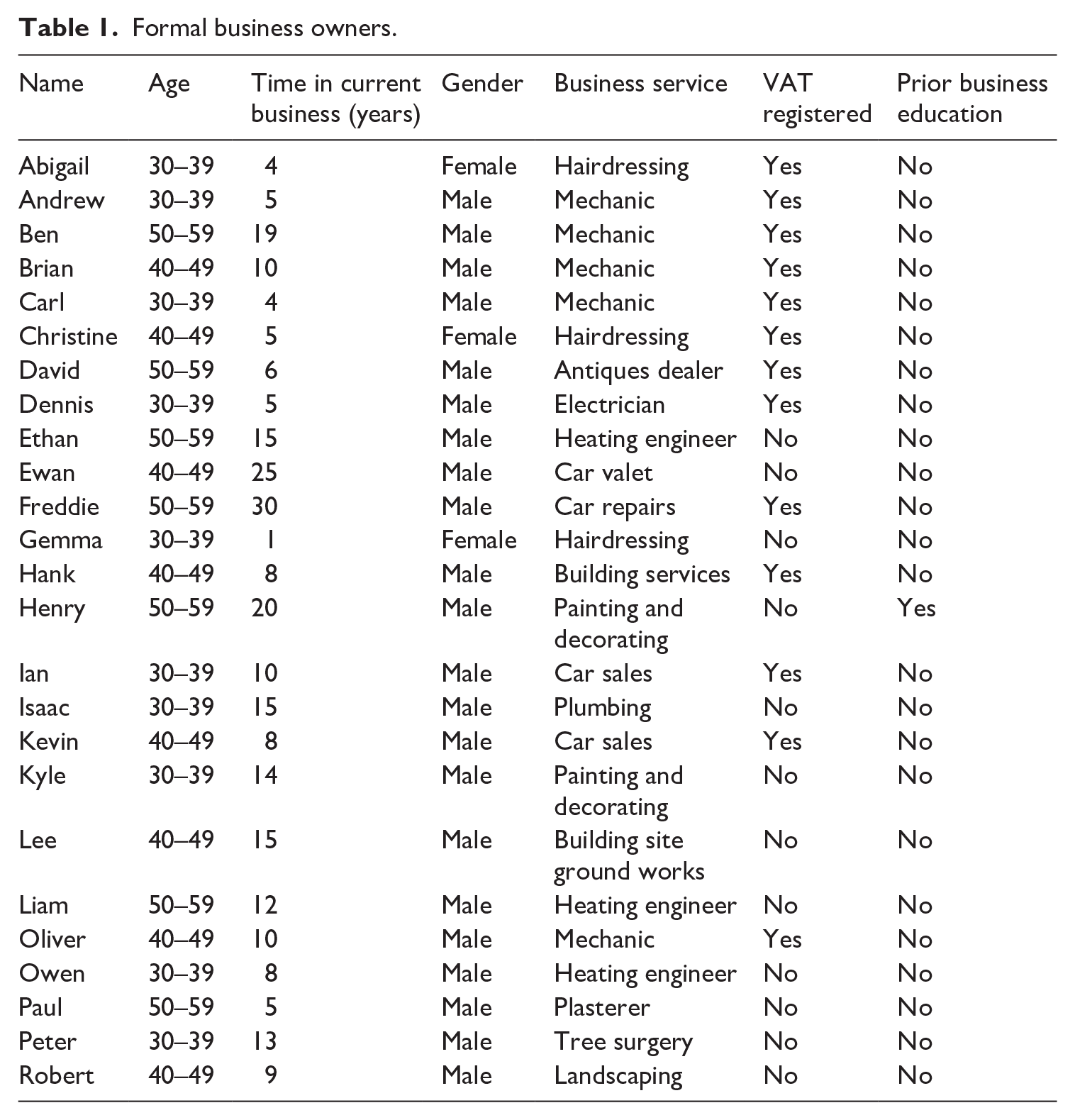
Formal business owners.
The empirical research followed De Montfort University’s ethical review process. Informed consent was obtained for all interviews, and all participants were anonymised through the use of pseudonyms. Data were securely stored in accordance with the university’s data protection policies, ensuring confidentiality and integrity throughout the research process.
Sampling
Table 1 presents the details of our sample of 25 service sector business owners and the nature of their IW activity. To gain access to this often hidden and inaccessible group (Williams and Ram, 2008), we adopted a network approach to sampling (Lee, 1993). The research team found the purposeful chain referral method (Heckathorn, 2002) beneficial. This chain referral approach used a multiple snowball method to access more social networks. The lead author entered these IW networks using five gatekeepers from his professional network. Each new referral then became a locator and nominated another respondent, and so on, to extend the networks’ reach. The purposeful chain referral sampling method allowed access to networks previously unknown to the interviewer, which widened the sample selection beyond the interviewer’s professional network by five degrees in some instances. This process ensured that the respondents in the sample did not derive from one social network, enabling the generalisability of findings to a wider population (Labuschagne, 2003).
Data collection
We conducted unstructured interviews with the 25 service sector business owners to generate insights and accounts of their engagement with IW practices. The lead author enquired, gained access to the informants and conducted each interview. The researchers were aware of their roles as active actors in the research process and recognised the intertwined nature of the research site, the researcher and the interview participants. The longitudinal data collection process enhanced the trust and rapport between the participants and the researcher, enabling the attainment of rich narratives from each participant. Furthermore, it is important to underline the importance of research reflexivity within this research methodology (Golombisky, 2006). The following questions formed the basis of the interview: How did you learn your current trade or profession? With regards to IW, what is your experience of it and what have you witnessed? Do you think IW is socially acceptable? Why do you think IW continues?
To ensure within-method triangulation during the research process (Bekhet and Zauszniewski, 2012), in addition to the interviews and informal conversations with the business owners, the first author observed daily work routines and interactions within each business setting. Subsequently, our in-depth, longitudinal, qualitative enquiry generated data from multiple sources, including field notes and impromptu conversations with other informal actors such as customers. In total, five customers were observed openly asking for discounts for informal undocumented transactions. The discussions with these customers provided complementary evidence supporting the business owners’ accounts.
We have focused specifically on developing a first-hand account of IW from the business owner’s perspective, as this is our unit of analysis and the focus of our scholarly interest. Although this approach develops rich, detailed insights, the account we provide is largely limited to the business owner’s perspective and, therefore, one-sided, as we are unable to verify the details beyond the business owner’s interpretation of his/her situation. Consequently, we must acknowledge this as a limitation of the findings. Although the short discussions with customers provided supplementary evidence, this was limited to five brief conversations, each lasting around 15 minutes.
Data analysis
Data analysis involved a reflexive thematic approach informed by Braun and Clarke (2021). First, we transcribed and re-familiarised ourselves with the interview data. We then explored the data further and established a set of initial codes, which were categorised into themes (Saldana, 2016) related to the research question. This exploration stage involved developing relevant themes from the data and the existing literature, which were then reviewed and refined in an abductive way. We then sought to derive explanations from the analysis through a connecting stage. This final stage focused on developing a theoretical re-description of the empirical data by looking for connections between the exploratory themes to understand the factors and processes which influenced the business owners in our study to accept the legitimacy of IW. The explanatory stage resulted in a causal explanation to understand the adoption and persistence of IW based on the data that had been collected (Table 2). The data generated emerged from 25 micro-sized (under 10 employees) service sector business owners who operated formally registered businesses, although they still adopted some IW practices at different junctures.
Examples of the coding process.

Note: HMRC, HM Revenue & Customs; IW, informal work.
Findings
Our research addresses the following question: ‘What factors and processes influence business owners to accept the widespread social legitimacy of IW?’. Firstly, we explore to what extent IW is considered legitimate and widely accepted by the business owners.
The widespread acceptance and legitimacy of IW was present in all 25 interviews. IW had become a legitimate part of the day-to-day choice architecture in which business activity was conducted for our business owners. The following responses typify this belief: ‘In the motor trade, it’s quite common’ (Brian) and ‘Basically, in the painting and decorating trade, it’s a big thing’ (Henry). Finally, Robert asserts: ‘It’s okay, isn’t it, it’s just normal – if it didn’t go on in the building trade, nothing would get done’.
We now explain the ‘factors’ that work to establish and embed the social legitimation of IW into the individual business owners. Our findings are separated into two significant parts: firstly, factors which legitimise IW and, secondly, factors which delegitimiseformal work. We discuss each area in turn with supporting excerpts from our findings, beginning with legitimising factors.
Legitimising informal work
For each of the business owners, their early work experience seemingly had a significant causal influence in relation to establishing the acceptance and belief in the overall legitimacy of IW. Indeed, all 25 business owners initially learnt about IW during their introduction to the working world; this understanding was an important reference point for future decision-making in their current business activities. Andrew succinctly explains: ‘For me, I had an early experience of being paid cash. I suppose that sticks with you.’ These early experiences typically consisted of various types of IW arrangements, which we have categorised as fully undeclared employment and under-declared employment. We discuss each type of IW arrangement, beginning with fully undeclared employment.
Fully undeclared employment
Fully undeclared employment was the most typical type of IW arrangement in the findings. Twenty-three business owners had an experience of receiving a fully undeclared income at the beginning of their working careers. This type of job was commonly conducted alongside secondary school education, therefore pre-dating their current business activities. This work often involved various entry-level roles, such as general shop work, kitchen assistants, bar work and waiting staff. These often temporary and casual work arrangements had no written employment contract and were never formalised, although they went on to help shape the actor’s beliefs around the acceptability of IW. Brian explained: ‘Well, I suppose, from a young age I was always paid cash – some summers I used to work in an egg packing factory that was always [undeclared] cash, which was just how I thought it was’. Lee succinctly explains the causal significance of these experiences: ‘I’ve always been around people working for cash, so that seems acceptable to me [. . .] I’ve learnt that it’s acceptable’.
Fully undeclared employment relationships are a common lived reality for the business owners in our study. These IW employment relationships pre-dated their current business activities and worked to establish the legitimacy of IW into the actor’s belief system. From the 25 business owners we spoke to, nine specific cases of early IW directly led to more formal employment opportunities. For example, Liam began working on a fully undeclared basis as a labourer for various builders until he eventually became formally employed as a trainee heating engineer. In this respect, IW provided Liam with networking opportunities and the ability to prove his work ethic. For others in the study, early experiences of IW were merely the start of a working career and did not directly result in future formal employment.
These early experiences had a significant causal influence on future business activity in all cases. Lee discusses this in more detail: ‘It’s fairly normal for my trade [. . .], there’s always a bit of this and that [IW] happening’. Lee confirmed that based on this belief and prior experience, he now employs people informally: ‘Occasionally, I’ll employ someone on a cash-in-hand [undeclared] basis to help me out on a big job’. Another 10 respondents supported this narrative by outlining how their early experience of IW shaped current employment practices.
Under-declared employment
Further experiences of IW early in the actor’s career involved receiving both a declared and undeclared wage from the same employer, making these arrangements a hybrid under-declared arrangement (Williams, 2009a). This hybrid under-declared arrangement was most prevalent within service sector trades that required formal training (e.g. electrician or heating engineer). These formal training positions involved attendance at college on day release alongside formal employment. Most commonly, these business owners were initially part of government-backed apprenticeships or training schemes, whereby the individual received a lower than the national minimum wage for their work while training. This situation led to an unmanageable financial strain on the apprentice/trainee, resulting with IW becoming a requirement for the successful completion of training as it subsidised the low formal income. This was the case for all 18 business owners from our study who needed formal training early in their careers. The following response typifies this situation and highlights the reality that low trainee wages can cause:
I came out with a 113 quid [. . .]. By the time I was finished [paying living costs such as food and rent], I was left with nothing. We used to do a bit of cash-in-hand, which helped me get by. (Dennis)
In practice, Dennis was offered extra IW by his employer who facilitated this through an off-the-book payment. Paul supports this further: ‘Ever since I started there was always weekend work on the side [informal]. This started while I was training; I used to go with the guy who was training me.’
These off-the-book payments were not questioned as they seemingly provided instant relief to the trainees’ financial problems and were supported by the employer. Dennis explains: ‘I just knew that I got some extra money. I never really questioned it. He was the boss, after all.’ Abigail explains further: ‘I’ve just gone along with what my employers have told me; you just trust them, don’t you’. Comments like this were common throughout the study, with 20 business owners stating that they believed others were working this way. Carl confirms: ‘Yeah, they’re all at it; the apprentice wages are so poor’. IW in these scenarios not only subsidised low formal income but also provided the trainee with a means to pay for the tools and equipment needed to do the actual work, a costly responsibility which often fell on the apprentice, as Ethan explains: ‘You have to do it [informal work] because you have such low wages and you’ve got to buy all your own kit’.
Delegitimising formal work
Having outlined the different forms of IW arrangements which embed IW as a legitimate practice into the business owners’ beliefs, we now outline various other factors, namely customer demands and formal regulatory agents, which contribute to the delegitimisation of formal work – a situation which further increases the actor’s belief in the legitimacy of IW.
Customer demands
Findings from our study show that customer demands to cut prices are a significant factor in the continued normalisation of IW, which assisted in the delegitimisation of formal work. Customer demands for discounts were specifically referred to in 22 interviews. These customer demands provided positive nudges for the business owners in relation to the widespread legitimacy of IW at the micro-level.
Previous studies have shown that business owners already operate in a problematic market environment characterised by various macro-level government and regulatory failures and imperfections (Webb and Ireland, 2015). For example, the presence of ‘serial off-the-books traders’ (Williams, 2009b: 440) who have no intention of complying with formal rules or regulations indicates government powerlessness regarding law enforcement. The market presence of these serial off-the-books traders negatively affects a formal business owner’s ability to profit from their business activities by reducing the market price for goods and services. Indeed, as Iriyama et al. (2016) maintain, formal businesses often adopt informal strategies to address competitive threats by informal businesses. Hank confirms this problem: ‘It’s not the ones that play by most of the rules that cause the problems; it’s the ones who couldn’t care less – they drive everyone’s prices down’. Consequently, this troublesome market environment provides the customer with bargaining power over the business owners, leaving them with tough decisions:
You do feel pressure from customers, which drives all prices down [. . .] The only way I can keep cutting costs would be to either use cheaper materials, not pay everything [income tax and VAT], or employ people off the record [informally]. (Ethan)
In some instances, customer demands directly reference specific regulations such as value added tax (VAT). Freddie supports this: ‘My customers wouldn’t pay VAT’. Customer demands regarding VAT result in comments such as, ‘Can we lose the VAT?’ (Carl), which equates to ‘How much for cash?’ (Williams and Martinez-Perez, 2014: 802). Andrew explains the situation in detail when recalling a recent customer interaction:
The first thing the customer asked was, ‘can we lose VAT?’; it does my head in . . . he was asking me to commit VAT fraud [. . .] Most people see VAT as a business tax only, so they don’t want to pay it.
Customers may believe this to be harmless bartering when attempting to purchase goods or services. However, the power customers have in the relationship with the business owner due to market conditions gives them a significant advantage, which outlines them as choice architects who shape the choice architecture for the business owners. A common scenario a small formal business owner often faces is whether to lose the customer to a rival serial off-the-books trader or adopt IW practices to accommodate a demand for discount. Ethan succinctly explains:
When there’s no other work, you have to take it, it’s as simple as that. I choose whether I’m going to earn some money or not. It’s a survival choice rather than greed. It would be a luxury to make these choices without some pressure. One that I’ve never had.
Freddie goes on to explain the longer-term effect of customer pressure on the business owner’s choice architecture:
Some businesses go entirely off the books to survive. If you have too many customers who want cash deals, you have to do it, or they would find someone else who would [. . .] The area [of the city] I’m in cash is king.
Unfortunately, customer demands for discounts are a common occurrence. Our findings relating to customer pressure are consistent with other studies on IW. For instance, Williams and Kosta (2020) find that 58.9% of customers in the European Union, including the UK, demand IW to reduce prices. Although various social rationales for IW exist (Horodnic et al., 2022) within this study, price is shown to be the primary concern; this was confirmed by the five customers we spoke with during the onsite visits and observations. Ben believes that this demand for reduced prices is often the result of the customer wanting more than they can afford: ‘I think people like to keep up with the Jones’s [. . .] What’s it called, millionaires’ lifestyle and poverty pockets.’
In practice, when these undocumented cash transactions [IW] are agreed, the only beneficiary is the customer. The business owners in this study did not keep any money that would have gone to pay the income tax and/or the VAT element for profit; rather, it was used as a flexible margin to negotiate and secure the deal. A deal which benefits the customer first while business owners attempt to cover their tracks. Hank explains: ‘The customer makes the saving, leaving me to have to make [false] receipts up to cover the fact that the punter has made a saving’. Although the business owner does not have to accept the customer’s bartering tactics and nudges, over a period these conversations provide positive cues about the acceptance of IW, which further embed its legitimacy while also delegitimising formal work at the micro-level.
Formal regulatory agents
Formal regulatory agents such as accountants provided further nudges relating to the acceptability of IW, again reinforcing its legitimacy and delegitimising formal rules for the business owners in our study. Accountants are important regulatory advisors who are relied upon to explain formal regulations. It is important to remember that although the service sector business owners in this study are well-qualified professionals in their relevant trades, in 24 cases they had not received any training concerning formal regulations or business management. This is consistent with findings from Ram et al. (2020), who outline the accountant as a regulatory agent who advises about, and in some cases facilitates, IW. Henry attested to this when asked how he learned about running a business: ‘Basically, just through the accountant [. . .], everything I learnt is through going to see my accountant’. In 16 cases, the business owners discussed how their accountants explicitly and implicitly encouraged IW, with advice which undermined formal regulations. This advice worked as a nudge to delegitimise formal work. Dennis explained: ‘Even the accountant says have a cashbook [record of IW] and a proper book’. Henry corroborates this by discussing how his accountant advises against registering for VAT by implying IW should be adopted when getting close to the VAT threshold: ‘I’d ring my accountant and say what can we do. I know her answer would be let’s see if we can keep under it in any way possible.’ Although the accountant’s motivation to promote IW remains unclear in this study, they clearly influence the business owners’ decision-making by shaping their choice architecture through nudging.
Finally, other findings from this study show that the absence of an effective formal regulatory agent can also delegitimise the legitimacy of formal rules. For instance, as a business owner attempts to navigate a confusing regulatory situation, the lack of available information through supportive nudging results in more confusion and uncertainty, leaving business owners to adopt the previously embedded reference point that IW is legitimate. Fifteen of the 25 business owners in this study felt that formal regulatory authorities, such as the tax authorities (HM Revenue & Customs; HMRC), failed to disseminate the required information about mandatory rules and regulations in an appropriate and timely manner. Henry explains: ‘No, I can’t say that they’ve (HMRC) been helpful [. . .] when I asked specific questions about my situation, they couldn’t answer them’. Overall, only a single business owner discussed receiving formal business training on tax and VAT regulations. As a result of the lack of purported information made available by HMRC, the business owners felt that they were reluctantly forced to make decisions about regulations. This resulted in an evaluation of the information they had available alongside the previously outlined accepted legitimacy of IW built from their early employment relations.
Discussion
This article outlines the factors which influence individuals to accept the legitimacy of IW. Taking into consideration the misalignment between the macro-level formal rules and regulations and the meso-level informal norms of society (i.e. what is considered legitimate) (see Webb et al., 2009, 2020), there is a need to question how IW becomes legitimate through micro-level negotiated practices.
Theoretically, we contribute to the extant research on IW by adopting a novel approach that showcases the dynamic legitimation process of IW (Webb et al., 2009), using insights from behavioural economics through nudge theory (Thaler and Sunstein, 2021). We outline a variety of factors which shape the business owners’ choice architecture in two ways (Figure 2). We explain the thinking behind our conceptual model next. Before this, there are three issues worthy of discussion: the processual nature and role of temporality within the legitimation process of IW, what encompasses a ‘nudge’ within the context of IW and, finally, what makes an IW practice legitimate.

Legitimation process.
Firstly, the legitimacy of IW is a phenomenon which critically evolves over time, often involving trial and error, phases where individuals dip in and out, learning what works and what does not work within a specific set of contextual IW arrangements. Indeed, Mutch et al. (2006) suggest that although contextual arrangements result from human activity, the institutional environment within which actors operate may not be entirely of their making. In most cases, this contextual environment has, in fact, been preconfigured by others’ actions, some of which have been constructed in the past. For a practice to become embedded, the actors engaged in IW must share their tacit knowledge, and their learnings from the field with other actors. This shines a light on the relational side of legitimacy building, showcasing not just the individual but, more importantly, the collective level of legitimacy building that validates these exchanges (Suddaby et al., 2017; Tost, 2011). Beyond conceptions that legitimacy building takes place within relational exchanges, we should not ignore the ‘temporal specificity’ of phenomena, as ‘time matters’ (Kitching, 2016: 603; Ram et al., 2020: 868) and is critical in acknowledging the processual nature of legitimacy building and how these processes often do not take place in a unidirectional fashion. Therefore, it is evident that longitudinal analysis can enable us to grasp the complexity and contextual dynamics of legitimacy building.
Secondly, our study highlights the essential role nudges play in these processes, enabling IW as part of the daily routine of various actors. Building on Damgaard and Nielsen’s (2018) explanation that nudges can facilitate unintended consequences and varied outcomes, it was our intention to understand how, within the parameters of IW, nudges do and do not influence the legitimation of IW activities. In fact, ‘much of our behaviour is non-conscious, habitual and driven by cues in our environment or the ways in which choices are presented’ (Hallsworth and Kirkman, 2020: 2). For nudges to have impact and prime legitimacy, they need to emanate from experienced actors in the field (i.e. the messenger) (Hallsworth and Kirkman, 2020). In this manner, nudging produces unquestionable actions where seemingly insignificant malpractices come to be seen as the ‘norm’ and therefore accepted and understood as ‘obvious’, the ‘way to do things’ in that specific context. What nudges represent on the surface is harmless banter, small talk and familiarity. However, underneath, these nudges are a product of structurally conditioning action (Archer, 2020), orientating actors towards engaging in IW in the field. Within this milieu, nudges supporting IW practices act as rational justification tactics, particularly for those actors who would not survive in formal spaces.
Thirdly, Hallsworth and Kirkman (2020: 96) posit that ‘in order to influence behaviours, we need to understand what is producing them’. Our empirical investigation into the field of legitimacy and IW reveals how business owners are nudged to accept the pre-existing legitimacy of IW through various legitimising factors. These legitimising factors include early exposure to IW arrangements which make up the lived reality of entering the labour market. In some instances, these were considered harmless part-time jobs undertaken while studying in return for an off-the-book payment. In other instances, business owners undertook other IW arrangements through necessity to help supplement low formal trainee or apprenticeship wages before starting up their current businesses. In these situations, IW was supported and facilitated by employers who acted as choice architects (Thaler and Sunstein, 2021) who advocated the legitimacy of IW by allowing and promoting these types of arrangements in many cases. These behaviours could be understood through macro-level explanations, such as regulatory failure, under-regulation of the economic market (Castells and Portes, 1989) or related to other institutional misalignments (see Webb and Ireland, 2015), which allow IW arrangements to exist. However, by accepting any of these macro-level explanations, we fail to acknowledge the micro-level nuances these factors have for the individual actor in legitimising IW.
Our study demonstrates how the IW arrangements nudge and shape the individual actor’s understanding of what is legitimate, a situation that conditions their future practices as business owners. This view on the legitimation of IW showcases how nudges play a role in the negotiated process over time. This is an important area for future research (and for policymakers) as IW accounts for around 61.2% of all global employment, which equates to around two billion workers (ILO, 2018). When considered through a nudge lens, around two billion workers are currently being nudged to accept that IW is a legitimate practice within their given choice architecture. In fact, our study shows the critical role of choice architects in the wider interplay between formal and informal workspaces. Specifically, this article demonstrates that dominant choice architects, be it customers demanding cash-based discounts, accountants sharing practical tips on non-compliance or regulatory agents offering unclear guidance, are all nudging business owners to embrace IW by legitimising it while simultaneously delegitimising formal work (Olsen and Van Buren, 2024).
It is important to state that our findings emerged from data generated in the UK context. Considering the influence of the UK context on our findings, it becomes evident that national characteristics may play a pivotal role in shaping IW practices and legitimacy. The UK is a developed and largely formal economy (Williams, 2014), with established regulatory frameworks and an enduring perception of IW as legitimate, implying that various institutional factors play a substantial role. This contrasts with developing or transitional economies, where IW often addresses economic underdevelopment or regulatory gaps. Our findings indicate that IW in the UK is a strategic response driven by specific institutional nuances and contemporary economic realities, supported by prior learning from various nudges and choice architects that legitimise IW. This insight is crucial for understanding how these factors might differ under other regulatory or socio-economic conditions. For instance, countries with less stringent labour regulations, economic underdevelopment or rapid industrialisation may experience different choice architecture and prevalence of IW, supported by varying perceptions and drivers of its legitimacy. Consequently, while our study illuminates the intricacies specifically within the UK service sector, future research should investigate IW and the role of nudges and choice architects in varied contexts to uncover potentially contrasting dynamics and choice architectures, which emerge across varying contextual landscapes. Such comparative analyses would enhance our understanding of the complex characteristics, factors and processes driving IW globally from a scholarly perspective and also, alongside this, bring tangible benefits to policymaking communities globally.
Conclusion
This article contributes to existing theoretical and empirical interpretations of IW in several ways. Firstly, we make a theoretical contribution by developing a fine-grained account of the relationship between macro and meso-level factors, legitimating practices and the individual actor using insights from behavioural economics. Our findings outline a complex legitimation process. in which the individual actor faces choice architecture whereby the legitimacy of IW pre-exists them and becomes accepted through various IW employment relationships. Secondly, we outline a variety of other choice architects who encourage individual engagement in IW through nudging, and, in doing so, knowingly and unknowingly delegitimise formal work. Thirdly, we propose that within the legitimacy-building process of IW, there are three distinct aspects encompassing the processual nature and role of temporality within this process and how nudges and choice architects interact to enable IW to become normal, obvious and legitimate.
In relation to policy decision-making, our findings highlight the importance of understanding the micro-foundations of legitimacy. We argue that without micro-level clarity focusing on understanding how the choice architecture in which IW is considered legitimate influences the behaviour of the individual actor, any future policy responses may have limited effectiveness or unintended negative consequences (Fredström et al., 2020). After all, as Hobbs (1988: 14) reminds us, without ‘some tactile quality, a qualitative base, then any ensuing policy is in danger of being essentially a one-dimensional directive’.
Although this article has made several contributions to knowledge, statistical generalisation is unachievable due to the small sample and chain referral sampling method adopted. Furthermore, our account is limited to the business owners’ understanding and beliefs. Our qualitative approach has aimed at achieving a micro-foundational account of the relationship between the individual business owner and the legitimacy of IW by exploring what happens rather than how frequently. We conclude our study by urging more research to focus on understanding this legitimacy-building process in different contexts and through the lens of different stakeholders to better understand the nuances of IW.
Footnotes
Acknowledgements
The authors would like to thank the Associate Editor and the anonymous reviewers for their insightful and constructive comments, which improved the article.
Funding
The authors received no financial support for the research, authorship, and/or publication of this article.
