




Abstract
We have a limited understanding of how individuals anticipate the experience of stigma, make sense of it as a group, and how such sensemaking trickles down to the individual level, especially for white-collar inmates who have experienced a drastic fall from grace. To address these issues, we draw on three waves of semi-structured interviews and focus group data with 70 inmates in a federal prison in the United States over a period of 16 months. Our findings reveal that following collective sensemaking, inmates use varying tactics to either select, borrow, contribute, reinforce, disguise or maintain the status quo, which variably impact on their perceptions of their ability to both reassure others of their soundness of character and adapt their professional identity. Our work contributes to the sociology of stigma and white-collar crime by showing how high-status professionals collectively prepare for stigmatization and implications for their individual responses to stigma.
Introduction
Offenders are considered one of the most stigmatized groups when re-entering the workforce (Moore et al., 2016; Pandeli et al., 2019) and the stigma faced by offenders is tightly connected to employment discrimination (Anazodo et al., 2019; van den Broek et al., 2021). One category of offenders who are of particular interest because of their high professional status is white-collar workers (Braithwaite, 1985; Coleman, 1987). The collective dynamics in managing the experience of incarceration for white-collar workers are important in mitigating their consequences (McBarnet, 1991), but those dynamics have remained unstudied in the sociology and organization studies.
Offenders are a unique category of stigmatized individuals in that they interact as a group before experiencing the full consequences of stigma (Major et al., 1993). Despite the extent of the literature on stigma (Pescosolido and Martin, 2015; Roulet, 2020; Tyler and Slater, 2018), most of the empirical work focuses on individuals who are already experiencing stigma (DeJordy, 2008) rather than those who are at the early stage of making sense of this tainted label. We know for example that sexual minorities might experience stigma in a radically different way before their stigmatized characteristic is out in the open at work (Stenger and Roulet, 2018) or that the experience of sex work (Simpson and Smith, 2019) or unemployment (Howley and Knight, 2022) may lead to anticipating stigma. We also know that interactions within a stigmatized group partly shape how individuals experience a tainted identity (Crabtree et al., 2010; Lyons et al., 2020). The literature on dirty work has found that tainted professions were able to build a positive identity despite hostility (Ashforth and Kreiner, 1999, 2014). However, we know very little about how groups anticipate a stigmatization they have not experienced and how group processes condition this anticipation, ultimately affecting the individual experience of stigma. This is especially true in the unique context of white-collar criminals who have experienced a striking contrast between their pre- and post-incarceration life (Simpson, 2013).
One way to understand how stigmatized groups collectively process their perception of tainted nature by external audiences is through a focus on collective sensemaking (Heaphy, 2017; Roberson, 2006). Understanding the collective sensemaking within a stigmatized group can have implications for understanding the stigma at the individual level. One example is through unveiling the nature of the perceived stigma from the perspective of the stigmatized individual and its implications on self-identity, self-esteem and integration (Roulet, 2020). In this study, we ask how a stigmatized group collectively makes sense of its tainted identity and how this in turn affects individual strategies. We focus on a high-status group of white-collar workers because of the radical effect stigma has on them, with a more drastic ‘fall from grace’ (Graffin et al., 2013; Kakkar et al., 2020).
We conducted a qualitative study in a federal prison combining interviews and focus groups with 70 white-collar inmates over 16 months. Our article unpacks perceptions of stigma, both as it is internalized as well as anticipated by white-collar criminals before, during and after their incarceration. We then explore the implications of that on the intended objectives of incarceration such as rehabilitation, restitution and reintegration as productive working citizens. We address two key questions. First, how do white-collar inmates build a collective perception of the challenges of stigma before they come to fully experience it? Second, how does collective sensemaking influence individual intended responses to cope with the perceived challenges of stigma?
Through our in-depth study of inmates’ collective experience and unique data set, we make several contributions to the sociology of work, particularly the literature on stigmatization and marginalization. First, we emphasize the crucible moment of anticipated stigma, when members of stigmatized groups make sense of the taint they will come to experience by interacting with each other. Second, we unveil the dynamics of sensemaking internal to the stigmatized group due to a specific individual event (Maitlis, 2009), thus bridging the gap between different levels of analysis (Zhang et al., 2020). We link collective sensemaking to intended individual strategies for dealing with stigma. We also directly contribute to the sociology of white-collar criminality. Finally, we provide practical implications for the way we approach white-collar crime as a society, by focusing on how the stigma attached to it is experienced by inmates within prisons.
Theoretical background
Stigma is the mark, condition, or status that is subject to devaluation (Goffman, 1963; Hinshaw and Stier, 2008; Sartorius, 2007), while stigmatization is the social process by which the mark affects the lives of those touched by it. According to the sociological literature, both stigma and stigmatization manifest through four components: (a) distinguishing and labelling differences, (b) associating human differences with negative attributions or stereotypes, (c) separating ‘us’ from ‘them’ and (d) experiencing status loss and discrimination (Link and Phelan, 2001). The manifestation of stigma requires the exercise of power (Tyler and Slater, 2018), social relations (Aranda et al., 2023; Goffman, 1963), a social context (Coleman, 1987), and a continuum of responses (Pescosolido and Martin, 2015).
Stigma is defined as a process that occurs when ‘elements of labelling, stereotyping, separation, status loss and discrimination co-occur together in a power situation that allows the components of stigma to unfold’ (Link and Phelan, 2001: 367). Stigma is considered to occur at three levels in a society: structural, social and self (Moore et al., 2016). It impacts on individual behaviour through interactions between institutional barriers that marginalize groups (structural), stereotypes and discrimination from community members (social) and individual responses to these factors (self) (Keene et al., 2018). It is a multifaceted construct that is best understood when disaggregated into its component parts. At the self-level, individual responses to stigma fall under the category of self-stigma (Corrigan et al., 2010), which is the focus here given both the lack of understanding in the sociology of work literature and the relevance to the empirical context of this research.
Group processes and perceived stigma
Self-stigma encompasses several constructs such as perceived stigma: an individual’s perceptions of the public’s stigmatizing attitudes towards their group (Corrigan et al., 2010), or of the public’s stigma towards the self (Berger et al., 2001; Howley and Knight, 2022). Within the construct of self-stigma, the notions of internalized and anticipated stigmas are central. Internalized stigma is defined as how people accept stereotypes as being true of the self and feel devalued as a result (Corrigan, 1998). Anticipated stigma is defined as the anticipation of being rejected or discriminated against because of one’s identity (Quinn and Chaudoir, 2015). While perceived stigma refers to an awareness of stigma, anticipated stigma refers to perceptions of future events that people believe will result in personal experiences of stigma (Quinn and Chaudoir, 2015).
Crucial to the understanding of perceived and anticipated stigma at the individual level are the interactions within tainted groups (Crabtree et al., 2010; Howley and Knight, 2022; Lyons et al., 2020; Major et al., 1993). Research on dirty work has looked at how tainted professions such as funeral home directors or exotic dancers are able to build a positive identity despite stigma (Ashforth and Kreiner, 1999). The group mechanisms through which those professions build a positive identity are by discounting external identity threats and overvaluing some aspects of their group (Ashforth and Kreiner, 2014). Such a perspective leaves limited understanding of what happens when individuals are making sense collectively of a stigma they expect to face. Groups of stigmatized individuals often know about their belongingness to a stigmatized group, before being fully exposed to stigmatizing audiences, as shown in the case of closeted LGBTQ employees (Stenger and Roulet, 2018) or sex workers (Simpson and Smith, 2019).
Research with other stigmatized groups, such as mentally ill individuals (Link and Phelan, 2001) and people with bipolar disorders (Perlick, 2001), has found concerning outcomes such as depression, lower self-esteem, loss of identity, social withdrawal and unemployment. Labelling theory proposes that structural and public stigma results in offenders feeling like outsiders, causing them to withdraw from the community and engage in higher rates of criminal actions (Chiricos et al., 2007). Corrigan et al. (2010) refer to the ‘why try’ effect in which people are discouraged from trying to integrate into society. High status groups are at particular risk of more radical downfalls (Graffin et al., 2013; Kakkar et al., 2020), which is likely to affect how they make sense of stigma as a group, and how it translates into negative consequences for them. People with concealable identities have been shown to experience more negative psychological effects from stigma compared with those with obvious identities (Frable et al., 1998).
The anticipation of stigmatization by white-collar inmates
We focus specifically on the anticipation of stigmatization by white-collar inmates, and how collective processes of sensemaking relate to individual perceptions and approaches. An inmate’s past is often concealable (Galgano, 2009) and needs to be managed as a tainted identity (Keene et al., 2018). Incarceration has already been documented by previous sociological research as a stigmatizing experience (Anazodo et al., 2019; Coleman, 1987) leading to employment discrimination (van den Broek et al., 2021). Gausel and Thørrisen (2014) have reported that individuals with multiple stigmas, for instance a felony conviction as well as a record of incarceration, may be more susceptible to ostracism and discrimination. In this sense, the experience of incarceration stigma is often intersectional (Galgano, 2009). Another important specificity of offenders that makes the study of their stigmatization unique is that they have not fully experienced negative evaluations from audiences until they are actually released out of prison. In other words, they know they will experience stigma, but have not felt the full brunt yet.
Most work on the sociology of stigma focuses on individuals already experiencing stigma (Pescosolido and Martin, 2015); for instance, through the inauspicious circumstances of being laid off (Wiesenfeld et al., 2008), or as in the case of invisible stigma (Peat and Winfree, 1992; Simpson and Smith, 2019; Stenger and Roulet, 2018). Stigma can be expected before it is fully experienced (Simpson and Smith, 2019) and this pre-stigmatization experience remains underexplored. The early stage of individuals making sense of a stigmatized label plays a crucial role in the experience of stigma (Goffman, 1963; Roulet, 2020). A sociological perspective on collective approaches to individual stigma can help open this black box (Tyler and Slater, 2018). Since stigma affects groups, interactions within these groups are crucial and drive collective sensemaking (Dawson and McLean, 2013) of what ends up being an individual experience. In fact, calls to bridge the gaps between different levels of analysis (Zhang et al., 2020) stress the importance of collective dynamics within stigmatized groups for individuals to make sense of that tainted label (Conroy and O’Leary-Kelly, 2014; Lyons et al., 2020). Understanding how stigma is anticipated, before negative evaluations are fully experienced, resides in those collective dynamics (Howley and Knight, 2022).
One setting in which we can study how stigma is anticipated is the context of white-collar imprisonment. The sociology of white-collar crime is a well-developed literature (Braithwaite, 1985; Simpson, 2013), regularly studied through the angle of stigma (Anazodo et al., 2019; McBarnet, 1991). But the collective dynamics involved in processing stigma, and their implications for post-incarceration self-perception, need further exploration. Imprisonment disproportionally impacts marginalized groups (Wakefield and Uggen, 2010), yet we do not think about marginalized groups within the usually more privileged white-collar workers. White-collar inmates, despite their differences, share common values and are likely to socialize in a way that helps them process their experiences (Osnos, 2021).
We focus on the period during which individuals anticipate stigma in the unique context of white-collar offenders. In particular, we look at how they make sense of it as they interact with other members of the same stigmatized group during incarceration. Such collective sensemaking (Dawson and McLean, 2013) can drive their individual approach to stigma and thus the labour and work-related consequences of stigma. Hence, we ask how a stigmatized group collectively makes sense of its tainted identity and how this in turn affects individuals and their approaches to reintegration into mainstream society and employment.
Methodology
Empirical context and research design
We focus on two research questions. First, how do white-collar inmates build a collective perception of the challenges of stigma? Second, how does collective sensemaking influence intended strategies to cope with the perceived challenges of stigma? To achieve our objectives, we used a qualitative (Bryman and Burgess, 1994) and longitudinal (Pettigrew, 1990) participant-as-observer (Delbridge, 1995) research design to derive a grounded theory (Charmaz, 2000; Strauss and Corbin, 1990). We were presented with a unique opportunity to collect data from inmates at a federal prison in the US. All of these inmates were serving sentences for white-collar crimes at the time of data collection, and were at various stages of reflecting on how to rebuild their lives upon release from prison. The first author was serving a sentence for a white-collar crime at the same prison. As part of his PhD research, he had received ethical approval from his university, which included support from one of the Education Officers at the prison, to collect data from willing inmates who had been incarcerated for committing white-collar crimes.
Data collection
We collected data for 16 months from August 2018 to November 2019. In total, we conducted three rounds of interviews with 70 inmates and 20 focus group discussions with six to 10 participants each. The participants were all male, in the age range of 27 to 71 years, with a median age of 47 years. Professional backgrounds, roles and status span a diverse variety including CEOs, investment and fund managers, management consultants, medical doctors, real estate developers, public accountants, technologists, entrepreneurs and public/civic leaders. Appendix 1 provides an overall profile of the 70 participants, including their age, education, profession and role, size of organization, status and cause of and time since the conviction.
The interviews and focus group discussions were conducted in confidential settings at the prison. The insights from interviews and focus groups were kept confidential and no data were attributable to specific individuals. Themes that emerged from the interviews, but not specific details about individuals and organizations, were further discussed during 20 focus groups and multiple informal conversations. All 70 participants were interviewed in round one and round two, and 40 participants were interviewed in round three because many of the 70 inmates had left the prison. The interviews lasted between one and three hours each and the focus groups lasted for one hour each. All data were captured through detailed notes and cross-checked later, but were not recorded given the US Federal Bureau of Prisons’ restrictions on using recording devices.
The interview questions were designed to be open-ended and probing, while flexible enough to allow the participants to relate to their individual journeys (Casey, 1995). This permitted the participants to provide deep insights into what they deemed relevant and important regarding the nature and circumstances that led to their perceptions about stigma, their planned strategies and their perceived implications. One of our goals was to understand the process (Langley, 1996) that each subject had gone through mentally, emotionally (Jordan et al., 2019) and physically in their journey.
The 20 focus group discussions hosted six to 10 participants and were aimed at playing back the emerging insights, creating a dialogue among the participants and eliciting deeper insights as the participants had the opportunity to listen to the stories of other inmates. For instance, several participants suggested that listening to the journeys of other inmates challenged them to think deeper about the ‘how’ and ‘why’ of their perceptions about stigma and its implications on their ability to rebuild their lives.
The observations and insights from the first round of interviews as well as the focus group discussions provided the impetus for a second round of interviews with three objectives. First, deeper insights and clarifications from the first round of interviews. Second, ‘respondent validation’ (Marshall, 1995) by playing back the concepts, categories and themes derived from the first round of interviews. Third, following their individual journeys, challenges and plans over the last six to 16 months.
The first author had the advantage of being someone who had experienced similar challenges as an ‘insider’ and was also coming to terms with his own fall from grace and reintegration into mainstream society. Intrigued by his own predicament and the effect of stigma on white-collar offenders, following ethical approval, he decided to start collecting data for his PhD. His proximity as a peer within the prison as opposed to an ‘outsider’ helped create both candid and rich data because participants did not feel they had something to show or prove. This was evident by the length of interviews, which often lasted for several hours, as the sensitive nature of the discussions would frequently result in emotional outpouring from participants, requiring the first author to listen, empathize and encourage them to ‘tell it like it is’ (Nichols and Beynon, 1977). Several participants also approached the first author after focus group discussions and volunteered one-on-one time during meals and social time to share more detailed perspectives. We felt this was an indicator that participants trusted the first author and did not feel burdened by any significant power relations.
In addition to the interviews and focus group discussions, the first author had complete immersion in the field as he was spending 24 hours a day with the participants as a prison inmate. This enabled additional time for informal listening, understanding, clarifying and asking questions, similar to an ethnographic study (Rosen et al., 1990). Furthermore, this helped build the level of relationship and trust that we discussed above, which otherwise would not have been possible for an outside researcher.
Data analysis
The data analysis followed a structured three step approach. First, we consolidated and summarized all qualitative data into 125 concepts based on participant input and perspectives gathered during the interviews. These 125 concepts were then synthesized into 46 level 1 codes, 14 categories and three themes, using the principles of axial coding (Charmaz, 2000; Strauss and Corbin, 1990). To increase coding reliability, we used two coders: the first and second authors (Miles and Huberman, 1994). When it was difficult to reach consensus between coders, we brainstormed how to overcome possible disagreements and involved a third author to help us collectively come to a consensus. For example, during the early stages of our analysis, we identified codes such as transparency, practical, honesty, which we combined into a more manageable code that we called selective engagement. The 46 codes were then aggregated into 14 categories through an iterative process of finding relationships between the codes, grouping and re-grouping, and problem-solving. The 14 categories were then synthesized and aggregated following the principles of the Gioia methodology (Corley and Gioia, 2004; Gioia et al., 2012), while recognizing the limitations of being burdened by templates (Köhler et al., 2022; Mees-Buss et al., 2022), as we show in Table 1.
Data structure.
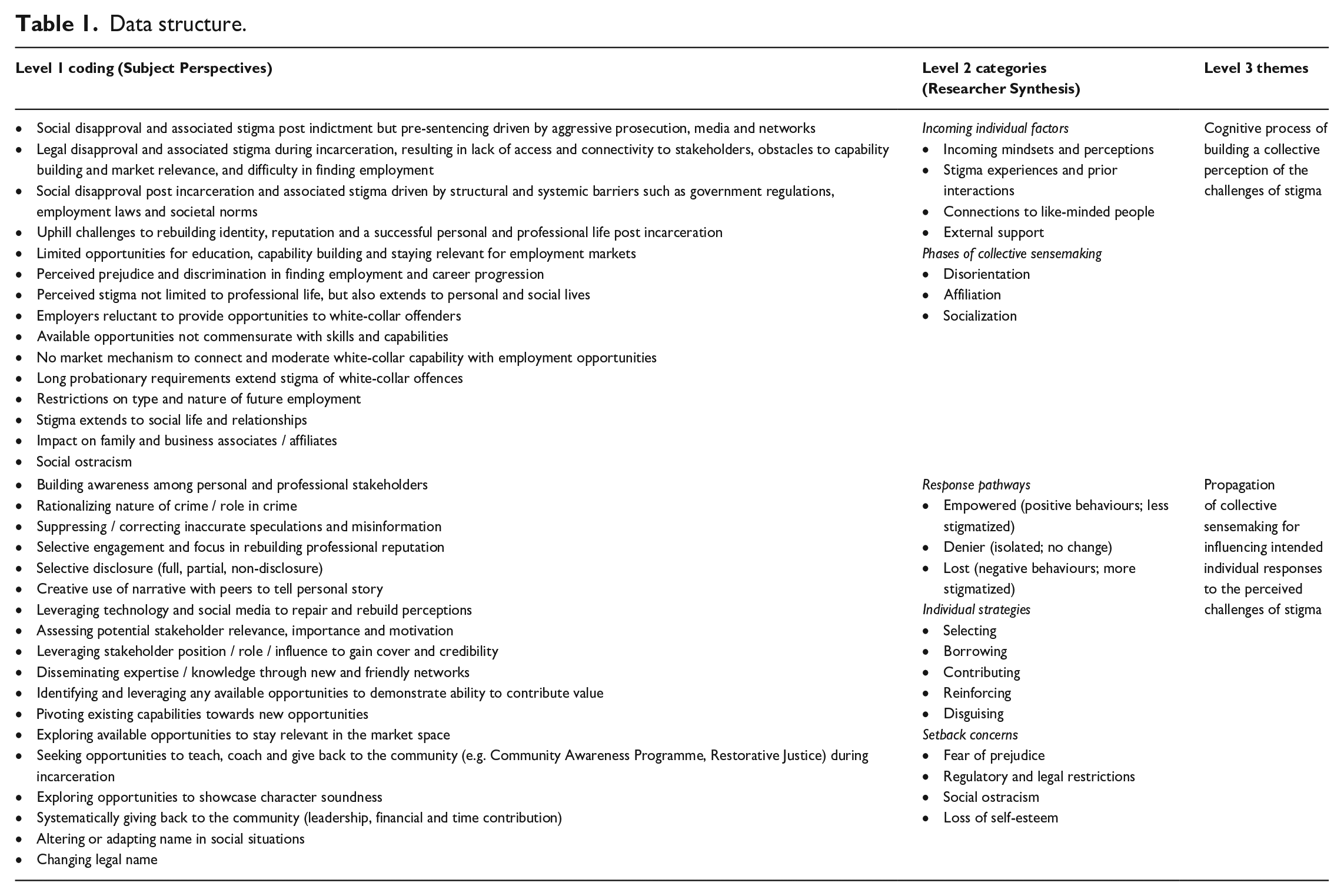
In the second step of our data analysis, we leveraged the second and third round of interviews to make refinements and additions, validated the emerging coding, categories and themes by playing them back to participants and elicited deeper insights through listening and dialogue during focus group discussions. In the third step of data analysis, we compared and contrasted the emerging findings against the literature to abductively (Mantere and Ketokivi, 2013) identify overlaps, synergies and gaps that would provide theoretical insights to the sociology of work literature and opportunities for further research.
Findings
Collective sensemaking of stigma among inmates
We found that there were three phases in which inmates collectively made sense of stigma: disorientation, affiliation and socializing.
Disorientation
The first phase of collective sensemaking was disorientation, when individuals were initially overwhelmed by their perceived stigma, which they considered extended far beyond the term of their sentence, to include time before sentencing and incarceration (one to seven years), during incarceration (one to 15 years) and post incarceration (one to five years of probation). This, they believed, significantly impacted on their ability to rehabilitate, earn an income to support their families and restitute the losses they were held responsible for, and reintegrate back into society. As one participant alluded to, disorientation began with confronting isolation as he struggled to cope with the loss of social and professional ties: ‘I see my family every two months. Ex-colleagues that I had known for years have cut me off. I can understand their reasons, but it is still difficult to deal with’ (Participant # 47). This seemed further exacerbated by a sense that their behaviours had an extended negative impact on their families, as this participant articulated: I don’t really know what to tell my wife and daughter. They are bearing the brunt as many friends have distanced themselves since my ordeal. My daughter has suffered at her school. She wants my family to move to another city and school. (Participant # 51)
In the words of another participant, the overwhelming experience of incarceration caused him to feel lost. He slowly started to engage with a small number of inmates to discuss their shared challenges: I spent the first two months just lost and listening to my room-mates, and then started eating lunch and dinner with one of my room-mates and another guy in a similar situation. (Participant # 38)
Another participant was gloomy about his stripped identity, and a sense of hopelessness about the future: I went from being a successful commercial banker to driving a truck in two months. There is no opportunity for me to stay relevant to banking or rebuild my capability. If I am lucky to find a job, I will earn enough just to support my family. The government will then keep 10 percent of my salary towards my restitution, which is $12 million. At that rate I will never be able to pay it off. Everyone loses. (Participant # 45)
The above participant’s sense of despair was matched by another participant who felt that he would need to be reborn to shrug off his stigma: I think I am tainted for life. There are 98 online links with news about my arrest and sentencing. Ninety percent of them are incorrect and purely speculative, but that is what people see. Will employers take the time to understand that I have paid my debt to the society when they read about me online? They will just put me in the criminal bucket and forget about me. Will I have to be reborn to get rid of this stigma? (Participant # 28)
The permanence and indelibility of their stigma was further highlighted by a participant who said that information online was his biggest barrier to overcoming stigma: People might be willing to forgive me and even forget, but will Google ever forget? It will keep reminding people. People pay attention to what is fresh in front of their eyes – even reminders of bad news from the past. (Participant # 6)
Many participants suggested that the impact of stigma had stripped them of their own unique identity, and instead, bestowed upon them a blanket identity consistent with the stereotypes associated with convicted and incarcerated individuals: I am a felon just like anyone else in federal prisons. It is the big F on our foreheads that erases your self-identity. The world does not have the time to look deeper; a felon is a felon whether you are a murderer or a petty thief. People react on perception, not reality. (Participant # 54)
This concern of the future was often a reflection of the extreme emotional damage and sense of disorientation and dehumanization: The day after my headlines in the newspaper, I became a social outcast. People stopped calling me, stopped replying to my emails and seemed to walk away if I saw them in public. That worsened my emotional reaction – I was too afraid to even go back and talk to them. One thing led to another and kept getting worse. (Participant # 17)
The anticipated experience of stigma seemed palpable in the interactions inmates had with external stakeholders even while still in prison: I can already see what is coming my way by the way people on the outside have either ignored my emails and phone calls or shrugged me off. And we are talking about people who are long-term friends and business associates. Many were at least encouraging when I was fighting my case but all changed when I pleaded guilty and got sentenced. (Participant # 37)
Having experienced the trauma of disorientation, participants slowly start to experiment with a new phase of affiliation.
Affiliation
Having initially found themselves disoriented, the second phase of collective sensemaking was affiliation, when inmates had started to connect with others, after coming to terms with their circumstances. One participant described a group of inmates from financial services as his lifeline as they shared their stories, made plans and also provided a reality check for each other about what was to come when they left the prison: There are nine of us that have shared our stories, even cried together and made plans for the future. I don’t know what I would have done without them. We all come from financial services and know the kind of shit we are going to face when we leave here. (Participant # 11)
Affiliations were based mostly around similar professional backgrounds (e.g. individual business owners, corporate leaders, lawyers, etc.), occupational status and age/stage of life, as the following participant describes: There is a large group of ex-business owners here – contractors, builders, suppliers. Ups and downs have been a part of our life but nothing like this. Yes, we will have to boot-strap again when we go out but this time it is a different ball game. Banks won’t have anything to do with us. Customers probably will not care as long as we don’t carry the felon sign with us. We always talk about how we can help each other when we get out. These guys can relate to me. (Participant # 44)
Another participant alluded to how affiliation with others helped him make sense of challenges related to his stage of life: I am signed up for two evening classes to meet with others with a similar real estate background, and every Sunday about 15 of us above 55 meet to discuss how the upcoming prison reforms are going to affect us. Will I be able to even build and manage real estate, forget about law and financing? (Participant # 16)
As we see in the next phase, affiliation seems to be an important precursor for socialization.
Socialization
The third phase of collective sensemaking builds on the previous stage of affiliating with others to socialization. Socialization describes not merely talking to peers in the prison, but establishing kinship through participating in shared activities, building deeper and trust-based relationships, and sense-checking their intended plans to overcome anticipated stigma by converging to smaller sub-groups of three to five peers based on their perceived similarities and differences in challenges.
One participant highlighted the essence of socializing with a small sub-group when it comes to sense-checking his intended approach to face anticipated stigma post incarceration: I must have talked to about 100 other white-collar guys like me. It helps me do a gut check if I have it all wrong. At the end of the day, I come back to the small group I trust to figure out how I am going to deal with things. (Participant # 62)
Another participant alluded to how he had come to trust a small group with similar circumstances and anticipated future challenges: There are three of us below 35 and we have built a deep connection. The rest of our life is ahead of us and that is what makes it even harder. We have similar challenges ahead of us – young families, education, careers and making a livelihood. Who will give us a second chance? Will I even be able to go back to school? Will that even make a difference with a criminal record? We have our meals together, work out together and share stories. Our families have also come to know each other. (Participant # 67)
Part of the process of transition from affiliation to socialization, which can progress and regress (see Figure 1), is participants converged to smaller, closely knit groups of peers, as one participant explains: You have seen me hang out mostly with five other 65 plus-year-olds. None of us are that concerned about making money when we get out. It is about retirement, families and immediate friends. We will make new friends, travel and move somewhere else. My prison time will chase me but less so socially. That is what we hope. We have plans to stay in touch – whenever they let us. (Participant # 24)
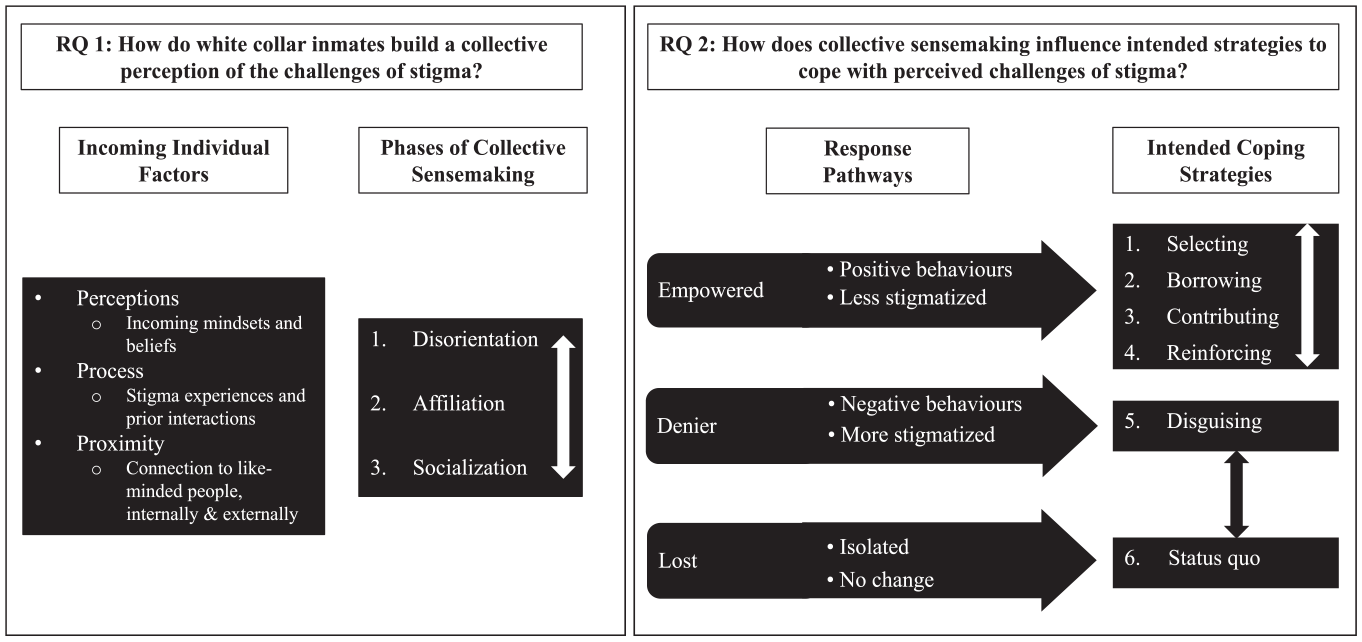
The emergence of collective sensemaking and how it influences individual responses to the challenges of stigma.
While we show that there were three overlapping dynamic stages (disorientation, affiliation and socializing) that explain how white-collar inmates build a collective perception of the challenges of stigma, we also found that the stage that individuals were at in engaging with collective sensemaking was underpinned by three factors. First, their incoming perceptions. Second, the process of how they experienced stigma prior to collective sensemaking, which fed into the anticipation of further stigmatization experiences. In the words of one participant: My punishment started the day I was charged, and the media splashed speculations. Lost my job, two professional memberships and several friends before I was proven guilty. [. . .] I take responsibility for my mistakes and the time I need to serve, but it will be nine years of suffering between my initial charge and when I finish probation, and then a life-long felon sign hanging above my head for a two-year sentence. (Participant # 12)
Third is the proximity to like-minded people and outside stakeholders. One participant explained that his connection with both people on the outside as well as people on the inside has helped him to feel more positive and believe that he can overcome his strife: I was horrified by the stories I had heard when I came here. The more I have stayed connected to family and friends on the outside and others in my situation here, the better I have felt. I think I can overcome this. (Participant # 41)
How collective sensemaking influences intended strategies to cope with perceived challenges of stigma
Having taken the initial steps to address the first research question of how white-collar inmates build a collective perception of the challenges of stigma (see Figure 1), we now turn to the second research question of how this collective sensemaking influences their intended responses to the perceived challenges of stigma. We coded participants according to three categories: empowered (67% of participants), denier (9% of participants) and lost (24% of participants), which we now explain in more detail.
The empowered participants generally talked in ways that demonstrated positive behaviours in response to their perceived stigma. They generally felt less stigmatized compared to other white-collar inmates and were exploring ways to overcome barriers. In the words of one participant: I will never be able to practise medicine again, but I was also a world-class medical researcher with a PhD in Mathematics. My discussions and reflections here have made me realize the power of what I have versus what I have lost. I am using my expertise in mathematics to create models for equity market investments. (Participant # 5)
What is striking with the quotation above, which was reflective of the empowered participants, was the positive ways inmates were framing their circumstances. Another participant described the practical steps he had already embarked on to overcome perceived stigma post incarceration: It is not going to be easy, but I am already enrolled at the university for my further education – the least I can do to show my remorse and rebuild my life and family. I will have a Master’s degree in one year and will redirect from a career in accounting to human resources. (Participant # 47)
The denier participants were still coming to terms with their circumstances and often not recognizing that they had done any wrong. These participants tended to isolate themselves from others and showed little willingness to change. The following participant, for example, was still focusing on how he was accused falsely of crimes and had yet to come to terms with his circumstances: What we were doing was legal and smart tax avoidance as permitted by law, not tax evasion – which is what they charged us with. I was accused falsely and will continue to fight my charges. (Participant # 14)
The lost participants felt that they had been more stigmatized compared to other white-collar inmates and tended to talk in more negative ways around their circumstances and predicament.
Intended coping strategies
We identified six categories of individual coping strategies that participants intended to adopt to counter the negative consequences of their perceived stigma: selecting, borrowing, contributing, reinforcing, disguising and maintaining the status quo. The ‘empowered’ participants talked about the first four strategies, while the ‘denier’ participants alluded to a fifth strategy. The ‘lost’ participants had no clear plans. We now explain these intended coping strategies in more detail.
First, selecting was acknowledging that some people would be willing to engage with them while others will not, so they would approach the situation with their eyes wide open: ‘I will be selective in who I approach and what I say before I open a can of worms’ (Participant # 48). Similarly, participant # 1 said: ‘I am not just going to put myself out there to everyone. Online blogs and narratives don’t work – people discriminate against people like me so I am going to be super careful about who I talk to.’
Second, borrowing was when participants saw that there were limits with their own personal development so they would try and work with others to avoid the stigma around their own name: ‘I can never be the face of my business again, but I can partner with someone who can use my expertise and use his name’ (Participant # 31). Here, there was a strong emphasis on partnering with trusted others to continue previous work as a back seat partner, or to develop a new line of employment. In both instances, this involved operating in an inconspicuous manner.
Third, contributing is showing other people that they can provide value in the future because this will increase the likelihood that they will want to work with them: ‘If they think they will benefit from you, they will work with you. If not, they will use your conviction as an excuse not to work with you’ (Participant # 51). Participant # 24 alluded to: ‘Making myself productive and useful to my family, to my church and to my community is the only way forward. The world has moved on – I need to find a way to stay relevant in two years when I am out.’
Fourth, reinforcing is showing conviction to others that they have reformed and learned from their mistakes of the past: ‘The monkey is on my back to show them that I am a better person as a result of this’ (Participant # 25). Another participant (# 64) said: ‘I am going to clean up my online reputation and create a storyline that explains what really happened so people know the facts and not just make assumptions’.
Fifth, disguising is when individuals recognized that there is a significant cost associated with their name, including through people searching about them online. As a result, many participants considered changing their name, moving their house and other approaches to façade their undesired former identity and focus on a new desired identity to overcome their perceived risk of stigma. In the words of one participant: I will use my real name when it comes to legal things. For the rest, I will just use my nickname. I am not going to hurt anyone, just minimize the hassle in social situations. (Participant # 46)
Finally, maintaining the status quo captures those participants who were lost. Their strategy was to remain isolated and not to change. These people were often in denial of what had happened to them or unwilling to take a proactive strategy to cope with their perceived challenges of stigma. In some cases, they had tried something, but setbacks had caused them to recoil to the status quo: Criminal conviction is a kiss of death. I have sent out a few CVs with the help of my family but even a slight reference to my conviction filters me out. I loathe the idea of doing something below my capability but will I have a choice? Maybe I will move to another country, change my identity and avoid this stigma. Nothing positive seems to be coming out of this based on my discussions with others like me. (Participant # 14)
The above participant is erring on maintaining the status quo, but he also alludes to elements of disguising, which indicates movement between coping strategies as we illustrate in Figure 1 through different arrows within and between strategies.
While participants described their individual strategies to protect themselves from perceived stigma, based on extensive group discussions with their peers in their prison cells, during meals, over breaks and when they were participating in activities and programmes in the prison, their level of confidence in success was low because of the multiple setbacks they perceived they would encounter. These perceptions were driven by four factors. First, apprehensions of continued prejudice and discrimination in employment and new business opportunities. This was based on what they had heard from their peers of the experiences of other white-collar offenders after they had been released from prison. Second, regulatory and legal restrictions on what ex-offenders are permitted to do. For example, some professions such as healthcare and financial services had very strict rules related to ex-offenders not being able to practise in their field after they have completed their prison sentences. Third, social illegitimating and ostracism that they perceive will continue for years and impact their relationships and family life. In this instance, inmates were fearful that they would always be perceived and treated differently by those in their social network, including friends and family members. Fourth, the loss of self-identity and self-esteem associated with perceived stigma, creating a vicious cycle of self-stigmatization. The following two quotations capture this sentiment: Unless the corporate world steps forward and pushes the justice system to find ways to productively use white-collar prisoners, nothing will change. Even the government does not hire ex-felons, how can they expect others to? The only way to change it is to make it an economic reality. (Participant # 51) I have even lost the right to voice my concerns. I became a second-class citizen the day I was charged. I have gone from being confident to being fearful of even trying and getting turned down. (Participant # 31)
Discussion and conclusions
Offenders is a relevant, extreme context in which to explore our two research questions because they interact with other members of the stigmatized group in a temporary and physically bounded context (Graffam et al., 2008; Pandeli et al., 2019). However, they are not standalone as many other groups face similar collective challenges, such as people who are unemployed, rehabilitating from an addiction or who are neurodiverse. Using unique data collected by one of the authors as an inmate in a US federal prison, we empirically explored how stigmatized individuals collectively make sense of their label before they get fully exposed to the evaluation of outsiders. We first explored how inmates with a previous career in white-collar work built a collective perception of the challenges of stigma. Second, we unveiled how collective sensemaking influenced intended individual responses to the perceived challenges of stigma.
We provide a comprehensive model (Figure 2) linking the collective sensemaking of stigma with individual approaches and strategies fed by the collective experience and the group as a resource. We found that stigmatized individuals were first disorientated by their new label but found answers in their affiliation to the group comprised of others from a similar occupational strata. Socialization becomes a way to connect with a smaller sub-group, build trust and derive insights and intended individual strategies to cope with anticipated stigma. Our findings identify three pathways linking collective sensemaking to intended individual reactions to stigma, and ultimately how they anticipate the experience of being stigmatized: they are empowered, deniers or lost. Empowerment makes the stigmatized feel energized by their label, and willing to show their value to the world, in contradiction with the taint they are facing. Deniers reject the taint and refuse change. Lost individuals have partly given up and are pessimistic about how they will experience their label. Finally, we identified six individual strategies, derived from the collective sensemaking process, for the stigmatized to prepare for the full experience of stigma (in our case, when they come out of prison). The ‘empowered’ select the stakeholders to interact with, borrow positive evaluations from others, contribute by reframing their stigma and show their contributing value to external audiences, and reinforce their redemption as ‘useful’ and employed members of society. The ‘deniers’ have not come to terms with their actions and opt for disguising themselves from others within their social network to avoid negative evaluations in the future. The ‘lost’ feel more stigmatized and opt for maintaining the status quo.
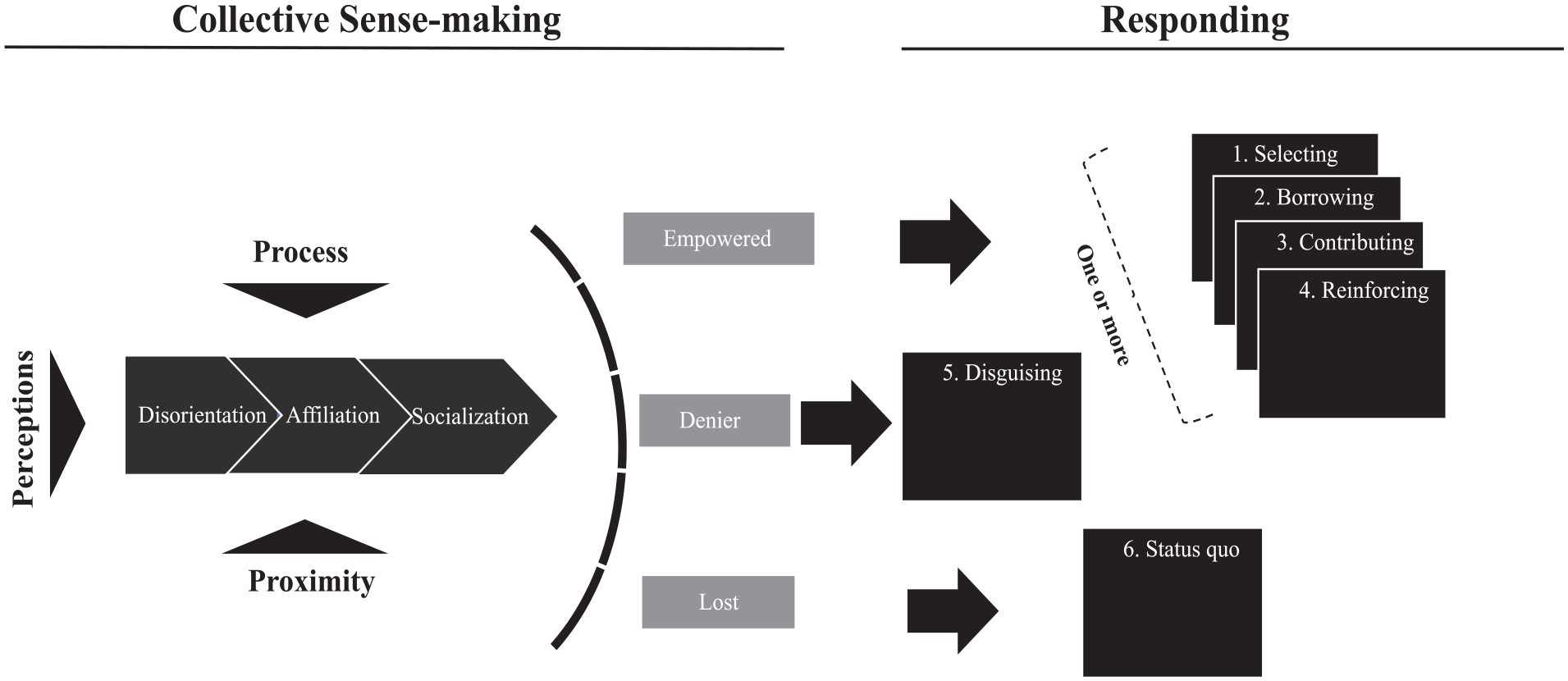
Linking the collective sensemaking of stigma with individual approaches and strategies from the collective experience.
Theoretical and practical implications
Our research makes three theoretical contributions to the body of research on stigma in the sociology of work and organization studies literature (Link and Phelan, 2001; Pescosolido and Martin, 2015) and more generally the field of negative social evaluations. First, this research fills an important gap in our understanding by investigating the perception of internalized and anticipated stigma and its consequences, through the eyes of a specific occupational group, the stigmatized, and white-collar offenders in our case. It is one the first empirical studies of its kind that has explored stigma through the perspective of white-collar offenders during incarceration.
Our findings show that the internalization and anticipation of stigma is a cognitive process in the mind of the subject (whether yet stigmatized or not) that does not necessarily require direct interpretation of evaluative input from outsiders (cf. Savaget et al., 2024) and nor does it require power in order to propagate. The internalization and anticipation of stigma itself, mediated by interactions with the rest of the stigmatized group, sets into motion a cycle of responses that self-reinforce each other, and result in different behaviours and outcomes. It can either trigger a set of positive behaviours where the subjects feel gradually empowered and able to face stigma, or a set of behaviours where the subjects can feel further devalued.Second, we argue that while the onset of stigma is triggered by others, the propagation of stigma, especially concealable stigmas as in our empirical context, depends largely on the perception and reaction of the stigmatized individual, building on exchanges with other members of the same tainted group (DeJordy, 2008; Zhang et al., 2020). Propagation of perceived stigma is further enabled by other forms of negative social evaluations (Roulet, 2020). Legal assessment of the individual before and during incarceration is relatively defined, and potentially challengeable and defensible. It can evolve into social and moral disapproval after incarceration (once the mandated punishment is over), which, based on our findings, can be incessant, tacit, unbridled and unchallenged. For white-collar offenders who are trying to rebuild their careers and lives, and how they are perceived, this ongoing and dynamic form of construed negative evaluation adds a layer of complexity.
Third, our findings contribute to the sociology of white-collar crime (Coleman, 1987; Simpson, 2013). This leaves us to question whether the current approaches to criminal justice overly stigmatize white-collar offenders with significant negative socio-economic implications, thus impacting their reintegration into the workforce. Despite increasing public awareness and adoption of policies to support and guide employers to make inclusive and equitable employment decisions, offenders with white-collar offences continue to face barriers with mainstream societal reintegration, including securing employment (Graffam et al., 2008). They are marginalized in employment, and excluded from diversity management initiatives (Blessett and Pryor, 2013). Furthermore, the potential psychological and social effects of prison living have been referred to as ‘antithetical’ to the reintegration of individuals into the world of work post release, regardless of their capabilities (Peat and Winfree, 1992). Self-stigmatization, when combined with incessant negative social evaluations, can create vicious cycles of negative socio-economic impact, with work and careers playing a specifically notable role.
Limitations and further research
We have used an extreme case of individual stigma to build theory through clearly visible dynamics (Ducharme and Fine, 1995; Pettigrew, 1990). However, our subjects were all men who were reflecting on their perceptions of stigma before their release. Expanding this research to include contexts such as other genders, performance-related issues as well as association and affiliation, and consequences less severe than incarceration, would provide theoretical insights into a richer set of perceived stigmas and their consequences. In addition, triangulating evidence beyond a single source of data, especially extending it to include personal and professional stakeholders, would help reconcile the subject’s perceptions with what they might actually experience upon release. Extending this research longitudinally to understand causality between anticipated and actual stigma as well as intended strategies versus actions to cope with anticipated stigma could help elicit predictive insights. Finally, we were limited by the regulations and restrictions of a federal prison, and had to adapt accordingly (e.g. not being able to record interviews) through extensive feedback loops to confirm and refine our dataset.
We suggest future research opportunities in several related topics. First, extending this research to explore how individuals deal with and overcome their perceived stigmas, after their release from prison, will help understand the individual attributes, characteristics, strategies and actions that are related to negative or positive outcomes over time. We would then be able to connect collective sensemaking of stigma with longer-term outcomes. Second, understanding the personal and professional stakeholder perspective will help shed new light on which stigmas are triggered externally versus internalized, anticipated and thus propagated by perception. While we did not look specifically at the question of ethnicity and race, many of the offenders we interviewed and observed were from marginalized groups. Marginalized groups are more likely to go to prison (Wakefield and Uggen, 2010), but we rarely think about marginalized people among white-collar workers, which is traditionally perceived as a privileged group. Race and ethnicity play a significant role in employment outcomes for individuals who have been released from incarceration (Western and Sirois, 2019). Thus, the ethnic and racial dynamic in the incarceration of white-collar workers would represent an important avenue of research. Finally, we highlight extending similar research to various segments of white-collar offenders (regulated professions versus non-regulated professions and public versus private sectors) to understand the interactions between different types of negative evaluations rooted in legal and moral norms.
Supplemental Material
sj-docx-1-wes-10.1177_09500170241268391 – Supplemental material for Will I Have to Be Reborn? Collective Sensemaking of Stigma among White-Collar Inmates
Supplemental material, sj-docx-1-wes-10.1177_09500170241268391 for Will I Have to Be Reborn? Collective Sensemaking of Stigma among White-Collar Inmates by Navdeep K Arora, William S Harvey and Thomas J Roulet in Work, Employment and Society
Footnotes
Acknowledgements
The authors are grateful to editor Clare Butler for her support and for the guidance of the reviewers. We also thank the participants of this study.
Funding
The authors received no financial support for the research, authorship, and/or publication of this article.

Supplemental material
Supplemental material for this article is available online.
References
Supplementary Material
Please find the following supplemental material available below.
For Open Access articles published under a Creative Commons License, all supplemental material carries the same license as the article it is associated with.
For non-Open Access articles published, all supplemental material carries a non-exclusive license, and permission requests for re-use of supplemental material or any part of supplemental material shall be sent directly to the copyright owner as specified in the copyright notice associated with the article.
