




Abstract
Job seeking is a crucial yet overlooked process through which people navigate the world of work. Yet there remains limited qualitative research examining the complex and nuanced experiences of job seekers in a contemporary labour market. This article explores 38 interviews with job-seeking women in England, all of whom were interviewed over a six-month period. Using a postfeminist sensibility, findings revealed an oscillation between empowerment and success on the one hand, and disempowerment and perceived failure on the other, including wanting to: find the ‘right’ job, but accept any job; convey an authentic self but imitate what they think employers want; negotiate salaries, but accept pay cuts; emulate ‘successful’ behaviours, but experience doubt, uncertainty and negativity. This article contributes to the sociological practice of employment, identifying that through this oscillation, women experience a form of postfeminist precarity that starts from the outset of job seeking.
Introduction
In today’s labour market, job seeking is strenuous, often involves long hours and remains a relatively opaque process. On average, job seekers spend a minimum of 11 hours per week on job-seeking activities (CareerBuilder, 2016). Finding a job can take between six and 12 months (Lim et al., 2016). Middle-skilled jobs are decreasing and, in recent years, individuals have experienced increased precariousness, periods of prolonged job seeking and less government support (Rubery et al., 2018). Many applications may be ignored by potential employers without any justification or feedback (Lim et al., 2016). Indeed, approximately 98% of job seekers face rejection as part of an application process without necessarily knowing why (Glassdoor, 2017). The 2020 global pandemic exacerbated these issues, impacting employment levels and available job opportunities to the point where one in 20 people was unable to find a job (BBC, 2021). This particularly affected women, who have suffered the brunt of challenging job-seeking experiences (Finch and Groves, 2022). Post-pandemic, women globally have been affected by precarity, including unemployment, job displacement and income loss (Mooi-Reci and Risman, 2021). While job-seeking literature is beginning to better contextualise the job seeker (e.g. in terms of labour market conditions and socio-economic issues), literature on how people of specific social groups, such as women, experience their job search remains sparse (Abrams, 2024). A better understanding of the experiences of job-seeking women is both timely and urgent for the effectiveness of: (1) women job seekers and their wellbeing; (2) those supporting them to access job opportunities (i.e. career counsellors); and (3) the organisations where they will work. It is therefore important to explore how women experience job seeking.
This research focuses on 38 interviews, detailing the experiences of 15 women across six months as they sought jobs in England, and responds to the research question: What experiences guide women during their job search? In doing so, this article contributes to knowledge about the sociological practice of employment, presenting a novel insight into contemporary job-seeking experiences. By exploring the experiences of women job seekers, our article demonstrates that: (1) through a range of dichotomies, job seeking is elevated from merely ‘finding a job’ to a strenuous process of self-improvement to a degree that it constitutes work in itself; and (2) women cope with this demand by oscillating between an overtone of empowerment through the postfeminist sensibility, and the reality of the stresses the job-seeking process entails. We therefore argue that this oscillation presents a form of postfeminist precarity that starts during job seeking.
We next present an overview of current literature specifically relating to job seeking. We then follow with literature describing what is defined as a postfeminist era. We use this literature as a framework for interrogating our findings from interviewing job-seeking women.
Job seeking
Literature on job seeking is a vibrant field. Spanning across organisational psychology, vocational behaviour and career development, a wealth of extant empirical and conceptual studies exists (see for example van Hooft et al., 2018; van Hoye, 2018; Wanberg et al., 2020). By ‘job seeking’, we refer to a series of activities that people perform to secure a new job (Wanberg et al., 2020). These bodies of literature share an understanding of what constitutes job-seeking activities, including: scouring job advertisements, compiling CVs (curriculum vitae/resume), completing job applications, networking and attending interviews or assessments (Boswell et al., 2012). Each field is interested in concepts with similarly defined boundaries, such as: job search content, job search effort/intensity, and/or job search temporality. These concepts are typically used to assess behaviours, goals and outcomes (Wanberg et al., 2020). As such, job seeking is collectively considered, across disciplines, as a self-regulated, goal-directed and proactive process in mainstream literature (Wanberg et al., 2020). Yet job seeking is also marked with precarity: there are setbacks, failures and obstacles that a job seeker must overcome, with little to no financial, state or employer support (Sharone, 2007, 2013). It is therefore, also, an all-consuming, emotionally exhausting and stressful process for the job seeker (Liu et al., 2014), the nuances of which, have not yet been given due consideration, particularly across different social groups, including women.
The job seeker
Job seekers are currently treated as largely self-sufficient agents in their search process. Interventions to support job seekers typically seek to address individual behaviours (Liu et al., 2014). When job seekers are successful, this is largely considered to be a result of individual efforts and characteristics (Wanberg et al., 2020). Advice is commonly offered on the management of negative emotions; CV-editing strategies that encourage the ‘discovery’ of skills and aptitudes in past experiences; and the rehearsal of interviews in order to present oneself in the best light (Boland, 2016). This approach can create an environment that infers that the job seeker is wholly responsible not only for their successes in securing employment, but also for their failures (Fogde, 2011; Sharone, 2007). Indeed, extant sociological research indicates that while job seeking is tedious and uncertain, it is still coupled with the demand to perform and succeed alongside repeated failures (Boland and Griffin, 2015). Yet, there has been little recognition of the precarity of job seeking, and particularly ignored are the wider, contextual social factors that may inform job seekers’ experience, such as the differing social expectations of men and women in relation to work.
Emerging evidence suggests that this backdrop affects women differently to men. For example, women go above and beyond during their job search, using extensive networking as a form of ‘discrimination insurance’ to identify and weed out working environments that may prove to be inhospitable to their needs, without this necessarily leading to better outcomes (Obukhova and KleinBaum, 2022). Women feel greater uncertainty about where they belong and are less likely to apply to the same company again if they are rejected at an executive level (Brands and Fernandez-Mateo, 2017). This finding also appears to traverse career-level experience and can greatly affect the motivation and aspirations of young women in disadvantaged communities (Escott, 2012). Rejection from the labour market can be particularly detrimental to a woman’s health and wellbeing if they strongly aspire to work but cannot access employment due to constraints such as caring responsibilities (Escott, 2012). Women’s experience of the labour market, and their associated response to job-seeking barriers, appear sufficiently different to men to warrant specific research. However, previous explorations of job seekers have been predominantly psychological and quantitative, often at the detriment of sociological considerations (Manroop, 2017; Manroop and Richardson, 2016). In this study, we have responded to the research question: What experiences guide women during their job search? In doing so, this article contributes to knowledge about the sociological practice of employment, including what it means for women to be a job seeker, and how they cope with its related demands.
Theoretical framework
In this article, we adopt a sociological approach and draw from postfeminist theory, an approach with growing importance for the study of experiences and representations of women in organisational and management literature (Adamson, 2017; Adamson and Kelan, 2019; Ahl and Marlow, 2019; Lewis, 2014; Lewis and Benschop, 2022; Lewis et al., 2017, 2022; Ronen, 2018; Swan, 2017).
Postfeminism is a contested theory with multiple meanings and interpretations (see for example Banet-Weiser et al., 2019; Lewis et al., 2017). We take the most widely used understanding of postfeminism in scholarship, interpreting it as a sensibility (Gill, 2017; Gill et al., 2017). ‘Sensibility’ is a term that has been used to highlight a pattern of sense-making that has been observed, wherein longstanding structural problems concerning women, such as their place within work – which collective feminist action sought to address – tend to be translated into individualised problems to be overcome through individual behaviours, attitudes and emotions (Cairns and Johnston, 2015). As a result, women feel personally responsible for individual successes and failures (Beijbom et al., 2023). For scholars of postfeminism, and those who draw upon it as a framework for analysis, it is these behaviours, attitudes and emotions that offer an empirical basis for study (Riley et al., 2019). Similarly, as authors of this study, we take postfeminism as the object of our study rather than as our belief system (Gill, 2017).
Examining this sensibility-in-action via our empirical data allows us to better understand the life of the job-seeking woman and how the experience of job seeking shapes women’s thoughts about themselves, their capacities and responsibilities as well as the emotional impact on those women. It also helps us to map out how these experiences interact with broader cultural patterns of gendered beliefs and expectations. This approach can be particularly effective in exploring contradictory features of everyday life that affect women (Litosseliti et al., 2019).
A postfeminist sensibility is expressed, circulated and reproduced through three key dimensions: choice, empowerment and individualism (Ahl and Marlow, 2019; Gill, 2007, 2017; Lewis et al., 2017). Within a postfeminist sensibility, the idea of choice is framed as doing things to please oneself and is mobilised to demonstrate self-determination (Gill, 2007). Within a feminist sensibility, choice also emphasises that individuals are in control of their lives and de-emphasises the influence of social and economic dynamics that are beyond the individual’s sole control, such as privilege, access and resources that may confer an advantage to some over others (Sørensen, 2017).
Threaded throughout postfeminism is individualism, which frames all experiences as largely, or even exclusively, personal, decontextualising them from broader structural issues (Gill, 2007). This is problematic because it reduces the individual down to a socially independent subject, unaffected and unconstrained by external pressures as opposed to other feminist frameworks that emphasise the embeddedness of the individual in socio-economic systems. This ultimately paints a picture of a self-empowered individual (i.e. someone who is self-made and ever-flexible; Kauppinen, 2013) and points to the third dimension of a postfeminist sensibility: empowerment, whereby a postfeminist woman is positioned as harnessing personal potential for both self-fulfilment and economic contributions. In doing so, she holds the ability to overcome systemic barriers through individual means and self-reflection (Ahl and Marlow, 2019). She enacts confidence, control and courage to get ahead (Adamson and Kelan, 2019) and engages in individualised self-work, including careful grooming and positivity, with the goal of ‘having it all’ (Swan, 2017). However, when women perceive themselves to be failing at these behaviours, a pattern of self-blame ensues (Baker and Brewis, 2020).
The description above paints a picture of how the three dimensions of a postfeminist sensibility (choice, individualism and empowerment) are inextricably linked and therefore difficult to untangle. Within a postfeminist sensibility, women often encounter contradictions and paradoxes that are difficult to make sense of, masquerading feelings of empowerment, because it is still constrained by social expectation (Keisu and Brodin, 2022; Lamberg, 2021, 2023). What has been significantly underexplored is whether a postfeminist sensibility might explain the job-seeking experiences of women. Job seeking is a crucial yet overlooked process through which people navigate the world of work. As demonstrated, there remains limited qualitative research examining the complex and nuanced experiences of job seekers, particularly women. By using a sociologically informed, postfeminist sensibility to explore the job-seeking experiences of women, this study shows how job seeking itself is transformed into work, presenting a postfeminist precarity that starts from the outset of labour market engagement.
Methods
Our empirical study was based on 38 in-depth, unstructured interviews with 15 women. All of the participants were aged between 20 and 40 years old and had graduated from United Kingdom (UK) higher education within two years of data collection. Their higher education is a crucial characteristic of our study; female graduates are more likely to work in lower-skilled occupations and earn less than their male counterparts. Some 41% of women are either unemployed or outside the labour market compared with 17% of men with higher education (International Labour Organization [ILO], 2019). Five participants had undergraduate degrees, nine had undergraduate and master’s degrees and one participant had undergraduate, master’s and PhD degrees. All women were applying for jobs within the knowledge sector and had varying previous work experience. For the purposes of this article, we define a job seeker as anyone actively seeking work (i.e. sending out weekly applications and engaging in other job-seeking activities) regardless of their status (e.g. employed or unemployed) (Wanberg et al., 2020). Therefore, we include individuals facing a range of different situations during their job search including employment, unemployment, redundancy and those on Jobseeker’s Allowance. 1 This wide-ranging participant sample included: socio-economic statuses – including two participants accessing Jobseeker’s Allowance while job seeking; ethnicities – including Asian Indian, Mixed Race, Asian Chinese, or White/Other White; and geographical locations – including the north of England, the south-east of England and London. While these characteristics were not the primary object of analysis, they are important to mention since participants’ accounts produced largely homogenous responses.
Seven participants were recruited through university lecturers and in-house employability teams at five UK-based universities. Eight were recruited through alternative professional networks including LinkedIn; information from peers within their social circles; and during a CV-building workshop held at a UK university.
Ethical approval was granted by Kingston University Research Committee on 11 September 2017 (FREC 17 26).
Data collection
Data collection occurred between June 2017 and May 2018, a period planned for the purposive identification of individuals who had finished their higher education courses earlier in the year and had therefore begun to actively seek work. A data set of 38 interviews, all between 60 and 90 minutes long, comprise this study. Multiple interviews were conducted with participants, with an aim of three interviews being undertaken with each participant. The purpose of multiple interviews was to explore any change over time (i.e. whether any change in narrative occurred if a job was secured for example), and explore different facets of the job-seeking experience (Read, 2018). Time points for each interview were flexible and contingent upon the ongoing nature and experiences of each job seeker. However, all were completed within a six-month period to provide the participants and research with a boundary. Five participants did not respond to follow-up invitations to participate and so took part in one or two interviews as opposed to three (Table 1). This meant that some experiences were left un-done, possibly missing a vital change in experience if, for example, a participant did secure a job but did not engage in a follow-up research interview.
Participant characteristics.
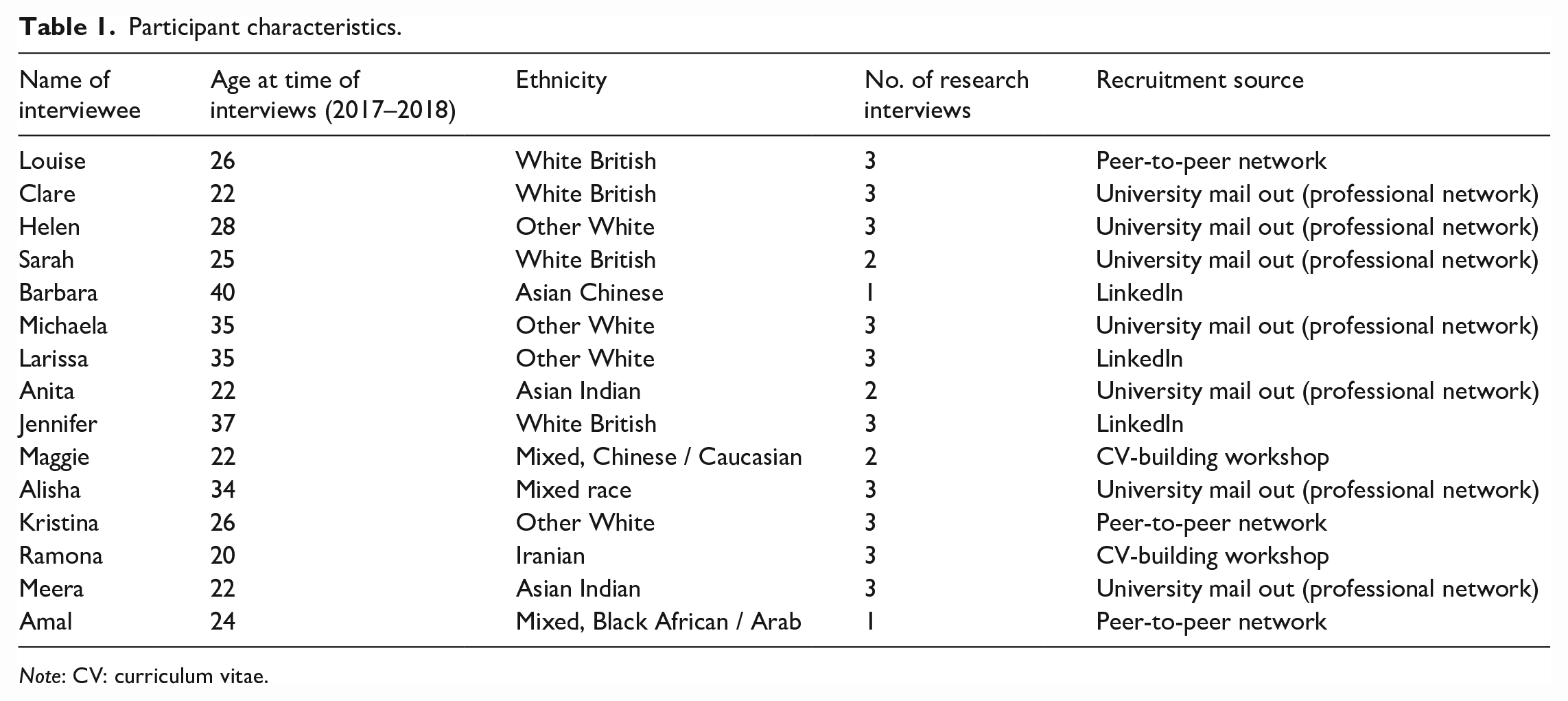
Note: CV: curriculum vitae.
Interviews were unstructured, meaning there was not a pre-defined topic guide structing the conversation (Patton, 2002). This enabled a spontaneous approach to question generation and the identification of unanticipated themes (Patton, 2002). Advantages of unstructured interviews include the emphasis placed on participant-led responses, the ability to elicit storied experiences and to also place the participant in a position of power and control over what they disclose (Corbin and Morse, 2003). Limitations of this approach include the ability for interviews to stray too far away from the intended focus. However, this risk was mitigated with the use of broad aide-memoires (McCann and Clark, 2005). For example, interview one focused on the recent history of the job seeker, through the opening question: ‘Tell me a bit about where your life is up to at the moment in relation to thinking about jobs and finishing your studies’. Interview two focused on participants’ present-day experiences, to elicit events as they unfolded: ‘Tell me a bit about your recent job-seeking experiences’. Interview three followed up on recent experiences and opened with the following question: ‘Tell me a bit about how you’ve found the job-seeking process up until now’. All interviews were transcribed verbatim.
Data analysis
Data were analysed using Braun and Clarke’s (2006, 2020) thematic analysis. This enabled an inductive approach, supporting the identification of unanticipated themes emerging from the unstructured interview data (Braun and Clarke, 2020). The analytical steps included: subjecting the data to familiarisation; initial coding; theme generation; reviewing of themes; defining and naming themes; and writing up. The first author (RA) undertook the initial analysis using NVivo 12, with the second and third authors (DB, MI) contributing to reviewing and defining themes. In our inductive analysis, we observed several contradictions in participants’ accounts. By drawing on the key dimensions of a postfeminist sensibility (i.e. choice, empowerment and individualism), this helped us to explain and give structure to unanticipated findings (Litosseliti et al., 2019). In the following section, we provide empirical accounts of women throughout their job search and report on these same broad dimensions of a postfeminist sensibility in the context of job seeking.
Findings
Findings in this section draw out key elements of job-seeking experiences, which include wanting to: identify the ‘right’ job but being willing to accept any job; constructing and deconstructing the job-seeking self; the impossible burden of opting out or having it all; being ‘successful’ (in a postfeminist way); and staying positive (while feeling negative). Within these themes, we show how the three dimensions of postfeminism are threaded throughout the experience of job seeking, causing a pendulum effect whereby participants oscillated between expressions of empowerment and success on the one hand, and disempowerment and perceived failure on the other, presenting a postfeminist precarity.
Identifying the right job but willing to accept any job
For some participants, job seeking was a process that centred on the belief that the ‘right’ role existed somewhere ‘out there’, waiting for them to discover it. There appeared to be a single-mindedness to the job-seeking process; participants intentionally sought out work that would help them to move up the career ladder or acquire new skills. This was illustrated by Sarah, a graduated master’s student who had previously worked in the charity sector for several years. In the extract below, Sarah referred to her job search as a selfish process because of the way she believed she was directing it: My approach to the job is more selfish in terms of like I’m not, I don’t want to do the best I can in my job so the company will really like me and promote me, although obviously I’ll do the best I can, I’m not so invested in the organisation, I’m more invested in myself and gaining experience so that I can do something that I actually want to do. (Sarah, interview one)
Initially, this might be read as a form of empowerment; Sarah approached job attainment with only one thing in mind: what she could gain from it. Indeed, previous literature suggests that empowerment through individual autonomy is emphasised as a key to success within a postfeminist sensibility (Rottenberg, 2014). However, while Sarah positioned her so-called selfishness as an empowered choice, this conceptualisation is also a possible misrecognition of the structure of the modern job market. Although Sarah conveyed empowerment in her approach (i.e. it is a decision she has made about how to conduct herself during her job seeking), she is also responding to the external pressures of the job market (a disempowered position). This presents a contradiction: Sarah believes she gets to ‘decide’ what is the ‘right’ type of work for her (i.e. empowerment). Yet, in doing so, she will ultimately accept any job that presents itself (disempowerment).
In a further contradiction, Sarah expressed guilt for approaching her job search in this so-called selfish way: I also feel guilty doing that because I don’t want to pretend to an organisation that I’m passionate about a job and leave after two months. (Sarah, interview one)
This is paradoxical because although Sarah feels guilty about being ‘selfish’, she also believes that being selfish is necessary in order to secure a job. The affective force of feeling both guilt and necessity appears to be an essential, motivating factor in driving her towards finding ‘the right’ job. It is also here that we can see the contradiction between an earlier statement, wanting to find the right job, while equally being willing to accept any job: I want to make my own way in life and be a bit more ambitious than what I have been, especially now I’ve got a master’s degree and I’ve spent all this time doing it, I feel like I need to do something with it. I just think I do need to be more ambitious and try harder to find not just any job but the right one. (Sarah, interview one)
Sarah appears to perceive ‘the right job’ as something that will show she is an empowered, freely choosing individual (i.e. making her own way, being ambitious, trying hard enough, applying her master’s degree). Yet without clear targets, being ‘more ambitious’ and ‘trying harder’ are elusive and, therefore, possibly disempowering. Even the idea of the ‘right job’ is left undefined, presenting endless choice. We can also observe this in Helen, who suggested she would need a violent jolt to her system to recognise when she had ‘arrived’ at the chosen destination: I’m thinking also, once you achieve that dream, I think like once I’m there someone will have to punch me in the face and be like ‘hey you’re there’. (Helen, interview two)
Thus, women job seekers appear as both empowered and disempowered by the idea and reality of job attainment.
Constructing and deconstructing the job-seeking self
Participants explained that job seeking offered them an opportunity to gain a valuable and intensely personal understanding of their selves. This builds on the notion of becoming better via job seeking and positions job seeking itself as a beneficial activity (instead of a difficult and undesirable means to an end). For instance, Kristina justified six months of no callbacks by explaining that the underlying personal process was still ongoing – and, therefore, the six months were not wasted at all: I always thought, oh my god, it’s six months and it feels like nothing achieved but I had to work personally on myself to like, there is still a process happening, it’s not that you don’t work on yourself or anything. (Kristina, interview three)
The idea that the job-seeking process presented an opportunity to constantly construct and deconstruct parts of themselves was considered something that job seekers needed to be open to (i.e. prepared for, aware of and/or want it): I think it’s the way, how you reflect about yourself. But I’m saying that it’s not everyone who is prepared for that, not everyone is aware or wants it. There’s always a desire behind all of this effort you know, there is something that I desire that I am putting all of my efforts towards. (Larissa, interview three)
There was, however, a constant tension in this process: participants appeared to be always hammering themselves into different shapes, for other people (i.e. employers), as described by Meera, below: One of the people I went to see said, when I’m applying for every single job, I have to change it [CV] every single time because she said every job is different so look at their thing and basically merge their thing with your thing and you’ll have something and be more likely to be shortlisted. (Meera, interview two)
Participants engaged in additional activities that they thought might enhance the way they appeared to employers, such as networking, unpaid internships, work experience or volunteer activities. This work was continuous, open-ended and stressful: I’m actually trying to grasp onto anything I can and I’m like, oh I’ll do this session, and obviously things that give me great contacts and some stuff to put on my CV, so I’m sort of trying to do as much as I can. Even though it’s stressing me out, in the back of my mind I keep thinking master’s, jobs, things like that and I still don’t know much about it but, I think I’m trying, I’m searching everywhere so, careers events, open days, things like that so, so I don’t know what else I can possibly do . . . I’m quite full up! Genuinely, I wake up at 5.30 in the morning. (Ramona, interview two)
This process forms an essential practice in the way that the job seeker treats herself as an object of craft, fulfilling the postfeminist demand to always refine and become better (Riley et al., 2019), but often against elusive benchmarks (McRobbie, 2015). Indeed, the jobseeker’s CV often became an outlet to continuously implement this practice of refinement. Curriculum vitae, when translated from Latin, means ‘the course of one’s life’. Through redrafting their CVs for each job application, participants grappled with deciding between being authentic and truthful, and imitating what they thought employers wanted: I want to put someone who is true, my true soul out there, not pretending. (Larissa, interview two) I think truthfully update [my CV], not just based on a job role I would or like change it based on who I think might be looking on profile like, oh this recruiter will be looking on my profile today, but truthfully. It means like to move away from the stereotypical words. (Anita, interview two)
The double-bind is that job seekers want to show and find their ‘true’ selves in the jobs they apply for. However, to be successful, they must also tailor this to each prospective employer without fully knowing what this entails: ‘I could be what I had told them I was by the time I get into the job’ (Clare, interview two).
For Helen, we see how this constant process of becoming manifests as pressure, confusion and uncertainty: They [employers] expect you to have a couple of years’ work experience and I’m thinking like yes but when, I only have one life, with 24 hours, how do I get work experience, be amazing at that and study and be amazing at that, it’s just so tough. (Helen, interview two)
Helen’s account illustrates that, for women job seekers, there is a dichotomy in feeling the need to be amazing at everything while also trying to live a normal life. The pressure this extolls means everything feels ‘tough’, which significantly affected some participants’ self-belief: You’re like questioning yourself all the time. I feel like I’m doing that at the moment and it’s not very nice and I feel very downhearted about the whole thing. (Sarah, interview two)
The postfeminist dictates of self-regulation and self-management are evident in this theme and are exacerbated by a mandate for perfectionism – always choosing, doing and saying the ‘right’ things in order to succeed (McRobbie, 2015).
The impossible burden of opting out or having it all
The responsibilities of children and childcare arose as part of the research conversations with many participants. These experiences presented further dichotomies, more so than any other element discussed in the research. For example, Sarah (who does not have children) described how, despite finding the job-seeking process challenging, she felt able to endure this period of difficulty (i.e. not securing a job) because she would eventually be able to ‘opt out’ by having a family. In this extract, we see the ‘choice’ of opting out, positioned alongside the idea of having unfulfilled potential: When I think about my career, in my head I see myself taking time out or going part-time and looking after my family, so I’m kind of seeing myself as being – I could have reached the top of everything but I had a family . . . it’s a joke that me and my friends joke about sometimes just planning to set the ‘opt out’ button and just have a few kids. I could have . . . but I chose to have a family, I could have been more successful than him but . . .. (Sarah, interview two)
Sarah’s account positions her as able to achieve job success but choosing not to become this person. In this respect, motherhood is positioned as a legitimate ‘natural choice’, meaning opting out is both permissible and forgivable (Sørensen, 2017).
Several other participants described how their careers would eventually be interrupted by family. However, for these participants, the prospect of motherhood appeared to compound feelings of pressure to find a job immediately: I think when you’re young you can do everything that you want but in the future there’s this mentality that you have your own family, and kids are the most important things. But then, now that I’m young and I can do everything possible, why should I just stay home not doing it or wasting time on other things? (Amal, interview one) I’ve seen how hard it is to get back to the position where you were. I have many friends that actually just started a family and they’re a lot older than I am and it’s just interesting to see what they tell you and also how people put you in this box, you’re a woman, you have kids now, you’re not taken seriously anymore. (Helen, interview one)
For these participants, the individualised quest to ‘have it all’ was manifested sequentially, via the attempt to achieve one element of the postfeminist ideal (success in paid work) and then the other (success in the family unit).
For other participants, the job search was shaped by having to navigate the job market with existing children. This involved complex practical and emotional negotiations, such as calculating the distance from home and their ability to collect children from childcare (‘it’s just an added psychological burden and it makes things very hard’, Barbara, interview one); or whether the cost of childcare outweighs the income from paid work that they could obtain: Most people I’ve spoken to that have been in my situation, they will stay out of work, they have multiple children and they stay out of work. Sometimes they might have a partner to help them, but they stay out of work because one of the main things is that childcare doesn’t make sense. It’s like, what am I working for? I don’t even get to enjoy or see, save, whatever. (Alisha, interview three)
Participants in this study felt the need to be acutely biologically aware if they did not have children, and psychologically and emotionally aware if they did. As women in paid work, and perhaps even as primary earners, some participants experienced this as a conflict with the postfeminist idea of ‘having it all’ in relation to family life. Larissa illustrated this: Don’t you think it’s hard though, being a woman? I mean, I’m 35, ok and I have a couple of years if I want to decide whether to have children or not. If I decide to have children it’s one year, two years where I have to stop my career. And my career is not even close to where I want. It’s not my first priority but there is a time in life when you can’t keep postponing but it’s a decision for life. So, this is something that I’m still thinking about. It’s definitely a part of it. And the financial side always worries me, it’s really hard and my husband he’s not as career focused as me and I’m the primary, the person who brings in the most and he would give me support in whatever I choose and he will be there for me but I cannot count on his finances to support me. It’s really hard, I really don’t know how. (Larissa, interview two)
Larissa feels a strong sense that both the problem and its solution are in her hands; she needs to be self-reliant to resolve this tension (rather than seeking recourse in organisational or social systems). At no point does she refer to maternity leave packages or state support for help. Instead, she positions herself as the only possible resource (Sørensen, 2017). This is an example of an individualised solution to a more macro problem (gendered notions of successful parenting). This presents a dilemma for job-seeking women because it creates pressure around making a perceived ‘right’ choice, contributing to contradictory feelings of both empowerment and disempowerment.
Being successful (in a postfeminist way)
For some participants it appeared to feel important to enact certain behaviours in order to be seen as ‘successful’. For example, portraying confidence was discussed by participants as specifically needed in women and regarded as a personal undertaking: I think, as women, we need to be confident in our skills and sell ourselves and learn, there should be a programme that offers these kinds of skills because, selling, at the end of the day, is everything. If you’re amazing and you don’t sell yourself you have no chance and if you’re not that amazing and you sell yourself well, you’ll get the job. (Helen, interview two)
Carefully crafting an image that projected confidence rather than arrogance was something women like Helen felt they had to do to compete on an even platform with men. This turning inwards to correct themselves echoes the mainstream, contentious call for women to embody confidence in the workplace so they can get ahead or make themselves seen (i.e. be perceived as successful) (Coffman, 2014; Patten and Parker, 2012; Sandberg, 2013): I also read some articles about so, if a man and woman apply for the same job, if they have the same skills, they’ll take the man because he’s good at selling himself and that’s something I really acknowledged and I’m really trying not to fall into this trap, and what I also read about was saying if a man fits 40% of the job profile, he’s going to apply but if a woman fits 60%, she won’t apply. (Helen, interview two)
Helen accepted this call to be confident as key to overcoming the barrier of gender inequality and thus female success at work. However, this self-managed act of being confident was also fraught with self-doubt as participants attempted to navigate its meaning. For example, how confident is too confident was a question Anita asked herself: Sometimes I feel like, ‘am I being too boastful about myself?’ or is it like, ‘do I need to do it that way?’; it’s like, you know, blowing your own trumpet kind of thing, ‘do I need to, do I have to?’. But sometimes you do have to if you want to sell yourself that well, I think not overdo it and be too stereotypical like, umm, I don’t know. (Anita, interview two)
When participants such as Anita were unclear about what type of person a prospective employer expected them to be or the extent to which they could match those expectations and sufficiently exhibit the desirable traits, they began to doubt themselves: I see a lot of people [employers] wanting people with humour for some reason and I mean like a streak of it here and there is fine but they have that in their job role, the job specifications, and I’m like, is that, I mean sometimes I do tend to get a little bit comical with stuff but it’s not something I’m like ready to give an answer for and it kind of puts me like, you know, do they want someone who is perfectly ready? (Anita, interview two)
Another job-seeking behaviour perceived to convey success was salary negotiation. Negotiating salary is a recognised gendered marker of success, and participants were very cognisant of doing so, in order to demonstrate empowerment: I have to negotiate my salary because all the women, most women don’t do it, so I have to do it. I want to do it. (Helen, interview two)
Moreover, the inherent value of this empowerment goes beyond the mere financial outcome for the individual woman negotiating and is seen as beneficial for all modern women: It’s only in the last couple of jobs that I’ve actually negotiated when I’ve been offered, I’ve not accepted it and gone back in and tried to negotiate it where I wouldn’t have done before and that’s because I had a conversation with someone quite a few years ago who said you know you’ve got to do that because women don’t do it and men will do that many times apparently, men will do that quite often when they get offered something, they won’t just accept the offer whereas women tend to just accept it and I would say historically I had always accepted the offer. (Jennifer, interview three)
In the examples above, we observe how participants drew on the postfeminist dimension of empowerment to make sense of fruitful salary negotiations. Paradoxically, participants also fell back on postfeminist sense-making when negotiations failed and they were forced to consider/apply for jobs that they regarded as a ‘step back’ (Barbara). In these experiences of ‘failed’ postfeminist empowerment, participants instead resorted to the postfeminist notions of choice and individualism to reframe their behaviours: It’s more senior, even though it’s paying a lot less than [my current role]. It’s for an organisation called [organisation name] so I’m really into [activity that the organisation promotes] and I’ve been really interested about going into the sport and leisure industry anyway, which I knew would mean taking a step back. So yeah, I thought if it’s stressful and awful, at least I’ll hopefully be passionate and enjoy what I’m doing. (Barbara, interview one) The substantive role that I took before was probably maybe even like a level below what I was actually doing at the time, but the opportunities were better. (Jennifer, interview three)
In these accounts, we note how participants changed their explanatory postfeminist frameworks from ‘empowerment’ to ‘choice’ to make sense of negotiating outcomes. However, in either case, these concepts represent a psychological turn towards the self and an individualised frame of reference rather than a societal critique of gender, negotiating power and pay. On one side, participants were manifesting empowerment and success by aiming for higher salaries, while on the other, they were reframing disempowerment as a matter of choice. Perhaps, for some women, becoming ‘inspirational’ may represent, as McRobbie (2020) suggests, a moral, feminist duty. However, the dark side of a postfeminism sensibility is the impact on women’s self-perception when they perceive they are failing: I think the one thing I lack right now is not being fully happy where I am, doing a part-time job not related to my field left me feeling very incomplete in terms of what I’ve come here to do, so the one thing that would change for sure is that I would be mentally happy, I think. Where I’m getting my return on my investment and my education and when I know I’m progressing, when I know I am moving from where I start in the job. It would just make me a lot more proud of myself. (Anita, interview two)
This finding reminds us of the potential psychological burden that we have seen participants encounter elsewhere in the data, when the need to continually self-cultivate is closely tied to achievement. These feelings are significant as they get to the heart of the predicament that job seekers find themselves in and the contradictions inherent to postfeminism. Participants grapple with the demands of a postfeminist sensibility that constructs them as both liberated, successful, self-made subjects, and lacking. Thus, with each job rejection, feelings of being flawed and in need of fixing are experienced. This is distinctly postfeminist in the way it demands constant self-work and psychologises ‘flaws’ (Gill, 2017).
Staying positive (while feeling negative)
An important rationalising strand that participants drew on was ‘positivity’ as an empowered act. This appeared to help to continue their job search. This involved a recognition of hardship (i.e. possibly being in a disempowered position, emotionally or structurally) and a turn towards hope (i.e. choosing to individualise the problem). The prospect of success, of light at the end of a tunnel of challenges, may well generate an experience of positivity. However, participants also constructed success as being, in part, determined by their positivity. Alisha was a particularly positive participant during her initial research interview: I’m optimistic, I’m not pessimistic about it, I know something’s coming, I just don’t know when or where. I’m just trying to apply myself to whatever. Some days I have my up days, like ‘yes I can do it, why not me?’, but other days it’s like ‘oh no, everyone’s better than me’. (Alisha, interview three)
Alisha’s account is permeated by a positive outlook. However, we can see the ambivalence of her experience in that she is having to try to ‘apply herself to whatever’, meaning jobs that are not felt to be empowering. The end of this quote also belies Alisha’s positivity, suggesting that maintaining that positivity requires effort on her part. This effort raises an important question about the uncertainty that the conflicting demands of postfeminism have on job-seeking women. The postfeminist expectation for women to overcome their problems as individuals appears in the response to this barrier, whereby participants delegitimise and mask negativity with what feels at times like ‘synthetic’ positivity. For example, here Alisha struggles to rationalise her negativity, which seems caused by financial concerns: I’m still in debt and the bills are coming through and I’m trying not to panic and trying to be you know very positive about things. I’ve had a huge issue with benefits and stuff like that and it’s very, it can be at times very demoralising and sometimes I think to myself well, ‘what’s the point?’, I don’t even want to continue, what’s the point? (Alisha, interview three)
This section of her account highlights times when challenges became overwhelming. It seemed to require considerable effort for Alisha to continue to enact positivity under such circumstances. Alisha rallied towards the end of her narrative, reframing her circumstances through gratitude: I’m so sick and tired of all the negativity and I could have given up so many times, so many times and, yes, I wanted to. I just learned that there’s a reason for everything and right now I choose to use that reason wisely, even though I’m out of work and not doing anything right now. It’s about being grateful for where you’re at. (Alisha, interview three)
Alisha’s gratitude is achieved through a reference to fate and a refocusing on the positive action that she can take as an individual – ‘making the most’ of what she has. The likely structural contributors to her experience as a, unsupported mother of three who is seeking work are forced out of the frame to re-establish an acceptable postfeminist sensibility.
For some participants, positivity appeared to be the only option. As stated by Helen: ‘I’m not thinking about the bad. I cannot think of the bad parts of it right now’ (Helen, interview two).
In the extract below, Michaela frames the need to remain positive as common sense: I’m just trying to stay positive because what else can you do? You can’t get down, you keep going. So, I’m trying to stay positive and believe in myself that I’ve got the skills and something to offer. So, I’m just trying to stay positive even though my moods change and sometimes I’ll be quite negative and feel down, but you always lift yourself up. (Michaela, interview two)
For Michaela, positivity is an embedded habit; the alternative is unthinkable. Anything other than maintaining a positive mental attitude would mean ‘getting down’. This represents the antithesis of empowerment, which, as we have seen, is the cornerstone of the postfeminist drive. Being able to retain a successful postfeminist identity (e.g. keeping going, staying ambitious, being self-reliant) is a way of coping with the emotional and financial trials of job seeking. This seemed increasingly difficult for participants to do as periods of job seeking became extended and related negative experiences increased. What is distinctly postfeminist is how empowerment in the postfeminist sense involves being able to ‘bounce back’ (as termed by Gill and Orgad, 2018).
Discussion
This research has examined the experiences of job-seeking women across 38 interviews, exploring the research question: What experiences guide women during their job search? Based on the evidence, we provide two contributions. Firstly, by exploring the experiences of women job seekers empirically, we enhance a sociological understanding of the practice of employment, including the meaning women associate with being a job seeker, and how they cope with its related demands. For example, women in this study want to: find the ‘right’ job, but are willing to accept any job; convey an authentic self, but imitate what they think employers want; negotiate salaries, but are willing to accept pay cuts; emulate successful behaviours, but experience doubt, uncertainty and, at times, negativity. This article adds to emerging knowledge about how certain groups, in this case women, engage in job seeking, presenting a more nuanced picture of the contemporary job seeker and her needs, a previously underexplored area. Findings show that women experience a pendulum effect when job seeking, oscillating between empowerment and success on the one hand, and disempowerment and perceived failure on the other. This has implications when considering previous research that suggests women are more likely to give up their job-seeking efforts sooner than men if they encounter repeated barriers (Escott, 2012) or are less likely to apply for similar positions for which they have previously been rejected (Brands and Fernandez-Mateo, 2017).
Secondly, and conceptually, our findings illuminate a hitherto overshadowed but important aspect of gendered working life. Shaped by a postfeminism sensibility, job-seeking experiences intensify forms of competition that require women to always be better (McRobbie, 2015). Our results show that over time the meaning of job seeking is elevated, taking it from merely ‘finding a job’ to a strenuous process of self-improvement. It is through this experience of meaning-making that we argue job seeking is transformed into a certain type of work (albeit invisible and intangible) in itself. Women cope with this demand by oscillating between an overtone of empowerment through the postfeminist sensibility, and the reality of the stresses the job-seeking process entails. Thus, we propose the pendulum-like oscillation between empowerment and disempowerment presents a form of postfeminist precarity, which will maintain its own momentum, even when women find work, because job seeking can always be used as a site to become better.
Conclusion
This article demonstrates that a postfeminist sensibility, and specifically the dimensions of choice, empowerment and individualism inform women’s job-seeking experiences. Yet, by drawing on these dimensions, they also encounter uncertainty and doubt because of the way they swing between empowerment and success on the one hand, and disempowerment and perceived failure on the other. While a postfeminist sensibility may appear to be positive, conferring advantage to those who subscribe to it, on closer scrutiny it functions to heighten individualised labour market experiences, transforming job seeking into the work of self-improvement. Findings from this study contribute to an understanding of the practice of employment, demonstrating that this oscillation presents a form of postfeminist precarity that starts during job seeking. As such, there is a need for complementary mechanisms of support, above and beyond the realm of individual characteristics and behaviours (i.e. moving beyond confidence-building interventions), to help disrupt contradictory thought patterns enough to slow down the pendulum-like oscillation experienced by women job seekers.
Footnotes
Acknowledgements
We would like to thank the managing editor and reviewers for their feedback. We would also like to thank both Dr Lilith Whiley and Professor Matthijs Bal for their comments on an earlier draft.
Funding
The author(s) disclosed receipt of the following financial support for the research, authorship, and/or publication of this article: Ruth Abrams received a university funded stipend throughout her PhD to conduct the research. The authors have received no financial support for the authorship or publication of this article.
