




Abstract
Research from the US argues that women will benefit from a structural labour market change as the importance of social tasks increases and that of manual tasks declines. This article contributes to this discussion in three ways: (a) by extending the standard framework of task content of occupations in order to account for the gender perspective; (b) by developing measures of occupational task content tailored to the European context; and (c) by testing this argument in 13 European countries. Data are analysed from the European Skills, Competences, Qualifications and Occupations database and the European Structure of Earnings Survey. The analysis demonstrates that relative to men the structural labour market change improves the earnings potential of women working in low- and middle-skilled occupations but not those in high-skilled occupations. Women are overrepresented in low-paid social tasks (e.g. care) and are paid less for analytical tasks than men.
Introduction
Globalisation, digitalisation and population ageing have substantially changed the demand for different types of work, driving a structural change in the labour market (Autor et al., 2003; Ridao-Cano and Bodewig, 2018; Goos et al., 2014). The importance of non-routine cognitive work has increased, benefitting workers who are able to perform complex analytical tasks (e.g. data analysis or programming) as well as social tasks which require interactions with people (e.g. communication or recognition of emotions). At the same time, demand for workers who perform non-routine manual tasks (e.g. physical work) and routine (repetitive) work, which are most susceptible to automation or offshoring, has been in decline. And even though these processes do not seem to substantially increase unemployment among the affected social groups, they clearly lead to substantial disparities in earnings across the social strata (Acemoglu and Autor, 2011; Böhm, 2020; Koomen and Backes-Gellner, 2022).
While there has been abundant empirical research on how these processes affect the labour market outcomes of highly educated versus less-educated workers, much less is known on how the changing task content of work affects women’s position in the labour market relative to men’s (Howcroft and Rubery, 2019). Despite the enormous progress women in developed countries have made in gaining and maintaining employment over the last several decades, they still earn on average less than men (Matysiak and Cukrowska-Torzewska, 2021). These differences in wages have been so persistent that some scholars have even hypothesised that the progress towards gender equality in the labour market has stalled (England, 2010). This study asks whether the ongoing structural change in labour demand will help women improve their relative position in the labour market or, conversely, contribute to the persistence or even widening of gender inequalities in earnings.
There is no simple answer to these questions. On the one hand, women’s earning opportunities may improve alongside the structural labour market change. First, women are increasingly better educated than men and thus may more easily take up jobs which require non-routine cognitive work and which, at the same time, are better paid than highly routine jobs. Research shows that women have been more successful than men in moving from jobs involving routine tasks into jobs intense in non-routine cognitive tasks and that this process contributed partly to a decline in the gender wage gap (Black and Spitz-Oener, 2010; Brussevich et al., 2018, 2019). Second, it is argued that women will benefit from the growing demand for social tasks brought about by the expansion of the service sector (Bacolod and Blum, 2010; Cortes et al., 2018; Deming, 2017). Social tasks cannot be easily automated and women are stereotypically considered to be better endowed with social and emotional skills and thus inclined to perform jobs rich in social tasks (Charles and Bradley, 2009; Charles and Grusky, 2018). On the other hand, however, jobs requiring social tasks range widely (Fernández-Macías and Bisello, 2022). Those that involve providing service to others (e.g. teaching or care), which are usually female-dominated, are often poorly paid (England, 2005; Wharton, 2015). This is in contrast to top-level managerial jobs, which are more often done by men (Freeland and Harnois, 2020). Women also remain less likely to pursue STEM degrees (science, technology, engineering and mathematics) and are underrepresented in STEM jobs which are highly demanded in contemporary labour markets and thus well paid (Bol and Heisig, 2021; Matysiak and Cukrowska-Torzewska, 2021). All these arguments put into question whether gender inequality in earnings will indeed decrease as a result of the structural change in the labour market.
This article contributes to this debate by linking two distinct strands of the literature: the economic literature on the task content of occupations and the sociological literature on the sources of occupational sex segregation. The former has been developed to describe changes in labour demand brought about by digitalisation and globalisation (Autor et al., 2003, 2006). It classifies occupational tasks into three major groups: abstract tasks (non-routine cognitive, in other words), which are further divided into analytical and social tasks; routine tasks; and (non-routine) manual tasks. The latter strand concerns the literature on occupational sex segregation (England et al., 2020; Leuze and Strauß, 2016; Roos and Stevens, 2018). The article argues that there is a wide diversity of social tasks in the world of work: the tasks which are usually done by women often entail subordination to the needs of others, resulting in lower compensation, while those performed by men frequently carry connotations of prestige and authority, consequently leading to higher pay. Altogether, this undermines the opportunities for women to benefit from the structural change in terms of earnings.
In order to verify this claim, this article proposes an expanded framework for the analysis of the task content of occupations, taking into account the gender perspective. To this end, social tasks are divided into two subgroups: outward and inward ones. Outward social tasks involve interactive service work with the customers of one’s organisation (e.g. providing care, education or customer service). In their very nature they imply subordination to the needs of others. Inward social tasks also involve human interactions but with individuals from the same organisation. They are not performed to serve the others, but rather to guide and supervise, provide instructions, execute orders or, at most, cooperate on an equal standing. Consequently, they more often manifest authority and power rather than subordination. The task structure of occupations is evaluated using data from the European Skills, Competences, Qualifications and Occupations (ESCO) database. Next, the microdata from the European Structure of Earnings Survey (SES) (2002–2018) is employed for assessing wage returns to and gender differences in occupational tasks. The analyses are based on 13 European countries – Bulgaria, Czechia, Denmark, Estonia, France, Greece, Italy, Latvia, Lithuania, Norway, Poland, Slovakia and the United Kingdom (UK) – around 2018. In addition, for a smaller number of countries (Bulgaria, Czechia, Estonia, Latvia, Lithuania, Poland and Slovakia) developments over a period of nearly two decades (2002–2018) are traced.
The study also contributes to the methods of measuring the task content of occupations. That content is assessed for countries in Europe, based on data available in ESCO on occupational skill requirements pertinent to European labour markets. Research in the field has so far usually relied on the O*NET database, which provides information on the task content of occupations in the US. Recently, Lewandowski et al. (2022) demonstrated that the content of occupations in Europe differs from the content of occupations in the US. As such, measures based on European data may be more appropriate. The task measure introduced in this article has the additional advantage of being based on a large number of task items, which provides additional flexibility. In this article, this flexibility is employed to study different types of social tasks. Building on our approach, one could also consider other departures from the canonical model, which would set the focus on other task subcategories as well (ICT-, finance- or law-related tasks, to name three) while retaining consistency with other research on the task content of jobs.
Changing demand for tasks
Structural change in the labour market is often described with a task-based approach which characterises jobs as collections of tasks of different types that are done with varying degrees of routineness (Acemoglu and Autor, 2011; Autor et al., 2003). By altering the structure of tasks required to perform a certain job, structural transformations such as technological change, globalisation or population ageing change the demand for labour and thereby affect workers’ earning opportunities (Autor and Handel, 2013).
The classical task-based approach developed in labour economics distinguishes three broad categories of tasks: abstract (non-routine cognitive), routine and non-routine manual tasks (Acemoglu and Autor, 2011; Autor et al., 2003, 2006). The first group encompasses tasks which require creative thinking, problem-solving and complex organisation and communication. These may be analytical tasks, like data analysis, programming or planning, or social tasks, requiring interactions with people, including teamwork, negotiations and conflict solving. At the current technology level, abstract tasks are least exposed to automation or offshoring while routine tasks, by definition, are those that ‘can be accomplished by machines following explicit programmed rules’ (Autor et al., 2003: 1283). Routine tasks are well structured and repetitive, do not involve complex communication, decision-making or adaptability to situations, but instead require following clearly defined procedures. Finally, non-routine manual tasks require physical adaptability and/or strength, body coordination, spatial orientation and/or finger dexterity (e.g. cleaning, repairing, renovating).
Over the last four decades, the demand for abstract tasks, usually performed by high-skilled workers, has increased across developed countries (Autor et al., 2003; Ridao-Cano and Bodewig, 2018; Hardy et al., 2018). The rapid development of the high-tech sector and the explosion of digital data have generated enormous demand for analytical tasks. At the same time, the importance of social tasks has increased with the continuous expansion of the service sector, as well as the growing demand for education, childcare and healthcare services. In parallel, the demand for routine tasks has been in decline (Autor et al., 2006; Ridao-Cano and Bodewig, 2018; Goos et al., 2014). Workers performing highly routine jobs have to adjust to the new situation by either upgrading their skills or competing for jobs involving non-routine manual tasks, putting downward pressure on the wages of manual workers. As a result of these changes, wage returns to abstract tasks are not only much higher in comparison with routine and manual tasks (Autor and Handel, 2013; De La Rica et al., 2020), but have also grown, contributing to increasing inequalities between highly skilled and low- and mid-skilled workers (Bacolod and Blum, 2010; Cortes et al., 2018; Koomen and Backes-Gellner, 2022).
Gender and the structural change in the labour market
The impact of structural changes in the labour market outcomes of workers on women’s versus men’s labour market outcomes, including earnings, has been less studied and remains unclear (Howcroft and Rubery, 2019). On the one hand, women do more routine tasks at work than men (Brussevich et al., 2019; Piasna and Drahokoupil, 2017). Women also pursue STEM degrees less often (OECD, 2015) and are more likely to leave STEM jobs to pursue careers in unrelated fields (Cech and Blair-Loy, 2019). At the same time, STEM jobs have been consistently shown to pay the highest wages among jobs performed by higher education graduates (Bacolod and Blum, 2010; Bol and Heisig, 2021; Deming, 2017).
On the other hand, women may also benefit from the ongoing structural transformations in terms of earnings. Even though they still perform more routine tasks at work than men, they also move more quickly out of routine and into better paid abstract tasks as they attain higher education (Black and Spitz-Oener, 2010; Cortes et al., 2020). Brussevich et al. (2019) demonstrate that older cohorts of women in OECD countries perform routine jobs more often than younger women. This finding is consistent with that by Black and Spitz-Oener (2010) for Germany and Bacolod and Blum (2010) for the US who demonstrate that women transition into jobs involving non-routine cognitive tasks faster than men and that this process contributes substantially to the narrowing of the gender wage gap (by 20% in the 1970s and 1980s in the US and 50% over the 1980s and 1990s in Germany).
The relative differences in men’s and women’s earnings may also decline as a result of the increasing importance of social tasks (Bacolod and Blum, 2010; Cortes et al., 2018; Deming, 2017). Women are, in general, perceived to have better social skills than men (Charles and Bradley, 2009; Charles and Grusky, 2018). Women are also overrepresented in jobs that require social skills (i.e. in the service sector, education or healthcare) (Matysiak and Cukrowska-Torzewska, 2021). At the same time, research from the US finds that the demand for social skills has been increasing even more quickly than for analytical skills. Using data spanning the years 1980 to 2012, Deming (2017) demonstrates that jobs requiring high levels of social interaction expanded by nearly 12 percentage points and this expansion went hand in hand with an increase in the returns to social skills from 2% to 3.7%. The same study reports a decline in the number of jobs high in mathematics (by 3.3 percentage points) and a reduction in wage returns to analytical skills (by 25%, i.e. from 20% to 15%). Bacolod and Blum (2010) find an increase in wage premiums for analytical skills, though weaker than for social skills and for an earlier period. Both studies determine that the growing importance of and consequently increasing returns to social skills creates opportunities for women in the labour market. Cortes et al. (2018) even concluded that these changes will imply the ‘end of men and rise of women in the high-skilled labour market’.
Occupational sex segregation and devaluation of female job tasks
Whether women’s earnings will indeed increase relative to men’s as the demand for social tasks rises can be questioned, however. The classical task-based approaches developed in economic literature treat social tasks as one category while these work tasks vary widely (Fernández-Macías and Bisello, 2022; Levanon and Grusky, 2016). In that respect, this study argues that social tasks executed towards persons from outside one’s organisation (customers/clients) differ largely from social tasks executed towards co-workers or subordinates from the same organisation.
The first group of social tasks distinguished here, called outward social tasks for simplicity, entails serving customers, teaching/training persons from outside the organisation and providing care or selling products/services. They largely correspond to four out of five groups of social tasks distinguished by Fernández-Macías and Bisello (2022) and are also often referred to as interactive service work, namely work which requires ‘workers to interact directly with customers or clients regardless of the sector’ (Leidner, 1999: 82). This sort of work requires understanding emotions, demonstrating willingness to listen and help and, in certain cases, such as the customer service or care sector, it may even entail suppression of emotions and subordination to the needs of the client (Hochschild, 1983; Wharton, 2015). It thus demands high inputs of emotional labour, which is often invisible and unfolds alongside the application of specialised skills and knowledge, such as psychological, pedagogical, medical, legal expertise, etc. (Hampson and Junor, 2005; Harris, 2002).
Another group of social tasks distinguished in this study are social tasks executed towards workers from the same organisation (inward social tasks for simplicity). These are managerial tasks (e.g. supervising, coaching, motivating and coordinating workers, delegating work, building and leading teams), which is the fifth and last type of social tasks distinguished by Fernández-Macías and Bisello (2022), as well as teamwork and collaboration among co-workers occupying similar positions in the organisation. Inward social tasks are different from outward social tasks as they are directed not towards the needs of others, but towards realising one’s goals (Levanon and Grusky, 2016).
Following the literature on occupational sex segregation (England et al., 2020; Leuze and Strauß, 2016; Roos and Stevens, 2018), this study further argues that women, in contrast to men, more often sort into occupations which are rich in outward social tasks and more rarely involve inward social tasks. This phenomenon stems from societal stereotypes that associate interactive service work with femininity and managerial work with masculinity (Charles and Grusky, 2018; Levanon and Grusky, 2016). Women are often expected to embody traits such as kindness, warmth and empathy, and are thus perceived as inherently suited for providing service to others (Hochschild, 1983; Wharton, 2015). Men, in turn, are expected to exhibit authority, leadership and confidence, and act as more assertive and less accommodating (Ridgeway and Correll, 2004; Rudman et al., 2012). Consequently, they more often choose and excel in jobs abundant in managerial responsibilities, where they can effectively conform to these social expectations.
Finally, the study anticipates that occupations rich in outward social tasks pay on average less than occupations intense in inward social tasks. This expectation is justified by the gendered cultural stereotypes which associate outward social tasks with femininity and inward social tasks with masculinity. The proponents of the devaluation theory argue that work stereotypically perceived as female or which requires typically feminine characteristics is devalued (England, 1992; Kilbourne et al., 1994). In keeping with this perspective, care work is particularly undervalued due to its association with unpaid care work done at home (England, 2005; England et al., 2002). Other scholars provide evidence that work characteristics associated with masculinity (such as power, domination, competence) are exceptionally strongly rewarded (Freeland and Harnois, 2020), especially in the hierarchical organisational structures (Acker, 2006; Cohen et al., 2023; Valizade et al., 2023). Additionally, some theoretical perspectives suggest that interactive service work is relatively poorly paid because it is considered a calling, motivated by altruism, love and concern rather than profit, or that it is done to the benefit of a broader society (e.g. work in (health)care or education services) (England, 2005; England et al., 2002). The discussion on which of these explanations is most accurate continues today (Hodges, 2020; Levanon et al., 2009; Magnusson, 2008; Perales, 2013). It remains unquestioned, however, that gender segregation of occupations is one of the crucial reasons for the persistence of the gender pay gap, which persists even net of parenthood obligations (Blau and Kahn, 2017).
Against this background, this study argues that the statements envisioning women as winners and men as losers of the structural labour market change are exaggerated, in particular in the high-skilled labour market, because (a) women are underrepresented in well-paid occupations intense in analytical tasks and (b) women are overrepresented in occupations rich in outward social tasks which pay substantially less than occupations rich in inward social tasks.
Data and methods
To realise its objectives, the study proceeded as follows. First, it adopted the expanded framework for the analysis of occupational task content from the gender presented in Table 1 in order to evaluate the task structure of occupations in Europe. To this end, it used the information stored in the ESCO database. The task measures were then standardised using the information about occupational structure from the EU Labour Force Surveys (EU LFS) and linked by occupation (third digit in the International Classification of Occupations 2008 (ISCO-08) classification) to individual data on workers and companies from the European SES. The combined data were then used to examine wage returns to and gender differences in work tasks.
Expanded framework for the analysis of the task content of occupations from the gender perspective.
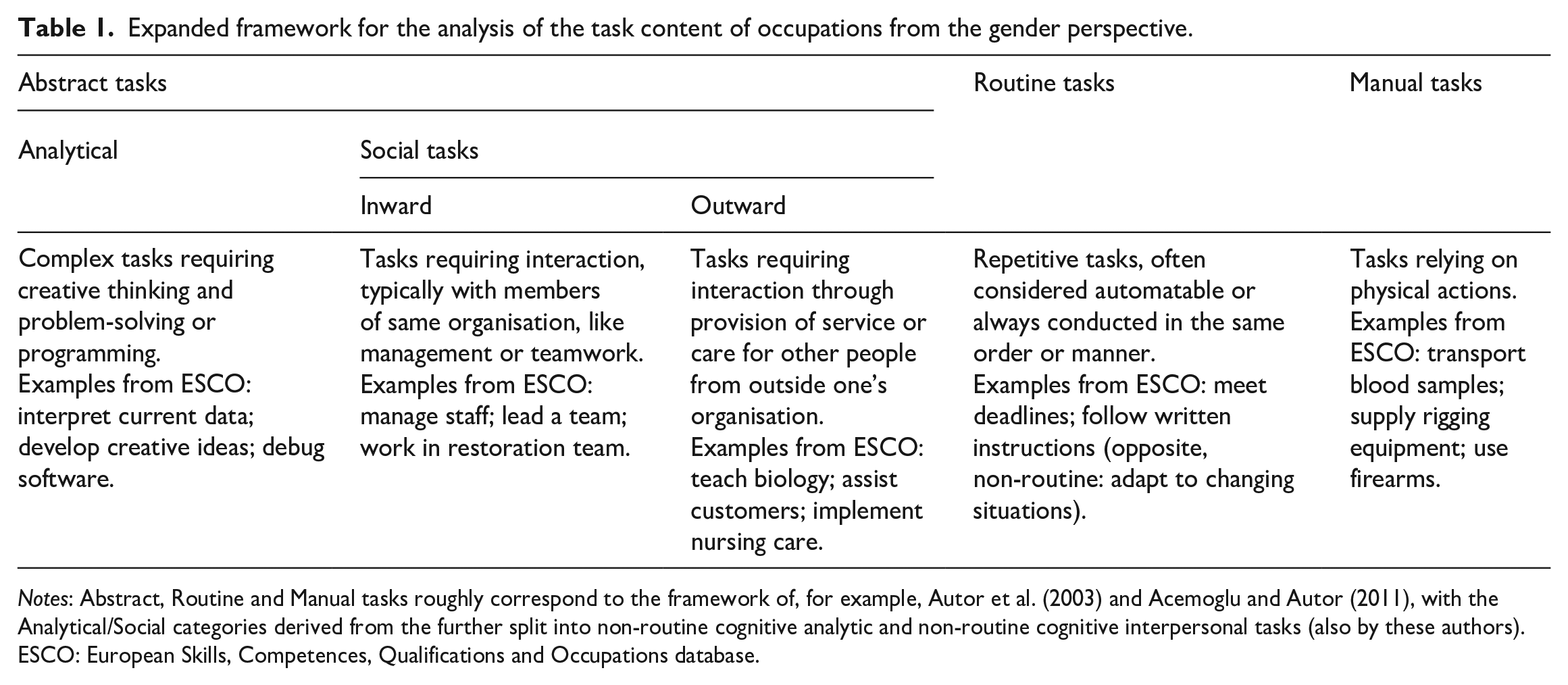
Notes: Abstract, Routine and Manual tasks roughly correspond to the framework of, for example, Autor et al. (2003) and Acemoglu and Autor (2011), with the Analytical/Social categories derived from the further split into non-routine cognitive analytic and non-routine cognitive interpersonal tasks (also by these authors). ESCO: European Skills, Competences, Qualifications and Occupations database.
Data
The European SES is an excellent source of data on earnings, hours worked and occupations as it is obtained directly from employers. It also contains information on worker characteristics (sex, age, education level, tenure, occupation, hours worked) and firm characteristics (size, economic sector, location). The data are reported to Eurostat every four years by EU Member States and countries belonging to the European Free Trade Association. The first available SES was done in 2002 and subsequent waves took place in 2006, 2010, 2014 and 2018. The database houses data on enterprises operating in the countries, exclusive of agriculture. The inclusion of public administration workers and workers in firms with fewer than 10 employees varies by country and depends on the collection instrument the governments employ. In the main sample, most countries included those workers apart from Denmark, France, Greece and Italy which did not include companies employing fewer than 10 employees and Denmark and Greece which did not cover public administration.
While SES offers numerous advantages, it also has limitations. First, there is no information on workers’ family characteristics, including partnership or parenthood status. Second, countries were allowed to report occupations using either two- or three-digit ISCO codes. Finally, SES has applied a new classification of occupations (ISCO-08) since the 2010 wave, and a direct one-to-one match between occupations before and after that date is not always possible.
Overall, our main analyses on SES data concern 12 countries which provided occupational data at the three-digit level (Bulgaria, Czechia, Denmark, Estonia, France, Greece, Italy, Latvia, Lithuania, Norway, Poland and Slovakia) observed in 2018. It also includes the UK, which at the time of this study provided data to Eurostat for 2014 but not for 2018. We excluded countries which used two-digit ISCO codes as we believed that aggregating data at the higher level would result in a substantial loss of information. We also dropped three countries – Cyprus, Luxembourg and Malta – which differ considerably from the rest of the EU in terms of the size and the structure of their economic activity. Details on country selection and sample size can be found in Table A1 in the online Appendix.
The second data source used in this study is the ESCO database. ESCO was created as part of a European Commission initiative to harmonise the definition of occupations across the Member States. The database contains information on the skills/competences, qualifications and attitudes required to perform each occupation. The data stem from various sources, including national classifications, online job ads and curricula. The first complete version of ESCO was released in 2017 and it has been updated continuously since. In this study, we use the ESCO version 1.0.8.
ESCO builds on the four-digit ISCO-08. At its most disaggregated level, ISCO-08 lists 436 occupations, which are further disaggregated into 2942 detailed occupations within ESCO. For example, the ISCO-08 code 2422 (policy administration professionals) has 14 sublevels in ESCO and these are further divided (e.g. the code 2422.10 – policy officer – has 15 sublevels ranging from agricultural to social services policy officer). Each ESCO occupation is described by a set of essential and optional skills, competences, attitudes and types of knowledge required. The adjective ‘essential’ serves to identify the core components of occupations, while ‘optional’ identifies context/industry-specific items. Notably, some items may be optional for some occupations but essential for others. In this analysis, the focus was set on the essential tasks (similarly to, for example, Zilian et al., 2021).
Measures of task content of occupations
The ESCO database was used to construct the measures of task content of occupations. These measures are replicable, and the respective codes will be shared through a data repository upon publication of this manuscript. In order to construct them, we utilised the information on ‘skills’ and ‘competences’ required to perform a certain occupation (such as ‘contact customers’, ‘forecast product demand’, ‘extinguish fires’) as well as the ‘attitudes’ (‘cope with pressure’, ‘willingness to learn’). The ‘required knowledge’ characteristics were not considered, as they are more concerned with the associated type of education. This approach is consistent with Acemoglu and Autor (2011), who interpret skills, competences and attitudes as an indication of tasks performed.
Overall, ESCO provides approximately 10,000 skills, competences and attitudes (hereafter called items). For the present research, 97% of them were grouped into four categories: (I) social (which we further split into inward and outward oriented), (II) analytical, (III) manual and (IV) routine (Acemoglu and Autor, 2011; Autor et al., 2006). The original definitions were followed as closely as possible: social tasks are those that are relevant for interpersonal interactions; analytical tasks are those connected to the mental process used to solve problems and digital skills; manual tasks refer to those that have a space-based component, such as driving, handling products or repairing; and routine tasks are those that are sufficiently well-understood so that a machine could be programmed to execute them. Consistent with the past literature, the routine content of an occupation identifies not only routine tasks, but also reflects how tasks are executed (Fernández-Macías and Bisello, 2022). Variables were identified within ESCO to show the non-routineness of occupations, particularly when defining competences (e.g. whether jobs require one to show adaptability or cope with uncertainty).
Following the classification of the skills/competences and attitudes, the measures of the task content of occupations were constructed. This involved three steps. The first was to determine how many of the skills/competences and attitudes grouped into a given category were essential to perform a given occupation. On average, 20 items were available within each occupation, though there was large variation across occupations. Second, the measures were aggregated to the three-digit ISCO-08 level so that they could be linked with the SES data. The aggregation was handled stepwise. The task content was computed first at the lowest ESCO level. The task content at the immediately higher level of the ESCO classification is an average from all occupations that appear below it. Once the task content for each occupation was obtained at the second lowest level, the procedure was repeated at the third level until the ISCO-08 three-digit level was reached (three steps). Our approach is summarised by the below equation, where

Hence, the task content in occupation o is a weighted sum of the task content in each occupation (j,k,l) listed at the lower level. Additionally, the non-routine task content was deducted from the routine task content to arrive at an aggregate routineness measure.
Finally, the measures were standardised in order to facilitate the interpretation of findings. The standardisation was done using data from all EU countries, not only those present in SES. This approach is consistent with how ESCO was conceived and allows a direct comparison of coefficients across tasks and samples. The standardisation was performed using weights computed from the 2018 EU LFS (for Poland we used the national 2018 LFS as the EU LFS for this country contains less detailed occupational information). In all further discussions and analyses, a one-unit difference of a task measure should be interpreted as a difference in one standard deviation from the average of (most) EU workers in 2018.
Figure 1 presents the average task content for different occupations in the EU. Analytical and social tasks proved to be most commonly performed in occupations at the top of the occupational hierarchy (ISCO codes 1–3: managers, professionals and associated technicians). Routine task content is particularly high among clerical workers (ISCO code 4), but also in sales occupations (ISCO code 5) and for most plant and assembly line work (ISCO code 8), most craft and related trades work (ISCO code 7) and some elementary occupations (ISCO code 9). Finally, manual tasks are most common at the bottom of the occupational hierarchy (ISCO codes 6 and higher and, in particular, 9).
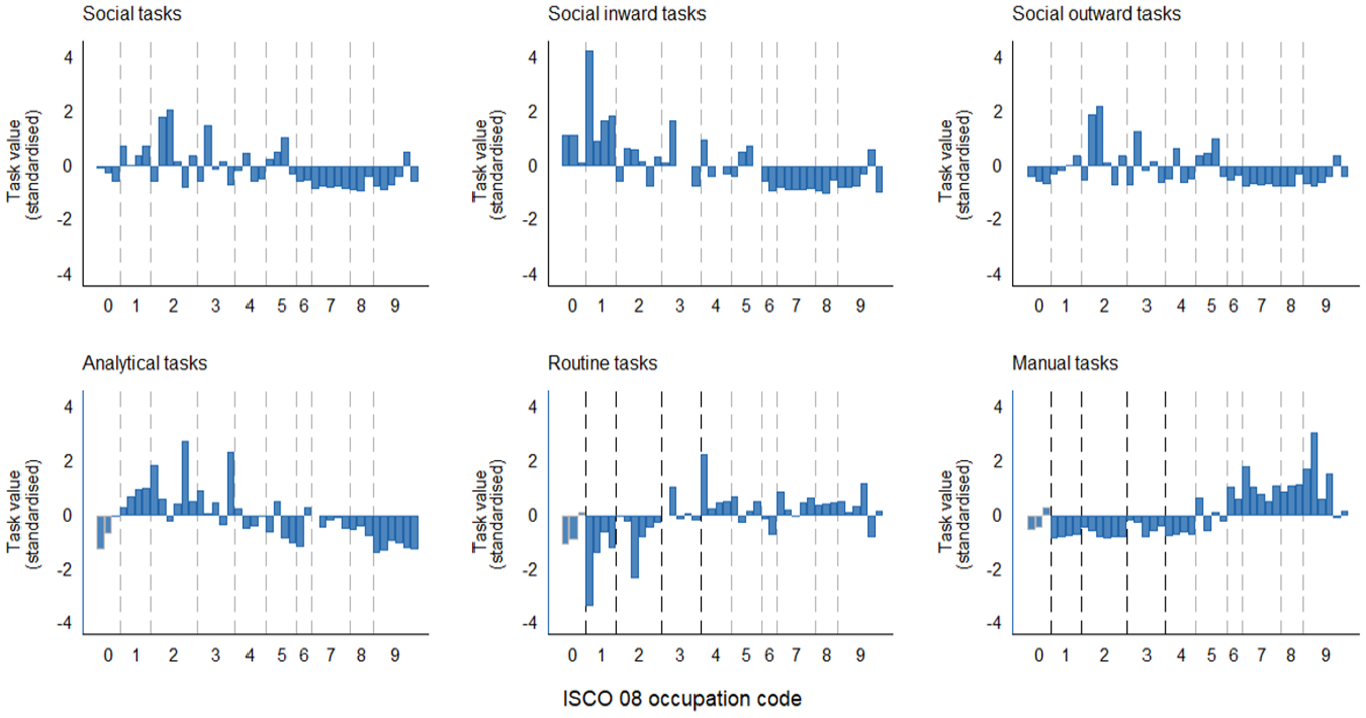
Task content of occupations by two-digit ISCO-08 codes, European Union 2018.
After the measures were constructed, two validation tests were done to minimise the risk that some of the items were erroneously categorised. For the first test, experts in the field of task content of jobs were asked to classify 30 randomly selected ESCO items into one of the four categories: analytical, social, routine and manual. Five experts, who remain anonymous, responded. The percentage of agreement came in above 60%. This was twice what would be expected by random chance alone, which is why the initial classification remained unchanged.
Second, the constructed measures were compared with those proposed by Acemoglu and Autor (2011), which were based on the O*NET occupational data. To this end, their classification was mapped to EU LFS (2018) data. The correlations between our measures and those based on O*NET range from 0.47 for routine tasks to 0.71 for manual tasks (see Table A2 in the Appendix). In general, these correlations are similar or higher than those obtained by Autor and Handel (2013), who compared O*NET-based measures with the measures based on US Princeton Data Improvement Initiative (PDII) data, as well as by those obtained by De La Rica et al. (2020), who correlated the O*NET-based measures with measures constructed using data from the Survey of Adult Skills (PIAAC). These relatively high correlations suggest the measures used for this article can be viewed with confidence.
Models
Once the task measures were constructed, they were linked with the microdata from the EU SES using data on occupations coded at the three-digit ISCO-08 level. These data were used to first evaluate returns to tasks and second to assess gender differences in the task content of occupations.
To determine wage returns, linear regression models were estimated using ordinary least squares, with log hourly wages as the dependent variable, and the constructed task measures and a set of controls (enumerated below) served as covariates. Two models were estimated, depending on whether social tasks were considered jointly (Model 1a) or whether a distinction was made between social inward and outward tasks (Model 1b). Gender differences in wage returns were also examined. To this end, the task content of occupations was interacted with worker’s gender (Models 2a and 2b).
Next, whether occupations performed by men and women differ in their task content was studied. To this end, the occupational task measures were treated as dependent variables and regressed against gender and a set of control covariates using linear regression. One regression was estimated for each task measure, yielding a total of six models (Models 3a–3f).
The set of control covariates in each of these models (1a–3f) includes worker-specific characteristics – gender, age, education level and tenure, and job-related characteristics – type of contract (full-/part-time), sector, firm ownership (public/private) and firm size. All regressions include country fixed effects. In the case of wage regressions, the proportion of women in an occupation was also controlled (derived from the SES data) as past research demonstrated that female-dominated occupations tend to pay lower wages (Leuze and Strauß, 2016; Magnusson, 2008). Following Moulton (1990), the standard errors were clustered at the occupation level.
Results
Wage returns to occupational tasks
The findings, based on the pooled sample of 13 European countries (Models 1a and 1b), suggest workers gain positive wage returns to analytical tasks but negative to routine and manual tasks (see Table 2 and Table A3 in the Appendix for the full model estimates). An increase in the analytical task content of an occupation by one standard deviation (SD) leads to an increase in the wage premium by 5.1% (which corresponds to exp(0.05)). At the same time, a similar increase in the routine or manual content of an occupation reduces wages by around 6.5%. Only social tasks do not command a wage premium/penalty. Closer investigation reveals, however, that aggregation of social tasks into a single category conceals important differences in wage returns to inward social tasks and outward social tasks. Inward social tasks generate neither wage premiums nor penalties, but outward social tasks accrue wage penalties. Overall, only analytical tasks bring positive wage returns, while the returns to social tasks depend heavily on their type with outward social tasks generating wage penalties.
Wage returns to occupational tasks on the pooled sample (total and by gender), coefficients estimated using SES 2018.
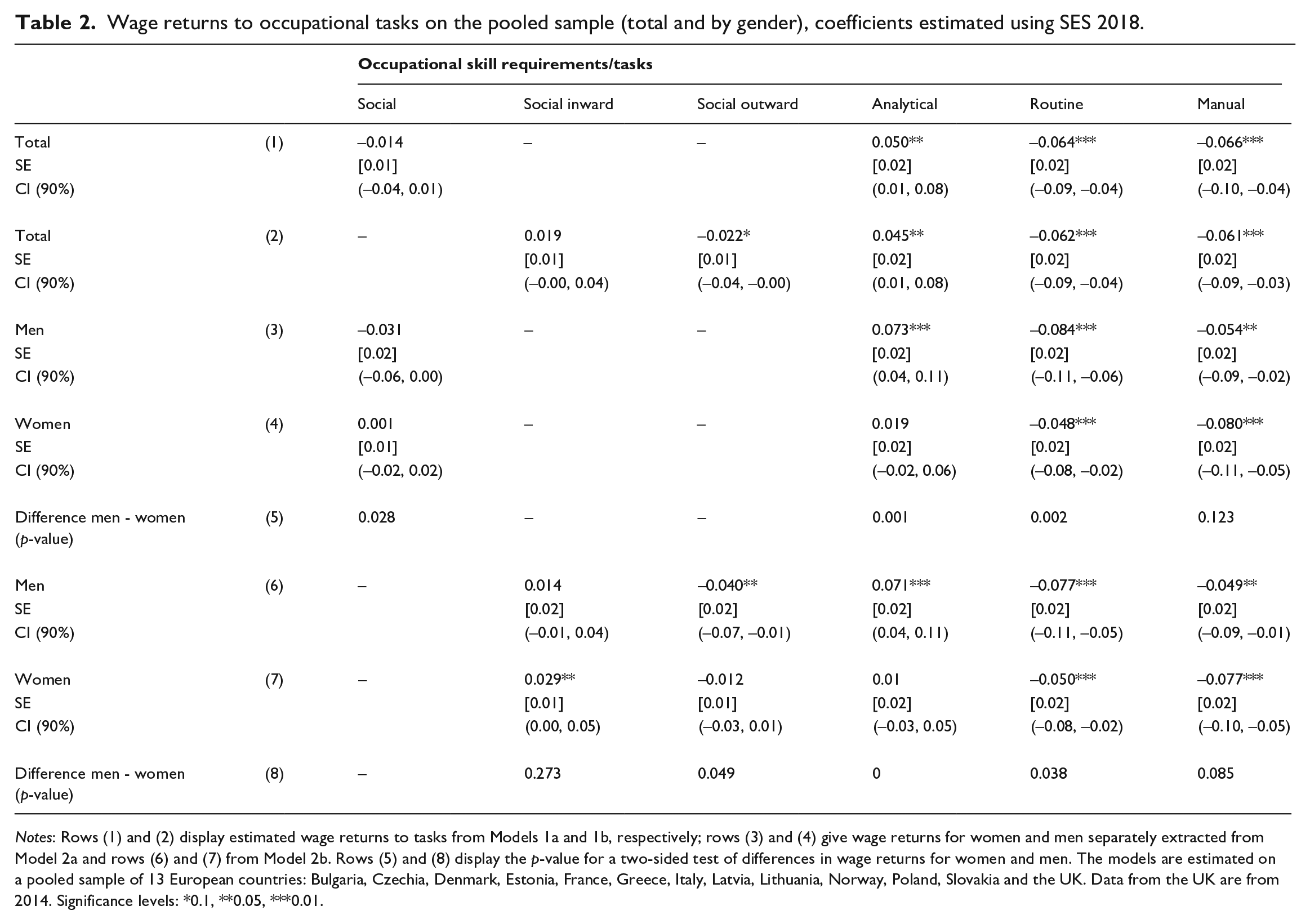
Notes: Rows (1) and (2) display estimated wage returns to tasks from Models 1a and 1b, respectively; rows (3) and (4) give wage returns for women and men separately extracted from Model 2a and rows (6) and (7) from Model 2b. Rows (5) and (8) display the p-value for a two-sided test of differences in wage returns for women and men. The models are estimated on a pooled sample of 13 European countries: Bulgaria, Czechia, Denmark, Estonia, France, Greece, Italy, Latvia, Lithuania, Norway, Poland, Slovakia and the UK. Data from the UK are from 2014. Significance levels: *0.1, **0.05, ***0.01.
Wage returns to occupational tasks depend on workers’ gender (Models 2a and 2b). Women do not receive any wage premium for working in occupations featuring analytical tasks. In this respect, the situation of women stands in clear contrast to that of men, for whom one SD increase in the analytical content results in a wage increase at 7.5%. At the same time, women are better rewarded for social tasks than men. While inward social tasks bring wage premiums for women at the level of 2.9%, they do not appear to be related to men’s wages. The social outward task content drags down wages for men, whereas for women the relation is much weaker and not statistically significant. Men are also more penalised for working in more routine occupations than women. Women appear to have lower returns to manual tasks, but the difference is only marginally significant.
Gender differences in tasks
Whether the growing demand for social and analytical tasks and declining demand for routine and manual tasks will benefit women or not depends not only on wage returns to tasks but also on how frequently women perform certain tasks in comparison with men. The latter question is addressed here by referring to the estimates from Models 3a–f (see Table 3 for the main findings and Table A4 in the Appendix for the full model estimates).
Gender differences in task content of occupations, coefficients estimated based on SES 2018.
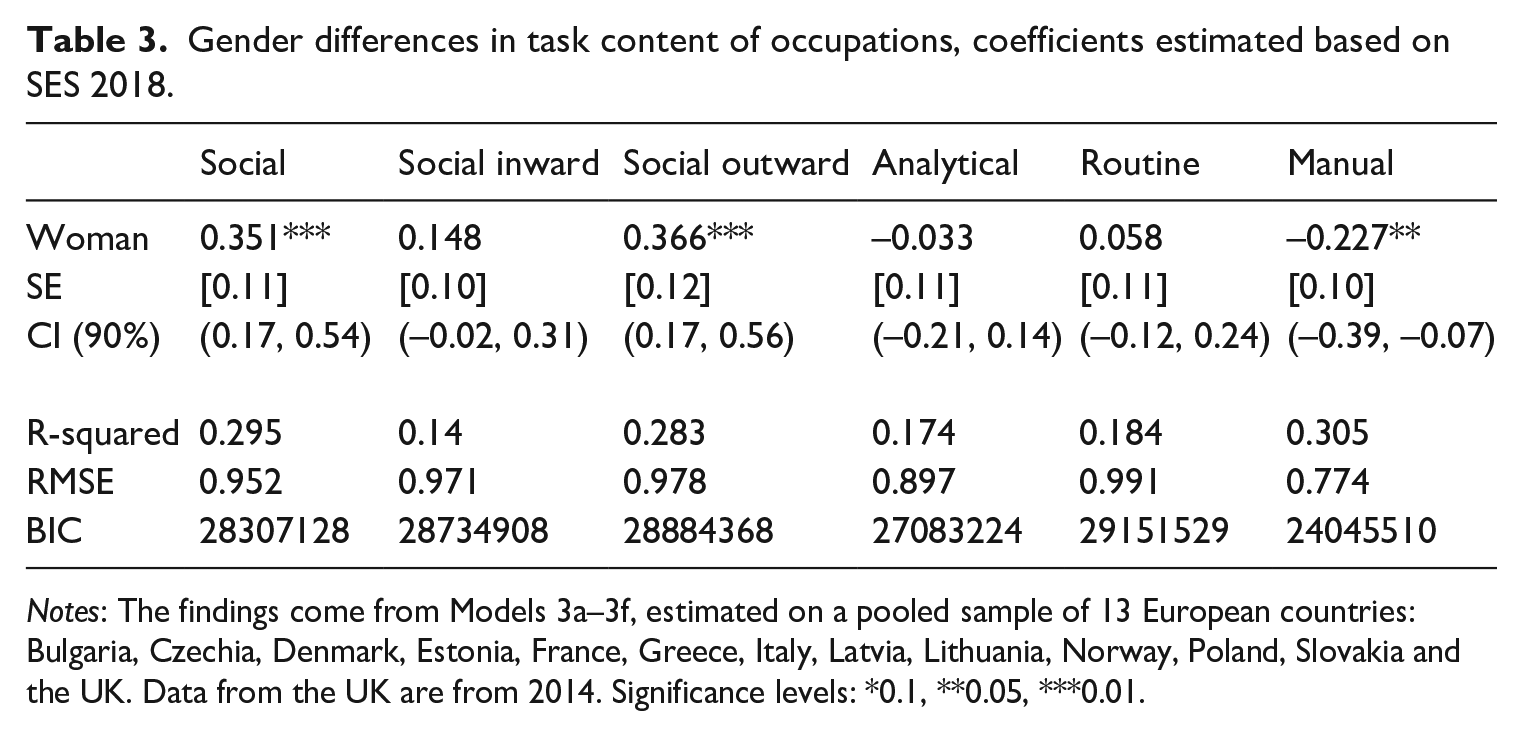
Notes: The findings come from Models 3a–3f, estimated on a pooled sample of 13 European countries: Bulgaria, Czechia, Denmark, Estonia, France, Greece, Italy, Latvia, Lithuania, Norway, Poland, Slovakia and the UK. Data from the UK are from 2014. Significance levels: *0.1, **0.05, ***0.01.
In contrast to past studies, this one did not find that women were more present in occupations with high routine content (i.e. occupations most exposed to automation and offshoring). In fact, the risks were the same for women and men. This finding puts men at a disadvantage relative to women given that men experience stronger wage penalties for working in routine occupations than women. Furthermore, women clearly benefit from being less likely than men to work in occupations with high manual content which is negatively related to earnings. However, women are overrepresented in occupations that prominently feature outward social tasks, which bring them no wage returns. No gender differences were observed in the frequency of working in occupations featuring analytical tasks and inward social tasks. The latter finding suggests that women do not reap the benefits they could potentially win from working in occupations featuring inward social tasks which offer them the highest wage returns.
Heterogeneity analysis
In this section, two potential sources of heterogeneity in our findings were explored: variation across countries and over time. Models 2a and 2b (wage regressions) were expanded to include interactions between the dimension of interest (country and year fixed effects). The resulting regressions then included a three-way interaction: task × gender × country/year. In the case of gender differences in tasks, Models 3a–f were expanded to include two-way interactions between gender and country/year.
The results for heterogeneity across countries are presented in Figure 2 (wage returns) and Figure 3 (gender differences in tasks). Figure 2 revealed that wage returns observed in the pooled sample were consistent within countries as well. Social inward tasks did not bring significant returns in most countries. Only in Denmark, France, Greece and Norway were the returns positive. Social outward tasks were associated with either no returns or slightly negative returns for men and women alike, except for Czechia and Poland, where women received slightly positive returns. Finally, the point estimates of wage returns for analytical tasks were higher for men than for women in all countries but Czechia, Denmark and the UK, where gender differences in wages were not statistically significant. Analytical tasks resulted in null wage returns for women in most countries except for the three Central and Eastern Europe (CEE) countries (Bulgaria, Czechia and Slovakia) where they yielded wage premium, and Greece and Italy, where, surprisingly, they resulted in wage penalties. Finally, routine and manual tasks largely yielded negative wage returns for both women and men in the vast majority of the countries. Men were slightly more penalised for routine work than women in Bulgaria, Czechia, Denmark, France, Norway and Poland; and less penalised for manual tasks in Estonia, Greece, Italy and Latvia.
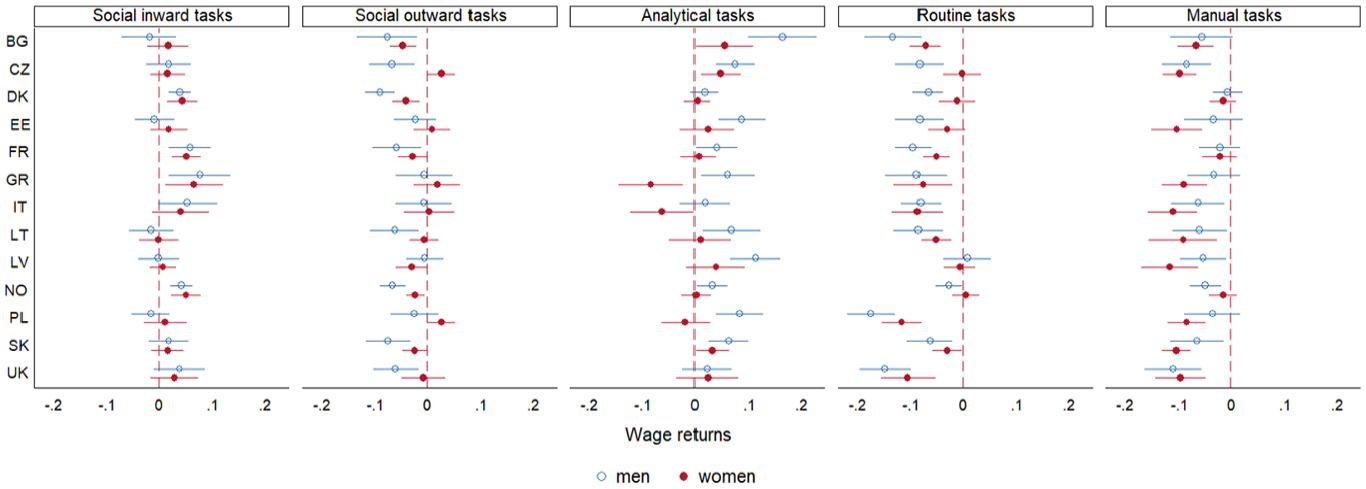
Wage returns to occupational tasks by gender and country in 2018, 90% CI.
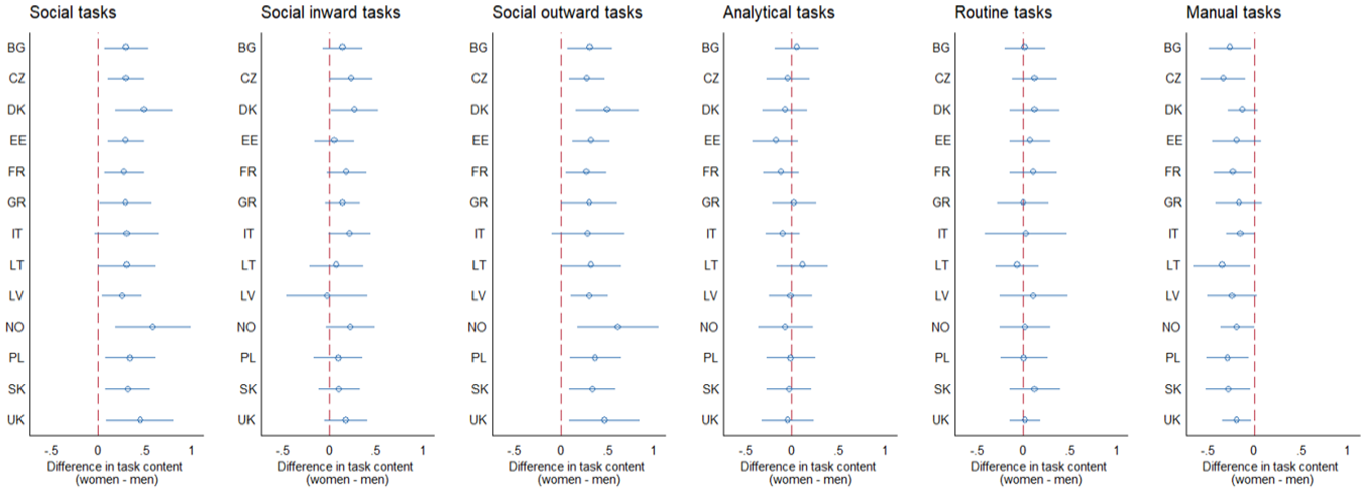
Gender differences in occupational task content by country in 2018, 90% CI.
Figure 3 showed that gender differences in tasks were homogeneous across European countries. In all cases, women worked in occupations that had a higher social content, a difference driven by social outward tasks (except for Greece, Italy and Latvia). We did not find gender differences in the analytical and routine content of occupations in any country. Women usually worked less often in highly manual occupations, apart from in Denmark, Estonia, Greece and Latvia, where no gender differences were observed.
Aside from differences across the countries, our research also examined evolution over time. Given that SES is collected every four years since 2002, the trajectories of wage returns and gender differences in tasks can be seen over the previous 16 years. Analysing changes over time added two layers of complexity, however. First, only a few of the countries – Bulgaria, Czechia, Estonia, Latvia, Lithuania, Poland and Slovakia, all located in CEE – collected detailed data on occupations in every fourth year. While the results from the previous analysis suggested that cross-country heterogeneity was moderate, extrapolating the results to other countries should be done with care. Second, a new classification of occupations was introduced in 2008, creating two separate samples. One, covering the 2002–2006 period, employed the old ISCO-88 classification; while the most recent sample (2010–2018) employed the new ISCO-08 classification. Given the changes in the classification, coefficients from the two periods are not directly comparable.
Figure 4 presents the evolution of returns to different tasks over time, and Figure 5 presents the evolution of gender differences in tasks. In both cases, remarkable stability is observed. In spite of structural transformation, there was no evidence that returns to tasks changed much over time, either for men or women. Moreover, gender differences in tasks were constant. Women performed more outward social tasks and fewer manual tasks in every sample year. No gender differences in social outward tasks and analytical tasks were found over time. In contrast to reports elsewhere in the literature, our study did not find that women performed more routine tasks in the earlier years.
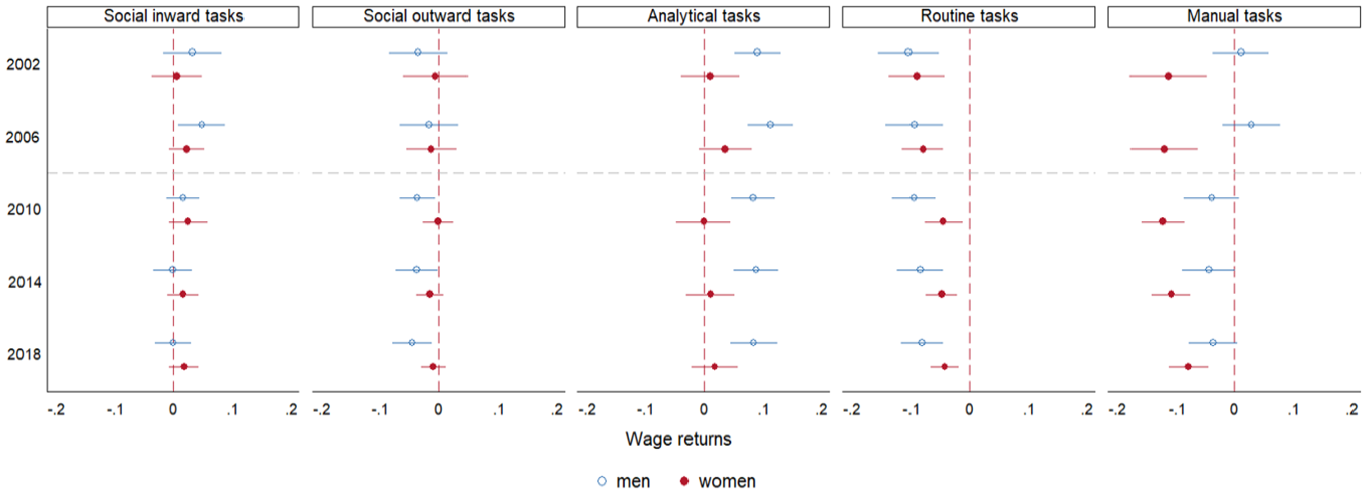
Evolution of wage returns to tasks over time, 90% CI.
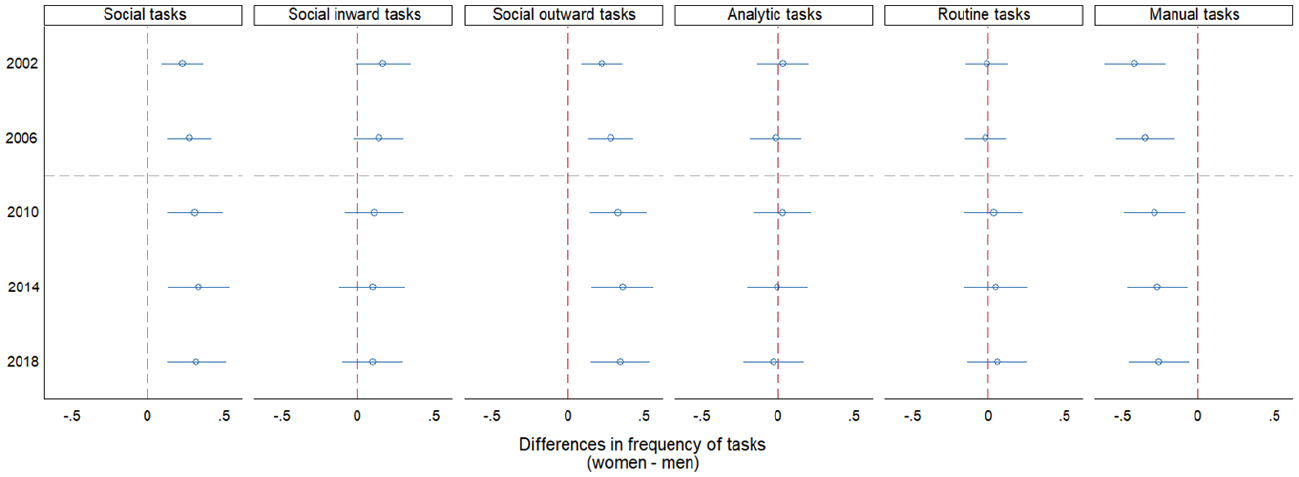
Difference in predicted task content of occupations by gender over a calendar year.
Care versus managerial tasks
This study divided social tasks into outward and inward tasks to assess women’s opportunities in the labour market. One may wonder, however, whether our conclusions would hold if the study concentrated directly on care-related and managerial tasks instead of examining the broader categories of outward and inward social tasks. In order to verify it, the Models 2b, 3b and 3c were re-estimated but inward social tasks were replaced with managerial tasks and outward social tasks with care tasks. The estimated coefficients for both outcome variables, gender differences in tasks and wage returns are presented in the Appendix in Table A5. The patterns observed earlier were even more pronounced when these narrower definitions were applied. Women more often worked in occupations requiring more ‘care’, but less often in those requiring more ‘management’. In terms of rewards, ‘care’ tasks generated negative wage returns, with the penalty being stronger for men, and null for women. On the other hand, lower returns to ‘management’ tasks were observed when women perform these tasks, though the coefficient is not precisely estimated. These results confirm past findings from the US (Levanon and Grusky, 2016; Liu and Grusky, 2013).
Discussion
There is a body of research, largely done in the US, that argues that women will benefit from structural change in the labour market thanks to the increasing role that social tasks, occupied predominantly by women, will play, and the declining importance of manual tasks, which are more commonly done by men. This study tests this argument in the context of EU countries, primarily by two means. The first is by extending the standard framework of the task content of occupations to account for the gender perspective. The second is through the development of measures of occupational task content based on EU-specific data on occupations and their respective skill needs, which are more suitable for analysing the continent.
In contrast to studies for the US, the present study provides only partial evidence that the structural labour market change benefits women’s earnings. Women working in low- and middle-skilled occupations can indeed make inroads relative to men as they are less likely to perform occupations geared around manual tasks, and they tend to be penalised less for working in occupations dominated by routine tasks. Overall, it seems that if occupations built around routine and manual tasks are shrinking or wage returns to these tasks fall, women’s earnings are less likely to suffer from these changes than men’s. This conclusion pertains to most of the countries analysed in this study except for Greece and Italy, the two Southern European countries and Estonia and Latvia, two Baltic countries. In these four countries, women appear to be most threatened by the ongoing changes as they face stronger negative wage returns to manual tasks and, moreover, do not get less penalised than men for doing occupations intense in routine tasks.
At the same time, women working in high-skilled occupations are susceptible to losing out due to the ongoing changes in the labour market. First, in contrast to men, they do not experience positive wage returns to analytical tasks. An extreme example comes from Italy and Greece, where women are even penalised for working in occupations built around analytical tasks. Second, the findings of this study throw into question whether women will benefit from the expansion of social tasks, which clearly pay women lower wage returns than analytical tasks pay men. Furthermore, women more often work in occupations which involve outward social tasks, often resulting in wage penalties. These findings hold for most of the countries studied, apart from Czechia and Poland, where outward social tasks generate positive wage returns for women.
Overall, highly skilled women appear unlikely to benefit from the structural labour market change in terms of earnings unless they experience an increase in wage returns to outward social tasks or analytical tasks. Theoretically, growing demand for childcare, elderly care or healthcare should increase wages in the care sector. Whether this will indeed happen is questionable, however, given that care work has been traditionally low paid (England, 2005; England et al., 2002). It is also difficult to say whether women will experience an increase in wage returns for women doing analytical tasks as our study provides no explanation on why analytical tasks pay lower wages to women than to men. Is it because women perform different analytical tasks than men – which our data do not bear out – or that women are simply paid less for the same tasks?
Temporal changes in gender differences in wage returns to occupational tasks were also examined. Unlike in studies on US data, no changes in returns to tasks over time were found. However, these findings should be taken with caution. The period used in this study was much shorter than those in the American studies and our observation is blurred by changes in the occupational classification. Moreover, the estimates of time trends used here were obtained for a subset of countries for which information was available in every wave (mostly CEE countries). More research with better data – longer time series and larger country coverage – is still needed.
This study suffers from the same limitations as other studies of the task content of jobs. First, the focus is on occupational tasks but not on the actual tasks workers perform at their jobs. While occupations certainly are good proxies of what people do at work, studies have revealed substantial within-occupation heterogeneity in tasks (Autor and Handel, 2013). This study sought to overcome this problem by employing occupational data at the highest possible level of granularity. Second, the measure of task content used in this study does not vary over time. As such, the analysis of changes over time should be viewed with caution. Finally, our study focuses only on wages while the structural labour market change may affect women’s opportunities in the labour market in other respects; for example, the opportunity to find and maintain employment or have a high-quality job. Future research should address these aspects to obtain a more comprehensive picture of the impact of the labour market’s changing structure on women’s position in the labour market.
Besides these limitations, this study provides evidence that claims that women will benefit from the ongoing structural change in the labour market are overly optimistic, at least when it comes to earnings. In fact, it is women in highly skilled occupations who may lose from these changes relative to men. These claims should be verified in a more careful analysis of wage returns that applies a gender perspective. Such analysis could, for instance, involve more detailed task categories which account for the gender heterogeneity within existing tasks. The division between inward and outward social tasks proposed in this article is just a first step in this direction.
Footnotes
Acknowledgements
We would like to thank the employees of the Interdisciplinary Centre for Labour Market and Family Dynamics (LabFam) for their helpful comments at various stages of developing this study. We would also like to thank the anonymous experts who provided their feedback on the classification of the job tasks.
Data availability statement
The task measures constructed on the basis of the European Skills, Competences, Qualifications and Occupations (ESCO) database together with appropriate documentation are available from Zenodo https://zenodo.org/records/11092167. The microdata used in this study can be requested from Eurostat following the procedure explained under: https://ec.europa.eu/eurostat/documents/203647/771732/How_to_apply_for_microdata_access.pdf. The statistical code written to prepare and model these data is available from GitHub  .
.
Declaration of conflicting interests
The authors declared no potential conflicts of interest with respect to the research, authorship, and/or publication of this article.
Funding
The authors disclosed receipt of the following financial support for the research, authorship, and/or publication of this article: The study was prepared thanks to the financial support from the ERC Consolidator grant ‘Globalisation- and Technology-Driven Labour Market Change and Fertility’ (LABFER, grant agreement ID 866207) and the National Agency for Academic Exchange (NAWA) under the Polish Returns 2019.
Supplementary material
The supplementary material is available online with the article.