




Abstract
The adverse effects of COVID-19 on labour market outcomes are amplified by and partly attributable to the imposition of extreme mobility restrictions. While gendered disparities in job losses and reduction in working hours are demonstrated in the literature, is an informalization of employment observed, and is this phenomenon likewise gendered? This article analyses the Philippines, a country that imposed one of the world’s longest and strictest lockdowns, and specifically how its imposition affected informal employment. A conceptual and empirical distinction between compositional and survivalist informalization is proffered – the former referring to informality induced by changes in the size and composition of overall employment, and the latter referring to informality induced by the need to work owing to absent sufficient welfare support and precautionary household savings. Examining the regional variation in lockdowns as a quasi-experiment, results demonstrate that extreme lockdowns increased the probability of informal employment among employed women but not among employed men.
Introduction
The COVID-19 pandemic is unique in that broad and stringent mobility restrictions, which were not present in previous crises, were imposed. While general labour market outcomes (e.g. employment, labour force participation) have been analysed in the growing strand of the literature on the effects of COVID, the impact of extreme lockdowns on employment, independent of the pandemic’s blanket economic effects, have received little attention. Indeed, the pandemic caused what can be considered a ‘She-cession’ – that is, job losses disproportionately affected women across geographical and socio-economic contexts. In Latin America, 56% of job losses involved women and in most low and lower-middle income countries, working hours decreased disproportionately more for women (Cucagna and Romero, 2021; Maurizio, 2021). Among developed countries, job loss and a decrease in working hours were disproportionately higher among mothers, at least in part due to their increased care responsibilities (Del Boca et al., 2020; Dias et al., 2020; Qian and Hu, 2021). In many developing countries where informal employment constitutes a sizeable fraction of the employed population, informalization as a result of COVID-19 is thus far understudied (Jaga and Ollier-Malaterre, 2022).
Lockdowns were common at the onset of the pandemic. With sufficient information about the transmission channels and mortality incidence of the disease absent, many countries erred on the side of caution and imposed extreme mobility restrictions that were instrumental in taming initial COVID outbreaks (Pajaron and Vasquez, 2023). However, what exactly was restricted and how much these restrictions were enforced largely varied across countries. This article looks into the Philippines – widely reported by international media organizations as having imposed one of the world’s longest and strictest lockdowns, with severe mobility restrictions enforced by military and police forces (Olanday and Rigby, 2020; Reuters, 2020; See, 2021). In lockdown areas, all forms of public transport were stopped, offices and schools were entirely closed and recreational activities, such as going for a walk, were also banned. Notably, however, not all regions in the Philippines were affected by COVID at the same time, and with the same severity, given the country’s archipelagic nature. Thus, widespread regional lockdowns, solely determined by the national government, applied only to some regions, whereas others underwent less restrictive containment measures. The labour market implications of this spatial variation in the design and enforcement of lockdown policies are thus far barely explored.
While most people in employment are in informal employment, it is also appropriate to focus on informalization for two additional reasons. First, informal workers experience greater precarity and uncertainty, leading to lower financial satisfaction and overall well-being (Ferrer-I-Carbonell and Gërxhani, 2011; Webb et al., 2020). Second, economic response (e.g. ‘pump-prime’) policies during periods of crises may have unwarranted consequences on employment formalization, a policy goal of many developing countries. State deregulation succeeding the Global Financial Crisis is positively associated with the size of the informal economy and partly responsible for its growth in some countries (Kus, 2010). Despite COVID-19 lockdowns directly affecting an estimated 1.1 billion informally employed workers heavily concentrated in developing countries (ILO, 2020a), our understanding of informalization remains largely descriptive, with little evidence of its underlying determinants.
Looking back at previous economic downturns in developing countries is suggestive; there is some consensus that informal employment is countercyclical (Albertini et al., 2019; Colombo et al., 2019). Immediately after periods of banking crises in Mexico, Brazil, Costa Rica and Bolivia in 1994, as well as after the Argentinian peso crisis of 2001 and its 2002 spillover crisis in Uruguay, informal employment increased and remained persistently high for succeeding years (Colombo et al., 2019). The same is true during and after natural disasters (Mendoza and Jara, 2020; Pecha Garzón, 2017).
However, little is said as to why we observe such informalization and this article conceptually and empirically fills this gap by distinguishing two channels. First, compositional factors, namely the size and composition of overall employment, shapes informal employment rates. When overall employment decreases and formal employment decreases more than informal employment does, this results in a ‘mechanical’ increase in informal employment. Net of these ‘compositional effects’, however, the informal sector has long been pointed in the literature to play a cushioning role, especially in developing country contexts. When economic uncertainty is high and formal job opportunities are scarce, workers would rather work informally than be unemployed or inactive. More broadly, the informal sector becomes part of one’s ‘survival strategy’ in the absence of formal employment opportunities and government support in times of need (Macdonald, 1994).
Regarding gendered differences, women are disproportionately more likely to work informally during and after recessions. In many developing country contexts, there are more limited employment opportunities for older and lower-educated women in the formal sector (Floro et al., 2009). During periods of economic downturns, these opportunities are even scarcer (Floro et al., 2009; McCaig and Pavcnik, 2015). On the ‘supply’ side, the flexibility of working conditions in informal employment allows women, who bear the brunt of care work, to more easily balance work and family responsibilities (Finnegan and Singh, 2004; Rodin et al., 2012). Indeed, during and after the 1997 Asian Financial Crisis in South Korea, it was mostly older women who were pushed into informal employment since prevailing gender and family norms meant that formal work opportunities fell mainly to men and to younger women (Floro et al., 2009). Even in normal times, informal employment in developing countries is predominantly female-dominated (ILO, 2018).
In the earlier months of 2020, not only was the severity and contagiousness of COVID uncertain but also the length and tightness of ensuing lockdowns. These restrictions triggered significant disruptions in economic activity – the length (Coccia, 2021) and stringency (König and Winkler, 2021) of lockdowns have a negative effect on aggregate economic output. To contribute to a broader understanding of the labour market effects of lockdowns in countries with sizable informal sectors, this article analyses whether extreme lockdowns increase the probability of being informally employed and whether this effect varies by gender. Using data from 16 pooled quarterly Labour Force Survey (LFS) rounds from the Philippines since 2016, the article employs a two-way fixed effects difference-in-differences (TWFE DD) approach and compares the probability of informal employment in lockdown and non-lockdown regions before and during the lockdown.
The article’s contributions are threefold. First, it makes a conceptual and empirical distinction between compositional and survivalist factors as the underlying causes of employment informalization during the lockdown – a distinction that also applies to explaining informal employment dynamics in general. Second, it fills the gap in the literature on how state actions during crises enable gendered informalization (Hammer and Ness, 2021) by isolating the ‘lockdown effect’ from the other ‘recessionary’ effects of the pandemic. Finally, this article broadly speaks to the literature on how informally employed women bear the brunt of labour market consequences during periods of crisis and how women play a dual role as both workers and carers of first resort.
Literature review
Expansive and stringent lockdowns were periods of increased uncertainty that were inherently different from the uncertainty brought about by previous financial crises or natural disasters and weather shocks. There was unpredictability not only in terms of the contagiousness and severity of COVID but also in the length and stringency of extreme lockdowns. This section elaborates expectations of the patterns of informalization and its gendered dimensions. In so doing, a conceptual distinction is made between compositional factors and survivalist motives that drive the informalization process (Kalleberg and Vallas, 2017; Lee et al., 2020; Rogan et al., 2017).
Compositional factors encompass movements in the size and composition of overall employment – a reflection of the labour and capital structure where large swaths of the employed population are constrained in informal arrangements given low absorption in and intense competition for formal jobs. Survivalist motives, on the other hand, refer to the financial security that one gains from participating in the ‘shadow economy’, which encompasses informal work, rather than being unemployed or inactive. In many macro-level analyses, informal employment follows a countercyclical pattern: it increases when economic conditions are dire as it absorbs some workers who lose jobs in the formal sector (Colombo et al., 2019; Feridhanusetyawan and Gaduh, 2000; Fernández and Meza, 2015; Floro and Dymski, 2000; Nguyen and Su, 2022).
However, the notion that lockdowns consequently increase informal employment cannot be taken as given, considering that the size, nature and regulations governing informal work vary across countries. Contrary to earlier findings, Maurizio et al. (2023) demonstrate that during the COVID-induced contraction phase in six Latin American countries, informal employment exacerbated the decline in overall employment and did not play its usual countercyclical role. Further investigations in other contexts, as well as those that make a more nuanced distinction between the effects of lockdowns from that of COVID, might offer differing insights, including why informal employment responds as such.
How extreme lockdowns ‘informalize’ employment
There are multiple channels through which extreme lockdowns may affect informal employment including both compositional factors (macro-) and survivalist motives (micro-level behaviour). On aggregate, changes between employment and unemployment, as well as between formal and informal work, affect the overall size and composition of the workforce. It is reasonable to expect that stronger lockdowns, likely due to higher incidence of COVID-19, induce larger contractions in overall employment (Qian and Fan, 2020).
Suppose that due to an exogenous shock, the formal is more adversely hit than the informal sector. In this case, the decline in formal employment outweighs that of informal employment such that informal employment (as a share of the workforce) increases 1 even if the number of informally employed workers does not necessarily increase. One example is the case of Latin American countries where lockdowns amplified the decrease in regular employment in terms of working hours and actual number of jobs, but did not have an effect of the same magnitude on informal employment (Maurizio, 2021).
Since lockdowns impose mobility restrictions, those employed in home-based informal occupations, such as piece-rate and freelance workers, may find it easier to retain jobs rather than formal workers whose jobs require physical presence (e.g. retail services, hospitality and tourism, etc.) (ILO, 2020b; Maurizio, 2021). Meanwhile, self-employed individuals who typically rely on working outdoors (e.g. street vendors) face the risk of arrest if caught outside since these activities are prohibited during the lockdown. This ‘chilling effect’ of extreme lockdowns compositionally increases the probability of working informally if employment losses are more concentrated among the formally employed.
On the other hand, involuntarily displaced workers in the Philippines face a massive constraint: social assistance mechanisms are largely absent and precautionary savings are low. Under these conditions, many people cannot afford to be unemployed and would rather work informally instead, a mechanism classically referred to in the sociology literature as ‘survivalist motive’ (Lee et al., 2020) and in the economics literature as the ‘luxury unemployment hypothesis’ (Udall and Sinclair, 1982). Indeed, widely accessible insurance programmes are absent in the Philippines, although some institutionalized assistance programmes are present. 2 While there was a one-time cash transfer for poorer households at the onset of the pandemic, this was plagued by delayed distribution (Cervantes, 2020) and a relatively low payout. 3 Households are also beset by having insufficient savings due to the low average savings rate (~5%) of disposable income (Terada-Hagiwara, 2009).
The financial unpreparedness of many households in the Philippines to weather episodes of involuntary job loss means that many workers cannot afford unemployment and would rather take a job even if conditions are poor or informal. The survivalist motive also captures the flexibility advantage of informal work – since these are usually occupations with no fixed hours, workers can plan around a schedule that allows for balancing work and family responsibilities (Sarker, 2021; Singh and Kaur, 2022). Figure 1 summarizes compositional and survivalist informalization – two non-mutually exclusive mechanisms of employment informalization. In light of these factors, my prior expectations point to a lockdown-induced informalization warranting a test of this hypothesis:
H1: Extreme lockdowns increase the probability of informal employment, conditional on being employed.
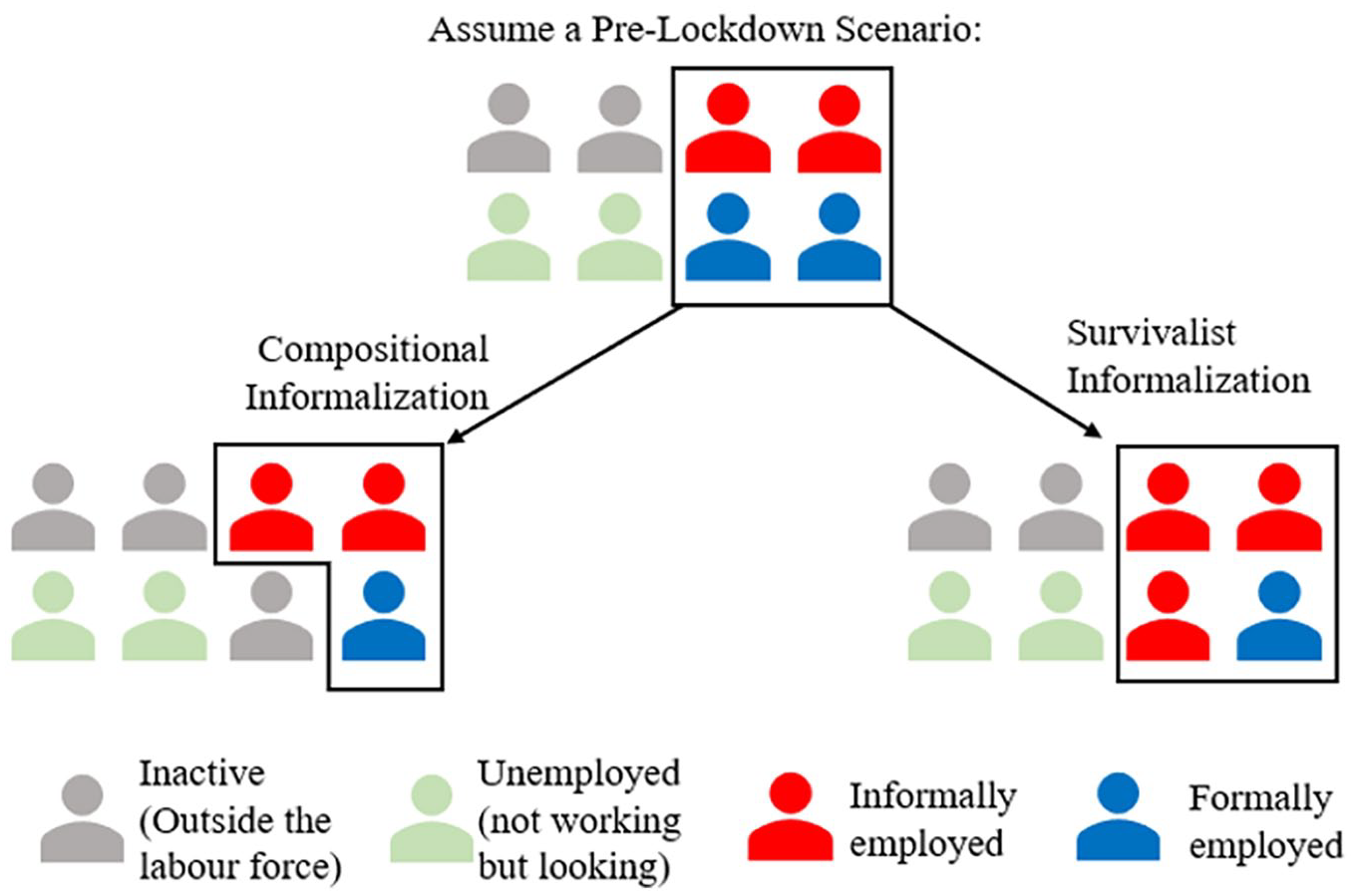
Compositional and survivalist employment informalization.
How ‘informalization’ is a gendered phenomenon
The literature on the COVID-19 ‘She-cession’ demonstrates the gendered effects of the pandemic across geographical and socio-economic settings. In both developed and developing countries, job losses and decreases in working hours were disproportionately higher for women (Cucagna and Romero, 2021; Del Boca et al., 2020; Dias et al., 2020; Ducanes and Ramos, 2023; Fan and Moen, 2022; Maurizio, 2021; Yavorsky et al., 2021). Among the most prominent explanations is that despite the increased involvement of fathers in housework during the pandemic, increased care responsibilities were disproportionately shouldered by mothers (Collins et al., 2021; Craig and Churchill, 2021; Kreyenfeld and Zinn, 2021; Yaish et al., 2021). In the Philippines, empirical evidence suggests that household responsibilities are performed predominantly by women (Bayudan-Dacuycuy and Dacuycuy, 2017).
Informal employment and gender are closely intertwined subjects in developing countries: in Sub-Saharan Africa, 89.7% of employed women are informal and in Latin America, Southeast Asia and South Asia, informal employment rates are higher for women (ILO, 2018). Rodin et al. (2012) find that the majority of informally employed women are involuntary and constrained by family responsibilities – they would have preferred a more stable formal job had there been an opportunity. In the Philippines, Gaerlan et al. (2011) find that the flexible nature of informal work for female garment workers allows them to combine multiple sources of income since one job alone cannot sufficiently pay for the entirety of household expenses.
Since informal employment has fewer barriers to entry, informal workers would likely want to continue working at the height of the lockdowns, especially in the absence of social protection mechanisms and with fewer opportunities in the formal sector. Ogando et al. (2022) find that in 12 cities with large rates of informality, the paid and unpaid work that informally employed women did during the pandemic served as ‘shock absorbers’ and coping mechanisms. Broadly, this survivalist motive among informally employed women is both an ‘exercise of agency to improve living conditions’ (Lee et al., 2020) and a manifestation of their dual role as workers and carers of first resort. During uncertain times when there are pronounced threats to economic survival, women with the survivalist motive in mind simultaneously perform paid and unpaid work rather than trading off one for the other.
The informalization of women’s work when the economy is dire is not unprecedented. Floro and Meurs (2009) show that female informal employment rates in South Korea increased after the 1997 Asian Financial Crisis as formal job opportunities fell mainly to men. This effect is more pronounced for older women since men and younger women tend to accept lower wages. A similar increase in women’s informal employment was found in Indonesia, Mexico and Argentina during their respective episodes of financial crisis (Albertini et al., 2019; Feridhanusetyawan and Gaduh, 2000; Fernández and Meza, 2015). In terms of non-financial crises, weather shocks, which are common in Asia-Pacific countries including the Philippines, resulted to reduced wages and salaries for informal workers and lower income for the informally self-employed (Bayudan-Dacuycuy and Baje, 2019). Similarly, the probability of being informally employed rises in Ecuador after local earthquakes (Mendoza and Jara, 2020) and in Jamaica after hurricanes (Pecha Garzón, 2017).
On the other hand, informalization could also be more pronounced among males when considering a traditional breadwinner model in the Philippines (David, 1994) where males assume the sole responsibility of paid work whereas females assume unpaid care work. From a compositional perspective, if the shift from formal to informal male employment is larger in lockdown than non-lockdown regions, this would also induce a male-dominated informalization. Thus, it cannot be presumed that informalization is a women-only phenomenon, although prior evidence largely points to this direction. Thus, we test the hypothesis that:
H2: Extreme lockdowns increase the probability of informal employment more for women than men.
Data and identification strategy
Labour Force Survey
The LFS is a quarterly survey of around 40,000 households, representative at the national and regional levels in the Philippines. Absent administrative and panel data, the LFS is the most widely used data for many developing countries in labour market research. To sufficiently establish the trends in informal employment before the imposition of the extreme lockdown, the article uses quarterly LFS data since 2016 to restrict the sample to the then-incumbent administration that assumed office in June 2016.
The analysis is likewise restricted to regions that underwent a stringently imposed regional lockdown (‘treatment’) and those that did not impose any lockdowns at the regional level in favour of more targeted ones (‘control’). Many regions changed the lockdown status on 1 May 2020 and since the second quarter of the 2020 round of the LFS was conducted from 16 April to 8 May 2020, only regions that had a consistent classification throughout the survey period were retained in the sample. 4
It is important to establish that the ‘treatment’ (lockdown) is similar and comparable across all regions that were under regional lockdowns. Similarly, in the counterfactual analysis, the control group (no lockdown) does not imply the absence of any mobility restrictions but rather the absence of a regionally imposed extreme lockdown. Since the COVID-19 response in the Philippines at the onset is centralized, the design and implementation of these regulations are uniform across all lockdown regions. Table 1 summarizes the policy differences in effect at the onset of the pandemic (April to May 2020).
Comparison of measures in lockdown versus non-lockdown regions.
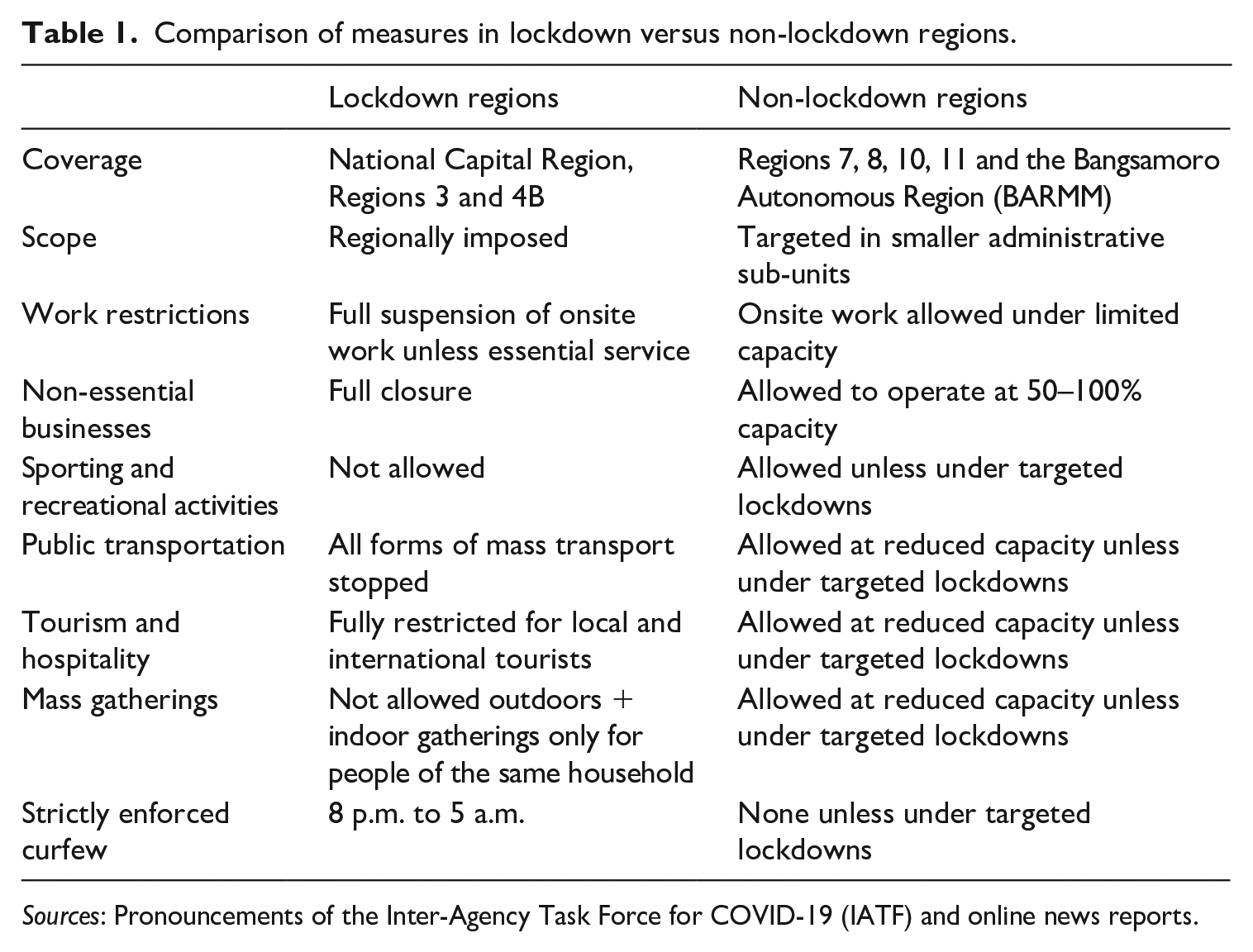
Sources: Pronouncements of the Inter-Agency Task Force for COVID-19 (IATF) and online news reports.
One important distinction between the lockdown and non-lockdown regions is that police and military enforcement is heightened and concentrated in lockdown regions. Hapal (2021) argues that the government’s approach at the onset of the pandemic is comparable to ‘waging a war’ but since ‘COVID is an unseen enemy’, policing was targeted towards violators of COVID restrictions. To show that this translated to different mobility changes between lockdown and non-lockdown regions, we verify, using Google Community Mobility Reports (Google LLC, 2021), that there was a larger average mobility reduction in lockdown regions during the conduct of the April 2020 round of the LFS. Appendix Figure A1.2 in the online supplementary material also shows that the gap between the lockdown and non-lockdown regions dissipated over time as restrictions became spatially granular and targeted.
Measurement and analytical sample
Given that the LFS is typically limited in capturing informal employment, the article relies on technical guidance from the ILO on measuring informal employment from LFS microdata (Simons and Lake, 2006). From a gendered perspective, household surveys are shown to disproportionately underestimate women’s labour market participation, as they tend to undercount intermittent, home-based and uncompensated work (Langsten and Salen, 2008). Despite these limitations, LFS remains a widely used data source to analyse labour market dynamics, including that of informal employment (Cabegin, 2018; Comola and De Mello, 2011).
Consistent with ILO guidelines, informal employment in this article encompasses non-professional, own-account workers and contributing family workers (in their own or another household) outside the agricultural sector and public sector. The ‘non-professional’ exclusion restriction prevents self-practising or freelancing professionals such as lawyers and accountants from being included in the definition. This type of self-employment, where invoices are typically issued and thus covered by taxation, is not informal by definition and thus makes the exclusion of professionals a reasonable restriction.
The agriculture sector is likewise peculiar because there is no consensus on what informality in this sector looks like, as confirmed by the International Conference of Labour Statisticians (ICLS) (Hussmanns, 2004). For instance, an own-account worker who is an employee of a trading agricultural cooperative is considered in informal employment if the said cooperative is an informal enterprise, which is loosely defined in the agriculture sector (ASEAN, 2019; Vanek et al., 2014). Finally, the public sector is also excluded because the nature of employment here is largely formal. These three exclusions are consistent with ILO recommendations and practices.
Beyond these formal measures, what does informal employment actually look like in the middle of the pandemic? In the adopted definition, non-professional self-employed individuals are classified as informally employed. This includes street vendors, non-registered online sellers and domestic care workers, among others, some of whom are able to keep their jobs during the lockdown. Those who were laid off may have also done informal online selling as an income-generating means of survival. 5
Consistent with official definitions, the sample is restricted to individuals 15 years old and above, also considering that there is no retirement age in the informal sector and informal old-age employment is prevalent in the Philippines at 52% (Racelis et al., 2012). The sample is also restricted to employment with positive working hours since at the height of the pandemic, some employed individuals whose basis of pay is daily or weekly were not asked to report to work and had no income. To the extent that employed workers do not work and have no income, employment status alone, without regard for actual work hours, becomes a poor indicator of labour market activity. The final analytical sample consists of 525,488 individuals over 16 quarters, and supplementary analyses demonstrate the robustness of results when these restrictions are relaxed.
Identification strategy
The presence of a uniform widespread lockdown in select regions and its absence in others make a differences-in-differences (DD) strategy suitable in determining the causal effect of extreme lockdowns on informal employment. Given non-random treatment assignment, DD can also be applied to repeated cross-sections assuming that compositional changes do not affect the variables of interest (Cunningham, 2021). The key identifying assumption is that of parallel trends – the outcome variables for both lockdown and non-lockdown regions must have been moving in a parallel manner before the lockdown. The empirical challenge arises from the inability to observe what informal employment in a region would have been had it not undergone a lockdown. Empirically, placebo regressions showing whether a ‘lockdown effect’ was present prior to the lockdown itself can be used to demonstrate parallel trends.
Given individual-level data from the LFS, the effect of extreme lockdowns on informal employment is estimated using a linear probability model, parsimoniously specified as follows:

where Y denotes informal employment, and LA and LP are binary variables indicating if the person was surveyed in a Lockdown Area and during the Lockdown Period, respectively. The coefficient of interest is

The two-way fixed effects estimator is used in DD set-ups to account for unobservable time-invariant heterogeneity as well as a group-invariant time effect (de Chaisemartin and D’Haultfœuille, 2020; Pajaron and Vasquez, 2023; Wooldridge, 2021). This is likely present in the set-up – where unobserved sociodemographic, economic and political variables may vary between lockdown and non-lockdown regions.
Results and discussion
Compositional changes in the labour market
Recognizing that the lockdown has affected the labour market at large, this section first contextualizes the changes within the employed population. During the lockdown quarter, the Philippines experienced a 21% drop in overall paid employment compared with the same quarter in the previous year, and these employment losses are pronounced in the entertainment (−50%), hospitality (−36%) and energy (−36%) sectors (Ducanes et al., 2021). Disaggregated changes in total employment based on lockdown status and gender show that, from a macro perspective, compositional changes in the labour market partly explain informal employment dynamics as theoretically outlined in the literature review section.
Figure 2 presents employment trends and compositional changes by lockdown status and gender and shows that total employment decreased during the lockdown period and the decline is more pronounced in lockdown areas. Disaggregating by gender, total employment had a steeper decline for workers in lockdown regions, with males being slightly more affected than females. This descriptive figure alone shows the stark and gendered impact of lockdowns on employment.
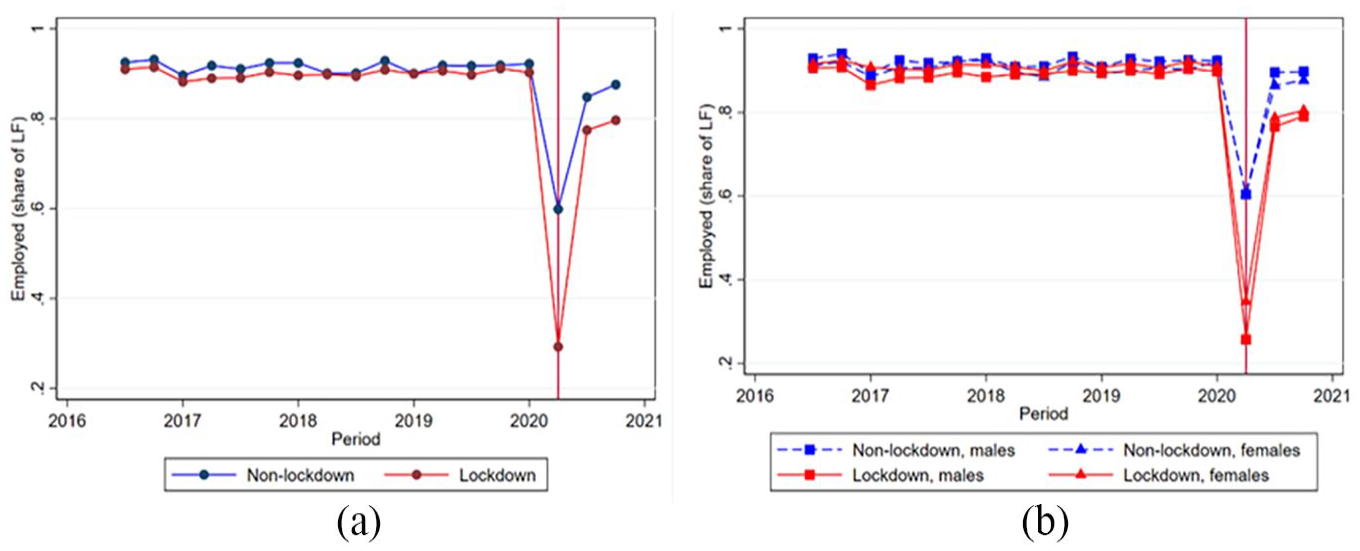
Quarterly employment rates, as a share of the labour force (LF), 2016 Q3 – 2020 Q2: (a) by lockdown status; (b) by lockdown status and gender.
However, the decrease in total employment is only one part of explaining compositional labour market changes. In Figure 1, compositional informalization occurs when the decrease in formally employed workers outweighs the decrease in informally employed workers. Disaggregating employment changes by type and lockdown status, Table 2 shows two prominent findings: (1) indeed, the overall decrease in formal outweighs that of informal employment; and (2) the decrease in formal outweighs the decrease in informal employment in non-lockdown areas.
Counts and percent change of employment by type and lockdown status.
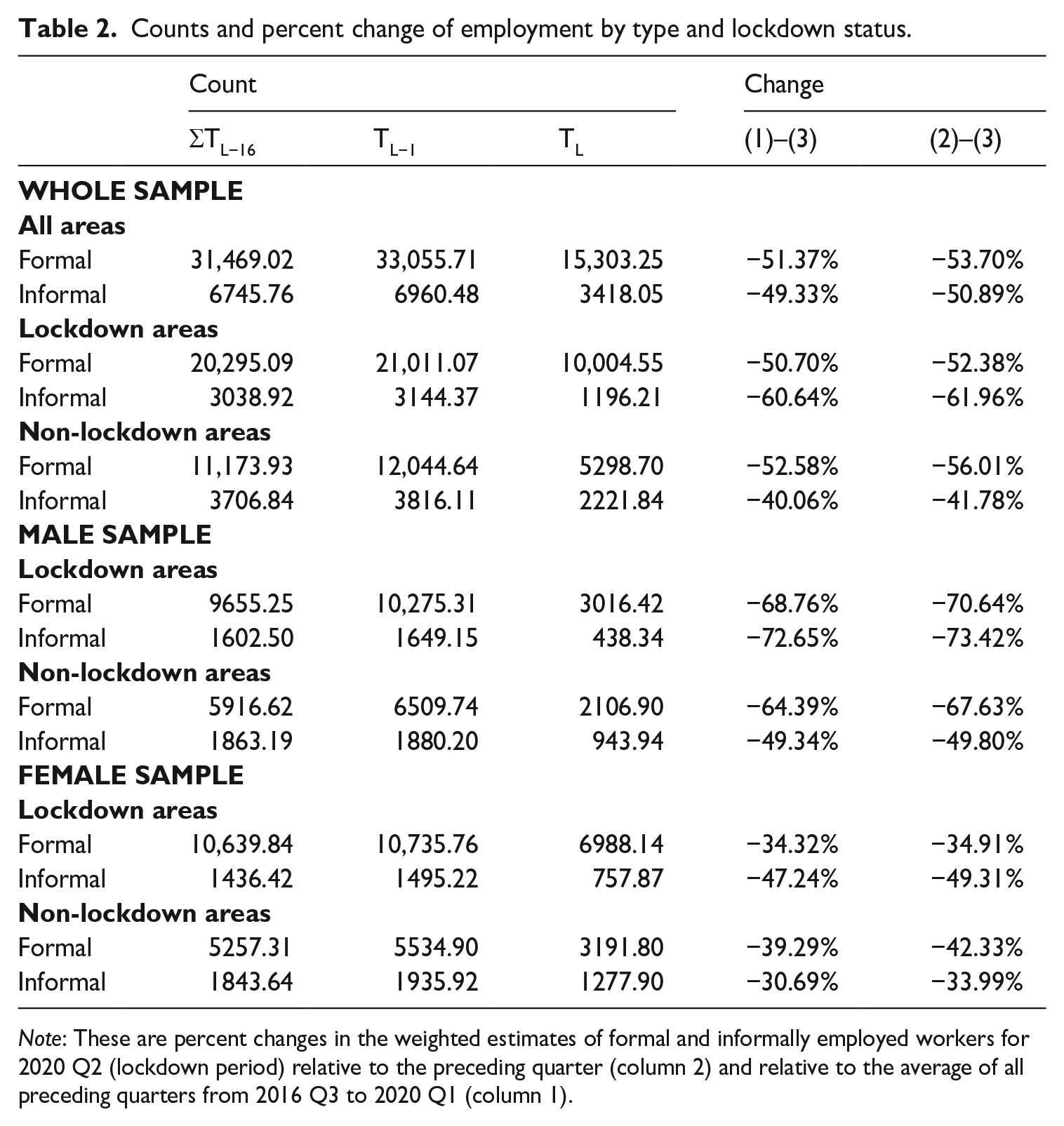
Note: These are percent changes in the weighted estimates of formal and informally employed workers for 2020 Q2 (lockdown period) relative to the preceding quarter (column 2) and relative to the average of all preceding quarters from 2016 Q3 to 2020 Q1 (column 1).
These compositional changes are not entirely surprising. Since lockdown areas are characterized by more severe mobility restrictions, the decline in total employment in these areas is inevitably larger. Regarding gendered differences, the larger decline of informally than formally employed females reflects the fact that traditionally female-dominated informal sectors, such as retail and other service work, had been more restricted during the lockdown (Ducanes and Ramos, 2023). Therefore, any gendered differences in informal employment are at least in part due to the gendered differences on who left and who stayed in the labour market during the lockdown. 6
Focusing specifically on the employed population, Figure 3 shows estimates of informal employment, as a share of total employment, over time. From mid-2016 to January 2020, informal employment rates for lockdown and non-lockdown regions moved in similar trends and, for the most part, in parallel. Informal employment rates steeply increased in lockdown areas during the imposition of the extreme lockdown. Disaggregating by gender, the trends confirm a common finding in the literature that in most developing countries, women have a higher share in informal employment (Cucagna and Romero, 2021; Floro and Meurs, 2009; Gaerlan et al., 2011; Horn, 2010). During the imposition of the extreme lockdown, it was women in lockdown regions who have experienced the steepest increase in informal employment rates, providing first-pass descriptive evidence of a gendered informalization.
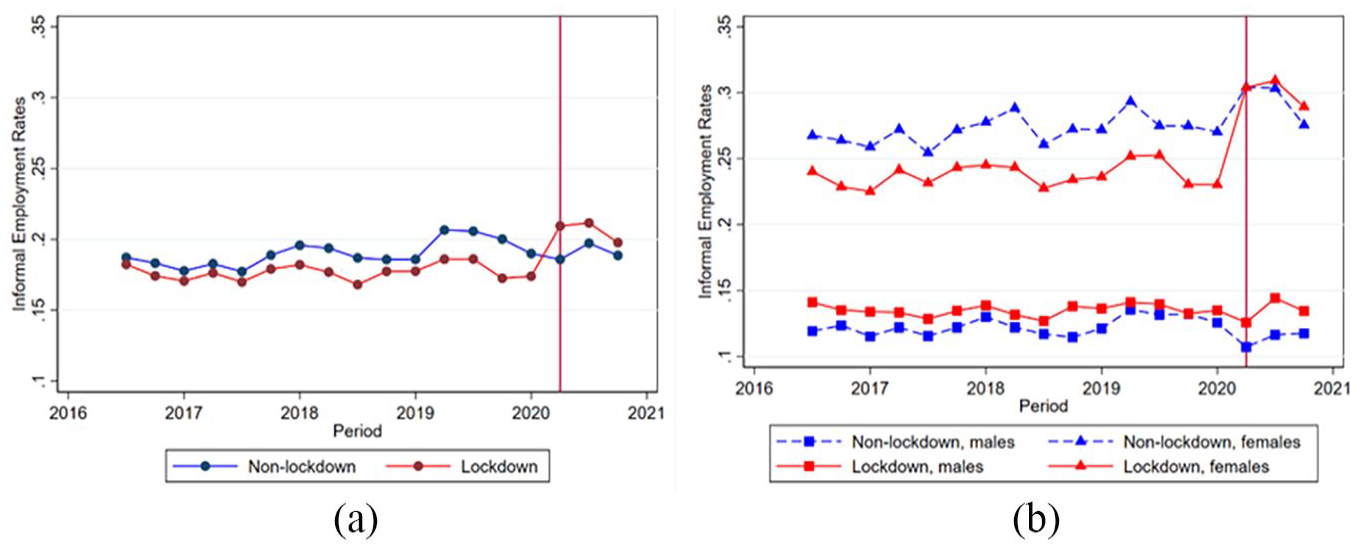
Quarterly informal employment, as a share of the employed population, 2016 Q3 – 2020 Q2: (a) by lockdown status; (b) by lockdown status and gender.
Figure 3 shows that the trends of lockdown and non-lockdown regions moved in parallel for the most part. While this is a ‘first-pass’ test of whether the parallel trends assumption of DD is met, additional placebo regressions are also conducted to check whether a ‘lockdown effect’ existed before the lockdown itself, which would invalidate our key identifying assumption. These placebo regressions are extensively used as sensitivity analysis and additional evidence for parallel trends in other DD studies (Clarke and Schythe, 2021; Correia, 2017; Lechner, 2010). Results of these analyses in Figure 4 show that pre-lockdown treatment effects are significantly close to zero for the most part, except for three quarters in 2018. Similar patterns also hold true by gender. These regressions include the relevant covariates in equation (2), including region and period fixed effects.
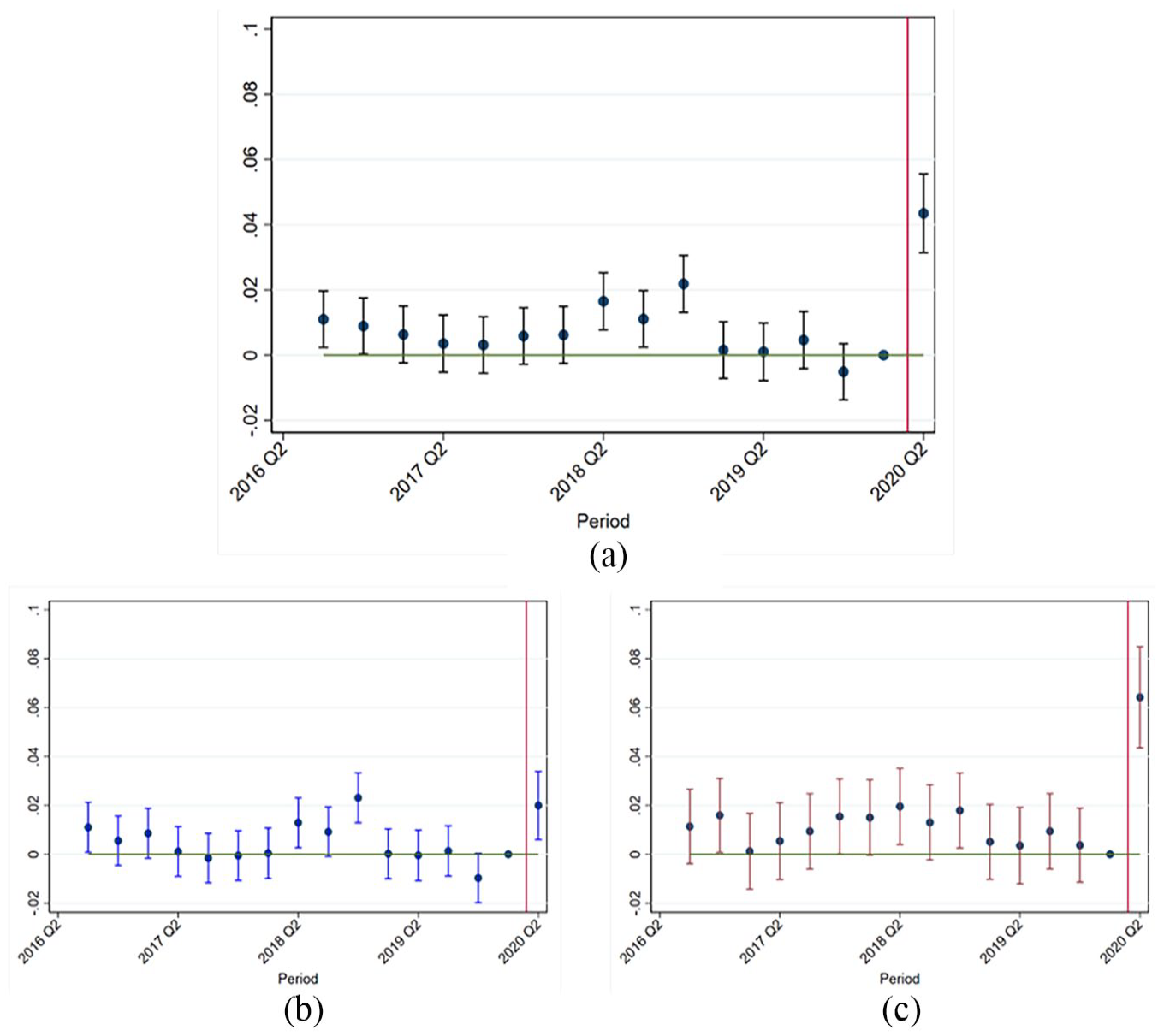
Event study regression plots: (a) whole sample; (b) males; (c) females.
Broadly, other policy-related and structural factors not accounted for by the regional and period fixed effects in the placebo regressions do not necessarily threaten the parallel trends assumption. Employment policies, including on informal employment, are nationally determined by the Department of Labour and Employment. While local governments sometimes perform ‘crackdown’ on illegal vendors along major thoroughfares and central areas, these crackdowns simply displace vendors to other locations rather than shifting them towards formal employment (Kusaka, 2017).
Regression results
Extreme lockdowns have a positive and significant effect on the probability of being informally employed and this finding is robust to the inclusion of individual-level controls and regional and period fixed effects. In the full specification, lockdowns raise the probability of being informally employed by 1.7 percentage points (pp). Disaggregating by gender, the DD coefficient is robustly positive and significant only for females, implying that the effect seen in the full model is largely driven by the increase in the probability of informal employment among females of about 2.2 pp. Consistent with earlier findings in the literature of a gendered informalization of work during periods of economic uncertainty, these results suggest that among women employed during the lockdown, informality increased (Table 3).
Main regression results.
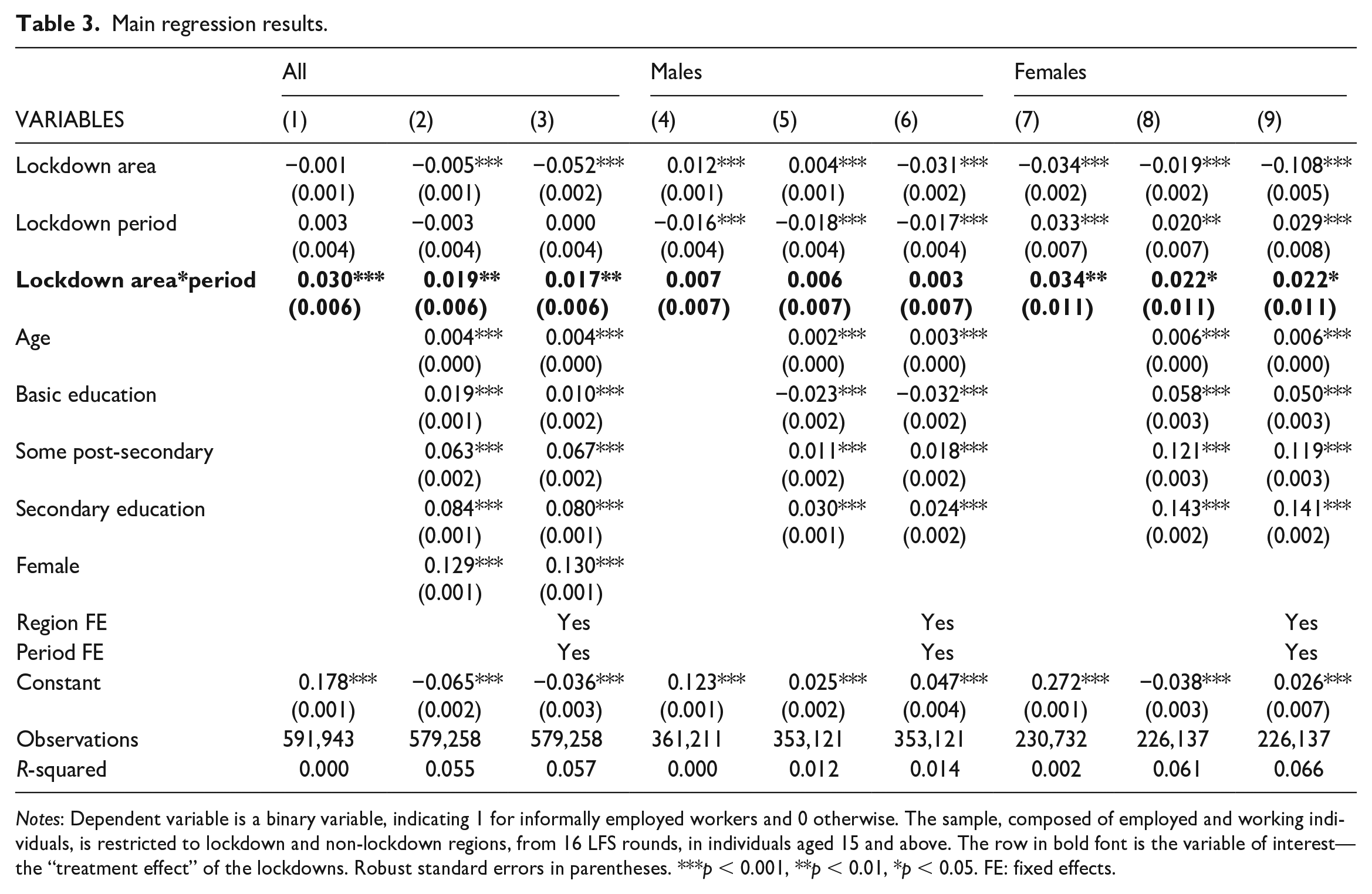
Notes: Dependent variable is a binary variable, indicating 1 for informally employed workers and 0 otherwise. The sample, composed of employed and working individuals, is restricted to lockdown and non-lockdown regions, from 16 LFS rounds, in individuals aged 15 and above. The row in bold font is the variable of interest— the “treatment effect” of the lockdowns. Robust standard errors in parentheses. ***p < 0.001, **p < 0.01, *p < 0.05. FE: fixed effects.
One potential explanation for the overall informalization of the employed during the lockdown is the survivalist motives established earlier. Where social assistance mechanisms and sufficient precautionary household savings are absent, the poor simply cannot afford unemployment. Thus, they face high pressure to look for employment opportunities immediately after job loss episodes (Turnham and Eröcal, 1990; Udall and Sinclair, 1982). Given that informal employment has lower entry barriers and more flexible conditions than formal employment, this seems to be a preferred outcome, instead of unemployment, by people who lose a job.
To establish support for the survivalist motive, various alternative labour market outcomes of the entire labour force are considered – formally employed, informally employed, unemployed and inactive. Using multinomial logistic regression, results presented in Appendix 4 online suggest that extreme lockdowns significantly increase the likelihood of being in informal employment relative to unemployment for males, consistent with the survivalist motive. As further evidence, estimates using a 2020 World Bank (2022) survey suggest that there is a slightly higher proportion of households in lockdown regions that relied on selling assets/properties, engaging in additional income-generating work and online selling, and requesting advance payment from employers as coping mechanisms than in non-lockdown regions (see online Appendix Table A5.2).
Certainly, survivalist motives are not the only mechanism at play. Compositional changes, as discussed in the section ‘Compositional Changes in the Labour Market’, also suggest that changes in gender-specific trajectories of formal and informal employment shares partly explain this difference. To visually demonstrate this difference, Figure 5 shows that compositional changes in lockdown areas are larger in general, and are steepest among informally employed females. Whether this is a household coping mechanism or a consequence of insufficient social support mechanisms should be looked into in subsequent work with more information on time use and state-to-state transition, as was done by Maurizio et al. (2023). However, to the extent that the amplifying effect of lockdowns is demonstrated, net of the adverse social and economic effects that all areas have experienced due to COVID, these results are notable.
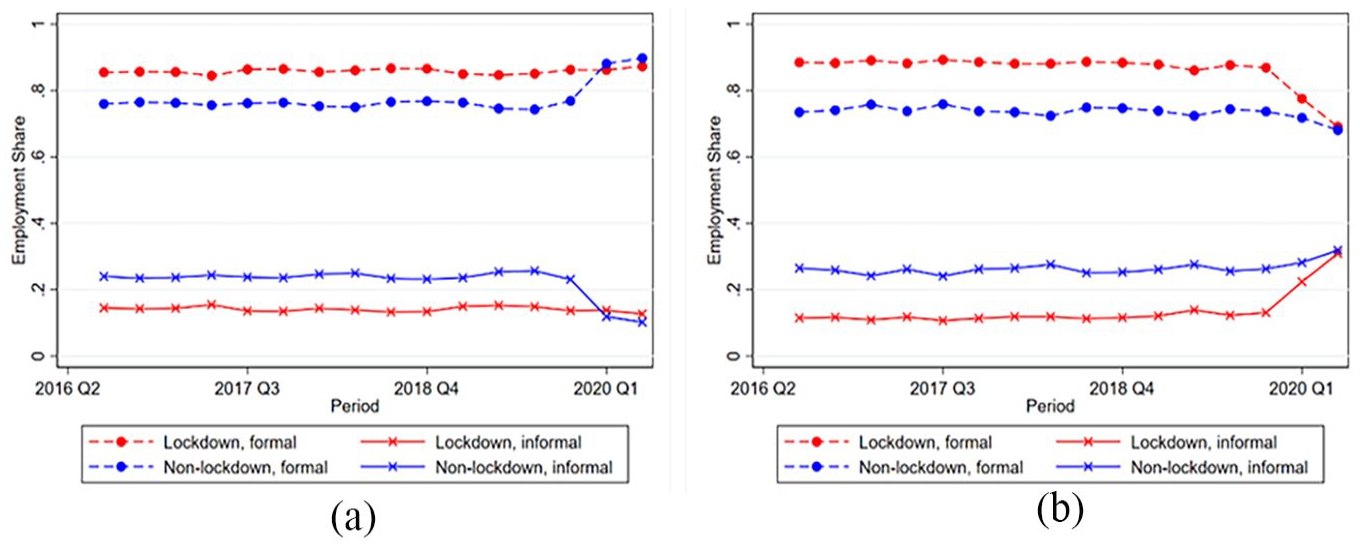
Gender-specific trajectories of formal and informal employment: (a) males; (b) females.
Heterogeneous effects and robustness analysis
The finding that widespread lockdowns had a positive and significant effect on the informalization of employment for women, but not for men, begs the questions: does this hold for all women, and is this robust to alternative model specifications and informal employment definitions?
Heterogeneous effects among the women’s sample
The findings from the preceding section show that the positive effect of lockdowns on the informalization of employment is present only among women. However, this result might differ based on the marital and parental status of women. Table 4 presents the results of the regression on different sub-samples: single women, married or cohabiting women with no minor children, and married or cohabiting women with minor children. Informalization is pronounced among women with co-resident children under the age of 15 (minor children), who arguably have more childcare responsibilities than women without or with older or non-dependent children. Oxfam Philippines (2021) reports that women on average performed 6.5 hours of primary care work per day during COVID, more than double the 2.4 hours done by men on average. In Germany, despite men’s increased involvement in household work during COVID, women also worked more and still did the bulk of the tasks (Kreyenfeld and Zinn, 2021). Given the unequal distribution of care work and the flexibility that informal employment offers compared with formal employment, it is not surprising to find that extreme lockdowns informalize work more for mothers with minor children than for others.
Fixed effects regression results, female sample.
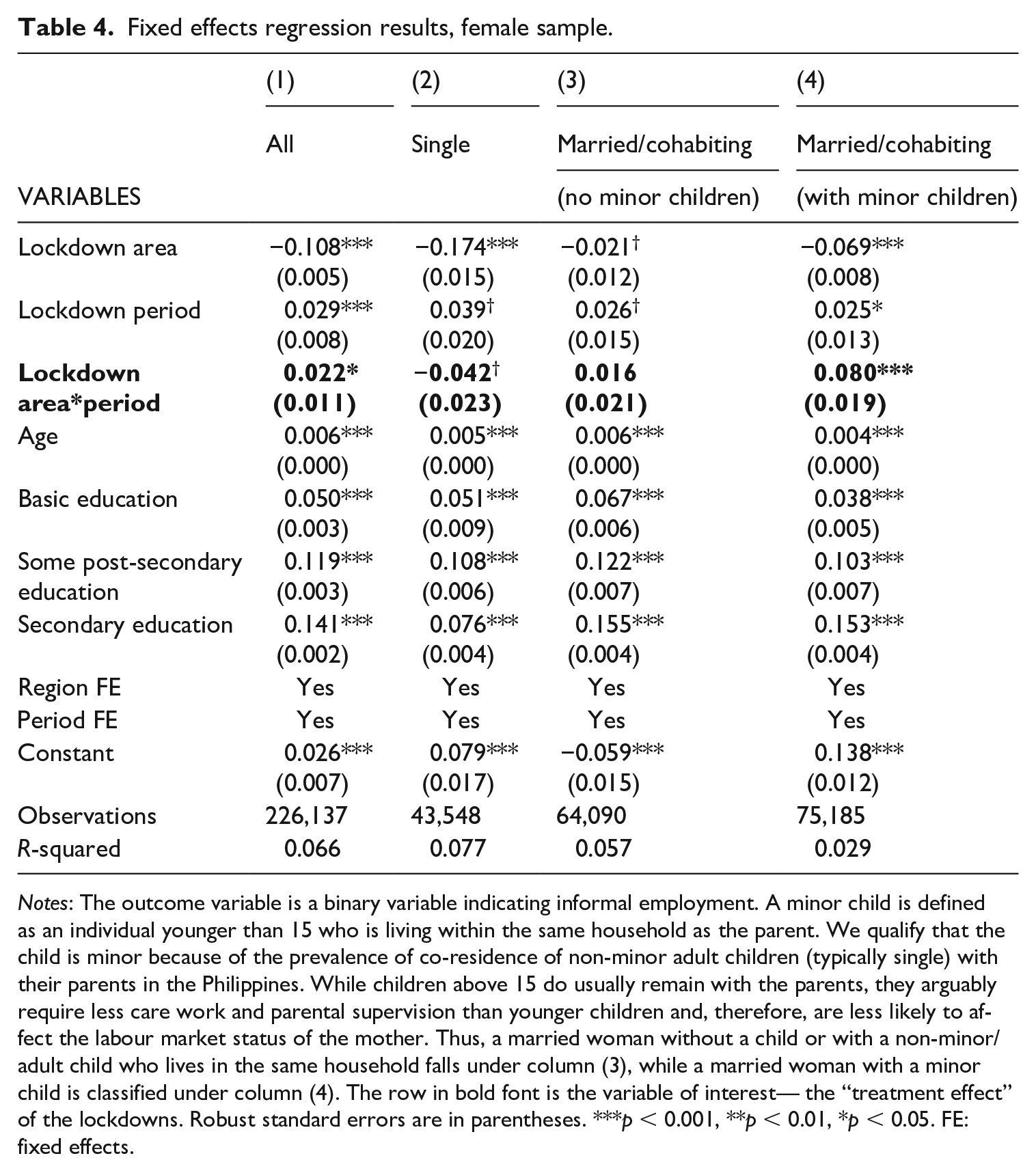
Notes: The outcome variable is a binary variable indicating informal employment. A minor child is defined as an individual younger than 15 who is living within the same household as the parent. We qualify that the child is minor because of the prevalence of co-residence of non-minor adult children (typically single) with their parents in the Philippines. While children above 15 do usually remain with the parents, they arguably require less care work and parental supervision than younger children and, therefore, are less likely to affect the labour market status of the mother. Thus, a married woman without a child or with a non-minor/adult child who lives in the same household falls under column (3), while a married woman with a minor child is classified under column (4). The row in bold font is the variable of interest— the “treatment effect” of the lockdowns. Robust standard errors are in parentheses. ***p < 0.001, **p < 0.01, *p < 0.05. FE: fixed effects.
This finding resolves the paid work versus care work dilemma that was potentially exacerbated by the lockdown. If a mother experiences a job loss during the lockdown, she can disengage in job search and paid employment to focus on care work. However, the survivalist motive posits a different outcome for developing countries – despite the increased demand for care work, individuals cannot afford unemployment, and inactivity by extension, since they have little to no access to safety nets. This confirms an earlier finding of Bayudan-Dacuycuy and Dacuycuy (2018) that among females, a wage increase has a statistically insignificant effect on housework hours – implying that women try to balance carefully the need to participate in the labour market and care responsibilities. Results in Table 4 show that during extreme lockdowns, mothers of minor children have a higher probability of being informally employed, which despite its instability, offers more flexibility.
These results likewise echo the findings in Brazil and Peru that, all else held constant, women with minor children have a higher probability of being in paid employment with positive hours (Aragao and Villanueva, 2021). There is also little reason to believe that being informally employed is voluntary or driven by an outright preference for informality, as prior literature demonstrates that mothers in involuntary informal employment are simply unable to look for formal opportunities due to family responsibilities (Rodin et al., 2012). Overall, these results confirm prior expectations that at the height of these lockdowns, women perform the dual role as workers and carers of first resort.
Robustness to alternative sample restrictions and definitions of informal employment
In the main model, the pre-treatment period was limited from the third quarter of 2016 onwards. Considering that labour market policy is within the ambit of the national government, only the period of the incumbent administration, which assumed office in June 2016, was included. Estimating the models on alternative temporal restrictions generates the same implications. The lockdown effect on informal employment is robustly positive and significant when one considers shorter alternative periods such as only second quarter surveys and only the three preceding quarters. Note that including periods covering earlier administrations (before 2016 Q3) introduces more heterogeneity, because labour market policy and enforcement differ across administrations. Similarly, considering a shorter period restriction, despite yielding stronger results, cannot be conceptually justified, especially if data availability allows for longer coverage that would sufficiently establish parallel trends.
In terms of age restrictions, the main model limits the sample to age 15 and above, consistent with the definition of the working-age population by the Philippine Statistics Authority and by most statistical offices (ILO, n.d.). It is also uncommon to place an upper bound restriction on the working age for developing countries, considering the prevalence of old-age employment. Racelis et al. (2012) show that over 50% of the elderly report being in paid employment, even after the compulsory retirement age in the formal sector. An overwhelming majority of this work is informal. Nevertheless, results hold even under the narrowest sample restriction based on age. By including an upper bound at 64 years old and by increasing the lower bound to 18 years old, results are consistent in direction and, to a large extent, magnitude. Appendix Tables A2.3 and A2.4 in the online supplementary material show the results of robustness analysis for alternative timeline and age restrictions, respectively.
Finally, it should be noted that there exist various definitions of informal employment in the literature. In some definitions, informal employment has an insurance-based definition (whether one is a contributor to the social security system) (Madero-Cabib and Cabello-Hutt, 2022; Villanueva and Lin, 2020). Within mainland Southeast Asia, there are operational differences in the definition of informal employment, with Thailand incorporating the social security-based definition, whereas Myanmar and Lao PDR incorporate both social security-based and worker-based definitions (Ducanes et al., 2023). In the Philippines, a 2008 Informal Sector Survey allowed for both an enterprise-based definition of employment in the informal sector and a job-based definition of informal employment (Cabegin, 2018). This does not mean that one approach, more so one article, is superior or necessarily correct. On the contrary, highlighting and scrutinizing alternative, context-based definitions is critical in advancing research on informal employment. In this analysis, the preferred definition is both class- and sector-based with an explicit preference for an underestimate, such that the estimates presented are likely lower bounds and the true lockdown effect might even be larger.
In Tables A3.1 and A3.2 of the online Supplementary Material, results show that across all relevant and expanded definitions of informal employment, the lockdown effect is positive and strongly significant and the gendered informalization finding holds. Results also hold even when merely using a class-based definition of informal employment and controlling for or omitting agriculture and government sectors instead (see Table A3.3).
Conclusion
The Philippines imposed what many considered one of the world’s longest and strictest military-enforced lockdowns in select regions at the onset of COVID. This quasi-experimental set-up allows the article to uniquely contribute to the literature by isolating and analysing the ‘lockdown effect’ on the informalization of employment and distinguishing between compositional and survivalist explanations underlying this process. Using a two-way fixed effects difference-in-differences design on pooled LFS data, results show a positive and significant effect of extreme lockdowns on the probability of being in informal employment. This finding is pronounced among women, particularly for working mothers with minor children, and is robust to alternative age and period sample restrictions and definitions of informal employment.
The article explores compositional factors and survivalist motives that explain these findings. While compositional changes in the employed population played a role, survivalist motives also suggest that some workers, males in particular, are more likely to informally work rather than be unemployed. Around 44% of households in lockdown regions also engaged in additional income-generating work. 7 Meanwhile, gendered differences are also explained by women retaining or taking on paid informal employment due to increased uncertainty brought about by the lockdowns, on top of their increased caregiving responsibilities.
One caveat when interpreting these results is that LFS data consistently undercount informal employment in developing countries. More specifically, the LFS might exclude from the definition of informally employed those wage and salary workers employed in unregistered businesses since the LFS does not contain information about the employers’ legal status. While results are demonstrated to be robust across possible alternative definitions, the data are inherently limited in that there is no information about social security contributions or the legal status of the employer. Still, this limitation underestimates rather than obscures the causal effect of extreme lockdowns on the probability of informal employment, so the true effect might actually be somewhat larger than the estimates presented.
Similarly, further research could look into sector-specific differences in informal employment given its prevalence in some occupations (e.g. babysitting, house cleaners, etc.). Absent panel data in the Philippines that allows analysis of individual trajectories, qualitative work that focuses on individual coping mechanisms regarding employment, might likewise be insightful.
Limitations aside, these results should be read not only as an analysis of the gendered effects of COVID, but also as part and parcel of a rich body of the literature demonstrating how informally employed women bear the brunt during periods of crises and how state responses, or the lack thereof, facilitate informalization (Hammer and Ness, 2021). In light of growing uncertainties, mobility restrictions are becoming either a consequence (e.g. during natural disasters) or a response mechanism (e.g. during pandemics). Either way, informal employment rises, succeeding these crises (Feridhanusetyawan and Gaduh, 2000; Floro and Dymski, 2000; Mendoza and Jara, 2020; Pecha Garzón, 2017), although some evidence suggests that informal employment does not always play its usual countercyclical role (Maurizio et al., 2023).
Whereas most of the recent literature has interchangeably treated the ‘COVID-19 pandemic’ and ‘lockdowns’ in both language and substance, this article offers evidence that stringently enforced and widespread lockdowns, per se, caused an informalization of employment for women. This highlights the need to reconsider the design and targeting of safety nets for vulnerable segments in the labour market but, more broadly, challenges any notion or misbelief that employment responses during the pandemic were only male-driven. On the contrary, the lockdown effect on informalization is pronounced for women with minor children, who also arguably perform more caregiving responsibilities. Women, therefore, played a dual role of being both a worker and carer of first resort. Expanding gender-sensitive and targeted active labour market policies including job search assistance, training and public employment programmes is likely to proactively establish additional ‘layers’ of defence against crises-driven informalization. While some argue that lockdowns were the ‘great equalizer’ that affected everyone equally, the article offers evidence that in the case of informal employment, such was not the case.
Supplemental Material
sj-docx-1-wes-10.1177_09500170241247121 – Supplemental material for Extreme Lockdowns and the Gendered Informalization of Employment: Evidence from the Philippines
Supplemental material, sj-docx-1-wes-10.1177_09500170241247121 for Extreme Lockdowns and the Gendered Informalization of Employment: Evidence from the Philippines by Vincent Jerald Ramos in Work, Employment and Society
Footnotes
Acknowledgements
I am grateful for the generous comments and feedback by Michaela Kreyenfeld, Mark Hallerberg, Max Steinhardt, Natalia Danzer, Nina McMurry, Geoffrey Ducanes, Heike Kluver, the participants of the DYNAMICS of Demography, Democracy, and Public Policy Research Training Group Internal Seminar at the Humboldt University Berlin and Hertie School Berlin. Earlier versions of this article have benefitted from comments in the Work and Family Researchers Network 2022 Annual Conference, CEU Graduate Student Conference on Poverty and Inequality, University of Goettingen Conference on Shocks and Resiliency in Southeast Asia, Berlin School of Economics’ Research Seminar in Applied Microeconometrics, 15th EAEPE-INET-APPEAL Summer School on Labor and Welfare in the Post-COVID era, and the 2023 Population Association of America Annual Meeting. I would also like to acknowledge the Philippine Statistics Authority for providing the LFS microdata. I am grateful to the editor and three referees for their helpful feedback and guidance. All remaining errors are mine alone.
Funding
The author disclosed receipt of the following financial support for the research, authorship, and/or publication of this article: This research benefitted from funding by the German Research Foundation (DFG), grant number 390285477/GRK2458.

Supplementary material
The supplementary material is available online with the article.
Notes
References
Supplementary Material
Please find the following supplemental material available below.
For Open Access articles published under a Creative Commons License, all supplemental material carries the same license as the article it is associated with.
For non-Open Access articles published, all supplemental material carries a non-exclusive license, and permission requests for re-use of supplemental material or any part of supplemental material shall be sent directly to the copyright owner as specified in the copyright notice associated with the article.
