




Abstract
Recent scholarship has documented the effects of unstable scheduling practices on worker health and well-being, but there has been less research examining the intergenerational consequences of work schedule instability. This study investigates the relationship between parental exposure to unstable and unpredictable work schedules and child sleep quality. We find evidence of significant and large associations between parental exposure to each of five different types of unstable and unpredictable work scheduling practices and child sleep quality, including sleep duration, variability and daytime sleepiness. We are also able to mediate 35–50% of this relationship with measures of work–life conflict, parental stress and well-being, material hardship, and child behaviour. These findings suggest that the effects of the temporal dimensions of job quality extend beyond workers to their children, with implications for the mechanisms by which social inequality is reproduced and for social policies intended to regulate precarious and unequal employment conditions.
Keywords
Introduction
Spurred by declining unionization (Western and Rosenfeld, 2011), globalization and deindustrialization (Autor et al., 2013; Wilson, 1987), and the rise of a shareholder value orientation (Fligstein and Shin, 2004), work has become more uncertain and unpredictable from the perspective of workers, especially those with less education and in such sectors as food service and retail, transportation and logistics, hospitality and some segments of health care (Kalleberg, 2009).
This growing precarity is manifest in several dimensions of job quality. Real wages have not grown for the bottom 50% of workers and there has been a pronounced decline in employer-provided benefits (Cappelli, 1999; Kalleberg, 2009; Pugh, 2015). Beyond this economic dimension of job quality, increasing precarity is also manifest in work time. Prior research has examined this temporal precarity in terms of non-standard schedules that involve evening or night shifts (Presser, 1999) as well as in terms of a lack of schedule flexibility and control for white collar workers (Moen et al., 2014).
Recent research identifies another constellation of work scheduling practices that appear to introduce significant temporal precarity, especially for hourly service-sector workers. Rather than being assigned a regular day shift, or even a regular evening or night shift, workers contend with schedules that are unstable and unpredictable, and change from day to day or week to week, often with little advance notice (Clawson and Gerstel, 2014; Lambert et al., 2014, 2019). Even once published, employers appear to frequently change the schedule at the last minute, using shift cancellations, on-call work and last-minute timing changes (Halpin, 2015; Schneider and Harknett, 2019) to closely align staffing with customer demand (Lambert, 2008). These schedules represent flexibility for employers, but instability for employees who have little control over their schedules and are often required to keep ‘open availability’ to work whenever needed (Wood, 2018). It appears that the rise of algorithmic scheduling in the early 2000s (Disselkamp, 2009) and the economic pressures of the Great Recession substantially increased the prevalence of work hour volatility, especially for lower income and less educated workers (LaBriola and Schneider, 2020).
Recent work has detailed the consequences of such unstable and unpredictable work schedules for workers’ economic security (Schneider and Harknett, 2020), work–life conflict (Henly and Lambert, 2014), and health and well-being (Schneider and Harknett, 2019). Much less research, however, has examined the intergenerational consequences of unstable and unpredictable work schedules, and in particular, the consequences of parental exposure to unstable and unpredictable work schedules for child well-being (but see Schneider and Harknett, 2022a; Walther and Pilarz, 2023). Detailing these intergenerational processes is essential for mapping out how inequalities within generations, such as in precarious working conditions, shape opportunity and mobility across generations (Kalleberg, 2018).
This article takes up this question by focusing on the association between parental exposure to unstable and unpredictable work schedules and one important dimension of child well-being – child sleep quality. Children and adolescents who experience poor sleep are at greater risk of poorer health and well-being across a wide range of outcomes, such as physical health and weight, cognitive and academic performance, behaviour and emotional regulation (Chaput et al., 2016; Spruyt, 2019). For younger children, inadequate sleep has been linked to physical and emotional health challenges such as cardiovascular risk and increased impulsivity (Guerrero et al., 2019; Matthews and Pantesco, 2016). For adolescents, sleep quality, variability and duration have been shown to negatively affect physical health and mental health and predict risky behaviour (Feliciano et al., 2018; Fuligni and Hardway, 2006; Winsler et al., 2015). Finally, sleep loss, sleepiness and erratic sleep patterns are associated with lower academic performance and learning capacity for all school-aged children (Curcio et al., 2006; Dewald et al., 2010).
Scholarship on unstable work schedules has highlighted several ways in which temporal unpredictability affects the lives of parents. Given that the lives of parents and children are intertwined, it is likely that certain characteristics of parents’ lives also affect the lives of their children. Scholarship on the determinants of child sleep has conceptualized sleep as the combined product of biological, psychosocial and contextual factors (Becker et al., 2015; Newton et al., 2020; Owens and Ordway, 2019). Parental work conditions are a noted but understudied social determinant of child sleep according to these frameworks, and parental exposure to work schedule unpredictability and instability in particular is likely to shape children’s sleep quality via mechanisms such as material hardship, work–life conflict, parental well-being and child behaviour.
To investigate the relationship between parental exposure to unstable and unpredictable work schedules and child sleep, this article draws on data from The Shift Project, which contains detailed reports of parental exposure to unstable and unpredictable work schedules alongside fine-grained measures of child sleep and potential mediators of this relationship. The data were collected between 2018 and 2020 from 3760 parents working in hourly positions at 97 of the largest firms in the retail, food-service, grocery, pharmacy, and delivery and fulfilment sectors in the United States. First, this study models the association between child sleep quality and parental exposure to on-call shifts, last-minute schedule timing changes, cancelled shifts, limited advance notice and variable schedules. Second, this study assesses the extent to which these associations are mediated by family processes including material hardship, work–life conflict, parental stress and well-being, and child behaviour – all well-established predictors of sleep quality and all processes that have been shown to be affected by unstable and unpredictable scheduling.
The results of this study provide evidence of significant and large associations between exposure to each type of unstable and unpredictable work scheduling practice and child sleep quality. In particular, the analysis presents a dose–response relationship between the extent of parental exposure to unstable scheduling practices and child sleep problems, with children whose parents are exposed to the most unstable and unpredictable schedules experiencing about a third of a standard deviation more sleep problems than those whose parents worked stable and predictable schedules. Finally, the model developed in this article mediates between 35% and 50% of the association between parental schedule instability and child sleep problems. When including work–life conflict, parental stress and well-being, and material hardship, 35% of the relationship is explained. Adding child behaviour to the model explains 50% of this relationship.
Temporal precarity and social inequality
Alberti et al. (2018) argue that scholars of work should move beyond the term precarity as a concept (which has been so overused and overstretched, they contend, that the meaning has been diluted) to understanding precarization as a process. Because precarity has taken on so many meanings in such different contexts, it can be hard to quantify and measure its existence in various forms. The authors argue that one way of measuring the existence of precarity is by studying patterns of precarization, such as the strategies that employers and managers use to transfer various forms of risk to employees. This might allow studies, especially quantitative ones, to narrow in on the extent and impacts of precarity affecting workers.
Several studies highlight work scheduling practices as a site where processes of precarization occur. Work by scholars, including Lambert (2008) and Schneider and Harknett (2019), describe how work schedules have become unstable and unpredictable for many hourly paid workers, especially those in the service sector, in the United States, since the Great Recession (LaBriola and Schneider, 2020). Work schedules vary significantly from day to day and week to week, are often published with little advance notice and then may be changed by managers at the last minute as workers are held on-call, asked to stay late or leave early, or have their shifts cancelled entirely. Such scheduling practices appear to be the result of a ‘risk shift’ from firms to workers, as service-sector employers attempt to ruthlessly manage payroll costs in an environment where shareholder pressures shape company labour practices (Lambert, 2008).
These scheduling practices are embedded in the complex social relations of the service-sector workplace. Halpin (2015) finds that managers at a high-end food-service firm create ‘mock schedules’ to create the illusion that workers have scheduling stability while simultaneously cutting workers from the schedule without notice, deliberately overscheduling workers, redistributing shifts at the whim of management and withholding shift information until the last minute, effectively leaving workers ‘on-call’ on certain days of the week. Wood (2018) finds that the social relations of these schedule outcomes are even more complex and dynamic. Wood finds that flexible scheduling in retail settings allows managers to engage in gift exchanges around scheduling needs as a form of ‘flexible discipline’ in the workplace. Honouring employees’ scheduling needs then becomes a way to obscure workplace relations and bind employees to managers’ interests through feelings of gratitude and obligation.
These studies have been important for establishing patterns of precarization through scheduling practices for workers in low-wage service-sector jobs. They have illuminated specific practices that employers engage in that generate instability for employees around time, or what we call temporal precarity. These qualitative studies, however, have focused mostly on the complex managerial strategies used to transfer various forms of risk to employees. This article takes insight from studies of scheduling practices to focus on the impacts of these practices on the children of workers.
Work in this vein necessarily involves some data reduction of the complex workplace social relations that produce temporal precarity given the methodological realities of survey research. Research on the effects of unstable scheduling on workers then relies on constructing measures of schedule instability that impact the worker at the individual level (regardless of the social processes that lead to this instability). Building off of conceptual work on the measurement of temporal precarity (Lambert and Henly, 2014), research using survey data has found that unstable and unpredictable work scheduling, captured by the amount of advance notice, the occurrence of last-minute timing changes, on-call shifts and schedule cancellation, are strongly and consistently associated with household economic insecurity (Schneider and Harknett, 2017, 2020), diminished sleep quality (Ananat et al., 2022; Harknett et al., 2020; Williams et al., 2022), psychological distress (Schneider and Harknett, 2019) and work–life conflict (Luhr et al., 2022).
Parents’ exposure to such schedule instability and unpredictability may also diminish child well-being (Schneider and Harknett, 2022a), which is an important precursor to later life attainment. In this way, exposure to temporal precarity may shape the process of intergenerational mobility. Sociologists have long been interested in the intergenerational transmission of social inequality. Research has found that occupational status, income and wealth (Beller and Hout, 2006; Blau and Duncan, 1967; Chetty et al., 2017; Conley, 1999) are transmitted intergenerationally. Scholars examining the substantive effect of parental circumstances on children’s development, well-being and performance have found that income, employment status and parental education shape the resources and time available for children’s development (Guryan et al., 2008; Kalil, 2015; Lareau, 2003; Wang et al., 2021). This study contributes to each of these literatures by examining how conditions within employment affect the daily lives of children in a substantive way. This article examines how temporal precarity within jobs can reproduce temporal precarity in the lives of children through effects on their ability to get adequate sleep.
The reproduction of temporal inequality: Parental unstable schedules and child sleep outcomes
Existing literature examining the relationship between parental work and child sleep quality suggests that parental work schedules are linked to children’s sleep outcomes. At the broadest level (i.e. the existence of a work schedule), previous work finds that children whose mothers work go to bed slightly later and get less sleep (Hofferth and Sandberg, 2001; Kalil et al., 2014), and in the summer, children wake up earlier on the days that mothers work (Stewart, 2014). When focusing on specific characteristics of parental work schedules, we learn that longer work hours, nonstandard shifts and work schedule flexibility are associated with markers of child sleep quality in different ways. Magee et al. (2012) find that long work hours for both mothers and fathers are associated with reduced odds of at least 9.5 hours of sleep per week for children, and that these hours shifted the times children went to bed. Lee et al. (2019) find that perceived flexibility in parental work schedules is associated with longer sleep duration due to greater bedtime adherence. Both Magee et al. (2012) and Kalil et al. (2014), however, find that nonstandard work hours do not impact the length of children’s sleep.
This existing research on parental work and child sleep suggests that parental work schedules may impact child sleep due to parents’ ability to be present and consistent at children’s bedtimes. As primary caregivers, mothers’ work schedules are likely to impact when and how children are able to get to bed (Kalil et al., 2014). Long parental work hours impede when children can be put to bed or woken up (Magee et al., 2012), while work schedule flexibility has been found to facilitate more regularity in bedtimes (Lee et al., 2019). Nonstandard work hours may have less impact on child sleep if they allow parents to be present and/or consistent.
There is much less research, however, on how parental exposure to work schedule instability and unpredictability affects children’s sleep. Radoševic-Vidacek and Košcec (2004) find that shift work (defined as rotating shifts for the majority) for parents is associated with earlier wake times and less sleep for students in Croatia. Muller et al. (2017) find that children in Aotearoa/New Zealand with a shift-working adult (captured by rotating shifts and variable hours) experienced sleep deficits due to shifting sleep schedules. Finally, mothers in Aotearoa/New Zealand felt that consistent bedtime routines and having the same care-taker facilitated better sleep, and that working irregular hours challenged parents’ ability to achieve this (Muller et al., 2019). In addition to being geographically specific, this previous research on work schedule instability and child sleep has been restricted to only one or two measures of work schedule instability and/or has had to use measures that combine schedule instability with nonstandard, consistent schedules (Kalil et al., 2014; Muller et al., 2017; Radoševic-Vidacek and Košcec, 2004).
Mechanisms linking parental unstable schedules and child sleep outcomes
Beyond the limited evidence of a direct association between parental exposure to work schedule instability and child sleep quality, there is little work that conceptualizes and empirically tests how and why parental work schedule instability is linked to children’s sleep. By drawing on literature examining the effects of unstable schedules on various family outcomes and literature examining the determinants of child sleep quality, we develop four theoretical and empirically grounded propositions for why exposure to precarious work schedules might negatively affect child sleep quality. We hypothesize that precarious work schedules might impact levels of work–life conflict and schedule instability within the family, levels of parental stress and well-being, material hardship, and children’s emotional and behavioural well-being. Each of these mechanisms further specify levels of parental presence and consistency in the home and may in turn shape children’s sleep quality.
Unstable work schedules, work–life conflict and child sleep quality
One reason why parental exposure to unstable work schedules may ultimately reduce child sleep quality is that unstable work schedules have been shown to be quite disruptive of family life, manifesting a time-based strain (Greenhaus and Beutell, 1985) that leads to significant work–life conflict. This work–life conflict may restrict the presence of parents at home, upset regular family routines and make it difficult to establish household schedules. Each of these processes might interfere with children’s sleep.
Broadly, in the workforce, irregular or on-call schedules are significantly associated with work–life conflict (Golden, 2015). In a study of workers at a large retail chain, Henly and Lambert (2014) find higher work–life conflict among those with limited advance notice, last-minute schedule changes and variability in the days of the week that they worked.
In turn, various dimensions of work–life conflict have been linked to children’s sleep. Unpredictable home environments and infrequent daily routines have been linked to children’s poorer sleep quality, daytime sleepiness and shorter sleep duration (Koulouglioti et al., 2014; Philbrook et al., 2020). The Confusion, Hubub and Order Scale, which includes items such as: ‘we are usually able to stay on top of things’ and ‘no matter what our family plans, it usually doesn’t seem to work out’, has predicted both sleep problems and disturbances in children (Boles et al., 2017; Spilsbury et al., 2017).
Unstable work schedules, parental well-being and child sleep quality
A second pathway by which parental exposure to unstable work schedules might affect children’s sleep quality is via increased parental stress and decreased parental well-being. Parental stress and well-being can shape parental warmth, engagement and consistency for children, which can in turn affect children’s sleep quality.
In the retail and food-service sectors, workers with less advance notice, variable shifts, on-call shifts, last-minute cancellation and timing changes have worse sleep quality (Harknett et al., 2020), more symptoms of psychological distress and lower levels of happiness (Schneider and Harknett, 2019). A recent, large-scale field experiment found that greater schedule stability improved sleep quality (Williams et al., 2022), and a quasi-experimental evaluation of Seattle’s Secure Scheduling Ordinance, which mandates greater advance notice and predictability pay for last-minute changes, found that covered workers experienced improved sleep quality and happiness (Harknett et al., 2021).
In turn, parental stress has been linked to a variety of children’s sleep outcomes. Several studies have found that children with parents overwhelmed by their caregiving responsibilities experience more sleep variability, more sleep disturbances and lower sleep duration (Bajoghli et al., 2013; Brand et al., 2009; Schmeer et al., 2019). Studies have also found links between parental depressive symptoms, a significant measure of parental well-being and functioning, and child sleep quality (El-Sheikh et al., 2012; Schmeer et al., 2019).
Unstable work schedules, material hardship and child sleep quality
Parental exposure to unstable work schedules may also affect children’s sleep by increasing material hardship within the family. Schedule instability is strongly associated with material hardships (Schneider and Harknett, 2020) and hardships such as hunger, insufficient heat, or unmet medical need can significantly interfere with children’s ability to get quality sleep.
Schneider and Harknett (2017) document an association between schedule instability and higher earnings volatility. More broadly in the workforce, research using the Federal Reserve’s Survey of Household Economic Decision-making finds that a third of workers with variable schedules report that they are either ‘just getting by’ or ‘finding it difficult to get by’ – against only one-in-five workers who work more regular hours (Federal Reserve, 2019). Using more fine-grained measures of work scheduling, Lambert et al. (2019) find that lack of advance notice and lack of schedule control are associated with heightened feelings of financial insecurity. Finally, Schneider and Harknett (2020) find that workers with more schedule instability and unpredictability experience greater material hardship, including hunger and housing hardship, net of earnings, a relationship that they attribute to both income volatility and unstable schedules.
Various dimensions of material hardship have also been linked to poorer sleep outcomes for children. Schmeer et al. (2019) find that adolescents experiencing more than ‘a little’ economic hardship in their home, captured by parents’ inability to pay critical bills and buy necessary things, had higher variability in their nightly sleep duration. Brown and Low (2008) and Barazzetta and Ghislandi (2017) have shown that children’s sleep problems are associated with poor housing conditions, crowding and noise. These findings suggest direct effects of material hardship on children’s sleep through issues such as hunger, lack of access to proper medical care and poor housing conditions and sleep environments.
Unstable work schedules, child well-being and child sleep quality
A fourth mechanism that might link parental work schedule instability and child sleep is child emotional and behavioural well-being. Children whose parents work unstable and unpredictable schedules experience more behavioural problems as a result and these same problems of internalizing and externalizing have been shown to interfere with children’s own sleep quality.
While research has found mixed evidence on the association between a broad measure of maternal variable scheduling and children’s behaviour (Dunifon et al., 2012; Grzywacz et al., 2016), more recent work using the more detailed and precise measures of schedule instability in The Shift Project data (Schneider and Harknett, 2022a) finds that parental exposure to on-call shifts and having last-minute schedule timing changes is positively associated with internalizing behaviour, and having less than one week of advanced notice of schedules is positively associated with both internalizing and externalizing behaviour.
Several aspects of children’s emotional and behavioural health have also been linked to the quality of children’s sleep. Internalizing behaviour and externalizing behaviour have been found to predict insomnia and difficulty falling asleep for children (Kelly and El-Sheikh, 2014; Steinsbekk and Wichstrøm, 2015). ADHD has been linked to sleep problems, duration and insomnia (Cortese et al., 2009; Gregory and O’Connor, 2002; Steinsbekk and Wichstrøm, 2015). Child sleep problems have also been shown to predict child behaviour problems (Gregory and O’Connor, 2002) and studies using longitudinal data find evidence of a reciprocal relationship between child behaviour problems and child sleep problems (Kelly and El-Sheikh, 2014; Steinsbekk and Wichstrøm, 2015).
Data and methods
This study draws on data from 3760 parents working in the service sector that were collected by The Shift Project between October 2018 and May 2020. The Shift Project collects surveys from hourly workers employed at large retail, food-service, grocery, pharmacy, hardware, delivery and fulfilment firms in the United States. These data are collected using a novel non-probability sample approach that uses Facebook/Instagram as both sampling frame and recruitment device.
The Shift Project constructs the survey sample using a non-probability approach. First, the pool of potential respondents is identified using Facebook’s sophisticated advertising targeting platform. The Shift Project constructs ‘audiences’ of workers at large firms in the subsectors of food service, grocery, hardware, electronics, retail apparel, big box stores, pharmacy, delivery and fulfilment, hospitality and miscellaneous retail. Facebook and Instagram users who are identified as working at large firms in these sectors are then recruited to the survey using paid advertisements delivered to those audiences on Facebook and Instagram. These advertisements use a simple recruitment message – ‘Working at [FIRM NAME]? Take a short survey and tell us about your job’. The advertisement offers the chance to enter a draw and contains a link to a Qualtrics survey. Respondents who click through are asked to consent to participation and then complete the online survey.
The Shift Project data provide a unique view into workers’ exposure to precarious scheduling practices at large firms in the service sector alongside detailed measurement of family processes and child outcomes. However, there are important limitations to the data inherent in this approach to data collection.
First, Facebook/Instagram use is optional and not universal. However, recent estimates from Pew indicate that Facebook/Instagram use is quite widespread, at about 80% of American workers, 80% of whom report being frequently active on one of the platforms (authors’ calculation from 2018 Pew survey).
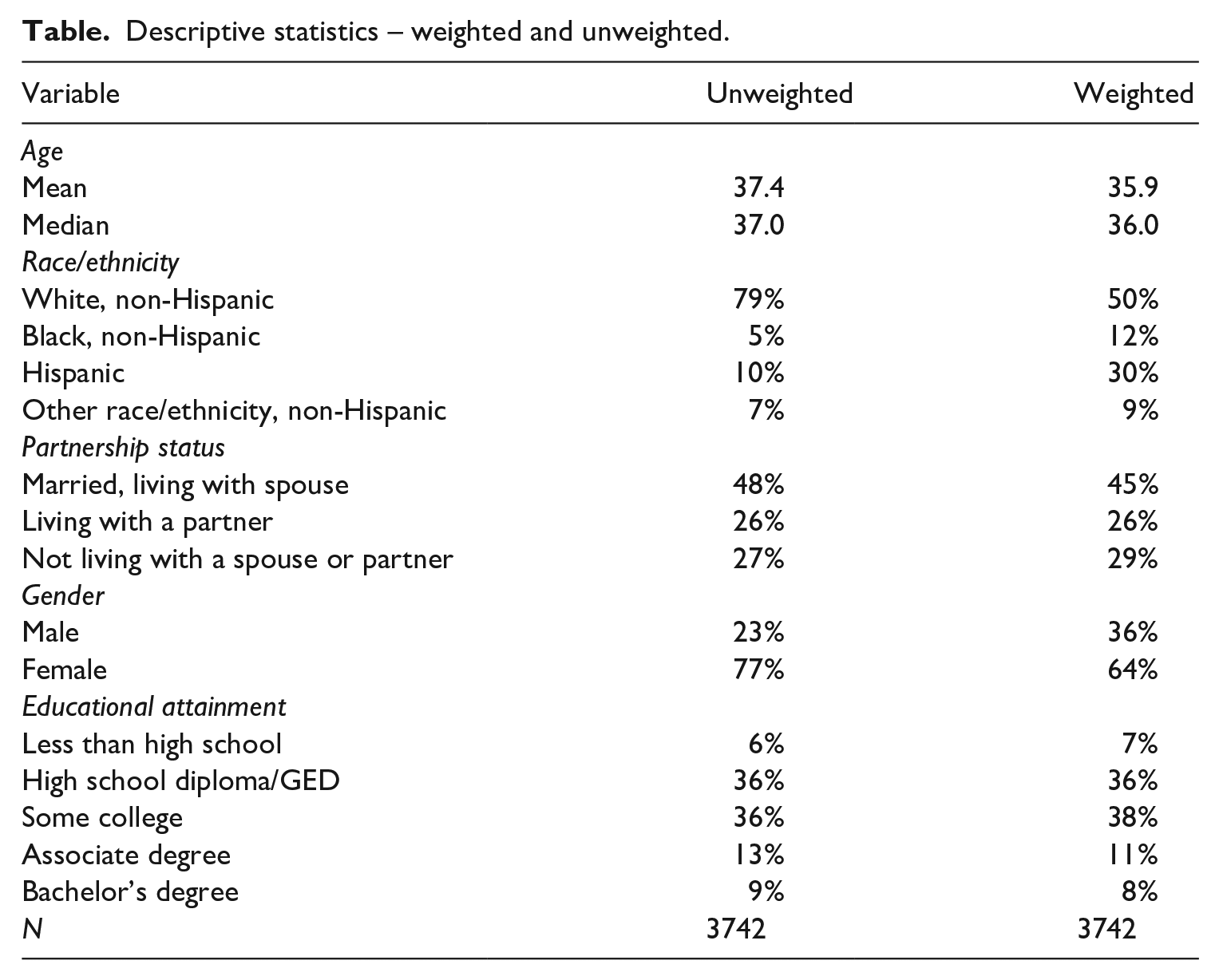
Second, the choice to respond to the survey invitation is not random. We follow prior work in weighting The Shift Project data to demographic benchmarks from the American Community Survey (ACS), a gold standard probability sample survey, which aligns the sample on race/ethnicity, gender, age and education with ACS respondents who were also parents working in the same set of industries and occupations (Schneider and Harknett, 2022b). We contrast the demographic characteristics of the sample in weighted and unweighted statistics in the Appendix 1 Table.
It is possible that respondents are also selected into the survey on characteristics that might confound the association between work schedules and child sleep. Selection on such unobserved confounders will not be resolved through demographic weighting. While it is not possible to rule out this source of bias, Schneider and Harknett (2022b) describe a series of tests in which they benchmark associations in the Shift data against those in the Current Population Survey and National Longitudinal Survey of Youth (NLSY) and in which they purposefully select respondents into the survey on potential confounders and assess moderation in key associations by selection channel. These tests all suggest that there is not significant selection into the survey on such confounders.
The article draws on data collected by The Shift Project from parents with at least one child under age 18 who completed a detailed module about child sleep. We multiply imputed the data for item non-response using the Amelia package in R (R Foundation for Statistical Computing, Vienna, Austria) to impute 10 implicates, given approximately 4% missing data in the sample (Bodner, 2008). The final analysis sample is composed of 3760 respondents employed at 97 large firms.
This approach allows for the construction of detailed data on parental exposure to work scheduling practices alongside information on child outcomes. Such data are not available in any other survey of American workers. While some surveys, such as the NLSY97 and General Social Survey, contain a more limited set of work scheduling measures, they do not contain measures of child sleep outcomes. Other data sets, such as the Fragile Families Study, which contain some measures of child well-being, including sleep, do not collect detailed measures of work scheduling.
Measures
Child sleep outcomes
Previous studies of parental work and children’s sleep have been limited to the sleep measures included in large-scale surveys such as the Fragile Families and Child Wellbeing Study. We advance this work by combining large-scale survey data with detailed measures of sleep duration, sleep variability and daytime sleepiness, all outcomes that have been linked to children’s well-being and stem from clinical research on children’s sleep. The measures used in this article are derived from the Children’s Sleep Habits Questionnaire (CSHQ), a questionnaire that is considered one of the most well-established surveys in terms of reliability and validity. The survey questions have been tested for internal consistency, intercorrelation, reliability in community and clinical populations, and the ability to differentiate children with and without clinically diagnosed sleep disorders (Lewandowski et al., 2011; Owens et al., 2000b). In the study by Lewandowski et al. (2011), five out of the six surveys designated as ‘well-established’ by the authors use parent-reported sleep data, and all four of the ‘well-established’ surveys capturing multiple characteristics of sleep (including the CSHQ) use parent-reported data.
Parents are asked to assess the frequency of five statements about a focal child’s sleep habits in terms of if they occur ‘usually’, ‘sometimes’, or ‘rarely or never’. The statements are: (1) sleeps too little, (2) sleeps the right amount, (3) sleeps the same amount each day, (4) takes a long time to be alert, and (5) has a hard time getting out of bed. Statements 1 and 2 represent sleep duration (while they are similar, both are included in the validated scale); statement 3 represents sleep variability, in line with research that has established a conceptual distinction between duration and variability (Fuligni et al., 2006; He et al., 2015; Schmeer et al., 2019); and statements 4 and 5 capture daytime sleepiness. The Shift Project collects a full roster of household children’s ages and genders. For parents with just one child, the survey asks the sleep questions with regard to that child. For parents who report more than one child on the roster, the survey selects a focal child who is closest to age 7. We reverse code items 1, 4 and 5 and then construct an additive scale variable for children’s sleep problems (alpha = 0.72). For our supplemental models where we separately examine the association between schedule instability and each sleep item, we dichotomize the sleep measures to compare those reporting ‘sometimes’ or ‘rarely/never’ against those reporting ‘usually’. In line with Owens et al. (2000a), where 10–12% of parents report children’s sleep duration or sleepiness as a ‘problem’, Table 2 shows that 7–11% of parents in our sample report the aforementioned sleep habits occurring ‘usually’ in their children.
Parental exposure to unstable and unpredictable schedules
We examine five work scheduling measures that have been previously used in the literature to capture exposure to unstable and unpredictable working scheduling (Harknett et al., 2020, 2022; Schneider and Harknett, 2019, 2020). First, respondents report if they worked at least one on-call shift in the prior month (‘In the past month or so, have you ever been asked to be “on-call” for work at [EMPLOYER NAME]? By “on-call”, we mean you have to be available to work, and you find out if you are needed to work just a few hours before your shift.’). Second, respondents report if they experienced at least one shift timing change in the prior month (‘In the past month or so, did your employer ever change the timing or the length of your scheduled shift at [EMPLOYER NAME]? For example, your employer asked you to come in early or late or asked you to leave early or to stay later than the hours you were originally scheduled for.’). Third, respondents report if they experienced at least one shift cancellation in the prior month (‘In the past month or so, did your employer ever cancel one of your scheduled shifts at [EMPLOYER NAME]?’). Respondents also report the amount of advance notice they receive of their schedules, and we categorize this notice as 0–2 days, 3–6 days, 1–2 weeks, 2–3 weeks, 3–4 weeks, or 4 or more weeks’ notice. Finally, respondents report on their general schedule type, distinguishing: (1) ‘variable schedules (one that changes from day to day)’, (2) ‘regular daytime schedule’, (3) ‘regular evening shift’, (4) ‘regular night shift’, (5) ‘rotating shift (one that changes regularly from days to evenings or nights)’, (6) ‘split shift (one consisting of two distinct periods each day)’ and (7) other. We also construct a scale variable that gauges the degree of work schedule instability and unpredictability on the extensive margin by summing the number of exposures to any of the five measures of instability. We top code the scale at four exposures so this variable can range from 0 to 4.
These measures of schedule instability have important limitations. Because our scale of schedule unpredictability captures exposure to numerous types of instability and not the intensity of any individual type, a person experiencing a large amount of only one type (e.g. cancelled or on-call shifts) would score low on this scale. The scale also necessarily simplifies the complex social relations of scheduling in the service sector, in which availability, notice, hours sufficiency and last-minute changes all interact and reflect and enable power relations among workers, managers and firms. Even so, these measures capture a wide range of scheduling instability observed in the literature on precarious scheduling practices (Halpin, 2015; Lambert, 2008) and follow many of the best practices for question design laid out by Lambert and Henly (2014).
Mediators
We construct a set of five mediators: work–life conflict, parental stress, parental well-being, economic insecurity, and child behaviour. We provide detailed information on the measurement of each of these mediators in Appendix 2.
Controls
Demographic characteristics could potentially confound any association between parental work schedules and child sleep quality as worker characteristics appear to shape schedule quality (Storer et al., 2020; Wood, 2020) and these same characteristics affect child sleep quality (El-Sheikh et al., 2017; Schmeer et al., 2019). We control for parents’ age, race/ethnicity, marital status, gender, educational attainment, school enrolment and whether a language other than English is spoken at home. Similarly, other aspects of parental job quality, such as union membership and involuntary part-time status, may affect both work scheduling and have independent effects on child sleep quality (Finnigan and Hale, 2018; Kalil et al., 2014; Kim et al., 2020; Lee et al., 2019). We control for whether the parent is a manager at work, union membership, hourly wage, usual work hours, involuntary part-time work and the frequency with which the parent works on the weekend. We control for the age and gender of the focal child as well as for the total number of children in the home. We additionally include a set of fixed-effects for survey year, survey month, state and employer.
Analysis
Our analysis proceeds in two steps. First, we estimate a series of ordinary least squares (OLS) regressions to describe the association between each of our five scheduling measures and the scale measure of child sleep outcomes. In these models, we enter the scheduling items individually, with controls for the set of parental and household demographic characteristics, parental work characteristics and child characteristics, along with fixed-effects for year, month, state and employer. We then use the OLS model to estimate the association between our scale measure of the extent of parental exposure to unstable and unpredictable schedules and the scale measure of child sleep outcomes. These models include the same set of controls, and we estimate the models using both a continuous measure of schedule instability exposure and a categorical measure that allows for non-linearities in the relationship. We plot predicted values of child sleep by schedule instability exposure from both approaches.
In our main results, we take the sleep outcomes scale as our dependent variable. We also assess the association between our work schedule instability scale and each of the component items in the sleep outcomes scale. We present predicted values for these outcomes across the observed range of schedule instability.
Second, we examine the degree to which associations between parental exposure to unstable and unpredictable schedules and child sleep outcomes can be mediated by family processes. We use the -khb- method to conduct the mediation analysis (Karlson et al., 2012). While our outcome is not binary, the -khb- approach remains useful in providing clear tests of significance of mediation and a decomposition of the contribution of each mediator to the total indirect association. However, we note that as of yet, it is not possible to estimate the decomposition on multiply imputed data. For that part of the analysis, we restrict the data to unimputed data.
Results
Table 1 describes the characteristics of the sample members. These descriptive statistics are weighted. We compare the demographics of the sample with and without weights in the Appendix 1 Table, which shows that the weights correct for over-representation of White, non-Hispanic respondents and of mothers. The average age of the parents in this study is 36 and the sample was about one-third male and two-thirds female. A total of 50% of respondents identified as White, 12% of respondents identified as Black, 29% as Hispanic and 9% as another race/ethnicity, with 71% of the sample married or living with a partner. Only 8% of the sample had a bachelor’s degree or higher. In terms of work, 29% of the sample involuntarily worked part-time, and 91% of participants work weekend shifts. The average hourly wage is US$12.90. The children of respondents had a median age of 8 years old.
Descriptive statistics: parent and child characteristics.
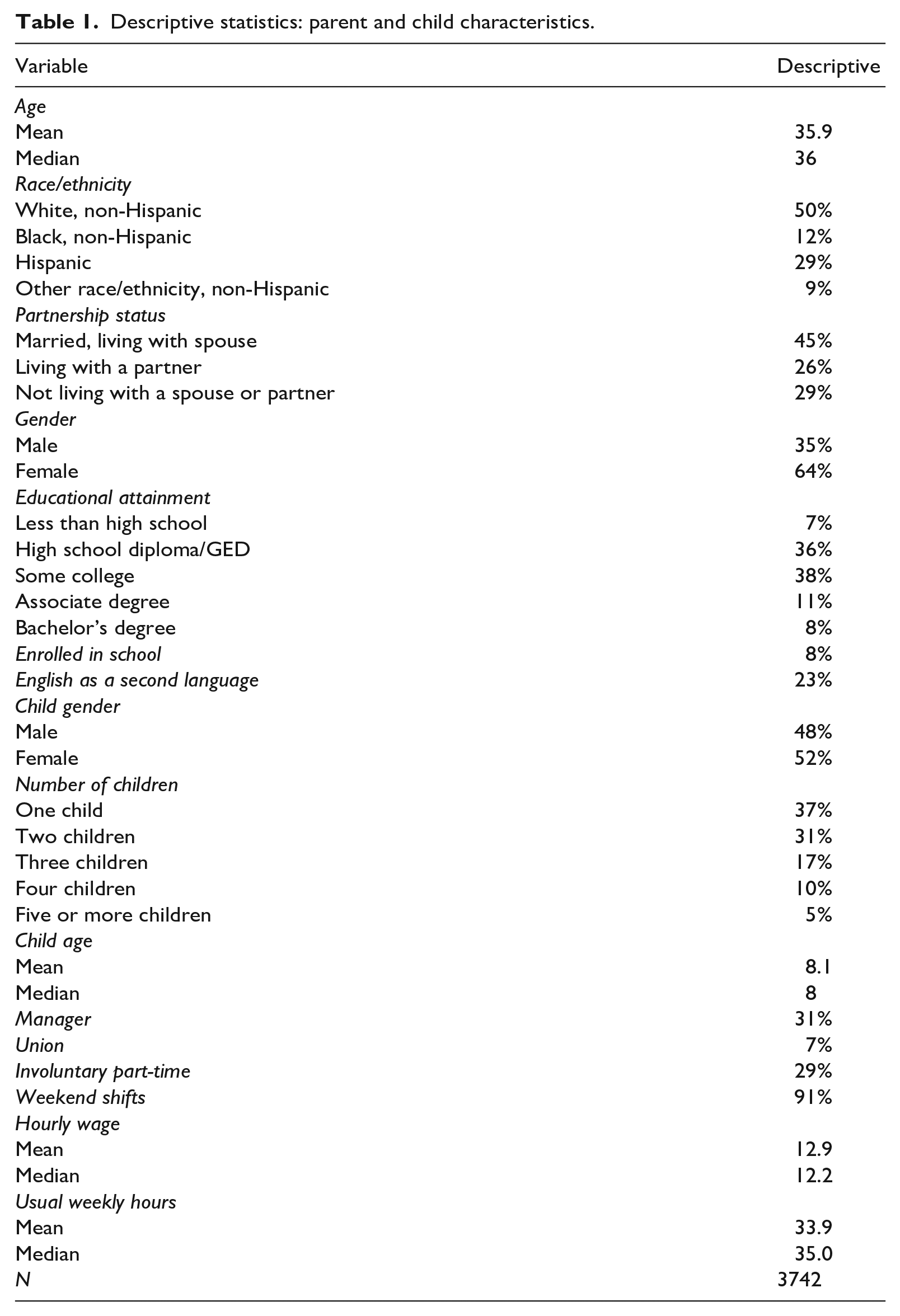
Table 2 describes the extent of child sleep problems reported by parents. We find that 7% of parents reported that the focal child usually sleeps too little and, conversely, that 93% responded affirmatively to the separate item that their child usually or sometimes sleeps the right amount. That these items essentially match is reassuring evidence that we are not seeing significant straight-lining down the matrix in survey responses. A total of 13% of parents reported that their child rarely or never sleeps the same amount each day, a measure of consistency that we would expect to be particularly sensitive to parental schedule instability. Beyond insufficient and irregular sleep duration, we also found that 7% of parents report that their child usually takes a long time to be alert and 11% that their child usually has a hard time getting out of bed. We construct an additive scale from these five measures where a score of ‘5’ would indicate that the child ‘rarely or never’ experienced these sleep problems and a score of 15 would indicate that the child ‘usually’ experienced each problem. We find a mean score of 7.5. This mean is higher than the mean score observed in the general community (6.12) sampled by Owens et al. (2000b), but below the mean for the clinical population (8.14) sampled, which accords with our hypothesis that a population with significant exposure to work schedule instability is likely to have worse than average sleep quality.
Descriptive statistics: child sleep and parental scheduling.
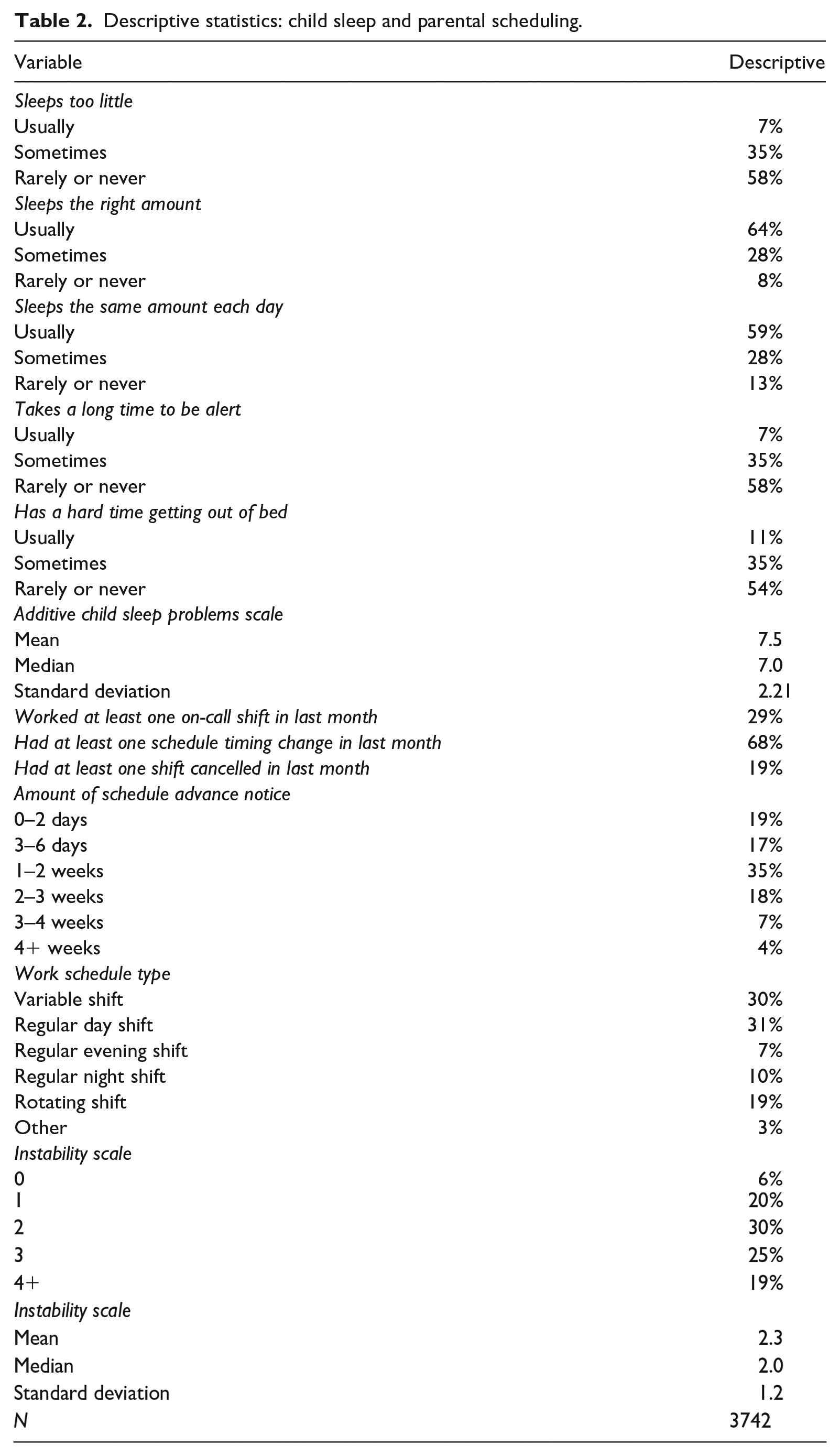
Parents also reported significant exposure to unstable and unpredictable work schedules. More than a quarter of parents reported at least one on-call shift in the prior month and 19% reported a cancelled shift. A much larger share, two-thirds of parents, reported at least one schedule timing change. In terms of notice, we found that a third of parents reported receiving less than a week’s advance notice of their schedule and just 29% report at least two weeks’ notice. A third of parents reported working a variable schedule – one that changes from day-to-day – and another 19% worked a rotating shift. Just a third of parents reported working a regular day shift; in fact, a minority of parents, at 48%, worked any kind of regular shift.
These exposures sum up to substantial work schedule instability and unpredictability for parents. Just 6% of parents reported the absence of these practices – a stable and predictable schedule; 20% reported one such exposure, 30% reported two and 25% reported three. One-in-five, 19%, reported at least four such exposures.
Work scheduling and child sleep
Table 3 presents the results from a set of six regression models describing the association between exposure to unstable and unpredictable work scheduling practices and our scale measure of child sleep problems. Each model is weighted and contains the full set of controls and fixed-effects, with the scheduling items entered singly (one measure per model). We found consistent evidence that children whose parents work on-call shifts, have last-minute schedule timing changes, or experience cancelled shifts have more sleep problems. We also found that shorter advance notice of schedules is associated with more sleep problems. Compared with children whose parents receive at least a month’s notice, children whose parents receive less than 72 hours’ notice experience significantly more sleep problems (B = 0.681, p < 0.01), roughly a quarter of a standard deviation difference.
Association between parental exposure to unstable scheduling and child sleep quality.
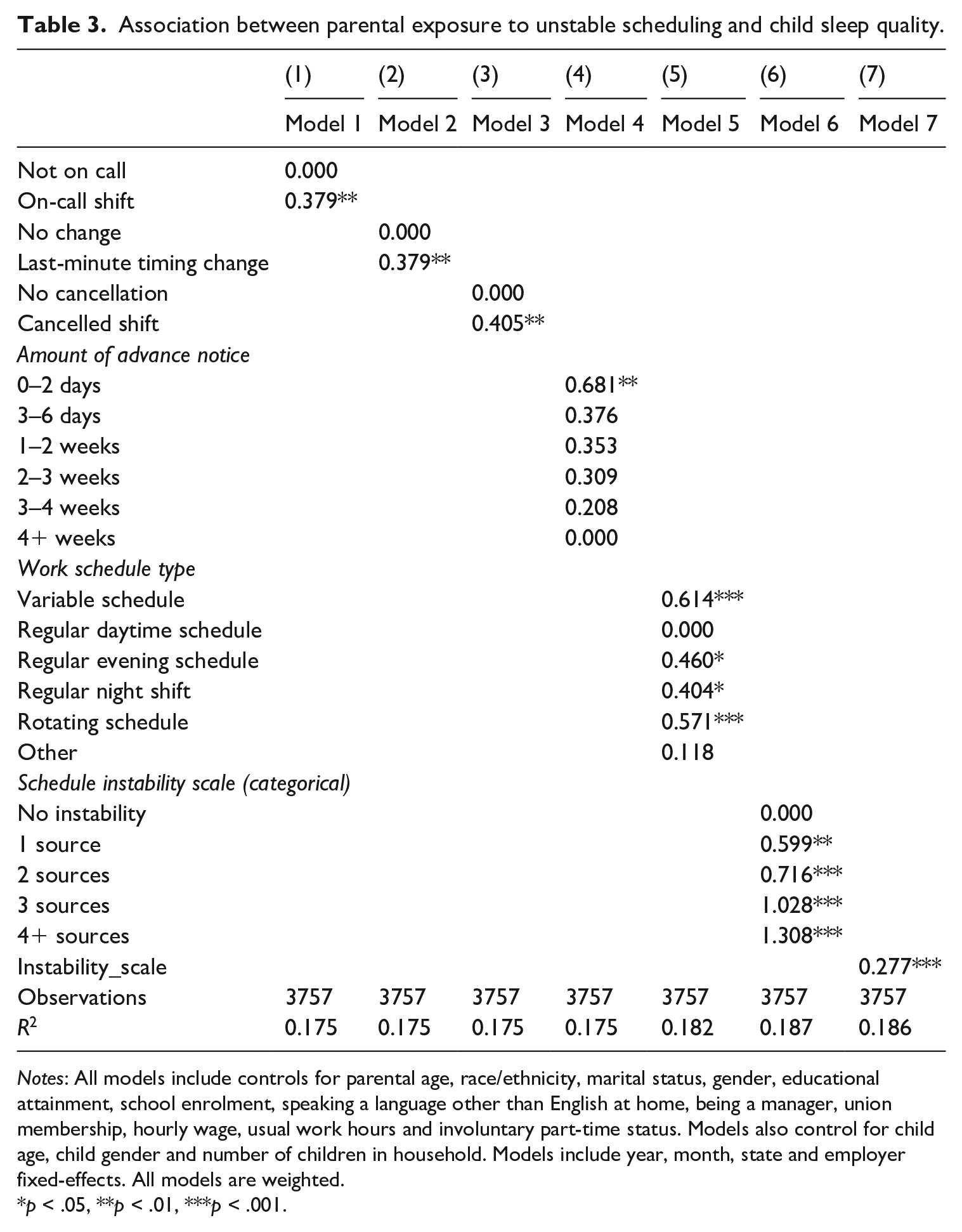
Notes: All models include controls for parental age, race/ethnicity, marital status, gender, educational attainment, school enrolment, speaking a language other than English at home, being a manager, union membership, hourly wage, usual work hours and involuntary part-time status. Models also control for child age, child gender and number of children in household. Models include year, month, state and employer fixed-effects. All models are weighted.
*p < .05, **p < .01, ***p < .001.
In Models 6 and 7, we estimate the association between child sleep problems and the additive scale measure of schedule instability and unpredictability. We enter the scale as a categorical variable in Model 6, allowing for a non-linear relationship with sleep problems and we enter the scale as a continuous variable in Model 7, which constrains the relationship to be linear. In both, we see strong and statistically significant associations with sleep problems. Children whose parents are exposed to more types of unstable and unpredictable scheduling practices exhibit more problems with sleep.
We plot predicted values from these models in Figure 1. First, we see that even when not constrained to be linear, the relationship essentially is so, with the predicted values from the categorical model closely tracking those from the linear model. Second, we see that the association is substantively large. The 6% of children whose parents had stable and predictable schedules exhibited about half of a standard deviation fewer sleep problems than the 19% of children whose parents had the most unstable and unpredictable schedules. In terms of the scale, we found that children whose parents have stable and predictable schedules have an average of 6.9. Children whose parents had the most unstable and unpredictable schedules, however, exhibited an average of 8 on the sleep problems scale, which is almost approaching the 8.14 mean of these measures exhibited by children with clinically diagnosed sleep problems reported by Owens et al. (2000b).
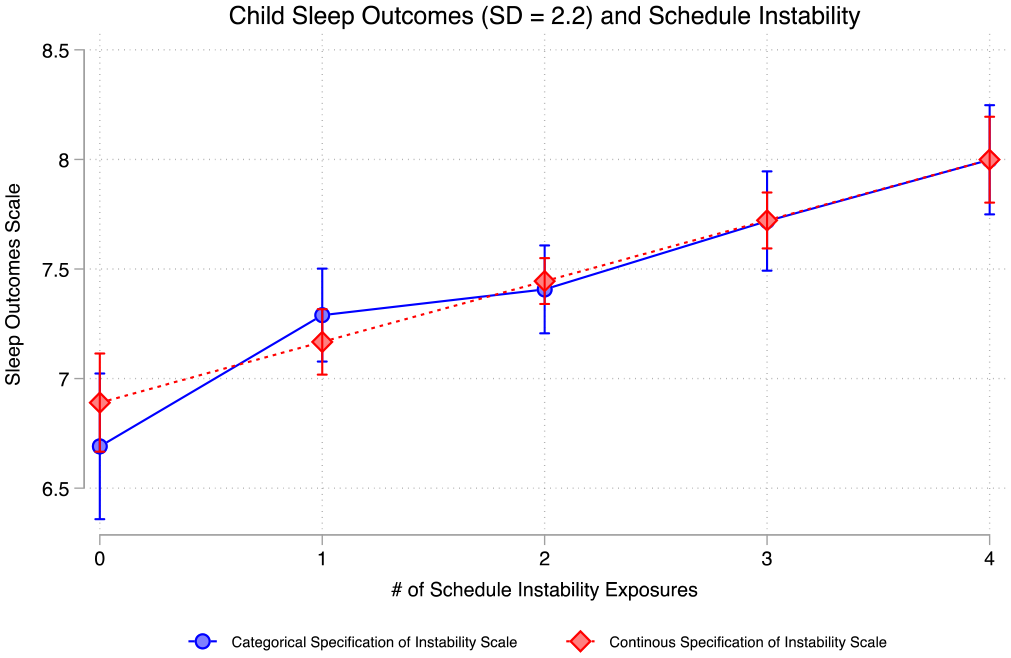
Schedule instability measures and child sleep outcomes scale.
Figure 2 plots the predicted values of each component of the sleep problems scale across the values of the schedule unpredictability scale, using the same model specification as in M7 of Table 3. In these models, the outcomes are dichotomized to aid in the interpretation of the substantive size of the effects. Each outcome presents significant associations, with the largest such associations for not sleeping the right amount each night and for not sleeping the same amount each day. For the former, 47% of children whose parents had the most instability did not sleep the right amount each night, against just 21% of those whose parents had stable and predictable schedules. For the latter, 49% of children whose parents had the most unstable schedules did not sleep the same amount each night, against 32% of children whose parents had the stable and predictable schedules.
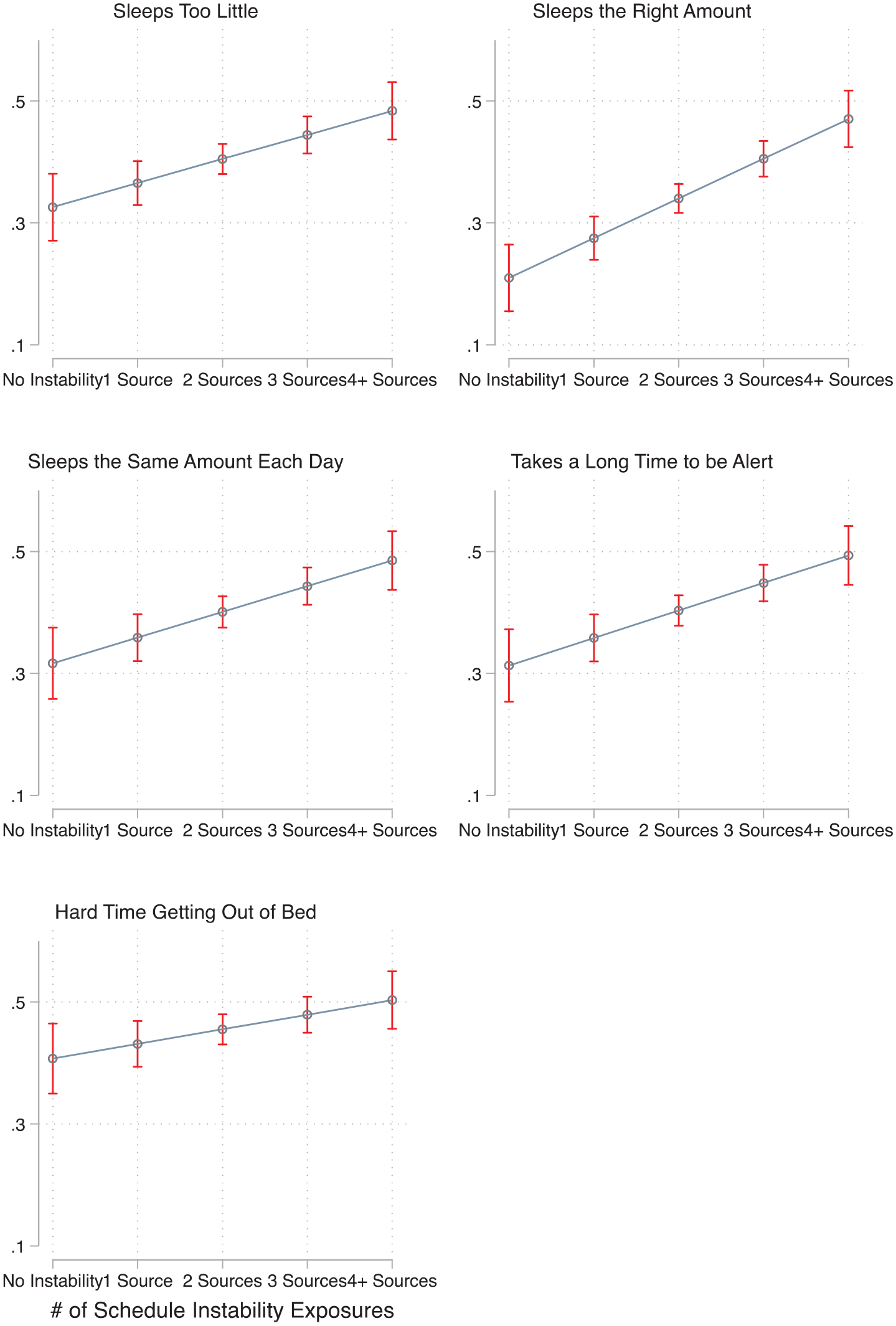
Robustness: association between schedule instability scale and individual child sleep quality measures.
Mediation analysis
This article hypothesized that any association between parental exposure to schedule instability and unpredictability would be mediated, in part, through work–life conflict, parental stress, parental well-being, economic hardship and child behaviour. Table 4 presents the results of our mediation analysis. The first set of results include work–life conflict, parental stress, parental well-being and economic hardship as mediators. These factors mediated 35% of the total association between schedule instability and sleep problems, with parental stress and parental well-being the most important mediating factors. The second set of results include child behaviour as a mediator. In these models, 50% of the total association is explained, with child externalizing, child internalizing and parental stress and well-being playing the most important mediating roles. However, while child behaviour could mediate the association between unstable scheduling and child sleep quality, it could also be the result of sleep problems, so these results should be interpreted cautiously.
Mediation of association between parental exposure to schedule instability and child sleep quality.
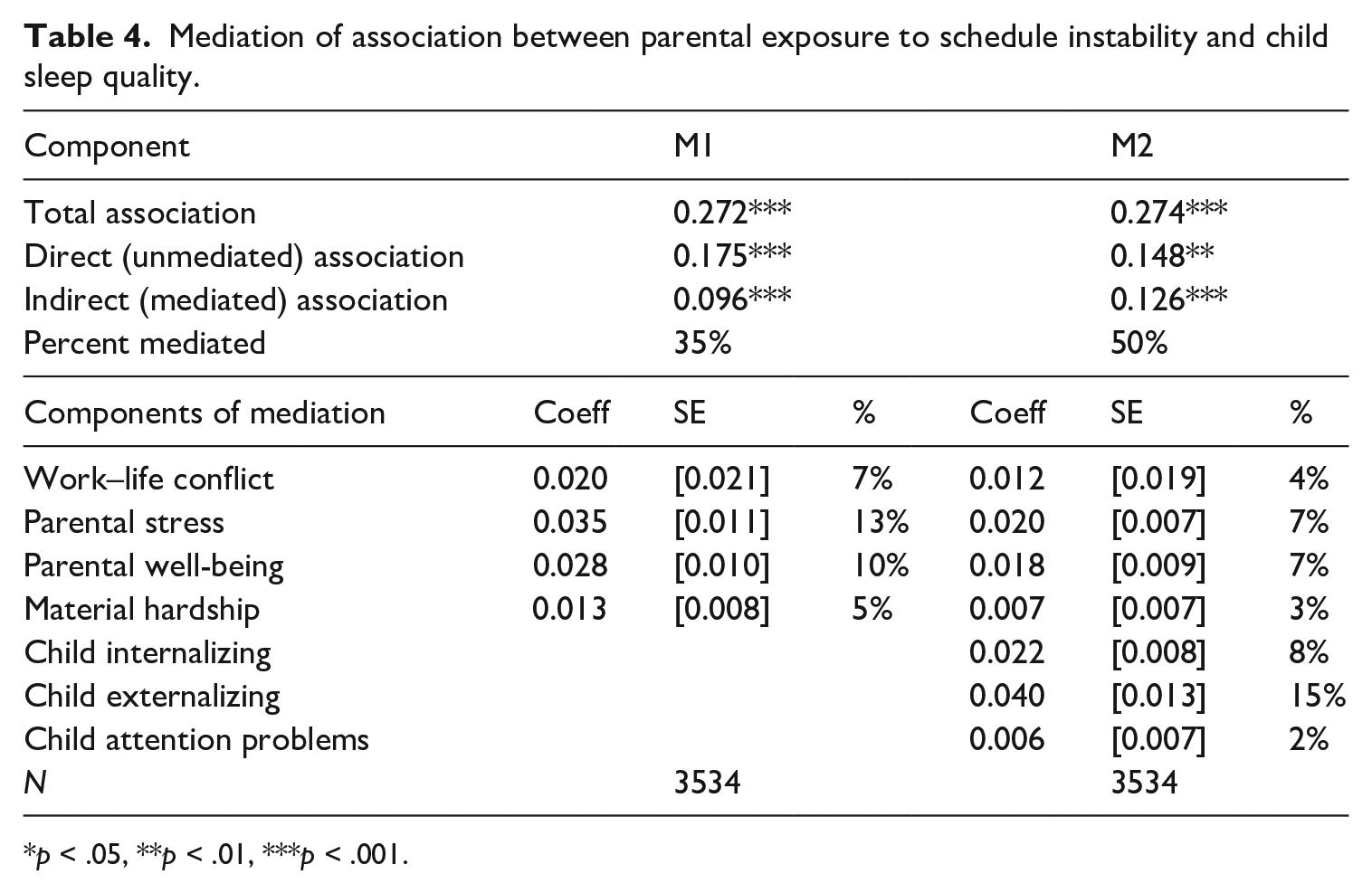
*p < .05, **p < .01, ***p < .001.
Discussion and conclusion
This article examines whether parental exposure to work schedule instability is associated with lower quality sleep for children and assesses the mechanisms that connect parental schedule instability and unpredictability with child sleep quality. Previous research investigating this question has had to rely on data that are limited in their ability to measure work schedule instability, child sleep quality and potential mechanisms, or have focused on contexts that are markedly different from the United States. The results from this study suggest that children whose parents experience on-call shifts, last-minute schedule timing changes, cancelled shifts, less than two weeks’ notice of their schedules and have variable or rotating shifts experience significantly more sleep problems. Taken together, these findings present an essentially linear relationship between increased exposure to schedule instability and increased sleep problems for children. This association is also substantively large, with the increase in sleep problems of children whose parents experience the highest range of schedule instability approaching the average reported by children suffering from clinically diagnosed sleep problems (Owens et al., 2000b). Finally, the model used in this study explains between 35% and 50% of the effects of parental schedule instability on children’s sleep difficulties.
This study also has several limitations. First, because these analyses rely on regressions of cross-sectional data with non-random selection into schedule instability, the ability to make causal inferences is limited. While these effects cannot be definitively identified, a plausible causal pathway is suggested with the use of mediation analysis. Additionally, while The Shift Project data contain the most detailed measures of work scheduling practices in the service sector currently available in US data, there are several limitations of our measurement of schedule instability. The scale of work schedule unpredictability in this study does not capture the intensity of any individual type of instability, so it is possible that these results under- or over-estimate the effects of scheduling precarity. Additionally, because the analysis focuses on scheduling practices that directly affect workers, the measures used in this article do not capture the complex social relations determining these outcomes. The social relations of scheduling practices could determine how certain individuals interpret each measure and cause the overestimation or underestimation of scheduling instability for certain workers.
Second, The Shift Project data uniquely focus on a population of workers of substantive and policy interest and include rich measures of schedule instability and unpredictability alongside detailed measures of children’s sleep quality and mediating processes. These data, however, are collected using a non-probability sample design. While much of the literature in sleep science similarly relies on non-probability or ‘community’ samples and while we attempt to validate and guard against bias from sample selection, the threat of such sampling biases remains.
The findings in this article add to a growing body of research investigating unstable and unpredictable work scheduling practices by employers in the low-wage service sector (Halpin, 2015; Lambert, 2008; Schneider and Harknett, 2019; Storer et al., 2020; Wood, 2020). Heeding the call by Alberti et al. (2018) to conceptualize and measure distinct processes of precarization in the workplace, this article both quantifies these practices and assesses the seriousness of their effects on children. These findings, and others (Schneider and Harknett, 2022a), suggest that sociologists of work should continue to measure and assess the impacts of scheduling practices on workers and their children. Temporal inequality among parents in the form of scheduling practices is an increasingly compelling distinction to study, even among already marginalized and precariously employed low-wage workers.
Additionally, by investigating how unstable and unpredictable parental work schedules affect children, this article adds to a longstanding literature in sociology examining the reproduction of social inequality. First, by focusing on temporal characteristics within parents’ occupations, this article moves beyond traditional measures of parental characteristics such as income, education, occupational status or wealth when examining the intergenerational transmission of inequality. Second, by using child sleep as an outcome, this article also highlights temporal inequality as a dimension of social inequality that can be intergenerationally transmitted. This study joins other studies that have examined the effects of temporal disparities in children’s lives, such differences in children’s activities or quality-time spent with parents (Guryan et al., 2008). Illuminating sleep as a salient dimension of temporal inequality among children has implications for their well-being and outcomes (Chaput et al., 2016; Curcio et al., 2006; Dewald et al., 2010).
Finally, this study points to several avenues for future research. This article does not examine whether the relationship between parental work schedule instability and children’s sleep problems are moderated by key child or family characteristics (e.g. age of child, family structure or the gender of parents). Future studies might examine these factors and investigate the effects of other potential mediators, such as childcare arrangements and parents’ social networks on children’s sleep outcomes. Additionally, studies examining the reproduction of social inequality could investigate whether children’s poor sleep quality might intersect with other obstacles that parental exposure to unstable work schedules presents to children, such as economic insecurity and difficulty in arranging childcare (Carrillo et al., 2017; Harknett et al., 2022). Finally, future research may explore whether the reproduction of temporal precarity varies by the gender, class or race/ethnicity of parents and their children.
Footnotes
Appendix 1
Descriptive statistics – weighted and unweighted.
| Variable | Unweighted | Weighted |
|---|---|---|
| Age | ||
| Mean | 37.4 | 35.9 |
| Median | 37.0 | 36.0 |
| Race/ethnicity | ||
| White, non-Hispanic | 79% | 50% |
| Black, non-Hispanic | 5% | 12% |
| Hispanic | 10% | 30% |
| Other race/ethnicity, non-Hispanic | 7% | 9% |
| Partnership status | ||
| Married, living with spouse | 48% | 45% |
| Living with a partner | 26% | 26% |
| Not living with a spouse or partner | 27% | 29% |
| Gender | ||
| Male | 23% | 36% |
| Female | 77% | 64% |
| Educational attainment | ||
| Less than high school | 6% | 7% |
| High school diploma/GED | 36% | 36% |
| Some college | 36% | 38% |
| Associate degree | 13% | 11% |
| Bachelor’s degree | 9% | 8% |
| N | 3742 | 3742 |
Appendix 2. Mediators
We construct a set of five mediators: work–life conflict, parental stress, parental well-being, economic insecurity and child behaviour.
First, we measure work–life conflict. We measure work–life conflict using a three-item scale variable that gauges parents’ ability to handle personal matters while at work, if their shift causes extra stress for themselves and family, and if they have enough flexibility in their schedule to handle family needs (α = 0.82). Parents answered whether any of these situations were ‘always true’, ‘often true’, ‘sometimes true’, or ‘never true’.
Second, we measure parental stress (α = 0.74). Parents were asked to rate their agreement from ‘strongly agree’, ‘agree’, ‘disagree’ or ‘strongly disagree’ with three statements. First, ‘I feel trapped by my responsibilities as a parent’. Second, ‘I find that taking care of my child/children is much more work than pleasure’. Third, ‘I often feel tired, worn out, or exhausted from raising a family’.
Third, we measure parental well-being. We construct a scale variable (α = 0.62) composed of three sets of indicators. The first is coded as ‘1’ if parents reporting being ‘pretty happy’ or ‘very happy’ as opposed to ‘not too happy’. The second is coded as ‘1’ if parents report their sleep quality as ‘very good’ or ‘good’ as opposed to ‘fair’ or ‘poor’ over the past month. The third item is coded as ‘1’ if respondents score below 12 on the K-6 scale of psychological distress with reference to affect over the past month, the generally accepted cut-off for significant psychological distress (Lee et al., 2012).
Fourth, we measure economic insecurity. We construct a scale variable (α = 0.79) that is composed of three items. For the first item, financial fragility, respondents report their capacity to cope with a $400 expense shock in the next month with responses options of ‘I am certain I could come up with the full $400’, ‘I could probably . . .’, ‘I could probably not . . .’ and ‘I am certain that I could not come up with $400’ (Federal Reserve, 2019). For the second item, respondents report on in a typical month, ‘how difficult is it for you to cover your expenses and pay all your bills?’, with responses of ‘very difficult’, ‘somewhat difficult’ and ‘not at all difficult’. The third item captures whether parents report experiencing any of seven material hardships (using a source of free food, going hungry, not paying utilities, taking an informal loan from kin/kith, doubling up, staying in a shelter, deferring medical care).
Fifth, we measure child behaviour. Parents complete the Child Behaviour Check-List Brief Problem Monitor, which contains items that we use to construct scales for internalizing (α = 0.85), externalizing (α = 0.86) and attention problems (α = 0.86) (Achenbach et al., 2011). These alphas meet or exceed the benchmarks reported by Piper et al. (2014) in their validation study. The internalizing scale has a mean of 1.9, the externalizing scale a mean of 3.2 and attention problems a mean of 3. These scores are higher than the means of 1.5 and 2.5 reported by Piper et al. (2014) in their validation study using a convenience sample of Oregon caregivers.
Funding
The authors disclosed receipt of the following financial support for the research, authorship, and/or publication of this article: We gratefully acknowledge grant support from the W.T. Grant Foundation (188043 and 200093). The Shift Project is supported by the National Institutes of Aging (R01AG066898), the Robert Wood Johnson Foundation (Award No. 74528), and the Bill and Melinda Gates Foundation (INV-002665).
