




Abstract
COVID-19 devastated the ability of self-employed and freelance live performers working in the UK’s live entertainment industries to sustain a living in an already precarious sector of employment. It also exposed the inadequacies of existing ways of conceptualising precarity in allowing a complete understanding of performers’ experiences of precarious employment, particularly during such a crisis. Combining research into precarity, recognition theory and qualitative data on how such performers experienced and responded to the pandemic, this article identifies two forms of precarity they experienced: socioeconomic and recognitive. In doing so, it contributes to the sociology of work by demonstrating how these two modes of precarity generated considerable operational and existential challenges for performers while extending the conceptualisation of precarity in such a way as to offer a more nuanced understanding of its impact, not only on the livelihoods of those experiencing it but also on their work identities and sense of self.
Keywords
Introduction
Measures taken to contain the COVID-19 pandemic dramatically accentuated the precarious employment conditions faced by freelance and self-employed live performers 1 working in the UK’s entertainment industries. Venues closed for an (at the time) indefinite period, undermining performers’ livelihoods, many of whom already struggled in an insecure labour market. Besides posing a threat to their incomes, the pandemic also exposed performers’ precarious sense of identity as creative workers, as they found themselves denied access to sources of professional recognition, something that existing conceptualisations of precarity do not allow us to fully account for. Drawing on qualitative data collected over a 24-month period, from March 2020, when the UK entered its first period of lockdown, to February 2022, when venues began to re-open after successive periods of closure, this article addresses this issue by highlighting how such socioeconomic precarity can co-exist with a form of what is termed here, recognitive precarity; one that compounds the sense of insecurity and vulnerability experienced by many individual performers.
To date, socioeconomic precarity is the most widely documented outcome of precarious work (Han and Hart, 2021; Kalleberg, 2009; Standing, 2011). It refers to how a person or group’s capacity to sustain a viable (liveable) income is characterised by irregularity, uncertainty and/or structural inequality. While socioeconomic precarity was widely experienced by many of those employed in the entertainment industries before the pandemic, in this article, the concept is used to understand not only the acute financial consequences of COVID-19 but also the socioeconomic impact of the pandemic, including worsening intersectional inequalities. The second mode of precarity considered here is what is termed recognitive precarity. 2 This concept draws on work by philosophers Axel Honneth (1996, 2012) and Judith Butler (2004) and describes the emotional and psychological insecurity posed primarily, in this instance, by the potential breakdown of the traditional interrelationship between live performers and their audiences that the pandemic brought about. For many, we show how this resulted in a crisis of identity.
In adopting this distinction, the article demonstrates the value of these two forms of precarity in helping us to understand how performers experienced threats not only to the sustainability and viability of their livelihoods but also to their sense of professional selfhood and value during COVID-19 and beyond. Moreover, it shows how this distinction is essential to understanding the impact of performers’ differential capacities to respond to such challenges and how this could impact their ability to take up opportunities to perform online and, in doing so, not only generate an income but also establish new networks of recognition, buttressing and, in some instances, growing their sense of professional identity.
The article aims, therefore, to extend our understanding of precarity by examining the specific work experiences of performers for whom precarity is the ‘norm’, focusing on what, even for them, were extreme circumstances. In doing so, it demonstrates how the already precarious project of building a stable income and career can be both damaged and contested by structural and cultural conditions that often defy even its provisional attainment. We show how this is acutely felt by performers who are often highly accomplished in their fields and who identify closely with their work, yet for whom work is a chronically precarious endeavour.
The article begins with a discussion of precarity in the creative industries and of the intersubjective relationships through which a desire for recognition shapes social and, in this case, professional identities. It then considers precarious work among those employed within the UK entertainment industries, particularly live self-employed and freelance performers, exploring the pandemic’s impact on them. This is followed by a discussion of the methods of data collection and analysis and a presentation of the main empirical themes emerging from the study, focusing on lived experiences of the two modes of precarity under discussion. Finally, the article highlights the importance of considering both socioeconomic and recognitive precarity in order to understand how the pandemic both provided the momentum and opportunity for some performers to develop creative responses while intensifying, for others, existing inequalities. Reflecting on this, the article concludes that both socioeconomic and recognitive precarity are valuable concepts for understanding why this was the case and what it implies for a workforce for whom ‘struggles for . . . recognition and fair remuneration’ (Conor, 2014: 12) are – for the vast majority of workers – mutually constitutive of their work experiences and identities.
Precarity, creativity and recognition
The entertainment industries and COVID-19
Research into precarity, characterised as a state of ‘job insecurity, temporary or part-time employment, a lack of social benefits, and low wages’ (Millar, 2017: 3), highlights its detrimental effects on working conditions, economic security and the capacity to organise collectively (Hassard and Morris, 2018; Moore and Newsome, 2018; Però, 2020). One sector of work intimately associated with precarity, particularly its socioeconomic dimension, is the creative sector and those industries that comprise it (Genders, 2022; Gill and Pratt, 2008; Hesmondhalgh and Baker, 2010), especially the live entertainment industries (Arditi, 2021; Butler and Russell, 2018; Dimen-Wagner, 2017; Hancock et al., 2021). Reliant on a workforce of self-employed and freelance performers and other workers, the entertainment industries tend to be regulated (at best) through fixed-term contracts dependent on the length and success of a production. This results in a workforce that is particularly vulnerable to the lack of security and infrastructure, as well as opportunities for representation and recourse, that employment can provide (Carey Jones, 2020; Maples et al., 2022).
Moreover, despite a host of policy interventions to promote the value of these industries (Flew, 2017), this situation has been exacerbated by a drive to strengthen market forces, resulting in cost-cutting, reductions in long-term investment (Aroles et al., 2022; Chafe and Kaida, 2020) and an increase in ever-more insecure terms of employment (Gill and Pratt, 2008; McRobbie, 2004; Ross, 2006/7). As such, many of those who find paid work in entertainment face obstacles that preclude secure working conditions and fair remuneration (Eikhof and Warhurst, 2013; Owolade, 2022; Shade and Jacobson, 2015). Furthermore, like many other creative workers, the large number of freelance and self-employed workers in the live entertainment industries are frequently dependent, through a combination of strategic adaptability, social networks and entrepreneurial practices (Neff et al., 2005), on their ability to continually ‘hustle’ (Langevang et al., 2022; Mehta, 2017; Steedman and Brydges, 2023) and to extend their work remit beyond their artistic or professional skill sets and contractual terms.
It was against this backdrop, one of ‘heightened competition, rampant insecurity, and the individualisation of risk’ (Duffy and Wissinger, 2017: 4652), that, in 2020, COVID-19 struck. Internationally, it resulted in the almost total collapse of the live entertainment industries, while in the UK, it denied more than 300,000 freelance and self-employed live performers the ability to earn a living from venue-based performance work (Office for National Statistics, 2020). Exacerbating the already precarious nature of work in these industries (Arditi, 2021; Banks, 2020; Langevang et al., 2022), the pandemic, lockdown and social distancing led Equity (2021), the UK’s foremost performing arts and entertainment trade union, to refer to COVID-19 as a ‘pandemic of precarity’, 3 accentuating the contours and effects of pre-existing structural inequalities (Comunian and England, 2020; Eikhof, 2020; Friedman et al., 2017; O’Brien and Taylor, 2021).
The pandemic also served as a creative catalyst, however, prompting (or perhaps necessitating) some live performers to embrace a shift towards remote working (Nagel, 2020) and to make greater use of digital platforms and social media (Hancock et al., 2021). For while a drift towards supplementing live performance with digital outputs was already underway before the pandemic, albeit predominantly by major theatre venues (e.g. London’s Barbican and National Theatre), COVID-19 ‘translated’ and dispersed this growing interest in digitally based modes of performance more widely as venues, production companies, and self-employed and freelance performers began to livestream their work during early and subsequent periods of lockdown in an effort to engage audiences and to generate income. Nonetheless, for the latter, lacking the technological and financial infrastructures of larger venues and organisations, performing online generated its own challenges, a point returned to shortly.
Live performance, precarity and identity
As noted already, socioeconomic precarity in the creative sector, including the live entertainment industries, is well documented (Arditi, 2021; Butler and Russell, 2018; Dimen-Wagner, 2017; Gill and Pratt, 2008; Hesmondhalgh and Baker, 2010; Shade and Jacobson, 2015). Nonetheless, while a concern with its impact remains integral to this article, the data discussed below suggest that focusing solely on socioeconomic precarity does not tell the whole story, failing to fully convey how live performers experienced precarity during, before and after the pandemic. Instead, such economic hardship and uncertainty can also accentuate ongoing concerns about the viability of their identities as credible, professional live performers (i.e. those who are able to make a viable, sustainable living from performance work) and, in doing so, undermine their sense that they are recognised as such by their audiences (Langevang et al., 2022).
As Leidner (2016: 7) observed in her study of stage actors, live performers often struggle to ‘assert and defend an identity’ given the heightened precarity of their occupation and the various and often competing factors that contribute to this. Indeed, as research has documented (Entwistle and Wissinger, 2006), the nature of the live entertainment industries means that, for many, the challenges of accessing work can involve a constant threat to their self-esteem, requiring a continual aesthetic and emotional investment to cope with the experience, and anticipation, of perpetual rejection or objectification. Moreover, the need that many performers experience to maintain a portfolio of jobs and deploy entrepreneurial techniques (Ross, 2006/7; Stokes, 2021) to sustain a viable living (Langevang et al., 2022; Mehta, 2017; Steedman and Brydges, 2023) can also be a significant contributor to such existential anxiety. As Dimen-Wagner (2017: 11) observes, theatrical performers must frequently undertake various and often low-paid jobs outside their chosen profession due to the industry’s endemic precarity. This can lead to a fragmentation of occupational identity, resulting in ‘personal social anxieties and insecurity’ among performers who have to juggle a panoply of different jobs, legitimising what are often discriminatory working practices as well as the acceptance and reproduction of structural myths surrounding what it means to commit to life as a creative practitioner (Bain, 2005). Such myths can include a dedication to one’s art or craft above all else, again resulting in self-doubt and an ongoing questioning, or fracturing, of professional identity (Beech et al., 2016; Hoedemaekers, 2018).
The pandemic again amplified many of these challenges, significantly affecting the psychological well-being and mental health of individuals employed in the creative sector (Bradbury et al., 2021). This was particularly pronounced among freelancers working in the live entertainment industries (May et al., 2022), as they grappled with the challenge of supplementing their incomes through those limited work opportunities that were accessible to them. Nor was this helped by the state’s relative lack of financial and political support for this workforce (Freelancers Make Theatre Work [FMTW], 2021). While UK schemes such as the Self-Employment Income Support Scheme (SEISS) that ran from May 2020 to September 2021 were designed to support the freelance and self-employed workforce, it is estimated that around 40% of applicants from the live entertainment industries who thought they were eligible for this funding were unsuccessful in their applications, leaving them not only dependent on minimum benefits but feeling ignored by a government 3 that appeared suddenly keen to discourage the idea that work in these industries, or a creative identity, was valuable. 4
Taken together, these challenges created a heightened struggle among live performers not only for socioeconomic survival but equally for recognition as viable working artists, a struggle that pre-dated the pandemic but which was exacerbated by it. In considering how this was experienced by those working as live performers, the findings presented below respond to ongoing calls to extend the analytical reach of precarity without losing sight of the core role that the contemporary organisation of work and labour markets plays in its structuring and proliferation (Alberti et al., 2018; Millar, 2017). It does so by foregrounding recognition as a medium through which this struggle is ‘worked through’ via efforts to maintain a viable living and credible professional identity, connecting precarity and recognition as key to understanding work as a freelance or self-employed live performer.
Precarity and recognition
A growing body of literature applies the concept of recognition to understanding work practices (Fassauer and Hartz, 2016; Hancock, 2013; Newlands, 2022). Much of this draws on the framework developed by Honneth (1996), whose ontology of recognition positions individuals as sharing a common desire for intersubjective recognition, not only as intimate partners but also as bearers of legally enforceable rights and as valuable contributors to the healthy reproduction of society. While the former is deemed to take place predominantly in the private sphere, the latter two modes of recognition, in the form of respect and esteem, are achieved through an engagement in public activities, particularly paid work. While respect leads to the achievement of universal rights, guaranteed, for the most part, by law, esteem is achieved through a recognition of one’s skills, achievements and contribution to the common good, something that is widely experienced through employment that takes place in a predominantly market economy (Honneth, 2014). The achievement of such recognition is, for Honneth, vital to the intersubjective development of a secure and, to evoke Korsgaard’s (1996: 101) terminology, practical identity – one that is valued both by oneself and by others and which is ‘a description under which you find your life to be worth living and your actions to be worth undertaking’.
To date, however, only Motakef (2019) utilises Honneth’s (1996) work to directly link how employees experience recognition in the workplace with the condition of precarity. Combining Honneth’s model with a critique of the precarity of life arrangements, as developed by Klenner et al. (2012) and Amacker (2014), Motakef argues that socioeconomic precarity in employment negatively impacts an individual’s experience of recognition, as being trapped in temporary or part-time work, being a contract-worker or having a perpetually low income ‘can encroach on one’s possibilities to realise [. . .] skills, abilities and talents’ (Motakef, 2019: 169), thus denying opportunities for esteem and recognition. Moreover, even though such a lack of recognition can be partly compensated for by other aspects of one’s life – such as through friendship groups – it can still result in a sense of misrecognition that, returning to Honneth (1996), can have significant pathological consequences leading to a crisis or fragmentation of identity and what, as shall be argued below, might be considered to be a heightened sense of what we understand here as recognitive precarity.
While Honneth’s theorisation of recognition tends to be most widely drawn on as a reference point for understanding the world of work, Butler’s (2004) writing on precarity, including that developed in dialogue with Honneth (Butler, 2008; see also Honneth, 2008), also offers a valuable contribution to the framing through which scholars within the sociology of work have started to approach precarity and its relationship to recognition (see Tyler, 2019; Varman and Al-Amoudi, 2016). As Millar (2017: 4) observes, Butler uses the term precariousness to describe not simply a socioeconomic relationship but rather the ‘generalised condition of human life’ in which we are all vulnerable to various assaults on our integrity, both physical and emotional, as we seek recognition through social relations. Nonetheless, the social positioning of this vulnerability means that while we are all precarious, we are by no means equally so due to the differential risks posed by socioeconomic precarity, including within and through the world of work (Butler, 2022). As such, Butler’s thinking on precarity and its relationship to recognition brings to the fore not only the precarious nature of all social relations but also leads one to question how the social positioning and organisation that takes place in and through work means that while precariousness is a defining feature of the social condition, exposure to precarity is shaped by the structural contouring of that condition. While the former is a condition shared by all, the latter – precarity – is experienced as an exploitation of the precariousness engendered by our desire for recognition (our need to belong and to be appreciated for who we are and what we do), including in and through work.
Drawing on both of these ways of conceptualising recognition, this article delves into the intensified socioeconomic precarity that freelance and self-employed live performers endured during the pandemic and their ongoing struggles in seeking recognition. Combining these two conceptual frameworks, it explores the nature of this precarity and its connection to the challenges related to recognition. Through this, it illustrates how these two forms of precarity – socioeconomic and recognitive – coexist and, notably, how the former can magnify the latter’s impact, creating a reinforcing cycle. Its contribution is, therefore, threefold.
Firstly, acknowledging that the work of freelance and self-employed live performers is underpaid (and often unpaid), insecure and exhibits poor working terms and conditions, it provides empirical insight into how COVID-19 accentuated pre-existing socioeconomic precarity in this sector even, in the main, for performers who were able to adapt to new ways of working, most notably online. Secondly, it extends the conceptualisation of precarious work by introducing the concept of recognitive precarity to offer a more nuanced understanding of the pandemic’s impact, not only on the livelihoods but also on the identities of those undertaking it. Finally, the article critically evaluates the observation that vulnerability to both socioeconomic and recognitive precarity was, and remains, inequitably distributed and shaped by differential access to various forms of capital. These include not only economic but also cultural, experiential and social capital, access to which is commonly closely aligned with particular demographic characteristics such as social class and gender.
Methodology
The article draws on qualitative data from a mixed-methods research project into the impact of the COVID-19 pandemic on the work of freelance and self-employed live performers in the UK. Funded by the British Academy/Leverhulme, it initially comprised a Qualtrics-administered survey completed online between October and December 2020. This generated quantitative and free-text qualitative data, which was then supplemented by semi-structured, in-depth interviews with 26 participants between January 2021 and February 2022. In addition, the research also collected contextual material relevant to the project, including relevant media coverage and survey findings by organisations such as Equity, The Musicians’ Union (MU) and Freelancers Make Theatre Work (FMTW), and policy documents and reports published before and during the period of the project.
Data collection
Informed by the qualitative data set only, this article provides insight into the reflections on, and quotidian experiences of, the research respondents during the pandemic and the challenges it generated both then and (as they anticipated it at the time) for their future. As such, this data set combined circa 68,000 words of data from the free text comments taken from the survey (n = 221) and one-to-one interviews (n = 26). The original survey comprised a mix of quantifiable attitudinal questions and qualitative open questions inviting free-text responses. It was distributed through a combination of inviting survey participants to sign up, snowball sampling and recruitment via social media networks and groups, including a dedicated social media account to counter the geographical concentration that might result from the snowball sample. The interview questions were piloted and focused on the challenges and opportunities performers had experienced during lockdown, as well as their future expectations, both for themselves and for the sector. Interviewees were selected from those survey respondents who had indicated a willingness to take part in further research and on the basis of geographical, demographic and artistic representativeness.
Regarding artistic representation, most of the live performers interviewed identified themselves as multi-skilled and able to perform across several genres, including, for example, as actors, magicians and storytellers. Others identified themselves solely as, say, musicians or dancers, even though they also performed other roles as needed. Nevertheless, all those interviewed described themselves as predominantly ‘live performers’. For participant details, please see Appendix One.
Interview schedules were informed by the preliminary analysis of the qualitative data derived from the survey and opened with the request, ‘Please tell me about your work as a live performer’, with subsequent questions either following the schedule or working from their responses to this opening question. Interviews were conducted remotely via password-protected Zoom links and were recorded and professionally transcribed. In addition, participants were invited to comment on (anonymous) emergent findings so that data collection and analysis were as integrated and interactive as possible. All interviews were recorded and professionally transcribed, amounting to over 400 A4 pages of typed text. NVivo was used to aid data management and support the analytical process, but all interviews were manually coded. Standard institutional ethical protocols were applied throughout.
Data analysis
Initial analysis of the qualitative survey data identified expected and emergent codes and informed the design of the semi-structured interview schedule. Once the interviews were completed, the entire body of qualitative data was subject to a thematic analysis drawing on the three-stage process of data reduction, data display and conclusion drawing described by Miles and Huberman (1994). As such, it was initially subject to a process of data familiarisation, a recursive process that involved reading each set of survey responses and transcripts in their entirety, identifying and reducing down to first-order codes that allowed the data to be organised and then categorised in line with a combination of emergent and theoretically pre-indicated priorities, such as financial challenges, opportunities to perform, emotional and psychological experiences, and future possibilities. These first-order codes were then organised and displayed as second-order themes. Next, these were systematically worked through by teasing out different experiences and perspectives under each theme and, finally, by connecting insights across themes to reach conclusions about performers’ experiences, informed by a theoretical commitment to understanding the impact of precarity on this particular workforce. Finally, the analysis followed a slightly expanded version of Gioia et al.’s (2013: 21) concept of ‘re-cycling’ involving a movement iteratively and reflexively between ‘data, themes, concepts, and the relevant literature’, as well as participant and other stakeholder responses to emergent findings.
As the data collection and analysis developed, the findings coalesced around themes relating to participants’ sense that the pandemic had worsened pre-existing inequalities, that a struggle for recognition was endemic to their work and industries, and that the two phenomena were related in important and evolving ways.
Findings: Experiences of precarity during/after COVID-19
Socioeconomic precarity
Working in the live entertainment industries is a precarious undertaking at the best of times, something summed up by classical musician Carey Jones (2020: 48) when he notes that ‘to be a freelance artist is to live your life like a startled rabbit’. Nonetheless, the pandemic and the closing of live performance venues across the UK profoundly impacted the working lives of such performers. As cabaret artist Yvonne Smith reflected, speaking in 2020 in the middle of the first UK lockdown: I’ve wiped tables and arses. I’ve done every job under the sun . . . And I suppose I’m used to life being very up and down . . . We’re used to that. But this is like nothing else in intensity.
Most performers reported a dramatic worsening of their socioeconomic circumstances during the pandemic due to a sharp decline in their incomes from performance work. As puppeteer Basil Jackson starkly put it: ‘in the 2020–21 tax year, my income from live performance dropped to about 1.5% of what it normally was, so 98.5% [had] just gone’.
As prior to the pandemic, socioeconomic precarity was not evenly distributed. While not the only factor, one of the discriminating criteria during the pandemic was whether or not respondents were registered as self-employed or performed on a predominantly freelance basis. For the former, demonstrating eligibility for state support during periods of lockdown, particularly under the terms of the SEISS, was more straightforward with an employment evidence trail. Moreover, for many freelancers or the newly self-employed, despite often being dependent on their income as performers, not having such a trail, combined with the need to take on additional contracted employment to see them through fallow periods, saw them effectively excluded from meaningful governmental support, as explained by actor Diana Kitchener (emphasis added): . . . you just have to have a mix of PAYE, casual work and self-employed to get through this industry and to survive . . . So, after working so hard and always being so busy and doing multiple things at once, to suddenly have nothing, it was just a complete loss of ourselves.
Furthermore, the differences in performers’ abilities to access such support and cope with the socioeconomic impact of COVID-19 were also shaped by intersectional inequalities and differential access to resources and supportive infrastructures. This was raised, for example, by actor Charlie Rogers when he referred to class inequalities within the theatre industry: There’s a real class system within the acting fraternity . . . up until the pandemic, I’d never ever let anything like that bother me . . . But then this pandemic brought in this income support scheme, and it actually only favoured the guys who didn’t have to work in between acting jobs. It favoured those guys that live on a trust fund and that sort of stuff.
Certainly, performers who reported having been educated at ‘elite’ educational institutions or who had longstanding familial or professional networks within the arts and culture industries appeared to weather the storm of the pandemic more successfully. This reflected direct access to sources of financial capital such as having personal savings or their rent being paid by parents or siblings, being ‘in the know’ when specific opportunities to perform arose or possessing sufficient cultural capital to navigate or maximise opportunities when they appeared. Yet this was not unproblematic, as entertainer, magician and actor Brandon Knights (emphasis added) noted: I have had to dip into savings constantly to try and keep my head above water. So, whereas I know I’m very lucky, in that I had savings to dip into, a lot of people didn’t – so I mean, some people have really struggled, really, really struggled.
Changing ways of working online during lockdown
Despite the socioeconomic challenges posed by COVID-19, for some, performing via online apps and platforms such as Facebook and combining everything from online booking systems and artist support platforms such as Patreon to virtual tip-jars and the like provided a means of generating income during lockdown. Indeed, for several, notably male, performers who were relatively well-established in their careers and did not (in the main) have caring responsibilities and/or who had other financial support to fall back on, including the SEISS, lockdown was a period in which, financially at least, they thrived. For example, Brian Jones, a self-employed musician and artist, observed how, despite other challenges, combining an extensive online presence with access to state support meant that he was financially quite comfortable as a result of the pandemic: I seem to have more money than I’ve ever had. I don’t quite know how that’s happened. I can only assume that going on tour is actually really expensive . . . I mean, the help from the government has obviously been a great thing.
For others, just being freed from some of the rigours of attending venues, combined with a need to update their materials more regularly to accommodate repeat audiences and the creative affordances of the online environment itself, injected their work with something of a new vitality, as commented on by actor and comedian Gregg Mason, who noted how he had ‘been able to experiment with new ideas and techniques because I’ve had time that would otherwise have been used for admin and travel’.
Skills-wise, lockdown was also a period when some performers reported being able to develop new skills, particularly regarding the technical side of online performance. Musician Will Taylor summed this up when he noted that performing online during lockdown had left him feeling that his ‘technical knowledge and ability’ had ‘improved substantially’, leaving him ‘more confident with live audio and video set-ups and live production’ and feeling ‘able to apply this in various contexts’, improving his socioeconomic position both during and, (he hoped), after the pandemic.
Nevertheless, even for those who could adapt to new media and were able to extend their creative repertoires and skill sets, doing so often remained a socioeconomically precarious undertaking. As musician Richard Mears observed, while online performances were something of a lifeline, they could be disconcertingly uncertain, causing worry: Not having a sense in advance of whether anyone will definitely log in to watch, or if we will make enough money to justify the time put into the preparation and performance.
Indeed, for most of the performers we interviewed, performing online did not represent a path to a sustainable income in the medium to long term. Many quickly found that people were not prepared to pay much, or indeed anything, despite having watched a show, something that became more evident as the pandemic continued. As magician, Alan Rupert, lamented: I left it that people could pay whatever they wanted through PayPal, or I could send them bank details, and it was working quite well. I was getting about £50 a show. But then, at the end of that first lockdown, it just died a death.
Another problem was that access to the online environment was inequitably distributed. As alluded to above, the ability to invest time and resources into establishing an online presence often depended on having other sources of income available, such as grant support, additional employment, or a supportive partner. Moreover, the cost of investing in the equipment necessary to stage a credible online performance was also a significant obstacle for those already struggling with socioeconomic precarity. As actor Alison Lennon put it, she simply had ‘no money to invest in professional equipment’; something particularly true for women whose relatively lower pre-pandemic earnings meant that investing in the expensive equipment needed for live-streaming was not viable.
Other related problems participants raised included the availability of stable, high-speed fibre broadband access, particularly for those unable to afford it or for whom, such as comedian Jane Tompkins, it was simply not available: I live in a rural area, the broadband isn’t great. This means I often get dodgy connections, which limits what I’m able to do online.
Moreover, necessary business skills or, more generally, a familiarity with the ins and outs of the technology and social media were unevenly distributed. Each of these issues, along with financial concerns, often shaped the feasibility of online delivery as a means of generating income and maintaining a professional presence. Hence, a linkage between social inequalities and the capacity to earn a viable income from performing online and being able to ‘capitalise’ on opportunities to adapt to evolving ways of working during the pandemic was evident; something illustrated by actor Diana Kitchener, who described herself specifically in terms of her gender, working-class background and neurodivergent status: It comes down to privilege and money . . . it’s like, running a theatre festival myself, we’re not a funded festival; it’s just me. And I try really hard to try and make a digital festival work, but (a) I’m not very good with technical skills, and I did get some people trying to help me, but (b) you do still need money, a significant amount, to make that happen. And I just couldn’t, with me being in such a precarious financial situation. I just couldn’t take the risk.
Socioeconomic inequalities were also evident in references to the spatial restrictions of performing from home, especially for those who lived in smaller properties, had families, or were forced to share with relatives during the pandemic. As performance artist Tracie Kingsman explained, space in which to prepare and put on a credible performance was a genuine obstacle, describing this with reference to both the size of the available space where she lived and its unsuitable aesthetic: Artistically, backdrops/visual issues are the biggest challenge for performing at home. Living in a small apartment means I physically don’t have space for some of my acts, and there isn’t a suitable place that looks good to film against – it always looks like a show at home.
Even when space was adequate, technical obstacles to creating and monitoring the aesthetics of the performance also raised concerns interrelated with accentuated socioeconomic precarity, such as living in housing with poor soundproofing. Parenting and caring responsibilities were also considerations for some, restricting their ability to perform from home. As singer Tracy Ainsworth explained: ‘I am a mother, and my children are at the front of my mind all the time. Not being able to detach from home makes me inhibited!’
Losing the ‘moment of exchange’: Recognitive challenges during COVID-19
In addition to the pandemic’s socioeconomic impact, there was also an acute sense among interviewees of losing recognition of themselves as performers due to their inability to perform. The nature of their work, in which recognition is provided by both an appreciative audience and a sustainable income, meant that the struggle for recognition was keenly felt among performers. Such recognition as a professional (income-generating) and credible (artistically successful, or simply entertaining) live performer was something that many of those we interviewed had worked towards for many years, making personal and financial sacrifices to do so, and which COVID-19 had dramatically eradicated. Consequently, many found lockdown to be existentially challenging as they were forced to face, head-on, not only heightened socioeconomic precarity but also a form of recognitive precarity that undermined their identities as performers and the esteem and sense of recognition they desired, and which they had worked hard to secure.
For example, storyteller and actor Charlie Clipper described not being able to perform live as being ‘taken out of, not just what we do for a living and what we enjoy doing, but something that informs who we are’, reflecting on this experience as akin to ‘being negated’. Integral to this negation was the breakdown of those moments whereby the audience and performer were able to enter into an intersubjective exchange, with each being dependent on the other to acknowledge their co-presence in the experience, something reiterated by several of those we interviewed, such as Diana Kitchener, who referred explicitly to the significance of what she described as the ephemeral ‘moment of exchange’: It’s just that moment of exchange between you as a performer and an audience . . . making this magic happen in the moment with the audience. You know, there’s an ephemeral moment that’s never going to happen again.
The loss of such encounters and the scope for mutual recognition they opened up represented one of the most significant shocks of the pandemic for the performers we studied. The experiences of those whose acts or circumstances meant that they were unable to perform, even online, were illustrated in the words of Brandon Knights, who observed that among himself and fellow performers ‘there’s been a lot of struggle with loss of identity, because as a performer [if] you don’t perform, . . . what are you?’ Yvonne Smith summed this up when referring to how she felt about the loss of proximity to a live audience during lockdown and her need to get back to ‘who and what I am’, saying: I make stuff that I care about. But what I’m good at has now become my job, and I’m very proud of that . . . And that sense of identity being taken away . . . I want to get back to doing the thing that I do, to who and what I am.
What COVID-19 took away, therefore, was not only the opportunity to make a sustainable, if for many, a perpetually precarious income from live performance work. It also represented an equally acute threat to being recognised and granted esteem as a live performer.
Singer-songwriter Bev Vale summed this up when she described the impact of the pandemic on her sense of self. As she explained it (emphasis added): I felt like, kind of that March where it all happened [the first UK lockdown], I genuinely lost who I was as a person. And I think people don’t realise, you know when you have a job that’s so special to you, it’s who you are. It’s not just what you want to do . . . just had no kind of sense of what am I. It was horrible. So, it’s definitely more than just losing your earnings, it’s losing who you are.
Dancer and performance artist Glenda Kelp made a similar point, referring to the total loss of identity she felt as a result of the pandemic, given her commitment to an industry that is an ‘enormous part of your identity’, even while she feels that, due to its precarious conditions, it does ‘everything in its power to expel people’. Finally, singer, performance artist and stand-up comedian Mary Locket summed up a widespread view when she said: ‘All I want is to be recognised and respected’.
‘Making a community of fans’: Online performance, recognition and connection
Again, the ability to undertake live performance work online did, however, provide some performers with a means to secure a sense of recognition both in and through their work, albeit not unproblematically. For some, this meant providing not only entertainment but also respite for their audience, with performers seeing themselves as acting as a focal point for community and connection in the face of the deprivations of lockdown. As Yvonne Smith explained it, the online environment opened up the possibility of a new way to stay connected to, and to support an audience: I watched a lot of other people’s online things, and I thought something that’s trying to replicate the live experience online, for me, is not working, but . . . if you can interact with the audience and make them feel special, then I thought OK, that’s worth doing.
Performing online, almost exclusively via live-streaming from their homes, also allowed many performers to develop new ways of engaging with their audiences in what was felt to be a more intimate manner. By utilising, for example, online chat functions to interact directly with audience members during a performance and to create communities of fans, some performers could not only sustain a paying fanbase but also garner recognition of their continuing viability as artists. As musician Mark Godiva observed, by building what he described as a global ‘community of fans’ through his weekly online shows, he was able to sign off at the end by thanking them for ‘validating me and my life choices’.
The affirmation resulting from being able to perform in front of an online audience during lockdown was summed up by Mary Locket, who explained that what went online was ‘the glittering part of me’, restoring to her a sense of ‘meaning’ and ‘purpose’. As such, while strewn with obstacles, online performances could still enhance a sense of intersubjective recognition and the self-esteem of performers who felt they were making a meaningful contribution to their art and their audiences’ lives.
Not that this sense of meaning and purpose was entirely disconnected from the pursuit of financial security, however. While some performers were optimistic about the opportunities online performances created for more widespread recognition (e.g. due to their enhanced reach across more geographically dispersed and diverse audiences), they also admitted that such recognition could help them to build and sustain a future income stream, especially when face-to-face performance resumed. As Will Taylor (emphasis added) explained it: Live-streaming has enabled me to perform for audiences across the world who perhaps would not have had a chance to see me live. This has potentially opened/increased opportunities for international bookings when live performances are able to resume.
However, despite offering a lifeline for some, and even for those performers able to do so, online performances could also accentuate a sense of recognitive precarity by bringing the interrelationship between socioeconomic success and recognition to the fore. This was often due to something as simple as the aforementioned problem of not being able to reliably predict how many people might actually turn up for an online gig or the worry that the available (i.e. affordable) technology might prove inadequate to the task of home streaming, undermining the quality of both the public performance and, by implication, of the performer. Moreover, those unable to interact with other performers and/or their audiences directly (e.g. through chat functions or by making eye contact) found themselves reliant on more quantitative forms of recognition, including viewing figures and/or financial contributions, as a means of adjudging the reception of their performance. Bev Vale recalled how a disappointing socioeconomic response (in terms of online viewers and the income they generate) could accentuate her sense of recognitive precarity and feelings of ‘exposure’: When you first start going live, and like, ‘Oh my god, there’s 10 people, wow’. Then it got to a point where I had about 100 people watching me. And then whenever you don’t get that amount, you kind of feel like, ‘Oh no, why? Why have I not got many people today? Am I worse today?’ You start to question yourself, and you can feel very exposed.
For Bev and others, therefore, socioeconomic and recognitive precarity could be closely interrelated as a lack of financial success or stability could itself accentuate a sense of recognitive precarity as the former served as a manifest indicator of the latter.
Discussion and conclusion
COVID-19 and socioeconomic precarity
While far from alone in their struggles (Maples et al., 2022), this article has shown how COVID-19 significantly accentuated the experience of socioeconomic precarity among self-employed and freelance live performers in the UK’s entertainment industries. The pandemic, along with its associated social distancing, lockdowns and a lingering discomfort with enclosed social gatherings, dramatically reduced, if not decimated, their sources of earned income and undermined careers that had often been built over decades. While some undoubtedly benefited from the availability of state support in the form of, say, the SEISS, along with opportunities to shift to forms of online performance that allowed them to supplement their incomes to (for some) a sustainable level, it is evident that access to such lifelines was unequally distributed, leaving many struggling to stay afloat by incurring debt and depleting what savings or pension funds they had been able to accrue.
Moreover, even with the threat of COVID-19 receding and a new-found appetite for live entertainment resuming, the scars of the pandemic remain relevant to understanding the socioeconomically precarious character of live performance work in particular, and creative labour in general. Of ongoing importance is the need to identify and engage with the aforementioned inequalities that continue to pervade the live entertainment industries. Already precarious, live performance takes place in a sector that continues to be shaped by structural inequalities. This was highlighted during the pandemic, most notably by the inequitable access experienced not only to financial support but also to the social and technical resources that allowed only some live performers to navigate the challenges posed by the collapse in live entertainment. Currently, there are concerns, particularly among campaigning bodies, that not only have the lessons of the pandemic proven to be a missed opportunity to improve the pay and working conditions of self-employed and freelance workers in the live entertainment industries, but rather they have been ‘used strategically to drive pay and conditions down’ while leaving many feeling as if they are being increasingly exposed to a ‘very toxic and aggressive place to work’ (FMTW, 2022: 8/9).
Challenges of recognitive precarity
As has been argued here, the precarious nature of life as a live performer involves more than simply socioeconomic challenges. Rather, as has been demonstrated, to fully understand how this workforce experiences precarity, the subjective, or more accurately, intersubjective challenges characteristic of such work also require ongoing attention and intervention. In particular, and drawing on the ideas developed by Honneth (1996, 2012) and Butler (2004, 2022), we have shown how self-esteem, while vital to a live performer’s sense of recognition and identity, is itself a precarious achievement vulnerable to the same shocks and uncertainties as socioeconomic stability. To lose access to work in this context not only undermines material survival, therefore; it also has profoundly emotional and psychological consequences whereby performers often feel as they did during lockdown when access to live audiences was prohibited, as if their very reason for being had been negated.
Not that these two modes of precarity are entirely distinct. As Honneth (2007: 75) himself acknowledges, paid work, in the form of ‘an economically rewarding and thus socially regulated occupation’, provides a significant opportunity to achieve a sense of recognition that underpins a healthy and practical identity. This article has sought to identify how, among this workforce at least, crucial to understanding the dynamics of precarity is an appreciation of both its socioeconomic and its recognitive dimensions, not least because, as Honneth’s words acknowledge, a paying audience is itself a form of recognition. Nonetheless, as we observed, during the pandemic, some performers were positioned in such a way as to have advantageous access to resources that enabled them to mitigate particular vulnerabilities and to navigate the heightened socioeconomic precarity faced across the entertainment industries. They were, therefore, better positioned to mitigate the worst excesses of recognitive precarity by retaining access to a viewing and, hopefully, appreciative audience.
Precarity and inequitable vulnerabilities
Vulnerability to both socioeconomic and recognitive precarity was not, therefore, as we have shown, distributed equitably among those taking part in the research. While in some instances, access to, say, financial support, particularly in the form of the SEISS, was an outcome of a fortuitous contractual status, in others, relative class positions were defined not only by access to economic resources but also by cultural capital, and professional and social networks that ensured that the stringent conditions to claim such support could be met. Without such support, the fact was that many performers reported being unable to perform and, at the time of the research, were planning to leave the industries, being deprived both recognitively and financially of a sustainable sense of viability.
The emergent online performance environment provided not only a further illustration of this inequity; it was also something of a crucible within which the challenges of both modes of precarity could be viewed, transforming the lived experiences of these live performers as they sought to harness new opportunities while facing the limitations of an environment that, to return to Glenda Kelp’s previous comment, does ‘everything in its power to expel people’. Particularly vulnerable were those from backgrounds (e.g. disadvantaged and/or under-represented groups) who felt less able to hustle their way into this emerging online entertainment environment, be it due to a discomfort or unfamiliarity with social media, spatial restrictions and/or inadequate equipment, or caring or family responsibilities. Deprived both of an income and an opportunity to be seen and heard as performers, to be recognised for their skills and contribution in a job in which to be applauded can be everything, these individuals were particularly precarious.
Even for those who were fortunate enough to be able to utilise online opportunities to perform, the precarity of their situation was often little improved. While performing online – despite what might be its own exploitative character (Arditi, 2021) – helped some performers to address particular challenges, the research presented here found that doing so brought with it old and, indeed, new vulnerabilities. As previously observed, socioeconomically, online performance retained a highly unpredictable quality, with patrons and audiences being notably fickle in how much they could or would pay for any given performance – that is, if anybody turned up at all – while such uncertainty further exacerbated performers’ sense of recognitive precarity as they experienced such a lack of interest or support as a direct affront to their integrity as entertainers.
As such, in an (online) environment in which usually only highly mediated intersubjective encounters with an audience were possible, performers quickly came to assess their sense of self-esteem (Honneth, 1996) against the socioeconomic measure of funds raised or, at best, on the basis of mechanised feedback provided by a ‘like’ button or often hard to read chat functions. Both elements frequently left performers feeling un- or under-appreciated and deprived of the recognition they derived from the immediacy and viscerality of performing in front of a live, physically proximate audience, something that previously had sustained their identities as performers.
Concluding comments
The findings presented in this article illustrate the coexistence of socioeconomic and recognitive precarity that significantly influenced the parameters of the lived and largely negative experiences of self-employed or freelance live performers in the UK entertainment industries, both during and immediately after the COVID-19 pandemic. It shows how expanding the concept of precarity and precarious work to encompass recognitive precarity can provide a more comprehensive and insightful understanding of precarious work experiences beyond but connected to the socioeconomic realm across various sectors and industries.
In future, gaining a deeper appreciation of how these different forms of precarity intersect would be beneficial in devising effective strategies to address the persistent challenges of precarity within the entertainment industries and beyond. It would also contribute to pursuing a more equitable and sustainable creative work environment.
Footnotes
Appendix
Interview participants.
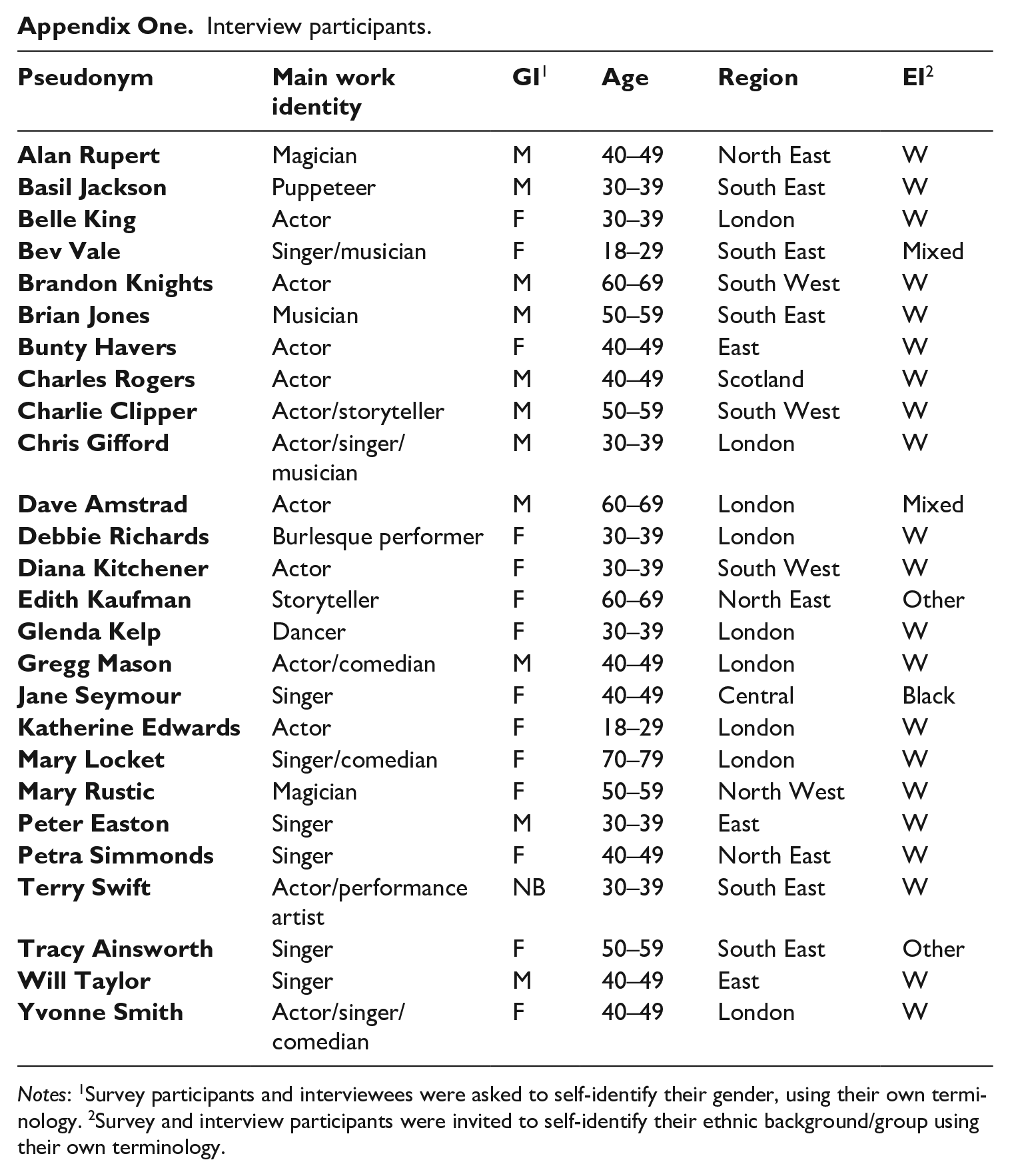
|
|
|
|
|
|
|
|---|---|---|---|---|---|
|
|
Magician | M | 40–49 | North East | W |
|
|
Puppeteer | M | 30–39 | South East | W |
|
|
Actor | F | 30–39 | London | W |
|
|
Singer/musician | F | 18–29 | South East | Mixed |
|
|
Actor | M | 60–69 | South West | W |
|
|
Musician | M | 50–59 | South East | W |
|
|
Actor | F | 40–49 | East | W |
|
|
Actor | M | 40–49 | Scotland | W |
|
|
Actor/storyteller | M | 50–59 | South West | W |
|
|
Actor/singer/musician | M | 30–39 | London | W |
|
|
Actor | M | 60–69 | London | Mixed |
|
|
Burlesque performer | F | 30–39 | London | W |
|
|
Actor | F | 30–39 | South West | W |
|
|
Storyteller | F | 60–69 | North East | Other |
|
|
Dancer | F | 30–39 | London | W |
|
|
Actor/comedian | M | 40–49 | London | W |
|
|
Singer | F | 40–49 | Central | Black |
|
|
Actor | F | 18–29 | London | W |
|
|
Singer/comedian | F | 70–79 | London | W |
|
|
Magician | F | 50–59 | North West | W |
|
|
Singer | M | 30–39 | East | W |
|
|
Singer | F | 40–49 | North East | W |
|
|
Actor/performance artist | NB | 30–39 | South East | W |
|
|
Singer | F | 50–59 | South East | Other |
|
|
Singer | M | 40–49 | East | W |
|
|
Actor/singer/comedian | F | 40–49 | London | W |
Notes: 1Survey participants and interviewees were asked to self-identify their gender, using their own terminology. 2Survey and interview participants were invited to self-identify their ethnic background/group using their own terminology.
Acknowledgements
First and foremost, we would like to express our sincere gratitude to all those live performers who gave their time and shared their experiences with us. We hope this article accurately reflects their words and thoughts. Thanks also go to the three anonymous reviewers for their constructive engagement and advice.
Funding
We The authors would like to acknowledge the support of the British Academy/Leverhulme Trust whose award (SRG20\201393) made this research possible.
