




Abstract
This article focuses on the London Metropolitan Police Service, an organization charged with being institutionally racist. It asks why the percentage of black officers in senior positions remains so low, despite explicit formal attempts to change this situation. Rather than concentrating on the factors holding back the recruitment and promotion of black officers, the article examines how senior white officers managed their career journey. Through in-depth interviews with senior officers, the authors develop the notion of ‘social network volition’, linking to sociological literatures on race, social networks and elites in work and organizations. The agency of a ‘club’, composed of white senior officers, performs social network volition, defined as an invisible guiding hand that identifies, pursues, advises and sponsors white officers who fit the existing leadership composition. The implications of the article underline the need to make explicit the informal supports that reproduce whiteness while upholding the myth of merit.
Introduction
It’s almost like an unholy club at times. And when I say club, I don’t mean it’s a select club which is being defined and there’s an intention behind it. But it’s behaving like a club and the club then becomes strengthened and further engendered by the way people are recruited and the way people are then groomed to be a part of their club. Institutionally throughout the decades and the years, we just sort to recruit people from its own image . . . and that’s why it’s hard to break into the circles and any degree of difference that isn’t similar to their own characteristics becomes uncomfortable for this institution of Chief Officers. Interviewee13
The article examines how those in power within a public bureaucracy, the Metropolitan Police Service (henceforward, the London Met or Met), maintain and reproduce networked positions of power and elite status for those like themselves. It highlights the importance of hidden or latent social networks that support officers who matched the social characteristics or homophily of the current leadership, that is ‘rapport and relationships with others on the basis of shared interests and experiences’ (Woodson, 2015: 2560). The article explains that social homophily was gendered and racialized – those in senior positions being almost exclusively male and white. In a formal command organization such as the Met, there is a strong merit narrative supporting open and explicit promotion criteria – the passing of exams and moving through the ranks are directly linked to promotion chances. However, the interviewee accounts of promotion journeys underline the operation of a hidden social network that those with positional power use to ensure posts go to those like themselves.
As a major public institution, the London Met has been, and continues to be (Casey, 2023; IOPC, 2022), under external and internal pressures to improve diversity in recruitment and promotion following several major independent reports that highlighted limited diversity in the force (European Human Rights Commission [EHRC], 2016; Fox, 2004; MacPherson, 1999; Muir, 2001; Police and Crime Committee, 2014; Scarman, 1981; Smith, 2005). Public sector organizations ‘are often treated as proxies for anti-discrimination policies because public sector employers . . . are more susceptible than private sector and small organizations to government influence’ (Smith, 2002: 520). Home Office National Statistics (2021) show marginal change in percentages of ethnic minority individuals in the senior officer rank: from 2% to 4% between 2007 and 2020. Numerically, of the 29 Chief Officers in post in 2018, only one had a minority ethnic background; 29 were white, five were white female and 24 were white male. The percentage of ethnic minority officers in other positions of authority above constable, also moved slowly: from 2% to 5% between 2007 and 2020. When the research commenced there were four minority ethnic Chief Officers, but this dwindled to one as the research progressed; hence, moving away from, not towards greater diversity, and thus reinforcing the power of existing informal networks up the organization that our research highlights.
Despite the structural requirement for reporting targets for recruitment, progression and retention of minority ethnic staff suggested by the 1999 MacPherson report, perceptions of black officers suggested this is more ‘window dressing’ (Cashmore, 2002; Phillips, 2011; Rowe, 2004). A review of policing across Europe noted diversity ‘diminishes as police officers’ rank increases’ (van Ewijk, 2012: 76). London Met Chief Officers acknowledge the continued underrepresentation of minority ethnic officers in more senior roles. In a recent policy statement, this was attributed to ‘the way most police officers must work their way up through every rank to reach senior command – a process that takes many years’ (Mayor of London, London Assembly, 2020). But over 20 years after MacPherson, progress is imperceptible. We therefore need to examine the processes involved in progressing careers, not simply the time taken to build a career. Time applies to all officers; and therefore, there must be another mechanism accounting for the continued absence of diversity at senior levels. The two policy proposals in the same report to assist minority ethnic officers up the ranks (target setting and positive action workshops) are both formal tools that do not account for the powerful role of informal social processes as reported in this article.
Despite legal changes and corporate embrace of diversity programmes, ‘a steady stream of research indicates that powerful, if more covert forms of bias persist in contemporary workplaces’ (Tolbert and Castilla, 2017: 3). Looking at race, it has been noted ‘there has been a dearth of scholarship on how racism is enacted at higher levels of the organization’ (Prasad and Qureshi, 2017: 353). What is new about our research is that it lays bare the narrative journey made by white aspirants up the hierarchy of the Met and reveals in detail the importance of a ‘co-produced’ career journey, with white aspirants being cooperatively guided up the hierarchy. The details of this process have not been revealed before. Our research shows the role of an implicit and hidden mechanism of a social network, the ‘chief officers’ club’, as a processual racial filter, which maintained white officers’ occupancy in senior positions. The term ‘club’ was generated inductively from an interview with a Chief Officer.
Race and social networks
This article engages two interrelated conceptual fields in order to develop a contribution to specific sociological literatures on work, and the role of networks in reproducing inequalities and maintaining dominant power elites within organizations. We firstly look at the sociology of race within formal organizations, where a diversity agenda has produced ‘color-blind racism’ (Bonilla-Silva, 2017) that operates below the formal surface of organizations. And, secondly, the role homophilous networks play within organizations for producing organizational stasis (McPherson et al., 2001).
Racism and organizations
Race is a product of racism – the deliberate attempt to categorize human beings into distinct types based on what are considered fixed attributes (biological or physical differences) that allow for a ‘double standard’ to be applied – treating one group in an inferior way to another (Fields and Fields, 2012). The ‘idea of race is inextricably linked to notions of white or European superiority that became concretized during the colonization of the Americas and the concomitant enslavement of Africans’ (Golash-Boza, 2016: 130). Racial differentiation applies to all areas of social life, including access to positions of power within formal organizations, such as our research case, the London Met, an organization noted for being ‘institutionally racist’ (Casey, 2023; MacPherson, 1999).
The idea of institutionalization frames racism as something beyond individual prejudice and overt discrimination – both of which may have declined but not disappeared from society – towards thinking of racism as a structural mechanism, operating unconsciously or indirectly, without deliberate or transparent individual agency. We suggest that institutionalization makes actions that support continued white dominance more routine: ‘whiteness acts implicitly through routine and normalized practices within social environments as a consequence of a White-centred culture’ (Fletcher and Hylton, 2018: 169). Countering structural racism requires new structures – such as opening employment and promotion opportunities to all or revealing the hidden structures that reproduce the status quo.
Noon (2018: 204) notes: ‘embedding racial disadvantage, sometimes labelled institutional racism, [has the effect of] making organisations resistant to agendas for change’. We would add that they make social reproduction less visible, by focusing on the discriminated, and not the practices of the dominant group, which is what we examine here. Diversity management misses the underlying causes of the social reproduction of disadvantage. Liu (2017: 458) ‘questions the ways in which mainstream diversity management “individuates difference, conceals inequalities and neutralizes histories of antagonism and struggle”’ (Ahmed and Swan, 2006: 96). This article focuses on ‘the subtle character of most mechanisms to reproduce racial privilege’ (Bonilla-Silva, 2015: 1362) as this is most appropriate for an organization-level article.
Race, social networks and career progression
Sociologists have long explored more informal processes of career progression and highlighted the role of social networks in discriminating in the distribution of information and resources. Early work by Kanter (1977) examined blocked routes or dead ends as some groups were in the wrong place or network due to possessing ascribed social characteristics, specifically being women and racial minorities – for a recent application, see also Hudson et al. (2017). Alongside occupational channelling, Kanter also said a ‘shadow structure’ existed within corporations, with the excluded disconnected from the informal conversations, key information, mentoring and support that is available to those with connections – typically white males. Broader sociological literature on ‘whiteness’ and ‘masculinity’ to an extent (and intersectionality of class), all show how social networks and social homophily distribute uneven opportunities in organizations. These approaches have fed into the growth of metaphors, such as the ‘invisible hand’ (McDonald and Day, 2010) and ‘glass ceiling’ – a hidden block on career progression, and ‘glass elevator’ – an invisible fast track (Maume, 1999), which are responsible for distributing unequal opportunities to different groups within formal organizations. Ashley and Empson (2013, 2017) reveal how City of London elite professional service firms’ formal commitment to diversity and meritocracy constitute legitimating myths that serve to protect the organizations from criticism, while still effectively reproducing entrenched class-based structural inequalities. McDonald (2011) refers to ‘segregated networks’ giving an unequal or differential distribution of informational assets that support some and block others in progressing up organizational hierarchies. Social networks within bureaucracies thereby create ‘network-based social closure’ (McDonald and Day, 2010) and glass ceilings that are gendered or racial in character (McDonald, 2011; Powell and Butterfield, 1997).
This tendency for information to be sticky and only flow within networks to those with similar cultural homophily may be magnified as organizations come under pressure to be more diverse, through external demographic, political and social pressures (Noon, 2018). As formal pressures increase, informal rules are strengthened. White males in dominant positions are structurally inclined to duplicate this dominance, reproduce white, by choosing, grooming, supporting, informing and helping those like themselves, and concomitantly excluding those not like themselves (Damaske, 2009; Fernandez and Fernandez-Mateo, 2006; Marin, 2013; Maume, 1999).
This literature often links gender and ethnic minorities together as outsiders of white, male dominated structures (Ibarra, 1993; Kanter, 1977; Moore, 1988). The gendered occupational segregation explored in such research was more common in the 1970s and 1980s, and many organizations (including our case study) created standard, gender and racially neutral formal structures (Smith and Nkomo, 2003). Moreover, the diversity agenda has changed the narrative, yet differential outcomes along gender and racial lines persist (Noon, 2007, 2010, 2018). Fearfull and Kamenou (2006) examined continued exclusion of ethnic minority women from senior positions in accounting, and Tomlinson et al. (2013) examined career strategies of minority ethnic candidates in the law, where despite increases in numbers, old opportunity structures and inequalities persist.
We have outlined the external pressures on the London Met to diversify – these have been present for over 20 years. Structural requirements, following MacPherson (1999), to report improvement on minority officers’ career progress have not changed the status quo. Our research addresses a continuing research gap identified by Joan Acker in her seminal article on inequality regimes: ‘the informal interactions and practices in which class, race, and gender inequalities are created in mutually reinforcing processes have not so often been documented’ (Acker, 2006: 451). The uniqueness of the research is the comprehensive interview coverage of the majority of Chief Officers in the London Met, and their own accounts of the apparently unplanned, normal, route up the ladder that is strongly guided by those in senior positions. A sustained, club-like pattern of passing on access routes up to positions of power, and the reproduction of the status quo of white, male dominance, shows the need for more visibility to careers in the case study. A concept we have constructed from analysis of the data is ‘social network volition’, by which we mean the power of an informal, hidden and exclusive support group to act in the interests of network members and those identified as potential members. The network is a social actor, such that those with network volition, the favoured group, move forward; while the unfavoured group are told to look to their own volition to move forward. The hidden function of network volition understates the ability of the unfavoured group to progress their career, and overstates the ability of the favoured group, who progress through the invisible volition of the club while on the surface move up under their own volition.
The study
The qualitative fieldwork was conducted in 2016 and 2017. This article comes out of a wider investigation into race, building on work on police culture (Cockcroft, 2012; Loftus, 2009) and occupational typologies in the Met for minority ethnic officers (Clarke, 2020). The London Met is an important organization for researching race as there has been a long-standing concern with racism in the police service as noted above.
The first author was a male, black serving Met officer at the time of the research. Being an insider as a researcher is perceived in different ways. For some, the dual roles of investigator and employee are considered to be incompatible, leading to power conflict, information distortion, censorship and an over-concern with maintaining post-research social relations, thus placing the researcher in an untenable position (Hollway and Jefferson, 2000; Mercer, 2007). Contrary to this position, others (Brannick and Coghlan, 2007; Dwyer and Buckle, 2009) argue that there are many areas of life where we are insiders and yet we are able, through reflexivity, to get intellectual distance.
Merton (1972) noted that an ‘insider doctrine’ (only insiders can do ‘proper’ research) and an ‘outsider doctrine’ (only outsiders have detachment for ‘proper’ research) are both fallacies precisely because we rarely are completely an insider or an outsider. A continuum between the two is more realistic. Reflecting on what it means to be an insider as a black police officer researching senior ranked white officers in the same organization, elements of insider and outsider status coexist. The researcher was outside the senior rank, not a white officer and not known to the interviewees. But there were also shared understandings of the organizational structure, police culture and organizational history, producing common ground between interviewer and interviewees.
Initially, permission was sought from the Home Office to conduct the interviews. The Home Office eventually came back and said that it was not within their parameters to give the authority to conduct the research, but it was up to the Chief Officers themselves to volunteer their cooperation. The first author then proceeded to contact the Chief Officers via email and LinkedIn. Only one responded via LinkedIn – the others did not. Subsequent to this, a personal friend of the first author initiated an interview with one of the four Assistant Commissioners. On completion of the interview, two Chief Officers were personally contacted by this Assistant Commissioner on behalf of the first author. Once this routine of interviewees recommending other Chief Officers was established, subsequent interviews steadily trickled in.
Consent was informal. The first author, as an experienced police officer at the time, was aware of the occupational culture within the Met and requesting that officers sign any document would have been counterproductive. The culture was based on trust and camaraderie. The first author came highly recommended, had several years’ experience as an officer and this was the required authority for the respondents.
The sample of respondents selected for the purpose of this research reside predominantly within the realms of the National Police Chief Council, specifically within the Met. This is the elite in the Police Service. There were 28 officers at this level in the London Met when the research was conducted. The Chief Officer rank consists of: Commanders (n = 15); Deputy Assistant Commissioners (n = 7); Assistant Commissioners (n = 4); Deputy Commissioner (n = 1); and Commissioner (n = 1). The research ensured close to a full population study: 10 of the 15 Commanders (66.66%), five of the seven Deputy Assistant Commissioners (71%), and three of the four Assistant Commissioners (75%). This is the most comprehensive set of interviews at this level of the Met.
Interviews were audio-recorded, semi-structured, face to face and allowed participants to speak freely about their individual experiences. Race and social networks informed the research questions, but the interview schedule was designed for officers to give an account of their career journeys both within policing and prior to joining the service. This proved not only to be a creative method to engage the participants in the research, but also a useful way to compare narratives. Table 1 presents the set questions used during each interview.
Interview schedule.
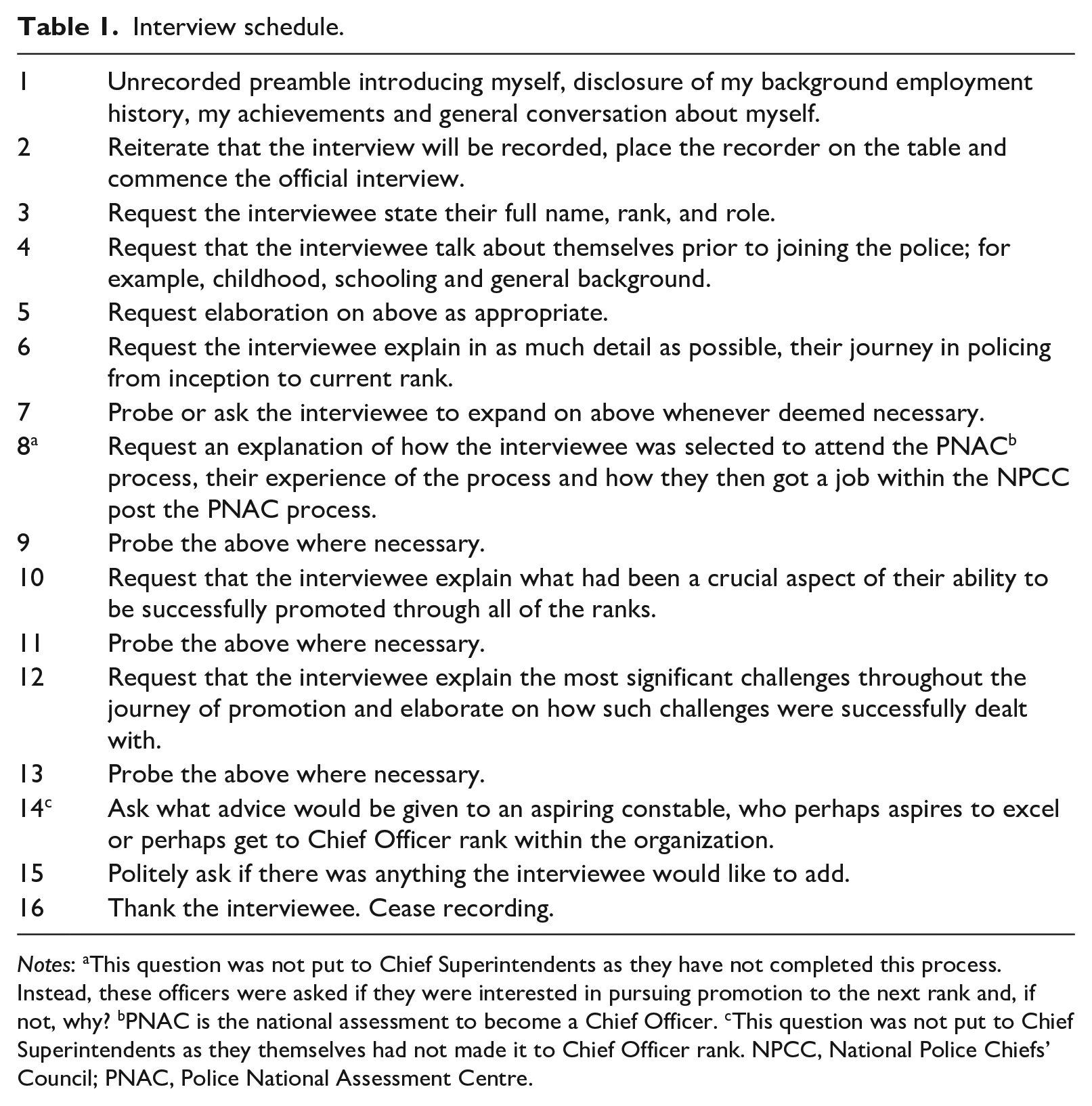
Notes: aThis question was not put to Chief Superintendents as they have not completed this process. Instead, these officers were asked if they were interested in pursuing promotion to the next rank and, if not, why? bPNAC is the national assessment to become a Chief Officer. cThis question was not put to Chief Superintendents as they themselves had not made it to Chief Officer rank. NPCC, National Police Chiefs’ Council; PNAC, Police National Assessment Centre.
The interviewer as a black officer could not disguise this identity, but neither did questions lead with issues of ethnicity as these would have invited a ‘corporate message’ of diversity or unease and defensiveness. Those interviewed were given full disclosure that the purpose of the research was about career journeys, and questions were designed for officers to give an account of their journeys both within policing and prior to joining the service. Most interviewees were forthcoming in providing their accounts, while others were quite cautious and brief in their responses. Given the small numbers of total Chief Officer ranks in the London Met, interviewees were very concerned about anonymity. We have adhered to strict confidentiality/anonymity, and this has affected the presentation of results, but not the results themselves. The presentation of the interviews in the article ensures that it is not possible to identify individuals. We have deliberately made individuals anonymous through this process, but while we cannot identify interviewees by gender and race, we can say that almost all were white males. Top management in the Met were fully aware and also interviewed in the research. The research had full approval of the organization but was conducted as independent doctoral work from the first author who was a Police Officer on sabbatical leave to pursue his studies. The Met did not ask for anonymity, nor did it not put any conditions on using the name of the organization in publications.
The concept of ‘the club’ central to this article emerged from one of the interviewees. The concept of ‘social network volition’ came out of our interaction between theories discussed above and the interview data. In the interviews, the social processes of informal networked career moves are highlighted, as we detail below through the narratives of club membership qualities, sponsorship, support and guidance.
Findings
Club membership qualities and entry requirements
Career progression in the Met involves formal, merit-based bureaucratic requirements to become a Chief Officer. Passing exams is a necessary, but not sufficient, basis for such progression. Officers need to be deemed suitable to be recommended for the Police National Assessment Centre (PNAC). Once the course has been successfully negotiated, the candidate becomes qualified to be promoted as a Chief Officer. However, it is still necessary to apply for a job as a Chief Officer and there are no guarantees: ‘You can be successful on the Senior Command Course and you can end up never getting a job’ (Interviewee25).
In referring to the actual formal channel to the NPCC, another interviewee explains: PNAC is the last process which in my view is completely fair, if you are looking at the force and you are looking to appoint a Commander or an ACC [Assistant Chief Constable], you look at the person, but you also look at what they are bringing to the party, so it’s always a partial judgement, it may not be a fair and open and transparent process but it’s about what that person brings and would they fit in with your team. I think, most of us would agree, the last transparent fair process you go through based on ability is PNAC; everything else is viewed through a different lens. Interviewee24
Here, the formal exam process is considered open – the outcome less so. More importantly, there is a clear insertion of fit and profile, beyond formal qualifications, being more significant for career progression. What ‘they bring to the party’ suggests difference; ‘fit with your team’ conformity to group norms. If group norms are gendered and racialized, then the absence of ‘transparency’ serves to reproduce these norms and not disrupt them. It ‘may not be a fair and open and transparent process’ but fit dominates; the current team is reproduced with all its current social characteristics.
The club
The metaphor of a club operates as a heuristic, explaining the role of informal, but highly structured, codes of promotion into the senior ranks of the Met. During interviews with NPCC officers, the existence of the club was referenced by interviewees when they described their journey up the Met corporate ladder.
Identifying potential club members
We set out below the informal, but highly structured, interaction between aspirants and incumbents, showing the effective operation of the social network: So largely male, so largely middle class, so largely from the same type of build. People who enjoy either rugby or golf or shooting, that type of stuff. Familiar people trying to talk and network and that type of stuff. Familiar stuff for people to be comfortable with, uh and talk to each other about – because it’s easy, comfortable conversation, and it’s enjoyable to them. And it’s easy in that type of way because people are either talking about a Sunday afternoon, whether they are talking about a game, or whether they are talking about how they’ve all misbehaved or drank too much between 18 and 21 before joining the police force. It’s very uh, very, very familiar to them all – and they resonate with that. So . . . white, male dominated, largely speaking in the same way . . ., largely following the same set of ideas. Interviewee13
Interviewee13 comes closest to Rivera’s (2012) discussion of cultural match, and the importance of non-work values for selection decisions – getting on with those who share the same leisure pursuits – ‘enjoying either rugby or golf or shooting’. This is one element. Masculinity, ‘same type of build’ is also important; and being ‘comfortable and enjoyable’, and one of the boys, who ‘misbehaved or drank too much’ when young, speaks to the literature on the power of police culture (Cockcroft, 2012; Loftus, 2009). But race is also there, as ‘the Association of Chief Police Officers (ACPO) class is white, male dominated, largely speaking in the same way . . ., largely following the same set of ideas’. In Rivera’s work, shared education and leisure pursuits are classist, but not necessarily racialized or gendered. In this quote, whiteness is both implicit and explicit. While leading with social homophily, the club is nevertheless colour-coded. The majority of Chief Officers were white British males and the methods of reproducing Chief Officers relied on referral through homophilous networks connecting those in the club with potential members, and, as such, whiteness is indirectly, but deliberately, reproduced.
Some Chief Officers casually acknowledged barriers for officers who were competent but different; that the system of promotion ‘does not recognize diversity in its wider sense’. The ethnicity of the officer in the quote below is not made explicit, but it seems a fair inference to draw that the interviewee was referring to a non-white officer. The denial of diversity that characterizes the ‘chief officers’ club’ is made obliquely, which is itself revealing of the normalization of whiteness at that level of the organization. Of course, a fellow officer’s assessment of another is not the same as passing a formal assessment process, but the implication of the quote is that if you are able but different, it is far more challenging to progress up the ladder: I studied for PNAC with a guy who has just retired actually from the Met. I was put in contact with him and I spent the whole of my preparation time thinking‚ ‘you are bloody excellent, you are a cut above the rest of us, you are superb’, and he failed the PNAC process three or four times and then decided to give up and so he retired as a Chief Superintendent. I still think that he would have been a very, very good Assistant Commissioner. I believe that the system [Club] didn’t recognize that in him and I genuinely don’t know why, um yeah, I’m not so sure that the system [Club] does recognize diversity in its wider sense. Interviewee9
Informing and sponsorship in preparing to join the club
The white Chief Officers interviewed about their career journeys said that they became aware in a concrete sense of the existence of the club through an informal route, a telephone invite. This informed the officer that they were considered a suitable candidate, and that sponsorship would prepare them for the formal interview process. For example: I knew I would like to come to the Met, but I hadn’t considered, um, what I would do to prepare for that interview. So, it was really great when I got the call to come to London and get the experience and I think it was a lot better then. I had a sponsor in the Met. There were people who had moved around, who knew me, and they were now in the Met. And I think they were keen for me to come, to be seen in the Met. Interviewee17
Interviewee17 is informally invited to gain experience, and supported, ‘I had a sponsor in the Met’, through personal connections, ‘people . . . who knew me’, to get exclusive experience that was necessary to ‘prepare for that interview’. Here, the informal informs the formal. Those identified as potential members of the club, are prepared for the formal test.
Another Chief Officer outlined the same process, stressing the importance of sponsorship from an existing Chief Officer. The route remains informal; it is who you know and who you want to reproduce the status quo: A Chief Officer phoned up and said that, ‘I know you wanted to get promoted, would you like to come down to London and, um, work for me?’. I said, well, ‘Hey, sir, that would be a good idea’. So, I did, so I think some of that . . . that helped as well, so that when I did apply for the job in the Met, I had the appropriate background, it fluffed out my CV if I’m being honest. Interviewee3
Interviewee3 makes clear the contribution of the sponsor as a direct supervisor offering work under his command, and the experience in giving him the ‘appropriate background’ and pumping up his CV, suggesting an advantage is gained for him that was not available to others. Chief Officers have authority to create jobs and move those identified as potential members around so they can gain relevant work experience to prepare to join the club. This is an example of how formal institutional authority can, in practice, support the informal networks that we describe in detail.
Persuading potential club members
Just as with head-hunters, the individual was not necessarily thinking of moving and so the informal phone call can prompt action. It sometimes took several such calls and member pressure to persuade the officer to make a move. Interviewee18 dramatically shows the strength of the incumbents to encourage and persuade, against considerable reluctance from the officer. As is revealed below, reluctance may come from the view that posts are only available ‘if nobody is marked for it’; thus, signifying promotion as an informal, but very managed process. Once a potential recruit is identified as ‘fit’ for membership, a self-reinforcing pressure came into play: A job came up in a County Force, someone phoned me up and said, ‘What do you think about a Chief position in this County Force?’. I was like, I’ve never even given it a first, let alone a second thought; wasn’t looking for jobs, wasn’t looking for anything, so I dismissed it. And another person called and said, ‘There is a job there, you know you should enquire’, and so I looked at it, didn’t meet any of my skill set and a friend of mine said you should give this person who is a Chief Constable a call and ask. I phoned the Chief up and said, look, you know a friend of mine said that I should look at this, uh, you know, I don’t want to waste anybody’s time. This is what my background is, and I think I’ve got transferrable skills, but I don’t want to apply and waste anyone else’s time, especially if there are people in mind. The Chief was supportive and said, ‘No, you should stick in for it’, and said ‘my skills are transferrable, and we will give it to whoever turns up best on the day’. So, I was like, ok, if nobody is marked for it, and it’s a fair process, then I will give it a crack. So, I kind of applied, did well in the boards and got the job. Interviewee18
Persuading, reassuring and directing the officer with the appropriate social profile is a key strategic role of the existing club members, showing the power or volition of the club’s social network. It acted, had power and co-produced the career progression of interviewee18.
Building confidence, job swaps and network volition
Leadership needs to be imagined by the subject before being realized and interviewees recall being given opportunities that built confidence to dream. Existing senior officers had power to move individuals around through job swaps to give experience and confidence. Individuals with the right fit for membership had opportunities presented to them informally. An interviewee explained: I was having a career chat with the senior officer who ran the area. He pulled me aside and said – ‘You probably need to do something a bit more difficult, you’ve found your feet in your current rank’ . . . And I ended up being swapped round with somebody else. So, that was, probably, I think, where my confidence and leadership ability really grew . . . Took off I would say. Interviewee22
Club members create opportunities for new members, often in cases where the candidate may lack confidence, professional direction, or even ambitions to pursue a specific opportunity. However, having been offered the chance, the candidate becomes more confident due to this level of support. Sponsorship from existing senior officers transfers volition to the club, that in turn reproduces itself. Another interviewee explained: A prestigious specialist department [post] became free as the Chief Superintendent said that he was going to leave and I was asked if I would be interested in applying to be Chief Superintendent there, which seemed terrifying to me. I thought: ‘Wow! I was astonished that you would think that I could go and do that job.’ And in the end, ok, well, they’ve obviously seen something in me, so I applied for it and I got it. Interviewee16
Both these Chief Officers talk about their career trajectory being shaped by others as they did not possess a personal plan for promotion: So, I can honestly say I’ve had no plan, no strategy. Did I get support? Absolutely. I’ve had the support of really fantastic members, at different points. Interviewee25
Interviews highlight the power of social network volition as opposed to individual volition. It confirms that even with limited ambition once there is adequate support from key sponsors, individuals would be strategically positioned to attain success, perhaps in a manner that had not been previously anticipated for a variety of reasons, whether a lack of confidence or ambition. This is important because in diversity or merit narratives it is often the case that not possessing ambition or confidence are specifically attributed to people who are non-normative (minority ethnic or women, for example), and as something that they will need to overcome (Ashley and Empson, 2013). Whereas for those with a club member profile, such personal attributes were no barrier to sponsorship. Informal supports are extensive, but hidden, reinforcing the false idea that white officers advance without the need for additional support (target-setting and positive action workshops, mentioned above for minority ethnic officers). Whereas, the club provided extensive support, experience, sponsorship and confidence building. The diversity agenda focuses on the non-dominant group, and what additional supports are needed to move their career along, suggesting ‘special support’ and perpetuating the ideology of ‘extra help’ for those with a non-normative social profile. But the special and extensive supports to white incumbents are hidden, and thereby supporting the myth that they need no such support to progress their careers, thus preserving a sense of entitlement and dominance, and the myth of merit.
The idea of the club as an invisible hand with volition to guide and direct the chosen individual is made clear in these quotes: I definitely had different points in my career where things have happened that sort of steered you in a slightly different way and then opportunities sort of present itself. (Interviewee14) You have to have a sponsor, or at least a group of senior leaders who recognize your potential, and I think, that’s not always very easy for people to break into. (Interviewee24) When this role came, the person who was in this role came to see me and said he was going to be retiring; he wanted to talk to me about whether I would think of putting in an application and we talked it through and I did. (Interviewee16)
Positions open through retirement (Interviewee16) and the incumbent is keen to steer his chosen replacement into place, helping them by firstly giving advanced notice of their intentions, then talking through the application and interview process. The sense of being ‘chosen’ comes across in interviewee16. This is all informal; it is all targeted at someone with a shared social profile; thus serving to reproduce the status quo and inadvertently exclude others.
Individual volition and club sponsorship
A minority of individuals suggested that their success was achieved through personal grit and fairness of organizational opportunities. These individuals supported a merit narrative and suggested that the organization provides an ‘equal playing field’ for all ambitious officers. Individuals supporting this perspective would, however, then frequently contradict themselves when recalling another part of their professional journey. For example, interviewee24 said: ‘All my promotions have been by the best of my determination’. But later in the interview, the same officer noted how sponsorship from club members was pivotal: It’s being given those opportunities in hard places to understand your ability and how to make things happen. So, I think the crucial journey for me is being given the opportunity to do those jobs, coz people had confidence in me, but I was able to access the learning and the development through being sent to do those things. Interviewee24
Of course, individual effort remains important for career progression. But the hidden power of social network volition alongside individual volition is only open to those sharing the same profile of the dominant Chief Officers, and hence perpetuates structural racism in the London Met.
Discussion and conclusion
Reviews of the literature in the field of police diversity policies have noted that ‘most studies do not touch upon three policy areas of recruitment, retention, and promotion’ (van Ewijk, 2012: 76). Our contribution has been on the question of promotion. What we identify as the chief officers’ club comes out of institutional racism in the Met and the normalization of whiteness at the top of the organization (Cashmore, 2002; Rowe, 2004). To label an entire organization racist implies it impacts all levels and is multifaceted, and not the consequence of a ‘few bad apples’. However, critics have suggested that the concept of institutional racism absolved individuals from volition over fighting racism and was insufficiently directive in changing operational police culture (Souhami, 2014: 6). For our purposes, the legacy of structural racism in the London Met is an important conditioner to attempts to overcome or challenge such structures, through widening recruitment to minority ethnic officers and advocacy of a diversity agenda (Phillips, 2011).
Our article contributes to the sociology of race and social networks in employment, via the metaphor of an elite ‘club’ and our conceptualization of how networks powerfully influence careers (Kalev et al., 2006). This hidden mechanism reproduced white dominance at the apex of the organization, within a formal system of diversity management and open opportunities (Tolbert and Castilla, 2017: 3). Social networks, or what we refer to as the ‘club’, support white officers in clear and sustained ways. ‘Homophilous ties provide valuable sources of mutual support but may limit racial minorities’ access to resources and information in organizations’ (Mollica et al., 2003: 123). Our data support the view that there was a close relationship between those in power (incumbents) and successful aspirants, and an informal organizational pathway was laid out to support those with the right social profile advancing up the tree.
We suggested in the literature review, that external pressure applied to the London Met following the label of its operating as institutionally racist created ‘acute sensitivity to overtly racist behaviour as a result of a stringent managerial policing of language . . . strongly shaping the ways in which staff talked and thought about their interactions with each other’ (Souhami, 2014: 15). But this is more the formal face of the organization. Interviewees did not employ or show awareness of diversity language, judging career progression instead, in terms of breaks, support and fitting in, and spoke in normalized or natural language, without engaging with a diversity agenda. Ashley (2010), in examining equality of opportunity in UK elite law firms, noted the pervasive adoption of a ‘diversity discourse’, which was drilled into professionals as normal talk. Whereas our respondents showed no sensitivity to such a language. We suggest the normalization of whiteness in an ‘institutionally racist’ context shows through in our sample, who describe career journeys in neutral terms.
The metaphor of the ‘club’, more than an obstacle (glass ceiling) or single pathway (glass elevator), best reveals leadership journeys. The club is an exclusive network that identifies, pursues, advises, informs and sponsors those white officers that ‘fit’ the existing social composition of the club, thus ensuring a very deliberate reproduction of white domination, even when the official ideology of the organization is for increasing diversity. The image of a maze or labyrinth (Wyatt and Silvester, 2015) suggests mystery to movement up the organization and understates the powerful structure of guidance exclusively available to a selection of organizational members. The interviews show individuals not looking to go up, but being spotted, nurtured and led up the ladder by those above. This active and organized reproductive role of social networks is better disclosed through the image of a ‘club’.
Hirschman and Garbes (2019: 9) mention that racism is a mode of social practice that ‘naturalizes race as a category of difference’ and this is evident in the interviews. Only one respondent explicitly noted race as a signifier of club membership, otherwise it was more hidden or implicit, subordinate to notions of shared interests or cultural homophily or likeness. Because of the numerical dominance of white officers at all senior levels of the Met, whiteness is normalized, and neutralized. The fact that the club only reached out to white officers could be taken for granted by these white officers because its very exclusivity neutralized their ethnic identity. Likeness made support natural and normal. Race was never explicitly on the agenda; it was homophilic structures that were explicit but being the same meant differences did not arise. Esmail et al. (2005: 171), in leadership interventions in the health service, aimed at black and minoritized ethnic staff, identified various organizational barriers, but also ‘cultures of whiteness; lack of Black and minoritized ethnic mentors/role models; exclusion from informal networks; stereotyping, which led to preconceptions over abilities and role allocation’. The culture of whiteness at the senior level of the Met ensured its reproduction.
In reflecting on limitations of our research, we would say looking at the journeys of white officers who failed to make Chief Officer level, as noted earlier, would be important, especially for exploring intersectionality, perhaps along class, gender and education lines. Persistent structural racial disadvantage, despite formal monitoring existing for 20 years, suggests the need to go further in embedding ‘accountability, authority, and expertise (affirmative action plans, diversity committees and taskforces, diversity managers and departments)’ (Kalev et al., 2006: 611) as the best way to increase numbers of black and female officers. The Met has not embraced these formal lessons. Moreover, the wider pattern of racism in society may also be relevant, as suggested by critical race theory. But we would also suggest more fine-grained exploration of the taken-for-granted decision making, and more research to uncover the informal and routine, and get behind the window dressing of diversity and inclusion measures (Noon, 2018).
The pressure to increase diversity within the London Met has been reduced to the task of increased entry-level recruitment from the minority ethnic community. While still lagging in levels of representation that would match the diversity of London, to assume that entrance will automatically generate a pathway up the organizational hierarchy misses the hidden structural mechanism that we have identified in this article. While public bureaucracies offer statistically greater opportunities for minority ethnic employees (Smith-Ring and Perry, 1985), the presence of exclusive networks of dominant positional power holders nevertheless persists. A merit narrative is often used to justify the privilege of those already in power, and the explicit formality of an exam and experience basis for promotion in the Met supports a belief in meritocracy, although the powerful role of informal networks, is, as we have demonstrated, the stronger guide to the route up the organization. In documenting these informal interactions and social processes, we aim to move the discussion on from identity and numbers to the powerful role of hidden practices that need to be made visible to open the opportunities for all officers in the London Met. Without a deliberate effort to eliminate informality as a powerful career support mechanism, and informal sponsorship for those with similar social, racial and cultural homophily, then there is no reason to assume that diversifying entry routes will positively translate into diversity up the ladder.
Footnotes
Acknowledgements
The authors express their thanks to all the Chief Officers in the Met who were kind enough to provide such personal insight on their professional journeys. The authors wish to acknowledge the guidance and comments from Alexandra Beauregard, our editor at WES, and to the anonymous reviewers who provided such great comments on earlier drafts of the article. Various people read and commented on various drafts, and we thank them for their time and commitment. These include Louise Ashley, Tom Cockcroft, Jörg Flecker, Michael Gold, Betham Loftus, Marisa Silvestri and Yu Zheng.
Funding
The authors received no financial support for the research, authorship, and/or publication of this article.