




Abstract
This article contributes to an understanding of work-intensive entrepreneurial lives as part of analysing the intensification of work in society. It offers an empirical extension of Foucauldian analyses, which attribute commitment to work to the influence of neoliberal enterprise discourse while often neglecting the material conditions of entrepreneurial work. The article draws on moderate constructionism and materialist discourse analysis to offer an account that pays attention to discourse and material realities. This ethnographic study shows how participants evoked norms of enterprise discourse to explain their commitment to work. However, they also understood these norms to be fundamentally shaped by their material conditions. The major contribution of the article is to show that the interpenetration of discursive norms with the investment logic of enterprise tends to displace boundaries between work and personal life and shift temporal arrangements of work from work–life ‘balance’ to prospects of free time in the imagined future.
Keywords
Introduction
Under a post-Fordist economy characterised by deregulation of capital, intensified global competition, and decline in the power of organised labour and welfare provision (Beynon, 2016), work arrangements and conditions have changed profoundly, including declining standard work contracts, increasing precarity and in/extensification of work. Despite worsening conditions, many individuals remain committed to, and personally invested in, their work (see Musílek et al., 2020) with a tendency for work and career to enlist workers’ subjectivity, blurring or displacing boundaries between work and personal lives (Ekman, 2015; Fleming, 2015; Gray et al., 2017; Lewis, 2003).
Foucault-inspired studies of neoliberal discourse and its effect on individuals present a powerful, widespread way to account for developments of personal commitment to work within and beyond the sociology of work (e.g. Du Gay, 1996; Rose, 1999). This influential body of scholarship argues that intensive personal commitments to work are caused by neoliberal discourses, and associated technologies shaping subjectivities and changing the meaning of work into spheres of self-realisation, freedom and fulfilment. New forms of commitment to work-intensive ways of living are seen as a product of the dominant neoliberal discourse shaping individual subjectivities and self-understanding in ways that comply with the work demands characteristic of post-Fordist capitalism (Boland, 2016; Feldman and Schram, 2019; Handley, 2018).
Entrepreneurs and self-employed workers are seen as among those most ardently targeted by this discourse. Many studies identify neoliberal discourses and forms of subjectivity as responsible for the especially intensive and extensive commitment to work among these groups (Ashman et al., 2018; Cockayne, 2016; Fenwick, 2002; Munro and O’Kane, 2021; Scharff, 2016). This interpretation of norms of autonomy, freedom and self-realisation through work is seen as the primary force explaining why for some entrepreneurs and self-employed work ‘becomes the defining feature [of life]’ (Cockayne, 2016: 461); thus, ‘leisure and even innate human creativity are subordinated to profit-making’ (Munro and O’Kane, 2021: 49).
This article seeks to offer a theoretical and empirical extension of this influential way of interpreting intensive and extensive working lives. It argues that a singular focus on discourse and norms that typically characterises Foucault-inspired scholarship risks underplaying material factors in shaping intensive working lives. Whereas similar theoretical critique has been presented elsewhere (Adkins, 2018; Cook, 2018; Cushen and Thompson, 2016; Dean, 2014; Lazzarato, 2012; Rehmann, 2013; Tellmann, 2009), there has been a lack of explicit effort at developing analysis that would transcend this limitation.
This article makes a theoretical contribution by extending the framework of discourse-oriented analyses to incorporate material realities of entrepreneurial working lives. This is done by drawing on the ontological position of moderate constructionism (Elder-Vass, 2013), which resists reducing reality to discourse and insists that discursive norms interact with structural and material factors. Furthermore, our extension draws on theoretical developments within materialist discourse analysis (Beetz and Schwab, 2018b), which argues that conditions of production are ‘fundamentally material-discursive’ (Beetz and Schwab, 2018a: 338) and their reproduction must therefore be studied as a joint discursive and material process. In other words, this perspective explores the connections between material conditions and meaning-making activities of social actors.
Putting these perspectives to work, the article also makes an empirical contribution to existing knowledge by producing an extended account that adds to our understanding of the intensive nature of entrepreneurial work-lives. Existing studies arguably simplify the dynamic of working life to an interaction between an individual and discourse, which fails to explain why and how individuals sustain commitments to intensive work despite the absence of immediate fulfilment. Such commitment is frequently explained by reference to deep internalisation of neoliberal norms or a mere illusion of their fulfilment (e.g. Ashman et al., 2018; Cockayne, 2016; Scharff, 2016; Shukaitis and Figiel, 2020). This approach risks portraying commitment to work as a purely illusive outlook and risks downplaying the extent to which individuals take their material circumstances into consideration. This simplification also renders this approach unable to convincingly explain how individuals sustain their commitment to enterprise discourse in situations where intensive and extensive work does not lead to actualisation of its promises. Drawing on an ethnographic study, this article develops an alternative account. It shows that the discursive norms are interpreted in relation to the conditions of material reproduction, and that start-up entrepreneurs engage in a series of mental and material practices to bridge the gap between the promises of entrepreneurial norms and their current (material) situation. It shows three forms of interaction between discursive norms and material aspects that are prominent in mental and material practices of entrepreneurs:
(1) identifying the gap between the full realisation of entrepreneurial norms and their feasibility in current material circumstances;
(2) practices of investment where current effort and resources are invested into the start-up enterprise; and
(3) speculation on future returns, both material gains and realisation of the discursive norms.
Fundamentally, our account shows that rather than simply ignoring the material circumstances by virtue of internalisation of neoliberal norms, these are taken into account as a part of an implicit economic strategy reconciling the promises of the norms with the lack of their immediate fulfilment. The societal relevance of this insight is to argue that it is this combination that can help us understand how commitment to intensive work is sustained – despite challenging conditions like poor pay, strenuous labour, low autonomy and high uncertainty.
The article proceeds as follows. First, it explores the limitations of Foucault-inspired accounts in the sociology of work, arguing that this position generally suffers from de-emphasising material factors on working individuals, often leading to reductive accounts of working lives. Second, the article suggests the use of moderate constructionism and materialist discourse studies and draws on the literature on political economy and entrepreneurship to formulate further pointers for empirical analysis. After discussing methods, the findings show how norms and material realities of entrepreneurial work together produce orientations to work-life, characterised by blurring of personal and work time, investment orientation to life and the logic of future returns – instead of a work–life balance logic.
Neoliberal discourse, entrepreneurial selves and work
Given his importance in understanding discursive changes/influences in working lives, including self-employed and entrepreneurs (Ashman et al., 2018; Cockayne, 2016; Fenwick, 2002; Munro and O’Kane, 2021; Scharff, 2016), Foucault is a key theoretical point of departure. Foucault (1977, 1992) proposes that discourses and associated practices shape subjectivities, influencing individuals’ thoughts and actions. Furthermore, his influential work on neoliberalism captures how neoliberal discourse conceives of individuals as ‘entrepreneur of himself, being for himself his own capital . . . his own producer . . . the source of earnings’ (Foucault, 2008: 226). Rose (1999) documents how the idea of the worker as an entrepreneurial subject became influential in the context of production, portraying work as a sphere of autonomy, self-development and self-fulfilment. These conceptions of working subjects as entrepreneurs-of-the-self are implemented through ‘technologies of regulation’ (Du Gay, 1996: 138), including training, appraisal and (self-) monitoring that seek to translate this ‘new way of being at work’ (1996: 145) into individuals’ self-understanding and behaviour. These discourses and their effects on subjectivity are seen as producing intense personal commitments to work, despite often unsatisfactory conditions, excessive demands and insecurity. These norms of entrepreneurial subjectivity are also seen as addressing students (Handley, 2018), the unemployed (Boland, 2016) and the poor (Feldman and Schram, 2019).
These arguments have become increasingly influential in research on entrepreneurs and self-employed workers. Several studies argue that the norms associated with neoliberal enterprise discourses are especially prominent in governmental, organisational and popular texts addressed to these groups (e.g. Da Costa and Silva Saraiva, 2012; Dempsey and Sanders, 2010; Munro and O’Kane, 2021), and are accepted and internalised by entrepreneurs and self-employed (Ashman et al., 2018; Cockayne, 2016; Fenwick, 2002; Scharff, 2016). These neoliberal norms, it is argued, are responsible for intensive commitment to entrepreneurial work, acceptance of challenging working conditions and erasing the boundary between working and personal life. For instance, in his study of start-up entrepreneurs, Cockayne (2016: 461) argues that the ideals of autonomy, freedom and self-realisation are responsible for situations where work ‘becomes the defining feature [of life]’. Similarly, Scharff (2016) shows that female musicians’ acceptance of neoliberal enterprise discourse leads to extensive work, despite precarity and physical and emotional injuries.
This article seeks to problematise an important aspect of this scholarship and offer a contribution pertaining to the role of materiality in making sense of intensive entrepreneurial work-lives. As others argue, the focus on norms and discourse can lead to empirical neglect of other important facets influencing working lives, including material and economic factors (e.g. Cushen and Thompson, 2016; Rehmann, 2013). Foucault recognises the influence of non-discursive factors, acknowledging that the spread of modern forms of power is connected to capitalist economic relations (1988; see also Marsden, 1999). Foucault’s work also somewhat anticipates emphasis on the matter characteristic of new materialism (Lemke, 2015). However, Foucault arguably neglects the influence of materiality as understood in ‘old’ (Edwards, 2010) or Marxian (Beetz, 2016) materialism; that is, materiality pertaining to the practical human activity of achieving reproduction and to relations and economic forms mediating it in capitalism. It can be argued that Foucault never theorised these factors as having a direct influence on the subject alongside or in interaction with discourse and technologies of power. This applies especially to Foucault’s work on neoliberalism, which is arguably the most influential in inspiring the accounts discussed above. Whereas Foucault’s account offers an analysis of neoliberal economic theory, it does not take into consideration more direct ways for material relations to exert influence on individuals without necessarily being mediated through discourse (Dean, 2014). This leads to underplaying ‘mediation of relations of power through money and objects’ (Tellmann, 2009: 8), realities of exchange and commodification (Cook, 2018), or depressed wages and relations of debt (Adkins, 2018; Lazzarato, 2012). Such omissions mean that in the Foucauldian framework, economy and materiality remain ‘invisible’ (Tellmann, 2009: 5).
Foucault’s omission of materiality is arguably a problem for Foucault-inspired research on working lives. When statements are made about real individuals, their actions and navigation of life, this omission becomes especially problematic – it might be seen to reduce complex situations simply to the effect of discourse – thereby producing too straightforward an image of individuals as entrepreneurial selves; one that ignores the more complex, messier realities of life. The internalisation of neoliberal norms clearly plays a role, but so too do questions like earning a living or expectations of financial futures – factors unconsidered (or remaining implicit) in the above analyses. This omission is not only a theoretical problem; it also diminishes the analytical purchase of otherwise revealing and rigorous studies. The next section therefore offers pointers on how materiality might be incorporated – alongside discourse – into studies of working lives.
Discourse and materiality: Pointers for analysis
The perspective of this article is inspired by the development of an ontological position of moderate social constructionism (Elder-Vass, 2013). Moderate construction recognises the influence of discourse, while also refraining from ‘denying the significance of material reality, the human individual, or social structures’ (Elder-Vass, 2013: 157). By not reducing individuals to effects of discourse, this perspective invites more explicit reflection on the role of extra-discursive factors, postulating that actions are ‘multiply determined’ (Elder-Vass, 2013: 202) by a range of forces and conditions, including material factors. Our argument and analysis throughout the article unfold from this ontological position of moderate constructionism. The development of the materialist discourse analysis perspective (Beetz and Schwab, 2018b: 32) is another step towards encompassing the analysis of discourse together with material influences as ‘coextensive’ aspects of reality that ‘can only be separated conceptually and methodologically’. What this perspective calls for is an analysis that takes account of material influences while simultaneously refraining from understanding discourse and norms as mechanically determined by material reality. Rather, it invites the exploration of their mutual interaction and constitution.
Discursive norms are likely to interpenetrate material concerns in complex ways. Two aspects of entrepreneurship and self-employment as material economic practice deserve special attention. First, entrepreneurs and freelancers, like other workers, need to materially reproduce their life and capacity to work, which in capitalist societies is mostly financed by earning a wage or income. This ‘imperative to earn a living’ (Denning, 2010: 80) is a force of its own. For instance, the need to secure funds – for example, combining entrepreneurship with paid employment (Villares-Varela et al., 2018) – can be a reason for entrepreneurs’ extensive working hours as much as any desire for self-realisation. Second, individuals do not simply endure the economic conditions of their life but have expectations about the future income and possibilities that wealth promises. Entrepreneurs and freelancers are often expected to work for free or invest their own finances, hoping that these invested efforts will bring future returns (Rosenkranz, 2019). This investment forms part of ‘a logic of speculation’ (Adkins, 2018: 1) inherent in entrepreneurship.
This article contends that inclusion of material factors in the analysis can lead to an improved empirical account of how intensive commitment to work is created and maintained among entrepreneurs and other freelancers. The existing research reports on individuals whose work conditions and material circumstances typically do not correspond to the promises of neoliberal discourse of work. This includes very demanding expectations, insecurity, limited autonomy and low pay. The question is how do individuals sustain their commitment to the entrepreneurial ethos in situations where investment into intensive and extensive work does not (at least not yet) lead to actualisation of its promises? In other words, how is the gap between future expectations and contemporary circumstances bridged?
In extant literature, this is frequently explained by reference to the profound internalisation of neoliberal norms or the power of fantasy that it builds. Thus, authors refer to ‘internalization of competition’ (Scharff, 2016: 119), ‘fantasies of autonomy and control’ (Cockayne, 2016), ‘deep seated psychological investment’ (Shukaitis and Figiel, 2020: 294) or ‘deeply internalized . . . promise of neoliberalism’ (Ashman et al., 2018: 479). This is not to dismiss the persuasive power of neoliberal work ethics or the affective attachment to its ideals some individuals can develop. However, as Fleming (2022) argues, this approach risks portraying the commitment to work as mainly a subjective, illusory or chimeric outlook and arguably risks downplaying the extent to which individuals are able to reflect on their material circumstances, rather than being engaged in a fantasy. This article argues that more robust explanation rooted in empirical exploration of intensive and extensive attachment to work among freelancers and entrepreneurs can be developed. Extant Foucault-inspired studies explain commitment to intensive work as a function of internalisation or fantasy, thereby omitting individuals’ capacity to reflect on their material circumstances. In contrast, this article highlights how the norms are considered in relation to both evaluation of current material circumstances and in expectations about the future material rewards. The connection to evaluation of material situation and future prospects subsequently helps us to understand how and why the commitment to intensive work is maintained or even reinforced despite the immediate failing of realisation of the promises of entrepreneurship discourse in entrepreneurial work-lives.
Methods
Our analysis is based on an ethnographic study of the working lives of start-up entrepreneurs living in an entrepreneurial ‘coliving’ space called Habitat 1 in a Nordic capital city. Coliving is a new type of shared accommodation for entrepreneurs, aimed at creating conditions conducive to intensive and extensive working lives. It does this by providing accommodation for people who share similar professional goals and ambitions, enabling knowledge-sharing and mutual support. Such commitment preceded participants’ residence in Habitat; coliving was seen not as a cause of work–life blurring, but as a way of making the commitment to entrepreneurial life more feasible through co-location with other entrepreneurs. Coliving residents typically live single lives with no care commitments and come from a range of socio-economic, cultural and educational backgrounds.
In the tradition of many ethnographic studies (Atkinson, 2015), the research started with a relatively broad exploratory research question reflecting the interest of the authors: ‘what explains the dedication to extremely intensive work-life and willingness to closely integrate personal and working life in the coliving space?’. The study progressed abductively, seeking observations that appear to be ‘surprising’ in the light of existing knowledge – in this case the Foucault-inspired literature on intensive work-lives. The frequent reflections on the material situation vis-a-vis the norms of enterprise discourse and their connection to a particular speculative logic of entrepreneurial work was what emerged from this approach. This emerging issue is important because it is not extensively discussed in the existing literature and therefore seemed to present an interesting theme to pursue further through observations and interviews. In other words, the rigour of the fieldwork did not come from a strict adherence to preconceived procedures and protocols (Humphreys et al., 2003), but rather from continuous exposure to real-world conversations and interactions with the participants, with the focus progressively evolving from this engagement. Thus, our approach strongly resonates with a tradition in ethnography most recently represented by the work of Tarrabain and Thomas (2022: 7), in which the sub-themes gradually emerge from the overarching theme through engagement with ‘patterns of behaviour in the field’.
In this methodological context, the first author lived in Habitat for three months (July – October 2017) following ethics approval and negotiation with participants. Karel joined the coliving space as a researcher; an ‘outsider’ position that enabled him to ask naïve questions to understand the context. At the time, Habitat housed 21 start-up entrepreneurs in shared apartments where Karel participated in and observed the lives of entrepreneurs from diverse fields, from financial technology, through social entrepreneurship, to the beauty industry.
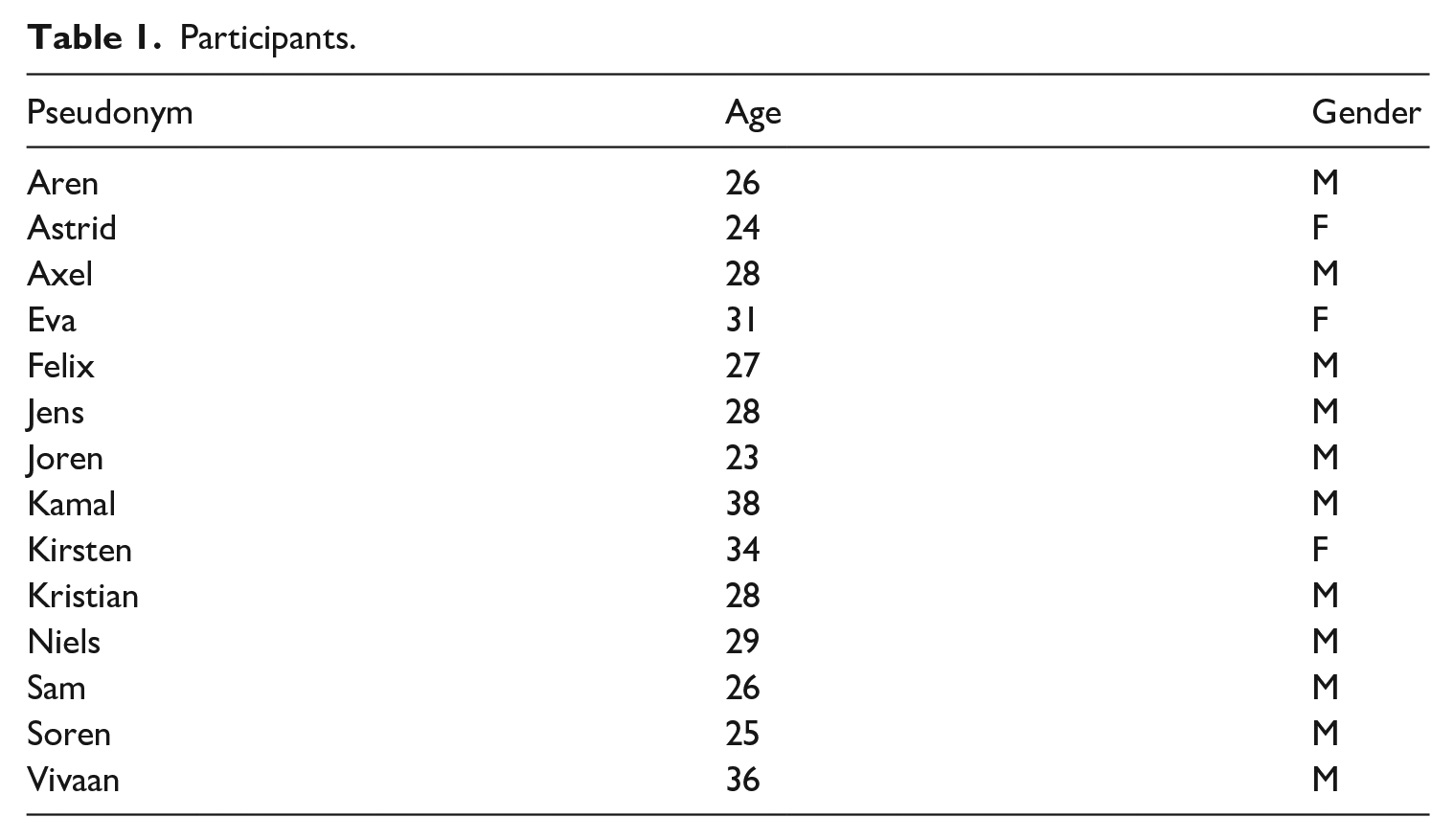
Following Pole and Hillyard (2016: 5), Karel became immersed in ‘what action is taking place’, to describe the ‘cultural practices, understandings and beliefs’ (Wright and Hobbs, 2006: x) of everyday life in Habitat. Observations were made during participation in as many happenings as possible, including communal parties, interviews with prospective Habitat residents, accompanying participants to their workplaces, as well as simply chatting in the corridor/kitchen, smoking together and drifting in/out of impromptu conversations. Being a similar age to most participants allowed participation in most activities taking place in the field. The fieldwork was an ‘intensive period of engagement’ (Atkinson, 2015: 25) to learn about the language, rhythm and significance of events in entrepreneurial life and work and so was both an intensive and extensive study of entrepreneurial work-lives, with Karel producing fieldnotes throughout. In addition, Karel conducted 14 semi-structured interviews with Habitat residents and eight informal interviews with former residents and visitors (met in person during the fieldwork or contacted with the help of current members of Habitat) to capture participants’ accounts of entrepreneurial work and life. The interview guide for Habitat members was developed using an abductive approach where pre-existing conceptual schema acted as ‘sensitizing concepts’ (Blumer, 1954: 7) to root the interviews in existing sociology of work frameworks, while allowing flexibility to develop novel ‘empirically based theorizations’ (Tavory and Timmermans, 2014: 4). This abductive approach enabled alignment between theory, methods and analysis whereby pre-existing conceptual insights scaffolded fieldwork and guided analysis, enabling new theoretical insights to unfold at each stage of the research process. Table 1 gives basic socio-demographic information for the interview participants.
Participants.
Intensive involvement in the study site raised some ethical issues around informed consent given that participants were being observed in their private domestic space. To address this, participants were given the opportunity to discuss their concerns or reservations prior to and during the fieldwork, and an option to consult research outputs before publication to identify anything they considered too sensitive – or to withdraw from the study. Conducting ethnographic fieldwork in the coliving space for entrepreneurs was a strategic choice as it allowed us to explore entrepreneurial working lives from the vantage point of the organisation of domestic and private lives and enabled us to observe everyday practices as well as participants’ perceptions of the relation between work and life within an entrepreneurial context. Taking Foucauldian studies of entrepreneurial discourse as a starting point, this article contributes an exploration through ethnographic fieldwork of how the norms of discourse interact with the everyday dynamic of work and life, including the material pressures and incentives that entrepreneurs face. Rather than commenting on the rules of entrepreneurial discourse or the portrayal of the entrepreneurial subject within it, the study goes beyond analyses of text and instead seeks to provide an account of how the discursive norms are mobilised, interpreted and used in entrepreneurs’ everyday lives. In Hacking’s words, the fieldwork enabled us to explore in more depth ‘how the forms of discourse become part of the lives of ordinary people’ (2004: 278). Furthermore, in the tradition of discourse-oriented ethnography, the study also goes beyond analyses of text by exploring ‘discourse practices through which a particular social group constructs, maintains, and reproduces a shared social world’ (Smart, 2012: 148).
The fieldwork produced an extensive corpus of observational and interview data, offering a complex account of factors playing a role in work-intensive entrepreneurial lives. This dataset was analysed using situation analysis, a method seeking to combine analyses of action and discourse with ‘materialities, structures and conditions that characterize the situation of inquiry’ (Clarke, 2005: xxii), accounting for a phenomenon by drawing on a variety of influences that are at play in producing them. Situation analysis uses maps of situations to find ‘relations among different kinds of elements across a number of events over time’ (Clarke, 2005: 46). The analysis proceeded through abductively coding all participant observation, interviews and document analysis data, using pre-existing concepts as ‘sensitising notions’ but also allowing space for unexpected findings, which may offer new theoretical avenues. This initial coding was accompanied by a more focused situational map, which traced relations between relevant codes and data points, tying together social action with material and discursive factors. The analysis below focuses on the presence of discursive norms of freedom, self-realisation and social change that featured prominently in accounts of the participants. While other scholars have located such norms as important in entrepreneurial work-lives, this account illustrates how the realisation of these values is seen as always imperfect and shaped by material conditions, which in this context mainly concerned access to money. Thus, the analysis shows how it is a combination of norms and material aspects of entrepreneurial work that together produce an especially intense investment into work through the logic of speculative investment.
Findings
Freedom, self-realisation and social change: ‘You’d just do anything to achieve your vision’
The working lives of entrepreneurs in Habitat were characterised by an intensive commitment to entrepreneurial work and a necessity of extensive work hours. This frequently involved working beyond ‘standard hours’ into evenings, weekends and nights. As in other entrepreneurial contexts (e.g. Cockayne, 2016; Shukaitis and Figiel, 2015), entrepreneurial commitments were accompanied by an inclination to see any time as potentially work time, and a conviction that clear distinctions between work and life do not apply to entrepreneurs. The commitment to a work-intensive entrepreneurial life was confirmed by a shared understanding that entrepreneurs should be willing to make considerable sacrifices for their entrepreneurial projects: We’re always in. We’re never out. You are still thinking about it. You are selling or you are recruiting. You are still in that mode. (Frans, Serial entrepreneur and consultant, Fieldnote #56)
Participants justified this intensive and extensive commitment to entrepreneurial work through recourse to several ideals of entrepreneurial ethos. Freedom and potential for self-realisation were perhaps the most common norms invoked in justifying long working hours and personal dedication to start-up work. Start-up entrepreneurship was seen as an opportunity to follow one’s own goals, work on projects with personal relevance, and be free of routines, hierarchies and restrictions of standard corporate employment. Rather than freedom from work, this meant freedom in and through entrepreneurial work. Freedom was emphasised especially strongly in contrast to standard employment: I didn’t want to get on the classic corporate ladder. I think it’s repulsive . . . I think my friends who work there hate their lives. I liked the energy of entrepreneurship. It has a lot to do with autonomy. When you start your start-up, you can do what the fuck you want. (Niels, Design, Fieldnote #61)
In other words, entrepreneurship was frequently connected with the freedom to determine one’s own objectives and as an opportunity for personal self-realisation, which erases the need to distinguish between work time and personal time: Entrepreneurs are often people that blur the line between being in the job and not being in the job, because it’s such a big part of their identity and they want to push forward the start-up that they work with. Business and pleasure are sort of one and the same thing. (Axel, Fashion and media, Interview)
A commitment to making an impact in the world through entrepreneurship was also an important ideal justifying intensive and extensive commitment to work. Entrepreneurship was seen by participants as a vehicle potentially leading to positive, large-scale social change. Although only a few of the participants classified themselves as ‘social entrepreneurs’, this ideal connotes an emphasis on large-scale social change that is an important part of the aura of social entrepreneurship (Dey et al., 2016) and is aligned with a more general ethos of the start-up economy (Levina and Hasinoff, 2017). Much like the ideals of freedom and self-realisation, the vision of affecting large-scale social change was referred to as justification for extensive work and personal investment: At a certain level of start-up life, you’d just do anything to achieve your vision. Including working 48 hours a day. And eight days a week. And hopefully, people are driven to do that because they’re passionate about the goal the start-up has set for the product and the company. That they are making a difference in the world. (Aren, Web developer, Interview)
Despite Aren’s comments, free time and leisure were not completely squeezed out of participants’ lives; dinners, drinks and various social events were part of everyday co-living life. Moreover, several participants engaged in activities to manage stress, including physical exercise, yoga or meditation. Rather than completely displacing non-work-life, leisure activities were carefully moderated to prevent endangering the prospects of entrepreneurial success.
These norms were salient and indeed were the dominant way of explaining and justifying intensive commitment to entrepreneurial work among the participants. They were also present in the wider social, organisational and discursive environment of participants, including coworking spaces and wider start-up community events Karel attended during the fieldwork. These findings are consistent with wider literature explaining the intensive commitment to entrepreneurial work and dissolution of a work–life boundary by reference to wider enterprise discourse and associated ideals of freedom and self-realisation (e.g. Cockayne, 2016). They are also congruent with the neoliberal image of the worker as an entrepreneurial self (Du Gay, 1996; Rose, 1999).
The Foucault-inspired research discussed above frequently stops here, at the conclusion that the internalisation of these norms is what explains that individuals accept intensive work. However, a moderate constructionist perspective proposes that discourse does not entirely determine individual subjectivity and suggests researchers explore interaction between norms and other factors. Material discourse analysis argues that the norms of discourse influence meaning-making activities of actors but in interaction with specific material conditions. To explore how the norms influenced the patterns of work–life integration, we must take into consideration how they were interpreted vis-a-vis the material conditions and practices of entrepreneurial work-life, including financial circumstances and logic. These empirical findings are discussed in the next section.
Identifying the gap: ‘Money probably has something to do with my life’
Among the participants, there was a clear understanding that the realisation of the norms of freedom, self-realisation and working towards social impact is to a large degree conditioned by the logic of material necessity. Money plays a crucial role in this equation. First, start-up entrepreneurs need money to buy food and clothing, and pay rent and bills, etc. Second, participants saw money as essential to sustain the start-up enterprise and ensure its growth. Crucially, securing money through paid employment, selling services or commodities, or through funding was seen as a necessary material condition allowing the realisation of the ideals of freedom, self-realisation and social change in the first place. Only when the demands of financial necessity are met can entrepreneurs achieve a degree of autonomy to realise these ideals fully.
While participants came from diverse national and ethnic backgrounds and their life trajectories varied, it is possible to identify some contours of the economic situation they faced. The participants were typically in their 20s or early 30s. Most of them had graduated from university and started their entrepreneurial career shortly after, typically holding various jobs to finance their entrepreneurial pursuits. Those participants whose start-ups were already generating income paid themselves low wages to save money for the running or expansion of their companies. However, income that would allow for savings or a financial reserve was often an aspiration, rather than a reality, with some participants worrying about their account balance at the end of each month. There were also occasions when a temporary lack of company resources (e.g. a gap in funding) forced some participants to live off their savings or credit-card debt for a period of several months. The shared understanding among participants was that start-up entrepreneurs are people who endure years of low and unstable income in the hope that their efforts will be rewarded by entrepreneurial success in the future.
Commitment to entrepreneurial norms was therefore negotiated vis-a-vis ability to earn money. Take the example of Niels’ conversations about his idea for a sustainable farming start-up. His ideas met with support from Soren, who spoke approvingly during a cigarette break: ‘I think this is a good move for you. I think it seems that you were moving into ecology and farming for some time. I think it fits you well’ (Fieldnote #62), thus affirming norms of self-realisation and social impact. However, when Niels presented the same idea during casual evening drinks, he met with a more cautious reaction from Raj, who questioned the profitability of the start-up: ‘Who makes money and how? I am not sure if there is really profit in it’ (Fieldnote #56).
Similarly, Soren, reflected on personal wealth per se as relatively unimportant; however, he saw money as crucial for the realisation of his entrepreneurial ambitions: To me, a good life is not about having a lot of money. My ambition is to have a positive impact on the world. For me, it would be ok to just have a normal salary if I could improve the whole world in some way . . . But money probably has something to do with my life because my aspirations, you could say, correlate with money. To be able to have an impact on the world, to some extent you need money. So, if I earn a lot of money doing this [his current start-up], some future ventures will be easier to do. (Soren, Fitness app developer, Interview)
For Soren, the ultimate goal was to use enterprise as a means towards improving the world, but he needed money and investment to fuel future enterprise for these ends. Joren similarly hoped to garner resources that could be further invested into work on positive large-scale change: I would buy a lab somewhere, get together with friends and work on core new technologies without worrying about being profitable. But right now, I’m quite limited by how profitable these technologies are. Instead, I want to be steered by how good this is going to be for the world. But I cannot do that right now because one day I might need money to buy an apartment or whatever that’d be. (Joren, Software developer and consultant, Interview)
This outlook can be described as identifying the gap between the imperfect or insufficient degree to which the entrepreneurial norms can be realised in current material circumstances and potential full realisation of their promise. The norms of freedom, self-realisation and impact on the world contained expectations about what kind of work-life is desirable. However, they were contemplated vis-a-vis the limits imposed by material conditions in the present, which do not allow their full realisation. Whereas the norms that a Foucauldian framework suggests are important for justifying intensive work, they were also clearly interpreted in relation to material conditions, as material discourse analysis would suggest. As the next section discusses at greater length, rather than weakening their commitment to the entrepreneurial norms or leading participants to abandon them, participants frequently resolved the tension by adopting a particular outlook towards the future, which arguably reinforced their commitment to those norms. The thinking about work, life, values and material conditions thus had an important temporal dimension, acquiring a speculative logic whereby time and money are gambled on the prospects of financial success and freedom from material necessity in the future. The following sections illustrate how this dynamic can lead to blurring of personal finance and time and start-up capital, investment orientation to life and the replacement of the logic of work–life balance with the logic of future returns.
Investment and speculation: ‘I want to have freedom. But at the moment I don’t have it, right?’
The interconnection of norms with material conditions – and their influence on the organisation of working lives – was perhaps most visible in the investment approach to entrepreneurial work-lives. This approach influenced the present regarding the question of what role work should play in one’s life but was also oriented towards the future where the investment of time and money is expected to lead to the situation where norms and ideals can be realised. It is speculative when it comes to betting on the futures that might or might not materialise, yet also very real in the shaping of current practices, schedules and priorities.
The investment approach corresponded with specific attitudes towards work, life and time. The participants frequently talked about their work in terms of investment. This can apply to money, as Kirsten said about subsidising the start-up from her salary: ‘I see it as an investment into making the company work’ (Social entrepreneur, Fieldnote #27). Time was also thought of in terms of investment: in an interview, Soren said ‘a lot of my investment is there’ when reflecting on years spent working on establishing a company. In this perspective, the standard distinction between working and personal time became problematic or insignificant, as every moment of time and every bit of energy became a valuable investment into the favourable future that may bring financial success and returns on the current efforts. Joren expressed this logic especially clearly: I probably put all my energy into work and setting up a social life after work often gets deprioritised a lot, which means I don’t really want to spend a lot of my time setting up dinners with friends or going for drinks. Not that I don’t like those things. It’s just the investment of keeping those things alive and doing them regularly is very expensive for me. . . . It’s probably flawed to look at everything in my life as an investment, but to some degree it comes down to that, right? (Joren, Interview)
The investment approach, however, entailed more than a perspective or orientation towards work and life. Rather, it encompassed a set of material practices that the participants generally engaged in. Investment in entrepreneurial work-lives can be understood as a practice of investing money, work and time into the start-up enterprise, also described as bootstrapping (Winborg and Landström, 2001) or patch-working (Villares-Varela et al., 2018). Among the participants, these practices commonly manifested as using day-job income to pay for living expenses, and as an investment into the company to cover rent and pay hired workers. Alternatively, this meant using personal savings or debt to cover periods when the start-up did not generate income. The practice of investment had a direct impact on the organisation of entrepreneurial work-lives in two respects. First, for those participants who used a day job to fund themselves and their company, bootstrapping imposed an immediate time pressure of combining regular work and start-up work. For instance, one participant admitted that combining paid employment with start-up work meant that during particularly busy periods she worked close to 16 hours a day. Second, some participants invested as much as nine years’ worth of their savings or money from selling their apartments on the potential future successes of their start-ups. In these scenarios, start-up entrepreneurship required extraordinary expenditure of time and financial resources and was an important reason why entrepreneurs adopted a ‘full-on’ approach to work.
The logic of investment changed the way the relationship between work, leisure and time were understood. However, it was also connected to an important temporal dimension oriented towards possible future outcomes. In other words, it included a logic of speculation when it comes to betting current efforts and investment of time and energy on the uncertain futures that might or might not materialise. Seen through the logic of speculation, work and leisure time became commensurable entities that enter a calculation of what investment will yield the highest financial profit and thus create conditions where the norms of freedom, self-realisation and large-scale social change may be maximally realised. In the lives of the participants, this often meant that the logic of work–life balance was overshadowed by the logic of speculation and betting on what the investment of time to work now can yield in the future.
Kristian’s situation and outlook on work and life illustrate the point particularly well. Kristian was among the participants who worked the hardest, often late at night and over weekends. Kristian’s goal was to save as much money as possible doing freelance work to be able to devote his work entirely to his start-up in the future and to finance the work of his collaborators who worked for the company full-time. As Kristian put it in start-up jargon, he was ‘earning a runway’. However, he was also looking forward to returning to a less hectic lifestyle that would allow more time to focus on his relationships and hobbies: I need to make more money now, so I can take a break later. I want to have time for other things I like to do. To see my girlfriend, to see my family, to do my hobbies . . . there are things that I like that I was not able to do in years. (Kristian, Commercial real estate, Fieldnote #87, emphases added)
For Kristian, sacrificing leisure time in the present made sense when seen as a speculative investment into the possibilities that the future success of his company can yield. This can lead not only to freeing time to spend on leisure and relationships, but fundamentally, the financial success of his start-up should unlock long-term freedom from financial necessity. The important norm of freedom was therefore dependent on the current investment of time, effort and money, and the potential success of the company: I want freedom. But at the moment I do not have it, right? Because I have to pay the rent. If I wanted to play the piano tomorrow, I could. If I wanted to go on a trip tomorrow, I could. But then soon I would be on the street because I couldn’t pay the rent. Freedom is very important for me. The plan is for the company to run and make a profit. Then you gain that freedom only to do things that make sense to you. (Kristian, Fieldnote #87)
Kristian’s words illuminated how the logic of speculation changes thinking about work and life. Instead of balance in the present, Kristian hoped for free time and freedom in the future. His reflections further illustrated the entanglement of norms that were seen as important virtues of the entrepreneurial situation with the material logic of start-up enterprise. Freedom, self-realisation, or large-scale impact were seen as norms that can only be fully realised in the future if the financial success of the start-up enterprise allows. This pressing intensity was, in some instances, re-considered. Digital marketer Sam, for example, expressed a preference for standard working hours and steadier growth of his business. However, this kind of negotiation of intense investment logics was rare.
The previous section discussed how the entrepreneurs identified the gap between promises of the entrepreneurial norms and their insufficient realisation in current material situations. This section demonstrated how the entrepreneurs were aiming to close the gap by an investment approach that in itself required considerable sacrifice of personal time and substantial work effort. This was part of a logic of speculation, which bet current effort and resources on uncertain futures where the norms of enterprise discourse can be potentially fully realised. The adherence to the norms of the enterprise discourse and to intensive work was therefore sustained by its connection to a particular economic strategy that was expected to lead to their future realisation. Whereas the norms of enterprise discourse described in Foucauldian literature were highly important for motivating commitment to intensive work, these were also judged in relation to material realities; adherence to them was ultimately tied to a speculative economic strategy that promised their full realisation in the uncertain future.
Discussion
This study focuses on explaining the intensive commitment to entrepreneurial work characterising the lives of start-up entrepreneurs living in an entrepreneurial coliving space. Drawing on the ontological position of moderate constructionism and theoretical developments within the materialist discourse analysis, the article suggests an extension of discourse-oriented studies (Ashman et al., 2018; Cockayne, 2016; Da Costa and Silva Saraiva, 2012; Dempsey and Sanders, 2010; Fenwick, 2002; Munro and O’Kane, 2021) to include attention to the material realities of entrepreneurial lives. The article demonstrates how this extension can lead to a better empirical understanding of how individuals sustain commitment to intensive and extensive entrepreneurial work, especially in situations where their current work efforts do not lead to full realisation of the promises of the neoliberal work ethic.
The empirical account in this article allows us to see how the norms interact with material realities, arguing that it is this interaction that sustains and arguably reinforces commitment to intensive and extensive work. It shows that even entrepreneurs who take up norms of neoliberal work ethic, rather than ignoring them in favour of a fantasy, reflect on their material circumstances in relation to these norms. It describes the material practices that entrepreneurs engage in to reconcile the promises of enterprise discourse with the lack of material realities. The article also describes how these individuals identified the gap between promises of entrepreneurial discourse and their imperfect or insufficient realisation stemming from material lack, which limits the ability to work freely on self-chosen objectives. Overcoming these obstacles requires effort, which typically manifests as what the article calls an investment approach, whereby entrepreneurs invested effort, time and money into their start-ups, virtually erasing the boundary between work and free time. This orientation and these practices are tied to the logic of speculation in which current efforts were bet on possible future outcomes. In the case of success, the financial gain and freedom from necessity could lead to a full realisation of the norms of freedom, self-realisation and social impact, thus (potentially) closing the gap between the promises of the enterprise discourse and reality.
This theoretical and empirical extension makes a contribution to existing discourse-oriented studies (Ashman et al., 2018; Cockayne, 2016; Da Costa and Silva Saraiva, 2012; Dempsey and Sanders, 2010; Fenwick, 2002; Munro and O’Kane, 2021). Current scholarship frequently explains the willingness of individuals to work arduously, despite material and emotional hardship, exclusively through a reference to a seductive fantasy of neoliberal discourse or ‘deep’ internalisation of its norms. This approach arguably does not only leave the dimension of interaction with material realities underexplored, but also risks portraying real individuals as unable to reflect on their material conditions. In such a reading, the discourse and its effects might appear to explain everything. This makes it particularly difficult to understand how individuals deal with the discrepancy between the promises of enterprise discourse and their lacking material situation. The account in this article instead shows that participants not only reflect on their material circumstances in relation to enterprise discourse, but also reveals how these reflections are tied to a particular material strategy oriented towards both material and normative ends. It was this future-oriented logic that preserves the integrity of the entrepreneurial norms. It also leads to sustaining the commitment to intensive and extensive entrepreneurial work despite the failure of an immediate fulfilment of the promises of the enterprise discourse.
These findings suggest that discursive norms do play an important role in motivating individuals to embark on the entrepreneurial journey in the first place. For example, though the majority of our participants were university educated and could earn significantly more money in standard employment, choosing start-up entrepreneurship was motivated by the discourses of freedom, self-realisation and real-world impact. In contrast, for instance, to minority ethnic entrepreneurs who commonly enter entrepreneurship out of material necessity (Villares-Varela et al., 2018), Habitat members see entrepreneurship as a normative choice. Nevertheless, material factors (not least money and long-term financial success) are still seen as critical for enabling full realisation of these discursive norms. Missing either side of the equation risks reducing complex life situations to singular cause-and-effect mechanisms and potentially remaining blind to some of the more nuanced and complex interactional factors at play in shaping working lives. Our article therefore represents a call for more complex theorising, which explores the everyday working of discourse in relation to non-discursive factors, including material realities and logics of working and economic lives (Beetz and Schwab, 2018b; Elder-Vass, 2013; O’Doherty and Willmott, 2001; Porpora, 2015; Thompson and Harley, 2012).
The implications of these findings are larger than the particular case explored in this article and the context of start-up entrepreneurship. The acceptance of the neoliberal discourse of work may combine with the speculative logic and betting on future rewards to produce intensive commitment to work in other sectors. Examples include freelance journalism, where workers are expected to invest their work effort and resources in the hope of future remuneration (Rosenkranz, 2019) or certain creative industries where workers endure financial and emotional hardship justified by hope in and betting on future success (Christiaens, 2020). Given the increasing importance of assets, investment of money and time and speculation on possible economic futures (Adkins, 2018; Adkins et al., 2020), similar interaction between discourse, material necessity and speculative future expectations may help to explain commitment to intensive and extensive work more generally. Overall, the interaction between discourse, material factors and future expectations signals an important area for future investigation for scholars interested in intensive working lives and the real-world workings of neoliberal discourse.
Nevertheless, the results of this ethnographic study may be limited when it comes to generalisation to other contexts. There are ways in which the specificity of the case of coliving entrepreneurs may serve to amplify the patterns described in our findings. The selective nature of the coliving space means that only individuals who demonstrate commitment to the entrepreneurial ethos became part of this social setting. As a result, norms that are part of wider start-up circles are arguably collectively reinforced in the coliving space. This applies also to the willingness and ability of entrepreneurs to engage in speculative strategy with uncertain future rewards. Furthermore, being surrounded by others in a similar situation is likely to have strengthened the resolve to persist with this strategy, rather than to consider different work-life arrangements. Albeit the participants came from a variety of class and cultural backgrounds, some similarities made them more likely to engage in the practices of investment and speculation on future rewards. Participants were typically highly educated individuals with a range of marketable skills, which made the options of freelancing or well-paid side employment more accessible. This might have also increased the ability of these entrepreneurs to rely on their savings or to access credit in especially financially strenuous periods. Finally, the fact our participants had no responsibility to provide for children or dependent family members enabled them to accept low or uncertain income and to work extremely long hours in ways that would hardly be possible otherwise.
While the article demonstrates how discursive norms together with material realities produce especially intensive commitment to work with a tendency to erase the boundary between working and non-working life, it is also important to note that these effects were not absolute. The ‘Findings’ section discussed, for example, that non-work activities were not completely squeezed out of participants’ lives and that a minority of entrepreneurs were trying to maintain more standard working patterns. This suggests that future studies should focus not only on how discursive norms and material factors produce intensive lives, but also on the limits of the relationship that allows some individuals to negotiate and resist the demands of intensive and extensive work (see, for example, Norbäck, 2019; Vallas and Christin, 2018).
Conclusion
This article argues for the need to combine the attention to discursive and material factors in accounting for intensive entrepreneurial working lives. It shows how and why the omission of material factors presents a weak spot in Foucault-inspired accounts and argues that to fully account for the dynamic of intensive working lives, scholarship must take account of this material logic alongside the influence of powerful discursive norms. It draws on the analytical position of moderate constructionism (Elder-Vass, 2013) and developments within materialist discourse analysis (Beetz and Schwab, 2018b) to develop an account that combines attention to discourse with an emphasis on the material constrains and incentives in analysing the intensive character of entrepreneurial working lives. Based on an ethnographic study it highlights that neoliberal norms do not act alone but are rather seen as being conditioned and connected with material aspects of work-life and speculation on future material and normative outcomes. As such, it contributes to the growing efforts to develop a perspective that unifies attention to discourse with materialist inquiries into the logic of the political economy of capitalism (Beetz and Schwab, 2018b; O’Doherty and Willmott, 2001; Porpora, 2015; Thompson and Harley, 2012).
Future research should focus on exploring this dynamic in more thorough and explicit ways. Without this focus, not only analyses but also critical interventions risk diminishing their accuracy and effect by privileging the role of norms while leaving the material realities of working lives unexamined. Given the prevalence of relations of debt and speculation (Adkins, 2018), increasingly punitive welfare arrangements (Greer, 2016) and the growing importance of ownership of assets (Adkins et al., 2020), the material pressures of economic lives are bound to play an important role beyond the working lives of start-up entrepreneurs. This signals that analyses of discourse in connection to everyday practice and material pressures and incentives should be an important part of the examination of the political economy of lives in contemporary capitalism.
Footnotes
Acknowledgements
We are grateful to members of coliving space who kindly let us into their lives and shared their stories and perspectives. The authors would also like to thank three anonymous reviewers and Dr Cara Reed, Dr Marcus Gomes and Dr Toma Pustelnikovaite, members of Cardiff Organisational Research Group, for their comments on earlier drafts of this article.
Funding
The authors disclosed receipt of the following financial support for the research, authorship, and/or publication of this article: The work was supported by the Economic and Social Research Council (Doctoral Training Grant, grant number ES/J500082/1).
