




Abstract
Specialisation and gender theories offer competing hypotheses of whether men’s and women’s wages rise or fall based on the couple’s division of household unpaid and paid labour, and how effects differ across the wage distribution. We test division effects by analysing British panel data using unconditional quantile regression with individual fixed effects, controlling for own hours in housework and employment. We find only high-wage men’s wages were significantly greater when their partners specialised in routine housework, and when they were the sole breadwinner. Conversely, low- and high-wage partnered women incurred significant wage penalties as their share of housework exceeded their partners’. Wages for low-wage men and median- and high-wage women also decreased as their share of household employment increased. We conclude only elite partnered men benefit from specialisation. Everyone else is either better off or no worse off with equitable household divisions of paid and unpaid work.
Keywords
Introduction
Partnered women’s labour market activity and men’s contribution to housework have both increased over the past few decades, but households continue to be characterised by a gender division of labour (Anxo et al., 2011; Esping-Andersen et al., 2013; McMunn et al., 2020). With each family transition – partnering, marriage and parenthood – partnered men’s employment levels and domestic contributions change only marginally, whereas partnered women increase their unpaid domestic work and are more likely to interrupt employment or reduce their employment hours (Anxo et al., 2011; Baxter et al., 2008; Kühhirt and Ludwig, 2012). The gender division of heterosexual couples’ paid and unpaid labour has widespread socioeconomic consequences, such as partnered women’s relative earnings disadvantage and subsequent greater risk of poverty throughout their lives (Corsi et al., 2016). It is therefore important to understand the relationship between how couples divide up their labour and individual outcomes in terms of wages – the subject of this article.
Economic and gender theories differ in their predictions. The specialisation model posits that the partner doing the routine housework will suffer wage penalties regardless of employment hours because housework depletes their available effort, undermining productivity (Becker, 1981, 1985). This economic logic is gender blind and lies behind the perspective that policies supporting more equitable divisions of household labour are key to achieving gender economic and other equalities (European Commission, 2020). In addition, one partner’s specialisation in housework is theorised to support the wage-earning capacity of the other partner, even after accounting for individual wage effects of own housework hours (Becker, 1981, 1985). We refer to this as division effects, net of own hours, which is the specific topic of this article.
In contrast to the specialisation model, gender theorists assert routine housework divisions are more than rational time allocations. They are also symbolic displays of intimate feminine or masculine gender identities (Berk, 2012[1985]; West and Zimmerman, 1987) and status hierarchies (Ridgeway and Correll, 2004). This is why partnered women do a larger share of housework even when employed similar hours as men (Berk, 2012[1985]; Hochschild and Machung, 2012[1989]). In addition, women tend to retain the mental management of housework even when the partner contributes more hours, which may undermine their work productivity (Daminger, 2019). The gender divisions are also normative, such that employers assume partnered women do the housework and partnered men are freed up to focus on employment (Acker, 1990; Ridgeway and Correll, 2004). These factors may account for why the scant research evidence on division effects is mixed (Killewald and García-Manglano, 2016; Matteazzi and Scherer, 2021).
The studies to date also estimate only average effects, whereas we assert division effects on each partner’s wages may vary across the wage distribution. Elite workers’ egalitarian ideals are at odds with employers’ expectation that such workers be more work-focused because of the high cost of any lost productivity (Coltrane, 2004; Cooke and Hook, 2018; Lyonette and Crompton, 2015; Usdansky, 2011; Williams et al., 2013). This suggests that a partner’s specialisation in housework especially benefits high-wage women and men. In contrast, surviving on a single income is difficult for low-wage workers, particularly in more liberal, unregulated labour markets as found in the UK (Hook and Paek, 2020). At the same time, dual-earning, low-wage couples lack the resources to buy in outside help or more labour-saving devices and therefore have more hours of housework to do (Cooke and Hook, 2018). These pressures and constraints suggest more equitable divisions of paid and unpaid work may predict greater wages for low-earning partnered individuals.
To test our hypotheses, we use unconditional quantile regression (Firpo et al., 2009) and analyse the wages of 96,720 observations of 21,787 partnered individuals in the 1991–2021 waves of the British Household Panel Survey (BHPS) and UK Household Longitudinal Survey (UKHLS). The panel data allow us to match couples and estimate their wages over the course of the relationship as division effects (net of own hours) accumulate. Panel data also allow us to estimate fixed-effects models to control for stable unobserved characteristics that influence both individual hour choices and wage outcomes. Note that when we mention housework, we refer to routine housework unless otherwise specified. Our unique analytical approach reveals that the ‘best’ household paid and unpaid work division for maximising own wages differs not only by gender, but for low and high earners.
Household paid and unpaid labour divisions and wages
Becker (1981) argues that the optimal arrangement for maximising household income is for one partner to specialise in employment while the other specialises in unpaid domestic work. He argues it is a gender-neutral model, although because of comparative advantage, men specialise in employment and women in domestic work (Becker, 1981, 1985). Others argue a stark division of household labour is not optimal in modern economies as it is riskier to rely on a single income (Oppenheimer, 1997). A focus on household income also obscures problems of dependence, leaving the housework-specialising partner along with any dependent children vulnerable (Oppenheimer, 1997). Consequently, dual earning now dominates European couple households, although partnered men still tend to work more hours and contribute a larger share of the household income (Klesment and Van Bavel, 2017). Partnered men’s housework time has increased over the past few decades, but not commensurate with the increase in partnered women’s work hours (Kan et al., 2011).
A well-researched aspect of the specialisation model is the impact of own housework hours on own wages. Despite the theorised gender neutrality of specialisation, the evidence indicates effects are gendered. For one, not all domestic tasks affect wages. US evidence indicates that non-routine tasks like repairs and yard work frequently done by men do not affect the wages of either women or men (Cooke and Hook, 2018; Hersch, 2009). Neither do hours spent in childcare, although number of children predicts wage penalties for women and premiums for men (Cooke and Hook, 2018). It is only the routine, daily housework such as cleaning normally done by women that predicts penalties, with the penalties per additional hour generally larger for women than men (Bryan and Sevilla-Sanz, 2011; Carlson and Lynch, 2017; Cooke and Hook, 2018; Hersch, 2009; Hersch and Stratton, 1997; Killewald and García-Manglano, 2016; Kühhirt and Ludwig, 2012; Matteazzi and Scherer, 2021; Pollmann-Schult, 2011). We therefore focus on wage effects of routine housework; robustness checks of the wage impact of non-routine tasks and childcare confirm their division does not alter conclusions (online supplementary material, Appendix Section 4).
Division effects of housework
Less well researched is the specialisation claim that having one partner do all the housework supports the other partner’s greater employment effort (Becker, 1981; see also Bardasi and Taylor, 2008). In other words, after controlling for the negative wage impact of own housework time, as done in the studies noted above, own wages will increase as the partner’s share of routine housework increases (H1a: Housework specialisation division effects).
Matteazzi and Scherer (2021) argue that partnered women’s wages might benefit more from their partners’ specialisation given that their time in and wage penalties for routine housework are greater than men’s. This suggests that the benefits of specialised housework divisions accrue more to women than men (H1b: Housework specialisation division effects favouring women). They do not find this to be the case among German, Italian and US couples when using a measure of partners’ housework hours (Matteazzi and Scherer, 2021). Another study using the same US data, though, finds that mothers’ wages increase with fathers’ greater housework time, whereas fathers’ wages do not change with mothers’ housework time (Killewald and García-Manglano, 2016).
The mixed evidence could be due to these studies’ use of housework hours, rather than shares of the household’s total housework time. Shares better capture division effects and also control for the fact that the total household housework time varies greatly among couples. Consequently, housework share is the more appropriate measure to test division effects, after controlling for wage effects of own housework time as we do here.
Contrary to the specialisation perspective, a gender perspective holds that heterosexual couples’ divisions of household labour are more than rational time allocations. Some theorists assert divisions are a means of ‘doing’ gender (West and Zimmerman, 1987), a way to display intimate feminine or masculine gender identities (Berk, 2012[1985]). Consequently, partnered women often take on a ‘double burden’ of a larger share of housework when employed to support intimate identities (Hochschild and Machung, 2012[1989]), in some cases even when working more hours than their partners (Sullivan, 2011; Syrda, 2023). Further evidence of the persistent gendered nature of housework is that much of the increase in men’s housework time over the past few decades has been in the non-routine tasks that do not affect either person’s wages (Kan et al., 2011).
The gender division of labour is also reinforced at structural levels (Ridgeway and Correll, 2004). Acker (1990) argues one aspect to this is that bureaucratic organisations envision an ideal worker as a disembodied person with no distractions beyond employment. This androcentric conception favours men under the gender division of labour (Acker, 1990). If employers assume partnered men have someone doing most of the housework and partnered women are assumed to be doing it, actual household divisions will have a minimal impact on the wages of either partner after accounting for the impact of their own housework time on wages. This leads to a competing hypothesis to the first set: H2: Gendered assumptions indicate no housework specialisation division effects. This is the case for German and US women and Italian men when using the partners’ housework hours rather than share (Matteazzi and Scherer, 2021), and for US fathers (Killewald and García-Manglano, 2016).
Housework division effects across the wage distribution
The division of housework likely affects lower- and higher-wage workers differently as there is a strong class gradient in gender attitudes, workplace cultures and housework time. Greater education and earnings predict more egalitarian attitudes (Kan, 2007; Usdansky, 2011), but egalitarian divisions of housework among high-wage workers are often achieved by neither partner doing much (Cooke and Hook, 2018). High-wage women use their own resources to buy out of some of these demands (Gupta, 2007; Lyonette and Crompton, 2015), a strategy readily done when in a high-income inequality country such as the UK (Heisig, 2011; Hook and Paek, 2020).
Consequently, high-wage workers of both genders spend less time doing routine housework (Cooke and Hook, 2018). Some of this may reflect preferences in terms of how to spend one’s time (Gupta, 2007), but there is also more pressure on elite workers to devote themselves more fully to paid work (Coltrane, 2004; Williams et al., 2013). This is because the cost of lost productivity for workers and their employers increases as wages increase (Cooke and Hook, 2018; Hook and Paek, 2020). Having a partner specialising in housework should therefore be especially beneficial to the wages of high-wage workers. Hence: H3a: Specialised housework divisions benefit high-wage workers.
In contrast, low-wage workers tend to have more traditional ideas about women’s and men’s paid and unpaid work (Kan, 2007; Usdansky, 2011). Consequently, low-wage women do appreciably more routine housework than high-wage women (Cooke and Hook, 2018), whereas the difference among UK men’s housework time is much smaller across educational levels (Sullivan, 2010). These workers also lack the high wages to buy in outside help or more labour-saving devices when both partners are employed (Lyonette and Crompton, 2015). As a result, employed low-wage women face the largest wage penalties for their own housework time unless their partners share housework more equitably. This may be one reason for the sharp increase in less educated UK men’s housework over time (Sullivan, 2010). It is also consistent with time diary evidence that less educated UK men spend more time doing housework than they report on surveys (Kan, 2007). From this, we offer, contrary to the specialisation model for high-wage workers, H3b: Low-wage workers’ earnings are greater with more equitable housework divisions.
Employment division effects across the wage distribution
Specialisation theory does not consider any wage impact of divisions of employment, but we make some broad arguments to complement housework divisions. Household divisions of housework and employment reflect a mix of gender attitudes, time constraints and financial motivation. Motivation depends on a balance between individual financial need (income effects) and the availability of other income sources (substitution effects) (England et al., 2012). When one partner earns high wages, substitution effects reduce the incentive for the other partner to be employed. A sole family breadwinner cannot fall back on the partner’s earnings, and so has the greatest motivation to maximise wages. This suggests that own wages will increase as the partner’s share of paid work decreases.
The feasibility of specialisation in household employment, however, varies across the wage distribution. Someone earning high wages is more financially able to be the sole household earner in more precarious post-industrial labour markets (Oppenheimer, 1997). In addition, bureaucratic organisations envision an ideal worker as one with no distractions beyond employment, specifically a male person and especially at the higher ends of the wage distribution (Acker, 1990; Coltrane, 2004; Williams, 2000). High-wage workers have more pressure to devote themselves to paid work because their cost of lost productivity is higher (Coltrane, 2004; Cooke and Hook, 2018; Williams et al., 2013), which they may be better able to do when they are the main worker in the relationship as their career will be prioritised. Additionally, if employers are aware of the job position of the partner, employees whose partner is not employed or works part-time may be expected or be better able to live up to the ideal worker norm in the perception of the organisation. Hence, just as high-wage workers benefit most from housework specialisation under H3a, H4a: High-wage workers’ wages are greater as their share of household employment hours increases, especially men.
Lower-wage couples, in contrast, are less able to survive on a single income, particularly in countries such as the UK with high income inequality (Hook and Paek, 2020). Consequently, financial constraints encourage both partners’ employment (Hook and Paek, 2020). If low-wage workers are more likely to be motivated to work and maximise wages due to their more precarious economic position, the partners’ employment hours may impact own wages less than among higher-wage individuals, H4b: Low-wage workers’ wages are not greater as their share of household employment hours increases. These hypotheses are consistent with qualitative research findings of ‘lived egalitarianism’ among less educated couples, as contrasted with the ‘spoken egalitarianism’ of highly educated couples (Lyonette and Crompton, 2015; Usdansky, 2011).
Method
Data and sample
We used the nationally representative BHPS (1991–2008) and its successor, the UKHLS (2009–2021) (University of Essex Institute for Social and Economic Research [ISER], 2022). People who participated in the last wave (2008) of the BHPS entered the UKHLS sample in its second wave. The combined surveys include 726,022 observations of 104,936 individuals, of which 230,784 observations were during the BHPS. From this we selected people in different-sex, co-residential relationships who were between 20 and 45 years of age. Using the relationship histories documentation (University of Essex ISER, 2020), we further limited the sample to those couples we could observe at some time in the first 20 years of the relationship (157,380 observations of 29,642 individuals).
As we are interested in wage effects of household divisions of labour, we next selected observations where the individual was an employee working at least 7 hours per week. Observations therefore were excluded when the respondent was self-employed, working in government training schemes, or in apprenticeships because their hourly wages reflected a combination of pay for their labour and assets and/or government subsidies. We did not control for selection into employment given the difficulty in doing so with the analytical models. This historically would have led to biased wage estimates, especially for married women (Heckman, 1979). The UK gender employment gap, however, has significantly narrowed since the 1970s due to both the fall in men’s employment and the increase in women’s regardless of the presence of children (Razzu et al., 2020). Consequently, any bias in our estimates was likely small.
From this sample, we selected observations where the individual’s partner was not a student, retired, or unable to work due to illness, although they could be a homemaker, unemployed, an employee, or self-employed (yielding 102,824 observations, 22,593 individuals). For respondents who were observed in multiple relationships, we limited the observations to the first observed relationship to ensure changes in wages and divisions of labour were unrelated to re-partnering (dropping 2164 observations). We also excluded observations if wages were above the 99.5 percentile of the original sample or below £1 per hour (yielding 99,012 observations, 22,348 individuals).
We used multiple imputation (five imputations) in Stata 17 separately for men and women and included all dependent and independent variables to deal with missingness on the variables. To calculate divisions of employment and housework, we first imputed each partner’s paid and housework hours separately using as much observed information as available. Additionally, we included the reported division of housework on four household chores (grocery shopping, cooking, cleaning/hoovering, washing/ironing) and partner’s education to estimate both partners’ missing housework and employment hours. Analyses without imputations lead to the same conclusions.
After imputation, we retained observations with non-missing values of the dependent variable (wages), leading to a total of 96,720 observations (47,612 male, 49,108 female) of 21,787 individuals (10,402 men, 11,385 women). Around 36% of the observations had missing values on one or more of the variables that were imputed, mostly on the divisions of housework and employment and own housework hours (Table 1). This was due to partners’ housework and employment hours being unavailable if the partner was not interviewed and because housework hours were asked in every other wave in the UKHLS sample.
Descriptive statistics.
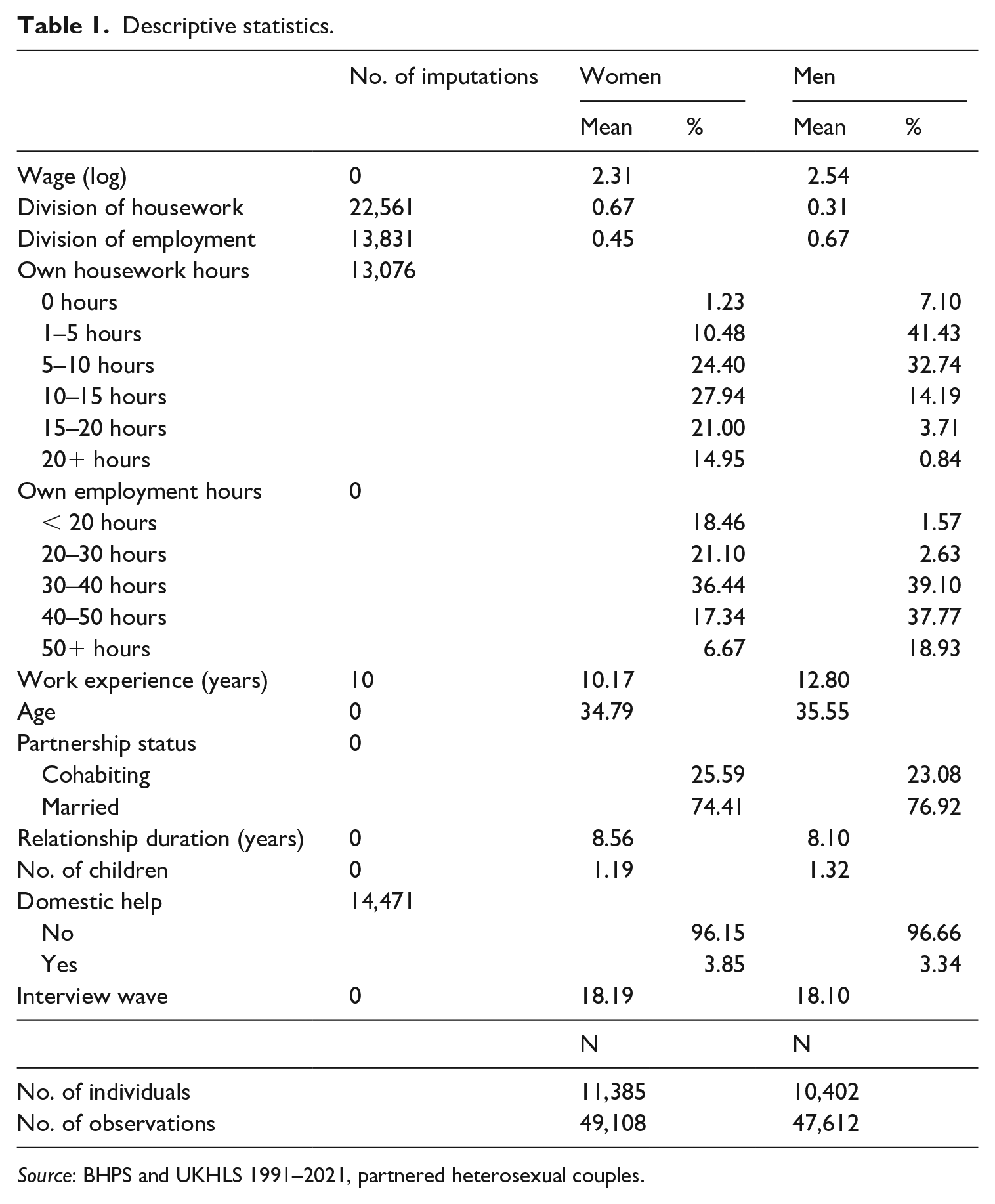
Source: BHPS and UKHLS 1991–2021, partnered heterosexual couples.
Measurements
For the dependent variable, hourly wage, we first adjusted gross monthly earnings to 2015 prices using the Consumer Price Index including housing costs provided by the Office for National Statistics (2021). We divided these earnings by the total number of hours employed each month, including normal employment hours and overtime. We followed convention and took the natural logarithm of the hourly wage to normalise the distribution and pull in outliers (Bardasi and Taylor, 2008; Killewald and García-Manglano, 2016; Kühhirt and Ludwig, 2012). Hourly wages are the gold standard for measuring productivity returns, but we also conducted a sensitivity test using the log of monthly wages given the high incidence of part-time work among partnered UK women (see section entitled ‘Robustness analyses’ and Appendix Section 4).
We are interested in how the divisions of housework and employment affect earnings, beyond the individual effect of own hours in each. The division of housework was based on each partner’s response to the question: ‘About how many hours do you spend on housework in an average week, such as time spent cooking, cleaning and doing the laundry?’. This question was asked in all BHPS waves 2 to 18 and in UKHLS waves 1, 2, 4, 6, 8, 10 and 12. Missing values were imputed using interpolation before using multiple imputation. We top-coded each partners’ housework hours at 80 hours per week. Based on both partners’ responses, we calculated the percentage the respondent contributed of the couple’s total housework hours. Division of employment was based on both partners’ employment hours and overtime hours per week. Each partner’s employment hours were capped at 80 hours per week. The division of employment was also measured as the percentage the respondent contributed to the couple’s total employment hours. The divisions of housework and employment were included as both linear and quadratic terms to account for non-linear effects.
Control variables
Of interest is how couples’ divisions of paid and unpaid work affect wages, after accounting for the individual effects of own hours in each. In addition, because of the correlation between respondent’s labour and the division of labour, the model would suffer from omitted variable bias if own hours were not included. Further, we are interested in assessing whether a partner assuming the domestic work supports an increase in the unmeasured ‘effort’ of the partner to enhance their wages as asserted by Becker’s specialisation thesis. We therefore controlled for the housework and employment hours the respondents did weekly. Individual housework and employment hours were included categorically to avoid collinearity with the share measures but still account for threshold effects and non-linearity (Hersch, 2009; Hersch and Stratton, 1997). Housework hours were included as doing 0, 1–5, 5–10 (referent), 10–15, 15–20 and more than 20 hours of housework per week. Employment hours were measured as less than 20, 20–30, 30–40 (referent), 40–50 and more than 50 hours of employment per week.
We controlled for other time-varying individual characteristics affecting wages. Work experience in years was calculated based on individuals’ full employment histories prior to the interview (Wright, 2020). We also included its square and adjusted for the intensity of employment by estimating full-time equivalent years of experience: (months in full-time employment + (months in part-time employment * 0.5)) /12. We also controlled for whether domestic help was hired for household chores (grocery shopping, cooking, cleaning/hoovering, washing/ironing).
Demographic and relationship controls that vary over time included age, relationship status (cohabiting (referent) or married) and number of own dependent children in the household under age 16. Relationship duration was based on relationship files (University of Essex ISER, 2020). Lastly, we controlled for the interview wave to account for business cycles and policies that might affect all wages. Table 1 displays descriptive statistics for all variables.
Analytical strategy
As we are interested in comparing the variation in effects across the wage distribution, we followed other recent studies (e.g. Cooke et al., 2022) and used the unconditional quantile regression (UQR) estimator initially developed by Firpo et al. (2009), specifically the rifhdreg command in Stata by Rios-Avila (2020) that estimates fixed effects (FE). We estimated UQR with individual FE to estimate within-person variation over time, thus controlling for stable unobserved heterogeneity as done in other studies of wages using panel data (e.g. Cooke et al., 2022; Killewald and García-Manglano, 2016; Pollmann-Schult, 2011). Models are estimated separately for men and women. The results can be roughly interpreted as the predicted change in hourly wages at the designated quantile for a small change in the independent variable (Firpo et al., 2009). For visual clarity, we estimated and displayed the predicted results for the 20th, 50th and 80th quantiles using marginal effects at the means for each quantile to show how the impact of the division of labour net of own hours and other controls differed over the wage distribution, but not at the extremes of the wage distribution.
A limitation in our analyses is the potential endogeneity between couples’ housework and employment divisions and wages (Maani and Cruickshank, 2010). People’s labour market involvement is associated with the partner’s wage and socioeconomic position (Bröckel, 2018; Verbakel and de Graaf, 2009). Furthermore, greater individual earnings, particularly women’s, reduce housework time (Gupta, 2007). FE models support a stronger causal case than random effects models or models using cross-sectional data but cannot differentiate changes that happen simultaneously. The data, however, did not contain suitable instrumental variables that predict employment and housework time but not wages to control for endogeneity. Hence, FE models were the best option. We therefore tested all hypotheses by estimating UQR FE models controlling for all the variables described above but refrain from using strong causal language in our interpretation of results.
Results from UQR
Figure 1 presents the estimated wage effects of different percentages of household divisions of housework and Figure 2 presents estimated wages of divisions of employment hours net of own hours in both types of work and all other control variables at the 20th, 50th and 80th wage quantiles for each gender. The figures show the estimated wage differences between certain divisions of housework (Figure 1) or employment (Figure 2) as compared with when housework/employment is divided equally (50/50). Full models are in Appendix Table A1 for women and men, with the marginal effects at the means (MEMs) of each quantile displayed in Table A2 for housework and Table A3 for employment. Differences in the associations across the wage distribution and between women and men are estimated based on these MEMs using Z-scores.
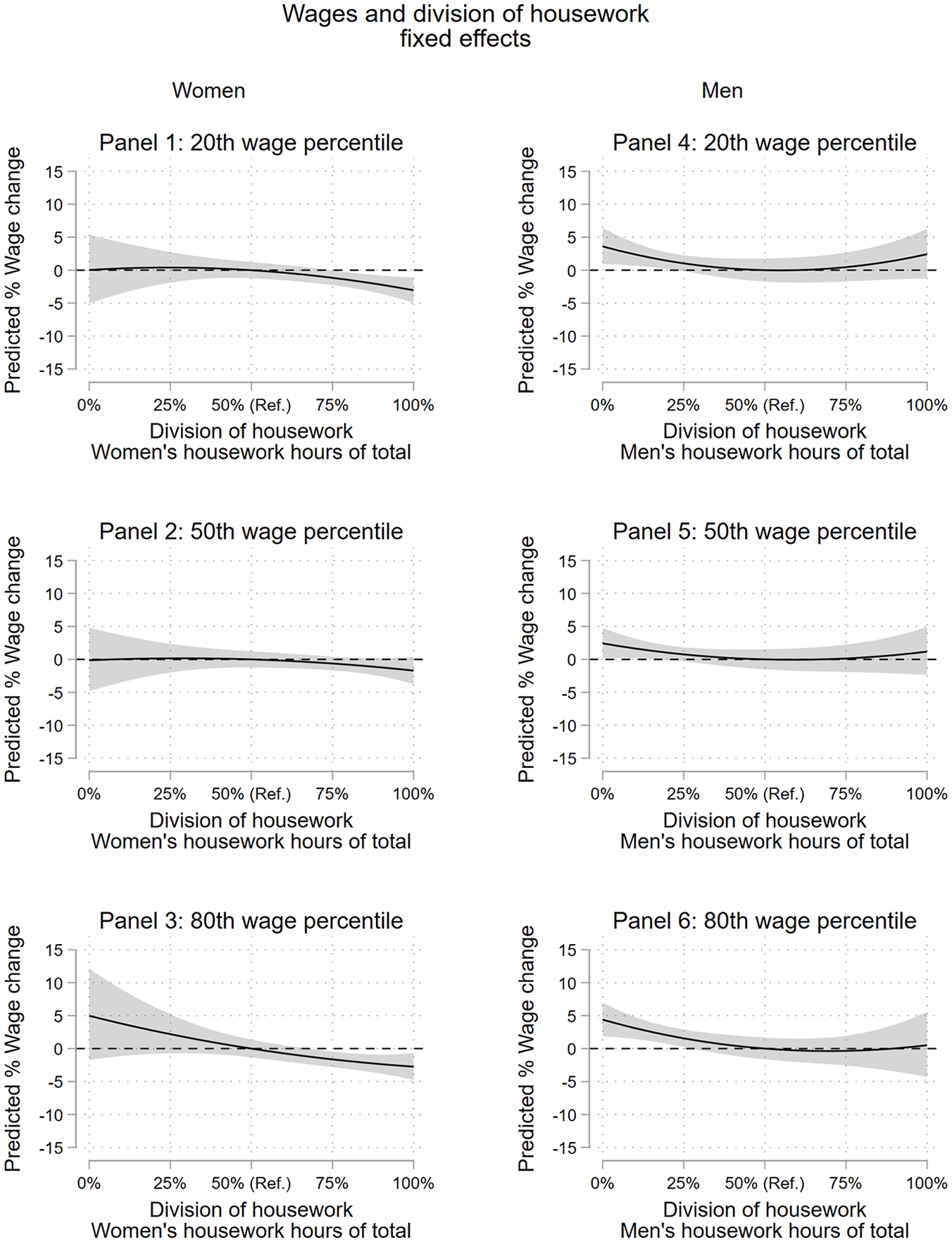
Women’s and men’s predicted wages differences by division of housework across the wage distribution from unconditional quantile regressions with fixed effects.
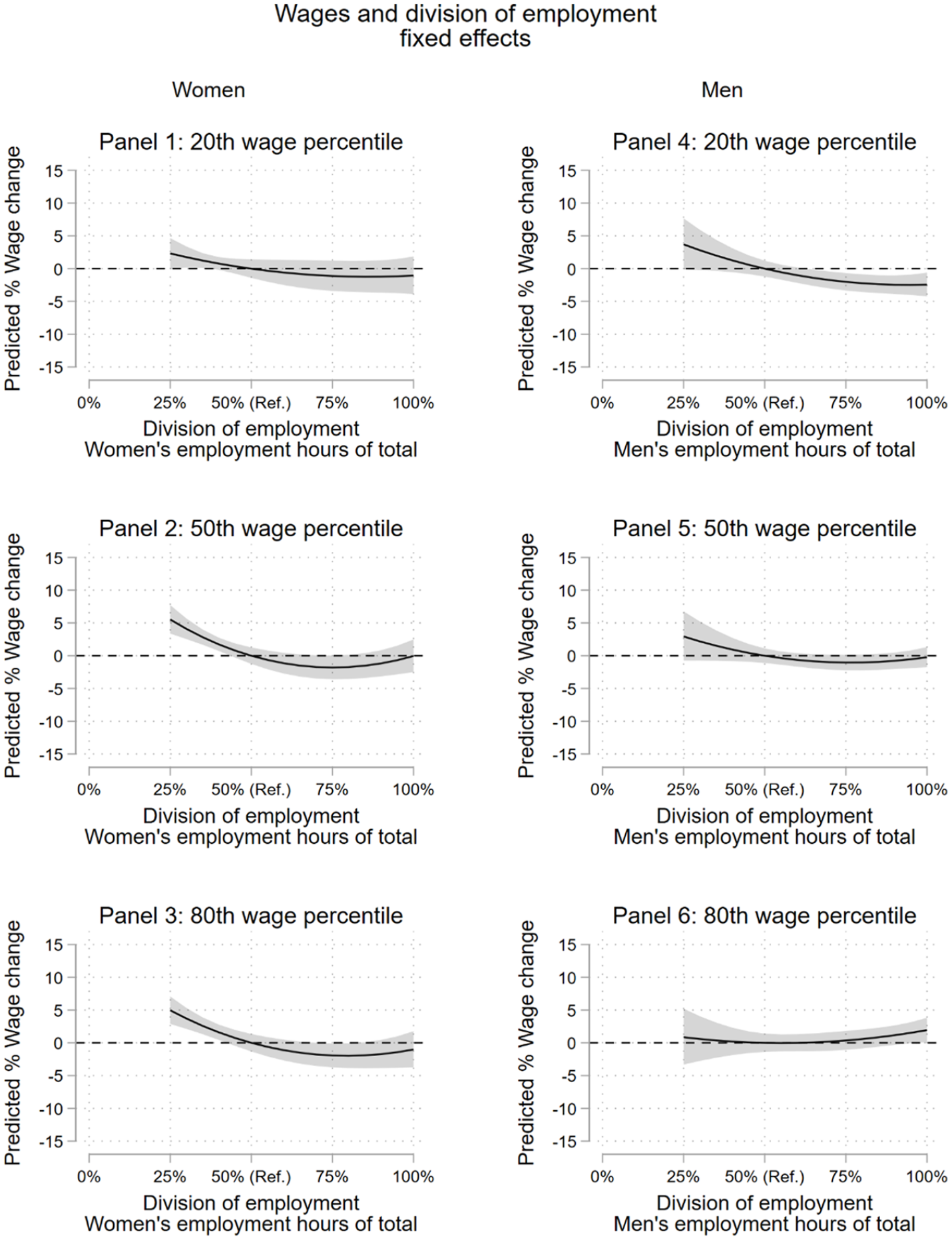
Women’s and men’s predicted wages by the division of employment across the wage distribution from unconditional quantile regressions with fixed effects.
Before discussing the figures, the effects of some control variables in Appendix Table A1 are worth noting. Women’s greater own housework hours predicted wage penalties only for women at the 20th quantile. Legal marriage also predicted lower wages among low-earning women, whereas it predicted higher wages at the median. Number of children predicted lower wages for women at the median and especially at the bottom of the wage distribution. Having domestic help predicted greater wages for women across the distribution, with the effect largest for the highest-wage women. Among men (Table A1), own housework hours predicted no wage penalty as found in much research (cf. Cooke and Hook, 2018). Marriage as contrasted with cohabitation predicted greater wages for men, but only at the median and below. Children predicted penalties at the bottom and a premium at the top for partnered UK men, consistent with other research (Cooke et al., 2022). Having domestic help also predicted significantly lower wages for the lowest-wage partnered men, but higher wages for high-wage men.
Division effects of housework
Figure 1 displays women’s estimated MEMs of housework divisions on hourly wages net of own hours and other control variables at the 20th (panel 1), 50th (panel 2) and 80th quantiles (panel 3). The referent is a 50/50 split of housework.
Women with wages at the 20th quantile were predicted to incur a 1.5% penalty when doing 80% of the couple’s housework, rising to 3.0% when doing all of it (panel 1, see also Table A2), compared with sharing housework equally. For women at the 50th wage percentile (panel 2), while the overall pattern looks similar to the pattern seen for lower-wage women, these differences were not statistically significant.
The highest-wage women (panel 3) benefited most when they did less housework than their partners. They were predicted to have a 0.7% wage premium when they did 40% of housework compared with equal division of housework. This wage premium rose further when she did relatively less housework, but due to the wide confidence intervals, these did not reach statistical significance. High-wage women were also penalised as their housework contribution exceeded equity, ranging from a 0.7% penalty when doing 60% to a 2.7% wage penalty when doing all the housework, compared with when she did half of the housework. Overall, we found that lower and higher-wage women received wage penalties from doing more housework relative to their partners once controlling for own housework hours. However, additional analyses comparing the difference in wage change by the division of labour across the wage distribution (see Z-scores in bottom panel of Table A2) revealed that the association between housework division and wages were not statistically different across the wage distribution. Overall, we found support for hypothesis H1a among women as women’s share of housework specialisation was negatively related to her wages. Results offered no support for hypotheses H3a and H3b among women considering that the association between the share of housework and wages did not significantly differ across the wage distribution.
Results for housework division effects among men are presented in Figure 1, panels 4 (20th quantile), 5 (50th quantile) and 6 (80th quantile), and in Appendix Table A2. The direction and magnitude of housework division effects was quite similar among men across the wage distribution. All men’s wages net of their own housework hours were greater as their partners did a larger share of housework, but effects were statistically significant (p < 0.05) only among the highest-earning men. As compared with equitably sharing housework, high-earning men’s wages increased by 0.5% when their partners did 60% of the housework, to 4.4% when their partners did all of it. This is consistent with H3a, that specialisation benefits high-wage workers, but only high-wage men. At the same time, the magnitude of coefficients among men was similar (see Z-scores in bottom panel of Table A2); thus, we cannot confirm H3a definitively for men.
In further contrast to results for women, no man incurred significant wage penalties when doing more than half of the housework, although this may be partially because few men do more than 50% of the housework. Additional analyses revealed that the associations between share of housework and wages were similar between median and high-wage men and women, in contrast to H1b (see Z-scores in bottom panel of Table A2). However, lower-wage women received a wage penalty when doing (almost) all housework, while lower-wage men did not; this difference was statistically significant.
Division of employment
Figure 2 displays the impact of household divisions of employment at the 20th, 50th and 80th wage quantiles using MEMs (full models are in Appendix Table A1 for women and men, with MEMs predicted changes in wages shown in Appendix Table A3). For low-wage women (Figure 2, panel 1), the division of paid work did not predict significant changes in their wages relative to an equitable division. Low-wage women earned about 1% less as their share of employment hours increased to 60% or more, but the estimates were only marginally significant (p < 0.1). These results for women were consistent with H4b, that the wages of lower-wage women were not associated with their share of the couple’s employment hours.
Becoming the household breadwinner did significantly affect the wages of median- and high-wage women. As their shares of household employment hours increased to 80%, their wages were predicted to be about 2% less. The differences in the association were not different across women’s wage distribution (see Z-scores in Table A3, bottom panel). These results do not support H4a for women, that higher-earning women would benefit more from working larger shares of paid work hours, as we find the opposite: they receive wage penalties from working more than their partners. At the same time, working a smaller share than their partners predicted wage premiums for median- and high-wage women from just under 2% when working 40% of the household’s total employment hours, to 5% or more when working 25%. These results suggest median- and high-wage partnered women were not penalised for working less, which is counterintuitive.
Net of their own employment hours, men at the 20th quantile were predicted to receive a statistically significant wage penalty as they became breadwinners, up to a 2.4% penalty when they were the sole family earner. As found for women, low-wage men who worked fewer hours than their partners were predicted to receive a wage premium of up to 3.7% when they worked 25% of the couple’s employment hours.
Men at the 50th wage quantile received smaller premiums from working fewer hours than their partners, but the effects were only marginally significant (p < 0.10). Men at the median also received smaller penalties when working a greater share of employment hours than their partners, up to about a 1% penalty when they worked 70% of the couples’ work hours. Again, though, the effects were only marginally significant. In all, the patterns of the wage impact of employment divisions were similar for all women and low- and median-wage men.
In contrast, men at the 80th wage percentile received no wage penalties, but instead a marginally significant (p < 0.10) wage premium of 1.9% when they were the sole family breadwinner. Additional analyses indicated that this difference between high- and low-wage men in the associations between wages and the division of employment was also statistically significant (Table A3). Furthermore, we found gender differences in the association between the division of employment and wage penalties/premiums only for the highest wage groups (Table A3). High-wage women received a penalty of working more hours than their partners, but high-wage men received a marginally significant wage premium when the sole earner. This offers equivocal support for H4a, that elite breadwinners would enjoy the benefits of their employment specialisation, but only for men.
Robustness analyses
The finding that wages for both men and women were greater when working fewer hours than their partners was unexpected. This was not the case when estimating pooled ordinary least squares (OLS) with clustered standard errors rather than fixed-effects models (Table A4). The OLS estimates indicate that low-wage men and women who worked fewer hours than the partner earned lower wages and no groups earned higher wages when working fewer hours than the partner. That these penalties disappeared in fixed-effects models indicates individual, stable, unobserved characteristics account for both the lower hours choices and the higher wages. Additionally, the UQR FE results implied that when people started working fewer hours than the partner (and/or started working part-time) they were able to retain a disproportional amount of their prior wages.
The online supplementary appendix contains additional robustness tests. First, wage premiums/penalties of the division of employment may be conditional on the division of housework. Potentially, increased work motivation from doing more paid work was conditional on doing less housework. Additional analyses estimating interaction effects between employment and housework divisions (see Appendix Section 3) indicated that this was not the case; premiums or penalties of the division of employment were not affected by the division of housework.
Second, our dependent variable was hourly wages as used in prior research (e.g. Cooke and Hook, 2018; Hersch, 2009; Kühhirt and Ludwig, 2012). A key source of UK partnered women’s economic inequality, however, is their tendency to work part- rather than full-time (Razzu et al., 2020). We therefore estimated models using monthly earnings (logged) as the dependent variable to see if conclusions would change (Appendix Section 4, Figures A2 and A3). Housework division wage effects were essentially the same (Figure A2). The impact of household divisions of earnings (Figure A3) differed more markedly from those for hourly wages (Figure 2). Most striking was that low-wage women working less or more than their partners incurred significant monthly earnings penalties. Low-earning men also incurred significant penalties when working a lower share, although their earnings were not penalised when working more than their partners. Together, results for monthly earnings more strongly support H4b, that low-earning partnered individuals are better off with more equitable divisions of employment. Using monthly earnings as the dependent variable also provided stronger support for H4a, that elite workers benefit more from specialising in employment, but only elite men.
The third robustness test assessed whether including the division of childcare alters conclusions, limiting the sample to parents only (Appendix Section 5). Therefore, we re-estimated our models twice, once by selecting only people who have at least one biological, adopted or step dependent child under age 16 living in the household and including a control variable for division of childcare by the couple. The results from these two sets of analyses lead to the same conclusions irrespective of whether the division of childcare was included, with results for parents only similar to our main results.
Fourth, while non-routine housework is not associated with wages (Cooke and Hook, 2018), potentially the division of it is. We therefore re-estimated models by including two control variables for couple divisions of DIY jobs and gardening (Appendix Section 6). Overall, our main conclusions about housework remained the same, as the division of DIY jobs and gardening did not change the associations between the divisions of housework and employment and hourly wages.
Discussion and conclusions
Despite progress over the past few decades, couples’ divisions of paid and unpaid labour remain gendered (Anxo et al., 2011; Esping-Andersen et al., 2013; McMunn et al., 2020). A large body of research investigates the consequences of own hours spent on employment or housework and hourly wages (e.g. Bryan and Sevilla-Sanz, 2011; Cooke and Hook, 2018). The few studies assessing effects of the division of housework or the other partners’ housework hours on own wages come to competing conclusions depending on the country and research design (Bardasi and Taylor, 2008; Killewald and García-Manglano, 2016; Matteazzi and Scherer, 2021). We investigated how the divisions of housework and employment, net of own hours in each, affects partnered women’s and men’s wages across the UK wage distribution using unconditional quantile regression with fixed effects. We call these division effects, to see if they were incremental to well-researched own-hours effects.
We developed competing hypotheses of division effects from specialisation (Becker, 1981) and gender theories (Acker, 1990; Berk, 2012[1985]; Ridgeway and Correll, 2004; Williams et al., 2013). Specialisation theory asserts that, beyond the wage impact of their own housework hours, wages of one partner should increase as the other partner does a larger share of the housework. We found this to be the case only for the highest-earning partnered men. Consequently, only elite men enjoy the benefits of their partners’ housework specialisation. In addition, the wages of men across the distribution were not negatively affected when they did the larger share of housework. These results suggest that gendered assumptions around housework trump the dynamics of specialisation for most men. The results also indicate that partnered men could contribute much more to routine housework without hurting their own wages, contrary to Becker’s (1985) arguments.
Results for women also indicate some support for the specialisation thesis. Not only do women suffer wage penalties for the higher volume of housework that they do, they get further penalised for doing the greater share. One reason for the essentially double wage penalty may be that women often manage and plan housework even if their partners ‘help’ more with the tasks (Daminger, 2019). This suggests that achieving greater gender economic equality requires men to be more responsible for the planning as well as execution of daily domestic tasks. Whether this reduces the gender differences in patterns of wage effects found here might be confirmed in future studies.
Both specialisation and gender theories are silent on the potential wage impact of household divisions of paid work, net of own work hours and the education and accumulated experience predicting wages. We therefore developed broad hypotheses of why the impact of breadwinning or dual earning on wages varies across the distribution. In contrast to our expectations, results indicated that partnered women incurred wage penalties as they became the main breadwinner, although effects were statistically significant only for median- and high-wage women. This is consistent with research showing that breadwinning women are in especially disadvantaged households (Sullivan, 2011), but further suggests these women themselves are disadvantaged relative to their peers who share employment more equally. The same was also true for breadwinning men at the 20th quantile of the wage distribution. We conclude from these patterns that all women and low-wage men are economically better off in households where couples work similar hours.
A counterintuitive finding from the fixed-effects models, though, was that hourly wages for partnered women and low- and median-wage partnered men were higher when they worked a minority share of household employment hours. A comparison of fixed-effects estimates with those from OLS models revealed that this finding was due to individual heterogeneity. Stable unobserved characteristics accounted for the lower hours and the wages. An additional sensitivity test using monthly earnings as the outcome rather than hourly wages yielded more intuitive results. Low-earning women’s monthly earnings were greatest when they worked similar hours to their partners. Low-earning men’s monthly wages were also greatest when they worked similar hours, although they were not penalised as they became the breadwinner. Together the results suggest equal dual earning is the optimal household arrangement for low-earning couples’ monthly wages. This is consistent with the qualitative evidence that lower-earning or educated couples have ‘lived egalitarianism’ (Lyonette and Crompton, 2015; Usdansky, 2011).
In contrast, results for high-wage partnered individuals support the argument that, despite espousing egalitarian gender attitudes, the egalitarianism of more educated couples is more rhetorical (Lyonette and Crompton, 2015; Usdansky, 2011). Not only were high-wage men the only ones to further benefit from their partners’ specialisation in housework, their hourly wages were also higher when they were the sole family breadwinner. Estimates for hourly wages were just marginally statistically significant but became significant when using monthly earnings as the outcome. Thus, only elite men benefit from specialisation. Everyone else is either better off or no worse off with equitable household divisions of paid and unpaid labour. We tested effects for partnered women and men separately, but the increasing likelihood that individuals partner with those with similar education or earnings potential (Blossfeld and Buchholz, 2009) suggests conclusions drawn can be applied to couples.
Novel insights notwithstanding, this study has several limitations. First, the UK panel data rely on own reports of work and housework hours, which are not as accurate as time-diary data (Kan, 2007). Kan (2007) finds that less educated UK men under-reported their housework hours in the BHPS. An analysis of the UK time diary data could confirm the housework division effects found here, although those data are limited by being cross-sectional. Second, estimates may be slightly biased as we could not control for selection into employment for our analytical sample (Heckman, 1979). The UK gender employment gap has narrowed appreciably over the past few decades (Razzu et al., 2020), though suggesting the extent of this bias has also reduced. Nonetheless, findings here should be confirmed in future research with suitable controls for selection into employment of both men and women. Lastly, although our fixed-effects models are a stronger test of causality than cross-sectional assessments, the potential endogeneity among individual and household hours in paid and unpaid work and wages persists and may also bias coefficients (Gupta, 2007; Maani and Cruickshank, 2010).
Our research indicates that women and lower-wage men benefit in terms of their wages when paid work is more equally distributed between the partners. Potentially, the partner’s social, human and cultural capital helps the individuals’ career progression (Verbakel and de Graaf, 2009). Couples with similar educational attainment may have more relevant expertise to share, and this homogamy is associated with couples’ divisions of labour (McMunn et al., 2020). The interplay between educational homogamy, partner resources, and divisions of labour and wages could be a promising avenue for future research and could perhaps account for the wage benefits of working similar hours, as we found here. Additionally, besides wages, the divisions of paid and unpaid labour are also associated with (relationship) wellbeing (Blom et al., 2017; Kalmijn and Monden, 2012). Further research could study how these associations differ across social strata as we have done for wages.
In all, our unique approach reveals that the optimal division of household labour for wages differs not only between women and men, but among men. That elite men still benefit from specialisation may explain why policies have not pressed harder for greater gender equality than offering some subsidised childcare and no UK statutory right to paternity leave (Cooke et al., 2022). As long as men’s domestic work is considered ‘helping out’, the gender socioeconomic consequences will persist. Our research highlights the importance of the partner’s contribution to housework beyond individual housework for wages. This suggests that to achieve economic gender equity, policies should not focus on enabling work–life balance for women, but incentivise men’s higher domestic contribution (European Commission, 2020).
Supplemental Material
sj-pdf-1-wes-10.1177_09500170231180818 – Supplemental material for Wage Effects of Couples’ Divisions of Labour across the UK Wage Distribution
Supplemental material, sj-pdf-1-wes-10.1177_09500170231180818 for Wage Effects of Couples’ Divisions of Labour across the UK Wage Distribution by Niels Blom and Lynn Prince Cooke in Work, Employment and Society
Footnotes
Funding
The authors disclosed receipt of the following financial support for the research, authorship, and/or publication of this article: The research was made possible with funding from the European Research Council (ERC) under the European Union’s Horizon 2020 research and innovation programme (grant agreement no. 680958, LP Cooke, PI). Opinions expressed here reflect only the authors’ views; the Agency is not responsible for any use that may be made of the information it contains. Blom’s salary was supported by the UK Prevention Research Partnership (Violence, Health and Society; MR-VO49879/1), an initiative funded by UK Research and Innovation Councils, the Department of Health and Social Care (England) and the UK devolved administrations, and leading health research charities.

Supplemental material
Supplemental material for this article is available online.
References
Supplementary Material
Please find the following supplemental material available below.
For Open Access articles published under a Creative Commons License, all supplemental material carries the same license as the article it is associated with.
For non-Open Access articles published, all supplemental material carries a non-exclusive license, and permission requests for re-use of supplemental material or any part of supplemental material shall be sent directly to the copyright owner as specified in the copyright notice associated with the article.
