




Abstract
The decline of the power of organised labour, which is a central feature of neoliberalism, was compounded during the ‘age of austerity’. Yet, the potentially disruptive agency of workers remains. This article presents a qualitative process-tracing exercise for over 150 prominent episodes of worker-led dissent in the period 2010–2019 in the UK, the results of which are also made available in a website accompanying the article: ‘Contesting the UK’s neoliberal model of capitalism: worker-led dissent (2010–2019). The article identifies seven configurations of causal conditions that proved sufficient for workers to successfully pursue their stated aims during this period. While ‘standard’ national disputes led by mainstream trade unions were on the whole not sufficient to achieve success during this period, nevertheless a number of alternative combinations of conditions did prove to be sufficient, especially locally-focused campaigns, those undertaken by grassroots ‘indie’ unions and those in the transport sector.
Keywords
Introduction
The decline, demobilisation and disarticulation of organised labour is widely considered a core (and arguably defining) feature of neoliberalism (see Harvey, 2005). As multiple scholars have argued, a number of central processes in contemporary capitalism have coincided during the past four decades. These have reduced the capacity for labour to organise, to exert its influence within the workplace vis-a-vis capital, and/or to achieve influence over public policies more indirectly through links to social democratic or other left parties (Baccaro and Howell, 2017; Benedetto et al., 2020). Common factors considered to have brought this demise about include globalisation, financialisation, the transition to a service/post-Fordist/post-industrial economy, the proliferation of post-materialist values and a corresponding erosion of class identity, and the limits to growth of the post-war model of managed capitalism (Kollmeyer, 2022). This decline is often considered to have advanced further still in the period following the global economic crisis of 2008, with the period from 2010 onwards especially noted by many to be an ‘age of austerity’ in which further measures to undermine working conditions, wages and welfare were imposed as part of an effort to shore up neoliberalism and to offload the public debt accrued by governments in the process of (partially) stabilising the financial markets after the crisis of 2008 (Cameron, 2012; Farnsworth and Irving, 2018; Heyes et al., 2012; Scharpf, 2013).
The ‘age of austerity’ therefore represents a particularly hostile environment for organised labour and workers. Yet, informed by those accounts of capitalism that consider contestation, and especially the agency of labour (in both its organised and disorganised forms), to be an ever-present phenomenon, there remains an empirical question regarding the types of dissent, and anti-austerity, that workers were able to mobilise under these especially hostile conditions, and with what effect (Atzeni, 2021; Bailey et al., 2018). This article presents the results of a process-tracing exercise for over 150 prominent episodes of worker-led resistance in the period 2010–2019 in the UK, the results of which are also made publicly available online in a website accompanying the article. 1 Using qualitative comparative analysis (QCA), the article identifies the configurations of causal conditions that proved sufficient for workers to successfully pursue their aims in prominent campaigns undertaken in the UK during this period. The article shows that, while ‘standard’ national disputes led by mainstream trade unions were on the whole not sufficient to achieve success, nevertheless a number of alternative combinations of conditions did prove to be sufficient, especially locally-focused campaigns, those undertaken by grassroots ‘independent’ unions and those focused on the transport sector (itself considered a ‘choke point’). The article therefore shows that, while the ‘age of austerity’ might have been largely characterised by the further decline of organised labour, opportunities for successful contestation and struggle remained, and new opportunities opened.
Workers’ dissent under neoliberalism
The capacity for workers to organise and assert their interests within neoliberal capitalism is widely considered to have faced a number of obstacles and constraints, which have grown throughout the neoliberal period, creating a decline in the capacity of workers to mobilise around their shared interests. These obstacles are also widely considered to have become more constraining still during the post-2008 period following the onset of the global economic crisis and the subsequent pressures to maintain the competitiveness and fiscal discipline that this unleashed. These pressures are both general in that they are producing a global trajectory of neoliberal reform (Baccaro and Howell, 2017) and are nationally specific in that global pressures are mediated (and in some instances mitigated) by national institutional configurations (Thelen, 2014).
In explaining this decline in workers’ capacity to mobilise and assert their interests, Baccaro and Howell (2017: 22–23) draw on the power resource approach to political economy developed by Korpi (2006) to argue that a decline in the relative strength of labour vis-a-vis capital has produced a number of structural changes to the labour market in advanced capitalist democracies. In particular, the onset of the decline of the post-war Fordist model of capitalist production, associated with the end of the Bretton Woods system in 1971–1973, saw both the liberalisation of financial markets and the increased global competition in trade, each of which were promoted by firms and governments as a response to the declining productivity, labour militancy and associated stagflation of the 1970s. This post-Fordist period has therefore seen heightened global economic competition and greater potential for capital mobility, each in a way that favours the structural power of capital over labour. This relatively weakened capacity of labour has resulted in (or enabled) an erosion of labour market regulations, especially those relating to collective bargaining, reducing the institutional opportunities for the inclusion and incorporation of workers’ views and demands in the workplace (Baccaro and Howell, 2017).
The industrial relations literature, in particular, has highlighted the way in which this decline of collective bargaining has been driven by an increased structural power for firms and the need for trade unions, as the main representative body of workers, to adapt their expectations and demands in accordance with their relative capacity and interests (Glassner et al., 2011). During the post-2008 crisis period, the heightened pressure on firms to remain economically viable, and for governments to achieve fiscal balance, posed a further challenge for workers (Heyes et al., 2012). In this unfavourable economic context, workers faced firms that were struggling to remain competitive. They also faced the prospect that their employing firm would collapse (and they would subsequently lose their jobs) if the demands made were excessive. In this context, trade unions were forced to engage in ‘concession bargaining’, whereby they would offer to reduce or lower existing workplace conditions in exchange for the promise of job retention. Thus, in a choice between job losses and wage demands many unions opted for lower wages in order to guarantee greater job security (Ivlevs and Veliziotis, 2017; Roche et al., 2015). Likewise, many firms sought to decentralise collective bargaining systems in order to gain greater flexibility in negotiations with trade unions, who in turn were structurally disempowered from preventing or opposing such moves (Brandl and Bechter, 2019).
Despite these heightened structural obstacles to the capacity of workers to organise and assert their interests within contemporary neoliberal capitalism, a number of scholars have highlighted the ongoing and different ways in which workers are able to mobilise despite these constraints. Drawing on insights within both labour process theory (Thompson, 2016; Thompson and Laaser, 2021) and from the tradition of autonomist Marxism (Tronti, 2019), the observation is often made that, regardless of the constraints that have been created to prevent or impede the incorporation of organised labour within contemporary advanced capitalist economies, nevertheless the reliance of capitalist production upon an antagonistic relationship with labour ensures that there is always the scope for dissent and resistance, as acquiescence can never be absolutely assured and conflict is always implicit given the structural nature of this antagonism (Edwards, 1986). That said, the specific concrete form that this conflict, dissent or resistance takes is an empirical question; and one that is influenced (but not determined) by the structural context in which it occurs (Edwards and Hodder, 2022: 223–225). While institutionalised forms of labour mobilisation might become impeded, therefore, new, innovative and alternative means of mobilisation have the potential to emerge, and possibly replace them.
Drawing on these insights, commentators have highlighted the innovative forms of mobilisation conducted by precarious workers, who have typically been under-represented by more traditional trade unions (Carver and Doellgast, 2021). This has focused especially on the opportunities for renewed, ‘revitalised’, or alternative modes of organisation, through which to improve the prospects for labour mobilisation (Frege and Kelly, 2003; Keune and Pedaci, 2020; Moody, 2017; Nowak, 2019; Rizzo and Atzeni, 2020). Likewise, scholars have noted the way in which these innovative strategies and tactics have been learned and adopted by more traditional trade unions (Smith, 2022). From this perhaps more optimistic perspective, the much-noted decline of workers’ capacity for action could instead be considered a change in the way that workers are able to mobilise and assert their interests. While older methods might become unsuccessful, these are in time likely to be replaced by new and alternative methods that are more suited to the changed structural conditions facing workers in contemporary neoliberalism. The concrete form that these new types of dissent take, moreover, is an empirical question that deserves our attention.
Workers’ dissent in neoliberal Britain’s age of austerity
The empirical research for this article explored all prominent instances of worker-led dissent, protest and industrial action in the UK between the beginning of 2010 and the end of 2019. The UK was chosen as the country case as it is typically considered one of the most neoliberalised of the advanced capitalist democracies. Thus, while there is an ongoing debate within the literature over the degree to which we see a general convergence upon, or trajectory towards, a neoliberal model of capitalism, or whether nationally specific models of capitalism are able to retain their national specificity in the light of global pressure to conform to neoliberal restructuring (Hay, 2020), in the present article we explore the general trajectory of neoliberalisation as it has occurred in what is widely accepted to be one of its most advanced concrete forms in the UK case (Bogg, 2016). Indeed, the policies adopted by the Conservative-led government during this period were widely considered to be one of the most advanced in terms of promoting an austerity agenda (Berry, 2016). The time period was chosen as it coincides most closely to the period during which the austerity agenda was imposed in the UK. The Conservative-led coalition was elected in 2010, with the Conservatives being re-elected to office in the 2015 general election. Therefore, 2010–2019 represents a period during which most of the austerity measures were imposed that arose directly as a result of the proclaimed attempt to reduce the public debt accrued by the British government in the aftermath of the 2008 crisis, and prior to the large socio-economic change that was prompted by the onset of the covid crisis in early 2020.
Prior to the 2010s, the UK was already considered an emblematic case in which neoliberalisation had been especially advanced (Heyes et al., 2012). The 1980s saw a concerted attempt by the Conservative government under Margaret Thatcher to undermine the confidence and strength of the British labour movement, most obviously with the set-piece battle designed to crush the mineworkers in the 1984 miners’ strike, alongside the introduction of a series of anti-trade union legislation designed to make it more difficult for strike action to take place and to prevent secondary picketing and erode the capacity for national and multi-plant action by trade unions (Dorey, 2016; McIlroy, 1999). This was compounded by a deliberate attempt to use monetary policy and (the lack of) industrial policy to engineer a shift from manufacturing to services, which, combined with the attack on trade unions, saw a dramatic fall in the level of union density between the 1970s and 1990s (Towers, 1989). The move towards outsourcing of public services, which advanced rapidly during the 1990s, also further undermined trade union density and capacity, as outsourced firms were typically non-unionised and workforces were fragmented through the process of outsourcing (Grimshaw et al., 2002). Further, the austerity measures introduced following the 2008 crisis focused predominantly on reducing public spending and therefore public sector employment, targeting the sector of British employment where unions were comparatively better represented and therefore again making it difficult for unions to assert the interests of their members as they once again faced a dilemma between job losses and wage growth (Bach, 2016; Cunningham and James, 2014). This was exacerbated further still with the introduction of another round of anti-trade union measures, particularly in the form of the Trade Union Act 2016, which purposefully sought to make strike action more difficult to conduct, especially action that would have an impact upon ‘important public services’, to the extent that Bogg (2016) describes this as ‘moving beyond neo-liberalism into the realm of anti-liberal labour law’ (p. 334). Finally, public policy has increasingly sought during the 2010s to promote flexibility in the labour market, witnessing the emergence of a growing proportion of ‘gig work’ and other forms of irregular employment that also contributes towards inequality and further undermines attempts at unionisation (Whiteside, 2019).
Potential conditions of workers’ success
In order to consider the scope for successfully mobilised worker dissent during the 2010s, the present research focused on a number of potential ‘conditions of success’. These were based on observations within the literature regarding the scope for trade union and worker-led dissent to be rejuvenated in the context of neoliberal capitalism and/or in the context of the heightened pressures for retrenchment and austerity discussed above.
Militancy
Many within the literature argue that only those forms of labour mobilisation that take a militant form will have a realistic prospect for success. Thus, under the structural conditions of neoliberalism, the capacity for labour struggles to be effective are narrowed, and therefore only those that are most determined and adopt the strongest tactics of disruption can be expected to make any headway. Whereas under more amenable circumstances employers and firms might be willing to accommodate labour demands expressed in a moderate form or through collaborative processes, under the conditions of entrenched neoliberalism the only way to secure influence is through disruption and determined confrontation (Bailey, 2015; Briskin, 2011). As Darlington (2009) describes, ‘one of the principal reasons why British workers generally are not joining unions in greater numbers is that unions are often viewed as simply not being effective enough’, a trend that Darlington claims more militant unions, such as (in the case of the UK) the RMT (National Union of Rail, Maritime and Transport Workers), have managed to buck, as a result of an ‘apparent ability to deliver in terms of obtaining real and demonstrable material improvements in pay and conditions’, itself a result of adopting ‘a combative stance, often involving the collective mobilisation of members and the threat and use of strike action’ (Darlington, 2009: 27).
Sustained action
One notable aspect of militancy that is also commonly viewed in terms of its importance for worker resistance is the willingness to commit over time to sustained activity. Thus, not only must labour mobilisation under neoliberalism be bold in order to have a chance of success, but disputes must also see workers (and the organisations through which they are represented and mobilised) willing to commit to long-term mobilisation. As Hyman and Gumbrell-McCormick (2017) note, ‘trade unions in most countries have recently endeavoured to organise and represent precarious workers and to bring their concerns into the mainstream of union demands’. But doing so has often required a commitment to lengthy campaigns that do not offer short-term results, as unorganised workers take time to organise. As a result, ‘such campaigns give rise to the question of how long unions will devote increasingly scarce resources to campaigns among precarious, low-paid workers that do not lead to immediate improvements in union density, even if there are other positive results’ (p. 548). The capacity for sustained action over time, therefore, is an important condition for successful action, but one that is especially difficult to obtain within neoliberal labour markets.
‘Choke points’
In addition to militancy and sustained activity, a number of commentators have also highlighted the importance of targeting ‘choke points’ (Alimahomed-Wilson and Ness, 2018). As Alimahomed-Wilson and Ness (2018) describe, choke points are ‘critical nodes in the global capitalist supply chain—which, if organized by workers and labor, provide a key challenge to capitalism’s reliance on the “smooth circulation” of capital’ (p. 2). These ‘choke points’, it is argued, are also therefore likely to see workers achieve results, as they are able to use the advantage gained through the existence of choke points as leverage in their bargaining, thereby drawing on sources of power that arise from the structural context in which unions and workers find themselves. While much of the literature focusing on choke points places its attention on supply chains and logistics, such as container freight, we need also to consider the political economy contexts within which choke points are located (Nowak, 2022). From this perspective, the dominance of the service sector in the UK renders the passenger transport sector as an important choke point, due to the capacity to disrupt significant sections of the UK’s service sector.
Grassroots mobilisation
Much commentary has lately focused on the mobilisation of (especially precarious) workers through grassroots-level organising or ‘independent’ (or ‘indie’) unions that exist outside of more mainstream or conventional trade unions (Smith, 2022). This also builds on a more longstanding debate, according to which formal trade unions are considered to be hampered by their reliance upon a bureaucratic model of worker organising, in which the democratic demands of rank-and-file workers are stifled by the existence of a trade union elite that are more focused on securing class compromise as a condition of their own status and power within the labour movement. As Moody (2017) describes, unions have shown a tendency (especially at the leadership level) to have an ‘essentially conservative culture’, creating a situation in which any attempt to adapt to the more challenging (neoliberal) socio-economic context that unions face today find itself ‘locked in the union hierarchy, still deploying old methods of organizing’ (p. 80), thereby creating a situation where there is an absence of ‘anything directed at activating or mobilizing labor’s ultimate source of power: its membership’ (p. 80) (for a similar view, see Milkman, 2006). From this perspective, we should anticipate that workers organised outside of the more established, conventional, formal and bureaucratic trade unions should also be more capable of successfully exerting their demands. This can be either through independent unions (Però, 2020) or through self-organisation; for instance, that facilitated by online tools (Wood et al., 2018). As Petrini and Wettergren (2022) highlight, these more independent grassroots unions are also better placed to represent marginalised groups, due to an approach that is ‘characterised by confrontational and direct action, positioning [for instance] migrant outsourced workers as powerful political subjects of labour struggles, as opposed to established unions’ bureaucratic procedures and ambivalent approach to migrant workers’ (p. 13); although, in contrast, Carver and Doellgast (2021) find that migrant workers also experience higher levels of failure in securing concessions through their collective action. It should also be noted that other commentators have instead viewed the newer ‘indie unions’ as subjected to the same contradictory pressures that more longstanding trade unions face (see Gumbrell-McCormick and Hyman, 2019: 101–105 for a good discussion of the dilemmas at play in attempting to achieve internal union democracy). In other words, while newer unions might be able to evade the ossifying pressures of bureaucratisation in their earlier phases, nevertheless they are likely to experience similar tendencies as they move through the ‘cycle of protest’ and themselves become more institutionalised (on the cycle of protest, see Tarrow, 1998).
Immediacy (scale and material interest)
The question of scale has also been of considerable importance in recent discussions regarding the efficacy of different forms of social, labour and protest movements (Ribera-Almandoz and Clua-Losada, 2021). In particular, the capacity to organise and mobilise around issues that are ‘closer to home’ is widely regarded as a factor that improves the likelihood of concerted action and commitment from movement participants. Thus, Tapia (2013) contrasts organising at the level of local individual communities with more widescale organising, showing how at the more immediate scale there is a benefit to be had from ‘local, small-scale organizing, making it advantageous and relatively easy to build a network of strong relations through one-on-one meetings’. In contrast, ‘trade unions often try to organize workers of an entire industry, or workers in the UK as well as abroad, making it hard to adhere to the same mobilizing mechanisms’ (p. 682). Likewise, Herod (2003) draws our attention to the importance of spatial relations between workers, which are themselves constructed within and as part of processes of production. While these are not limited to the local geographical place, nevertheless they do tend to be stronger where interconnections are more immediate – within individual workplaces (see also Jordhus-Lier, 2013; Turner and Cornfield, 2007). Indeed, given the ongoing decentralisation of collective bargaining systems, we might expect that the capacity to mobilise at the local level brings with it a greater likelihood of successful action.
In addition to scale, the question of shared interests remains an important question for social movements in general. This is often considered in terms of the distinction between materialist and post-materialist concerns (Inglehart, 1997). In much the same way that we might expect workers to organise more effectively when they are connected by the same locality, likewise the capacity to act collectively around clearly shared material interests has tended to be a key factor in determining the success of workers’ capacity to collectively organise as workers (for a similar elaboration, see Wright, 2016).
For the purposes of this study, we can consider these two conditions – scale and material interest – as two elements of a single condition: immediacy. That is, the degree to which workers share a common immediate connection, regarding both the locality of the workplace through which action is organised, and shared material interests. For instance, a workplace dispute around wages or working conditions in a single local workplace (such as a factory, school, or local council offices) would be considered to fully meet the definition of ‘immediacy’. In contrast, a worker-led campaign seeking to influence the government’s national environmental policy would not meet the definition, as it would be both national in scope (and therefore not local) and not focused on the immediate material interests of workers in their workplace.
Political support
Finally, whereas much of the foregoing discussion has focused on conditions that empower collective action by workers vis-a-vis the employer, specifically within the workplace, power resources of a more political type have also been identified as an important source of influence (Schmidt et al., 2019). In particular, the capacity to secure the support of either governing or opposition political parties represents an important means by which to exert workers’ power and influence in a way that does not depend entirely upon the capacity to organise and mobilise directly within the workplace.
Method
The empirical research for the article draws on a dataset of protest events in Britain covering the period 1985 to 2019, which catalogues all protests reported in two national newspapers (The Guardian and The Times, and their Sunday equivalents, The Observer and The Sunday Times) (see Bailey, 2014 for a discussion of the method; and Bailey, 2020 for an overview of key findings). From this dataset, those protest events conducted by ‘workers’ and ‘professionals’ between the start of 2010 and end of 2019 were selected. This produced a subset of 337 protest events, of which those events led by the same actors, and focusing on the same issues, grievances and goals, were combined into discrete individual campaigns. This produced a list of 160 discrete worker-led campaigns, identified as the most prominent worker-led campaigns in the UK as reported in the national press throughout the 2010–2019 period. Of those 160 campaigns, process-tracing methods were deployed in an attempt to identify the key events that took place throughout the campaign, with a specific focus on the initial goals and the overall outcome of the campaign (specifically in terms of the degree to which the initial goals were realised) (on the process tracing method, see Bennett and Checkel, 2015; for a specific application to the study of instances of contestation, see Bailey and Shibata, 2019). In addition, for each campaign an assessment was made regarding the degree to which a range of potential conditions of success were present or absent. Through the use of online sources, it was possible to identify the key details for almost all of the discrete campaigns identified, with the exception of only seven, thereby creating a case narrative and overview, including all key details, for 153 (out of 160) of the campaigns. This represents, to the author’s knowledge, the most extensive dataset covering worker-led disputes in the UK during this period, and is made available online in a website, Contesting the UK’s neoliberal model of capitalism: worker-led dissent (2010–2019), accompanying the article. 1
The description for each of the 153 worker-led campaigns represents a series of (brief) qualitative case studies. In order to systematically compare the different outcomes in each of this large number of qualitative case studies, the research deployed QCA. Initially developed by Ragin (2008), and subsequently refined through a number of publications and software packages, QCA is a form of configurational analysis that uses set-theoretic methods to explore and identify the causal conditions that produce particular outcomes (Schneider and Wagemann, 2012). QCA enables the researcher to consider the complex interaction between different causal conditions, allowing the researcher to use his or her knowledge of specific cases to qualitatively determine whether or not, and the degree to which, a particular case displays the conditions and outcome of interest to the study (Ragin, 2008). These assessments are subsequently coded numerically, and through the construction of a truth table and a process of ‘logical minimisation’ it is possible to ascertain whether a (configuration of) causal condition(s) is necessary and/or sufficient for the outcome of interest to occur. In instances where the configuration of conditions is necessary, these conditions must be in place for the outcome of interest to occur. In that sense, it is a minimum requirement. In instances where the configuration of conditions is sufficient, if these conditions are in place then the outcome of interest does occur. In that sense, it is a maximum requirement.
Findings
The details of each of the 153 campaigns covered in the study are available at the website, Contesting the UK’s neoliberal model of capitalism: worker-led dissent (2010–2019). 1 These were subsequently coded according to the scheme described in the supplementary online appendix, with the full table of results available online. 2 As discussed in the supplementary online appendix, the criterion for considering campaigns to be successful was whether they secured ‘substantial achievements’, rather than outright success in terms of realising all declared goals. This reflects a degree of pragmatism in terms of evaluating the effect of protest and dissent. Accordingly, 73 out of the 153 campaigns were considered successful (47.7%).
The QCA package developed by Duşa (2019) uses Boolean logic and logical minimisation to identify the configurations of conditions that are necessary and/or sufficient, an approach that was applied to the dataset of the 153 prominent worker-led campaigns during the 2010–2019 period.
Adopting the criteria suggested by Dușa, 3 none of the conditions included in the study were both non-trivial and necessary, and as such no conditions were found to be necessary for worker-led campaigns to be successful.
In order to identify which conditions were sufficient for worker-led campaigns to be considered successful, we report the Quine–McCluskey minimisation results from the QCA package. 4 Table 1 presents the intermediate results of this calculation. 5 The table reports the inclusion score (measuring the consistency with which the causal configuration covers [or explains] the positive outcome), the proportional reduction in inconsistency (which measures the degree of consistency of each configuration), the raw coverage (how much of the outcome cases are explained by that particular configuration) and the unique coverage (how much of the outcomes cases are only covered by that particular configuration), along with a list of the concrete cases that are fully within each of the seven configurations of conditions (causal recipes) and fully resulted in a positive outcome. Cases in bold are those that feature in only one of the rows in the final column (‘Cases’). Each of the cases is described in more detail in the accompanying website.
Sufficient conditions for successful campaigns.
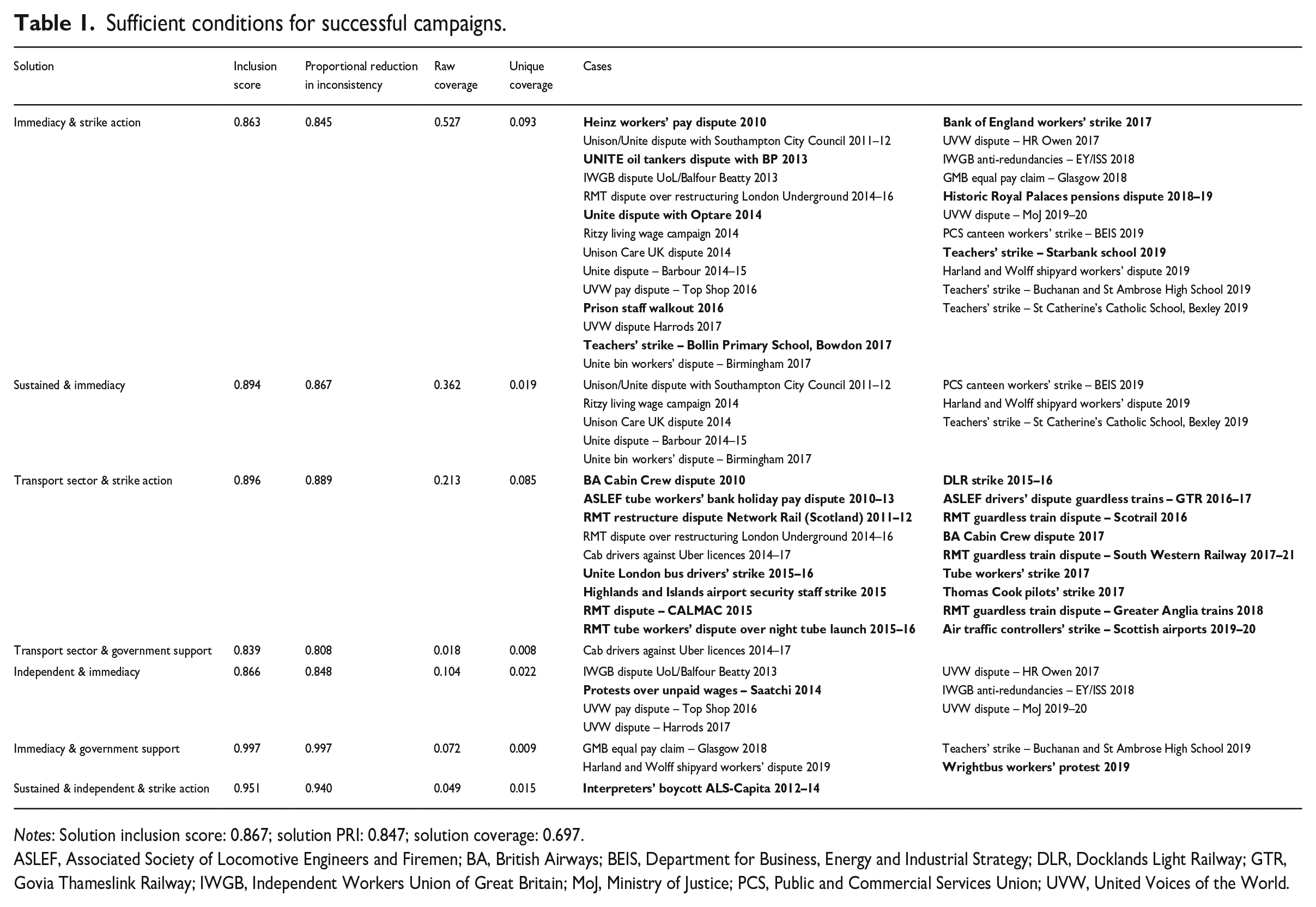
Notes: Solution inclusion score: 0.867; solution PRI: 0.847; solution coverage: 0.697.
ASLEF, Associated Society of Locomotive Engineers and Firemen; BA, British Airways; BEIS, Department for Business, Energy and Industrial Strategy; DLR, Docklands Light Railway; GTR, Govia Thameslink Railway; IWGB, Independent Workers Union of Great Britain; MoJ, Ministry of Justice; PCS, Public and Commercial Services Union; UVW, United Voices of the World.
The solution, as shown in Table 1, has seven different configurations of conditions, or ‘causal recipes’, that were sufficient for the positive outcome (substantial achievements arising from the campaign) to occur. With a solution inclusion score of 0.867, we can see with a very high level of certainty (86.7%) that if any one of these seven configurations of conditions was in place during the 2010–2019 period in the UK, then this would be sufficient for a prominent campaign (i.e. one reported in the national press) to be successful. The solution has a coverage of 0.697, meaning that 69.7% of the positive outcomes are covered (or explained) by the solution.
In terms of interpreting the findings, perhaps most notable is that none of the causal configurations that proved sufficient for campaigns to be successful took the form of national disputes (except for those in the transport sector). This is clearly significant in that it confirms the suspicion that during the ‘age of austerity’ trade unions performed poorly in national disputes. This also clearly highlights the difficult structural conditions faced by organised labour during the ‘austerity’ phase of neoliberalism, and confirms our earlier discussion regarding the significant constraints that workers faced in seeking to mobilise in neoliberal Britain’s ‘age of austerity’.
Also notable is that no single condition by itself was sufficient for success, highlighting again the difficult circumstances faced by workers during this period, and indicating that multiple favourable conditions needed to be in place in order for these to prove sufficient to secure a successful outcome. In order to shed some light on the concrete instances through which success occurred, we can consider each of these seven configurations, or ‘causal recipes’, in turn.
Immediacy and strike action
The combination of two key conditions – ‘immediacy and strike action’ – proved to be the configuration of conditions to secure the most frequent number of positive outcomes, with a raw coverage score of 0.527, meaning 52.7% of the successful outcomes were explained by this configuration. There were 25 cases in the set that fully displayed this causal configuration and resulted in a successful outcome. Put simply, if an industrial dispute was targeted at the local level and focused directly on material goals, and took the form of at least strike action (or action more militant than strike action), this proved sufficient to ensure a successful outcome. Perhaps the most obvious lesson from this is just how much more effective local industrial disputes proved to be when compared with national ones during the period studied. This brings sharply into focus the impact of scale on the efficacy of disputes during the age of austerity in the UK. Thus, as shown in Table 1, disputes targeted at individual firms or organisations were successful on numerous occasions, including Unite’s dispute with Optare, the Ritzy living wage campaign in 2014 and a number of teachers’ strikes at different schools, including Bollin Primary School in Bowdon, Starbank School in Birmingham, Buchanan and St Ambrose High School in Coatbridge and St Catherine’s Catholic School in Bexley. On each occasion, and as can be seen in more detail in the accompanying website, the pressure that could be exerted through local action was sufficient to prompt concessions or a climbdown by the employers, and a resolution to the dispute. To give one example, the Unite workers’ dispute with Optare in 2014 saw workers at the Leeds-based bus and coach manufacturer’s Sherburn facility take two days of strike action over changes to holidays and pay. This therefore represented a dispute with a high degree of immediacy (workers were all based at a single facility, and the dispute focused directly on the shared material interests of working conditions and pay). The two days of strike action were undertaken by around 140 workers in May/June 2014, with the action proving sufficient, especially given the threat of a further two days of strike action, such that in June the dispute was resolved following the offer of a pay rise to compensate for the changed working conditions. Similar outcomes were witnessed in almost all of the campaigns with a high level of immediacy and in which strike action took place, with 25 (83%) of the 30 campaigns that were fully within this configuration of conditions proving successful.
2. Sustained and immediacy
The second causal recipe in our solution – ‘sustained and immediacy’ – refers to those cases that saw campaigns last for a sustained period of time (10 days or more, for those fully within this set of cases) and being highly immediate (both in terms of scale and in terms of material interests), regardless of the type of action that took place. Notably, a campaign being sustained by itself was not sufficient to bring about a successful outcome, requiring the campaign to also have an immediate focus, and thereby highlighting (again) the importance of both local scale and immediate material interests. As Table 1 shows, eight cases were in the set that fully displayed this causal configuration and resulted in a successful outcome. One of these was the Unison/Unite dispute with Southampton City Council between 2011 and 2012. This saw 300 social workers (members of Unison) and another 700 Unite members take 200 days of strike action over contract changes and a pay cut, in opposition to a move to ‘fire-and-rehire’ the staff on worse pay and terms and conditions of employment, before eventually securing a reversal of the contract and the pay changes that had been imposed upon them. As this case illustrates, the combination of a prolonged campaign with a local focus on shared material concerns was sufficient to raise the prominence of the dispute and gain local attention, with the successful reversal of the contract changes eventually secured following local elections in 2011.
3. Transport sector and strike action
Our third causal recipe – ‘transport sector and strike action’ – highlights the success of worker-led campaigns in the transport sector, where more than in any other sector we see successful campaigns being run during this period, confirming that the transport sector represented a ‘choke point’ for the UK economy during this period. Action that took the form of (at least) strike action proved sufficient within the transport sector to secure a successful outcome. This reflects therefore that transport sector workers are relatively strong in terms of their bargaining power vis-a-vis employers, including both government and employers; thus confirming the claim that they benefit from access to ‘choke points’ within the British economy. Eighteen cases were in the set that fully displayed this causal configuration and subsequently resulted in a successful outcome, with 21.3% of the outcome explained by this particular configuration. The disruptive impact of strike action upon the transport sector, and the degree to which this subsequently resulted in pressure being placed upon the employers with whom the dispute was against, clearly had an impact in terms of securing a successful outcome. Several cases illustrate this point. For instance, the Docklands Light Railway (DLR) strike in 2015 saw the workers (RMT members) launch two days of strike action in November 2015 in opposition to the use of agency staff and bullying management practices. Following the failure of the DLR to resolve the dispute, the RMT announced another plan for escalating action of 17 days over January to March 2016, which proved sufficient to result in an offer forthcoming from the DLR management (without any further need for strike action) and which resolved the dispute to the satisfaction of the union. In another instance, the RMT dispute with Greater Anglia trains in 2018, over the attempt to introduce guardless trains, saw 12 days of strike action eventually prompt an agreement with the company guaranteeing the continuation of guards on trains. In sum, of the 22 campaigns that saw (at least) strike action in the transport sector, 18 proved successful.
4. Transport sector and government support
As Table 1 shows, the fourth causal recipe – ‘transport sector and government support’ – includes only one positive case: cab drivers against Uber licences (2014–2017). Here the combination of transport sector workers receiving government support in their campaign resulted in concessions for cab drivers opposing the introduction of Uber licences. While this only relates to one case (in terms of those fully within the set of cases in this configuration), it nevertheless highlights the importance of political power resources (Schmidt et al., 2019). In this particular campaign, cab drivers staged protests over four different days between 2014 and 2016, organised by different organisations, including the Licensed Taxi Drivers’ Association and United Cabbies, RMT and Unite, and including disruptive go-slow protests that blocked the roads in opposition to the Mayor of London’s decision to allow an Uber meter. After some time, in 2017, Transport for London (TfL) ended the licence for Uber, in part as a result of the hostility towards the Uber licence expressed by two consecutive mayors of London, Conservative mayor Boris Johnson and Labour mayor Sadiq Kahn, although in both cases neither mayor went so far as to issue a statement unequivocally supporting the protesting cab drivers.
5. Independent and immediacy
The fifth causal recipe – ‘independent and immediacy’ – is the first (of two) of the configurations including our measure of independent action (which is action conducted by smaller ‘indie’ unions outside of the mainstream Trades Union Congress [TUC] and informed by a commitment to direct action and grassroots member-led campaigning – Independent Workers Union of Great Britain [IWGB], United Voices of the World [UVW], Industrial Workers of the World [IWW] – or otherwise referring to campaigns organised outside of formal trade unions altogether). This success confirms the widespread view that independent unions and/or member-led, direct action and grassroots-oriented campaigns have been more able to adjust to the conditions of neoliberalism and to respond in a more agile way to the difficulties of organising within the contemporary labour market (Però, 2020). The combination of independent organisation and immediacy in terms of material goals and local scale proved sufficient to secure a positive outcome in seven cases. For instance, the UVW dispute with the Ministry of Justice (MoJ) in 2019–2020 saw cleaners and security guards take strike action and stage a number of protests, both against outsourcing (to the contracted firm, OCS) and for parity of conditions with ‘in-house’ staff members. In doing so, they eventually secured a number of substantial achievements, including union recognition and parity on sick pay (albeit without, at the time of writing, achieving parity of pay). Similarly, UVW secured substantial concessions for their members in disputes with both the department store Harrods and a local car dealership, HR Owen. In the case of the Harrods dispute, UVW staged a number of disruptive protests, including blocking doorways outside the department store, in opposition to the company practice of keeping staff tips; a practice that was ended as a result of the UVW action. In the case of the HR Owen dispute, demonstrations and two days of flashmob protests prompted the dealership to agree to pay the living wage to its cleaning staff.
6. Immediacy and government support
The combination of immediacy of the campaign focus (local scale and a direct material interest), plus government support, also proved to be a sufficient combination of conditions to produce a positive outcome, although as Table 1 makes clear only one case fully met each condition and resulted in a successful outcome. This successful case was the Wrightbus workers’ protest in 2019, where protesting workers sought to oppose the closure of the company (and associated job losses), and in doing so were able to gain the attention of the national media, which in turn prompted positive statements of support from Prime Minister Boris Johnson. This proved sufficient to ensure that a buyer for the firm emerged who promised to put in place measures to rescue the firm, eventually resulting in the retention of 700 of the 1200 jobs at risk of redundancy. This case also indicates again the potential for government support to facilitate a successful outcome.
7. Sustained and independent and strike action
The final configuration of conditions sufficient to produce a positive outcome – sustained action by independently organised workers adopting strike action – also saw only one case meet those conditions. This was the case of the interpreters’ boycott of ALS–Capita between 2012 and 2014. This saw up to 1000 interpreters launch a largely self-organised boycott of courts in 2012, amounting to a de facto strike in that they refused to take on the work, in opposition to a privatisation of the contract by the Ministry of Justice, whereby the contract was awarded to ALS at the time that it was purchased by Capita. The boycott was widely upheld and resulted in years of under-performance by ALS–Capita, resulting in fines for the company and eventually a substantial achievement in the form of an increase in the pay rate offered to the interpreters. The combination of independent organising, strike action and a sustained campaign therefore proved sufficient to ensure a successful outcome in this case.
Conclusion
The empirical question of how labour mobilised during the ‘age of austerity’, and with what effect, remains of interest and importance. Exploring this question, the article has presented the key details of almost all prominent campaigns featuring worker-led dissent in the UK between 2010 and 2019, as recorded in a new accompanying website: Contesting the UK’s neoliberal model of capitalism: worker-led dissent (2010–2019). This presents over 150 brief qualitative case studies documenting the conditions that characterised the different types of worker-led dissent that took place during this period, and their resulting outcomes. Using qualitative comparative analysis to compare these different cases, we can identify seven different ‘causal recipes’ or causal configurations, which describe alternative routes that proved sufficient for workers in the UK to successfully secure substantial achievements through their struggles. As the results have shown, national-level disputes did not feature in any of the seven routes that were sufficient to secure successful outcomes, with the important exception of those organising in the transport sector. Indeed, the transport sector – and especially the passenger transport sector – proved an important choke point within the UK economy, witnessing 81.8% of the prominent campaigns that were led by transport workers and included (at least) strike action, proving to be successful. The importance of immediacy – in terms of both immediate local scale and shared immediate material interests – was also consistently displayed in the findings. Local campaigns around shared material interests that included (at least) strike action had a success rate of over 80% and accounted for over half of the set of successful cases. Finally, independently organised workers (workers organised through the new independent ‘indie’ grassroots unions [UVW, IWGB] and self-organised workers outside of trade union structures) also proved able to successfully assert their demands during this period, confirming the commonly held view that such forms of organisation are especially effective under the conditions of neoliberalism.
Returning to our initial theoretical discussion, the findings confirm the view widely held within the literature that the constraints imposed upon workers and trade unions during neoliberal capitalism, and which were consolidated during the post-2008 ‘age of austerity’, have served to make it difficult for successful mobilisation against austerity measures and to advance the interests of workers. The absence of any national route that proved sufficient for success highlights this point; as does the absence of any national route to success within the public sector, in part reflecting the impact that outsourcing and austerity have had upon public sector trade unions’ capacity for mobilisation during the course of neoliberalisation. Nevertheless, the increasingly decentralised and fragmented collective bargaining systems of the UK have also displayed a susceptibility to workers who are able to mobilise at a local scale, indicating that the absence of national-level mobilisation does not preclude alternatives emerging at a more local scale.
Further, the success with which the ‘indie’ unions were able to mobilise also indicates a susceptibility, on the part of those firms employing precarious labour within neoliberalised labour markets, to the more direct action-type tactics of newer and more grassroots-focused independent unions. It should be noted, however, that there remains the potential for independent unions to become bureaucratised in the future, including through the ‘bureaucratisation of the rank-and-file’, as ‘indie’ unions face the same pressures and contradictions that trade unions invariably face in seeking to organise workers within capitalism (Hyman, 1979: 58). Indeed, trade unions experience contradictory pressures both towards bureaucratisation (as formal organisations requiring a bureaucratic structure) and to adopt a more ‘social movement’ (or ‘rank-and-file’) style of campaigning (as part of an effort to remain mobilised and in close connection with the active demands of workers in the workplace). The challenge that faces ‘indie’ unions is therefore an ongoing one of seeking to retain momentum, mobilisation and growth, while at the same time avoiding bureaucratisation. This is an ongoing tension and dilemma. As Hyman put it, this reflects a ‘radical dualism within trade union practice’ – ‘between autonomy and incorporation (and hence in unions’ role as an agency of power for workers or power over them)’ (p. 60).
Finally, the capacity for transport sector-based workers to successfully pursue their goals also highlights the ongoing presence of structural leverage for certain groups of workers, especially in the transport sector; although it remains to be seen whether new policies or legislation will be introduced to seek to limit this bargaining power.
In terms of avenues for further research, it should be kept in mind that the present study only focuses on the most prominent worker-led disputes of the 2010s, with prominence measured in terms of whether the campaign received national press coverage in either of two national newspapers and their Sunday equivalents (The Guardian, The Times, The Observer, The Sunday Times). This has the potential to create a set of findings that are only applicable to those disputes that have first gained national prominence. This could affect the type of findings reported, meaning that disputes with less national prominence might see different configurations of conditions being associated with successful outcomes.
As the study has shown, while there is a widespread view that labour and workers have been rendered far less able to mobilise and assert their interests under neoliberalism, and especially during its austerity phase, nevertheless the capacity for dissent and resistance remains considerable under specific circumstances, even in especially neoliberalised contexts such as that of the UK. The use of fine-grained analysis of individual acts of dissent and contestation, compared systematically using the method of QCA, enables us to uncover qualitatively the combination of conditions that have resulted in successful outcomes during this period, enabling a more detailed insight into the ways in which labour has successfully challenged neoliberal capitalism at a time when it has become increasingly constrained in its capacity to do so. As the onset of the pandemic in early 2020 potentially marked the arrival of a changed socio-economic context with a new set of constraints and opportunities, the need to understand and identify the changing conditions for successful contestation and resistance has become more urgent still.
Supplemental Material
sj-pdf-1-wes-10.1177_09500170231169675 – Supplemental material for Worker-Led Dissent in the Age of Austerity: Comparing the Conditions of Success
Supplemental material, sj-pdf-1-wes-10.1177_09500170231169675 for Worker-Led Dissent in the Age of Austerity: Comparing the Conditions of Success by David J Bailey in Work, Employment and Society
Footnotes
Acknowledgements
Earlier versions of this article were presented at the European Sociological Association conference (2021), the British Universities Industrial Relations Association (BUIRA) conference (2021 and 2022), the Alternative Futures and Popular Protest conference (2022) and the Planetary Emergency and the Politics of Resistance workshop in Queen’s University Belfast (2022). I’m grateful for all comments from the participants of those events. The article benefited from comments and suggestions from Damian McIlroy, Alex Wood, Paul Lewis, Andy Hodder and Oscar Berglund. The two anonymous reviewers provided very helpful suggestions, which allowed me to improve upon earlier drafts, and I’m grateful for the editorial guidance of Knut Laaser.
Funding
The author received no financial support for the research, authorship, and/or publication of this article.

Supplementary material
The supplementary material is available online with the article.
Notes
References
Supplementary Material
Please find the following supplemental material available below.
For Open Access articles published under a Creative Commons License, all supplemental material carries the same license as the article it is associated with.
For non-Open Access articles published, all supplemental material carries a non-exclusive license, and permission requests for re-use of supplemental material or any part of supplemental material shall be sent directly to the copyright owner as specified in the copyright notice associated with the article.
