




Abstract
Forging solidarity among seemingly privileged white-collar professionals has been seen as a challenging process. However, many banking employees in Pakistan feel marginalized and lack formal collective mechanisms to voice their concerns, leading some to participate in social-media groups. Drawing on various discussions linked to labour process perspectives, we examine how these banking employees use social media as a means to create broader and diverse collective bonds within their profession and build bridges to their counterparts in other organizations within the sector. By doing so, we reveal that employees post on social media to express and affirm their concerns, offer broader support with one another, ‘cope’ with existing circumstances, highlight their unrewarded professionalism, and share relevant information around collective issues and experiences and not solely to critique their work environment. The article draws on and contributes to new debates on collectivism and solidarity, revealing the opportunities for actions on social media.
Introduction
Some core aspects of research on labour solidarity – and collectivism – often focus on the conditions that make it more difficult for employees to create bonds (Morgan and Pulignano, 2020), highlighting how out-sourcing, off-shoring, the ‘gig economy’, government policies, as well as the growth of temporary and agency employment, render work relations more individualized (Bolton and Laaser, 2020; Tassinari and Maccarrone, 2020; Visser, 2017). Moreover, research on the process of forging solidarity among workers in these atomizing conditions typically examines workers in developed economies (Bolton and Laaser, 2020; Thomas and Tufts, 2020). The focus of research on workers in emerging economies tends to be on labour standards in global labour supply chains and manufacturing. Consequently, relatively little attention has focused on how worker solidarity develops among professionals in emerging economies, such as banking employees in Pakistan.
At first sight, such workers are among a minority of workers who are part of Pakistan’s formal economy, meaning that they have contracts, are paid regularly and have certain employment rights (Cho and Majoka, 2020; Saqib et al., 2022). However, such workers can, as in developed economies, feel marginalized by employment practices that stem from the nature of labour relations, their work process and associated national regulations. For instance, many Pakistani banks were privatized in the early 1990s, and labour unions, which used to be very powerful, have become all but defunct (Munir and Naqvi, 2017). At the national level, trade unions have a very limited role in shaping employment conditions, with only 6.3% of the workforce unionized and collective agreements covering just 2.2% of workers (Ahmad and Allen, 2015). In addition, the 2010 Industrial Relations Act prevents unions from having any significant role in employees’ retention, suspension, or dismissal (Jhatial et al., 2014). Moreover, formal companies in Pakistan do not always ensure that their employment practices adhere to the principles of their human resource management policies, which supposedly follow the ‘best HR practices’ prevalent in Western companies (Khilji, 2003; Saqib et al., 2022), resulting in appraisal systems that downplay accomplishments and bonus schemes that favour seniority over contribution (Saqib et al., 2022). More generally, the distinction between manual and non-manual workers is becoming less clear in many countries (Pérez-Ahumada, 2017), meaning that the treatment of bank employees may not differ significantly from that of informally employed manual workers.
The labour process, with its associated practices of de-skilling, has also resulted in a ‘core’ and a ‘periphery’ set of employees. In banking, the latter consists of branch employees who have customer-facing roles. Although they are ‘white-collar workers’ and are graduates (often from lower ranked universities), they have limited promotional prospects and their experiences of work are likely to be akin to those of traditional ‘blue-collar’ employees (Pérez-Ahumada, 2017). The unemployment rate for this group is relatively high and, thus, these employees work extra hours in an intensely pressured environment, with many being paid close to the minimum wage (Ali, 2012; Chaudhry and Khan, 2020). Moreover, although the banking sector is growing with a focus on expanding branch networks and is highly profitable, including during the pandemic period, strategies to increase automation and grow the number of customers have often developed with very little discussion of how these changes will affect employees (KPMG, 2021). Partly because of their marginalization, some bank employees are becoming increasingly vocal on social-media platforms to protest against increased working hours (Ali, 2022). The online group we focus on mostly posts on issues related to work in bank branches.
The concept of ‘solidarity’ is sometimes seen as a type of pre-condition for collective action by workers within specific organizations and more broadly within sectors or economies (Fantasia, 1988). Understanding better how workers express solidarity with one another and how that can form the basis for collective action is, therefore, of fundamental importance to assessing workers’ prospects in Pakistan, a country in which most workers have few if any rights (Cho and Majoka, 2020).
Moreover, it should not be forgotten that, in other contexts, employees’ use of social media can have negative consequences for them. For instance, existing research often highlights the detrimental effects for employees who engage with social media, especially if it affects their employer’s reputation (Richards, 2012; Schoneboom, 2011a; Thompson et al., 2020). Indeed, several studies note the deleterious outcomes for employees of their social-media engagement (Holland et al., 2016), revealing organizations’ propensity to discipline or curtail their employees’ opinions, especially those aired to external audiences. Employers often use social media to vet, profile and stereotype (potential) employees (Jeske and Shultz, 2016; McDonald et al., 2016; Thompson et al., 2020). In the context of Pakistan’s high unemployment rate among graduates (Chaudhry and Khan, 2020), banking employees’ posts on social media that are slightly critical of employers could be seen as an act of dissent.
By conceptualizing social media primarily as platforms for outright dissent or opposition, existing research tends to overlook employees’ broader and complex uses of social media (Sayers and Fachira, 2015; Thompson et al., 2020), potentially misconstruing the implications of informal voice mechanisms for worker solidarity and its potential to facilitate collective action. Furthermore, the literature on this form of ‘unsanctioned’ employee voice (i.e. voice mechanisms that are not controlled by management or unions), as well as social-media interactions in general, including more diverse uses of social media, remains relatively undertheorized with scholars calling for more empirical analysis on this phenomenon (Holland et al., 2016; Richards, 2012; Walker, 2020).
Our research aims to understand (1) employees’ diverse uses of social media, and (2) how those uses, potentially, represent nuanced forms of solidarity that often rely on subtle forms of dissent, especially when traditional channels of collectivism and voice might be limited (Kwon et al., 2016; Martin et al., 2015; Walker, 2020). We examine how an online community of banking employees in Pakistan emerges as a platform for developing solidaristic forms of behaviour and action. Using non-participant netnography to answer our two related research questions (Orsolini et al., 2015), we asked: how does an online group serve employees’ manifold needs, and how do the group’s activities influence the formation of a sense of labour solidarity? We argue that the tensions within the working relations and hierarchies of banking encourage bank employees to use social media to legitimate and sustain a space for different forms of solidarity, ranging from expressions of discontent to attempts to undertake collective action. By studying a banking group’s various activities on a large social-media group, we demonstrate how this community shapes and contributes to the solidarity of the group’s employee members who generally lack alternative means and mechanisms to create solidarity, especially in the wake of increasing challenges to union functions and managerialist tools of employee voice in developing-economy settings.
The article, therefore, contributes to debates on collectivism and solidarity by engaging with a set of workers in a developing economic context who are normally rarely studied and by discussing broader questions of identity and workplace dignity: it builds on Stephenson and Stewart’s (2001) notion of the ‘solidarity of everyday life’. Although the actual impact of the group’s activities on regulations and working conditions is more indirect, which partly reflects the limited power of workers and their representation in the industrial relations system, our research indicates a need to extend our views on how labour solidarity forms as well as the purpose of worker-led initiatives (Jiang and Korczynski, 2021; Thomas and Tufts, 2020).
The remainder of this article has five sections. First, we discuss the existing literature on employees’ use of social media. The second section sets out our methodology and analytical techniques. The third section presents our findings, highlighting employees’ many and various uses of social media. The final sections conclude, discussing our findings and their practical implications, and setting out directions for future research.
Solidarity on social media: A closer look at the broader
social
spaces of workers
The term social media refers to an online platform where users sign up to create profiles and build a list of connections to share different aspects of their lives (Leonardi and Vaast, 2017). These can sometimes coalesce and develop into groups where the users create and share content, including, potentially, expressions of dissatisfaction with some aspects of their work (Cohen and Richards, 2015; Richards, 2012). Facebook, Twitter and Instagram are the most popular platforms (Kaplan and Haenlein, 2010).
Both formal direct (management-controlled) and formal indirect (union-facilitated) and informal direct (interactions between workers and management) voice and participation are increasingly taking place through internet technologies, such as intranets, blogs and social-media platforms (Cohen and Richards, 2015; Martin et al., 2015; Tassinari and Maccarrone, 2020). There is evidence of employees’ widespread use of firm-administered social-media pages (Estell et al., 2021); however, employees tend not to express grievances or share opinions that are critical of their employer on these pages to avoid any potentially detrimental consequences (Holland et al., 2019; Leonardi and Vaast, 2017; Walker, 2020; cf. Estell et al., 2021). Similarly, research has also examined unions’ use of social media (formal indirect mechanisms) (Barnes et al., 2019; Martínez Lucio and Walker, 2005; Tassinari and Maccarrone, 2020).
Consequently, much of the existing research on employees’ use of social media has focused on (1) how organizations/managers facilitate and encourage employees to voice their opinions to attempt to achieve a strategic or management objective (Holland et al., 2019; Wilkinson et al., 2018), and/or (2) how unions broaden voice mechanisms to enhance their exchanges with their members (Barnes et al., 2019; Hodder and Houghton, 2020). This research indicates that social media, as voice conduits, are becoming increasingly important to understand the wider debates on voice (Conway et al., 2019; Thompson et al., 2020), with unmanaged and unmonitored employee voice through social media receiving attention in the literature only recently (Walker, 2020). In addition, how this mechanism leads to solidarity, voice and collectivism needs further research, especially in developing country settings (El Ouirdi et al., 2015; Walker, 2020). However, by often examining employees’ use of social media from a voice perspective, the literature is seemingly locked in to a binary or ‘step-like’ approach to formal actors and informal processes (and is still framed by early pioneering work on questions of voice (Marchington and Suter, 2013)); yet, increasingly, the developing ways in which employees use social media challenge this binary approach.
For instance, existing research largely neglects how workers use independent employee-led, social-media mechanisms (Leonardi and Vaast, 2017; Richards, 2008), suggesting that we need to widen the scope of research (Geelan, 2021; Greene et al., 2003; Hogan et al., 2010). This is especially important when a substantial and growing proportion of worker interactivity and support occurs within broader informal networks and on the margins of trade unions. Therefore, the limited scholarship on informal employee interactions, especially those on social media (Kwon et al., 2016; Marchington and Suter, 2013; Miles and Mangold, 2014), requires an assessment of how employees use social media for social, or solidaristic, purposes. There is, then, a need to link broader discussions on aspects of solidarity and collectivism(s) to the conditions that shape their emergence and social forms (McBride and Martínez Lucio, 2011; Stephenson and Stewart, 2001).
Putnam (2001), Morgan and Pulignano (2020: 20) define solidarity ‘as a set of bridging and bonding processes which are embedded in moral discourses, political coalitions and social performances’. Bonding refers to the commonalities within members of a group that provides the basis for collective action; bridging denotes the ability to link to other groups that share some, but not necessarily many, characteristics (Morgan and Pulignano, 2020). These two processes exist in some degree of tension: the greater the bonding there is within a group, the more difficult it may be to bridge to other groups, as intra-group similarities are emphasized that may identify and stress the differences to other groups (Banting and Kymlicka, 2017; Morgan and Pulignano, 2020; Putnam, 2001).
Indeed, ‘bonds’ and ‘bridges’ are not entities that exist in their own right (Anderson, 2006), but are socially constructed, as are the solidarities that emerge from them (Morgan and Pulignano, 2020). While bonding among workers within the same employer may, typically, be easier because of shared, collective experiences and physical spaces (Tassinari and Maccarrone, 2020), in workplaces, such as many bank branches in Pakistan that lack mechanisms that facilitate worker interactions and whose reward systems emphasize individual achievements, bonding may be more difficult (Saqib et al., 2022). In such a context, bonding is likely to require, as bridging does (Morgan and Pulignano, 2020), common discourses and networks to emerge and endure.
Groups on social media can generate stories, exchange pertinent information, be humorous, provide informal knowledge through gossip, and affirm their professional and personal identities. Hence, such groups enable workers to sustain themselves with physical as well as symbolic support, and, thereby, generate a sense of solidarity that also manages to create a sense of collective identity, purpose and recognition in work and life (Kaplan and Haenlein, 2010; McBride and Martínez Lucio, 2011; Stephenson and Stewart, 2001).
Thus, by examining employees’ use of social media, which employers individually or collectively do not directly govern, we record the many ‘unheard’ voices that may be echoing here, and whose contributions are not outright expressions of grievances and dissent (Holland et al., 2019; Thompson et al., 2020; Wilkinson et al., 2018), creating, potentially, a solidaristic space. This examination is especially required for developing economies where other mechanisms to facilitate and support solidarity are likely to be weaker (Kwon et al., 2016; Saqib et al., 2022). What is more, while not a formal actor, such social media-based communities are visible among more formal actors in the regulatory space of employment (Hodder and Houghton, 2020). Regulation consists of a range of actors, such as employers, unions, state agencies and social movements, who negotiate and/or influence a set of working conditions and often compete with each other for the lead in establishing such conditions. Their function is often to influence agendas indirectly and to heighten concerns within more formal actors, and occasionally do so in a more consistent and often inclusive manner than, say, one-off protests or mobilizations (ensuring formal negotiation agendas are aware of ongoing concerns). To that extent, it forces us to think of representation and communication as not just being a range of formal actors with different forms of participation within definable spaces – across a continuum of direct to indirect participation – but also as consisting of informal sets of actors within the communications fields themselves (Marchington and Suter, 2013; Martin et al., 2015; Van Zoonen et al., 2016).
Research design
We analysed the content of posts to a bankers’ group on a popular, readily available, free social-media platform. The group has almost 105,000 members (as of September 2020), mostly Pakistani bank employees. Some students, prospective employees and academics are also part of the group. The page is a ‘public’ group and as part of the platform’s terms of service, posts on the group are public information, shareable and visible. The platform allows unlimited options of sharing textual posts, pictures and short videos with other members (and non-members in the case of public groups). The group has been active since late 2014.
Online data, especially data generated through social-media sites, provide longitudinal data and textual sources from diverse points of view. These interactions are fluid, representing employees’ actual feelings, ideas and words when they post material (Platanou et al., 2018; Vaast, 2020). The social-media site allows researchers not just to collect visual and textual data, but also to understand the reactions of posts and their popularity through shares, emoticons and comments (El Ouirdi et al., 2015).
The methodology we adopted is a variant of ‘netnography’ (Kozinets, 2015), which is the study of human interactions, cultures and social spaces in online fora. In one form, netnography is akin to an ethnography that entails participant involvement. We use non-participant netnography, enabling us to observe the group in a naturalistic and unobtrusive way (Orsolini et al., 2015). Orsolini et al.’s (2015) protocol of non-participant netnographic research guided our research. For this study, we did not engage in discussions either through private messages with the members of the group or through public posts in this period. We were mindful of the ethical implications of the research and therefore went beyond the accepted convention of research on public posts as we do not identify the platform or the name of the group, nor did we collect or store publicly available personal data about the members of the group (Franz et al., 2019; Mason and Singh, 2022). We paraphrased most of the posts to add an extra layer of anonymity. In addition, none of the quotations comes under the purview of ‘intimate publics’ (Ravn et al., 2020). As the social-media group is open to all, including managers in banks, and as many of the group members are likely to use their real names, we recognize that this may reduce the scale and scope of members’ posts that are critical of their employers or the industry more generally. Despite this, there are critical posts on the forum, and sometimes members use humour or other means to express their ideas in less directly critical ways.
This article analyses the forum’s posts between 2015 and 2020. It forms part of a larger research project investigating employee perceptions of HR and human-capital resource allocation in Pakistan’s banking sector. Contributors engage in the forum through posts, comprised of status updates, pictures, videos, memes and photographs, as well as through comments, which are sometimes made in response to others’ comments. The analysis of textual or narrative content largely underpins the literature on online communities (Sayers and Fachira, 2015; Schoneboom, 2011b). We go beyond this, by examining visual data as well, and enabling us to deepen our analysis (Cohen and Richards, 2015; Emmel and Clark, 2011).
We organized the data into three categories: pictures/memes, videos and textual posts. For pictures/memes and videos, we went through the database for the last five years, categorizing them around themes. We based our analysis on a sample of approximately 1000 pictures and memes, and about 50 videos. We downloaded samples of pictures and memes as well as links to videos. This is because there were multiple images and videos conforming to some common themes. For example, the humour behind being underpaid and overworked had several similar posts. We have attempted to draw on a wider frame of representations and images in terms of the use of social media and not just the language and terminology as outlined in other similar studies, such as Conway et al. (2019).
For written posts, we extracted sample posts using a keyword search, as the social-media site enables textual searches within the group page. Thus, we did not compile a database of posts, as this content was easily searchable. We used several keywords to find relevant posts, such as salary, training, recruitment, promotion, grievance, holidays, management, bosses. We approximate that we went through 10,000 of these written posts as the project progressed. Later, in an additional step, we also looked at the textual posts randomly to minimize researcher bias. This step led us to realize that the activity by group members may have focused on issues outside our four themes that were more relevant at particular times. For example, COVID-related posts increased significantly over 2020, yet members’ posts generally remained related to the four themes we identify. It should be emphasized that we did not evaluate the relative importance of the themes based on the number of comments or posts on any particular subject. Rather, our objective was to identify the themes that illustrate the uses of the platform and to draw out some of their assumptions. Thus, the proportion of posts linked to the themes we identified varied, and the substantive content fitted into the four themes we identified (seeking and sharing information, coping with stress and anxiety, affirming their professional and personal identity, and organizing around collective issues). As we discuss in more detail below, these themes can help to create and sustain a sense of solidarity among group members.
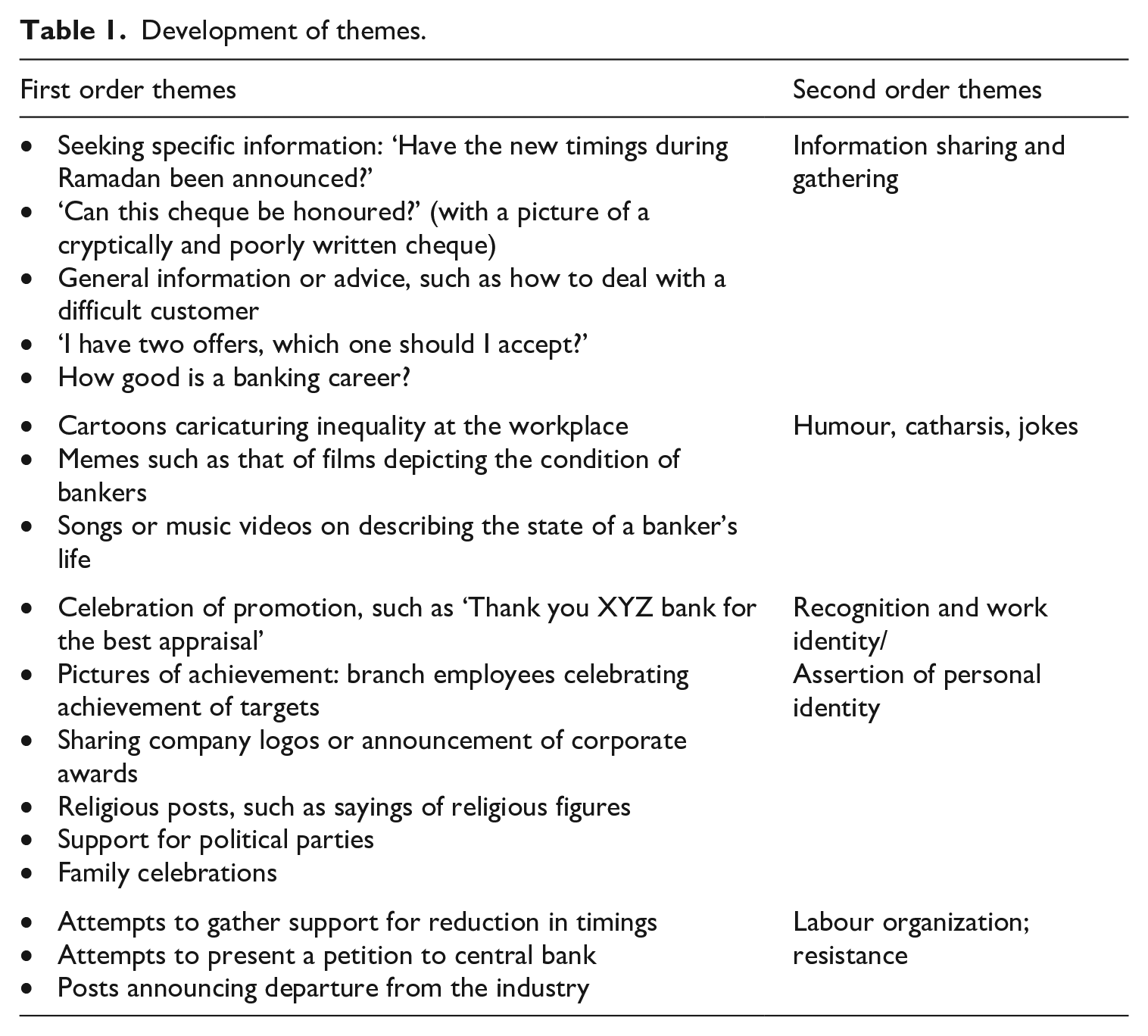
In addition, we opted to manually code the data instead of using automated tools that can tend to cluster categories around the literal meaning of words, whereas we were interested in unpicking and examining nuances behind the posts (Albalawi et al., 2020; Canhoto and Padmanabhan, 2015). For example, a verse on the flight of birds implies a longing for freedom, and posts such as these had to be interpreted beyond their literal meaning. We note that, although the content of posts changed slightly with the onset of the pandemic, we reached the saturation of themes in the first three years’ worth of data. We conducted a template analysis of the themes (King, 2012). Although thematic analysis is a popular method for analysing verbal data, the use of this method is also useful for visual thematic analysis (VTA) (Braun and Clarke, 2006; Walters, 2016). Template analysis is a flexible technique that allows for the interplay of induction and deduction. After an initial review of all the content, one of the authors developed draft themes, which all of the authors then refined during discussions. Table 1 shows the development of our themes.
Development of themes.
Findings: The diverse uses of social media as a space for broader forms of solidarity
Our themes revolve around the focal group’s broader uses of social media. In this case, we focus on four of these: seeking and sharing information, coping with stress and anxiety, affirming their professional and personal identity, and organizing around collective issues.
Seeking and sharing information: Social media as a means of support and site of moral discourse
These posts related to members seeking information on dealing with customers, or specific mechanisms, such as technical information on particular activities, including opening bank accounts. Such an engagement in these communities is important for employees to gather information when their employer’s formal mechanisms are insufficient (Richards, 2012). During March/April each year, posts increasingly mentioned the expected announcement of appraisal results. Furthermore, posts commented on the sharing of bonuses and increment figures. Both are interesting to note as bankers feel they can obtain this information from other forum members (at times from colleagues in the same bank) rather than calling and asking HR or their line managers; this suggests, for practical or identity reasons, a solidarity among workers in similar situations. In some posts, members asked for advice before switching jobs and information on expected salary levels, indicating anticipated support from, and solidarity with, the group.
These interactions between workers within this group illustrate how members share information with, and draw strength from, each other through the process of ‘bonding’ and ‘bridging’ (Putnam, 2001), highlighting the commonalities within and across different workplaces for bank employees, and using the information they gain to make decisions about their future in terms of employment and salary. These posts illustrate how morality underpins some of the members’ actions. Morality stems from a wider normative view of society that itself rests on notions of ‘us’ and those who differ from ‘us’ (Atzeni, 2009; Morgan and Pulignano, 2020; Visser, 2017). That view itself relies on norms about how groups interact with one another. Although individuals who request information about expected salary levels are doing so, in part, for their own private gain (in the form, potentially, of a higher starting salary), there is also likely to be a normative dimension to the request, as knowledge about salaries in other banks may help to ensure comparable or equitable pay within and across different banks.
The request for information on expected salary levels also reveals a ‘them’ (banks) and ‘us’ (fellow bank employees) view of the employment relationships. It reflects the nature of the sector’s labour process and assumes that employers will seek to minimize salaries if possible. In addition, those who respond are unlikely to gain directly from providing the information, indicating that they have less of an individual ‘cost/benefit’ rationale for answering queries, and suggesting that helping others in their group is the ‘right’ thing to do, which reveals a normative perspective and mutual commitment (Morgan and Pulignano, 2020; Visser, 2017).
The discussion of work targets is very common on the forum. Bankers face increasing pressure to sell newly launched products, such as banking insurance or car loans. One such post enquired, ‘Is it legal to stop one’s salary if one doesn’t meet his or her targets?’. Another early career banker asked through a post, ‘What is the maximum time period for a contractual employee to become a permanent employee of the bank?’. Some responses criticized the initial request, highlighting a view that the question was very naïve and ‘silly’, as no one knows the answer, and suggesting a lack of solidarity with some employees; however, other posts were more collegiate and provided information on vacancies and career opportunities. These collegiate posts indicate a mutual commitment, a desire to help others in the group to find a permanent or better job (Stjernø, 2004). Hence, by being collegiate, these workers demonstrate a form of ‘strong solidarity’ (Morgan and Pulignano, 2020), which may be greatest among small groups with high levels of shared workplace and community conditions.
Coping with stress and anxiety
Some pictures, posts and memes seem to serve as a coping mechanism from work-based stress and anxiety (Sayers and Fachira, 2015). They relate to themes that draw on an implicit or explicit moral discourse that highlights workplace unfairness and the lack of an equitable distribution of rewards. For example, a post near appraisal time showed a picture of a huge tank of water flowing with a large pipe. Next to the tank were men of different sizes. The size of each man was in proportion to his rank in the bank’s hierarchy. The picture shows all the employees with their mouths open to drink the water. The senior managers and the branch managers receive the biggest share of the water, with the branch and lower-level employees gaining only a few drops or nothing. The person who posted the image assumes that those who view it will recognize the ‘them’ and ‘us’ situation in it, with members of the group identifying with the lower-level employees in the image and apprehending the inherent injustice in the distribution of water. Thus, members of the group demonstrate mutual understandings and shared subjective perceptions of injustice (Atzeni, 2009).
One video depicts one employee’s frustration and angst. The video clip, taken from a Bollywood film, shows the protagonist expressing his frustration at failing in a particular endeavour. He appears to be a rock-star who can be seen trashing a hotel room with his guitar, with dramatic music playing in the background and the caption: ‘When the balance is out after closing of accounts’. These posts make light of important issues facing employees that management may not properly understand. For example, the ‘balance being out’ in the last example equates to hours of extra unpaid work until the omission is found and corrected at the end of the day before the accounts are closed. Again, such posts rely on other group members sharing similar experiences and having a collective understanding that has resonance, and acts as a mechanism to bond with, and bridge to, other employees.
These posts also refer to, or depict, difficult working conditions. The online group, or community, also seems to serve as a vessel for ‘verbal resistance’ (Walker, 2020). These posts are more common after a banker has tendered his or her resignation (Cohen and Richards, 2015). Another post showed a picture of a resignation with only a couplet in Urdu, ‘There is no use of a means of livelihood that stifles one’s flight’ – referring to the prevalent feeling among bankers that their jobs, which are their only means of making a living, restrict their lives. Such posts also reveal the antagonisms between employers – who seek to control workers to increase profits, and employees – who need paid work, that are inherent within the labour process.
Other posts highlight how to deal with difficult customers through humour and storytelling (Sayers and Fachira, 2015). One such post asks, ‘Why does the customer think that bankers are their batman [a local term for domestic help]? Is it due to education or something else?’ This post elicited a long discussion, with some people blaming the top management, the high level of competition in the banking sector, and one person saying with resignation that this has become part of one’s job description now. Hence, employees use storytelling, general gossip about the industry and humour as means to cope with work-related stresses and to collectivize or share their experiences so others understand they are not isolated in their negative experiences of work (Sayers and Fachira, 2015).
Professional and personal identity affirmation: Social media as a means to personalize contributions to the collective
The forum also features pictures of members in their offices or with awards indicating identity-affirming posts or expressions of pride in their achievements (Richards, 2012). These are in the form of blog posts announcing promotions, screen shots of promotion or offer letters, and even as pictures of late-night sittings or pictures of a busy bank branch. One picture showed a branch officer displaying new mobile phones that they received for achieving their targets. Others showed pride or identification with the organization. One post was of an automated teller machine (ATM) with mountains in the background and the caption, ‘The highest ATM in Pakistan’ with the emoticon of feeling proud, suggesting satisfaction with, and participation in, the bank’s achievement. These posts are often of a more personal nature and echo an aspect of some work on solidarity that emphasizes how an individual becomes a person by the relationships that he or she has with others (Stjernø, 2011). Social-media platforms may enable individuals to convey their personal achievements to others. It is also important to remember that employees can hold positive identities of themselves even if the work they conduct is not affirming and is not fulfilling (Miscenko and Day, 2016).
As the Government of Pakistan announced a nationwide lockdown due to the coronavirus outbreak in April 2020, several posts illustrated some bankers’ assertions of personal identity. The Government deemed banks an essential service, allowing them to remain open during the height of the coronavirus pandemic (Raza and Junaidi, 2020). One of the posts during this time read: ‘We are serving in the front lines just as doctors, nurses and soldiers. Proud to be a banker.’ Other contributions on the page showed branches declaring their discretionary efforts, such as placing chairs at a distance from one another to ensure social distancing, to keep staff and customers safe.
The extreme demands of some occupations and challenging work makes employees engage in extreme segmentation of their personal and professional identity. Thus, the forum also serves as a mechanism of finding a negotiated balance between two identities (Kreiner et al., 2006). We found several posts asserting a personal or non-work identity and those seeking recognition outside their professional duties. There were posts about personal achievements as well. For example, there was a picture of a trophy where one member was announcing his son’s exam results. These suggest that the space for engaging on such matters within the workplace itself was limited and that managers were not interested in such matters, forcing the workforce to reconstruct its mutual recognition based on the value of what they do.
Labour organization/resistance: Social-media contributions as social performances in virtual space
The broader social processes above set the basis for the dissatisfaction that is felt on more ‘traditional’ worker representation issues. The privatization of many Pakistani banks in the mid-1990s drastically curtailed key aspects of union activity, including membership and collective bargaining (Jaffry et al., 2008). There is evidence from this forum that some contributors were trying to turn it into a virtual union (Barnes et al., 2019; Martínez Lucio and Walker, 2005), addressing issues that unions may have dealt with previously. For instance, group members tried to organize a petition to the Supreme Court of Pakistan as well as the State Bank, Pakistan’s central bank, to address the issue of late sittings in banks. The following post on this issue is emblematic and suggests an attempt to perform as a group an activity (commenting and re-tweeting) that expressed the views of the workers collectively in a broad sense:
In order to boost ongoing efforts against extended bank timings everyone is requested to please start using #reducebanktiming in comments below and while making any comment/tweet related to bank timings in any forum. Let’s make it top trend #reducebanktiming. Good Luck Everyone.
In this case, these attempts to reduce working hours did not derive from an initiative by a (formal) trade union; they were, instead, started and maintained by a disparate group of employees who were undertaking ad hoc efforts to provide a collective response.
Another post showed a picture of an open letter addressed to the Prime Minister that described how bankers routinely worked late because the customer interface is non-stop and most bankers cannot complete their work during regular working hours, leading to higher stress levels. As an example of a social performance in a virtual space, this post was one of the group’s most ‘shared’, suggesting that it resonated with others and captured a shared experience. Similarly, another post started a discussion with numerous group members posting responses to the question: ‘Banks [sic] timing issues and [employees] working on holidays also . . . what’s the solution?’.
Relatedly, in the 2020 COVID crisis, when banks remained open, there were several ‘protest posts’ regarding the lack of protective gear and equipment as well as calls for an additional basic salary because of the hardship bankers were facing. One video, which made several rounds in the forum, included a piece of sentimental music with four children wearing surgical masks holding placards and declaring slogans such as: ‘My father is a banker. He is human and he is at risk for catching COVID-19.’ However, we find relatively less evidence for this theme as most of these initiatives seemed short-lived and did not sustain themselves: nevertheless, the void left by a declining trade union influence was picked up by these broader network interventions even if they were mainly symbolic.
Discussion
Based on the findings, we argue that this online social-media community is not just a simple conduit of venting grievances and expressing dismay in isolation, as the existing literature often highlights (for a critique see Thompson et al., 2020). This informal, indirect mechanism operates at different levels and facilitates a general sense of solidarity among employees; expressed in various forms from shared perceived injustices to collective, norms-based support through to attempts at social performances. We found that this social-media-based collective served as an information-sharing platform, a coping mechanism, a platform to express work and personal identities and, potentially, a vehicle for labour organization and resistance albeit, at the time of writing, in less formal terms. Whether this sense of shared experiences and sense of solidarity evolves into a more offensive or transformative, as opposed to a defensive and narrow, set of demands and expectations may depend on other factors, such as broader political and organizational factors (see Thompson, 1990 for a discussion of such differences). It may also depend on the way the labour process of their work and class structures continue to evolve and generate more common points of reference, and erode traditional class distinctions, as has been seen elsewhere in the banking sector, such as Chile, where bank workers who would have once viewed themselves as ‘middle class’ have increasingly been less negative about being identified as a ‘worker’ (Pérez-Ahumada, 2017).
However, at the same time, this platform, ‘unmanaged’ by either unions or firms, exhibits an inherent dynamic, changing from being merely a coping and information-sharing platform to a space where a form of ‘collective’ identity is expressed (potentially creating some form of sustainable support for collective labour activity). In this way, coping, mutual support and recognition strategies among workers potentially constitute broader and innovative forms of collectivism and solidarity; they are important social aspects of the way banking employees enact different aspects of collectivism (Geelan, 2021; McBride and Martínez Lucio, 2011), strategies that are more social and indirect on occasions, but which can consist of formal and informal approaches based on the ‘social collectivism of everyday life’ (Stephenson and Stewart, 2001).
Therefore, as the complexity of the functions performed by such social-media communities develops, the more powerful or effective a platform for solidarity they can potentially become in terms of their impact. Figure 1 depicts the growing complexity of functions the social-media community performs. While some could argue that such developments do not represent a strong form of embedded collectivism seen in other indirect voice mechanisms (Conway et al., 2019: 152), we contend that by widening our understanding of collectivism and mutual worker support or solidarity, the value of such social-media activities can be noted more clearly across a wider range of activities from more functional coping mechanisms and learning to broader questions of appreciating shared experiences and mutual understanding as defined through a range of independent social communications, even if the effects of these are more subtle and discrete than the usual encounters of formal wage bargaining or employee representation.
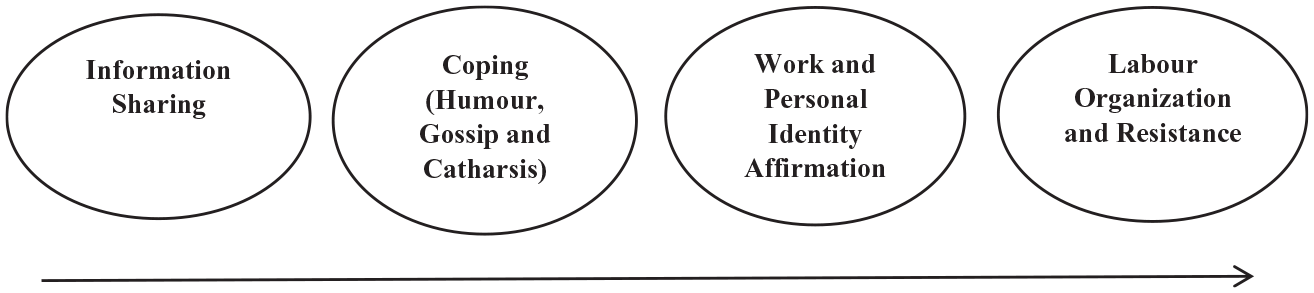
Growing complexity of functions performed by the social-media community.
Our study suggests that, through the informal community that social media facilitates, this engagement can potentially have a broader social effect that may have unanticipated positive organizational outcomes by easing communication and dialogue among workers and management (Cohen and Richards, 2015; Leonardi and Vaast, 2017). A vast literature on humour, gossip and silence within the sociology of work more generally indicates that employees’ expressed views are capable of resonating ‘horizontally’ or ‘upwards’ even when the channels of direct communication with management are weak (Noon and Delbridge, 1993; Tebbutt and Marchington, 1997) – and even silence needs to be considered a more complex space that is not empty per se (Donaghey et al., 2011). For example, humour serves various functions in organizations and can help to convey difficult or tense topics to management and subordinates (Lang and Lee, 2010). Put differently, the interactions generated through these platforms may provide a much-needed space for humour, informality and dignity, which could help to alleviate the stress and anxiety in an otherwise pressured work environment, potentially leading to a heightened sense of well-being (Parry and Solidoro, 2013; Van Zoonen et al., 2016).
The use of this social-media forum also facilitates efforts to renew and develop a collective identification in an otherwise difficult work environment (Rasmussen, 2017; Richards and Kosmala, 2013), such as the hyper-competitive banking industry of Pakistan where employees have borne the brunt of liberalization policies (Jaffry et al., 2008). Thus, the study contributes to the literature on solidarity by highlighting the potential of social media to promote new and more subtle forms of solidarity among supposedly ‘privileged’ groups of workers (Jiang and Korczynski, 2021). The social-media group highlights how the platform facilitates forms of solidarity and assists us in widening our understanding of its broader, social forms linked to coping, identity and even dignity at work manifested through the indirect informal voice channels (Holland et al., 2019; Raz, 2007).
However, we realize that the social-media community is not a formal actor or established institution. It is one that occupies a more indirect and indeterminate – but visible – space that resonates across other actors and regulatory spaces, especially in contexts where the formal regulatory processes and interactions are not readily available or functional, which necessitates an examination of other sites of solidarity (Kwon et al., 2016; Saqib et al., 2022). The recent literature on social media has highlighted the importance of ‘sideways voice’ that indirectly influences management decisions. Furthermore, this literature emphasizes how online posts primarily act as (or are intended to be a form of) dissent (Walker, 2020). We contend, however, that not all postings to the forum represent strong forms of dissent. Rather, those postings more frequently act as bonds and bridges for solidarity, highlighting shared experiences and collective understandings of work and some of the injustices that employees experience.
Because social-media groups for workers are a relatively new phenomenon, there is need for more data to show that these online interactions actually have an impact (Walker, 2020). Our article does not trace the direct impact of these online collectives in a unilinear outcome as it views such online activity in broader terms. However, there are early signs that it is showing some impact. In 2022, when the government revoked Saturday as a public holiday, there were widespread protests by bankers, primarily organized through social-media platforms. These protests led to the government revoking the initiative (Ali, 2022). Similarly, most banks announced an inflation allowance in August 2022 due to the cost-of-living crisis for their employees, notably after the issue was highlighted on social media (PT Pakistan, 2022). In addition, this requires us to rethink the notion of what we consider to be the outcomes of deliberate or informal actions within the space of work, as such platforms – as used in this particular case – have discrete or subtle effects that should not be considered secondary (because they do not necessarily lead to some substantive material outcome in a clearly identifiable chain of action). By mapping solidarity and collectivism in a broader manner, we make a contribution to the literature on employee solidarity by demonstrating that these spaces can be more sensitive to the more subtle impact of worker voices on the way work is understood and questions of injustice framed.
Conclusion
By demonstrating the widespread use of an online community, the article complements the growing literature on employees’ use of social media (Estell et al., 2021; Vaast, 2020). For instance, by highlighting the range of employees’ engagement with social media in the form of humour, gossip, information sharing and creating, celebrating and maintaining professional identities, our research extends existing work on employees’ use of social media, which has so far largely focused on dissent (Thompson et al., 2020). Our research, therefore, helps us to develop a more nuanced understanding of the informal and worker-led forms of solidarity through social media: appreciating these broader cultural or symbolic dimensions are important to the discussion on new forms of worker representation generally (Però, 2020). This, in turn, necessitates a re-assessment of the tendency to view attempts to undertake collective action in terms of impact that is clearly visible and instrumental.
Our study points to the idea that these interactions on social-media platforms can have a positive impact on employees, providing them with a means to create and sustain solidarity with other employees; something that is lacking in social-media research (Holland et al., 2016). Our research encourages us to see communication not just as a mere adjunct to formal actors but also as a form of quasi-participant and indirect actor with a range of functions. In addition, if we link this discussion on ‘participation’ with new social approaches to collectivism, it is more than the tail-end of some formal–informal continuum, even if the impact of posts to social media is more indeterminate and uncertain (Dundon et al., 2004; Marchington and Suter, 2013). This is especially important for developing countries, such as Pakistan, where formal mechanisms, such as unions, which elsewhere have often been a facilitator, and social instantiation, of solidarity, are often constrained by legal requirements (Gunawardana, 2014; Saqib et al., 2022).
Our research has also revealed how social media enables group members to express their personality and personal identity through their posts and the responses to those posts. As a result, social media may enable more far-reaching interactions with others who are in a similar situation compared with other ways of forging solidarity, such as direct, face-to-face interaction with others. Further research is required to gain a deeper understanding of group members’ reasons and intentions for posting messages on the social-media forum as well as their reactions to others’ comments. This will also give us an insight on who exactly these members are trying to address, other than fellow group members and what outcomes they expect. However, our research suggests that social media can be an important mechanism for employees to create and sustain a general sense of solidarity with one another and to voice, in terms of questions of dignity and identity – as well as the cost of injustices, their concerns and ideas when other means are insufficient or wholly lacking; how this sense and shared experience of solidarity develops further may depend on other external factors, but the role of social media has become increasingly important in the initial stages of framing such developments and broadening them.
Footnotes
Acknowledgements
We are grateful to the associate editor for our article, Professor Rory Donnelly, for his guidance and support during the review process and three anonymous reviewers whose input was valuable in shaping the theoretical contributions of the article.
Funding
The authors received no financial support for the research, authorship, and/or publication of this article.
