



Abstract
Existing workplace bullying literature suggests that ethno-racial minorities and women are more likely to be bullied in relation to their ethnicity, race or gender. However, very few studies apply an intersectional framework of analysis to consider, for instance, how ethno-racial status and gender interacts to affect general workplace bullying experiences and their reporting decisions. This article uses an intersectional analytical framework and a cross-sectional quantitative analysis of the British Workplace Behaviour Survey (2007–2008) to examine bullying in the workplace, as experienced by the intersections of ethno-racial status and gender. In discussing how some groups report particular dimensions of bullying more than others, this article closely examines the somewhat unexpected finding that ‘white’ men were significantly more likely to report instances of workplace bullying. This article argues for the use of an intersectional analytical approach to understand and progressively address the nuances of identity, power and workplace bullying experiences.
Introduction
Bullying in the workplace has a detrimental short and long-term emotional, psychological, physical, financial and health impact on those subjected to it (Kivimäki et al., 2000). Specifically, the literature suggests that ethno-racial minority groups 1 (Cain et al., 2021; Wingfield and Chavez, 2020), especially women within these groups (Hollis, 2018), are more likely to be bullied. In this article, we argue that it is important to examine experiences and reports of bullying in the workplace by intersections of ethno-racial status and gender. Intersectionality, as a critical framework of analysis, can assist with this consideration.
To examine which intersectional identities are most or least likely to report workplace bullying, a secondary cross-sectional data analysis of the British Workplace Behaviour Survey (BWBS) (2007–2008) data was conducted. This article discusses the somewhat unexpected finding that ‘white’ men are significantly more likely to report on instances of workplace bullying compared with women of ethno-racial minority status. In examining this more closely, this article uses an intersectional analytical approach to understand the nuances of identity, power and workplace experiences.
Studies of workplace bullying and intersectional points
Einarsen et al. (2009, 2011) define workplace bullying as that which includes those direct and indirect behaviours that seek to mistreat or result in the mistreatment of any person/group within a workplace setting. The result of which would cause the victims of bullying social, physical, or psychological harm. Einarsen et al.’s definition is considered relevant for this article because it goes beyond the bullying experienced because of one’s gender, ethnicity or race. It also includes indirect-aggressive behaviours and external interactions. It therefore permits us to understand more fully the socio-cultural context of workplace bullying, as well as its complex, multi-causal and nuanced dimensions. In developing this conceptual point, our analysis makes a distinction between work-related bullying, which makes it difficult to perform one’s work tasks, and person-related bullying, which identifies personal attacks at the workplace. This distinction is adopted because, as Einarsen et al.’s (2009) research shows, these two types of bullying are distinctive. Indeed, this article assumes that it might be possible that some intersections are more vulnerable to work-related bullying, some to person-related bullying, and some to both.
Workplace bullying has typically been defined in ways that focus on organisational practices, management behaviour, or colleague interactions (Einarsen et al., 2011). It can vary in form and content, but the most cited recognisable behaviours are name calling, scapegoating, physical abuse, verbal threats, humiliation and control of work tasks (Einarsen, 1999). It also includes indirect-aggressive behaviours that have a bullying dimension but are not sufficiently recognised as such in the literature. For example, the use of heavy workloads (Balducci et al., 2011), expectations to work below skill level or being set impossible targets (Zabrodska and Kveton, 2013), or taking credit for others’ work (Ciby and Raya, 2014) have been identified as means to covertly bully employees. In some workplaces, such behaviour is presented as part of the normative cultural competitive climate of market-driven and consumer-orientated organisations (Salin and Hoel, 2011). Workplace bullying can also be found in external interactions (i.e. contacts with clients/customers) (Bloisi, 2021), where interactions have been found to be ethno-racially or xenophobically defined (D’Cruz and Noronha, 2015) and often mislabelled as ‘being part of the job’ and consequently overlooked (Bishop and Hoel, 2008).
The existing literature finds that workplace bullying can result in physical, social or psychological harm, such as low self-esteem (Keashly and Harvey, 2005) and stress disorder (Leymann and Gustafsson, 1996), as well as negatively affecting interpersonal relationships (Rayner et al., 2002). Of the studies to date, workplace bullying is framed as a consequence of socio-demographic and structural factors (i.e. age, educational attainment, status of victim within the organisation, sector, and social and working conditions). However, findings remain inconclusive and somewhat contradictory. This is especially true for those instances where it is suspected that a combination of factors are significant. Studies on bullying experiences do suggest a relationship between power and employee status. For example, Beale and Hoel (2011: 5) consider workplace bullying behaviour as a method of ‘managerial control of labour’ that is illustrative of the broader employment power imbalance. Roscigno et al. (2009: 1561) find that in addition to the role of structural and social vulnerability, such as being an ethno-racial minority or of a low occupational position, bullying is also more prevalent in ‘chaotic and disorganised workplaces’, where power imbalances are used by those in managerial positions against those in lower-ranked status positions. Wingfield and Chavez (2020) support this in their work with, whom they refer to as, ‘black’ healthcare workers in the US, finding that not only is ethno-racial identity significant, but so is employee position in the organisational hierarchy.
Although ethno-racial minority groups report higher rates of bullying, their experiences are not universal. Hoel and Cooper’s (2000) British study sampled over 5288 employees and found that although 19.6% of, whom they termed, ‘Asian’ employees reported being bullied, compared with 10.5% of ‘white’ employees, there were variances in terms of which ethno-racial minority group reported being bullied. For example, 5.4% of, whom Hoel and Cooper (2000) refer to as, ‘Afro-Caribbean’ employees compared with one ‘Chinese’ employee reported being bullied. Similarly, Fox and Stallworth’s (2005) US study observed no significant difference in bullying rates between ‘whites’ compared with some of its ‘Asians’ and ‘African-Americans’ but found ‘Hispanics/Latinos’ reported overall higher bullying rates. Divergence in formal reporting of bullying across different ethno-racial minority populations is expected and, depending on how data are collected, may not reflect the true levels of bullying experiences. This is because different ethno-racial minorities would have varied experiences of power imbalances, trust and structural discrimination, as well as other specifics of a given social context, which is likely to impact on their reporting of discriminatory harm and violence: see for instance the research on the varied (and intersectional) experiences and reporting of hate incidents during the COVID-19 pandemic (Lou et al., 2021).
Others highlight a relationship between bullying experiences and social dimensions (i.e. ethno-racial status, gender, sexuality, class, age, etc.). Evidence implies that ethno-racial minorities are more likely to be bullied, or at least more likely to report on their bullying experiences. For instance, in studying 11 (Polish, Latvian and Hungarian) ‘migrant women’ workers in the UK tourism industry, Rydzik and Anitha (2020: 883) argue that migrant women are in a ‘location at the intersection of multiple axes of disadvantage and discrimination’ primarily related to their gender and immigration status, which places them in enhanced positions of vulnerability. Cain et al. (2021) echo this finding in their Australian study of migrant (refugee) workers.
In examining, why some ethno-racial minority groups experience more bullying than others, it is argued that, culturally and structurally, the specifics of an ethno-racially defined social stratification system of wider society extend to the workplace setting. That is, everyday discriminatory experiences and related inequalities become replicated and normalised in the workplace. Ethno-racial minority groups are often subjected to subtle acts of bullying behaviour in the workplace, such as social exclusion (Fox and Stallworth, 2005), which serve to further disempower ethno-racial minority employees and reinforce workplace power structures (Ogbonna and Harris, 2006; Van Laer and Janssens, 2011). In reporting on ‘types’ of bullying experiences, Lewis and Gunn (2007) find that ethno-racial minorities are more likely to experience more personal forms of bullying, such as comments presented as ‘jokes’ or ‘racially’ loaded remarks, humiliation and hostility. In comparison, their ‘white’ counterparts reported more job-related criticisms.
Gender too has been found to be related to bullying experiences at the workplace. Women are more likely to report workplace bullying (Hoel and Cooper, 2000; Zapf et al., 1996), especially related to sexual harassment (Salin, 2021). However, other studies find no significant gender differences (Lange et al., 2019), possibly because women are more likely to experience bullying but are less likely to report it (Salin, 2003). Gender though has been found to intersect with other social dimensions, creating unique and varied experiences for different women’s groups (Salin, 2021). Zapf et al. (1996) argue that women are more likely to have to deal with the multiple and combined oppressions associated with being a woman of ethno-racial minority group status in the workplace. Other works indicate that ethno-racial minority women are also less likely to be willing to report bullying to the management. Often instead, they opt to ignore it or put up with it, experience work-related stress, (plan to) leave the workplace (Deery et al., 2011; Hollis, 2018), or develop a range of assertive responses (Rydzik and Anitha, 2020).
In considering bullying experiences, specifically an understanding of social dimensions of ethno-racial status, gender and workplace bullying, this article applies the theoretical framework of intersectionality. The intersectional approach permits us to avoid simplistic, essentialising and over-generalising commentary about bullying in the workplace as well as giving voice to a broader range of groups and subgroups who are located at various intersectional points (McBride et al., 2015). Embedded within a feminist critique, intersectionality and its focus on identity and oppression, permits a fuller and comparative exploration of the different experiences of women of varied ethno-racial status. Intersectionality shows how experiences of ethno-racial status and gender are inextricably bound, with women of ethno-racial minority group status situated in a unique position of discrimination and marginalisation (Crenshaw, 1989). It is noted that others argue the scope of intersectionality should avoid essentialising analytical components and instead be widened to include other sources of oppression and privilege, for instance, class, sexuality and nationality, so as to capture more fully the complex and diverse range of human experiences in a range of sites where power relations are key features (Choo and Ferree, 2010; Collins and Bilge, 2016; Mirza, 1997).
In response, intersectionality has branched out to include topics such as inequality and bullying in the workplace. This branching offers an opportunity for analytical specificity that does justice to both inter- and intra-group differences, via what McHall (2005) and Tomlinson et al. (2019) refer to as its inter-categorical approach. Application of the inter-categorical approach to experiences in the workplace is evident in studies by Tomlinson et al. (2019) and Mandel and Semyonov (2016) who highlight the significance of ‘multiple axes of discrimination’, and how one’s positionality at their intersection goes on to inform ‘labour market privileges and penalties’ (Tomlinson et al., 2019: 1046). In applying the inter-categorical branch of intersectionality theory to our analysis, it is possible to examine how multiple sources of oppression and their intersectional points of significance inform structures of power and experiences of workplace bullying. Accordingly, the following research question is examined in our analysis: how are the risks of bullying at the workplace related to gender and ethno-racial intersection?
Based on the previous research that shows that women and ethno-racial minorities are the most likely to be bullied, we propose a hypothesis that there is a relationship between ethno-racial group status and gender, and the reporting of bullying experiences – specifically that ethno-racial minority group workers, especially women, are significantly more likely to report bullying generally, and both personal and work-related bullying. In testing this hypothesis, we will control for other characteristics, such as age, job characteristics in terms of contract status, sector type (El Ghaziri et al., 2021), tenure, pay and occupation (Ortega et al., 2009), which have been shown to be related to the prevalence of bullying in general and specific bullying behaviours.
Methods
Data and sampling methods
To analyse the relationship between ethno-racial group status and gender in relation to workplace bullying, data from the 2007–2008 British Workplace Behaviour Survey were used (Fevre et al., 2014). The BWBS still remains the most comprehensive survey of workplace bullying and harassment in Britain and includes a boost sample of ethno-racial minority group respondents to ensure large enough subgroup sizes for robust multivariate analysis. However, it was important to be aware that the data were collected shortly before/during the economic crisis of 2008. Higher job insecurity and organisational change (e.g. redundancies) during economic downturns can increase bullying levels (Salin, 2003); thus, even workers such as ‘white’ males that would ordinarily be less vulnerable, might feel more exposed to bullying at the workplace. Respondents for the survey were identified by screening participants in a face-to-face Omnibus survey. The Omnibus interviews are a representative sample of around 2000 adults per week in Britain (England, Wales and Scotland). It is carried out using a quota sample, with sample points (and addresses within these sample points) selected by a random location methodology. It constituted a nationally representative sample of 3494 adults aged 16 and over resident in Britain who were either working as employees at the time of selection, or who had been in employment in the previous two years (Cardiff University, 2008). All those who were selected were interviewed in person at their homes. To adjust for the sample boosts, all analyses presented in this article are weighted using the weights available in the dataset.
Sample
The total number responding to the BWBS was 3494. The sample consisted of 1789 women (51.2% ) and 1705 men (48.8%), 78.2% ‘white’ and 21.8% ethno-racial minorities (i.e. 11.2% ‘Asian’, 8.9% ‘black’, 1.7% ‘mixed race’), aged between 16 and 82 (M = 39, SD = 13), currently or in the past two years employed.
Variables: Independent variable
To operationalise intersectionality, the two variables of ethno-racial status and gender were used to create a new intersection variable of six categories: ‘white’ men (n = 1277, 37.5%); ‘white’ women (n = 1430, 42%); ‘Asian’ men (n = 235, 6.9%); ‘Asian’ women (n = 153, 4.5%); ‘black’ men (n = 148, 4.4%); and ‘black’ women (n = 161, 4.7%). Categories 0 (‘white’ men) and 1 (‘white’ women) included men and women who, respectively, had reported ‘white’ British, Irish, or other ‘white’ backgrounds. Categories 2 (‘Asian’ men) and 3 (‘Asian’ women) included men and women who had reported Chinese, Indian, Pakistani, Bangladeshi and any other backgrounds. Categories 4 (‘black’ men) and 5 (‘black’ women) covered men and women who reported ‘black’ Caribbean, ‘black’ African and any other ‘black’ backgrounds. ‘Mixed race’ and those who refused to answer ethnicity questions (0.23%, n = 8) were excluded from further data analysis.
Variables: Dependent variables
To measure bullying experiences, the survey used 14 workplace bullying items from the Negative Acts Questionnaire–Revised (NAQ-R). NAQ-R is a validated and standardised instrument for measuring experiences of workplace bullying and other negative behaviours (Einarsen et al., 2009). The respondents were asked: ‘Thinking about your current/most recent employer over the last two years, how often, if at all, have you experienced any of the following in a negative way, this could be from people you work with or from clients or customers?’. They were provided with a list of 14 items and the following answer options: ‘never’, ‘just once’, ‘now and then’, ‘monthly’, ‘weekly’, ‘daily’, ‘refuse’, ‘don’t know’. Responses were recorded into two categories: 0 = ‘no’ for those who have never experienced the named behaviour; and 1 = ‘yes’ if they have experienced the behaviour.
Using the NAQ-R factor structure identified in the UK workers sample by Einarsen et al. (2009) for categorising workplace bullying, our analysis measured two types of workplace bullying: (1) work-related workplace bullying, and (2) personal workplace bullying. The work-related workplace bullying variable consisted of six behaviours:
(i) Someone continually checking up on you or your work when it is not necessary.
(ii) Being given an unmanageable workload or impossible deadlines.
(iii) Pressure from someone else to do work below your competence level.
(iv) Having your views or opinions ignored.
(v) Someone withholding information, which affects your performance.
(vi) Pressure from someone else NOT to claim something that is rightfully yours.
Respondents who had reported that they had experienced at least one of these types of bullying behaviours were coded as 1. Respondents who had not experienced any of these types of bullying behaviour were coded as 0.
The personal bullying variable is based on eight behaviours reported to have been experienced in the last two years:
(i) Gossip and rumours being spread about you.
(ii) Being insulted or having offensive remarks made about you.
(iii) Persistent criticism of your work or performance that is unfair.
(iv) People excluding you from their group.
(v) Being treated in a rude or disrespectful way.
(vi) Being treated unfairly compared with others in your workplace.
(vii) Being humiliated or ridiculed in connection with your work.
(viii) Hints or signals from others that you should quit your job.
Respondents who had reported that in the last two years they had experienced at least one of these types of bullying behaviours were coded as 1. Respondents who had not experienced any of these types of bullying behaviours were coded as 0.
Conceptually regular experiences of bullying on more than one dimension (i.e. the intensity and scale of bullying) could be more important for intersectional analyses than the occasional bullying on just one dimension. To test this, we performed a sensitivity analysis. We created a bullying intensity index for each type of bullying by summing the values for the regularity of bullying on each item (dimension) (0 = ‘never’, 1 = ‘just once’, 2 = ‘now and then’, 3 = ‘monthly’, 4 = ‘weekly’, 5 = ‘daily’). Thus, the bullying intensity index ranged from 0 to 65 (M = 5.4, SD = 9.1) for workplace bullying in general, 0 to 30 (M = 2.9, SD = 4.9) for work-related bullying and 0 to 35 (M = 2.4, SD = 4.9) for person-related bullying. The distribution for all three variables was positively skewed, with most workers reporting that they had never been bullied in the past two years or that they have been bullied just once or occasionally on just one or a few items. We then performed multiple regression analyses with these intensity variables using the same control variables. The conclusions about the relationships between intersections and reported bullying experiences were similar. As the conclusions remained similar and because of the skewed nature of bullying intensity variables, we decided to use the binary dependent variables described above for the ease of presentation of findings.
Control variables
To control for potentially spurious relationships between intersectional group and bullying, our analysis controlled for:
Socio-demographic characteristics: age in years; and whether has a university degree (0 = no, 1 = yes).
Job characteristics: (i) permanence of the job (0 = permanent, 1 = not permanent); (ii) sector (0 = private, 1 = public, 2 = third sector); (iii) the length of tenure with the current employer in years (0 = under 1 year, Categories as in the original dataset. 1–2 years, 2–3 years, 3–4 years, 4–5 years, 5–10 years, 10–15 years, 15 years +); (iv) usual pay – measured as a variable with 11 categories, treated as a continuous variable for our analyses due to small subsample sizes; and (v) occupation – measured in the original dataset as a series of dummy variables (e.g. manager or senior official: 0 = no, 1 = yes, etc.) Categories as in the original dataset.
Organisational characteristics: (i) ethnic composition of the staff in the workplace, where the question asked was: What would you say is the composition of the staff in your workplace in terms of ethnicity? (0 = no ethnic minorities; 1 = ethnic minorities present at the workplace); and (ii) gender composition of the staff in the workplace (0 = no women at the workplace; 1 = women present at the workplace). 2
Data analysis methods
To analyse the data, appropriate univariate and bivariate data analysis methods (e.g. chi-squared test for two categorical variables) were used, along with a logistic regression to examine whether once some demographical variables were controlled for, there still was a relationship between the intersectional ethno-racial group status and gender, and workplace bullying. All analyses were weighted using the weights that accounted for sample selection bias.
Findings
Ethno-racial group status, gender and workplace bullying risk
First, our analysis explored the bivariate relationships between ethno-racial group status and gender, and workplace bullying. Men were more likely than women to report that they had experienced workplace bullying (58.3% and 53.3%, respectively), they also had higher rates of work-related bullying (51.8% and 44%), and all these differences were statistically significant at p < 0.001. There was no statistically significant difference between gender and personal bullying at the workplace, as the proportion of men (40.5%) and women (40%) reporting experiences of this type of bullying was very similar (p = 0.77). A considerably higher proportion of ‘white’ employees (49.5% and 41.4%) reported experiences of work-related and personal bullying, compared with ‘black’ (42.1% and 37.9%) and ‘Asian’ (31.4% and 24.4%) employees. These differences were statistically significant at p < 0.001. A very similar pattern was observed for workplace bullying in general, with ‘white’ employees having the highest rates (57.5%), followed by ‘black’ (48%) and ‘Asian’ (39%) workers (p < 0.001). Overall, as can be seen in Figure 1, ‘white’ men had the highest rates of reporting experiences of bullying on all three bullying dimensions measured in this study, although ‘white’ women had a nearly similar rate of personal bullying. The lowest rates were for either ‘Asian’ women (workplace and work-related bullying) or ‘Asian’ men (personal bullying). All three relationships between intersectional group and bullying experiences were statistically significant at p < 0.001.
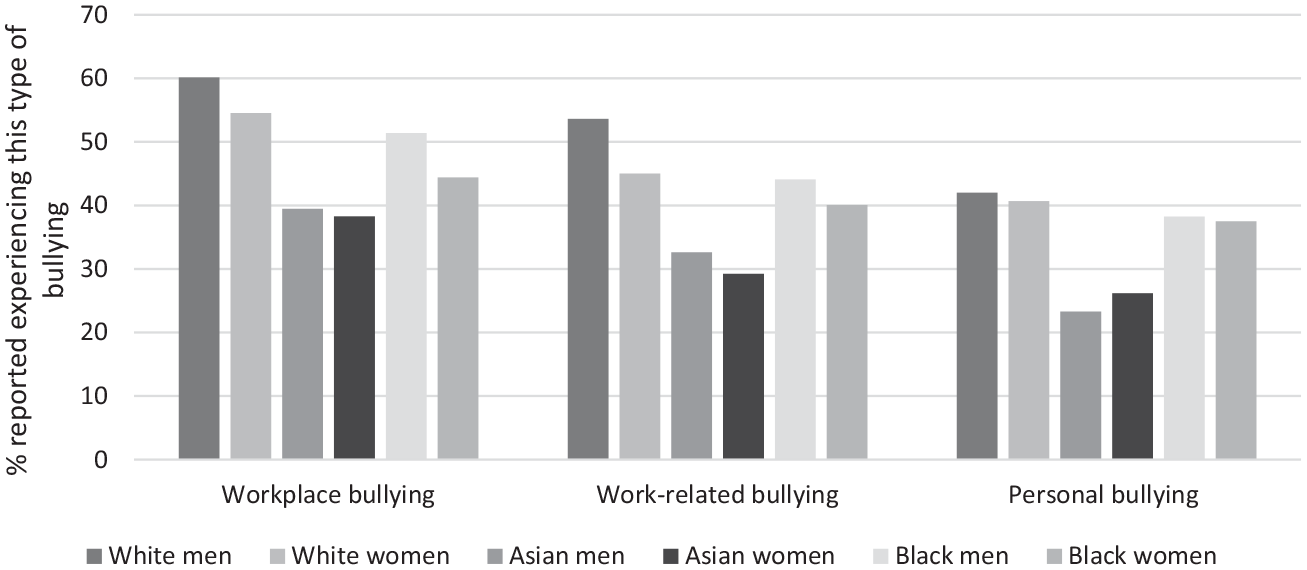
Intersections and workplace bullying.
Experiences of workplace bullying
Figure 2 suggests there were significant relationships between intersectional group and specific personal bullying in workplace dimensions. Although which group had reported the highest rates on each dimension varies, the pattern was that the lowest rates for these dimensions were mostly among ‘Asian’ men and women. ‘Black’ and ‘white’ men, and slightly fewer ‘black’ women, had the highest rates of experiencing gossip and rumours being spread about them. ‘Black’ men and ‘black’ women were the most likely to report receiving hints that they should quit their job. ‘White’ men and ‘white’ women were most likely to report being treated disrespectfully or rudely, with the ‘white’ majority group men most likely to report being insulted. Intimidation rates were the highest among ‘white’ women and ‘black’ women. Both ‘black’ men and ‘black’ women, along with ‘white’ men, all had high rates of reporting experiences of persistent criticism of their work.
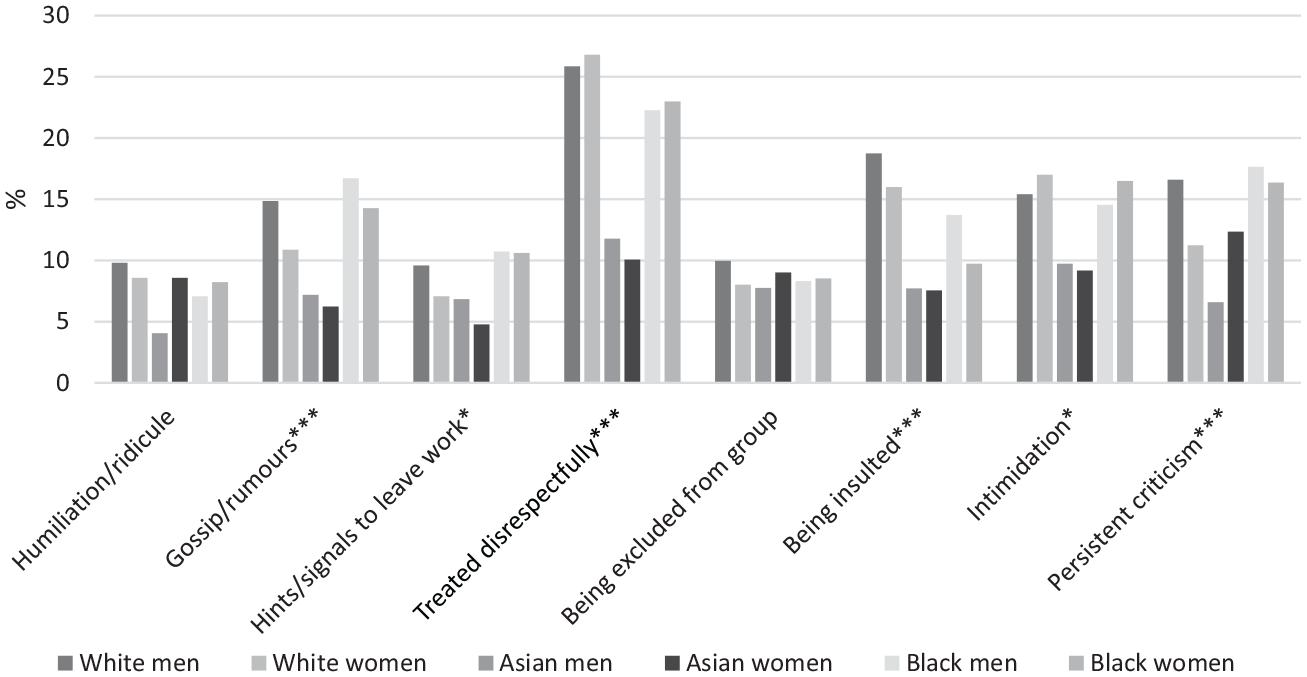
Intersectional group and personal bullying in workplace dimensions.
According to Figure 3, there was a significant relationship between all work-related bullying dimensions, except for experiencing pressure from someone else not to claim something that by right one is entitled to. In all significant dimensions, ‘white’ men had the highest rate, which were also noticeably higher than for any other intersectional group.
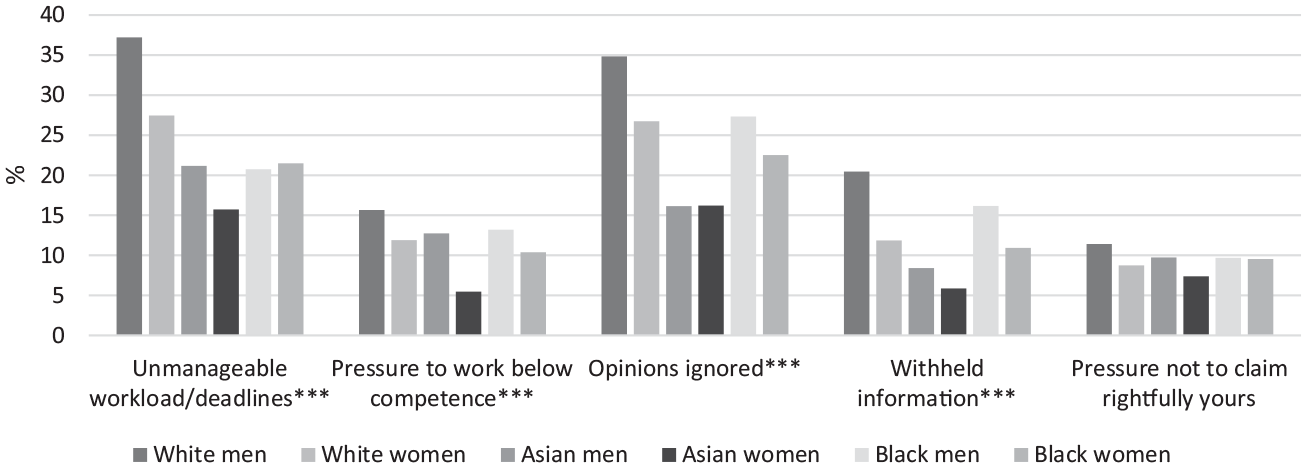
Intersectional group and work-related bullying dimensions.
The lowest rates, again on all dimensions, except for one’s opinions being ignored, were among ‘Asian’ women workers. Another apparent pattern was that all men’s intersectional groups were more likely to report being bullied than their women counterparts across most work-related bullying dimensions.
Table 1 presents logistic regression estimates for the relationships between intersections and bullying. In general, in all three models, ‘white’ men tend to have had the highest likelihood of reporting different workplace bullying types. Model 1 estimates suggest that all intersections, except for ‘white’ and ‘black’ women, were significantly less likely than ‘white’ men to report workplace bullying in general, with ‘Asian’ women being the least likely to report it. According to Model 2 estimates, all intersections, except for ‘black’ women, were significantly less likely than ‘white’ men to report work-related bullying. Finally, as Model 3 suggests, only ‘Asian’ men and women were significantly less likely than ‘white’ men to report personal bullying. The differences were not significant for other intersections.
Logistic regression estimates for relationships between intersectional group and bullying.
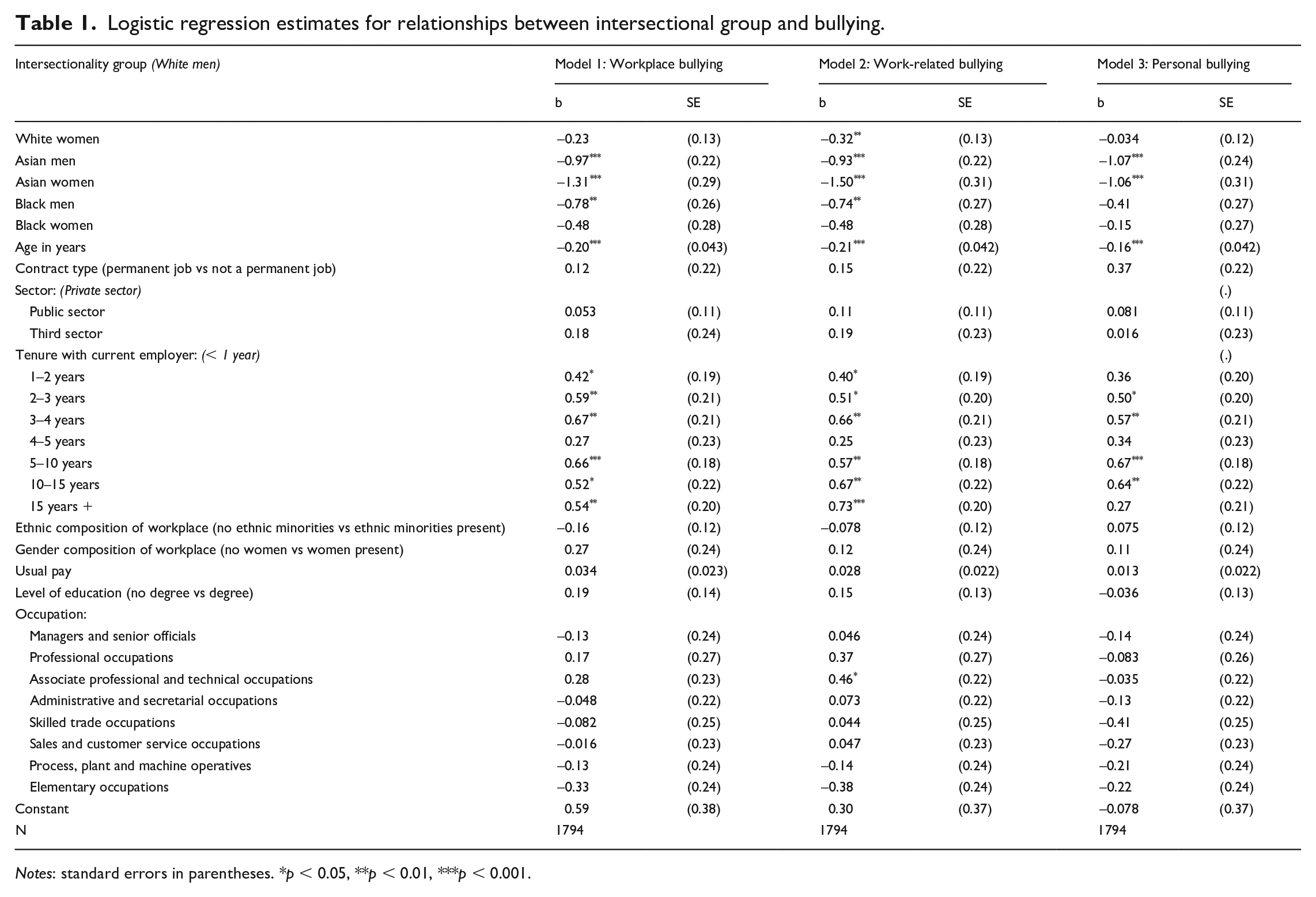
Notes: standard errors in parentheses. *p < 0.05, **p < 0.01, ***p < 0.001.
Other factors that made a difference to the likelihood of bullying were age, where older workers were less likely than younger workers to report all three types of bullying, and tenure, where the longer someone has been in their current workplace, the more likely they were to experience bullying.
Discussion
The aim of this article was to examine bullying in the workplace, specifically the intersections of ethno-racial group status and gender. The key finding, somewhat unexpectedly and contrary to our hypothesis, is that, in general, ‘white’ men were more likely to report workplace bullying. This contradicts existing evidence that ethno-racial minority groups are more likely to be and/or report on being bullied (Cain et al., 2021; Hoel and Cooper, 2000). The BWBS data suggested that all intersectional categories, except for ‘white’ women and ‘black’ women, were significantly less likely than ‘white’ men to report workplace bullying in general. Similarly, all intersectional groups, except for ‘black’ women, were significantly less likely than ‘white’ men to report work-related bullying. However, all intersectional groups, except for both men and women of ‘Asian’ status, had similar levels of reporting personal bullying at the workplace. We also found some significant variations in reporting experiencing specific personal bullying behaviours, such as being intimidated (most likely reported by ‘white’ and ‘black’ women), persistent criticism of one’s work (‘black’ women, ‘black’ men and ‘white’ men), hints that they should leave their job (both ‘black’ men and ‘black’ women), being treated disrespectfully and rudely (both ‘white’ men and ‘white’ women), being insulted (‘white’ men) and with a tendency of both ‘Asian’ men and ‘Asian’ women to be the least likely to report most dimensions. In contrast, on all specific work-related bullying dimensions, except for experiencing pressure from someone not to claim something that one is rightly entitled to, ‘white’ men had the highest rate, which was noticeably higher than for any other intersectional group. The conclusion is that ‘white’ men are most likely to report experiencing specific bullying behaviours that make it difficult for them to complete their work but there are wide variations in which specific personal bullying in workplace dimensions are reported by each intersectional group. These findings suggest that the patterns of workplace bullying experiences are far more nuanced than previously thought. This challenges the current consensus that ethno-racial minority groups, women especially, are (one of the) groups that are most likely to report bullying in the workplace setting. This article now turns its attention to exploring possible explanations behind this key finding.
Here, the issue of reporting is important, specifically the confidence to report bullying and a belief somewhat in the system that the report of bullying will be ‘counted’. Reported bullying differences found in other studies focus on either ethno-racial status (Cain et al., 2021; Wingfield and Chavez, 2020) or gender-related incidents (Salin, 2021). However, the BWBS data reported in this article focused on broader personal and work-related bullying incidents for groups whose identities crossed ethno-racial status and gender. Thus, the scope of the bullying experience was widened and could be one of the possible explanations for these unexpected findings. While in previous studies ‘white’ men might not have reported bullying in relation to their ethno-racial group status and gender, in our study they were more likely to report more general forms of workplace bullying, specific dimensions of work-related bullying and some personal bullying dimensions that might or might not be directly related to their ethno-racial group status and gender.
This unexpected finding can be framed within the heavily masculine context of many workplaces, especially in those cultures found in the UK and USA. In such environments, these dominating groups were more likely to compete against each other in indirect-aggressive ways by using more covert bullying methods, such as the use of heavy workloads (Balducci et al., 2011), working below skill level or being set impossible targets (Zabrodska and Kveton, 2013), or taking credit for others’ work (Ciby and Raya, 2014). That men, majority group men especially, were more likely to be employed in professional environments where there is a normative cultural competitive climate, where dominating masculine norms and markers were presented as ‘healthy competition’ (Berdahl et al., 2018), could mean that they were more likely to experience and report on workplace bullying. Although it may be expected that men who experience more bullying in such environments may report on it less due to being active members of the cultural competitive climate, it could be argued that reporting may be increased if self-reporting anonymously in an anonymous and confidential survey such as the BWBS.
Secondly, it is plausible then that women from an ethno-racial minority group felt the most uncomfortable coming forward to make any bullying reports, resulting in under-reporting of actual events. This may be due to the structural values of a specific workplace, which influences specific gender groups’ willingness to come forward regarding bullying, or related to ‘suspicion’ and/or previous negative experiences of ethno-racial minority groups in relation to discrimination in the workplace (Cain et al., 2021; Wingfield and Chavez, 2020). These would impact on these groups’ confidence in the reporting system and impact on whether they decided to report on bullying experiences, both formally and otherwise. As interviews were conducted face to face, it is also possible that some ethno-racial minority group workers might have been less likely to disclose bullying if their interviewer was ‘white’. It should be noted that our analysis found that the ethno-racial group status and gender composition of the workplace was not a significant predictor of reporting experiences of bullying. However, it is important to note that there was no clear definition of ‘workplace’ in the survey, meaning that it could have been interpreted differently by respondents (i.e. either as the wider organisation or one’s immediate team/division). This is noteworthy given the questions on ethno-racial group status and gender composition and bullying experienced by those in senior positions, who would have been in places outside of the team.
As reported in other studies (Cain et al., 2021; Fox and Stallworth, 2005; Wingfield and Chavez, 2020), throughout our analysis of the BWBS data, there was a persistent theme of more subtle (or covert) forms of bullying towards ethno-racial minority groups in the workplace. For example, ‘black’ workers were more likely to report personal forms of bullying, such as gossip and rumours spread about them (covert), like that reported by Lewis and Gunn (2007), whereas in comparison, ‘white’ workers were more likely to have reported being treated in a rude or disrespectful manner (overt). As Duncan et al. (2020) suggest, there has been a shift away from macro-aggressions to micro-aggressions in the workplace. Such micro-aggressive (covert) bullying practices are more likely to go unchallenged in the workplace, given their ‘vague’ nature.
Although the findings in this article contradict some of the established literature, which has reported that ethno-racial minority groups were more likely to be bullied (i.e. Hoel and Cooper, 2000; Lewis and Gunn, 2007), they also align with some other findings. For instance, our finding that ‘white’ men were more likely to have types of bullying experiences such as bullying based in job-related criticism, similar to that found by Lewis and Gunn (2007) and Fox and Stallworth (2005). Zapf et al. (1996) note that women are also more likely to be additionally subject to overt forms of ethno-racial discrimination and deal with the multiple and combined oppressions associated with being a woman and of ethno-racial minority group status in the workplace; although we did not specifically measure ethnicity, race or gender-related bullying.
The somewhat unexpected finding that ‘white’ men were significantly more likely to report on instances of workplace bullying compared with women and ethno-racial minority group counterparts can be explained, therefore, with reference to the normalised position of power that they hold. When such power is challenged, white men find confidence to report it given trust in a structure that typically works in the interests of people like them. Resonating with the work of Mitchell (2019), it can be identified as a form of ‘white male fragility’ – a state whereby even a minimum amount of ethno-racial and gendered stress becomes intolerable, triggering anger and ensuing actions. Thus, a negative experience held by someone in a typical position of power and authority, who is then bullied, may be more likely to be ‘angered’ about their stress and ready to report it within a system that they consider to be ‘on their side’. Similarly, women of ethno-racial minority group status may have a greater experience and/or awareness that such a system does not favour them, and consequently decide not to report bullying. Thus, everyday inequalities with such ethno-racial discriminatory and sexist undertones become normalised and personalised in workplace bullying. In this sense, the core ideas of intersectionality, as outlined by Collins and Bilge (2016), are relevant – that is, (i) the presence of social inequality caused by multiple social factors; (ii) the use of power relations; and (iii) the relevance of social context.
Theoretically, the findings discussed in this article offer some points for consideration on the usefulness of the intersectional framework of analysis for studying workplace bullying. Intersectionality allows us to recognise and understand how one’s experiences of bullying in the workplace are multi-layered, complex and informed by multiple (perceived or real) social dimensions. Workplace bullying experiences and the decision to report are reflectively mulled over depending on status and power, themselves related to how one positions oneself and is positioned by others within a (workplace) setting that has a socially constructed hierarchical system (of power). The intersectional framework of analysis alerts us to the existence of this structure and the dynamics of positionality within it, which go on to determine access to rights and privileges – that is, the right to work in a safe ‘bully-free’ workplace and to have the confidence to report on, and have remedy to, any bullying experiences. That said, it should not be ignored that one of the key, albeit unexpected, findings of our analysis of the BWBS data (i.e. that ‘white’ men reported higher rates of workplace bullying experiences) contradicts one of the main premises of intersectionality and critical race and gender studies: women of ethno-racial minority group status have enhanced vulnerability and experiences of harm in the workplace setting. This poses the question of the degree to which intersectionality remains accurate or, more specifically, whether some social dimensions and intersectional positions are no longer relevant in the ways that they once were, especially if the claims of those about an equality-achieving, post-racial, post-gender state are considered.
Methodologically, this article has some limitations, including the somewhat dated dataset and impact of the changing employment landscape, which may affect its generalisability. Some research suggests that the proportion of ethno-racial minority groups in higher-skilled positions and occupations has increased (Clark et al., 2019), which might reduce their exposure to bullying (although we did control for occupation in our analyses). In terms of future directions then, research could provide a deeper level of understanding by consulting data sets or samples that include those who have experienced bullying but have chosen not to report it. One way to do this would be to have a wider sample of employees and ask from that about bullying experiences and reporting decisions/experiences. Research could also consider adding (qualitative) questions to permit more nuance in categories, so as to also measure the significance of other social dimensions and intersectional points (i.e. class, disability status or sexual orientation). This would permit a fuller exploration of emerging findings in more detail. It is also important to note further studies are needed on other intersecting oppressions (i.e. class, disability status or sexual orientation), which were out of the scope of our study.
Conclusions
To advance the existing body of knowledge on workplace bullying, this article considered the intersections of ethno-racial group status and gender, and its relationship to the reporting of bullying experiences. Our analysis produced several findings that suggest that ethno-racial group status and gender combined, informed experiences of personal and/or performance-based bullying in the workplace. The somewhat unexpected finding that, in general, ‘white’ men reported higher rates of bullying in comparison with their ethno-racial minority group counterparts, challenges the current consensus that ethno-racial minority groups – women especially – are more likely to experience bullying in the workplace.
On a theoretical basis, this article advocates the use of intersectionality to understand how one’s experiences of bullying and the decision to report is informed by the possession of multiple (perceived or real) social identities, positionality and their status in a socially constructed hierarchical system (of power). In practical terms, intersectionality highlights processes and structures that hinder equality and anti-bullying progress – in this case, how employers can recognise and cater for those who are most at risk of experiencing and not reporting bullying.
Footnotes
Funding
The authors received no financial support for the research, authorship, and/or publication of this article.
