




Abstract
Previous studies found contradictory results on whether women benefit in terms of earnings from having a female manager. This mixed-method study draws on survey data from the Netherlands to determine whether female employees have higher wages if they work under a female manager and combines these with data from interviews with Dutch female managers to interpret and contextualize its findings. The survey data show that having a female manager does not affect the wages of female (or male) employees in the Netherlands. The interviews revealed different ways in which managers can improve outcomes for female employees and suggest several reasons as to why some female managers experience a lack of motivation to enhance female employees’ earnings. This detailed focus on mechanisms that underlie female managers position to act as ‘cogs in the machine’ emphasizes the importance of incorporating context and looking at outcomes other than earnings in future research.
Introduction
Female managers are more common today than a few decades ago (Mintz and Krymkowski, 2010). In the Netherlands, the country on which this study focuses, the percentage of women in a management position increased from around 15% in 1985 to more than 21% in 2008 (Blommaert et al., 2019) and women’s share in management positions grew further in recent years (Jongen et al., 2019). As women more often occupied managerial positions, scholars became interested in its implications (Huffman, 2016; van Hek and van der Lippe, 2019). Research proposes that male overrepresentation in management is one of the reasons men earn more, and studies indeed show that male managers benefit male employees in some respects (Elliott and Smith, 2004). Now that the number of female managers has increased, a logical follow-up question is whether women also benefit from having a same-sex manager.
Since gender inequality in earnings is still one of the most pronounced and visible forms of labour market inequality, it is the focus of this study. A complexity of factors cause women to earn less than men. Factors well established are human capital investments (e.g. choice of occupation), discrimination and gender roles (Lips, 2013). Referring to the famous ‘Bringing the firms back in’ study by Baron and Bielby (1980), Huffman (2013) argues it is essential to consider organizational processes when studying the gender pay gap. In organizational processes, managers are considered key. Although, in general, managers do not decide on employees’ wages alone or in a vacuum, they are at the centre of decisions about many practices that shape inequality (Castilla, 2011; Huffman, 2013, 2016). This article’s goal is therefore to understand if and why Dutch female managers differently affect women’s and men’s wages, and by doing so, reduce gender wage inequality in the organization. To this end, it uses a mixed-method approach employing quantitative and qualitative information.
Prior research proposes opposing hypotheses on the influence of female managers on gender wage equality in organizations (Cohen and Huffman, 2007; Maume, 2011). First, female managers are argued to function as ‘agents of change’ who improve equality between female and male employees. Second, scholars argue that female managers could also be ‘cogs in the machine’ who do not, or even negatively, affect gender equality in the organization. Findings tend to differ according to the type of data used to test these hypotheses, as noted by van Hek and van der Lippe (2019). Studies that employ organizational-level data link the proportion of female managers in an organization to the gender earnings gap and mostly find support for the ‘agents of change’ hypothesis. Studies that employ individual-level data investigate whether female employees earn more when they have a female manager themselves, and usually draw conclusions more in line with the ‘cogs in the machine’ hypothesis.
This article addresses three shortcomings of previous research. First, most existing research consists of organizational-level assessments. Individual-level studies are relatively rare, although they are less prone to ecological fallacy and more suitable for determining how the actions of female managers affect gender (in)equalities among workers (Huffman, 2016). This article employs data from the European Sustainable Workforce Survey (hereafter ESWS), which allows for assessing the influence of direct supervision by a female manager while controlling for a wider range of individual and organizational characteristics than some previous studies (Maume, 2011; van der Lippe et al., 2016). Second, most studies focus on the United States. Since recent European studies show varying results (Abendroth et al., 2017; van Hek and van der Lippe, 2019; Zimmerman, 2021), investigations of whether and how female managers in European countries influence organizational gender inequality are needed. This article’s focus on Dutch managers broadens existing knowledge on the influence of female managers on organizational gender equality in Western countries other than the USA. Lastly, quantitative studies explore correlations between managers’ gender and gender wage equality, but are not able to shed light on the underlying social mechanisms (van Hek and van der Lippe, 2019). For example, female managers can be cogs in the machine because they have no real organizational power or because it is in their self-interest to not show female solidarity. Adopting a mixed-methods design, this study sheds more light on these mechanisms. It first employs the ESWS to explore variations within the group of managers. Quantitative findings are further contextualized by analysing nine in-depth interviews with Dutch female managers. Interviewees were asked about the extent of their power and motivation to improve the earnings and careers of female employees. Although the focus is on earnings, managers were also asked about advancement opportunities because this was more appropriate for some questions and the two correlate highly. This way, this article sheds more light on the underlying mechanisms of our, and possibly also others’, quantitative findings. The study’s research question is: To what extent and through what mechanisms do Dutch female managers influence women’s and men’s earnings differently? A smaller or larger gender pay gap is the result of female managers exerting a differential effect on women’s and men’s earnings.
Female managers and organizational gender pay gaps
In this section, opposing hypotheses are deducted on how female managers impact gender pay gaps in organizations (Cohen and Huffman, 2007). First, it is argued that female managers could act as change agents who benefit women and therefore diminish gender inequality in earnings. Second, arguments are brought forward for why female managers might not impact the gender pay gap or even advantage men and enlarge it; respectively the weak and strong version of the cogs in the machine hypothesis (Maume, 2011).
Female managers are agents of change
The first reason why female employees could benefit from having a female manager is due to people’s tendency for homophily; a preference for similar others. Kanter (1977) theorizes that preference for people with similar characteristics increases up the organizational ladder where the need for quick decisions about complicated and important matters requires trust and clear-cut communication. One way managers ensure this is by hiring people similar to themselves as direct subordinates to increase predictability (Elliott and Smith, 2004). Gender is an important factor on which social categories are based (England, 2010). Previous research points out several ways by which homophily benefits employees working under a same-sex manager. First, managers are more likely to befriend and mentor same-sex employees (Tsui and Gutek, 1999). Second, relatedly, homophily stimulates organizational sex-segregated networks, and informal networks matter greatly for receiving job-related information and outcomes (e.g. earnings). Third, employees receive better performance evaluations from same-sex managers, which could be a result of managers’ more positive evaluation of people from the same social categories (Castilla, 2011).
Female managers could also benefit female employees because shared experiences with sex-based stereotyping and discrimination might lead them to discriminating women less and being more understanding of employees’ work–family conflicts (Maume, 2011). Stereotypes hold that women in general, but mothers in particular, are less dedicated and competent employees. New mothers are perceived less competent than childless women and men, but also men who recently became fathers, and are penalized in terms of hiring, promotion and training (Cuddy et al., 2004). As female managers are more likely to have had experiences with sex-based stereotyping and discrimination, they could notice it more and perform it less. The link between recognition and practice of stereotyping and discrimination is one of the foundations on which many diversity programmes are based. Because of their own experiences, female managers might even be active anti-discrimination protagonists. Accordingly, Halpert et al. (1993) find women give less biased performance evaluations of pregnant employees. Female employees and female managers also likely have similar experiences with work–family conflicts (Maume, 2011). This could lead to female managers being more understanding and supportive in this domain, enabling (especially female) employees to establish a healthy work–life balance and, consequently, higher job satisfaction and commitment (Abendroth and den Dulk, 2011).
Female managers can simulate gender equality in organizations by improving opportunities of subordinates, like the previous two mechanisms illustrated. They can also reduce gender inequality throughout the organization through other mechanisms. First, the mere presence of female managers in an organization could challenge stereotypes that leaders (e.g. managers) are men, and women are less ambitious and committed employees (Ridgeway, 1997). By challenging such stereotypes, female managers could alter the behaviour of managers and employees. Managers could more often consider female employees for promotions and female employees might pursue these better paid positions more frequently. Ridgeway (1997) refers to this as status value belief concepts, theorizing that female managers can change people’s status beliefs about whether it is legitimate and possible for women to attain high paid positions. Accordingly, Ely (1995) finds that sex roles in organizations are less stereotypical in organizations with high percentages of female managers.
Lastly, female managers may reduce gender earnings inequality throughout the organization by supporting gender equality enhancing policies (Cohen and Huffman, 2007; Huffman, 2016). Female managers might be stronger advocates of such policies because of their experiences with discrimination or stereotyping, or because it is in their self-interest to implement them. Cohen and Huffman (2007) show female managers more often than male managers believe organizations should make special effort to recruit and promote women (Dobbin et al., 2011) and show that the proportion of female managers in organizations positively relates to the number of diversity policies. Such policies might directly influence the gender earnings gap, but might also indirectly diminish it by signalling corporate concern with gender equality to employees and managers.
In line with the four above-stated general mechanisms, the ‘change agents’ hypothesis is: Women’s earnings are higher when they have a female manager compared to a male manager, men’s earnings are higher when they have a male manager compared to a female manager. Correspondingly, we expect that the gender pay gap is smaller under a female manager (hypothesis 1).
Female managers are cogs in the machine
As does most prior work, this article proposes a weak and strong version of the cogs in the machine hypothesis (Maume, 2011). First, female managers might not reduce gender wage gaps because they do not have sufficient (access to) power to do so (Cohen and Huffman, 2007; Maume, 2011). Scholars argue that not all managers have actual organizational power and that especially in bureaucratic organizations the power of managers is limited by regulations and procedures (Cohen and Huffman, 2007). This applies particularly to low-level managers who are additionally bound by demands and regulations of higher-level managers. As women tend to be overrepresented in low managerial positions, they often have less organizational power than male managers and are therefore in a less optimal position to improve the opportunities of their subordinates (Acker, 2006). Some argue that the rise of female managers was accompanied by an increase in bureaucratization, indicating these managers were increasingly bound by organizational regulations (Huffman, 2016). Also, Maume (2011) argues that male organizational elites might withhold power from women through rules and procedures. In line with this, Blair-Loy and Wharton (2002) show male supervisors have more access to resources that benefit their employees than female supervisors.
Second, female and male managers might have similar stereotypes. If female and male managers alike believe that women (especially mothers) are less committed and capable employees, they will both not improve their earnings (Acker, 2006; Ridgeway, 2001). Correll et al. (2007) show that women and men equally discriminate mothers. Derks et al. (2011) found that female managers believe women are less committed and have weaker leadership abilities. The previous two arguments lead to the weak version of the ‘cogs in the machine’ hypothesis:
Women’s and men’s earnings are unrelated to their managers’ sex. Correspondingly, we expect that the gender pay gap is equal under female and male managers (hypothesis 2a).
Female managers could also enlarge the gender earnings gap in organizations by purposefully or pragmatically disadvantaging female employees and advantaging male employees. Cohen and Huffman (2007) argue that female managers likely accept the organizational status quo in which most power belongs to men. They explain that on the one hand, only women who accept the organizational hierarchy are assigned management positions (selection). On the other, female managers are socialized by other managers supporting current hierarchies. This reasoning aligns with queen bee theories stating that women in masculine organizational cultures adhere to the prevailing culture at the top of organizational hierarchies to get and keep powerful organizational positions (Kanter, 1977; Ridgeway, 2001). Referring to social identity theory, Derks et al. (2011) explain that when women work in organizations where their gender is devalued, a strategy for individual success is to distance themselves from others in that social category (i.e. women). Female managers do this in three ways: distancing themselves from other (especially junior) women physically and psychologically, legitimizing and endorsing the current organizational hierarchy (e.g. deny discrimination of women) and by emphasizing masculine features and leadership styles within themselves (Derks et al., 2016). This reasoning leads to the strong version of the ‘cogs in the machine’ hypothesis:
Women’s earnings are higher when they have a male manager compared to a female manager, men’s earnings are higher when they have a female manager compared to a male manager. Correspondingly, we expect that the gender pay gap is larger under a female manager (hypothesis 2b).
Data, measurements and methods
European Sustainable Workforce Survey
Data
This research draws on two data sources. First, it employs the ESWS (van der Lippe et al., 2016), collected in 2015/2016, from which all 48 Dutch organizations are selected. For organizational sampling, the business list from the Dutch chamber of commerce was used. Organizations with 20–99, 100–249 and 250+ employees were selected from six sectors: transport, manufacturing, financial services, telecommunications, higher education and healthcare. These were selected to reflect variation in the causes and types of investments in a sustainable workforce. The six sectors vary therefore in the percentage of women working in the sector, the percentage of older employees, flexibility in contracting and the extent of technological development (van der Lippe and Lippényi, 2019). In case of insufficient response rates within a size-sector category, a matching strategy was applied by replacing non-participating organizations with an organization with similar characteristics. Within each organization, one supporting and at least two core departments were surveyed. Three different questionnaires were distributed in the organization: an employee questionnaire, a department questionnaire – filled in by the department manager – and an organizational questionnaire – filled in by an organizational representative (mostly the CEO or HR manager). Response rates were 54% at the employee level and 75% at the department level. Cases with data on all three levels were selected; six employees aged under 18 and two male-only organizations were removed, leaving 2135 employees, 150 departments and 43 organizations for analysis.
Measurements
Dependent variable
Employees’ net hourly income in Euros was the dependent variable. Income was measured using the question: ‘What are your net monthly earnings from your main job at this organization? Please refer to your average earnings in recent months’. A definition of earnings was added: ‘What you have left every month after deducting national and local taxes and compulsory national insurance contributions’. Employees who did not answer the question for whatever reason were asked to choose one out of 21 income categories; those respondents got the median value of their income category. Respondents’ earnings were divided by their contract hours to calculate hourly income. If information on contract hours was missing, the hours the respondents indicated they actually worked for the organization was used. The original value of employees’ net hourly income was converted to its natural log to deal with extreme values.
Independent variables: Employee-level
Employees’ sex was coded male (0) or female (1). Employees’ educational level was included (linearly; including it categorically did not change the results); categories ranged from primary education or first stage of basic education (0) to doctoral degree (7). Other control variables were employees’ age, whether they live with a partner (0/1) and have dependent children (0/1) (living at home or are under the age of 18). Two characteristics of employees’ job were included. Dummy variables for the eight International Standard Classification of Occupations (ISCO) codes on the one-digit-level measure occupational class and tenure measures how many years employees worked for the organization.
Independent variables: Department/manager-level
First, it was determined whether the department manager is female (1) or male (0). Managerial status was measured as department size. Managers were asked: ‘How many employees are there in your department?’ A higher number of employees indicates a higher managerial status. Alternative measures based on the managers’ educational level, income (Cohen and Huffman, 2007), the average income of the managers’ employees and the time the manager has been managing the department give highly similar results. Analyses include whether managers lead a core or support department (discussed beforehand with the contact person of the organization). Core departments’ activities evolve around the key objective of an organization (department of oncology in a hospital), whereas support departments’ tasks are mostly facilitating these activities (e.g. finance, maintenance). This dichotomy largely overlaps with what is sometimes referred to as line or staff departments.
Independent variables: Organizational-level
Organizational representatives indicated the percentage of female managers in their organization; they were asked to estimate if they did not know exactly. Organizational-level controls were the number of employees in the organization and the percentage of female employees in the organization. Organizational representatives indicated the latter on a nine-point scale ranging from ‘there are no female employees’ (0) to ‘all employees are female’ (8). By assigning values of 0% and 100% to the lowest and highest category, and the median of the categories in between, it was converted into a linear variable.
A total of 426 respondents with missing information (mostly on earnings) were removed from the data. The final dataset consists of 1704 employees, working in 138 departments in 41 organizations. Descriptive statistics are presented in Table 1 and online Appendix A.
Descriptive statistics, reduced version. a
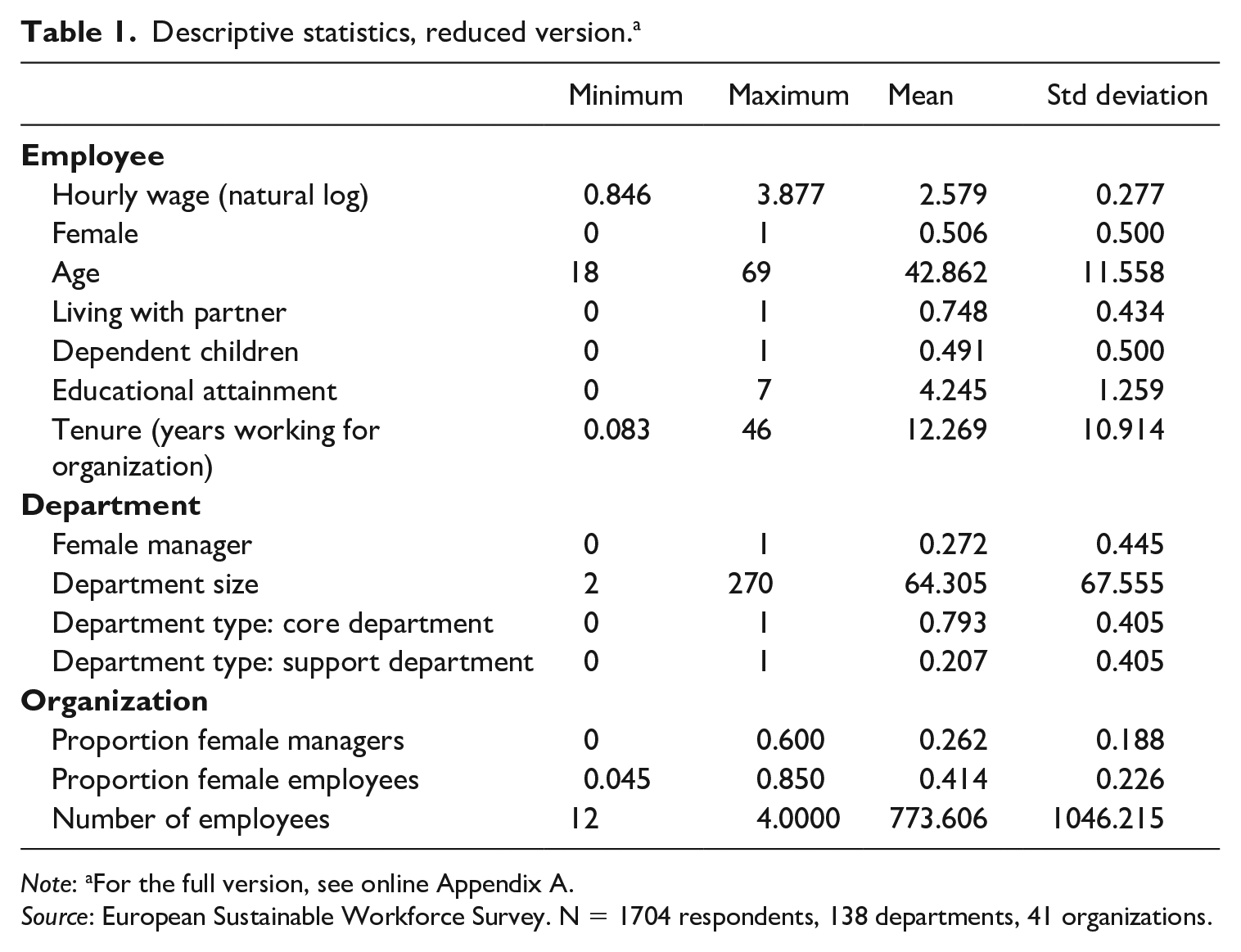
Note: aFor the full version, see online Appendix A.
Source: European Sustainable Workforce Survey. N = 1704 respondents, 138 departments, 41 organizations.
Analysis of the ESWS
The ESWS has a three-level structure, so three-level linear regression models in R (LME) were performed to test the hypotheses. The intercept and effect of females vary over departments and organizations. Except for the null-model and model 1, dummy variables for sector were included to control for the nesting of organizations therein; the sector ‘transport’ is the reference category.
Model 0 determined the variance in earnings between employees, departments and organizations. Model 1 includes employees’ gender to determine the (uncontrolled) gender wage gap in Dutch organizations. In model 2, all other independent and control variables were added. Model 3 includes the interaction between female with female manager to determine whether women’s earnings are higher when they have a female manager compared to a male manager and controls for the interaction between female and the proportion of female managers in the organization. Since the sample of organizations is not representative for all Dutch organizations, this interaction is not the focus of this article. Models 4, 5C and 5S search for indications about mechanisms that lead to the main result. To explore the influence of managerial power, it was estimated whether female managers with greater departments have more influence than female managers with smaller departments (model 4), and whether effects differ between core and support departments (models 5C/S). The assumption was that female managers with greater departments have more power, as do female managers in core departments because bureaucratization might be less severe in core departments than in support departments (Korczynski, 2004). Results can be found in Table 2. Online Appendix C shows Table 2 where men are coded 1.
Linear three-level regression models on hourly wage (natural log).
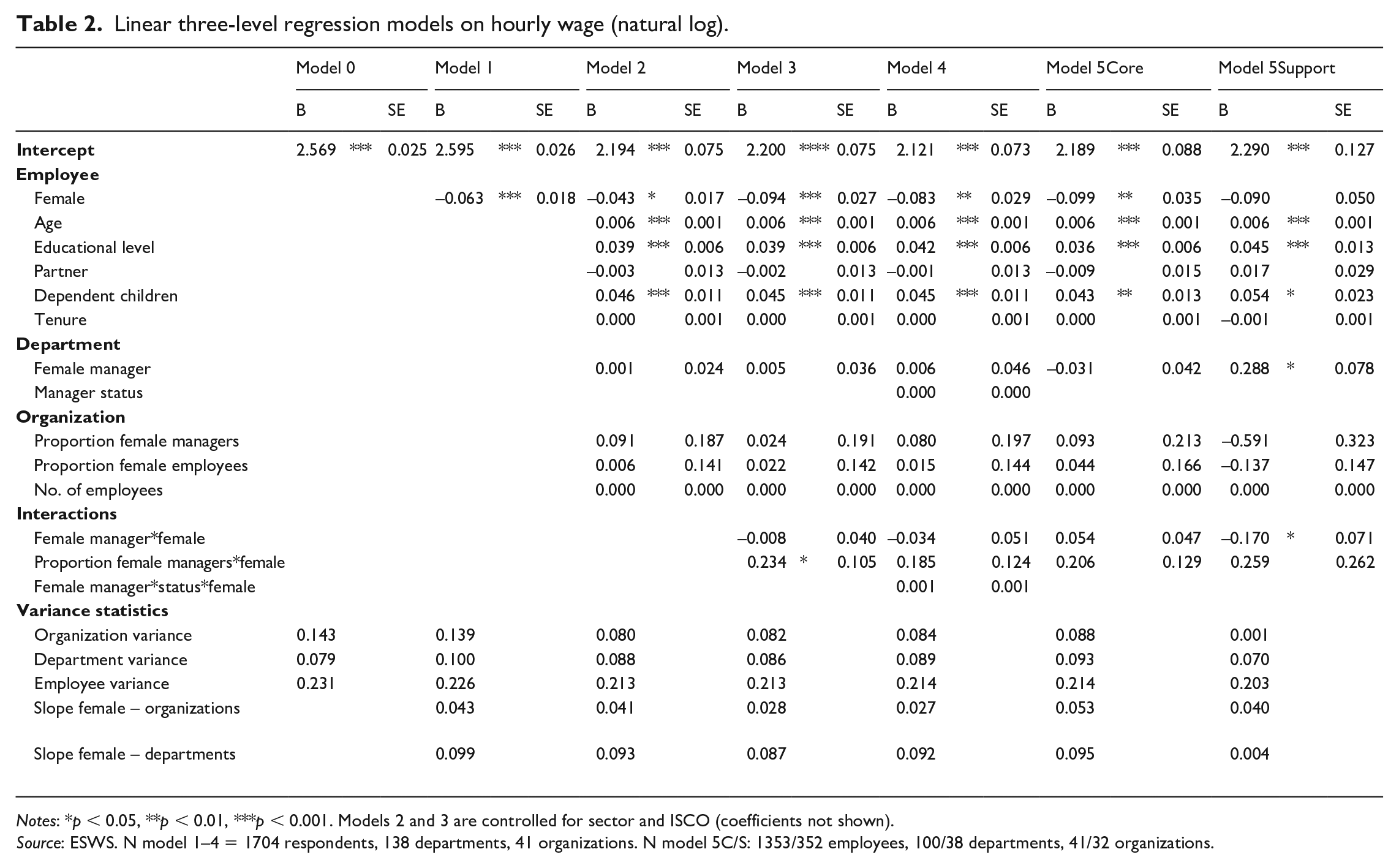
Notes: *p < 0.05, **p < 0.01, ***p < 0.001. Models 2 and 3 are controlled for sector and ISCO (coefficients not shown).
Source: ESWS. N model 1–4 = 1704 respondents, 138 departments, 41 organizations. N model 5C/S: 1353/352 employees, 100/38 departments, 41/32 organizations.
Semi-structured in-depth interviews
Data and measurements
Besides the ESWS, semi-structured in-depth interviews from 2018 and 2019 with nine Dutch female managers were used to contextualize quantitative findings. Mid- and senior-level managers working in core and support departments of organizations from the same sectors as available in the ESWS were selected. Online Appendix B shows the characteristics of these managers and their organizations. All managers were found through personal contacts of the first and second author and interviewed by the first author. Managers received an email with a short biography of the authors, description of the project’s goal, sample questions and assurance that interviews would be confidential. Interviews took place at a location chosen by the respondent; all opted for their workplaces. Interviews began with a confidentiality assurance, request to record audio of the interview and demographic questions. Further questions were based on a combination of theory and survey results, meaning they were designed to provide insight in the underlying mechanisms of the main quantitative finding about whether female managers affect wage gaps in organizations. Therefore, a manager was asked about her role in diversity policies in the department/organization, whether/how she exerts influence on her employees’ earnings/career, whether/how she intentionally enhances opportunities of female employees, the manager’s level of ambition and that of her (fe)male employees, work–family conflicts of the manager herself and her employees, and the manager’s experiences with sex discrimination. Most interviews lasted about one hour (range: 59–105 minutes). All took place after quantitative analyses were conducted.
Analysis of the interview data
The nine semi-structured interviews were transcribed verbatim and a deductive thematic analysis was employed (Braun and Clarke, 2006). Themes were based on theory and quantitative results, after which the text was latent coded by identifying phrases or words associated with these themes. It identified whether managers’ statements were associated with different aspects of their power or motivation and within these aspects different subthemes were distinguished. Two aspects of power were distinguished: policies (two subthemes) and employees’ earnings/career. For motivation, a distinction was made between queen bee mechanisms (three subthemes) and own experiences (two subthemes). Two (sub)themes were added during coding: organizational characteristics and manager’s career path. Both were mentioned in relation to manager’s motivation.
Results
Survey results: Do women benefit from having a female manager?
Variance parameters of model 0 in Table 2 showed employees’ earnings depended on nesting in departments and organizations. The intraclass-correlation was 17.4% on the department-level and 31.5% on the organizational-level. Model 1 showed the uncontrolled gender wage gap. As the dependent variable was hourly wage, working hours were accounted for. The effect of female was negative and highly statistically significant, showing that women earn less per hour than men. The intercept showed the average earnings per hour for men: 13.40€, or e^b2.595. Women earned on average 12.58€ per hour, or (b = (b2.595 – b0.063)), a gender wage gap of 0.82€, which is just over 6%. In model 2, the effect of female was partly explained by the control variables but stayed negative and statistically significant, indicating a gender pay gap of 0.38€ (b–0.043). Employees who were older, more highly educated and had young children earned more. Having a female manager and organizational controls were not statistically significant.
In line with the weak version of the cogs in the machine hypothesis (hypothesis 2a), results from model 3 showed that it did not matter for employees’ earnings whether their direct manager was female or male. Women, but also men, did not benefit from having a same-sex manager, so manager’s sex was not related to the size of the gender pay gap (see also online Appendix D). The positive and statistically significant interaction effect of female with proportion of female managers indicated that women benefited from working in organizations with a high proportion of female managers (b0.234). The effect of female (i.e. the gender pay gap) indicated women earned 0.81€ (b–0.094) less than men in organizations with no female managers, and 1.15€ (b0.140 (–0.094 + 0.234)) more than men in organizations with only female managers. This seemed to indicate that the proportion of female managers mattered for the gender pay gap. Sensitivity analyses with converted variables dealing with non-normal distributions/non-linear effects (e.g. age and number of employees) led to substantially similar results. Robustness checks with only full-time workers also led to similar results. Conclusions largely resembled Abendroth et al. (2017) who also use multilevel data (other than the ESWS) and included gross earnings.
The three-way interaction in model 4 was not statistically significant, showing that managerial status did not matter for earnings of (wo)men working under a male or female manager. Whereas results in model 5C mirrored the main results, results for support departments (model 5S) differed. Model 5S showed that men earned more when working for a female manager than for a male manager: 13.17€ versus 9.88€ (b0.288). For women, this effect was less positive: 10.15€ versus 9.03€ (b0.118 (0.288 – 0.170)). So, although both men and women working in a support department benefited from having a female manager, female managers in these departments enlarged the gender earnings gap because they benefited men working for them more than their female counterparts.
Interview findings: In search of mechanisms
To interpret and contextualize the main finding that female managers do not affect gender wage gaps in organizations, nine female managers were interviewed about aspects of their power and motivation related to gender equality in the organization.
Power: Directly influencing earnings/career
The interviews revealed several mechanisms through which female managers influenced employees’ earnings. Senior-level managers indicated they could simply determine wages of employees, whereas mid-level managers more often indicated they influenced employees’ earnings by assigning them tasks that improved their chances of advancement, or by putting in a good word with senior-level managers: Meanwhile, he [the employee] wants to go to management, so for some time I assigned him the finances of the department, because I am convinced that one has to have a base of finances, so he did that for a while. For some time now, he is an ‘added member’ of the management team. So, in those ways [I stimulate opportunities of my subordinates], I do those things so he can develop his competences, but especially because he can show on his CV that he did those things, because in the end you have to. Interviewee 5 (mid-level)
The interviews indicated that managers of all levels exert some power over the earnings/careers of subordinates but that the way in which they do that differs. The same pattern emerges when looking at a manager’s influence via policies.
Power: Indirect influence through diversity or work–family policies
Many managers influenced earnings or the career prospects of female employees through policies in their department or the organization. They did so by influencing diversity policies or work–family policies. The explicit goal of diversity policies was to improve the career opportunities of female employees. Positive effects of work–family policies on the earnings of (young) women seem to be a side-effect: by being flexible and understanding, managers reduced stress among mostly female employees and made combining work with family obligations easier. Policies could be formal and stipulated in organizational statutes, or comprise everyday practices of managers’ handling of employees. Irrespective of whether they were in favour of certain policies, high-level managers more than mid-level managers expressed influence on formal diversity/work–family policies in the organization or their department, as indicated by the following two managers: I do not have an explicit policy. I dislike the word policy because it often does not work that well. That is more something for the stats [statistics], I think you should do it yourself. Interviewee 3 (senior-level) No [we do not have a diversity policy], we’re developing it right now. And I am the initiator of this. Interviewee 7 (senior-level)
In contrast, almost all managers expressed they had influence on informal work–family policies in their department. More often than diversity policies these seemed to concern the everyday handling of employees’ work–family conflicts: So, the single mom, she cannot travel easily. We have to travel a lot for work. I have had a lot of stress about that, that I had to travel a lot while that was not really possible, but was being pressured by my manager to travel. So I do not pressure her to travel in any way. Interviewee 6 (mid-level)
Since both senior- and mid-level managers have, or at least experience, power to influence the outcomes of their employees, this might explain the quantitative finding that the managerial influence does not vary by managerial status.
Motivation
Managers differed in the extent to which, and reasons why, they were motivated to improve female employees’ earnings/careers. There was no clear division between motivated and unmotivated managers. Some female managers were clearly motivated to enhance women’s organizational opportunities and did so in various ways, whereas others expressed little motivation and acted accordingly. Most managers, however, sent mixed signals. Some expressed motivation but did not seem to act on it, whereas others did not seem particularly motivated but throughout the interview gave multiple examples of when they took action to improve women’s opportunities. What influenced managers’ motivation were organizational characteristics of the current organization, queen bee considerations and a manager’s own experiences with gender discrimination/stereotyping relating to the manager’s career path. It was not related to managerial status.
Organizational characteristics
Here, the sex-ratio among employees and managers was important. In organizations with female overrepresentation, or with a nearly perfect gender balance, managers expressed there was little need for them to stimulate women’s organizational opportunities. In contrast, managers in masculine organizations sometimes saw hiring and advancing women as a way to change the masculine organizational culture they perceived as having negative side-effects: We’re looking for the next step and you need a coaching leadership style for that. And women have that more than men. Interviewee 9 (senior-level)
Even though some managers in masculine organizations emphasized the added value of female employees, they also expressed doubts about whether these women would be able to stand their ground in such masculine contexts. This relates to queen bee considerations described in the next section.
Queen bee mechanisms
Regarding queen bee indicators, most managers showed mixed signs. Mid-level managers made statements aligning with the queen bee phenomenon somewhat more than senior-level managers. First, most managers did not see themselves as more ambitious than their female employees, so did not explicitly distance themselves from junior women in that way. Second, managers differed in the extent to which they endorsed or legitimized existing hierarchies. Some clearly stated they wanted to change the existing (masculine) organizational culture, and did so by hiring/promoting women, implementing diversity policies and/or being flexible about employees’ work–family conflicts, whereas others did not. For example, interviewee 4 expressed that working long hours is simply needed to get ahead and opposed diversity policies. Interviewee 6 said about diversity policies: Well, I’ve never been enthusiastic about it. I don’t, how do I say this, care so much about the man–woman difference. For example, I myself feel more of an individual than a woman in the management team. And I do not have the feeling to be different than the men in the management team. Or not in a way that I, that it would be disadvantaging or something like that, or advantaging. So, I’m different, but everyone is different. And the fact that I’m a woman does not bring something extra or negative. Interviewee 6 (mid-level)
Managers’ gender stereotypes influenced their motivation to strive for better opportunities for (their) female employees, but not only negatively. Many interviewees expressed positive stereotypes about women as a reason to strive for diversity in their department or organization (see, for example, the previous quote from interviewee 9). However, gender stereotypes also hindered managers to hire/promote women, although this was usually mentioned less explicitly. For example, interviewee 8 expressed concern about whether female candidates could hold their own in the masculine organization, and considered her actions should she prefer a woman if presented with two similar candidates: [I only do that] if I feel like she fits in the organization. Because of course it’s not only knowledge and skills you bring but also, well, how you are as a person. You have to, you cannot say there is a difference, but there is always difference [between women and men] and you have to be able to stand your ground. You have to have a certain personality to be able to hold your own. Interviewee 8 (mid-level)
The statements by interviewees 6 and 8 emphasize women’s individual choices and personalities as causes and solutions for women’s poorer career opportunities rather than gendered structures within organizations and society (Mavin and Grandy, 2017). This acknowledgement of gender inequality and expression of positive stereotypes about women combined with a reluctance to hold existing hierarchies responsible aligns with notions of moderate feminism (Mavin and Grandy, 2017).
Third, interestingly, managers often emphasized both masculine and feminine traits in themselves. Interviewee 1, for example, stated she was ‘tough’ and more of a ‘masculine woman’, but also portrayed herself as a mother looking out for her employees as her children. This might be indicative of the thin line women have walk to be perceived as competent and warm/likable at the same time (Cuddy et al., 2004).
Manager experiences with sex discrimination and work–family conflicts
Predominantly managers in masculine organizations, or who had previously worked in masculine organizations, could come up with situations where they had been discriminated against (Derks et al., 2011). They were, however, adamant that these experiences did not motivate them to support junior women. However, managers’ own experiences with work–family conflicts did lead them to be more flexible and understanding in that area. Almost all managers recounted their own work–family conflicts and alleged this helped them understand employees better and be more flexible towards them.
Conclusions
This study aims to provide insight into whether and why Dutch female managers benefit female employees in terms of earnings and, thereby, contribute to smaller organizational gender pay gaps. Its mixed-method approach advances prior research by rigorously testing hypotheses with a large sample of Dutch managers followed by analyses of survey- and rich interview-data to provide insights into mechanisms underlying that result. This provides a deeper understanding of the actions of female managers to diminish organizational gender equality. The overall conclusion is that the dichotomy among female managers as change agents or cogs in the machine as proposed by prior studies is too simplistic in that female managers can show indications of both, and the extent to which they (can) present themselves as one or the other depends on contexts and the outcome studied.
Survey results support the weak version of the cogs in the machine hypothesis (i.e. employee earnings are not influenced by a manager’s sex). This is consistent with earlier European studies employing surveys with manager–employee links (Abendroth et al., 2017; van Hek and Abendroth, 2019; van Hek and van der Lippe, 2019) but differs from studies using organizational samples and/or are from the USA (Huffman, 2016). In the Netherlands, as in many European countries, national policies facilitate combining work with family life (e.g. via child care facilities and leave options). This contrasts with the USA where a liberal regime provides fewer national policies, and employees (or organizations) need to arrange this themselves. This implies that the gender of the manager is more important in the US than in Europe, also with respect to the gender pay gap (Ruppanner, 2021; Sainsbury, 1999). This emphasizes the need for multilevel-data and underscores the importance of further research on how organizational processes relating to gender earning gaps and employee–manager interactions differ internationally and link to, for example, countries’ welfare policies (Huffman, 2016; Ruppanner, 2021).
Further analysis of the ESWS and interviews with female managers indicated why Dutch female employees’ earnings do not benefit from having a female manager. The ESWS indicates managerial power is likely not the best explanation and interviews show that female managers at different levels experience power to influence earnings. Interviews suggest, however, that for senior-level managers influence was more direct, so the importance of status seems to lie in how influence takes place. Prior studies’ findings are mixed on the influence of managerial status (Cohen and Huffman, 2007; Zimmerman, 2021), so more research on if and how manager status influences employee outcomes is warranted. Interviews indicate that managers’ motivation more likely plays an important role. There are several reasons for why female managers might not choose to use their power to enhance female employees’ opportunities. First, organizational characteristics matter. Managers working in organizations with over 50% women do not feel urged to implement diversity policies and therefore do not put much effort into influencing gender wage gaps. Second, managers’ lack of motivation relates to queen bee indicators. Many managers to some extent legitimize existing organizational hierarchies or have stereotypes that withhold them from stimulating female employees’ earnings. Mid-level managers do this more than senior-level managers, possibly because they are in a career stage in which they still have to prove their worth, or because they belong to a generation that did not experience the same opposition from the existing (male) hierarchy as the senior-level (often older) managers. However, many managers also have positive stereotypes about women that, in turn, stimulate their motivation to enhance opportunities for female employees. These mixed beliefs seem to overlap with notions of moderate feminism, so future research might delve more into the complexities of a manager’s feminist beliefs (Mavin and Grandy, 2017). This study therefore underscores that managerial beliefs and context should be taken into account when formulating hypotheses about the influence of female managers. Managers’ beliefs about the proper order of society and causes of and solutions to gender inequality, as reflected upon in political science (Carnahan and Greenwood, 2018) and feminist literature (Mavin and Grandy, 2017), evidently matter, but beliefs, and the extent to which they lead to (managerial) action, are influenced by contextual conditions (Derks et al., 2011).
Further, interviews show that the gender wage gap is only part of the story. Female managers use their power to remove obstacles for employees combining work and family tasks, and these work–family conflicts of employees tap into the manager’s own experiences (Ruderman et al., 2002). This implies that being a cog in the machine or change agent depends on the outcome studied. Perhaps women in management positions are more likely to use their influence to alleviate employees’ work–family issues because this is in line with today’s gender stereotyping (England, 2010). A practical implication is to value the importance of decreasing the gender wage gap, but also to show organizations that ‘softer’ outcomes at the workplace such as work–family balance and support are worthwhile.
Evidently, limitations of this study have to be mentioned. First, this study is restricted to the Netherlands. Although there likely exists an overlap in national and organizational cultures in European or Western countries, the importance of international research in this field is emphasized. Second, it should be emphasized that managers are part of organizational processes, and other actors will influence their decisions. Lastly, for this study, only a limited number of women are interviewed, which limits how many variables can be captured. Although the number is sufficient to interpret the quantitative findings, the qualitative findings cannot stand on their own. Combining such a high-quality quantitative dataset with interview data is, however, unique for this topic and it enables taking the first steps in interpreting findings produced by this and other quantitative studies about the influence of female managers on organizational gender equality. Furthermore, this contribution opens avenues for new research. Its mixed-methods approach shows that more insight is needed in the complex mechanisms that determine levels to and ways in which female managers act as cogs in the machine or change agents. Besides looking at outcomes other than earnings, the focus on context should be encouraged. Foremost, the organizational context – that is, the makeup and structure of the organization and department or team. Studying the interplay between power and motivation and (organizational) context opens understanding of how female managers’ influence depends on the organization for which they work. However, context is layered, so the sector and even the country with its own institutions and regulations might impact managers’ influence on wage gaps (Maume and Ruppanner, 2015).
Following the careers of women is another fruitful avenue. Organizations that managers previously worked for influence their experiences and possibly considerations (Derks et al., 2011). Considering their careers will give insightful factors besides current organizational contexts. Finally, focusing on women specifically is legitimized by the increase in female managers and the new research questions related to it. However, future research should consider both male and female managers to study the extent of conceptions of masculinity and femininity, in addition to being male or female, to help decrease gender wage gaps. We could learn from the increasing amount of attention from social scientists and policy-makers to the roles that fathers play in taking care of their children (Banchefsky, 2016). When it comes to organizational gender inequality, we showed that merely belonging to the female sex is not enough to assume one will (want to) act as an agent of change.
Supplemental Material
sj-docx-1-wes-10.1177_09500170221083971 – Supplemental material for Why Female Employees Do Not Earn More under a Female Manager: A Mixed-Method Study
Supplemental material, sj-docx-1-wes-10.1177_09500170221083971 for Why Female Employees Do Not Earn More under a Female Manager: A Mixed-Method Study by Margriet van Hek and Tanja van der Lippe in Work, Employment and Society
Footnotes
Acknowledgements
We would like to thank Paul ‘t Hart for his valuable comments on earlier drafts of this manuscript. Also, we would like to thank the anonymous reviewers for carefully reading earlier versions of the manuscript and providing us with suggestions to improve it.
Funding
The authors declared the following potential conflicts of interest with respect to the research, authorship, and/or publication of this article: This research was made possible by funding from the Royal Netherlands Academy of Arts and Sciences.
Supplemental material
Supplemental material for this article is available online.
References
Supplementary Material
Please find the following supplemental material available below.
For Open Access articles published under a Creative Commons License, all supplemental material carries the same license as the article it is associated with.
For non-Open Access articles published, all supplemental material carries a non-exclusive license, and permission requests for re-use of supplemental material or any part of supplemental material shall be sent directly to the copyright owner as specified in the copyright notice associated with the article.
