



Abstract
This article examines two commonly adopted trade union strategies to increase the representation of under-represented groups – first, reserved seats on union decision-making bodies and second, self-organisation, involving separate structures. It does so through the case of the Fire Brigades Union (FBU), whose equality reforms were considered remarkable within the union movement and fire service due to the union’s small size and highly male-dominated, white membership. However, reserved seats at senior levels were later removed following objection on the grounds of democratic legitimacy. The article examines this decision using original data comparing UK union rules for additional representation. It exposes the tensions for small, male-dominated unions of reconciling Young’s theoretical principles of ‘group-differentiated democracy’ with the realities of perceived democratic legitimacy, and argues that progress on union equality is contingent on both the particular forms of democratic representation and the political and industrial context.
Keywords
Introduction
Trade unions are important actors in pursuing equality and diversity at work, with UK unions placing a significant emphasis on the concerns of previously under-represented members, namely women, and black and minority ethnic (BME), disabled and lesbian, gay, bisexual and trans (LGBT) members (Dickens, 2007; Heery, 2006; Hoque and Bacon, 2014; Kirton, 2015; Milner, 2017; Paraskevopoulou and McKay, 2015). Union capacity to address workplace inequalities, including equal pay, gender and ethnic pay gaps, race discrimination, and bullying and harassment, is closely related to questions of internal representation of women and minority groups and the extent to which their interests are given prominence within unions (Dickens, 1997; Heery, 2006; Heery and Kelly, 1988). While unions have made strides in increasing the representation and visibility of women and black and minority ethnic members, women account for less than a third of leaders (29%) of unions affiliated to the Trades Union Congress (TUC) and only one union currently has a BME general secretary (Labour Research, 2020a, 2020b).
Over the past three decades, UK trade unions have sought to increase the representation and interests of women, BME and LGBT members through strategies based on two different models of union democracy. The first is a form of representative democracy, the introduction of reserved seats for under-represented groups on union decision-making bodies. The second is self-organisation, a form of participatory democracy that involves the creation of separate structures for women and minority members. The Fire Brigades Union (FBU) adopted both models and was seen as an exemplar of how smaller, male-dominated, industrial unions can introduce radical structural changes to provide representation (Moore et al., 2018), and to be providing leadership on equality in the fire service (HM Fire Service Inspectorate, 1999). However, in a move that surprised many, in 2012 it became the first – and to date only – UK union to reverse a rule change providing reserved seats on its executive for women, BME and LGBT members, abandoning the representative democracy model. This move is significant in its apparent reversal of a trajectory towards greater representation for previously under-represented groups widely adopted by other UK unions. Consequently, this article seeks to understand the reasons for this rejection of a widely accepted measure for greater inclusion, and the implications for trade union democracy. It does this by posing two specific questions. The first is, what are the conditions under which targeted equality measures gain or lose democratic legitimacy within a union? The second question is how particular forms of additional representation – the voting rules and remit of the additional representatives – influence their perceived legitimacy among members.
The answer to these questions has salience beyond the case of the FBU and goes to the heart of academic scholarship that seeks to identify effective trade union strategies to redress democratic deficits in predominantly white, male-dominated leadership and activist structures to better represent women, BME, LGBT, disabled, young and migrant members.
The use of additional measures, such as self-organisation and reserved seats, is underpinned by principles set out by political theorist Iris Marion Young (1990) in her formulation of ‘group-differentiated democracy’, which aims to redress disadvantage and oppression through targeted forms of representation for marginalised groups. The article draws on Young’s model to explore the tensions between competing visions of democracy within the FBU and to examine the conditions under which particular equality measures gain or lose democratic legitimacy among union memberships. Related to this is the question of how particular forms of additional representation – the voting rules and remit of the additional representatives – influence their perceived legitimacy among members. The article thus compares the form of democratic structures introduced by the FBU for minority representation to those adopted by other UK trade unions. It therefore considers the applicability of Young’s concept of differentiated democracy to trade unions that may not share the compositional and demographic characteristics of the FBU.
The article starts by examining scholarship on the two models of democracy and located in Young’s (1990) notion of ‘group-differentiated democracy’. Second, the research methods, drawing on two data sources, are explicated. The first is a case study of the FBU, which represents 34,000 operational firefighters (wholetime and retained) and control room staff in the fire and rescue service, with one of the highest UK union density rates at around 90% of firefighters (Moore et al., 2018). Women account for 7% of membership, BME membership is 3% and LGBT 0.3% (SERTUC, 2016). The case study is derived from documentary material from union archives, published sources and interviews with 97 respondents, both equality and lay activists. The second source is data on TUC-affiliated union reserved seat structures, which informs a comparison of the FBU rules for representation with those of other unions. An account of the introduction of equality measures in the FBU from the late 1980s focuses on the union’s internal reforms. There follows an evaluation of the challenges to democratic legitimacy prompted by these reforms, and influenced by particular industrial, political and financial issues confronting the union. The bases of these challenges are evaluated, raising ongoing questions for unions still working to improve equality representation, and suggesting limits to Young’s (1990) model of group-differentiated democracy. The article concludes by arguing that the FBU case offers insights for unions into the challenges of introducing special representation for marginalised groups, while also recognising the importance of political leadership and industrial context for gaining authority for these measures. The debate is of particular contemporary interest in a context in which women now form the majority of UK trade union members, but are under-represented in leadership positions.
Trade union strategies for increasing representation
An extensive literature has evaluated and critiqued the efforts of trade unions to more effectively represent women in internal structures (Colgan and Ledwith, 1996, 2000, 2002; Fryer and Williams, 2021; Kirton, 2015; Parker, 2002, 2003; Sayce et al., 2006). There is a growing but a less developed body of work on representation of BME (Kirton and Greene, 2002; Virdee, 2000; Virdee and Grint, 1994), disabled (Foster and Fosh, 2010; Humphrey, 1998), LGBT (Bairstow, 2007; Colgan, 1999; Humphrey, 2000) and, most recently, migrant (Marino, 2015) members.
Of the two models of union governance, representative democracy is concerned with rules and structures for election of representatives, on ensuring procedural fairness and tends to focus on processes of decision-making rather than outcomes (Colgan and Ledwith, 2002; Morris and Fosh, 2000). Participatory democracy, emphasising members’ contribution to decision-making at local levels, became more prominent in the 1960s and 1970s, putting greater power in the hands of shop stewards and reducing the centralised power of full-time union officers (Fairbrother, 1984; Heery and Kelly, 1994). Kirton (2015: 487) noted that participatory democracy is ‘now widely accepted as the ideal in the UK union movement’.
As a form of participatory democracy, self-organisation is a radical strategy providing women and other disadvantaged groups with separate spaces to discuss their concerns, to ‘develop consciousness, confidence and skills’ and to ‘formulate policies and practices and strategies to get these onto the trade union agenda’ (Colgan and Ledwith, 2000: 245). Thus, one measure of their effectiveness is the extent to which the concerns of self-organised group members shape mainstream union agendas. Separate organising, therefore, does not constitute a strategy of separatism, but a means to an end of achieving integration into union mainstream structures and concerns (Briskin, 1999). Self-organisation has become accepted as an established union strategy, with 49% of unions having formal bodies for women and for BME members (Trades Union Congress (TUC), 2018). Yet it has been periodically challenged (Colgan and Ledwith, 2000: 245) and Briskin (1999) noted that separate organising is sometimes mischaracterised as separatism, perceived to undermine the common interests and unity that form the very basis of trade unionism (McBride, 2001). Forms of semi-autonomous organising have thus been considered ‘divisive and counter-productive’ (Virdee and Grint, 1994: 208). McBride (2001: 415) suggests that self-organisation can lack legitimacy in the eyes of members not covered by self-organised groups. Since the ‘grass-roots’ organising model (Morris and Fosh, 2000) emphasises collective organisation and building common aims, internal divisions are perceived as a source of weakness and a barrier to the development of democracy. However, Morris and Fosh note that exceptions are permissible and ‘it is generally conceded that special measures may be needed to promote the involvement of women, ethnic minorities and other disadvantaged groups’ (2000: 98).
Young’s principles for the establishment of group representation are consistent with both participatory and representative democratic forms. She argues (1990: 184) that their legitimacy depends on principles that support: (1) self-organisation of group members to achieve collective empowerment and an understanding of their group experiences and interests; (2) group generation of policy proposals that decision-makers should take into account; and (3) group veto powers over decisions that affect them directly.
Similarly, it has been argued that for self-organisation to succeed it must be accompanied by mainstreaming strategies to ensure that group concerns influence union policy-making. Briskin (1999: 549) maintains that success requires ‘a strategic balance between autonomy from the structures and practices of the labor movement and integration (or mainstreaming) into those structures’. Thus, the mechanisms whereby the demands generated by these groups contribute to union decision-making processes at local, regional, national or industrial level are crucial. They may manifest in powers to send motions to union conferences, or in links to, or representation on, national committees or bargaining processes.
One form of representative democracy is the provision of reserved seats for women and under-represented groups on national executive committees (NECs) or other decision-making committees. This strategy may link to the principle of proportionality, as established in UNISON on its creation in 1993, to ensure that its female-dominated membership (around 70%) were represented proportionately on regional and national ruling bodies and at national delegate conference (McBride, 2001). By 2016, most NECs were representative of their women members (SERTUC, 2016) but unions with reserved seats came closer to NEC gender proportionality than those without (Kirton, 2015). However, a strategy of proportionality alone may be inappropriate to ensure representation for BME members where numbers are small, and reserved seats may be needed (Kirton and Greene, 2002).
Young proposes that proportional representation assumes that it is primarily individuals who must be represented. Instead, she argues for the principle of ‘representation of group experience, perspectives and interests’ (1990: 187). She highlights the importance of accountability between occupants of reserved seats and their constituents, underscoring the necessity of the co-existence of and interrelationship between participative measures such as self-organisation and the representative form of reserved seats.
Yet there may be tensions within and between additional and participative models of union democracy, and arising from Young’s (1990) concept of ‘group-differentiated democracy’ that challenges notions of impartiality on which commonly held conceptions of democracy are founded – an impossibility, she argues – and (spurious) universality, which denies difference. For trade unions, collectivism is built on a common class experience as workers (Fairbrother, 1984); group-differentiated democracy thus challenges them to recognise other axes of difference that shape members’ experience. Indeed, Virdee and Grint’s analysis of black self-organisation in NALGO (the precursor to UNISON) notes that understandings of classed and racialised experience may be complementary, finding that some black activists saw self-organisation as ‘a catalyst to greater class-based unity, rather than as subordinating class interests to race’ (1994: 212). Drawing upon the experience of the FBU, the article illustrates how the challenges identified by Young and the operationalisation of differentiated democracy played out in a male-dominated trade union, leading ultimately to the reversal of initiatives that reflected the principle of representative democracy.
Research methods
Two data sources are analysed: a case study of the FBU’s introduction of equality structures and a comparative review of the rules adopted by UK unions to provide special representation on executive bodies. The FBU case draws on research conducted for a book marking the union’s centenary in 2018 (Moore et al., 2018). A total of 97 interviews were carried out with national officers, regional and brigade officials, local reps and equality section reps. Semi-structured interviews, largely face-to-face, took place between January 2016 and June 2017 and probed interviewees on their history in the fire service and union, eliciting recollections of major changes and events. Research was based on informed consent and interviews were recorded and transcribed. The development of equality structures was seen by the union as an important part of its recent history and was explored in all interviews. This article draws on this wider analysis, but particularly on the testimonies of representatives of the equality sections from the 1990s onwards. Accordingly, 18 interview transcripts were re-analysed and key themes located within the conceptual framework. The interviewees represent those holding the most prominent positions in the equality sections (i.e. the NEC members, chairs and secretaries), as well as the national officers with responsibility for equality (see Table 1). Interviewees are designated by their contemporaneous union position.
Interviewees.
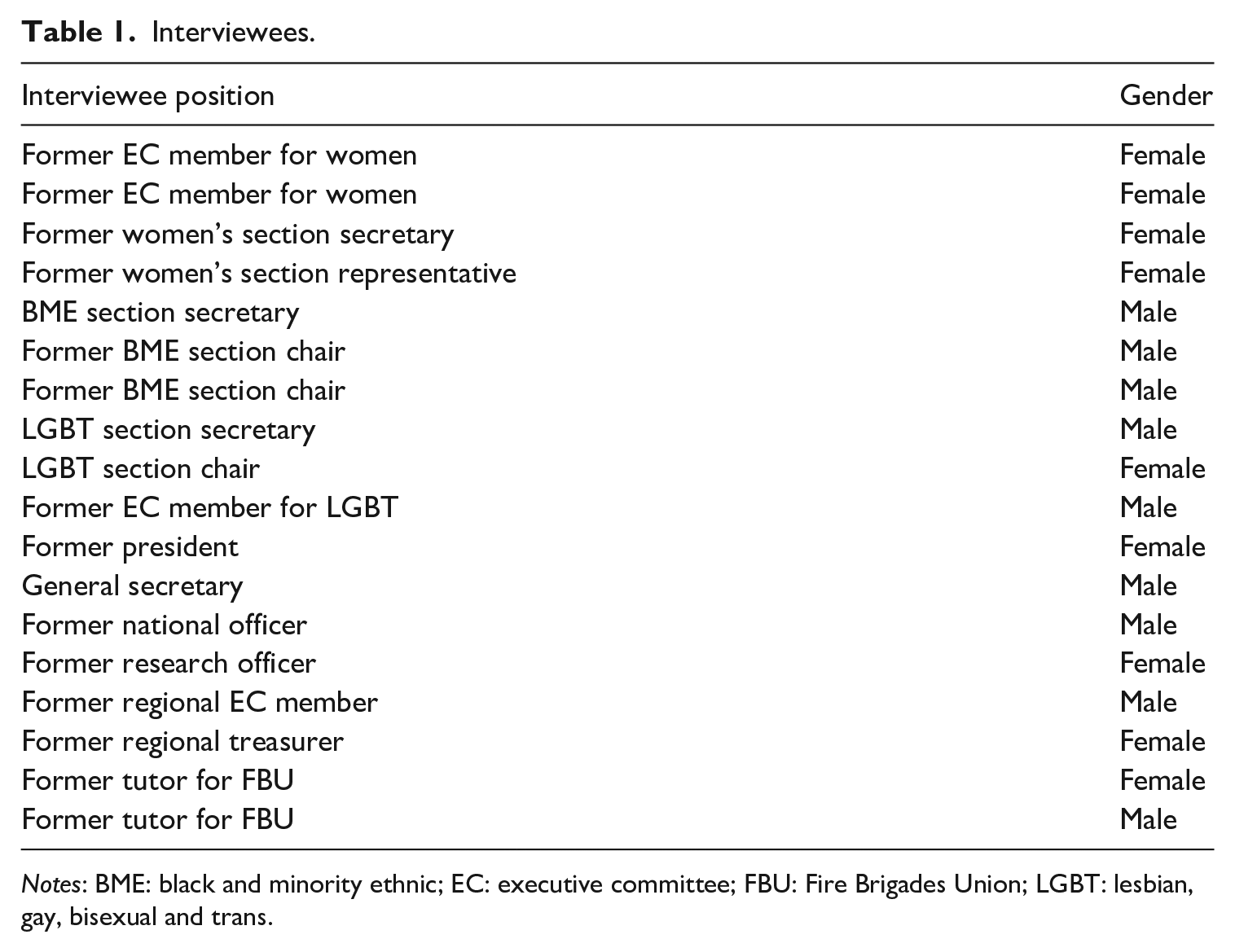
Notes: BME: black and minority ethnic; EC: executive committee; FBU: Fire Brigades Union; LGBT: lesbian, gay, bisexual and trans.
For the purposes of this case study, FBU documents were a key data source, in particular conference proceedings where equality structures were debated, and notably of the 2012 conference where reserved seats were withdrawn. While privileging the accounts of equality activists, the article also draws on the wider pool of interviewees who captured the tensions within the union over the implementation of equality measures and factors that led to the reversal of representative democracy. Research for the book was commissioned by the FBU, who assisted in accessing participants and providing union documentation. The authors were free to select interviewees, had full access to documents and enjoyed independence to critically interpret the data. Drawing on sociological research traditions, the authors were sensitive to the limits to their objectivity (Smith, 1988). Positionality is acknowledged, in line with the emancipatory paradigm of much trade union research (Hyman, 1989), including that underpinned by feminist principles (Ramazanoğlu and Holland, 2002).
Data on trade union equality structures and rules were provided for this article by the Labour Research Department, re-analysing data it had collected for the TUC Equality Audit (TUC, 2018), with additional information collected from trade union officers. This evidence enables comparison of the FBU’s particular implementation of reserved seats with that of other trade unions.
‘Putting our own house in order’: The development of FBU equality policy and structures
The context in which the FBU made changes to internal democracy is essential. The fire service began recruiting women as full-time firefighters in the 1980s in London, before which women had largely been found in control rooms, other than in small numbers during the Second World War (Segars, 1992). It was only during the 1980s that black firefighters were recruited in greater numbers in London, reaching 3% of the workforce by 1989, although as early as 1955 the FBU had reached an agreement with the London Fire Brigade that there would be no colour bar in recruitment (FBU, n.d.). The recruitment of women and BME firefighters in London during this period was driven by the Greater London Council’s equal opportunities policies, which recognised the need for the fire service to reflect the population it served.
Numerous reports of sexual and racial harassment emerged during the 1980s and 1990s, which required action by both union and fire service. The FBU supported individuals to fight high profile sexual harassment (Tanya Clayton) and race discrimination (Warren Mann) cases in the 1990s (Moore et al., 2018), while simultaneously women and BME members established informal self-organised groups. LGBT firefighters also faced hostility, with most not daring to declare their sexuality at work. They formed a support group in 1996.
The union established an equal opportunities committee and policy in 1986, but frustration grew during the 1990s over the lack of progress for women and BME members. General secretary Ken Cameron was committed to change. A former research officer recalled: The stories were just awful, awful from the black members – razor blades in fire boots, shit in fire boots – and those were the extremes, obviously. And Ken [Cameron] took it on . . . but within the union there was hostility, there was silence . . . What Ken saw was a huge amount of talent that wasn’t coming through the union structures, they were articulate people, why aren’t they coming through, why haven’t we got these people as officials? Something’s wrong. So, for him . . . it was a political issue, totally and utterly . . . We can’t claim to be socialists if we’re excluding people . . . And we couldn’t tackle the service if we hadn’t tackled the union, he was absolutely clear about that. We’ve got to make sure our house is in order.
Self-organisation
For Cameron there was no conflict between the FBU’s commitment to socialism (stated in its rule book) and specific action on equality. However, for others, introducing separate structures for under-represented groups was seen to threaten the class-based solidarity on which unions are founded (Fairbrother, 1984). A male, former national officer recalled his initial resistance to separate sections: I think a big part of the opposition from officials like me at the time was this idea that having sections in our union was a bit of an insult because I thought well, I was a socialist and I certainly wasn’t sexist or racist or homophobic. And if someone came to me, I would absolutely deal with it and I became involved in politics through anti-racist activity and Anti-Nazi League-type stuff in the very early 80s, probably even late 70s. So, I felt, well, are you suggesting I wouldn’t look after black members or women members or LGBT members? [but] we had created a culture where women were never going to come to me anyway because they saw white men as being part of the problem. And they had had too many experiences of where they weren’t being listened to, where the issues weren’t being dealt with.
Having initially seen separate structures as divisive (Virdee and Grint, 1994), and an affront to his political activism, this officer’s position altered once he heard the experiences of under-represented members and understood the limitations of the union structures.
Some women too were opposed to separate organising, as this interviewee, later active in the women’s committee, recounted. She attended the Women’s School (an organising event for women control staff and firefighters), expecting it to be ‘the worst weekend ever’, but: I was really taken aback at, I suppose, how political it was, how organised it was, how supportive it was. How I felt that the issues that I was experiencing, that I was hiding, were experienced with other women, it was a safe space. It felt like a weight off my shoulders, I felt I can kind of be myself here. And I went from somebody who was against it to somebody that was really passionate.
The importance of a ‘safe space’ to be oneself was also emphasised by a male LGBT committee activist who recalled the time when he realised there were other gay firefighters: It was empowering because up until that moment it was all those years of hiding and pretending to be something that I wasn’t . . . It was that moment of seeing someone else in the service who was like me. And also seeing them surviving.
Similarly, an organiser of the first informal meeting of 15 BME firefighters recalls: ‘the feeling of camaraderie and that empathetic feeling was like nothing I’d ever felt before with firefighters’.
By 1998, the National Women’s Advisory Committee had been established and parallel structures agreed for BME and LGBT members, who had been meeting informally. The groups were able to draw support and learn from each other; a former BME section chair acknowledged that the women’s section ‘were the vanguards . . . it was the women who really started this off’.
In addition to individual empowerment from meeting others experiencing similar problems, there are indications that self-organised group participation increased members’ confidence to undertake mainstream union positions. A study found that the number of women holding union positions at brigade level almost doubled, from 5.8% in 1992 to 10.3% in 2010, reflecting the period when women’s structures were established. Women were twice as likely to take a union position as their male counterparts (McGhee, 2011).
Reserved seats
The momentum generated by recognising self-organisation prompted demands for further reform and, in 2001, the FBU conference agreed to radical structural changes, which included reserved seats on the NEC and regional executives to represent women and BME members. This innovation had precedent in the existing representation for control, retained and officer members, each with a dedicated NEC seat. The first NEC member for women was elected in January 2002, followed by the BME position in March 2002 and the LGBT seat in 2005.
At the time the FBU introduced these reforms, they were among a minority of TUC-affiliated unions with NEC seats for women (28%) and BME (25%) members in 2003, and among only 4% with LGBT seats in 2007 (TUC, 2007: 23). The FBU’s actions on equality and representation of minority members were widely admired across and beyond the UK union movement, particularly given its relatively small size and male-dominated membership (HM Fire Service Inspectorate, 1999). A male external tutor at the BME School that established the union’s BME structures recalled that the FBU was one of a very small number of unions that enabled structures to be developed by black members, with support from the top. He saw the FBU as ‘one of the beacons to the rest of the trade union movement’.
Through this dual approach of combining self-organised group structures with representation on the highest decision-making body, the FBU may have achieved Briskin’s (1999: 549) ‘strategic balance between autonomy from the structures’ and ‘integration (or mainstreaming) into those structures’. These combined structures were highly effective in pushing equality issues up the negotiating agenda with fire service employers (Moore et al., 2018).
Questioning democratic legitimacy
Underlying tensions over representation became manifest when general secretary Andy Gilchrist, strongly associated with the reforms and the national officer responsible for equalities under Ken Cameron’s leadership, failed to be re-elected as general secretary in 2005. He was defeated by Matt Wrack who had been highly critical of Gilchrist’s leadership of the 2002–2004 pay dispute, seen widely as a defeat.
The political and industrial context is crucial. During the protracted, bitter 2002–2004 dispute over pay and modernisation, the government and fire service had tried to link the modernisation agenda to equality and diversity by demanding the introduction of more ‘family-friendly’ working patterns (Bain et al., 2002). Women activists fiercely rejected attempts to use women’s concerns to justify unpopular shift changes, claiming that a large majority of women firefighters supported the existing shift system and organised caring responsibilities around it.
The issue of democratic legitimacy emerged in the light of the NEC’s decision to end the 2002–2004 dispute without recourse to a national conference, with the votes of the equality representatives seen by some as tipping the outcome of the vote and over-ruling regional representatives. While recollections of the breakdown of voting were contested, the women’s, BME and LGBT reps were perceived as having illegitimate influence over an industrial issue, and of being allies of Gilchrist. Long-standing tensions about equality structures and representation surfaced.
A male, former regional NEC member believed that the equal weight accorded to the votes of the equality sections and those of the regional reps was unacceptable in industrial matters, perceiving their equivalence as ‘the real reason why the equality section debate kicked off after the pay dispute’.
Under the leadership of the newly elected Matt Wrack, the union entered a period of local disputes resulting from the fragmentation of the fire service in the aftermath of the national strike, heavy funding cuts and attacks on pensions. These unfavourable conditions led the union to prioritise resistance to cuts and worsening conditions, while it faced increasing financial pressures as an organisation. Financial stringency became an imperative for employers and union alike. In 2011, the union withdrew full-time paid release for equality section secretaries, in order to reduce its facility time budget. In 2012, it called a special conference to debate an NEC paper on reorganisation, which proposed financial savings the union leadership considered necessary to meet the FBU’s organisational challenges. It recommended removal of the reserved seats for women, BME and LGBT members, with the remit of the National Sectional Committees to provide advice and recommendations. Equality section reps would also lose voting rights at brigade and regional committees, attending in an advisory capacity only.
The NEC paper argued that the reserved seats for equality groups distorted internal democracy, with four objections on the grounds of constituency size, remit, multiple votes and mandate. Wrack rejected the legitimacy of a voting structure with a regional committee of 11 members representing five brigades: You’d have one delegate from the officers, one delegate from control, one delegate from retained, one delegate from women, one delegate from BME, one delegate from LGBT, so there’s five representing the whole workforce and six representing sectional interests. No-one has ever made a robust defence of that structure to me, ever.
According to this view, it is not legitimate for those representing small constituencies of particular interests (i.e. the small numbers of women, BME or LGBT members) to have an equal vote to those representing far larger regional constituencies. Further, concerns were raised about multiple representation: a black woman, for example, could have three votes for NEC positions, via membership of her region, the women’s and BME sections. This position did not go unchallenged. A former regional treasurer, also active in the women’s section, was sceptical, pointing out that such concerns could have been addressed by pro-rata voting (in this case referring to the NEC), and suggesting that the proposal to remove the seats was a political one since existing regions already represented significantly different numbers of members: If they really believed in that . . . London’s EC member would stick his hand in the air with 5000 votes and region 1 would stick their hands in the air with 2000 votes or whatever it is.
Wrack believed that the remit of those ‘representing sectional interests’ had gone beyond the original intention that the reserved seats represent their members’ concerns at the highest level, instead allowing their equivalence with those elected through the workplace branch and brigade committee structure. The sectional seats had ‘no input into branches, or from branches’. The efficacy of self-organisation was also questioned, with a view that equality seat reps did not necessarily fully represent their own constituencies, due to insufficient group participation at lower levels. A male national officer proposed: ‘I don’t think the structures were in place in order for them to go there [NEC] with a proper mandate’. The NEC proposals prompted a passionately argued debate at the conference, with 71% voting to support the recommendations, rejecting the legitimacy of representative democracy. The vote reflected a perception that the structures intended to give voice to the interests of the equality groups had, in reality, given these reps a disproportionate and therefore illegitimate say in matters affecting all members. The fact that there were three reps – one for each of the equality groups – was also significant given the small overall numbers on the national and regional committees.
Union rules for special representation
Analysis of data for 38 unions responding to the TUC’s equality audit (representing 76% of affiliates) shows that, in 2018, seven had reserved seats for women and 11 for BME members. The Communication Workers Union (CWU) introduced reserved seats for women, LGBT+, race and disability from 2021 (Labour Research, 2020b), indicating the continued salience of such measures for union equality strategies despite reversal in the FBU.
The question of the remit of group seats is more significant in a union with a small executive body, where the influence of sectional seats is proportionally greater. Table 2 shows that all unions (except the 2000-member National Association of Racing Staff) with reserved seats have larger NECs than the FBU’s 19-member executive in which the six sectional seats (three equality sections plus a seat each for the control, officers and retained sections) accounted for almost a third of votes. On the 11-member regional committees, the six sections represented more than half the votes, as critiqued by Wrack. Thus, in most unions, concern about potential undue influence on the basis of numerical strength is less significant.
Unions with reserved seats in 2018, by membership size.
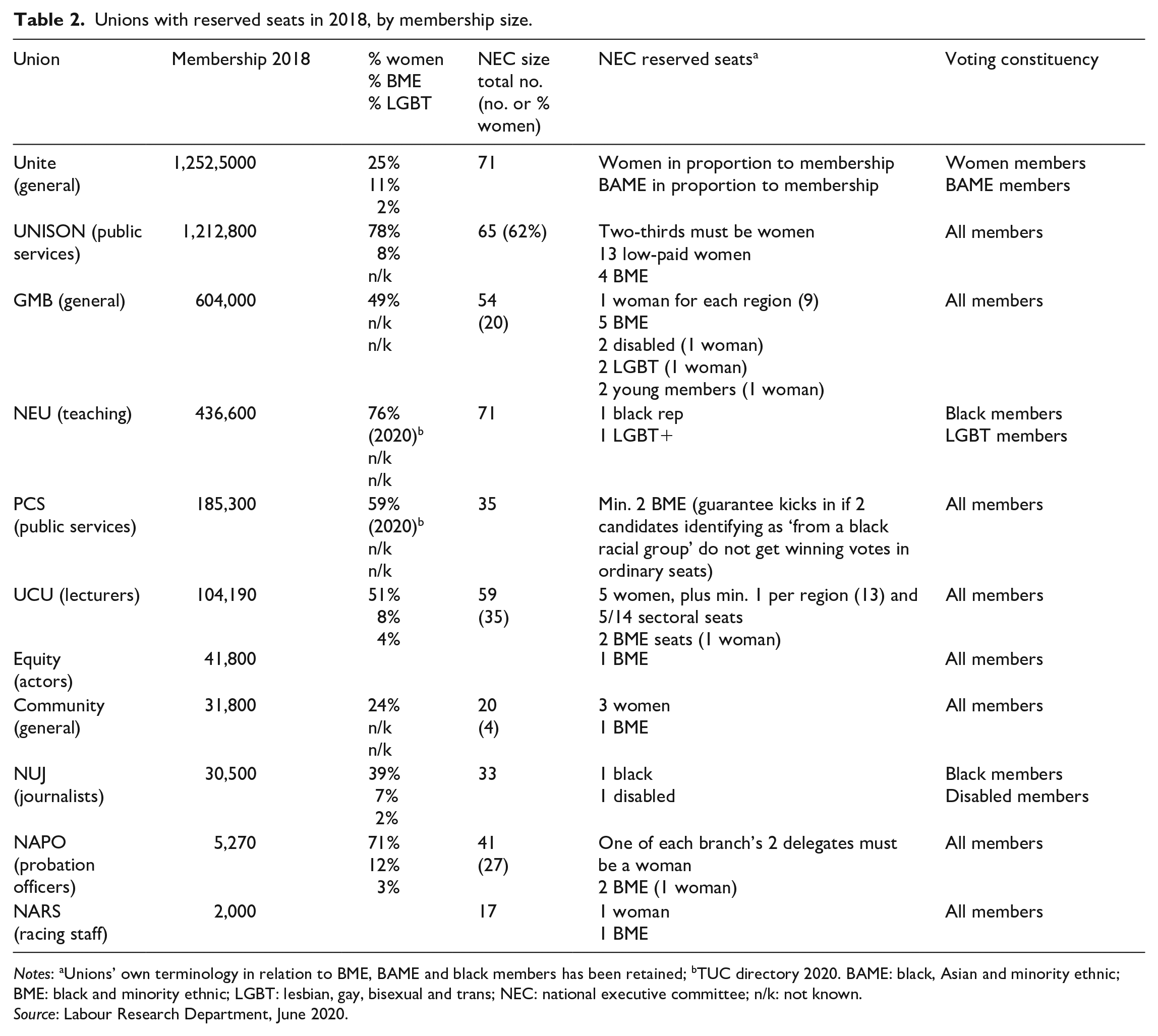
Notes: aUnions’ own terminology in relation to BME, BAME and black members has been retained; bTUC directory 2020. BAME: black, Asian and minority ethnic; BME: black and minority ethnic; LGBT: lesbian, gay, bisexual and trans; NEC: national executive committee; n/k: not known.
Source: Labour Research Department, June 2020.
The constituencies for election of representatives to these seats vary, and the FBU was unusual in only permitting members of the groups represented to vote for these positions. Just three unions had rules allowing election by member constituencies only. One is the UK’s largest union, Unite, with a 71-member NEC and reserved seats for women and BME members in proportion to their membership size (25% and 11%, respectively), elected by those constituencies. The other two in which voting is by the group only, NEU and NUJ, also have larger NECs than the FBU, each having one BME and one LGBT seat.
However, for heavily male-dominated unions such as the FBU – 93% male membership – it would be problematic to allow all members to vote for a women’s seat, for example, which could result in the male majority electing a woman whose views did not represent the female membership, thereby nullifying the objective of giving women a voice. Such outcomes could not occur in a union with 70% female membership, such as UNISON, which allows all members to vote for reserved seats.
The approach adopted by Italian union confederation CGIL is apposite. The union’s committees require quotas of 8% of members from migrant backgrounds, who are nominated by migrant committees, but elected according to the union’s general procedures (Marino, 2015). Migrant representation developed from the model of 40% quotas in operation for women members, with the requirement for approval of women’s committee nominees by all members, described as a sort of ‘double validation’ (Beccalli and Meardi, 2002: 122). Marino notes that the general approval of migrant representatives is because they are ‘representatives of all workers and not only of the migrant constituency’ (2015: 835). This perception contrasts with the FBU’s remit of reserved seats to represent only group interests, based on the parallel voting structures for sectional constituencies.
Discussion
The legitimacy of group representation has been questioned in other unions. McBride argued that UNISON’s self-organised structures, which operate alongside representation through service group (sector) structures, mean that representatives are ‘derived from two fundamentally different forms of democracy’ (2001: 415). In essence, common-sense notions of fairness are challenged when equal status is accorded to ‘the representative who has gained legitimacy through open election with the representative who has gained legitimacy through their membership of a social group’ (McBride, 2001: 415). Humphrey (2000: 268) also noted the problematic ‘duality between universal rights for all and group-specific rights’ inherent in UNISON’s structures. As in the case of the FBU, the legitimacy of this dual system of representation is further questioned when one set of reps are elected via workplace structures to represent widespread industrial concerns and another elected to represent sectional interests, but both have an equal say in determining union policy on industrial matters affecting all members.
Young does not consider the breadth of the remit for group representation, but proposes that groups have a ‘veto power regarding specific policies that affect a group directly’ (1990: 184). Her emphasis is on institutional mechanisms and resources to enable the self-organisation of group members, so that they can collectively articulate group perspectives to be taken into account in mainstream decision-making processes.
The changes made by the FBU in 2012 did not question the self-organised structures, which continue to be supported by the union, although with more limited resources since their secretaries lost full-time officer status in 2011. However, institutional mechanisms and resources are key requirements for Young’s (1990) group-differentiated democracy to function effectively.
Colgan and Ledwith (2002) have argued that participatory democratic measures such as self-organisation offer more radical potential for change than representative measures, which are necessary but insufficient. Young emphasises the necessary interdependence of representative democratic structures and participatory forms such as self-organisation. Where group organisation is not seen to be strong or effective, the mandate of group representatives can be questioned, as in the FBU. The data do not permit verification of interviewee claims that reserved seat reps did not have a mandate from their members, but, significantly, this perception from those outside the groups contributed to challenging the legitimacy of group representation.
In the FBU context, the question remains as to whether participatory measures are sufficient without mechanisms at executive levels of the union. Since the loss of reserved seats in the FBU in 2012, women have been present on the NEC by virtue of election to regional positions in six out of nine years to 2021, and through the reserved seat for control staff until 2015 when this position was abolished (along with the officer and retained members seats). For three years from 2018 to 2020, the union had an all-male NEC. A survey by the journal Labour Research reported one BME EC member in 2020 (Labour Research, 2020a). Reserved seats may offer continuity of women’s representation, ‘especially in male-dominated unions where the departure of just one or two women from mainstream positions/committees can leave a large gender representation gap’ (Kirton, 2017: 276).
In response to the first question posed about the conditions under which particular equality measures gain or lose democratic legitimacy among union memberships, analysis pointed to contextual factors, including the political priority given to particular forms of equality mechanisms, and allocated resources. Defeat in a major industrial conflict in 2002–2004 resulted in a change in union leadership, while attacks on jobs, terms and conditions provoked a refocusing of industrial priorities, and financial constraints. Fryer and Williams’s (2021) reflection on the elements that contributed to the ‘trail-blazing’ introduction of reserved seats for women in the National Union of Public Employees (now part of UNISON) in 1975 highlights the importance of leadership, member activism and ongoing equality reforms. The analysis presented here adds consideration of the conditions under which reforms may also be undone.
Further, in response to the second question, this article has uniquely addressed the specific rules for representative democracy. In one sense, the FBU’s structures were no different from other unions, with parallel equality and sectoral structures promoting both participatory and representative differentiated democracy (McBride, 2001). However, other unions had advantages in terms of maintaining legitimacy for reserved seats. First, the rules for women’s and BME representation on the NEC in some unions were based on the unassailable principle of proportionality of membership, in UNISON’s case a majority female membership of around 70%. However, where women, BME and LGBT members account for such small numbers, proportionality is not an appropriate target (Kirton and Greene, 2002), especially where numbers of BME or LGBT may be unknown due to inadequate monitoring or reporting. Such considerations support Young’s contention that fair group representation should be based on articulation of group perspectives, rather than determined by numerical strength. Second, NEC size matters: the FBU’s reserved seats were proportionally greater than for unions with NECs two or three times larger. The votes of equality sections could therefore have more influence and be questioned, especially when representing a challenge to the leadership. Similar concerns may arise in other smaller unions. Third, in most unions, reserved seats were elected by all members, giving them some kind of universal mandate and removing the objection that minority members had additional votes. However, this measure is problematic in a union with the demographic composition of the FBU, where minority members’ views would be lost. A possible solution may be the ‘double validation’ of positions for women and migrants in the Italian confederation CGIL whereby candidates are nominated by the groups themselves, but then confirmed by the whole membership (Marino, 2015). A final objection to the FBU’s reserved seats was the question of remit. The leadership under Wrack believed that the equality groups’ influence over industrial and general union matters was illegitimate. Their remit went beyond Young’s (1990) principle of legitimate representation of a group’s own interests or perspectives. Yet group members may have multiple or intersectional ‘interests’; as a former women’s activist put it, ‘everything I ever did in my workplace for women was all about improving the lives of all working people, including women’.
Conclusions
The article is the first to evaluate the conditions for the removal of radical equality measures within a UK trade union and to provide a detailed comparison of UK union rules for election and representation through reserved seats. The article sought to understand a decision made by the FBU in 2012 to remove reserved seat representation of women, BME and LGBT members at the highest levels of the union, a move that ran counter to prevailing practice on increasing the inclusion of under-represented groups within UK unions. Conceptually, such practice is underpinned by Young’s ideas of group-differentiated democracy that legitimated measures to support under-represented groups to overcome structural disadvantage (Young, 1990). In exploring the tension within and between participatory and representative models of union democracy, the article traced the evolution of the FBU’s establishment of self-organised groups for women, BME and LGBT members, followed by representation on national and regional executives. Initially, the union overcame objections that group representation weakened collective class-based solidarity, by highlighting its compatibility with the union’s socialist principles.
The analysis of the conditions under which targeted equality measures gain or lose democratic legitimacy suggests that the external context is highly significant. When the FBU introduced its equality reforms, the union was operating in a supportive political climate for equality within the fire service and, arguably, under a Labour government committed to improving equality legislation and tackling inequality. However, the fallout from the 2002–2004 pay and modernisation dispute resulted in the replacement of a leader associated with its failure, who had been closely connected with the union’s equality measures. In responding to local disputes, stringent fire service cuts and attacks on pensions, the union faced financial pressures, and residual underlying tensions over democratic legitimacy surfaced. Challenges focused on structures for representative democracy in the form of reserved seats for women, BME and LGBT members, but did not extend to self-organisation itself.
Equally important to understanding the FBU’s removal of reserved seats was an examination of how particular forms of additional representation – the voting rules and remit of the additional representatives – influence their perceived legitimacy among lay representatives. In the light of Young’s view that representation should be based on articulation of group perspectives, rather than numerical strength, the case of the FBU suggests that reserved seats based on proportionality are not appropriate for a union with such small minorities of women, BME and LGBT members. The level of women’s or BME membership at which it is appropriate to apply proportional representation remains an open question and may be affected by the uneven geographical spread of BME populations across the UK (Kirton and Greene, 2002). In the case of LGBT membership where numbers may be unknown and small, proportionality offers little promise of representation. A further challenge for a union such as the FBU with a predominantly male, white and heterosexual membership is identifying the appropriate constituency for electing the reserved seats. In female-dominated unions such as Unison, or those with larger proportions of BME members, reserved seats can be elected by all members without risk of overshadowing the voices of minorities. Small unions also face further difficulties in maintaining legitimacy for additional representation where executive committees may be small and the reserved seats therefore have a greater effect on decision-making. In unions with larger executive bodies, minorities can be given a say without it appearing disproportionate. Related to this is the question of remit. The article showed that the FBU equality groups’ influence over industrial and general union matters appeared to exceed Young’s (1990) principle of legitimate representation of a group’s own interests or perspectives. However, compartmentalising ‘interests’ when individuals may have multiple or intersecting interests is not simple.
Existing scholarship tends to concur that both participatory and representative democratic measures are needed for an effective balance between autonomy and integration (Briskin, 1999), and that without functioning self-organisation to formulate the perspectives of marginalised groups, additional representation cannot be legitimate (Colgan and Ledwith, 2002). However, the jury is still out on the longer-term effect of the loss of reserved seats in the FBU, and whether self-organisation without top-level representation can effectively mainstream the concerns of minority members in the bargaining process, raising significant questions about confining their representation to ‘non-industrial’ matters. For male-dominated trade unions seeking to advance equality for minority members, the article offers an example of what can be achieved, as well as insights into how the particular forms of representation may face challenge on grounds of democratic legitimacy.
Footnotes
Acknowledgements
The authors would like to thank all the interviewees for their participation in the research, FBU head office staff and Dave Smith, who conducted some interviews. Thanks also to Clare Ruhemann at the Labour Research Department for compiling data on union rules.
Funding
The authors disclosed receipt of the following financial support for the research, authorship, and/or publication of this article: some of the research data analysed in this article was part of a wider study commissioned from the authors by the Fire Brigades Union.
