



Abstract
Prevailing dualisms of work as formal, paid employment on the one hand or informal, unpaid domestic labour on the other, means volunteering is often overlooked. Although academic interest in voluntary labour is growing, it remains inadequately theorised in the sociology of work. A more sociological meaningful understanding of volunteering is needed. Through an analysis of voluntary body work labour, this article advances theorisation of volunteering as work in two ways. Firstly, the article invokes a total social organisation of labour approach to overcome the paid/unpaid work dichotomy. Secondly, it grounds this theorisation empirically by drawing on the volunteers’ insights into their delivery of body work labour to shed new light on the complex ways in which volunteers frame labour within wider social relationships.
Keywords
Introduction
Despite important contributions to the field, voluntary labour remains inadequately theorised within the sociology of work. Persisting binaries between paid work in the public sphere and unpaid work within the family result in unpaid voluntary labour being overlooked as a form of work. This under-theorisation of volunteering as work has been exacerbated by the continued framing of volunteering as a leisure and citizenship activity and therefore in contrast to ‘work’ (Read, 2021; Taylor, 2004). This article advances theorisation of volunteering as work in two ways. Firstly, by invoking a Total Social Organisation of Labour (TSOL) approach as a framework for understanding interactions between paid employment and various modes of unpaid work (Glucksmann, 1995, 2005; Taylor, 2004; Williams, 2011). Secondly, the article empirically grounds this theorisation by drawing on insights gained from volunteers in a study designed to explore relationships between volunteering and unpaid and paid working lives. The article draws on the complex ways in which volunteers understand their voluntary body work labour to inform the theoretical generalisation about the processes involved.
To achieve these aims, the first section of the article begins with a brief overview of recent changes in the UK voluntary sector and the growing significance of voluntary labour in the health and social care subsectors. Next, it reviews the ways in which voluntary labour has been understood in previous literature, before proposing the TSOL framework as a means of achieving a nuanced conceptualisation that responds to calls for more sociologically meaningful understandings of volunteer labour (e.g. from O’Toole and Grey, 2015). Finally, the review of extant knowledge turns to the concept of body work. To date, body work is almost exclusively theorised in the context of paid work. However, body work presents a particularly fruitful field for the article’s purpose of advancing theorisation of unpaid voluntary labour because who can carry out such labour and how it takes place is strictly demarcated.
The second section sets out the methodological approach, research context and methods of analysis before turning to the third section in which these arguments are empirically grounded using data from a study of six health and social care organisations in the UK non-profit sector. Finally, the contribution of these findings for advancing theorisation of volunteering within the sociology of work is discussed.
The UK voluntary sector context
Over recent decades, successive UK governments have outsourced more and more public service delivery to the voluntary sector (Aiken and Harris, 2017; Cunningham and James, 2009; Davies and Baines, 2011; Egdell and Dutton, 2017). The sector has grown in terms of the numbers of organisations, levels of employment and the receipt of public funds. Growth has been accompanied by a transformation of the funding environment to marketised, competitive contracting for scarce funding in a landscape now pervaded by the principles of New Public Management (Baines et al., 2011; Cunningham and James, 2009; Cunningham et al., 2014; Fine and Davidson, 2018). Widely publicised instances of mis-governance (e.g. in Kids Company (Grierson, 2015), Oxfam (O’Neil, 2018) and Save the Children (Dalton, 2020)) and dubious fundraising tactics (see e.g. Smith, 2015) have lent further impetus to growing demands for accountability in the spending of public money. Years of austerity have led to increasing demand for services, resulting in many non-profit organisations feeling under pressure to provide more and more for less and less (Venter et al., 2019). Grant funding has been almost entirely replaced by contracts and contract-like arrangements within which funders demand evidence of cost efficiencies, standardisation and performance measured according to clear targets (Baines et al., 2011; Egdell and Dutton, 2017). Securing increasingly scarce funding has become a highly competitive process and non-profit organisations are required to appear demonstrably professional and business-like to compete (Baines et al., 2013; Maier et al., 2014; Read, 2021). Despite concern at the impact of these changes, many non-profit organisations have embraced this demand for professionalisation (Read, 2021) and both academic and practitioner interest in the adoption of practices more usually associated with the private sector is growing (Curran et al., 2016; Read, 2021; Shirinashihama, 2019).
The growing significance of voluntary labour
Volunteering is defined as ‘any activity in which time is given freely to benefit another person, group or cause’ (Wilson, 2000: 215). All voluntary organisations by definition include an element of voluntarism, but in the environment described above, voluntary labour has become critical for the survival of many non-profit organisations. In the UK, approximately a third of adults (36%) volunteer formally (through an organisation) at least once a year and almost a quarter (22%) at least once per month (NCVO, 2020). Still more people (52% of the working age population) volunteer informally, providing unpaid help to others outside their family at least once a year, with 26% of people doing so regularly (NCVO, 2020). While motivations to volunteer are varied (Wilson, 2012), common among them are some kind of calling or desire to contribute to a moral good (Greene and Robbins, 2015; Grönlund, 2011).
Despite the important contribution of volunteer labour in the delivery of public services, volunteering remains inadequately understood. In part, this is because traditional theories of work focused almost entirely on paid labour, which has long been distinguished from unpaid work that takes place within the family, in the home. Although feminist theorising drew attention to the economic and social value of unpaid labour within the household, unpaid labour outside the home, including voluntary labour within formal organisations, continued to be overlooked (Taylor, 2004). Perceptions of volunteering as a form of citizenship or leisure activity and less commonly as ‘work’ have persisted (Overgaard, 2019; Read, 2021). Prevailing stereotypes of volunteers as largely middle-class women who are not in paid employment, or a leisure activity for those who are (Allan, 2019), serve to further distance volunteering activities from ‘work’ and establish volunteer labour in contradiction to professional labour (Ganesh and McAllum, 2011).
The link between paid work and voluntary work is now being made. The precarity of employment in a neoliberal context has been linked to volunteering, which is suggested to offer ‘hope labour’ (Allan, 2019), by which individuals invest in their skills development seeking to increase their employability. However, even where volunteering is considered as work, persisting binaries between paid and unpaid work fail to capture the nuanced ways in which volunteering is embedded in wider social structures and relationships.
The health and social care subsector
Health and social care services is the largest subsector in the UK non-profit sector in terms of number of organisations and income received and is heavily reliant on government income as its largest source of funding (NCVO, 2020). Within the framework of New Public Management, regulation and market competition have been seen by the state as the solution to longer-term cost efficiencies and competitiveness across health and social care. These solutions place the state in the ambiguous position of both ensuring quality and legitimacy while simultaneously maintaining sufficient distance to avoid detracting from the intended appearance that marketisation and competition will drive up quality, increase efficiencies and reduce costs (Breslin and Wood, 2015). Consequently, target-driven performance measures have become central within funding contracts. Elusive funding has increased the importance of unpaid work to the sector. Baines et al. (2017) suggest that employers have utilised unpaid labour to supplement and replace paid care labour, ‘filling the gaps’ created by funding cuts. Unpaid labour may be compelled or coerced from paid employees, often drawing on gendered assumptions of women’s labour and pressurising the most precariously employed to demonstrate their commitment to the organisation through additional unpaid labour (Baines et al., 2017).
The dualism of work and care is well established, though widely problematised (Ungerson, 2005). The case for distinguishing caring about (care in feeling terms) as compared to caring for (tasks associated with care) has also long been made (Graham, 1983), and despite its crudity continues to persist within the literature (Ungerson, 2005). Volunteers again occupy a liminal position between these conventional understandings of care work: considered neither a professional paid workforce nor unpaid kinship carers (Ganesh and McAllum, 2011).
The total social organisation of voluntary labour
The perceived shortage of volunteers at a time when voluntary labour is seen as a ‘cost effective weapon’ to address ‘societal ills’ (Taylor, 2005: 121) has led to an emphasis in sociological literature on the relationship between individual sociodemographic characteristics and volunteer motivations from an organisation resourcing perspective. This has encouraged a focus on the implications of such findings for Human Resource strategies. For example, how volunteers may be recruited and engaged (e.g. Willems and Dury, 2017) and the causes of burnout and dropout (e.g. Cox et al., 2018; Hamerman and Schneider, 2018). This has resulted in a wealth of information on who volunteers and their individual choices and motivations to do so. However, meaningful understanding of voluntary work demands significant contextualisation within the wider social relations that shape it. More recent research highlights the complex ways in which volunteering is embedded in wider social relationships (e.g. Kelemen et al., 2017; O’Toole and Grey, 2015; Read, 2021; Ward and Greene, 2018). However, this remains embryonic and the call for a more socially embedded meaningful understanding of volunteering (O’Toole and Grey, 2015) is still needed.
This article offers a two-stranded approach to answering this call. Firstly, it advances existing theorisation of voluntary labour as unpaid work by extending the TSOL models of Taylor (2004, 2005), Williams (2011) and Williams and Nadin (2012). Secondly, the article grounds this theorisation empirically by drawing on the insights from volunteers themselves to demonstrate the complex, multifaceted and socially embedded ways in which they understand their voluntary labour.
Glucksmann (1995, 2005) and Lyon and Glucksmann (2008) conceptualised the total social organisation of labour to better understand the wider relationships that inform labour and to break down the dualism between paid employment in the public sphere and unpaid work in the private sphere. Taylor (2004, 2005) developed this work to reconceptualise volunteer labour, arguing that traditional theorising of work as taking place in two discrete spheres of public paid labour or private unpaid labour excluded voluntary labour from sociological understandings of work. As illustrated in Figure 1, Taylor (2004) modelled public/private work cross-cut by paid/unpaid work to propose a framework of six interconnected work domains within which individuals’ labour could be mapped, highlighting the social interconnections between paid and unpaid labour in these domains.
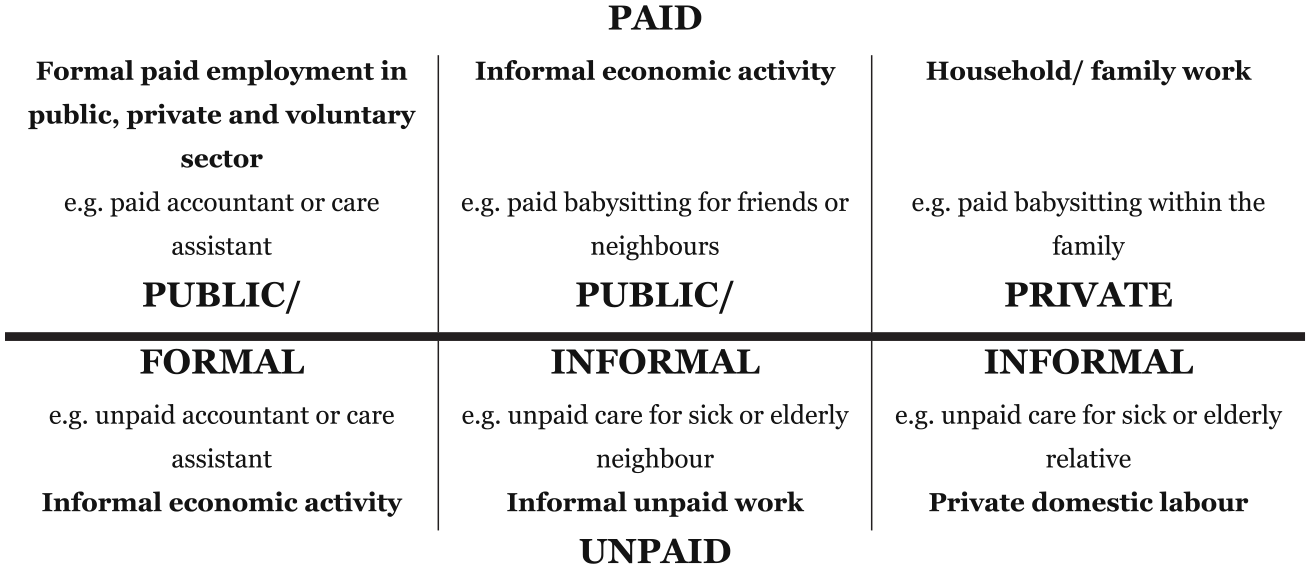
A framework showing the organisation of labour.
Taylor’s model was extended by Williams (2011) and Williams and Nadin (2012) to capture formal paid and unpaid work and to capture informal reimbursement and favour exchange in different forms across public and private spheres. They argue that seeing paid/unpaid and formal/informal not as cross-cutting dualisms but rather as continuums, illuminates the seamless ways in which individuals may move between these categories. Baines (2004) and Baines et al. (2017) propose an additional continuum in the social organisation of unpaid labour to reflect the ways in which this may be compelled or coerced by employers. Baines et al. (2017) highlighted how employers in social care were responding to austerity by ‘filling the gaps’ it created with unpaid labour through the compulsion and coercion of the most precarious paid employees to provide unpaid labour which is normalised as part of the job. This has also been documented in the experiences of domiciliary care workers (Venter et al., 2019).
This work on the social organisation of labour has challenged the notion that a job must be either formal and paid or informal and unpaid. However, much of this focus has been on the ways in which different forms of work are situated in different domains. The current article draws on the insights from volunteers using a TSOL model to highlight how specific forms of labour may be repositioned by those carrying it out, to reflect complex understandings of their voluntary labour, blurring categorial distinctions and reframing formal unpaid voluntary labour in the public domain in relation to social relationships of other domains. Through these insights, we see how volunteers’ own framing of their work may bring them into contradiction with organisational framings imbued with the ethos of the professionalisation agenda.
The empirical grounding for this theorisation is an ethnographic study of volunteers in six health and social care organisations. The article uses the insights from volunteers themselves about the complex, multifaceted ways in which they understand a particular form of their voluntary labour, their body work labour. Body work provides an especially fruitful field for this exploration because voluntary organisations construct strict demarcations of who does and does not undertake body work labour and how and where they may do so.
Body work labour
Body work has been used to describe work undertaken by individuals on their own bodies and on the bodies of others. Twigg et al. (2011: 171) define body work as that which ‘focuses directly on the bodies of others: assessing, diagnosing, handling and manipulating bodies, which thus become the object of the worker’s labour’. Body work also includes ‘care or remedial work on the body by nurses, paramedics, doctors or care workers’ and ‘teaching others bodily deportment or movement in so far as this requires touching or (re) positioning others’ bodies’ (Cohen and Wolkowitz, 2018: 42–43). The amount and nature of touch required by different forms of body work varies and diverse forms of labour on the bodies of others are considered within extant literature (Cohen and Wolkowitz, 2018; Wolkowitz, 2006).
Research on body work has included the care of bodies as an object of science by doctors and nurses. Here the most basic and messy elements of body work are found in the lowest status occupational roles, with distance from the body tending to increase as one ascends occupational hierarchies (Twigg, 2000; Twigg et al., 2011). Others have explored body work in relation to improving the appearance and beautification of the bodies of others; for example, hairdressers (Cohen, 2010), beauticians (Kang, 2013) and the giving of pleasure, for example, through massage (Purcell, 2013) or sex work (Chen, 2018). Body work also includes the low status work of dealing with messy, unattractive bodily waste, such as work undertaken by lavatory cleaners or undertakers (Jordan et al., 2019; Twigg, 2000). Body work also refers to the management of ‘embodied emotional experience and display’ and ‘the production or modification of bodies through work’ (Gimlin, 2007: 353).
Common within these definitions is the emphasis on work that is ‘paid’. Volunteer labour as an ‘unstable category’ (Twigg et al., 2011: 173) outside the informal family sector and outside paid employment has been excluded from these body work analyses. That volunteers are kept away from this kind of labour is reinforced in practice in the ways organisations formally organise and regulate body work. The adoption of institutional rules has been used by organisations to achieve an external legitimacy (Breslin and Wood, 2015). In the case of body work, such rules enable organisations to demonstrate to funders a strict demarcation as to who is allowed to provide body work labour and who is not, emphasising body work as a professionalised task. However, this article argues that while volunteers were formally distanced from body work in practice, many were involved in its delivery. The article advances theorisation of voluntary labour by applying a total social organisation of labour lens to the empirical insights drawn from volunteers’ complex understandings of their body work labour to develop a nuanced, socially embedded theorisation of volunteer work. This is also important for practice, firstly because rendering volunteers’ body work invisible has implications for volunteers, for non-profit organisations and for those who rely on them. Secondly, this theorisation has practical implications through its explanatory value in making sense of the contradictions between organisational depictions of body work and volunteers’ experiences.
Research design, methodology and analysis
The empirical study on which the article is based explores experiences of volunteering in six health and social care organisations in the UK non-profit and voluntary sectors. Organisations were purposively selected to incorporate a range of funding arrangements and sizes. All organisations had at least one paid member of staff and relied significantly on volunteers for service delivery. Details of the organisations can be seen in Table 1.
Case study organisations.
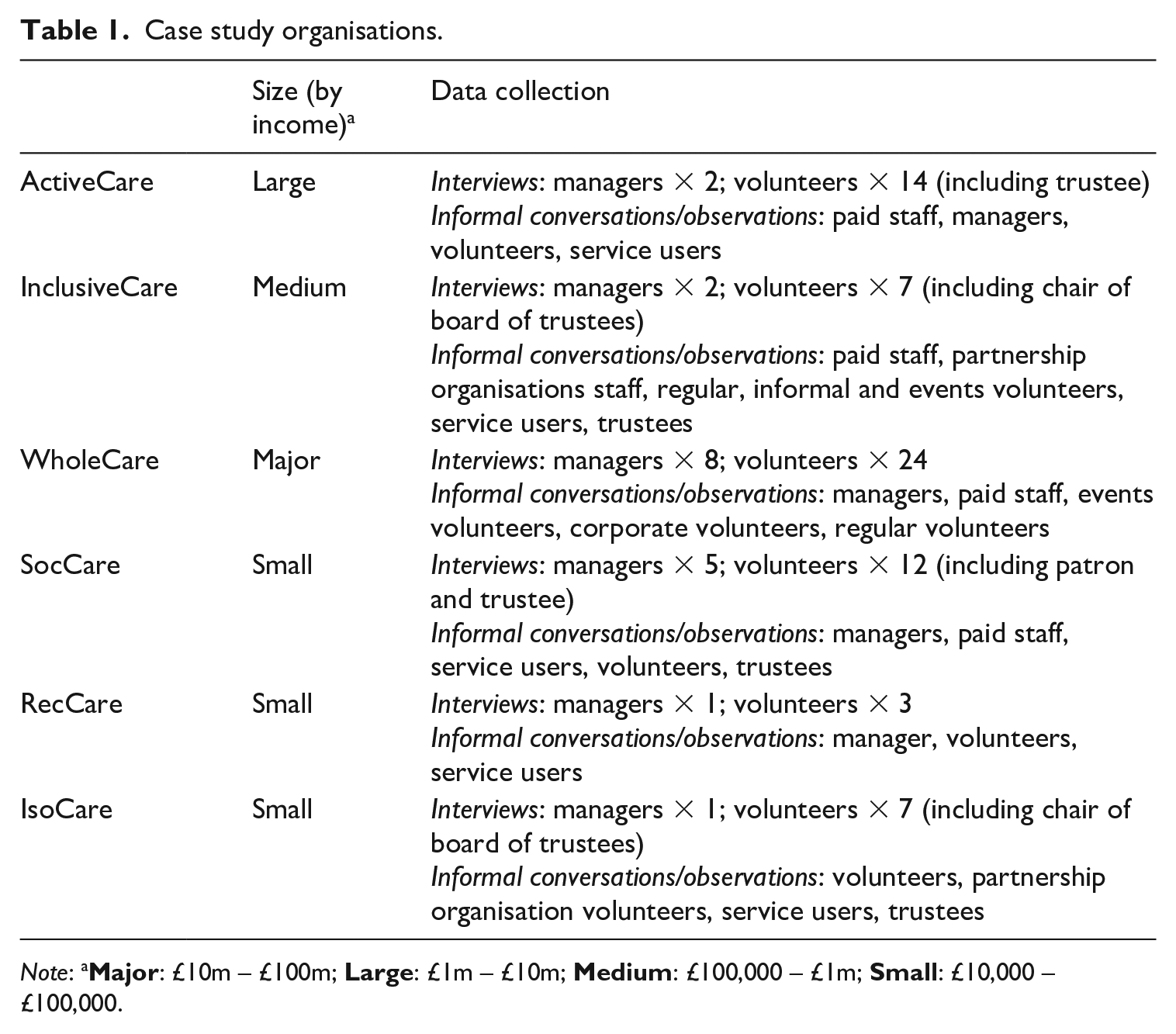
Note: a
The research employed a multi-tiered ethnographic method over a two-year period comprising participant and non-participant observation, volunteering diaries and the collection of audio, visual and written fieldnotes. Ninety-three visits were made to organisational sites and 259 hours of observations were undertaken across the six organisations. In addition, 86 semi-structured interviews were conducted with 67 volunteers (including five trustees) and 19 managers. One-to-one interviews with volunteers were supplemented with two focus group interviews: one conducted with four Gujarati-speaking volunteers and a translator, and one with five ‘corporate volunteers’ given time by their employers to engage in one-off volunteering days. The volunteers comprise 23 men and 44 women. Volunteers ranged in age from 21 to 83 with the majority skewed towards the older age range. This is representative of the volunteer population more widely (NCVO, 2020). The data were supplemented with organisational and third-party documentary data.
Volunteers were invited to be interviewed at an appropriate location of their choice. Interviews took place at participants’ homes, the organisational or in nearby cafes. Interviews began by exploring participants’ first awareness of volunteering, asking the question, ‘When did you first become aware of volunteering – your own or someone else’s?’, and subsequently a biographical approach covering paid work, voluntary work and home, family and leisure lives.
Data analysis
The interviews, fieldnotes and observations were recorded, transcribed and analysed using NVivo 11. An abductive analytical approach was taken rather than a solely inductive approach (Timmermans and Tavory, 2012), enabling the generation of theory from the data while also being sensitive to extant knowledge within the field (Deterding and Waters, 2021). Analysis followed Deterding and Waters’ (2021) ‘flexible-coding’ approach, which capitalises on the facilities provided by qualitative data analysis software.
The first stage of analysis comprised re-familiarising myself with the data: re-listening to audio recordings and re-reading transcripts, fieldnotes and diaries. During this stage transcripts were linked to person-level and site-level demographic attributes. Next, broad-level categories linked to the interview schedule, key broad topics pursued in the research, and key concepts and debates in the literature were developed to index the transcripts. Index codes were then applied across all data. Memos were used to capture the stories emerging from the data and to document initial thoughts on emergent themes, unexpected findings and early thoughts on relationships between concepts. Following the indexing stage, a more focused reading of data captured under each broad topic was undertaken to enable further development and application of analytic codes. A similar approach was taken with supplementary data from organisational and third-party documents. After the analytical coding phase, the data were further interrogated to explore how the emerging stories were grounded in the wider data. This phase drew out trends between cases and ensured that all data were considered, that unusual events were not over-emphasised and that data that diverged from patterns were not overlooked, enabling alternative explanations to be continuously considered and explored.
The following section presents the research findings. These findings highlight that organisations made clear distinctions between paid worker and volunteer roles in body work. Rules were in place to emphasise and consolidate these distinctions. However, despite formal rules, volunteers delivered body work labour by using the liminality of their position to reframe their work as professional or familial, formal or informal and inside or outside of the organisation, in order to give what they felt was the ‘authentic’ care they were there to deliver.
Formalising body work labour
All the case study organisations stipulated that volunteers did not undertake body work labour. How management formalised this varied according to organisational size, services delivered and the extent of regulation organisations were subject to. Body work was situated as the domain of paid professional contracted staff. Exceptionally, body work labour might be formally part of a voluntary role where volunteers were recruited to an employment-like contract in a professional capacity as a member of an association, often governed by professional codes of conduct, with commensurate certification (e.g. complementary therapists, hairdressers).
Where formal role descriptions existed, these explicitly distanced volunteers from body work labour. Role descriptions excluded (often explicitly) tasks likely to involve body work, focusing instead on affective, relational outcomes (e.g. to ‘improve the individual’s self-confidence and emotional well-being’ and ‘to reduce social isolation’). Volunteer roles were framed as the affective, emotional caring about service users. Thus, volunteers were encouraged to build relationships of ‘friendship and trust’ that required ‘reliability’, ‘patience’, ‘friendliness’, ‘good communication skills’ and a ‘genuine interest in making a difference’. Rules emphasised that volunteers should not be involved in task-oriented work that a paid carer might undertake (e.g. personal care, administering medication, attending medical appointments, dealing with financial issues). Organisational monitoring practices reinforced these rules, which were further legitimated by the professionalisation agenda.
Voluntary body work labour
Despite organisational representations of their roles, volunteers described delivering body work. For many volunteers that involvement was critical to complex understandings of their voluntary work. Some body work involved more frequent and more intimate touch than others. For example, Eva described physical care work on the body highlighting the lack of predictability (particularly around toileting), which generated circumstances where body work seemed unavoidable: It was a physically demanding four hours, very. I had to buy something to strap my back so that I could carry her to the loo and I did things that I really wasn’t expected to do but what do you do if she has to go to the loo? (Eva – WholeCare)
Similarly, Jenny explained: She was in a wheelchair, she couldn’t move around and she was saying her carer couldn’t get there until a certain time, so she said [whispers]: ‘I won’t have any coffee because I won’t be able to go to the toilet’. So I said: ‘No, have your coffee. I don’t mind coming with you if you want to go into the loo.’ [. . .] I tried to do it as sympathetically as possible so as not to embarrass her (Jenny – InclusiveCare)
Others described work involving bodily touch to (re)position, guide and support the bodies of service users. For example: We sing, we have exercises and I sit with them, well, like Sarah, and helping her lift her legs up and things. (Vivienne – ActiveCare)
Volunteers were aware of the rules but suggested that, while some were ‘unbreakable’, others required a ‘flexible approach’ in order to give the type of care they believed central to the organisations’ social mission: They [management] are aware of this, of course they are aware of it, but they give us ‘guidance’ and some really unbreakable rules. The unbreakable rules are to do with confidentiality for example. I mean, that is an absolute strict one, or receiving gifts. (Eva – WholeCare)
The total social organisation of voluntary body work labour
Invoking a TSOL lens enables us to advance the theorisation of voluntary body work by highlighting how volunteers understand their labour in relation to the social organisation of work in multiple domains. Previous research (Taylor, 2004, 2005; Williams, 2011; Williams and Nadin, 2012) has highlighted how individuals may be simultaneously involved in work that falls into a variety of categories or sits at different points of paid/unpaid and formal/informal continuums. This article extends that theorisation by illustrating how volunteers are engaged in a dynamic, ongoing process of framing and reframing of their voluntary labour that permeates boundaries between work domains. This is explored and illustrated further through mapping volunteer experiences against the TSOL domains of work. We begin with Eva’s story and use the experiences of other volunteers to expand this explanatory framework.
At the time of the research Eva had been retired for approximately five years. She had been involved in formal and informal community volunteering since her youth. Eva was employed part-time while she cared for her young children. Her career consisted of a series of part-time and full-time formal paid employment positions. At the time of interview, Eva had been formally volunteering for WholeCare for two years. Eva framed her volunteer labour in WholeCare in complex ways. For Eva, an important aspect of volunteering was that it gave her a ‘professional identity’, a ‘public persona’ after retirement. She talked of volunteering as pseudo paid employment: ‘It’s my job, so I consider myself staff, just unpaid staff’. She distinguished herself from other volunteers who she suggested were often over ‘earnest’, ‘altruistic’ and ‘very religious rather than professional . . . like the staff, like I am’. Buying ‘equipment’, including the back brace mentioned earlier, emplaced paraphernalia that further cemented her self-perception as a ‘skilled professional’. Eva framed her volunteer work as formal and professional, using this to justify stepping outside the rules and redrawing boundaries. In apparent contradiction, in other instances Eva repositioned her labour as informal and unpaid. Again, using this to justify moving outside the rules: They [the rules] make sense. With this lady I’m telling you about they caused difficulties in the sense that I abandoned WholeCare, I let it go and did my own thing, and so I spent more time there or I’d go more than once a week, I’d go a few times . . .. I went native, it became personal and so it wasn’t that I abandoned WholeCare . . . when I say I abandoned them, I mean I simply stopped abiding by their limitations, that’s all. (Eva – WholeCare)
The betwixt and between liminality of volunteering blurred boundaries which the volunteers redefined through a dynamic reframing of their labour, which they positioned and repositioned along the public/private, formal/informal dimensions in order to deliver what they saw as ‘authentic care’.
While professional identities formed part of the reframing for some volunteers, for others communal and kinship work identities underpinned the reframing. Like Eva, Vivienne’s paid employment and volunteering were interconnected. Vivienne volunteered for the social contact it gave her. However, her certified workplace skills (in health and safety and food preparation and hygiene) made her valuable to voluntary organisations. Vivienne was repeatedly asked, ‘Will you come and help us since you’ve got your certificates?’, resulting in her being ‘drawn into’ areas requiring these skills in the voluntary organisations she encountered as a part of family life. Thus, through familial care roles, she became involved in volunteering initially at her children’s school, later at her bowling club and at ActiveCare, which she attended to accompany her husband who was an ActiveCare service user until his death.
Vivienne was critical of funding cuts that reduced the social opportunities that had been so important to her and her husband. She saw her role as being to ‘make people’s lives better’ and to give those who could ‘not do anything’ the opportunity to ‘have fun’ and ‘enjoy themselves’; lifting their legs so they could move, holding them up so they could dance, or holding and guiding their hands so they could feel what they were making/sewing/crafting. Vivienne distinguished this ‘helping people’ from what she saw as skilled, professional, task-oriented activities in the kitchen. Tasks Vivienne associated with professional work (e.g. managing the kitchen) required rigid rule adherence. Vivienne suggested that she was thought ‘bossy’ because of her insistence on this. However, she had made ‘friends’ among the individuals attending ActiveCare’s social groups. Vivienne did not see rules as any more relevant to how she socialised with these ‘friends’ than they were to friendships outside ActiveCare. Thus, she positioned this aspect of her labour as informal, unpaid and outside ActiveCare’s formal territory.
Others framed volunteering in relation to private informal kinship care in the family to deliver the care they believed necessary. Amanda explained: I couldn’t turn round and say ‘no’, you know, if she needed help and it’s something that we’re not . . . I mean, we’re not supposed to do the things that carers really do or, like, they pay somebody to do . . . I always sort of think, well, if that was my mum and somebody’s come to see her, I think, well what harm would that do, just doing that for her. (Amanda – ActiveCare)
Jenny explained, ‘I don’t see it as work’ and its ‘not really volunteering’, describing what she did at InclusiveCare as ‘just talking to people’ and doing ‘what was wanted and needed’. Jenny framed her volunteering with people with disabilities in relation to caring for her mother who, at the end of her life, was in a wheelchair. Volunteering enabled her ‘to do the same for somebody else’s mum’: I suppose there’s lots of people who wouldn’t even think of doing that, but again it’s because my mum, she ended up, although her mind was as bright as a button, her body had let her down. (Jenny – InclusiveCare)
Jenny saw willingness to be involved in ‘messy’ aspects of care ‘beyond what is expected’ as evidence of ‘real’ authentic care about recipients. This was common in the ways volunteers described what it was to care and what gave their volunteering meaning and value. For these volunteers, by virtue of volunteer labour’s betwixt and between position in the professional/familial care dualism, the physical, corporeal, messy care for leaky bodies became necessary to fulfil the affective, emotional caring about. For some, the willingness to undertake messy work as a volunteer distinguished them from those who were there because they were paid to be. Far from dirty work being perceived as low status (Buse and Twigg, 2018; Twigg, 2000), these volunteers prized their failure to be repulsed by dirty work as evidence of their commitment to ‘real’ care: I’d said from the beginning that I would tolerate anything and do toileting and, it doesn’t faze me in the slightest, any extreme. (Eva – WholeCare)
Perceptions of corporeal work adding value to care were widespread. Vivienne illustrated this as she mourned the loss of services in ActiveCare over her years of volunteering: We used to get them up and hold their hands and dance and it used to be wonderful for them because they were up dancing. (Vivienne – ActiveCare)
The value of volunteering, for Vivienne, came from enabling service users to do things that they would not otherwise be able to. Involvement in body work was fundamental to her feeling she was doing a ‘good job’. Physical support and manipulation were essential to making a difference.
In SocCare, volunteers supported parents, usually mothers, with young children. Volunteers described taking care of babies and young children to allow parents to do other things (e.g. attend hospital appointments, make baby food, undertake housework or deal with the demands of multiple children). This meant that SocCare volunteers were regularly explosed to tasks such as toileting young children and nappy changing.
Increasing dependence in old age, as bodies fail, is stigmatised, devalued and generates disgust (Buse and Twigg, 2018) in ways that the bodily waste, touch and nakedness of infants is not. Twigg (2000) uses the ‘dirty work’ of body work to explain why elder care is often attributed little value and represents something to be distanced from (Buse and Twigg, 2018). By contrast, in SocCare, body work focused on the bodies of babies and young children could be framed in this setting as feminised domestic labour. Despite organisational rules against volunteer involvement in toileting/nappy changing, reframing these activities as proxy private kinship care by female volunteers (all of whom were mothers or grandmothers themselves) rendered it unnoticed by virtue of its normalcy: Then, when it came to finish, she said to me: ‘I know you’re not family, but you feel part of our family now, you will still come and see us, won’t you?’ (Anne – SocCare)
The families the volunteers worked with provided ‘little surrogates’ for absent grandchildren or for children long since grown and left home. Thus, the gendered, framing of volunteer labour as pseudo-family rendered body work labour invisible and unremarkable.
While organisational documentation, rules and monitoring systems distinguished between task-oriented roles and emotive, relational roles, volunteers found that in practice they were often drawn (reluctantly or enthusiastically) into providing both. Familial care giving across these domains is highly gendered and male volunteers saw boundaries as less permeable, and rules less problematic, to their understanding of their voluntary roles. This is illustrated by Jeff, who, when faced with a toileting situation, saw clear boundaries marking where his involvement ended: . . . last time he couldn’t go from his bed to the toilet, and then he was about to have a piss and the seat was still down, which I noticed because I was guiding him in, but I wasn’t getting more involved than that: ‘Well, hang on, hang on Terry!’ (Jeff – ActiveCare)
The liminality of volunteer work resulted in volunteers attributing meaning to their labour by embedding it within wider social relationships across informal, formal, public, private and paid and unpaid spheres of social life. These findings show how volunteers navigate the rules of body work in relation to a broad set of social relationships across the domains of paid, unpaid, formal, informal, public and private spheres.
Conclusion
Voluntary work is not yet sufficiently theorised within the sociology of unpaid work. This is important as volunteer labour plays an increasingly significant role in the delivery of public services and unpaid work is becoming normalised within other forms of work, particularly care work (Baines et al., 2017). The current article advances theorisation of voluntary labour by applying a TSOL lens to make sense of the ways in which volunteers understand and legitimate stepping outside formal organisational rules and practice. The article achieves this purpose through the utilisation of body work as a fruitful site to examine volunteer labour owing to the strict rules around who can deliver such labour. Volunteer involvement in body work and the complexities of the associated labour processes are rarely acknowledged. This article redresses this by illuminating the body work undertaken by volunteers in non-profit health and social care organisations in the UK. Cohen and Wolkowitz (2018) argue that it is important to delineate body work from more general interactive service work because failure to do so means that the material nature of body work is rendered invisible by its conflation with the emotional, affective, nurturing concern of existing work on service labour. The present article demonstrates that this conflation has occurred in the case of voluntary care labour and suggests that an emphasis on the affective emotional element of voluntary labour has rendered the material and corporeal nature of that labour invisible. Marketisation of the sector and its associated emphasis on standardisation and efficiency (Baines and Cunningham, 2011; Cunningham et al., 2014) has further obfuscated the reality of voluntary care labour in these contexts. This lack of acknowledgement of volunteers’ body work poses practical problems for the management, organisation and deployment of volunteer labour, and for volunteers themselves.
By invoking a TSOL approach the article illuminates the wider social relationships that explain how voluntary body work labour is understood and performed and responds to O’Toole and Grey’s (2015) call for more richly detailed, ‘thick’ and meaningful conceptualisation of volunteering. Volunteers imbued body work labour with meaning that constructed it at times as employment-like and professional and at others kinship-like and familial. By contrast to paid work, where increasing status precipitates distancing from the ‘dirty work’ (Buse and Twigg, 2018), for some volunteers, involvement in the dirty, ‘messy’ work of body work exemplified what made their volunteering valuable. While volunteer body work labour may be an ‘unstable category’ (Twigg et al., 2011), its conceptualisation here through a TSOL lens highlights the social processes through which volunteers deliver what they see as ‘authentic’ care by framing and reframing their labour in relation to the social organisation of labour across the paid/unpaid, formal/informal, public/private continuums.
Voluntary roles often explicitly demand caring about, affective engagement with service users separating this from specific tasks necessary to care for. It is argued here that, in reality, roles often required volunteers to do both. For some volunteers, demarcations between task and emotive care were distinct and easier to navigate. For many others, boundaries were fuzzy and unclear. The focus of much extant volunteering research on an organisational perspective (Wilson, 2012) detaches volunteers from their social contexts (O’Toole and Grey, 2015). The TSOL lens highlights that these complex social relationships are fundamental to understanding the complex, multi-layered meanings embedded in volunteer labour. This calls for a reimagining of care that recognises not only how processes of functional care may stimulate the development of affective relational care as suggested by Buse and Twigg (2018), but how functional care may also be intrinsically entwined in the provision of unpaid care.
Volunteer involvement in body work complicates the labour process, creating particular tensions for non-profit organisations struggling to reconcile the pressures of marketised, competitive funding environments, accelerating demands for accountability and professionalisation with their social mission and limited funds. Widely publicised scandals when things go wrong remain at the forefront of managers’ minds as organisations seek to protect and maintain their reputations while advancing their social missions. The arguments here highlight inherent tensions in policy discourses reflecting concerns around quality care delivery, with pressures to standardise and professionalise on the one hand being in tension with simultaneous demands for personalised authentic care on the other.
Footnotes
Acknowledgements
The author wishes to thank the volunteers, paid staff and management who generously gave their time and shared their insights. The author would also like to thank the anonymous reviewers and editors for their valuable and constructive feedback on the manuscript.
Funding
This research was funded by the British Academy under the grant Work, Life and Volunteering (award no. SG150165).
