




Abstract
Emerging patterns of south–south migration and rapid economic growth in developing countries have highlighted the need for new conceptual contributions accounting for the experiences of migrant workers in the Global South. The concept of super-exploitation has been among those contributions with reference to appalling working conditions and the dependence of developing countries on the export of commodities. However, this article argues that the understanding of contemporary forms of super-exploitation experienced by migrant workers remains underdeveloped. Drawing upon 42 semi-structured interviews with Haitian workers in Brazil, this study makes an innovative contribution to the conceptualisation of super-exploitation in the 21st century, particularly from the perspective of social reproduction theory. This article argues that super-exploitation can be defined more accurately as a combination of economic and non-economic forces that entangle productive–reproductive–exploitative relationships, thereby shaping the dependence of workers on wages below the value necessary for their social reproduction.
Keywords
Introduction
Rapid economic growth in countries such as Brazil, India and China and anti-immigration controls in many wealthy nations have increased the south–south migration and geographical and industrial concentration of migrant workers within the Global South. Following the 2010 earthquake in Haiti more than 70,000 Haitians were granted humanitarian assistance in Brazil in the form of a five-year visa programme that entitled them to full labour market access and oversaw their absorption in expanding agribusiness and infrastructure sectors. Despite some media attention at the time of their arrival in Brazil, the labour conditions of these workers have received limited empirical attention while the broader theoretical implications of south–south migration linked to capitalist expansion in ‘the periphery’ are poorly served by conventional frameworks.
In this context, renewed interest in the concept of super-exploitation (Latimer, 2016; Peña López, 2012; Roberts, 2016; Selwyn, 2018, 2020; Smith, 2016) and its relevance in explaining capital–labour relations in Latin America more broadly is instructive. As the contradictions in contemporary globalised capitalism become increasingly apparent through myriad crises, Marini’s original analysis (Marini, 1973) helps explain the progressive integration of developing countries into global markets, but in a manner that retains or indeed deepens core–peripheral hierarchies with implications for labour value and conditions. Economic integration is frequently characterised by relatively strong economic growth together with the persistence, or indeed, further deterioration of, appalling working conditions (Valencia, 2015). Given that migration restrictions in ‘core’ countries are contributing to an increasing volume of low-paid labour in regions of the Global South (Smith, 2016), and are increasingly confining migration to within-Global South trajectories, the theorisation of super-exploitation requires revisiting. It does so because the experiences of these mobile workers not only manifest historical, super-exploitative employment practices that have a distinctive character in former colonies but reveal new, cross-border systems of extra value extraction from the transitory and domestic aspects of these workers’ lives.
To investigate these experiences across the spheres of economic and social reproduction a multidimensional framework is constructed from new empirical work exploring the following questions: What are key causes and experiences inherent in persistent and evolving forms of super-exploitation; how are these accounted for amid a period of economic growth and, apparently progressive, regulatory reforms? Second, the study revives and extends the theory of super-exploitation the better to understand the particular dimensions of migrant trajectories, networks and employment. Specifically, the article asks: What is the combination of economic and non-economic relationships of exploitation shaping the observed dependence of workers on wages below the value necessary for their social reproduction? These questions are addressed below by first revisiting and updating the theory of super-exploitation to account for contemporary labour exploitation and the extra economic dimensions of migrant workers’ lives that are not adequately analysed in the migration literature. The particular context for this study, Haitian migration to Brazil, is then outlined before the methods, findings and analysis of the primary research.
Super-exploitation reborn
The discussion of super-exploitation aims to advance a central aspect of Marx’s theory of value, as Higginbottom notes (2009: 3): I assume (1) that commodities are sold at their value; (2) that the price of labour-power rises occasionally above its value, but never sinks below it. (Marx, 2011: 569)
Marx posited that under capitalism workers exchange their labour for a wage that was adequate for their social reproduction (Higginbottom, 2009: 3); that is, to the ability of individual ‘free labourers’ to reproduce daily their labour power ‘in the same conditions as regards to health and strength’, including daily biological needs (i.e. eating, sleeping and housing) as well as more complex ones mostly associated with an individual’s subjectivities and social-historical contexts (Marx, 2011: 190). While Marx did allude to particular conditions whereby the wage returned was below that necessary for workers’ social reproduction, it was Marini (1973) who originally developed the concept of super-exploitation to explain how prevailing conditions of labour exploitation in Latin America, as a distinct social formation, routinely removed from workers the means to adequately maintain their labour power (1973: 41–42); that is, an objectified amount of labour that can be exchanged for money to maintain labour’s ability to work (Marx, 2011).
Simply put, in the periphery, capital reduced wage value below the amount necessary for social reproduction. Drawing on Dependency Theory (Bambirra, 1983; Dos Santos, 1970; Marini, 1973), Marini argued that this prevalence of super-exploitation in Latin America relates to the region’s inability to succeed in competition with former colonial nations who controlled the access to advanced technologies to the detriment of former colonies. Thus, the super-exploitation of labour in countries such as Brazil was, according to Marini, a compensatory strategy of economic elites in Latin America to reduce labour costs in order to compete externally. The origins of this super-exploitation could thus be found in sugar cane, rubber, coffee plantations and mineral excavation. What the barons of these sectors had in common was a reliance on slavery and other forms of unfree labour stretching back almost 400 years (Dowbor, 1982; Galeano, 1999) that allowed local oligarchies to generate profit from the exportation of commodities to imperialist countries without the requirement to invest in the longevity of the labour force or its purchasing power.
Marini illustrated super-exploitation by highlighting processes of intensification and extensification of the working day as well as the expropriation of wages to a degree in which the purchase of essential provisions is compromised (1973: 126). Social reproduction is compromised because workers did not have the physical and material conditions to adequately reinvigorate their labour power from exhaustive working shifts. Therefore, super-exploitation is not solely referring to ‘more’ labour exploitation as it might be commonly understood but to the physical, psychological and social degradation of the worker in the realms of productive and reproductive. This point is crucial in understanding the process of Haitians’ super-exploitation in Brazil as we shall see.
Following developmentalist logic, increasing technology and labour productivity in the Global South (inter alia Brazil) would end conditions for super-exploitation. Instead, the intensified competition inherent in the global economy and south–north commodity flows have motivated local elites to continuously attract foreign capital and super-exploitation has expanded (Osorio, 2013; Selwyn, 2020; Valencia, 2015). An equally important aspect to a distinctive super-exploitation in the periphery is how this economically motivated organisation between local elites and foreign capital is manifested in social relations of production (Marini, 1973); specifically colonial legacies of racism (Latimer, 2016; Mbembe, 2019), patriarchy (Pinango et al., 2021), class inequality and the absence of social welfare states (Garvey and Stewart, 2015) common to the industrial core countries. Indeed, peripheral countries subsidised the development of core countries through repressive labour regimes that allow(ed) for super-exploitation, including long periods of dictatorial and oligarchical regimes in Brazil (Marini, 1973).
The legacy of this elitist organisation of the internal economy, despite democratic reform, pressurises workers and their working conditions, a situation that has been obscured by the gains made by some categories of labour under economic reforms in several countries since the turn of the century (Selwyn, 2018). The neo-development model of the Brazilian government (2003–2010) provides a vivid case in point whereby modest poverty reduction strategies sat alongside the rescue of 50,000 workers from slave labour (MTE, 2017).
While studies updating Marini’s original contribution have provided further insight to the conditions for exhaustive work in the Global South, less attention has been paid to the myriad ways in which labour’s social costs and its reproduction are increasingly borne by workers rather than by employers or the state. To better understand this in relation to modern forms of super-exploitation, a turn to the materialist feminist literature is necessary. Federici (2012) and Strauss (2013), for example, have shown how women ‘inherit’ disproportional responsibility for household and community care by maintaining the needs of adult male workers or taking care of those who are unable to work, such as children, the disabled and elderly. While revealing a system of gender oppression, this body of work demonstrates the within-class hierarchies in specific social structures allowing capital to avoid paying for the social costs of the labour in its entirety. Thus, unpaid or underpaid labour allows for the disinvestment of both the state and the employer in social reproduction.
Despite significant work addressing critical gaps in previous Marxist theorising on domestic spheres of production (Huws, 2019), social reproduction remains surprisingly underexplored in the super-exploitation literature (Selwyn, 2020) and in the better understanding of migrant workers (Peña Lopez, 2012). In the periphery, prevailing political–economic structures provide for limited social protections and the conditions of labour exploitation rely upon social inequalities inherited from colonialism. As will be argued, in contrast to ‘catch up’ development theories in relation to reproduction costs (i.e. enhanced social rights and services, higher wages and currency differential), south–south migration is expanding rather than compensating for social vulnerability. As the case of Haitians demonstrates, understanding migrant work and engaging with the theory of super-exploitation can extend understanding of social reproduction as understood in reference to labour sustainability in the Global North.
Super-exploitation and migration
The inability of individuals to gain sufficient remuneration for social needs drives the relatively high rate of emigration which is one specific outcome of super-exploitation in peripheral countries. The literature illustrates that migrants increasingly depend on jobs and the higher currency rates of developed countries to survive and to support their community networks in their home country (Portes, 2016). The inflow of personal remittances in peripheral countries has increased from less than $50 billion to over $529 billion in the last three decades and serves to illustrate this important tendency (World Bank, 2018). In Haiti, for instance, between 1998 and 2016, the total value of remittance payments increased from 327 million dollars to 2.356 billion dollars, or 33.6% of Haiti’s gross domestic product (World Bank, 2018), making Haiti the second most dependent country in the world on remittance payments (Orozco and Burgess, 2011).
Peripheral states in turn have presented migrants in this context as heroes of development, frequently overshadowing state failure in assuring fundamental citizenship rights (Ferguson and McNally, 2015; Phillips, 2009), while profiting from remittances. By contrast, evidence suggests that emigration of individuals represents an exit strategy, an escape route from deep set, economic and political structural contradictions rather than a pathway to economic development (Castles, 2010). The massive emigration of individuals from the periphery has been ‘accompanied by the multiplication of borders and the operation of zoning technologies that make the space of global capital all but smooth’ (Mezzadra and Neilson, 2013: 203). The criminalisation of unauthorised migration and high deportation numbers (Anderson, 2010; De Genova, 2013) contributes to sustaining the conditions of super-exploitation, because they prevent workers from accessing better living and employment conditions abroad. They also allow for the increased presence of people-traffickers and smugglers in the transnational journey of migrants (Portes Virginio et al., 2017). This concentrates ‘surplus’ zones constituted by low-waged workers seeking, and competing for, employment in peripheral countries (Smith, 2016).
Within developed countries, for the most part, international migrants from peripheral countries have less access to citizenship status and the welfare state (social wage). Combined with local social hierarchies, colonial constructs and legacies, including those of gender, ethnicity and race (McDowell et al., 2009; McGovern, 2012; Tsing, 2009), migrants are increasingly vulnerable to negligent and extra-legal employment practices (Anderson, 2010; MacKenzie and Martinez Lucio, 2005; Portes Virginio et al., 2017; Wills et al., 2009).
These distinctions are important as the dominant literature on labour migration, with important exceptions, is concerned with the structural conditions and patterns of subordination most usually existing in developed countries. Studies thus frequently adopt a northern-centric perspective, drawing upon conventional south–north migration interpretations and Keynesian welfare assumptions about the capacity for labour protections (Stewart and Garvey, 2015). Unfortunately, even studies making a geographical leap insufficiently theorise how developing countries are subject to radically different historical processes of development, subjugation and class relations which impact on social reproduction and exploitation (Kowarick, 1980; Munck, 2013; De Oliveira, 2006; Pun, 2016). Super-exploitation is not an exceptional condition in countries such as Brazil, and not one that may be overcome by granting full citizenship status, or a better job. On the contrary, super-exploitation is forged through the intersection of historical and contemporary social processes commonly naturalised in the context of economic development. In this respect, super-exploitation can be seen as constitutive of a determinate regime of citizenship-labour-subordination: a form of capitalist society sui generis characteristic of many countries in the Global South. Transnational networks, citizenship rights, remittances and precarious work are vital to the dynamics of contemporary migration. Altogether they are components in an analysis of the structural organisation of super-exploitation.
In revisiting Marini’s original analysis (Marini, 1973), these vital aspects are thus integrated into the multidimensional framework employed here for an understanding of contemporary super-exploitation through the prism of the struggles of Haitian workers for social reproduction in Brazil.
Haitians in Brazil
Haitian emigration to Brazil illustrates the contemporary intersection between migration and super-exploitation in Latin America. Emigration has been an escape attempt (by rulers and citizens alike) from local political, environmental and economic crises engendered by local elites and developed countries (Dupuy, 2014). Wages in Haiti are the lowest in Latin America and one of the lowest in the world, with workers earning less than four and a half dollars for an eight-hour shift (Fair Labor Association, 2014; Seguy, 2014). Consequently, almost 20% of the Haitian population is living abroad, including more than 75% of the skilled population (Jadotte and Ramos, 2016).
This situation escalated after the 2010 earthquake, with the destruction of the country and the neoliberal-oriented UN humanitarian mission (MINUSTAH) overseeing a mass exodus (Seguy, 2014). The mission was coordinated by ‘traditional’ developed countries – that is, France, USA and Canada, who, despite their humanitarian rhetoric, rigorously resisted the arrival of Haitians at their ports. In contrast, Brazil’s visible military leadership in this mission (part of President Lula’s determination for a greater international profile for Brazil) was paralleled by positive migration rhetoric and an invitation to Haitians amid the short-lived, commodity-based boom. Launched by the Workers’ Party (2003–2016), the economic growth model was characterised by an attempt at class conciliation, combining modest social gains with domestic, consumer-led policies, flexible labour legislation, high interest rates to attract an inflow of foreign capital, tax exceptions for multinational companies and public investment in infrastructure (Braga, 2015). When Brazil created a five-year humanitarian visa to Haitians in 2011 it was boasting the lowest unemployment rate in its history, accompanied by wages increasing approximately 80% during the government of the Workers’ Party (PTs) (DIEESE, 2018). How then, amid these policy innovations and subsequent social and economic achievements, did new patterns of super-exploitation come to define the experience of Haitians in Brazil? The following section addresses the methods used to investigate these contradictions.
Methodology
Fieldwork was conducted between July and October 2016. The study obtained the approval of the University of Strathclyde Ethics Committee and participants were selected according to nationality and residency – in the states of São Paulo and Paraná. These are two of three states which have received the highest number of Haitians in Brazil. Participants were recruited with the support of migrant associations and community leaders who invited Haitians to learn about the study and its goal to understand their individual experiences of employment and migration in Brazil. All participants were anonymised. Data consist of semi-structured interviews with open-ended questions and secondary quantitative data on immigration policies and labour statistics. Fieldwork observations, including visits to the places of work, recruitment, accommodation and community meetings were also incorporated into the data.
Using snowballing, the original sample of 33 interviews was expanded to 42 participants until a saturation of knowledge was reached. Participants were informed that the study focused on understanding their individual experiences of employment and migration in Brazil. Interviews were face-to-face, and sampling consisted of 37 men and five women. The limited number of female participants was unintended. While this may impact on aspects of our interpretation of social reproduction, the number reflected the gender representativeness of the study population – over 70% of Haitians in Brazil were men – and as a result of Haitians’ incorporation into male-dominated sectors in the labour market at the time, such as civil construction and agribusiness. Analysis started with mind-maps to create visual representations of migrant narratives and subsequently emerging themes were manually coded. This revealed a pattern of super-exploitation which is featured in the following sections.
Transnational relations: turning the screw on migrant workers
Haitians that are here [in Brazil] must send money abroad. Those who are abroad must help Haitians who are still at home. This is how the diaspora works in Haiti. If you have a brother abroad, it’s as if he were your mother because he will send money to Haiti. (Andre Martineau, 37 years old)
In conventional readings of transnational migration, community networks linked to migration are frequently considered a positive in relation to economic solidarity, resilience and resistance (Portes, 2016). The testimonies of Haitians presented here, however, reveal distinct hierarchies and expectations of extended family and friends across bounded space that are constitutive of, rather than resistant to, super-exploitation.
It is here that the differentiated historical and geographical specificity of countries within the periphery are important in understanding super-exploitation. Through migration, the burden of struggle for a livelihood and citizenship amid severe deficits in terms of direct and indirect wages in Haiti are transferred to the shoulders of those Haitians arriving in Brazil. Against a backdrop of expectations by, for example, family members who have helped support his or her emigration and others who have formally or informally helped along the journey, extra costs are placed on the migrant worker that are by no means compensated for in the standard working day or broader currency fluctuations in peripheral economies. These circumstances ultimately help to shape a (non-passive) malleability towards super-exploitation in the workplace: My mum and other members of my family don’t work. I must help them. To help them, whoever can pay to help them must go to work in another country. [. . .] Haitians leave their country with the aim of helping other Haitians. It is not like other nations. Haitians leave to help their families in Haiti. Do you understand that? (Jonassaint Fanor, 34 years old)
As Jonassaint highlights, emigration has been vital for Haitian youth – both men and women – who represent more than 50% of the local population but have consistently experienced unemployment rates of over 35% (World Bank, 2018). However, emigration as a strategy requires substantial sums of money. Despite the promise of humanitarian protection in Brazil, Haitian pathways into Brazil are marked by high expenses to meet the costs for visas, transportation, various forms of abuse including extortion, all added to the huge expense incurred due to multiple border crossings. On the evidence of interviews, the overall cost of a journey is between US$2000 and US$5000. In meeting these extra costs, several Haitians were subjected to extortion by smugglers in the consulate area in order to obtain their visas. As Philiphe highlights: The problem is that they are doing business at the consulate. They are selling the visa more expensive. There are people paying 1000 dollars [for the humanitarian visa] in Haiti [. . .]. To enter into the embassy, you will spend a lot because you cannot pass the entry without doing so. Then you spend money. (Philiphe Pascal, 27 years old)
This situation is exacerbated by their engagement in dangerous migratory routes, their fall into financial debt with formal and informal actors along this journey, and their forced separation from family, that creates at least two households to support economically: I have not recovered the money that I spent to come here [in Brazil]. Maybe I got it, but I have spent it on my family. If my family were here, the money that I am making now would have been enough. But I am spending money here and in Haiti, my wife and my children are spending money. The money that I am making now is not enough. (Philiphe Pascal)
Philiphe continued by vividly illustrating his limited options due to entanglements between household reproduction and migration costs: I cannot bring them [his family] here because it is too expensive. [. . .] How can one Haitian like me, who has five children, afford to spend US$300 for each visa? US$300 for six people, it will be more than $1500. I cannot even save US$100 each month! How can I save US$1800? (Philiphe Pascal, 27 years old)
While the situation in Haiti explains Haitian migration, these narratives highlight how networks are embedded in this process. Most migrating Haitians rely on financial support from their family and other network members to sustain their costs. This commonly activates a bounded solidarity (Portes, 2016) as network members expect remittances from migrating workers to compensate for low earnings and debt repayment once Haitians arrive in Brazil.
Direct and indirect wages: beyond the workplace
In Brazil, the persistence of super-exploitation, despite reforms, is revealed in workers’ testimonies on both working and social rights. These are hallmarked by the struggle to guarantee adequate direct wages, such as the minimum salary, in the absence of stronger regulation, and the yawning gap between direct wages and access to indirect wages – for example, social rights and benefits (Figure 1). For Haitians, the elusiveness of a ‘living’ wage is compounded by the absence of comprehensive social policies in humanitarian protection (i.e. the absence of language training, social allowances and social housing allocation for migrants). This leads to forms of spatial segregation and shared accommodation that are among everyday survival strategies while attempting to support their network members in Haiti: In Haiti, people were told they could make 5000, 10,000, 15,000 reais in Brazil. They thought that the dollar was not very high at that time; it was a good deal. Let’s go to Brazil! (Daniel Damas, 33 years old)
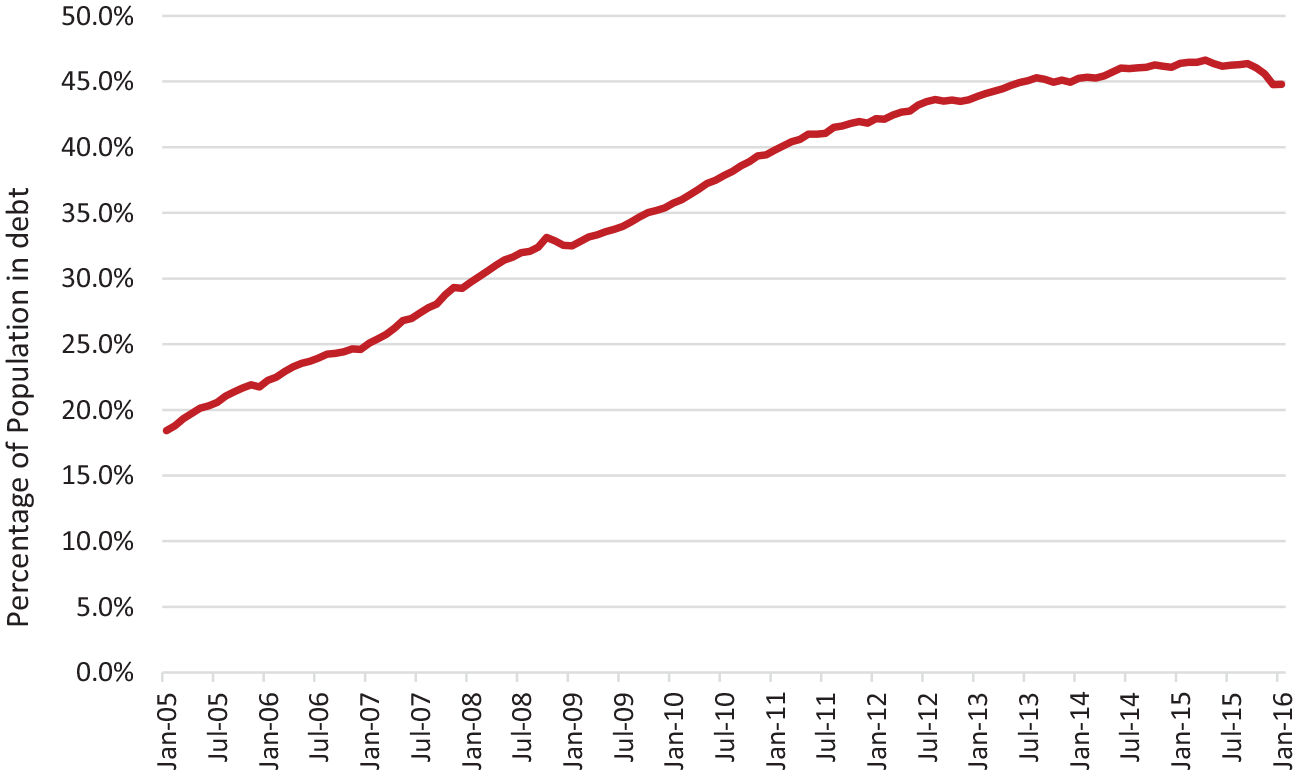
Household debt of the working class in Brazil.
For Daniel Damas, the income expectations of Haitians were attached to the American dollar to calculate migration costs and the value of remittances they could send to Haiti. However, Brazil’s 21st century development strategy has not addressed historical inequalities, which substantially deepened during almost four decades of military dictatorship in Brazil (DIEESE, 2011; Garvey and Barreto, 2016). For instance, the national minimum wage had increased from R$200 in 2002 to R$880 in 2016. The living wage, however, increased from R$1154.63 to R$3992.75 over the same period (DIEESE, 2018). The average income of interviewed Haitians has been close to the statutory minimum wage in 2016, with earnings between R$900 and R$1500. This low payment is typical of 94% of jobs created during Brazil’s neo-development model (Pochmann, 2012) while, owing to their precarious jobs in civil construction and agribusiness, they have experienced dramatic fluctuations in remuneration.
In addition to low and unstable wages, the boom of a commodity-dependent growth offered Haitians the worst of ‘two (peripheral) worlds’: economic inflation and currency fluctuation. Owing to a sluggish economy and the devaluation of commodity prices, local currency against the US dollar plunged from 1.58 reais in 2011 to approximately 4 reais in 2016. While this allowed for better competition for exports of commodities, it complicated the lives of Haitians who faced both higher food prices and soaring currency rates while providing for their families across territories, as Jean Baptiste and Toussaint Duprés illustrate: When I arrived here, the dollar was better. I remember when I sent money to my wife the dollar was 2.25 reais. The salary was low, too low, but with 2.25 reais it was possible to do something. Then it started to increase, increase and increase . . . I think it’s a bit over 4 reais now. (Jean Baptiste, 36 years old) When I arrived, it was a bit better because a carton of milk cost about one Brazilian real at the time. Maybe up to one and a half. Today, one carton of milk costs up to four Brazilian reais, and the price of beans and a carton of milk has increased a lot. It kills us because we are still earning the minimum wage. There are people here working for 900 reais. (Toussaint Duprés, 28 years old)
While official data point to moderate rates of inflation of between 4.5% and 7.5% across the economy (IPEA, 2009), prices of essential goods suffer a more substantial shock in response to priority given to external market and government consumer-led policies. For family members still in Haiti, an even greater rate of inflation is found (Dupuy, 2014) with the price of beans increasing 30% in just one month (216% in four years), while the local food parcel increased 3.67% in the same period (65% in four years). This was equivalent to 50.95% of the minimum wage (DIEESE, 2018). Significantly, because statutory annual minimum wage increases are based on the average inflation of a wide range of products and economic growth of the previous year, these mask the within-year fluctuations in the price of basic goods that periodically intensify the hardship experienced by interviewees in attempting to cover reproductive costs across two countries.
Haitians thus constrain their reproductive activities to reduce their financial costs in Brazil with collateral effects on their resting time, and physical and psychological health. Interviewees reported walking long distances to work, withdrawing from social life, poor dietary quality and co-habiting in overcrowded homes in urban peripheries, as Andre and Stevenson point out: You will see that in a Haitian home you will not find just one Haitian living there. There are two, three, four, five people . . . people who are living together to share their expenses. Alone, Haitians cannot afford a life here and provide for their families in Haiti. (Andre Martineau, 37 years old) My life is only to leave work and come home; leave home and go to work. But when I was in my country, I had opportunities to go to other cities, see my friends, go to the beach, go to dancing clubs and listen to the music. Here, it is the worst, I can’t do that. I can’t do it! Morally, even psychologically, there is a delay for me. I feel like I am a disabled person. (Stevenson Chaumeille, 35 years old)
Andre revealed a hidden dimension to the reproductive lives of super-exploited workers embedded in the legacies of repressive regimes such as colonialism and military dictatorship.
Urban peripheries are marked by informal housing, lack of infrastructure and limited social services (Kowarick, 1980). Here, the logic of state coercion in place of welfare reveals itself in racialised patterns of discrimination, as Andre explains: They [Haitians] had much better lives in Haiti than here living in a slum, where their lives will be questioned daily. If they buy a car the police will stop them to say that those are not their cars. (Andre Martineau, 37 years old)
Access to public higher education is also subject to racialised barriers in Brazil (IBGE, 2016) and Haitians experience both the highest rate of devaluation of their educational credentials and of professional qualifications as compared with other migrants (Ruediger, 2015), which also hinders their access to education and jobs. State coercion is also manifest in the legal restrictions that prevented Haitians from joining mass protests in 2013 triggered by rising bus costs in one of the most expensive transportation services in the world (Avelar, 2017; Magalhães, 2015; The Brazilian Foreigner Statute 1980–2017).These restrictions on migrants’ capacity to organise, introduced during the military dictatorship, have only recently been revoked. These factors add pressure on workers to accept the deteriorating labour standards, as described in the next section.
The flexibility trap in the super-exploitation of Haitians in the workplace
Haitian employment in the local labour market has been predominantly concentrated in the sectors that expanded most markedly in the first decade of the 21st century, such as civil construction and agribusiness. These sectors are known for having persistently extracted value from workers based on innovative forms of super-exploitation rather than on technological innovation in Brazil (Braga, 2015; Garvey and Barreto, 2016; McGrath, 2013), illustrated by the involvement of these sectors in approximately 33% of all cases of slave labour in Brazil between 2010 and 2016. In these cases, black workers predominate and international migrants disproportionally constituted 35% of those who were found to be subject to slave labour, despite representing less than 1% of the working population (MTE, 2017).
More recent labour legislation changes to encourage the flexibilisation of employment relations across all economic sectors have shaped new intersections between formal and informal employment (Antunes, 2014) while underplaying the reduction of informal employment by 10% during Brazil’s development model (2002–2016). In addition, 85.3% of new jobs lasted for less than one year during this period (Pochmann, 2012). This also has a deeply racialised dimension with a violent legacy, as African descendent workers disproportionally fill approximately 80% of these jobs, although they represent approximately 55% of the workforce and constitute almost three-quarters of the poorest 10% of native Brazilian workers (IBGE, 2016).
One important outcome is that, whether Haitians have had a formal or informal job in these sectors, low wages and job insecurity typify their experience. Civil construction has an 87.4% employee turnover rate, the highest in Brazil, followed by agriculture with a 65.9% turnover rate (DIEESE, 2018). This indicates a significant demand for a large and contingent labour force across myriad production sites, as reflected in the monthly admissions and dismissals of Haitians in Brazil’s labour market (Figure 2).
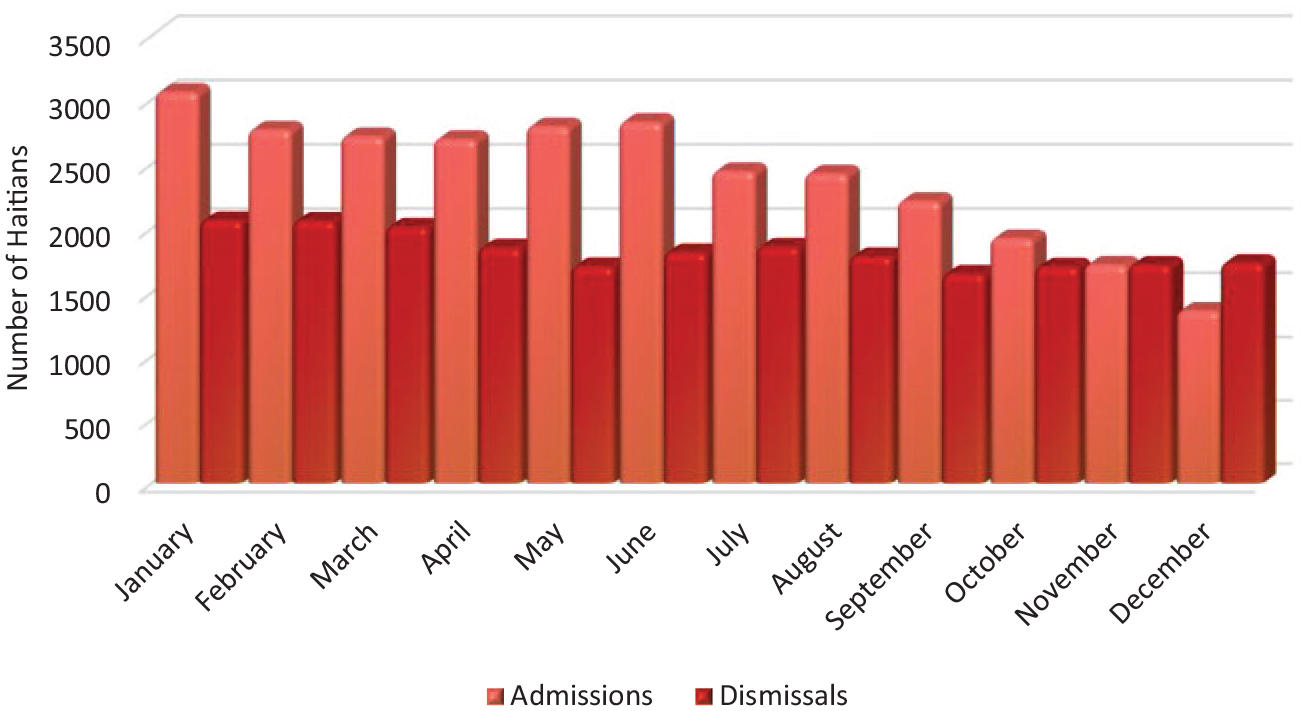
Participation rate of Haitians in the labour market in 2015.
This structural scenario, alongside the pressure on Haitians to send remittances, results in their subordination to a range of legal and illegal modes of working leading to super-exploitation. This includes intensification and extensification of work to meet changing, sector-specific demands during certain busy periods (i.e. harvest period, tight construction deadlines) as a means of optimising costs. Haitians face routines of 10–14 hours a day, meaning they often work almost twice the hours per week legislated for and with few labour protections, as Yves points out: You have to work under the sun, loading wagons of corn, soy and bran. [. . .] The sun is very hot at midday. The wagon comes with that heat and you must enter, clean very fast and load it. [. . .] It is hard to clean that wet corn and soy . . . you have to remove everything, but it is stuck and stinking. I will never forget this. I spent two months working this way every day. From 8 a.m. until midnight. Sometimes we arrived at 9 a.m. on Saturdays and, on Sunday, we arrived at 5 or 6 a.m. (Yves Fayette, 33 years old)
The acceptance of working longer hours and intensification of effort is not only a unilateral response from migrants to increase wages, but a strategy for super-exploitation actively encouraged by employers, as Jameson states: Before I started, I knew the person doing my job who received R$1500. But when I started, the salary decreased to R$1300. Afterwards, he [the boss] agreed to increase my salary to R$1420, but not formally. In fact, he told me he would decrease my formal salary, which would be R$1420, to R$1200, so he could pay me overtime hours. [. . .] Brazilians believe that we must accept anything because we left a small and a poor country. [. . .] This the idea they have in their minds. They have this idea about Haitians because they believe that we can’t go back to Haiti. Haitians left a poor country . . . (Jameson Thébaud, 41 years old)
Significantly, at the time of the interviews, Brazil’s economy was entering a depression, a fact that squeezed options for individual resistance to this situation. The competition for decreasing vacancies and plunging currency rates increased economic and psychosocial pressures from network members, as Stevenson explains: These people that helped me are expecting something in return, they are expecting something back from me. Unfortunately, here, I cannot offer it. I work here. I earn 900 reais. I have difficulties helping my friends and family, who are expecting something back. They doubt every time I tell them that I can do nothing for them because I have no money. They think: ‘Is that true?’. (Stevenson Chaumeille, 35 years old)
These individual pressures and high turnover rates also inevitably compromised worker collective organisation. Haitians most commonly stated that they were ‘let go’ after only three months. This length of time is the statutory probationary period during which workers are not entitled to social rights such as redundancy or increased social security payments. In the absence of statutory support and a social wage, Haitian workers turn to their networks to alleviate financial burdens but in a manner that sustains the cycle of exploitative work. As Amiot Sanon explains: I want to work to pay for what my father owes [debts with Amiot’s migration] and to help my brother to come to Brazil. If he works here in a normal job, he helps me by earning 1000 reais and sharing accommodation. If he comes, he works, I work, and then, we bring another sister here [from Haiti]. We will help each other. It will be better. If I am here by myself, it’s hard because everything depends on me. (Amiot Sanon, 42 years old)
Discussion
The account of Haitian migrant workers in Brazil reveals the extent to which the neoliberal citizenship model and associated populist discourses of employment opportunities (Swyngedouw, 2010) obscures the inherent contradictions and social inequalities of the Brazilian development model that has not broken with the colonial legacy of racial oppression and extensive inequality. This is because economic growth largely, still, depends on the extraction and export of natural resources together with the exploitation of cheap labour in relatively labour-intensive sectors. At a time when economic growth was broadening employment and education opportunities for a new generation of Brazilians, Haitians provided a much-needed, flexible workforce for labour-intensive sectors. The pressure to sell their labour power to achieve anticipated living conditions for themselves and return money to their extensive networks has led to an acceptance of super-exploitative employment conditions in these key industries.
Their experiences serve to highlight how export-oriented and consumer-led strategies in Brazil’s 21st century development do not resolve but rather emphasise a particular citizenship model that sustains the yawning gap between the minimum wage and a basic living income. The socio-spatial and economic reproduction of colonial legacies, including residential segregation, were seen to be underpinned by a racialised dimension of super-exploitation (Latimer, 2016) and discriminatory police profiling, education and employment access. These social relations of super-exploitation converge towards an enduring lack of effective social and employment rights having little in common with Keynesian welfare legacies assumed in much of the literature on citizenship and migration (McGovern, 2012; Munck, 2013). While native Brazilian workers continue to suffer the indignity of super-exploitation and its legacy of social divisions, the reduced access to citizenship in Brazil and restrictions to migrating further north experienced by Haitians facilitates further commodification and racialisation of foreign-born migrant workers (Mezzadra and Neilson, 2013). Haitians are invited and recruited as flexible workers paying full taxes, but lack decent working conditions and access to social and political rights such as higher public education and political organisation. This means that while Haitians, as workers, help meet the productive needs of the state and the reproductive need of its citizens, they absorb disproportionately higher costs of inequality, and must meet their own reproductive needs (health, housing, education, reunion, family provisions) in the private sphere with the consequent susceptibility to further commodification (Federici, 2012).
Transnational networks, remittance payments, the migratory journeys and visa costs are key, day-to-day, considerations of the reproductive life of migrants. Haitians reveal that, while the initial support of migrant networks is essential to satisfy these reproductive needs, the role they play over time is more ambivalent than commonly referred to in the literature (Ferguson and McNally, 2015; Portes, 2016): networks, responsibilities and familial expectations also enforce a certain discipline which requires migrants to absorb further social costs while accepting exploitative conditions. These reproductive responsibilities converge, particularly at a time of economic stagnation, higher currency exchange rates and intensified job competition, to further enable the employer’s capacity for exploitation, limiting options for the worker to fight or flee.
The arrival of Haitians sustained demand for a specific morphology of employment during a commodity boom typified by flexible work, high-labour turnover, low wages, insecurity, outsourced jobs, manual labour, and the extensification and intensification of the working day. These sectors have not only historically relied on super-exploitation but also expanded its contemporary signature with the deepening flexibilisation of work amid a period of remarkable but short-lived economic growth. Haitians’ subordination to a condition of super-exploitation transgresses the ‘standard’ subordination of Brazilian workers due to the way in which their agency as migrant workers is being both politically and economically overdetermined by the factors identified in the article. Despite their cognisance of structural injustice and discrimination, the options to resist explicitly are constrained by social dynamics running through and beyond the workplace. Racism, spatial segregation and top-down humanitarianism alongside language barriers, partial citizenship and restrictions on political activity usurp individual and collective agency. Subsequent survival strategies among this transnationally displaced community within Latin America expand our understanding of the social reproductive realms in the super-exploitation of migrant workers in the periphery. In addition to workplace dynamics, the processes of household overcrowding vividly illustrate this. These households are not primarily formed by family members nor are their existence simply the conditions for the reinvigoration of daily labour (Marini, 1973; Marx, 2011). Rather, these are a cooperative form of reproduction supporting networks of family members and friends in Haiti amid migration debts and a buffer against local fluctuations in food costs, overtime wages and currency rates.
It is in this sense that super-exploitation is revealed not only in conventional economic factors alone (Peña Lopez, 2012; Smith, 2016) but also in the role played by non-economic forces and community arrangements that transgress productive and reproductive realms. Thus, migrant labour and its extensive networks beyond the immediate household heavily subsidise social costs that allow both the state and employer to drive wages below the costs of their reproduction. Community networks, visa fees, paid mediators, or traffickers intersect with restricted social rights to extract value from workers crossing borders, and create a backdrop to the decisions made in the workplace, and create a backdrop to the decisions made in the workplace. Migrant networks may offer protective and compensatory measures, but are also constituted by emotional and monetary debts that contribute to a transformation rather than eradication of super-exploitation in contemporary south–south migration.
Conclusion
The article restates the relevance of super-exploitation in seeking to account for the particular condition and experiences of workers in peripheral economies, with a focus on Brazil. It goes further than pre-existing work on the subject by outlining causative factors for super-exploitation within and between countries where legacies of colonialism can be seen to unravel the origins of distinctive working-class formation. It addresses the issue of unpaid labour and social costs transferred to migrant workers, supporting insights into the realm of reproduction not fully developed in the literature on super-exploitation. These are embedded both in the process of transnational migration and in the structures of daily life: across households, communities and countries.
The yawning divide in the minimum wage between core and peripheral countries, the residual access to Keynesian welfare rights even for many migrants in the developed world, and the reserve supply of racialised labour in the Global South are exacerbated by discriminatory border restrictions in the north. These are important distinctions for justifying and retaining a particular application of super-exploitation to the periphery (Selwyn, 2020).
The violently repressive state apparatuses of colonialism and military dictatorships, and subsequent International Monetary Fund (IMF) imposed adjustments, have sustained elitist models of economic development and gross inequalities. These legacies and the continued subjection of former colonies to the market needs of wealthier nations help account for the dramatic difference between the minimum wage, economic fluctuation and the level of income for dignified survival, and the lack of social rights, whether in Haiti or Brazil. Economic inequalities between these nations, especially given the commodity boom-related growth in 21st century Brazil, have driven migration from the poorer of the two nations, with acute implications for migrant workers’ employment and domestic settings.
This study has demonstrated how the neo-developmental strategies of internal consumption and commodity export strategy, alongside modest poverty alleviation schemes in Brazil, only served to exacerbate the pressure of labour super-exploitation in the long term, favouring conditions for the physical, psychological and social degradation of workers (Marini, 1973). Beyond the household unit, such degradation ultimately extends to the society within which these workers are embedded and thus the essential features of super-exploitation become further generalised. While workers deploy collective strategies to face their common challenges, their deteriorating conditions further highlight the contradictions inherent in driving down the value of labour. The contemporary militarisation of Brazil’s government to sustain the retrenchment of labour protections, promote the hyper-flexibility of work and curb social unrest amid the pandemic, escalating homelessness, debt, poverty and hunger, has done little to ease an economic crisis. These accounts of Haitian migrants justify a (re)turn to the concept of super-exploitation for understanding repressive labour regimes and migration within the entrenched dynamics of Global South–North subordination.
Footnotes
Acknowledgements
The authors would like to thank the editor and the anonymous reviewers for careful reading and insightful suggestions. We feel that these detailed comments have resulted in a stronger article.
Funding
The authors disclosed receipt of the following financial support for the research, authorship, and/or publication of this article: This work was funded by an ESRC Global Challenges Research Fund (ES/S001417/1), Leverhulme Early Career Research Fellowship (ECF-2021-614) and Strathclyde Research PhD Grant.
