



Abstract
Research suggests that structural change drives occupational mobility in high-income countries over time, but two partially competing theories explain how such change occurs. One suggests that younger cohorts replace older ones through higher education, and the second suggests that individuals adapt to structural change by switching from declining to new or growing occupations during their careers. A proposed occupational scheme aligns with the two dimensions of structural change – skill upgrading on the vertical axis of occupational differentiation, increasing demand for data comprehension (i.e. high skill) and primary tasks concerning either people or things on the horizontal axis. Applied to career trajectories in the Swedish labour market, sequence analyses of the scheme suggest stability in attainment of career mobility types over time between consecutive birth cohorts, and considerable evidence for within-career manoeuvring. Analyses address heterogeneity along parental class and gender.
Introduction
Structural economic and industrial shifts have a strong influence on workers’ opportunity structure, with the most powerful of such contemporary shifts including processes of skill upgrading and service expansion. All else equal, skill upgrading is supposed to increase opportunities for high-skill occupation careers in the 20th century (Gallie et al., 1998; Handel, 2020), and service expansion decreases opportunities for manual, things-oriented work in production industries (Kollmeyer and Pichler, 2013) but extends opportunities for people-oriented work in care, retail and hospitality industries (Oesch, 2013; Schettkat and Yocarini, 2006).
Early research suggests that traditionally disadvantaged sociodemographic groups benefit from a modernising occupational structure (Bell, 1973; Featherman and Hauser, 1978), but the labour market integrations of several such groups is complicated. For example, younger cohorts’ careers are both increasingly unstable and delayed (DiPrete, 2005; Tåhlin and Westerman, 2020), many former industrial workers have experienced limited upward transitions or paths out of declining production industries (Murphy, 2014), women’s increasing labour force participation continues to vary dramatically among industries and sectors (Charles and Bradley, 2009; England, 2010) and the influence of parental class on career trajectories appears stable rather than diminishing, as modernisation theories predict (Bukodi and Goldthorpe, 2011; Bukodi et al., 2016). The mechanisms by which structural change occurs are important to understanding labour market integration frictions. If structural change unfolds through cohort replacement, the target of interventions should be to raise the quality of the educational system, but if structural change unfolds through within-career manoeuvring, interventions that smooth paths from declining to increasing types of occupations are crucial.
Extant research on the topic focuses on career progression along income, class position and occupational prestige (Bukodi et al., 2016; Härkönen and Bihagen, 2011; Jarvis and Song, 2017; Manzoni et al., 2014), such as promotion from machine operator to foreman, or apprentice to craftsman. The current study departs from such research by introducing a unique simultaneous classification of occupations on their vertical (i.e. a job’s skill level) and horizontal (i.e. a job’s things-oriented versus people-oriented tasks) dimensions in a single scheme. This nominal classification of occupations captures substantive, within-career manoeuvring made possible by structural change, such as paths from a shopfloor to white-collar technician (i.e. skill upgrading) or human resources manager (i.e. service expansion).
A two-by-two occupational scheme is used during sequence analysis to identify occupational mobility types in individuals’ early to mid-careers in the Swedish labour market. The occupational scheme disentangles, on the one axis, the degree of data comprehension and analysis tasks and, on the other axis, the extent to which job tasks concern ‘things’ or ‘people’, either directly or indirectly. A task-based occupational categorisation is used during a variety of labour market analyses (Hadden et al., 2004), and in recent studies of skill upgrading and sociodemographic inequality (Kitschelt and Rehm, 2014; Oesch, 2006). Current findings suggest that the comprehensive occupational scheme provides an effective measure that reveals major patterns of structural change that occurred during the second half of the 20th century. Substantial within-career horizontal manoeuvring, between (declining) things-oriented and (increasing) people-oriented low-skill work, and between low-skill things-oriented and high-skill things-oriented work, is observed. Evidence that supports cohort replacement appears primarily in the form of women increasingly entering high-skill things-oriented careers.
Cohort replacement and within-career manoeuvring
Structural change can alter occupational distribution and careers in three ways. First, since skill upgrading and service expansion are both linearly progressing mechanisms, individual careers change subtly. Analogous to cohort replacement (Lutz, 2013; Ryder, 1965), structural change creates space gradually for modernised types of occupational careers, those into which younger cohorts primarily enter, while those of older cohorts remain largely unchanged. Were this mechanism dominant, cohort effects would be evident, whereby younger cohorts are increasingly likely to attain careers that consist of (stable) high-skill and people-oriented occupations.
Second, structural change, as viewed through the lens of a life-course perspective (Billari, 2015; Karhula et al., 2019; Mayer, 2009), suggests that workers can enter different career mobility types at a comparable rate, which implies that labour market incumbents adjust their occupational trajectories to accord with the changing supply of jobs and skill demand. Structural change is thus absorbed by continuous adaption of individuals to modern (i.e. high-skill or people-oriented) occupations through within-career manoeuvring, rather than through gradual replacement of retiring cohorts, and careers. A third form of structural change occurs when a single cohort or sociodemographic groups’ occupational careers are affected by a one-time job-supply shock. One such shock is an economic recession, which has profound effects on the career trajectories of cohorts who are exposed disproportionally to a detrimental opportunity structure (Blossfeld et al., 2005; Gangl, 2006; Witteveen, 2017). Using an occupational scheme that includes both vertical and horizontal dimensions of skill, this study examines the extent to which these competing theories apply to observed patterns of within-career mobility, and the extent to which types of career trajectories change between cohorts.
Structural change in Sweden
This study assesses the Swedish labour market, which underwent forms of structural change during the latter half of the 20th century, comparable to other European countries, that affected cohorts in multiple ways. Throughout the 1950s and 1960s, labour productivity increased rapidly, and smaller, low-productive firms, such as craftspeople and local farmers, were pushed out of the market gradually. Administrations implemented a series of policies to encourage career manoeuvring and allow mid-career workers to adapt to new productivity trends (Erixon, 2008). However, rapid decline of manufacturing, successive recessions and slowing productivity growth steered mid-1970s labour market policies towards employment protection legislation. Furthermore, like other European countries, the 1970s were characterised by expansion of higher education. In combination with employment protection legislation, education expansion policies signalled a shift from encouraging career manoeuvring among incumbents to cohort replacement as a strategy to solve labour market allocation problems that structural change caused. Despite such policy shifts, job turnover remained high in Sweden, in comparison to many European countries, and unemployment was low throughout the 1980s (Erixon, 2008).
Women’s labour market emancipation occurred relatively early in Sweden, driven initially by expansion of the public sector during the 1970s and 1980s, such as that in the care sector (Gustafsson and Jacobsson, 1985). Women’s economic independence thus increased, but women remained overrepresented in temporary and insecure jobs, which, contrary to conventional wisdom, remained common in the Swedish public sector (Esping-Andersen, 1999; Statistics Sweden, 2015). Women born during the 1960s and later benefitted most from higher education expansion, which improved their competitiveness for high-skill occupations during the late 20th century. A severe recession occurred in the Swedish economy during the early 1990s, which induced structurally higher unemployment and declines in manufacturing employment. Policy reform led to increased shares of workers with fixed-term contracts, and social security became less generous and more difficult to access (Korpi and Tåhlin, 2011). Sweden thus appeared vulnerable to global factors that shape labour markets in high-income, post-industrial economies, including high unemployment and insecure work arrangements (cf. Kalleberg, 2003, 2018; Kalleberg and Mouw, 2018). Supplemental online Appendix A includes a timeline of cohort-specific exposure to Swedish labour market dynamics and policies.
This study addresses two challenges regarding how structural change shapes careers. The first is the extent to which occupational careers include within-career manoeuvring, and whether such manoeuvring has changed over time. To do so, an occupational scheme that disentangles vertical (i.e. skill level) and horizontal (i.e. task orientation) axes is applied. Second, given demographic changes and education expansion, analyses assess who was exposed to what kind of within-career manoeuvring and attainment of career types over time, with focus on parental class backgrounds and gender.
Sociodemographic dimensions of structural change
Parental class
Research on intergenerational class mobility – the relationship between parents’ class positions and an offspring’s class position during their respective prime working ages – concentrates on trends, cross-national variation and education mediation (Breen and Jonsson, 2005). Researchers argue that intergenerational mobility depends on mobility that occurs during a life course, or intragenerational occupational mobility and career trajectories (Bernhardt et al., 2001; Cheng and Song, 2019). Featherman and Hauser (1978) note that this is due partially to loose or rigid connections between first and current jobs, which in part determines the degree of occupational fluidity in the labour market, and in turn the opportunity structure for (mostly upward) intergenerational mobility.
Sociologists have identified several direct paths between parental resources and an offspring’s experiences in the stratification system. Occupational stratification operates through acquisition of skills, such as education. Crucial resources (e.g. cultural capital) are transmitted intergenerationally within the household, as children derive routines and clues from within the parental home. Since capital transmission commonly aligns with the parental home’s class position, it contributes considerably to intergenerational persistence of occupational attainment (Erikson and Jonsson, 1996; Haller and Portes, 1973; Lareau, 2003). Working-class families are thus least likely to be exposed to high-skill technical orientations, such that their offspring experience more obstacles to attain such positions through, for example, education.
The influence of parental background extends beyond education, continuing to influence an individual’s capacity to manoeuvre between jobs and occupations during their working lives. Bison (2011) and Bukodi et al. (2016) use sequence analysis to analyse the influence of parental class background on an offspring’s occupational mobility using the EGP (Erikson-Goldthorpe-Portocarero class) scheme and the United Kingdom Socio-Economic classification, respectively. They report associations between parents’ class and an offspring’s career manoeuvring and stability in associations across cohorts, demonstrating the historically persistent influence of class origin.
A primary challenge regarding both labour market stratification and mobility scholarship is examining the extent to which the modernising occupational structure allows sufficient opportunities for cohort replacement, which has a decreasing influence of family class backgrounds among younger cohorts (Featherman and Hauser, 1978). The proposed occupational scheme, which combines both vertical and horizontal axes of occupation, is applied to both parental background and an offspring’s career progression, advancing understanding of which components of parents’ class position (e.g. skill and task orientation) are relevant to which kind of an offspring’s occupational mobility pattern.
Gender
Women’s entry into male-dominated occupations varied after dissolution of the (male) breadwinner household. Gender integration occurred faster in high-skill, as opposed to low-skill, occupations (Magnusson, 2009; Magnusson and Tåhlin, 2018), but traditional blue-collar jobs in manufacturing, and high-skill, high-pay STEM occupations (science, technology, engineering, mathematics) remained male-dominated (Morgan et al., 2013). Women’s limited entry into blue-collar work can be explained by the fact that, for women, such jobs provide no upward shift in prestige or improvement to work conditions (England, 2010), but reasons behind women’s underrepresentation in high-skill STEM jobs are less clear. Some researchers suggest that education tracks were and remain gendered, or that gender-typical occupational choices are considered safer during rapid structural change (Charles and Bradley, 2009).
However, in other dimensions, structural change associates with absolute declines in career opportunities for men. As Kollmeyer and Pichler (2013) discuss, employment declines in one sector and emerging vacancies in another do not automatically imply smooth transition among mid-career individuals in the former who seek to remain employed. Men employed in traditional manufacturing industries commonly possess limited people-oriented skills or training for such horizontal transitions. Murphy (2014) finds that men are much less likely than women to leave declining occupations, and to enter emerging service sector occupations. Hence, restructuring of the labour market during the second half of the 20th century likely imposed costs on cohorts of workers differently for men and women. An analytical lens that distinguishes things- and people-oriented occupations across the entire vertical distribution of occupations is critical to understanding how career mobility patterns are structured between the genders.
Analytical strategy
Research questions
This study assesses how 20th-century structural change shaped within-career manoeuvring and cohort replacement patterns in occupational mobility. Analysis begins with descriptive examination of workers’ entire mid-careers using sequence analysis, addressing: (1) What kind of career mobility can be identified using an occupational scheme that consists of skill level and job task orientation? An advantage of using sequence analysis over linear measurement (e.g. occupational prestige) is observation of meaningful career changes along both vertical and horizontal axes of occupational classification. The relative influence of cohort membership on attaining types of career mobility patterns are subsequently examined, addressing the main research question: (2) Are consecutive cohorts differentially or equally exposed to career mobility types? Varying exposure to career mobility types may result from cohort replacement (linear progression into distinct career types among younger cohorts), within-career manoeuvring (significant movement along one or both axes in a two-by-two occupational scheme, and only marginal linear progression into distinctly upgraded careers over time), or job-supply shocks (cohort effects linked to recessions).
Given increasing labour market participation of women during the second half of the 20th century, and a theorised decline of parental class effects on an offspring’s occupational outcomes, gender and parental class dimensions of the cohort replacement hypothesis are examined: (3) To what extent and in which direction are cohort changes in attainment of career mobility types structured by parental class background and gender? A series of interactions between both sociodemographics and cohorts are thus applied.
During an era of education expansion and meritocratisation, progressive decoupling of career progression from class origins over time is intuitively expected. The proposed two-by-two occupational scheme can detect previously overlooked paths between parental and an offspring’s occupation on the horizontal axis. Regarding gender, older cohorts of women are expected to be overrepresented in low-skill careers, and younger cohorts to be characterised by greater entries into skill-upgraded careers through people-oriented jobs and sectors. Older cohorts of men are expected to be overrepresented in high-skill careers across people- and things-oriented jobs. Younger cohorts of men are likely to increasingly rely on careers that involve people-oriented jobs, though signs of career instability might indicate obstacles in shifts along the horizontal axis.
Data
Data were drawn from the decennial Swedish Level-of-Living surveys (Stockholm University 2010[2000,1991]), with response rates of 79%, 77% and 61%, respectively. Since 1991, all surveys have included retrospective occupational biographies. Initial case selection (N = 6389) was based on respondents having worked for pay for more than 10 hours per week for at least six consecutive months at some point in their lives. Observations from workers in their younger 20s were excluded from analysis to avoid overemphasis of the school-to-work trajectories. Incomplete mid-careers (i.e. post-1960s cohorts) and sparse cohorts (pre-1930s) were excluded, resulting in a sample of 4000 respondents born between 1930 and 1969. Data consisted of longitudinally structured monthly observations between ages 25 and 45. Internal missing values and right-censored missing values (455 episodes) in labour market status variables were imputed using a forward-backward algorithm, with up to 40 internal monotone and non-monotone imputations per individual career.
Occupational classification
The occupational biography was coded according to the Socioekonomisk Indelning (SEI) and the Nordisk Yrkesklassificering (NYK) (Statistics Sweden, 1984, 2009). The Swedish SEI classification distinguished occupations vertically (i.e. years of required education) and horizontally (i.e. services or goods production, excepting higher classes). Tertiary education requirements proxied analysis tasks such as comprehension of information, abstract knowledge and data processing. Low-skill occupations were defined as SEI 11 through 36 (requiring fewer than three years of tertiary education) and high-skill occupations as SEI 45 through 57 (requiring at least three years of tertiary education).
Aside from the SEI being readily available and therefore replicable, the decision to use this classification for the vertical skill axis included several considerations. First, the classification was based on expert ratings of occupations, a measure preferred over observed skill requirements (e.g. proportion tertiary educated in an occupation) because it is less sensitive to effects of overeducation during the second half of the 20th century (Korpi and Tåhlin, 2009). Hence, although requirements to enter occupations might have changed over time due to forms of credential inflation (Horowitz, 2018), these changes should not affect current analyses. Second, although an alternative is worker-reported job traits to construct occupational codes (e.g. O*NET), they generally correlate closely with the SEI occupational classification (Handel, 2020; Magnusson and Tåhlin, 2018; Tåhlin and Westerman, 2020).
The NYK was based on the functional traits of an occupation’s work experience, distinguishing only on the horizontal dimension. In this study, the NYK was preferred over an industry-based categorisation because the latter cannot demarcate overarching skill sets and job tasks accurately. For example, in a standard horizontal industry-based classification into production and services, a car manufacturer (i.e. production) and car mechanic (i.e. repairs) reside in different sectors. The car mechanic is located in the same category as a care worker, rather than next to a ‘colleague’, the car manufacturer. A task-based ‘people versus things’ classification of occupations highlights tangible obstacles and paths for within-career manoeuvring between substantively different occupations.
A people versus things classification is particularly straightforward to fit on lower- and middle-skilled occupations because their primary job tasks often deal with either people or things. In their application to occupations that involve comprehension and processing of information and data, things tasks are represented in STEM-oriented occupations, and people tasks are common in humanities and social science occupations (Su et al., 2009). This type of horizontal differentiation aligns with occupational stratification and class research (Güveli et al., 2007; Kitschelt and Rehm, 2014; Oesch, 2006). The NYK was therefore converted into two categories – people and things (online Appendix B) – which became the second dimension of the operationalised scheme. 1
Method
Combining the two occupational axes comprise a scheme that applied to respondents’ career biographies. For each of the 252 consecutive career months, seven unique states were identified: low-skill people-oriented, low-skill things-oriented, high-skill people-oriented, high-skill things-oriented, self-employment, education and inactivity. Farmers, military personnel and self-employed workers with more than 20 employees were omitted. 2 The categories also applied to a parent’s primary occupation. Five clusters of career mobility were then identified using sequence analysis (Cornwell, 2015; Halpin and Chan, 1998) and localised optimal matching (Hollister, 2009). Clustering decision-making was based on an assessment of the prevalence of occupational positions on both axes, the type of mobility experienced, and the strength and type of within-career volatility (online Appendix C).
Findings
Clusters of career mobility
Figure 1 plots the chronograms of the five career mobility types, which aided qualitative assessment of clustering. Some clusters overlapped with previously theorised forms of mobility. The ‘meritocratic career’ (16.5%) was characterised by high prevalence of education attainment during the early-career phase, and subsequent career stability in high-skill and people-oriented jobs. It was largely stable because of low chances of horizontal (.129) and vertical (.186) occupational transitions during a career. This career type was meritocratic (cf. Bell, 1973; Featherman and Hauser, 1978) because of the high prevalence of jobs that normally require at least three years of tertiary education, continuing propensity to enter education between ages 25 and 45 (.657 entries, on average, while 31.6% re-entered for a second education period) and its limited vertical and horizontal mobility in comparison to other typically high-skill careers (see below).
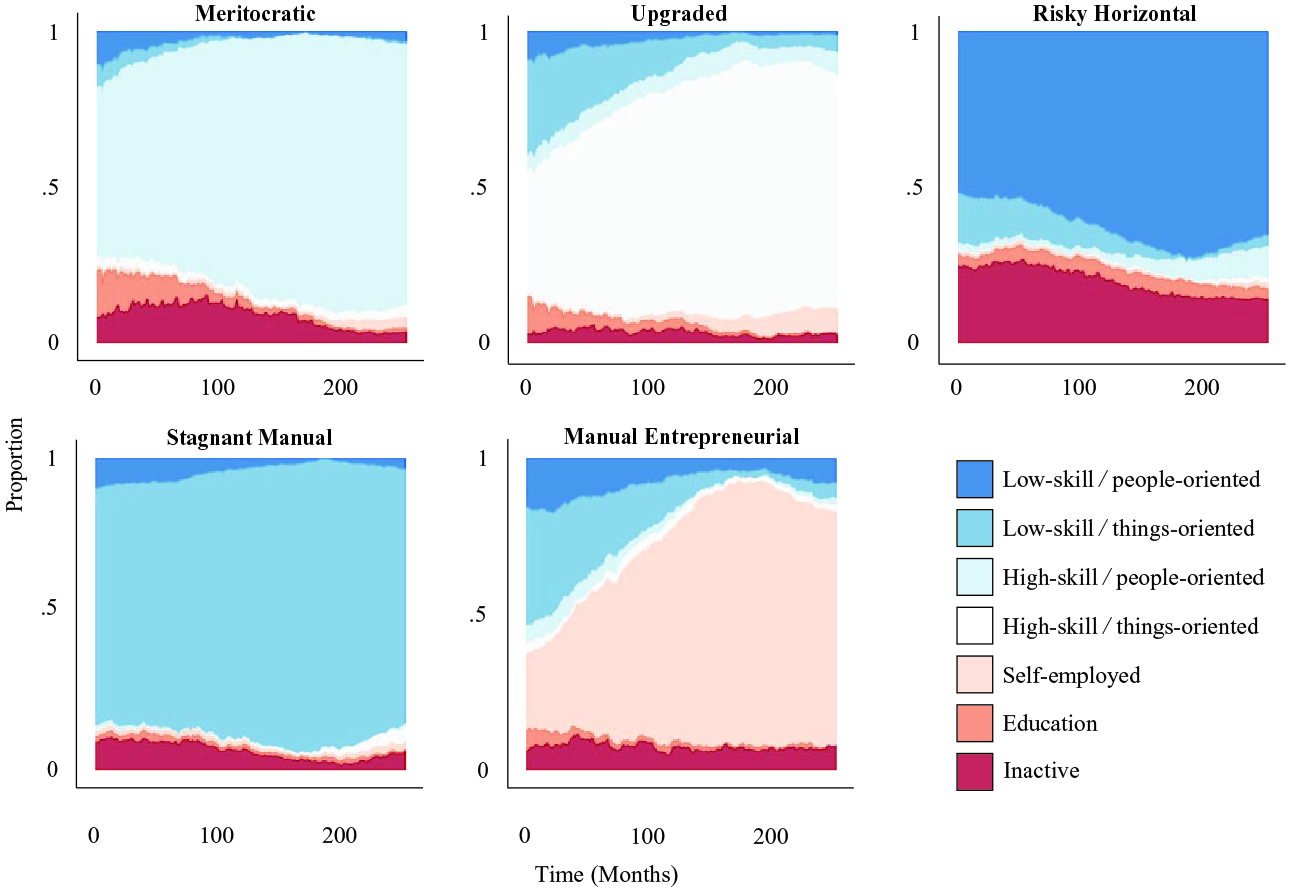
Chronograms of occupational careers.
The ‘upgraded career’ (14.5%) was characterised by vertical manoeuvring throughout a career between lower- and higher-skill jobs, from jobs that involve less comprehension of abstract knowledge into jobs with higher intensity of such tasks. The chance of vertical occupational axis transitioning (37.7%) was twice as high in comparison to other clusters, and its direction was nearly always upward (86.8%). Exposure to high-skill things-oriented jobs, which normally required three years of tertiary education, grew steadily over a career, in parallel with declining exposure to low-skill, primarily things-oriented occupational positions. The probability of re-entering education was rare in comparison to people-oriented careers. A career is termed upgraded when it plausibly is formed by increasing demand for high-skilled work in production industries, pulling some workers up the occupational ladder (cf. Baumol, 1967).
The ‘risky horizontal career’ (35.3%) comprised more than one-third of all career trajectories. Most observed months were spent in low-skill people-oriented occupations, a type of career mobility termed risky, given high exposure to inactivity in combination with a high degree of instability, in comparison to a stagnant manual career (cf. Kalleberg, 2018). The chance of upward mobility was low, while switching occupations horizontally, between skill orientation types, was more common (cf. Baumol, 1967; Esping-Andersen, 1999; Oesch, 2013).
The ‘stagnant manual career’ (24.8%) was dominated by low-skill things-oriented occupations. About 85% of occupational positions were in this state at age 25 and changed little over time. On average, workers experienced only two unique states, and the average occupational period was lowest among all identified career types (3.33), called a stagnant manual career because of its stability on both axes (7.5%). This stability suggests that a large share of workers in this career type were ‘insiders’, protected by low unemployment during earlier decades and employment protection legislation in subsequent decades (cf. Erixon, 2008; Kalleberg, 2003).
The ‘manual entrepreneurial career’ (8.9%) comprised a much smaller group of occupational careers, which had above average exposure to low-skill things-oriented jobs during the earliest career phase. However, the transition was rapid movement towards self-employment – a 61% chance. It is plausible that artisans and craft workers, who started as employees in more experienced workers’ firms before they started their own businesses, comprised the bulk of this career cluster.
Cohort
Workers’ birth cohorts proxied timing of initial labour market entry, and the experienced occupational opportunity structure. A multinomial regression was fitted on the five identified career types using the four birth cohorts, and the marginal probabilities of cluster membership were estimated for each cohort. Results for the manual entrepreneurial career were omitted from presentation (online Appendix D). Figure 2 reports unadjusted marginal probabilities using dotted lines and 95% confidence intervals, with solid lines indicating marginal probabilities, adjusted for gender, class origin, urbanicity and immigration background. A prominent finding from estimated marginal probabilities between cohorts was the stability of exposure to career types. The trend lines were mostly flat, and most deviations remained small and/or statistically non-significant. Between-cohort stability is most apparent on the left side of each panel, suggesting no differences for career mobility attainment among cohorts born during the 1930s and 1940s.
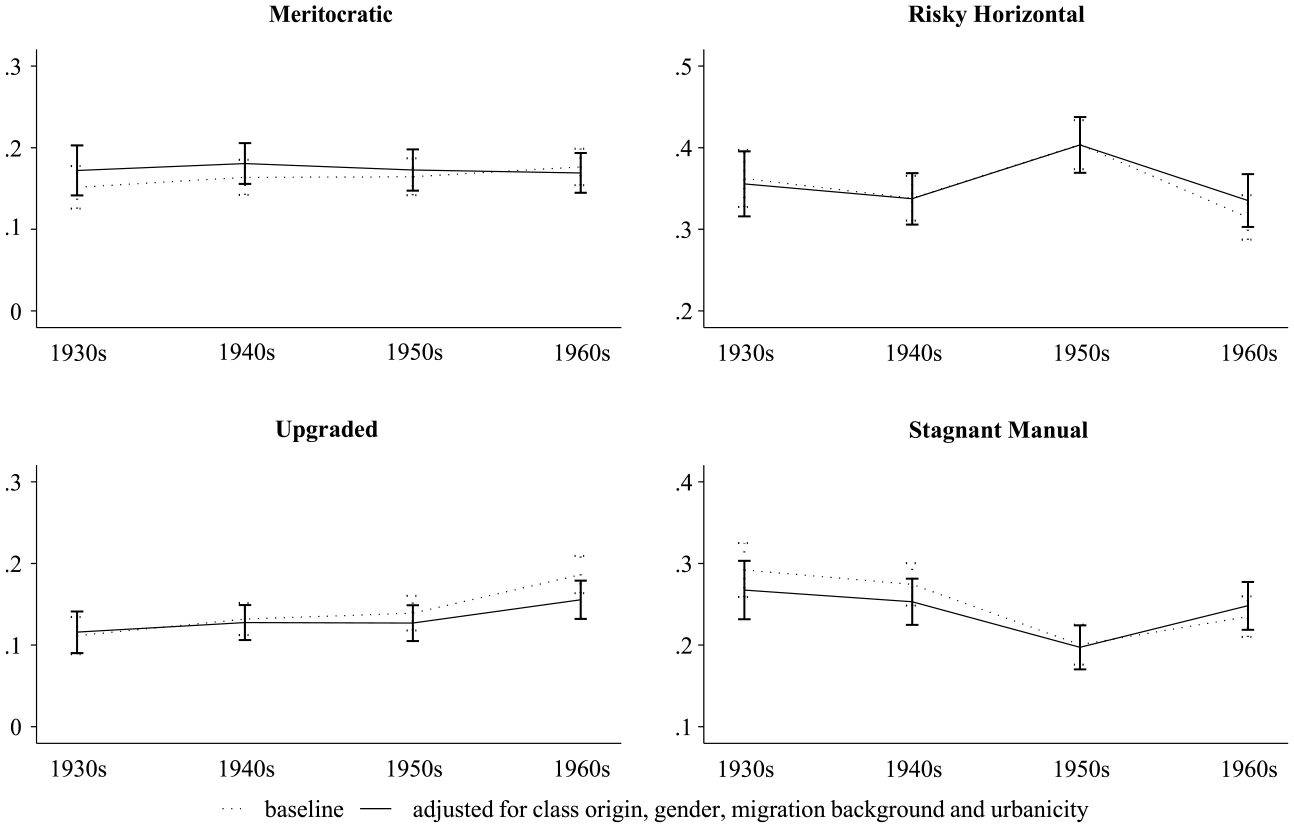
Marginal probability to enter career trajectories by birth cohort.
The right-hand sides of the panels indicate small between-cohort shifts, affecting younger respondents. Regarding meritocratic careers, shown in the top-left panel, the unadjusted probability of having entered this trajectory increased over time, from about .15 (1930s cohort) to .19 (1960s cohort). The shift was relatively small (albeit statistically significant) and, when adjusted for covariates, the chances of exposure to this traditionally upwardly mobile career further stabilised across successive birth cohorts. This pattern was exemplary for cohort effects on attainment of career mobility types.
Two exceptions were evident regarding career mobility attainment. First, members of the youngest cohort, born in the 1960s, display a significantly higher chance to have entered the upgraded career as compared to those of the oldest cohort, but only after adjusting for workers’ sociodemographic characteristics. These contrasting marginal probabilities are shown in the bottom-left panel of Figure 2. Second, as seen on the right-hand side of Figure 2, both the unadjusted and adjusted estimates indicate a significantly higher marginal probability to having entered the ‘risky horizontal’ career (top panel) and a significantly lower marginal probability of entering a ‘stagnant manual’ career (bottom panel) among the 1950s cohort. These shifts appeared to be temporary. The next cohort’s (i.e. 1960s) propensity of attaining these careers was similar to the pre-1950s cohort’s level.
Parental class
Estimates for the four main parental class backgrounds are reported in Figure 3. The grey point estimates and confidence intervals are unadjusted, and black markers were adjusted for birth cohort, gender, urbanicity and migration background. A test for an interaction between compositional changes and parental class remained non-significant for all specifications of the model and are therefore not reported. Analytical interest thus lay with persistence of parental class background effects over time.
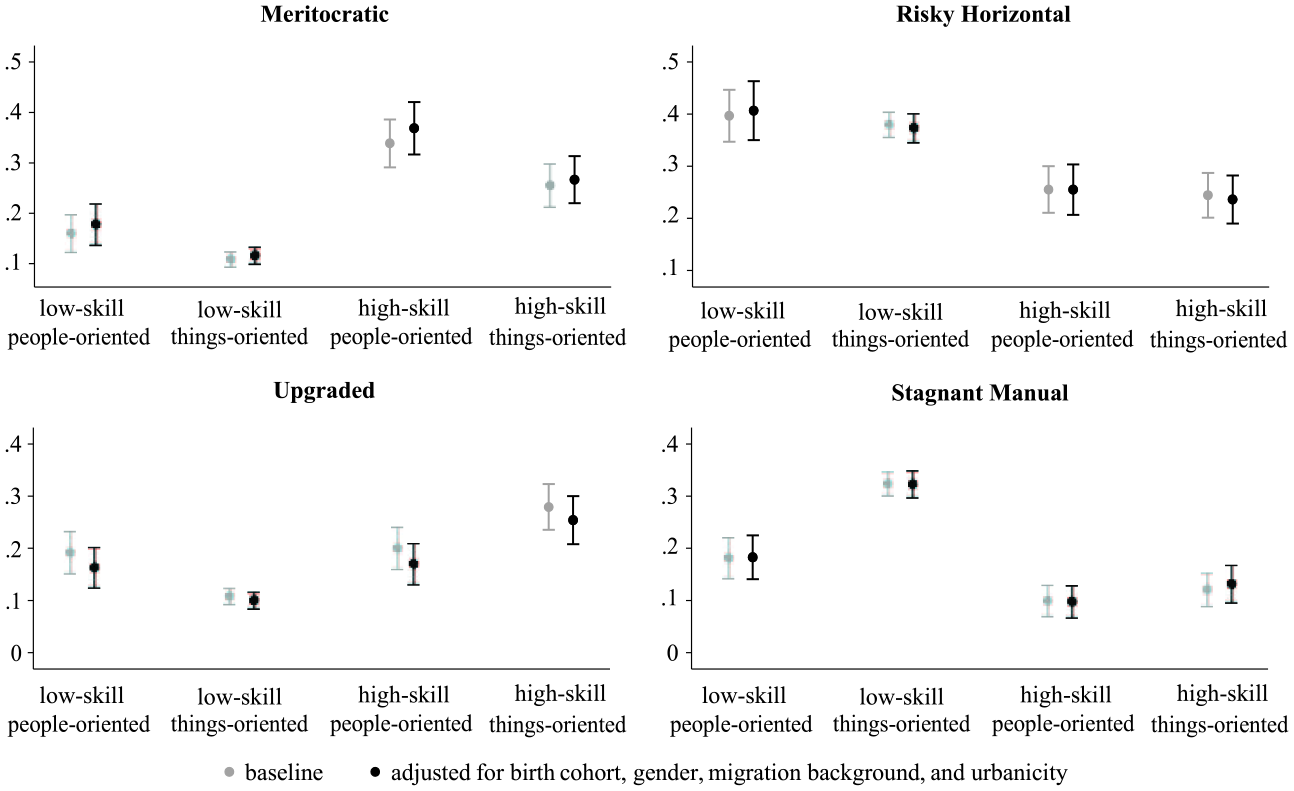
Marginal probability to enter career trajectories by parental class background.
Figure 3 suggests substantial association between parental class and forms of career mobility after age 25, and marginal probabilities remained robust to addition of control variables. 3 Panels on the left-hand side indicate profound intergenerational persistence for workers from higher-class backgrounds through upgraded and meritocratic careers. Shown in the bottom-left panel, the upgraded career was more probable among workers from low-skill people-oriented class backgrounds (.16), in comparison to low-skill things-oriented class backgrounds (.09). Offspring from any lower-class background had higher marginal probabilities of entering a risky horizontal career (about .40; top-right panel), and having parents who relied on low-skill things-oriented jobs corresponded to greater association with a stagnant manual career (.35), in comparison to any other class background (bottom-right panel).
Among workers with higher-class backgrounds, the horizontal positioning of parents’ primary jobs appeared to matter for an offspring’s type of occupational mobility. Focusing on adjusted models, the relative probability of entering an upgraded career was .25 for individuals from high-skill things-oriented backgrounds, in comparison to .15 for any people-oriented class background and .10 for low-skill things-oriented class backgrounds (bottom-left panel). In contrast, a high-skill people-oriented class background associated with high likelihood of a meritocratic occupational mobility pattern (.36; top-left panel).
Gender
Shown in Figure 4, men and women had different probabilities of accessing the occupational trajectories. Marginal probabilities were robust to the adjusted models, indicated by black point estimates and confidence intervals. Among men, a stagnant manual career was the most likely career path (marginal probability of .36), which reflected their overrepresentation in industries such as manufacturing. The next most likely paths were upgraded (.21) and risky horizontal (.18) careers. Among women, a risky horizontal career was the dominant occupational mobility path (marginal probability estimate of .58), and this modal career mobility type was followed distantly by a meritocratic career (.21), which had a high probability in comparison to that of men (.12). On average, women had greater chances of accessing occupational trajectories that consisted of high-skill and people-oriented jobs through highly educated routes (top-left panel in Figure 4).
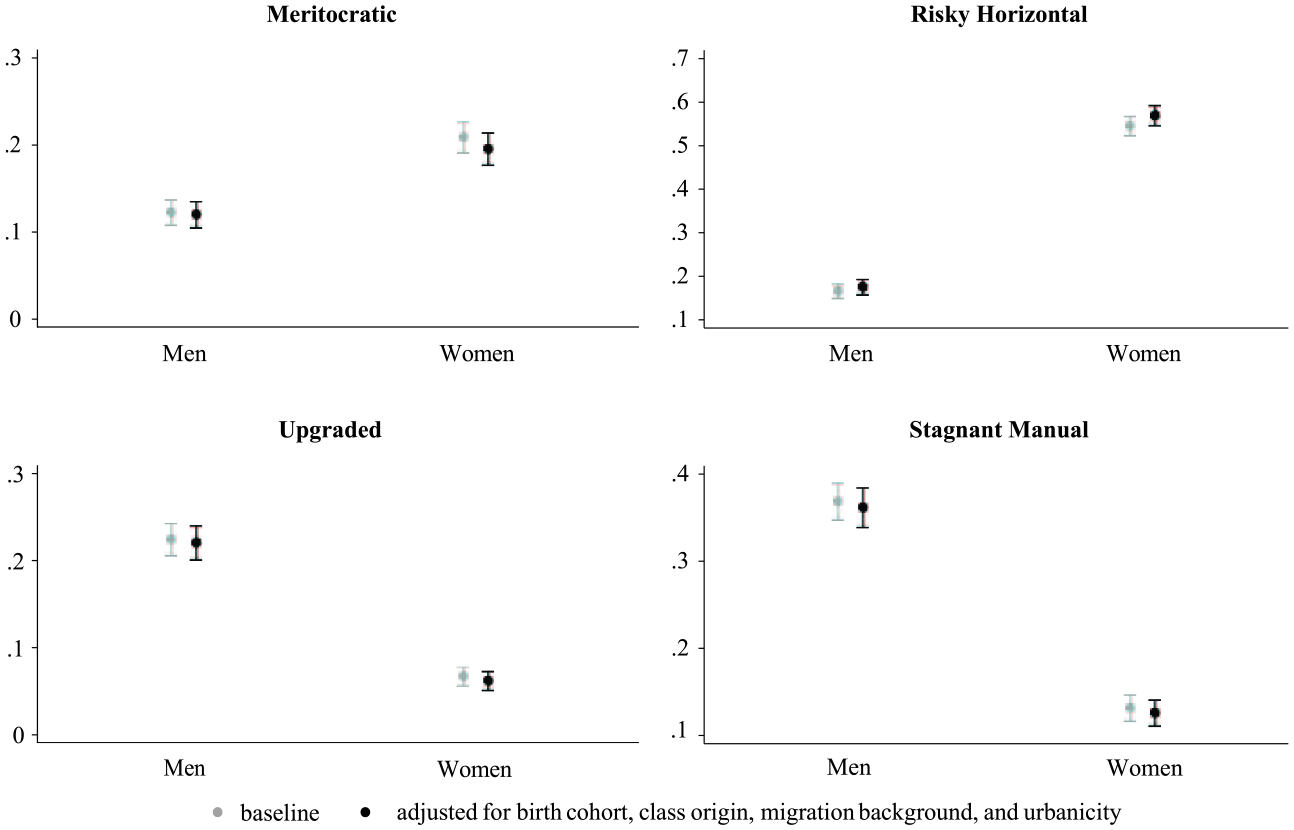
Marginal probability to enter career trajectories by gender.
A risky horizontal career contained several features of instability throughout early to middle careers. Some inactivity periods might have contributed to this cluster’s turbulence, which consisted of voluntary labour market exits related to unequal distributions of family responsibilities, biased towards women. However, the share of inactive positions was too great for this to be a principal mechanism. A robustness check suggested that the relative share of parental leave, of all inactivity periods, was similar across clusters. 4
To contextualise women’s exposure to risky and unstable careers, many jobs in the risky horizontal career type were located in the public sector. Although a public-sector job is generally more stable than jobs in the private sector (Van Winkle and Fasang, 2017), this is not necessarily true in Sweden. Table 1 reports estimates from a series of multinomial regressions on cluster membership. A start in the public sector associated with experiencing a meritocratic career (RRR = 1.847), after adding all controls and a first occupation, and less evidently with the explicitly vertically upgraded career (RRR = 1.220), after adding standard controls. However, the interactions between an individual’s first occupation (at age 25) being low-skill people-oriented and the sector (public) yielded a significantly greater probability of having experienced a risky horizontal career (RRR = 2.841).
First job’s sector (private or public) relative risk ratios.
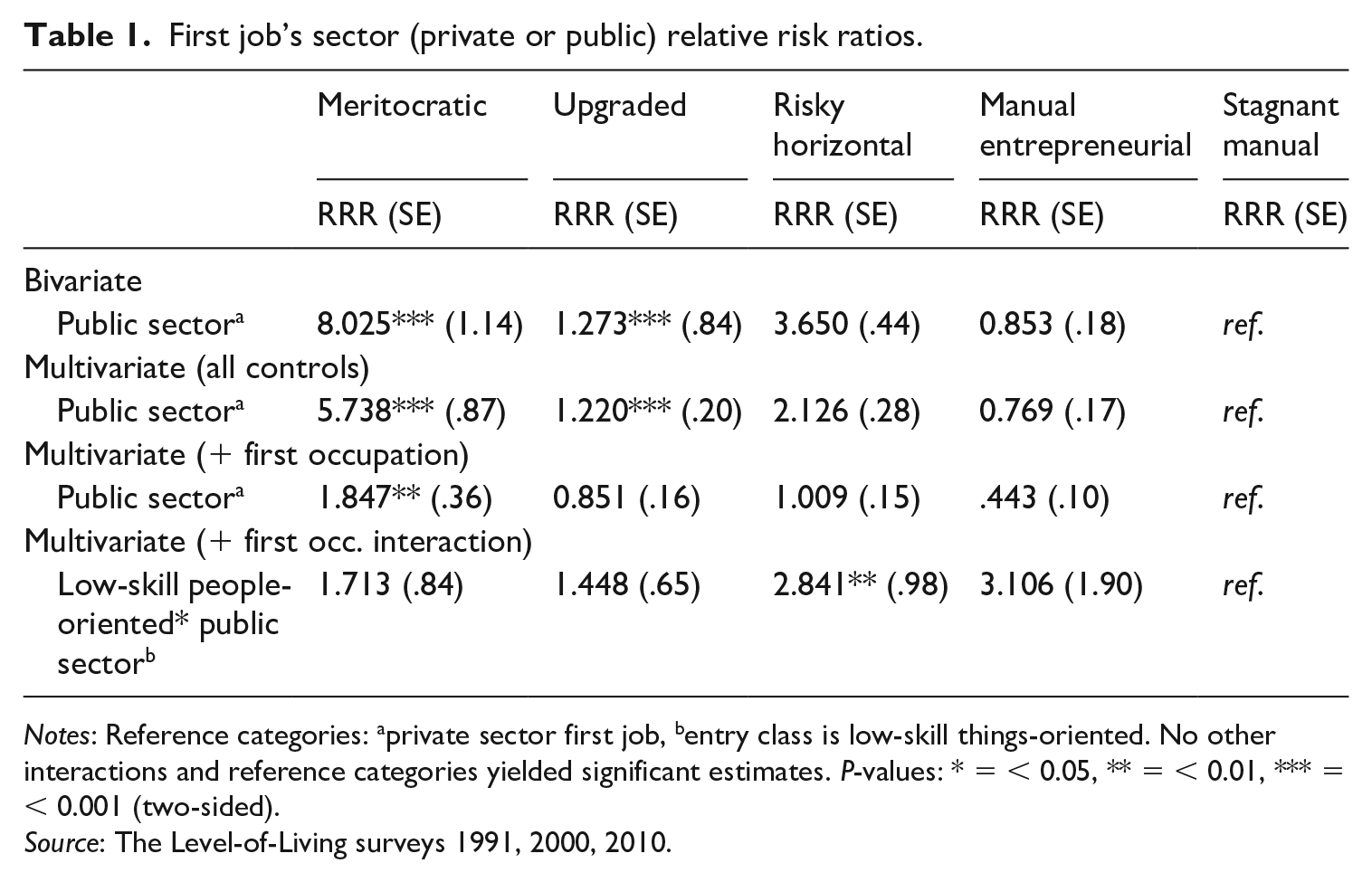
Notes: Reference categories: aprivate sector first job, bentry class is low-skill things-oriented. No other interactions and reference categories yielded significant estimates. P-values: * = < 0.05, ** = < 0.01, *** = < 0.001 (two-sided).
Source: The Level-of-Living surveys 1991, 2000, 2010.
To assess whether observed gender differences regarding access to occupational mobility pathways were structured by change over time, the margins of an interaction between gender and cohort were calculated. Figure 5 reports estimates for men, which suggested that the chances of attaining occupational mobility types were stable between cohorts, with one exception. The marginal probability of men versus women entering a risky horizontal career increased gradually and became significantly different among 1950s and 1960s cohorts, in comparison to older cohorts (top-right panel). Thus, although women were disproportionally more likely to be exposed to a risky horizontal career (a main effect), men became disproportionally exposed more to this trajectory during the second half of the 20th century.
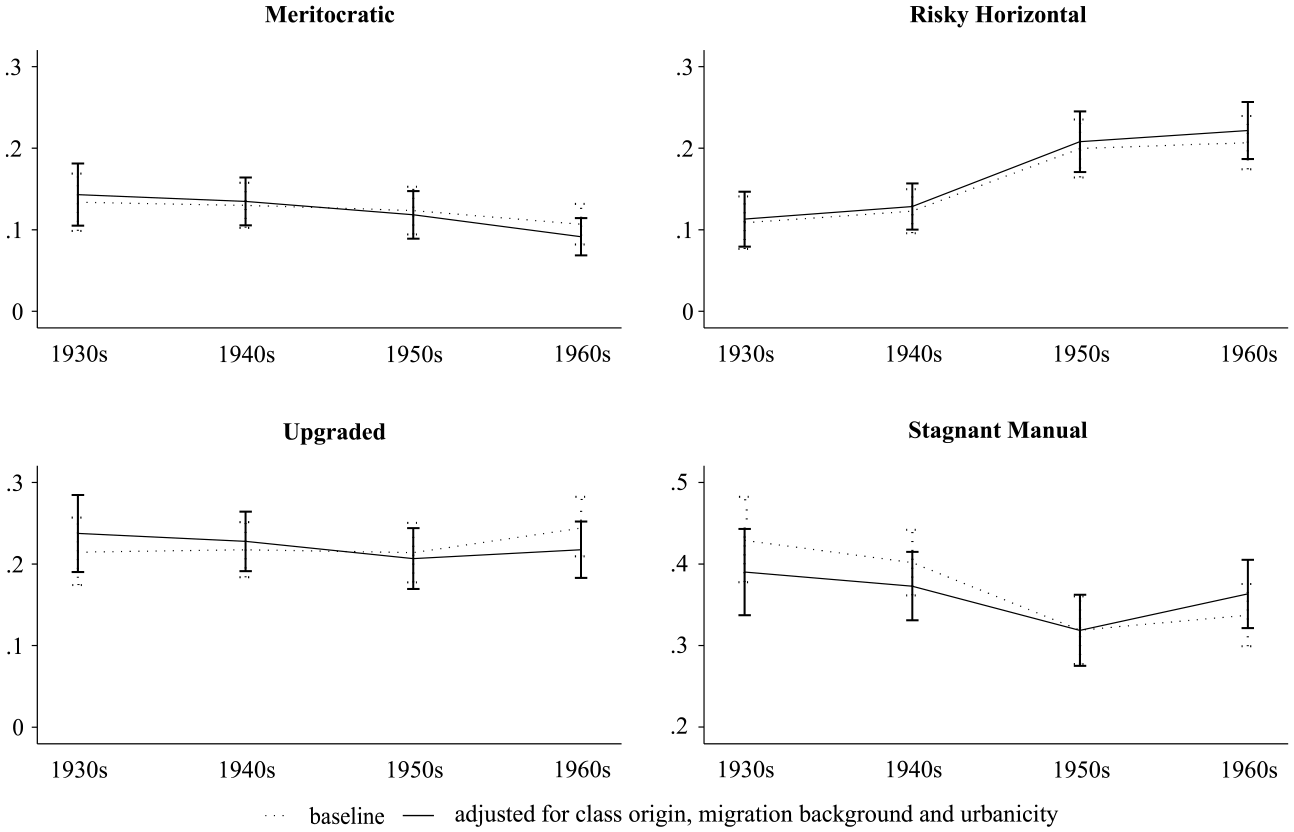
Marginal probability to enter career trajectories by birth cohort: Men.
Between-cohort estimates yielded a different result among women. Figure 6 shows a steadily increasing trend in exposure to an upgraded career for women, in comparison to men. Specifically, every successive post-1930s cohort had a greater probability of entering an upwardly mobile career, from nearly non-existent for the 1930s cohort to .11 for the 1960s cohort (bottom-left panel). Across these four birth cohorts, the youngest was also significantly less likely to enter a risky horizontal career (top-left graph), the opposite of that among men.
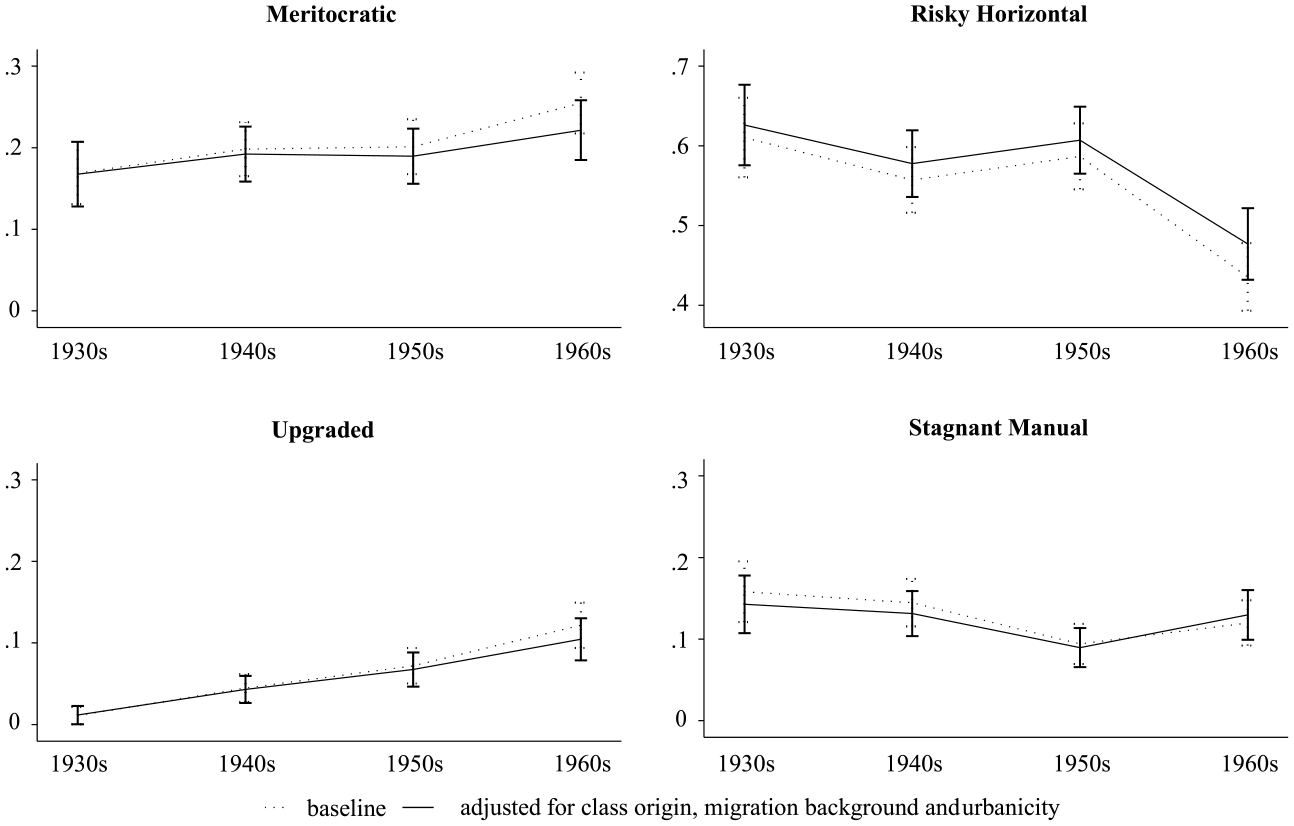
Marginal probability to enter career trajectories by birth cohort: Women.
Conclusion
The consequences of structural change are studied broadly in stratification literature, with most theoretical contributions focusing on emerging prospects for new generations of workers. However, despite indications of progression in work conditions, research documents waning opportunity structures among various groups. The current study assesses whether structural change shapes career mobility patterns through cohort replacement or through substantive shifts or manoeuvring within careers among several cohorts. It also examines which groups likely benefit or lose out during upgrading of the occupational structure and service expansion, concentrating on gender and parental class.
To observe the influence of structural change on careers, this study departs from conventional occupational schemes used in career mobility studies (Bison, 2011; Mayer and Carrol, 1987). Using occupational biographies from Sweden, career mobility is analysed holistically using a joint classification of occupational positions, one that encompasses both vertical (i.e. skill level) and horizontal (i.e. people/things) axes. Application demonstrates how an occupational scheme represents the extent to which macro-structural developments shape modern career mobility patterns. Influences of skill upgrading and service expansion on occupational trajectories are made observable by allowing career transitions to occur across both the (ordinal) skill requirements and the (nominal) skill types of jobs, a combination that reveals both tangible career opportunities and obstacles.
Clustering of occupational trajectories identifies several theoretically relevant forms of career mobility, with combined sequence and cluster analyses suggesting that when using cohort memberships as predictors of career mobility attainment, there is remarkable stability of access to types of career mobility, as labour market stratification literature reports is evident. These include ‘meritocratic’ (cf. Bell, 1973), ‘upgraded’ (cf. Baumol, 1967) and ‘risky horizontal’ (cf. Kalleberg, 2018) careers.
Crucially, based on birth cohort associations with career types, this study does not find a cohort replacement model of structural change in occupational mobility (cf. Lutz, 2013; Ryder, 1965), instead evidencing structural change that shapes distinct forms of within-career manoeuvring. An upgraded career, characterised by job entries that would normally require a tertiary degree, suggests that experienced workers occupy (new) high-skill jobs in expanding sectors. One explanation for this pattern is that skill upgrading traditionally occurs not only through increased higher education demand, attained by younger generations, but through the value of work experience. Men more frequently attain this path, which presumably stems from their overrepresentation in things-oriented occupations. Indicative of structural change, a parallel process occurs during a risky horizontal career – transitions between low-skill things-oriented and low-skill people-oriented occupations. Women are more likely to experience this path, partially because of their selection into low-skill people-oriented occupations across cohorts. Many such jobs remain insecure, making the career type prone to inactivity spells.
In terms of job-supply shocks, this study finds that members of the 1950s cohort were more likely to attain a risky (unstable) career along horizontal occupational lines and less likely to attain traditional stable manual labour careers. However, the shift in career mobility appears to have been temporary because the subsequent cohorts’ propensities returned to those of the pre-1950s cohort. Structural change in the late-20th century Swedish labour market was thus absorbed into occupational careers, through job transitions involving either a move towards high-skill things-oriented tasks or low-skill people-oriented tasks. Features of skill-upgrading and service expansion were manifested in workers’ career trajectories, an absorption of structural change best understood from a life-course perspective (Billari, 2015; Mayer, 2009).
To be sure, the within-career manoeuvring model of structural change, and relative stability in attainment of career mobility types, should not be confused with no between-cohort change at all. This study finds that over time, women became more likely to enter various high-skill career trajectories, including the things domain of the labour market. This finding contradicts the idea that women’s labour force participation growth was biased towards people-oriented jobs (cf. Charles and Bradley, 2009). Contrarily, structural change shaped conditions of linearly increasing propensities of women to enter careers in generally men-dominated high-skill and things-oriented domains of the labour market, though from a low starting point.
Younger cohorts of men increasingly selected into risky horizontal careers, or increasingly precarious and unstable careers (Kalleberg, 2003, 2018); which can be explained by their nominal skill sets likely diverging from skill demands in newly emerging sectors (Kollmeyer and Pichler, 2013; Murphy, 2014). Given continuous technological change, industrial decline and inevitable redundancies of low-skill things-oriented skills in the Swedish labour market, such careers were unlikely to become more stable during the subsequent decade.
Analysis offers no evidence of parental class affecting entrance into types of career mobility over time, which contradicts sociological theses that suggest decoupling of class origin from occupational attainment, but accords with recent studies that assess class position sequences (Bukodi et al., 2016). However, inclusion of a nominal occupational dimension offers insights into how intergenerational inequality persists. First, among workers with higher-class backgrounds, a meritocratic career was a much more likely path if parents were in people-oriented jobs. Second, among workers from lower-class backgrounds, having parents in low-skill people-oriented jobs predicts a greater likelihood of upward social mobility through an upgraded career, in comparison to having parents in low-skill things-oriented jobs. This finding suggests that a people-oriented parental home yielded a comparative advantage for within-career mobility, regardless of its position on the vertical axis. Although, beyond the scope of this study, it is plausible that these forms of intergenerational persistence were rooted in transmission of the type of skills and cultural capitals within families and education (Lareau, 2003; Willis, 1977). Having less indirect exposure to an emerging service sector (mostly children from blue-collar families) might have affected both (early) education trajectories and the chances of experiencing upward mobility throughout life. The present approach provides a comprehensive framework for occupational classification during study of structural change, designed to emphasise tangible opportunity structures as cohorts and socioeconomic groups experienced them. Nonetheless, several questions, such as those regarding changes to job quality in big occupational groups, remain beyond the scope of this study and should be considered using longitudinal data.
Supplemental Material
sj-docx-1-wes-10.1177_09500170211044305 – Supplemental material for Structural Change Shapes Career Mobility Opportunities: An Analysis of Cohorts, Gender and Parental Class
Supplemental material, sj-docx-1-wes-10.1177_09500170211044305 for Structural Change Shapes Career Mobility Opportunities: An Analysis of Cohorts, Gender and Parental Class by Dirk Witteveen and Johan Westerman in Work, Employment and Society
Footnotes
Funding
The authors disclosed receipt of the following financial support for the research, authorship, and/or publication of this article: This research was funded by the Swedish Research Council for Health, Working Life and Welfare (2019-01352) and the Postdoctoral Prize Fellowship of Nuffield College, University of Oxford.
Supplementary material
The supplementary material is available online with the article.
Notes
References
Supplementary Material
Please find the following supplemental material available below.
For Open Access articles published under a Creative Commons License, all supplemental material carries the same license as the article it is associated with.
For non-Open Access articles published, all supplemental material carries a non-exclusive license, and permission requests for re-use of supplemental material or any part of supplemental material shall be sent directly to the copyright owner as specified in the copyright notice associated with the article.
