



Abstract
Participatory action research (PAR) has been offered up as a methodological orientation for public sociology. The challenges of PAR at the local level have been well documented. In contrast, PAR with the labour movement, in particular international meta-organisations such as global trade union federations, has received short shrift. We demonstrate how partisan scholars working with the labour movement can engage with both the different logics of collective action and the different levels of worker representation in pursuit of (political) emancipation. To illustrate how PAR can be ‘scaled up’ from the local to the global, we reflect on our participation with the European Transport Workers’ Federation (ETF). This revealed three particular perils of PAR – personal, purpose and political – that partisan scholars must navigate in order to foster action and emancipation by research. While PAR is an affirming process for our research partners, it is not a panacea for their problems.
Keywords
Introduction
The risks of globalisation for workers are better understood when sociologists work with the labour movement through participatory action research (PAR), ‘a complex strategy for orchestrating processes of democratizing social reform’ (Greenwood, 2007: 146). While PAR has been offered up as a generic methodological orientation for partisan scholars (Brook and Darlington, 2013: 232), it is typically associated with the co-production of research and emancipatory action at the local (micro) level (e.g. Kibbutz and Mondragon cooperatives) (Selener, 1997: 253–254). However, globalisation demands intervention and strategies to promote decent work at the international (macro) level. The challenges of PAR with the international labour movement, or more aptly the perils of such engagement, are seldom explicated (Lambert, 2008: 98–99). This is hardly surprising, as there are very few participatory studies with trade unions (Huzzard and Björkman, 2012: 162) and even fewer with global or European trade union federations. To be sure, ‘the challenges of going to broader scale with participatory research are enormous, but so also are the risks of failing to do so’ (Gaventa and Cornwall, 2001: 79).
The enormity of this challenge is demonstrated through our participation in the Campaign for ‘Fair and Safe Ferries for All’ orchestrated by the European Transport Workers’ Federation (ETF). The ETF, like other European and global trade union federations, is a ‘meta-organisation’ (i.e. an association of associations) (Garaudel, 2020) whose members are other organisations (national transport unions) rather than individuals (transport workers). PAR with these meta-organisations is primarily concerned with political emancipation (i.e. formal equality under the law), which is the last form of human emancipation within the existing social order (Miliband, 1965: 281). To this end, our research contributes to the understanding of the ‘public turn’ in sociology, from the labour process to the labour movement (Burawoy, 2008), and the prescription of PAR for public sociology (Brook and Darlington, 2013), demonstrating that while PAR is certainly an affirming process it is not necessarily a panacea for (political) emancipation. As we ‘scaled up’ PAR from the micro to the macro, in accordance with the challenge for sociologists to ‘change the boundaries of the possible . . . in a highly globalized world’ (Gaventa and Cornwall, 2001: 78), we encountered three particular perils that partisan scholars must try to navigate.
First, in the following section, we outline the personal perils of PAR. As the emancipatory version of action research (Brook and Darlington, 2013: 233), PAR is inherently disruptive of the status quo, but it is not inherently democratic. The latter is contingent on the socio-political orientation of the researcher (Stewart and Martínez Lucio, 2017: 536–537). Once the high degree of ethical-political judgement inherent to PAR is acknowledged, and researchers accept that while they constantly strive to be objective they cannot claim to be detached, the partisan nature of PAR is readily apparent (Brook and Darlington, 2013: 239). For those working with the labour movement, where PAR is typically informed by a ‘labourist’ tradition and a deeply held belief in social justice (Darlington and Dobson, 2013: 289), alignment with the oppressed and democratic participation in the disruption of hegemonic relations is one way to distinguish emancipatory partisanship from other ideal-typical forms of partisan scholarship. However, our personal commitment to emancipation can run up against the overall purpose of PAR as well as the democratic politics of the labour movement and the countervailing forces of a single European market.
Second, therefore, in a subsequent section, we consider different participatory approaches that partisan scholars have developed to support the labour movement. The competing logics of collective action, and the way we engage with different constituents within the labour movement, can create a peril of purpose. In the case of seafarers on short-sea ferries in European waters, we identify opportunities for union organising when the vessels of particular shipping lines call in specific ports, which has the potential to bring direct and immediate improvements in seafarers’ terms and conditions of employment. However, this course of action contrasts (and conflicts) with the institutional route towards political emancipation favoured by the ETF (e.g. lobbying the EU institutions and working with maritime unions in other geographical regions such as the Maghreb).
PAR is inherently political, as is evident in our involvement with the ETF’s Ferries Campaign, which we report in a subsequent section. Political perils are magnified when trying to navigate the complex internal decision-making processes of meta-organisations (e.g. within the ETF and between the ETF and its affiliated trade unions) as well as the external constraints and opportunities of the wider political economy and the inevitable counter-resistance of external interlocutors. PAR can reveal the existence of alternative possibilities hidden within the hegemonic social order, but simply mobilising existing resources may fall short of emancipating seafarers on short-sea ferries. Alas, when charting a course for organising across the geographical borders of different international trade union federations, our emancipatory ambitions were sunk.
Where do we stand and who do we stand with?
The clarion call for public sociology has revived interest in PAR (Brook and Darlington, 2013: 237; Burawoy, 2005: 23), a long-standing research tradition that dates back well beyond the recent emergence of calls for ‘co-produced knowledge’ and the ‘impact agenda’ (Wakeford and Sanchez Rodriguez, 2018). Although the public sociologist is cast as a partisan who defends society against market tyranny and state despotism (Burawoy, 2005: 24), there is often a reluctance on the part of sociologists to openly ‘choose sides’, with the result of undermining, or even erasing, the transformative (emancipatory) potential of public sociology (Arribas Lozano, 2018: 96). By choosing sides, PAR moves social inquiry from the expert domain of professional sociology to the public domain of people’s lives. The objective is not simply the development of critical consciousness on the part of researchers and participants, but also emancipation through the transformation of societal structures and relationships: ‘Human activity is theory and practice; it is reflection and action . . . directed at the structures to be transformed’ (Freire, 1970: 125–126).
When participating in action research with trade unions, democratic engagement cannot be mandated at the outset (Greenwood et al., 1993: 175–176) as different trade unions are characterised by more or less democratic (representative) decision-making structures. A particular concern for trade unions is that if workers lay bare their understanding of exploitation in their workplace, this knowledge might be appropriated by management to extend methods of control (Woodcock, 2014: 506). Nonetheless, it is only when PAR is ideologically driven by a personal democratic commitment to defend the rights of labour and disrupt neoliberal hegemony that the public sociologist can be identified as an emancipatory partisan, as illustrated in the typology of Figure 1.
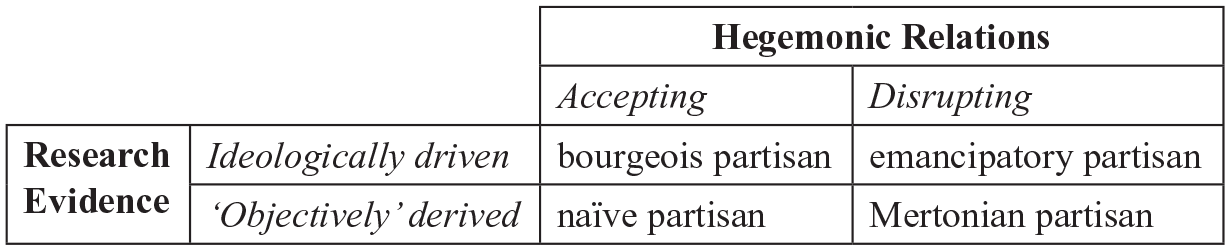
Partisanship.
Whereas all (social) science is dependent on particular types of social structure, by the early 20th century, if not before, ‘the scientist came to regard himself [sic] as independent of society and science as a self-validating enterprise which is in society but not of it’ (Merton, 1942: 116). As a traditional intellectual, the Mertonian partisan stands apart from and towers above the rest of society, driven by kudos via CUDOS:
Communism implies that the substantive findings of science, as the product of social collaboration, are shared and not secret;
Scientific claims are Universal as they do not depend on the personal or social attributes of their protagonists;
Disinterestedness implies an altruistic pursuit of the truth and a personal detachment from truth claims; and
Organised Scepticism involves critical scrutiny, logical and rational research methods (Merton, 1942: 118–126).
Under the institutional imperatives of CUDOS, research evidence is presented as objectively derived, even though the scientist is rooted in, and bound to, ‘preconceptions of his/her milieu and historically or socially specific experiences and interests’ (Hobsbawm, 1998: 166). As a result, while ‘an emphasis on evidence could have significant critical and emancipatory potential’ (Learmonth, 2008: 285), given that ‘questions of fact, including potentialities’, may disrupt ideas and attitudes ‘crystallized and often ritualized by other institutions’ (Merton, 1942: 126), emancipation is rarely realised without an explicit ideology.
While there is ‘disdain for anyone naïve enough to ascribe to value freedom’ (Edwards, 2015: 175) – partisanship is inevitable, wanted or otherwise, in all scholarship (Brook and Darlington, 2013: 233) – the naïve partisan tries to maintain ‘a distinction between the objective factual evidence of their research and any subjective evaluation of its implications and consequences, drawing no relationship whatsoever between the two’ (Darlington and Dobson, 2013: 286, original emphasis). Clearly, the maintenance of neutrality can only be manifested in relation to a given social order to which the naïve partisan is blind, a world where ‘facts have no feelings’ irrespective of whether ‘the facts’ are (re)interpreted and used in a way to benefit one social group at the expense of another. At best, the naïve partisan is concerned with why the world is as it is, rather than how it could be otherwise. At worst, the ‘popularist science’ (Hodgkinson et al., 2001: S43–S44) of the naïve partisan unwittingly legitimises a world of management fads and fashions that invariably sustain existing inequalities and immiseration.
By definition, the bourgeois partisan has no desire for the world to be otherwise. Ideology, as opposed to political naivety, drives the bourgeois partisan’s support for the status quo. If asked: ‘For whom and for what do we pursue sociology?’, the bourgeois partisan would no doubt proclaim professional autonomy, independence of thought and a detachment from elites. In practice, they turn a blind eye to power and inequality, using ‘the rhetoric of science as a mask for the politics of evidence’ (Learmonth, 2006: 1089), thereby functioning as intellectuals for the dominant social group (Brook and Darlington, 2013: 235). Eric Hobsbawm (1998: 180) drew attention to the dangers of such common-sense knowledge ‘presented, not as politically based and oriented views, but as eternal truths discovered with no purpose other than the pursuit of truth’. Indeed, when bourgeois partisans hide their ideology behind the pretence of science, they can cause untold harm to society (e.g. the new orthodoxy of trickle-down economics or the deregulation of labour markets). There are some in university business schools in particular who incessantly question managerial policy and practice but offer ‘little in the way of claims that are academically rigorous, intellectually interesting and practically relevant’ (Spicer et al., 2016: 226). While they might claim to be disruptive and subversive, these scholars rarely traverse from the balcony to the barricades.
Standing on the barricades are the emancipatory partisans, participating in the struggles of the labour movement, occasionally ‘putting our bodies on the line’ in the tradition of workers’ inquiry (Woodcock, 2014) but more often ‘putting our heads to good use’ (Dawson and Sinwell, 2012: 187). For all subaltern classes, ‘no research about us without us is for us’ (Wakeford and Sanchez Rodriguez, 2018: 11). When the activist-scholar stands ‘with us and for us’, s/he (re)claims ‘a re-signified objectivity, while at the same time critiquing its hegemonic (mis)use’ (Hale, 2008: 12). Political action on the side of the oppressed, through PAR, ‘must be pedagogical action in the authentic sense of the word’ (i.e. action that is the object of critical reflection) and, therefore, ‘action with the oppressed’ (Freire, 1970: 66, emphasis added). As research typically starts with studies on or for a specific organisation, campaign or wider political movement, the emancipatory partisan must invest considerable time and emotional resources to build the necessary trust and credibility to research with, within or even in the name of the movement, campaign or organisation (Brook and Darlington, 2013: 236). One of the personal perils of this approach is that it hardly sits well with the demands of publishing journal articles (as opposed to practitioner reports) in the neoliberal university (Stewart and Martínez Lucio, 2017: 552), but ‘Far from movement engagement detracting from intellectual endeavor, direct involvement stimulates fresh directions relevant to the overriding issue of our times: can market rule be challenged?’ (Lambert, 2008: 102).
The emancipatory partisan speaks freely and fearlessly, with confidence and candour, demonstrating not just the ability ‘to “get on well” with people’ (Huzzard and Björkman, 2012: 167) but also the socio-political nous and interactional skills necessary for intellectual arbitrage and conflict resolution. In this regard, the context-independent knowledge (sophia) sought by the Mertonian partisan stands in stark contrast to the practical, context-dependent knowledge (phronesis) of the emancipatory partisan. Such knowledge and experience are at the very heart of PAR, where the more important test of knowledge is practical adequacy rather than peer review, as knowing is more valuable when it is enacted. With PAR, action and reflection are indissolubly united: otherwise, it is mindless activism or empty theorising (Freire, 1970). That said, even mindful and purposeful participation can leave emancipatory partisans becalmed.
PAR with the labour movement
Purposeful participation with the labour movement demands critical reflection of the researcher’s relationship with one’s partner(s), especially as PAR is context- and partner-dependent (Greenwood et al., 1993: 175–176 and 179). For example, our partners might be rank-and-file union members and activists (Stewart and Martínez Lucio, 2011: 333), and/or national and international trade union officials, as depicted in the theoretical framework of Figure 2. PAR might activate the logic of membership, which requires the trade union to maintain its representative credentials by articulating the vested interests of its members, and/or the logic of influence, whereby unions adapt their aims and methods to the actual decision-making processes on which they exert an impact (Dølvik, 1997). Partisan scholars might use PAR to promote militant forms of action (e.g. Operaismo) or to give voice to rank-and-file members by democratising their union (e.g. Socialisme ou Barbarie) (Woodcock, 2014). Alternatively, researchers might work with national union officials seeking to organise workers or influence the decision-making institutions that determine everything from pay and conditions of employment to market competition. PAR must therefore be structured differently in different settings according to the specificities of time, place and research partner(s).
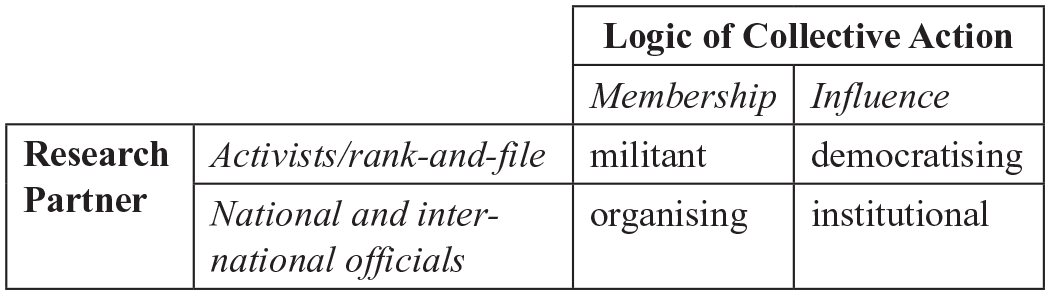
Forms of participatory action research (PAR) with the labour movement.
When our primary research partner is an international trade union federation, the logics of membership and influence are obviously very different to grassroots struggle: the members of these meta-organisations are national trade unions and influence is directed primarily towards international decision-making institutions. Our partner, the ETF, is the recognised European Trade Union Federation (ETUF) of the European Trade Union Confederation (ETUC) for transport, logistics, fisheries and tourism. The Federation represents more than 200 affiliated transport unions with more than five million members in 41 European countries and is integrated into the regional structure of the International Transport Workers’ Federation (ITF). Through the logic of influence, at the European level, the ETF assists affiliated transport unions to ‘defend and promote the economic, social, occupational, educational and cultural interests of their members’ (ETF Constitution, Rule I.7). The logic of membership is articulated through the Federation’s aim to unite all its affiliates ‘on the principle of solidarity . . . to promote practical international cooperation and joint action’ (Rule I.5).
Although the logics of collective action depicted in Figure 2 are not mutually exclusive categories, in the event of industrial action the role of the ETF is limited to moral support, financial assistance and succour for the affiliate in its approach to national governments and inter-governmental organisations (Rule XIV.2). As a result, without a mandate to call for direct (militant) action, the logic of influence preoccupies the ETF Secretariat, most notably in relation to the European institutions (Rule XIII.4). 1 These institutions, especially the European Commission, favour ‘objective’ (social science) evidence over the representative credentials of the ETUFs. In fact, as ‘[s]takeholders are expected to provide partisan information’ (Bozzini and Smismans, 2016: 93), their evidence must be subject to ‘peer-reviewing, benchmarking with other studies and sensitivity analysis’ in order to ensure ‘the robustness of the results’ (European Commission, 2009: 20).
Evidence is more persuasive when backed up by action, or at least the possibility of action, especially as it can often reveal opportunities for organising (Figure 2) that might bring immediate improvements to workers’ terms and conditions of employment. For example, data might reveal the ports where sub-standard vessels call most often, enabling trade unions to focus organising in the ports where collective action might benefit seafarers most. Under the ITF’s Flag of Convenience (FoC) 2 campaign, ITF inspectors, with the cooperation of national dockworker trade unions, not only inspect but on occasion ‘arrest’ a vessel in port (e.g. dockworkers refuse to un/load cargo) until decent work deficits have been rectified (Lillie, 2010). Cooperation between maritime and dockworker trade unions is coordinated by the ITF’s Fair Practices Committee and European dockworkers have previously demonstrated their capacity for coordinated (pan-European) industrial action (Turnbull, 2006). Cooperation between maritime and dockworker trade unions might therefore provide opportunities for organising, and a credible threat of membership action, to bolster the ETF’s institutional logic of influence (Figure 2). That said, we can find ourselves at cross-purposes with our trade union partners as politics can scuttle any recommended course of action, particularly as PAR is a democratic process of co-produced research.
Democratising research
Democratic participation in any co-produced research process is ‘messy, noisy, demanding, and exciting . . . [PAR] . . . is anything but dull but we often write about it as if it were’ (Greenwood, 2007: 147). The ‘mess’ is a consequence of co-produced research incorporating the observation of events and social processes, the experiences and insights of participants, and changes in both events and accounts over time. As the concept of emancipation only makes sense at the objective level, we need to claim factual status for an emancipatory project that identifies a causal connection between human action (e.g. ships that fly a more convenient flag in terms of taxation, employment rights for seafarers, etc.) and repressive consequences (e.g. a preponderance of human element deficiencies on particular ships, as reported by official vessel inspectors).
PAR is neither a method nor a recipe (Greenwood, 2007: 146), but typically embraces different data collection methods and the use of data of different sorts, ‘quantitative and qualitative, historical and current – anything that the researcher (or their research [partner]) have good reason to think “makes a difference”’ (O’Mahoney and Vincent, 2014: 15). Proponents of PAR often downplay the utility of quantitative data (Brook and Darlington, 2013: 240), but when combined with other data and analytical methods they offer an important point of departure for deeper exploration of casual connections (i.e. from know that to know how knowledge). Our research included interviews with a range of different stakeholders (e.g. DG Move in the European Commission, the European Community Shipowners’ Association, several shipping lines, union officials and activists), a review of a wide range of secondary sources, the creation of statistical databases for vessels sailing in the Mediterranean, Channel and North Sea, a questionnaire of national union officials and union-sponsored (port-based) vessel inspectors, and conversations with non-EU seafarers working on short-sea ferries.
When PAR is reported through a narrative (chronological) strategy, we can not only add some colour and excitement but also some order to events as they unfolded. Figure 3 depicts how we navigated the research as it oscillated between the processes of identifying, planning, acting/observing and reflecting. Although PAR might appear from this Figure to involve three sequential (albeit iterative) stages of joint diagnosis (Phase 1), joint prognosis (Phase 2) and potential courses of disruptive action (Phase 3), it is best conceptualised as a spiral, denoting progression, return and sometimes reversal. This is an inevitable consequence of how the personal perils of partisan scholarship interact with different interpretations of the purpose of PAR. Consequently, the final Phase (3) is by no means guaranteed, even for the emancipatory partisan (Figure 1). As detailed in the case that follows, ‘organising PAR’ (Figure 2) can be blown off course by the democratic procedures and political machinations of our partner organisation(s), and/or the material conditions and social structures of the wider political economy.
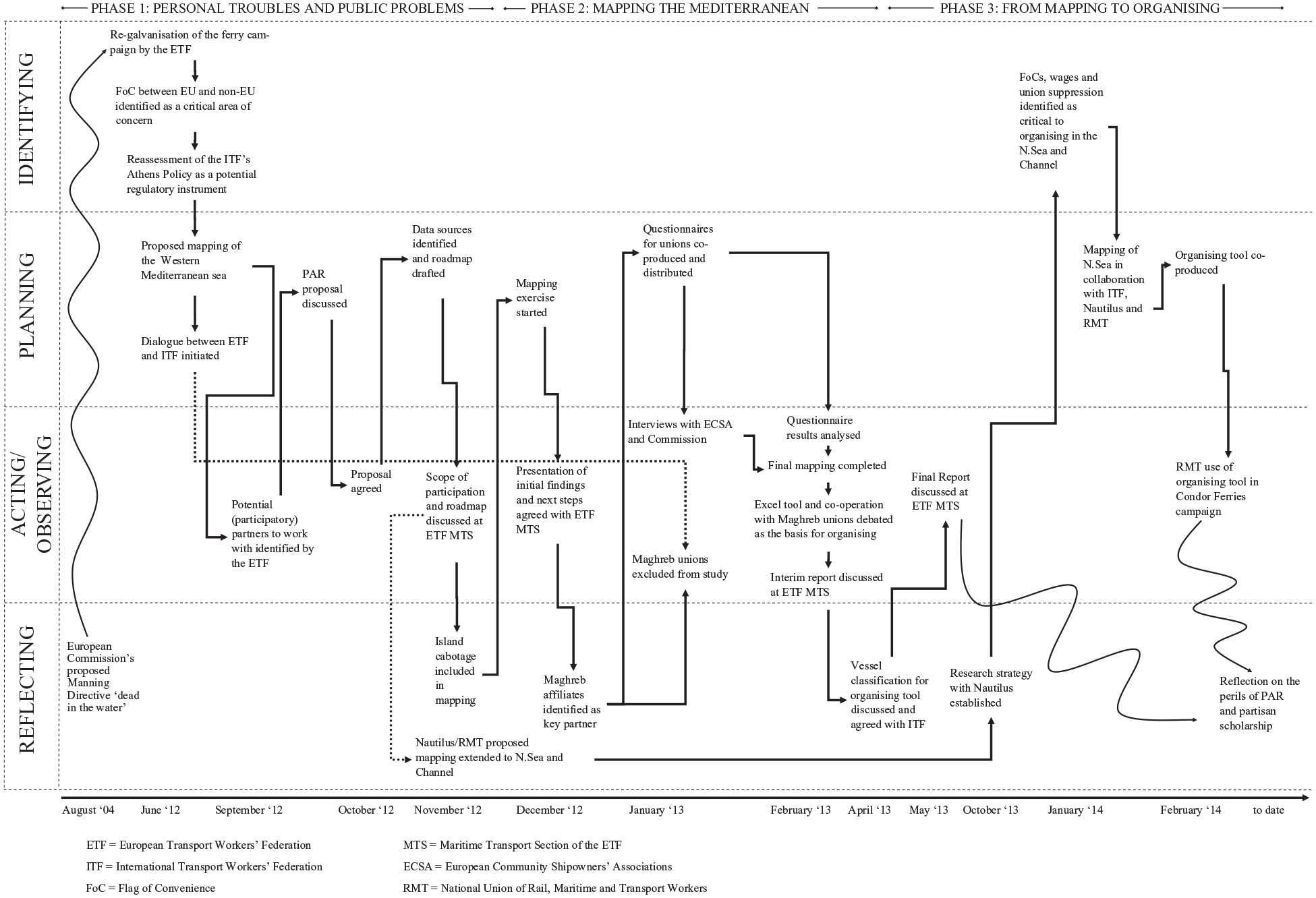
From mapping to navigating alternative courses of action.
Phase 1: Personal troubles and public problems
In an email to an ITF inspector concerning the contracts of Ukrainian seafarers aboard Condor Ferries, who were paid just over £28 for a 12-hour day (£2.35 per hour), 3 the Assistant National Secretary of the National Union of Rail, Maritime and Transport Workers (RMT) made the obvious point that: ‘European seafarers cannot compete with these slave wages’ (28 October 2013). All five vessels operated by Condor Ferries fly a (Bahamas) FoC and sail primarily in Crown Dependency waters between the Channel Islands and the south coast of England.
At the turn of the millennium, non-EU nationals constituted only 2–3% of the crew on-board regular short-sea services between EU member states and most services were carried out by ships under member states’ flags. A decade later, around one-in-five crew were hired from third countries (ECORYS, 2009: v). In order to protect and promote the employment of EU seafarers, the European Commission proposed a ‘manning Directive’ (Commission of the European Communities (CEC), 1998) that would impose EU standards for all seafarers in European waters, thereby ‘prevent[ing] social dumping . . . and the distortion of competition brought about by the employment of third country seafarers at non-EU wages. It will prevent further replacement of EU seafarers by cheap non-EU nationals’ (CEC, 1999: v).
The European Community Shipowners’ Associations (ECSA) vigorously opposed a policy that effectively constituted political emancipation for all seafarers sailing in European waters, and the proposed Directive ultimately ran aground in 2004. This focused the attention of European maritime unions on the ITF’s Athens Policy. With similar wording to the failed Directive, this Policy states that: ‘the crews of vessels engaged in European ferry trades, including non-European vessels, shall be covered by European conditions of employment which are regulated through national collective bargaining agreements held by the appropriate ITF European affiliates’. 4 In pursuit of the Athens Policy, the ETF called on the European Commission to create a ‘level playing field’ for competition with a revamped bona fide manning Directive that recognised the changes brought about by the enlargement of the EU. However, the nature of these changes was not well understood, and it was clear from previous lobbying by the ETF that the Commission indeed was more persuaded by empirical evidence than worker representation. While the ETF determined to generate the necessary evidence base, the Federation also recognised that: ‘It is now high time to pursue industrial actions with a view to support our legitimate political demands’ (Philippe Alfonso, MTS News Online, 20 September 2010). In the UK, for example, it was apparent that ‘political action is “nebulous” without industrial backing’ (Umney, 2012: 79). Any industrial action, however, was characterised by national action ‘reacting to companies’ infringement of Athens Policy demands . . . rather than on proactive . . . transnational engagement’ (Umney, 2012: 83). Moreover, not all infringements were known, at least not beyond the better publicised cases such as Condor Ferries.
In support of the Athens Policy, the ETF launched a campaign for Fair and Safe Ferries for All in 2010 (Umney, 2012) and, as part of the Maritime Transport Sector (MTS) work programme for 2013–2017, it was decided to conduct a mapping exercise of short-sea ferry trades (Planning). This followed concerns raised by several Mediterranean affiliates in respect of ‘the terms and conditions applied to crew members on-board ships trading between European countries and then prolonging their trade to non-European southern Mediterranean countries (Identifying) (email from the ETF, 18 September 2012). Thus, the (explicit) decision to comprehensively map all the short-sea ferries in the western Mediterranean was evidently political, and thereby consistent with an institutional logic of influence (Figure 2), but the (implicit) potential to support industrial action via organising was also recognised from the outset.
Exploratory discussion with the ETF set out the parameters for the project, namely a five-month timeline with agreed dates for data collection and preparation of joint progress reports, reviews and a final report (Planning). The agreed objectives (Acting) of the project would be to: (a) map the working and living conditions of seafarers on-board ships (EU flag and FoC) in the western Mediterranean, (b) analyse the impact of the (de)regulatory environment (e.g. re-flagging of vessels), and (c) explore with the ETF and its affiliates ‘how to best involve the unions of the countries of the southern border of the Mediterranean Sea’ (email from the ETF, 18 September 2012). When we map (a) we observe the empirical (e.g. vessel flag, ports of call, crew composition and nationality, terms and conditions of employment, etc.). When we analyse regulatory mechanisms (b), the actual patterns that govern events can be discerned, drawing on substantive theories (e.g. regulatory ‘spaces of exception’) (Lillie, 2010) to facilitate ontic depth (e.g. the cost advantages of hiring a ‘crew of convenience’ from different national labour markets and how this impacts competition in an open European market that is extended to non-EU countries). Our interpretation of the empirical map through these causal mechanisms and competitive forces – the praxis of reflection and action directed at the structures to be transformed – made for rather uncomfortable dialogue with the ETF and several affiliated national maritime unions in relation to an organising strategy that involved cooperation with their counterparts in the Maghreb countries (c).
Previous projects with the ETF included very close collaboration with dockworkers (e.g. Turnbull, 2006, 2009), which furnished a working knowledge of the maritime sector but not necessarily the level of expertise required for the short-sea shipping project. In particular, was the problem with short-sea shipping in and around European waters one of ‘bad apples’ or ‘bad markets’? The former was the conclusion of a year-long concentrated inspection campaign by the Paris Memorandum of Understanding (MoU): ‘there are still shipping companies which have made a deliberate choice to operate sub-standard ships . . . Unfortunately the seafarers on these ships have to live under often horrendous working and living conditions. Filthy living quarters, unsanitary conditions and rotting food are a few examples’ (Paris MoU, 2016: 6). For the ETF, in contrast, the root of the problem was both market expansion (accession of new member states creating much larger differentials in pay and conditions between EU seafarers) and market (de)regulation, specifically the ability of shipping lines to ‘flag out’ and hire a crew of convenience from even cheaper non-EU countries. Bad apples are more often found in bad markets: ‘There are some shipping lines that exploit these differences, creating a downward spiral in salaries and creating widespread discriminatory practices’ (Philippe Alfonso, Political Secretary for Fisheries, Dockers & Maritime, ETF, Lloyd’s List, 27 April 2010). The mapping exercise was therefore designed both to identify the bad apples and to establish just how bad the market had become.
Phase 2: Mapping the Mediterranean
The target population for the mapping exercise was all ferries departing over a 6-month period (1 June to 30 November 2012) from France, Italy and Spain to non-EU countries. At the first meeting with the MTS Steering Committee (November 2012), the French maritime union (CGT) proposed the inclusion of island cabotage – ferries to the respective islands of the three member states – as a control group, given that national flags and national seafarers are the norm on these routes (Reflecting). The annual market report published by Shippax (2012) provided a comprehensive list of all short-sea operators and more than 6100 vessels. For all ferry routes in the Mediterranean, including island cabotage, Shippax lists the operator(s), vessel(s), flag and flag changes, which we recorded from 2003 onwards. These data were combined with information available on Sea-web (www.maritime.ihs.com), which can be used to identify shipping companies and track more than 180,000 vessels across the globe in real time.
From these data sources, we identified 116 vessels sailing from either France, Italy or Spain to non-EU countries and 227 vessels on island cabotage. Of the latter, almost 96% sailed under their national flag. The picture was very different on ferry routes to non-EU countries: within this population there were 33 operators under 59 registered owners, with almost 30% sailing under a FoC. Although less than a third of the vessels flew the flag of France, Italy or Spain, more than 40% of all vessels were under French, Italian or Spanish ownership. In other words, there is clear evidence of flagging out by ECSA members. Over the period from 2003 to 2012, almost one-in-five vessels had switched to a flag that allowed the operator to employ seafarers on inferior pay and other conditions of employment in comparison to the pay and benefits enjoyed by French, Italian and Spanish seafarers. 5 Among the vessels flying a FoC, six vessels per annum (on average) changed flag, indicating a strong predilection for regime shopping.
Information from Shippax and Sea-web was then cross-checked against the Equasis (www.equasis.org) database, which records whether the vessel has been detained, and for what reason(s) (deficiencies), by the Paris MoU on Port State Control. Objective and agreed deficiencies are both technical (e.g. structural integrity of the vessel, equipment, maintenance, etc.) and human, where the latter relate both to the crew (e.g. competency and training standards) and conditions aboard (e.g. hygiene, living accommodation, medical equipment, etc.). The worst apple in the bad market was the BNI Nsar, with 293 deficiencies in the previous 10 years that included 44 human element deficiencies leading to three detentions. For the population as a whole, the number of detentions and deficiencies per vessel, including human element deficiencies, was almost double for FoC vessels compared to other flags, as documented in Table 1.
Deficiencies and detentions per vessel, EU to non-EU routes (2003–2012).
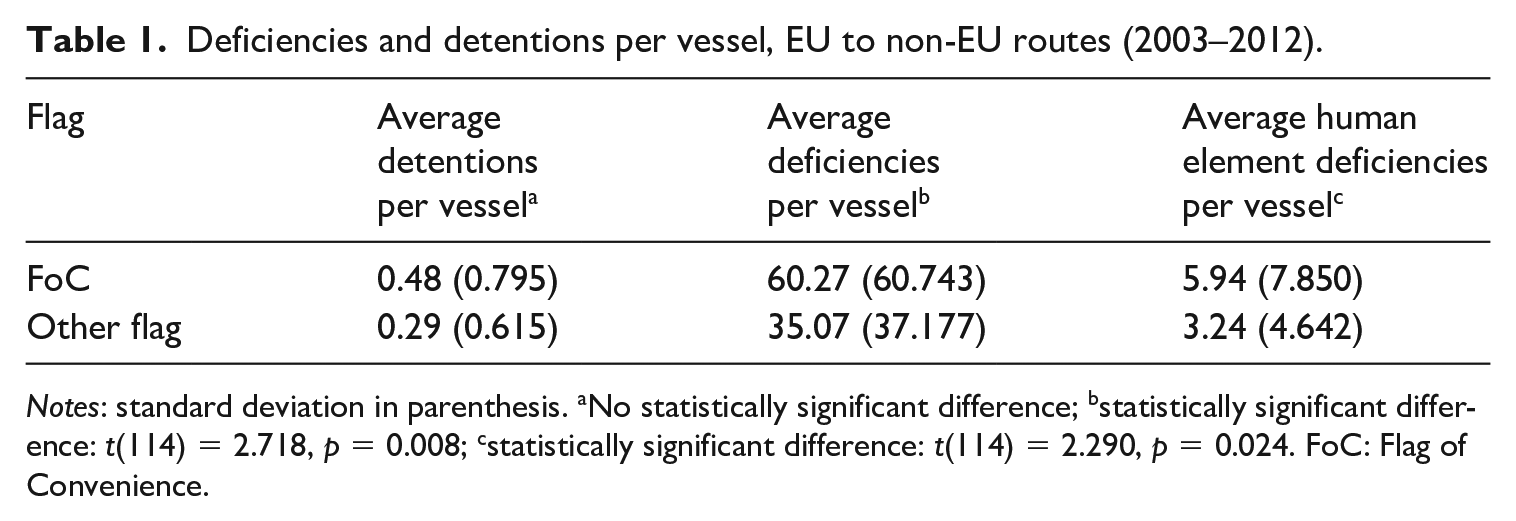
Notes: standard deviation in parenthesis. aNo statistically significant difference; bstatistically significant difference: t(114) = 2.718, p = 0.008; cstatistically significant difference: t(114) = 2.290, p = 0.024. FoC: Flag of Convenience.
An important shortcoming in the database was incomplete crew data. Moreover, even when crew data were available, it was not clear whether European or third country terms and conditions applied. For example, the vessel AF Michela operating between Bari and Durres, owned by an Italian company and flying an Italian flag, employed Filipino, Montenegrin and Italian seafarers. But there was no information on whether they were all covered by an Italian collective agreement. Thus, in the first data review meeting of the project we flagged these gaps in the database and agreed with the ETF to co-produce a questionnaire survey that national maritime unions would complete, covering every vessel on EU to non-EU routes and a representative sample of vessels on island cabotage (Planning). This required national unions to work with port-based union reps and ITF vessel inspectors to collate the necessary data. Our proposal to involve ITF inspectors and union representatives from the Maghreb countries, however, was deemed to be ‘not appropriate’ at the time (email from ITF Maritime Section, 31 January 2013).
The questionnaire for each of the French, Italian and Spanish maritime unions identified all the relevant vessels with information requested on crew members and whether crew were nationals of the country in question, other EU nationalities and/or non-EU. There then followed a series of questions on: recruitment (e.g. directly by the shipping line or via a manning agency); coverage of any collective agreements; compliance with the ITF’s standard manning policy and other international regulations; wages and hours of work compared to national agreements and the international collective agreement between the ITF and the International Maritime Employers’ Council (IMEC); and a subjective assessment of human elements (e.g. crew accommodation, amenities, food, hygiene, safety, personal protective equipment and medical care). Further questions sought confirmatory data on reports of human element deficiencies and the effectiveness of procedures for reporting and recording any such deficiencies.
For island cabotage, questionnaires were returned for almost every vessel. For trades to non-EU countries, the response rate was commendably high for Italy (79% of all vessels) and Spain (73% of all vessels) but disappointingly low for France (just 17% of all vessels). With any mapping exercise, however, ‘non-data’ – in this instance the absence of information on a specific vessel – is still useful as it helps to establish any knowledge gaps and evident shortcomings in the ability of trade unions to generate reliable and actionable evidence.
The data were imported into a live spreadsheet file. This resource could then be used, and regularly updated, by ETF affiliates and ITF inspectors to identify shipping lines, manning agencies, routes and ports with a preponderance of detentions and human element deficiencies. At a minimum, the spreadsheet file could be used to identify the bad apples who exploited regulatory spaces of exception, including union (dis)organisation and limited collective bargaining coverage, in what is evidently a bad market. The intended purpose was for the database to not only constitute an additional (power) resource that the ETF and its affiliates could mobilise in their everyday activities, but more importantly to provide the foundations for organising (Figure 2) by identifying where structural power is needed (i.e. the ports where sub-standard vessels call most often) and associational power is possible (ITF inspection and solidarity action by dockworkers).
Phase 3: From mapping to organising
While the data for the western Mediterranean were updated and analysed with the ETF, research started on a similar mapping exercise for the Channel and North Sea with UK maritime unions (Nautilus International and RMT) rather than the ETF (Reflecting). Building on the Fair and Safe Ferries for All campaign, the UK maritime unions recognised the potential of the database as an organising tool: ‘We desperately need to get a handle on the passenger ferry and cargo ferry sector to and from the UK . . . and understand who the operators are, what flags they operate and most importantly what crews they employ’ (email from the General Secretary of Nautilus, 19 November 2012). In fact, the UK maritime unions proved to be the only ETF affiliates to use the database (Acting) as part of a campaign against a shipping company (Condor Ferries), a reflection of the fact that different maritime unions can leverage more or less powerful national institutions.
Compared to Ukrainian seafarers sailing in Crown Dependency waters, on the other side of the Channel, French seafarers sailing between France and the Channel Islands on-board Condor Ferries were hired on permanent contracts under a 7-days on/7-days off roster. France and Italy are two of the most active member states in terms of using state aid to protect the employment of national seafarers (under Article 3(2) of Regulation 3577/92) and the power of maritime unions is bolstered by national employment laws and extension clauses that widen the scope of collective agreements to employers not affiliated to the signatory employers’ organisation(s). As a result, on cabotage and intra-EU ferry services, collective bargaining coverage in both France and Italy is 100%. The questionnaire survey data revealed that, for both France and Italy, it was only when ferries extend their services to non-EU countries that flagging out, crews of convenience and sub-standard terms and conditions of employment are found.
A common feature of European trade union federations, as meta-organisations, is that ‘the international needs its affiliates – or at least, the larger, wealthier and more powerful ones – more than these need the international’ (Hyman and Gumbrell-McCormick, 2020: 261). ETF affiliates with more comprehensive collective agreements (e.g. French and Italian maritime unions) had little incentive to cede authority to the European federation, whereas those in a weaker position (e.g. UK maritime unions) needed the support of both the ETF and its more powerful affiliates. It was only when vessels extended their service to the Maghreb countries that stronger maritime unions looked for wider international support, but this was beyond the remit of our research and the jurisdiction of the ETF. As the MTS Steering Committee made clear, ‘questions relating to the possible cooperation between the unions of the two borders of the Mediterranean will not be left in the hands of the academics’ (MTS Minutes, November 2012). Internal union politics (the relationship between the ETF and the ITF) and the political situation of the time and place (the Arab Spring) ultimately put paid to any use of the database as an organising tool beyond the campaign against Condor Ferries.
Conclusion
For many advocates of public sociology in general, and partisan scholarship in particular, PAR is a welcome change of tack towards a more democratic and progressive way to engage with personal troubles, social issues and public problems (Brook and Darlington, 2013). That said, there is still more theoretical and reflective discussion of the propriety of PAR (i.e. about action) rather than practical examples of PAR in action (Huzzard and Björkman, 2012). Moreover, there is considerably more attention to micro-level participation with local communities fighting against the commodification of social existence, in contrast to our focus here on macro-level engagement with the struggles of the labour movement for (political) emancipation. In this regard, we demonstrate the emancipatory potential of partisan scholarship compared to other ideal types (Figure 1), that PAR with the labour movement must be structured differently according to the nature of our engagement with research partners and the logics of collective action (Figure 2), and that PAR is subject to political perils that are magnified when working with the democratic decision-making processes of international meta-organisations (Figure 3).
Shipping is a global industry par excellence and as such demands participatory action at the macro-level, ideally combined with local (port-level) action at the micro-level in order to disrupt and redirect the hegemonic forces driving exploitation. As our participation in the ETF’s Ferries Campaign clearly demonstrated, PAR can be ‘scaled up’ but this involves ‘change in multiple spaces and arenas, and link[ing] those processes of change through new and accountable forms of interconnection’ (Gaventa and Cornwall, 2001: 76). The spaces occupied by meta-organisations, such as international trade union federations, are geographically extensive and forms of interconnection are inherently contentious. Political relationships between international federations (e.g. ETF and ITF) and between the Federation and its members (e.g. the ETF and its affiliates, whether strong or weak in a national context) further complicates and challenges the participation of emancipatory partisans in class struggles.
By definition, the purpose of PAR with the labour movement, whether local or global, is political. This exacerbates the personal ‘research-action dilemma’, as charted by Burawoy (2003: 668) that we found perilous at times to navigate. The research dilemma relates to the ‘world outside ourselves’ (realist moment), which we can only know through our relation to it (constructivist moment). This is the world of politics where, as emancipatory partisans, we become embroiled in the action dilemma, a realisation that while we are part of this world (internal moment), we are only part of it (external moment) (Burawoy, 2003: 668). Whether the emancipatory partisan works with union activists and rank-and-file union members (e.g. Stewart and Martínez Lucio, 2011) or the union hierarchy (e.g. the ETF’s MTS Steering Committee and national union officers), the action dilemma for PAR will always be unchartered waters. Having worked with different transport sectors of the ITF/ETF for more than 20 years, we had a sense of being more part of this world than, on this occasion, internal union politics and the external political opportunities of the time and place would allow. This is not to suggest that the ETF and several maritime unions failed to appreciate the purpose of our participation or the potential of a union organising strategy. The UK maritime unions used the database in their organising efforts against Condor Ferries and the organising tool was entirely consistent with the ITF’s FoC campaign that targets specific vessels when they call in well-organised ports. Rather, our participation in this particular project highlighted the personal perils of aligning research potential and action possibilities in a contentious and problematic political context. Whether problems are local or global, they are always in need of a theoretical explanation as well as a practical solution. However, this does not necessarily translate into social transformation through which the alternative(s) might plausibly be attained.
While PAR is neither a panacea nor a prescription – the objective contours of short-sea shipping in European waters did not fundamentally change – the way the situation was defined and thereby experienced was nonetheless transformed. The democratic nature of PAR is an affirming process, especially when the judgement, expertise and experience of trade union officials and rank-and-file activists is taken seriously (to do otherwise would be an act of epistemic injustice). It is also a continuous process, not simply in relation to the Phases represented in Figure 3, but also in terms of sustaining relationships and demonstrating commitment over many years and many different PAR projects. If the labour movement is to be at the heart of a new public sociology (Burawoy, 2008: 372–373), then choosing sides demands resilience in the face of setbacks and resistance from those opposed to (political) emancipation. At a minimum, therefore, sociologists must ‘do the research right’ to enable our research partners to ‘do right by our research’. Anything beyond that can be a perilous endeavour.
Footnotes
Postscript
The authors continue to work in partnership with the ETF and ITF.
Funding
The authors received no financial support for the research, authorship, and/or publication of this article.
