



Abstract
Opinion is divided on how far and in what ways professionalism as a mode of regulation has evolved. To date, attention has focused on the impact of neoliberal political and economic ideologies that challenge the idea that professions should be trusted to regulate themselves. This article further examines the impact of these attacks on professionalism and assesses whether they have triggered a process of decline. Drawing on a range of documentary sources from the US, it suggests that, while professional modes of regulation are evolving, the dominant pattern is one of continuity. The analysis also draws attention to the path-dependent nature of professionalism and how it is associated with increasing returns for key stakeholders: producers, government regulators and employers. The article’s main contribution is to highlight these trends empirically and raise questions about the accuracy and value of grand narratives that over-emphasise change and understate the self-reinforcing nature of professional modes of regulation.
Keywords
Introduction
In a seminal essay published soon after the first-ever Work, Employment and Society conference in 1987, Rosemary Crompton (1990) reflected on the (then) current state of ‘professionalism’ as a mode of regulation. Professionalism, she notes, has deep historical roots in Anglo-American contexts from the 19th century or earlier. Implied is a distinctive approach towards organising, whereby members of an occupation retain control over the definition, performance and evaluation of their work in return for a commitment to serve the wider public. In its most developed form, professionalism facilitates degrees of self-regulation in two overlapping domains: the ‘production of producers’ and the ‘production by producers’. While the former involves control over the supply of expert labour – through certification or licensing – to establish labour market shelters that limit competition, the latter (production by producers) ideally supports this process by regulating standards of competency, ethical conduct and, if necessary, addressing malpractice (Abel, 1989).
However, Crompton (1990) further suggests that professionalism is threatened as government, employers and consumers embraced the ideals and practices of the free market. Specifically, ‘by exploiting capitalism’s past distortions, professional occupations had, according to neoliberalist philosophy, secured oligopolistic protection[s] . . . to which they have no particular right’ (Crompton, 1990: 158). Over the past 30 years, these critiques have intensified and, arguably, become more influential. Leicht (2016) refers to the growing hegemony of ‘market fundamentalism’ in the United States (US) and Europe over this period, which has also been fuelled by declining public trust in experts (Eyal, 2020) and concerns about malpractice and wrongdoing (Adams, 2020; Currie et al., 2019). In the US, from the mid-1980s onwards, such thinking was filtered into mainstream political demands to roll back professional regulation with moves to halt or even reverse occupational licensing (Bryson and Kleiner, 2019; Koumenta and Pagliero, 2019; Nunn and Schefler, 2019).
Nevertheless, while these attacks on professionalism as a mode of regulation are longstanding, their impact is less clear. On the one hand is the view that professionalism is being substantially eroded and may be in terminal decline (Adams, 2017; Reed, 2007). According to Ackroyd (2016: 27–28): ‘Whatever theoretical view is taken, it is difficult to conclude that professions are as important as they were even a few decades ago’. This perspective chimes with earlier grand narratives on the professions. Take, for example, Evetts’ (2002) account of ‘acquired regulation’ or Adams’ (2015: 158) claim that professional self-regulation has increasingly become a ‘relic of the past’, notably in high-profile cases such as law and medicine. However, in her essay, Crompton (1990: 147) is far less sanguine about the power of neoliberal ideologies and policies to erode the ‘historic monopolies’ of professions. On the contrary, she highlights the ‘continued significance of “professionalism” as a mode of regulation’, stating that ‘it would be premature to assume that market-led provisions and procedures will eventually prevail’.
As such, essential questions remain about the development and future trajectory of professional modes of regulation, both with regard to the production of and by producers. However, the literature on this topic remains surprisingly fragmented and polarised. While these concerns remain central in labour economics (see, for example, Bryson and Kleiner, 2019; Kleiner, 2013), in recent years, sociologists have reoriented attention away from professionalism as a regulatory form to alternative concerns, such as shifting relationships with organisations (Adler et al., 2008; Noordegraaf, 2011) or even away from the sociology of professions altogether (Gorman and Sandefur, 2011). Eyal (2020), for example, has argued that the sociology of professions has increasingly been superseded by a more inclusive ‘sociology of expertise’. Consequently, our understanding of how distinct forms of professional self-regulation are evolving remains hazy and incomplete, even though ‘professional’ employment continues to grow in many developed economies (Muzio et al., 2020).
Given these concerns, this article focuses on one central research question: How have professional modes of regulation changed and evolved over the last 30 years since Crompton’s seminal essay? To address this question, the article considers the US as an illustrative case. The US is theoretically interesting because of its large (and expanding) professional workforce (Bureau of Labor Statistics (BLS), 2016) and the historical strength of civil society relative to the state, favouring the development of semi-independent professions (Larson, 1977; Macdonald, 1995). The devolved nature of government in the US has meant that professional modes of regulation, in the form of licensing and voluntary certification, have advanced further than in any other national context (Adams, 2017). Nevertheless, as will become clear, because the US is at the forefront of neoliberal critiques and policies, it also represents a bellwether for how professionalism is evolving.
The analysis that follows draws on a ‘documentary research strategy’ (Prior, 2016) combining a range of published secondary and administrative data sources and proceeds in two stages. First, using a mix of these sources, the article assesses the extent to which professional regulation in the US has changed and its likely future trajectory. This analysis concluded that while professionalism has adjusted, partly in response to the changing political and ideological climate, overall, there has been no ‘wholesale reshaping of this turn-of-the-millennium institution’ (Kritzer, 1990: 715). Second, using the same sources, the reasons for this underlying continuity are explored, drawing loosely on the notion of path dependency (Pierson, 2000). Overall, the article finds strong support for Crompton’s (1990) original predictions regarding the robust nature of professionalism in the face of ‘market-led provisions’. A central contribution is to document this tendency and raise fundamental questions about the prevalence of grand narratives of decline or transformation. It is argued that these grand narratives are often skewed to the experiences of a few high-profile professions (such as law and medicine) and, as such, fail to account sufficiently for the continued vitality and self-reinforcing nature of professionalism in contemporary society.
In what follows, professionalism as a mode of regulation is defined, prior to exploring more fully the challenges to it arising from neoliberal critiques and inspired policies. The article then introduces the methods and data sources relating to trends in three main areas: the formation of professional associations (PAs); voluntary certification; and licensing. In the main body of the article, the results of this analysis are presented in two parts: (a) highlighting a dominant pattern of continuity; and (b) how this (continuity) can be explained in terms of the increasing returns of professionalism for three key stakeholders: producers, government regulators and employers.
Professionalism as a mode of regulation
Conceiving professionalism as a distinct ‘mode of regulation’ draws attention to the way expert occupations may achieve degrees of autonomy and monopoly control over their own production process. Central to this is the notion of ongoing ‘professionalisation projects’ (Larson, 1977: xvii). According to Macdonald (1995: xii), these projects are ‘concerned with the ways in which the possessors of specialist knowledge set about building up a monopoly of their knowledge and, on this basis, establish a monopoly of the services that derive from it’. For the most part, projects are initiated by motivated groups of practitioners who lay claim to bodies of knowledge and assert occupational mandates (Abbott, 1988). This involves ongoing work to define and control the boundaries of particulate jurisdictions of work and employment which relate to their knowledge. Ultimately, the aim is to ensure exclusivity by regulating practice both in terms of the ‘production of producers’ and the ‘production by producers’ (Abel, 1989). In this regard, professionalism strives to balance the interests of practitioners themselves and the users of their services. By creating institutional boundaries to access the supply of skills or credentials within a given jurisdiction (production of producers), a successful profession can generate higher economic rents and maximise the returns associated with their qualifications (Freidson, 2001). However, at the same time, this ideally reinforces the social function of professions as agents who regulate themselves (production by producers) to uphold standards and serve the wider public interest (Brint, 1994).
In practice, professional regulation is highly variable in its development and effectiveness. According to Weeden (2002), three key trends highlight the emergence of such regulation, linked to degrees of occupational closure. First is the formation of PAs, which are voluntary membership organisations with particular missions and codes of ethics. While PAs engage in a variety of activities (including knowledge exchange and member services), a primary function is to campaign for and defend occupational closure: the basis for professional regulation (Millerson, 1964). A second indicator is the development and uptake of voluntary certification programmes. Certification is associated with a form of soft closure, linking access to labour market opportunities to qualifications and vocational training (Albert, 2017) – although its effectiveness in regulating access and standards can be highly variable. Lastly, in its most developed form, professional regulation may involve occupational licensing. Resulting in a quasi-legal monopoly, ‘Occupational licensing is one of the most powerful mechanisms in achieving closure (protecting labour market shelters) not least owing to the active role that the state plays in granting and enforcing licensing status’ (Williams and Koumenta, 2020: 713).
Both individually and in combination, the formation of PAs, certification schemes and licensing are important signals of the ongoing development of professional modes of regulation, both with regard to the production of producers in the labour market and their subsequent behaviour (Abel, 1989). This, of course, does not mean that all professionalisation projects will develop at the same rate or even that all occupations will follow this pathway (Anteby et al., 2016). Nor is it the case that professional modes of self-regulation, once fully established – for instance, in medicine – guarantee high standards or provide effective safeguards to combat misconduct (Currie et al., 2019). Nevertheless, to a greater or lesser extent, in developed capitalist economies, professionalism has been (and arguably remains) the dominant approach to organising and regulating expert labour (Freidson, 2001; Muzio et al., 2020).
The current challenge to professional modes of regulation
As mentioned, a significant threat to professionalism originates from neoliberal ideology and its influence on public policy (Leicht, 2016). A notable example is ‘private interest theory’, which views professional self-regulation as a form of ‘capture’ that limits competition and enables practitioners to earn economic rents (Stephen, 2013). Typical of this are the arguments of Milton Friedman (1962), who fundamentally questioned the notion of professions as unbiased gatekeepers or enforcers of standards in the public interest. On the contrary, private interest theory asserts that licensing creates producer monopolies and stifles competition. As Larkin (2016: 331) argues: ‘Numerous state regulatory schemes function simply as a means of limiting entry by potential rivals to protect incumbents against competition and allow them to raise the price of their services. Indeed, occupational licensing schemes often serve no other purpose . . .’.
In a number of countries and at transnational levels, these ideas have filtered into policy discourses. Hence, in Europe, the OECD (2018) recommended removing 348 self-regulatory privileges across 13 professions in Poland alone. In the US, from the early 1970s, there have been similar attempts to enforce anti-trust laws to open up competition (Brint, 1994). These challenges grew in the 1980s under the Regan administration, with occupational licensing becoming a prime target (Nunn and Schefler, 2019). Subsequently, an increasing number of states have launched legal challenges through the courts to reverse this regulation or propose alternatives such as voluntary certification (Kleiner, 2013; Timmons and Thornton, 2019). Young (2002) also refers to ‘sunset laws’ that some states introduced to force public agencies (including licensing boards) to justify their existence. By 2015, calls for reform received a further boost from the Obama Administration’s groundbreaking White Paper on occupational regulation (Hemphill and Carpenter, 2016). Alongside Congressional Hearings, this White Paper initiated a four-year project led by federal and state agencies ‘to examine best practices in occupational licensing policy, reduce occupational licensing-related barriers to the labor market, and improve the portability of licenses across state lines’ (CLEAR, 2020: 3).
Hence, since the late 1980s, powerful forces have railed against professionalism as a mode of regulation, questioning both its economic utility and the ability of professions to control the ‘behaviour by producers’ in the public interest. This, in turn, could have negative consequences for professionalism in two key respects. First, it is possible that neoliberal ideas and inspired policies will contribute to lower public trust in professions, helping to increase competition and roll back existing modes of self-regulation. An example of the latter is the separation of the regulatory from the representative functions of PAs, as in the case of the legal profession in England and Wales (Evetts, 2002; Leicht, 2016). Second, this increasingly hostile climate might indirectly undermine professionalism by reducing the commitment and enthusiasm of newer occupations to embark on their own professionalisation projects (Anteby et al., 2016; Reed, 2007). In what follows, the article focuses on the US experience to explore how far (if at all) these negative consequences for professional regulation have unfolded.
Methods
To address the primary research question concerning how the evolution of professional modes of regulation have changed and evolved, a ‘documentary research strategy’ (Prior, 2016) was adopted. Given the fragmented nature of the literature and research on professions, it made sense in the first instance to draw on a wide range of (mainly) secondary sources to produce a composite picture of key trends and relationships. Accordingly, the review encompassed two main strands. First, a narrative review was conducted of available published secondary sources (mainly books and peer-reviewed journals) from several related disciplines: sociology of employment, labour market economics and regulation theory. A narrative review is useful for exploring ‘how research within a selected field has progressed over time’ (Snyder, 2019: 335) and for delineating components of a theoretical concept (such as professionalism) (Ward et al., 2009). In this analysis, a narrative review employed a snowball technique and more systematic searches of abstracts and titles using keywords such as professions, professionalism, certification and licensing. Once the relevant sources had been selected, a thematic analytic technique was adopted in order to synthesise the main findings.
Second, in support, a review and analysis of ‘administrative data’ sources was undertaken. This included publicly (and commercially) available databases and websites (for example of PAs). The databases used were established for varying purposes, maintained by separate organisations and largely targeted different audiences (see Kirkpatrick et al., 2017). A key source was the US Bureau of Labor Statistics dataset comprising details of nearly 6000 PAs: compiled and maintained by CareerOneStop (see: https://bit.ly/32xDAMY). Further information was obtained on PAs and certification activity from privately run directories and websites, including: National Trade and Professional Associations of the United States (NTPAUS), the Gale Encyclopedia of Business and Professional Associations and the webpages of the National Commission for Certifying Agencies (NCCA).
To guide analysis of the administrative data, the study adapted a ‘Knowledge Discovery in Data research framework’ (KDD) to identify ‘valid, novel, potentially useful, and ultimately understandable patterns in data’ (Fayyad et al., 1996: 82). A key strength of this framework is its focus on process, enabling researchers to follow a methodical, repeatable and traceable plan when undertaking secondary data analysis. Typically, KDD follows three main steps: data familiarisation, pre-processing and analysis. In the first step (familiarisation), after an initial perusal of the data, the second author identified a series of issues requiring clarification and contacted the actors with responsibility for managing each database. Following a telephone call and email exchange with each actor, three types of queries were resolved: (a) clarification about units of measurement, especially where labelling was inconsistent; (b) contextual detail about the original purpose, scope and function of the database; and (c) explanations about missing data and evaluation of its overall quality. In the second step (pre-processing), the main datasets were re-organised to put them in the form most suited to address the study questions (including the use of both numerical and ordinal scales). At this stage, variables which were irrelevant to the study were omitted. Lastly, quantitative data were analysed to identify patterns of change and continuity, using Weeden’s (2002) three main proxies for professionalism: the formation of associations, voluntary certification and licensing. An example of this analysis is depicted in Figure 1, which depicts historical trends in the formation of PAs, identified from our analysis of the CareerOneStop database.
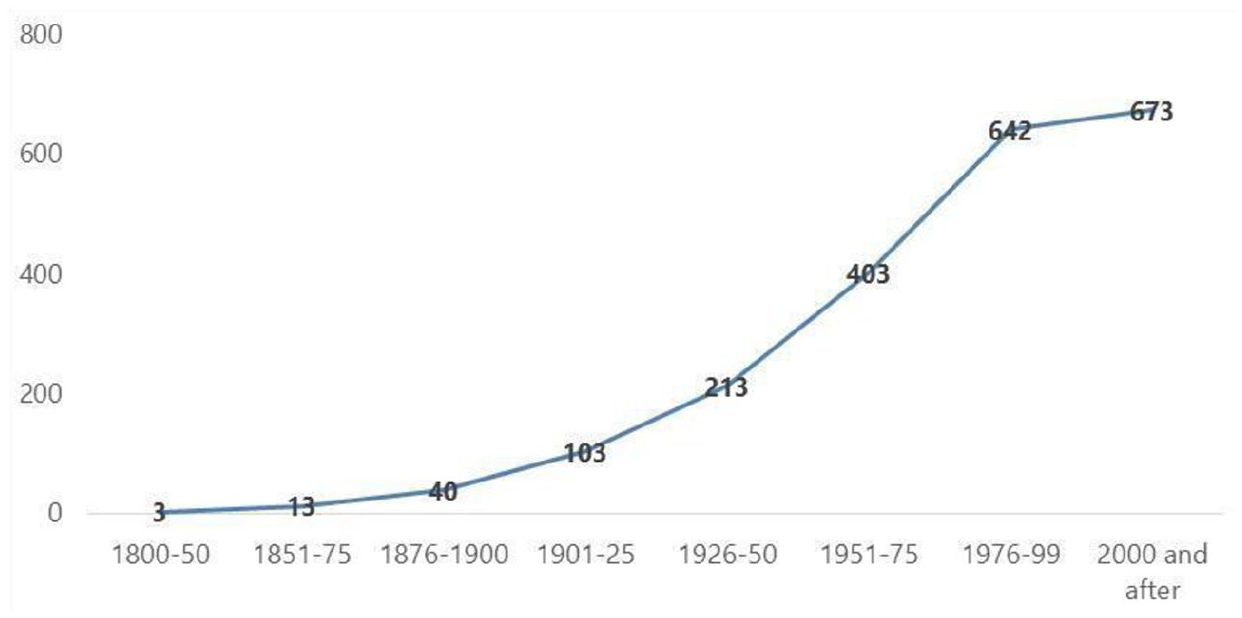
Trends in professional association formation in the US: 1800 to current.
Finally, the results of these two stages of review (narrative and administrative data, using KDD) were combined and subject to further scrutiny to identify prominent trends and second-order categories. This made it possible to: (a) identify key trends in the evolution of professional modes of regulation; and (b) develop an analytical understanding of the factors that appear to explain continuity. To frame the latter, the notion of path dependency theory was used, specifically the work of Pierson (2000).
The system of professions in the US
As noted, the US has possibly the largest and most developed system of professions of any country in the world. In employment terms, ‘professional and technical’ occupations are significant, with a workforce of over 30 million. This number has increased dramatically in recent years from 12% of the workforce in 1965 to 21% in 2016 (BLS, 2016). Indeed, over the previous three decades, the proportion of ‘occupationally organized work’ (employment in craft, technical and professional fields) has increased steadily relative to ‘hierarchically defined work’ (Anteby et al., 2016).
Accordingly, PAs of various kinds are highly developed in the US, with the Gale Encyclopedia listing over 6700 associations in 2017 at regional (state) and national levels. Closely linked to this is what Albert (2015) describes as a sophisticated ‘certification ecosystem’. Voluntary certification programmes are widespread in the US, seemingly covering every conceivable occupational group. Many programmes are run or controlled directly by PAs, while others are managed by a subsector of independent certification organisations and peak bodies such as the NCCA – created in 1997 by the Institute for Credentialing Excellence – which offer third party accreditation. Lastly, as we have seen, occupational licensing is well advanced in the US, covering a broad spectrum of occupations (Redbird, 2017). Licensing represents a form of mandatory registration, imposed at city, state or even federal levels, effectively restricting the ‘right to practice’ or use occupational titles (Kleiner, 2013).
In what follows, the article explores how this complex system of professional regulation has evolved, looking first at sources of continuity and then at sources of change.
Sources of continuity
Adopting Weeden’s (2002) framework introduced earlier, our analyses highlighted continuity in three main areas: the development of PAs, voluntary certification and occupational licensing. First, it is notable that trends in the density and membership of PAs appear to be generally upward. While the Gale Encyclopedia listed just over 5557 ‘professional associations’ in 2004, this had risen, by 17%, to 6700 in 2017. An analysis of the CareerOneStop database gives a further indication of upwards trends in PA formation in the longer term. This database recorded just under 2500 ‘professional associations’ in 2016, most of which with a national or international membership. Of the total number, 711 (28.6%) PAs were classified as ‘qualifying associations’ (directly involved in certification) and a further 334, as independent certification and training associations. Although it is not possible to compare actual population shifts over time using these data, analysis of the foundation dates of the current population of qualifying associations revealed some interesting trends. As can be seen in Figure 1, the fastest rate of expansion was between 1976 and 1999 when 36% of the current population was established. More recently (1999–2016), the rate of foundation has dipped to only 5% of the current population, although notably the trend in new association formation is still upwards.
In parallel with this growth trend is the increasing globalisation of the membership and regulatory ambition of many larger PAs. In the human resource management field, for example, the Society for Human Resource Management currently has 285,000 members in over 165 countries (Parks-Leduc et al., 2017). PAs in the accounting field (see Samsonova-Taddei and Humphrey, 2014) and project management (Hodgson et al., 2015) have developed in a similar way.
The second indicator of continuity is the upward trend in the number of certificants, certification programmes and occupations covered by them. The NTPAUS data revealed a significant increase in the number of certification programmes between 2008 and 2016: rising from 1456 to 3806, respectively (161% increase). Over the same period, the number of organisations providing certification also rose by 124%, from 786 in 2008 to 1768 in 2016. While these data should be treated with caution (also suggesting improvements in data collection and recording), they align with anecdotal evidence on the booming certification industry in the US and elsewhere (Albert, 2015). A growing emphasis on re-certification and continued professional development (CPD) to ‘signal quality’ (Weeden, 2002) is a further indicator of continued interest in professionalism. According to Tschirhart et al. (2011: 26), many associations perceive a direct link between increasing ‘rigor in the process of obtaining the credential’ and wider reputational benefits. The rising number of certification programmes accredited by the NCCA – which sets a very high bar for entry – also backs this up. Analysis of websites suggested that the number of schemes accredited by the NCCA had risen from 196 in 2005 to 312 in 2015. Moreover, while most schemes were concentrated in the health field, the number of ‘industry sectors’ represented had increased from 13 in 2009 to 26 in 2015.
Lastly, is the continued vitality of occupational licensing. As noted earlier, licensing has been a prime target of neoliberal critiques in the US since the 1980s. However, despite this, the available research suggests that a hostile political climate has so far failed to reverse (or even significantly slow down) its growth (Bryson and Kleiner, 2019; Hemphill and Carpenter, 2016). Data collated by the Bureau of Labor Statistics (Cunningham, 2019: 2), for example, indicate that in 2018, 43.7 million people in the US held an active certification or licence: 24.1% of the workforce (or 21.8% in the case of licences only). According to the report, the ‘prevalence of occupational licenses, common in fields such as healthcare, law, and education, has risen substantially over the past 50 years’ (2019: 1). Using different figures, Redbird (2017: 600) also notes that, in 1950, a mere 5% of the workforce was subject to licensing requirements but, by 2012, this had risen to over 32%. This, she argues, implies that ‘occupational closure, and particularly licensure, quietly became the form for a broad swathe of US occupations’, travelling way beyond more established fields of law, medicine and engineering. Therefore, it would appear that the system of occupational licensing has been highly resilient in the US. Indeed, it is telling that, in the last 40 years, there have been only eight successful moves by states to de-license occupations, some of which were subsequently reversed (Timmons and Thornton, 2019).
Sources of change
Notwithstanding these trends, the analysis did also highlight ways in which professional regulation appeared to be evolving, partly in response to the altered climate of neoliberal critiques and inspired policies.
First is evidence to suggest an increasing burden of regulation and (possibly) a reduction in the ‘institutional autonomy’ of professions (Adams, 2017). Historically, PAs have been ‘paired organisations’ (Lester, 2009), representing their members and serving as de facto regulators. In some areas, such as legal services in the UK, state-enforced separation of membership and regulatory functions has eroded the dual role (Aulakh and Kirkpatrick, 2018). By contrast, formal de-coupling of regulatory functions in the US is far less advanced (Levin et al., 2018). However, there was evidence of a trend towards what Evetts (2002: 347) has termed ‘acquired regulation’: a ‘form of externally required, but internally devised and operated, regulation’ (by professions) linked to ‘external monitoring, assessment and audit’. Hence, Kleiner (2013) notes how PAs have been drawn into the running and administration of state licensing boards, effectively acting as gatekeepers on behalf of local governments. Some PAs have also been co-opted into taking on pseudo-regulatory functions on behalf of employers (Bartley, 2011). Carter and Mahallati (2019: 64), for example, show how two PAs, acting as ‘regulatory intermediaries’, encouraged operators to comply with rules governing the production and certification of organic foods.
Related to this have been the attempts by PAs themselves to voluntarily raise standards and monitoring, possibly as a response to growing public scrutiny fuelled by neoliberal critiques. Many PAs, for example, have sought to enhance their position by conforming to external accreditation standards, such as those linked to the NCCA (see above). Others have focused on raising entry requirements, investing in CPD and imposing additional re-certification demands (Kirkpatrick et al., 2017). In one survey, Tschirhart et al. (2011) found that 72% of surveyed credentialing programmes have a formal re-qualification requirement, with more than half of these insisting that re-qualification occurs every three years. As such, implied is a trend towards what Spada (2009) describes as the ‘regulated self-regulation’ of professions.
Changes in PAs’ governance and strategies represent a further indicator of how professional modes of regulation are evolving. In recent years, there has been a trend towards corporate membership with PAs seeking to represent employers in addition to individual practitioners who were once their primary constituency (Hodgson et al., 2015; Kirkpatrick et al., 2017). For example, in a national survey of 1585 non-profit CEOs, Gazley and Bowers (2013: 19) find that 28% served ‘a combination of individuals and organisations’. Closely linked to this have been changes in governance. Historically, PAs relied on motivated volunteers, organised through local chapters with voting rights and federated decision-making (Millerson, 1964). However, more recently, there has been a tendency for PAs to employ full-time staff and dedicated management functions (Gazley and Bowers, 2013), transforming them from ‘dinner-club’ to ‘service’ associations (Spillman, 2019: 90–91).
There is evidence that, in some cases, these shifts in governance and membership of PAs have gone hand in hand with a weakening commitment to the goals of occupational closure (Muzio et al., 2020). As PAs become more focused on financial viability and inclusivity, this could trigger a watering down of standards and tension between stringency and membership growth (Brint, 1994: 77). A prime example reported by Albert (2015) is the decision by Society for Human Resource Management (SHRM), mentioned earlier, to roll back its internal ‘firewall’, separating PA membership and credentialing functions. Formal separation of this kind is assumed to enhance the integrity certification programmes to maintain standards and, therefore, legitimacy (Tschirhart et al., 2011). Nevertheless, in SHRM (and other PAs), this structure was also felt to impair flexibility and the ability to adapt programmes to attract new members and income streams (Albert, 2017).
Therefore, the analysis pointed to some important sources of evolution in professional modes of regulation in the context of neoliberal critiques and inspired policies. The latter has arguably helped generate a more hostile environment for professions, increasing the demand for acquired regulation and the appeal of strategies that are not exclusively focused on advancing occupational closure. However, the impact of these tendencies should not be exaggerated. As we saw, the bigger picture is still overwhelmingly one of continuity in terms of new PA formation, certification and licensing. In this regard, the evolutionary tendencies just described represent a modification of professionalism rather than a departure from it.
Accounting for continuity
Turning to the question of how one might account for continuity, a useful starting point is the notion of path dependency, linked to the deep institutionalisation of professionalism as a regulatory form (Muzio et al., 2013). As a concept, path dependency highlights the importance of historical legacy, habit and costs of switching. However, also implied is that ‘established institutions’ can ‘generate powerful inducements that reinforce their stability and further development’ (Pierson, 2000: 255). In this respect, the pattern of continuity just described can be explained, not just by focusing on the costs and risks of change, but also the ‘increasing returns’ (Pierson, 2000) and inducements associated with professionalism. Specifically, these are returns for three key stakeholders: producers (practising members of occupations); government regulators; and employers, who are the primary users of professional expertise.
Starting with producers, as noted, for some emerging occupations, the appeal of professionalism may have declined as they seek alternative ways of furthering their collective interests (Anteby et al., 2016). However, while professionalism is not without risks for producers (notably, the regulatory burden), the weight of evidence suggests that it is still likely to generate economic benefits and upward social mobility. Drawing on the Educational Longitudinal Study (ELS) in the US, Albert (2017) finds a strong positive association between certification and early career income, even after adjusting for background characteristics and occupation. State licensing has similar effects. Kleiner (2013) notes that licensing both restricts the labour supply and delivers a significant wage premium for established professions, such as teachers and nurses. These relationships between professional regulation and superior earnings are also borne out by more recent Bureau of Labor Statistics (Cunningham, 2019). In 2018, median weekly earnings for full-time wage and salary workers with a currently active professional certification or licence were 35% higher than earnings for those without one of these credentials.
When making these observations, it is important not to ignore the adverse costs associated with licensing both for consumers (see Kleiner, 2013) and unlicensed occupations (Blair and Chung, 2019). Wage premiums associated with professionalism are also highly variable depending on education, age and occupational group. For example, while in legal occupations the possession of a certification or licence was associated with a 68% earnings premium, this is far lower in the case of education, training and library occupations (17%) and healthcare support occupations (only 5%) (Cunningham, 2019). Nevertheless, these data suggest that professionalism remains appealing from a narrow economic standpoint, especially in national contexts where union membership and collective bargaining have declined (Bryson and Kleiner, 2019).
Turning to government regulators (including politicians), despite the influence of neoliberal critiques, the appeal of (and necessity for) professional regulation remains strong and may even be growing. The reasons for this are not hard to understand. Most obviously, professionalism offers a ‘convenient and relatively cheap’ (Timmons, 2010: 346) method of controlling and maintaining standards, especially where ‘consumers have incomplete information about practitioners’ competence or where practitioners can inflict serious harm’ (Nunn and Schefler, 2019: 30). This perspective highlights the role of the state in driving the creation of market shelters to lower risks and enhance legitimacy. The professions and their associations constitute a quasi-regulatory system of institutionalised gatekeepers, which help to regulate and stabilise some of society’s key services, such as healthcare and justice (Coffee, 2005). Of course, this imperative may not completely override political concerns about the risks of extending professional monopoly. Rather, it leads to a complex trade-off in which some level of ‘weak regulatory capture’ (by occupations) (Carpenter and Moss, 2014: 12) is regarded as politically tolerable given the risks associated with an absence of regulation. As Hemphill and Carpenter (2016: 21) explain, when ‘faced with a decision between no licensing and full licensure, legislators tend to choose the latter in the hope of protecting against the possibility – no matter how remote or unsubstantiated – that someone will be harmed by unlicensed practice’.
If anything, in recent years, this calculation may have skewed increasingly towards the tolerance of weak capture, despite the (mounting) noise of neoliberal critiques. Key reasons for this are the growing complexity of professional services (increasing risk) and resource pressures on the state itself to manage regulation. The latter makes forms of ‘regulated self-regulation’ by professions increasingly desirable. Schneiberg and Bartley (2008), for example, note how emerging forms of private, voluntary certification represent examples of ‘soft law’ that complement (or even replace) state-level regulation. Therefore, when looked at in this way, emerging forms of ‘hybrid’ or ‘multi-stakeholder governance’ (Djelic and Quack, 2018) represent both a method of controlling professions and a source of ‘regulatory relief’ for (increasingly) over-burdened government agencies (Bartley, 2011). In the US, resource pressures have also made it harder for politicians to reverse occupational licensing, which represent an important (and stable) source of income (Nunn and Schefler, 2019).
Lastly, from the employers’ perspective, professional regulation also continues to deliver returns. This is not to ignore the costs of occupational closure for employers, especially when there is a significant certification (or licensing) earnings premium. As Albert (2017: 142) suggests, ‘employers generally do not seek to improve their employees’ position in the labor market unless they perceive rewards (e.g. the alleviation of skill shortages) for themselves in doing so’. However, notwithstanding these tensions, the available evidence suggests that many employers in the US remain broadly supportive of professionalism. Spillman (2012: 433), for example, notes how a discourse of ‘professionalism’ provides ‘a pervasive vocabulary for American business associations’, with 24% of associations introducing ‘standards and accreditation’ and 40% involved in education and ‘professional development’ (see also Albert, 2017). A concern to enhance professionalisation may even lead some trade associations to actively lobby for state licensing (Kleiner, 2013).
One explanation for this employer interest is the role of professional regulation in raising skill levels and as a form of signalling – helping to enhance the reputation of organisations that employ professionals (Cappelli, 2012). In Europe, Koumenta and Pagliero (2019: 819) note the continued potential of licensing ‘to serve as a strong incentive for employers and workers to invest more heavily in skills’. This, of course, is essential in business sectors that rely heavily on professional expertise (healthcare, legal services, for example) but may also apply to emerging, newer sectors where there is a ‘legitimacy deficit’ (Sine et al., 2007). Related to this is the role that external certification might play as a substitute for in-house training or as a screening method to support recruitment and selection decisions. In this regard, ‘Certification boards and programs can fill the institutional void left behind by the more active and nurturing HR departments’ (Albert, 2015: 11). Lastly, employers may view both voluntary certification and licensing as a less ideologically risky form of regulation than unionisation (Williams and Koumenta, 2020). As Kleiner (2013: 220) suggests: ‘For firms, licensing creates the perception of higher quality services without the potential constraints that unions impose on the workplace’. Hence, as with producers and government regulators, the evidence indicates that, for employers, professional modes of regulation continue to provide returns, which, if anything, may be increasing.
Conclusions
To recap, the main point of departure for this article is debates, featuring in this journal and more widely, about the evolution of professional modes of regulation. While some grand narratives highlight the pervasive and negative influence of new liberal ideas and inspired policies (Ackroyd, 2016; Adams, 2017; Brint, 1994; Leicht, 2016; Reed, 2007), others – including Crompton (1990) – have emphasised the resilience of professionalism. However, although these concerns are still live, especially given the steady rise in the ‘professional’ workforce of advanced capitalist economies, they have been given less emphasis by sociologists of work and employment (Adams, 2015; Gorman and Sandefur, 2011).
In seeking to address this matter, the analysis presented in this article leads to three main conclusions. First is to highlight a dominant pattern of continuity of professional modes of regulation in the US context, illustrated by the formation of PAs, the growth of occupational licensing and the emergence of a sophisticated ‘certification ecosystem’ (Albert, 2015). This does not ignore evolutionary tendencies, such as a move towards ‘acquired regulation’ (Evetts, 2002) and (in some cases) declining commitment of PAs to occupational closure goals. Instead, it is to emphasise the lack of strong evidence to support grand narratives of terminal decline.
Second, and related to this, the analysis points to the surprisingly minimal impact of neoliberal ideas and inspired policies on professionalism. Although the evolutionary tendencies noted earlier can be attributed, partially, to the altered policy climate in the US, they are also endogenous, arising from the system of professions itself. For example, the move towards more acquired regulation is a response to competition between PAs (seeking to differentiate themselves) and to demands from key stakeholders, such as the state and employers. Similarly, the changing governance and membership profile of some PAs might be interpreted as attempts to modernise and strengthen professionalism and increase its appeal (Friedman, 2020).
Lastly, our analysis highlights the path-dependent and self-reinforcing nature of professional regulation, in terms of the ‘increasing returns’ (Pierson, 2000) this generates for producers, government regulators and employers. Regarding producers (practising members of occupations), interest in professionalism, as a strategy for upward social mobility, may have received a boost in the context of declining union membership and support for collective bargaining (Kleiner, 2013). Where employers are concerned, the rise of voluntary certification – displacing risks and costs to employees – may coincide with a downsizing of investments in home-grown talent management. For governments and politicians, the appeal of professional self-regulation has increased in the context of declining public sector resources and in-house capabilities to perform these functions. As such, explanations for the resilience of professional regulation need to go beyond simply noting historical legacy and switching costs (Muzio et al., 2013). Rather, it is crucial to emphasise the continued utility of this regulatory form for prominent stakeholders.
This analysis has broader implications for research and theory. In terms of research, it highlights the value of bringing together insights and data from a variety of disciplines, including employment relations, regulation theory and the sociology of occupations. This helps to overcome the siloed nature of much of this research to arrive at a composite picture of recent trends.
Theoretically, in contrast to much of the contemporary discourse about the professions, the article draws attention to key sources of continuity and path dependency. These trends are often downplayed in recent accounts of professions that are fixated on decline and decay and highlight the pervasive influence of neoliberal ideas (Leicht, 2016; Reed, 2007). Of course, the possibility that professionalism is morphing rather than disappearing is sometimes noted. Adler et al. (2008), for example, suggest that professional modes of governance have become more ‘collaborative’, while Noordegraaf (2011) talks about ‘re-configured professions’ that are more attuned to the demands of organisations. However, our analysis suggests that even these claims are probably exaggerated. In particular, what they fail to acknowledge is the robust and embedded nature of professional regulation and the powerful inducements associated with it. These dynamics hint at the continued power and vitality of professions as purposeful social actors and should, we argue, be firmly on the radar of all scholars of work and employment.
Finally, it is important to note caveats and directions for future work. Clearly, more research is needed to verify some of the longer-term trends uncovered by this article and to explore their policy implications. Recently, it has been argued that given changing markets, technologies and client needs, professions need to become less ‘protective’ and more ‘connective’ (Noordegraaf, 2020). However, the analysis presented here suggests that in the US context protective regulation continues to serve the interests of multiple stakeholders and, as such, is unlikely to be displaced any time soon.
Added to this is a need to examine professional regulatory modes in jurisdictions beyond the US. Given a similar institutional legacy of professions as semi-autonomous agents within civil society, the UK might represent a valuable point of comparison (Macdonald, 1995). Although accurate figures are hard to come by, the available evidence from the UK suggests that membership of PAs has increased in recent years (Professional Associations Research Network (PARN), 2015) with similar upward trends in occupational licensing and other forms of state recognition, such as Royal Charters (Koumenta and Pagliero, 2017; Muzio et al., 2020). However, on the other hand, there are some important differences between the US and the UK (its closest comparator), most notably the more devolved and less intrusive state apparatus. This could mean that professions in the former have retained greater autonomy and scope to regulate themselves (Adams, 2017). Either way, addressing these concerns will be important for understanding precisely how professionalism is evolving in different settings and with what consequences.
Footnotes
Acknowledgements
We are grateful to the two anonymous reviewers for commenting on earlier drafts whose insightful suggestions have helped strengthen the article. We would also like to thank Prof. Donald Hislop and Dr Alessio D’Angelo for the editorial guidance provided throughout the review process and are appreciative of the patience shown by Dr Amber Davis from the WES Editorial Office.
Funding
The authors received no financial support for the research, authorship, and/or publication of this article.
