



Abstract
This article explores the lived experiences of disabled men and women who work in sheltered employment. Specifically, it analyses how the entanglement of sociomaterial practices affects disabled workers’ co-constructions of work and disability. Theoretically grounded in posthumanist performativity theory, the article shows how embodied employment experiences within organisational spaces contribute to the materialisation of disability. Findings emerged from ethnographic participant observations and interviews with management and workers at a sheltered workshop. The data highlight how the entanglement of bodies, space, objects and discourses affects materialisations of disability in ways that appear more inclusive than in mainstream employment. However, these sociomaterial practices remain embedded in a productivity-oriented work logic.
Introduction
This article explores experiences of disability in the workplace, by analysing the ways in which disability materialises within an organisation that primarily employs disabled people. The article theorises the interrelation of disabling practices and processes in the workplace by focusing on the sociomateriality and performativity (Barad, 2007; Gherardi, 2017) of disability. Sociomateriality focuses on the network of human and material practices, discourses and phenomena and how they act as a togetherness (Orlikowski, 2007). Central to studies grounded on sociomateriality is the concept of assemblage (stemming from the French ‘agencement’ used by Deleuze and Guattari, 1987), referring to the integration, connection and organising of concepts and the arrangement of these concepts that provides context for their meanings. The sociomaterial assemblage is, thus, a device for describing and examining the entanglement (as a becoming) of human and non-human aspects that affect the performance of spaces, objects and practices.
Disability identities develop within space–time and in relational assemblages, which are viewed as a ‘series of affective and relational becomings’ (Gherardi, 2017: 42). Disability, thus, materialises through the performative enactment of dominant sociomaterial practices resulting from the entanglement of human bodies (i.e. flesh, emotions), physical artefacts (i.e. furniture, buildings), technologies and other agents, including social discourses 1 (Harding et al., 2021). The ontological inseparability and relational entanglement of these phenomena lead to the performative (re)production of disability inclusionary or exclusionary practices (e.g. acceptance or oppression of bodies) (Braidotti, 2019; Jammaers and Zanoni, 2020).
Research has shown that sociomaterial practices performatively mark bodies in specific ways (i.e. being disabled or gendered); for example, able-bodied behavioural norms, an unadaptable physical environment, and the prejudiced attitudes of colleagues relationally affect the (re)production of discriminatory practices that dehumanise and exclude individuals for their disability (Barnes and Mercer, 2005; Goodley and Lawthom, 2019; Mik-Meyer, 2016; Van Lear et al., 2020). These dominant sociomaterial phenomena privilege able-bodied individuals and result in a lack of knowledge and accountability by managers and organisations that continue to perpetuate exclusionary practices (e.g. discrimination) (Bend and Priola, 2018).
While current research on disabled people in the workplace (e.g. Foster, 2018; Thomas, 1999) has generated valuable knowledge on the cultural and organisational practices that affect workplace inclusion, employment studies focusing on materiality and the relational entanglement between the disabled body and the work environment, remain rare. Despite a renewed interest on materiality and performativity in organisations (Harding et al., 2021; Orlikowski, 2007; Orlikowski and Scott, 2015), much research on disability in the workplace focuses on subjectivities and discriminatory processes (e.g. Richard and Hennekam, 2020) or statistical causalities (e.g. Woodhams et al., 2015). However, it is crucial to better understand how disability discrimination practices are affected by the intersecting properties of material artefacts, infrastructures, nature and discourses (see Feely, 2016). In acknowledging the need to account for the co-constitutive agentic capacity of all matter on lived experiences of disability, this article is grounded in a posthumanist perspective (Barad, 2003, 2007) which acknowledges the ontological inseparability (expressed as entanglement) of material-discursive practices (sociomateriality). Reality (ontology), what is known (epistemology), and ethics are theoretically inseparable to form, using Barad’s (2007: 185) expression, a ‘ethico-onto-epistem-ology’.
Questioning whether and how organisations that employ a large number of disabled people enact inclusive and ethical practices, this study focuses on sheltered employment. Sheltered employment is an alternative to mainstream employment for those individuals who, for a variety of reasons, are unable to secure or remain in employment as a direct result of exclusionary practices attributed to their disability (Hall and Wilton, 2011). The Office of Government Commerce (2009: 4) defines sheltered employment as an establishment ‘where more than 50% of the workers are disabled persons who due to their disability are unable to take up work in the open labour market’. Sheltered employment services, therefore, represent segregated programmes for disabled individuals, and differ in terms of mission, services provided and funding sources. Most sheltered employment services in the West are operated through private, not-for-profit organisations that are funded through a variety of government and private funding sources. Current studies on sheltered organisations (e.g. Cimera, 2017) tend to focus on their economic performance, generally neglecting the deep understanding of the different forms of cultural and material support they provide to workers. This study focuses on a charity-based sheltered workshop operating in the UK.
Attending these theoretical and empirical gaps, the study addresses the following research questions: (a) How do sociomaterial organisational practices affect the work experiences of disabled employees within sheltered employment? and (b) How are these organisational practices performatively reinforced or disrupted (or transformed) to affect workplace inclusion/exclusion? Below an overview of the theoretical framework adopted is offered before moving on to the review of the literature on disability and employment. This is followed by an outline of the context of the study and the research methodology. The analysis of the ethnographic data is presented before a conclusive discussion.
Posthumanist performativity
Conceptualisations about disability are steeped in historical representations and social discourses around who is regarded disabled or able-bodied (Goodey, 2015). While this discursive perspective does not deny the materiality of disabled persons’ experiences, emphasis remains on subjective representations. Recent world-wide ecological disasters and developments in new technologies have blurred the boundaries between human, machine and nature, highlighting the limits of the linguistic turn and influencing the development of a posthuman ontology within a new materialist field of inquiry (Haraway, 1991; Le Grange, 2018). To better understand experiences of disability at work and practices of inclusion/exclusion, it is necessary to uncover how the assemblage of inseparable material-discursive practices affect the disabled body at work.
New materialism questions the privileging of subjectivity and representation, and deems the material and discursive components of phenomena as co-constitutive (Harding et al., 2021; Hughes et al., 2017). Within a new materialist ontology, posthumanism challenges exclusionary humanist and anti-humanist thinking to consider all matter having agential capacities (Braidotti, 2013). Posthumanists, such as Barad (2003: 815), move the focus of inquiry away from a sole human perspective to focus on the relational affect or ‘ontological inseparability’ of material phenomena, discursive practices and ethics. It is through the mutual agential relations of matter and discourse that the materialisation of boundaries become meaningful (e.g. the bodily production of disability). Barad (2003, 2007) advances Butler’s (1993) early one-directional theory of performativity, which focused on how social discourses performatively materialise a human body’s sex, that subsequently affects people’s behaviours and identities. Barad develops a co-constitutive bi-directional performative theory that explores the relational assemblage of material-discursive intra-actions 2 (for all matter). More recently, Butler (2015: 9) invokes a more relational concept of becoming by referring to a ‘matrix of relations’. She claims a human being’s ongoing becoming is ‘in the “hands” of institutions, discourses, environments, including technologies and life processes, handled by an organic and inorganic object field that exceeds the human’ as well as other human bodies (Butler, 2015: 7).
As an alternative to representationalist ontologies that separate the linguistic/semiotic from the material reality, Barad (2003: 808) develops a posthumanist performativity framework which advocates agential realism. She explicitly states that her framework of ‘agential realism incorporates important material and discursive, social and scientific, human and nonhuman, and natural and cultural factors’. Barad’s approach differs from critical realism, which retains an ‘ontological realism (there is a real world that exists independently of our perceptions, theories, and constructions) while accepting a form of epistemological constructivism and relativism (our understanding of this world is inevitably a construction from our own perspectives and standpoint)’ (Maxwell, 2012: 5). Critical realism, therefore, views ontology and epistemology as distinct, accepting that one can be realist at the ontological level, and interpretivist at the epistemological level. Agential realism, on the other hand, considers the practices of knowing and being as mutually implicated and the separation of epistemology from ontology as a ‘reverberation of a metaphysics that assumes an inherent difference between human and nonhuman, subject and object, mind and body, matter and discourse’ (Barad, 2007: 185).
Matter, for Barad (2003: 826), is not a ‘substance’ but an intra-activity; equally, agency is not the prerogative of humans but the ‘enactment of iterative changes’ across levels of matter. Posthumanist performativity theory stresses the inseparable and the relational of the material and the discursive, and human and nonhuman bodies, in order to overcome the restrictive and limited knowledge informed by humanism. Within this theory ‘neither biology nor the social is privileged over the other’ (Fox and Alldred, 2017: 132), and instead a sociomaterial approach is used to explore the entanglement of multiple factors (e.g. discourse, materiality, culture, nature, science, biopolitics) that affect knowing and being (Gherardi, 2017). This study adopts a posthumanist performativity approach with the theoretical aim to disrupt the binary distinction between ability and disability, subject and object, and nature and culture. By opening up a new materialist interpretation of disability within work organisations, it contributes to embedding an ethics of care, respectful of the need to pay attention to how the sociomaterial affect processes of becoming at work.
Disability and employment
In the UK, exclusionary practices that prevent equal access to employment are evidenced in the 28.1 per cent employment gap between the disabled (53.6 per cent) and able-bodied (81.7 per cent) population (Powell, 2020). On further interrogating the employment rates across different types of disabilities, statistics show that those with learning disabilities have the lowest employment rate (17.4 per cent) compared with the employment rates of those with physical or sensory disabilities (61.1 per cent) (Department for Work and Pensions [DWP] and Department of Health & Social Care, 2020). However, research shows that, with the right support, people with learning difficulties can and do contribute to the labour force (Bates et al., 2017). Furthermore, while statistics provide an overall picture of various employment rates, it is fundamental to consider how and in what ways political, cultural, social and material practices impact the embodied work experiences of disabled individuals.
Critical employment studies (e.g. Dennissen et al., 2020) have identified that diversity management within mainstream organisations often privilege business imperatives rather than social justice and reinforce a hierarchy of diversities rather than challenging exclusionary processes and practices. Despite improvements in the design and access to buildings and the layout of the working environment, performance-based norms (re)produce disabled workers as ‘unproductive’ subjects (Foster, 2018) and often lead to their work exclusion. Humans are ‘constituted through performative acts in which material flesh and discourses of bodies are intertwined’ (Harding et al., 2021: 2), contributing to their identity formation. It is likely that the sociomateriality of sheltered work may lead to more inclusive work experiences for disabled people, as the performative effect of the entanglement of material-discursive phenomena might contribute to a more positive becoming. A better understanding of this experiential context could lead to the development of disability inclusive practices across different workplaces, including mainstream work.
Sheltered employment
Sheltered workshops were established after the Second World War to provide supported employment to recovering wounded or disabled soldiers (Slorach, 2016). Since then they have evolved as segregated organisational spaces for disabled workers and tend to specialise in manufacturing or general service (Cimera, 2017). Research on sheltered employment is often contentious focusing on their poor economic viability and the subsequent low employment success rate of the individuals who attend them (e.g. Cimera, 2011; Sayce, 2011). Some scholars argue that sheltered workshops reinforce neoliberal precepts of the capitalist labour market, as they do not challenge the mainstream organisation of work but rather segregate ‘less able’ workers (Lazzarato, 2009). Sheltered workshops are a popular employment option in the USA and Canada, however, only a small number of sheltered workshops remain in the UK following government scrutiny on their economic viability (Sayce, 2011). 3 The UK government’s current position on employment for disabled individuals focuses primarily on funding agencies and service providers (e.g. the Shaw Trust and Job Centre Plus) that offer support via training and work placements in organisations. The funding is channelled through the Access to Work programme (providing grants for special equipment or transport for individuals in paid employment), and the Work and Health Programme (helping people to find and keep a job) (Department for Work and Pensions [DWP], 2019).
Despite a focus on supporting access to mainstream employment for disabled individuals, this is not necessarily occurring in practice. The sheltered employment workshops/factories that remain in the UK are privately owned or charity-based and are largely supported by multiple sourced funding grants. This study addresses the lack of research on embodied experiences of disability within a purportedly inclusive organisational context.
Research methodology
In order to explore the day-to-day workings of a charity-based sheltered workshop, data were collected through qualitative ethnographic participant observations and semi-structured interviews (Reeves et al., 2008). The first author identified the organisation as a unique case study and sought research access by contacting the senior manager by email and phone, before meeting her in-person to discuss a possible interest in taking part in the research. The organisation is a small British charity-based manufacturing workshop, employing approximately 50 people with a range of disabilities, most of whom worked part-time. It is managed by a core team of five individuals: three senior managers (Joyce, Diana, and Shaun) and two team leaders. The three senior managers are disabled and this allows them to bring their personal experience and perspectives into the organisation. Shop-floor workers report directly to the team leaders, neither of whom was disabled at the time of the study. Furthermore, the organisation has a board of directors, working on a voluntary basis.
The participant observations adopted an affective ethnographic approach which “acknowledges that all elements – texts, actors, materialities, languages, agencies – are already entangled in complex ways and that should be read in their intra-action, through one another, as data in motion/data that moves” (Gherardi, 2018: 742). The first author worked as a volunteer at the workshop throughout 2016, participating in staff training, working alongside shop-floor workers and supporting administrative staff. This allowed direct experience of the materiality of repetitive work (sitting in uncomfortable chairs doing mundane tasks for six to seven hours a day in the open-plan shop-floor), as well as access to some of the manager’s dilemmas when production deadlines were looming. In total she worked for 36 full days, visiting on average once a week and completing a field-diary of 220 pages (111,586 words). Field notes were briefly written during breaks and written up in full at the end of the day. All individuals in the sheltered workshop were aware that the researcher was conducting a study on disability and work, and all gave their written consent to observations and work-place interviews.
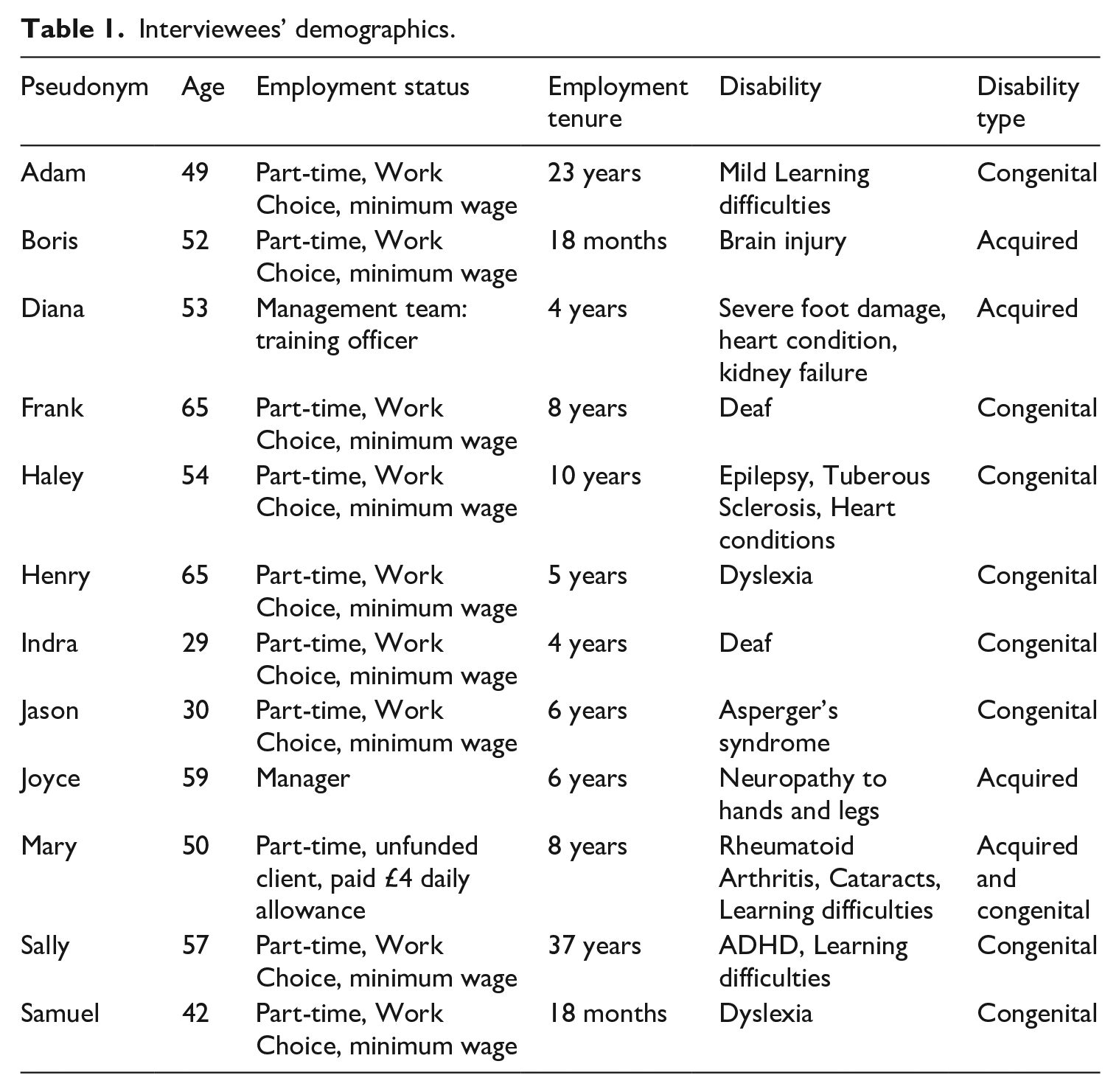
To explore in greater depth aspects that emerged during the fieldwork and to obtain richer and more personal data, semi-structured interviews were conducted with 12 workers in the last two months of fieldwork (Bourgois, 2010). These took place in private offices or, when this was not possible, in the canteen during quiet times; interviews lasted between 14 and 100 minutes, with an average length of 54 minutes. There was a degree of data triangulation between interview and observation data which allowed for data saturation to be observed across the data set (Hammersley, 2008). Interviewees included managers (x 2) and shop-floor workers (x 10) with a wide range of disability type and severity. The gender split of the interviewees was equal (6 men and 6 women), although there were more men employed than women. Table 1 reports the demographic information of the interviewees. In order to preserve anonymity pseudonyms were used for all participants.
Interviewees’ demographics.
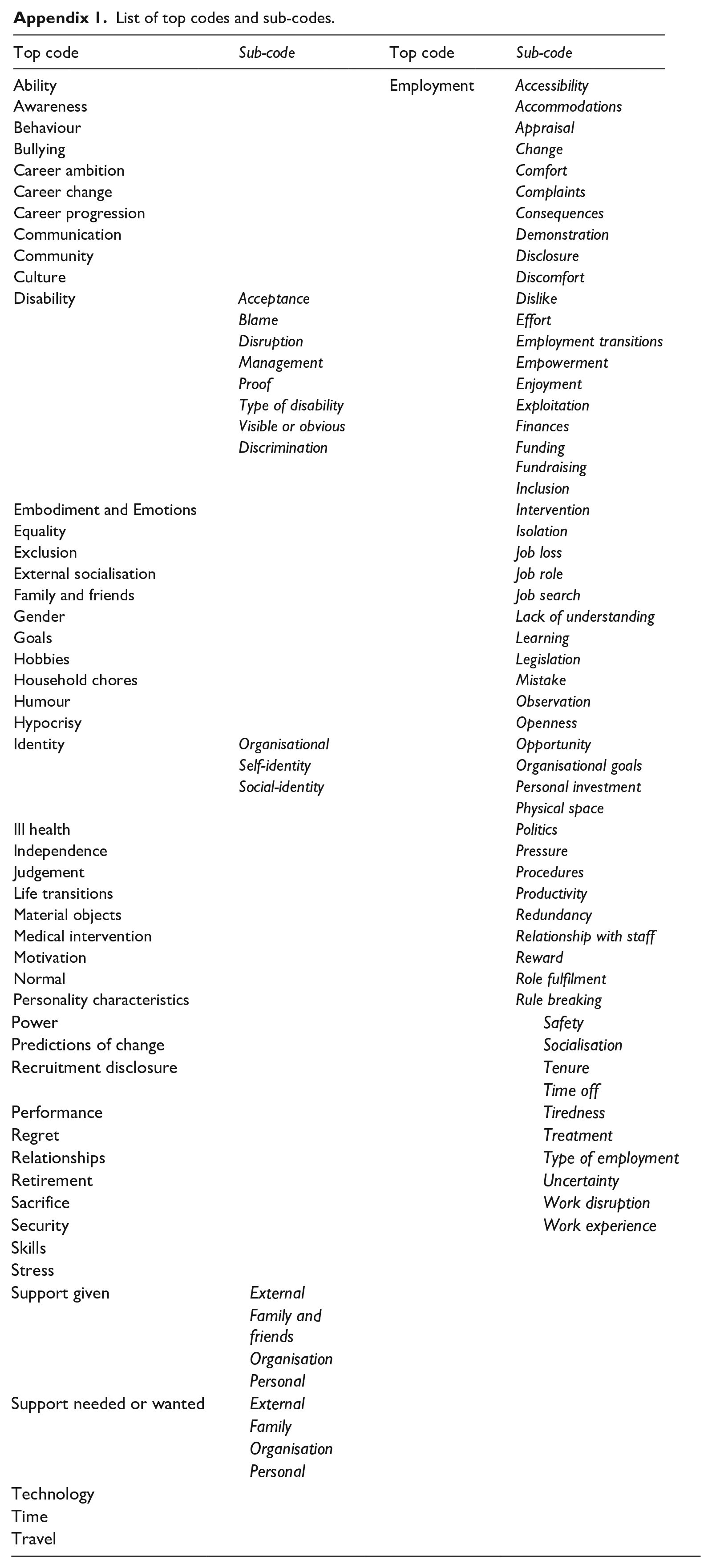
The data analysis followed the six phases reported by Braun and Clarke (2006): familiarisation of data, generate initial codes, search for themes, review of themes, and production of findings. Interview transcripts and observation notes were entered on Nvivo (qualitative data analysis software) for an initial familiarisation and subsequent coding to help organise the data. Initially around 50 top codes and another 50 sub-codes were produced with Nvivo (see Appendix 1), these were then reviewed and refined to identify themes or commonalities. Once the themes were identified the analysis focused on exploring the relationality of the material and discursive aspects of the data as related to the research questions. The sections below present the analysis and discussion of, first, how disability emerges within the sociomaterial assemblages embedded within the organisations and, second, how new sociomaterial assemblages within organisations reinforce or disrupt exclusionary material-discursive practices.
Performative enactment of disability as sociomaterial
Drawing upon interview data and ethnographic field notes, this section shows the ongoing becoming of disability at work, through the entanglement and inseparability of material objects, human bodies and discursive practices associated to the management of labour, policies, regulations and relations with other organisations. As simplified in Joyce’s words below, day-to-day practices at the workshop are affected by the dynamic assemblage of sociomaterial practices – for example, the requirement to highlight every worker’s impairment in all documentation such as those associated to the bureaucracy of the Care Quality Commission (CQC): so generally my plan will be when I come in that there will be a number of documents that I have to look at. . . [to] see how they affect us as an organisation. . . often I have to reply and say what we are going to do to fulfil those requirements. . .so if we get something from healthcare that says, which we did the other day, saying they want all our documents highlighted so you can immediately see that somebody has a learning issue or is blind or deaf. . .and how we’re going to do that, so then I have to sit and think and talk to Shaun and Diana about how we’re gonna quickly make all our filing system easy for someone to see that somebody has got, you know, is deaf. Now in this organisation it’s very easy because we know everybody. . .but unfortunately because we come under the CQC, we are governed in the same way as a hospital or a care home. (Joyce, Manager)
Healthcare policies determine the entanglement of specific material-discursive practices which affect the actions and practices enacted within the workshop at that particular moment. For example, the practice of highlighting workers’ impairment in all documents creates a new sociomaterial assemblage leading to a performative enactment that brings into being disability itself. The actions of highlighting or accessing the documents intra-acts with the prior discursive system affecting some workers (e.g. Shaun and Diana) in their relations with other employees. These particular sociomaterial practices materialise, or rather mark, bodies as being disabled and have behavioural and/or procedural ethical consequences, as these labels are embedded within historical and cultural practices (e.g. exclusion) (Barla, 2016; Braidotti, 2016).
The ongoing and changeable sociomaterial entanglements of bodies (both living and non-living), space and discursive practices in which disability materialised became evident during participant observations. The researcher’s bodily intra-actions with material objects (placing plastic edges onto foam pieces) as she sat on a hard stool, feeling discomfort and back-ache, led to deeper reflections on how the inseparability of the material and the discursive (e.g. the requirement to work for 8 hours) could make work experiences more or less comfortable: I hadn’t realised but I was obviously looking uncomfortable, fidgeting and stretching my back out a lot, Frank, who is deaf, came over to me and pointed to my chair and imitated a sore back (he touched his lower back and grimaced in pain and then pointed to my back), he then pointed to a more comfortable chair. I realise he wanted to give me a more comfortable chair, I smiled up at him, said thank you and went to grab the chair, he then took away the old chair I was using. (Field note)
The researcher’s bodily movements visually signalled the incompatibility of the assemblage of the chair, the body and the job requirements. The personal physical toll of the entanglement of the human body, material objects and the affect economy (i.e. agentic capacity) between them, provided insights, for the researcher, into the embodied experiences of others within specific space, time and matter relations (Barad, 2007; Gherardi, 2017).
Work practices enacted in mainstream organisations, materialise bodies as disabled or able-bodied on the basis of an individual’s (re)production or disruption of established productivity behavioural norms (related to work performance) within specific ‘spacetimematter’ relations (Barad, 2007). Rasheed, for example, explained that her back pain, a consequence of several slipped discs, led to her resignation as a playground assistant at a school, which required a high level of physical involvement. Although Rasheed’s physical abilities were supposedly better accommodated in the sheltered workshop, the expectations of the work in the playground and in the workshop (to a lesser extent) created incompatibilities with the material environment, as she intra-acted with toys and children in her old job and sat for extended periods of time at the workshop.
On one occasion the researcher worked with four to five people folding and packaging 100,000 bags (to be completed in three weeks). As the bags needed to be folded in a specified way, not all workers could complete this job as fast as needed. The shop-floor was open plan, with a large number of tables of varying sizes and heights that were often moved within the workspace to accommodate specific jobs. On this particular job, people worked as a small assembly line between two tables pushed together, with one person folding the bag in three parts, the next person sealing the bags and the following person placing the sealed bags into a cardboard box until each box contained 1000 bags. During that period Rasheed was often assigned to this job, as she has better manual dexterity than others; on some days she folded bags from 8am to 4pm (barring a few breaks). The researcher noted in the field diary: Rasheed sat on a hard stool with no back rest and she attempted to move her body to a more conformable position by resting her feet on a box under the table which kept her legs bent at a 90-degree angle. She was struggling while completing this job and I could see it in her bodily language and the noises she was making, such as sharp intake of breath or groaning. She also appeared to be struggling with her hands: she kept stretching her hands and rubbing them together. (Field note)
Rasheed’s discomfort was noticed and commented on by other co-workers, but neither the team leader nor the management team moved her to another task. Rasheed’s disability came into being through the ontological inseparability of her body with the material-discursive (Barad, 2007). Specifically, discourses concerning individual productivity levels, requirements to complete the production task and fulfil the production contract, targets and performance levels, were all entangled with material phenomena to produce the specific work arrangement. The material phenomena included Rasheed’s bodily intra-actions with the stool, the box upon which her feet rested, the height of the table, the plastic of the bags, the bodily mechanics involved in sitting and folding the bags. This entanglement prevented her managers moving her to another task, as no other worker could do the job as well and as fast as her.
Similarly, Mary, who has arthritis and a mild learning disability, shared how the speed required by the production line at her previous mainstream employment materialised her disability: I kept up eventually with them but not all the time. . . we had like a [production] line. . .we had four stages of the job to do, and they put me on the end because I wasn’t keeping up in other places. . .so I did find it very hard to work in the community . . . I find it a lot better here, you do get some pressure here, but not as much as you do outside. (Mary)
Mary’s disability materialised in two ways. First, the material environment had been structured in a way that placed human bodies within a ‘labouring system’ which, reflecting a Fordist production line, depended on the work of others on the same line (Haraway, 1991: 2). This system was set up for able-bodied bodies as it expected them to intra-act with the line and the products in a uniform way, without accounting for bodily differences; thus, Mary’s ability emerged as subnormal or rather disruptive. Furthermore, the decision to move Mary’s body at the end of the line, almost as an appendix, acted as a mechanism for the exclusion of non-normative disruptive bodies, considered as ‘disposable’ (Braidotti, 2016: 21). While in mainstream employment disabled bodies can be seen as ‘out of place’, their positioning within a different set of relational encounters (i.e. the sheltered workshop) leads to different lived experiences.
In my first ever job I did find it difficult with the public. . . people would come up to me and I couldn’t answer their query. . . they made complaints about me. . .they then moved me into the cafe. . . and they told me that I was too slow. . .and then they put me in the office and something went wrong there, I didn’t enjoy it. . . even now, I wouldn’t want to do anything like that. . .it would definitely be too much stress. (Haley)
Haley’s old employer moved her body around different spaces, rather than affecting the environment in which she worked, leaving the sociomaterial norms intact; the physical surroundings and other bodies (i.e. customers, co-workers, managers) changed, but the embedded material and discursive norms remained the same (i.e. behavioural and productivity norms) (Barnwell, 2017). The enactment of these sociomaterial practices performatively reproduced able-bodied productivity norms, which could not be upheld by Haley, regardless of the physical location and the different roles (Barad, 2003). Conversely, at the workshop Haley felt acknowledged for what she could contribute.
There were, however, differences in how participants reacted to the ways in which their disability materialised, with some evidence of resistance to essentialist categorisations. This aspect is explored below.
Producing new assemblages to disrupt exclusionary practices
Sociomaterial practices that reproduce privilege and exclude non-normative bodies were challenged in multiple ways at the workshop. While the pace of work at the sheltered organisation better suited most workers, there were some that still found this to be too much for their bodies, in particular, during specific times and/or jobs, as shown above in Rasheed’s case. For instance, Boris talked about being reprimanded for not working as fast as other workers, as he resisted pressures to speed-up admitting that that the job can only be done at the speed we can do it. Despite efforts by managers and supervisors to accommodate individuals’ requirements, Boris’s experience revealed that a focus on performance – albeit more lenient – still characterised sheltered work. Diana, the training officer, during her interview confirmed the pressures they experienced from a financial point of view but stressed the importance of working with the individual over time and on particular jobs, to find a bespoke solution to ‘address’ lower productivity: even some of the low capable guys, if there is that one-to-one training and you sit opposite to them and you mentor them. . .and you go through the same things, say ‘oh alright let’s see why you’re so slow doing this. . .let’s see if we can get a jig together’, that they can then achieve those jobs here. . .but it just takes time and support. (Diana, Training Officer)
Diana highlights the need to reassess the assemblage of body skills, abilities and their intra-action with the materiality of the task. This is an example of what Barad (2007) calls an ethical agential cut, which in ‘taking account of the entangled materialisations we are a part of, including new configurations, new subjectivities, new possibilities’ (Barad, 2007: 384), they can produce new assemblages. Diana’s suggestion can produce new configurations that can make a disabled worker feel more involved and included, but it still remains anchored to an essentialist logic aimed at assuring a level of productivity, arguably reinforcing ableist material-discursive practices. Simultaneously, as workers themselves are entangled in and enact performance expectations, these intra-actions have a moral agenda of making staff ‘feel that they are productive’ in order to make them more ‘confident’ (Diana’s words). While demonstrating a level of flexibility in their expectations about workers’ performance, the managers at the sheltered organisation do not appear to challenge the traditional organisation of work; workers still have to turn up at the workplace at a certain hour, stay there for the agreed number of hours and produce a certain amount of work within that time.
In contemporary work organisations individuals are generally expected to keep their work and personal lives separate; organisational practices embodying ableist norms often depersonalise and dehumanise the workspace. Those workers who fail to separate their personal and professional lives frequently face disciplinary and exclusionary consequences (Pecis and Priola, 2019; Priola et al., 2018; Pullen and Rhodes, 2015). This is exemplified in this study when certain ‘types’ of bodies were excluded from organisational spaces on the basis of their judged (in)abilities to fulfil the expected behavioural norms. Equally, at the sheltered organisation the separation between work and private lives was deliberately blurred, and managers often intervened to support workers in their daily lives (e.g. applying for a passport, booking a medical visit), as they personally understood how inseparable personal and work are for most.
The sociomaterial assemblages of the workshop were also relationally entangled with the sociomaterial assemblages of other local organisations, specifically those who employed disabled workers from the workshop, as the management team tended to maintain communication and offered support if and when needed: we always say to the people who are employing them, if there is a problem ring us. . .and we can talk to you about the best ways to deal with that problem. . . so simple things like, we got James, he’s partially sighted and we got him in a job, and they’ve said about him [having issues] picking stuff [off shelves]. . .we were talking about labelling the boxes and they were saying ‘oh it’d take ages’, and. . .we said ‘well does everything go into the same place’, ‘yes’, ‘so why don’t you just put on the rack a massive label’, ‘oh yeah we can do that’. . . so now he knows, he just reads the big label and knows that box is [for] that [item]. . .whereas they were trying to really complicate things like put labels on everything. (Joyce, Manager)
Despite enacting essentialist performance-oriented practices, the sheltered organisation attempted to transform the entrenched material-discursive practices that sustain prejudice and oppression within society; it did so by supporting the value and capacity of all human beings in the workplace (Braidotti, 2006). In the above example, management collaboration with the external organisation aligns with the affirmative ethics of posthumanism (Braidotti, 2016). By making explicit for other employers the relational sociomaterial assemblage of the disabled worker and their intra-action with the material environment (i.e. how James could or could not easily access materials), they pushed them to critically reflect, and held them accountable for, how the material environment could be sustainably altered to accommodate James’ sensory difference in a positive and empowering way (Braidotti, 2013). However, the ‘passive-aggressive blockage’ of action by the employers (i.e. resistance to affirmative ethics), who noted the potential time and related financial cost of altering the material space (i.e. labelling everything), highlights the toxic hold of a capitalist logic which uses criteria based on the able-bodied to distinguish between productive work and non-productive work and prioritises objective profits over subjective well-being (Braidotti, 2019: 41).
Through open communication and practical demonstrations with other employers, the management team of the sheltered workshop attempts to encourage the redefinition of the relationship between productive work and non-productive work, making productive what is unproductive in an ableist logic. To do so, senior managers regularly invited representatives from local private (e.g. Morrisons, Wilko) and public sector organisations (e.g. the local council) to generate awareness and offer evidence of a work environment in which disabled workers could flourish. As Joyce reports: when everybody comes here it changes their mind, because they have this view of us all little sleepy, somebody moving one screw, sort of [every] 20 minutes and then having a little break. . .and they come here and they see it as so vibrant and everybody rushing around doing stuff and everybody working, and they’re like ‘oh my goodness. . .it’s incredible, we can’t believe it’d be like this’. . .so I think it’s a lot of education really and it would be nice to get people here to see what we do. . .and how we do it. (Joyce, Manager)
The workshop aimed to disrupt normative assumptions of disabled workers as slow or ‘sleepy’ and incapable of vibrancy in how they perform their job, even during more mundane tasks like packing screws. For instance, from the perspective of external organisations, as potential employers, the ability to observe how disabled workers can and do intra-act with their co-workers, how they act within the workspace and how they physically make, sort, package and seal manufacturing goods can confirm or contradict previously held assumptions about disabled bodies at work. By opening-up to a range of mainstream employers the managers at the workshop want to show ‘just how normal. . .they are’ (Diana, Training Officer) within the materialities of work, in the hope that visitors can understand that, with the right support, most disabled people can contribute to labour. While the sheltered workshop managers performatively enact a form of posthuman affirmative ethics as they challenge pejorative hierarchical binaries in favour of non-hierarchical and positive views (Braidotti, 2013, 2016, 2019), they still enact such performativity within a logic based on capitalist ableism which highly values performance (i.e. achieving performance targets, rushing around). While performance is constructed as malleable and adaptive within the workshop, ultimately the normative ideal worker remains the model to aspire to.
Conclusive discussion
This article analyses how the ontological inseparability of material and discursive practices affects the materialisation of disability and, subsequently, how these practices are reinforced or disrupted to affect practices of inclusion/exclusion in organisations. The analysis is grounded on a posthumanist performativity perspective (Barad, 2003) that helped us to explore how, in shaping the constitution of disability at work, non-human matter, such as workplace objects and space, is agentic, as much as social discourses associated to disability and inclusion are also agentic.
The findings reveal that disabilities materialise within assemblages of space, objects, social relations and wider discourses and that workplaces, such as sheltered employment, act upon the sociomaterial relations rather than on a specific aspect (e.g. physical barriers), as is often the case in mainstream employment. Furthermore, the study shows that while workers and managers engage with performance abilities within relational co-constructive practices in a more adaptive manner (Jammaers and Zanoni, 2020), this dynamic remains problematic and paradoxical. Managers in the sheltered employment do attempt to disrupt normative constructions of disability by challenging the reluctance of mainstream employers to hire disabled workers (see also Lindsay et al., 2019), by involving them in the work done at the workshop and redefining ‘non-productive work’. They also endeavour to educate employers to the ethical importance (i.e. affirmative ethics) of evaluating and altering material-discursive practices to better fit the capabilities of disabled workers. However, it is noted that the workshop also (re)produced practices grounded in performance imperatives, in particular when production deadlines were looming. It was during such periods that the materialisation of disability was even more evident in the material-discursive assemblages, as non-human matter – objects and space – was rendered less adaptive, thus antagonising the relation with the disabled body.
Discursive norms associated to the able-bodied ideal worker were also reproduced in representations of work as vibrant and energetic. This has an effect on experiences of being ‘different’. Feeling ‘different’ emerges as a deeply embodied state that results from the intra-acting sociomaterial factors that, in their entanglements, create a particular condition of knowing and being: ‘Difference is not some universal concept for all places and times, but is itself a multiplicity within/of itself’ (Barad, 2011: 176). In echoing other types of oppressions (i.e. race and gender), the study reveals that most participants do not question their right to exist, but they become ‘other’, when the label ‘disabled’ materialises as a consequence of relational entanglements of sociomaterial practices within specific ‘spacetimematter’ configurations (Barad, 2007). This became more poignant as participants compared their experiences of work in mainstream organisations with their current experiences at the workshop.
This study contributes to an increasing body of research exploring the ways in which organisational spaces and ableist organisational and social practices exclude disabled bodies (e.g. Lindsay et al., 2019; Van Lear et al., 2020). While much of this research has focused on how mainstream organisational practices exclude disabled workers, this study extends such knowledge by focusing on sheltered work, a context which may better demonstrate the dynamic ‘spacetimematter’ relations that materialise disabled bodies. Furthermore, the study adds to the growing interest in new materialism within work and employment studies, showing how hierarchical binaries, that materialise particular bodies, are performatively enacted during ongoing sociomaterial intra-actions within the work space (Braidotti, 2016, 2019; Kordovski et al., 2015). Lending empirical evidence to the work of Barad (2003, 2007) and Braidotti (2016, 2019), the analysis shows the performative enactment of disability in the daily bodily production of manual work.
The sheltered organisation appears to engage in affirmative ethics, a theoretical assertion that bodies historically labelled as ‘deviant’ are valued for their differences, by transforming traditional binary thinking embedded within organisational material-discursive practices, to be more inclusive for all employees (Braidotti, 2019). Nonetheless, the implications of the agentic capacity for all matter to affect other matter is complex and paradoxical and requires an ‘ethico-onto-epistem-logical’ lens which appreciates the entanglement of ethics, ontology and epistemology as the ‘becoming of the world is a deeply ethical matter’ (Barad, 2007: 185). In fact, the complexities of bodies are entangled with enduring discursive pressures associated to the performance of the ideal able-bodied worker, while simultaneously acting to dismantle them.
The findings emerged from one charity-based sheltered organisation operating in the UK, therefore they cannot be generalised to other mainstream organisations, nor do they intend to represent other sheltered organisations. The presented data relate to specific ‘spacetimematter’ entanglements, an agential cut, or a particular unique moment that was observable by or shared with the researcher (also part of the assemblage). Therefore, while the data analysis can be used to inform the practices and critical reflection of researchers and practitioners, it cannot be transferred to reflect other disabled employees’ experiences of work. Future studies should, thus, consider how the entanglement of material phenomena and discursive practices affect the bodily production, and the performative enactment of a variety of bodies, sometimes with complexities and contradictions.
Footnotes
Appendix
List of top codes and sub-codes.
| Top code | Sub-code | Top code | Sub-code |
|---|---|---|---|
| Ability | Employment | Accessibility | |
| Awareness | Accommodations | ||
| Behaviour | Appraisal | ||
| Bullying | Change | ||
| Career ambition | Comfort | ||
| Career change | Complaints | ||
| Career progression | Consequences | ||
| Communication | Demonstration | ||
| Community | Disclosure | ||
| Culture | Discomfort | ||
| Disability | Acceptance | Dislike | |
| Blame | Effort | ||
| Disruption | Employment transitions | ||
| Management | Empowerment | ||
| Proof | Enjoyment | ||
| Type of disability | Exploitation | ||
| Visible or obvious | Finances | ||
| Discrimination | Funding Fundraising | ||
| Inclusion | |||
| Embodiment and Emotions | Intervention | ||
| Equality | Isolation | ||
| Exclusion | Job loss | ||
| External socialisation | Job role | ||
| Family and friends | Job search | ||
| Gender | Lack of understanding | ||
| Goals | Learning | ||
| Hobbies | Legislation | ||
| Household chores | Mistake | ||
| Humour | Observation | ||
| Hypocrisy | Openness | ||
| Identity | Organisational | Opportunity | |
| Self-identity | Organisational goals | ||
| Social-identity | Personal investment | ||
| Physical space | |||
| Ill health | Politics | ||
| Independence | Pressure | ||
| Judgement | Procedures | ||
| Life transitions | Productivity | ||
| Material objects | Redundancy | ||
| Medical intervention | Relationship with staff | ||
| Motivation | Reward | ||
| Normal | Role fulfilment | ||
| Personality characteristics | Rule breaking | ||
| Power | Safety | ||
| Predictions of change | Socialisation | ||
| Recruitment disclosure | Tenure | ||
| Time off | |||
| Performance | Tiredness | ||
| Regret | Treatment | ||
| Relationships | Type of employment | ||
| Retirement | Uncertainty | ||
| Sacrifice | Work disruption | ||
| Security | Work experience | ||
| Skills | |||
| Stress | |||
| Support given | External | ||
| Family and friends | |||
| Organisation | |||
| Personal | |||
| Support needed or wanted | External | ||
| Family | |||
| Organisation | |||
| Personal | |||
| Technology | |||
| Time | |||
| Travel |
Acknowledgements
We wish to thank the participant organisation and all its members for allowing us to participate to their work lives. We also wish to thank the associate editor and the anonymous reviewers for their feedback and deep engagement with our work.
Funding
The author(s) received no financial support for the research, authorship, and/or publication of this article.
