




Abstract
Employment relations scholars argue that industrial relations institutions reduce low pay among the workforce, while the insider-outsider literature claims that unions contribute to increase the low-pay risk among non-union members. This article tests these expectations by distinguishing, respectively, between the individual effect of being a union member or covered by collective agreements and the sectoral effect of strong trade unions or encompassing collective agreements. Findings from multilevel logistic regression analyses of the German Socio-Economic Panel reveal that unions and bargaining coverage have distinct effects at individual and sectoral level. The analysis of their cross-level interactions provides partial support to both the insider-outsider approach, since non-union members are more exposed to the risk of low pay in highly unionized sectors, and to the power resource perspectives, since the probability of being in low pay in sectors with encompassing collective agreements decreases also for those workers who are not covered by them.
Introduction
With an average incidence of 16% of the workforce in Organisation for Economic Co-operation and Development (OECD) countries, low pay has been at the centre of political and academic debates on inequality and in-work poverty. While global macro-economic trends including automation, global competition and tertiarization have certainly contributed to the increase of low pay (Neckerman and Torche, 2007), there is broad consensus that policies and institutions such as social protection systems and industrial relations (IR) institutions, including unions and collective bargaining, have played a crucial role (Emmenegger et al., 2012; Gautiè and Schmitt, 2010).
The effect of IR institutions on low pay and, more generally, on labour market segmentation, is controversial in sociological debates. On one side of the debate, research in sociology of work and employment relations, mainly based on cross-country case studies, suggests that strong unions and collective bargaining protect the whole workforce from the risk of low pay and deliver homogenous labour market outcomes (Dex et al., 1999; Gautiè and Schmitt, 2010; Grimshaw, 2011). On the other side of the debate, the insider-outsider (I-O) literature contends that unions and collective bargaining only benefit ‘labour market insiders’, contributing to wage segmentation (Lindbeck and Snower, 2002; Saint-Paul, 2002). Because unions are mainly composed of workers on safe contracts and fairly high wages (Becher and Pontusson, 2011), it is argued they follow a logic of representation and focus on improving the wages of insiders at the expense of outsiders.
This article contributes primarily to this debate by showing that the contradictory claims from both literature strands are due to conflating different effects of IR institutions – trade union density versus bargaining coverage – on low pay and the different levels at which they operate: individual versus sectoral level. Indeed, sectoral wage agreements and trade unions are often implicitly treated as the same institution, even though their effects are likely to be distinct in most continental European systems of IR, including in Germany, the country we focus on. Furthermore, the empirical approaches do not distinguish between the individual and sectoral level of IR institutions.
This article develops hypotheses for both individual inclusiveness of IR, measured through union membership and individual bargaining coverage, and sectoral strength of IR, measured through union density and sectoral bargaining coverage. It also theorizes the effect of their cross-level interactions on low-pay risk, particularly the contingent effect of individual inclusion of IR institutions on their sectoral strength. Hypotheses are tested through a multilevel random intercept logistic regression analysis of the German Socio-Economic Panel (wave 2015). Individual union membership and individual and sectoral bargaining coverage have distinct and significant effects on the probability of low pay, whereas the effect of sectoral union density is not statistically significant. The analysis of the cross-level interaction between individual union membership and sectoral union density supports the claims of the I-O approach, as non-union members are more exposed to the risk of low pay in highly unionized sectors. In contrast, the probability of being in low pay decreases also for those workers who are not covered by collective agreements – albeit to a lower extent than those who are covered – with the increase of sectoral bargaining coverage, in line with the expectations of the employment relations literature adopting a power resource (PR) approach.
Thus, these findings confirm the value of our multilevel, fine-grained approach to the analysis of low pay, strengthening a mounting body of multilevel research on labour market segmentation across countries and sectors (e.g. Baccaro et al., 2016; Bol and Weeden, 2015). More specifically, this article advances the debate on the relationship between IR institutions and low pay by partly reconciling the different positions of the two dominant theoretical approaches. Its contribution consists in the conceptualization of the effects of union membership and collective bargaining at individual and sectoral level as distinct, as well as in its analysis of their cross-level interaction. By so doing, this article shows that the I-O literature correctly predicts that non-union members are at a greater disadvantage in highly unionized sectors whereas the PR approach is correct in expecting sectoral collective bargaining to benefit the whole workforce.
The next section illustrates the debate on IR institutions and low pay and the second section develops the hypotheses. Two subsequent sections describe the empirical approach and present the results. The theoretical implications of the findings are discussed in the final section.
Industrial relations and low pay
The debate: Low pay in advanced political economies
While low pay has been increasing almost everywhere, the extent to which it has done so varies substantially across most advanced political economies (McKnight et al., 2016). To explain this phenomenon, scholars have analysed the role of IR institutions and have attributed this rise to declining collective bargaining coverage and union density (Gautiè and Schmitt, 2010; Grimshaw, 2011; Palier and Thelen, 2010). Despite a consensus around the crucial role that these institutions play in wage setting, previous studies have provided drastically different interpretations of the link between IR institutions and low pay.
Employment relations scholars argue that the erosion of IR institutions impairs the redistribution of income from capital to labour. Where unions are strong, whether in terms of membership and of institutionalized collective bargaining rights, they use their power to redistribute from capital to labour, to the benefit of the whole workforce (Gautiè and Schmitt, 2010; Kristal, 2010). Indeed, studies in the private and public sector in Europe and the US find that strong unions contribute to better and more homogenous labour market outcomes, reducing the diffusion of low pay (Gautiè and Schmitt, 2010; Grimshaw et al., 2015). There is also good evidence that unions are increasing their bargaining efforts to protect the income of low-skilled, marginal and vulnerable workers, even when they are not their members (Doellgast et al., 2018; Durazzi et al., 2018; Pulignano et al., 2015).
In contrast, the dualization literature argues that unions act exclusively to protect the interests of their members, neglecting the needs of marginal workers, who are often not unionized (Emmenegger et al., 2012; Palier and Thelen, 2010). As unions become less powerful and cover increasingly limited segments of the workforce, their attempt to bargain benefits for their members might go at the expenses of peripheral workers, who are pushed into low-pay precarious job positions. These dynamics have, for instance, been observed in South Korean large enterprises (Yang, 2006) and German manufacturing (Hassel, 2014). In this view, IR institutions only benefit large segments of the workforce when union density remains high because this incentivizes unions to represent a broad range of workers, even in the context of increasing liberalization (Thelen, 2014; Vlandas, 2018).
The conflicting expectations and contradictory findings of these two literatures concerning the effect of IR institutions on low pay raise the following question: Do IR institutions only benefit those who are covered, possibly even at the disadvantage of those workers who are not, or do they benefit the workforce as a whole, regardless of membership or individual coverage? This article contends that these two different positions can be partly reconciled by distinguishing between two IR institutions – collective bargaining and unions, and two levels of analysis – individual versus sectoral.
Indeed, the dualization literature suggests that only individual inclusion in the representation and bargaining domain of the union protect workers from low pay; IR institutions are considered to be detrimental to those workers who are not covered. By contrast, the employment relations literature points at the diffused effect of strong IR institutions on the incidence of low pay, even beyond the domain of collective representation.
The significance of the German case for the low-pay debate
A critical case for the academic debate illustrated above is the German labour market. Germany has been at the centre of recent debates on labour market segmentation because the low-pay sector has been growing to unexpected levels – it was around 18% of the workforce in 2017 according to the OECD (2019) – considering that the country used to be regarded as a model of ‘social capitalism’ (Albert, 1993). Furthermore, the role of IR in the transformation of the German labour market is particularly controversial. While some scholars have argued that insider-focused unions have contributed to labour market segmentation (e.g. Hassel, 2014; Palier and Thelen, 2010), others have claimed that IR institutions have been actually preventing the further expansion of low pay, which is rather imputable to their erosion (e.g. Benassi et al., 2016). Indeed, sectoral collective bargaining and union density have dropped from 73% of employees’ coverage to 56%, and from 26% to 17%, respectively, between 1998 and 2017 (OECD, 2019).
In response to the increase of low pay, the German government introduced an hourly minimum wage in 2015, whose level, however, corresponds to 48% of the median wage, while the low-pay threshold, as defined by the OECD, is 67% of the median wage (Schulten and Luebker, 2019). Thus, despite overall erosion of IR institutions, collective bargaining is still the major institutional instrument of wage setting in Germany, which can affect the incidence of low pay (Fitzenberger et al., 2013).
Germany has one major trade union confederation, with eight sectoral trade unions as members. Those unions bargain with the sectoral employer association on behalf of the whole workforce in one sector, independently of occupations and skill levels; the salary level set by sectoral agreements are broadly similar across Federal States even though they are adjusted to the local price levels and labour market conditions. Companies belonging to the employer association are required to, with some exceptions, apply the collective agreement, which covers all workers in the company, unionized or not. While sectoral agreements are the main negotiated wage-setting mechanism, companies can also have company-level agreements, which most often just integrate the sectoral agreements (e.g. through variable pay). Yet, only a minority of workers are covered exclusively by company-level agreements. In the SOEP (German Socio-Economic Panel) survey data (wave 2015), 52.5% of workers were covered by no agreement, 36.5% by a sectoral agreement, and only 11% by a firm-level agreement.
Being a union member in Germany therefore does not necessarily imply being covered by collective agreements, and conversely, non-union members might be covered by collective agreements. While this is similar to most continental European countries, such as Austria, France, Italy and Sweden, this contrasts markedly from Anglo-Saxon systems, where union membership and collective bargaining agreements are more intimately linked, even though with some exceptions (e.g. the British academic sector) (Barry and Wilkinson, 2011). Crucially, at the sectoral level, collective bargaining coverage does not only depend on union density but also on the density of the employer association, as the collective agreement gets extended to all member companies – except for those companies which requested an exemption. Furthermore, the government can extend the collective agreement to the whole sector if one of the social partners requests it and collective bargaining agreements cover 50% of the employees in that sector, even though this practice has become rarer over time (Bispinck et al., 2010).
Thus, the characteristics of the German systems, which are shared with many other so-called ‘coordinated’ and mixed market economies (Hancké et al., 2009), require distinguishing between bargaining coverage and unionization at both individual and sectoral level. The substantial variation in sectoral bargaining coverage and union density across sectors (Eichhorst et al., 2013) also makes it possible to explore the effect of IR institutions while keeping other factors constant, which might vary across countries and impact the low-pay sector, including, for example, government partisanship, culture and the fiscal system.
Individual and sectoral effects of IR institutions on low pay
The two theories on the role of IR institutions for low pay discussed above – the I-O approach and the PR approach – rely on two fundamentally different starting theoretical positions and they focus on different mechanisms operating at distinct levels.
The I-O approach was originally developed by the economics literature, even though it is now used in sociology and political economy as well, as part of a wider dualization literature. Unions are not only argued to benefit their members, the so-called ‘insiders’, more than outsiders, but also expected to do so at the expense of the latter: when unions push for excessive wage demands for insiders, this results in lower labour demand and hence higher unemployment for outsiders (Lindbeck and Snower, 2002; Saint-Paul, 2002). This ultimately leads to a higher probability of low pay for workers who are not covered by IR institutions. Higher unemployment negatively affects wages as employees are more likely to accept lower wages when it is difficult to find another job (Carneiro and Portugal, 2008). In addition, employers may need to hire outsiders on low-pay contracts to reduce labour costs if unions raise the salary level for their members (Lindbeck and Snower, 2002: 11).
These detrimental effects of IR institutions are contested by the PR approach, which was developed by the sociologist Walter Korpi (1983) and is now typically used by employment relations and sociology scholars. This approach suggests that wage inequality mainly depends on whether unions have sufficient power to bargain for the benefit of the weakest members of the workforce, as unions are assumed to act in the interest of the whole working class. Strong unions, in terms of institutionalized collective bargaining rights and/or mobilization potential, are therefore expected to redistribute income from capital to workers, even when they are not their members (Kristal, 2010; Rueda and Pontusson, 2000). Through the negotiation of wage agreements, the union acts therefore as a provider of collective goods (Olson, 1965), a role that is in contrast with the role assigned to unions by the I-O approach but is rather central to research on low pay in the fields of sociology and employment relations.
The two approaches therefore focus on different levels of analysis. Whereas the PR approach points to the crucial positive impact of (strong) unions within their bargaining domain, which could be the workplace, the sector and sometimes even the country (Doellgast et al., 2018; Gallie, 2007; Pulignano et al., 2015), the I-O approach focuses on the effects of unions on individuals, who are ‘in’ or ‘out of’ the union (Lindbeck and Snower, 2002; Palier and Thelen, 2010; Saint-Paul, 2002). To derive clear testable hypotheses, it is important to distinguish analytically between mechanisms linking the probability of low pay to being individually covered by IR institutions on the one hand, and to the sectoral strength of IR institutions on the other hand. Given the specificities of the systems of IR in Germany explained above, it is necessary to further distinguish between collective bargaining coverage and union membership to avoid conflating the effects of different IR institutions.
Low pay and IR coverage at the individual level
While the I-O approach suggests that collective agreements defend the particularistic interests of union members (Lindbeck and Snower, 2002), employment relations scholars follow the PR approach in arguing that collective agreements are typically associated with wage compression because unions want to promote solidarity and implement ‘equal pay for equal work’. In this latter view, unions try to standardize wages across establishments, at least within one sector, and to flatten the wage differences across skill groups (Card et al., 2004; Freeman and Medoff, 1984). Despite these differences, scholars belonging to both streams agree that collective agreements provide a wage premium to those covered by them, depending on the organization, industry and market (Blanchflower and Bryson, 2004; Budd and Na, 2000). Thus, hypothesis 1a is as follows:
Hypothesis 1a: Individual coverage by collective agreement is associated with a lower probability of being low paid.
In countries with a collective bargaining system similar to the German system, unions cannot bargain individual wage premia for union members (Fitzenberger et al., 2013: 171) because they cannot exclude non-members from collective agreements. Yet, union members may, everything else being equal, earn more than non-members (Becher and Pontusson, 2011). Union members may develop higher productivity through better access to training or they may have greater individual bargaining power in their negotiations with employers, who then discriminate against non-members (Budd and Na, 2000: 784). Thus, hypothesis 1b is as follows:
Hypothesis 1b: Union membership is associated with a lower probability of being low paid.
Low pay and IR coverage at the sectoral level
Employment relations scholars consider that a fundamental power resource for labour is the existence of institutional mechanisms for extending collective agreements beyond their membership. These extensions are typical of the German system and other continental European systems where sectoral bargaining is the main union bargaining domain (see previous section and Schulten, 2016 for an overview of these mechanisms in Europe). Thanks to these institutional mechanisms, unions act as a provider of collective goods because the agreements cover larger segments of the workforce within the sector (Doellgast et al., 2018; Gautiè and Schmitt, 2010; Grimshaw, 2011).
Sectoral collective bargaining systems also affect unions’ bargaining strategies: unions bargaining primarily at sectoral level are less likely to engage in ‘aggressive’ rent-seeking for their members than unions in decentralized systems like in Anglo-Saxon countries (Hartog et al., 2002). In addition, sectoral agreements are more likely to compress wages in a way which benefits low-skill workers, who are at higher risk of low pay (Magda et al., 2012). However, the effect of collective agreements can be even wider than their coverage because collective agreements can set standards even for firms which do not officially apply them. Indeed, encompassing collective agreements were found to have spillover effects also on uncovered employers by introducing wage rigidities in local labour markets, protecting employees from pay fluctuations (Elliott and Hemmings, 1991). For instance, in Germany, non-covered companies were found to pay lower wages compared to covered companies, but to orient their wage scales towards collectively agreed standards, thus reducing low pay (Addison et al., 2016). Therefore, hypothesis 2a is as follows:
Hypothesis 2a: Sectoral bargaining coverage is negatively associated with the probability of being low paid for workers in that sector.
Union density can also have an independent effect from sectoral bargaining coverage. Consistent with the PR approach (Korpi, 1983), high union density might have a ‘threat effect’ on employers. Where strong, unions can redistribute in favour of the workers, whether they are members or not, because employers fear mobilization or further unionization and therefore pay higher wages to all workers, regardless of membership (Fitzenberger et al., 2013; Rosen, 1969). Furthermore, PR scholars argue that high unionization contributes to lower wage inequality because unions institutionalize norms of equity in the wider society (Mosimann and Pontusson, 2017; Western and Rosenfeld, 2011). Hypothesis 2b is as follows:
Hypothesis 2b: Sectoral union density is negatively associated with the probability of being low paid for workers in that sector.
Low pay and the cross-level interplay between IR institutions
While the previous discussion considered individual-level and sectoral-level IR institutions separately, the effect of individual-level inclusion by IR institutions (i.e. being a union member and/or being covered by an agreement) is likely to depend on the sectoral strength of IR institutions (i.e. the level of union density and of bargaining coverage). Yet, as illustrated below, the I-O approach and the PR approach have different expectations regarding the effect of, for example, strong IR institutions on the incidence of low pay for covered versus uncovered workers.
Employment relations scholars who understand collective bargaining coverage as a measure of labour power in the sector (e.g. Mishel, 1986) expect that, as the sectoral collective bargaining coverage rises, the low-pay risk of both covered and non-covered individuals decreases. As mentioned above, collective agreements were found to affect the wage-setting strategies even of those companies which are not covered by introducing wage rigidities in the labour market (Elliott and Hemmings, 1991). In contrast, when the collective bargaining coverage is low, such a diffused effect of collective agreements cannot be expected; in those sectors, only covered workers would benefit from the protection of collective agreements against low pay. Hence, the overall expectation is that the gap in the probability of low-pay risk between individuals who are covered and not covered falls as the sectoral bargaining coverage increases. The following hypothesis can be formulated:
Hypothesis 3a: High sectoral bargaining coverage is associated with a lower gap in the probability of being low paid than low sectoral bargaining coverage.
On the other hand, the I-O approach would expect workers who are not covered to be at higher risk of low pay in those sectors characterized by high coverage (Lindbeck and Snower, 2002). This expectation is consistent with two plausible mechanisms: the uncovered sector could be ‘overcrowded’ due to the lower employment resulting from high wages in a large covered sector (Fitzenberger et al., 2013) and/or employers may choose to keep labour costs low in the uncovered sector to be able to pay the covered workers according to the collective agreement (Lindbeck and Snower, 2002). In contrast, collective agreements with a low coverage should have fewer ‘disruptive’ effects on the labour market and therefore non-covered workers should be less disadvantaged than in high-coverage sectors. Thus, hypothesis 3b is as follows:
Hypothesis 3b: High sectoral bargaining coverage is associated with a higher gap in the probability of being low paid than low sectoral bargaining coverage.
Both the PR approach and the I-O approach agree on the protective effects of individual union membership when unions are strong. The stronger the union, as captured by sectoral union density, the greater the protective effect of being a union member. By contrast, and similarly to the previous set of hypotheses, these approaches have different expectations when it comes to non-members, and particularly how the low-pay risk of non-members is relative to that of union members.
The PR approach would expect the ‘mobilization threat’ of strong unions to force employers to raise overall wage standards or to enforce existing standards, reducing the low-pay risk for both union and non-union members (Corneo and Lucifora, 1997; Rosen, 1969). When union density is low, however, the threat of mobilization helps to protect, if at all, only union members, who are supposed to be already protected from low pay because of additional training or greater individual bargaining power (see hypothesis 1b above). In contrast, those workers who are not union members are more exposed to low-pay risk in sectors characterized by weak unions (Gautiè and Schmitt, 2010). Hence, the following hypothesis 4a can be formulated:
Hypothesis 4a: The gap in the probability of being low paid is lower in sectors with strong unions than in sectors with weak unions.
In contrast, the I-O approach would expect strong unions to drive wages up for their members while non-members remain on low-pay contracts or even suffer from salary deterioration because of union rent-seeking behaviour (Lindbeck and Snower, 2002). As a result, if union density is low, they should be less able to appropriate rents and therefore allow for a ‘fairer’ income distribution between insiders and outsiders. Thus, these scholars would expect the following hypothesis 4b:
Hypothesis 4b: The gap in the probability of being low paid is higher in sectors with strong unions than in sectors with weak unions.
Empirical approach
The analysis relies on the 2015 wave of the German Socio-Economic Panel. The sample is restricted to respondents aged 15 to 65, resulting in between 11,500 and 13,000 respondents depending on the independent variables. Detailed descriptive and summary statistics can be found in the online appendix.
The dependent variable is created using the hourly wage. It is calculated as follows: the annual salary from the respondent’s main job is divided by the number of weekly hours actually worked, multiplied by 52 (i.e. the average number of weeks in a year). If the resulting hourly pay is lower than €8.5, which is 67% of the median hourly wage, it can be categorized as low pay and is therefore coded 1. If not, the low-pay dummy is coded 0. About 25% of the sample is coded as low pay.
The key independent variables at the individual level are union membership and being covered by a sectoral wage bargaining agreement. Two dichotomous variables are created: ‘union member’ is coded 1 if the respondent is a current union member, and 0 otherwise; and ‘covered by agreement’ is coded 1 if the respondent is covered by a sectoral agreement, and 0 otherwise. These two individual characteristics are neither theoretically equivalent nor overlap strongly empirically (Table 1). About 48.5% of respondents in the sample are neither in unions nor covered by a sectoral bargaining agreement. Almost 3.8% are union members but not covered by an agreement, while almost 8% are members and covered by an agreement. Slightly under 29% are not union members but covered by an agreement.
Tabulation of individual bargaining coverage and union membership.
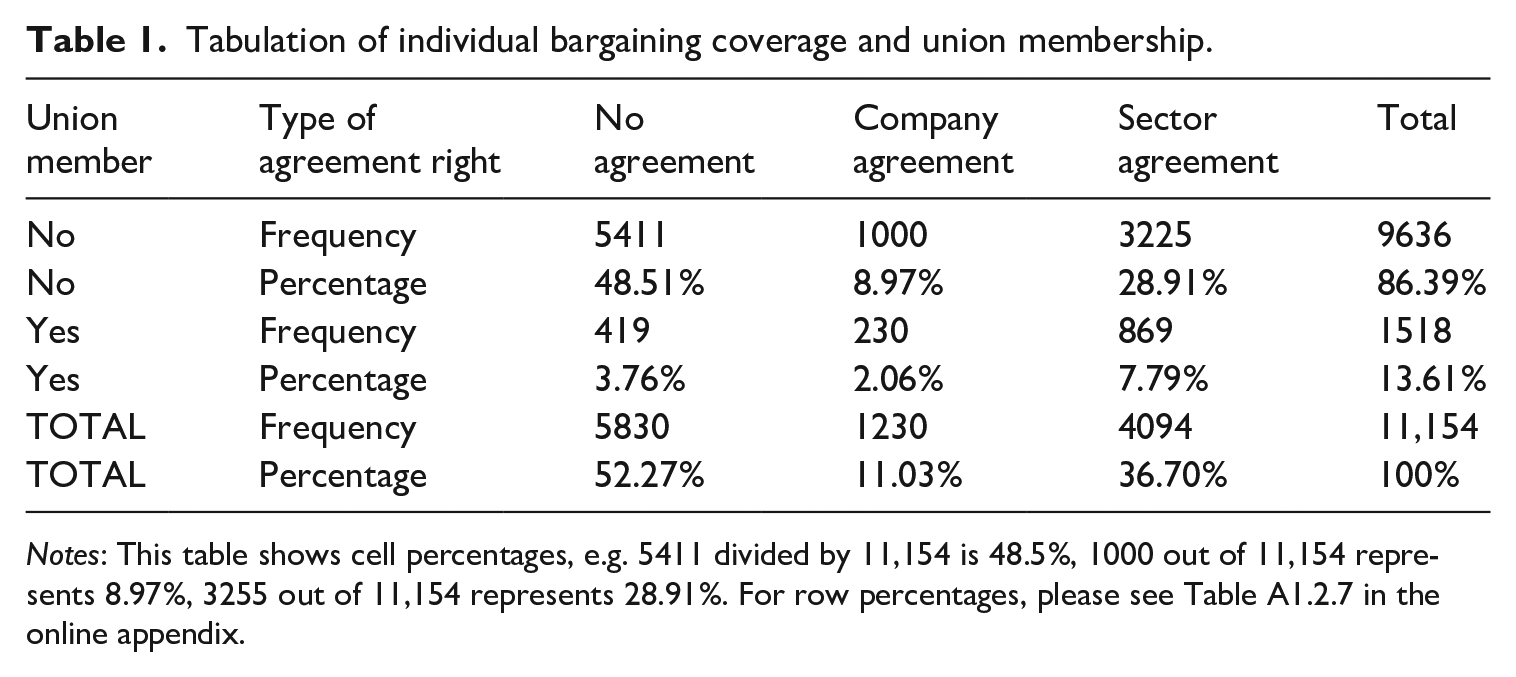
Notes: This table shows cell percentages, e.g. 5411 divided by 11,154 is 48.5%, 1000 out of 11,154 represents 8.97%, 3255 out of 11,154 represents 28.91%. For row percentages, please see Table A1.2.7 in the online appendix.
While almost 37% of respondents are covered by a sectoral agreement and 52% are not, it is noteworthy that 11% are covered by a company but not a sectoral agreement. In the baseline model, these are coded as 0, but as a robustness check the analysis was rerun when both sectoral and firm-level agreements are coded as 1 (section A2.5 in the online appendix). Finally, there are two key sector-level independent variables: sectoral average union density – ‘Union density’ and the sectoral percentage of workers covered by a wage bargaining agreement – ‘Bargaining coverage’.
A range of individual and sectoral controls are also included in the baseline model. At the individual level, the analysis is controlled for education using a categorical variable coded 0 if the respondent has primary or no education, 1 if secondary education and 2 if tertiary education. Next, the analysis controls for a measure of job tenure within the firm (in years), for gender (female coded 1, male 0) and age (coded into the following categories: 15–24, 25–34, 35–44, 45–54 and 55–64). A variable measuring firm size codes whether the respondent is in a firm with below 100 employees, between 100 and 200 employees, or above 200 employees. A self-assessed measure of how easy it is for the respondent to change job is also included as a proxy for the conditions of demand and supply in sectoral labour markets: difficult/almost impossible is coded 1, while easy is coded 0. The citizenship of the respondent is captured by including the following dummy variables: German, European from old member states, European from new member states and non-European. At the sectoral level, two key control variables were included in the baseline model: the average measure of job change and the share of female respondents.
The analysis relies on a series of multilevel logistic regressions. This method allows for testing the effect of both individual and sectoral-level variables on individual-level outcomes – both their direct effect and their effect in interaction with individual-level variables (Mathieu et al., 2012). In a first step, the null model is estimated to assess whether the data structure is nested and requires multilevel modelling. The intraclass correlation coefficient (ICC) value is equal to .17426, which indicates that 17.4% of the variance takes place at sectoral level. As a further confirmation, a series of sector-specific logistic regression on union membership and being covered by collective bargaining revealed wide variation in the size and significance of being a union member and being covered by an agreement on the probability of being in a low-pay job across sectors (see Figure A1.4.1 in the online appendix). Therefore, ignoring the clustering of data by using a single-level (i.e. pooled) model would lead to biased results (Mathieu et al., 2012).
Hence, in a second step, the multilevel logistic regression including all variables was run and, as a third step, cross-level interaction terms were fitted to test the conditioning effect of sectoral-level variables. Stata15 is used to run the analysis through the command melogit. Following the guidelines of Stata (2017), the coefficients of the interaction terms are not interpreted from the regression table but analysed using the commands margins and marginsplot in order to illustrate the marginal effects.
A multilevel approach is widely seen as superior to ignoring the hierarchical structure of the data and reporting robust clustered standard errors (DiPrete and Forristal, 1994: 348; Gelman, 2006: 434). That being said, the analysis was also rerun using multilevel mixed effects linear models, with and without robust standard errors clustered at the sectoral level, and normal OLS regressions with sector fixed effects (see the online appendix).
Results
Figure 1 reports the coefficients plotted as small circles of the model with only key controls. The bars around the point estimate indicate the 90% confidence interval; the full results for all specifications can be found in Table A2.8.1 in the online appendix. Education has the expected effect: those with secondary and tertiary education are less likely to be in low-pay jobs than those without (the reference category). Middle-aged respondents are less likely to be in low pay than respondents above 55 years old, who are themselves less likely to be in low-pay jobs than those under 25 years (the reference category). Female respondents are more likely to be in low-pay jobs. Respondents in larger firms are less likely to be in low-pay jobs, while those from non-EU member states are more likely to be in such a job than Germans, although it is noteworthy that there is no effect for other EU member states (old or new). The coefficients for job tenure and likelihood of changing job are also statistically significant.
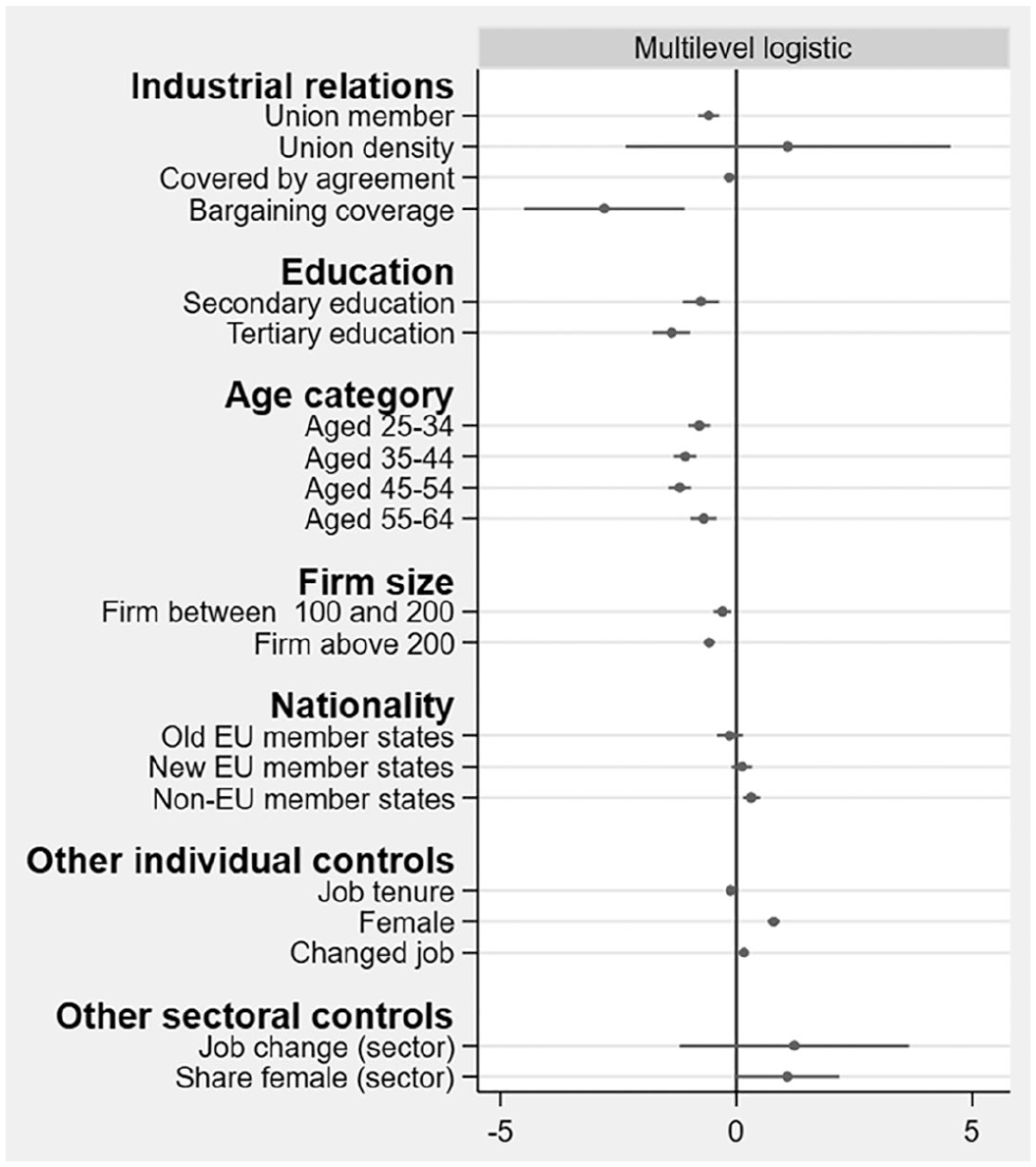
Baseline results from multilevel logistic regressions.
The first two sets of hypotheses are partly supported. At the individual level, union membership and being covered by a sectoral agreement are negatively associated with the probability of being on a low-pay contract. However, at the sectoral level, while collective bargaining is negative and statistically significant, this is not the case for union density, whose effect is not significant.
To test the other hypotheses, the same multilevel logistic random intercept models were rerun including the relevant interaction terms. The results are shown in Figures 2 and 3, which plot the predicted probabilities for different values of the relevant constituent terms of two interactions: Figure 2 for sectoral bargaining coverage and being covered by a sector agreement and Figure 3 for union density interacted with union membership. In each case, the bottom panel also shows the marginal effect of individual-level variables conditional on different values of the sectoral-level variables.
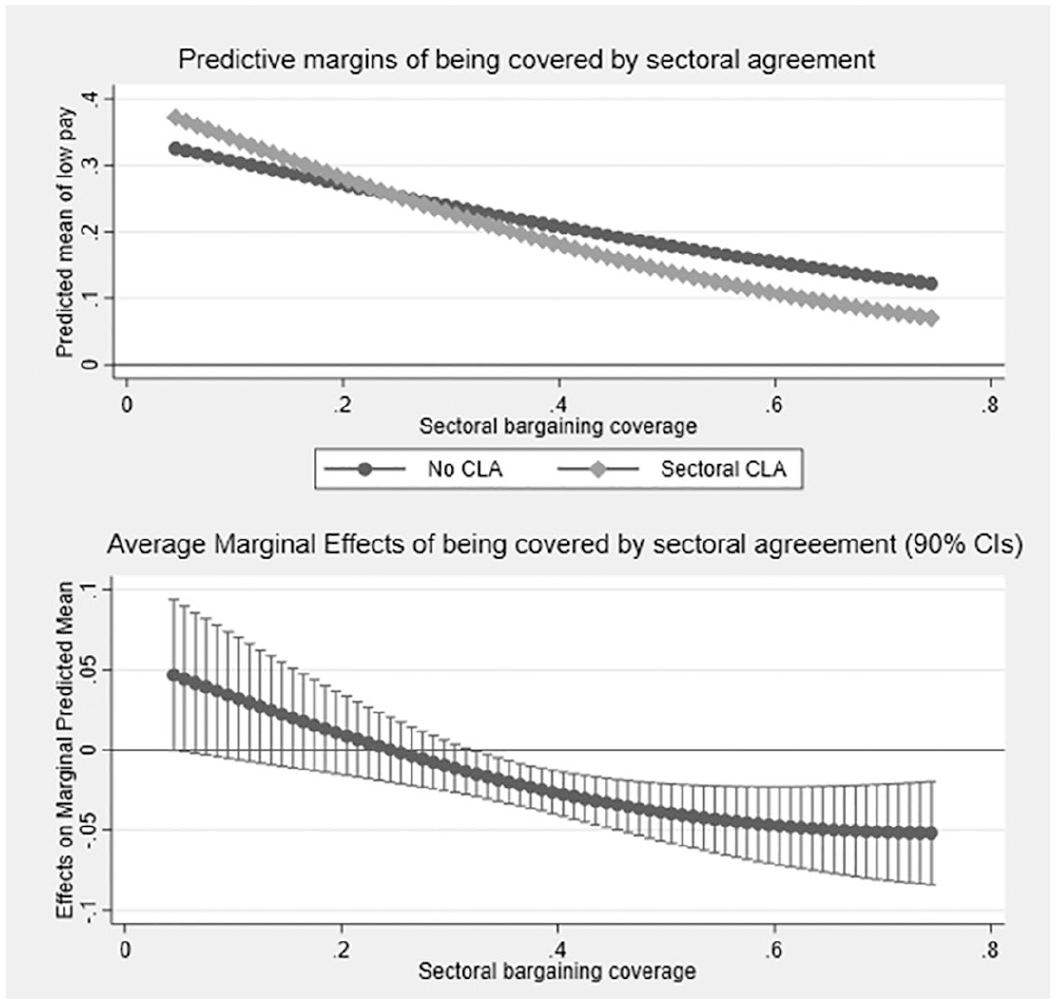
Predicted probability of interaction between individual coverage and sectoral collective bargaining.
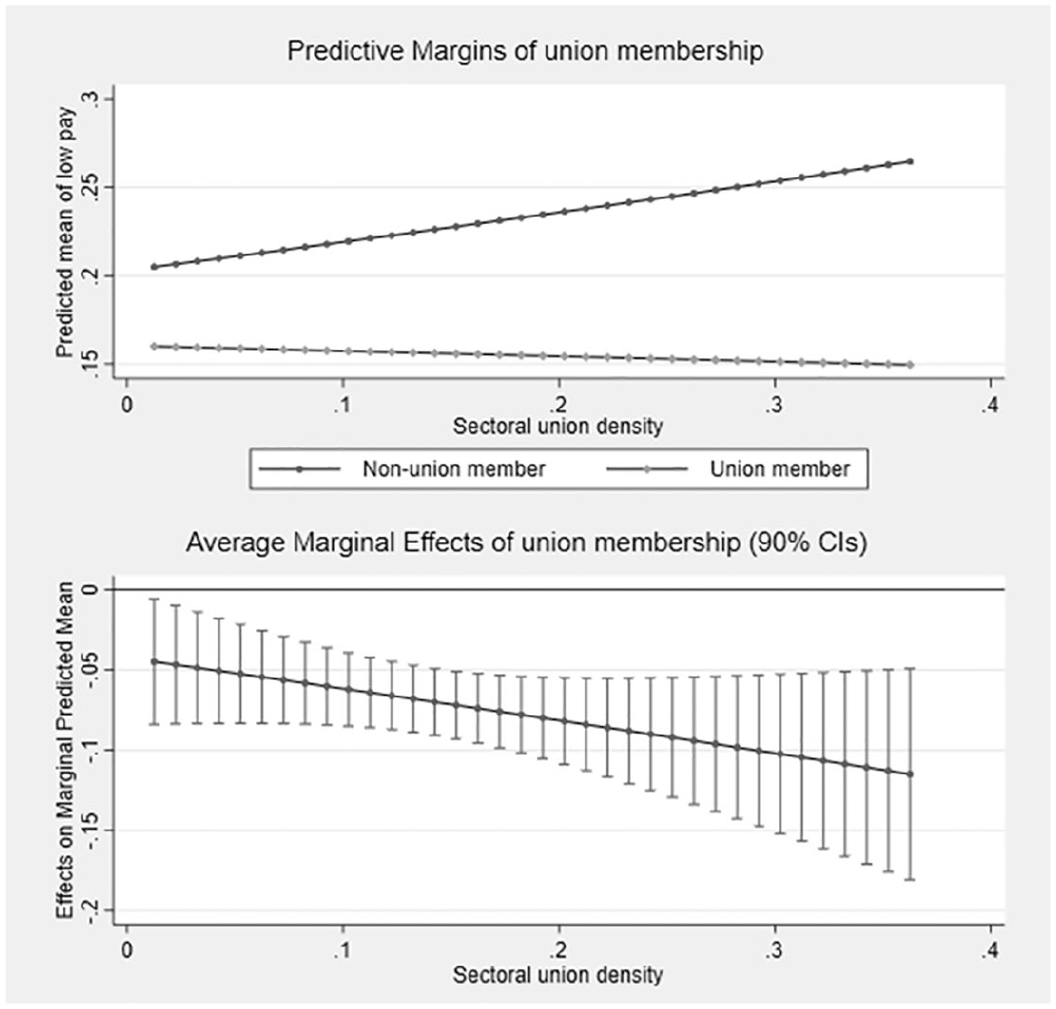
Predicted probability of interaction between union membership and union density.
Figure 2 shows that bargaining coverage reduces the probability of low pay for all workers, regardless of whether they are covered or not, but this protective effect is marginally stronger for those who are formally covered by the agreement. The implications for the differential effects of being covered versus non-covered at different levels of bargaining coverage are most apparent in the bottom panel which shows the marginal effects of being covered conditional on the percentage of workers who are covered in a particular sector. At very low levels of coverage, there is no statistically significant difference between covered and non-covered workers and it is only after a certain threshold that being covered is associated with a lower probability of being in low pay.
Therefore, higher coverage is associated with more protection for all workers, but the relevance of being covered at the individual level only materializes when many workers are covered. Even though the gap between covered and non-covered individuals seems to be larger in sectors with high bargaining coverage, overall, the probability of low pay is reduced for both covered and non-covered individuals, so the results are consistent with the PR approach (hypothesis 3a).
The top panel of Figure 3 plots the predicted probability of being a union member and sectoral union density. It shows that (1) being a union member is always associated with lower probability of being in low pay, (2) the higher the union density the more protective being a union member is and (3) as union density increases, the probability of being in low pay increases for non-members. As a result, the gap between members and non-members in their exposure to low-pay work actually widens as union density increases, and this is driven mostly by the higher probability for non-members. These latter findings are consistent with the I-O approach (hypothesis 4b).
Finally, a wide range of robustness checks was carried out and are included in the online appendix. First, by distinguishing between not being covered, being covered by firm-level agreements and being covered by sector-level agreements, the analysis shows that both types of agreements are negatively associated with low-pay probability (Figure 4). Furthermore, by including firm-level agreements in the sector-level bargaining agreement coverage measure, the negative correlation between being covered and low-pay probability remains statistically significant at the 10% level. Equally, when replacing the sector-level bargaining coverage agreement by a variable capturing the percentage of workers covered by either sectoral or company-level agreements, the coefficient remains similar (–2.445951, p-value 0.003 for the former, compared to –2.022002, p-value 0.013 for the latter). Next, creating the following three dichotomous variables confirmed the effect of union membership and being covered: being a union member not covered, being covered but not a union member, and being both a union member and covered by an agreement. The results suggest that all three variables are negatively related to low pay and significant, but the effects are larger for having both protections, followed by just having union membership (without being covered) and by just being covered without being a member (see Figure A2.5.2).
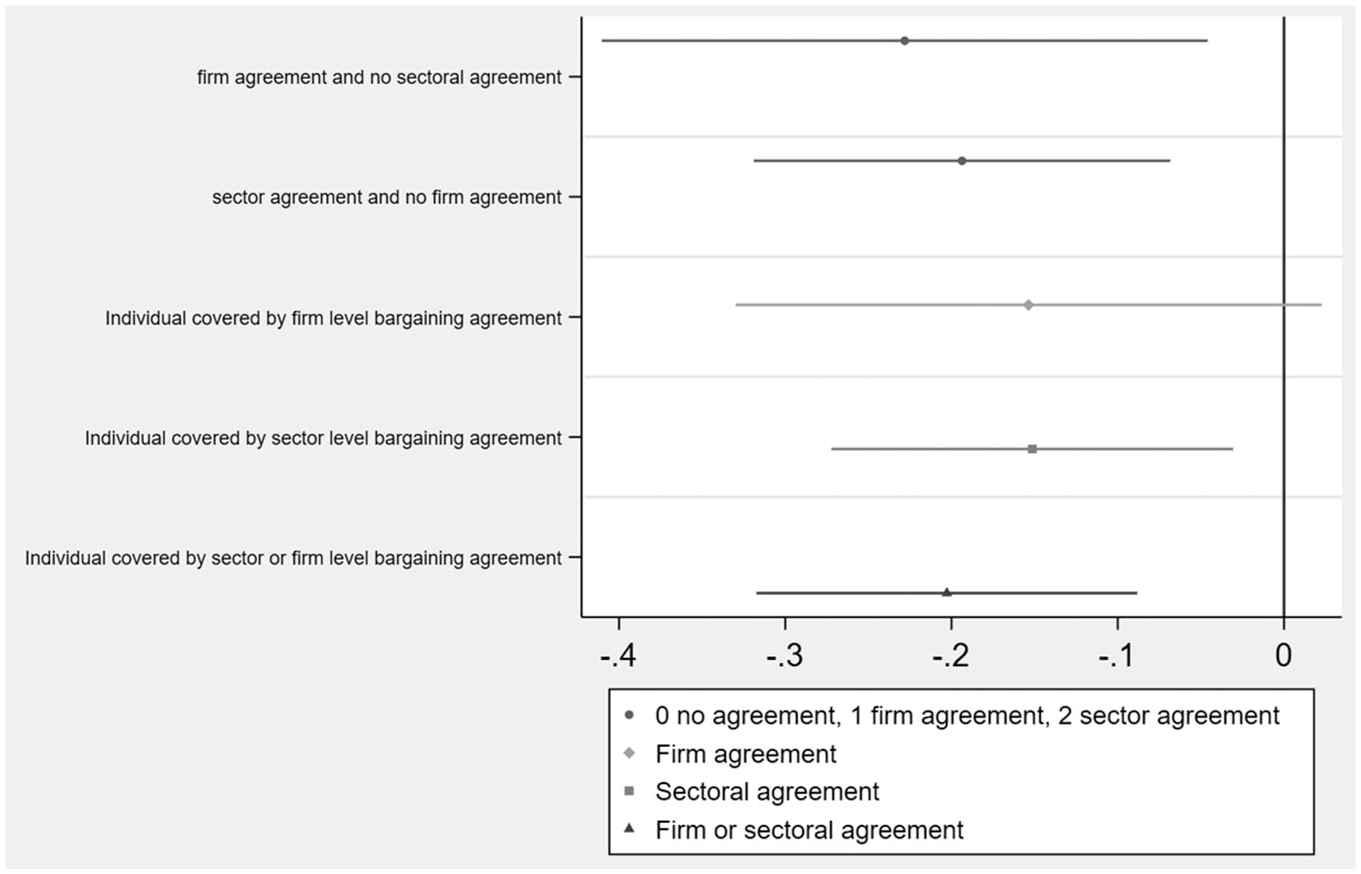
Multilevel logistic regression controlling for different measures of bargaining agreement.
Second, we reproduce our analysis using mixed effects linear regression, reporting robust clustered standard errors (Figure A2.2.1), and including sector-specific fixed effects (Figure A2.2.2). Third, including bonuses in the dependent variable does not change the findings (Table A2.8.1) and controlling for part-time workers (Figure A2.1.2) or public sector workers (Figure A2.6.1) does not change our key results. Fourth, our results are robust to the inclusion of ISCO-88 one-digit occupational controls (section A2.8) and to including a dummy for Eastern German states or including state-specific fixed effects (section A2.3). Fifth, controlling for two proxies of sectoral productivity does not change our results (section A2.4).
Discussion and conclusion
This article contributes to sociological debates on the relationship between IR institutions and low pay. On one side of the debate, the central claim of the I-O approach is that unions protect their members at the expense of so-called outsiders and therefore increase the risk of low pay for the latter group (Hassel, 2014; Lindbeck and Snower, 2002; Palier and Thelen, 2010; Saint-Paul, 2002). On the other side, scholars in the field of employment relations and sociology of work argue that unions and collective agreements benefit large segments of the workforce beyond their membership, reducing the overall risk of low pay (Doellgast et al., 2018; Gautiè and Schmitt, 2010).
In an attempt to critically analyse and systematize the debate, as well as to reconcile these contradicting claims, this article theorized several hypotheses that distinguished between the effect on individual low-pay risk of union membership and collective agreements at sectoral and individual level, respectively, and modelled the effect of the interplay between these factors. The empirical analysis of the German Socio-Economic Panel (wave 2015) demonstrated the value of a fine-grained multilevel analysis of the relationship between IR institutions and low pay and yielded several empirical and theoretical contributions.
In line with the individual-level hypotheses, union membership and collective bargaining at individual level were found to have distinct negative effects. Thus, both forms of individual ‘institutional inclusion’ matter to reduce low-pay risk even though the effect of union membership is stronger. In addition to greater access to training or negotiating power (Budd and Na, 2000: 784), this result might also capture the ability of union members to better enforce the individual or collective terms of their contract (Hogan, 2001). By contrast, workers who are not in the union, even if covered by a collective agreement, might be unable to enforce its correct application. The evidence for the effect of institutional strength at the sectoral level was more mixed: while bargaining coverage had a protective effect against low pay, the effect of union density was not statistically significant.
The analysis of the interaction between the sectoral strength of institutions and individual inclusion also reveals a mixed picture. In regard to the cross-level interaction between sectoral collective bargaining coverage and individual bargaining coverage, results suggested that the probability of being on a low-pay contract decreases also for those workers who are not covered by collective agreements – although to a lower extent than those who are covered – as sectoral bargaining coverage increases, which is consistent with the expectations of the PR approach. In contrast, the I-O expectations are confirmed by the analysis of the cross-level interaction between sectoral union density and individual union membership, as non-union members appear more exposed to the risk of low pay in highly unionized sectors.
These findings support our original claims that, first, different IR institutions have distinct effects on low-pay risk. Second, their effect at the individual level should be distinguished from their effect at the sectoral level; indeed, sectoral IR institutions mediate the relationship between individual coverage and low-pay risk, as strong IR institutions can have a positive or negative impact on the low-pay risk of individuals who are not covered. Thanks to its original multilevel fine-grained approach, this article therefore uniquely contributes to advance the debate on the relationship between IR institutions and low pay by reconciling the claims of scholars in the field of employment relations, who mostly take a PR approach, and of the I-O literature. In particular, this article suggests that employment relations scholars have better theorized the distinct effects of collective agreements while the I-O approach seems to have more accurately conceptualized the effect of unions.
The findings also have policy implications because they show that sectoral collective bargaining coverage has a stronger negative effect on the individual probability of low pay than union density and that encompassing sectoral agreements are beneficial also to those workers who are not directly covered. Hence, the findings support recent calls for strengthening institutional mechanisms for extending collective bargaining coverage independently from the level of unionization, which seem to be particularly crucial in times of union decline (Schulten, 2016).
Further studies should replicate this single-country analysis in other IR contexts: results can be expected to hold particularly well in those countries characterized by a system of sectoral collective bargaining with mechanisms of collective agreement extension (e.g. Austria, Italy and France), but they could differ in liberal market economies with decentralized bargaining systems (e.g. US and UK).
Supplemental Material
sj-pdf-1-wes-10.1177_09500170211024467 – Supplemental material for Trade Unions, Bargaining Coverage and Low Pay: A Multilevel Test of Institutional Effects on Low-Pay Risk in Germany
Supplemental material, sj-pdf-1-wes-10.1177_09500170211024467 for Trade Unions, Bargaining Coverage and Low Pay: A Multilevel Test of Institutional Effects on Low-Pay Risk in Germany by Chiara Benassi and Tim Vlandas in Work, Employment and Society
Footnotes
Acknowledgements
The authors would like to thank the reviewers and the editor for their helpful comments.
Funding
The author(s) received no financial support for the research, authorship, and/or publication of this article.

Supplementary material
The supplementary material is available online with the article.
References
Supplementary Material
Please find the following supplemental material available below.
For Open Access articles published under a Creative Commons License, all supplemental material carries the same license as the article it is associated with.
For non-Open Access articles published, all supplemental material carries a non-exclusive license, and permission requests for re-use of supplemental material or any part of supplemental material shall be sent directly to the copyright owner as specified in the copyright notice associated with the article.
