




Abstract
This article demonstrates how the unemployment of neighbours can ameliorate the psychological costs of unemployment. In support of this premise, we find that while unemployment is always harmful, the gap in psychological well-being between employed and unemployed individuals is much less in relatively high unemployment neighbourhoods (particularly so for males and relatively older cohorts). Our proposed explanation is that people employ close points of social comparison with the result that any feelings of shame or embarrassment associated with unemployment are mitigated when surrounded by unemployed neighbours. One potentially important labour market implication of these findings is that it may be more difficult than anticipated to transition some people out of unemployment in high unemployment neighbourhoods. Apart from highlighting the place-specific nature of the relationship between unemployment and psychological well-being, our findings also highlight the importance of non-pecuniary factors, such as the social norm to work, in explaining the substantive negative psychological impact of unemployment.
Introduction
There is a vast body of literature to suggest that unemployment is detrimental to psychological well-being and, moreover, the non-pecuniary or psychological effects are estimated to be several times larger than any financial impact (Helliwell and Huang, 2014). What this means is that even if we could somehow compensate people for the pecuniary losses associated with unemployment, the disutility experienced, as proxied by self-reported well-being, would remain high. According to the neoclassical framework, work is a ‘disutility’ and leisure should be utility enhancing and so the natural question to ask is why are the non-pecuniary effects so substantive? One explanation commonly put forward rests on social norms. There is much qualitative research, for instance, to suggest that in addition to financial penalties, individuals may experience informal social sanctions when unemployed, such as social exclusion as a result of not keeping up with expected norms of behaviour (Krug et al., 2019; McAdams, 1997). A further mechanism through which social norms may impact the psychological costs of unemployment is due to self-sanctioning. Self-sanctioning implies that as a result of social norms surrounding work, individuals may internalise feelings of guilt or shame from not working (Krug et al., 2019).
Given the difficulty in directly capturing social norms, researchers have commonly used proxy measures such as regional unemployment rates. The rationale behind the use of regional unemployment rates is that in regions with relatively more unemployment, it is thought that the social norm to work may not be as strong. In support of the idea that there exists a strong social norm to work, findings from this research generally suggest that the gap in psychological well-being between working and non-working groups is less in regions with the highest overall rates of unemployment (Clark, 2003; Clark and Oswald, 1994; Clark et al., 2010; Flint et al., 2013; Powdthavee, 2007; Shields et al., 2009). Jackson and Warr (1987), for instance, reported how the mental health of the unemployed in England and Wales is significantly higher in areas of relatively high unemployment. Suicides and para-suicides by the unemployed have also been shown to be lower in areas of relatively high unemployment (Platt and Kreitman, 1990). More recently, researchers have started to use panel-data analytical techniques in order to further explore the relationship between regional unemployment rates and the psychological well-being of the unemployed. This work using datasets from Britain, Germany, South Africa and Australia all suggests that unemployment ‘hurts’ less when living in a region with high unemployment rates (Clark et al., 2010; Clark and Oswald, 1994; Powdthavee, 2007; Shields et al., 2009).
The explanation commonly put forward to explain these findings is that being in contact with rising numbers of ‘others’ who are experiencing similar labour market challenges can evoke positive feelings (e.g. relief) in the unemployed, because it helps them feel ‘relatively’ better off. Put differently, while unemployment hurts, it may hurt significantly less when surrounded by others who are also unemployed, as the social norm to work may not be as strong. While this work has used indirect measures such as regional unemployment rates to capture social norms, some recent studies have been able to employ a more direct measure of the social norm to work. Stam et al. (2018), for instance, captured differences in the social norm to work across 45 countries by using individual responses to question items which can plausibly be argued directly capture norms surrounding work ethic. 1 This study finds a strong social norm to work reduces the well-being of retirees and non-working disabled men relative to their employed counterparts, but not for the unemployed. Stutzer and Lalive (2004) used political behaviour, namely the proportion of voters in favour of reducing unemployment benefits, as a proxy for the social norm to work and found that the stronger the social norm to work, the lower the reported life satisfaction of the unemployed.
While some research, such as that described earlier, has used regional measures of unemployment as a proxy for the social norm to work, a novel feature of this research is that we take advantage of localised neighbourhood measures of unemployment to act as our proxy measure. We do this by merging the UK Household Longitudinal Survey (UKHLS) with spatially disaggregated data pertaining to neighbourhood unemployment rates obtained from data released by the Ministry of Housing, Communities & Local Government. Apart from being a more powerful proxy for the social norm to work than regional measures, an additional advantage of this approach is that it allows us to examine to what degree the psychological cost of unemployment varies across neighbourhoods in England. We suggest that while unemployment will ‘hurt’, it will hurt much less when individuals are surrounded by others in close geographical proximity who are also unemployed. Our proposed explanation being that individuals will experience less social and internal sanctions from not working, when surrounded by ‘others’ who are also unemployed.
In addition to looking at the net effect of the neighbourhood context in shaping the psychological costs of unemployment, we also test various hypotheses regarding the potential for sub-group differences. In particular, we suggest that the role that neighbourhood unemployment rates will play in alleviating the psychological burden associated with unemployment will be gender and age-specific, at least to some degree. Our rationale for looking at gender is that due to masculine identities surrounding the role of males as ‘breadwinners’, the stigma associated with unemployment is still greater for men than women (Roex and Rözer, 2018; Van der Meer, 2014). When it comes to age, we suggest that in addition to being seen as an indicator of relative deprivation, low rates of neighbourhood unemployment may also be seen as a signal for better future employment prospects for younger cohorts. Additionally, relative to younger groups, older individuals may be more geographically constrained and thus local comparisons may take on greater importance.
In support of these hypotheses, we find from using both a variety of outcome measures (anxiety, social dysfunction, self-esteem, life satisfaction) and individual fixed-effects (i.e. following the same individuals over time) that the gap in psychological well-being between the unemployed and the employed is significantly less in neighbourhoods with relatively high unemployment rates. This is because in contrast to the employed, we observe a positive correlation between neighbourhood unemployment and the psychological well-being of the unemployed. This would support our suggestion that the neighbourhood context matters when it comes to understanding the psychological cost of unemployment. We also find that the unemployment of neighbours appears to play a much greater role in alleviating the psychological cost of unemployment for certain groups over others, namely men and older groups (e.g. over 45). In addition to helping us better understand the non-pecuniary costs of unemployment, and in particular the role of the social norm to work, these differences across neighbourhoods may also have significant labour market implications. If, for instance, the psychological costs associated with unemployment are significantly less in, as we suggest, high as opposed to low unemployment neighbourhoods, then it may be more difficult than anticipated to transition people (particularly males and relatively older cohorts) out of unemployment in these neighbourhoods. We conclude by noting that while our findings suggest that the degree to which unemployment is harmful for psychological well-being will be place-specific, unemployment is always associated with significant psychological distress.
The social norm to work
In standard economic theory, it is typically assumed that work is a source of ‘disutility’ (see Rätzel, 2012; Spencer, 2014 for a review of this literature). Under this framework, individuals are assumed to decide on an ‘optimal’ combination of income from work and leisure. An increase in time spent on work provides more consumption opportunities but reduces leisure opportunities, with leisure being utility enhancing. There is an emerging body of research to suggest, however, that assuming a disutility of labour may not be a realistic representation of the psychological value of work (Budd, 2011; Budd and Spencer, 2014). In support of this idea, there is evidence to suggest that individuals do not respond to economic stimuli in the fashion that one would expect if work incurred a loss in utility. As an example, while rising benefits relative to wages will lead to an increase in the amount of time people spend unemployed, the impact is generally not found to be substantive and below what would be predicted under the assumption that work incurs a loss in utility (Narendranathan and Stewart, 1993; Spiezia, 2000). Such outcomes would not be consistent with the neoclassical economic model of labour supply which predicts that individuals’ labour market behaviour merely amounts to simple rational calculations based on trade-offs between income and leisure. The view among sociologists and others that economic behaviour is heavily embedded and thus regulated by structures of social relations offers an explanation for such outcomes (Granovetter, 1974: 85). For instance, as noted by Granovetter (1985), seemingly irrational behaviour can be seen as rational or instrumental when we note that behaviour is not always driven just by economic goals but also by sociability and status.
Perhaps the most compelling evidence in support of the premise that work is not necessarily a disutility comes from the rapidly expanding ‘economics of happiness’ field. Research in this field demonstrates that the loss in psychological well-being arising from unemployment is substantial and long-lasting (Blanchflower and Oswald, 2004; Kamerāde and Bennett, 2018; Kassenboehmer and Haisken-DeNew, 2009; Nordenmark, 1999). What this research also makes clear, however, is that the non-pecuniary costs of unemployment seem to matter much more for psychological well-being than any losses arising from a reduction in income (Helliwell and Huang, 2014). That is, even if individuals were compensated entirely for any reduction in income associated with unemployment, they would still be much worse off in terms of their psychological well-being. Such findings are hard to reconcile with any notion that there is a disutility of labour. This is of course not to say that labour may in certain circumstances incur a loss in utility, as a lot will depend on the overall job quality and the degree of autonomy that people enjoy. Of note here is research from Australia which suggests that the mental health associated with being employed in what can be characterised as lowest quality jobs (e.g. little autonomy, agency, insecurity, unfair pay) can be comparable or indeed less than that associated with being unemployed (Butterworth et al., 2011).
If as suggested above, job loss incurs a loss in psychological well-being beyond that which is observed from a reduction in income, then the question is – why? Fortunately, there is a rich literature across the social sciences, but particularly in sociology and social psychology from which we can draw on. Jahoda (1981, 1982) points towards various psychological functions, central to mental health that are provided by employment. These relate to activity, time structure, social contact outside the family, sense of purpose and identity. These have been augmented by Warr (1987) who puts forward the concept of ‘vitamins’ of life associated with job characteristics which are important for mental health. According to this model, job characteristics influence mental health in a way that is analogous to the effects that vitamins can have on our physical health.
While employment may help foster psychological well-being due to various beneficial features (vitamins) associated with working life, it is also true that being unemployed may in and of itself have a deleterious effect on psychological well-being. This is because being unemployed not only incurs financial penalties but moral and psychological ones too. Unemployment can be regarded as a stigma of character, where, as described by sociologist Erving Goffman in the 1960s, the stigmatised are considered individuals with a ‘weak will, domineering or unnatural passions, treacherous and rigid beliefs, and dishonesty’ (Goffman, 1963: 4, as cited by Krug et al., 2019). Such stereotypical beliefs are also prevalent today and evident by labour market studies which report that negative stereotypes surrounding the unemployed on the part of employers can hinder the unemployed from actually obtaining employment (Krug et al., 2019). Independent of any discrimination, the stigma associated with being unemployed may also negatively affect individuals’ own psychological well-being. One channel through which this may occur is that individuals who deviate from the social norm to work may experience social sanctions from others which may, in turn, foster feelings of shame and inferiority. This is known as the ‘stigmatisation hypothesis’ (Kalmijn and Uunk, 2007). Additionally, individuals may also internalise negative labels and stereotypes into their own identity or sense of self-worth (Etzioni, 2000; McAdams, 1997).
The literature described above points out how independent of any financial implications, the psychological costs stemming from unemployment can be substantive. The key hypothesis we test in this study is whether the neighbourhood environment, namely the unemployment of ‘others’, will shape these psychological or non-pecuniary costs. Our intuition is as follows: in high unemployment neighbourhoods, we suggest that the social norm to work may not be as strong and, in turn, the non-pecuniary costs, such as those associated with feelings of shame and embarrassment from being unemployed, may be less. In support of this idea, Shildrick and MacDonald (2013), in an influential study, illustrated how people in poverty often deploy close points of comparison in order to diminish their own relative poverty and dissociate from the ‘poor’. By the same token, it is easy to imagine that the unemployed will also employ close points of comparison in judging their own circumstances. In effect, we suggest that when surrounded by others who are also unemployed, the unemployed may feel as if their own behaviour is not such a significant departure from social norms such as the norm to work.
While we suggest that the neighbourhood environment will shape to some extent the non-pecuniary or psychological costs of unemployment, we also suggest that the effect of the neighbourhood context will vary according to particular characteristics of the individual. The individual characteristics we focus on in this study are gender and age as it is these individual characteristics for which we have stronger a priori expectations. In relation to gender, while the gap has reduced over time as increasing numbers of women enter the labour market, the stigma associated with unemployment still weighs more heavily on men than women (Roex and Rözer, 2018; Van der Meer, 2014). As such, we hypothesise that as men are exposed to more social and internal sanctions from not working, they have more to gain from rising rates of neighbourhood unemployment or indeed anything else that reduces the stigma associated with being unemployed.
Our rationale for looking at age stems from some recent research in the area of income comparisons and psychological well-being. This research suggests that the degree to which individuals are affected by relative deprivation may vary over the life cycle (FitzRoy et al., 2014). In particular, findings from this work suggest that for the relatively young, who will typically be more mobile and flexible, a higher peer-group income may not just serve as an indicator of their own ‘relative deprivation’ but also as an indicator of better future prospects. We hypothesise that the same pattern could be evident when it comes to unemployment. That is, while low neighbourhood unemployment rates can be an indicator of relative deprivation when unemployed, it may also be seen as a signal for better future employment prospects, at least for relatively younger cohorts whose future careers are less well determined. A further reason why we suggest the neighbourhood context may affect age groups differently is that while unemployment for all groups lessens opportunities for social contact outside the neighbourhood, it seems likely that older cohorts will be relatively more geographically constrained when it comes to social networks and thus local comparisons may take on greater importance. Put differently, in the era of ever more virtual and online networking, for younger cohorts at least, their social world even when unemployed may extend beyond the neighbourhood (Howley et al., 2015).
Methods
The data used in this analysis come from Understanding Society: The UK Household Longitudinal Survey (UKHLS). This is a comprehensive household survey that started in 2009 with a nationally representative, stratified, clustered sample of around 50,000 adults (16+) living in the United Kingdom. This survey collects, on an annual basis, information relating to an individual’s psychological well-being, together with numerous other individual characteristics. To date, the UKHLS has released eight waves of data (each wave is collected over two and sometimes three years) and in this study we use all waves available, so we have data from 2009 to 2018.
Outcome variables
The main indicator of psychological well-being we use as our key outcome variable is the General Health Questionnaire (GHQ), which consists of a 12-item scale. Each item is accompanied by four possible responses: two of the answers are positive and two are negative. A score ranging from 0 (best) to 36 (worst) is computed for each individual in the survey – the higher the score then the more likely it is that respondents are suffering from some form of psychological distress. For simplicity, we reorder this variable so that individuals are scored from 0 (worst) to 36 (best), and label this variable as psychological well-being. The original GHQ measure was initially conceived as a screening instrument for psychiatric disorders but the version used in this study consists of a shorter 12-item scale and is commonly used as a general measure of subjective well-being (Jackson, 2007).
Apart from a single severity scale, given the multidimensional properties of the GHQ, it can be dis-aggregated into three sub-components reflective of ‘anxiety’, ‘social dysfunction’ and ‘self-esteem’ (see Graetz, 1991). In addition to the overall GHQ measure, we also use these dis-aggregated sub-components as outcome variables in our analysis. In Table A in the online appendix, we present further details relating to the specific GHQ questions and on the dis-aggregation into the various sub-components. Finally, we use self-reported life satisfaction as an additional indicator of psychological well-being. This measure of psychological well-being is based on respondents’ answer to the following question: ‘How dissatisfied or satisfied are you with life overall?’. Respondents give a single reply from a Likert scale with options ranging from 1 (‘completed unsatisfied’) to 7 (‘completely satisfied’).
Neighbourhood unemployment
Through a special licence application, we were able to obtain a variable in the UKHLS which records each individual’s place of residence at the Lower Super Output Area (LSOA) level, also commonly referred to as the neighbourhood level in England. LSOAs are small (over 32,000 units) geographic areas designed to be of a similar population size, with an average of approximately 1500 residents in each. Using this geo-referenced indicator, we then matched each individual in the UKHLS with a measure of neighbourhood unemployment obtained from the Ministry of Housing, Communities & Local Government. The Ministry released indices in 2015 which aim to capture differences in deprivation across neighbourhoods on seven distinct domains, one of which was Employment. The remaining six domains include Income, Health Deprivation and Disability, Education, Crime, Barriers to Housing and Services, and Living Environment. The figures released in relation to Employment capture the percentage share of the working age population in each neighbourhood involuntarily excluded from the labour market. 2 This includes people who would like to work but are unable to do so due to unemployment, sickness or disability, or caring responsibilities.
By matching this employment index (for simplicity we refer to this as neighbourhood unemployment hereafter) to the UKHLS, we have a variable which reflects aggregate unemployment at the neighbourhood level. One limitation with using this measure is that rates of neighbourhood unemployment will change over time and this measure will not capture such changes. That being said, given that deprivation in the UK tends to be concentrated on the same areas, at least over the short term, we do not anticipate any substantive changes in the relative rankings of neighbourhoods over the time period of this study. As such, this measure should provide a reasonable and unbiased proxy for neighbourhood unemployment. It is perhaps also worth emphasising at this stage that our aim is not to uncover any causal estimates relating to the role of neighbourhood unemployment rates for psychological well-being. Rather, our aim is to see if any differences emerge when it comes to the relationship between neighbourhood unemployment and the psychological well-being of the unemployed versus the employed.
In addition to the seven distinct domains of deprivation described above, the Ministry also release an overall measure of neighbourhood deprivation, commonly referred to as the English Index of Deprivation. We included this measure as an additional covariate in our analysis to help us more cleanly isolate the relationship between neighbourhood unemployment and psychological well-being from other spatial correlates, albeit our estimates do not change in any meaningful fashion if we exclude this variable. We supplemented this measure with region dummies. 3 A detailed set of individual controls were also included in the analysis (see Table B in the online appendix for relevant summary statistics). Additionally, in order to control for any macro and period-specific changes, we added in wave dummies (each wave is collected over two and sometimes three years) and a measure of annual GDP growth. 4 Lastly, to account for any potential heteroscedasticity or serial correlation, we used cluster robust standard errors. 5
Empirical specification
The analysis begins by assuming that the psychological well-being of an individual (PWB) is explained by a vector of socioeconomic and demographic characteristics (X) and neighbourhood unemployment (NU). U is a dummy for own unemployment. It is possible that other spatial factors that are related with neighbourhood unemployment might also affect individual well-being. To help account for these effects, a neighbourhood index of deprivation (

We have three prior hypotheses that we test using Equation 1:
H1: The unemployed have lower levels of psychological well-being than the employed.
H2: Local labour market conditions (neighbourhood unemployment) moderates the relationship between unemployment and psychological well-being.
H3: The extent to which local labour market conditions moderate the relationship between unemployment and psychological well-being will vary according to gender and age.
In relation to the first hypothesis, there is, as discussed earlier, a rich literature across the social sciences documenting the negative impact of unemployment for psychological well-being. In relation to the second hypothesis, our a priori expectation would be that rising neighbourhood rates of unemployment would be negatively related with the well-being of the employed. This is because rising rates of neighbourhood unemployment would be a negative signal regarding future prospects (i.e. bad news for others makes me feel less secure about my own job) (Clark et al., 2010; Helliwell and Huang, 2014). Additionally, there is some prior literature to suggest that, in addition to individual-level deprivation, neighbourhood deprivation may adversely impact people’s happiness (Ludwig et al., 2012). If we focus specifically on the unemployed, higher unemployment rates in the local labour market reduce their chances of finding work. This means that one could also make a strong case for expecting the unemployed to experience a well-being loss in response to rising rates of neighbourhood unemployment, and indeed one that is more pronounced than that experienced by the employed as they have more to lose.
Drawing on the literature in relation to social norms discussed earlier, we hypothesise, however, that the unemployed will be less negatively impacted by neighbourhood unemployment than the employed. The intuition being that unemployment hurts psychological well-being not just through pecuniary losses, but also through non-pecuniary factors arising from informal social sanctions and feelings of guilt or shame. As the unemployment of their neighbours increases, the pecuniary losses associated with unemployment remain, but the non-pecuniary costs, such as those associated with the stigma of unemployment, may be alleviated. This is not to say that concerns about what unemployment rates in their own neighbourhood mean for their own future employment prospects is not important for unemployed individuals, rather we suggest that these will be counterbalanced to some degree at least by a reduction in the non-pecuniary costs associated with unemployment.
We can test to what extent the neighbourhood unemployment rate moderates the well-being of the unemployed (H2) by simply interacting own individual unemployment with neighbourhood unemployment (
Results
Main effects
Table C in the online appendix presents the estimates for the full sample population in England 6 using individual fixed-effects (i.e. a within-person analysis). This consists of 227,785 individual observations spread across eight waves of the UKHLS. It is worth noting that our use of fixed-effects will account for any unobserved heterogeneity that is time-invariant at the individual level. The results relating to our control variables are all along expected lines and so for parsimony are not discussed. The key explanatory variables of interest are the dummy variable unemployment, which represents the difference in psychological well-being between those that are unemployed, as compared to those in paid employment (hereafter referred to as the employed), and neighbourhood unemployment, which captures the relationship between the neighbourhood unemployment rate and individuals’ psychological well-being. The results in relation to unemployment are along expected lines (i.e. unemployed individuals have significantly lower levels of psychological well-being than employed individuals) (–1.58, p < 0.001). We also observe a negative correlation between neighbourhood unemployment and psychological well-being, but one that is not statistically significant.
Does unemployment hurt less if there is more of it around?
In this next part of our analysis, we test if the unemployment of neighbours moderates the relationship between unemployment and psychological well-being. This issue is examined by simply adding an interaction term, namely an interaction between the dummy variable capturing individuals who are unemployed (paid employment is the reference category) with neighbourhood unemployment (unemployed × neighbourhood unemployment). These results are presented in Table 1. The interaction term attracts a positive and statistically significant coefficient (2.52, p < 0.001), which suggests that neighbourhood unemployment moderates the psychological costs associated with unemployment. Put differently, the significant interaction term tells us that there is a different relationship between neighbourhood unemployment and psychological well-being for those who are unemployed as opposed to those in paid employment.
Does unemployment hurt less if there is more of it around?
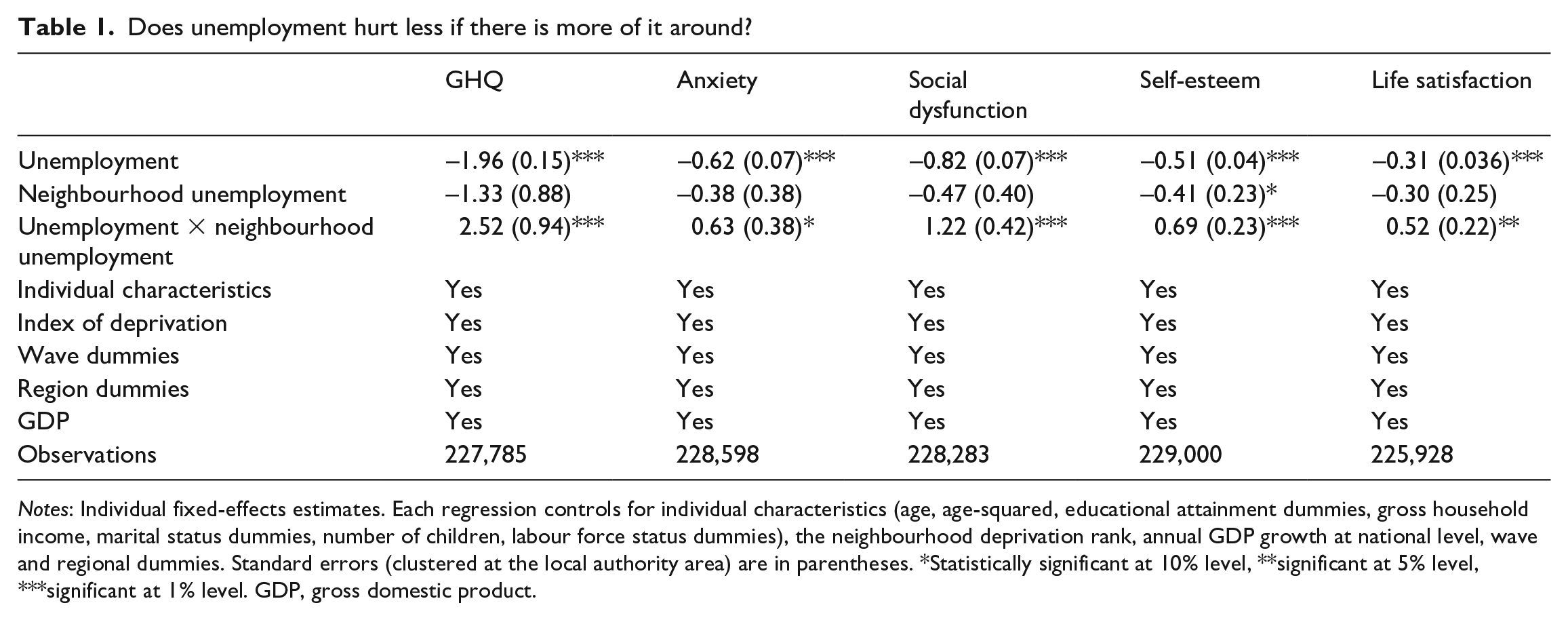
Notes: Individual fixed-effects estimates. Each regression controls for individual characteristics (age, age-squared, educational attainment dummies, gross household income, marital status dummies, number of children, labour force status dummies), the neighbourhood deprivation rank, annual GDP growth at national level, wave and regional dummies. Standard errors (clustered at the local authority area) are in parentheses. *Statistically significant at 10% level, **significant at 5% level, ***significant at 1% level. GDP, gross domestic product.
Figure 1 provides a visual illustration of this interaction effect. 7 Parallel lines would indicate that the relationship between neighbourhood unemployment and psychological well-being is the same for the employed and the unemployed. In this figure, we can see that rising rates of neighbourhood unemployment is negatively correlated, as one would expect, with the psychological well-being of the employed. In many ways, at least according to the rational actor agent model of behaviour, we would expect to see a stronger negative correlation between neighbourhood unemployment and the psychological well-being of the unemployed, as rising unemployment in the local labour market makes their future employment prospects bleaker. This is, however, not what we observe in the data as we observe a positive correlation between the neighbourhood unemployment rate and the psychological well-being of the unemployed. The net result is that there is a much smaller gap between the psychological well-being of unemployed and employed individuals in neighbourhoods with relatively high aggregate levels of unemployment. In other words, unemployment hurts individuals much less when more of their neighbours are also unemployed.
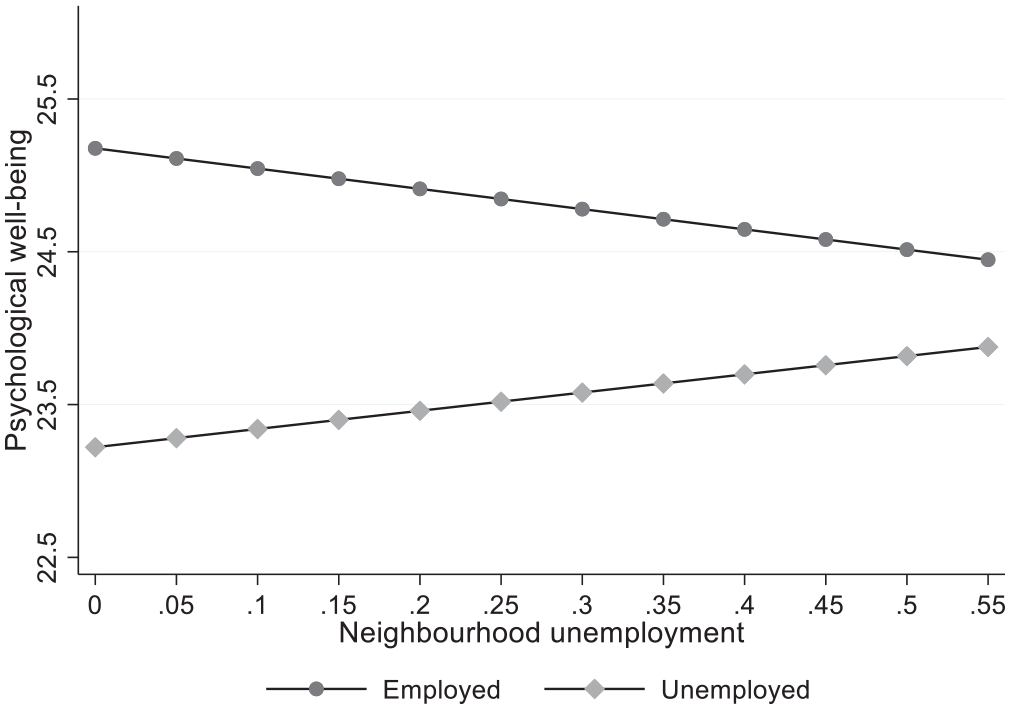
Unemployment * neighbourhood unemployment (interaction effect) – GHQ.
By way of illustration, the average estimated gap in psychological well-being between unemployed and employed individuals with the lowest rates (4%) of neighbourhood unemployment is over three times that observed in the neighbourhoods with the highest rates (56%). For example, we find that there is a 1.86 estimated unit difference in our measure of psychological well-being between the employed and the unemployed in neighbourhoods with the lowest levels of overall unemployment. This falls to an estimated gap of 0.52 units when we move to neighbourhoods with the highest rates of unemployment. We note here that fortunately very few neighbourhoods will ever reach such high levels of unemployment and there remains a gap in psychological well-being between the unemployed and the employed across all neighbourhoods. Therefore, while illustrative of the importance of the prevailing level of unemployment in neighbourhoods (and hence social norms) in shaping the psychological costs of unemployment for individuals living in those areas, it is perhaps also important to not lose sight of the fact that unemployment is always detrimental to psychological well-being, irrespective of the neighbourhood unemployment rate.
Disaggregating the GHQ
Our outcome measure to date has been the GHQ, which provides a single severity score of psychological well-being. The GHQ is, however, a composite measure of 12 items and due to its multidimensional structure can be further dis-aggregated into three sub-components reflective of anxiety, social dysfunction and self-esteem (Graetz, 1991). We examined if there were any differences in the relationship between neighbourhood unemployment and the psychological well-being of the unemployed across these disaggregated sub-components (see Table 1). Similar to what is done for the overall aggregated GHQ measure, the scale used for these variables is reversed so that ‘more is better’ (i.e. higher numbers reflect lower anxiety and social dysfunction or greater self-esteem). Irrespective of which measure is used, a significant interaction term is observed (see Table 1) between unemployment and neighbourhood unemployment. This analysis, therefore, suggests that whether it be in terms of anxiety, social dysfunction or self-esteem, the psychological burden of unemployment is alleviated, to some degree, by the unemployment of neighbours. Figure 2 provides a visual illustration of the interaction effects across the various sub-components of the GHQ.
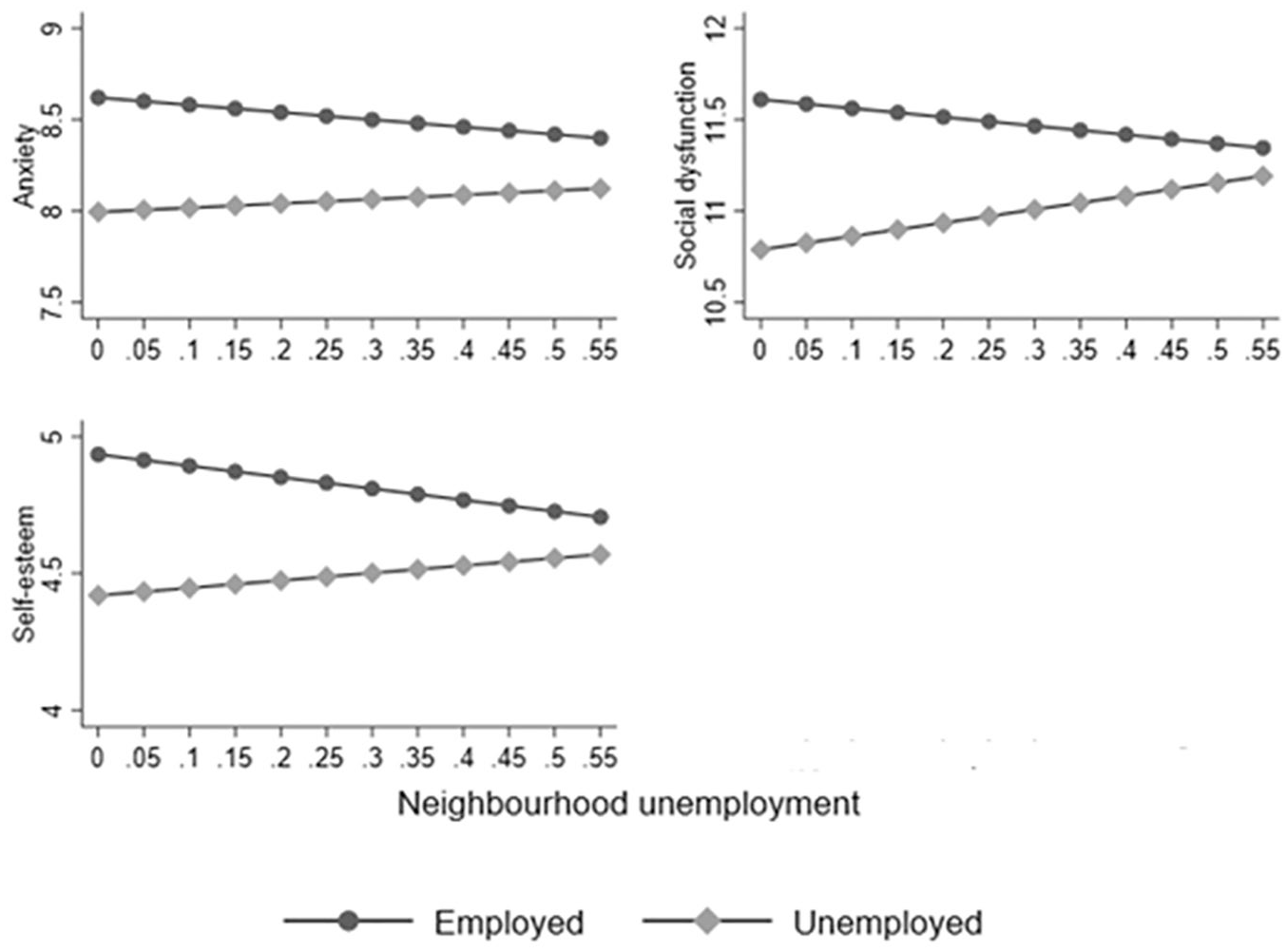
GHQ sub-components.
As a further sensitivity check, self-reported life satisfaction is used as the outcome variable. Similar to what is observed when using the GHQ and various sub-components as the outcome variable, the coefficient reflecting the interaction term between unemployment and neighbourhood unemployment attracted a significant and positive coefficient (0.52, p < 0.05: see Figure 3 for a visual illustration). Indeed, the moderating role of neighbourhood unemployment appears even more pronounced when using life satisfaction as opposed to the GHQ as our metric of psychological well-being.
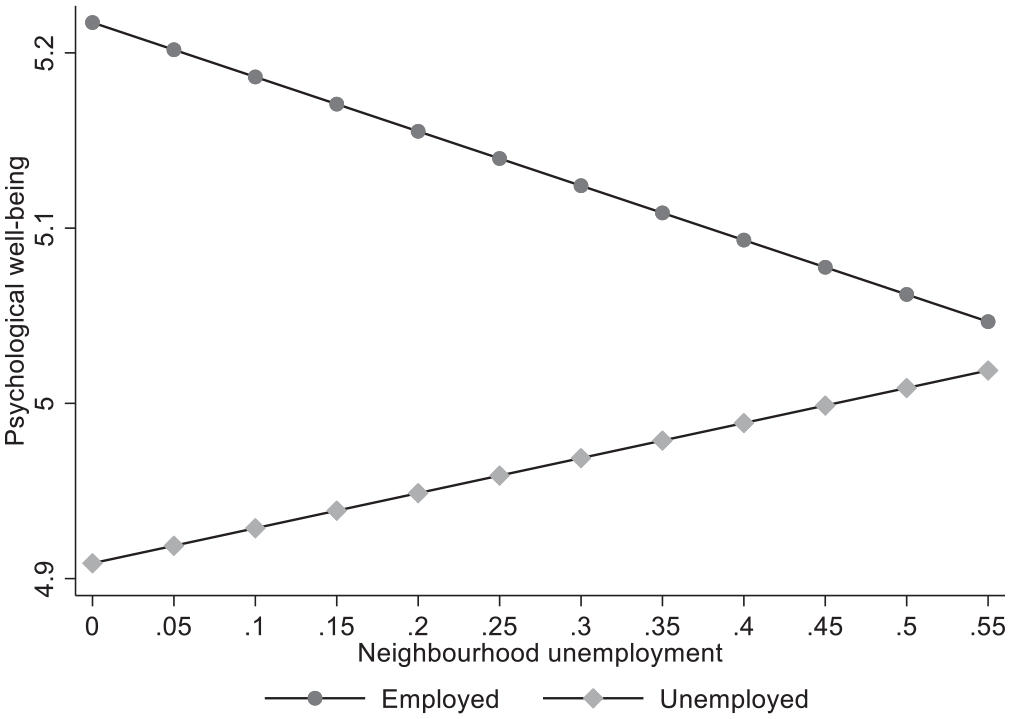
Life satisfaction.
Differences across sub-groups (age and gender)
Gender
Having illustrated how neighbourhood unemployment moderates the relationship between unemployment and psychological well-being for the population as a whole, we next examine if there are any sub-group differences according to gender and age. First looking at gender, we find that the interaction coefficient between unemployment and neighbourhood unemployment for males remains statistically significant at the 1% level (3.2, p < 0.01), whereas the interaction coefficient for females is smaller in size and not statistically significant (1.77, p = 0.16). Figure 4 provides a closer examination of the interaction between unemployment and neighbourhood unemployment for both males and females. Looking at Figure 4 we can see that while there is a strong positive correlation between the unemployment of neighbours and the psychological well-being of unemployed men, no significant relationship emerges between neighbourhood unemployment and psychological well-being for unemployed women. In other words, males when unemployed appear to be much better off in psychological well-being terms when living in neighbourhoods with high as opposed to low unemployment rates, but the same cannot be said for females. Our proposed explanation is that the stigma associated with unemployment is still stronger for men than women (Roex and Rözer, 2018) and, as a result, men have simply more to gain in terms of a reduction in feelings of shame or inferiority by the unemployment of others.
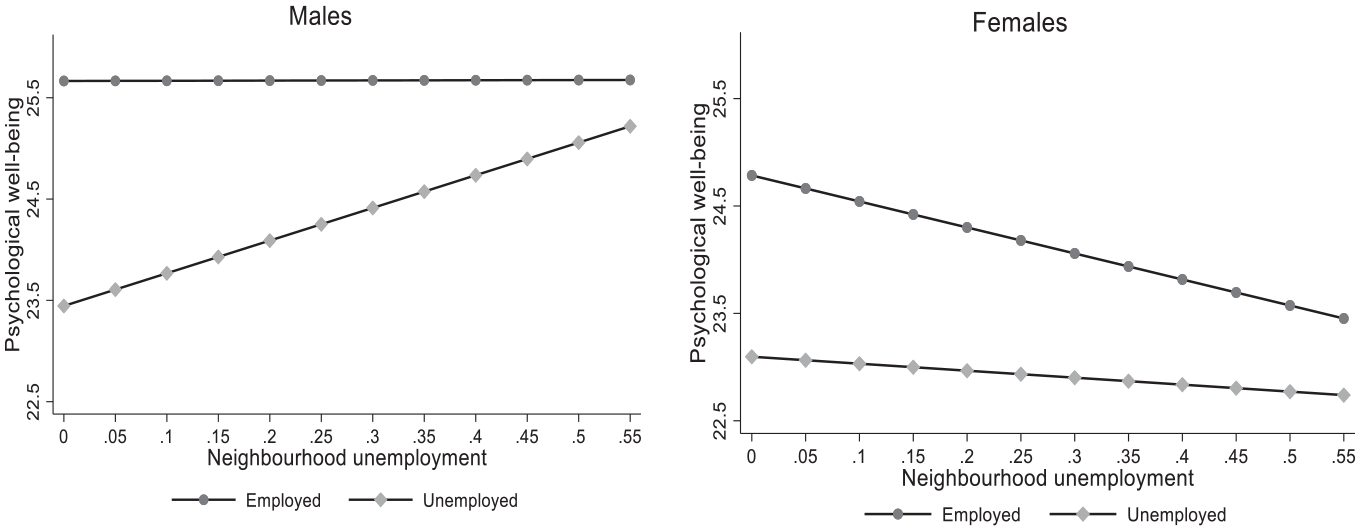
Gender differentials in the relationship between neighbourhood unemployment and psychological well-being.
While somewhat outside the scope of this study, it is perhaps worth noting that focusing on the employed, there also appears to be significant gender differences when it comes to the relationship between neighbourhood unemployment and psychological well-being. Specifically, we do not observe any significant relationship for men, but we do see a negative correlation between neighbourhood unemployment and the psychological well-being of employed females. It is unclear as to why the psychological well-being of employed females seems to be more adversely impacted by rising rates of neighbourhood unemployment than males. One possibility is that it reflects gender differences in empathy, as while findings are far from clear cut, some studies have found that women are more likely to empathise with the plight of those less fortunate, such as the unemployed (see Christov-Moore et al., 2014 for a review of this work).
Age
Figure 5 provides a visual illustration of the extent to which neighbourhood unemployment moderates the well-being of the unemployed for both those under as well as over 45. For both age groups we uncover a significant interaction term. More specifically, the interaction coefficient between unemployment and neighbourhood unemployment for those over 45 is statistically significant at the 5% level (3.35, p < 0.05), whereas the interaction coefficient for those equal to or less than 45 was smaller in size but also statistically significant, albeit at the 10% level (2.12, p < 0.10). Looking more closely at Figure 5, we can see, however, that while the unemployment of neighbours appears beneficial in terms of psychological well-being for both age groups when unemployed, it appears much more beneficial for older cohorts. To illustrate, for those over 45 living in very high unemployment neighbourhoods, there appears to be little difference in the psychological well-being of unemployed and employed individuals. Considering individuals under 45, there is a much more substantive gap between the psychological well-being of the unemployed and employed at all levels of neighbourhood unemployment. Therefore, similarly to our observed differences in relation to gender, it would appear that relatively older (over 45) unemployed cohorts are disproportionately more likely to benefit in terms of their psychological well-being from rising rates of neighbourhood unemployment. The same pattern relating to age group differences exists if we select cut-off points other than 45. 8
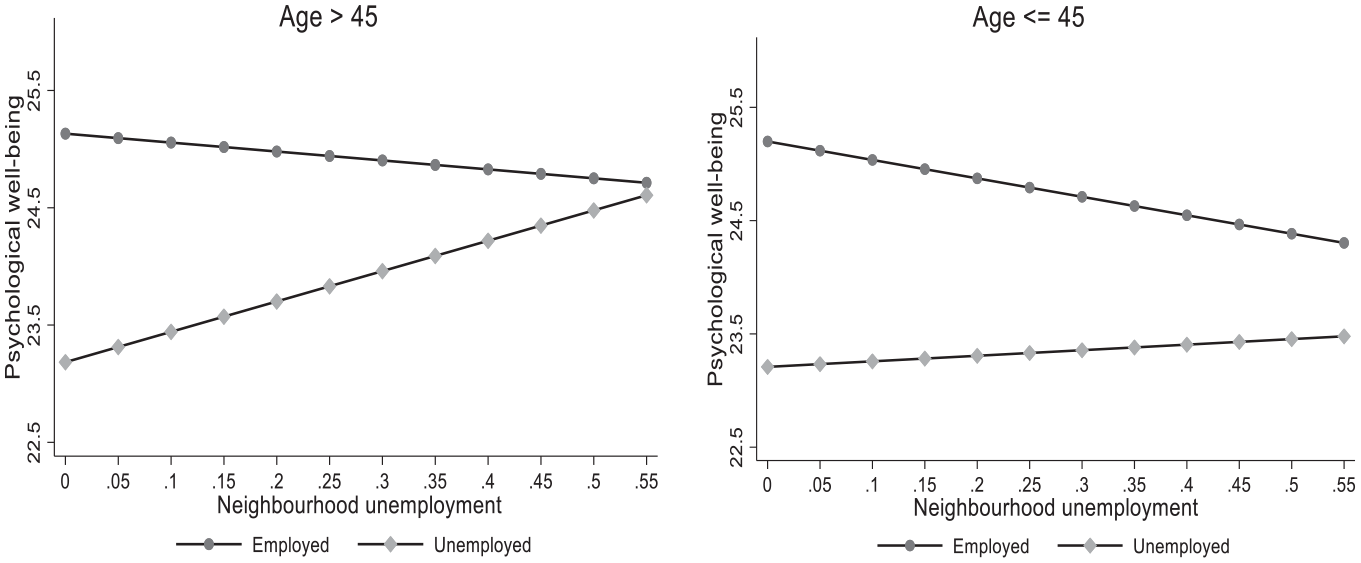
Does the relationship between neighbourhood unemployment and psychological well-being vary over the life cycle?
Our proposed explanation for these age group differences rests on both the extent to which rising neighbourhood rates of unemployment will be seen as both an indicator of better future employment prospects and the importance of the neighbourhood as a source of social interaction. We suggest that for younger cohorts, whose careers are less well-determined, low rates of neighbourhood unemployment will be relatively more likely to be seen as an indicator of better future employment prospects, in addition to being a signal of their own relative deprivation and subsequent departure from social norms surrounding work. Additionally, we suggest that social networks based on spatial proximity are likely to take on comparatively less importance for younger groups.
Discussion
This article explored whether there are spatial differences in the psychological costs of unemployment. Our hypothesis being that the gap in psychological well-being between being employed and unemployed will be less in high unemployment neighbourhoods as the social norm to work may not be as strong in those areas. This article extended previous research in this area by defining the spatial measure of unemployment at the neighbourhood level as opposed to relying on regional rates of unemployment. Using more localised neighbourhood unemployment rates will likely be a much more powerful proxy for social norms surrounding work than regional unemployment figures. An additional advantage of using these data is we are able to track to what extent the psychological costs of unemployment vary across local areas. In addition to using more spatially disaggregated data than any previous work, this research used a variety of outcome variables as well as individual fixed-effects (i.e. followed the same individuals over time) in order to help us identify the degree to which aggregate rates of unemployment can moderate the psychological costs of unemployment.
Our findings highlight how the neighbourhood context in terms of the prevailing levels of unemployment shape, to a significant degree, the psychological or non-pecuniary costs associated with unemployment. While previous research makes clear that unemployment ‘hurts’, our work highlights that these psychological costs vary across neighbourhoods depending on the overall neighbourhood unemployment rate (i.e. the unemployment of ‘others’). These findings hold true using a variety of outcome measures such as the GHQ and its various sub-components, namely anxiety, social dysfunction, self-esteem as well as self-reported general life satisfaction. A further novel and important finding of this work is that while the unemployment of neighbours is key when it comes to understanding the psychological costs of unemployment, we find this to be largely age and gender dependent. Specifically, while living in high unemployment neighbourhoods can partly alleviate the psychological burden associated with unemployment for males and relatively older unemployed individuals, the neighbourhood unemployment rate matters much less for other groups.
A plausible explanation in relation to gender is that social norms surrounding labour market participation are stronger for men than women due to gender stereotypes. As such, they may have more to gain from anything which alleviates the stigma associated with unemployment, such as the unemployment of neighbours. In relation to age, for younger unemployed cohorts, we suggest that low levels of unemployment among their neighbours may be seen as both an indicator of better future prospects, as well as a signal of relative deprivation. For older cohorts, it seems less likely that low levels of neighbourhood unemployment will serve as an indicator for better future employment prospects. It is also likely that younger individuals will be less reliant on the neighbourhood when it comes to social contact and thus local comparisons may take on comparatively less importance.
Finally, we note that there is an active debate, particularly in the economics literature, relating to the major determinants of neighbourhood differences in unemployment rates. This literature has so far largely concentrated on the role of, among other things, differences in human capital or other characteristics of the individuals, as well as the physical, economic and policy environment (Brunello et al., 2001; Clark, 1998; Elhorst, 2003; OECD, 2011). Findings presented here indicate that there are significant spatial differences across neighbourhoods in the psychological burden of unemployment, with individuals in some neighbourhoods (namely high unemployment ones) likely to experience much smaller well-being losses from unemployment than others. We cautiously suggest that these neighbourhood differences may have an important part to play in helping us to better understand geographic differences in unemployment rates and this, in turn, could be a fruitful avenue for future research. In effect, from a policy-making perspective, our findings would indicate that it may be more difficult than would be implied from a simple analysis of the labour market conditions in some neighbourhoods to transition people out of unemployment, simply because the well-being ‘cost’ associated with unemployment may be less than anticipated. Our findings suggest that this will be particularly evident for high unemployment neighbourhoods with higher concentrations of relatively older and unemployed males.
This of course may have implications for the design of labour market policies such as activation programmes, particularly if targeted at high unemployment neighbourhoods. In the same way that employed individuals will likely have less work commitment towards jobs with low perceived quality and hence comparatively less utility, it is also likely that the unemployed will have relatively less commitment to finding jobs (at least poor quality ones) when living in relatively high unemployment neighbourhoods, where the social norms surrounding work effort and hence psychological costs of unemployment may be lessened (see Dunn, 2014 for a further discussion surrounding potential links between job quality and search behaviour). Research by Clark (2003) is instructive in this regard as this work illustrated how those hurt more psychologically by unemployment find work faster. Therefore, further scrutiny of differences in the psychological costs of unemployment across neighbourhoods may help us better understand differences in labour market outcomes across neighbourhoods (e.g. labour market hysteresis). Having said that, we conclude by noting that even though it appears beneficial from a psychological well-being perspective to live in a neighbourhood with high as opposed to low unemployment rates when unemployed, unemployment is always harmful to psychological well-being, and substantively so. It is just the degree to which it is harmful that may vary from place to place, depending on the prevailing level of unemployment.
Supplemental Material
sj-pdf-1-wes-10.1177_09500170211003483 – Supplemental material for Staying Down with the Joneses: Differences in the Psychological Cost of Unemployment across Neighbourhoods
Supplemental material, sj-pdf-1-wes-10.1177_09500170211003483 for Staying Down with the Joneses: Differences in the Psychological Cost of Unemployment across Neighbourhoods by Peter Howley and Sarah Knight in Work, Employment and Society
Footnotes
Acknowledgements
The authors would like to thank Neel Ocean for helpful comments and suggestions. Any remaining errors are our own. The authors are also grateful for the detailed and constructive feedback from three anonymous reviewers and the associate editor in charge of the submission. The usual disclaimer applies.
Funding
The authors received no financial support for the research, authorship, and/or publication of this article.

Supplementary material
The supplementary material is available online with the article.
Notes
References
Supplementary Material
Please find the following supplemental material available below.
For Open Access articles published under a Creative Commons License, all supplemental material carries the same license as the article it is associated with.
For non-Open Access articles published, all supplemental material carries a non-exclusive license, and permission requests for re-use of supplemental material or any part of supplemental material shall be sent directly to the copyright owner as specified in the copyright notice associated with the article.
