




Abstract
This article studies women’s vulnerability to the economic crisis of 2008 through the lens of part-time work in Spain. It posits that part-time work made the female employment position more fragile by acting as a transmission mechanism of traditional gender norms that establish women as secondary workers. This argument is tested through an analysis of Labour Force Survey data from 2007 to 2014 that examines the influence of the employment situation of the household on women’s part-time employment patterns. The results expose the limited take-up of part-time work but also persistent patterns of involuntariness and underemployment corresponding to negative household employment situations, highlighting the constraining role of gender norms borne by the relative position of part-time work in the configuration of employment structures. The article concludes that, during the crisis, part-time work participated in the re-establishment of women as a family dependent and flexible labour supply, increasing their vulnerability.
Introduction
Studies on the gendered effects of the 2008 economic crisis in the employment domain have indicated the downward levelling of gender gaps in standard labour market indicators – particularly unemployment and job losses – underlining how women’s distinctive position in the job structure shaped gender differences in vulnerability to the economic downturn (Karamessini and Rubery, 2014; Périvier, 2014; Rubery, 2014; Rubery and Raffety, 2013; Smith and Villa, 2014). Beyond the relative employment fallout, the analysis of other indicators, particularly those related to non-standard employment, draws a more contrasting picture whereby women’s sheltered position in the labour force coexists with a deterioration of their employment situation and an increase in their vulnerability (Bettio and Verashchagina, 2014). The trends in part-time work observed in some countries are an example of this controversial dynamic. The constant growth of such work has changed neither its strong feminisation nor women’s great exposure to some of its most disadvantaging aspects, such as involuntariness and underemployment.
To account for these opposing tendencies, a branch of feminist and institutional research has stressed the importance of considering how the gendered effects of a recession are likely to reflect not only labour market structural dynamics, but also dominant gender norms regarding women’s presumed distinctive role as secondary labour force participants (Galvez-Muñoz, 2013; Rubery, 2014). Although current analyses have widely accounted for the employment opportunity patterns generated by the structural developments related to the crisis (Périvier, 2014; Rubery and Raffety, 2013; Sánchez-Mira and O’Reilly, 2019), their explanatory frameworks have less widely discussed the role of gender norms. This article argues that the consideration of gender norms can provide a more complete account of the complexity through which the crisis has indeed affected women’s employment situation through processes of contentious labour market inclusion, particularly if explored with respect to the mechanisms through which such norms operate (Rubery, 2014, 2015). Accordingly, it studies women’s part-time work in Spain in the context of the 2008 crisis and examines the extent to which such work increased the vulnerability of Spanish women – in terms of increasing the fragility of their employment situation – by exploring its role as a mechanism through which gender norms have operated throughout the crisis.
‘Gender norms’ refer to the set of dominant norms regarding the expected models of gender relations and women’s socioeconomic integration (Pfau-Effinger, 1993). Part-time work holds a distinctive position in the configuration of employment structures with respect to a specific set of gender norms that can be defined as traditional. These norms uphold a model of female integration in the economy based on the secondary nature attributed to female labour and its specialisation in unpaid domestic work (Addabbo et al., 2015; Galvez-Muñoz, 2013). Likewise, part-time work is primarily proposed to the female labour force on the assumptions that, first, women work for lower wages than their male equivalent (Rubery, 2014; Rubery and Raffety, 2013), and second, that it allows them to engage in a form of economic activity that is complementary to their domestic and family carer role (Fagan and Rubery, 1996; Pfau-Effinger, 1993). It thereby acts as a transmission mechanism of such norms to the extent to which it drives the patterns of female economic integration into a subsidiary labour force position.
This paradigmatic role of part-time work with respect to traditional gender norms is examined through the effect of the employment situation of the household on women’s part-time work patterns. Responses to employment opportunities can be seen as an expression of the manner in which households deal with societal norms regarding the gender division of labour (Rubery, 2014; West and Zimmerman, 2009). Research on the deployment of women’s participation in paid work in relation to household employment during the crisis has concluded that one of the main effects of the economic downturn has been to increase the importance of women’s economic role in the household (Bettio and Verashchagina, 2014; Sánchez-Mira and O’Reilly, 2019). Accordingly, in a context wherein the employment situation of her household may have intensified a woman’s necessity to work, and hence increased the potential to challenge traditional gender norms, the question remains whether women have voluntarily engaged in part-time work or whether they have instead intended to resist taking on such a subsidiary employment role, but ultimately adapted to it. Through this question, the article aims to explore if and how part-time work increased women’s vulnerability, by disentangling its action as a transmission mechanism of traditional gender norms.
Spain is an interesting case study for several reasons. First, it is one of the countries that has been most severely hit by the crisis, and a place where the socioeconomic condition of women has traditionally been quite vulnerable (Salido and Moreno, 2012; Torns et al., 2013). Second, although the percentage of female part-time workers has remained comparatively low despite its constant growth since 2008 (25.3% in 2014), a greater concern within the group of female part-timers is the increased share of involuntariness (from 36.5% in 2008 to 64.4% in 2014) and underemployment (from 7.3% in 2008 to 13.8% in 2014). Third, although socio-institutional arrangements still endorse familialism and the maintenance of the sexual division of labour (Lombardo, 2017), the altered conditions of the labour market due to the crisis have widely affected household employment situations and women’s patterns of socioeconomic integration (Salido, 2016; Salido and Moreno, 2012; Sánchez-Mira, 2019).
Using pooled micro-level data from the Spanish Labour Force Survey from 2007 to 2014, the article investigates the effect of the employment situation of the household on women’s involvement in part-time work relative to full-time work, in involuntary part-time work and in part-time underemployment. The results show that in the presence of negative household employment situations there is limited take-up, but persistent patterns of involuntariness and underemployment indicate the increased vulnerability for women and reveal the constraining role of gender norms borne by part-time work’s distinctive position in the configuration of employment structures. These findings corroborate the argument that specific spatial and temporal contexts significantly shape female vulnerability to the economic downturn not simply as a consequence of women’s responses to job opportunities in the framework of structural labour market developments, but also as a result of the constraints imposed on these developments by dominant gender norms. The article thereby informs the debate on women’s employment and vulnerability during the crisis through an analysis of part-time work that highlights the risk of re-establishing women as a family dependent and flexible labour supply (Rubery and Raffety, 2013).
Part-time work and the crisis in the Spanish context
The literature on part-time work in times of economic crisis has widely focused on levels of part-time work and the quality of part-time jobs (Buddelmeyer et al., 2008; Eurofound, 2007; Fagan et al., 2013; OECD, 2010; Warren and Lyonette, 2018). Studies have shown that female part-time employment has continued to expand even during periods of economic downturn, inevitably increasing levels of involuntary part-time work among women, mainly on a pro-cyclical basis, as the result of employers’ strategies for addressing unstable labour market demand and taking advantage of a flexible and cheaper labour force. However, feminist and institutionalist research has argued that, beyond this macro trend, concrete female part-time work patterns depend upon the specific role of part-time work within different societal systems (Fagan and Rubery, 1996; O’Reilly and Fagan, 1998; Rubery, 2014). According to these perspectives, the manner in which this role is driven by labour market structural dynamics must be understood in the context of the specific set of dominant gender norms that shapes the patterns of women’s economic integration in a given society (Pfau-Effinger, 1993, 1998). Moreover, the salience of this role with respect to such norms varies not only within different societal systems, but also within different moments in time. In particular, in times of economic downturn, gender norms contribute to shaping the context in which recessions occur, as well as the specific paths of adjustment and recovery, through the transmission mechanisms through which they operate (Rubery, 2014, 2015). The analysis developed in this article regarding the role of part-time work as a transmission mechanism of gender norms in the Spanish context builds on these standpoints.
In Spain, the part-time work divide applies to workers whose working hours do not exceed two-thirds of those worked in an equivalent full-time job. However, the distinctive character of part-time work is not simply that it is a fraction of full-time work, but rather it derives from what is socially defined as gainful employment, generally corresponding to the standard full-time and permanent work relationship normally associated with the profile of the male breadwinner (Pfau-Effinger, 1993, 2004), which continues to be a strong reference point in Spain (Lombardo, 2017; Torns et al., 2013). This contributes to the types of job opportunities open to women in part-time work, and to the interpretation of their position within the labour force as family carers first and labour force participants second (Pfau-Effinger, 2004; Rubery, 2014). Over the last three decades, part-time work has become available primarily to female employees, mainly through marginal occupations concentrated in the service sector (Ortiz-Garcia, 2014). During the crisis, changes in the regulation contributed to its further spread, as they made it more attractive to firms and more responsive to employers’ strategies to weather the economic downturn through lower workforce costs, favouring a degradation of their employment standards (Muñoz de Bustillo Llorente and Pinto Hernández, 2016; Ortiz-Garcia, 2014; Salido and Moreno, 2012). Research from other European countries has shown that the necessity to combine paid work with family responsibilities usually brings women to accept part-time work despite the negative conditions that may be associated with it, and that its availability is frequently a condition of their labour force participation (Jaumotte, 2003; OECD, 2010; O’Reilly and Fagan, 1998). Nevertheless, although women’s employment rates have increased continuously from the 1980s and labour market exit after childbirth has become less common (Lombardo, 2017; Salido and Moreno, 2012), disrupting the typical ‘opt in–opt out’ model of female participation (Fagan and Rubery, 1996), in Spain the take-up of part-time work which combines family and work is not widespread, nor has it strongly contributed to increased and continuous female labour force participation (Ortiz-Garcia, 2014). Instead, female part-time work shows high levels of involuntariness and underemployment, which have risen dramatically since 2008, confirming that part-time work in Spain does not represent an alternative model of maternal employment.
This raises the question of the role of part-time work during the crisis: whether it contributed to increasing women’s vulnerability by making their employment position more fragile and on what basis. The article investigates this question by analysing the effect of the employment situation of the household on women’s part-time work patterns. The following section lays the foundations of this analytical approach.
Analysing women’s part-time work in light of gender norms: The pivotal role of the household employment situation
Responses to employment opportunities can be seen as an expression of the manner in which households deal with societal norms regarding the gender division of labour (West and Zimmerman, 2009). In economically weak countries, like those of Southern Europe, the economic pressure for women to furnish an additional household income may shape gender attitudes (Lück, 2006). In particular, by affecting women’s decision to work part-time (Bielenski et al., 2002), the economic situation of the household can also alter labour roles among household members and push them to challenge dominant gender norms (Rubery, 2014). A part-time wage is generally insufficient to provide an acceptable living standard (Smith et al., 1998), which makes part-time work an unviable option when other household members are unable to provide adequate socioeconomic resources (Warren, 2008). In the context of the limited employment opportunities generated by the crisis, part-time work can turn into either a necessary or an undesired option if such resources are unavailable within the household. Accordingly, it can represent respectively either an economic buffer, contributing to endorsing the subsidiary labour force role in accordance with traditional gender norms, or a constrained option for women, leading to challenging such a role and such norms.
Research on the employment repercussions of the crisis has concluded that not only were female jobs comparatively sheltered, but also women’s labour market attachment was strengthened and the importance of their economic role within the household increased. From a labour supply perspective, such reinforced labour force commitment has been interpreted as the so-called ‘added worker effect’, whereby women enter the labour market or reinforce their economic activity to compensate for the loss of family income, particularly if their partner is unemployed (Rubery, 2015). This effect has been found mainly in low female employment countries, including Spain (Addabbo et al., 2015; López-Andreu and Rubery, 2018), although some have suggested that its actual order of magnitude may be modest (Bettio and Verashchagina, 2014) and its long-term ramifications mixed (Rubery, 2014). In fact, analyses show that, in most cases, the additional female breadwinner represents a working woman who managed to retain her job while her partner lost his, questioning whether the crisis pushed the transition from a male breadwinner to a co-primary income role for women (Bettio and Verashchagina, 2014; Sánchez-Mira and O’Reilly, 2019). These patterns suggest that in the context of household employment difficulties, the women’s buffer role has been dismissed, and traditional gender norms have lost their salience.
In this regard, this article studies the effect of the employment situation of the household as a way to account for the role of part-time work as a transmission mechanism of traditional gender norms and the way such work has contributed to women’s vulnerability. It posits that, in the presence of negative household employment outcomes, women’s responses to part-time work were most likely to challenge such norms. Accordingly, the patterns observed reflect traditional gender norms conveyed rather by part-time work’s distinctive position in the configuration of labour market structures, and indicate an increased vulnerability for women as they were constrained in a subsidiary labour force role. To test this argument, the empirical analysis examines the relationship between household employment situation and female part-time work during the recession by testing three aspects: (i) women’s chances to engage with part-time work relative to full-time work to evaluate the likelihood of women taking up part-time work as a buffer to the economic shock. If, in the presence of a negative household employment situation, women’s take-up of part-time work increases, it can be considered that they take-up part-time work as a buffer, reflecting traditional gender norms that consider the female labour force role as secondary and family dependent (Hypothesis 1a). However, women’s need to work may also challenge dominant gender norms and trigger different reactions to part-time work, which may result in limited take-up (Hypothesis 1b), and also in part-time work becoming a constrained or inadequate option for them. Accordingly, the article also examines: (ii) women’s participation in part-time work on an involuntary basis, to establish whether women intended to resist taking on a subsidiary labour position through part-time work; and (iii) women’s underemployment when working part-time, to evaluate if part-time work resulted in a poor alternative for them, but they eventually adapted to it – as forms of desired work commitment may be adapted through a worker’s employment experiences. It can be expected that in the presence of negative household employment outcomes, women prefer full-time employment opportunities which do not comply with their supposed subsidiary labour force position, hence challenging dominant gender norms. In this case, involuntary part-time work is more likely to be observed (Hypothesis 2a), whereas the contrary is expected when there is a positive household employment situation (Hypothesis 2b). Under negative household employment circumstances, underemployment is also expected to be more likely (Hypothesis 3a), unless women adapted to part-time work, especially if during the crisis and its aftermath employment opportunities became available to other household members (Hypothesis 3b).
Data and methods
The analysis draws on data from the cross-sectional Spanish Labour Force Survey. Different time points are studied to account for dynamics at different phases of the crisis and to identify consistent trends over time. The first time point is 2007, which represents the prosperity period and constitutes the pre-crisis baseline. The second is 2008, which reflects the beginning of the crisis. The third is 2011, when the country entered a second deep recession that more strongly affected female employment under the implementation of austerity policies. The fourth is 2014, when the recession first appeared to recede, favouring a slow process of job creation that mainly benefited male employment. The sample includes women between 25 and 54 years old. This age threshold is applied to focus on prime-aged women and to account for mid-life experiences, when paid work and family obligations are likely to take centre stage. Only employees are considered, given that part-time work may be of a very different nature in the context of self-employment. The reference is to the main job held by the respondents. For each year, quarters were pulled together to maximise the number of observations. The resulting sample is: 79,940 employed women in 2007; 80,872 in 2008; 80,526 in 2011; and 75,349 in 2014. Among these, 19,669 were part-time workers in 2007; 19,582 in 2008; 20,184 in 2011; and 21,770 in 2014.
The multivariate analysis aims to capture the effect of household employment on: women’s involvement in part-time work relative to full-time work; women’s probability of being in involuntary part-time work; and women’s probability of being underemployed when working part-time. These are the dependent variables. Part-time work is defined in line with Spanish statistical standards by a combination of individuals’ self-reporting of their status and their usual weekly working hours, with the cut-off point for part-time work being 30 hours. This definition is used to distinguish between full-time and part-time work through a binary variable. Involuntariness and underemployment are defined according to International Labour Organization (ILO) standards. Involuntary part-time work means working part-time because full-time work was not available or could not be found. A binary variable accounts for whether the individual is in this situation or not. Underemployment concerns those working part-time who wish to work additional hours and are available to do so. Another binary variable measures whether the individual is in such a condition or not.
Household employment is usually studied in terms of couple-level dynamics and hence approached through the employment status of partners (Sánchez-Mira, 2019). This article takes a different approach, which considers that the level and adequacy of the buffer provided by available wage-related resources in a household is related to the number of adult household members involved in paid work (Warren, 2008). This is because, in the context of this analysis, it better accounts for the strong redistributive role of the extended family in the socioeconomic Spanish regime, underpinned by familialistic institutional and cultural assumptions (Leon and Pavolini, 2014; Salido and Moreno, 2012). Hence, the employment situation of the household employment is approached here through three continuous variables, accounting, respectively, for the number of full-time working household members, the number of unemployed household members and the number of inactive household members. ‘Inactive members’ refers to adult members and excludes dependent children. 1 These are the focal explanatory variables.
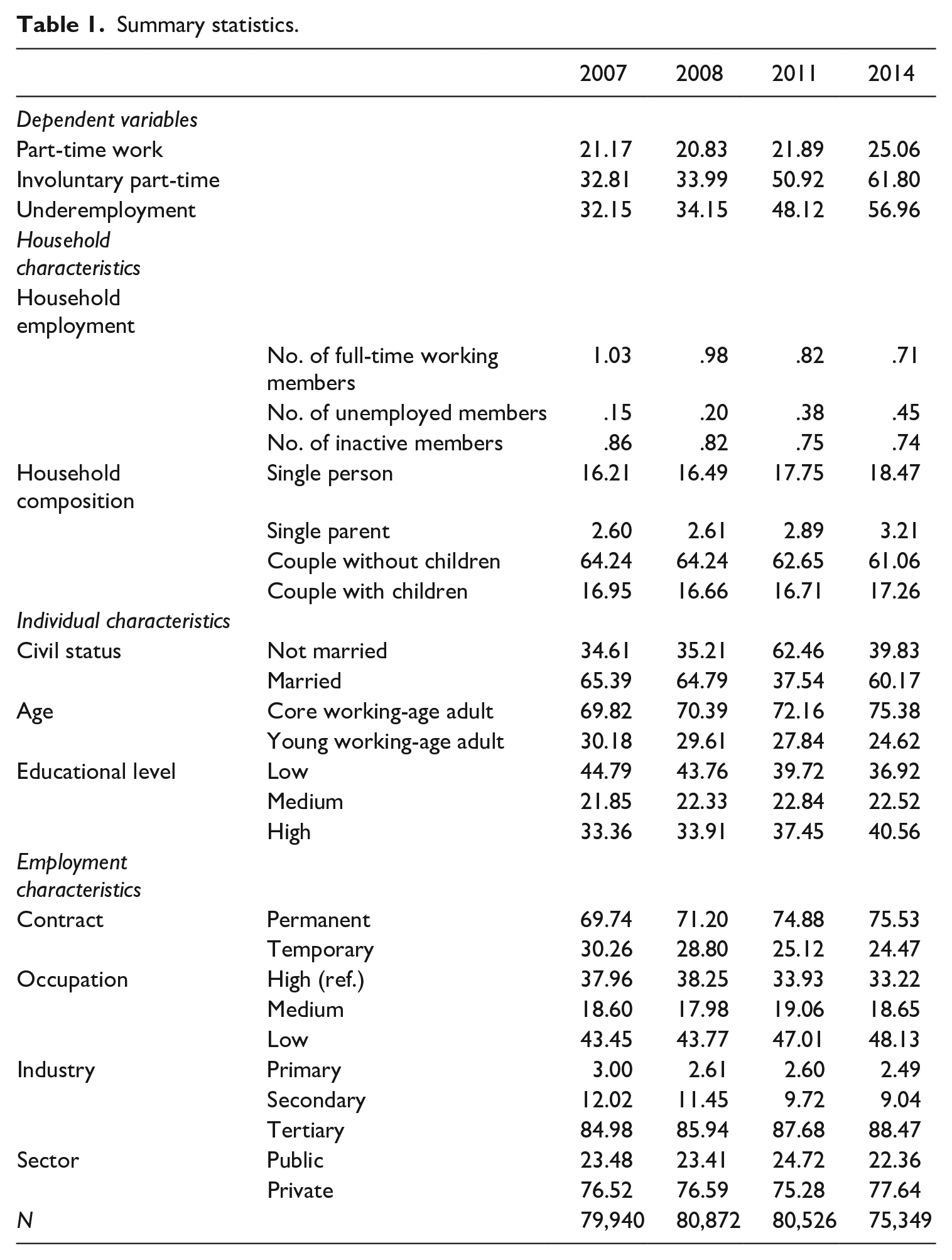
The analysis includes a number of control variables. Among them, household composition (single person, single parent, couple with children, couple without children) and sociodemographic characteristics such as marital status (married or not), age group (young adults 25–34 years old, core adults 35–54 years old) and educational level (low, medium, high). 2 Other control variables capture labour market position in relation to contract type (temporary or permanent), occupation (high, medium, low), 3 industry (primary, secondary or tertiary) and sector (public or private). Summary statistics (means or proportions) for all the variables are reported in Table 1.
Summary statistics.
Using probit regression techniques, the analyses on the three dependent variables are carried out separately for the different time points. All models account for women’s selectivity into part-time work, full-time employment or non-employment by including an extra regressor (called selection parameter). This was obtained by previously estimating a selection model 4 – using a bivariate probit model – where two equations jointly assessed first the probability of being in employment (relative to non-employment), then the probability of being in part-time employment (relative to non-employment/full-time employment). The number of dependent children living in the household was used as an instrument variable (i.e. a variable that predicts selection but does not affect the outcome). The statistical significance of the selection parameter indicates whether selectivity into part-time employment due to unobserved factors affects the dependent variables under study. For all models, cluster-robust standard errors are computed to account for the clustering of individuals in households. Average marginal effects (AME) are reported to facilitate the interpretation of results.
Results and discussion
Did women engage in part-time work as a buffer during the crisis? Table 2 shows the AME for the probability of part-time employment for women at different time points. 5 The marginal effect of the number of unemployed persons in the household was negative and significant in 2007, whereas it became positive and still significant in 2014. The marginal effect of having inactive members in the household was, in contrast, significantly negative for all examined years. The negative effects are consistent with other studies showing that when other wage-related resources are unavailable within the household, a part-time job is not primarily sought as a remedy to household income necessities (Bielenski et al., 2002; Smith et al., 1998; Warren, 2008), and they confirm that this was also the case during the economic downturn. The change of direction from negative to positive between 2007 and 2014 can be interpreted as indicative of the backlash of the crisis. As studies on women’s labour market transitions have shown that transitions from unemployment/inactivity into part-time work were not particularly high – and in any case were less frequent than transitions into full-time work – and declined during the crisis (López-Andreu and Rubery, 2018), it can be supposed that these women did not necessarily take-up part-time work as a buffer to economic shock. Instead, the employment difficulties experienced by their households might have turned their part-time work into a buffer. These findings indicate that women’s voluntary engagement with the subsidiary labour force position of part-time work was limited, as shown by the limited take-up of part-time work as a buffer. In that, they suggest that women’s employment responses in correspondence of household necessities were not in accordance with the traditional gender norms endorsed by part-time work, but rather in contrast with them, thus confirming Hypothesis 1b over Hypothesis 1a.
Probit model results for part-time work.
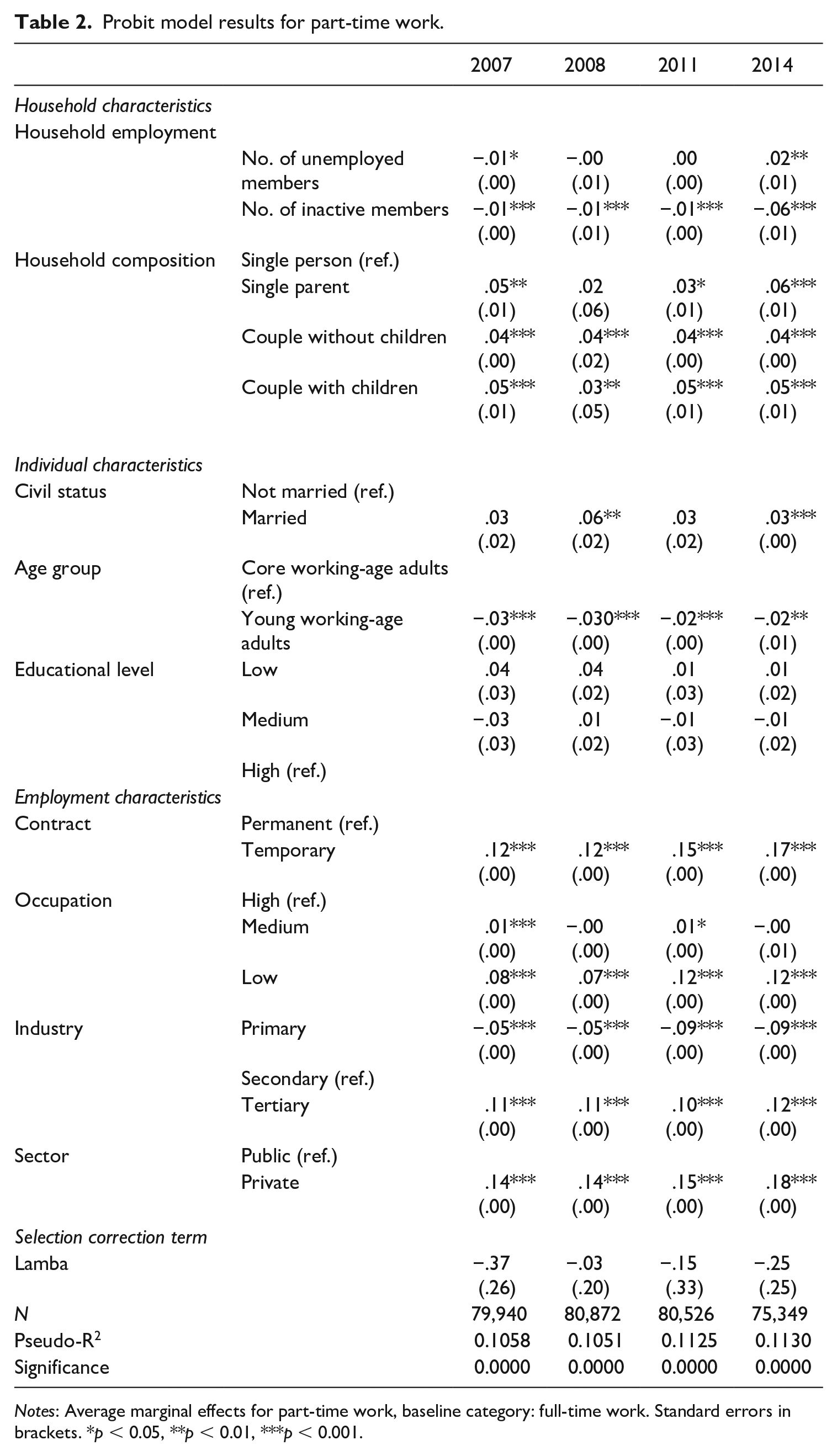
Notes: Average marginal effects for part-time work, baseline category: full-time work. Standard errors in brackets. *p < 0.05, **p < 0.01, ***p < 0.001.
If women’s engagement in the subsidiary labour force role set for them by part-time work was limited, did they instead intend to resist taking on such a role? The AME for the probability of women being in involuntary part-time employment at different time points answer this question and are shown in Table 3. The presence of unemployed members in the household increased the probability of being in involuntary part-time work at all examined years, and was stronger in 2011, when the crisis hit women harder. The same results could be observed for women having inactive members in the household, although marginal effects were smaller in this case and not significant in 2007. Clearly, although necessity pushed women to look for full-time work commitments, they were constrained to remain in part-time jobs. Again, research on labour market flows has shown that transitions out of part-time work into full-time work, which were not especially low before the crisis, started to decline with the recession (López-Andreu and Rubery, 2018). The economic downturn hence made full-time jobs scarcer but also less available to women in part-time work. In doing so, it made the gender norms embodied by part-time work even more salient. When women’s necessity to work exceeded the opportunities offered by part-time work, they were constrained by the boundaries of their role as secondary workers. However, once employment opportunities began to expand again, benefiting other household members, women were less likely to be involuntary part-time workers, as shown by the fact that the effect of the presence in the household of full-time working members was significantly negative in 2014. These results add to previous research on the macro-level drives behind the procyclical feature of involuntary part-time work (Buddelmeyer et al., 2008; OECD, 2010) in that they contextualise the relationship between job availability and employment behaviours within the action exerted by gender norms in reinforcing the secondary nature of females’ work through part-time work. Overall, they confirm Hypothesis 2a and, partially, Hypothesis 2b, highlighting some worrisome dynamics regarding women’s path of adjustment to the crisis. In the presence of negative household employment outcomes, women did not comply with their supposed subsidiary labour force position, but they seemed to do so as soon as employment opportunities became available to other household members, namely towards the last phase of the crisis. This raises the question of whether, in the long term, they might adapt to part-time work and traditional gender norms.
Probit model results for involuntary part-time work.
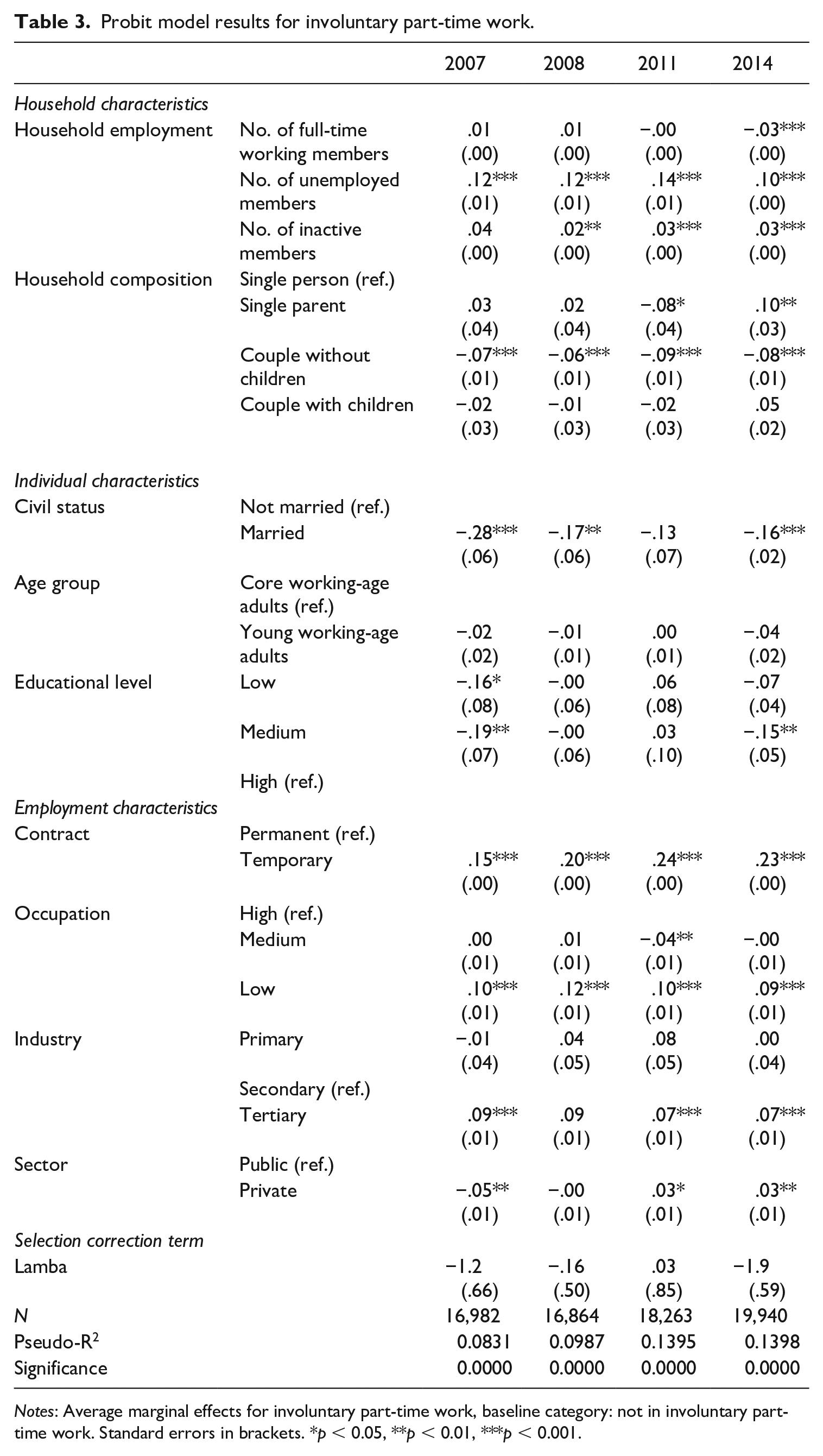
Notes: Average marginal effects for involuntary part-time work, baseline category: not in involuntary part-time work. Standard errors in brackets. *p < 0.05, **p < 0.01, ***p < 0.001.
The AME of the probability for women being in part-time underemployment at different time points are shown in Table 4, and provide hints in this sense. Having unemployed persons in the household made underemployment more likely among women working part-time before, during and after the crisis (AME are significant at all time points). The presence of inactive household members increased this likelihood only in 2007, so it is not a significant element during the crisis. In an environment of falling economic activity and/or rising unemployment, women may become willing to adapt to part-time work if their preferred full-time employment option is not available (Buddelmeyer et al., 2008). These results indicate that, in the presence of negative household employment outcomes, this is not the case, confirming Hypothesis 3a. As the need generated by their household employment situation pushed women to challenge gender norms that cast them as secondary workers, they did not conform to the part-time work experiences that were enforced on them and remained open to opportunities to increase their work commitment. However, the employment opportunities of other household members mattered in reducing part-time underemployment, also confirming Hypothesis 3b. The presence of full-time working persons in the household showed negative and significant effects in 2011 and 2014; more specifically, at the most critical point of the crisis for women, the presence of full-time working persons in the household acted as a counterbalance, and as soon as the crisis started to recede and employment opportunities were available to other household members, women were more likely to adapt to part-time work. These results suggest that entrenchment of part-time work and the subsidiary nature of female labour that it embodies is more likely to occur among Spanish women when a diversification of employment opportunities is not made available to them in the recovery period. On the one hand, these findings are consistent with previous studies showing that underemployment in part-time work is related to the level of prosperity of a country at the macro-level (Wielers et al., 2014) and with the negative employment and financial situation of the household at the micro-level (Bielenski et al., 2002; Fagan et al., 2001; Wielers et al., 2014). On the other hand, the findings complement these studies by showing under what conditions part-time work remains for women a form of inadequate work commitment or, rather, is adapted to it in an adverse context of limited employment opportunities that reinforces traditional gender norms.
Probit model results for underemployment among part-time workers.
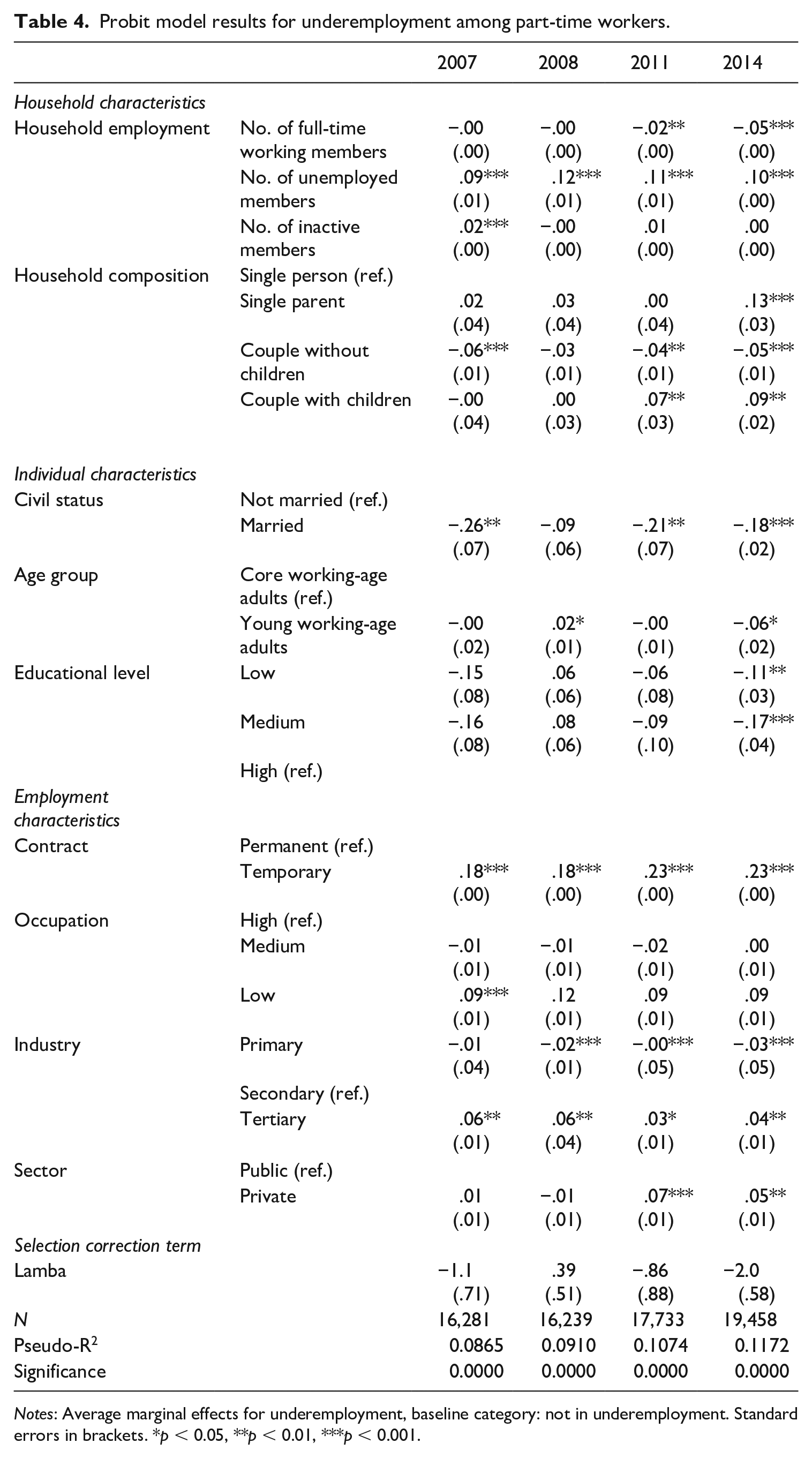
Notes: Average marginal effects for underemployment, baseline category: not in underemployment. Standard errors in brackets. *p < 0.05, **p < 0.01, ***p < 0.001.
Overall, the findings indicate that part-time work played a small role as an economic buffer for women’s need to work, showing that in the face of negative household employment outcomes they did not engage in the role of subsidiary workers. However, women were forced to remain in part-time work when their need to work, stemming from the difficult employment situation of their households, pushed them to challenge traditional gender norms. In the absence of other employment opportunities, they nevertheless maintained the willingness to increase their work commitment, resisting gender norms that cast them as secondary labour force participants while the economic necessity in their household persisted – but seeming to adapt to them when the household employment situation improved. Thus, part-time work increased women’s vulnerability, in that it acted as a transmission mechanism of traditional gender norms throughout the crisis to the extent that it maintained women in a subsidiary employment position, re-establishing them as family dependent workers. This role of part-time work was less reflected in women’s responses to part-time work, suggesting that it was instead driven by the distinctive gendered position of part-time work in the configuration of employment structures.
It is interesting to note the effects found on selected control variables such as type of contract and occupation. Both having a temporary contract and being in a low occupational category were two strong predictors of being in part-time work, being in involuntary part-time work and being in underemployment when working part-time. Their marginal effects were positive and statistically significant at all time points considered. These findings are consistent with research showing how the crisis has reinforced labour market segmentation and degradation of labour standards (Muñoz de Bustillo Llorente and Pinto Hernández, 2016), triggering a significant deterioration of women’s employment prospects, particularly of those in disadvantaged social strata (López-Andreu and Rubery, 2018; Sánchez-Mira, 2019). Thus, women in part-time, low-level occupations risk being exposed to increased vulnerability through dynamics of occupational polarisation, which have been found to be relevant in other countries with a stronger part-time tradition and where part-time workers are mostly relegated to secondary labour markets, such as the UK (Warren, 2015; Warren and Lyonette, 2018). These findings suggest that, as long as women are considered privileged candidates for part-time jobs because of traditional gender norms that view their role as carers first and labour force participants second (Rubery, 2014), they are maintained in a subsidiary employment position that re-establishes them not only as family dependent but also as flexible workers (Rubery and Raffety, 2013).
At all time points considered and in all models estimated, the selection term was not significant, indicating that the models do not suffer from selection biased estimates.
Conclusion
This article seeks to contribute to the knowledge on women’s employment and vulnerability in times of economic uncertainty through a study on women’s part-time work in Spain during the 2008 crisis. It highlights the value of expanding current explanatory frameworks by discussing the role of dominant gender norms, to give a more complete account of the complex dynamics through which the crisis has made women’s employment situation more fragile. By examining part-time work as an employment form that embodies traditional gender norms regarding women’s presumed secondary role as labour force participants, it shows that observed female part-time work patterns reflect the constraining role of part-time work as a transmission mechanism of traditional gender norms throughout the crisis. In particular, such norms are challenged by women’s need to work and their subsequent responses to part-time work opportunities, but are enforced by the distinctive position of part-time work in the configuration of labour structures, which maintains women in a subsidiary employment position, thus increasing their vulnerability.
On this basis, the article’s contribution is threefold. First, by studying part-time work rather than the standard labour market indicators such as unemployment or job losses, it accounts for the fact that behind general women’s sheltered and reinforced labour force commitment, there are multiple facets to women’s vulnerability (Bettio and Verashchagina, 2014), which are likely to further crystallise gender inequalities along the paths of adjustment to the recession. Second, by examining part-time work in light of its paradigmatic role with respect to gender norms, the article provides support to the argument that employment opportunity patterns generated by structural labour market developments imposed by the crisis must be examined in terms of their relationship to gender norms (Galvez-Muñoz, 2013; Rubery, 2014). In particular, the way these norms are transmitted through distinctive gendered labour market structures that support processes of contentious labour market inclusion and favour maintaining women as subsidiary workers, increasing their vulnerability. Third, with its focus on a country particularly affected by the crisis, where women’s employment position has been traditionally weak and familialistic arrangements particularly strong, the article corroborates the argument that beyond macro labour market developments, there are specific spatial and temporal contexts shaped by gender norms likely to trigger particular patterns of female vulnerability to the recession (Rubery, 2014). Where female models of socioeconomic integration are not well established and still based on dominant gender norms that endorse the male breadwinner as a reference for the definition of women’s employment status, part-time work is more likely to convey the subsidiary nature of female labour, exposing women to increased vulnerability through their maintenance as family dependent and flexible workers (Rubery and Raffety, 2013).
Although the article has examined general trends, future research might include a specific exploration of some intersectional factors that can trigger socioeconomic disadvantage and have important ramifications for the dynamics observed here. First, labour force segments and occupational classes, with a focus on low educated women, as the importance of processes of labour market segmentation and occupational polarisation and their effects on women’s vulnerability has been highlighted by other research work (Sánchez-Mira, 2019; Távora and Rodríguez-Modroño, 2018). Second, ethnic divides, as the differentiated allocation of migrants to labour market structures has been shown by analyses on the employment trajectories of migrant women (Muñoz-Comet and Steinmetz, 2020). Third, regional differences, as the uneven impact of the crisis on local labour markets has been observed (Addabbo et al., 2015). These aspects are likely to relate in specific ways to part-time work as a transmission mechanism of gender norms, and to show a potentially differentiated salience of such norms across different categories, revealing which ones are more exposed to increased vulnerability.
Footnotes
Acknowledgements
The author is grateful for the valuable comments received on earlier drafts of this article from Sébastien Chauvin, Stephanie Steinmetz and the anonymous reviewers.
Funding
The author disclosed receipt of the following financial support for the research, authorship, and/or publication of this article: This research was made possible by a postdoctoral fellowship from the École des Hautes Études Hispaniques et Ibériques, Casa de Velázquez (Madrid, Spain). Open Access publication was funded by the University of Lausanne.
