




Abstract
According to a 2019 UK government report, Roma had the ‘worst employment outcomes’ of any ethnic group in the UK with similar evidence in Europe. Roma are in the growing flexible, mobile workforce that constitute precarious, insecure workers. Based on a qualitative in-depth study of these precarious workers, and utilising Bourdieu’s concepts, we show the impact of flexploitation, while sharing Roma’s habitus and capitals that distinguish and challenge the dominant homogenous narrative about the response to precarity. We argue that Roma, owing to their long-standing, symbiotic relationship with precarity, compounded by centuries-old persecution, offer insights into the lived experience of precarious workers. While not diminishing the impact of flexploitation, we culminate with our claim that Roma possess a precarious habitus and, as such, are a ‘fish in water’ with a distinguishing feature of ‘social capital on the move’.
Introduction
Precarious work is a topic en vogue with burgeoning academic interest (Standing, 2016a), although for some this is a long-standing debate (Bourdieu, 1998) and a reality for many marginalised groups. We found alignment in our research with the work of Bourdieu, who first coined the term ‘precarite’ (Schierup and Jørgensen, 2016) as ‘a generalised state of insecurity’ (Nasstrom and Kalm, 2015: 557) that can have tangible and psychological impact on the individual. In Europe, precarity is a relatively novel phenomenon fuelled by a neoliberal agenda, in pursuit of a flexible labour force (Alberti et al., 2018; Hassard and Morris, 2018); however, from a ‘historical, majority world’ view, precarity is not new and perceived as the norm (Munck, 2013: 748). Workers’ experience of insecurity and unstable-wage labour can result in what Bourdieu terms flexploitation (Suliman and Weber, 2019) – the relationship between ‘one (employee) sided’ flexibility and exploitation of workers – robbing people not only of a future, but of a belief in a possible future that might impel them to change.
While recognising the controversy of ‘precariat class’ (Smith and Pun, 2018) and its limitations for critical analysis (Suliman and Weber, 2019), we acknowledge Standing’s (2014: 1) significant contribution and his view of the precariatisation process as ‘an habituation to expecting a life of unstable living’. We will explore how such habituation might be a more embedded expectation of Roma and, while conceding the multi-dimensional nature of the term precarious work (Nasstrom and Kalm, 2015), use the definition of Kalleberg (2009: 2) ‘employment that is uncertain, unpredictable, and risky from the point of view of the worker’. Precarity, like precarious work, is underpinned by insecurity, and defined as the specific ways that social, economic and political institutions distribute the conditions of life unequally. So, precarity is a broader concept in that it captures the relationship between precarious work and precarious life (Neilson and Rossiter, 2008), including political possibilities. We build further on their relationship later.
This research includes Roma migrants living in the UK from Central and Eastern European countries (CEE) where they face chronic uncertainty in securing regular employment. It is rare for this understudied, originally Hindavi people from northern India, to get involved in research. This is possibly owing to their treatment – for example, through the ‘legitimation of land dispossession’ and categorisation (Skeggs, 2019: 29) plus discrimination resulting, according to the UK House of Commons, Women and Equalities Committee (2019: 3) government report, in Roma having the ‘worst outcomes of any ethnic group across a huge range of areas including … employment’, a finding mirrored in Europe (European Commission, 2018). Indeed, precarity for Roma, Europe’s largest ethnic minority group, goes beyond the labour market to include insecure housing and, although well documented, albeit ignored, a persecuted past whereby hundreds of thousands of Roma were killed during the Holocaust (Hancock, 2014). Like other CEE migrants, Roma migrate for economic reasons; however, escaping persecution and lacking a homeland distinguishes them.
The motivation for this study is to address three gaps in the literature. First, there are few empirically examined studies of the impact of precarity for this marginalised ‘hard to reach’ migrant group subject to all forms of precarisation (explicit, implicit, productive and citizenship) suggested by Alberti et al. (2018). Specifically, we scrutinise their ‘lived experience’ generally in non-standard employment relationships dominated by low-wage and insecure work (Brown et al., 2013). Second, guided by Munck (2013) and Castel (2000), we show how precarity is, and indeed always has been, the norm for groups such as the Roma (see Loyseau, 1666: 80), making them more akin with precarious workers in the global South. Third, we utilise Bourdieu’s Field Theory to examine the concept and value of social capital and its capacity to re(produce) and thus transform the experience of precarious work.
The aim of our study is to learn from the dynamics of these migrants’ lived experience of precarious work through a Bourdieusian framework. Our two research questions are: What variables moderate the relationship between antecedent conditions and Roma’s lived experience of precarious work? How do Roma migrants respond to the antecedent conditions in their lived experience of precarious work? Thus, in this study, mindful of the findings of Vershinina et al. (2011) and Castel (2000) concerning social capital, we also respond to the calls by: (1) Moisander et al. (2018: 395) to explore the ‘lived experience’ of those in precarious work; (2) Alberti et al. (2018: 450) to understand the ‘experiences’ of precarity; (3) Umney (2016) to understand informal work norms; and (4) Skeggs (2004) to gain understanding of the lived experience of those, such as the Roma, who ‘cannot enter the game’.
To answer our research questions, we conducted a qualitative study of 29 hard-to-reach Roma workers. Initially, we unpack Bourdieu’s Field Theory in an unconventional and understudied context of the Roma; in so doing we reveal some previously unidentified factors of the impact of social capital and flexploitation on Roma as precarious workers. We will argue that for Roma, habitus and capitals interact, indeed intersect, such that they adapt to the demands of a flexploitative labour market, and posit habitus and capitals as markers of social identity ‘inextricably interconnected in the construction of social practices’ (Crenshaw, 1997). Finally, we advance Bourdieu’s theory in respect of the positioning of social capital and include a call to action to research those at the furthest margins whose voice is not heard (Skeggs, 2004), concurring with Samaluk (2015) who recommends considering migration from the perspective of CEE workers who lack capital prior to migration.
Precarious work (primarily) through the lens of Bourdieu
According to Bourdieu, fields comprise agents composed of thoughts and actions, each with their own habitus enabling them to manoeuvre within a social space (Bourdieu, 1989). Each field has its own internal logic, common properties and behaviour-governing rules, and an exchange value known and used by its members. Some (Choi, 2018; Simola, 2018) argue macro-structural changes with low state intervention and deregulation have institutionalised and fuelled the economic field’s demand for a flexible workforce, resulting in dualisation (Chung, 2018), a division between workers with stable and insecure jobs.
The combined impact of precarious work and precarity, whose Latin root of prex or precis, meaning ‘to pray, to plead’ (Casas-Cortés, 2014: 207) is bound through what Bourdieu (1989) terms flexploitation. In turn, this creates a generalised and permanent state of insecurity that forces workers into submission, the acceptance of exploitation leaving flexploitation and economic violence (e.g. limiting access to funds) to embody organisational power relations that act as a form of control and command.
The relationship between field, capitals and habitus is captured in Bourdieu’s famous formulation: (Habitus × Capitals) + Field = Practice (Bourdieu, 1984: 101); thus, practices are never the isolated product of an individual habitus. Defined by Bourdieu (1984: 170), habitus is an internalised and cognitive ‘structuring structure that organises practices and the perception of practices’ and comprises dispositional as well as physical factors. Bourdieu sees ‘wiggle room’ in altering the habitus, as ‘even the most strictly ritualised exchanges, in which all the moments of the action, and their unfolding, have room for strategies’ (Bourdieu, 1977: 15). Habitus thus implies not only a ‘sense of one’s place’ (understood by members), but also a ‘sense of the place of others’ (Hillier, 1999: 177), and it ‘conceptualises how structural domination is mediated at the interpersonal, everyday level’ (Robinson and Kerr, 2009: 881). For Bourdieu, the habitus is the accumulation of value through the conversion of capital (economic, cultural, symbolic and social), termed ‘illusio’, and achieved through the commitment of players in a field to invest in the perceived field values.
Economic capital is money and wealth, so therefore material worth. Roma have a lightness of touch towards accumulating economic capital (Grill, 2012) and have limited access to inherited wealth (Matras, 2014). Cultural capital concerns know-how, including qualifications, and is (re)produced – for example, through mainstream education: to unlock the messages transmitted in the classroom enables one to possess the code of the message. Reproduced through connections and education, Roma tend not to benefit from cultural capital as much as others since school attendance for many Roma is sporadic (House of Commons, Women and Equalities Committee, 2019). Furthermore, Roma often prioritise the economic activities of the family over education (Cozma et al., 2000) and – contrary to a common belief that Roma ‘scrounge’ – they (re)produce the major components of their capitals from within (Grill, 2012). Symbolic capital, based on honour, is recognised and valued both within and outside the field. Although the Roma have internal symbolic capital and there is evidence of patriarchal dominance within the family (Matras, 2014) that automatically bestows a referent upon male members, being part of a stigmatised identity, they have less external symbolic capital.
Social capital is about social relations and is highly valorised (Hage, 2013) and inward looking (Vershinina et al., 2011), based on relationships with friends or family (Grusendorf, 2016), that Sennett (2011) alleges is the foundation of fulfilment. Castel (2000: 525) asserts that the economic dimension ‘although far from insignificant, is not fundamentally determining’, and counts for less than social interactions. Social capital in practice can enable social spaces that reduce inner turmoil and facilitate sense-making (Petriglieri et al., 2019), aligning with Winnicott’s (1965) concept of a ‘holding environment’ that can be a safety net. Li et al. (2008) introduced three types of social ties – bonding, binding and bridging – that can provide emotional resources, yet seal off networks from the outside world. Roma, lacking bridging ties that connect beyond one’s group, mitigate through an abundance of bonding and binding ties that glue the community together, creating a seedbed for local connections to flourish, enabling the habitus and capitals to interact and reproduce precarity. Vershinina et al. (2011) posits that limited bridging capital also limits access to cultural capital. For Roma, however, their abundant bonding capital prevents them falling into Castel’s (2000) least desirable of three zones, the zone of disaffiliation, characterised by an absence of work and social isolation. So too does it blight their entry into the zone of integration, with its guarantees provided by a permanent job and ability to mobilise social support from relations, and the zone of vulnerability that comprises insecure work and fragile relationships. Castel (2000) warned that boundaries between the zones are not static but porous, while Vershinina et al.’s (2011: 113) research with CEE migrants recognised the fluid value of social capital that can ‘increase or decay’ with storage, and warned that reliance on bonding capital that contains little collective local know-how can limit job seeking. Roma, lacking a homeland, can access a global diaspora, giving them the means to fuel social capital, albeit bonding over bridging, on a wider scale.
Grill (2012) argues that Roma have an ‘existential disposition’ that is informed by a sense of movement in daily life and invest significantly in social capital with each other. Roma tend to stay together, avoiding what Castel (2000: 531) warns of as the destructive social effects of shrinking family relations and spatial dispersion that feed the ‘breeding tank of disaffiliation’. In this sense, Roma might be freer than others to play ‘the game’ (Bourdieu, 1998: 77) and from concern over others’ opinion of one’s economic wealth and standing, what Bourdieu called the pressure of a phallic modality of being. Importantly, staying together ensures that social capital keeps its value for the Roma, since Bourdieu (like Castel and Vershinina) warned that it can easily lose its value if it isn’t reproduced and this requires continual investment in social exchange (Bourdieu, 1984).
Roma’s relationship with precarious work
The word ‘Roma’ derives from Romani (the language of the Roma and Zincali) and means ‘human being’. Contrary to a popular misconception, there is no direct link with Romania, except many Roma have settled there (Baciu et al., 2016). While the myth of continuous nomadism has been challenged, and the settled nature of many Roma lives acknowledged (House of Commons, Women and Equalities Committee, 2019), marginalisation of Roma has meant that migrating for work, however menial, is essential. Marginalisation and persecution of Roma forces them to flee, disclosing their ‘mobility power’ (Smith, 2006: 391) as an act of resistance to overt hostility (Alberti, 2014). A study of Roma employment in European countries showed over two-thirds were refused work because they were Roma, and only 10% were in stable work (EU Inclusive, 2011). Despite EU attempts to reduce the gap between Roma and other workers’ employment rates, the gap remains (European Commission, 2018). In the UK population, Roma are disproportionately represented in ‘work for labour’ (Standing, 2016b), dominated by low-wage and insecure work (Brown et al., 2013), commonly termed ‘3D’ work – dirty, dangerous and difficult – such as manual labour, packing, car-washing and recycling (Chakraborty, 2020). When considering Roma’s habitus and capitals, in the context of precarious work, we suggest there is a symbiotic relationship. Symbiosis comes from the Greek sym and bios, which interpreted means together and life, or life working together, and is characterised by reciprocal and mutual benefit. So, while it may be a symbiosis that infers mutualism, it could also be the case that symbioticism deepens the degree of precarity for the Roma who, neither seeing nor attempting a way out, reproduces a flexploitative market.
We have shown how Roma remain one of the most marginalised ethnic groups in society, typically occupying jobs in precarious, insecure work and will now share how we sought to understand this lived experience.
Methodology/participants
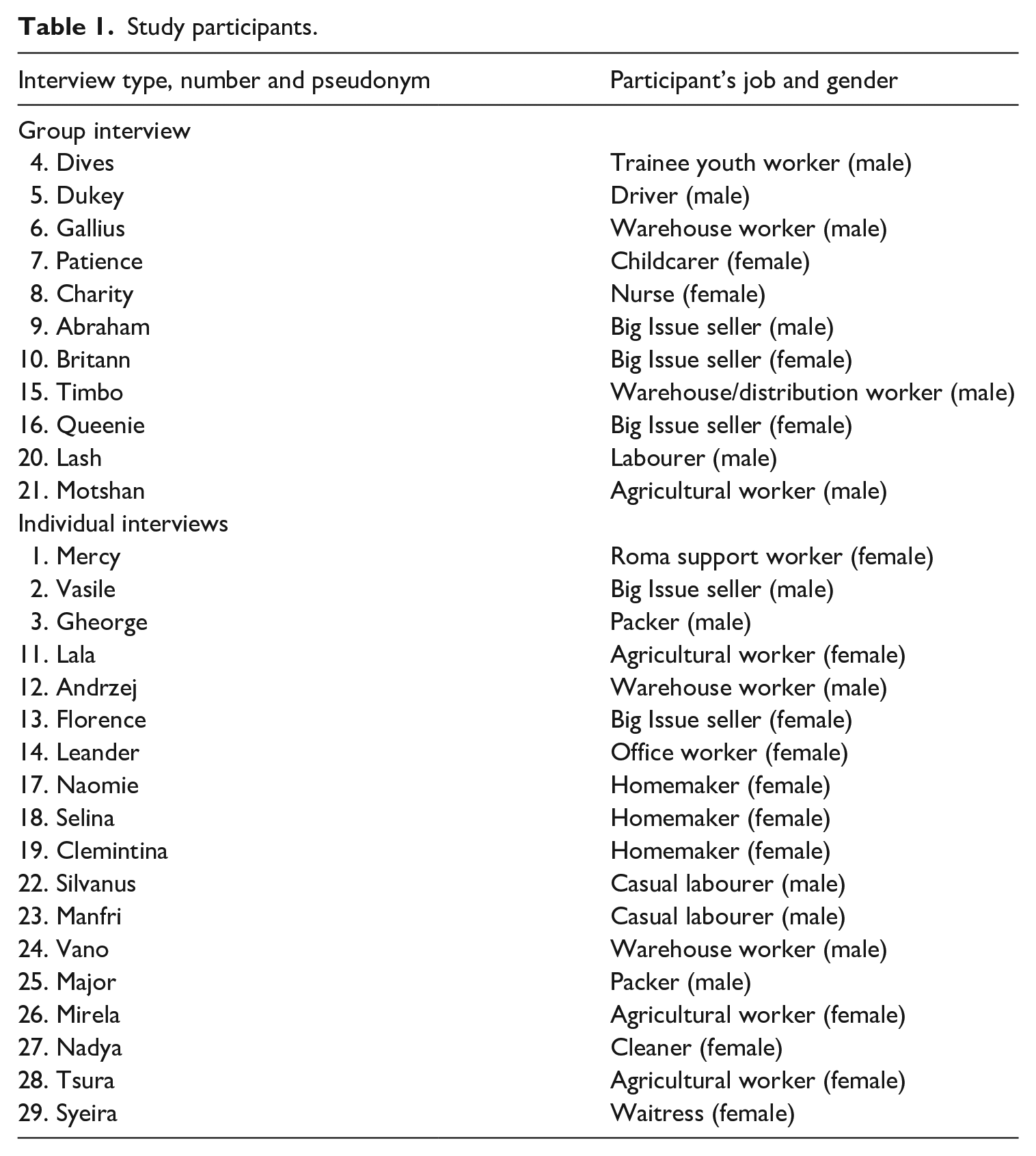
Our qualitative, inductive approach included individual and group semi-structured interviews. The selection of participants accorded to their personal lived experience of being migrant Roma. Nevertheless, owing to this being a hard-to-reach group, there were challenges with both access and language. A local community-based organisation and The Big Issue (a charity for people who are homeless in the UK) assisted with finding suitable participants and helping to build trust and credibility (Christopher et al., 2008). Most of the interviews were in their centres, but three took place in the home of one of the Roma. The 29 participants were primarily from Romania. In total, 18 individual and five group interviews were conducted, and participants given pseudonyms (Table 1). The sample size – given the hard-to-reach nature of the group, coupled with an understandable fear of researcher intent – is in line with similar studies (Baciu et al., 2016). Further, we found data saturation started to emerge for some common categories, such as recruitment practice, from participant 18. A form of volunteer sampling identified as self-selection sampling was used because of the nature of the participants, all of whom self-identified as Roma and were over the age of 18.
Study participants.
Owing to the language barrier for some participants, an interpreter was present during all the interviews. Two of the three interpreters were from the local community-based organisation and one from The Big Issue. We were conscious that interpreters can influence the process and content of interviews (Hsieh, 2007); however, we feel the research was enhanced by the inclusion of interpreters who possess personal community knowledge. Each participant was asked the same set of prepared questions. Interviews were recorded and transcribed, although – owing to Roma’s general lack of trust – no biographical data, except for the first name of the participant, was recorded. One author conducted the initial transcription, and the other checked the accuracy of the transcripts. Despite the drawbacks of recording interviews (King et al., 2019), having a less biased (than recalled post interview) record of the conversation that could be reviewed (Easterby-Smith et al., 2015) was deemed valuable. Owing to the nature of this group – with generally weak English and/or use of an interpreter – the verbatim responses tended to be short and to the point.
The approach taken during the interviews followed the principles – but not the change-eliciting aim – of Motivational Interviewing (MI) (Rollnick and Miller, 1995). Placing the client in the expert role, MI is more about a way of being with a client rather than a set of techniques. Its origin and success in the complex area of addiction counselling, another hard-to-reach group, was relevant to this research. Techniques such as warmth, empathy and reflective listening are used to elicit information and understanding (MINT, 2017). The ethos at the heart of MI reflected that of the interviewers, and was instrumental in gaining access, and in leaving the participants feeling valued for their input. The work of Lincoln (2010), with her intent to understand the lived experience of participants, guided the analysis process. The transcripts were analysed through a flexible approach of moving backwards and forwards (Mason, 2002), the aim being not only to explore connections but also to immerse ourselves. Following lengthy analysis, conceptual codes were extracted from the data and then grouped into themes. The final analysis, like the constant comparison method (Eriksson and Kovalainen, 2008), was used to seek connections between the emergent themes. To achieve credible research, there is an audit trail to evidence the analytical process (Richards and Morse, 2007).
Before we proceed with the findings/discussion, we provide deeper information about the sample and the working context. The work context for the participants was the UK, and the contractual status deemed to be independent (in contractual terms, noted as self-employment) and organised through a third party or agency – with some ‘exploitative’ practice (Nye, 2019) evident – rather than directly with an employer (Petriglieri et al., 2019); referred to by Fleming (2017: 693) as ‘radical responsibilization’ of employment whereby economic responsibility is placed on the individual.
Every participant in this study was living in the UK for economic survival (to find paid work) and (as became clear during the interview process) to escape persecution. The impact on the participants’ livelihood of economic hardship was evident: In Romania, I can’t really do nothing . . . but in Spain I do something, like you know. It’s not really good job . . . When you got a bar, wash the dishes, it can’t pay so much. Not good, you know . . . you can’t live. (Leander)
In comparison to Romania, the pay in the UK, when work was found, was higher and thus deemed to be ‘good’ (Mirela). However, finding and keeping work was a challenge for the participants. In keeping with the findings of the UK House of Commons, Women and Equalities Committee (2019) report, virtually all participants were in irregular, insecure work with high work–labour ratios. This may imply Roma were employed primarily in small, less regulated environments; instead, it was the case that most were working in ‘common household name’ companies.
Work such as car-washing, factory work, labouring, warehousing, driving and farming was most common. The participants did not know when they might get work, for how long and whether they would keep it: If you find the work today, is work, but if can’t because don’t find it . . . (Timbo)
We found that virtually all Roma women in this study either currently or in the past worked as self-employed street sellers for the not-for-profit social enterprise, The Big Issue. The pay is low, as mentioned by Hester; however, the work is flexible: She’s [referring to herself] working The Big Issue . . . not really good but . . . (Florence)
Despite the impact of insecure work, all Roma expressed gratitude and praised the UK for being able to find work. Virtually all stated that they liked the UK because they can earn money and it goes further than in their home country: ‘much better in the UK as easier to get a job’ (Silvanus).
We now explore the concepts that emerged from the literature review and data collected in order to gain insight into the lived experience of precarious work.
Findings and discussion
We present our findings and discussion supported by archetypal quotations from the interview transcripts translated verbatim from Romanian/Romani to English. It is crucial to note that our findings unfolded in the Liverpool community as the immediate work context for our participants, which influenced the way they made sense of their situation. Liverpool is the UK’s second highest deprived area, with a high number of lower socio-economic jobs (Ministry of Housing Communities & Local Government, 2020) that makes work possible for the participants. There is evidence of market dualisation with Roma working, generally, for third parties in insecure work, with some evidence of economic violence. Albeit a dire situation, Roma’s dispositional factors and ‘being Roma’ (Grill, 2012), underpinned by their collective behaviour, showcases a different way of being and interacting with the labour market. ‘Social capital on the move’ and ‘precarious habitus’, the concepts that emerged, will be explored, demonstrating Roma’s long-standing relationship with precarity and the way they interact with the environment.
Social capital on the move
Strong paternalistic relationships with other Roma were a significant form of social capital for every participant. All participants recalled behaviours and incidents of support from other Roma – for instance, providing basic material needs such as accommodation, food and clothes. Leander, by the age of 20, with three children, had worked in Romania, Spain and the UK as a cleaner, kitchen porter, bar worker, youth worker and seller at The Big Issue. Each time, she accessed her Roma network for practical everyday support for survival. Another participant, Florence, shared how she is with her ‘big family’. Participants spoke often of the need to connect with Roma, as being alone was deemed ‘not normal for Roma’ (Dives). Roma prefer to give and receive informal support with each other, over formal institutional mechanisms, even when financial subsidies are available. For example, while all the women in the study had children, none used formal childcare such as nurseries, instead depending on the family, with the primary reason cited being a lack of trust in strangers. In this sense, Roma do not buy into Bourdieu’s (1998) ‘code of the message’, such as alignment with institutional norms. This might also relate to their cultural capital as the socialisation process is invested in the family network rather than externally: . . . for me, what I think, because me also, I don’t want to my baby to be in the childcare you know? Because we feel more safe with someone that we know . . . (Mercy)
Roma’s habitus enabled word-of-mouth recruitment: ‘take two person’ (i.e. the one Roma plus two Roma friends) (Florence). Word of mouth, while extremely useful in creating short-term solutions for the participants, often reproduces homogeneity in the job market and rarely enables access to better job opportunities through bridging capital.
Mutual support networks that help Roma to find and keep work are instinctive to this group’s habitus, and many are prepared to travel significant distances to attain low-paid precarious work, virtually always taking their immediate and extended family with them to join other Roma groups. Florence – with her husband Andrzej – shared her experience of moving as a family to find work, resulting in pan-European family mobility power: together with their six children, they travelled from Romania to Liverpool, via Madrid and Birmingham. Community solidarity is internalised, so while others may risk the breakdown of family ties in a bid to escape precariatisation (Castel, 2000), Roma tend to move together, exhibiting mobility power, as reflected in Mercy’s account, with support staying within the group in what we call social capital on the move.
Major got a packer job through Roma friends, while Lala found work through her brother-in-law and travels to work with three other Roma. Gallius gave an example of ‘existential movement’, having migrated from Romania to Liverpool via Copenhagen and Birmingham, finding work through friends and family: ‘I driver job in Romania, cousin say drive in Copenhagen, then Birmingham, now Liverpool with other cousin’. Mercy identified, ‘they work through the communities, getting their contacts through each other’. The solidarity evidenced by Gallius, which according to Standing (2016a) may be different to other migrant groups, manifested in high levels of interpersonal trust, evident in behaviours such as a willingness to share aspects of lives commonly considered private (e.g. childcare and cooking). Bonding is reinforced and reproduced through the habitus and creates existential (adaptable) disposition and angst when absent (Grill, 2012). This co-presence, combined with constant movement, spanning local, regional and national borders, substantiates and indexes the closeness of social-capital relations of being Roma (Grill, 2012). It creates a supportive environment, provides opportunity to reflect, recharge and reframe and, indirectly, preserve the ethnic and social capital and security, and importantly prevents falling into Castel’s (2000) breeding tank of disaffiliation. On the negative side, however, Roma are less inclined to invest in bridging ties (e.g. to integrate and access opportunities), meaning (limited) economic activity stays within the habitus and seals off the network from the outside world, reproducing precarity, reminding us of Vershinina et al.’s (2011) warning that reliance on bonding ties can limit access to work opportunity.
Migration research has highlighted how working migrants draw on their transnational networks to migrate and develop economic activities, to sustain their migration; indeed, Anderson (2010) asserts that the migration process produces precarity. For Roma, a centuries-old stigmatised identity continues as a socially accepted and entrenched stigmatisation that renders them the most marginalised ethnic group in the labour market as such making precarity inevitable. In one sense, Roma used their mobility power inherent in migration as an act of resistance to discriminatory practices in their home country, and their mobility strategies are guided in part by non-economic gains; that is, to escape the marginalised experience in their home countries. Social capital, therefore, shared in abundance among Roma, becomes mobilised through escaping persecution and discrimination as well as simply ‘being Roma’ to produce a social capital on the move.
Precarious habitus
The research uncovered several attitudes that supported the omnipresence of Roma’s habitus manifest in the willingness to accept temporal flexibility, multi-skilling and change in a respectful way, possibly owing to the internalisation of economic violence. Participants highlighted their ability to adapt and to accept both change and temporal location as impermanent, with Dives commenting: ‘I adapt very quickly’. In terms of respect, Dives – while aware of his limited agency and low social status – shared how he behaved during the induction phase of new employment. He gained trust by listening and ‘mimicking’ the other employees’ working methods, despite his own good practical knowledge: So, first time I was working with more Englishman. I was working in construction and I start work early, and I watch and watch. I do what he doing. After one or two week, I show him what I do and he start watching and copying me . . . he worked better and faster.
Furthermore, Dives, later a trainee youth worker who in the preceding two years had worked as a car washer, farmhand, warehouse operative, driver and building labourer, emphasised the need to be flexible: Everywhere you go, you need to adapt, like when I was coming here – I can’t do what I like; I have to adapt . . . always you have to help with things or get bad name . . . one job then another job then back to first job.
Indeed, the natural collocation of Roma and lazy peddled by some media was countered very consciously by our participants who were acutely aware their situation was fuelled by economic violence, and therefore we deemed them to be enmeshed in flexploitation. Vano (a manual worker), when asked whether there were any English at his workplace, responded (with no trace of irony or bitterness), ‘No, only Roma, because it is very, very hard work’, while Patience concurred, ‘There are not a lot of English in the warehouses, in the factories; there are not many – mainly Polish, Romania, Roma’. Therefore, personal adaptiveness is essential, since much work in the UK for this Roma group is dirty, dangerous and difficult (Queenie and Florence).
Roma are aware that their agency is limited and finding work that is commensurate with their intelligence and experience is difficult. Disappointingly, almost all the accounts evidenced continued racism (more so in Romania, but also including in the UK) towards Roma: ‘The people in Romania are very racist to the Roma’ (Abraham). Ethnic composition, social capital and mutual dependence, common among Roma, help them in times of ‘flexploitation’. Dives explained how, in one of his jobs, the agency deducted too much tax, allegedly to send to the tax office. Warned by a Roma friend it was a scam, after some time he managed to get the agency to refund the overpayment. In turn, Dives helped other Roma by warning them of the scam, which was ongoing at the time of this research.
The experiences of previously encountered prejudice, thus clearly shaped understanding and behaviour for Roma, leading to a lack of trust in institutions – as Mercy commented, ‘the main problem is trust’. According to the participants, negative stereotypes against Roma prevail and appear particularly challenging in Romania where, as mentioned, most of the participants had lived. Gallius, aware of discrimination of Roma, shared his experience during his employment in Romania: ‘I am a driver, but if I say I am Roma, I cannot be a driver’.
When considering Roma’s habitus and capitals, in the context of precarious work, we suggest there is a symbiotic relationship. Roma’s symbiotic relationship with precarity and precarious work is embedded in their persecuted enslaved past that, in turn, fuels their current experience of persecution, as highlighted by Mercy: We have one history, about one persecution, about why we don’t have the same opportunities as others. I have other cousins, but they finish the Romania University . . . they are here [in the UK] for work and unfortunate they work like in warehouses and this kind of things . . . it’s not easy . . . as they are Roma . . . we need to start every time to have something, to become new again every time. (Mercy)
It was apparent that discrimination of Roma, coupled with an abundance of bonding and scarcity of bridging capital, constrained entry to some jobs, and left some Roma vulnerable to the abuses of modern slavery (House of Commons, Women and Equalities Committee, 2019). It is through myriad ways such as this that habitus and capitals interact to reproduce precarity. An example came from Vano, who shared his payslip that appeared to be below minimum wage and showed a further deduction of 30%. When probed about the deduction, Vano was unsure of the reason for it and had not felt brave enough to query it for fear of losing his job.
We suggest that a precarious habitus emerges and shapes precarity and in turn precarity is shaped by social capital on the move, its journey made simple through widespread flexploitative practices. Indeed, we posit precarity is not merely shaped by capitals and habitus but is formed at the intersection of social capital with an adaptive habitus. This habitus of shared ‘intuition and ideals’ (Herakova, 2009) binds Roma together, supporting Greer et al. (2018) and Sennett’s (2011) claim that enduring bonds of loyalty to fellow workers are the foundations of fulfilment. This mitigates against the formation of a tormented habitus, what Bourdieu called ‘hysteresis’. Paradoxically, however, abundant shared social capital both disciplines and liberates Roma into yielding to others’ authority and can handicap their progression beyond precarious work.
Overt marginalisation in one geo or economic sector, leading to discrimination and persecution, interweaves with their abundant bonding capital to envision new potential made actual through social capital on the move, exhibiting a risky geographical mobility yet safe in the hands of a shared social capital assured of ongoing value and affiliation. Our conclusion will deepen this conversation and draw out our contributions and, in so doing, address our research questions.
Conclusion
In responding to our research questions, we expose the antecedent conditions (such as labour market flexibility, flexploitation, persecution, stigmatisation and marginalisation) and Roma’s response to the impact of precarious work. We locate Roma in a socio-economic field and propose two theoretical contributions (precarious habitus and social capital on the move). Some authors assert that the migration process produces precarity (Anderson, 2010; Knox, 2010); indeed, Alberti et al. (2018) argue that the hardest to reach migrants, such as our cohort, are subject to greatest precarity. This study responds to Samaluk’s (2015) recommendation to consider migration from the perspective of those who lack capital before migrating, such as Roma. Our theoretical contributions, connected through Bourdieu’s concepts of habitus and social capital, advance Bourdieu’s theory.
Theory building is progressed by reflecting on social capital, persecution and the concept of habitus, identifying our theoretical contribution of precarious habitus. We posit that our social capital on the move contribution is an antecedent condition underpinning the formation of a precarious habitus. We posit Bourdieu’s concept of habitus as verb with precarious its adverb to capture the movement and fluctuation of a precarious habitus; since the habitus is not immutable, it has an affinity with the ebb and flow of precarity. With less reliance on direct labour relations for economic wellbeing (larger employers and social security) and formal support (unions and employer organisations), and more on their abundant social capital emboldened through migration to produce even stronger social bonds and through which power is reproduced and shared (Saitta, 2010), the participants demonstrate how social capital facilitates agency in social interactions, and indeed to access economic life. This long-standing relationship with precarious work, resulting in Roma being a ‘fish in water’, encourages them to react intuitively to this environment (Reed-Danahay, 2005: 5). Roma’s shared social capital enabled ‘relational’ forms of engagement with employment that lent a form of protection to their labour resembling some aspects of a formal trade union (Alberti and Pero, 2018). We do not suggest Roma are passive victims of a flexploitative market, but an acknowledgement of a deeply persecuted past that impacts the present. On the one hand, therefore, the habitus is a saviour for Roma, enabling them to cope with precarity. On the other hand, the habitus could be a tormentor, since it is through persecution Roma act out a ‘forgotten’ pre-knowledge, (un)consciously constraining them from building bridges beyond their group.
So, in summary, social capital on the move entails migration and produces precarity. Castel (2000) infers that precarity has always been the norm for groups such as Roma. The extent to which social capital on the move foreruns a precarious habitus assumes a natural collocation with our participants, who carry the reality of (fleeing from) a persecuted history (re)produced through centuries of working in a flexploitative labour market, and, as per Standing’s (2016a) view, predisposes them to expect insecurity, oiled by economic violence. In any event, the habitus seeks unity and consensus, and thus quests after alignment with the Roma’s lived experience of fleeing from persecution and discrimination such that it becomes a precarious habitus.
Advancing Bourdieu’s theory and the sociology of work
The architectural framework offered by Bourdieu’s concepts has enabled us to locate agents along quite different trajectories in a field. Precarity manifests to varying degrees in different social classes; indeed, it is a cross-class phenomenon. We advance Bourdieu’s concepts in two ways. First, we elevate the status of social capital, since we found it was fundamental in the dynamics of precarity and its presence is guaranteed by a continuous reproduction through social capital on the move. Second, we are less fatalistic than Bourdieu about the implications for one’s life opportunities of failing to receive the ‘code of the message’. We contend that being oblivious to the code of the message, which imprints upon recipients a universalist notion of success embedded in economic and cultural capital, may to some degree be liberating; for example, being freed from constraints imposed by norms, pressure and regulation. Bourdieu implies that rules set by the dominant create desirable cultural norms, the search for ‘distinction’ meaning those who regard themselves as holding a monopoly on ‘the right ways of being and doing’ (Bourdieu, 1998: 511) must constantly stave off a popularisation that would reduce the ‘elite’ taste to commonplace taste. We suggest that while this may be the case, it nevertheless overlooks the desire and capability of others, outside the dominant groups, to create their own cultures.
We contribute to the sociology of work in two ways. First, while our cohort exhibited few explicit labour practices, such as formal collective bargaining or formal recruitment, there was evidence that informal behaviours, supported by a common and shared social capital, made life more bearable for some in even the most precarious and demanding circumstances. Others, we contend, faced with similar dire circumstances, might fall into Castel’s zone of disaffiliation, but Roma are shielded by their shared precarious habitus. Sharing local knowledge about bad labour practices, learning, investing in a shared future, informal recruitment among peers and mentoring all occurred without any formal HR intervention. It is in this context and against a backdrop of uncertainty and discrimination that our cohort showed they were not merely passive workers but demonstrated ‘relational’ forms of engagement with the labour process (Alberti and Pero, 2018), and organised striving for a better future.
Second, Bourdieu’s notion of cultural sabir (Bourdieu and Sayad, 2020: 144), where one is ‘cast between two worlds and rejected by both’, is a common experience shared by our participants who without exception had fled from persecution. Here again we see glimpses of the unity and strength of a precarious habitus, fuelled by social capital on the move to enable recipients to transform from being ‘a fish in no water’ to a ‘fish in many waters’, yielding a flexibility, beloved by neoliberal work agendas, that protects yet confines workers.
Our research is not without limitations. We appreciate we have focused only on one group; however, the extent of evidence regarding persecution of Roma was so overwhelming that we have justified our choice. We recommend future research extends this study with other migrant groups, and includes closer scrutiny of the roles of ethnicity and the impact of precarity on family dynamics, migration and on identity building. By focusing on Roma, we have responded directly to Samaluk’s (2015) recommendation to investigate migration from the perspective of those with little capital before migration.
We posit that current debates around precarity focus on the newer precarious workers, thus excluding long-standing ones. The issue for Roma is their prioritised form of capital does not translate so well into the wider socio-economic field. We propose that long-standing and newer precarious workers are experiencing a hysteresis (where a habitus is not adapted to field conditions) but for different reasons. Newer precarious workers can mobilise forms of capital but are still finding it difficult to move beyond precarious work, while Roma do not engage with other forms of capital and remain stuck. This study challenges the assumption of those in precarious work (i.e. that the latter can be treated as a homogenised group) and calls for the exploration of different groups who have different needs. This enquiry was beyond the scope of this article; however, capturing more about the lived experience and the precarious practices is a research priority, not least due to shifts in the global economy making precarious work a growing model. Roma strategies, practised and honed over centuries, are worth greater inclusion in this debate.
At a national and practical level, the UK government could also help precarious workers by tightening up on ambiguous employment status (Nye, 2019) and providing economic security via a new social contract (Lockley and Wallace-Stephens, 2020).
Footnotes
Acknowledgements
We would like to thank Emeritus Professor Michael Greenfell at Southampton Education School and Dr Sarah Robinson at the University of Glasgow.
Funding
The authors received no financial support for the research, authorship, and/or publication of this article.