




Abstract
This article examines the development of the UK ‘Fast-Food Rights Campaign’ and the formation of a collective identity amongst McDonald’s UK workers. It illustrates how, despite an acquiescent and fragmented workforce, workers diagnostically frame (recognize, articulate and attribute) perceived injustices relating to their pay and working conditions. However, the main focus is on prognostic framing which brings people ‘together’ to find a ‘consensus’ for a solution to perceived injustices. Prognostic framing also requires the ability to process and interpret information in a holistic way and to reach out for support to external stakeholders such as trade unions. The article applies Bourdieu’s theory of capital and the concept of political opportunity to help us ‘unpick’ prognostic framing. In this context, it examines the cultural and social capital of worker leaders, in particular their personal characteristics, and their perceptions about the level of support in the external environment.
Keywords
Introduction
McDonald’s UK opened its first store in 1974 and for the first time in September 2017 around 30 UK McDonald’s workers went on strike in two stores in London and Cambridge. In May and October 2018 and November 2019 further strikes followed, some in cooperation with other workers from TGI Fridays, Uber Eats and Wetherspoons. These strikes took place after the launch of the UK ‘Fast-Food Rights’ (FFR) campaign in 2014 which organized several UK wide demonstrations against McDonald’s and other fast-food employers. Only a small number of McDonald’s workers were involved, but the significance of these strikes should not be underestimated. The majority of UK fast-food jobs are hourly-paid, vulnerable jobs which create a considerable organizing challenge for trade unions (TUC, 2007).
The UK FFR campaign and strikes took place in the broader context of a global corporate campaign targeting McDonald’s launched in 20141 and the US ‘Fight for 15’ (FF15) campaign which began in New York in November 2012. FF15 involved a number of community groups, but was led and funded by the (American) Service Employees International Union (SEIU). It is the biggest ever effort to mobilize fast-food and other low-wage workers in the USA (Rolf, 2016) and resulted in several US states and cities raising their minimum wages. In July 2015 McDonald’s USA also increased its basic wage by about $1 per hour in its directly owned and operated ‘McOpCo’ stores but not for the 90 per cent who work in its franchises (Hicken, 2015). FF15 is estimated to have achieved over $60 billion in wage rises for some 17 million US workers, however, it has not yet achieved collective bargaining with McDonald’s in the USA.
The article focuses on the UK FFR campaign and asks what factors determine the successful development of a collective identity amongst fast-food workers and how is this ‘translated’ into a collectively organized approach towards injustice? In order to answer this question, we apply and extend the ‘frame’ concept which has a sociological grounding influenced by Goffman (1974). The process of framing can help us to understand how ‘agents’ (such as workers and trade unionists) interpret reality and engage in the production of meaning. It also helps to link micro-level organization processes with the macro-level concept of (political) opportunity. As yet few studies have applied the concept of framing in union organizing and there are few in-depth case studies that examine the different stages of framing and the process of ‘deep organizing’ which involves the activation and engagement of individuals (Holgate et al., 2018). Empirically the article aims to provide insights into the perceptions and attitudes of a group of workers which is fragmented and at high risk of employment rights abuses (TUC, 2007: 3) and to shed light on the information exchange and identity formation processes within this group.
The article pursues two objectives on a theoretical level: first, the article aims to contribute to the further development of the framing concept, particularly by exploring characteristics of individuals such as their social and cultural capital which impact on the interpretation of information and different framing processes. We argue that these characteristics are in part further developed through feedback processes inherent in framing and that both framing processes and characteristics play an important role regarding the selection and development of ‘worker leaders’. Second, the article aims to link individual and collective perceptions of real-world events with the concept of (political) opportunity and available support mechanisms from external stakeholders. In this regard it tries to explore to what extent personal and collective perceptions of available support from the broader environment have an influence on the strength of collective identity formation processes. In the following section, the article provides some background information with regard to McDonald’s and the UK FFR campaign before setting out the theoretical framework.
McDonald’s and the UK FFR campaign
In 2019, as the largest food-service company in the world, McDonald’s and its franchisees employed around 2 million workers in 37,855 stores in 120 countries. McDonald’s is the market leader in the UK food sector and employs over 100,000 people in more than 1300 stores. Around 90 per cent of these are operated as franchises. The FFR campaign represents the first serious attempt to organize McDonald’s UK workers. However, the McDonald’s Corporation poses a considerable challenge. Its basic ethos is anti-union and in practice it has only ‘accepted’ independent unions when it has been forced to do so – such as in mainland Western Europe and more recently in New Zealand – but such organizing successes have nearly always involved continued struggle (Leidner, 2002; Royle, 2000, 2010; Tannock, 2001).
The proportion of McDonald’s global franchises has been increasing steadily and today around 90 per cent are franchise operations. McDonald’s plans to increase this further over the next few years because as the then CEO Steve Easterbrook put it, ‘. . .franchising. . . is incredibly liberating for us as a McDonald’s system’ (Taylor, 2015). Franchising may be ‘liberating’ for the Corporation, but as has been documented elsewhere, McDonald’s retains an extremely tight control over its franchisees (Leidner, 2002; Royle, 2000, 2010). Format franchises of this kind are legally independent entities, but economically dependent on the franchisor (Hardy, 2018). McDonald’s makes more money from the ownership of its sites (through franchisee rents and royalties) than it does from selling burgers. However, labour costs are a significant proportion of store operating costs and in such a highly controlled and standardized system, labour is one of the few areas where savings can be made. ‘Good’ store manager performance at McDonald’s is therefore based on low labour costs; as a result most stores are expected to keep labour costs at around 15 to 17 per cent of sales (Leidner, 2002; Royle, 2010; Tannock, 2001). As previous studies have shown (Rolf, 2016; Royle, 2010), this is mostly achieved through limited or zero hours contracts (ZHCs), understaffing on shifts, and hiring workers on the low wage rates; with high labour turnover rates often being the result (150 per cent per annum is the norm at McDonald’s UK). Driven by the need for profitability franchisees are likely to put further downward pressure on labour costs increasing the likelihood of labour violations. At the same time the franchise system allows franchisors like McDonald’s to distance themselves from such labour violations (Hardy, 2018; Ji and Weil, 2015).
The Bakers, Food and Allied Workers Union (BFAWU) established in 1847 has around 20,000 members and was key to the launch of the FFR campaign. According to the BFAWU President, the union had not undertaken any significant industrial action since 1979. However, in 2013 they led a strike at the Hovis bakery in Wigan against the introduction of ZHCs. This dispute was successfully settled after only two walk outs and as the BFAWU President stated in 2017, …it was an inspirational strike, that enthused others . . .we’d demonstrated. . . that collective action. . .wins, . . .it brought in people that normally would never have been anywhere near a picket line. . . I realized we needed to ‘up our game’. . .but we needed to look at how we could engage with people that currently weren’t engaged with us.
Given the success of the Hovis campaign, the ongoing context of ‘FF15’, Labour Party support and discussions with other labour activists, the BFAWU decided to launch the FFR campaign in January 2014. Several Labour MPs supported the campaign including (the then) Labour Party Shadow Chancellor John McDonnell, as well as other groups such as Unite the Resistance (Socialist Workers Party), the National Shop Stewards Network, Youth Fight for Jobs and Disabled People Against Cuts. The initial aims of the campaign were union recognition, the abolition of ZHCs and youth rates. In June 2014 the BFAWU included the demand for a £10 per hour minimum wage (this increased to £15 in 2019).
In 2013 the SEIU had already discussed the idea of an international campaign with the IUF (International Union of Food, Agricultural, Hotel, Restaurant, Catering, Tobacco and Allied Workers’ Associations). However, the larger UK unions considered the fast-food sector to be too challenging to organize. Two months after the BFAWU launched FFR, the SEIU contacted the BFAWU to offer their support and from August 2015 the SEIU funded the salary for one year for one full-time BFAWU national fast-food organizer (BNO). With support from other unions such as UNITE, the BFAWU have continued to employ the BNO on a longer term basis. This is significant because the BNO has played an important role in identifying, training and encouraging worker leaders at McDonald’s. The SEIU and the New Zealand Unite Union also provided advice and support by phone, sent organizers to the UK and provided training for BFAWU officials and worker leaders.
The development of a collective identity – Framing and (political) opportunity
In order to transform individual interests into collective interests, formal and informal processes of internal workplace democracy including dialogical processes are important (Atzeni, 2016). Workers in the fast-food sector face similar material conditions, but as earlier studies have shown, the characteristics of this workforce (made up of varying proportions of students, second income earners, economic migrants and those marginalized in the labour market) are fragmented and likely to be acquiescent to the managerial prerogative (Royle, 2000). Many workers do not have a strong ‘sense of identity, attachment and allegiance’ (D’Art and Turner, 2002: 11). However, some workers do exhibit a fundamental sense of solidarity when they refer to ‘. . .themselves as “we” in relation to the “others”’, in other words they distinguish between themselves as workers and management (D’Art and Turner, 2002: 12). The level of perceived justice which influences social relations within an organization is determined by ‘the proper exercise of power in the organization’ which includes ‘keeping promises’, ‘fulfilling contracts with employees’ and ‘fair remuneration’ (Zawadski, 2018: 180). Lopez-Andreu (2019) noted that as yet little is known about the processes which underlie the formation and sustainment of a collective identity and solidarity among workers in fragmented employment systems with a weak or non-existent trade union presence. The acknowledgement of this ‘black box’ is not new, nevertheless, little progress has been made in shedding further light on identity building processes in fragmented workforces.
More than two decades ago, Kelly’s (1998) mobilization theory which builds on the work of Tilly (1978) and McAdam (1982) provided a basic analysis regarding the identification of social injustices by workers and the process of forming a collective identity. However, there was little explanation of the ‘. . .active, processual phenomenon that implies agency and contention at the level of reality construction’ (Benford and Snow, 2000: 614). Gahan and Pekarek (2013), Gall (2003), and Frege and Kelly (2003) argued that framing and the concept of collective action frames need to be considered in this context because they can help to develop a deeper understanding of the processes through which individuals form a sense of collective identity. This is of particular importance because ultimately individual and collective interpretations of experiences, grievances and discontent ‘. . .effect whether and how they are acted upon’ (Snow et al., 1986: 465). The arguments made in favour of a more rigorous application of the framing concept also feed into recent critiques of Kelly’s work. For example, following McAlevey (2016), Holgate et al. (2018) argue that the organizing and mobilization concepts need to be examined separately. According to McAlevey (2016: 10) organizing: …places the agency for success with a continually expanding base of ordinary people, a mass of people never previously involved, who don’t consider themselves leaders at all. [. . .] Ordinary people help make the power analysis, design the strategy, and achieve the outcome.
The authors support this argument, but suggest that framing processes need to be considered in more detail with regard to the role which worker leaders play and their individual characteristics. This is important as worker leaders take on the role of a ‘change agent’ or ‘catalyst’ at store level arguably leading a new identity development process amongst the workforce. The following paragraphs introduce the ‘frame’ concept and the core framing tasks, and describe some key individual characteristics drawing on Bourdieu’s (1984, 1986) work.
The term ‘frame’ originally derives from the work of Goffman (1974: 21) and describes a ‘schemata of interpretation’ which enables individuals to interpret, label and organize their own experiences. The ‘agency’ of perceived injustice by individual workers and trade union leaders is essential in terms of generating interpretative frames. Frames provide a broader definition of an ongoing situation and they are culture specific and socially shared. Furthermore, they are influenced by individual characteristics which impact on the attribution of subjective meanings to perceived situations (McAdam, 1982). The bridging of these subjective interpretations and meanings which result in the development of collective action frames can be achieved through discursive processes (conversations between individuals) as well as through organizational outreach and the diffusion of information through interpersonal networks and the media such as the internet. Collective action frames represent a ‘shared understanding of some problematic condition’ which needs to change and they ‘articulate an alternative set of arrangements’ (Benford and Snow, 2000: 615).
Benford and Snow (2000) identify three interrelated core framing tasks including diagnostic, prognostic, and motivational framing. Our study focuses on diagnostic and prognostic framing. The first refers to the identification of the nature and the source of the problem and the latter involves the identification and articulation of solutions to the problem. Motivational framing which refers to the rationale for engaging in collective action and the ‘call to arms’ is not within the scope of this article. The authors argue that both, individual perceptions of reality and the identification and articulation of problems, are strongly influenced by the knowledge and education (cognitive ability) of individual actors, their economic means and the availability of contacts and social networks which can function as an ‘eye-opener’ and support. According to Bourdieu’s (1984, 1986) theory of capital, knowledge and education can be described as cultural capital, economic resources as economic capital, and social networks as social capital. The amount of capital which an individual has available influences their position in society, their outlook on the environment and is closely related to the formation of ‘habitus’. According to Bourdieu (1986), the habitus of individuals reflects their living conditions and structures, their perceptions and the evaluation of their environment and work. Habitus has some overlap with framing as both stress the role which individual agents play with regard to the interpretation of reality, but in contrast to framing it focuses more strongly on social conditioning and ‘. . .the competence of individuals and groups to understand the characteristics and different dimensions of social problems’ (Husu, 2013: 273).
Some McDonald’s workers may share the same habitus with other low-paid workers in the fast-food industry. However, we argue that those workers who become worker leaders have accumulated higher cultural and social capital over time and are likely to depend economically on their employment. Their social capital enables them to interpret information which is available in the organizational environment in a more critical way and to become ‘leaders’, allowing them to ‘. . .offer frames, tactics, and organizational vehicles’ to their co-workers and ‘. . .to construct a collective identity and participate in collective action at various levels’ (Morris and Staggenborg, 2004: 180). Worker leaders are close to their co-workers and they are more likely to be able to develop trusting relationships more quickly than external agents such as trade union officials.
The decision to become involved and to take a leading role with regard to the development of a collective identity amongst workers depends on personal views and attitudes as well as on the external environment (Meyer, 2004). The extent to which workers perceive opportunities within the environment has an impact on the desire of workers to become active. In other words, actions can be explained ‘. . .by what people can do and by what they want to do’ and by the ‘beliefs’ of people regarding opportunities (Elster, 1989: 14, 20). Opportunities are external to a person and vary over time (McAdam, 1982). Tarrow (1998: 71) argues that the ‘. . .levels and types of opportunities people experience, the constraints on their freedom of action, and the threats they perceive to their interests and values, vary over time and from place to place’.
In this respect the ‘political process framework’ and ‘political opportunity structure’ as part of this framework play an important role (Kriesi, 2004). The ‘political opportunity’ concept was developed into a more comprehensive theory by Tilly (1978) and has since been widely used in the social movement literature to examine how social movements respond to the world around them. However, to date there has been no coherent definition and agreed approach with regard to its application and therefore researchers still face the challenge of trying to clearly establish the features of the external world which affect the development of protest movements (Giugni, 2009; Meyer and Minkoff, 2004). Tarrow (2011: 32) defines political opportunity as ‘. . .consistent – but not necessarily formal, permanent, or national – sets of clues that encourage people to engage in contentious politics’. Following Tarrow (2011) we define the concept of ‘opportunity’ in a narrower sense focusing on those factors in the environment that can be perceived as steering the desire for change amongst individual actors and an opportunity to act on and challenge the status quo. These factors include for example policies introduced and implemented by the government, the availability of influential allies such as politicians, the media, customers and the general openness of the political system in terms of access to participation for leaders (Blyton and Jenkins, 2013; Heery and Frege, 2006; Kessler and Bach, 2011). Trade union organizers and politicians ‘. . .can lend their prestige and organizing skills’ to workers (McAdam, 1982: 47) and help to build internal solidarity. The media, particularly social media, can support a quick and wide dissemination of discontent, helping to draw attention to collective action or a campaign, even though it is arguably no substitute for the interpersonal thrust that comes from personal ties (Tarrow, 2011). The following framework summarizes the framing tasks, the dimensions which are related to these tasks and the relationship between framing, personal characteristics and the external environment.
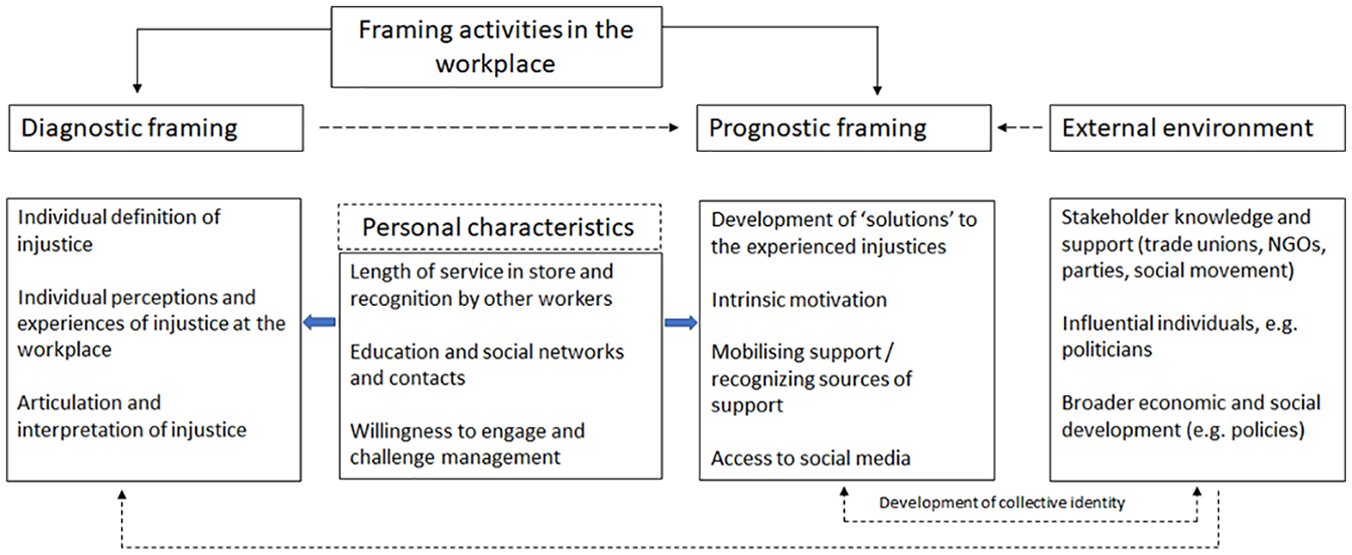
Framing in the workplace and influential dimensions.
So far, the framing concept from Benford and Snow (2000) has been widely received and adopted with regard to the analysis of protest and social movements. However, there is little application of the framing concept and virtually no in-depth analysis available with regard to workplace relations and in particular fragmented and atypical workforces. We argue that the application of the framing concept in this context needs to give particular attention to ordinary workers and the transformation of some of these workers into worker leaders, as it is these workers who are crucial for connecting other workers. We suggest that the factors which influence and support this transformation of individuals can be examined by the help of Bourdieu’s theory of capital and the interconnection with the external environment. This we argue is because available ‘opportunities’ in the external environment have a particular impact on prognostic framing and individual perceptions and interpretations regarding injustice.
Research methods
The data for this article are based on an ongoing qualitative study of employment conditions in the international fast-food sector. We conducted semi-structured, face-to-face interviews with McDonald’s workers, trade unionists and labour leaders in the UK. The interviews spanned a period of over five years from May 2014 to January 2019, although the majority of interviews were conducted in 2017 and 2018. It is challenging to gain access to fast-food workers because of the combination of high labour turnover, ZHCs and sometimes unpredictable shift patterns and a salaried store management versed in keeping workers’ voices silent and fearful of management reprisals. As previous studies of employment relations issues in fast-food have shown (Reiter, 1991; Royle, 2000) gaining formal access from fast-food firms like McDonald’s to do interviews with hourly-paid workers about the reality of working conditions is extremely difficult. For that reason, interviews were conducted outside the workplace so that workers could talk freely about their experiences. The interviews varied in length from 20 minutes to over two hours and some of the participants have been interviewed several times.
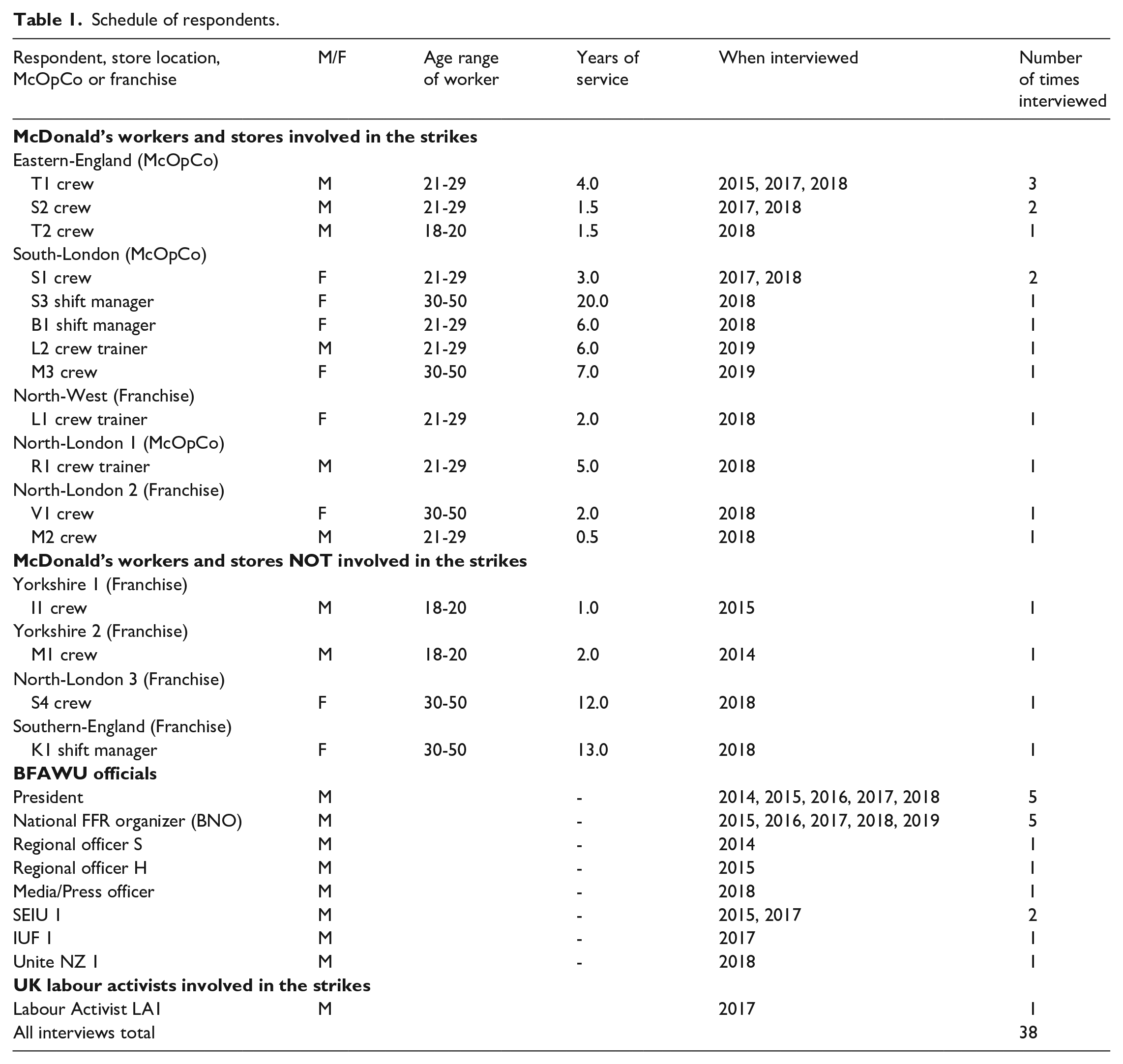
Access to workers was predominantly gained through the existing contacts of one of the authors, trade union officials and from snowballing with workers. The majority of interviews have been conducted in five UK stores which were involved in strike action. In order to anonymize the stores, we named them in accordance with the region in which they were located (see Table 1). In the five stores 16 interviews have been conducted between 2015 and 2018. Furthermore, four interviews have been conducted with workers in four stores which were not involved in strike action, and 18 interviews were conducted with trade union officials including 14 interviews with UK representatives and four interviews with representatives from the SEIU (USA), the IUF (Global Union Federation) and Unite (New Zealand).
Schedule of respondents.
All interviews were audio-recorded and transcribed by a transcription service recommended by the university. We applied an inductive approach to thematically analyse the data, aiming to identify and interpret similar emerging ‘themes’ in the interviews. The identification and interpretation of the themes were guided by our research question, but we aimed to adopt a flexible approach in order to deal with the research topic. After reading through the transcripts several times, initial codes (the ‘building blocks’ of themes) were retrieved from the data. In this context, the analysis focused on the views of individual workers and trade unionists in an attempt to identify commonalities and differences in perceptions across the different stores. Codes with similar content were combined into overarching themes. For example, the codes ‘political interest’ and ‘want revenge’ were subsumed under the theme ‘intrinsic motivation’ which we relate to the ‘prognostic’ framing task.
Framing applied – Diagnostic and prognostic framing amongst fast-food workers
Diagnostic framing, in other words problem identification and articulation by individuals, is influenced by the level of personally experienced deprivation and circumstances. This can include perceptions and experiences of material deprivation (working contracts, low wages) and social relations determined by the organization which impact on the personal identity and personal situation of employees. Our findings reveal that individual perceptions and the interpretation of working conditions and workplace issues is determined by the personal financial and family situation, previous experiences in other organizations, the length of service, social contacts (such as friends) and education. For example, while some fast-food workers may not rely on their wages to support their existence, others may rely entirely on their earnings from their employment.
Individual perceptions and interpretations of injustice
All interviewees worked as hourly-paid workers and expressed concern and anger about several different issues in their stores. The main problems raised by workers were low pay, work contracts, health and safety and the very frequently disrespectful and bullying behaviour of some salaried store managers (T1, S2, L2). For example, some workers reported being phoned at home and asked to come in when they were sick (S3, L2, M2). Others reported continuous understaffing (K1, L1, S4, I1), inadequate notice and last-minute changes of shifts (L1), sometimes leading to ‘off the clock’ work, being stopped from leaving work when sick, missed breaks and breaks allocated at times that only suited management (B1, S3, L2, M1, S4) and the alleged sexual harassment of young workers (T1, R1).
It has long been established that UK McDonald’s hourly-pay rates are low, for the majority only a little higher than the minimum wage (Royle, 2000), with the lowest wages in McDonald’s franchises. Pay is particularly low for under 21s and under 18s. One crew member (T2) earned just £4.75 per hour and although he worked an eight hour shift four days a week, he could not afford to rent a room and had been couch-surfing for some time. For older workers it was not substantially better. A crew member 25 years old (S2), earned £7.55 per hour and had to choose between eating a meal or visiting his son who lives with his mother 60 miles away. However, as one crew member pointed out, he was well aware of the fact that McDonald’s is ‘not a great place to work’ but he accepted it ‘for what it was’ (L2).
There is no legal mechanism in the UK to force franchisees to pay the same wages and benefits as those offered to workers in company-owned stores. McDonald’s recommends but does not enforce wage rates. As a result, McOpCo stores provide some additional benefits which are not available to workers in franchises, such as for example medical insurance (depending on length of service), child vouchers and an additional night rate of (£1 per hour between 12.00 midnight and 5am). McOpCo pay rises were not automatically passed on to franchise workers as one hourly-paid franchise employee stated: ‘. . .they [co-workers] were quite shocked that they wouldn’t get the pay rise cos they’re in a franchise. . .I blame McDonald’s and the franchise owner. It’s annoyed a lot of people and made them quite angry’ (L1).
Low pay is compounded by ZHCs and in some cases wage theft or ‘shaving’, where managers electronically reduce workers’ hours. In this context a shift manager (S3) confirmed that business managers use working hours as a tool to get ‘control over people’s lives’ and to ensure compliance with organizational standards.
However, one of the most predominant factors raised by workers was the bullying, aggressive and disrespectful behaviour of salaried store managers. In almost all the stores which were involved in strike action workers reported these behaviours as the following quotes illustrate: …they’re not very professional, . . . the managers will talk to staff like ‘where’s the f***ing burger?!’ or when I complained about his mistreatment of a worker he used to say, ‘I could make you cry if I wanted to’. (S3) Our last business manager wasn’t great, but our most recent business manager is a real bully, he seems to enjoy it, he picked on a woman in her early 30s who has Asperger’s, he shouted at her and told her to sign her own resignation. She’d worked there for 15 years. Luckily her mother threatened legal action. She was paid compensation and kept her job. (S2) The business manager is a bully, she’s worked at McDonald’s for 20 years, when it’s busy she screams at everyone, throws things at staff, whatever comes to hand, it’s a very unpleasant climate; even customers have noticed. (L1)
Managers often show little respect for workers (T1) which is perceived by workers as ‘maltreatment’ (Zawadski, 2018). In accordance with Mele (2014), this becomes manifested as aggression in the workplace and performed in action or in words, for example by speaking insultingly and harshly, as well as psychological and sexual harassment. Several interviewees reported that managers do not protect workers against aggressive and abusive behaviour from customers and avoid their own responsibilities as the following quotations from two crew members demonstrate: …expected to take abuse from customers all the time. I’ve seen workers get burgers thrown in their faces. . . a customer last week ordered a milk shake and the machine broke. . . so, one of the girls is trying to fix it and he started throwing sauce pots at her and telling her to hurry the f*** up and stuff like that. (S2) I think I’ve got a disposition of where I look out for injustices. I have always seen that where managers leave the floor, I started to see like 2 years ago when managers leave the floor and just let the crew do the work, harder and harder and harder and just like everyone loses their temper and things like that because there is no real leadership and that’s where I started to think like, you know. . . (T1)
Injustices were mainly attributed to salaried managers, franchisees, the organizational culture of McDonald’s and the ‘McDonald’s system’ (S1, L1). Some crew members stated that better managers could make a difference on a particular shift. However, the ‘McDonald’s system’, puts massive pressure on labour costs through the whole chain of command and leads to a ‘fear and control’ culture which ‘indoctrinates’ salaried managers (S1). The fear-based culture is shrouded in a ‘smoke screen’ of human resource management practices and procedures which gloss over or ignore the wrong-doings of managers (T1, S1, S2, L1). In many cases, if brought to the attention of senior management, they are ‘just brushed under the carpet’ (M3).
Prognostic framing – Telling a ‘collective story’ and developing a ‘solution’
The organizational culture of McDonald’s and the company’s aggressive approach towards trade unions make it challenging for trade unions to organize and support workers. However, through the FFR campaign, the Bakers union provided crucial support to those workers who became ‘worker leaders’ at store level and their efforts to align individual perceptions and experiences through the initiation of dialogue and discursive practices. Discursive processes are perceived as vital with regard to connecting workers because they bring attention to grievances and raise awareness amongst workers: I think the more conversations you have with people, [. . .], they start telling you their experience, so I think it opens your eyes to like how workers have won stuff, or what they’ve done. (L2)
Those workers who engaged in the development of a ‘collective’ story at store level, had not only a strong sense of injustice, but also the ability to embed perceived and self-experienced injustices in the broader political and economic context. All individuals who led discursive processes had in common that they were strongly intrinsically motivated and were less fearful of management than their co-workers. They all believed strongly that some change could be achieved over time. In this context it is important to note that most individual workers who became worker leaders were to some extent ‘politicized’ before joining McDonald’s. Their ‘politicization’ and existing contacts and social networks and friends, influenced their decisions to join the trade union and to seek support from the external environment as the following quotations demonstrate: I joined the Socialist Workers Party, I was involved with the anti-fracking movement, I watched a film called Zeitgeist, [. . .] it made me see that capitalism was massively flawed, but as far as I was aware there was no alternative [. . .] then I went to a political festival. I met the BNO, I’d been speaking about what union I should join because I wanted to join one, and he said the BFAWU, that was my first contact with a union. (S2) Some of my friends are leaders and they suggested I join a union. A friend, a shift manager I worked with, was being hassled. He contacted the Bakers regards his unfair dismissal grievance, so he set up a meeting with the BNO. That’s how I heard about the Bakers. (L2) I’d met [her] at uni. One of my friends was in trouble in another McDonald’s store, so we were talking and she said ‘Oh, I know the BNO’. We met him in London and his friend took this guy’s case on, tribunal and disciplinaries, . . .we joined the union and it snowballed from there. . . (S3)
The external support, especially from the BFAWU, influenced the strategies of worker leaders as regards how to relate with their co-workers and initiate conversations about joint experiences in the stores. The development of a collective frame is based on finding a consensus around issues which the majority of workers can agree on. One worker leader stated: ‘The best way to talk to a worker is by engaging them in what it is that makes them angry about the job’ (T1).
A key enabler for initiating conversations between worker leaders and co-workers is the shared experience at store level, including physical closeness and experiences with management on a day-to-day basis which trade union officials do not have. The daily joint interaction in the stores and the respect for worker leaders were crucial for co-workers to overcome their fears and to express their opinions more openly. Nevertheless, worker leaders often found it challenging to keep ‘leadership’ going (S2), and to deal with negative experiences including for example being ‘rejected by workers’ or ‘being laughed at by workers’ (BNO). The handling of these experiences requires a certain level of mental strength, a strong will to engage, self-control and a positive outlook. One worker leader stated: [. . .] you’ve got to maintain people’s respect; you’ve got to maintain people’s motivation. So, you’ve got to look at the ways in which you conduct yourself on the shop floor in terms of pulling managers up, how you represent the people that are coming to the meetings, it’s very, very, very difficult. . . (S1)
Worker leaders stated that the training provided by trade unions was useful in terms of learning about employment rights and procedures, but not enough to address all their issues. According to T1, ‘It helps a bit but there’s still a lot to learn’.
Generally speaking, most workers who decided to engage in prognostic framing and who became worker leaders were not employed as part-time students. Our findings suggest that part-time students who do not depend on the earnings at McDonald’s and consider the job as a temporary solution to their economic situation, are not likely to take on worker leader roles. However, in some cases student workers did support workers grievances and actions (L2, M3). With regard to our analysis of prognostic framing, this suggests that higher education and a higher amount of personal cultural capital does not necessarily overcome worker ‘acquiescence’ to managerial prerogative.
A window of (political) opportunity?
The definition of (political) opportunity applied in this article focuses on factors which have an impact on the development of the individual desire to achieve change and to translate this desire into action. In this context we found that traditional media (newspapers and TV) as well as social media have a signalling function. For example, some workers were motivated by the FFR social media campaign to become BFAWU members and in some cases to become worker leaders. The FFR media campaign raised the profile of the BFAWU amongst workers and ‘signalled’ the trade union’s willingness to challenge McDonald’s. The BFAWU’s agency in this regard and its success in achieving support in the external environment had a positive impact with regard to the recruitment of new trade union members, to confront their own internal challenges at the beginning of the campaign and to initiate change.
The BFAWU and its cooperation with trade unions at the international level, in particular the SEIU, Unite New Zealand, the IUF, EFFAT (European Federation of Food, Agriculture and Tourism Trade Unions) and some European unions, were important in terms of moral and financial support and coordinating activities. UK McDonald’s workers met McDonald’s workers from other countries and some worker leaders also travelled to Brussels and the USA for international events and days of action. The BFAWU President stated that the international campaign, the FF15 and the support of trade unions from other countries ‘. . .helped re-establish the trade union ethos around global solidarity, we’re seeing global solidarity in action, this is real solidarity action’.
Apart from the media and the work of the BNO, political developments in the UK and some stakeholders such as the Labour Party, the SWP, local trade union councils as well as the broader community played an important role in shaping the perceptions of some of the workers in terms of the support that was available. For example, the general election in 2017 and the relative success of Jeremy Corbyn made some UK fast-food workers perceive the political environment in a more positive way. In the first Prime Minister’s questions after the summer break in 2017, Corbyn asked the then PM what she thought about the McDonald’s strike. As one worker leader (S1) put it, this was ‘. . .pretty cool, it was amazing, because all the Labour Party was fully behind us and you could see it’. A crew member who decided to join the Labour Party under Jeremy Corbyn and the trade union was inspired by Corbyn’s ‘message of what he promised’ and the ‘idea of socialism’ (L2).
Furthermore, trade union councils organized unionists to go into stores and speak to managers about trade unions and workers’ rights (T1). These interactions were carried out in front of workers and ‘. . .shocked managers who were not used to being challenged in this way’ (S1). The relative success of the FFR campaign was in part shaped by the UK political and socio-economic context, but it was also shaped by the US FF15 campaign, as the BFAWU President stated, ‘. . .it gave us a model and it gave us money’.
Discussion and conclusion
This study provides insights into the development of a collective identity among McDonald’s workers who went on strike for the first time in the UK in November 2017. The analysis focuses on the discursive processes which underlie identity building among this fragmented and often acquiescent workforce applying diagnostic and prognostic framing (Benford and Snow, 2000). In this regard, the study interlinks dialogue processes at the micro-level with the broader environment (macro-level) and perceived opportunities within this environment. Individual workers at McDonald’s stores started to engage in contention because of individually experienced injustices at store level, in particular as regards working conditions which pose a threat to their interests and values (Tarrow, 1998), their dignity and their perceptions of justice (Zawadski, 2018). All interviewees reported ‘maltreatment’, either experienced by themselves and/or their co-workers which was seen as a ‘. . .blatant injustice based on the abuse of power’ (Zawadski, 2018: 177). The tight control of workers at McDonald’s and the abuse of management power, which is reflected in the bullying and unfair behaviour of some salaried store managers, is a common feature. Workers are considered by management as ‘units of production’ or ‘mere resources’ with little attention paid to their humanity and ‘intrinsic dignity’ (Mele, 2014: 464). The interviews suggest that diagnostic framing was evident at store level as all interviewees clearly identified and articulated problems and injustices in the workplace including a lack of fairness in remuneration (low wages), ZHCs, health and safety violations, the abuse of power by salaried managers over workers and in some cases sexual harassment. However, the data show that McDonald’s workers attribute the abuse of power to the organization as a whole and not just to particular managers and franchise owners. Salaried store managers are perceived as the executing organ of an organizational culture which promotes fear and control, which consequently leads to the exploitation and disrespect of hourly-paid workers. In this regard the data confirm and emphasize the influence of the organizational structure and culture on social relationships which ‘. . .determine the processes of undermining or enhancing dignity in the workplace’ (Zawadski, 2018: 183). We found that prognostic framing, which is the articulation of possible ‘solutions’ to the encountered problems in the workplace, was an important starting point to try to change the organizational culture in the longer term. In this regard, one of the main achievements of the FFR campaign has been to improve the work climate (more careful and respectful management) where worker leaders are present.
Our findings reveal that worker leaders influenced changes at the workplace which otherwise would not have been possible. They played a crucial role in connecting and embedding individual perceptions and experiences into one collective story. Our findings also show that the success of prognostic framing is strongly interlinked with individual characteristics. In accordance with Bourdieu (1986: 18) the ‘embodied capital’ (the conscious and unconscious accumulation of cultural capital, including for example formal education and engagement in political movements), as well as the volume of social capital (network of relationships that are directly usable), determine the engagement of individual workers in prognostic framing. In particular those workers who became worker leaders were financially dependent on McDonald’s and exhibited a level of politicization which they initially gained through active participation in political groups and movements. Politicization can be considered as a personal manifestation of cultural capital which becomes, for example, objectified in the language which workers use. In prognostic framing, the right type of language can help to raise expectations with regard to working conditions amongst the workforce at store level and to question the ‘ritualization of pathological relations’ at collective level (Zawadski, 2018: 183). In this regard it can be argued that the diffusion of cultural capital plays a decisive role in prognostic framing and the development of a collective identity. However, those workers who took a leading role in the transmission process had to overcome different obstacles at store level. For example, a higher level of formal education of workers (for example students) does not necessarily support the transmission of ideas regarding how to deal with injustices at store level. The latter can also be related to the high labour turnover in stores and the fact that many worker students have no real interest in promoting workplace change (for example they may not be financially dependent on the employer and/or do not see the job as a long term option), whilst other workers are too fearful to challenge management. Individual workers in a fragmented workforce exhibit different habitus, in other words, workers interpret their working environment including its structure, culture and social relations differently depending on their structural position in society (Husu, 2013). Trade unions, such as for example the BFAWU, give vital support to workers who engage in prognostic framing (for example through their national fast-food organizer), but with regard to uniting workers they depend on the personal ‘closeness’ of worker leaders with other workers. The cultural competence of worker leaders, their specific understanding of social problems and the ability to make themselves ‘visible’ is directly related to the external environment. In this context, societal stakeholders such as trade unions, political parties, community groups and social and traditional media are important for supporting worker leaders and their efforts to develop a collective story within stores.
Despite not achieving union recognition, the FFR campaign can be seen as a success on two levels. First, at store level it allowed workers to reflect on and articulate perceived injustices and it raised expectations regarding working conditions. In those stores where worker leaders were (and are still) in place, store management more carefully adhere to rules and procedures and show more respect to workers. Secondly, at societal level the campaign cast light on a group of workers that have received little attention. This study is limited in that it only focused on a small number of UK McDonald’s stores however, it is important in terms of its theoretical and practical implications. At the theoretical level it shows that an amendment of the framing concept can help a better understanding of diagnostic and prognostic framing activities. This is of particular relevance with regard to worker leaders who, as this case shows, play a significant role in helping to establish an identity amongst a largely acquiescent and heterogeneous workforce. The social and cultural capital of individuals determines their decision to get involved or not in the definition and articulation of injustices at the workplace (diagnostic framing). It also impacts on the individual’s ability to think about possible solutions and to reach out for external support (prognostic framing). The external environment and its ‘opportunities’ therefore influence framing activities. Trade unions and organizers are part of this environment which means that they can contribute to the creation of ‘opportunity’ for worker leaders. A stronger focus on the identification of potential worker leaders and their development by trade union organizers could help trade unions to increase their visibility amongst fragmented workers. Worker leaders have the advantage that they are already close to their peers, which puts them in a strategically important position with regard to initiating and shaping discourses relating to discontent. A redefinition of strategy placing greater emphasis on the role of worker leaders and making more resources available with regard to their support could prove useful for trade unions. Future research studies could aim to include a larger number of cases and focus on the sustainability of prognostic framing among fragmented workforces and the impact which prognostic framing can have on trade union strategies to organize and mobilize workers.
Footnotes
Acknowledgements
The authors wish to acknowledge the support and the time given by the many workers, activists and trade union officials and organizers (particularly from the BFAWU, EFFAT, the IUF, and the SEIU) which enabled the production of this article.
Funding
The authors received no financial support for the research, authorship and/or publication of this article.
