




Abstract
The role of time in organisational and relational development remains an understudied component of work and employment. In response, this article draws attention to the ways that temporality informs relations between workers and clients in service work. Drawing on data from interviews and observations with hair stylists in salons located in the North East of England from 2016 to 2018, we provide a nuanced account of emotional service work by considering the role of the temporal dynamics of recurrence and experience. Describing that which we label ‘relational trajectories’, we show the role of time in developing more authentic service performances. We conclude that acknowledging time allows for a more refined conceptual understanding of how emotional labour is performed based on an appreciation of how relations develop and change. Emotional labour is positioned as highly nuanced and adaptive in its responses to the specificities of relational trajectories that unfold over time.
Keywords
Introduction
The article presents an alternative analysis of emotional labour in service work by considering how temporality, recurring encounters and experience shape workers’ emotional performances. Certain service work contexts offer the opportunity for recurrent contact while others consist of an isolated encounter that is fleeting. Extant empirical research has focused largely on the latter occupational contexts where transactional exchanges are one-off, such as among call centre staff (Callaghan and Thompson, 2002; Lloyd and Payne, 2009) and hospitality employees (Seymour and Sandiford, 2005). Inasmuch, the temporal dynamics of service work go unconsidered, concealing employee–client trajectories and forms of emotional labour that are continuously (re)-defined and (re)-orientated. This article develops an alternative way of understanding temporality in service work, positioning emotional labour as a nuanced response to the passage of time.
Emotional labour is a complex and dynamic process, centred upon creating a preferred state of mind in the consumer (Hochschild, 1983) as part of relationships predicated on economic exchange. The performative capacity for emotional labour is commonly located within workers’ ‘soft skills’, that is ‘interpersonal and intrapersonal abilities’ (Hurrell et al., 2013: 162). Soft skills make possible the smooth functioning of service-based performances by enabling employees to appropriately respond to the emotive demands imposed upon them, through traits of adaptability, positive attitude, empathy, warmth and sociability (Robles, 2012). Attempts have been made to broaden the conceptual scope of emotional labour (Bolton and Boyd, 2003; Wouters, 1989); however, the performative implications of recurrent contact and cumulative occupational experience remain less explored. Consequently, explorations of the impact of time on relational experience and the emotion work of service employees are largely absent from existing research. This article therefore focuses on service encounters that involve recurrent employee–client contact.
Using data from UK-based hairdressers, time is considered as shaping interactions between hairdressers and clients, requiring hairdressers to intuitively adapt to each client relationship. Rather than offering unchanging and generic emotional performances, recurrent interaction demands refined and individualised interactions tailored to both unknown and highly familiar clients. In practical terms, this requires that hairdressers possess adequate soft skills and are well-attuned to shifting work situations such that they can tailor interactions to the specific needs, wants and emotions of clients. Such tailoring is not automatic. We show that it is not afforded to new clients but is a product of the passing of time and the subsequent carving out of a relational trajectory. Temporality is understood in terms of how long a service encounter lasts and how often it reoccurs. In exploring how relational performances unfold within the highly affective commercial context of the hair salon, this article follows two main lines of inquiry:
How do stylists locate the development of their interpersonal skills in relation to occupational experience acquired over time?
How do the temporal conditions of service work alter current understandings of emotional labour?
In this article, we explore the temporal conditions of service work. We analyse how occupational experience engenders adaption from senior and junior stylists that is individualised and refined. This is then located within a broader relational dynamic, which advances incrementally with each appointment. We suggest a conceptual redirection which captures the ‘levels’ at which display rules are adapted through time. Adaption occurs at the performative level of surface acting, the interpretive level of display rules and the social level of client relations. In doing so, we illustrate how these ‘levels’ of performance intertwine to create an embodied output within a distinct temporal backdrop. The article begins with a discussion of relevant literature, including that relating to temporality in organisations, the performance of emotional labour and the empirical context of hairdressing. Following this, we describe the methodology and present the findings. This article concludes by emphasising the importance of temporality across service contexts where recurrent contact allows the development of ‘temporal trajectories’ that instigate multidimensional conceptual shifts.
Time, skills and emotional labour
Time is at the centre of work, organisations and management (Thompson, 1967). It has been central to classic accounts of managing and organising in respect of surplus value (Booth, 1991; Marx, [1867]2009), informal routines for coping with monotony (Roy, 1960) and time and motion studies (Gilbreth, 1911; Taylor, 1911). Where time has been studied in sociological accounts of service work, it is associated with negative experiences such as alienation, burnout, stress and depersonalisation (Hochschild, 1983). Time can, however, alter a service exchange, particularly in occupational contexts where recurrent employee–client contact is the norm. Emotional expression may therefore become gradually detached from normative organisational display rules (Bolton and Boyd, 2003). Instead, relations may develop as employees and clients embrace their commonalties and disregard, or deprioritise, the commercial rooting of their encounter (Wouters, 1989). Recurrent contact is crucial in permitting structural opportunities that allow affective relations to flourish (Price and Arnould, 1999). Moreover, as time passes, individual and social experiences provide the opportunity to gradually acquire a situational habitus, assisting in the production of ‘fully functioning human beings’ (Wouters, 1989: 103). The tacit rules of the field are gradually learnt and, through mounting experience, situated responses contribute to the on-going development of workers’ skillsets. Such skills are encompassed in a wide-ranging discourse presenting them as ‘hard and soft skills, basic skills, key skills, transferable skills or poor skills’ (Westwood, 2004: 38). There is then an intimate link between time, encounters with customers and the development of soft skills. Thus, meeting with customers seems crucial to develop these skills.
Soft skills are perceived as rooted in personal attributes and traits (Hurrell, 2016: 607); making them ‘more to do with who we are than what we know’ (Robles, 2012: 458). Reducing soft skills to personality attributes risks simplifying the experience of a service encounter, which for the worker can represent ‘something of a feat’ (Bolton, 2004: 33). The challenge of customer interaction stems from the nuanced interplay of emotional literacy and intuition necessary to interpret the demands of each individual (Sheane, 2012). In determining which ‘face’ from a ‘repertoire of faces’ is most suited for appeasing the immediate social context (Tseëlon, 1992: 116), service employees routinely make decisions that require ‘a sophisticated form of social intelligence’ (Payne, 2009: 352). It is through the careful assemblage of soft skills that employees seek to ‘change their own, their colleagues’ and, of course, their customers’ emotions’ (McKenzie et al., 2019: 675). Emotional labour varies by occupation, as those of law enforcement and debt collecting may, for example, be premised on antipathetic or neutral performances (Rafaeli and Sutton, 1991; Ward and McMurray, 2011). Depending on the occupational context, emotional labour may also lead to surface acting, where inauthentic emotions are expressed as a means of conforming to prevailing display rules (Curley and Royle, 2013; Rafaeli and Sutton, 1989).
Where encounters are transitory and interaction is prescribed, conversation appears as though ‘stamped out on an assembly line’ (Hochschild, 1983: 89). Recurrent contact, however, facilitates enduring relations, as knowledge of client and employee alike unfold and change. On account of the considerable scope for change within the service relationship, we adapt Reddy et al.’s (2006) notion of ‘temporal trajectory’ concerning the sequential process of unfolding practice. To capture the gradual evolving of client–employee relations, we utilise the notion of ‘relational trajectory’. Relational trajectories are explored within hairdressing, an affective commercial climate that allows opportunity for the dynamic flourishing of a client–stylist relationship (Price and Arnould, 1999). Within each trajectory (i.e. relationship with a client), stylists perform emotional labour as part of a dyadic relation. Given stylists have multiple clients, each of these relational trajectories is at a different stage of development. Such heterogeneous conditions reshape service encounters, moving away from assumptions of sameness, uniformity and transience. Stylists’ emotional performance instead centres upon otherness, individuality and familiarity, the latter being a salient feature of recurrent customer contact. What we learn from our work with hairdressers is that the ability to not only recognise but also respond to that individuality and difference is dependent on time. Time is required to learn the (soft) skills necessary to emotionally engage with others, and to get to know and respond to the particularities of individual clients such that emotional and commercial offerings are personally tailored.
Relational trajectories in hairdressing
In the UK, the hairdressing sector is comprised primarily of independently owned outlets, each with a small workforce (Cohen and Wolkowitz, 2018). The tensions faced by most hairdressing employees do not reside in balancing distant corporate rules and an undifferentiated consumer mass as in airline travel or large-scale hospitality organisations (Hochschild, 1983; Seymour and Sandiford, 2005) but rather in accommodating the expectations of immediate owners, profit imperatives and customers. Where the stylist–client dyad is concerned, lengthy and episodic encounters enable informal ‘chatting’ (Stefani and Horlacher, 2018). Such ‘chatting’ can provide customers with a ‘good time’ and elevate their sense of self-importance (Hochschild, 1983; Korczynski and Ott, 2004). Time in the salon is therefore often experienced as ‘time out, pamper time, luxury time and me time’ (Holmes, 2018: 186) wherein the symbolic and social attentiveness constitute a ‘morale-boosting treat’ (Sharma and Black, 2001: 919). As a single appointment can last several hours, interaction can move beyond small talk as such lengthy and recurrent contact allows ‘relational trajectories’ to develop. A trans-temporal narrative is projected that extends to future encounters and is informed by those of the past. Time, frequency and recurrence appear, therefore, to represent key contextual features of the labour offered. What is not clear is how these features are key, or how they affect the emotional style of offering. This leads us to enquire firstly how experience shapes the development of stylists’ interpersonal skills. Finally, we question how traditional conceptualisations of emotional labour can be furthered by incorporating a temporal focus.
Research methodology
The fieldwork was conducted from 2016 to 2018 at seven salons across North East England – two based in a city centre, five in nearby villages. Prior research has reflected the heterogeneity of salons, which can operate in various ways, including as independently owned, local businesses (Gimlin, 1996), as mobile services (Cohen, 2010), or as a sleekly designed luxury space (Yeadon-Lee et al., 2007). The selection of salons for the purpose of this research was partly opportunistic, as smaller, independent salons tend to house a flat management structure and easier, direct contact with the salon owner. National chain salons were not considered given that they comprise only a minority of UK salons (Yeadon-Lee et al., 2007). Also, as chain salons are renowned for their knowledge of contemporary trends, they were perceived as contributing to the cultivation of a different type of customer experience with an overriding focus on the tangible output of hair and a reduced emphasis on the development of relations (Yeadon-Lee et al., 2007). The selected salons offered a range of services from regular cuts/blow-dries to more indulgent and costly treatments, such as perms and colourings. All salons were advertised as unisex, although considerably more female than male clients were observed attending the salons. Moreover, women’s appointments were typically lengthier than their male counterparts. Women could remain in the salon for as long as three hours when undergoing a full colour or perm. By contrast, male clients were observed only having dry cuts that usually took no longer than 30 minutes. Consequently, the salon was a primarily female-dominated space during the fieldwork period (Gimlin, 1996).
The data were gathered through semi-structured interviews and non-participant observations. Table 1 illustrates the occupational characteristics of the interviewees, including the salon they worked at and their years spent as a stylist, which ranged from 35 years to just several months. All interviewees were actively working as hairdressers during the research period and four were also salon owners.
Experience and position of each interviewee.
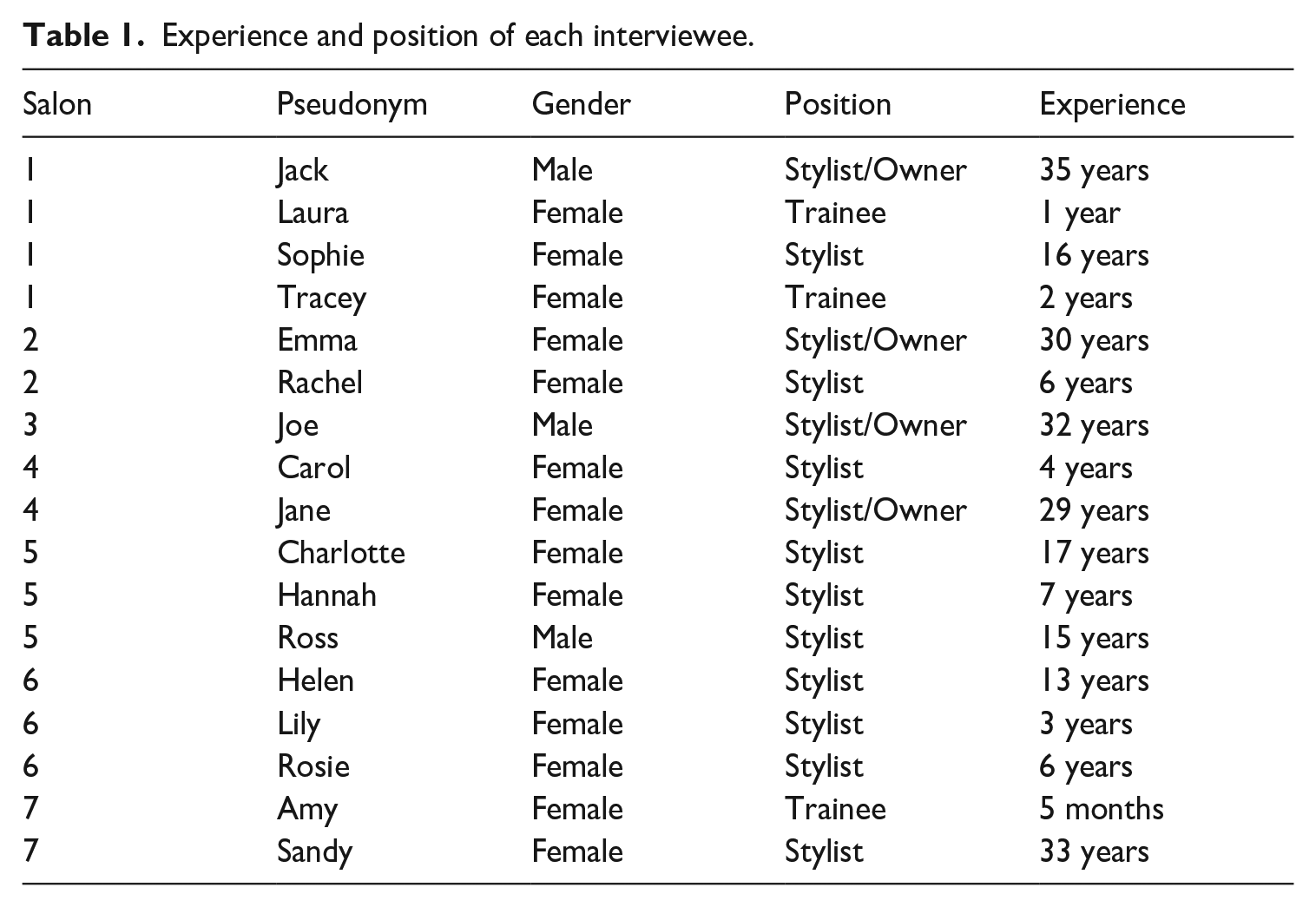
As shown in Table 1, three interviewees were male and 14 were female (reflecting the female dominance within the sector). All the interviews, which were recorded and transcribed, were conducted in the salons and lasted between 45 minutes to one hour. Interview questions covered a range of topics, including previous employment, perceived relationship with customers and personal appearance at work. Open-ended questions (e.g. ‘what does a typical day at work involve?’) were asked to elicit information concerning experiential knowledge and were followed by questions relating to participants’ emotional labour, such as ‘how do you define your relationship with clients?’. Several unexpected findings emerged from the interviews relating mostly to the diverse nature of client–stylist relations at different stages of development, the negotiation of which was crucial in the creation of closeness and trust.
Data were also gathered through observation, whereby the lead author observed interactions between stylists and clients in salon 1 (as listed in Table 1). Salon 1 was, like the other salons, small and independently owned, comprising five stylists, including the owner. Observations were undertaken over a three-month period, amounting to a total of approximately 75 hours, occurring both during the week and weekends to observe varying levels of client attendance. Notes were recorded initially using a smartphone to avoid discomfort resulting from the visible use of a notebook. Detailed notes were written up after each observational session. Where possible, conversations were recorded to capture the richness of dialogue. Conducting observations in the salon, a public space, produced various ethical considerations. Although consent was obtained from stylists, it was unfeasible to acquire consent from every client that entered the salon. As a partial resolution, only clients who attended the salon regularly are individually represented in the data. On account of her regular attendance, the lead author was able to acquire verbal consent from these clients, developing a rapport that allowed the opportunity to explain the nature of the research and confirm anonymised representation.
During observations, the leader author talked with both stylists and clients to gain partial immersion in the salon’s social milieu. The process of immersion was eased by the lead author being female, given that the space was primarily occupied by women. Although the lead author was younger than many of the clientele and senior stylists, this did not pose a notable issue and actually eased interactions with the junior stylists who were closer in age. As the observations were conducted over several weeks, the same clients were observed attending the salon more than once over the study period, providing a temporal snapshot of client–stylist relational trajectories. This allowed the observation of the interpersonal nuances present in the stylists’ performance of emotional labour, dependent upon the temporal factors of experience and depth of client relations. Observational sessions lasted between three and five hours. This often included a lunch hour when opportunistic, informal questioning occurred relating to earlier observations and stylists’ interpretations of recent client encounters. As these were in situ, spontaneous interviews, they were recorded in a paraphrased manner as part of a field note entry. All the verbatim quotations presented are from the semi-structured interviews.
The data were analysed using an inductive thematic approach and constant case comparison. Observational field notes and interviews were analysed together as textual data to develop an initial coding frame from which themes pertaining to working in a salon and developing relations with customers emerged. An additional round of coding elicited axial codes that structure the presentation of findings. Unified by the overarching notion of time, the latter codes include experience and interactional skills, situational performances and, finally, recurrent contact and the gradual development of relational trajectories.
Findings
The temporally bound relations established in the affective context of the salon are theorised according to three themes that were identified through axial coding. Time underpins all three themes, but we do not position time as imposing change so much as allowing client–stylist relations to flourish. The first theme details the learning of basic soft skills over time and with growing work experience. Our second theme builds upon this by detailing the enduring struggle junior stylists experience when faced with diverse relational conditions. This illustrates that adaption partially entails a temporal accomplishment. The final theme demonstrates how relational trajectories at various stages of development instigate conceptual and performative changes. Specifically, we note that surface acting is susceptible to situational adaption, as the relational shift from a purely transactional exchange to a ‘friendship’ potentially reshapes normative display rules. Therefore, performative rules that once marked encounters as economic transactions change as interactions become increasingly social. Each theme is considered in light of the contextual detail contained within Table 1.
Time and internalising soft skills for emotional labour
Soft skills such as ‘oral communication, team working, customer handling and self-preservation’ (Hurrell, 2016: 605−606) were found to be centrally important. Experienced stylists in particular emphasised the necessity of such skills; salon owner Joe, with 32 years’ experience, even provided in-house training to aid such skills development: We do a lot of customer service skills and training . . . it’s very crucial, I would say 50% of the hairdressing is cutting hair, colouring hair and 50% is the other stuff – the other stuff being customer service – you know, people need to be wowed.
Joe attributes equal weighting to technical skill and the ability to impress clients through customer service. To ensure clients are ‘wowed’, Joe was also committed to training staff in soft skills, something deemed especially necessary for junior stylists who were perceived by experienced stylists as lacking the required interpersonal skills. All stylists who expressed such a concern were those with significantly more occupational experience. Sandy, for example, conceived that younger stylists with less experience have ‘forgotten how to talk to people’. Similarly, Jane acknowledged that despite their technical skills being adequate, by ‘18 or 19, they’ve [trainees] got to start to show that bit of confidence with the client’. Senior stylists regularly witnessed moments of tension, discomfort and difficulty as juniors stumbled in their interactions with clients. Such moments occurred as juniors ‘hated answering the phone . . . [and] went bright red’ and ‘wouldn’t talk much at the basin’ (Charlotte).
Additional time in the role, where diverse conditions and varying emotional demands necessitated adaption, was thought to resolve this perceived lack of interpersonal confidence: ‘the more they can work on clients, the more they can experience different hair types, different skin types, different problems’ (Sophie). Sophie’s assertion suggests experiencing the ‘different problems’ that emerge across the unpredictable terrain of interaction allows less experienced stylists to enhance and develop their skillset. Skills can be taught; however, it is through application and practice during real social encounters that they are learned as part of a situated performance. Senior stylists therefore acknowledged the centrality of experience in producing capable stylists. Emma, a salon owner with 30 years’ experience, asserted that ‘if you could teach experience, then I’d be a multi-millionaire’, speaking about the importance of time within the learning process.
Junior stylists, with minimal experience and/or still in training, echoed the view of senior stylists regarding the acquisition of interpersonal skills: ‘I was really shy when I first started, I really struggled to talk to people, but now I’m dead chatty with everyone, it’s [communication] so important for the job’ (Laura). Laura, a junior stylist with one year’s experience, suggested that time spent within the occupation allowed her interpersonal skills to flourish from a less experienced state of reservation to a relaxed and socially adept persona. Junior stylists emphasised the challenges of immersion in the social environment of the salon that represented some clients’ ‘second home’ (Laura) on account of their regular attendance. They also reported appearing as an alien presence and struggling to be socially accepted by these clients. In still occupying this role, Amy, a junior of only 5 months, reasoned: ‘you can’t expect people to trust you straight away’. Time, however, was understood as a solution given that clients would grow accustomed to the junior’s presence and a relational terrain could gradually be established. Inexperienced stylists would begin to adopt the tacit rules that ensure the smooth functioning of the salon, learning both how to perform appropriately and how to utilise available props. There is, then, a latent sense of theatre.
Emotional labour and learning to adapt over time
Analogising the service encounter to a theatrical performance risks implying that a well-rehearsed, uniform performance is sufficient to satisfy all audiences. A generic performance may satisfy many clients; however, stylists spoke of a need to remain flexible: If you’re just moving within one . . . social type, that’s your only social interaction, but in hairdressing it’s different all the time, there’s the butcher, the baker, the candlestick maker. (Jack)
Jack’s comment speaks to a diverse clientele. Diversity in terms of age, gender and occupation was observed in the salon during fieldwork. With increased time in the job, stylists learnt how to adapt to clients from diverse demographic groups and their ‘transaction defining cues’ (Rafaeli and Sutton, 1989: 16). The nuanced capability to intuit and respond accordingly illustrated a temporally rooted shift from initial entry into the role, to a lengthy period of situated experience. This was apparent from the outset of the initial greeting offered, which depended on the demographic of the customer and the depth of the client–stylist relationship. Take, for example, the case of clients arriving at the salon with children. Where an established relational trajectory was shared, the young children of clients were greeted enthusiastically with sweets and an affectionate hug. By contrast, older male clients whose attendance was sporadic or an isolated event, were the recipients of a more muted greeting without physical contact. Rather than automatically incurring changes, time creates conditions for recognising and embracing situational nuances such that stylists not only learn the need for various responses, but also specific responses in the face of relational particularities. Such nuances reflected an extension of emotional labour that was developed over time. This change over time was associated with varying degrees of familiarity, intimacy, touch and favours. Adaption stalled among junior stylists who struggled to cope with the heterogeneity of the salon’s clientele, even where they understood the need for emotional labour: I do find that younger girls find maybe a woman who, a professional woman, you know, maybe in her mid-40s, who is, can be a very confident woman, can make a youngster feel a little bit nervous. (Jane)
Tracey, a trainee stylist of two years, echoed this sentiment. During an informal interview, Tracey revealed she was nervously anticipating the arrival of a particular client who she identified as an intelligent, career-driven solicitor whose preoccupation with work made Tracey ‘feel on edge’. Experienced stylists instead communicated in a relaxed and confident manner with all clients who entered the salon regardless of demographic differences, tailoring their performance in the face of each new client. This client variation required complex interactional skills as customers respond to different modes and types of conversation. A mismatch in client–stylist characteristics (e.g. relative experience, age and confidence) exacerbated the challenge. Time in the job and familiarity with specific clients instead afforded stylists the relational opportunities to uncover, register and respond appropriately to a client’s particular needs and preferences. Stylists therefore learnt to detect client nuances and locate these within a broader biographic backdrop. In other words, over time stylists were able to make assumptions about clients’ interests and emotions based on accumulated knowledge of that client’s background. This included specific detail regarding a client’s family, occupation and personality, as well as general demographic information including age and gender. Effective interaction with clients therefore constitutes a learnt accomplishment dependent upon the application of tacit knowledge acquired through occupational experience. This is, not surprisingly, a particular challenge for less experienced hairdressers for whom tacitly learned adaption takes time to acquire and relational trajectories remain in their infancy.
Relational trajectories and the development of ‘commercial friendships’
From the first meeting between stylist and client, time nurtures the growth of relational trajectories unique to each interaction. These trajectories stem from an interweaving set of relationships that emerge gradually, based on recurring encounters. This recurrent contact allows for transformative relations that shift from being informed by display rules and based upon surface acting, to resembling a quasi-friendship. Where clients attended more regularly, relations appeared stronger and conversation drew heavily from understanding and knowledge refined through frequent contact. The progression of relations required skills that, rather than being premised upon conformity with prevailing social norms and occupational display rules, were flexible, allowing for adaption to the relational idiosyncrasies of a client–stylist dyad. Relations developed as time facilitated the sharing of narratives that project backward and forward, leading both stylist and customer to frame, engage with, and care about the life and emotions of the other. This manifests in celebrations, disclosure of personal detail and quasi-therapeutic sharing (where the sense of catharsis can flow from client to stylist or the other way). Time also allows a nuanced form of interaction that is emotionally sensitive to the client, based on assessments of past mood and life narrative. Subsequently, such relations were the preserve of stylists whose years of experience afforded opportunity to build trust and develop a relationship.
It is, however, important to note that these encounters occur in a financially asymmetric relational context. Interactions are underpinned by economic exchange: their timing, location and task-centredness marking them as financially motivated interactions: the customer pays. For small-scale local salons there is a strong incentive to retain customers as part of a steady income (Price and Arnould, 1999). Accordingly, clients typified as ‘regulars’, such as those attending on a weekly basis, are the recipients of personalised services intended to demonstrate appreciation and, ultimately, ensure client retention. These economically incentivised embellishments included preferential out-of-hours appointments, discounted services, free product samples and a willingness to go the extra mile. Only stylists with several years’ experience offered such services, as illustrated in the following field note: Field note #1: Before leaving, Mrs D glances out the window, and another client inquires whether she requires her to move her car out of the way. However, Mrs D states, ‘No thanks, I’m just waiting for Jack or Sophie to get me out’. She then catches Jack’s attention and asks, ‘Would you mind?’ [while also waving her car keys at him]. Jack does not seem surprised by her request and happily obliges, excusing himself with his current client to reverse Mrs D’s car out of her space.
The above illustrates the provision of assistance unrelated to the primary objective of the service. This assistance appeared though as a ritualised component of the client’s appointment. The client’s request was communicated in the absence of specific language, as she uttered a vague, non-specific request and simply waved her car keys. This gesture was sufficient enough as Jack, the salon owner, and Sophie, an experienced stylist, seemed to anticipate this request. ‘Unequal exchanges’ within service relations are common (Hochschild, 1983: 86); some clients are the recipients of tokenistic gestures, embellishments and assistance, while others are not. Time is a crucial means of demarcating which clients deserve an embellished service on account of their regular attendance. Provision of a specialist and attentive service for regular clients symbolically reaffirms their relational superiority (Korczynski and Ott, 2004), ensuring they remain sufficiently ‘enchanted’ by the service. Time therefore has the potential to progressively restructure client–stylist relations, changing the interpersonal skills that help sustain and further develop the relationship.
A developed relational trajectory may result in additional services intended to retain clients, while allowing also for a more authentic emotional performance. Most service encounters are marked by the suppression of emotions deemed visceral or taboo (Rafaeli and Sutton, 1989; Seymour and Sandiford, 2005). However, the distinct relational trajectory fostered between client and stylist allowed the comfortable exchange of unfolding stories and emotions. The need to surface act therefore became temporally and situationally dependent, characterised by a performative fluidity. Moreover, a typical hair appointment lasted one to two hours, allowing stylists to intertwine necessary ‘task-directed talk’, with talk ranging from phatic to highly emotive (Stefani and Horlacher, 2018). From observations, conversation related to hair transpired primarily at the start of an appointment, followed by fleeting interjections intended to verify client satisfaction. Beyond that, stylists were free to explore and establish a relational terrain appropriate for the client, utilising opportunities to tease out and interpret personal detail. Where clients were chatty and open, relations were able to develop, and quasi-friendships often resulted. Under such circumstances, the need to maintain a positive mask was reduced as stylist and client shared experiences not only of joy, but illness, grief and anxiety. These were relationships that had unfolded over time and intensified through the client’s repeat attendance. In conceptualising this unfolding relationship, Charlotte likened her client interactions to a ‘comic book strip’, a metaphor highlighting the progressive nature of the encounters that develop episodically, frame (visit) by frame. These episodic encounters meant stylists became gradually embedded into the life course of long-term clients: I mean, a couple of my clients lately have been married, [I’ve] done their hair, her son’s just had a baby so it’s now nice to see that, but that’s frightening cause then you start seeing their kids growing up and now they’re getting married. (Emma, salon owner with 30 years’ experience)
Stylists’ experience of the pivotal events in their clients’ lives was not detached or peripheral but entailed a degree of emotional attachment and investment. Regular appointments provided the opportunity for clients to disclose personal and familial details, cumulatively building on information exchanged previously and establishing communicative terrain for future encounters. For example, regular clients shared sombre details pertaining to poor health, loneliness and grief, as recorded in the following field note: Field note #2: A client colloquially referred to by the salon owner as ‘Mrs N’ generally attends the salon on a weekly basis. Very little conversation relates to the client’s hair, leaving multiple conversational gaps, allowing Mrs N to share intimate concerns relating to living alone (domestic practicalities and finances), her health (fairly graphic details of ailments) and the declining health of her husband as well as his residency in a care home. Although there is very little her stylist can offer by way of advice or solution, an empathetic ear that absorbs and responds to concerns accordingly appears sufficient in providing at least a cathartic means of escapism from the melancholy associated with old age.
The affective climate of the hair salon is widely noted as facilitating catharsis through communication (Hanson, 2019). The compassionate responses observed among stylists emanated from a seemingly genuine connection as opposed to merely a nuanced interpretation of display rules (Frost et al., 2000). The empathetic reception offered by stylists represents a temporal accomplishment, perfected according to the detailed relational trajectory constructed through Mrs N’s frequent attendance. The exchange of intimate detail was not exclusively one-way, as stylists discussed their own relationships with certain clients, which provided a personal source of catharsis. The freedom to converse freely with clients was grounded in well-established relational trajectories. Jane, a salon owner, exemplified such emotional reciprocity: I’m probably too open cause I’ve been through marriage, divorce, had three children, I’m remarrying in a few weeks and they’ve [clients] been with me the whole journey, so very much they’re like a therapy to me.
Jane identifies her regular clients as permanent fixtures within the changeable reality of her life course. Certain circumstances may be unforeseen and turbulent, yet, for Jane, clients served as stable and unwavering witnesses to her personal narrative and, more poignantly, as friends. The consequential ‘reciprocal self-disclosure’ represents ‘an important factor in friendship formation’, distinguishing it from an encounter with an acquaintance (Price and Arnould, 1999: 38). Disclosure of more sombre personal detail indicates a conceptual shift from a relationship informed by normative display rules, to one guided by an intuitive analysis of the immediate situation. Time becomes an essential past–present feature in the experience of deeper worker–client relations in personal and emotional terms. This includes the development of reciprocal relations centred upon therapeutic listening and an empathetic reception. Given that disclosure of personal troubles was a frequent occurrence in the salon, participants described creating therapeutic spaces and atmospheres within client interactions: I’ve had a lot of customers cry on us, about splitting up with their boyfriend or something tragic happening in their family, so you’re a bit like an agony aunt when you’re a hairdresser. (Helen, 13 years’ experience)
Helen highlights the emotional weight put upon stylists as customers literally ‘cry on us’ and divulge life’s melancholic realities. A well-established trusting relationship imbues the encounter with therapeutic symbolism, positioning it as akin to a doctor–patient consultation due to perceived confidentiality. This quasi-medical confidentiality created an additional dimension to the hairdresser–client relationship beyond that of friendship, whereby clients can comfortably disclose personal information knowing it will not be shared. With well-known clients, the role assumed is one of ‘half-friend, half-therapist’ (Hannah, seven years’ experience). Disclosure of intimate information is determined by clients’ perception of their stylist as both a friend and a paid service provider capable of listening and offering support. This perception was, however, temporally rooted as client relations in their infancy did not typically entail such intimate conversation. Rather, conversations involving either a junior stylist or a new client were observed as centring upon task-related talk focusing upon the cutting and styling of the client’s hair. Younger stylists therefore reported that clients did not open up to them on account of their limited time in the salon, emphasising the importance of time in cultivating trust and establishing a relational terrain prime for further development.
Discussion
This article situates temporality within the context of relationality, taking into consideration the role of time through recurrent client–employee encounters and the subsequent development of affective relations. We have suggested a new direction for theorising contemporary service work, where emotional labour emerges as a nuanced interpretation of temporal and experiential conditions. As such, our findings make novel contributions to existing sociological research on the nature of service work by broadening emotional labour to include a temporal focus. Although our research focuses on hairdressing as a particular context, our insights have relevance across other service roles that entail episodic and recurrent contact. Our findings expand sociological understandings of service work by revealing how the performance of emotional labour is continuously adapted as relations evolve over time. To clearly illustrate the transitional and temporal reality of emotional labour in recurrent service encounters, Figure 1 was developed on the basis of our findings and analysis.
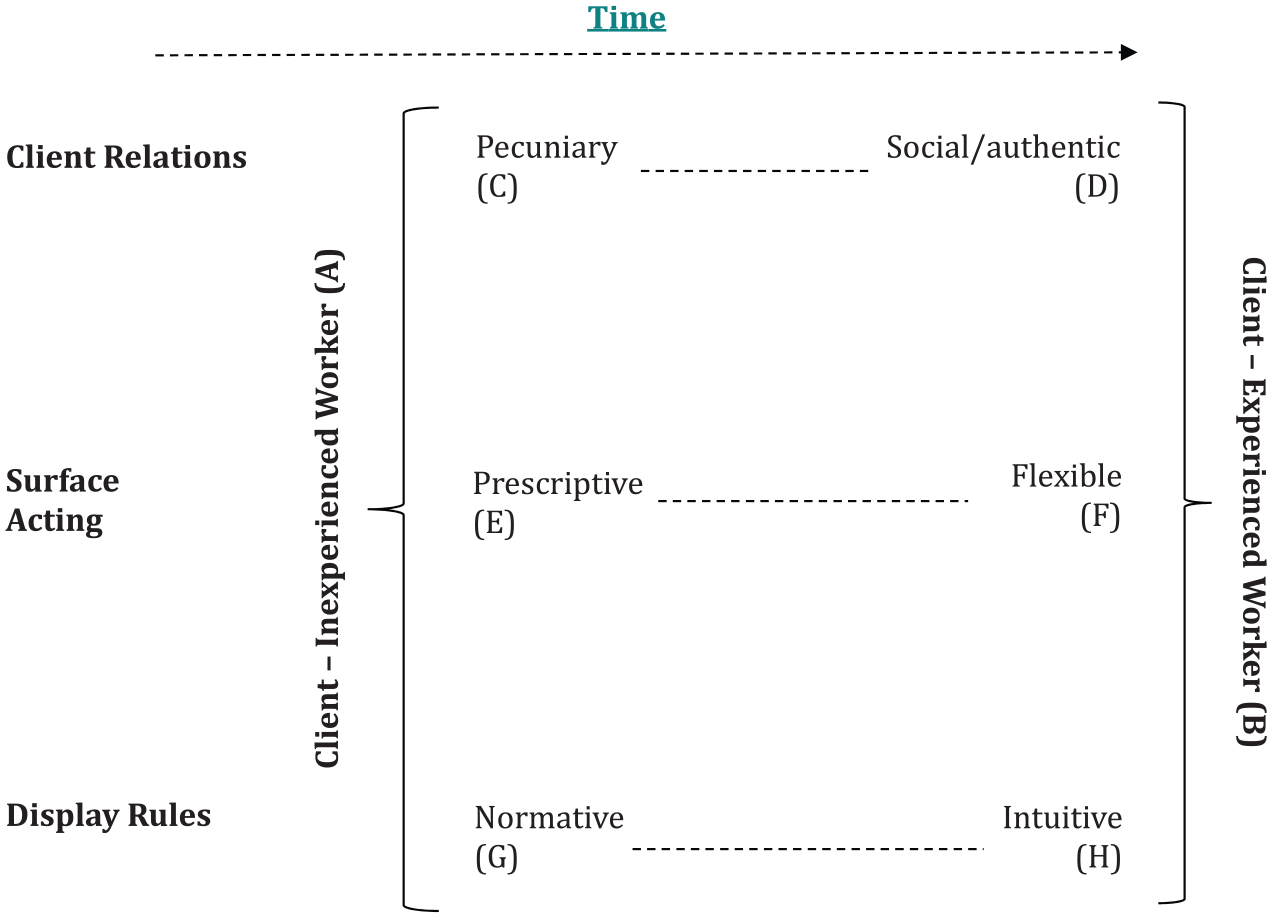
Temporality and the performance of emotional labour.
The performance of emotional labour becomes temporally rooted and dependent upon workers’ abilities to read and react to particular interactional situations through skills learned over time. In returning to our earlier research questions, stylists spoke of an ever-advancing situational understanding prompting changes at several conceptual locations, as illustrated in Figure 1. The continuous accumulation of experience (A to B) dynamically alters the interactional terrain, requiring adaptive responses from service employees. Adaption is multifaceted, occurring at the conceptual locations of client relations, surface acting and display rules. The ever-evolving client–stylist trajectories require nuanced performances of emotional labour. Figure 1 seeks not to imply automatic or deterministic transitions. Rather, time engenders performative fluidity where the interactions between clients and stylists are adapted depending on the history of their relationship – what we call the relational trajectory.
Recurrent encounters reshaped individual performances and allowed social relations to flourish. Individually, stylists relayed a personal narrative where experience allowed their interpersonal skills to flourish into highly intuitive relational competency. The potential to acquire soft skills gradually through experience problematises the contention popularised by research, policy-makers and employers that if an individual does not present with sufficient soft skills from the outset, they will permanently be lacking (Gatta et al., 2009). For those with comparatively minimal experience, there was an acknowledgement that the ability to comprehend the nuances of social interaction and enjoy the perks of authentic expression was dependent upon past–present encounters. As indicated by Figure 1, time builds individual experience (A to B), which incurs more targeted changes pertaining to the (re)-conceptualisation of client relations (C to D) from economic to increasingly social ‘commercial friendships’ (Price and Arnould, 1999). A well-developed relational narrative reshapes how situations are understood, in turn altering commitment to surface acting and the interpretation of conventional display rules.
All interactions, including those that transpire in the occupational context, are subject to normative ‘rules of conduct’ (Goffman, 1967: 55). However, recurrent contact enabled the development of an expansive relational terrain. Crucially, the direction of this terrain was dependent on prior encounters that potentially allowed rejection of service-based norms such as discussing taboo topics and sharing negative personal experiences. These are typically identified as a violation of normative display rules (Ashforth and Humphrey, 1995). Yet, established client–stylist trajectories facilitated a more liberal conversational terrain, whereby the reciprocal disclosure of divisive opinions and sombre topics presented as a hallmark of a more developed relationship. Display rules became subject to a more nuanced level of interpretation based upon an attuned and intuitive understanding of the client informed by past encounters (G to H). Client relations are, however, variable, according to the frequency of their visits, the duration of appointments and the history of their interaction with stylists. Stylists therefore exercised discretionary judgement to deliver a ‘mastered performance in a particular context’ (Hurrell et al., 2013: 162). The ‘particular context’ necessitates the intuitive activation of the correct ‘face’ (Tseëlon, 1992) accompanied by appropriate interactional skills to suit the immediate and individualised needs of the specific client.
Hair demands routinised maintenance (Holmes, 2018), allowing recurring client–stylist contact that facilitated the reciprocal exchange of personal stories. A ‘commercial friendship’ often developed despite underlying socio-economic and occupational disparity (Price and Arnould, 1999). Temporal conditions of recurrence therefore alter current understandings of emotional labour by gradually transforming interactions from purely situated, economic transactions to more social and authentic encounters. Crucially, this transition enables a degree of freedom from the normative emotional restraints imposed upon stylists (E to F). Freedom to express, rather than suppress, was dependent on the development of a client–stylist relationship that, when sufficiently established, enabled stylists to express their emotions more authentically. The resolve to surface act therefore became increasingly flexible, reflecting the episodic construction of a relationship. Rather than the client and stylist assuming ‘different rights to feeling and display’ (Hochschild, 1983: 85−86), stylists are also able to express their personal feelings. Recurrent encounters assigned different rights and ascribed a new reality to the client–stylist relational dyad. Responses to the passage of time and the diverse situational conditions created are not homogenous or automatic. Instead, responses are individualised, dependent upon relational narratives shared with clients and personal experience within the role. Figure 1 therefore features overlapping categories that fluidly alternate depending upon the individual, the surrounding context of an encounter and the broader relational terrain established. As experience mounts and client–stylist trajectories unfold further, each stylist’s performance is subject to constant (re)-evaluation on account of an ever-changing relational landscape.
Conclusion
The findings advance current sociological understandings regarding the performance of emotional labour. Time in the form of recurrent contact and experience engenders a performance that is nuanced and adapted to the relational context of a specific client who is seen as particular. The sociological significance of our insights extends beyond the specific context of hairdressing as similar effects could be visible in other service jobs, such as nursing, teaching or certain retail and hospitality contexts. Essentially, any service context involving recurrent contact allows the development of a distinct relational trajectory. We therefore present an original lens through which to interpret emotional labour as a temporally rooted accomplishment that is continuously adapted with each encounter. Focusing upon the situational and interactional conditions allows a nuanced analysis, examining how service providers can evade normative display rules and embrace a more authentic façade. Fundamentally, this article illustrates how the conceptual, performative and relational changes instigated by time are highly individualised. Time does not impose but rather provides the structural opportunity for skills to develop and relations to progress, the direction of which is determined by the distinct interactions between the service worker and the client.
Footnotes
Funding
The authors received no financial support for the research, authorship, and/or publication of this article.