




Abstract
The article examines the evolution of migrant low-wage employment in the context of structural changes in the German labour market. By drawing on data from the Socio-Economic-Panel, it seeks to answer why low-wage jobs disproportionally rose among migrants since the late 1980s. It argues that while human capital characteristics mattered to some extent, institutional and organisational changes were more important to account for worsening earnings. When linking the findings to the broader debate about migration and labour market segmentation, several issues emerge. First, the extent of low-wage jobs is not fixed but shaped by historically specific segmentation patterns that may change over time. Second, whether less-skilled jobs are precarious and of low pay depend above all on the presence of inclusive labour market institutions and power relations between actors. Third, the growth of low-wage jobs cannot be considered independent of the available labour supply, including a rise in cross-border mobility.
Introduction
Germany has experienced one of the sharpest rises in low-wage employment in Europe in the last two decades. Whereas it was viewed traditionally as a coordinated market economy with a relatively egalitarian wage structure (Hall and Soskice, 2001), it now has one of the largest low-wage sectors in the ‘old’ EU-15, on a par with liberal countries such as the UK and Ireland (Fritsch et al., 2014: 99). Among reasons that have been cited for the rise in low-wage work are the move towards service sector employment, the economic repercussions of reunification, an increase in the bargaining power of employers and the partial liberalisation of the labour market that culminated in the 2002/03 Hartz-Reformen (Bosch and Kalina, 2008; Carlin et al., 2015; Streeck, 2009; Thelen, 2014).
Among groups that have been most affected by the rise in low-wage work are, besides women, the less skilled and the young, especially migrants. This seems to be less surprising as it is a well-established fact that the latter are over-represented in vulnerable employment (e.g. Anderson, 2010; Castles and Miller, 2003; Piore, 1979). However, in Germany it was not always like this. In 1980, for instance, foreign workers in full-time employment had a slightly lower share of low-wage work than German employees, which was attributed to their large presence in the manufacturing industry with its comparatively high-wage agreements (Bosch and Kalina, 2008: 33). Since the late 1980s, this trend was reversed as the low-wage share of migrants sharply rose (Kalina and Weinkopf, 2015: 5). What were the main factors driving this development?
This article examines the evolution of migrant low-wage employment in the German labour market in a long-term perspective from 1985 to 2015. By drawing on data from the German Socio-Economic-Panel (SOEP), it aims to identify the main factors behind the disproportionate rise in migrant low-wage work and trace possible changes over time. Of particular interest is to what extent processes of national and ethnic stratification in the labour market intersect with broader processes of structural and institutional changes.
The contribution of the article to the literature on employment and migration is threefold. First, it shows that the extent of low-wage jobs is not predetermined but shaped by historically specific segmentation patterns that may change over time. Second, the article emphasises the crucial role of labour market institutions and actors in shaping the extent of low-wage work. Third, while pointing to the importance of employers as ‘architects of inequalities’ (Grimshaw et al., 2017: 12), it suggests that an increase in low-wage work cannot be considered independent of the available labour supply, including a rise in cross-border mobility.
The article proceeds as follows. It first contextualises the topic in the theoretical discussion about migration and vulnerable employment. This is followed by an outline of the research strategy. The subsequent section examines the situation of migrants in the context of structural changes in the German labour market in a longer-term perspective. This is followed by a logistic regression analysis that seeks to identify the main determinants of low-wage work. The discussion and conclusion summarise the main findings of the study and links them to the broader debate about migration and labour market segmentation.
Migrants and vulnerable employment
There are competing theoretical explanations for the labour market disadvantages of migrants. Many discussions start with an appraisal of human capital theories. The basic assumption of this approach is that differences in earnings are the result of different investments in qualifications, skills and knowledge (Chiswick, 1978). Usually, three reasons are cited for the inferior labour market position of migrants. First, migrants may have on average lower educational qualifications than the host country population (Borjas, 1985). Second, the move from one country to another can go hand in hand with a devaluation of existing human capital as the latter is often inextricably linked to specific national societies. This does not only concern language, but also professional qualifications and ‘culturally-specific knowledge’ (Kalter, 2008) about labour markets. Third, as many migrants see their time abroad as only temporary, they may be less inclined to invest in location-specific human capital. Employers, in turn, may share this view and be less inclined to invest in their training, even in circumstances when the stay of migrants turns out to be longer than expected (Granato, 2003: 29).
Educational qualifications, work experience and especially language skills are no doubt important factors that impact on the labour market success of migrants. However, human capital theories have been criticised for their individualistic approach, which ignores the broader social context of migration. As forcefully argued by Portes (1995: 24), migrants are not just ‘individuals who come clutching a bundle of personal skills’ but also members of social groups who are embedded in various social contexts. Of particular importance are networks, which do not only sustain the migratory process but also channel migrants into certain segments of the labour market (Waldinger and Lichter, 2003).
Human capital approaches, like neoclassical approaches more generally, have been further criticised for being too preoccupied with supply-side factors at the expense of the demand side (Grimshaw et al., 2017). How migrants advance in the labour market is not only shaped by qualifications and skills, but also by employer behaviour, labour market institutions and immigration regulations (Anderson, 2010; McGovern, 2007; MacKenzie and Forde, 2009). One approach that emphasises the demand side is the dual labour market theory (DLMT) by Michael Piore (1979). Its main proposition is that the labour market is divided into a primary sector with relatively stable and well-paid ‘good’ jobs and a secondary sector with ‘bad’ jobs that are poorly paid and confer little status and prestige. As domestic workers shun the latter jobs, employers resort to the recruitment of workers from abroad, thereby maintaining the ‘hierarchy of jobs’ (Piore, 1979: 33) in the workplace.
With its emphasis on the social status of jobs and the crucial role of employers in instigating the migration stream, the DLMT offers a stronger sociological approach to the analysis of labour market inequalities that ‘breaks with the neat wage-productivity theorising of neoclassical economics’ (Grimshaw et al., 2017: 3). Although a distinction between primary and secondary sectors is too simplistic as segmentation lines in ‘postindustrial’ economies are more complex, the DLMT still offers a useful analytical framework to capture contemporary labour market divisions (e.g. Felbo-Kolding et al., 2019; McCollum and Findlay, 2015; MacKenzie and Forde, 2009). In particular, its core assumption about distinctive job clusters that co-vary on pay, employment stability and mobility opportunities remains valid in the current ‘age of dualization’ (Emmenegger et al., 2012).
However, the DLMT has been less attentive to the specific national and sectoral context in which labour market divisions emerge and evolve over time. In particular, it has neglected the role of institutions and actors in shaping distinctive employment outcomes. Low-skill jobs may not necessarily be low pay if they are regulated by collective agreements or meaningful national minimum wages (Kalleberg, 2018: 119). Conversely, ‘good’ jobs in internal labour markets can turn into ‘bad’ ones if previous institutional arrangements unravel and the bargaining power of employers vis-a-vis unions increases (Fine and Milkman, 2016: 776). In other words, the quality of employment in different parts of the labour market is not fixed (as DLMT appears to assume) but amenable to change, depending upon the regulatory environment and power relations between actors.
Whether less-skilled employment is precarious and of low pay depends above all on the presence of inclusive labour market institutions and collective interest organisations that may constrain employer power in the workplace (Appelbaum et al., 2010). In the absence of such resources, ‘exit options’ from the regulatory framework are likely to widen, including employers withdrawing from collective agreements or outsourcing work tasks to external service providers, thereby changing the boundary of the firm (Weil, 2014). Other options may include ‘atypical’ work arrangements that deviate from the standard employment relationship in terms of pay and working conditions, including marginal part-time work and temporary agency work that have grown across Europe (Eichhorst and Marx, 2015).
While employers as ‘architects of inequalities’ (Grimshaw et al., 2017: 12) are of particular importance in the analysis of precarious work, an expansion of low-wage jobs cannot be considered independent of the available labour supply (Oesch, 2013). In that sense, supply-side divisions based on socio-economic characteristics (e.g. nationality and migrant status) can reinforce divisions on the demand-side in that groups of workers are allocated to different segments of the labour market (Rubery and Piasna, 2017: 46). However, there is no direct link between the share of migrants and the extent of low-wage jobs as the impact of cross-border migration is filtered through distinctive national labour market institutions. In that regard, inclusive wage-settings appear to be able to absorb an inflow of migrants without leading to a significant rise in low-wage employment (Appelbaum et al., 2010: 10).
The labour market fortunes of migrants are not only shaped by wage-setting institutions and employer behaviour, but also by immigration rules and product market regulations, including the EU freedom to provide services. If migrants are dependent upon a work permit, or even are without regular labour market access, they are more likely to be in precarious employment (Anderson, 2010). This also applies in the case of transnational service mobility if the employment relationship of posted workers is embedded in the home country and labour standards in the host country are only partially enforced (Wagner, 2018). Further, as, broadly speaking, migratory movements have become more skilled, the issue of recognition of foreign qualifications has gained in importance. This is an issue of particular importance in a country such as Germany with its highly formalised system of vocational training and credentialised skills (Kalleberg, 2018: 147).
To summarise, while human capital factors certainly matter to account for labour market inequalities, their explanatory value is limited. Possibly more important are factors connected to the labour market institutions of the host country. In that regard, a decline of collective bargaining is likely to be felt, especially in the bottom half of the labour market where migrants are over-represented. Before the German situation is examined in more detail, the research strategy of the study is outlined in brief.
Data and analysis
This article draws on data from the SOEP (version 32.1). The SOEP is an annual representative panel study of private households in Germany, which has been carried out since 1984. In more recent waves, almost 30,000 respondents in nearly 15,000 households have participated in the study (for more details see Goebel et al., 2019). The SOEP is the largest repeat survey of migrants in Germany and the latter were oversampled, especially in the early interview waves. More recently, a new migration sample of 5000 migrants and their descendants was integrated in the SOEP (Beyer, 2017).
Core topics of the SOEP include, besides socio-demographic information, health indicators and attitudinal questions, also questions on income earnings and employment. The SOEP is thus well-suited to study income distribution and wage inequality over time. As it includes information on the monthly gross labour income and weekly working time, it allows researchers to calculate hourly wage rates. This is of particular importance to the study of low-wage employment as part-time work can be included in the analysis (Lucifora and Salverda, 2009: 264).
In line with international convention, the low-wage threshold was set at two-thirds of the median gross hourly wage. When calculating the threshold, the actual weekly working time (and not the agreed working time) was selected except when overtime was compensated through working time accounts or time off (Brenke and Müller, 2013: 5). Low-wage thresholds were calculated for each year from 1985 to 2015, using the respective SOEP waves in a cross-sectional perspective. The analysis was confined to dependent employees aged 18 to 65 years in West Germany (without apprentices and interns). 1 As it is desirable to examine the labour market situation of migrants in relation to domestic workers, the two groups were distinguished by country of birth (and not nationality).
The analysis proceeds in two stages. The first stage traces the labour market situation of migrant and native-born workers in the context of structural and institutional changes in the German political economy by drawing on descriptive statistics from the SOEP. The second stage estimates the (changing) low-wage risks of these groups through logistic regressions by focusing on two years (1985 and 2015).
From manufacturing to services: Migrant employment and low-wage work
One of the crucial features of migrant employment in Germany was its considerable presence in manufacturing, which was more widespread than in other countries, reflecting different production systems (e.g. Zimmermann, 1993). During the ‘guestworker’ era of the 1960s and the 1970s, around 70% of foreign workers were employed in the industrial sector (including construction) (Herbert, 2001: 213). This distribution remained fairly stable over the years. Whereas a majority of domestic workers was already employed in the service sector by the 1970s, two-thirds of migrants were still employed in industry by the late 1980s (Figure 1). It was only since the 1990s that the foreign-born share in the sector declined in absolute and even more so in relative terms as employment shifted towards services. By the 2000s, the sectoral distribution between native- and foreign-born workers had become more even, although the latter remain over-represented in industry, suggesting a certain path dependency in their employment patterns.
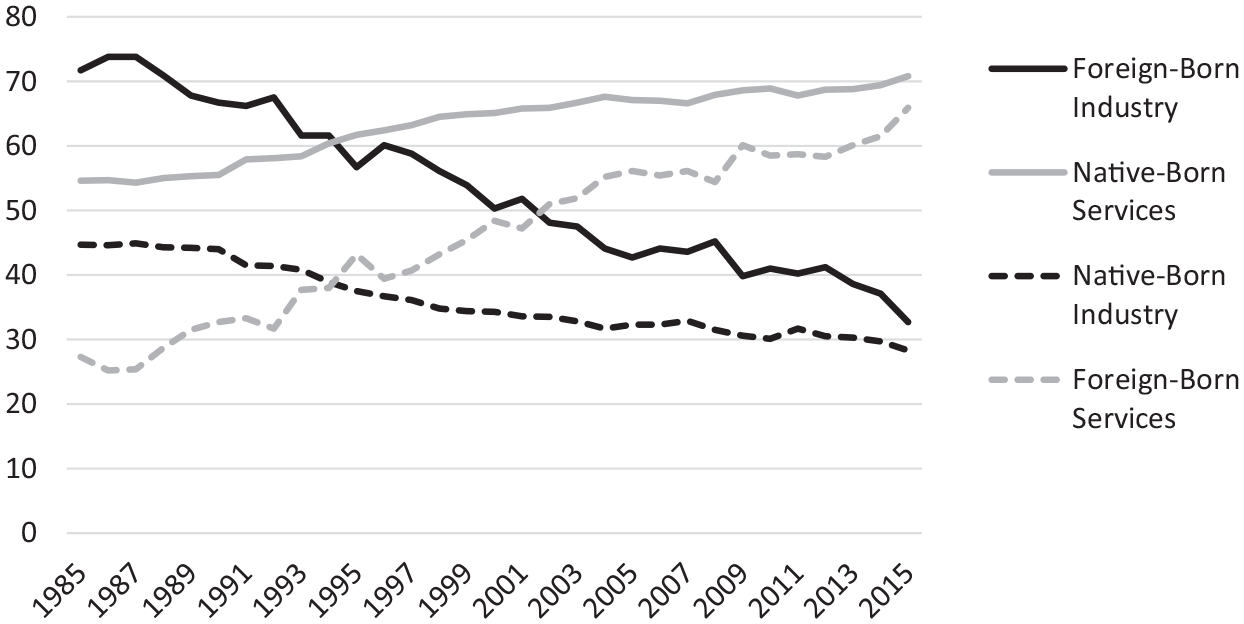
Employment of native- and foreign-born workers by economic sector (West Germany, 1985–2015). 2
In the past, migrants were mainly employed in low-skill industrial work (industrielle Einfacharbeit) (and continue to be over-represented in this segment of the labour market) (Abel et al., 2009: 26). Much of this work was (and still is) arduous, labour-intensive and of low social status, with comparatively little control over work tasks. In terms of segmentation theory, this was employment in the ‘secondary sector’ (Piore, 1979). At the same time, the German picture was more nuanced. Low-skill industrial work was not necessarily low-wage employment as unions pursued an inclusive bargaining strategy in the industry that lifted wages at the bottom (Eichhorst et al., 2015: 45). 3
While some manufacturing jobs fell prey to automatisation or offshoring, others did not – and in fact offered some stability. By 1990, over 50% of foreign-born workers in less-skilled manufacturing jobs were in long-term employment, an above-average share in relation to all dependent employees (Table A-1 in the online appendix). 4 While there was hardly any occupational mobility into white-collar employment, within the group of blue-collar workers there was some mobility towards more skilled positions, albeit on a limited scale (Fassmann et al., 1997: 740–741). This mobility was enabled by the considerable presence of migrants in large manufacturing enterprises where internal labour markets offered some prospects for upward mobility, even for low-skilled workers. Thus, in spite of the physically demanding nature of the work, to some extent these were ‘good’ bad jobs that offered some financial security and even the opportunity for social participation in the workplace as migrants were elected in growing numbers as works councillors (Hinken, 2018). This was quite a far cry from the ‘unstructured work environment’ that Piore (1979: 17) thought to be characteristic of secondary employment. Indeed, it is probably fair to say that with time segmentation patterns became less pronounced, especially in large manufacturing firms (Köhler and Preisendörfer, 1988).
However, such a process of de-segmentation was not irreversible. Many low-skill industrial jobs were contingent upon the historically specific circumstances of the German production model. The economic crises of the 1970s (which disproportionally affected foreign-born workers) reinforced a process of structural economic change and a move towards services, which accelerated after reunification. Data from the European Labour Force Survey suggests that between 1992 and 2008 industrial employment declined by almost three million and service sector employment grew by over five million in the now unified Germany (Eurostat, 2019a). Less-skilled migrants, especially, found it difficult to adapt to changing economic circumstances as they were lacking, or perceived as lacking, many of the skills required for interpersonal service work (Bach et al., 1987: 278). A worsening labour market situation led to rising unemployment, especially among non-EU migrants, a process that continued well into the 2000s. 5
Growing labour market risks, however, were not confined to rising unemployment. When companies embarked on a process of corporate restructuring in the 1990s, they began to cut down on jobs in their internal labour markets. As a result, many low-skill industrial jobs were moved abroad, moved to the margins of companies, or outsourced to smaller firms (Bosch and Kalina, 2008: 84–85; Geishecker, 2002; Goldschmidt and Schmieder, 2015). Outsourcing strategies included the greater usage of supplier firms, subcontractors and temporary work agencies, thereby introducing ‘new organizational boundaries’ (Doellgast and Greer, 2007: 55).
As many jobs were moved to less-regulated segments of the labour market, pay and employment conditions deteriorated. Migrants were particularly affected by this development. Whereas previously their low-wage share did not differ substantially from that of native-born workers (and in fact reflected similar gender divisions), since the late 1980s their pay fortunes increasingly diverged. By the early 2000s, almost one in three foreign-born workers was employed in a low-wage job, further rising to around 35% at the end of that decade before slightly levelling off in 2015 (Figure 2). Among migrant groups, those most affected by low-wage work were recent arrivals from the new EU member states (NMS) as well as those of German descent from the former Soviet Union (Aussiedler), and more generally migrants from South-East Europe (including Turkey), reflecting the legacy of the ‘guestworker’ era (Table A-2 in the online appendix).
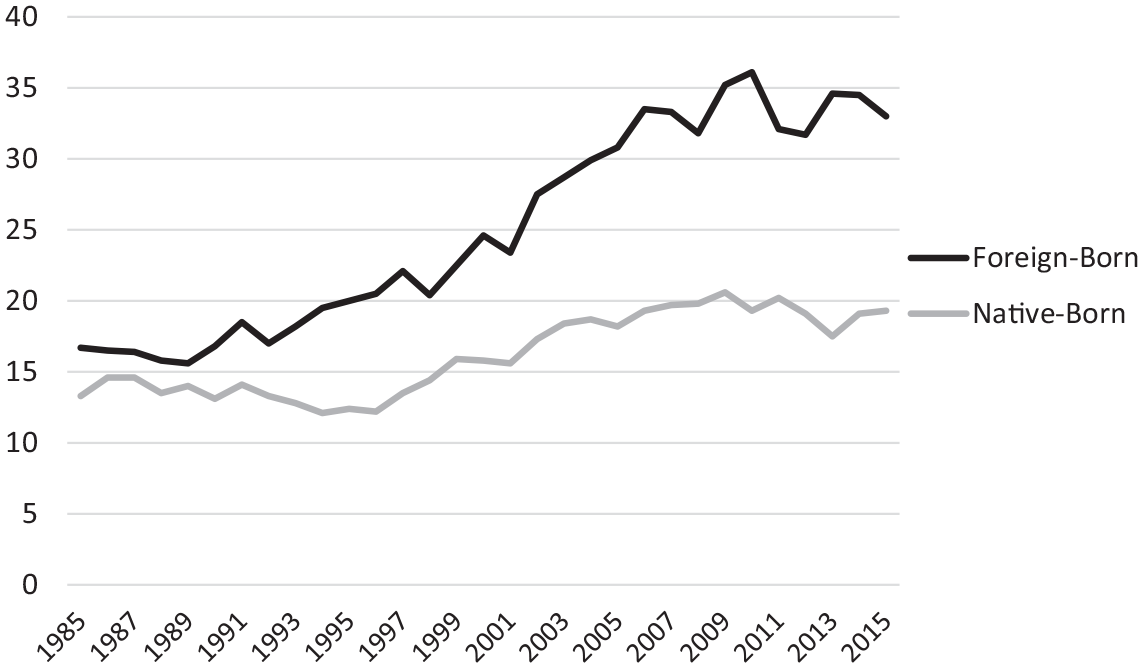
Share of low-wage employment in West Germany (native-born and foreign-born, 1985–2015).
The earnings prospects of male migrants, especially, worsened as part of a broader deterioration of employment conditions for less-skilled men (Giesecke et al., 2015). Whereas female migrants always had a comparatively high low-wage share, reflecting a strong overlap of gender, ethnicity and migrant status in shaping labour market inequalities (Mattes, 2005), male migrants had a low-wage share similar to native-born workers, at least until the late 1980s. Since then, however, their share sharply increased, more so than among any other group in the labour market (Table 1). This development was of course linked to the decline of relatively well-paid low-skill manufacturing jobs.
Share of low-wage employment (country of birth and sex).
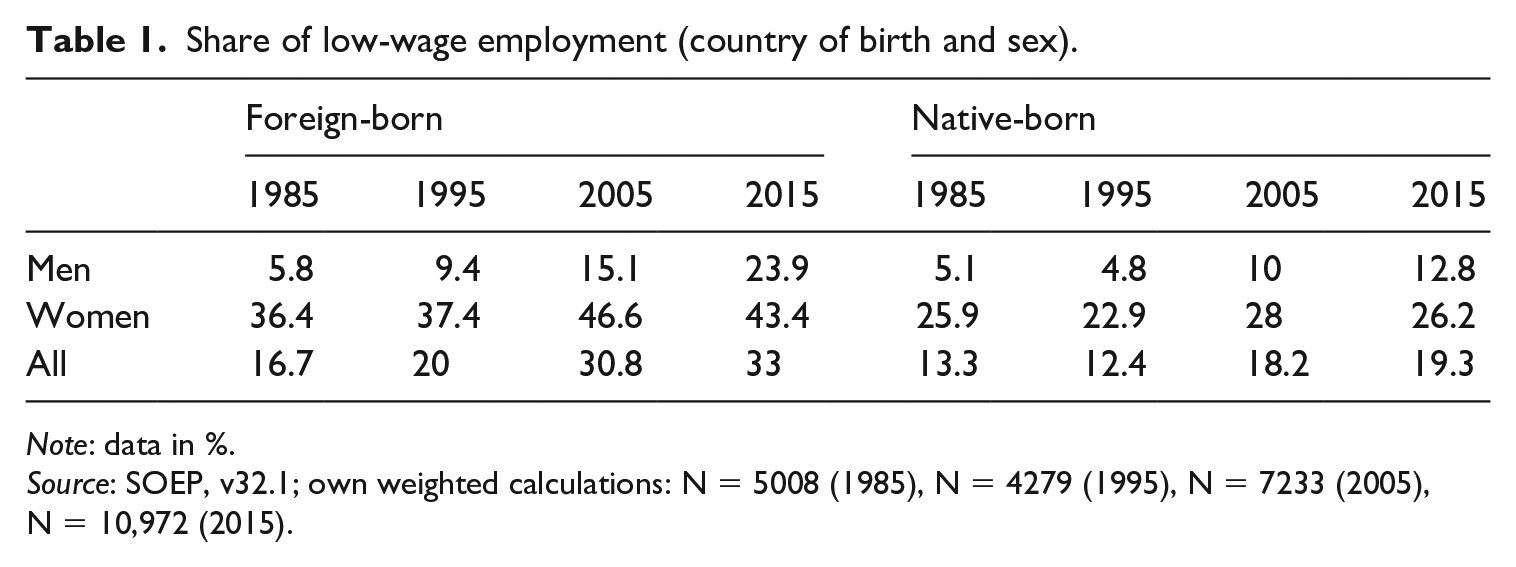
Note: data in %.
Source: SOEP, v32.1; own weighted calculations: N = 5008 (1985), N = 4279 (1995), N = 7233 (2005), N = 10,972 (2015).
A higher wage dispersion at the lower end of the income scale occurred in the context of broader institutional changes in the German political economy (Streeck, 2009). Since the 1990s, the traditional collective bargaining institutions lost their formative influence. This was linked to a number of mutually reinforcing developments, including growing wage competition as a result of product and labour market deregulation in the EU, a trend towards outsourcing of less-skilled activities to industries with lower wage agreements, the privatisation of publicly owned companies and considerable membership loss in the main bargaining associations (Bosch and Kalina, 2008: 66–68). As firms left the employer associations in growing numbers and, more importantly, new establishments never joined them in the first place, bargaining density fell sharply. This development was especially visible in the service sector but not confined to it. Even in the industrial core of metal manufacturing, membership in employer associations declined. Moreover, ‘opening clauses’ from sector-wide pay agreements and special membership for firms in associations that are not bound by these agreements (OT-Verbände) paved the way for the decentralisation and fragmentation of collective bargaining (Streeck, 2009: 46–51).
While the decline of collective bargaining was visible across all industries, its effects were most pronounced in service industries. In ‘personal and other services’ (which includes the hospitality industry) and ‘business services’ (which includes temporary agency work), only a minority of employees are still covered by a collective agreement (Figure 3). 6 In these industries especially (and in distributive services), low-wage work grew since the 1990s. It is perhaps no co-incidence that these industries experienced a huge rise in migrant employment in the last two decades (Table A-3 in the online appendix). This suggests a complex interaction of demand- and supply-side factors in the context of institutional change, whereby employers increasingly make use of a new pool of available labour with less bargaining power to develop a low-cost strategy in some parts of the labour market.
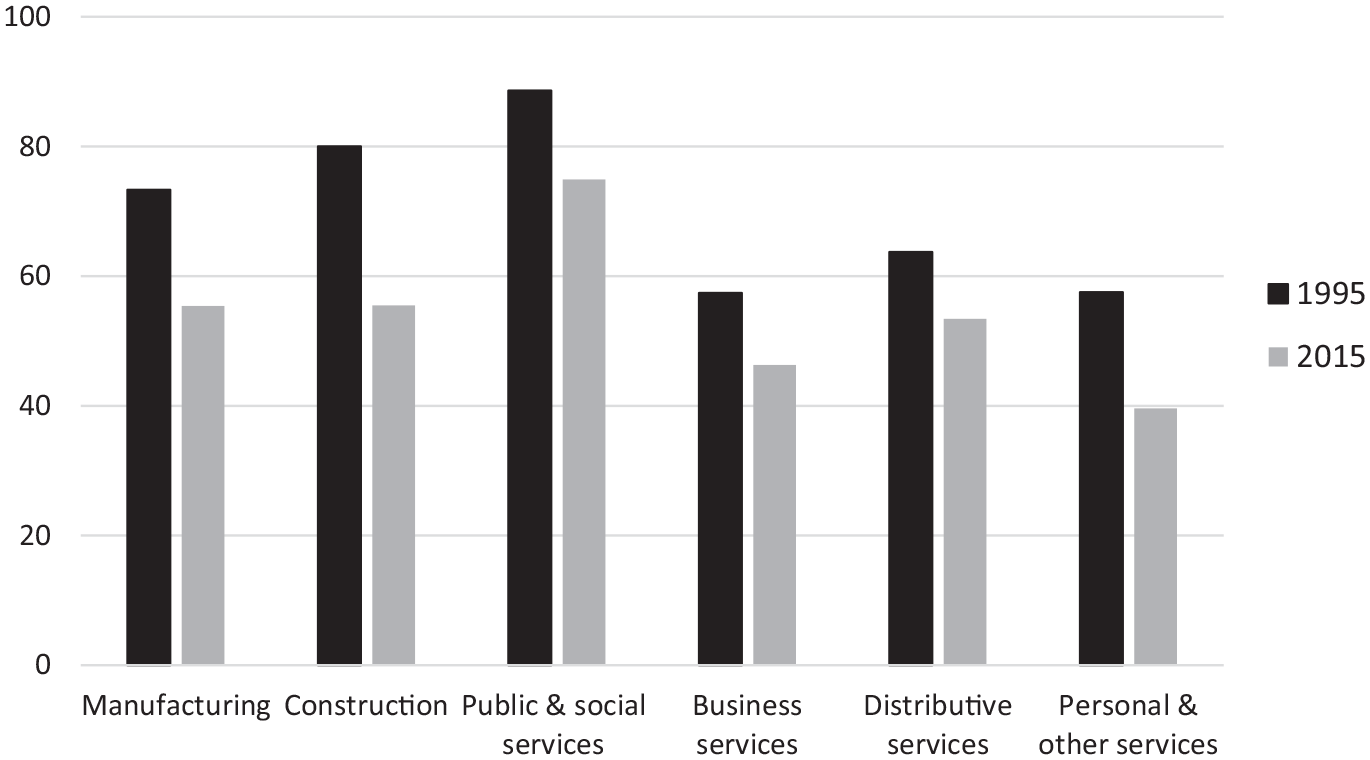
Collective bargaining coverage by industries (1995 and 2015).
Transformational changes in the industrial relations regime went hand in hand with an expansion of non-standard forms of employment (NSFE). Since the 1980s, regulations for fixed-term employment and especially temporary agency work (TAW) have been eased, culminating in the Hartz labour market reforms of the 2000s which abolished the maximum duration for TAW. 7 As regulatory loopholes enabled a derogation from the equal pay principle, manufacturing firms increasingly utilised TAW to circumvent the comparatively high-wage agreements of the industry (Carlin et al., 2015: 68). Moreover, the Hartz-Reformen eased the regulations for marginal part-time employment (Mini-Jobs) which hugely expanded since the 2000s. Mini-Jobs are mainly taken up by women in the service sector and effectively work as a built in ‘deregulator’ (Bosch, 2018) in a conservative welfare state.
There is little doubt that an expansion of low-wage jobs was driven especially by employer strategies in the context of a changing regulatory environment. However, a growth of precarious employment cannot be considered independent of the available labour supply (Oesch, 2013). Besides growing female employment, it was especially a new wave of ‘post-industrial’ migration from Central and Eastern Europe (CEE) that provided a new source of flexible labour (Table A-4 in the online appendix). In the early 1990s, the German government concluded a number of bilateral agreements with CEE countries that provided an institutional framework for short-term labour mobility (Rudolph, 1996). Unlike previous waves of cross-border migration, many of these migrants often entered workplaces that were not unionised or bound by collective agreements. Thus, while there is little doubt that the partial deregulation of the labour market preceded a new wave of work-related migration (Wilpert, 1998), its effects were likely to have reinforced a trend towards more precarious employment.
This article seeks to identify the factors that contributed to the disproportionate rise in migrant low-wage employment since the late 1980s. From the discussion so far, a number of hypotheses emerge:
Hypothesis 1: The low-wage risks of migrants have risen in the light of a less inclusive labour market.
Hypothesis 2: An increase in non-standard employment is likely to be accompanied by growing low-wage risks of ‘atypical’ workers.
Hypothesis 3: A growing trend towards outsourcing has increased the likelihood of low-wage employment.
Hypothesis 4: Manufacturing employment continues to be less affected by low-wage work than service industries.
The determinants of low wages
In this section, the hypotheses are tested using logistic regression analysis. To trace possible change over time, the focus of the regressions is on 1985 and 2015. Usually, an increase in the wage distribution in Germany is dated back to the mid-1990s. However, the migrant low-wage share had already risen since the late 1980s (Figure 2), possibly as an early indicator of a more general trend (Bosch and Kalina, 2008: 34). The time frame of the analysis should not only capture institutional and organisational changes in the German political economy, but also the impact of a new wave of cross-border migration from Central and Eastern Europe.
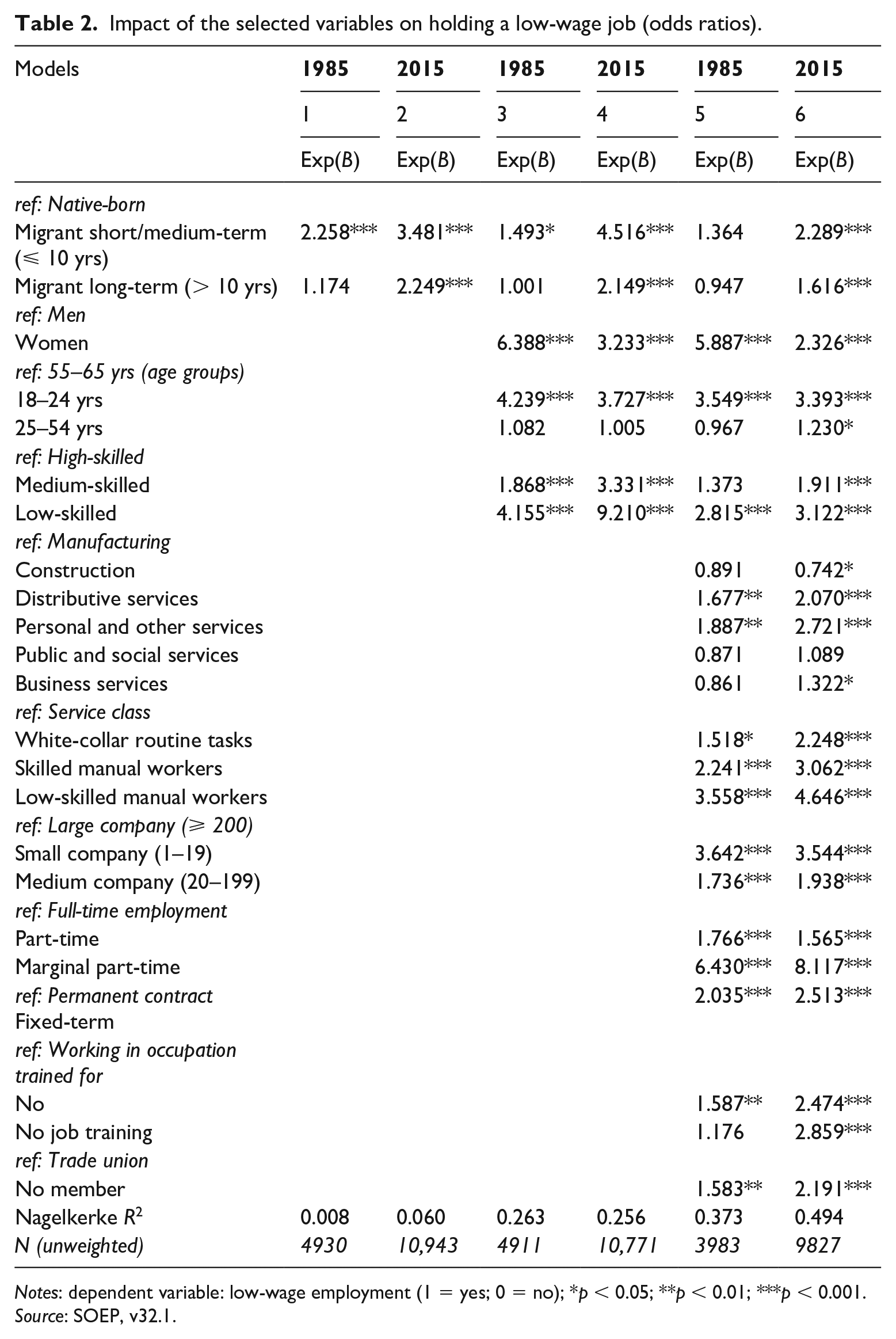
The dependent variable in the regression analysis is low-wage employment (1 = yes; 0 = no). Independent variables include, besides conventional socio-demographic variables such as age, sex and education, country of origin (native-born/foreign-born). It is a reasonable assumption that time spent in the host country has some influence on the wages of migrants (Chiswick, 1978). Hence, two groups of migrants were created: migrant short- and medium-term ⩽ 10 years; migrant long-term > 10 years. The occupational position was operationalised with a simplified version of the Erikson/Goldthorpe/Portocarero class scheme that distinguishes between four groups: service class, routine white-collar employees, skilled manual workers and low-skilled manual workers. Further, the employment status (full-time/regular part-time/marginal part-time) was included in the analysis, as well as the nature of the employment contract (permanent/fixed-term). Other variables include industry and firm size, which are likely to impact on low-wage risks (Fritsch et al., 2014: 98) (see Table A-5 in the online appendix for further details on the explanatory variables). The impact of the explanatory variables on the dependent variable is presented as odds ratios (Exp(B)) (Table 2).
Impact of the selected variables on holding a low-wage job (odds ratios).
Notes: dependent variable: low-wage employment (1 = yes; 0 = no); *p < 0.05; **p < 0.01; ***p < 0.001.
Source: SOEP, v32.1.
Models 1 and 2 present the likelihood of low-wage employment of migrants (short- and long-term) vis-a-vis native-born workers without control variables. The results suggest that the low-wage risks for both migrant groups have considerably risen in the past 30 years. By 2015, short-term migrants were three and a half times more likely to be in a low-wage job than native-born workers (Model 2). When including a wide range of control variables in Model 6, short-term migrants were still more than twice as likely as native-born workers to be in a low-wage job. The increase in low-wage risks for short-term migrants is likely to capture an increase in East–West migration since the 1990s that further accelerated in the context of EU enlargement in 2004 and 2007 (Krings, 2016).
If we look at the situation of long-term migrants in the 1980s, it becomes apparent that their low-wage risks were slightly lower than the ones of domestic workers if control variables were included (but the results were not statistically significant (Model 5)). Thirty years later, the low-wage risks of long-term migrants have substantially risen and were statistically significant. Even after controlling for other characteristics, this group of workers was still 60% more likely to be in a low-wage job than native-born workers (Model 6). This suggests a more general deterioration in the earnings prospects of migrants, which points towards the emergence of a less inclusive labour market (hypothesis 1). As migrants tend to be in a weaker bargaining position, in part because of language, but also because of their skill profile and employment status, they appear to be particularly affected by the erosion of the previously inclusive wage-setting institutions (Eichhorst et al., 2015: 45). This is visible especially in the case of less-skilled workers among whom migrants are over-represented. In 1985, the low-wage risks of workers with no training did not differ significantly from those of trained workers, which reflected the more inclusive institutions at that time. By 2015, such institutions had been profoundly transformed and workers with no job training were in a much more precarious situation than in 1985 (Models 5 and 6).
A more unequal labour market is not confined to the less skilled. It is noticeable that the earnings prospects worsened for trained workers who were employed in another occupation than the one for which they had trained. By 2015 they were significantly more likely to be in a low-wage job than 30 years earlier, controlling for other characteristics (Models 5 and 6). Skilled migrants are likely to be disproportionally affected by this development because they face greater obstacles in matching their qualifications with jobs – in part because of specific national qualifications, in part because of language difficulty and in part because of possible discrimination by employers (Kogan, 2016).
As wage-setting institutions have become less inclusive, the protective role of union membership has increased. By 2015, non-union members were significantly more likely to be in a low-wage job than 30 years earlier. This can be interpreted as evidence of a deepening segmentation trend in the German labour market, whereby a growing peripheral workforce is increasingly without collective interest representation (Palier and Thelen, 2010).
One of the features of a more segmented labour market is an expansion of non-standard forms of employment, particularly marginal part-time work and temporary agency work. As many ‘atypical’ jobs are not covered by collective agreements, or in the case of agency work only include lower agreements, its expansion is likely to be accompanied by growing low-wage risks. This is indeed what is found in the models. Low-wage risks for all NSFE, except regular part-time, has increased since the 1980s (Model 6) (hypothesis 2). This suggests a strong overlap of migration and ‘atypical’ work, as foreign-born workers are over-represented in the latter (Kogan, 2011).
Institutional change in the German political economy is closely connected to organisational restructuring. Growing outsourcing reflects a decline in collective bargaining while it also reinforces this development (Doellgast and Greer, 2007). This is probably captured to some extent by the changing low-wage risks of ‘business services’, which includes industry-support services such as agency work and industrial cleaning. Whereas in 1985 the low-wage risks of business services were slightly lower than in manufacturing (probably reflecting a dominance of more high-skilled services at that time), by 2015 they were 30% higher (and statistically significant) (Model 6). This is likely to reflect a growing trend towards outsourcing less-skilled work tasks to external service providers, thereby changing the boundary of the firm (Weil, 2014) (hypothesis 3).
As for sectoral differences more generally, Model 6 suggests that almost all industries continue to have higher low-wage risks than manufacturing (hypothesis 4), in spite of, or perhaps just because of, a growing trend towards outsourcing since the 1990s. 8 What is especially noticeable is an increase in the low-wage risks of ‘personal and other services’, which is probably linked to a significant decline in collective bargaining in that industry (Figure 3). The only industry where low-wage risks declined is construction, where workers in 2015 were almost 25% less likely to be in low-wage employment than in manufacturing. At first sight, this may come as a surprise as the former is usually associated with a high share of informal work practices. However, the likely answer is that more precarious work in construction mainly occurs in the context of cross-border worker posting and ‘bogus’ self-employment (Wagner, 2018), which are not captured by the SOEP data.
Discussion and conclusion
The findings of the article suggest that the earnings prospects of foreign-born workers in the bottom half of the German labour market considerably worsened in the past 30 years. Since the late 1980s, their low-wage risks increased much more sharply than those of native-born workers. To some extent, this reflects a general deterioration in the labour market position of less-skilled workers, men in particular, among whom migrants are over-represented (Giesecke et al., 2015). However, other factors matter too, not least because migration to Germany has become more skilled since the 1990s. Human capital issues concerning the recognition of foreign qualifications and language skills are likely to explain some disadvantages (Kogan, 2016). Possibly more important are institutional and organisational changes in the labour market. As the collective bargaining system lost its inclusive character, mainly due to employer defection, the income distribution has become less egalitarian, which disproportionally affects workers in more peripheral segments of the labour market. Unlike previous generations of ‘guestworkers’, many migrants who arrived since the 1990s found employment in non-unionised workplaces, especially in private services where low-wage employment grew more rapidly. While collective bargaining remains more widespread in manufacturing, many low-skill jobs here were moved to the margins of companies or outsourced to other firms with lower or no wage agreements at all (Carlin et al., 2015: 55). Thus, it was, in particular, the decline of the traditional bargaining institutions in conjunction with increased outsourcing, together with possible discrimination in job allocation (Constant and Massey, 2005) that contributed to the sharp rise in migrant low-wage employment.
If the findings are contextualised in the broader literature on migration and labour market segmentation, several theoretical issues emerge. The DLMT as developed by Piore (1979) appears to equate less-skilled and labour-intensive jobs with ‘bad’ secondary employment. However, the German experience of low-skill industrial jobs suggests that such jobs do not necessarily have to be ‘bad’ jobs in terms of pay, security and social participation. In fact, employment in large manufacturing enterprises even offered some limited mobility opportunities for migrants (Fassmann et al., 1997), suggesting to some extent a process of de-segmentation not considered by DLMT. From this follows that the quality of employment in different segments is not fixed but amenable to change. Whether less-skilled employment is precarious and of low pay depends above all on the presence of inclusive labour market institutions and collective interest organisations as a countervailing force to managerial unilateralism (Appelbaum et al., 2010). If such institutional arrangements unravel, as the German experience suggests, the quality of employment can deteriorate and segmentation lines sharpen. In fact, the growth of low-pay jobs taken by migrants points to the development of a distinct secondary segment in the labour market that is no longer regulated by the traditional bargaining institutions. 9
In the light of shrinking bargaining coverage and a rise in ‘atypical’ work arrangements, labour market divisions have become more entrenched in Germany and elsewhere (Palier and Thelen, 2010). Across Western Europe, an overlap of migration and segmentation processes is observable, especially in the context of a new wave of East–West labour mobility (Eppel et al., 2017; Felbo-Kolding et al., 2019; McCollum and Findlay, 2015). This suggests that while employers are the main actors in shaping employment outcomes, the demand for labour is not independent of the available supply of labour. In other words, the number and quality of jobs to be filled is not fixed but often dependent upon the particular type of workers that employers can recruit (Grimshaw et al., 2017). In that regard, a new pool of flexible and accessible labour can provide an opportunity for employers to pursue a ‘low road’ strategy in some parts of the labour market (MacKenzie and Forde, 2009).
In the light of the partial erosion of the traditional wage-setting institutions and with a view to the opening of the German labour market in 2011 and 2014, unions, in alliance with the Social Democratic Party, intensified their campaign for the introduction of a statutory National Minimum Wage (NMW). In 2013, this campaign was brought to a successful conclusion when the introduction of a NMW was agreed as part of a coalition deal between the Social Democrats and the Christian Democrats. 10 So far, the NMW has contributed to a substantial wage rise in the bottom half of the earnings distribution (Bosch, 2018). However, as the going rate of the NMW is well below the low-wage threshold of two-thirds of the median wage, further initiatives are required to beef up the ailing collective bargaining system. Otherwise, a high share of low-wage workers, among whom migrants feature disproportionally, is likely to become a long-term feature of the German labour market.
Supplemental Material
Appendix_T.Krings – Supplemental material for ‘Good’ Bad Jobs? The Evolution of Migrant Low-Wage Employment in Germany (1985–2015)
Supplemental material, Appendix_T.Krings for ‘Good’ Bad Jobs? The Evolution of Migrant Low-Wage Employment in Germany (1985–2015) by Torben Krings in Work, Employment and Society
Footnotes
Acknowledgements
I would like to thank three anonymous reviewers and the Editor for helpful comments on earlier versions of this article.
Funding
The author received no financial support for the research, authorship, and/or publication of this article.
Notes
References
Supplementary Material
Please find the following supplemental material available below.
For Open Access articles published under a Creative Commons License, all supplemental material carries the same license as the article it is associated with.
For non-Open Access articles published, all supplemental material carries a non-exclusive license, and permission requests for re-use of supplemental material or any part of supplemental material shall be sent directly to the copyright owner as specified in the copyright notice associated with the article.
