




Abstract
Millions of freelancers work on digital platforms in the online labour market (OLM). The OLM’s capacity to both undermine and reproduce labour inequalities is a theme in contemporary platform economy debates. What is less well understood is how processes of social (re)production take place in practice for diverse freelancers on global platforms. Drawing on a study of freelance designers, we use Bourdieu’s notions of capital and field to explore the specific ‘rules of the game’ and the symbolic valuing of skills and identities that secure legitimacy and advantage in the OLM. We contribute to contemporary debates by illuminating the power of Global North actors to shape freelancer positions and hierarchies in the online design field. The ‘cost advantages’ of Global South workers are counterbalanced by the symbolic legitimising of specific cultural and social practices (specifically in relation to language) and the devaluing of others.
Introduction
The ‘online labour market’ (OLM) links millions of freelancers looking for work with global employers or clients via a plethora of digital crowd-employment platforms (Bergvall-Kåreborn and Howcroft, 2014; Howcroft and Bergvall-Kåreborn, 2019). The current growth of the OLM, estimated at 20% year on year, is seen to be transforming the nature of work and employment relationships (Huws, 2014; Kässi and Lehdonvirta, 2018), prompting speculation that it could democratise work and create opportunities for all (Scholz, 2016). Yet, recent debates have raised concerns about the high levels of inequality in pay and the precarious work circumstances for many OLM workers (Perera et al., 2020). The OLM is a heterogenous space constituted by a range of industries and professional groups, labour practices and actors from across the Global North and South. It is a complex terrain for investigating inequalities. Our article explores how processes of social (re)production take place in practice for freelancers operating online in one particular occupational arena – the design field.
Drawing on the conceptual framing provided by Bourdieu’s notions of capital and field (Bourdieu, 1984), our article explores the relative positioning of freelance designers in the OLM. We examine data from qualitative interviews with freelancers from the Global North and South, their clients, industry experts and platform owners – key actors in the online design field. Our article explores how the different types of capital that designers bring to the field shape their understanding of and capacity to play by the ‘rules of the game’ and ultimately their position in OLM hierarchies. While Global South workers benefit from ‘cost advantages’, this is often counterbalanced by the symbolic valuing and devaluing of the forms of cultural and social capital held by freelancers and clients from the Global North.
The article proceeds as follows. The background section reviews current debates on the OLM. It then explores Bourdieu’s concepts of capital and field and how these might be applied to design work in the OLM. The methodology describes the data collection and analysis, and provides an overview of the research participants. The findings section explores the stratified market structure of the online design field, the rules of the game that freelancers from the Global North and Global South must navigate in order to work in the field and the role played by economic, social, cultural and symbolic capital in producing those positions. Our discussions and conclusions draw out the contribution of the article to wider debates. We argue that by understanding the actors’ position in the online design field, the symbolic valuing of particular skills and profiles, the legitimising of specific cultural and social practices of Global North freelancers and the symbolic devaluing of those from the South, we can see how wider inequalities and privileges between workers are both produced and reproduced in the OLM.
Background
The OLM
The OLM is comprised of the digital work platforms that gather and harness dispersed knowledge and skills, connecting millions of freelancers with employers or clients globally (Barnes et al., 2015; Bergvall-Kåreborn and Howcroft, 2014; Ettlinger, 2016). By removing institutional frictions in the market, the OLM extends the reach of global divisions of labour (Graham et al., 2017; Huws, 2014). Small businesses and individual entrepreneurs can access this marketplace since set-up costs associated with outsourcing and offshoring are minimised (Mill, 2011). Various forms and types of work are structured by platforms in the OLM, including micro-work (i.e. crowdsourcing simple modular tasks), asset-based work (i.e. sharing economy services such as time banks, short-term car and accommodation rental), playbour (i.e. work and leisure combined) and professional services work (Howcroft and Bergvall-Kåreborn, 2019; Scholz, 2016). Within that final category, freelancers serve a diverse range of industries including design, marketing, legal services and creative work. The creative and multimedia occupational field, for example, is one of the largest occupational categories on the OLM (Kässi and Lehdonvirta, 2018).
Professional services work mediated by platforms is internally differentiated in other ways. At one end of the spectrum, the OLM offers the potential for high pay and substantial benefits (Popiel, 2017). Platforms promote themselves as the ideal places for the reflexive worker earning potentially unlimited income and experiencing liberation from rigid work conditions: the ‘freelancer’s dream of picking and choosing their work and retaining time for their own passion projects’ (Sapsed et al., 2015: 29). They also promise the ‘democratising of work’, overriding inequalities dominating the offline market to offer equal opportunities for all (Scholz, 2016). This narrative affords freelancers in the OLM the agency and choice to compete in a ‘higher league’ (Sundararajan, 2016).
However, recent studies note these privileges are only for a small minority (Lehdonvirta, 2016). The work is often low paid with few rewards (Perera et al., 2020). Workers, generating products faster and at lower costs than their offline counterparts, enact ‘digital Taylorism’ on ‘an assembly line for cognitive labour’ (Aytes, 2013: 94). Scholars note the ‘uberisation’ of the OLM – the growth of casual, on-demand and individualised freelance work (De Stefano, 2016; Fleming, 2017). Exploitative working conditions are endemic, with many workers experiencing earnings below minimum wage, unpaid labour and long hours working to tight deadlines without the benefits of wage security, pension or labour representation (Bergvall-Kåreborn and Howcroft, 2013; Eurofound, 2015; Graham et al., 2017; Jesnes, 2019; Shevchuk and Strebkov, 2018). As such, the narratives promoting the power of platforms to ‘democratise’ and ‘level the playing field’ are undermined by the evidence that global labour market inequalities continue to structure the positions of clients and freelancers in the OLM (Nemkova et al., 2019; Popiel, 2017; Scholz, 2016).
The differential experiences of workers in the OLM are partially shaped by the structures designed into the digital platforms. For instance, the pay and rewards of work in the OLM are largely powered by the reviews of freelancers’ work provided by clients and available for other clients to read. Freelancers with a higher number of and better-quality reviews are more likely to be able to find work easily, and receive better rates for their services (Strebkov et al., 2019), while negative reviews serve as disciplinary tools that can lead to the loss of future work (Schörpf et al., 2017). This system gives substantial power to clients and it is not clear that it prevents the operation of discriminatory practices (Dy, 2019).
Likewise, the global nature of the OLM introduces a wide range of experiences driven by the geography of participation. The lower living costs and local wages of the Global South allow these freelancers to compete more effectively on price in the OLM (Mill, 2011). This has led to an exponential entry of digital freelancers from the Global South, although they are most frequently sellers and very rarely assume the role of the buyer (Graham et al., 2017; Lehdonvirta, 2016). As a result, freelancers from the South generally hold lower positions in the OLM and command lower rates in platform hierarchies, leading to polarisation between the top and the bottom of the OLM (Eurofound, 2015).
These debates provide important insights at the macro level about the stratified and segmented nature of the OLM. However, less is known about how these mechanisms operate at the micro-level. How, for example, are inequalities reproduced in practice as individuals from the Global North and South compete for work in the OLM? How does that relate to their various diverse skills, capital and resources? How do these processes play out in specific occupational fields and forms of work? Conceptually, how might we understand these processes?
Theorising the design field: Forms of capital in the OLM
Bourdieu’s theory of social and cultural reproduction, specifically his notion of fields and capital, helps to conceptualise the (unequal) structuring of resources that shape relationships between actors in the OLM and specifically within the occupational subgroup of design that is the focus of our study. Bourdieu defines a field as a network or configuration of positions (Bourdieu and Wacquant, 1992). As such, it might operate as a market for the production and distribution of particular goods, services or knowledge. Scholars have, for example, drawn on Bourdieu’s notion of fields to explore arenas in the cultural industries such as fashion (McRobbie, 2018), TV (Hesmondhalgh, 2013) and journalism (Benson, 2006). Within fields, actors are positioned in various relationships and hierarchies and engaged in particular forms of struggle as they compete for position and power in accordance with legitimate field-specific forms of practice; the ‘rules of the game’ (Bourdieu, 1984). Developing Bourdieu’s ideas, field theory has explored how these arenas can be constituted at multiple levels and scales – institutions, organisations, markets, sectors and industries – operating not as isolated units but intersecting, overlapping and nested domains (Fligstein and McAdam, 2012).
For our purposes, the OLM might be understood as a broad field constituted by a range of (sometimes overlapping) occupational and professional services fields – such as software development, copywriting, accountancy and design – each structured by a specific configuration of platforms and each part of a wider offline field for those services. The design field spans offline and online spaces and is constituted by designers working in areas such as illustration, graphic/web design and animation, but also those who run the platforms, and organisations (i.e. agencies, businesses) that undertake design work or commission designers. These actors have varying degrees of power to shape the rules of the game that define occupational positions, hierarchies and relationships (Bourdieu, 1984; Fligstein and McAdam, 2012).
For Bourdieu, understanding the hierarchical social relations between actors in a field requires acknowledging capital – the economy of practices and resources that confer power on their holder. In any field, power is produced and reproduced through the valuing, accumulation and trading of various forms of capital – economic, social, cultural – possessed by actors and mobilised in the pursuit of advantage (Bourdieu, 1986; Townley, 2014). For example, in the online design field, disparities of economic capital – the assets, property and material wealth of actors – might dictate freelancers’ ability to undertake specific technical work that requires expensive software and hardware, but also their tolerance for economic insecurity, low-paid or unpaid gigs and differences in hourly wages. Differences in material capital, then, structure relationships between freelancers in the Global North and South (Graham et al., 2017; Lehdonvirta, 2016), as well as within closer geographical locations (Ettlinger, 2016; Eurofound, 2015).
Social capital – the networks of relationships and associations that actors can mobilise as a resource – has long featured in scholarly accounts of the operation of labour markets (Atkinson, 2010). It is particularly relevant in understanding freelance work where contacts and networks are vital to generating clients and income (Gandini, 2016; Siebert and Wilson, 2013). In creative fields like film and TV, where there is little formal accreditation and work is characterised by short contracts, limited budgets and long hours, studies have shown how drawing on friends and recommending colleagues is the main recruitment mechanism (Grugulis and Stoyanova, 2012). Online platforms appear to make it difficult for workers to get to know each other and develop horizontal solidarity and group identity, although evidence suggests some construct informal networks to subcontract online work locally (Lehdonvirta, 2016) and others use social media to build online communities for organising (Wood et al., 2018). Most importantly, the accumulation of reputation and an online ‘profile’ curated through positive reviews, client scores and likes, can be seen as a symbolically valued form of social capital that serves as currency in the OLM (Gandini et al., 2016).
Cultural capital, both in embodied forms of being (dispositions, skills and behaviours) and objectified and institutionalised forms (qualifications, credentials), has been recognised to play a role in actors’ position in the labour market (Bourdieu, 1986). This is not only a question of having the right formal skills and qualifications to access jobs (Strebkov et al., 2019) but also looking the part, speaking the language, knowing the jargon and the right ‘tone’ for communications within the recruitment process (Edgerton, 1997; Lee, 2011). In the OLM, formal credentials and qualifications gained locally may not be transposable to a global market, proving difficult to inspect or verify (Graham et al., 2017). In any case, the design field mirrors the wider creative field where the value of formal credentials and qualifications in the recruitment processes is often limited (Brook, 2013; Grugulis and Stoyanova, 2012). However, in design and other professional fields in the OLM, freelancers’ capacity to communicate effectively not only in English (the language spoken by global clients) but using legitimate terminology and tone is likely to be an important form of cultural capital for those competing for work in a global market.
For Bourdieu, symbolic capital refers, in part, to the symbolic recognising, valuing, legitimising and activating of other forms of capital. Elements of cultural capital (an accent, a vocabulary) or social capital (a particular type of actor in the network) may draw heightened levels of power and prestige through their symbolic value within a particular field. In the OLM, the notion of reputation, the valuing of certain freelancer characteristics articulated in profiles and client interactions and legitimised by the review and rating systems, produces and reproduces field-specific social relations and hierarchies (Gandini et al., 2016; Graham et al., 2017; Howcroft and Bergvall-Kåreborn, 2019; Schörpf et al., 2017; Strebkov et al., 2019; Wood et al., 2019). At the same time, the misrecognition and misrepresentation of practices and characteristics legitimises domination and reproduces power (Bourdieu and Passeron, 1977). Invisible and apparently benign practices effect symbolic violence, devaluing the actions and practices of the less powerful. Studies of colonial power, for example, reveal the symbolic violence done by the imposing of language and culture on the colonised (Acuña, 1995; Shannon and Escamilla, 1999). In the design field, this raises the question: how is symbolic value attributed to particular cultural skills, language use and competencies by clients while others are marginalised?
The conceptual framework provided by Bourdieu offers the potential for interrogating and understanding the operation of the design field and the forms of capital that produce and reproduce hierarchies of power online. Current debates have not, as yet, explored how these hierarchies are reproduced at a micro-level in an online context – how cultural and social resources are symbolically valued and mobilised, and how this happens in specific fields already structured by particular professional practices and cultures. Our study enables us to explore how groups of freelance designers in the Global North and South experience the field, understand the rules of the game and frame their expectations accordingly, how reputation is built as particular forms of social and cultural capital are symbolically rewarded and conversely how other forms of cultural practice are delegitimised and undermined, and how this symbolic violence enacted against certain groups serves to exclude them from higher positions in an overcrowded market.
Methodology
The study aimed to understand the experiences and challenges of freelance designers working in the OLM. Forty interviews were conducted: 26 with freelance creative design professionals working in areas such as illustration, graphic and web design, and 2D–3D animation on employment platforms identified as operating within the design field (i.e. Upwork, Freelancers.com, 99Designs, etc.). Fourteen interviews were also conducted with other actors in the field: clients that regularly commissioned design work in the OLM, directors and owners of crowd employment platforms and industry experts.
A combination of purposive and snowball techniques was used to achieve this sample. Potential participants were approached via ‘Behance’, an online social site for creative professionals and used by designers. Based on having active Behance profiles (i.e. having posted a recent project within the last 30 days), 166 designers from 22 countries were identified and were invited to participate in the study if they were offering their services on one or more employment platform. This resulted in 26 interviews. Researchers then asked participating freelancers to recommend clients they had worked with to be interviewed for the study, resulting in nine interviews, and any employment platforms mentioned were contacted via email to request an interview, resulting in three interviews with founders and managers. The two industry experts ran union-like organisations or undertook consultancy to online freelancers, and were recommended by multiple designers in their interviews.
The freelancers interviewed charged between $6 and $95 hourly, reflecting the broad range of rates commanded on the platforms. They came from 17 countries: 13 from the Global North (using the common definition – Europe and North America, as well as some high income countries such as Australia, Japan, New Zealand, South Korea and Singapore) and 13 from the Global South (India, Pakistan, South America, etc.). All had a good command of English. The nine clients were from the Global North, reflecting evidence that the majority of buyers are from the US, Europe, Canada and Oceania (Kässi and Lehdonvirta, 2018). While the North–South distinction was used to ensure broad geographical coverage of participants, these categories were understood to contain considerable diversity and some countries such as Romania appeared to occupy a position on the boundaries (Solarz, 2012).
Separate interview guides were developed for each group of participants to capture their particular experiences. For designers, questions focused on understanding their working life and career, their experiences of finding and undertaking online design work, and the challenges and opportunities they perceived. For clients, questions concentrated on their experience commissioning work via platforms, how they chose the designers they worked with and their perceptions of the freelance designers they worked with. Interviews with platform owners focused on the platform’s role in mediating the designer–client relationship as well as their perceptions on the future of the OLM. Finally, interviews with industry experts touched upon all these issues to get a deeper understanding of the working relationships, power dynamics and success factors in the OLM. Most interviews were over an hour and conducted via Skype; two interviews were conducted in person at interviewees’ offices. All interviews were conducted in English, digitally recorded and transcribed verbatim.
Template analysis, a form of thematic analysis, was used to analyse the data (Brooks et al., 2015). The first set of codes representing the key empirical themes were developed based on the literature review and included ‘motivation’, ‘work routines’, ‘work circumstances’, ‘educational background’, ‘economic background’, ‘social network’ and ‘location embeddedness’. Additional codes were introduced based on themes arising from the data such as ‘business orientation’, ‘reputation’ and ‘Global South–North tensions’. All interviews were coded using a combination of Word and Excel tables and with cross-checking between the researchers.
Initial analysis revealed a central theme in the data: the hierarchical positioning of the freelancers based on the rate of pay they commanded in the field. Participants talked about the field being polarised between ‘precarious’, low-paid, ‘commodity’ designers and highly paid ‘elite’ designers. Discussions about what was considered to be a ‘low’ hourly rate in comparison to a ‘high’ one helped to identify the boundaries between groups and a third ‘transitional’ group emerged ‘in between’ the two extremes. A tentative freelancer typology emerged with six at the low-end of the field charging $5–$15 per hour, 11 in the ‘in-betweeners’ group charging $16–$29 per hour and nine in the high-end group earning $30 or more per hour and some as much as $95 per hour (Table 1).
Interviewee characteristics.
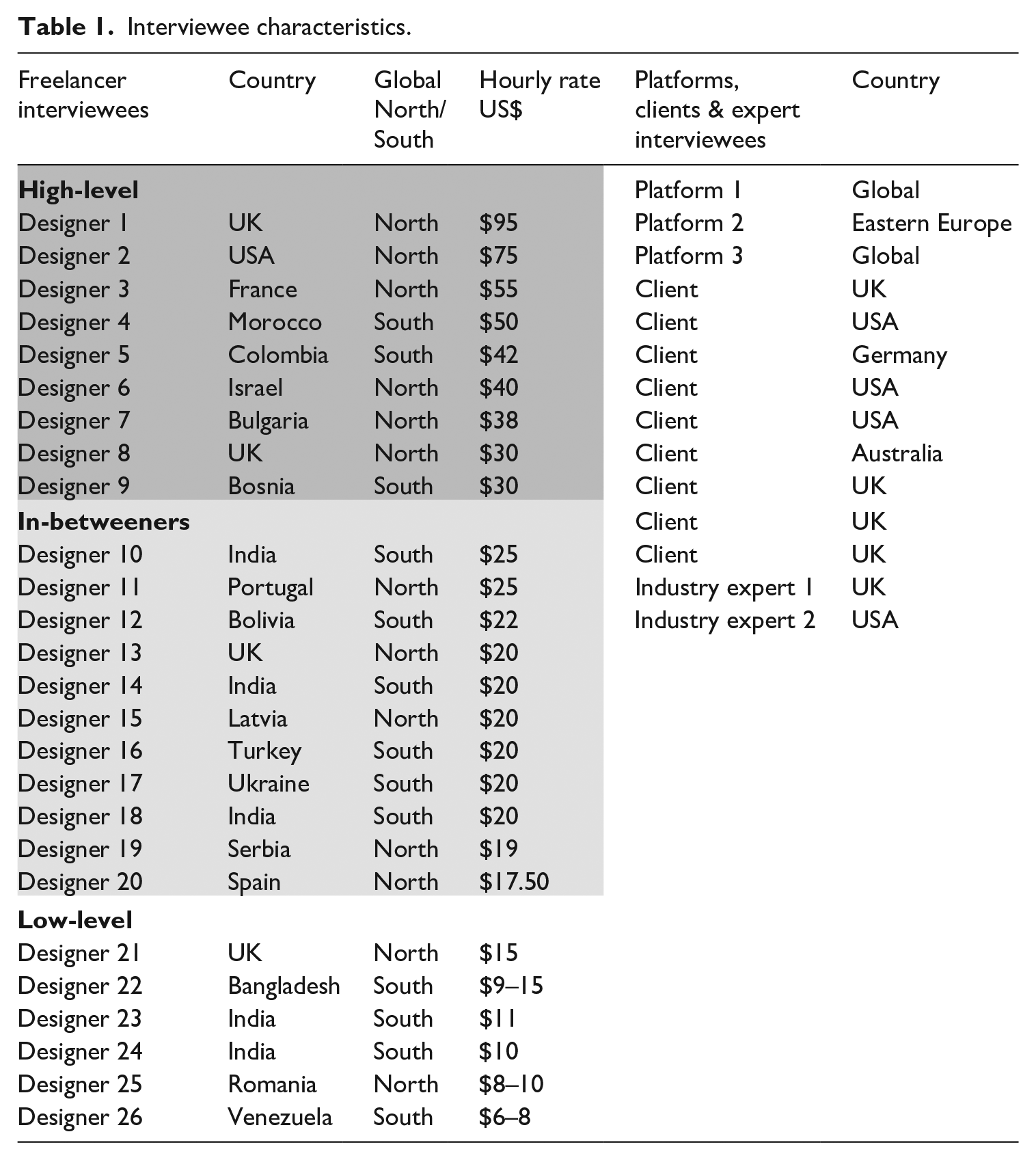
The geographical location of the freelancers was relevant in this stratification but did not determine their position. The low-level group were mostly but not entirely located in the Global South, the middle- and high-level groups were a mixture of both. This indicated diversity within these large geographical silos despite broad inequalities. Following this descriptive analysis, Bourdieu’s theoretical framework – the notions of capital and fields – was sought and applied as a way to understand the operation of the hierarchy. The data were explored thematically to identify ‘the rules of the game’ and the forms of capital and symbolic valuing, and delegitimising that operated to produce advantage and disadvantage in the design field.
Findings: Valuing capital in the online design field
Applying Bourdieu’s conceptual framing involved exploring freelancers’ experiences of the online design field and their location within it. Their initial discussions of moving from offline to online work revealed the process of learning ‘the rules of the game’ for obtaining design work through platforms in a large competitive global freelancer pool. Many described a long period of ‘fishing’ and ‘getting no responses at all’ (
Communication was also central to the allocation and delivery of work in the online design field; proficiency in English was central. Clients were very clear about this: ‘. . . what’s really big for me is the spelling and grammar, if they mess up on that [. . .] then it’s something that I’ll pass on’ (
The knowledge and resources freelancers brought with them – their economic, cultural, social and symbolic capital – was central to their capacity to understand and respond to the rules of the game in the online design field. Freelancers’ position at the high, middle or low-end of the field did not entail a straightforward transfer of existing resources and capital from offline to online. Their position was established and maintained through the valuing of different forms of capital in the field.
The low-end: Commodity designers
The designers at the low-end of the field mostly carried out unspecialised work that clients described as ‘not creative’, ‘generic’
In a hugely competitive market, the form of communication mattered. Polished English and client-centred communication reflecting the business norms of the Global North were symbolic indicators of quality, a form of cultural capital that facilitated access to gigs. These were missing from what clients described as the ‘generic’ cover letters from freelancers from India, Pakistan and Bangladesh. Freelancers from the Global South were routinely excluded from a range of jobs: ‘They just send you an application which is just a copy and paste text with “Hey, I’m the perfect candidate for the job” and there’s not one word about the actual project [. . .] I just delete them’
Equally, the individualised and mediated structure of OLM interactions made it difficult for these designers to see and identify the symbolic violence against them (Wood et al., 2018) or how it might be implicated in their struggles to bridge the gap between low-paid work for Global South clients and the lucrative work with Global North clients: ‘At the moment I [can] work only with Indian clients’ ( I did this job for an Australian guy and I charged, I don’t know, like $70 and a little bit more. And some friend of mine, Venezuelan in Australia, was like, ‘My God, you charged too little for that’, and I . . . seriously, I couldn’t believe that it was too little. (
The low-paid, one-off design work at the bottom of the field did not facilitate the acquisition of online social capital as they rarely translated into long-term relationships with clients, repeat projects and increased security. Low-end freelancers were on a treadmill of low-paid gigs that were not symbolically valued and did not enhance their cultural or social capital.
Despite the limits of their low-end position in the online field, these designers saw themselves working in the OLM indefinitely and perceived their working model as relatively secure since the value of their local currency enabled them to earn more than offline work but also remaining competitive despite a lack of cultural and social capital. One of the two designers from the Global North in this group, a second year college student, was the exception. He was not dependent on the income from the design jobs and saw working in the online field as a way to build up his experience and business skills alongside his studies so he would be in a position to command higher earnings after graduation. He had quickly recognised and understood the rules of the game in the online field: ‘I think the main thing that I’ve learnt is relationships with clients, how to speak to them, how to treat them, how to interact with them’
The middle: In-betweeners
Freelancers in this group earned more than the low-end group but saw their position in the online design field as transitional, discussing (without being prompted) their prospects of moving upward or downward. Two distinct subgroups emerged: the ‘ambitious’ and the ‘precarious’. The ‘ambitious’ were scaling the ladder to higher-paid roles, they understood the hierarchy and the rules of the game and were strategic in their engagement with the platforms. Although members of this group were mostly located in the Global South, their cultural capital included higher education and several drew on relatively well-paid experience in local offline labour markets. They had the cultural resources to articulate a global business language and deliberately sought higher-paying Global North clients. One Bolivian designer, an engineering graduate with 10 years of work experience, had taken a strategic decision to work in the OLM to fulfil entrepreneurial aspirations: ‘It [previous job] was always the same and I didn’t learn anything new at that time . . . . I have now my own brand and I am trying to become a company’
This group’s cultural capital was recognised and legitimised by the Global North clients who hired them. Despite their skills and capital, these freelancers charged ‘middle’ prices; a strategy that enabled them to invest in earning good reviews and building their reputations: ‘It was a really simple job, a small logo and he was happy. He gave me a good review and it helped to get more clients after that’ (
The other group, the ‘precarious in-betweeners’ feared falling to the low-end, and planned to exit the field if that happened. Freelancers in this group were mostly from the Global North and unlike their ‘ambitious’ counterparts, joined the OLM because they were in precarious circumstances (e.g. underemployment, redundancy, family issues) rather than having professional aspirations (e.g. entrepreneurial-orientation, building an online career). One example, a Polish worker in London, explained that despite having 10 years of design experience he struggled to find design work in London because employers did not recognise his Polish qualifications. He felt he had been forced onto the OLM and that it did not improve his circumstances
While ‘precarious’ freelancers also invested in their online social capital and had some repeat work from clients, they lacked the specific skills or experience that would enable them to command higher rates: ‘If I had years of experience, [. . .] I could have higher rates for that type of job. Because there are some UX (User Exchange) designers who have like $40 or $50 per hour. But for now, my rate will be $25’
Precarious freelancers felt vulnerable earning medium pay rates. Some in this group blamed the Global South workers for their insecure position saying they ‘spoiled’ the market by charging less than a ‘fair price’:
The Indian people came, and Pakistani, and they overwhelmed . . . when we posted, I don’t know, like, four versions of one logo, they already posted 20, 30. It was insane, and because of the inflation in their countries, they could work for a lot less money than we would. (
They feared their already modest levels of economic capital would further degrade. Some described a sense of having ‘nowhere to go’. They did not feel that they could go down to the lower end of the field and compete on price, or go up to the upper end and compete with those with higher cultural capital: better command of English and more sophisticated technical skills.
The high-end: Star players
The designers in our sample at the high-end of the field had joined the OLM with high levels of economic, cultural and symbolic capital. They saw themselves as equivalents of the elite designers in cosmopolitan cities like New York and London. The online design field facilitated their business becoming ‘location-agnostic’
These freelancers were endowed with substantial cultural capital resulting from technical higher education in high status institutions in the UK or US, combined with extensive experience in offline design careers in global companies. They described the importance of building an online identity or brand that they felt provided ‘additional value’ and meant they could win the clients who are willing to pay higher prices for their work:
People that I approached locally really didn’t have an idea of what I was talking about. So . . . we just decided we’ll give it a go on Upwork. I found, I think, five or six different designers. [Argentinian designer] was one of them. He was, actually, the most expensive of all of them . . . . But he has been excellent at helping us.
‘Star players’ were well versed in the corporate language of business consultancy: ‘The only skill that will differentiate you from other designers is your marketing skills’ (
Unlike the other groups, the high-end designers were strategic mobilisers of social capital not only via building long-term relationships with the clients in the OLM but also with other designers. Some talked about the use of online networking to enhance their skills: ‘I have 10 or 15 friends, and we have a small community on Facebook and we share our projects. I met a few of them on Reddit’ (
Discussion
Our data from interviews with actors across the online design field reveal the production and reproduction of a freelancer hierarchy structured by the price of work per hour on the platforms (low, in-betweener and high). Bourdieu’s notions of capital and field have provided a valuable conceptual tool for understanding the differentiated experiences of freelancers and exploring how hierarchical positions within the design field are produced and reproduced by the symbolic valuing/devaluing of certain social and cultural practices and forms of capital. The findings demonstrate how there is little room for upward mobility unless designers possess forms of capital that are symbolically valued by the powerful actors in the field and this may have little to do with technical or creative expertise.
Language plays a central role as a symbolically valued form of cultural capital; the use of English by freelancers in their online profiles and communications is closely monitored not only for its fluency but also for its articulation of Global North business etiquette and specific client-focused corporate practices. Higher education and prior experience in global companies were vital sources of these capabilities. Value was attributed not simply to linguistic capacities but to cultural and field-specific coded forms of language and this was also used to legitimise the marginalisation of less powerful actors in the field (Acuña, 1995). Those at the high-end were endowed with high levels of valuable cultural capital while those at the low-end had low levels even if they possessed the required technical skills.
Our study found less evidence of social capital from the offline world operating in the online design field to enhance freelancer positions. The platform structure mitigated against the systematic operation of existing social connections in the allocation of work and selection of freelancers. Additionally, there was little evidence of the use of social media groups and other forms of labour organising offering systems of social support and networks that improved freelancers’ position in the field hierarchy (Shevchuk and Strebkov, 2018; Wood et al., 2018). However, forms of online social capital could be seen to emerge and operate in the allocation of repeat business to freelancers based on past work, and more generally it was apparent that ratings and reviews operated as a symbolically valued form of social capital (Gandini et al., 2016). The reputation reflected in the online ratings and reviews commanded its own symbolic capital and further enhanced and amplified the value of other forms of cultural capital. Those without the required and legitimate forms of cultural capital were effectively trapped in the lower echelons of the field.
Conclusions
Our article makes an important contribution to current debates about the production and reproduction of inequalities in the OLM and the design field more specifically. Our application of Bourdieu’s interrelated notions of capital and field has been central to this, providing a valuable conceptual framework in which the field constitutes a specific set of power structures and relationships that define the value of capital possessed by actors operating in that arena. Our findings revealed how powerful actors, both clients and platforms, operated to dictate the terms of engagement in the OLM field through symbolic valuing and devaluing of the certain forms of social and cultural practices, specifically in relation to freelancers’ language use. We found that despite the narratives of platform owners and commentators, the OLM is not a neutral or meritocratic space capable of ‘democratising work’ and ‘levelling the playing field for all’. Only those with high levels of symbolically valuable cultural capital enjoyed the privileges offered by the OLM. This resonates with recent findings that the OLM is akin to ‘quicksand’ for many who do not have the ability to control and shape their work because they are not equipped with the capital sources needed to thrive (Perera et al., 2020).
Our research also suggests a number of useful avenues for future scholarship. First, the group of transitional in-betweeners identified suggests a longitudinal study following freelancers’ journeys in and through online fields could provide further insights into mobility within the OLM. Second, as the findings point to the centrality of language as a participatory mechanism on global platforms, future studies might investigate, in depth, language use and symbolic valuing of language by platforms, clients and freelancers. Third, our exploration of one specific field, design, was a necessary way to focus the study but there is considerable potential in applying the conceptual framework to other occupational fields and comparing symbolic mechanism for the reproduction of power. This would also enable a more critical discussion of Bourdieu’s tools. Finally, it would be useful to explore the policy implications, specifically how the various regulatory mechanisms in fields and on platforms might mitigate inequalities and the exclusionary practices of clients.
Perhaps the most pressing need revealed by our study is for research which delves more deeply into the diversity across and within geographical groupings of workers in the OLM. There is substantial heterogeneity between freelancers (both their characteristics and experiences) in broad geographical categories like Global North and South and even at regional and local levels. Ensuring that OLM studies can fully represent such diversity is challenging. For pragmatic reasons, our study prioritised English speakers, but multi-lingual accounts would substantially broaden the relevance of this type of research. Examining the geographical origins of freelancers and clients to explore the interaction of geography and capital within the OLM milieu would benefit future studies as would detailed comparisons of online and offline labour markets to explore how different types of capital evolve as freelancers move online. Our study provides useful tools and fascinating insights but there is much work still to be done.
Footnotes
Acknowledgements
The authors gratefully acknowledge valuable feedback from Prof. Laurie Cohen, the participants of the SASE Conference (2019) in New York and the 2018 Annual Research Seminar at the Center for Research on Self Employment. We also thank the three anonymous reviewers and the Associate Editor for the constructive review process, which has made the article stronger and better. All errors and omissions, of course, remain ours.
Funding
The authors received no financial support for the research, authorship, and/or publication of this article.
