




Abstract
Applying Bourdieu’s theory of social reproduction, this article deals with workers’ family-of-origin class position and the associated socialisation processes as systematic influencers of individual work orientations and commitment to work. It draws on a study of young blue-collar workers in Austria to argue how growing up in a working-class setting shapes dispositions that contribute to the commitment to manual work. The results show how these dispositions influence the assessment of work and, in particular, support a positive relationship with manual work and physical activity.
Introduction
While a general shift from production to services has been ongoing for decades, manufacturing companies are still an essential part of the economy and significant employers in several EU Member States. In 2018, 34 million people were employed in manufacturing, which accounts for 15.5% of all employees (EU-28, NACE code C). 1 Although some jobs in manufacturing clearly show more favourable working conditions than low-end service jobs, the level of risk exposure (shift work, physical strain, noise, dirt) and work intensity are still high (Eurofound, 2017). So why do people still choose these jobs and feel comfortable with what they do – at least to some extent?
The relationship between people and their work is among the core concerns of both Labour Process Analysis (LPA) and research on job satisfaction. The commitment to work and workers’ compliance are not only influenced by internal conditions at the workplace but also by ‘external factors’ shaping workers’ orientations before they enter the labour market. This article argues that in this context the family-of-origin class position and the socialisation process within a working-class milieu have not been given sufficient attention so far. Building on Pierre Bourdieu’s theoretical framework, the article draws on interviews with young blue-collar workers in the Austrian manufacturing industry to examine the respondents’ class-influenced dispositions and how these structure the way workers relate to their jobs. 2 More specifically, it investigates how these dispositions contribute to the commitment to work in manual manufacturing jobs. The article therefore contributes to the research on workers’ relationships with their work and, in particular, on commitment to work and job satisfaction.
The article starts with discussing the issue of workers’ compliance within LPA as well as research on job satisfaction, and the research methodology is introduced. In the main part, results from the study on young blue-collar workers are presented. The analysis of the interviews shows that most respondents developed a preference for manual labour during childhood which enabled them to relate positively to blue-collar jobs in manufacturing. In contrast, respondents lacking such dispositions perceive unskilled or semi-skilled work in arduous manual jobs as boring, tiring and unchallenging. Concluding, the article argues that the family’s class position systematically shapes subjective work orientations which, in turn, are crucial for understanding commitment to work and job satisfaction.
Social-class background and commitment to work
Describing his concept of the ‘hegemonic factory regime’, Burawoy (1985) claims that workers’ compliance to rules is not sufficient for capitalist production as it requires workers’ active consent, which in turn is generated within workplace social relations. This view has been criticised for presenting all forms of workers’ adaptation as consent, and also for neglecting the complex forces creating and sustaining consent (Edwards, 1990; Thompson, 1983; Vidal, 2019). Hodson (1999) suggested defining consent as ‘citizenship behaviors’ (p. 298), which include ‘pride, cooperation, engaging in peer training, use of insider knowledge to facilitate production, commitment to organizational goals, giving extra effort freely, and job satisfaction’ (p. 310). These behavioural outcomes, however, are not solely structured by workplace social relations – as Burawoy would argue – but by a wide range of ‘external factors’ that shape workers’ disposition before they enter the workplace and impact on how commitment and compliance can be established.
In the literature, a variety of external factors can be distinguished. Following a Marxist tradition, Antonio Gramsci (1971), and also representatives of the Frankfurt School (e.g. Marcuse, 2004), argue that the ruling class is able to shape the hegemonic perception of the social world in a way that leads the dominated class to comply with the ruling social order. A similar argument is made by Pierre Bourdieu (1984: 240): the embodiment of power relations during the socialisation process makes the existing social hierarchies appear natural (what he refers to as ‘doxa’) and foster consent. Nichols and Armstrong (1976) equally see dominant ideologies (e.g. perceiving the world as unchangeable) as strong forces of workers’ subjugation. Others have focused on the different institutions securing consent: the disciplinary effects of schooling (Bowles and Gintis, 1976; Lazonick, 1978) or prevailing gender relations (e.g. Walby, 1990). Workplace social relations are partly autonomous of macro-level structure; nevertheless, they build on and mediate them, resulting in various forms of management control and workers’ compliance or resistance (Edwards, 1990; Thompson, 1983).
To contribute to this wider debate, this article focuses firstly on one specific ‘external factor’, which is the workers’ original class position and the associated conditions of socialisation that show how a working-class upbringing shapes work orientations, contributing to compliance with manual labour later in life. Secondly, in its empirical part, the article does not address workers’ adaptation and compliance in general but focuses on commitment to work, largely leaving aside the commitment to the organisation (for the distinction see Bélanger and Thuderoz, 2010; Edwards, 1990).
Class background, labour process and job satisfaction
So far, empirical research in the LPA tradition has considered the social background of workers predominantly when it comes to management strategies in selecting suitable staff and also when looking at workers dealing with management control. Research on human resource management points to selection practices that make jobseekers reveal personality traits that are forged during socialisation processes (Townley, 1991). Studies of Japanese foreign direct investment (FDI) in manufacturing highlights the companies’ preference for non-industrial and non-unionised regions and stresses the firms’ stringent selection policies for establishing new forms of work organisation (Elger and Smith, 1994). Using the example of call centre labour, Callaghan and Thompson (2002) argue that companies cope with the problem of turning labour into value-creating work partly outside the labour process by selecting ‘suitable’ workers with a focus on personality and communication skills. In their research on aesthetic labour, Warhurst and Nickson (2007: 116) point to discriminatory effects of employers’ recruitment practices, as the attitudes and appearance they are looking for in applicants are formed differently depending on familial socialisation. As far as the interrelation of external factors and workers’ agency is concerned, research on control regimes in small clothing manufacturing firms, for example, accounts for ethnicity as well as workers’ socialisation background in responding to exploitation (Ram, 1991: 615). Sturdy et al. (2010) point to ‘the tenacity of prior socialised values’ as a reason for the failure of corporate culture management programmes and thus a limitation to normative control. Simpson et al. (2014) provide explanations for the meaning butchers give to their occupation with reference to masculinity and working-class habitus. Thus, there is a variety of studies that allude to the social-class background of workers in the context of management strategies and workers’ resistance, compliance or consent. Although some of them explicitly deal with the working class, they do not investigate the link between individuals’ work orientations and their particular form of upbringing.
In research on job satisfaction, studies show that the work orientations, norms and expectations individuals hold have independent effects on workers’ perception of and satisfaction with their jobs (Brown et al., 2012; Kalleberg, 1977). While an attenuated separation of conception and execution is usually seen as making manufacturing jobs more appealing (Milkman, 1998), Vidal (2007) shows that workers express different desires and needs when it comes to problem-solving, decision-making or participation in the production process. Therefore, different levels of satisfaction with similar jobs can be observed (Vidal, 2007: 262). An earlier German study, for instance, showed that blue-collar workers rejected the implementation of teamwork structures because the additional communicative requirements contradicted their value system in which practical work was more respected than non-physical work (Wittel, 1998). Such insights call for research that takes into account socialisation processes and life experiences of workers (Kalleberg, 1977: 141). 3
In consideration of these arguments, the article claims that work orientations are – as Ezzy notes – not ‘autonomous creations’ (1997: 440) of individuals and therefore arbitrary, but influenced in a systematic way by different factors outside the workplace such as the socialisation process. So far, this approach has been applied to research in the tradition of cultural class analysis. Lehmann and Taylor (2015), for instance, show how an early familiarity with manual labour facilitates the development of preferences for practical work and leads teenagers towards apprenticeship training in manual occupations. This is not only caused by available opportunities but also by the recognition attached, as manual skills are valued more than doing well at school (Lehmann and Taylor, 2015: 619). In a study on why working-class men in the US choose the dangerous occupation of a wildland firefighter, Desmond (2006) argues that during their ‘rural upbringing’ (p. 392) they developed a ‘country-masculine habitus’ (p. 391), which includes practical knowledge of the local woods and a rejection of indoor work, which represents middle-class masculinities and jobs.
Habitus and the relationship with work
The theories of Bourdieu provide an important set of tools that are absent from LPA and job satisfaction research. These can be used to theorise the role of external factors, specifically how social upbringing structures work orientations. Bourdieu argues that we can observe a homology between individual abilities and aspirations on the one hand, and on the other the objective conditions and opportunities common to a certain position in social space (e.g. occupational groups). This homology is created by the ‘habitus’, a system of ‘general, transposable’ dispositions developed from early age onwards which structures individuals’ perceptions and practices (Bourdieu, 1984: 169). As an embodied structure, the habitus reflects the social conditions of its acquisition and it provides individuals with a ‘practical sense’ not only for what seems to be possible or impossible but also appropriate (schools, jobs, work preferences, etc.). People sharing a similar position in social space, and who therefore are exposed to similar conditions, will acquire similar dispositions. The matching between position and disposition is also responsible for shaping trajectories typical of a certain class. It guides people towards (occupational) positions they feel capable of fulfilling, as the positions suit their skills and aspirations. This also explains why positions in the social division of labour are filled although they seem to be alienating and – especially from the viewpoint of the dominating class – unsatisfying (Bertaux, 1989: 75). Yet, Bourdieu emphasises that this matching does not only play out positively as feelings of belonging and satisfaction but also negatively when individuals feel trapped and unable to alter their situation (Bourdieu, 1981: 308).
Although Bourdieu’s approach was criticised for being deterministic, he explicitly warned against generalising his theory into a practically perfect model of social reproduction. Eventually, the habitus is about probabilities rather than destiny (1984: 111; emphasis added). The correspondence between position and disposition is just ‘a special case of the possible’, only (or most likely) occurring when the habitus’ conditions of acquisition correspond to the conditions in which it comes to force (Bourdieu, 1974: 5). Despite pointing towards those limitations, his work lacks a detailed account of the implications that follow from that. 4 Another theory (e.g. Lahire, 2011) suggests that despite a tendency for a homology between position and disposition, the complexity of the socialisation process may lead to maladjustments for various reasons.
The originality of our contribution lies in applying a family-of-origin class perspective to the question as to how blue-collar workers in manufacturing relate to their work. It highlights the importance of ‘prior orientations to work’ (Goldthorpe et al., 1968) and conceptualises these not as individual but as a part of the ‘habitus’ (Bourdieu, 1984) or the ‘social character’ (Fromm, 1941) of particular groups of workers who experienced similar conditions of socialisation. Moreover, it emphasises that workers’ dispositions need to be understood as both constraining perceived possibilities as well as generating meaning and feelings of belonging even under adverse working conditions. This means that outcomes of socialisation processes systematically mediate between objective job characteristics and workers’ job satisfaction and commitment to work.
Methods
The empirical dataset used for this article is based on 20 interviews with young blue-collar workers in Austria. Participant recruitment targeted workers between the ages of 20 and 34 employed in the manufacturing industry as skilled or unskilled blue-collar workers. 5 Interviewees were recruited with the help of the local works council and conducted at the respondents’ workplace. The semi-structured face-to-face interviews (Witzel, 2000) lasted between 60 and 90 minutes and collected information on the workers’ childhood, educational and work trajectories as well as experiences at their current workplace.
The study applied a circular research design in which data collection and analysis proceeded in an integrated way. Respondent selection was informed by principles of minimal and maximal contrast to provide grounds for comparison in the analysis, finally leading to a sample that included both men and women, unskilled and skilled workers, respondents in both urban and rural regions, and workers in the automotive, textile, metal processing, chemical and paper industries (Table 1). 6 Data were collected continuously until ‘thematic’ or ‘data saturation’ (Saunders et al., 2018: 1896) was achieved and no new categories emerged, and until the already identified categories seemed to be sufficiently developed (O’Reilly and Parker, 2013: 192). 7 When recruiting the respondents, the family-of-origin class position was unknown. In the sample, 17 respondents had a working-class background with the parents’ highest educational level being compulsory schooling or vocational training. Two cases showed a clear gap between the educational levels of parents. 8 One case represented downward social mobility, as both parents held a university degree.
Sample and typology.
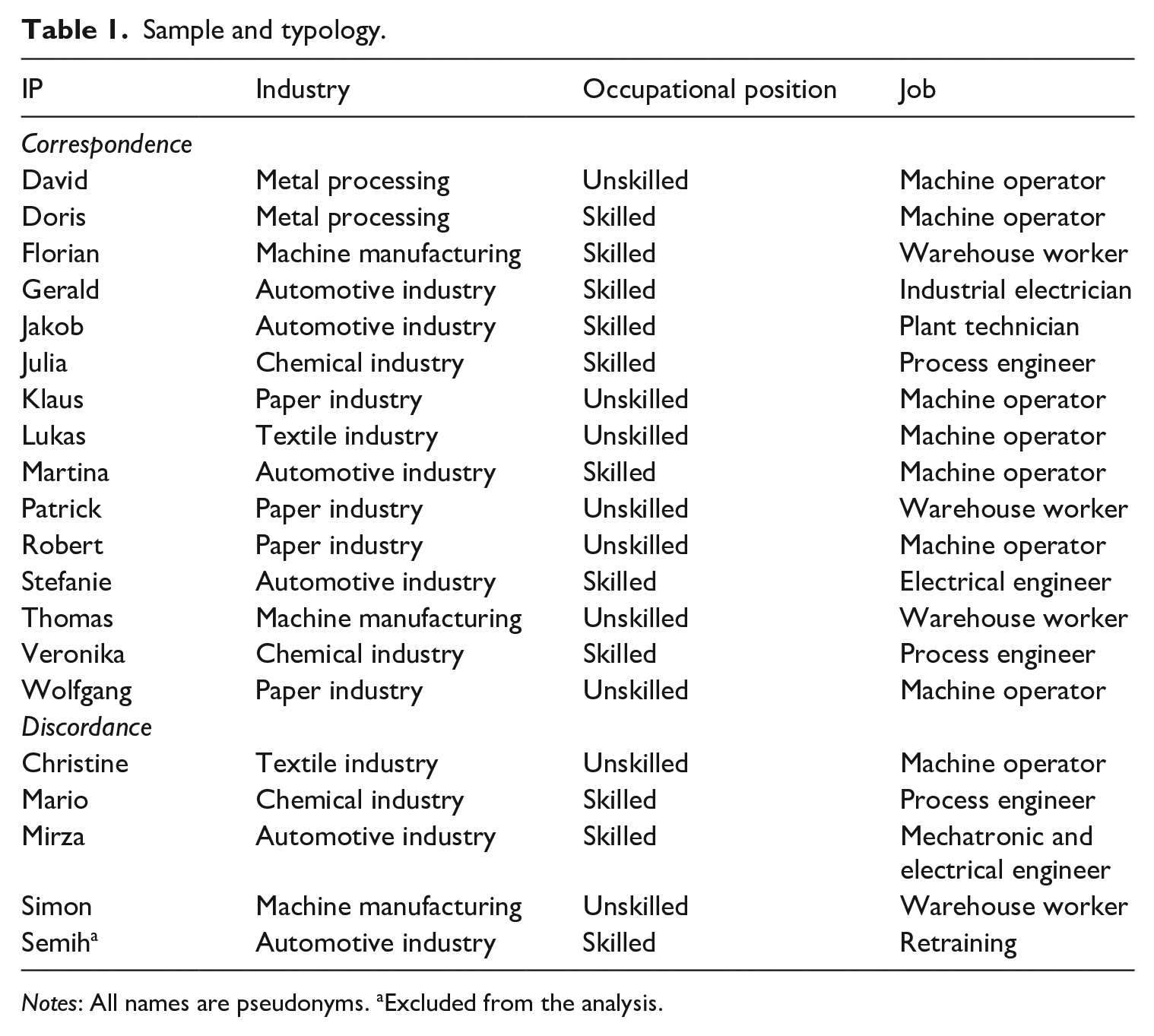
Notes: All names are pseudonyms. aExcluded from the analysis.
The analysis was guided by ‘habitus hermeneutics’ (Bremer and Teiwes-Kügler, 2013), a methodological approach developed in a German research project that translated Bourdieu’s theoretical propositions into methodological instructions, which Bourdieu himself did not flesh out in detail. It is based on an ‘interpretative’ approach (Flick, 2005), which targets the level of meaning on which the habitus operates (modus operandi) and provides the necessary analytical tools to break away from common sense constructions and discover the structures responsible for producing those meanings. This approach, for instance, allows recognition that the habitus manifests itself not only in what is explicitly said but also in things that are not (or cannot be) expressed because they are self-evident or beyond the mental boundaries of the habitus. In the study presented here, the approach was used to reconstruct workers’ dispositions.
The analysis comprised four steps: firstly, the biographical structure of each interview was reconstructed to help the researchers to extricate themselves from the self-presentation of individuals. This step was followed by the interpretation of smaller sequences of the transcript in order to unravel the tacit class mechanisms structuring respondents’ perceptions of the world. Analytical strategies as laid out in ‘Grounded Theory’ (Corbin and Strauss, 2015) (e.g. making comparisons, questioning, looking for a negative case) were then used to increase the richness of the material interpretation. In the final step, the interviews were contrasted with each other regarding the influence of the class position. The individual cases do not merely stand for themselves. Although the results cannot claim statistical representativity, they offer a detailed account of specific social practices that allow generalisable theoretical conclusions to be drawn as the mechanisms discovered can be translated to similar cases (Bertaux and Thompson, 2009).
Results
Today, physical labour is still decisive in manufacturing, although the amount and type of the required manual work vary by industry (chemicals vs textiles) and occupational position (skilled vs unskilled labour). The analysis of all interviews revealed two different constellations of respondents’ relationship with their job as unskilled, semi-skilled or skilled production workers and with workplace requirements: firstly, cases (N=15) where respondents acquired specific work orientations that gave preference to applying the body (i.e. to physical activity), but also to handling tools at work over jobs that required the body being still (e.g. sitting in front of the computer). Early familiarity with manual labour shaped the understanding and meanings of work and eventually formed a habitus that was geared to manual labour and later provided grounds for respondents to be able to relate positively to the tasks they had to fulfil at their workplaces. Secondly, cases (N=4) lacking a disposition for manual labour, which led the workers to perceive manual labour as ‘boring’, ‘dirty’ and ‘tiring’ and created feelings of dissatisfaction. 9
Apparently, the correspondence between work preferences and actual job requirements inducing commitment to work is only one source of worker compliance. While workers can feel satisfied with the tasks they have to perform and, on that basis, develop commitment to work, they still may be frustrated with the overall employment conditions (e.g. their salary or their status as temporary workers), which adversely affects their commitment to the organisation. Still, accommodation or compliance may be supported by other constraining forces of social class, such as economic necessities, which may bind workers to their jobs even though they do not take pleasure in the content of their work or disapprove of their employment conditions. This article, however, focuses on manual dispositions and commitment to work.
In the following, constellations in which the habitus supports the commitment to manual work are discussed using the examples of Doris, Wolfgang, Robert and Julia, as space did not allow for all interviews. The four cases were selected to account for variations regarding gender, skilled and unskilled labour, and industry. These cases are contrasted with two examples of constellations in which the workers’ habitus makes them reluctant to accept manual work (Mario, Mirza). For the argument of this article, both cases are interesting not so much regarding the reasons as to why this discordance occurs, but because they highlight the consequences of lacking dispositions for the commitment to manual labour and therefore further support the argument that the habitus influences the possibility to pursue a manual job in a meaningful way.
Preferences for manual labour
Doris, 24 years old, is the daughter of a signalman and gardener. She emphasised that ‘DIY’ was an important value in her family, acting as a source for defining essential values and beliefs. She highlighted that her father built everything by himself in the house and is very good at fixing things: 10
At my place, almost everything is done by ourselves. We always make sure that we don’t need craftsmen. My father renovated half of the house by himself and has never had help. My brother also disassembles everything [laughing] and so I also caught the practical bug.
As a child, Doris often accompanied her mother, who worked as a gardener. She enjoyed being outside, ‘building tree houses and playing in the dirt’. She presented herself as competent in handling tools, while others ‘don’t even know what a screwdriver is’. After dropping out of a full-time vocational school
11
for florists because of troubles with her exclusively female schoolmates, she was an apprentice manufacturing engineer in the metal industry. During her apprenticeship, she showed a lot of ambition, having to prove herself as the only female apprentice in her field. Later, she worked as a machine operator in the same company. Her machine shaped metal profiles according to customer orders by ‘stamping’ metal belts. Apart from supervising the machine, her job required extensive physical work as she had to ‘bundle pallets, cart away’ the product and ‘prepare the packaging material, welding ends of belts’. She developed the ethos of a craftsman who draws satisfaction from being able to solve mechanical problems on her own:
When the tool gets jammed in the machine and just doesn’t work anymore, you look for yourself, what could be the problem. [. . .] And when you are able to fix it by yourself, then, of course, this is really nice.
Being able to apply her skills and preferences to work in her job created a feeling of belonging and satisfaction: ‘I often thought, actually, it’s bloody awesome: I get money for what I like doing best’. Doris’ manual work-related habitus not only enabled her to experience a highly automated job as satisfying but also made her feel at home in a male-dominated workplace. It helped her to face problems with male colleagues (e.g. when an unskilled ‘helper’ at ‘her’ machine openly opposed instructions she gave as the trained machine operator).
Wolfgang, 31 years old, was the youngest of seven children. His mother was only allowed to complete compulsory schooling as her labour was required on her parents’ farm. His father left when he was a child, leaving the mother as a single carer. It was important that everybody in the family helped with chores, Wolfgang explained. When asked about key values in his family, he responded, after thinking hard: ‘To help, to not complain and to work’. Within the family, the realm of feasible educational trajectories was restricted to apprenticeship training (all his siblings took this path) and was instinctively felt by Wolfgang at the end of compulsory schooling. Explaining his choice of vocational training as a car mechanic, he said: ‘I always knew I wanted to do something with screws, bolts and metal’. During his early teenage years, he already developed initial skills. ‘When I was 14, I always repaired my mother’s car’, he declared proudly. We may assume that his mother acknowledged his efforts; at least he did not mention any repudiation of his practical interests. Upon completion of apprenticeship training, he had to look for another job, as the company could not keep him. He found a job in a paper mill as an unskilled machine operator as he could not find employment as a car mechanic. He described his job on the paper-cutting machine in the following way: ‘To put it plainly, I cut the paper wanted by the customer from the paper roll. In different formats, quality. And that’s it.’ Although he struggled with working night shifts, he managed to appropriate his new job in a meaningful way. This was enabled by a manual habitus built on technical expertise and shaped during his teen years, which created a curiousness that allowed him to experience his new job as challenging:
The first four years were really demanding because it’s a completely different area. All the mistakes the machine makes, what the paper does [. . .] every machine is different, and first you have to familiarise yourself with it until you know every button and every switch.
Interestingly, Wolfgang’s example showed a certain convertibility of the disposition for manual labour as he was able to make use of his ethos as a craftsman to appropriate labour positively in an automated production process.
Robert, aged 34 years, displays a similarly positive manual habitus. His father was a trained cook but worked in manufacturing as an unskilled worker; his mother was a nurse. Compared to Doris or Wolfgang, Robert cannot locate the origin of his deeply inscribed preference for practical work, as he stated: ‘Actually I never really knew what I wanted to do . . . but I always wanted to do something technical’. 12 His family, and especially his closest friends at school, structured his perceived realm of possibilities. School was not about studying, but rather about spending time with his friends. Although they had ‘a great time’, they turned their back on school as quickly as possible. For the boys, apprenticeship training promised independence and allowed them to get away from the ‘watchdogs’ (teachers). Not surprisingly, their trajectories followed similar patterns: ‘Eventually, all of my friends picked similar jobs – locksmith, car mechanic, or something similarly technical’. Contrary to Wolfgang, Robert’s manual dispositions were based on the notion of physical strength adding value to the labour process, which was forged during his apprenticeship as a locksmith: ‘You have to imagine, you have got a chunk of steel in front of you, banging full throttle on it’. He was subsequently able to transfer his preferences for physical work to a different working context: unskilled work in the paper industry: ‘Now, I cut paper on guillotine cutters to a specific format. When I [emphasis] don’t move, nothing happens.’ Like his job as a locksmith, where his physical strength had moulded steel, he also saw his body responsible for initiating the production process: ‘I have to do it with my body, with my hands’. This gave Robert a feeling of self-empowerment because he was not only a tool used by the machine, but his body subjugated the machine as a tool. In contrast to the positive relationship between Robert/Wolfgang and their job content, the workers were not always content with the employment conditions. Both faced 10 years of insecurity as temporary agency workers before the company employed them. Accommodation and compliance are not only created by the manual habitus but also fostered by economic necessities: their class position and the situation of the labour market made it difficult to change jobs: ‘And then’, Robert said, ‘you calm yourself down and say to yourself, no, carry on’.
Julia, 25 years old, grew up on a farm in the countryside with her two siblings. Julia’s mother was not allowed to pursue further education. Together with her husband, a former carpenter and joiner, she kept her parents’ farm. Owing to its small size, Julia’s father stayed in full-time employment as a crane operator in the steel industry. Her hard-working parents ‘didn’t have the time to play with us all the time’, Julia said. From early childhood, Julia was familiarised with manual labour as she was responsible for different chores on the farm, such as ‘driving the tractor or working in the stable and in the wood’. This formed a preference for practical work, which structured her choice not to pursue higher education at the end of compulsory schooling. She initially followed a typical female trajectory and applied for training in retail and administration. After several rejections from employers, she decided to train as a chemical process engineer. In the explanations for her decisions, a preference for practical work played a key role. When arguing why she initially favoured retail over office work, she said: ‘In retail, I did several internships, stacking shelves, and so you were on your feet a lot of the time and there was always something going on’. Also, in connection with her decision to work in the chemical industry, she emphasised: ‘I always liked doing practical things more’. Additionally, the wage was attractive, and both her father and brother worked in the manufacturing industry: ‘They also work shifts and I thought that’s not bad’. In the service sector, Julia’s preference for manual labour was stripped down to the deployment of the body in its basic form: it revealed itself in a need for physical activity. On the contrary, office work that required sitting still was perceived as boring. The chemical engineer apprenticeship added more variation to how her dispositions could be applied as it added handling tools and operating machinery. Her task was to operate a chemical plant in a small team: ‘It’s like baking a cake step by step, just like that we operate the plant step by step according to protocol’. Her tasks included ‘operating centrifuges’, ‘re-adjusting certain taps during the process’ or ‘pulling samples’. Recently, she was appointed ‘plant operator number one’, which is the head of a sub-team in the plant. The new position meant that supervisory work became more important in her workload. Although she still liked her job, she struggled with the fact that it required a lot of ‘sitting around’:
I would prefer [. . .] if there was a variety in the things you do, so you don’t have to sit for eight hours, but you can go outside more often.
Reluctance to pursue manual labour
The previous stories illustrated different forms of correspondence between conditions of socialisation and dispositions for manual labour, which could be found in the majority of all cases. A minority of cases, however, did not develop a manual habitus. Firstly, Mirza represents maladjustment arising from his family’s downward social mobility in the course of migration. His academic habitus was positioned in a working-class environment, creating tensions between aspirations and job conditions. Mario’s case, on the other hand, points to variations within the working class as he did not develop a preference for manual labour. Both cases underline the importance of a manual habitus in relating positively to manual tasks and developing commitment to manufacturing work.
Mirza, 24 years old, was born in Chechnya. His father, a dentist, had to flee when Mirza was 12 years old. His mother, who migrated to Germany after divorcing Mirza’s father, managed to acquire the necessary qualifications to pursue her career as a doctor. His father, on the other hand, was unable to maintain his former social status. As his economic and cultural capital had been devalued in Austria, he alternated between unskilled labour and unemployment. Yet, the original academic milieu of the family shaped Mirza’s aspirations quite differently compared to the other respondents in the sample:
Since I was a child, my father told me: ‘School is the most important thing, you must go to school, you must study’. Because he also studied, I also wanted to study.
Mirza was eager to comply with the plea, but lacked the necessary resources to fulfil it as he had to navigate a completely different educational system upon his arrival in Austria. He attended upper secondary school but after one year had to face the fact that his German proficiency was not sufficient to succeed. He chose an apprenticeship in mechatronics and engineering in the automotive industry. The preference for mental labour was also reflected in how he related to this job. He used two components of his job – electronic and mechanical work – to illustrate his work preferences. Electronic work was more challenging, ‘you have to think more’, which is why he favoured these jobs over mechanical work, which was ‘physically more challenging, you get dirty and I don’t like to do that very much’. His habitus is a barrier to appropriate physically challenging, manual labour in a meaningful way. A few years ago, he was moved to the assembly line for half a year because of internal restructuring, where he had to install truck batteries the whole day. Mirza soon got frustrated with the job:
After that, you are physically, really – how should I put it – you cannot do anything else after work, you are very tired [. . .] that is something you don’t like doing.
He looked for a way out of this and applied for ‘educational leave’ until he could eventually return to his initial position in maintenance.
Mario, 27 years old, grew up on a farm – his father, a toolmaker, and his mother, a carer, run the farm part-time. However, he did not develop an interest in farm work like Julia:
I grew up with it, I grew into it, but then I realised when I was about 10 years old that actually I don’t really like it, that is not really for me.
At the end of compulsory schooling, he showed aspirations to pursue higher education and attended upper secondary school but had to drop out because of bad grades in Latin. He chose apprenticeship training as a process engineer in the chemical industry and had been doing the job ever since. He described his time as an apprentice as ‘fairly unexciting’, being more interested in making trouble with his friends: ‘We were devils, we did not work as we should have’, he said laughingly. Mario and Julia were employed at the same company in similar jobs, yet how they both perceived them was quite different. Although Mario liked his job, often he felt insufficiently challenged. He was glad to work on a plant with short production cycles as this meant more variety:
A mono-plant would not be for me, where I would have to do the same thing every day. [. . .] In that case, I guess, I would look for another job sooner or later.
He especially liked it when he had to implement new things and work out how new procedures were applied. Then he felt ‘mentally’ challenged. On the contrary, he was not keen on physically exhausting labour:
At other plants, you have to do that during the whole shift, for eight hours. I have also had the ‘pleasure’ of doing this during my apprenticeship, it’s something that comes with the job, but I don’t want to do that forever.
Unfortunately, we do not have sufficient data to explain why Mario did not develop a disposition for manual labour in spite of his working-class background. Drawing on Bourdieu we can, however, assume that the extended time spent in school and the initial upward mobility (‘effect of trajectory’; Bourdieu, 1984: 453) strengthened both his initial reluctance towards manual work and his preference for intellectual tasks which later created tensions with manual labour. He managed to compensate for this lack of matching between work preferences and job requirements by getting involved in the works council, the elected workers’ representation body. He learned labour law and took a rhetoric course, which seemed to connect more with his original career plans.
Conclusion
Starting from debates within LPA and job satisfaction research on factors of workers’ consent that are external to the workplace, this article deals with the family-of-origin class position and corresponding socialisation processes to analyse their influence on the commitment to unskilled, semi-skilled or skilled production work in manufacturing. Drawing on Bourdieu, the article argues that to some extent such mediating dispositions depend on the upbringing in a specific social class and are thus shaped in a systematic way. This means that workers’ different relationships to the same jobs cannot only be due to individual and arbitrary idiosyncrasies, but also have systematic reasons.
In detail, the results of our analysis, firstly, show that the workers’ relationship with blue-collar manufacturing work is influenced by their dispositions. Dispositions for manual labour include preferences for work settings where the body can be applied and where tools are used with the hands. The majority of the blue-collar workers interviewed possess such dispositions, yet some respondents disapprove of manual work. In both cases, the interviews clearly show that workers’ dispositions impact on commitment to work.
Secondly, the cases identify that dispositions for manual labour are incorporated prior to entering the labour market. In this process, socialisation within a specific working-class milieu lays the groundwork for a habitus that is prone to manual labour as it offers opportunities for active participation in different forms of manual work from an early age (e.g. farm work, handicraft) but is also characterised by an environment in which practical abilities are valued higher than intellectual ones.
Thirdly, analysis on a micro-level reveals certain nuances regarding the concordance between dispositions and job requirements as the manual habitus can take different forms. Preferences for manual labour may assume the form of craftsmanship which focuses on the handling of tools (e.g. Doris, Wolfgang), the form of physical strength that adds value to the production process (e.g. Robert), or the simplest form of preference for bodily movement (e.g. Julia). The commitment to manual work is therefore influenced by the particular form taken by dispositions for manual labour and by the extent to which it corresponds with specific tasks assigned to the worker.
Fourthly, the analysis showed that the disposition for manual labour is a powerful resource that enables workers to relate positively to their jobs (i.e. to create meaning and experience their work as satisfying 13 despite the fact that exploitation and physical wear and tear form an integral part of manual labour). This function of the manual habitus as a resource is especially pronounced in the cases of downward occupational mobility when respondents change from skilled to unskilled jobs. However, the manual habitus proves a vital resource for the female workers in the study, providing them with a sense of legitimately ‘belonging’ to the shop floor even though colleagues question their abilities and skills.
Finally, looking at the discordant cases (Mirza and Mario), the dispositions leading to a disapproval of manual work can partly be accounted for by socialisation within an academic family, which shapes a habitus unfamiliar and ill-fitted to manual labour. Additionally, taking up Bourdieu’s argument about probability and not destiny, we can state that a working-class upbringing does not necessarily lead to a manual habitus. While we cannot explain the deviant formation of Mario’s habitus due to a lack of information in this respect in our data, this case also clearly shows the importance of incorporated dispositions for commitment to work.
In the literature, the sources for commitment to work are usually seen in opportunities for problem-solving and participation (Appelbaum et al., 2000; Milkman, 1998) often absent in unskilled or semi-skilled manufacturing jobs. Surprisingly, commitment to work and job satisfaction are clearly identifiable in this study, not only when blue-collar workers find intellectual challenges and opportunities for problem-solving, but also when they are able to handle tools, apply physical strength or move their body. As a larger share of problem-solving and decision-making is not necessarily welcomed by all manufacturing workers (Vidal, 2007; Wittel, 1998), there is a need to consider that physical aspects of work are appealing to workers with particular work orientations. In this respect, the study shows a typical pattern in which dispositions shaped by a working-class background lead to preferences for manual work and physical activity.
Focusing on the interrelation between dispositions, commitment to work and job satisfaction, we should not lose sight of the fact that a match between dispositions and jobs, while conducive to individuals’ well-being, also hinders change as it binds people to their social positions and supports the reproduction of a strongly unequal social division of labour. Evidently, most of the manual jobs are positioned at the bottom of the workplace hierarchy, providing less income and social recognition.
The study shows how workers’ dispositions allow them to create meaning and to positively relate to manual work, which creates commitment to work and contributes to workers’ compliance, particularly in a context in which their class origin often limits their career and labour market opportunities to strenuous and partly low-paid work. Considering the family-of-origin class position, therefore, sheds light on systematic variations in what appear to be, as Ezzy (1997) critically noted, individual and merely subjective orientations of workers. Future research should further elaborate the different forms that may be adopted by a manual habitus and especially explore the precise mechanisms of how and why in some cases a working-class upbringing does not foster such dispositions as well as the temporalities of habitus formation.
Footnotes
Acknowledgements
We would like to thank the anonymous reviewers for their valuable comments and constructive feedback on the manuscript, which greatly helped to strengthen our argument.
Authors’ note
The research presented in the article was conducted at the University of Vienna. An earlier version of the article was presented at the 36th International Labour Process Conference in March 2018 in Buenos Aires.
Funding
The authors received no financial support for the research, authorship, and/or publication of this article.
