




Abstract
This article analyses the role of age stereotypes in the employability of older people. Unlike in existing studies, we shift emphasis from a direct consideration of stereotypes, focusing instead on skill requirements during recruitment. Using five waves of an employer survey from Poland, we assess how the likelihood of recruiting people over 50 years old depends on the skill requirements of the post. This study uses a real-life framework by referring to existing vacancies and actual requirements that reflect labour demands at the scale of an entire national labour market. The results suggest that some requirements lead to age bias during recruitment, and the chances of an older candidate being hired are especially hindered in jobs requiring computer, physical, social, creative and training skills. By illustrating an indirect link between age stereotypes and age discrimination, this study contributes to an understanding of the mechanisms that reduce employability of older people.
Introduction
One of the primary responses to a rapidly ageing population is a set of policies that increase employment among older age groups; nevertheless, one of the difficulties faced in developed countries is the low employability of older jobseekers (Patrickson and Ranzijn, 2003; Tisch, 2015). Employability, or the capacity to gain or remain in employment, relates to the set of skills offered by a job applicant, which can be used at work (Fugate et al., 2004). Unemployed people aged 50 or over have little chance of finding a job, and a much lower probability of changing employers than younger or middle-aged people (Gielen and van Ours, 2005; Heywood et al., 1999). Despite shrinking and ageing labour markets, employers are reluctant to recruit older candidates (van Dalen et al., 2009). In a meta-analysis of this topic, Wanberg et al. (2016) demonstrated that the chances of re-employment after a job loss greatly deteriorate for individuals over 50. Questions on why people of a certain age are perceived to be too old to work, and what mechanisms drive the lower employability of older people, are priorities in the research agendas of ageing societies.
It is widely argued that the low employability of older people is triggered by adverse age stereotypes that motivate discriminatory practices by employers (Bytheway, 2005; Kirchner and Dunnette, 1954; Organisation for Economic Co-operation and Development (OECD), 2006; Perry and Finkelstein, 1999). Given the importance and popularity of this thesis, the evidence for it is surprisingly weak. Three approaches have been attempted so far in the related research. First, some authors have investigated general attitudes towards older workers in different countries, primarily through surveys (Gringart et al., 2005; Harper et al., 2006; Lu et al., 2011; Ng and Feldman, 2008; Posthuma and Campion, 2009; Taylor and Walker, 1998; Turek and Perek-Białas, 2013; van Dalen et al., 2010) or qualitative interviews (Loretto and White, 2006). They suggest that negative opinions about older workers almost universally correlate with unfavourable company practices or support for early retirement, and that little has changed in this respect in recent decades (Rosen and Jerdee, 1976). Based on these types of data, some authors then conclude that stereotypes have a causal role (Taylor and Walker, 1998), but the data show only a link between general attitudes and recruitment intentions regarding an abstract category of workers, with no clear implication for real-life behaviours. The second approach is to use quasi-experimental questionnaires (e.g. vignette or factorial surveys), with most studies finding that age stereotypes influence hiring intentions (in the US: Abrams et al., 2016; Fasbender and Wang, 2016; in the Netherlands: Karpinska et al., 2011; Oude Mulders et al., 2018), with a few reporting no relationship (in the Netherlands: Karpinska et al., 2013). The advantage of this approach is that information on individual older workers is incorporated during the analyses. However, its main disadvantage is its low ecological validity (i.e. approximation of real-world situations; Hughes and Huby, 2004). For example, Abrams et al. (2016) did not investigate employers; instead they asked workers to imagine being an employer who must choose between two candidates. Other studies of employers report only general attitudes toward hypothetical employees, and not actual recruitment intentions regarding older workers. As for the first approach, hypothetical opinions predict behaviours poorly, especially if a company is not hiring at the time of the research and no preferences exist. The third type of research addresses this limitation. Recruitment exercises arranged as field experiments show some forms of discrimination against older candidates (e.g. older applicants receive fewer invitations for interviews and job offers than younger candidates). Such findings appeared in France and England (Riach and Rich, 2006, 2010), Australia (Gringart and Helmes, 2001), Sweden (Ahmed et al., 2012), Switzerland (Krings et al., 2011), Spain (Albert et al., 2011) and the United States (Neumark et al., 2016). Although these studies provide reliable proof of age selection in real-life contexts, they can generally only hypothesise why it occurs. Above all, they do not offer evidence of the role of particular age stereotypes in the likelihood of recruitment. Such experiments were also conducted in specific contexts, limiting their external validity. Large-scale, comprehensive studies that include different types of companies and jobs are required for this purpose.
In this article, we deepen our understanding of the role of age stereotypes in the employability of older people by showing that recruitment decisions are affected by age-based opinions regarding skills. This study contributes to the literature in three ways. First, contrary to usual approaches, we shift the emphasis from stereotypes to skill requirements during recruitment. This offers a more realistic perspective of employers’ decision processes, during which the fit of candidates’ profiles to requirements is the most important element. Age discrimination does not necessarily result from conscious and explicit ageist stereotypes (Levy and Banaji, 2002; Stypińska and Nikander, 2018). As will become clearer in the following sections, age discrimination can operate indirectly through the requirements that apply to the position. We ask whether the likelihood of recruiting people over 50 depends on the particular skill requirements defined by employers for their vacancies. If employers’ recruitment decisions were unaffected by age stereotypes, we would expect no relationship between skill requirements and age preferences. However, when specific requirements reflect stereotypes regarding older workers’ skills, we expect a positive or negative influence on the likelihood of employing older candidates. As we show in this study, the chances of older candidates being hired in Poland are particularly hindered in jobs requiring computers, or physical, social, creative and training skills. By avoiding direct opinions on skills of younger and older workers, we limit response biases related to the reporting of socially correct opinions. The results then provide more robust empirical evidence of the mechanisms that link age-based skill stereotypes with the employability of older candidates.
Second, in this study we analyse the role of age stereotypes in the real-life context of a labour market by focusing on the likelihood of recruitment expressed by employers in respect of existing vacancies, including consideration of their actual requirements. This realistic framework (i.e. not abstract or hypothetical) enhances the ecological validity of the research compared to vignette or general opinion studies (Hughes and Huby, 2004). Data came from five waves of a large, representative employers’ survey in Poland. Employers seeking workers described the positions offered and their requirements, including skills and age requirements. Using mixed logit models, we analyse the likelihood of recruiting people over 50 years old, conditional on a range of skill requirements.
Third, unlike in existing studies (especially field experiments), we use large-scale data that show a representative image of labour demand at the scale of an entire national labour market. The evidence is therefore stronger because it covers a period of five years, mitigating period-specific fluctuations. By using one of only a few large-scale employers’ surveys conducted in central Europe, this study broadens the empirical base regarding age discrimination. By assessing Poland’s labour market, we provide insights from a post-transition labour market, in which employability and employment rates for older people are among the lowest of all OECD countries. In 2014, Poland’s employment rate for the group aged 50–64 for women and men was 44% and 60.3% (compared to the EU average of 54.3% and 67.1%; Eurostat data), the average retirement age was 59.5 and 62.2 (EU average: 61.8 and 62.9; OECD data), and the eligible retirement age was 60 and 65, respectively. Poland is the sixth largest labour market in the EU and the largest in Central and Eastern Europe (with almost 17 million workers, of whom 4.4 million are 50-plus; Eurostat data). At the same time, Poland is one of the most rapidly ageing European countries – by 2030 the share of the population aged 65-plus in Poland will be 50% higher (EU average: 26%; Eurostat projection). There is not much evidence on the strength of age stereotypes and discrimination in Poland in comparison with other countries, but the available information suggests that it can be placed at around the European average (Stypińska, 2014; Turek and Perek-Białas, 2013; van Dalen et al., 2012).
Age-based skill stereotypes
Literature on ageist attitudes draws a distinction between cognitive mechanisms, expressed through age stereotypes, and behavioural mechanisms that take the form of age discrimination (Cuddy and Fiske, 2000; Stypińska and Nikander, 2018). Although age-based skill stereotypes do not automatically lead to adverse behaviours, the prevailing opinion is that they constitute the basis for discrimination at work (Bytheway, 2005; OECD, 2006; Perry and Finkelstein, 1999). Early research into old-age stereotypes conducted during the 1950s suggested that managers’ negative attitudes contribute to the employment problems of older people (Bird and Fisher, 1984; Kirchner and Dunnette, 1954). Since then, numerous studies have investigated ageist opinions, but as Harper et al. (2006) argue, the general picture of an older worker has not changed that much. Despite cultural diversity, age-based beliefs are similar in structure and essence across countries (Chiu et al., 2001; Harper et al., 2006; van Dalen et al., 2009). One of the most harmful old-age stereotypes is low productivity (Ng and Feldman, 2008; Taylor and Walker, 1998; van Dalen et al., 2010). However, as a general work outcome, productivity cannot be required explicitly for a vacancy, and is thus less relevant for the study of recruitment than specific skill stereotypes. Numerous studies of age-based skill stereotypes have revealed a stable set of opinions shared by employers and employees. Taylor and Walker (1998) point to stereotypes that create primary barriers to old-age employment (i.e. a lack of perceived trainability, low creativity, poor physical capabilities and a lack of ability to work with younger workers). Posthuma and Campion (2009) report that the most common old-age stereotypes include aversion to change, poor flexibility, poor ability to learn and a high cost of employment. Positive opinions include responsibility, loyalty, fairness and engagement. In a meta-analysis, Bal et al. (2011) found that old age associates positively with reliability, but negatively with interpersonal skills and potential for development. Other authors found strong opinions regarding a decline in health and physical ability among older workers (Chartered Institute of Personnel and Development (CIPD), 2005; Ng and Feldman, 2013b). In a survey of Dutch employers, van Dalen et al. (2010) found that workers aged 50 and over are assessed lower than those under 35 on skills related to the capacity to deal with workloads, willingness to learn, adaptability, new technological skills, and flexibility, but higher on customer-oriented skills, reliability, commitment and accuracy. Similar results were obtained from other surveys conducted in the Netherlands (Karpinska et al., 2013; van Dalen and Henkens, 2017), Poland (Turek and Perek-Białas, 2013) and other European countries (van Dalen et al., 2012).
Based on studies of age stereotypes, it is possible to predict that we will observe the effects of age stereotypes in recruitment contexts. If the likelihood of recruiting older workers is affected by ageist stereotypes, positive or negative effects of those requirements related to stereotypes would be expected. Contrarily, in cases of skills not subjected to stereotypical beliefs, we expect no relationship between skill requirements and age preferences. We would then specify negative-, positive- and neutral-skills hypotheses:
H1. Employers are less likely to recruit workers aged 50 and over in jobs that require skills that feature in negative stereotypes about the capabilities of older workers.
H2. Employers are more likely to recruit workers aged 50 and over in jobs that require skills that feature in positive stereotypes about the capabilities of older workers.
H3. The likelihood of recruiting workers aged 50 and over is unaffected by skill requirements that are not featured in stereotypes about older workers.
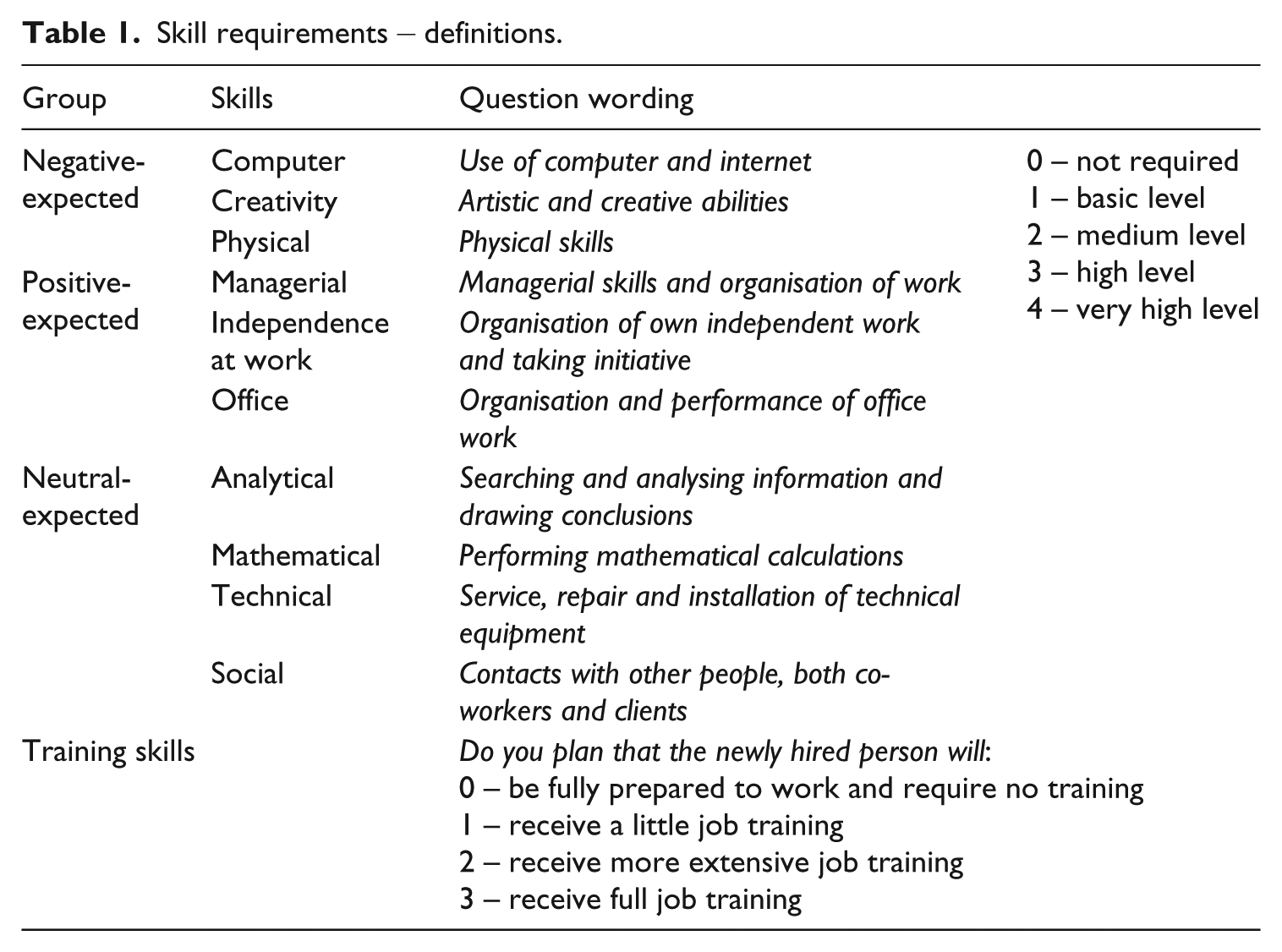
Data used for this study are described in a later section, but it is useful to point out what skills are included among negative-, positive- and neutral-expected groups. Previous studies provide reliable grounds for expecting computer and physical skills, as well as creativity to be negatively associated with old age (CIPD, 2005; Conen et al., 2012; Ng and Feldman, 2013a). The positive group includes managerial skills, independence at work and office skills (based on positive results for responsibility, accuracy, reliability or engagement, see: CIPD, 2005; Gringart et al., 2005; Posthuma and Campion, 2009; Turek and Perek-Białas, 2013; van Dalen et al., 2010). The neutral group includes analytical, mathematical and technical skills because these were not expected to feature in age stereotyping, given the lack of direct evidence in this respect. Additionally, social skills were included here due to the mixed results of previous studies (Bal et al., 2011; Turek and Perek-Białas, 2013; van Dalen et al., 2010).
Furthermore, we expect employers to have requirements regarding the trainability of a candidate – a set of skills, abilities, and attitudes that allow updating and acquisition of knowledge and competencies. This is suggested by evidence of strong stereotypes, according to which the ability to learn and develop declines with age (Maurer, 2001; Posthuma and Campion, 2009; Taylor and Walker, 1998), as well as by economic theories. Human capital theory and the deferred payment model (Heywood et al., 1999; Hutchens, 1988; Lazear, 1979) predict that companies focus on the training of younger workers as a more reasonable strategy from a career development perspective. In this sense, returns on investment regarding the human capital of older workers are lower due to shorter expected remaining working times. In contrast there is some suggestion that career expectancy is not that important when comparing younger and older workers. Younger workers change job more often, and such events are less predictable then retirement. Moreover, the highest returns from investments in human capital are in the first year or the first few years, implying that employers have no long-term expectations on this (Canduela et al., 2012). Nevertheless, data from many countries show lower rates of participation for training of older employees (European Centre for the Development of Vocational Training (Cedefop), 2012; Lazazzara et al., 2013). Hence, we formulate the fourth hypothesis:
H4. Employers are less likely to recruit workers aged 50 and over in jobs that require a high degree of training.
Previous studies also show that the acceptance rate of older candidates differs due to the size and sector of a company, and the type of job offered (Perry and Finkelstein, 1999; Posthuma and Campion, 2009). Staff shortages and difficulties with recruitment also encourage companies to accept older people (Henkens et al., 2008; Taylor et al., 2012). We may also expect a relationship between preferences towards age and gender. According to ‘job-typing’ theory, when employers wish to recruit they have a clear picture of the ideal candidate, which could exclude some groups (Oswick and Rosenthal, 2001; Perry and Finkelstein, 1999). Many studies find that older women are more likely than men to experience ‘double jeopardy’, involving ageist attitudes in recruitment due to potential misfit in two dimensions (i.e. age and gender) (Duncan and Loretto, 2004; Harnois, 2015).
Data and methods
Data
Data were obtained from five waves of the Human Capital Study–Employers Survey (HCS-ES) conducted in Poland between 2010 and 2014. HCS is the largest Polish employers’ survey (N2010–2014 = 80,017; N2010 = 15,841; N2011 = 16,158; N2012 = 16,000; N2013 = 16,005; N2014 = 16,013). It includes private and public enterprises of all sizes and from all sectors, excluding agriculture and public administration. The samples are representative at the national level and at each of the 16 regions in Poland (with n > 1000 in each). Sampling was stratified by six main sectors, 16 regions and four size groups, and was split into random and panel sections. The random sample covered companies employing from 1 to 99 people (excluding self-employed) and was independent for each wave. The panel survey included all Polish companies with more than 100 employees who were contacted at each wave (12,002 companies participated in more than one wave, and 551 in all five). Data were collected in 96% of cases via telephone interviews, supported in 4% of cases by personal or web-based interviews. The survey was part of the Human Capital Study, one of the largest labour-market research programmes in Europe (Górniak, 2015).
Dependent variable
Respondents were asked whether their companies were ‘currently looking for any people to work’, and those who answered affirmatively (approximately 17% during each wave, n = 15,408) identified and described the positions. Where a company was offering two or more jobs, one was selected randomly. Respondents were then asked about the characteristics and requirements of the position, including skills and preferred age of candidates. The dependent variable indicates acceptance of a worker aged 50 years or over (No/Yes), and was prepared based on an open-ended question about age preference for a candidate: ‘What is the minimum and maximum age of a person you are looking for, for this position?’. Respondents indicated both a low and high age, or could answer that one or both age limits were unimportant. Out of those recruiting, 67.3% (n = 10,371) provided a specific upper age limit as a criterion for employment – they received the value of 1 if the age was equal or higher than 50 and 0 otherwise. For 32.1% (n = 4941) of recruiting employers, the upper age limit was not important – they were assigned a value of 1 assuming that they would accept a 50-year-old candidate as well. There was a rate of 0.6% (n = 96) missing values.
Other possible analytical approaches, such as a sample restricted to employers with specific age preferences and two-stage selection models, returned almost the same results. We tested other threshold values for the dependent variable (e.g. 45 or 55 and over), and the results were consistent (see Sensitivity analysis). We chose the 50 and over value due to its embeddedness in social awareness as an indication of an older worker, and its standard use in public policies (OECD, 2006).
Skill requirements
Each employer was asked about the requirements for a candidate for a specific position. Skill requirements were measured with the question ‘Are these skills required for this position? If yes, at what level?’, followed by a set of pre-defined skills, with answers ranging from 0 (not required) to 4 (very high level). Training skills requirements were indicated using a separate question about planned initial job-training intensity, with a scale ranging from 0 (low degree, i.e. a newly hired person will be fully prepared to work and require no training) to 3 (high degree, i.e. she or he will receive full job training). The detailed wording of all items appears in Table 1. To provide better comparativeness in multivariate models, the variables were standardised into z-scores (mean = 0; SD = 1).
Skill requirements – definitions.
Control variables
The models were controlled for the size of the company (i.e. four groups with 1–9, 10–49, 50–249 and 250 or more employees) and its sector of activity (six sectors). We also included type of ownership (i.e. public or mixed, private) and region. ‘Training’ indicated whether the company provided training to workers within the last 12 months. Recruitment problems were based on the question: ‘Has your company had any problems finding suitable candidates for this position? (No/Yes)’. We also controlled for gender preference for the vacancy (men, women, gender not important).
An open-ended question was asked about the kind of vacancy referred to. Answers were coded into categories from the International Standard Classification of Occupations (ISCO-08). We used eight general ISCO categories, excluding category 6, skilled agricultural, because this study does not assess the agricultural sector. For descriptive purposes, they were grouped into three classes of high-, medium- and low-skill jobs based on ISCO classification and the average number of years of education of the current workforce. 1
Analytical approach
To estimate the likelihood of hiring a candidate aged 50 or over, we used mixed logit models. The maximum pooled sample from five waves of HCS-ES included 15,312 observations of companies that were seeking employees and had expressed a preference for accepting a 50-plus candidate. Owing to the partly panel design of the study, these observations come from 12,914 different companies (11,168 with single observations, 1746 with at least two observations, of which 152 with observations from four five waves). To account for the repeated appearance of some companies across waves, and to correct standard errors for within-correlations, we used a mixed (multilevel) random intercept model with observations clustered in companies (Heisig et al., 2017). Data were unweighted, but the models included sampling variables (i.e. sector, region and size). Characteristics of the sample are presented in Table 2.
Descriptive statistics of dependent and independent variables in the analysed sample.
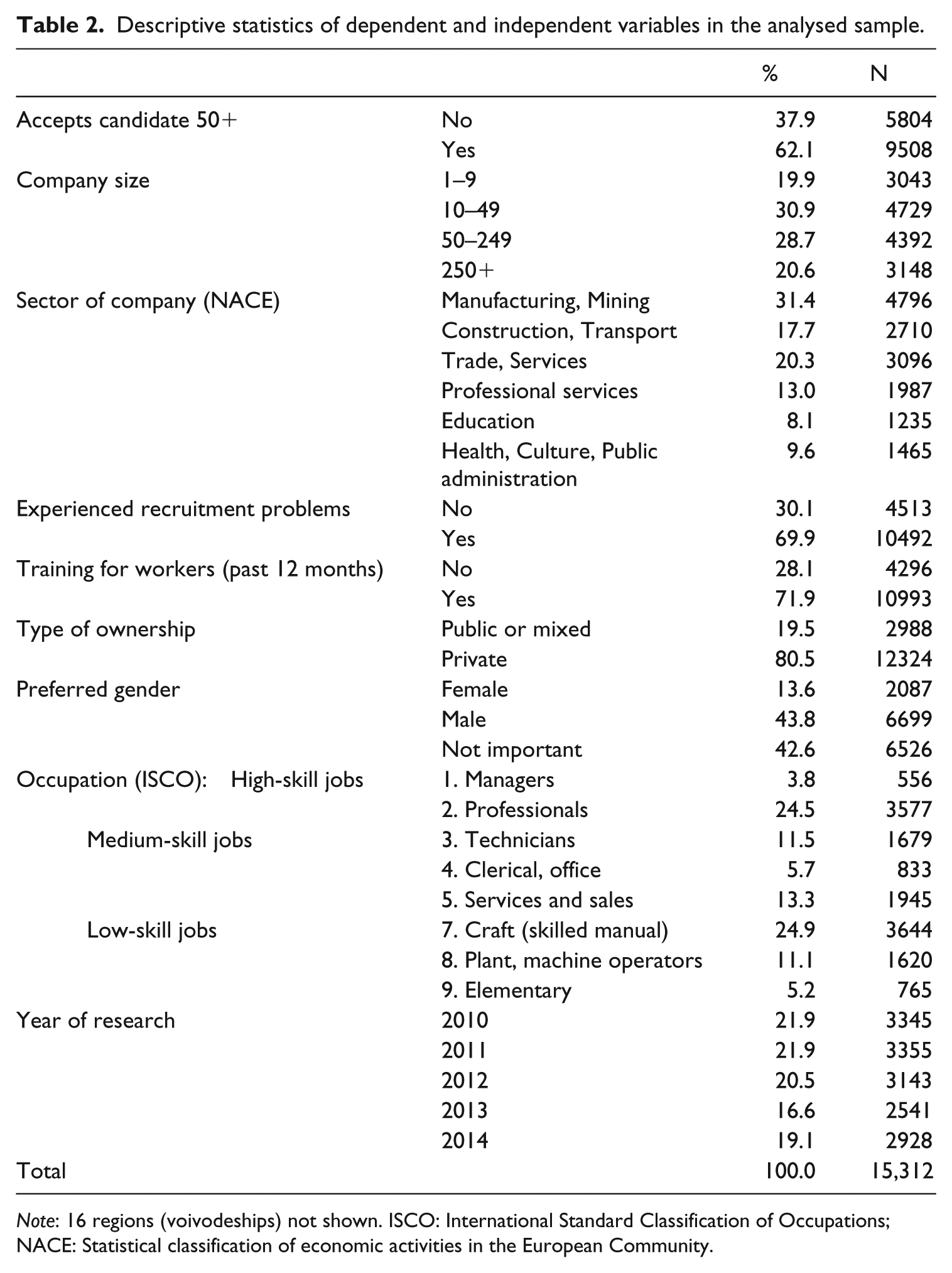
Note: 16 regions (voivodeships) not shown. ISCO: International Standard Classification of Occupations; NACE: Statistical classification of economic activities in the European Community.
Results
Descriptive statistics
The age of a candidate was unimportant to 32% of employers who were hiring. The remainder reported a maximum accepted age. The average value was 45 years (SD = 9.5) and 44.0% of respondents accepted candidates aged 50 and over (in 2010, it was 41.0%; 2011, 41.1%; 2012, 46.7%; 2013, 44.9%; and 2014, 46.8%). Assuming that respondents for whom the age range did not matter would accept a candidate of any age, acceptance of 50-plus increased to 62%. 2 Nevertheless, the results suggest that four out of 10 job offers involved rejection of older people in advance.
Skill requirements differed according to the type of job offered (Table 3). For medium- and high-skill jobs, the most desirable were social skills (required in 78% and 86% of job offers, respectively) and independence at work (66%, 83%). Also in high demand were computer (47%, 66%) and analytical (46% to 71%) skills. In low-skill jobs, most important were physical ability (51%) and independence (43%). The least desirable skills were creativity (10% in total) and office skills (15%). Initial training intensity was low: 31% of companies planned extensive or full job training for newcomers.
Descriptive statistics of skill requirements (original values).
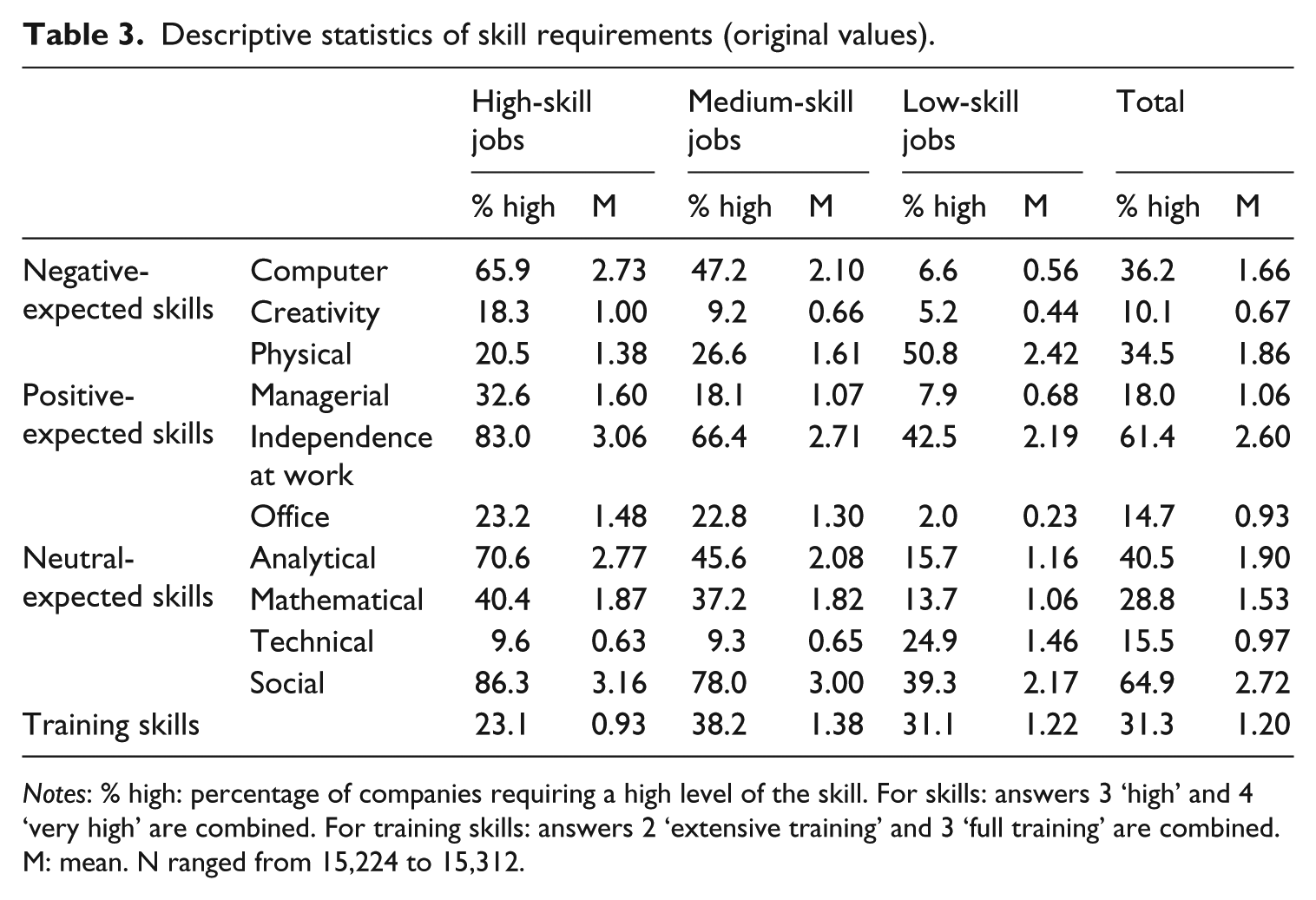
Notes: % high: percentage of companies requiring a high level of the skill. For skills: answers 3 ‘high’ and 4 ‘very high’ are combined. For training skills: answers 2 ‘extensive training’ and 3 ‘full training’ are combined. M: mean. N ranged from 15,224 to 15,312.
Multivariate models
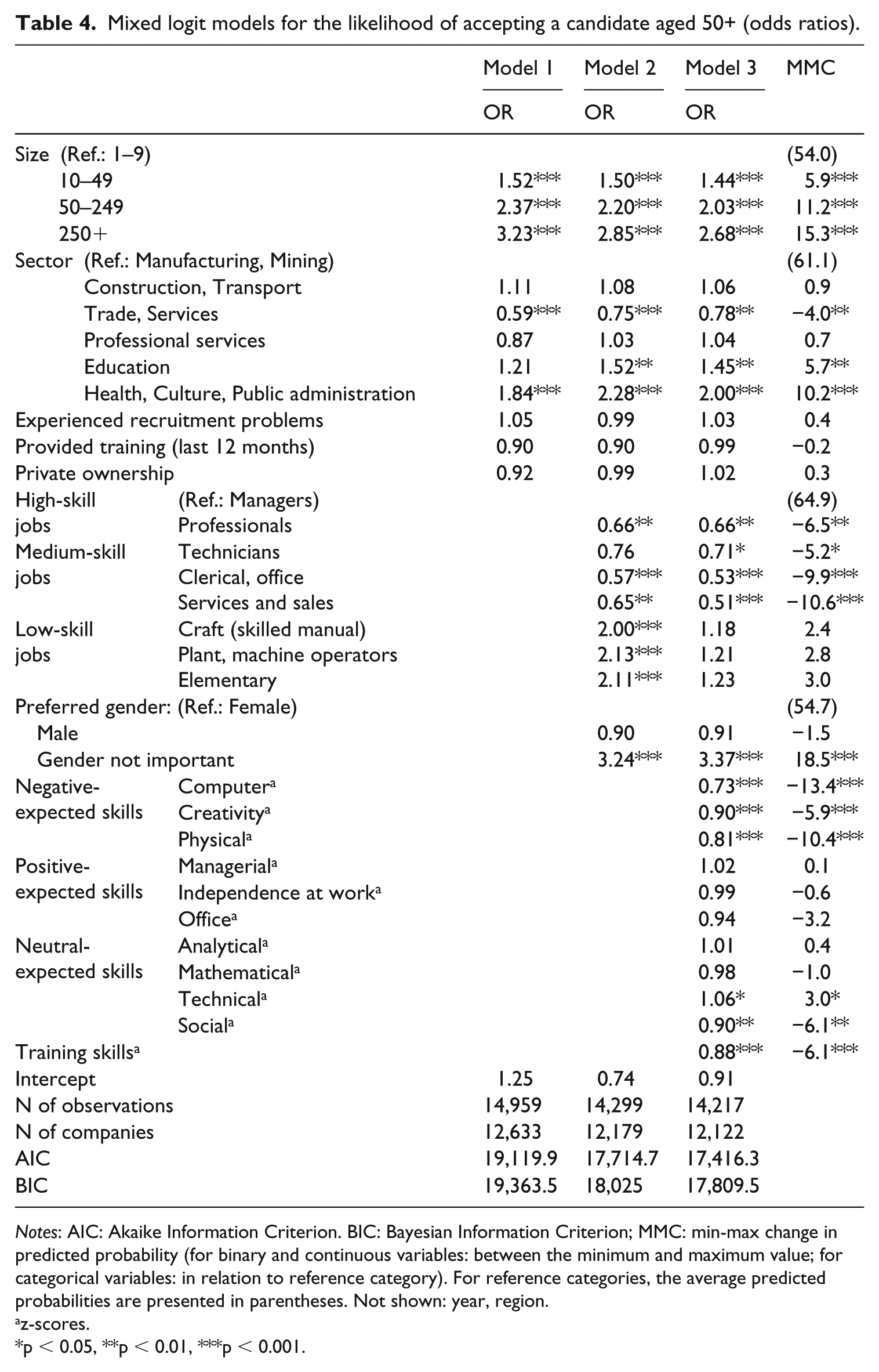
We estimated three models, each having more than 14,000 observations from more than 12,000 companies investigated across all five waves (Table 4). Model 1 includes year, region and control variables. Model 2 adds information about the occupation of a vacancy and preferred gender. Model 3 includes skill requirements. In addition to odds ratios (ORs), we also present min-max change in probability (MMC) for the variables in Model 3. MMC is more convenient for interpretation of the effects as changes (in percentage points – pp) in the likelihood of hiring older people (Long, 1997). For binary and continuous variables, MMC is the difference between predicted probabilities for the minimum (in this case zero) and maximum (1 for binary, 3 for training, and 4 for other skills) values. For categorical variables, MMC shows the difference in relation to the reference category.
Mixed logit models for the likelihood of accepting a candidate aged 50+ (odds ratios).
Notes: AIC: Akaike Information Criterion. BIC: Bayesian Information Criterion; MMC: min-max change in predicted probability (for binary and continuous variables: between the minimum and maximum value; for categorical variables: in relation to reference category). For reference categories, the average predicted probabilities are presented in parentheses. Not shown: year, region.
z-scores.
p < 0.05, **p < 0.01, ***p < 0.001.
Acceptance increased with size; companies that employed 250 or more workers showed odds more than two and a half times higher (ORModel3 = 2.68) and a 15 pp higher probability of responding affirmatively than micro companies. Industries with the greatest acceptance rates were health, culture and public administration (predicted probability of 71%), and those with the lowest were trade and services (57%). Occupations with the highest acceptance rate were elementary professions (68%), plant and machine operators (68%), and craft workers (67%). The lowest rates were for services and sales (54%) and clerical and office workers (55%). Experience of problems during recruitment, providing training, and type of ownership had no significant effects. The results show no difference between vacancies requiring females or males. However, employers without gender preferences had a higher likelihood of accepting people aged 50 and over (ORModel3 = 3.37; MMC = 18.5), meaning that respondents who do not discriminate on gender tend not to discriminate on age either. We can assume these respondents were less likely to hold a specific expected demographic profile for potential candidates, which resulted in a more inclusive approach. Additional analysis of interactions of gender preference with skill requirements or occupation showed no significant relationships.
The effects of skill requirements are shown in four panels in Figure 1. They were standardised to allow comparisons of effect sizes, with SD on the horizontal axis and predicted probabilities on the vertical axis. As hypothesised (H1), the first group of requirements had a negative effect. The strongest influence was computer skills. When the required level increased by 1 SD, the odds of accepting a worker aged 50 and over dropped by 27% (OR = 0.73). The value of MMC shows that for vacancies that required the maximum level of the skill, the predicted probability was lower by 13.4 pp than for vacancies that had zero requirements for the skill. For jobs that demanded physical skills, older workers also had much lower chances of employment, with MMC = −10.4. Also, creativity had a significant negative effect, with MMC = −5.9. The second group was hypothesised to facilitate the likelihood of recruiting older workers (H2), but there was no significant effect in the case of independence at work, managerial, and office skills. We expected no effect in the third group (H3), and indeed, analytical and mathematical skills did not affect employment. However, social and technical requirements were significant. Social skills had a negative influence – for vacancies that required very high social skills, the probability was lower by 6.1 pp versus no requirement. Technical skill had a significant positive impact, but the effect was relatively weak, with MMC = 3.0.
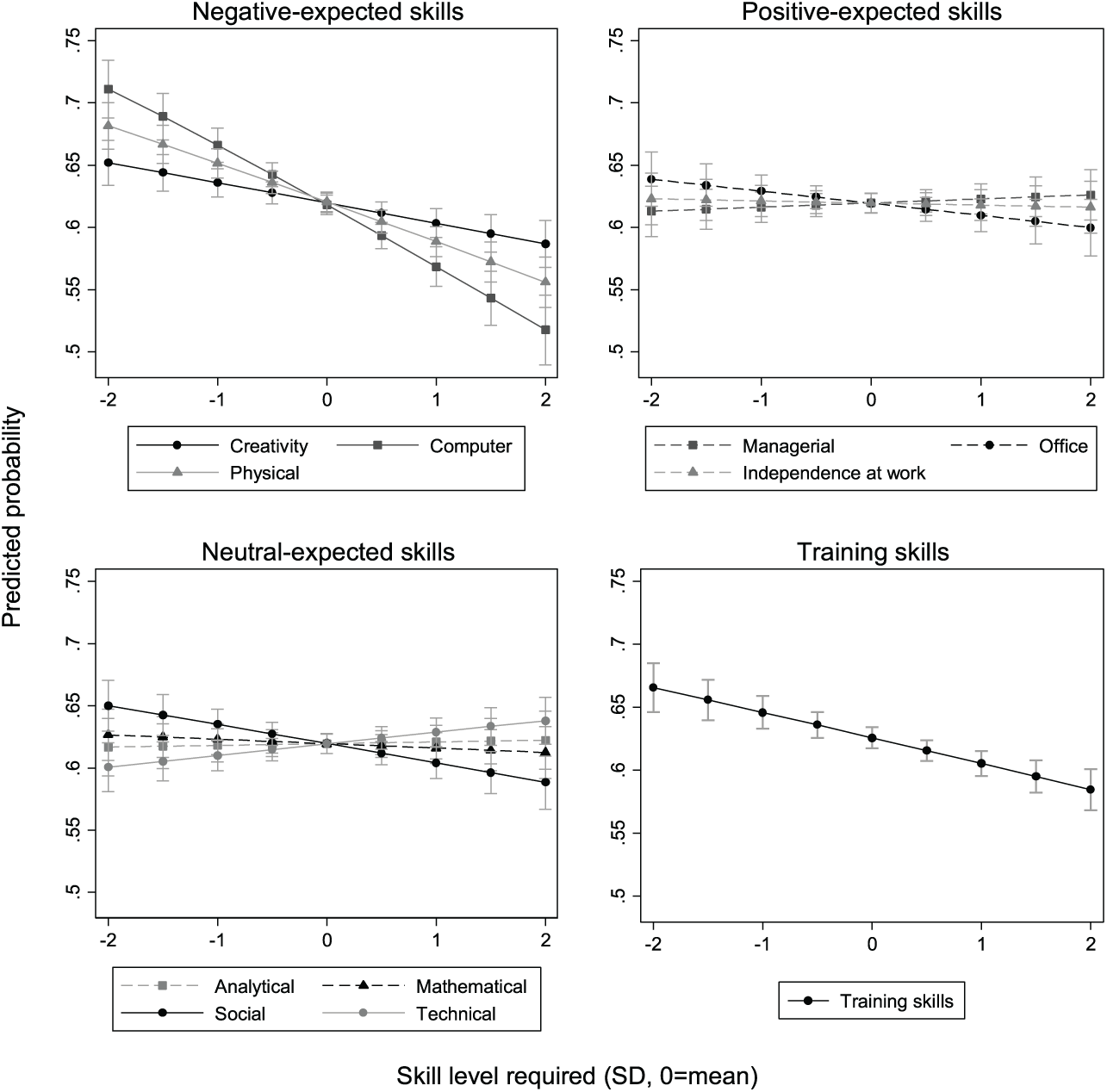
Predicted probability of accepting workers aged 50+ conditioned on the level of skill requirement (z-scores).
Results supported H4: companies that invested in training more intensively were less willing to accept older workers. The difference in the probability of a positive outcome between the minimum and maximum trainability requirements was −6.1 pp.
During additional analyses, interactions between skill requirements and job type (i.e. high-, medium- and low-skill jobs) were tested (Figure 2). For each occupational group, the effects of skill requirements are presented with the average importance of the skills. Computer skills had the most negative effect on the likelihood of recruiting a candidate aged 50 and over, but their importance differed. In high- and medium-skill jobs, many companies required high computer abilities (66% and 47%, respectively), whereas in low-skill jobs this was only 7%. A negative effect for physical requirements was also universal for all types of jobs, but it was only in low-skill jobs that the importance of these types of abilities was very high. The most common requirements, in general, were social skills; their effect was negative for medium- and low-, but not for high-skill jobs. Creativity had a negative coefficient in high- and medium-skill jobs, but it was a rare requirement. Independence and analytical abilities – two common requirements, especially in high- and medium-skill jobs – did not affect likelihood of recruitment. Technical skills had a significantly positive effect in low-skill jobs only, although their importance was moderate. Additionally, in high-skill jobs, managerial abilities had a positive effect. The negative effect of training skill requirements was significant for medium- and low-skill jobs, where it had moderate importance.
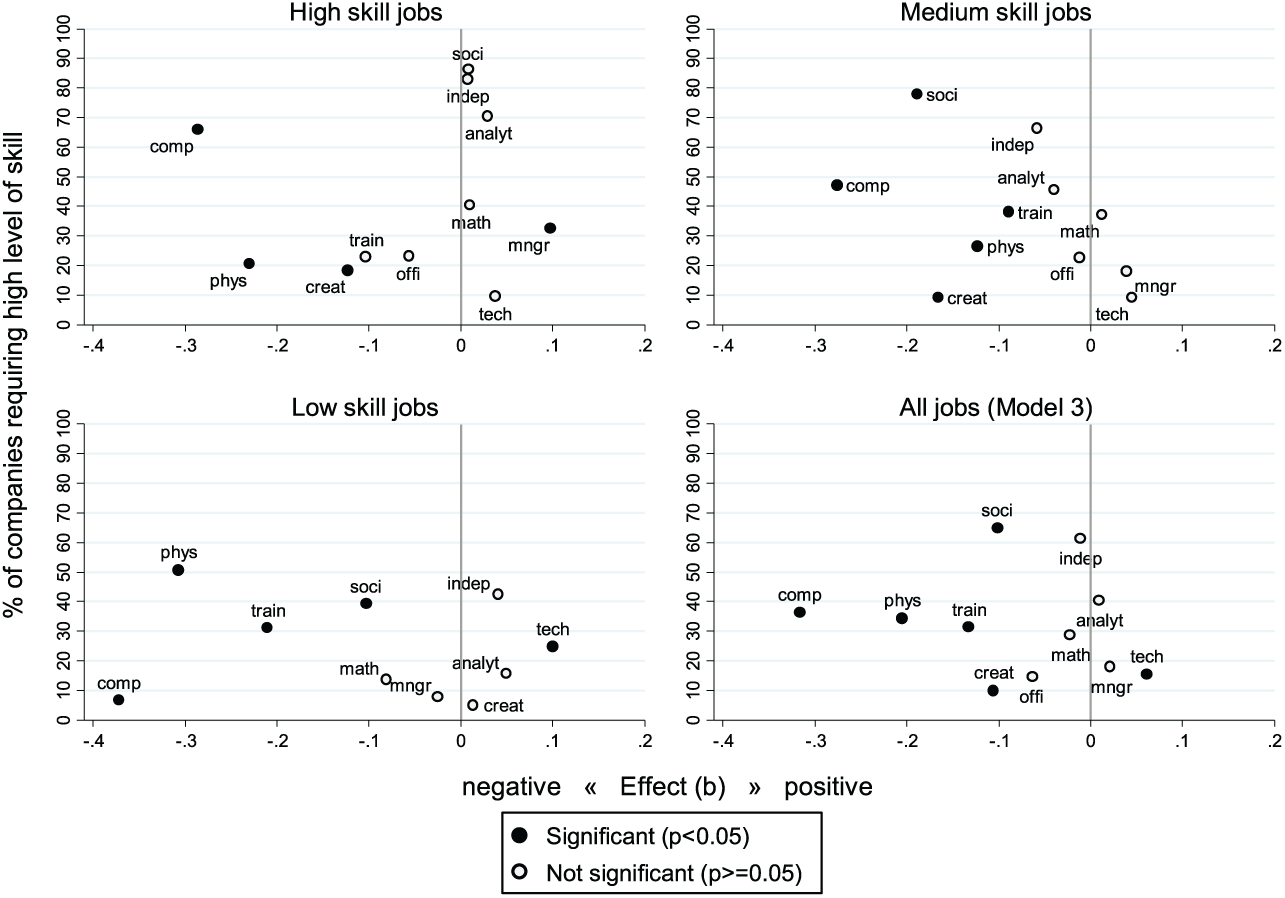
Effect and importance of skill requirements for different occupational groups.
Sensitivity analysis
Sensitivity analyses were conducted to test the robustness of the results (Online Appendix, Figure A1). We tested a model restricted to employers who had specific age preferences (excluding those who accepted everyone), and models for dependent variables that indicated acceptance for 45-plus or 55-plus candidates. We also used alternative statistical approaches (results available on request): a two-step sample-selection model (a participation model for the probability of having age preferences, and an outcome model for accepting 50-plus taking into account self-selection), and linear regression models with maximum accepted ages as a dependent variable. All approaches produce similar results and do not alter the main conclusions based on the models presented in Table 4.
Conclusions
We investigated whether the low employability of older people results from age-based stereotypes regarding skills. Using extensive survey data representative of the Polish labour market, we assessed the influence of skill requirements on the likelihood of recruiting older workers. Based on the relationship between cognitive structures and behaviours (Cuddy and Fiske, 2000; Stypińska and Nikander, 2018), we expected a positive or negative influence of skill requirements that feature in age stereotypes, and no influence of requirements that do not feature in age stereotypes.
The results provide evidence that recruitment decisions are affected by age-based opinions, but the influence is significant only in the case of a few skill requirements. The requirement with the most negative effect was computer skills. If a job required good computer skills, the likelihood of recruiting a person aged 50 and over was 13.4 pp lower than if such skills were not required. This relationship was universal across all types of occupations, but it was especially prominent for high- and medium-skill jobs, in which the majority of vacancies required a high degree of computer skills. Old-age employability is also significantly but moderately hindered in jobs requiring physical, creative and social skills. The adverse effect of physical requirement on old-age employability was in line with well-grounded expectations; similarly, creativity as a job requirement was evidenced as a drawback for the recruitment of older workers (CIPD, 2005; Ng and Feldman, 2013a; van Dalen et al., 2010). Previous results for social skills were mixed, with studies reporting negative (Bal et al., 2011; DeArmond et al., 2006), positive (CIPD, 2005; van Dalen et al., 2010), as well as neutral (Turek and Perek-Białas, 2013) effects. In this study, the negative coefficient for social skills was significant only for medium- and low-skill jobs. The only requirements that benefited older jobseekers were technical skills (expected to be neutral) and managerial skills (corroborating findings of studies of age stereotypes; Turek and Perek-Białas, 2013); however, these effects were rather weak and significant only in some types of jobs. Contrary to expectations, there was no positive influence of requirements regarding office skills and independence at work. The likelihood of employing a person aged 50 and over was lower for jobs in which more intensive initial training was available, though the size of the effect was moderate. This finding is also in line with other evidence (Canduela et al., 2012; Cedefop, 2012; Harper et al., 2006; Posthuma and Campion, 2009; Taylor and Urwin, 2001; Taylor and Walker, 1998; van Dalen et al., 2010).
The results regarding computer skills, creativity and training signal the problems that older people may encounter in evolving labour markets. Modern economies are less dependent on physical work, offering more possibilities for employment for people with reduced physical abilities (although 35% of job offers still require a high degree of physical ability). There is, however, a critical increase in demand for digital competencies, creativity, innovation and ability to learn as critical assets for firm-level performance (Ng and Feldman, 2013a). Previous research found negative old-age stereotypes related to these skills, evidencing the cognitive dimension of ageism (Cuddy and Fiske, 2000). The current study adds to the knowledge on behavioural ageism, suggesting that employers are also less willing to recruit older candidates if a job requires computer skills, creativity or training. These stereotypes directly hinder the employability of older workers and block the utilisation of their potential. Advancing age poses no strict and universal obstacle for acquiring and updating skills in new technologies (Wagner et al., 2010). Also, the common negative stereotype that older workers are less creative is at odds with some published evidence. For example, Ng and Feldman (2013a) show that older workers were more active in the generation, dissemination and implementation of innovative ideas in companies. Cognitive ageing also does not affect learning abilities of 50 or 60-year-olds in a way that would reduce the efficiency of training (Willis and Schaie, 2006; Zwick, 2012). However, stereotypical views from employers on these matters might create barriers to employment and human capital investment. Moreover, employees’ willingness to enter training depends on self-confidence regarding learning skills, which can decline as a result of age stereotypes at work (Maurer, 2001; Posthuma and Campion, 2009).
This study supports the thesis that in some areas, contemporary labour markets are old-age unfriendly and the potential of older staff is underestimated. In addition to the adverse effects of computer, physical, creative skills and training for the recruitment of older people, the results indicate that 38% of companies rejected candidates aged 50-plus no matter what their qualifications were. A positive conclusion for older jobseekers is that we find no evidence of discriminatory effects regarding a number of skills, such as independence at work or in the office, technical, managerial, analytical, and mathematical skills. Using employers’ data, we focus on the demand-side of the labour market, but attitudes of employers can change in reaction to the trends observed on the supply side. We may expect that ageing and shrinking labour markets will become more friendly to the greying workforce. Future cohorts will enter advanced age with different skills and attitudes, which will probably confront existing stereotypes, particularly those related to computer skills. Additionally, increasing flexibility of working arrangements, such as distributed work, and improved working conditions should increase employment opportunities. Most of all, growing labour shortages might stimulate a change in attitudes of employers, who have to learn how to draw on the potential of older workers (Henkens et al., 2008).
A challenge for public policy-makers whose aim is to extend working lives is to support these changes and limit the adverse impact of old-age stereotypes. To achieve this, employers must be recognised as key actors whose attitudes and decisions shape the labour market for older people (Henkens and van Dalen, 2008; Vickerstaff et al., 2003). One argument for this thesis is provided by the poor results of public investments that aim to improve training in older age. Although the importance of lifelong learning for extending working lives is emphasised in the majority of strategic policy documents (Fleischmann and Koster, 2017; Formosa, 2012), little progress has been made in participation in education in older age in the last two decades. One of the reasons for this has been a narrow approach in policy programmes, which focuses primarily on individuals and neglects employers who decide who has access to training in companies (Canduela et al., 2012; Cedefop, 2015; Johnson et al., 2009).
The combination of discriminatory effects relating to computer, creative and training requirements suggests a general image of older workers who are unable to adjust to a modern economy and high-skilled specialisms. Consequences can be especially profound for countries such as Poland, which must use their human capital efficiently to develop economies able to compete with those of Western Europe. Neglecting the potential of the 50-plus population, when the old-age dependency ratio is projected to increase in Poland from 22.2% in 2010 to 37% in 2030 (Eurostat data), could hinder economic progress.
On a separate note, we wish to address the relationship between discrimination based on age and that based on gender. Our results show that employers who have a preference for a certain gender are also more likely to have a preference on age. This point is linked to the ‘double jeopardy’ problem that is often found to be a burden for older women (Duncan and Loretto, 2004; Harnois, 2015). Furthermore, there is a possibility of a gendered bias in occupational titles and skills requirements that benefit men (Estevez-Abe, 2005). For instance, the strong role of computer skills could be expected in some settings to work against women in that it is a predominantly male-oriented domain (Sieverding and Koch, 2009). Going beyond this study design, these problems deserve further research.
The main strength of this study is a real-life framework that demonstrates whether skill requirements lead to age bias during recruitment. We investigated real employers, vacancies and skill requirements in an entire national labour market. Instead of soliciting opinions on the skills of younger and older workers, we focused on a tangible element of recruitment – skill requirements and hiring intentions. An important limitation, however, is that we had no information on real candidates who fulfilled vacancy requirements. Another limitation is a lack of information about wage offered for the vacancy, so we do not know whether older workers are preferred more for low- or high-paid jobs. Employers balance their expectations about productivity with the costs of employment, and, in the case of underpaid jobs, accepting a lower salary can be considered as a requirement for a candidate. Although this study is representative of the Polish labour market, generalisations to other countries are speculative. In Western Europe, which is characterised by higher employment rates for older workers and a different structure of the supply and demand of human capital, results might have been more favourable for older jobseekers.
We argue that age should be viewed in light of the meanings and expectations that employers impose on it. Despite progress with anti-age discrimination legislation (Neumark, 2009), which covers recruitment (e.g. prohibition of age as a factor for hiring), age remains a candidate’s essential characteristic. It serves as a convenient though unreliable indicator of skills, productivity, costs and remaining length of career. As this study shows, age discrimination influences recruitment, but it often does so indirectly through the job requirements defined by an employer. Skill requirements influence the preselection of candidates based on age, and thus must be considered an element of discriminatory practices that decrease older workers’ employability.
Supplemental Material
Supplemental_material_WES_847943 – Supplemental material for How Skill Requirements Affect the Likelihood of Recruitment of Older Workers in Poland: The Indirect Role of Age Stereotypes
Supplemental material, Supplemental_material_WES_847943 for How Skill Requirements Affect the Likelihood of Recruitment of Older Workers in Poland: The Indirect Role of Age Stereotypes by Konrad Turek and Kène Henkens in Work, Employment and Society
Footnotes
Acknowledgements
The authors would like to thank Hendrik P van Dalen from NIDI for his valuable comments, and three anonymous reviewers for all their careful, constructive and insightful suggestions.
Funding
This work was supported by the grant from European Commission ‘Marie Skłodowska-Curie Actions – Individual Fellowship’ [748671 – LEEP – H2020-MSCA-IF-2016/H2020-MSCA-IF-2016]. This article uses data from the Human Capital Study in Poland 2010–2015 conducted jointly by the Jagiellonian University (Centre for Evaluation and Analysis of Public Policies (CEAPP)) and the Polish Agency for Enterprise Development (PARP).
Notes

References
Supplementary Material
Please find the following supplemental material available below.
For Open Access articles published under a Creative Commons License, all supplemental material carries the same license as the article it is associated with.
For non-Open Access articles published, all supplemental material carries a non-exclusive license, and permission requests for re-use of supplemental material or any part of supplemental material shall be sent directly to the copyright owner as specified in the copyright notice associated with the article.
