




Abstract
Despite growing interest in the gig economy among academics, policy makers and media commentators, the area is replete with different terminology, definitional constructs and contested claims about the ensuing transformation of work organisation. The aim of this positional piece is to provide a timely review and classification of crowdwork. A typology is developed to map the complexity of this emerging terrain, illuminating range and scope by critically synthesising empirical findings and issues from multidisciplinary literatures. Rather than side-tracking into debates as to what exactly constitutes crowdwork, the purpose of the typology is to highlight commonalities rather than distinctions, enabling connections across areas. The framework serves as a heuristic device for considering the broader implications for work and employment in terms of control and coordination, regulation and classification, and collective agency and representation.
Introduction
Crowdsourcing is increasingly being hailed as providing opportunities for micro-entrepreneurs to enjoy flexible working via a digital platform. This type of activity utilises internet technology to source digital and material contributions from an on-demand workforce (Howe, 2006). When crowdsourcing initially emerged, it tapped into popular concepts such as collaborative consumption and the sharing economy with enthusiasts suggesting it serves as an alternative to more traditional forms of market and hierarchy (see Benkler, 2006; Shirky, 2010). This mode of organising has been variously described as a social movement and an egalitarian vision, drawing on the ideals of equality, sustainability and community (Slee, 2015). However, a major flaw with these celebratory accounts is that they are framed in such a way that they obscure the pivotal role played by labour, thereby avoiding consideration of employment relations and the exploitative working conditions which underpin it.
Although it is difficult to pinpoint the number of people working on crowdsourcing platforms, sources point to exponential growth. Surveys suggest there are nearly 5 million crowdworkers in the UK (Huws and Joyce, 2016c), around 12% of the Swedish population is working in the gig economy (Huws and Joyce, 2016b) and 18% of people in the Netherlands have tried to find work via a digital platform (Huws and Joyce, 2016a). This expansion is based on various complementary developments. First, advanced technological architecture has led to the creation of a global network to facilitate connectivity and enable rapid scalability (Gawer, 2014). Second, crowdsourcing is seen to capture and create value with the sourcing of unregulated and unprotected labour/expertise (Katz, 2015). It appeals to firms as they can access a broad range of skills at significantly lower labour costs, with the scaling of work execution without any significant transaction costs or logistical hurdles (Zhao and Zhu, 2014). Finally, the cumulative impact of work-related changes such as casualisation, informalisation and demutualisation of risk (de Stefano, 2016) means that increasing numbers are attracted to crowdwork. While survey research shows that some participate for additional earnings, others report on the substantial proportion that relies on digital platforms as their primary source of income (Berg, 2016; Huws and Joyce, 2016c). In this respect, crowdsourcing comprises another category of non-standard work, emulating working practices which are enmeshed within the wider labour market (Eurofound, 2015).
As crowdsourcing evolves, scope has diversified and numerous modes of operation exist. This is reflected in different terminology, often referring to the same phenomena, as well as debates as to what should be included/excluded. Crowdsourcing is highly heterogeneous and includes capital (crowdfunding), ideas generation (crowdsolving and competitions) and the polling of public opinion (crowdvoting), to name a few examples. The areas that have attracted most interest began with the sharing economy and more recently shifted to the gig economy; phenomena which are conceptually distinct yet have clear overlap. In the wider media, the employment status and working conditions of ‘giggers’ with high visibility such as delivery couriers and taxi drivers, has generated considerable attention, yet this represents a fraction of crowdwork. Research emanates from various disciplinary areas, including computer science, law, internet studies and anthropology; consequently there is an absence of overarching connections. Much of the literature emphasises business benefits and the desire to exploit new avenues of competitiveness and profitability, which tends to obscure the labour dimension. There is an emerging critical literature which clusters around the two prime examples of labour exploitation: Amazon’s Mechanical Turk (MTurk) and Uber. While critical analysis is to be welcomed, there is a need for a more expansive understanding of crowdwork that provides an analysis of common threads, rather than focus on isolated cases and examples. Therefore, the objective of this article is to provide a timely review and classification of crowdwork by critically synthesising empirical findings and issues from multidisciplinary literatures. The review will privilege the role of labour and capital–labour relations as the focus for analysis. The next section will present an overview of common characteristics of crowdwork. This is intended to frame the introduction of a typology of generic, ‘ideal types’ of crowd-based technologies and services, enabling connections across disparate areas and more abstract conclusions. This overarching approach will act as a vehicle for illustrating the range and complexity of this emerging terrain, in order to identify the implications for work and employment. This will be discussed in the context of control and coordination, regulation and classification, and collective agency and representation.
Common characteristics of crowdwork
Crowdwork functions as a marketplace for the mediation of both physical as well as digital services and tasks. For digital tasks, the entire activity is carried out online from initial instruction through to completion and evaluation; physical tasks are managed and mediated digitally (often via an app) but carried out offline (e.g. transportation, DIY). Although there are differences with regard to skill levels, task complexity, remuneration, as well as levels of autonomy and control, there are several defining features, which are appropriate for common analysis. This section will present an overview of these commonalities, focusing on five key areas: the platform; the labour pool; the employment contract; algorithmic control; and digital trust.
First, a careful examination of crowdwork begins with the concept of platform, a term used to describe the digital process of enabling interaction between external producers and consumers. As the area diversifies, nomenclature has loosened from its strict computational meaning to its more contemporary usage, which ‘suggests a lot while saying very little’ (Gillespie, 2010: 351). This opacity allows platforms to appeal to multiple audiences: consumers; producers; advertisers; and venture capitalists. While platforms are presented as a success of technological innovation, they are economic actors within the capitalist mode of production who are seeking new markets and new means for generating surplus value (Srnicek, 2017). One of the most costly aspects of the means of production involves investment in technical infrastructure that enables activities to be globally distributed at low marginal cost. Having invested in infrastructure, platforms open their technology to third-party contributions to provide an extensive range of applications and services which make platforms so compelling. This positions platforms in an orchestrating role as they provide the central hub upon which external parties supply and develop content. This stimulates network effects, whereby value increases geometrically as the extensive range of products and services expands market share. Cumulative benefits accrue as those that make it beyond a tipping point become hard to dislodge (Gawer, 2014), leading to extreme dominance by a few large corporations (Fuchs, 2014). These tend to be Silicon Valley technology companies, backed by large amounts of venture capital, with many developing explicit strategies to create monopolies (McCann, 2015; Srnicek, 2017). This combination of scale and corporate concentration represents a discontinuity from classic understandings of the power of capital (Scholz, 2016).
Second, crowdwork organisation predominantly features microtasks, which are menial, monotonous and tightly bounded (de Stefano, 2016). From the perspective of capital, voluminous crowds can process large quantities of data in a short time frame, enabling the exploitation of geographical differences in skills and labour costs (Lehdonvirta, 2016). Even with the more highly skilled, higher paid work, remuneration is comparatively lower than the non-platform-based equivalent. Crucially, the availability of lower cost work attracts consumers, enabling the platform to rapidly expand, build the brand and generate higher market valuations. It is increasingly common to view crowdwork as a new form of Taylorism (Kittur et al., 2013), as digitisation facilitates the transference of the assembly line model to a wider range of production systems. However, unlike a physical assembly line there is virtually no human contact as digital microwork entails an individualised and largely anonymous transaction, representing an extreme form of commodification.
Third, in terms of the employment contract, the majority of crowdwork platforms classify external contributors as ‘independent contactors’ (Berg, 2016) with self-employed status. This provides tax advantages for platforms and alleviates the regulatory requirements of paying minimum wage (Felstiner, 2011), while contributors shoulder personal liabilities. Some commentators claim that crowdwork presents opportunities for ‘micro-entrepreneurship’: ‘People who are empowered to make or save money by offering their existing assets or services to other people’ (Botsman, 2015). However, as numerous platforms morph into monopolies, absorbing small businesses and eroding more traditional sources of work (e.g. taxi firms and Uber), the claim that crowdwork is nurturing enterprise is highly questionable.
Fourth, digital evaluation of work processes features prominently, which is based on the assumption that software can seamlessly handle all transactions (Reich, 2015). Given many platforms base their success on rapid scalability of low-cost labour, direct assessment of the quality of the labour process can be both time-consuming and costly. Direct managerial control is replaced with complex software algorithms, which are bestowed with legitimacy and impartiality (Gillespie, 2014), and evaluate interactions with minimal intervention from the platform. These tools act as objective brokers of performance, providing a semblance of quality assurance. There is an assumption that platforms function as mere ‘middle-men’ operating as a neutral party, yet this is misleading since it fails to acknowledge that technology is a carrier of particular socio-economic interests (Wajcman, 2006).
Finally, the regulatory context whereby the platform-owner is absolved of responsibility for transactions has led to a growing literature on the digital trust infrastructure (Sundararajan, 2016), which is viewed as a substitute for regulatory consumer protection. While the brand and reputation of platforms remain pivotal in attracting a critical mass, it is assumed that reliability can be measured in digital ratings. Online recommendation systems, which have become ubiquitous for grading films (Netflix) and holidays (TripAdvisor), are now being applied to workers. This is viewed positively by some, who argue that it enables power and influence to transfer from wealthy elites and institutions towards those with the best reputations (Botsman, 2015). Reputation systems are seen to operate as an ‘invisible hand’ that rewards good producers while punishing poor ones (Goldman, 2011: 53). In reality, managing one’s online history becomes critical, even though ratings are not necessarily impartial or free from collusion or retaliation. These systems are only as effective as the testimonies, and negative reviews have been associated with race and gender discrimination (Slee, 2015).
Crowdwork typology
The typology of crowdwork is intended to help identify future challenges for work and employment and aid understanding of this complex, emerging terrain. The purpose of a typology is to reduce the plethora of examples into a lesser number of classes which share key attributes. This serves as a heuristic device to represent concepts rather than empirical cases. The dimensions are based on the notion of an ideal type, a mental construct that deliberately accentuates certain characteristics rather than something that is necessarily found in empirical reality (Weber, 1949).
The typology critically synthesises multidisciplinary literatures and cross-classifies extant research into a 2-by-2 table (Table 1) which generates four canonical types of crowdwork. The resulting types are intended as analytical tools for exploring basic assumptions, rather than as maps of reality that typically come across as messy and volatile (Collier et al., 2012). One-sided accentuation of payment type and initiating actor is applied. Within the payment type of ‘paid’, the platform specifies the payment level for the task, so that when completed the worker can anticipate receipt of an agreed fee. For the payment type of ‘non-paid or speculative’, the worker supplies contributions, which may or may not result in remuneration in the future. For the initiating actor type, there are requesters and workers. Requesters, who may be private companies or individual consumers, can initiate the transaction by posting requests online. Workers can also initiate the transaction by offering products, services or skills. This distinction is intended to highlight the locus of control and levels of autonomy. Although other dimensions may also be deemed relevant our focus on work and employment issues offers them as a coherent and parsimonious basis for developing the typology.
Typology of crowdwork platforms.
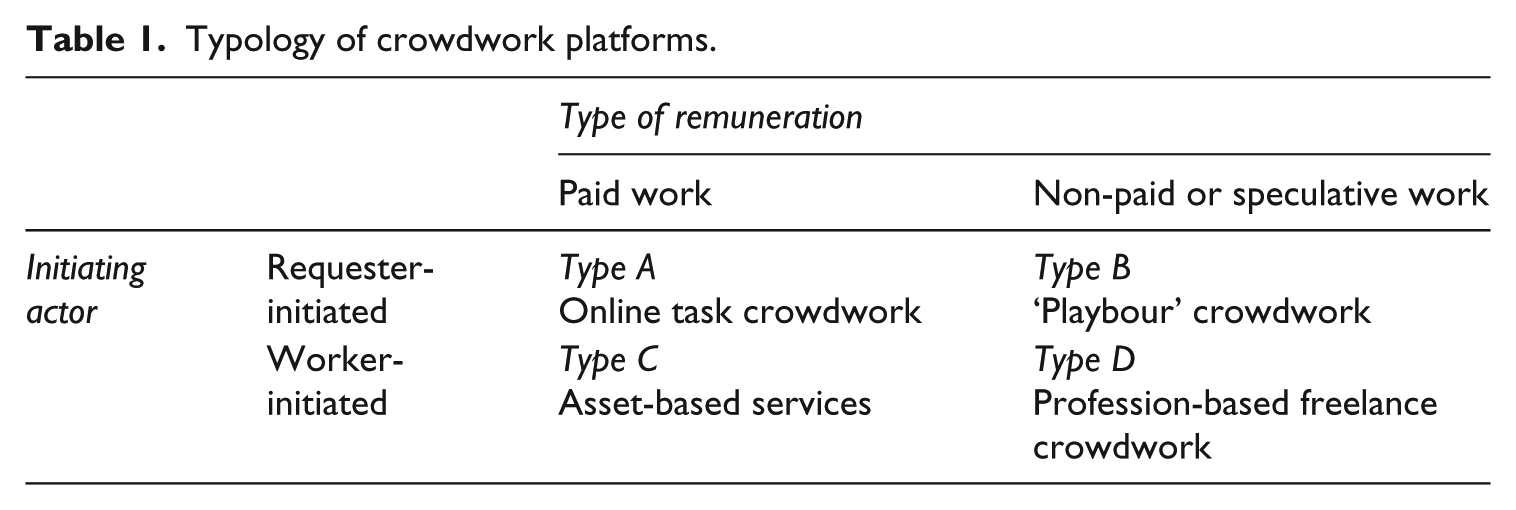
The ideal types are analysed with reference to the key participants: worker; requester; and platform. In particular we examine the relationships between the three actors and the context within which they operate. This broad-based approach is intended to illuminate key features and attributes more generally rather than focus on the specifics of platforms.
Type A: Online task crowdwork
Online task crowdwork offers paid work (sometimes subject to requester satisfaction) for specified tasks and the initiating actor is the requester. The tasks are modular, ranging from microtasks to more complex projects, with the potential for further Taylorisation. As noted by Howe (2008: 49): ‘breaking labour into little units, or modules, is one of the hallmarks of crowdsourcing’. This category of crowdwork is closely aligned to the concept of ‘computer control’ (Elliot and Long, 2016) whereby the manager–worker interaction is replaced with micro-level task control, which is more precise and impersonal. MTurk serves as an emblematic case of a microwork platform, whereby human labour fills the gaps in computational systems and value is extracted by enterprises. This process has been described as ‘heteromation’ (Ekbia and Nardi, 2014): compared with automation whereby human intervention is replaced by technology, heteromation pushes critical tasks to humans as indispensable mediators. It is possible for such tasks to be automated; it is just that low-cost human labour is far cheaper for firms who are driven by short-term profit maximisation. Most platforms are open to all workers in order to generate network effects, which reduces market competition and drives platform expansion. Online task completion is predominantly targeted towards individuals, with little opportunity for collective working, but there are limited instances of team-working (e.g. CloudFactory). While the majority of online task crowdwork consists of microtasks, there are examples more commonly associated with higher skill sets, such as UpWork, Fiverr and InCloudCounsel, but these tend to offer lower cost services than their bricks-and-mortar counterparts.
When requesters initiate the posting of work activities and assignments, specifying seemingly simple tasks for an unknowable crowd can be open to misinterpretation. The more fragmented the task, the greater the need to integrate the collective labour process (Hyman, 1987). Consequently, there have been two key growth areas. The first concerns the expanding literature within computer science that focuses on creating and analysing workflows, with a view to generating predictions about the resulting quality and cost (Ipeirotis et al., 2014). The second development concerns the emergence of firms who mediate between requesters and workers. Intermediaries offer services to help ensure that employing a digital workforce remains viable, particularly for large-scale corporations, so that the benefits of low cost and low commitment are not negated by the effort required to manage the workforce; this includes assistance in the specification of tasks, inspecting quality and authorising payment. While fractalised labour is expendable, nevertheless there is a need for the integration of tasks as part of the production process. Intermediaries also provide a more automated approach to the hiring and managing of workers, to the extent that some platforms combine automation with humans (e.g. CrowdComputing Systems). Filtering processes are not uncommon, whereby workers sourced on one platform provide labour for another (e.g. Casting Words source their entire workforce from MTurk); this highlights the complex layers of sourcing and the creation of low-cost value chains. Mediator firms also obscure the identity of large corporations, sidestepping corporate social responsibility and potential concerns associated with using crowdwork platforms.
Type B: ‘Playbour’ crowdwork
‘Playbour’ (the combination of play and labour) crowdwork is based on speculative or non-paid work and the initiative lies with the requester. ‘Playbour’ (Kucklich, 2005) is an ideological strategy of capital that associates pleasure, creativity and autonomy with labour (Fuchs, 2014). It is based on the assumption that if work is allied with fun, then workers are more inclined to innovate and increase productivity, as the boundaries between work and leisure become blurred (Florida, 2002). Aspects of labour associated with pleasure have become subsumed under capital and a sphere for exploitation, producing surplus value and increasing profit maximisation for high-tech firms. This type of crowdwork is not perceived as a replacement for traditional work as it would be difficult to survive financially, but it can provide monetary reward for the especially talented. Contributors are drawn into platform participation based on personal interest appeal and labour for free, unless prize money is won. The objective of these platforms is to attract the participation of highly skilled individuals in order to harvest creative potentials for profits (Fuchs, 2014; Howe, 2006).
Popular examples of this ideal type include the early cases of Threadless.com (Howe, 2006), where an online community upload and score T-shirt designs in an online gallery, and InnoCentive.com, which broadcasts scientific problems to an online community of ‘solvers’ who can win cash prizes (Jeppesen and Lakhani, 2010). One advancing area concerns crowdwork competitions within software development (LaToza and van der Hoek, 2016; Stol and Fitzgerald, 2014). These have been pioneered by TopCoder, one of the largest platforms for software development tasks with more than half a million members. Requesters pay a monthly fee to the platform and propose projects; these are decomposed as contestants provide competing solutions. A winner and runner-up receive lottery-like payment for their contribution, which is conditional on quality ratings scores (Tsai et al., 2014). Participants compete to accumulate social capital in the hope of gaining a reputation as a talented developer. This form of ‘training-for-labour’ (Standing, 2014) whereby workers face constant pressure to enhance their skills to maintain employability, is increasingly occurring. In terms of fairness there are issues as to whether people should be rewarded for their input and contribution, since ‘problems solved and products designed by the crowd becomes the property of companies, who turn large profits from this crowd labour’ (Brabham, 2008: 76).
Type C: Asset-based services
Crowdwork that involves asset-based services offers paid work (subject to requester satisfaction) and the initiating actor is the worker. This category links strongly with the notion of the sharing economy, which refers to crowdwork based on real-world exchanges (Slee, 2015). In this regard, the activities, which are managed digitally, are predominantly conducted offline and rely on utilising the assets of workers (e.g. cars, bikes, spare rooms, DIY tools) while lean platforms reduce their assets to a bare minimum. This type of platform has been described as a ‘hyper-outsourced’ model (Srnicek, 2017: 76). It enables new ways of monetising and digitising informal work and ‘cash-in-hand’ labour as high-tech firms build significant corporations on the back of what previously operated on the margins. Work is time and place-dependent and so carries obvious geographical limitations. Although transactions are locally based, the platform facilitates scalability and its role as an orchestrator is evident in the significant expansion of firms such as Airbnb, Uber and TaskRabbit.
With this ideal type, transactions are predominantly founded on face-to-face contact between the worker and requester and can be classified as interactive service work (Fuller and Smith, 1991). The material nature of the encounter means that trust and security issues become more prevalent as contracting with strangers online involves greater risks than similar exchanges with traditional firms (Katz, 2015). Consequently this ideal type is seen as being at the cutting edge of ‘algorithmic regulation’ whereby traditional forms of consumer-protection are replaced by online ratings. Emotional labour has long been a key element of interactive service work, but it takes on new resonances given the nature of evaluations, as workers are judged on their activities by customers. Behaviour is shaped by the threat that any encounter could become antagonistic if customer demands are not satisfied as workers face relentless pressure to perform quality service labour. Questions have been raised concerning the extent to which customers are qualified to provide a fair and objective evaluation, given that negative reviews serve as disciplinary instruments. In a study of ridesharing, research showed a differential understanding among passengers as to what ratings mean (Raval and Dourish, 2016). Few consumers realised the implications of how seemingly high scores (4.6 for Uber drivers and 4.79 for Lyft out of a maximum of 5) translate into potential deactivation from the platform and a loss of earnings.
Type D: Profession-based freelance crowdwork
Platforms for profession-based freelance crowdwork do not provide payment upfront and the initiating actor is the worker. This type of crowdwork tends to have a specialist focus which requires a high level of professional knowledge and competence, such as the development of mobile apps for Apple and Google platforms (Bergvall-Kåreborn and Howcroft, 2013) or supplying photographs for iStockphoto (Brabham, 2008). Of the four ideal types, profession-based freelance crowdwork is more akin to the working practices of the traditional self-employed (as distinct from misclassified ‘independent contractors’ working on platforms). The platform provides a centralised resource and access to a consumer base, which is useful to many small firms who do not have the capacity for marketing and distribution on a global scale. There is no upfront payment for labour from the platform-owner; instead there is an expectation that reimbursement will follow once products and services are sold to consumers. Consequently, remuneration is speculative as it is difficult to predict success at the point of release.
Within this category there are rarely any barriers to entry since benefits accrue as platforms offer a wide range of products/services with no direct costs in the production process. This serves as a classic example of shifting risk with platforms transferring uncertainty associated with fluctuating consumer demand to third-party contributors. While workers determine price levels (within normative guidelines) the platform usually deducts a percentage of each transaction, which cumulatively represents a significant amount. For example, since 2008 Apple have generated around $26bn from top slicing 30% of revenue from each app (Statista, 2017). Platforms benefit by showcasing a vast array of products and services, often from workers within the creative industries. Operating as experts that submit the output of their labour to the platform, workers are not subjected to direct managerial control, since work takes place outside platform boundaries. However, there are glaring power asymmetries and the primary power dynamic is unidirectional, with platforms taking on the role of an industry bottleneck (Thompson et al., 2016). The sheer scale of contributions means that third-party content providers have limited bargaining power which can be particularly problematic for workers whose career and livelihood is closely coupled with the platform.
Implications for work and employment
In this section, we draw on the combination of common characteristics of crowdwork and the ideal types outlined in the typology to consider implications for work and employment. We focus on three areas: control and coordination; regulation and classification; and collective agency and representation.
Control and coordination
In 1987, Richard Hyman posed the question as to how far microprocessor-based systems have been integrated with the control of labour (Hyman, 1987), an issue that is just as pertinent today as crowdwork poses fresh challenges to labour–capital relations. The typology illustrates the heterogeneity of crowdwork which generates varied dimensions of control. Compared with a hierarchical chain of command and clear line of authority, platforms are intentionally positioned as neutral intermediaries who merely facilitate a digital matching service between end-users. Yet the platform ensures general directive control by designing the environment, monitoring behaviour (of workers and consumers) and adjusting environmental conditions based on the collection of big data, resulting in glaring asymmetries of information and power (Calo and Rosenblat, 2017). Given that capital’s key concern is with profit accumulation, control over labour is not a key objective for many platforms. The compulsion to generate surplus value is often associated with the need for managerial mechanisms of discipline and surveillance (Hyman, 1987), but as Nichols (1980: 276) reminds us, generating surplus value is not simply about the control of labour-power. In the case of platforms, there is generally less concern with explicit control since the production of products and services merely represents one element in the wider circuit of capital. The business model is based on attracting large numbers of users in order to reap economies of scale and build critical mass, enabling platforms to value-skim each transaction, expand market share and maximise stock market valuation.
Crowdworkers exercise autonomy in that they usually choose when and for how long they wish to work, with little direct supervision of task completion. Nonetheless, if a platform aims to rapidly scale service offerings it needs to ensure that there are adequate mechanisms for directing, evaluating, disciplining and rewarding labour. Achieving effective control of a workforce comprising independent contractors is critical, since labour needs to be ‘both dependable and disposable’ (Hyman, 1987: 43). This is achieved via various means. First, self-employment classification mobilises commitment to quality work and encourages self-discipline, thereby neutralising the indeterminacy of labour. This employment classification applies across crowdwork types. Reliance on the labourer’s voluntary initiative and willing co-operation is usually advantageous to capital (Burawoy, 1979) as poor performance equates with limited access to further work. Second, tightly defined terms and conditions stipulate governance structures and ensure all transactions are in accordance with contractual terms (Bergvall-Kåreborn and Howcroft, 2014). For example, the MTurk Participation Agreement states that Amazon declines all responsibility related to transactions between requesters and workers in terms of quality, safety or payment issues. Many crowdworkers are regularly forced to agree to new and highly complex terms of service whenever they log in to access the platform (Calo and Rosenblat, 2017). Finally, software algorithms play a prime role in the employment relationship. They are essential for effective and efficient searching, matching, scheduling and determining levels of remuneration: in the absence of management they are non-negotiable. Computational processes are embedded into labour relations to evaluate and manage interactions with minimal intervention, despite the lack of accountability and transparency (Diakopoulos, 2016). This form of ‘algorithmic management’ (Lee et al., 2015) allows firms to meticulously track workers in an optimised manner over a large scale and is especially prevalent with crowdwork that is classified as types A and C. As direct managerial supervision diminishes, workers become functionaries in an ‘algorithmically-mediated work environment’ (Ipeirotis, 2012) of ruthless objectification (Ekbia and Nardi, 2014). Internal algorithms are supplemented with external user-generated evaluations of job performance that feed into workforce management (Zwick, 2015). With crowdwork types B and D, the fact that platforms are keen to encourage mass contributions means that evaluations take different forms, either as online product ratings or selecting a prize winner. Overall, the unremitting process of appraisal and evaluation generates a level of pressure that is of such magnitude, it is completely out of sync with the activity or task.
Regulation and classification
The rapid growth of crowdwork has resulted in a regulatory lacuna as platforms have been permitted to grow in the shadow of the law, raising difficult legal questions (Cherry, 2016). While some argue that crowdwork is simply a ruse for avoiding regulation, others claim the business model is so novel that it disrupts existing schemes (Katz, 2015). Given the footloose and borderless nature of crowdsourcing, platforms position themselves in a ‘regulatory sweet spot’ (Gillespie, 2010: 348). Technology start-ups in particular practise what has been described as ‘regulatory entrepreneurship’ (Pollman and Barry, 2017) whereby legal uncertainties are critical to their business model. Many of these firms seek to change the law by eliminating legal risks and incorporate political lobbying as a vital component of their business strategy. They employ innovative tactics which include scaling at speed in global markets, becoming ‘too big to ban’, ensuring the legal grey area becomes publicly salient, then using technology to mobilise users as a political force. While the growth of crowdwork is presented as a tale of technological connectedness and efficiency, much of the price advantage can be attributed to the circumvention of regulations. When compared with competitors operating within the realms of the law, this environment markedly favours the financial interests of high-tech companies, enabling them to challenge established rules to benefit their own interests and extending deregulation to previously protected areas (Slee, 2015). As platforms dodge the financial responsibility ordinarily assigned to an employer, this has a negative impact on the fiscal contribution towards nation states (TUC, 2017).
As platform-based working outpaces regulation, the key legal challenge concerns bogus employment classification (Cherry, 2016). While crowdworkers have tended to dominate the debate, this includes other types of occupations such as construction workers (Behling and Harvey, 2015) and sex workers (Cruz et al., 2017). Bogus self-employment represents a process of legal engineering that shifts risk onto workers who are unprotected by minimum wage legislation or any other workplace entitlements. The working environment is far removed from the traditional understanding of self-employment given many are working for a single employer and have negligible levels of autonomy. Legal challenges have clustered mainly around type C crowdwork, since confronting real-world exchanges which occur in an identifiable geographical space is more straightforward. For example, in the UK a landmark employment tribunal in 2016 ruled that Uber workers are not self-employed and should be classed as ‘workers’ who are entitled to the national living wage and holiday pay. Other successful lawsuits followed (e.g. City Sprint and Excel couriers) with the self-employed being awarded worker status.
Aware of the shifting legal landscape, some platforms have adopted specific procedures to avoid triggering statutory definitions of employment, for example, by preventing continuous work with one client (Lehdonvitra, 2016) or by re-classifying their workers as employees (e.g. Shyp, Eden, Instacart) to avoid compensatory claims (Sundararajan, 2016). In the UK, recognition of precarious employment practices led to the Taylor Review of Modern Working Practices (2017), in which gig economy working dominates. The report led to various recommendations including the call to rename the current classification of worker to ‘dependent contractor’ to distinguish from the genuinely self-employed. The new category will not be protected under minimum wage legislation which would be replaced with a piece rate offering, with minimal entitlement to rights such as sick pay and holiday entitlement. The report was heavily criticised by trade unions but generally welcomed by business interests and is unlikely to cause much concern to platform-owners. While change in public policy is certainly needed, this type of intervention is unlikely to adequately address worker interests given the contextual forces that shape crowdwork.
Collective agency and representation
Organising collectively when work is digital, globally dispersed and sporadic poses unique challenges to building collective voice. Research by the International Labour Organisation (ILO) revealed few examples of ‘fully fledged’ collective bargaining (Johnston and Land-Kazlauskas, 2017) with limited evidence of sustained action and critical mass (Salehi et al., 2015). The more traditional avenues for addressing unequal employment relations remain elusive as crowdworkers are either excluded from regulatory frameworks that enable collective representation or they experience difficulties in accessing and using them (ILO, 2016). The novelty of platform-based working and the inability of regulation to keep up with labour market adjustments raise fundamental questions about the employment relationship. The tripartite mode of organising leads to problems such as identifying exactly who the employer is and raises questions as to who is to be bargained with. Workers’ classification as self-employed again poses problems as competition law often restricts the rights of bona fide self-employed to collectively organise, since this is considered ‘price fixing’ to the detriment of consumers (Johnston and Land-Kazlauskas, 2017). While some forms of crowdwork (type C in particular) have a clearly identified place of work, others operate in a geographical quagmire, raising further concerns about the application of jurisdiction.
Crowdworkers are placed in a position of structural disadvantage and if they hope to protect their interests, resistance and collective action are required. Power asymmetries are such that agitating for collective action may pose reputational risks for individuals with the possibility of platform deactivation and loss of income. The substitutability of labour and the fact that workers may join and leave the platform on a daily basis constrains capacity to leverage scarcity and mobility power (Smith, 2006). The disparity of workers and absence of organisational infrastructure erodes feelings of institutional connectedness (Fitzgerald et al., 2012). Furthermore, when working conditions are akin to a ‘spot auction market’ (Reich, 2015) and task completion is based on individualised transactions which may only last minutes, expressing discontent may be perceived as futile.
As crowdwork evolves, attempts to develop collective agency, representation and bargaining are beginning to surface (Johnston and Land-Kazlauskas, 2017), with these activities predominating in types A and C. First, online forums and social media are being utilised to enable the rank-and-file base of workers to share information on nefarious employers (e.g. Turkopticon, FairCrowd.work). The Dynamo platform organised a campaign of sustained collective action around the publication of guidelines for academic requesters using MTurk, covering matters such as fair pay (Salehi et al., 2015). This type of activity tends to be clustered around a single platform or a particular issue. Second, different ownership models are emerging, including the creation of platform cooperatives which clone the technology while promoting worker voice and control (Scholz, 2016). For example, in Germany Fairmondo promotes the sale of ethical goods and services as an alternative to Amazon and eBay. While collaborative ownership undoubtedly represents an improvement on the competitive market, their development enables monopoly capitalists to claim that platforms are indeed diverse entities. Finally, trade unions have been active in particular areas, such as legally contesting the misclassification of workers, with the GMB successfully challenging Uber in the landmark ruling in 2016. Similarly, Teamsters International Union in Seattle have argued for legislation to expand collective bargaining to independent contractors who work for Transportation Network Companies (such as Uber and Lyft), allowing them to form unions. Alternative organising efforts have seen the formation of new independent unions for non-standard workers, for example Independent Workers Union of Great Britain (IWGB) which represents a part of the courier workforce and has successfully protested alongside Deliveroo workers fighting reductions in pay rates.
There are signs that unionisation, cooperatives and online forums have developed an array of strategies to foster collective agency and challenge workplace conditions, but it is still early days. As the typology illustrates, there is extreme variability in crowdwork and treatment is inconsistent. While advances have been made, these tend to cluster around a particular sector or particular firm, raising questions about widespread enforceability. Platforms persist in their resistance to existing employment regulation, hence the difficulty of applying legal protection more broadly across the sector. These challenges are not necessarily unique to crowdwork and mirror many of the facets of non-standard employment and the shift of employment-related risk to workers.
Conclusion
Based on a multidisciplinary literature review, the aim of the article has been to develop a typology of crowdwork to help identify challenges for work and employment researchers. The typology broadly categorises a diverse range of crowdwork platforms, integrating a number of disparate areas by highlighting commonalities rather than differences. Extant research has tended to black box crowdwork, either by focusing on one particular platform, by excluding certain practices from the so-called sharing economy or by concentrating on either digital microwork at the expense of physically resourced labour or vice versa; this inhibits the creation of broader links and connections. Undoubtedly, typologies have numerous limitations. Constructed around ideal types rather than empirical reality, they can be simplistic (Collier et al., 2012), with blurred boundaries and imprecise distinctions. What has been placed in one category, may well spill over into another category. Given the area is in a state of flux, new platforms emerge and amalgamate while others fail. Each category may be differentially appropriate and empirical research is needed to establish the various contexts in which this is so. As capital turns towards the technology sector in the light of declining profitability from manufacturing, further research is needed on increasing polarisation of ownership and the ways in which platform firms are masking new forms of inequality.
In little over a decade from when the term crowdsourcing was initially coined, its growth and scale has meant that numerous commentators are quick to point to a fundamental transformation of work, to the extent that ‘crowd-based capitalism’ (Sundararajan, 2016) is seen to signify a radical shift. This feeds into concerns regarding deregulation, insecure employment and flexibilisation of work, and contributes to the wider landscape of workplace change. Studies point to the use of crowdwork as both a primary and supplementary form of income, suggesting that austerity provides an ideological climate that is congenial to exploitation, driving increasing numbers of people to seek out alternative forms of remuneration. Concomitantly, some of the key attributes of crowdwork travel beyond digital platforms as capitalism continues its quest for new ways of extracting surplus value. As witnessed with outsourcing (see Taylor, 2015), this model of organising is permeating more traditional forms of work as firms latch onto the cost benefits and potential for profit maximisation. This is evident with the encroachment of crowdsourcing into areas of skilled labour (such as computer programming and legal advice) as tasks are digitally decomposed and workers contend with piece rate pay structures. In this regard, crowdwork acts as a significant contributor to increasing forms of non-standard employment (Eurofound, 2015) and can best be understood within the broader context of neoliberalism (Harvey, 2005).
Furthermore, given the fundamental role played by platforms, it is crucial we adopt a more nuanced understanding of digital technologies. When faced with the speed of technological change, it is tempting to retreat into interpreting innovations as a socially neutral process (Wajcman, 2006). As Winner (1986) reminds us, technologies embody specific forms of power and authority and can direct a particular way of ordering human activity. Digital technologies are designed and implemented under conditions where power resides with capital, not labour, and in circumstances where technological systems are developed to serve the interests of capitalist firms (Spencer, 2017). Consequently, they shape the form, direction, experience and evaluation of working practices and processes. However, there is some flexibility in the material form of digital technologies which can result in projects relating to the social good as well as being appropriated to serve big business. In the case of crowdwork, the vast majority of technologies are being leveraged to build new business models which externalise costs by side-stepping regulations to suit the interests of platform-owners. Predominantly, platforms facilitate a particular way of working that is based on value extraction, profit maximisation and immiseration of the workforce. These working practices are the outcome of particular socio-economic conditions, not because of the fixed attributes of humans and technology (Ekbia and Nardi, 2014). It is worth noting that a similar technology might well have different consequences: it could be otherwise. By situating crowdwork within a broader understanding of the politics of production we may hope to raise the possibilities of developing alternative frameworks which transcend the interests of capitalism.
Footnotes
Acknowledgements
We would like to thank the editor and the anonymous reviewers for their useful and thoughtful comments and suggestions, which have been incorporated into the article.
Funding
This article was produced as a part of the project ‘The Ecosystem of Crowd Employment Platforms: Global Sourcing of Digital Labour and New Forms of Work Organization’ which received funding from the Swedish Research Council for Health, Working Life and Welfare, grant number 2015-00710.