




Abstract
Inclusiveness, with its emphasis on productive employment, has become central in development policy. From this perspective, unwaged-work is condemned for not being sufficiently productive; that is, for failing to lift incomes above a poverty threshold. However, insights from the sociology of work reveal a range of unwaged activities that are potentially highly productive in their contribution to self-reliance. The article explores whether these activities are undermined by the promotion of inclusiveness. The case study takes place in Tigray, Ethiopia. Through semi-structured interviews, the activities of different households were classified according to a typology of work based on the work of Gorz, Illich, Wheelock, Taylor, Williams and others. Results show the heterogeneous character of work and shed light on the meaning of productivity. The article ends with a discussion on the risk that inclusiveness may be achieved by replacing activities ‘that count’ with activities ‘that can be counted’.
Introduction
Notions of inclusive growth and productive employment are now widespread in development policy. Rather than being the recipients of welfare, the poor must be brought into the process of economic growth. ‘Sustained, high growth rates and poverty reduction … can be realized only when the sources of growth are expanding, and an increasing share of the labor force is included in the growth process in an efficient way’ (World Bank, 2009: 5). The main thrust is expected to come from the creation of, and increased access to, so-called ‘productive employment’, which the International Labour Organization (ILO) defines as ‘employment yielding sufficient returns to labour to permit the worker and her/his dependents a level of consumption above the poverty line’ (ILO, 2012: 3).
Productive employment is still more widespread as an aspiration than as a reality in large parts of the global South. More prevalent forms of unwaged or non-marketed work – lumped together with illegal work under the label of informality – are often condemned for not being productive enough; that is, for failing to sufficiently raise household income or expenditures (ILO, 2012). From that perspective, ‘trying to bring the informal sector into the fold has several advantages. Not only is it unregulated and untaxed, it typically provides only low-wage and low-productivity jobs’ (Ahmed, 2011: para 4). The agenda is therefore to raise the pace of so-called inclusive growth by utilising more fully parts of the labour force trapped in those ‘unfavourable’ jobs and, in the process, ‘lift them out of poverty’ (United Nations Economic Commission for Africa, 2015; World Bank, 2009).
It is commonly argued that the rising tide of economic growth has indeed lifted all boats – uneven though the lifting has been. The United Nations (UN) (2012) announced that the global poverty rate at $1.25 (Purchasing Power Parity) a day fell in 2010 to less than half the 1990 rate. In Ethiopia, for example, the poverty headcount ratio dropped from 63 per cent of the population in 1995 to 37 per cent in 2011 (based on World Bank, 2015). Productive employment, as defined by the ILO, therefore seems to be on the rise and inclusive growth policies merely need to be reinforced. However, the poverty statistics on which this optimism rests are unconvincing. For example, insufficient weight is assigned to food prices in the consumption expenditures of the poor, which implies that the reported drop in extreme poverty has been overestimated (Pogge, 2010). Achieving productive employment therefore says very little about achieving food security.
These financial and normative interpretations of what poverty is (living on under $1.25 a day) and what work should be (productive employment) reflect deeper conceptual shortcomings. Poverty headcounts not only fail to address the issue of (food) consumption, they are also inadequate as an indicator for productive employment. In some countries, headcount statistics rely on expenditure data, which imply that extreme poverty might have been reduced through unregulated and untaxed informal income, rather than formal productive employment. Finally, headcount statistics are also inadequate when it comes to understanding control over production. For example, a household may not need to spend all its income on food if it is able to direct some of its labour efforts towards production for its own consumption (Glassman, 2012). The capacity to do so will depend on the ownership of material wealth, such as farmland, skills or tools, as well as access to essential resources, such as water or fuel. Providing formal employment opportunities then represents a very narrow approach to the reduction of poverty in the totality of the productive system (Breman, 2013).
Productive employment is therefore defined as formal work – paid and registered with the state, and explicitly distinguished from unwaged and undeclared informal work. This very dichotomous perspective brushes aside important complexities. Insights from the sociology of work – notably from feminist perspectives – have brought to light numerous distinctions and interactions between the formal, informal, paid and unpaid realms of work (see, for example, Breman, 2013; Losby et al., 2002; Meagher, 2013; Siegmann and Schiphorst, 2016; Taylor, 2004). This body of work can inform critical reflections – both timely and relevant – on the rather simplistic conceptualisation of productive employment in the current ‘inclusiveness agenda’.
The literature has also revealed how different forms of work can give rise to conflicting developmental outcomes. For example, some forms of work contribute to economic growth while deteriorating human well-being or increasing gaps in living conditions. Other forms fail to raise measurable income, but contribute to reducing vulnerabilities and improving the quality of life (Harriss-White, 2010; Williams and Lansky, 2013). Such types of complex interactions between work and well-being are undoubtedly going to emerge more and more with the implementation of inclusive growth and productive employment policies. This article provides an example from northern Ethiopia.
This brings us to our central question: by promoting the agenda of inclusiveness, with its particular emphasis on productive employment, what forms of work and productivity are likely to be ignored, excluded or even undermined? The question is relevant for understanding whether and how people manage to uphold informal and yet essential productive activities with limited support from the public sector (Williams and Nadin, 2012). To answer this question, the article draws from existing conceptualisations of work to distinguish productive employment from other forms of work prevalent in the Ethiopian context. The article also draws from the insight that the material wealth of households is a key determinant of the type of work that households are engaged in. These conceptualisations and insights are used to structure data from interviews with households from different wealth groups. This distinction serves to clarify the various manifestations of and connections between work and inequality, as well as to understand the possible influence of the ‘inclusiveness’ agenda on inequality.
The agenda frames development in terms of inclusion into paid employment, seemingly regardless of its quality and nature. By developing more complex accounts of what exactly is being formalised, and at what cost, this article contributes to the argument for more nuanced policy measures rather than adopting a ‘one size fits all’ approach (Williams and Nadin, 2012). Finally, the article also contributes a case study within a well-established body of literature on the often-conflicting interactions between different forms of work and well-being.
Methodology
The research took place in two woredas (districts): Raya Azebo and Kilte Awlaelo in Tigray regional state in northern Ethiopia. A total of four tabias (rural communities) were selected to cover a range of topographic and agro-economic conditions: Adi Kisandid, Hade Alga, Were Abaye and May Quiha. A total of 20 in-depth interviews (five per tabia) were structured around a typology of work described in the next section. The interviews addressed the activities of all the household members over the past 12 months, including children attending school or tending livestock, grandparents looking after toddlers, spouse working in a kiosk, and so on. The interviews also enquired about the division of labour and time spent on major activities.
The sampling procedure followed two steps. As mentioned, material wealth affects work. With the aim to select a range of interview respondents, a participatory wealth ranking workshop was conducted in each tabia (Grandin, 1988). With the assistance of local teachers and leaders, participants were selected from different kushets (sub-tabias), gender groups and socio-economic backgrounds: subsistence and surplus producers, landless labourers, mixed households, etc. During the workshops, participants categorised different wealth groups according to a list of indicators and estimated the percentage of households in each wealth group. In general, 50 per cent of the households were said to be in the ‘poor’ category, 30 per cent in the ‘middle’ and 20 per cent in the ‘rich’. The main indicators were livestock and land. Average livestock ownership was estimated at 36.8 TLU 1 for the ‘rich’ and 0.6 TLU for the ‘poor’. The indicator for land was said to be the total amount of land managed and cultivated, which includes owned properties as well as properties under rental arrangements. The average size was said to be 2.34 ha for the ‘rich’ and 0.22 ha for the ‘poor’.
The second step in sampling was to use these two indicators (land and livestock) to select respondents for the in-depth interviews. Through snowball sampling in each tabia, interviews were held with two households from each extreme wealth group (‘rich’ and ‘poor’) and one household from the ‘middle’ group as an additional comparison. Considering that 24 per cent of rural households in Tigray are female-headed (Nega et al., 2011), our sample included the heads of household from both gender groups (six were female and 14 were male). The respondents’ age varied between 28 and 73 years. Family size ranged from two to seven members, matching the general pattern in rural Tigray (Nega et al., 2011).
Typology of work and productivity
Formal and informal activities
Employment commonly means having a job with an employer who provides remuneration (in the form of a wage or in kind) for work or services rendered. Unemployment is then associated with idleness and a lack of earnings. Early modernisation efforts in the 1950s and 1960s were concerned with bringing down unemployment by raising national productivity, wage-labour and consumption by the workforce (Breman, 2013). In the same period, however, the ILO began to note a shortage of ‘modern jobs’, as well as tremendous economic bustle outside the framework of official waged employment. This brought us the term ‘informal sector’ in the early 1970s (Bangasser, 2000; Siegmann and Schiphorst, 2016). Theorists began reflecting on whether the informal sector would disappear, how it was being exploited by formal institutions, or how it flourished outside bureaucratic regulation (Siegmann and Schiphorst, 2016). At the same time, informality was being ostracised in economic policy processes. Understanding work became an economic matter of ‘monetising’ and ‘quantifying’ labour (Taylor, 2004). Even the ILO came to struggle with informality (Bangasser, 2000): only in a footnote in its 2012 report on productive employment did it recognise that ‘the employed include both those working for wages and those working on their own account or as unpaid family workers’ (ILO, 2012: 3).
The rhetoric of inclusive growth with its rejection of informality has also been adopted in Ethiopia. Notions of inclusive growth are prominent in its Growth and Transformation Plans (GTP) and a number of national policies before that (Ministry of Finance and Economic Development (MoFED), 2010, 2016): ‘the government has remained committed to sustaining inclusive and pro-poor development strategy during the coming years to further scale up the poverty reduction and employment generation efforts’ (MoFED, 2016: 8). The only real reference to informality in the GTP appears as part of ‘a host of problems, such as unemployment and underemployment, a burgeoning informal sector, deteriorating infrastructure […]’ (MoFED, 2016: 87).
Ignoring the informal sector is a major omission. The majority of the global labour force works in the informal sector (Williams, 2013). In the global South, the informal sector is said to comprise half to three-quarters of the non-agricultural labour force. When agriculture is included, the share of informal employment in total employment is higher still (Women in Informal Employment Globalizing and Organizing (WIEGO), 2014). In Ethiopia, more than 89 per cent of employment in 2009 took place in the informal sector. In other words, nine in ten rural and urban workers have informal jobs. Even in the non-agricultural sectors the figure is still 73 per cent (Kolli, 2010). Informal employment is also growing relative to formal employment (Ferede, 2014). When it was first recognised, the informal economy was expected to disappear; it is doing the opposite (Harriss-White, 2010; Williams and Lansky, 2013).
Not just its size but also its heterogeneity warrants a closer look at the informal sector. On the one hand, informal activities take the form of illegal transactions, tax evasion and labour exploitation (Harriss-White, 2003; Siegmann and Schiphorst, 2016; Williams and Lansky, 2013). While commonly attributed to informality, many of these problems are directly encouraged by the formal sector – for example, when formal organisations outsource or subcontract activities to the informal sector (Breman, 2013; Harriss-White, 2010; Meagher, 2013). On the other hand, informal work in developing countries also represents a survival strategy for those involved (Williams and Lansky, 2013). It often takes the form of useful non-marketed activities geared towards self-sufficiency, well-being and social reproduction (Harriss-White, 2010).
In line with its central question, this article also emphasises another subdivision of work into waged and unwaged forms (with formal and informal distinctions within those). This article is concerned with the effects of a narrow focus on productive employment (i.e. the selling of one’s labour for a wage in the formal sector). Productive employment could perhaps contribute to reducing inequality in wages, but more severe disparities exist in material assets and the capacity to produce output from those assets (Davies et al., 2008). This material wealth gap is particularly glaring for women who control remarkably fewer assets than men (Harriss-White, 2010). If it continues to widen, more and more people will join an already large and underpaid labour force, looking for wages – formally and informally. Efforts to absorb this group in productive employment opportunities would only be addressing a symptom.
Unpacking different categories of work
Human activities include leisure and work. The first category is associated with free time, social functions and so on; the second, with a human effort towards the production of wealth (Bezanson and Luxton, 2006; Taylor, 2004). The contributions by what Daly (1977) calls ‘nonhuman agents of production’, such as machines or draft animals, will enter the picture later. Work undertaken by people can further be grouped into (1) waged-work (for an external employer or for one’s own enterprise) and (2) unwaged-work (including work-for-oneself and shadow-work) (see Figure 1). Waged-work can be formal, informal or mixed. Unwaged-work, on the other hand, is by its very nature informal.
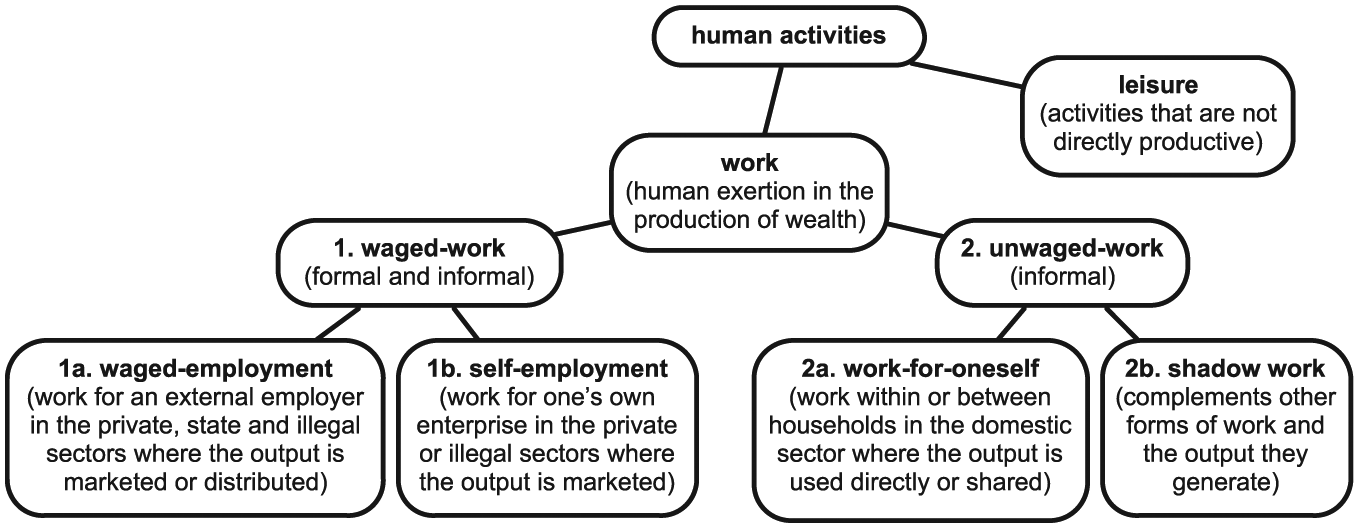
Categorisation of human activities.
Waged-work is directed towards exchange. A distinction can be made between waged-work for an employer in the private, state or illegal sectors (‘1a. waged-employment’ in Figure 1) and waged-work for one’s own business or farm, for example (‘1b. self-employment’, also sometimes referred to as ‘own account work’). As mentioned, productive employment falls in the formal waged-employment category. In the narrow sense of the word, a wage is financial or in-kind compensation paid to someone who has been employed to render services (Gorz, 1989). The broader meaning of a wage is a return for the exertion of labour. Through waged-employment, people earn a wage by selling their labour. Through self-employment, they earn a wage by selling the output produced from their assets. Both forms of work (1a and 1b) can therefore be perceived as being ‘waged’. They are not always easy to distinguish: what may look like self-employment might actually be a disguised form of waged-employment, for example, when petty traders procure goods on credit and get paid upon returning the unsold goods at the end of the day (Breman, 2013). What differentiates waged-work from other forms of work, is that the goods and services it generates are bought and sold on the market or distributed by public institutions. As mentioned, waged-work can be formal, informal or both. A useful insight has therefore been to place work on a continuum between formal and informal, with mixed forms in between (Harriss-White, 2010; Taylor, 2004; Williams and Lansky, 2013; Williams and Nadin, 2012).
Unwaged-work can be also unpacked in two subcategories: work-for-oneself (2a in Figure 1) and shadow-work (2b). Work-for-oneself 2 is not individualistic, as the name might suggest, but is undertaken for the aspirations of households as well as communities (Illich, 1981); for example, through volunteering, labour-sharing or bartering (Goldschmidt-Clermont and Pagnossin, 1995; Wheelock, 1992). It therefore includes what has been referred to as ‘community work’ (Williams and Nadin, 2012). The goods and services produced through work-for-oneself are intended for self-sufficiency (and for social reproduction, as discussed below). For example, backyard vegetable gardening and home schooling are unpaid and the product of work is not sold, as opposed to corresponding marketed waged-work undertaken by agribusinesses and private schools. Work-for-oneself exchanged between households is not always freely chosen and might be forced by circumstances (Williams and Nadin, 2012). For example, many households are compelled to rely on a sharecropper to cultivate their land as they lack the capacity to do so themselves.
Waged- and unwaged-work can overlap. A pastoralist might rely on his or her own livestock for personal consumption. At the same time, he or she can hire and remunerate a herder to look after the animals. As mentioned, work-for-oneself is associated with non-marketed exchange, and waged-work with marketed-exchange. The pastoralist is therefore engaged in work-for-oneself. The herder, on the other hand, is engaged in waged-work. In this case, the activity combines both types of work. Similarly, the rearing of cows might include a work-for-oneself unwaged component (the production of milk for household consumption) and a self-employed waged-work component (the production of meat for the market). Farmers might also exchange labour across categories; for example, when one produces food crops (work-for-oneself) and the other produces cash crops (self-employment). As with the earlier formal/informal distinction, the waged/unwaged distinction is therefore also a conceptual simplification (Williams and Nadin, 2012). Productive activities often contain both waged and unwaged elements.
The second form of unwaged-work is shadow-work (2b in Figure 1). Illich (1981) defines this to include unsalaried non-marketed activities that are essential complements to waged-work. Shadow-work therefore includes, for example, most housework chores such as cleaning or cooking (which partly overlap with social reproduction, as explained below), the activities connected with shopping, the toil of commuting, administrative errands and so on. Shadow-work is not the same as unemployment, which represents the absence of formal waged-work. It is also not the same as informal employment of, for example, domestic workers in households, which generally represents waged-work in the informal economy. Shadow-work includes the tasks that do not directly generate a return, but that are required for and enable the activities that do.
Unwaged-work is closely related to the feminist concept of social reproduction – defined as the work involved in the production and maintenance of life itself, as well as the production of the means of life, such as making food, clothing and shelter available for consumption and use (Bezanson and Luxton, 2006). Social reproduction also includes the mental, manual and emotional work involved in educating children or caring for the elderly and disabled persons. It is clearly unwaged, but it does not fall neatly in one of its subcategories. Although it goes beyond the scope of this article, it would be useful to explore how a specific social reproduction activity supports either market exchange (shadow-work) or self-sufficiency (work-for-oneself). Travelling and shopping for clothes at a department store or getting clothes mended by a tailor are activities that support waged-work in the textile and garment sectors. Since it directly encourages market commodity exchange, this type of social reproduction falls primarily in the shadow-work category. Household activities such as knitting and sewing, however, are considered work-for-oneself. This type of social reproduction reduces market-based commodity exchange and increases self-reliance. That being said, knitting and sewing still require the purchasing of inputs, which represent shadow-work components supporting market exchange. In fact, a range of activities represent at the same time shadow-work and work-for-oneself (Gorz, 1989).
Unwaged-work (work-for-oneself and shadow-work) is deeply affected by gender-roles and could reveal inequalities within the household. A large number of studies have concentrated on evaluating the gender divisions of unwaged-work and indeed found that women bear the brunt of this type of work before they can seek employment (Harriss-White, 2010; Williams and Nadin, 2012). Children also contribute to unwaged-work – again, especially the girls. A longitudinal study in Ethiopia, for example, found that children at the age of 12 were spending on average 2.7 hours per day on unwaged-work (1.8 hours for boys and 3.6 for girls). By the time they were 19, the average was 2.8 hours (1.5 hours for boys and 4.1 for girls) (Pankhurst et al., 2016).
Work, production and reproduction
As mentioned, work is an effort towards the production of wealth. The production of wealth includes both the maintenance of existing assets and the investment in new assets (Daly, 1977). Mending clothes or repairing a broken cartwheel is maintenance-oriented, while building a new water reservoir or planting crop seeds is investment-oriented. In the former example, the size of the stock of wealth remains the same. In the latter example, it grows. Wealth production is also linked to the aforementioned concept of social reproduction. From the perspective of the economy, social reproduction is fundamental to the production of wealth. Not only does it reproduce a population of workers to be involved in waged-work, social reproduction also overlaps with shadow-work, which complements and supports waged-work. From a household perspective, however, social reproduction is the goal and wealth production – through waged- or unwaged-work – is the means (Picchio, 1992).
Whether it is perceived as a means or as an end, the production of wealth (including inherited wealth) is achieved through different forms of work. As mentioned earlier, work generates a return, whether we consider the labourer who farms someone else’s land using someone else’s plough, or a landowner working on his own land using his own tools. The return to the labourer can be in kind or financial. The landholder might also collect an in-kind return from his own efforts. These returns generate flows of consumption. The work of both labourer and landholder also generate a flow of production, namely the maintenance and improvement of the land, soils and irrigation water supplies. Compared to the labourer, this production flow clearly benefits in the first place the landholder. One person’s work can therefore generate wealth for another person. Wealthy individuals can get their tasks done for them by less wealthy individuals who are not (or less) able to transfer their own tasks onto others.
This difference represents a difference in control. If there is labour surplus in a region, landholders might be able to set the level and nature of the wages. This leads to inequality in wealth accumulation. While the labourer can only maintain his or her own capacity to work, the landholder is able to invest in ‘nonhuman agents of production’, like an ox-drawn plough or motorised irrigation. This new wealth reduces the need for hired help (and generates additional income if its services are sold). Against this perspective, neoliberalism expects the resulting labour displacement to be temporary: as productivity increases, so will the creation of new jobs elsewhere in the economy. For as long as that may take, however, one group has no control and is disadvantaged while another group benefits.
The type of work undertaken by a household is therefore largely dependent on its wealth. Its assets dictate whether a household has the capacity to undertake certain forms of work, namely work-for-oneself with non-marketed output (informal), self-employment with marketed output (formal and informal), as well as complementary shadow-work. A lack of capacity to maintain assets – or a lack of public sector support to do so – will result in a growing population abandoning these forms of work to look for waged-employment (formal and informal).
Results: Work and productivity in rural Tigray
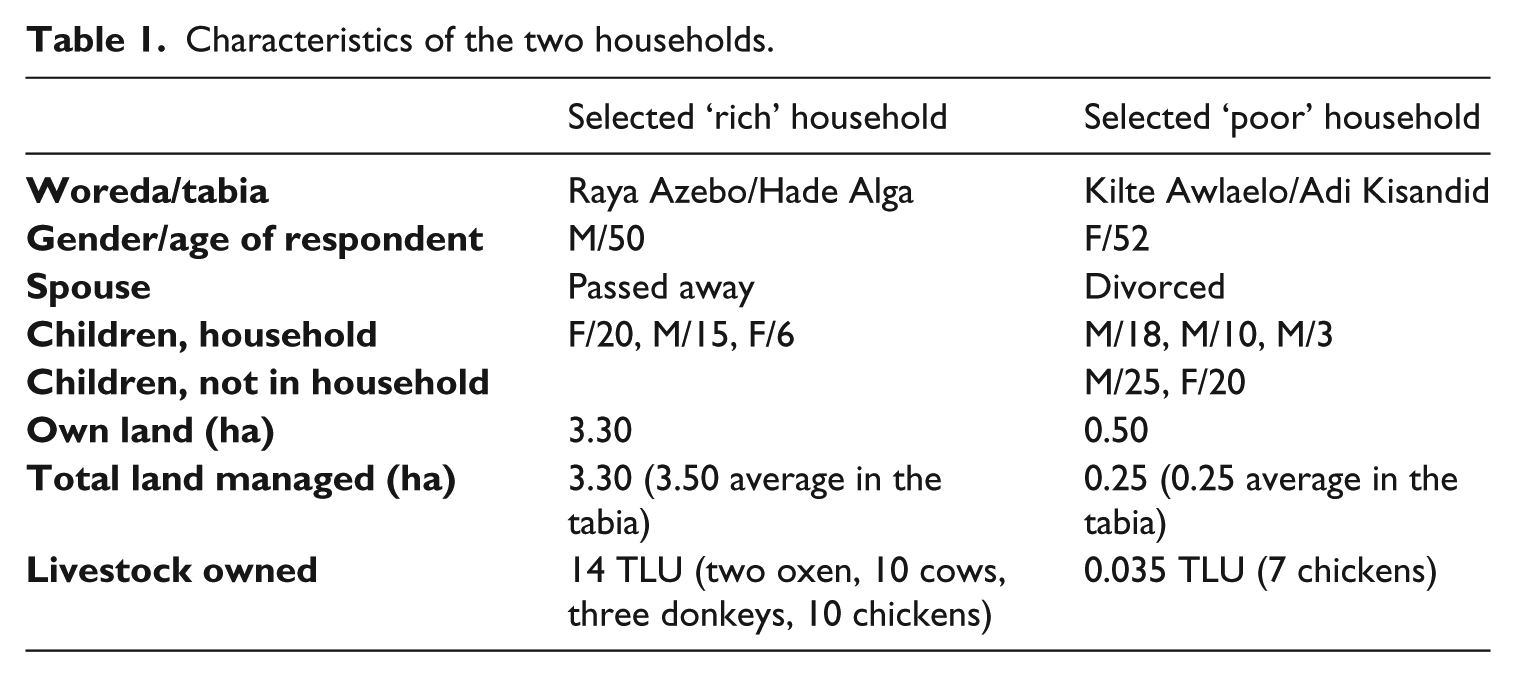
To reveal wealth and work differences between households, our results unpack the activities for one ‘poor’ and one ‘rich’ household, based on the rich/middle/poor categorisation that came out of the wealth ranking workshops (see earlier methodological section). The two households were selected to be close to their tabia average for livestock ownership and managed land. Interviews with the ‘middle’ group provided a useful anchoring between the other two, but they are not essential for understanding the contrast between households. Even though they can provide important sources of information and non-marketed benefits, personal ‘leisure’ activities, such as attending funerals, weddings and other social functions, are also left out. Table 1 presents the composition and major assets of the two selected households.
Characteristics of the two households.
Activities of ‘rich’ households
‘Rich’ households were only moderately engaged in waged-employment. The selected household only carried out the compulsory 20 days of ‘free labour’ for soil and conservation efforts or public works, as is the custom in Tigray. Another ‘rich’ household received a remittance from two family members residing abroad. The only two cases of waged-employment were in house construction (although much less than in the past) and in the public sector (e.g. in road maintenance). Waged-employment was much more common among poorer households as described later.
Self-employment, on the other hand, was much more prevalent and diversified in this wealth group. With a disproportionately larger share of productive assets, ‘rich’ households were able to combine livestock rearing and land cultivation for commercial ends. In terms of livestock ownership, the selected household matched the tabia average of the ‘rich’ category. It produced and sold butter, cereal and pulses. Other examples of self-employment in this wealth group included the production and selling of vegetables, fruit, stimulants and crop by-products. The relatively higher cash returns allowed this wealth category to employ poorer labourer households and improve the cost-effectiveness of its production – a clear illustration of the difference in control over production.
The work of this wealth group was not purely market-driven. Most of the mentioned activities simultaneously represented self-employment with marketed output and work-for-oneself with non-marketed output. Respondents were therefore asked for estimates of the shares of output sold and kept. The proportions varied per household and per product. For example, coffee, chat, timber and hay were mostly sold on the market. The selected household kept one-third of its grain for self-sufficiency, which implies that it was able to produce in one year what it consumes in 36 months, placing it above an already high average of 30 months per year for the tabia. Other ‘rich’ households in our sample kept between 75 and 100 per cent of the food they produced. This wealth group could easily cover its own needs from its own production, largely eliminating the need for additional cash income from employment.
The selected household fully cultivated its own 3.3 ha, which was close to the average of 3.5 ha managed by the ‘rich’ wealth group in Hade Alga. The other wealthy families were sharecropping 0.38 to 3.0 ha of additional land from others on top of their own. One particular outlier even managed 25 ha of sharecropped land. Sharecropping illustrated the complex overlap between types of work. First, it involved a non-marketed exchange between the household holding the land and the household that sharecropped it (i.e. the right to cultivate for a portion of the harvest). This represented work-for-oneself, between households. Second, when the land manager intended to produce for the market, sharecropping included elements of self-employment and complementary shadow-work activities for commuting to markets and farmers’ centres. The holder of the land, generally from a poorer wealth group, undertook only shadow-work when collecting its share of the harvest.
Revealing another form of inequality, households that were able to produce for the market were also generally those that were least dependent on it for their food consumption needs. The selected household was self-sufficient in teff, sorghum, barley, wheat, maize, chickpeas and beans. Other households in our sample produced lentils, finger millet, onions or garlic for home consumption. Two ‘rich’ households also prepared their own organic fertiliser from their own animals and compost. Its relative use against purchased inorganic fertiliser was 33 and 100 per cent, respectively. Two other households also produced animal feed and fuel for cooking from their own agricultural by-products. For the transportation of water, hay, grain and crops, ‘rich’ families were able to use their own donkeys. Sheep and/or goats were also often partly kept for household consumption and partly for selling as mentioned above. Chicken rearing and egg production was generally intended for home consumption, not for selling.
Considering the overlap between self-employment and work-for-oneself, it was impossible to assign shadow-work tasks as complements to self-employment alone, as suggested in the earlier typology of work. It therefore made sense to include in this description the complementary activities that support work-for-oneself. Seeds and fertiliser were generally procured from the tabia centre. Pesticides, herbicides and certain specific seeds (carrot, onion, maize) were procured from the woreda centres. Families transported the output by using their own pack animals (donkeys or camels) or by rented vehicle. In one particular case, middlemen visited the tabia for purchasing fruit directly from the household, which reduced this family’s shadow-work and shifted the activity into the realm of waged-work. This service was useful only for households that produced sufficiently large amounts of surplus. Livestock, if reared commercially, was taken to markets in neighbouring towns once or twice a year. Spices, clothes and school materials were obtained from larger town centres in the woreda when they were not available in the tabia. Having their own reserves, the better-off families generally did not need to go shopping for staple food. Shadow-work, such as preparing meals, cleaning, fetching water and other chores, was undertaken by the women. Men usually carried out shadow-work associated with trading, or recruited others to undertake the work for them.
Activities of ‘poor’ households
Compared to ‘rich’ households, self-employment and work-for-oneself by the ‘poor’ were severely hampered by limited asset ownership. Waged-employment was therefore the most important source of income for them, particularly work undertaken under the Productive Safety Net Programme (PSNP), 3 as there were few other opportunities. The selected ‘poor’ household was female-headed and all PSNP tasks were shouldered by her. Other households from this group were able to share the workload between husband, wife and occasionally the older children. Waged-employment was otherwise mostly informal and included harvesting, ploughing, weeding, picking and house construction. This was an example where informal waged-employment for one household was part of the formal self-employed activities of another household. Not all waged-employment involved a financial remuneration. For example, one household received an in-kind wage for transporting a farmer’s harvest to the threshing facility.
The selected household was the only one in our sample that was able to produce vegetables for selling on the market (self-employment). Another two ‘poor’ families were able to occasionally produce and sell grain (5% of total production, the rest was kept for self-sufficiency) and hay (less than 10%). It should be noted that these two households each managed a property that was twice the size of their wealth group’s average (0.75 ha for an average of 0.38 ha in May Quiha). As an example of formal self-employment, one household ran a bread bakery in the tabia centre (with assets either bought on credit or rented). Informal self-employment included, for example, producing and selling small amounts of coffee in the kushet, selling hairdressing services and homemade handicrafts (also locally).
Besides vegetables for the market, the selected household also produced wheat and cabbage for its own consumption in a home garden (work-for-oneself). Three other households from this wealth group consumed some amount of their own cereal and pulses production, but failed to cover food needs throughout the year. No ‘poor’ household managed additional land from others. In fact, two families sharecropped out their entire property and a third family sharecropped out half of it. All four food-producing households relied on neighbouring farms to borrow oxen for tilling – a form of inter-household work-for-oneself. Planting, ploughing, harvesting, threshing and transportation were tasks undertaken by the men in the household. Women undertook the weeding (the poor’s alternative to applying purchased herbicide). Two households reproduced their own seeds. Two other households produced their own organic fertiliser. In terms of livestock, all the ‘poor’ households owned at least a few chickens that were kept for special occasions and for their eggs. In May Quiha, two families owned an ox and a cow, which stood out from average livestock ownership among the ‘poor’. Normally, these households owned no more than four sheep or goats and some chickens.
The shadow-work activities of the selected household were quite typical of most households in this wealth group. Households engaged in self-employment took their livestock to markets in the woreda towns (i.e. shadow-work complementing self-employment). Eggs were also sometimes sold, but generally within the kushet. Three households travelled to woreda towns for selling their cash crops (vegetables or grain). The two households that produced their own organic fertiliser were able to reduce the time spent to obtain inorganic fertiliser from agricultural extension services in the tabia centre. Another household relied on purchasing inorganic fertiliser on credit. Several households had to collect their portion of grain from sharecropped-out land using a borrowed donkey or on foot. They also needed to collect their PSNP wages, which in some cases took up to two days per month (i.e. shadow-work complementing the household’s waged-employment). Every one or two weeks, the women in the household travelled to tabia or woreda centres for household goods and food (i.e. shadow-work supporting waged-work of other households). With better cash flow, wealthier households were able to reduce the number of trips to once or twice per month.
According to the participatory wealth ranking workshops, the ‘poor’ were said to be able to cover an average of only 2.9 months from their own land, including the in-kind return they received if they owned a property that was managed by a better-off household. They depended much more on markets for food, and even that was not enough. Nega et al. (2011) showed that the most food-insecure households in Tigray were able to feed themselves adequately for a period of 4.75 months through their own production and/or through markets. The rest of the year, they faced food shortages.
Discussion: Inclusive or exclusive productive employment?
The article set out to explore how the promotion of inclusiveness, with its emphasis on productive employment, might disregard and even undermine other forms of work and productivity within and between households from different wealth groups.
The results show that waged-work is not the only form of work that contributes to productivity. In current policies, however, waged-work remains the focus (waged-work refers to activities directed towards market exchange and includes waged-employment for others as well as self-employment in one’s own business or farm). The Ethiopian Growth and Transformation Plan (GTP) targets for productivity relate to increasing aggregate crop production, which is measured in weight per hectare or in cultivated land size (MoFED, 2010). Such targets benefit in the first place the self-employed land managers (i.e. the ‘rich’ wealth group). In our study, the ‘poor’ benefit only inasmuch as they receive in kind, through sharecropping arrangements with the ‘rich’. If they are involved in waged-employment for the ‘rich’, however, the ‘poor’ could suffer when productivity targets are achieved through labour-saving processes. Ethiopian agriculture indeed saw declining employment shares with positive (although low) labour productivity growth in the period 2005–13 (Ferede and Kebede, 2015).
The ‘poor’ are therefore expected to find employment elsewhere. In its simplest form and as framed by the ILO (2012), productive employment is nothing more than a well-paid job for the ‘poor’ (i.e. productive waged-employment). So far, we have seen that this wealth group has been unable to sufficiently raise its income for adequate food consumption. Moreover, the increased dependence on markets for food exposes the ‘poor’ to food price volatility (Hadley et al., 2011). Even if productive waged-employment raised earning or spending above the poverty line, households have hardly any buffer to absorb fast-changing food prices.
An alternative policy could encourage productive self-employment for the ‘poor’, but this is politically challenging as it would rely on redistributing wealth, not income. Results indicate that the ‘poor’ sharecrop out their properties when they are poor in non-land assets, such as ploughs, irrigation technology or draft animals. Rather than targeting aggregate production, policies could target the distribution of these means of production, thus stimulating the economic inclusion of the poor as producers rather than as labourers. The GTP does not consider such targets. Productivity targets are to be achieved through productive self-employment, and food security targets through productive waged-employment. Simply put, one group sells more and another buys more.
Yet another policy could encourage productive work-for-oneself. It would differ fundamentally from a focus on productive waged-employment, which is merely intended to contribute to a rise in income or spending above the poverty line. Stimulating productive work-for-oneself may in fact have the opposite effect because it reduces the need for income. The poverty headcount ratio is irrelevant when it comes to improving livelihoods through non-market means (Glassman, 2012). Productivity is therefore not solely a matter of measurable and marketed output. It is more useful to define productivity as the capacity to maintain and generate wealth (Daly, 1977; Max-Neef et al., 1987). For example, the preparation of animal manure and household compost into fertiliser and its application to the soil certainly falls under such a definition. Stimulating work-for-oneself decreases the total output of inorganic fertiliser purchased and sold on the market. The activity, however, contributes to creating and maintaining wealth outside the formal economy and perhaps even to reducing vulnerability to market price fluctuations. The same could be said for local seed production and exchange. From a policy perspective, this is not an argument for the formalisation of these informal productive activities: work-for-oneself is valuable precisely because it enhances autonomy rather than inclusiveness.
The conclusion so far is that addressing food needs through ‘poverty reduction’ policies focuses only on income (through productive waged-employment) as a means to enable more consumption, which is a very restricted perspective on development in general and on work in particular. The agenda of inclusiveness is repeating misperceptions that have long been corrected in the sociology of work literature. By focusing only on productive waged-employment, opportunities in other potentially productive forms of work are excluded (productive self-employment and productive work-for-oneself).
The second part of our question is much more difficult to answer: is work-for-oneself also undermined by productive employment policies? Development in the industrial-age has been associated with the destruction of work-for-oneself and its replacement with formal waged-work (and associated shadow-work) (Illich, 1981). This shift is often praised: the dismantling of what some perceive as ‘useless’ work is an established neoliberal policy of ‘structural transformation for economic diversification and competition, including creative destruction of jobs and firms’ (World Bank, 2009: 2). As mentioned, however, this is an illusion. Production in the informal sector is on the rise (Harriss-White, 2010), partly as a result of outsourcing by the formal sector (Breman, 2013). A question is therefore how the forces of markets and commercialisation are at work within the growing informal sector. These forces may drive a shift from work-for-oneself to informal self-employment.
It may then be tempting to contrast two development paths for the poor: one focused on raising disposable income, the other on reducing reliance on markets. In Ethiopia, government resources and efforts are clearly much more geared towards the first. The interviews revealed that the push for more market-oriented forms of farming is often quite forceful. For example, a GTP indicator for food security is the total amount of distributed improved seed and inorganic fertiliser. Two ‘poor’ households complained that PSNP wages are paid in inorganic fertiliser instead of food or cash, even though they do not manage any land. Several food-producing households complained about the pressure by extension services to adopt inorganic fertiliser despite its harmful effect on certain crops in water-short areas. Bearing in mind our small sample size, these are examples where the implementation of the agenda of inclusiveness does not merely disregard local self-reliance, but effectively undermines it.
The ‘poor’ wealth group may seek to compensate for the vulnerabilities arising from the dependence on the formal cash-based economy. However, the capacity to engage in work-for-oneself – and in the inter-household exchange on which this form of work often relies – seems undermined on a more systemic level. Several respondents mentioned that systems of sharing and bartering have withered in their kushet, that much of the mutual support that remains takes the form of cash-based loans, that there is no food trading between households within the kushet, that all production is transported to more profitable markets, and that waged-employment in the tabia has become more competitive. These changes are in many ways linked to inclusive growth policies (e.g. those aimed at incorporating local (surplus) producers in cash crop value chains).
The point is not to idealise the informal sector, or even self-sufficiency within the informal sector, as here too there are poverties and inequalities. However, inclusiveness is not the only path to address such problems. It is important to remember that inclusive growth is not redistributive, and neither is its slightly broadened version of ‘inclusive development’ (as defined by United Nations Development Programme (UNDP), 2014). The general idea is merely to increase the total size of the pie, not to re-slice it. Not only has ‘inclusiveness’ failed to address inequality, it has also been ineffective in reducing absolute poverty – despite statements of the opposite. More importantly, it has failed to embrace deeper non-financial conceptualisations of poverty. As a result, inclusiveness is in actual fact ‘exclusive’ and potentially ‘invasive’ as it progressively encroaches on informal yet useful activities undertaken by people and their communities.
Footnotes
Acknowledgements
We would like to thank Adugna Gessesse for his assistance in data collection as well as our respondents in rural Tigray for their participation.
Funding
This study is part of the research agenda of the Knowledge Platform on Inclusive Development Policies and funded by the Ministry of Foreign Affairs through NWO-WOTRO.