




Abstract
The growth of community gardens has become the source of much academic debate regarding their role in community empowerment in the contemporary city. In this article, we focus upon the work being done in community gardens, using gardening in Glasgow as a case study. We argue that while community gardening cannot be divorced from more regressive underlying economic and social processes accompanying neoliberal austerity policies, it does provide space for important forms of work that address social needs and advance community empowerment. In developing this argument we use recent geographical scholarship concerning the generative role of place in bringing together individuals and communities in new collective forms of working. Community gardens are places that facilitate the recovery of individual agency, construction of new forms of knowledge and participation, and renewal of reflexive and proactive communities that provide broader lessons for building more progressive forms of work in cities.
Introduction
In the context of deindustrialization and neoliberal driven processes of urban development and renewal, there has been increasing attention directed to the phenomena of community gardens (e.g. Crossan et al., 2016; Ghose and Pettygrove, 2014; McClintock, 2014; Rosol, 2012). A lively debate has ensued over whether community gardens are enabling marginalized communities to regain some control and power over land in cities, or are helping to reinforce neoliberal inspired projects of welfare retrenchment and property driven regeneration (Ghose and Pettygrove, 2014). To date, however, there has been less discussion about the potential of community gardens to provide alternative social relations around work that can empower individuals.
Community gardens can be viewed as particular locations of collective activities that serve a range of ends. For instance, community gardening may be part of a broader discourse to create more sustainable and ethical forms of living while also offering alternative ways of ‘being’ and community enhancement in the city (e.g. Harrison et al., 2005; Sassatelli, 2015). The growing trend towards ‘grow your own’ and ‘make and mend’ among some social groups signifies attempts to disconnect from the economic mainstream to develop more harmonious relations around work, consumption and the environment (e.g. Brook, 2012; Kingsley et al., 2009; Wise, 2014). The work of producing and reproducing the gardens similarly offers an interesting lens for exploring their generative potential for individuals and groups in developing new forms of place-based identity and community.
Our purpose in this article is to use the example of Glasgow’s burgeoning community garden movement to critically reflect upon the progressive possibilities inherent in the work that goes on in community gardens, while recognizing the limits of these spaces, in terms of the harsher macro-environment of neoliberal imposed austerity policies that underpin urban development (Peck, 2017). The article explores the kinds of activities taking place in the gardens and their potential for promoting new forms of work and living experiences linked to social and use value rather than exchange value. In doing so, we draw upon recent scholarship in economic and labour geography, concerning the active role of places in bringing diverse groups together to create new and more progressive forms of social relations (Featherstone and Griffin, 2016; Gibson-Graham, 2006; Massey, 2005; Wills, 2013). Developing Massey’s work on the ‘generative’ power of place (Massey, 2005), we argue that Glasgow’s community gardens create new forms of social relations around working with food that lead to important forms of social empowerment for individuals, while at the same time helping to re-energize communities in some of the city’s most deprived areas.
The article is divided into five further sections. In the next section, we develop a more active conceptualization of place and community as a framework for theorizing the generative and transformative potential for new social relations around work in community gardens. The following section outlines the research context and methodological design. We then identify the role of community gardens in constructing a more progressive sense of collective space in Glasgow. The next section builds on this to explore the potential of community gardens for generating new forms of collective and supportive social relations around work. The penultimate section identifies the ways that these forms of work foster new knowledge, skills and a sense of empowerment for marginalized communities and individuals. We conclude with some broader reflections upon the meaning of Glasgow’s community gardens for wider debates about place, work and collective agency in austere times.
Work and the re-forging of community agency through place
There is a lively ongoing debate about the emergent phenomenon of community gardens in large cities in North America and Western Europe (e.g. Crossan et al., 2016; Ghose and Pettygrove, 2014; McClintock, 2014; Rosol, 2012). In US cities such as Detroit and Cleveland, urban abandonment and social decay are leading to a raft of new initiatives around local food production and consumption. As a response to the failure of existing market-driven forms of development, innovative policies to reinvent cities are promoted around community regeneration and local sustainability (e.g. Colasanti et al., 2012; Flachs, 2010). A key argument is that the relationship between communities and food can be transformed from a passive dependency relationship to a more active one where local residents and communities are able to actively counter deprivation and poverty in part by taking control of their own food security issues (Morgan, 2015).
Critics have pointed to the exploitative aspects of community gardening work (Ghose and Pettygrove, 2014; Rosol, 2012), particularly so in deprived areas of cities typified by depopulation and deindustrialization, where the subsequent collapse of land values and departures of local businesses place increased demands on public service infrastructures, especially in the context of ongoing austerity. Unpaid and volunteer community gardening work, which regenerates derelict sites, effectively and unwittingly advances the interests of the private development agenda in preparing places for regeneration, gentrification and new rounds of accumulation where exchange value trumps social need (Lefebvre, 1991) and use value. Moreover, such activities can also be seen as working within the grain of punitive workfare programmes in generating more pliable working populations and reframing unpaid work (Adkins, 2015). As part of more active labour market regimes, they help to recommodify labour rather than providing any sense of autonomy and empowerment (Greer, 2016).
While we are alert to these issues, particularly in a city like Glasgow, where deindustrialization has led to the marginalization of many working class groups (Fevre, 2011; Helms and Cumbers, 2006), we suggest that there are more progressive aspects to community gardening work. Drawing on a more active sense of place (Massey, 2005; Ward, 2007), where working relations in cities are not straightforwardly incorporated into capitalist valorization processes, we would emphasize community gardens as more open and generative spaces (see also Featherstone and Griffin, 2016), where multiple and intersecting trajectories come together in everyday lived practices.
Doreen Massey’s conception of an active sense of place (Massey, 1991, 1993, 2005) is particularly helpful for us in theorizing how places can generate new forms of progressive social relations around work. The starting point for Massey is to reject conceptions of place and community as fixed, territorially bounded and often regressive in response to broader processes of economic, social and cultural globalization (Massey, 1993). Instead, Massey calls for a more open and dynamic sense of ‘place as process’, where, rather than a static sense of community linked to territory, place is seen more as ‘an ever shifting constellation of trajectories’ which ‘poses the question of our throwntogetherness’ (2005: 151).
This active sense of place is important to the development of our interrogation of work practices in community gardens in two ways. First, places are the meeting ground where diverse and sometimes conflicting economic identities come together and interact. Drawing on Massey’s (2005: 152) provocation to ‘theorise space and place as the product of social relations’, we view places as more than just the passive backdrop for mediating social relations around the economy and work, but, instead, as containing a more active generative quality in the forging and shaping of these interactions. As we detail below, there is an ongoing set of tensions in the work of community gardening. Following Massey, we argue that community gardens can be perceived as places where the ongoing tensions between neoliberal commodification processes and alternative sets of social relations are played out, though never completely resolved.
Second, beyond the divisions and tensions that inhabit places, Massey’s sense of place highlights the potential to create new alliances around labour in a more outward facing progressive sense. Jane Wills utilizes this sense of active place at the scale of the city as a whole with regard to both the emergence of new forms of community unionism and organizations, such as Citizens UK and the London Living Wage Campaign. Wills (2013) highlights the intersectional strategies that bring together diverse racial and ethnic groups around campaigns for decent pay and conditions. We think this point can be deployed at the local neighbourhood scale to emphasize how place is active in bringing together diverse groups and creating new social relations around work. In this vein, Featherstone and Griffin (2016) evoke an active sense of place in both rupturing past associations and generating new progressive labour formations. Appreciating the ways that place both disrupts existing forms of social relations but also produces new possibilities is a useful lens with which we now interrogate the work of community gardening.
Research context and design
With its legacy of industrial decline in the second half of the 20th century – in 2013 leaving four per cent of its total land area and 925 individual sites as derelict land – Glasgow is a particularly compelling case for exploring the potential of community gardens. Over 60 per cent of Glasgow’s population lives within 500 metres, and over 90 per cent within 1000 metres, of a derelict site (Maantay, 2013). Researchers argue that those living in close proximity to derelict sites tend to experience an increase in adverse effects, including poor health, social alienation and political disempowerment (e.g. Jeffrey et al., 2012; Maantay, 2013; Wallace, 2014).
Along with Bristol and Edinburgh, Glasgow is one of the leading cities outside London in terms of the number of community gardens that have developed over the last decade. At the time of our research, we identified 46 (as of November 2016 there were 68) community garden groups active in the city and gardens can be found across a diversity of neighbourhood types in areas with different forms of housing (e.g. owner occupied, rented, mixed tenure). From these, we selected 16 gardens across the city (Table 1), choosing gardens to reflect both their geographical diversity and extent, scale of operation and different practices, but also ensuring coverage in the more deprived urban neighbourhoods in the east and the south of the city.
Community gardens in Glasgow participating in research.
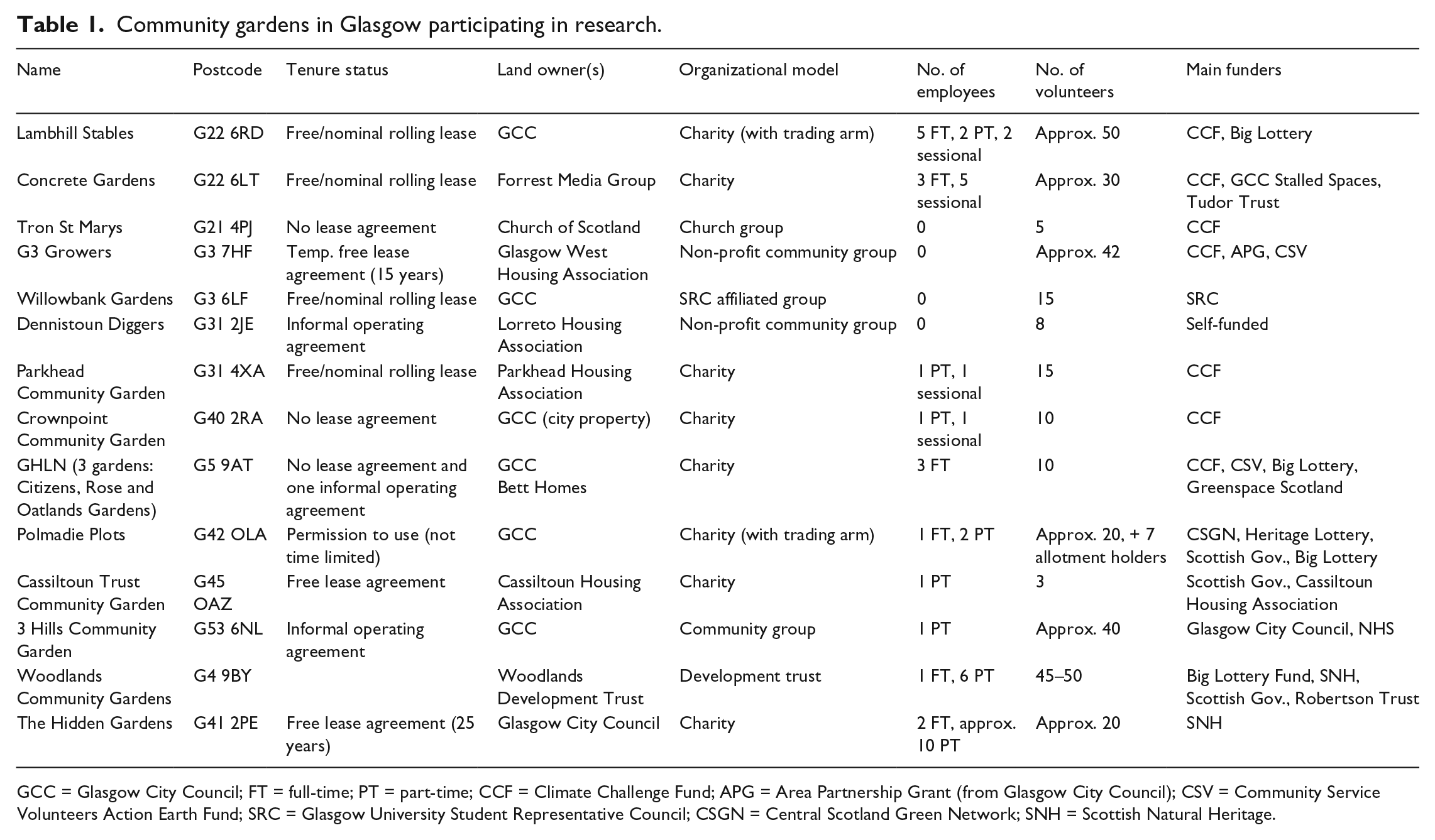
GCC = Glasgow City Council; FT = full-time; PT = part-time; CCF = Climate Challenge Fund; APG = Area Partnership Grant (from Glasgow City Council); CSV = Community Service Volunteers Action Earth Fund; SRC = Glasgow University Student Representative Council; CSGN = Central Scotland Green Network; SNH = Scottish Natural Heritage.
We gained access to the community gardens initially through contacting the Glasgow Local Food Network, a loose affiliation of gardening and food producing groups, and through our own social networks as long-term residents of the city and grassroots campaigners on a range of social, political and environmental issues.
The study was carried out between February and July 2014 and involved participant observation and semi-structured interviews to obtain a deep understanding of individuals’ experiences. First, active participant observations were conducted across 16 community gardens in Glasgow, resulting in 50 hours of observations. This was important in facilitating insight and understanding of the nature and structure of behaviour in a naturalistic setting. During this phase, the researchers engaged in the activities of the garden alongside participants.
Semi-structured interviews were conducted with 20 participants: nine volunteers, eight community garden staff and three representatives from stakeholder groups. These represented the diversity of active participants in community gardens. Interviews were between 45 and 90 minutes in duration and all took place in the gardens. The interview sample included 11 males and nine females who were heterogeneous in age, education, marital status and household composition. The interviews commenced with general questions about the role of the community garden in participants’ lives, and continued to explore the nature and role of community gardening work, the kinds of social interactions produced, the sharing and distribution of any produce, organizing structure and community connections.
All interviews were recorded and transcribed, and along with participant observation notes, were open-coded to form initial categories and emergent themes. Through an iterative process across and within the data, initial categories where modified to reveal key relations (Miles and Huberman, 1994). During this process, participant observations and interviews were placed in dialogue with each other to facilitate a wide-reaching understanding of the phenomenon under investigation. The process of analysis was conducted in parallel by the authors and deliberated until agreement was reached.
Reclaiming place for community and social diversity
As is evident from our earlier discussion, the community gardening movement is an international phenomenon, and while community growing projects have a long history, its recent expansion needs to be contextualized against a broader backdrop of urban decay, neoliberal inspired property-based regeneration and claims by communities to re-appropriate land for public and communal use. In the UK, the Federation of City Farms and Community Gardens has estimated that there are over 1000 community gardens in towns and cities, although this is probably an underestimate (https://www.farmgarden.org.uk/our-work).
In Glasgow, we found that community gardens were present in all parts of the city (Table 1), from the wealthier parts such as the west end, where more affluent and student groups tended to predominate, to more economically deprived parts of the city such as the east end and northern periphery, as well as more mixed and suburban areas on the south side. Such diversity was also evident in the organizational values and practices adopted by the garden groups, reflecting the blend of personal histories, ethnic mixes, local politics and physical attributes.
All community garden groups we interviewed emphasized the centrality of recovering derelict space for community use, and the importance of recovering places for people living locally. Most gardens demonstrated a broader environmental awareness, linking local food growing with global sustainability issues. However, there were a range of values (including health and local economic development) and diversity of scale and ambition around these central threads. Two contrasting examples included: ‘we are a small group of people from in and around the area who have set up a community garden’ and a much larger and ambitious operation with ‘the aim of providing recreational, occupational, employment and training opportunities for the residents of xx district’ (community garden website). Another example was a garden owned by a charitable trust ‘concerned with the long-term regeneration of xx area of Glasgow’, which described its garden as a ‘wonderfully therapeutic space that helps people recover from the stresses and strains of everyday life’ (community garden website) compared to one that enunciated a much greater spatial ambition targeting the south side of the city with a social and environmental ethos around ‘empower[ing] local people to make choices and lifestyle changes that are beneficial for them, their communities and the environment’ (community garden website). While the sense of a broader ‘geography of responsibility’ (Massey, 2005) to broader social or environmental values varied, all the gardens displayed an open and non-exclusionary sense of place as we detail below (Massey, 1993).
A critical element of Glasgow’s community garden experience has been the active role played by citizens and community groups in regenerating derelict sites, reclaiming place for public use. Local residents were investing their time, labour and emotions in these long-neglected parts of the urban landscape, as the following two quotes illustrate: Yes, we tackle vacant derelict land, of which we are spoilt for choice in this area … and this wider area has a far higher average rate than most other areas in Glasgow. So, if you get off this main street that is when you see the dereliction – there are gaps that have been there for decades and that is one of the things in this area – it is not a gap site for five years, the youngest gap site is 25 years. (Volunteer, north Glasgow) There are places that lie empty and get fenced off for year after year. There is one there at the corner that we went for. We were going to try and get that corner of land and no, no, no, that is going to be developed and the next thing they put up a fence round about it. But they’ve still not done anything about it. Whereas if that was left to [the] community and it was cleared onto reasonably levelled ground, you could be growing stuff in it. (Volunteer, city centre)
In short, a positive aspect of community gardening is transforming the city’s derelict spaces into living places in the open and dynamic approach (Massey, 1993, 2005). Moreover, the active reclamation of derelict, fenced-off and privatized space speaks to the broader ‘right to the city’ ethos of the urban as a collective public space, rather than a property-based, gated and privatized sphere (Harvey, 2008).
As the second quote suggests, the tensions between these competing conceptions of place were evident in the ongoing conflict with private developers and elements within the city council, where a commercialized property-based narrative continued to inform the urban renewal agenda. This included the recent decision to charge community garden groups (and all third sector organizations) full market rent on city owned land (Crossan et al., 2014: 13). These tensions crystallized in 2010 when the city council’s executive committee voted to end the practice of ‘peppercorn’ rents from the council’s properties, charging community and voluntary groups full market rates for council owned land (Nolan, 2015). The city council’s property portfolio is now managed by an arm’s length company, City Properties (Nolan, 2015), who are charged with maximizing exchange value, working against both the city council’s own environmental and social objectives and community self-valorization projects, providing a rather apposite case of the way urban space is always in some sense ‘the product of conflict’ (Massey, 2005: 153).
By their very existence, however, community garden groups do challenge such hegemonic urban agendas problematizing the existence of derelict space, the consequences of disinvestment and the potential for more progressive collective uses for such sites. As attested to by the following quote, the rehabilitation of sites for a diversity of social uses demonstrates how communities begin to reclaim their own sense of place (Massey, 2005): Now that we have tidied it up and continue to maintain it and weed it, make it look nice, then it sort of gives them [local children] a safe place to go out and play and to enjoy just lying around being kids and stuff. People can go and sit in there and enjoy it on a sunny day. So they have that opportunity, whereas before you wouldn’t want to go and sit in there. No one would want to go and sit in there. You wouldn’t even want to go and walk through it. (Volunteer, north Glasgow)
In this way, in many of the more deprived parts of the city, community gardening has transformed derelict sites from what are often hostile, threatening, vacant and closed-off spaces (Smith, 1987) to more positive and open spaces for community engagement and interaction where diverse individuals and groups come together in a variety of ways that foster sociability, which include, but go beyond, producing food and gardening: Yes, I think it is important that the garden is much more than just food growing and it is a space people can come and use for storytelling and crafts and music performances and things like that. It just means more people and we get people contacting us to use it. (Employee, west end)
A notable element of many of the gardens was their use by disadvantaged and more marginalized groups. The same garden noted above was being used by a range of NHS bodies, disability and mental health charities, as well as drug and rehabilitation schemes, a food health project for the elderly and various church-based charities. This particular garden was established by residents in an ethnically mixed area with a large Asian population that had originally created a community trust to campaign for better housing conditions (Boyle, 1997).
A particularly important aspect of place construction evident here is the way a diverse range of social groups, who might otherwise have little substantive contact with one another, come together to meet and exchange ideas, stories and knowledge as they collectively produce new urban spaces though the practice of community gardening: I have eight people in my taskforce. Most don’t have English as their first language. There is Roma, Czech Republic […] I also have someone from Ghana, someone from Gambia, someone from Eritrea. […] When we had young refugees and asylum seekers last week it was fascinating the things they were telling us about wild garlic and making soup, and how they would use various herbs in their culture. (Employee, south side)
Asylum seekers and other members of minority ethnic communities are making use of the city’s community gardens and also bringing their own diverse knowledge and experiences around food to share with existing groups. For Massey (2005: 151), ‘the chance of space may set us down next to the unexpected neighbour’. Countering problematic issues surrounding the terms ‘cultural assimilation’ and ‘integration’, the gardens, therefore, promote a positive recognition and celebration of different food cultures. This speaks to Massey’s demand that we think of place and community as ‘progressive; not self-closing and defensive, but outward-looking’ and ‘this in turn allows a sense of place which is extroverted [in] its links with the wider world, which integrates in a positive way the global and the local’ (1994).
Many of the gardens visited were also actively engaging with residents in the surrounding areas, helping generate broader relational networks beyond the gardens themselves (Massey, 2005). A typical example was taking food waste and recycling it in the gardens, usually with the offer of supplying some food back or, in other cases, becoming involved in offering training courses in gardening and food preparation for local communities. Community gardens were also involved in a diverse range of other outreach activities that include maintaining allotments for housing associations and growing projects with adults and young people with learning disabilities. In this way, community gardens are home to what Askins (2015: 473) calls a ‘transformative politics of encounter’ that brings diverse groups of people together in surrounding areas where there has been an absence of community engagement in public space. A desire to spread a sense of togetherness through communities is exemplified by one garden employee, who expressed it is: … also the immense pleasure you can get from that [growing food]. So I sort of recognize the value of both physical work outside gardening but also being able to produce your own edibles. So I guess trying to bring that to the masses, trying to bring that to people who don’t usually even consider the opportunity of being able to do that, say because they live 24 floors high or they don’t have a garden or whatever. Any other reason that you can come up with for not doing it. It’s nice to encourage people to do that so they can share in that enjoyment. (Employee, city centre)
New ways of working in community gardens
Although the quantifiable effects of gardening activities are minor when considering the city’s broader economic problems, they have nevertheless had positive benefits for both job creation and in the scale of volunteering activity that they have stimulated (see Table 1). For example, one of the larger gardens at the northern edge of the city, comprising two acres with a resource centre including a kitchen and cafe, employed five full-time staff, two sessional workers and 50 volunteers. In another instance, a sustainable food-based charity, which was started as a gardening club by three local residents in 2004 in one of the more economically deprived parts of the south side of the city, by November 2013 had developed into a registered charity with over £410,000 in income per annum. Employment included one full-time and two part-time positions with a broader training and educational remit to promote sustainable food production and knowledge across the city, working with schools, housing associations and various parts of local government.
Arguably, an even more significant achievement is a qualitative one in fostering a collaborative self-help ethos around work and labour. The autonomous and cooperative aspects of work are evidenced by this description of how food growing is organized in one garden: We sort out ourselves. We have had three growing seasons and this will be our fourth. We’ve tried different models in terms of who is doing what. The one that worked last year we are going to go through with this year. We have seven raised beds, so four of them are team beds. We have a perennial bed, a potato bed and a squash bed, so they are communal beds. So you choose your team and agree with the team that you will also grow something communally in your team bed, usually something leafy because that is what people want a lot of … any decisions that affect everybody, we meet as a group and discuss it and come to some sort of conclusion on it. (Volunteer, east end)
As McClintock noted in relation to similar forms of urban agriculture in the US, such spaces produce a ‘force of de-alienation [which can help] re-establish a conscious metabolic relationship between humans and our bio-physical environment by reintegrating intellectual and manual labour’ (2010: 202). Community gardens, therefore, not only establish new relations between urban citizens and the physical environment but they also confront the Taylorist separation of work conception from its execution, evident in conventional mass production foods systems.
An important aspect of the gardens was their potential to empower people through developing positive and active sets of connections with, for instance, food and nature, developing a sense of value and identity around carrying out productive work, which gives a sense of ownership and empowerment. Commenting on the meaning for volunteers and local residents, one garden employee stated: It has visible, tangible results. You can see things. If you planted peas then every time you […] are passing a bed […] you can watch the progress of those peas […] It gives us the opportunity to be involved in a joint enterprise, a group project activity. That is satisfying. Any gardener will tell you it is satisfying, getting to watch a seed turn into a plant, into a fruit, being able to eat it […] that’s the whole idea of having this space, not as allotments as such, but as a communal community asset. (Employee, south side)
An important aspect of community gardening work here is the way that people are able to forge new forms of identity and self-worth around work, and the ability ‘to encounter themselves differently […] actively constructing their economic lives, on a daily basis, in a range of non-capitalist practices and institutions’ (Gibson-Graham, 2006: 152).
The community garden project referred to in the quote above is located on a site that was once a small public park but had long since been left untended by the local authority. Residents of the local area, along with local primary school children, aided by two horticultural sessional workers provided by a local charity, have regenerated the park. This quote captures the multiple identities of place (Massey, 1993) that the community garden fulfils in the lives of local residents. It is a growing space in an active sense. Residents work the space and watch, in real-time, how their collective labour transforms space into place, and forges a new shared and territorially rooted identity. This is not a site divided into segments with each segment assigned to an individual or bounded group, as is often the case in allotment growing. Rather, the site is collectively worked and managed, divisions of labour collaboratively negotiated and agreed upon in a community setting. This also serves to re-establish the relations between producers, nature and community in place, arguably missing in the employment relations of the mainstream delocalized and hierarchically organized global food system (Morgan, 2015).
In our research we found that informants were motivated to become community gardeners by overlapping concerns about personal health, community cohesion and the environment (the latter in both the imagined global and immediate material sense). We also found, as implied in the above quote, a redefinition of the relationship between people, work and environment. This was also captured well in the following quote: [it’s the] social aspect of being a part of a community garden, of doing things outside, connecting with the world around us in different ways. You can do social work in a hall, and I think that is really important. However, you get that connection with the rest of community but I also do think that there is something about a connection with nature. There is a different community garden at the weekend and some of the people there had never done any growing at all and we were looking at the seeds growing up and it is just an amazing thing to see what you can grow from a seed, and that connectiveness with nature is a bit awe-inspiring. (Volunteer, south side)
In short, as places that are collectively produced, which for many also involves learning and doing new types of work and acquiring new skills, the gardens have a high intrinsic value for those participating. This finding supports the view of Humphreys and Grayson (2008: 974), who argue: ‘people value the objects they produce more than things others produce, even when the things produced by others are, objectively speaking, higher in exchange value’. As another participant put it: ‘people have ownership [of the project], which is really important’. Slowly, and not without overcoming a raft of obstacles, citizen gardeners are beginning to define alternative ways of working and living in the city. In turn, such collective and self-managed forms of work have given a sense of autonomy and control over the labour process that contrasts with the common experience of various forms of hierarchically organized and tightly supervised forms of employment available in much of Glasgow’s service-based economy (e.g. Taylor et al., 2002).
The fostering of knowledge, skills and social empowerment through gardening work
Our study found that Glasgow’s community gardens are places where groups can come together to learn and relearn key skills related to the production and consumption of food. It also facilitates management, team-work and engaging with other stakeholders, such as third sector bodies (e.g. other community gardens), state agencies (such as the local authority) and NHS bodies, and potential funding agencies.
The role played by the gardens in introducing people from the local neighbourhood to food growing as well as health and well-being skills, such as cooking and preparing fresh fruit and vegetables, should not be understated. As one experienced volunteer from a community garden in one of the most deprived neighbourhoods observed: People don’t know how … yes, grow something, that is great, [but] what do you plant, when do you plant it, what do you do with it so it doesn’t die, and once you have grown it what do you do with it – your carrot, your beetroot, whatever you have just plucked out of the ground? Trying to do all that on your own is scary. Having something like the garden we have, all these resources, we’ve got folks who will help you; the veg side programme is good for that because it has little cards which show you – this is what you have got, this is what the seed looks like, this is what the baby plant looks like, this is what it looks like when it is ready to eat, this is how long different stages take, this is when you need to keep it on a sunny ledge. You need to keep it [in] proper bite-sized bits, which we love, to give people a taste and they think – I can do this. It is not as tricky as it looks. (Volunteer, north east)
In another community garden, in the east end of the city, one of the interactions between the gardeners and residents of a local social housing scheme for mental health patients led to the latter starting to produce their own food in their own spaces: This was SAMH (Scottish Association for Mental Health), a residential property of SAMH, and they had a brilliant time using it [the community garden] last year. It had been amazing for them and they were bringing their residents down and gardening with them and getting them involved and taking their produce back to their flats and cooking stuff with them. And people who had never really eaten vegetables were getting into soups and stews and stuff and they were super positive and they had also then started growing stuff in their backcourts and a couple had raised beds as well. (Volunteer, east end)
Alongside the obvious health benefits, the potential for the gardens to be transformative at the individual level in developing both skills and knowledge in various ways, but also at a much deeper level in generating a positive sense of self around community gardening for more marginalized groups is palpable from such examples.
The importance of bottom-up processes of collective learning is also evident in these examples, where people who have little knowledge in relation to horticulture, food production and preparation can develop new skills, albeit in a supportive and participatory environment rather than a more top-down form of training and education. For instance, during the course of our observation and participation in the gardens we became aware of the diversity of skills being learned. Of particular note was the reference made by many garden volunteers to how they had learned to organize and conduct meetings, being as inclusive as possible, and acquiring skills such as taking minutes of meetings and recording events. This contrasted with the more top-down government initiatives, such as those around healthy living that had failed to generate community involvement because: They used ingredients, which you couldn’t source locally; they used recipes and terminologies that nobody had ever heard of. They made meals you couldn’t make at home because they couldn’t feed them to the children because they wouldn’t have eaten them and then they wondered why halfway through there was no turn out. (Volunteer, north east)
An important dimension to the community gardens is their grassroots nature, which ensures that they are embedded in communities from the outset. This is achieved through learning practices and projects that people can relate to from their own everyday experiences. One community garden had successfully engaged local children through projects that mimicked some of the popular television cookery shows – a good example being ‘cook offs’, where each week two different teams would cook produce from the garden which their friends would taste and then vote for their favourite.
In another example from a more deprived neighbourhood, the community garden was playing a similar role in educating local children on the links between food growing and preparation: As part of the harvesting, they do a walk through the kitchen so it is not cookery in that way but they will harvest the potatoes or the helpers have worked with the adults and children to make chips. They will harvest the veg to make soup and at the end of the growing season they will always have a harvest festival. But it is not a cookery skills festival, it is about saying – this is where chips come from, or this – I think the kids were excited when they were cooking a turnip. They were desperate to try and juice this turnip but it is not cookery in that respect because we don’t have the facilities here to do that. (Volunteer, south side)
From these examples, the active participation and immersion of community groups in garden activities are evidence of a range of self-directed learning practices. These in turn lead to greater community empowerment as members of the community collectively address a range of issues around food that, at the micro-level, recast relations of production and consumption in potentially radical ways. Community empowerment is, we argue, evident in the wealth of creative thinking applied by community gardeners. For example, the following quote explains a food waste recycling project that a community garden group established with residents of a high-rise housing block who had not previously been involved in the gardens: We started handing out kitchen caddies and encouraging people to divert their food waste from going down the chute to giving it to us to compost. Part of the pay off with that was to give them something in return – so we get their kitchen waste, compost it, use the compost on the beds, use the beds to grow produce, harvest the produce and then return it to the people who gave us the waste, so it is a massive cycle […] We don’t sell anything at all, it is all given away. It’s given to people who are involved in the project, be it garden volunteers or people who contribute in another form. (Employee, south side)
What is more, these ideas are being prefigured by the gardeners in the here and now, reducing the distance between the means and the ends of urban living. This we argue is greatly enhancing individual and community empowerment and the urban lived experience that blurs distinctions between designer and user, producer and consumer.
The creation of new forms of self-valorized work practices in community gardens clearly resonates with recent writing on the production of commons outside processes of capitalist enclosure (e.g. De Angelis, 2007; Holloway, 2010). The gardens become the site of a broader urban imaginary where an urban commons is being created, in which production and work are based on social need, management strategies are democratic and collaborative, and values of collective knowledge formation and sharing are being cultivated; all aspects associated with a ‘solidarity economy’ rather than an appropriative one (Gibson-Graham, 2006: 97).
Conclusion
While we have presented a generally positive perspective on community gardening as a collective experience, the ‘movement’ in Glasgow is not without its tensions, notably in the competition that exists between gardens to secure funding in a macro-environment of budget cuts at all geographical scales that affects both the city council and third sector organizations. Our comments about individual and community empowerment around socially useful work must also be set against continuing job losses across the local public sector. Glasgow City Council, along with the rest of the local government sector across the UK, has suffered years of real terms reduction in spending from Coalition and now Conservative Governments (e.g. Lowndes and Gardner, 2016). Over a longer time period, the erosion of the public realm means that relatively well paid, secure public sector jobs in the upkeep of the city’s green spaces are effectively being replaced by intensification of working conditions for remaining employees and unpaid labour in the form of the volunteering that is maintaining community gardens. As we have noted earlier, these issues have been highlighted elsewhere by those critical of community gardening work (Ghose and Pettygrove, 2014; Rosol, 2012). In this respect, it is important to be realistic about the progressive potential for community gardens against this harsher political and economic backdrop. Nevertheless, through the lens of Massey’s active sense of place, we feel that there are some important contributions from our findings about the potential for community gardening to help remake urban neighbourhoods and communities in progressive ways. In the first instance, Glasgow’s community gardeners have played an important role in reclaiming derelict and vacant space – often fenced-off for the purposes of private speculation and future property-led accumulation – for social, communal and public use. An active sense of place does not regard such gains as irreversible but underpins the conflicts at work here in the struggle for an ‘urban commons’ around self-valorization and social need over the dominant, but perhaps increasingly untenable, process of neoliberal urbanism (see Peck, 2017).
Second, the community gardens are spaces that actively remake urban labour. This is a particularly instructive insight for the apprehension of space in the construction of work. The gardens both rupture existing exploitative and alienating work relations under capitalism (Featherstone and Griffin, 2016) around low wage deregulated work and punitive welfare regimes (Cumbers et al., 2010), and become generative spaces for creating more collective and solidaristic forms of work. More specifically, our findings suggest that community gardens foster new collective and egalitarian ways of working with food that also enhance people’s knowledge and everyday food skills. They offer a tantalizing glimpse of an alternative way of working and living around food and the environment that can contribute to a more sustainable urban economy as well as a healthier engaged society (Morgan, 2015). They represent local examples that could be enrolled into a broader discourse of decent work and economic solidarity (Gibson-Graham, 2006).
Finally, their ‘throwntogetherness’ (Massey, 2005) provides an outward and relational sense of community, rather than a parochial and exclusionary sense of place that leads to social and individual empowerment among disadvantaged and economically marginalized groups. Like many deindustrialized cities in the US, Glasgow’s community gardens have provided new spaces for working class and low income groups, including, in our case study, asylum seekers, refugees and individuals and groups with disabilities and mental illnesses, to engage with food and the outdoor urban environment in ways that enhance individual dignity and self-esteem. In this way, and in the context of sharp social divisions, they have the potential to forge broader agendas that bring together and empower low income communities in the face of untrammelled market forces and rapacious processes of economic restructuring.
Footnotes
Funding
The authors wish to thank the University of Glasgow and Glasgow City Council Knowledge Exchange Partnership Fund for funding the research behind this article.