




Abstract
Drawing on nationally representative data for British employees, the article argues for a more comprehensive concept of job insecurity, including not only job tenure insecurity but also job status insecurity, relating to anxiety about changes to valued features of the job. It shows that job status insecurity is highly prevalent in the workforce and is associated with different individual, employment and labour market characteristics than those that affect insecurity about job loss. It is also related to different organizational contexts. However, the article also shows that the existence of effective mechanisms of employee participation can reduce both types of job insecurity.
Introduction: types of job insecurity
In recent decades research has considerably enriched our knowledge about the determinants of job insecurity and its consequences for employee well-being (Cheng and Chan, 2008; Keim et al., 2014; Sverke et al., 2006). It has shown that the implications of the fear of job loss for psychological distress are comparable in their severity to those of unemployment itself (Burchell, 2011; De Witte, 1999). The focus of this research, however, has been primarily upon a particular type of job insecurity – fear of loss of employment. In this article, we examine job insecurity in a wider sense, taking account not only of anxiety about job loss but also of anxiety about threat to job status. We consider the relative prevalence of the different forms of job insecurity, the way they are distributed across the workforce and the factors that may moderate their severity.
From the 1980s, job insecurity has become central to discussions about the changing quality of jobs. It gained initial theoretical salience through analyses of labour market segmentation. It was also important in the development of class theories, as a factor differentiating employment relationships into ‘service’ or ‘labour’ forms of contract (Goldthorpe, 2000). It was, however, from the 1990s, with the new focus on labour market flexibility, that it became a major focus of research. Some analysts have pointed to a long-term growth in structural insecurity as a result of the growth of short-term contracts (Cappelli et al., 1997; Kalleberg, 2011); others have sharply contested this, arguing that, in the UK at least, there is little evidence of such changes (Gash and Inanc, 2013; Green, 2009; McGovern et al., 2007).
These different perspectives, however, shared a common focus on job insecurity in the sense of insecurity about job tenure. Yet, the need for a more differentiated concept of job insecurity has been increasingly recognized in the literature. In a seminal article, Greenhalgh and Rosenblatt (1984) pointed to forms of insecurity that may not involve job loss, but a threat to ‘valued job features’, an insight developed by Hellgren et al. (1999) and Sverke et al. (2006) into a distinction between ‘quantitative’ and ‘qualitative’ job insecurity. As it is unclear how a ‘quantitative-qualitative’ differentiation helps to capture the specific nature of the two forms of job insecurity, we adopt instead a substantively focused distinction between ‘job tenure insecurity’ and ‘job status insecurity’.
While job tenure insecurity refers to anxiety about the loss of employment, job status insecurity relates to anxieties about the threat of loss of valued features of the job. The concept implies that there are certain features of jobs that are very widely regarded as aspects of a good quality job. While there are individual differences in the extent to which some features of work are valued, previous research has shown that there is a high degree of consensus among British employees about the importance of personal treatment by one’s superiors, the ability to use one’s skills, opportunities for initiative or task discretion, task interest and the level of pay (Gallie et al., 2012). Evaluations of such core job features have been shown to be very stable across time. The negative effects of insecurity about important job features for both exhaustion and sickness absence have been shown in earlier longitudinal research among Finnish employees (Kinnunen et al., 1999). To our know-ledge, however, there has been no previous research about job status insecurity in Britain.
In the next sections, we seek then to compare the frequency and determinants of the two types of job insecurity. We begin with a discussion of the previous theoretical and empirical literature, then discuss our data and measures and subsequently turn to the empirical results.
Work contexts and variation in job insecurity
Current understanding of the sources of job insecurity reflects the priority hitherto given to job tenure security. It has focused primarily on two aspects of work context that affect employees’ perceptions of job security: employment characteristics in terms of contractual status and class position; and the nature of labour market conditions. However, we also consider a third factor – the organizational context – since this is arguably particularly germane to the risks of job status insecurity.
Employment characteristics: contract and class
Employees may be differentially vulnerable to job insecurity because of their contract status and their occupational class. A consistent finding is that employees on temporary contracts are more worried about job tenure security than those on permanent contracts. There are less evident grounds however for expecting this type of contract to accentuate job status security. Indeed, given their short tenure, temporary employees may be less subject to fears of status loss.
There has been less agreement about the job tenure insecurity of the other major category of non-standard contract workers – part-time employees. Although initially integral to theories of the insecure ‘secondary’ labour market, there has been growing doubt that part-time workers are particularly vulnerable to redundancies. The empirical evidence is ambivalent (Gallie et al., 1998; Green et al., 2000).
Turning to occupational class, there is a significant literature arguing that lower occupational classes have greater job insecurity. This is pivotal to schemas that conceptualize class differences in terms of relative proximity to a ‘service’ or ‘labour’ contract (Goldthorpe, 2000). Burchell (1999) showed that in Britain, over the period 1966 to 1986, those in lower class positions were more likely to experience transitions from secure to insecure jobs, while others showed a stable class gradient in risks of unemployment over the period 1973 to 1992 (Gallie et al., 1998). Class differentials in power could also be expected to be reflected in job status insecurity. Since the 1990s, however, class differentials in job tenure insecurity may have been declining, as employers look for economies through mergers and delayering (Green et al., 2000). Such factors could also have affected job status insecurity, leading to modest class differentials in both types of job insecurity.
Our expectation then is that temporary employment contracts will be strongly associated with job tenure insecurity, but not with job status insecurity, while lower occupational class is expected to be a predictor of both types of job insecurity.
Labour market conditions
Job tenure insecurity has been shown to vary with the economic cycle, reaching its highest levels in times of high unemployment (Chung and Van Oorschot, 2011). What has not been established is the way in which unemployment rates translate into individual insecurity. Direct personal experience of unemployment is likely to be important. Research has shown that previous experience of unemployment carries over into less secure employment when people return to work – a ‘scarring’ effect (Dieckhoff, 2011). It is also possible that high unemployment in the local labour market accentuates the insecurity of those who remain employed, by increasing contact with people who have experienced unemployment.
Job tenure insecurity may also be affected by the industry sector in which a person works. Construction, for instance, is likely to be particularly insecure, due to the seasonal nature of work and its vulnerability in times of economic downturn. In contrast, the public sector traditionally has been depicted as a bastion of employment stability. However, in the aftermath of the global financial crisis, the reduction of public sector expenditure has become central to government strategies, implying significant staff reductions that may have increased fears about job loss and reduced the distinctiveness of the public sector.
The impact of unfavourable labour market conditions for insecurity about job status within the organization is currently uncharted. It is plausible that a shift in the balance of power in favour of management in the private sector could have facilitated more authoritarian forms of management, thereby also heightening job status insecurity, while more progressive employment policies in the public sector may have been protective with respect to job status insecurity.
With respect to labour market conditions, then, our hypotheses are that high national unemployment rates, negative changes in industry employment rates and personal unemployment experiences will accentuate both types of job insecurity, while working in the public sector may reduce them.
Organizational context
Advanced technology has been central to theories of employment reduction (Autor et al., 2003; Goos and Manning, 2007), but, paradoxically, has rarely featured in discussions of job insecurity. If such arguments are correct, it seems plausible that anxiety about job tenure would tend to be higher in organizations that make greater use of advanced technologies. The implications for job status security are less evident. The extensive literature on automation has shown very diverse effects on intrinsic job quality, depending upon managerial job design strategies (Bresnahan et al., 2002; Clark et al., 1988).
There also have been developments in managerial practices that may have accentuated insecurities about internal organizational change: in particular, the growth of human resource policies designed to improve job performance through closer monitoring of work outcomes (through targets and appraisals) and greater attention to raising skill levels. These are likely to imply stronger sanctions for under-performance, increasing job status insecurity. In contrast, they are likely to have a more limited impact on job tenure security, since such productivity-enhancing policies often require investment in employee skills, giving employers an interest in retaining employees.
It has been suggested that frequent organizational restructuring is no longer an exceptional event in response to economic crisis, but is increasingly an on-going feature of employer policies even in periods of prosperity (Cappelli, 1999; Cappelli et al., 1997). The effects of organizational change for the two types of insecurity are likely to differ depending on whether they involve workforce reductions. Organizational change that is limited to job redesign may accentuate job status insecurity by undermining traditional work practices, but is less likely to affect job tenure insecurity. However, policies that involve employment reduction through downsizing are likely to increase both forms of insecurity.
A factor that may moderate both sources of insecurity is the strength of employee participation. This may be due to the effects of perceived procedural fairness in enhancing trust and moderating sources of job strain (Colquitt et al., 2001; Elovainio et al., 2001; Sora et al., 2010), as well as to the effects of greater control in reducing the psychological impact of work stressors (Probst, 2005). While trade unions may have lost some of their former capacity to protect employee job security, this may have been offset by the growth of direct participation. More participative organizations could be expected to take a longer-term perspective on employment reduction, emphasizing natural wastage and voluntary redundancy. Moreover, by providing the opportunity to discuss and influence organizational change, they may encourage a sense that individuals are fairly treated and that their needs are taken into account when new work roles are constructed.
With respect to organizational context, we hypothesize then that advanced technology will be associated with higher job tenure insecurity, but will be neutral with respect to job status insecurity; more sophisticated human resource management practices will accentuate job status insecurity; workforce reductions will increase both types of insecurity; and higher levels of organizational participation will reduce both forms of insecurity.
Data and indicators
The skills and employment surveys
Our analysis draws on the 2012 British Skills and Employment Survey, which provides measures of both job tenure and job status insecurity. It is part of a series of nationally representative surveys of working people aged 20–60 years old that have been conducted at approximately five-year intervals since 1986. The samples were drawn using random probability principles subject to stratification based on a number of socio-economic indicators, with one eligible respondent per address randomly selected for interview. All of the surveys involved household interviews carried out in people’s homes.
The 2012 survey had a sample size of 2949 in 2012, with a response rate of 49 per cent. It has been weighted both for design features and to reflect the distributions across a number of socio-economic indicators produced by the Labour Force Survey. In examining trends, comparisons are made both with earlier surveys in the British Skills and Employment Survey series and with a separate representative survey of the workforce – the Working in Britain Survey – carried out in 2000, with a sample of 2466 (McGovern et al., 2007).
Measures of job insecurity
Our measures of both types of job insecurity are based upon employees’ subjective evaluations. Job tenure insecurity is assessed through two questions. Respondents were first asked: ‘Do you think there is any chance at all of you losing your job and becoming unemployed in the next 12 months?’. Those who thought they might lose their job were then asked a further question about the likelihood of this happening (very likely, quite likely, evens, quite unlikely and very unlikely). To give robust sample numbers in each category, responses were combined into a three-point scale running from ‘1’ for those who reported no chance of losing their job or that it was very unlikely, ‘2’ for those who considered chances ‘evens’ and ‘3’ for those who thought it was either very or quite likely.
The measure of job status insecurity was based on a number of items introduced with the words: ‘How anxious are you about these situations affecting you at work?’. The items included being dismissed without good reason; being unfairly treated through discrimination; victimization by management; future changes to my job that may give me less say over how it is done; future changes to my job that may make it more difficult to use my skills and abilities; future changes that may reduce my pay; and being transferred to a less interesting job in the organization. A principal components analysis, with varimax rotation, revealed only one underlying dimension, on which the different items had very similar factor weightings (see online-only Appendix 1). The overall scale had a Cronbach’s alpha of 0.90. To provide similar scaling to the job tenure insecurity index, the job status insecurity index grouped the average scores across the items into three categories, with ‘1’ representing scores lower than two, ‘2’ for scores lower than three, and ‘3’ for scores between three and four. Those with a score of three were on average very or fairly anxious across the range of items. The measures of job tenure and job status insecurity were only weakly related – with an overall correlation of 0.20.
Since much of the interest in job insecurity has derived from its negative consequences for psychological well-being, we examined the distinctiveness of the two measures in this respect by regressing them on a measure of job-related psychological well-being (depression–enthusiasm), drawn from a multi-dimensional job-related well-being scale developed by Warr (1990). This consists of a series of items introduced with the words: ‘Thinking of the past few weeks, how much of the time has your job made you feel each of the following …?’. The items were: ‘depressed’, ‘gloomy’, ‘miserable’, ‘cheerful’, ‘enthusiastic’ and ‘optimistic’. It is notable that, when simultaneously introduced, both types of job insecurity had highly significant (p=0.001) negative effects on the measure (–0.23 for job tenure insecurity and −0.33 for job status insecurity), indicating that they measured distinct stressors.
Statistical procedure
The analysis focuses on employees. Given the categorical nature of the indicators, ordered logit regression was used for the main statistical analysis. The results, however, are consistent with those obtained from OLS regressions. Brant tests showed that the estimates meet the parallel lines or proportional odds assumption of ordered logit analysis. The Skills and Employment Survey 2012 is a cross-sectional survey and therefore cannot demonstrate causality. Our procedure is to explore the extent to which the distributions of the two types of job insecurity are consistent with prior hypotheses: hence, in reporting results, we use the term ‘effect’ in the statistical, not a causal, sense.
We introduce the details of the independent work-related variables at the relevant point in the discussion of results. All of our models also include controls for potential individual factors affecting job insecurity. The most commonly included are gender and age, although the empirical evidence about their effects is diverse (Keim et al., 2014). Some studies have also pointed to the potential importance of personality factors (Sverke et al., 2006), although there has been debate about their assumed stability over time. Such personality factors could be expected to affect both types of job insecurity. Questionnaire space prevented the introduction of extended sets of measures of personality, but the survey contained a condensed set of indicators (see online-only Appendix 1) of the ‘Big Five’ personality traits: Extrovert–Introvert, Agreeable–Quarrelsome, Conscientious–Disorganized, Emotional Stable–Anxious and Open–Attached to Convention. We included the scales derived from the short-form version of these scales, designed and validated for use where interview time was scarce in large-scale surveys (Gosling et al., 2003; Muck et al., 2007).
The prevalence of job insecurity
Job tenure insecurity
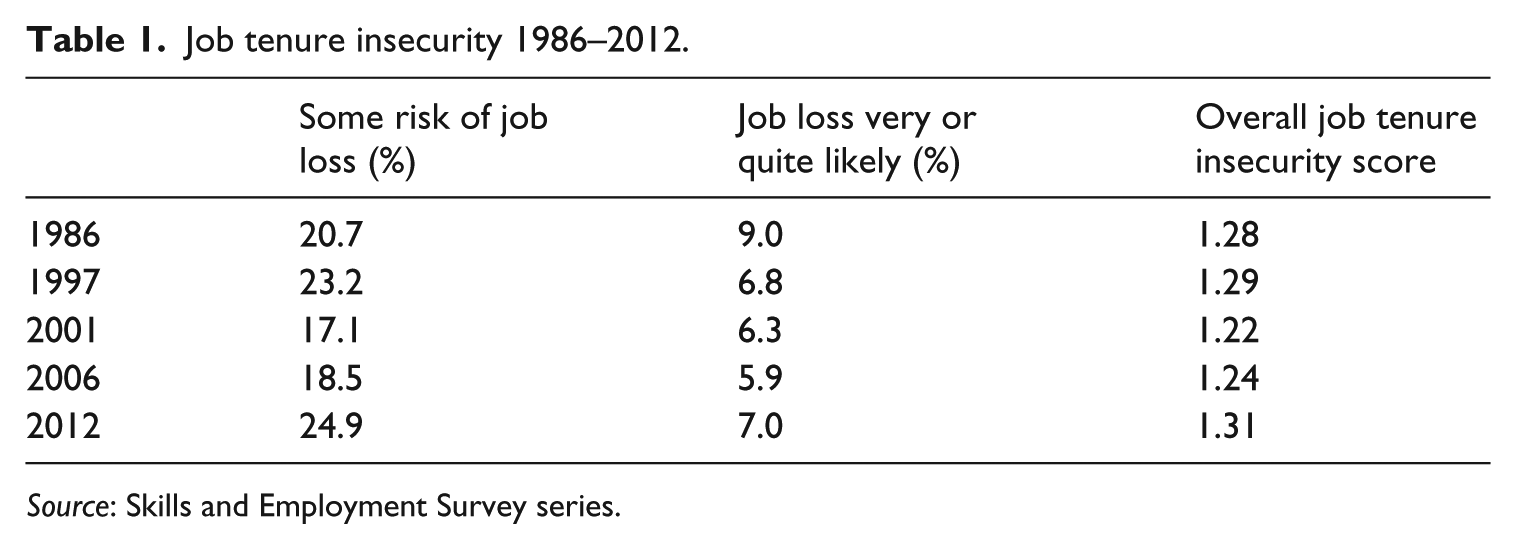
The Skills and Employment Survey series makes it possible to compare job tenure insecurity from 1986 to 2012. The left-hand side column of Table 1 gives the proportion reporting that they had some chance of losing their job and becoming unemployed, the middle column gives the proportions thinking this was very or quite likely, while the final column gives the mean overall job tenure insecurity score for each year.
Job tenure insecurity 1986–2012.
Source: Skills and Employment Survey series.
In 1986, at the end of the severe recession of the early 1980s, 21% of all employees thought there was a chance that they might lose their job in the next 12 months. Levels of job tenure insecurity were a little higher in 1997 and then declined in the early 2000s in the sustained period of economic growth. Over the period 2006 to 2012, which saw the most severe recession since the 1930s, job tenure insecurity again rose steeply – affecting nearly a quarter of the workforce, the highest figure in the period covered by our data. The pattern for the proportion with severe anxiety about job loss (thinking it was either very or quite likely) was also curvilinear – starting at its highest point in 1986, then declining and finally rising again between 2006 and 2012. The figure for 2012, however, remained lower than that in the mid-1980s. These fluctuations in job tenure insecurity are broadly consistent with the results of other research that indicate its sensitivity to the economic cycle and the unemployment rate (Green, 2009).
Job status insecurity
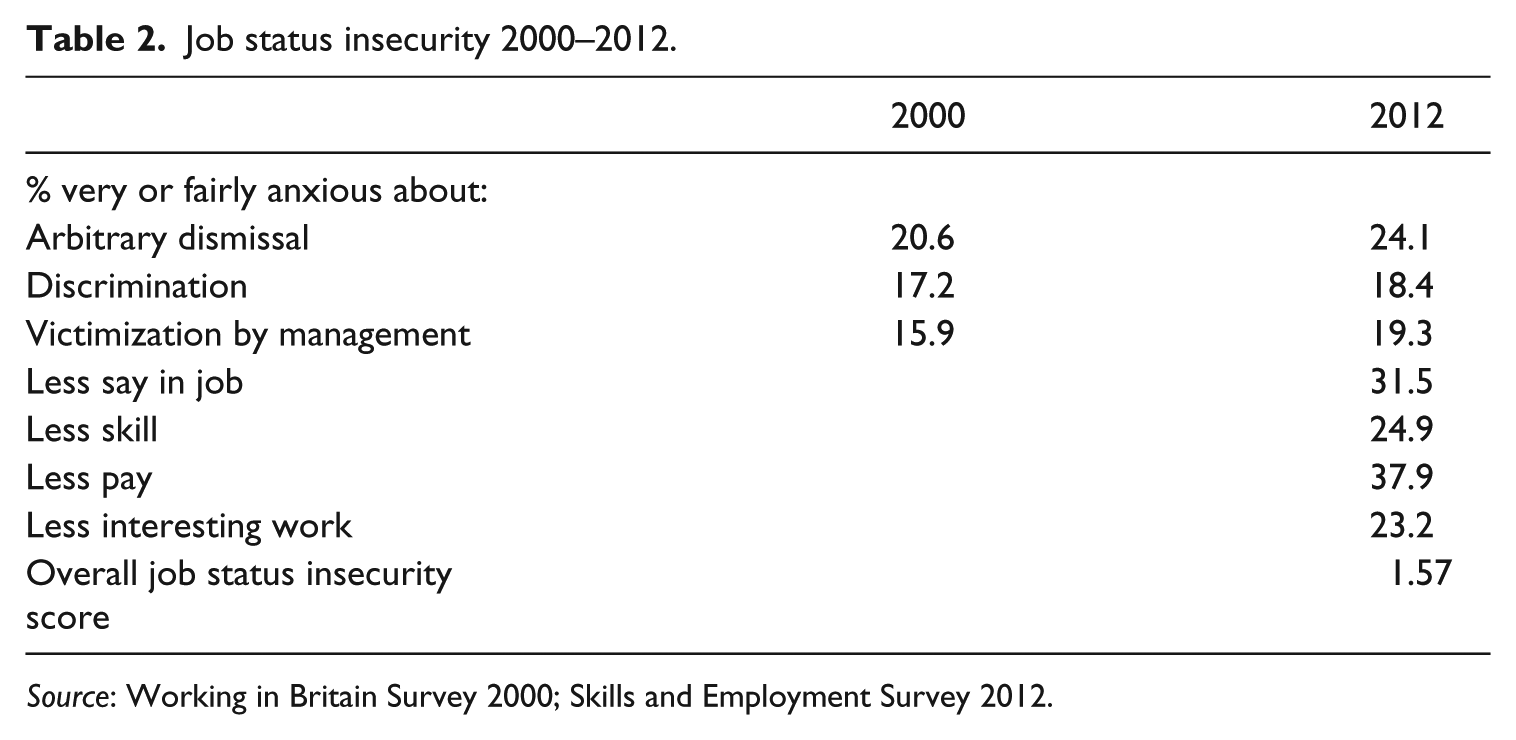
Job status insecurity can only be compared across time on a limited number of items – those concerned with personal treatment by management. As can be seen in Table 2, the proportion of employees very or fairly anxious about unfair treatment rose between 2000 and 2012 on each of the three items. This suggests that, as with job tenure insecurity, there had been a rise in job status insecurity since the beginning of the millennium. 1
Job status insecurity 2000–2012.
Source: Working in Britain Survey 2000; Skills and Employment Survey 2012.
Evidence on other items is only for 2012. This shows that possible future loss of pay caused the highest anxiety, followed by a reduction in the ability to make decisions about how the job should be done. Worries about having less ability to make use of skills and abilities on the job and being transferred to less interesting work were about equally common.
An estimate of the relative prevalence of the two types of insecurity is necessarily very approximate, but we can compare those who thought it was either very or quite likely that they would lose their job within the next 12 months with those who were very or fairly anxious about the loss of a given job status feature. In 2012, seven per cent of employees thought it was very or quite likely that they would lose their job in the coming year. A considerably higher proportion (ranging between 18% and 38%) said that they were very or fairly anxious about each item of job status loss. If account is taken only of those who expressed themselves as ‘very anxious’, job status insecurity with respect to at least one item still affected 23 per cent of the workforce. There are some grounds then for thinking that high levels of anxiety are even more prevalent with respect to job status insecurity than for job tenure insecurity.
The distribution of job insecurity
We examine first the relationship between the two forms of job insecurity and the various individual, employment and labour market characteristics discussed earlier. We then turn to the potential effects of longer-term organizational practices. Finally, we introduce variables relating to more recent experiences of organizational change.
Individual, employment and labour market characteristics
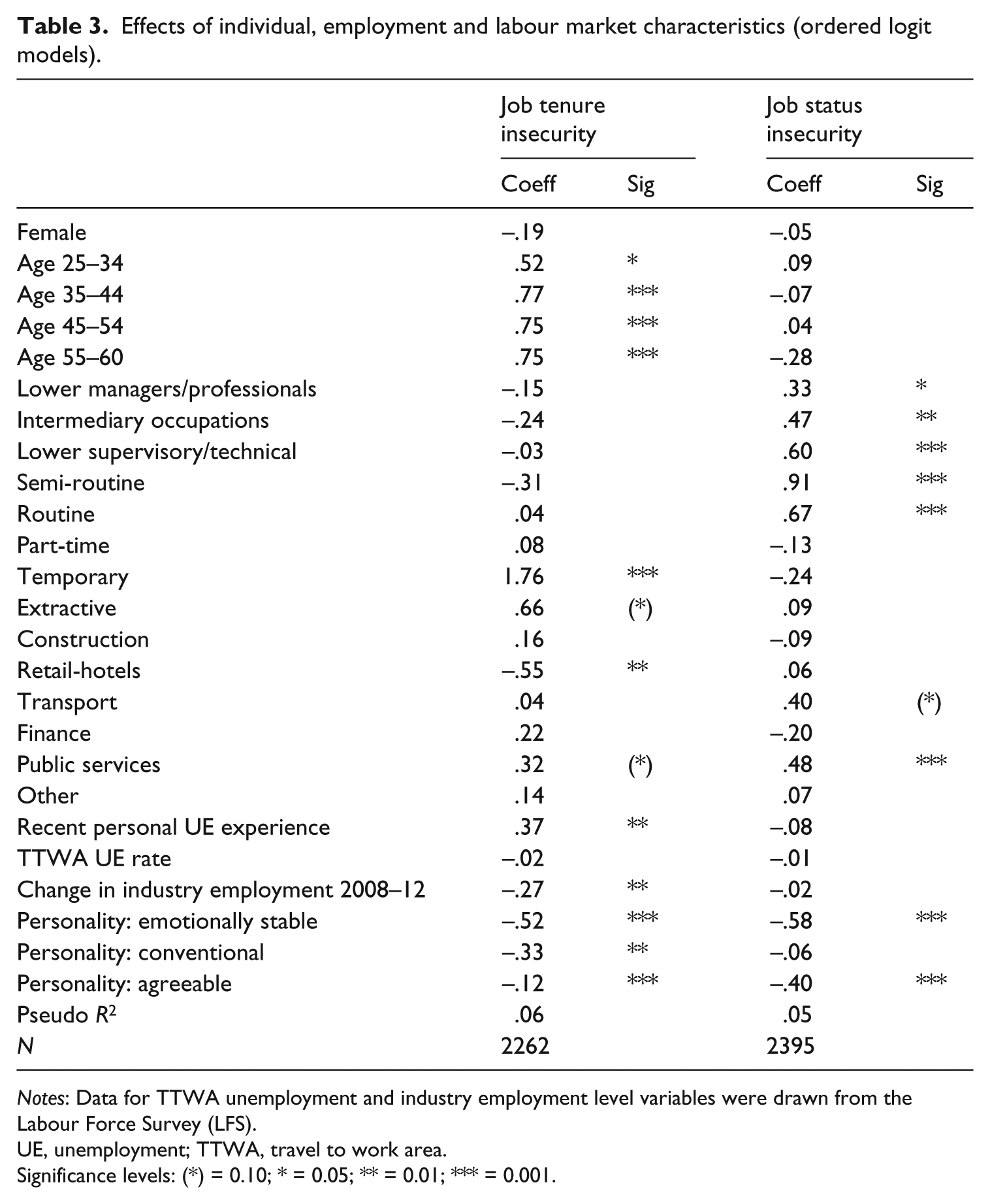
There was no evidence of a difference between male and female employees with respect to either type of job insecurity. However, a notable difference of pattern emerges with respect to age. Age was strongly linked to job tenure insecurity, with worry higher among those aged 25 or more (and particularly among those over 34). In contrast, age was unrelated to job status insecurity.
Our measure of occupational class was the ONS Socio-Economic Classification (NS-SEC), which has been extensively validated with respect to its capacity to differentiate employment relationships (Rose and Pevalin, 2003). Without controls, there is some evidence of class effects on job tenure insecurity, although the pattern is at odds with our initial expectations: lower professionals and managers and semi-skilled operatives had lower job tenure insecurity than higher managers and professionals. These differences, however, were no longer statistically significant once other factors had been controlled for. The view that the class distribution of job insecurity has changed over time was confirmed when a comparison was made with Skills and Employment Survey series data for 1986 (not shown). In the earlier period, both semi-skilled and especially routine employees had significantly higher levels of job tenure insecurity than all higher classes.
Class did still matter for job insecurity in 2012, but this was in relation to job status insecurity rather than job tenure insecurity. Even with other factors controlled, those in lower class positions had significantly higher job status insecurity than those in managerial or professional occupations. This is likely to reflect the persistence of traditional hierarchical relations, in which the costs of internal flexibility fell primarily on those in the lower ranks.
Turning to the implications of non-standard contract status, the expectation that temporary workers would feel greater insecurity about job loss than regular employees was strongly confirmed. In contrast, part-timers appeared to be at no significant disadvantage. Moreover, there was no relationship between either type of non-standard contract and job status insecurity.
With regard to labour market experience and context, previous research has shown that higher unemployment accentuates job insecurity, but the mechanisms underlying this were unclear. It may be that it is the personal experience of unemployment that is important or people may be affected by their knowledge of what is happening to others in the same locality or industry. Our analysis showed that there was a clear relationship between personal unemployment experience in the recent past and job tenure insecurity. However, the expectation that the level of unemployment in the local travel to work area would heighten insecurity about job loss was not confirmed. A more important factor was the change between 2008 and 2012 in the level of employment in the industry in which an employee worked (estimated from the Labour Force Surveys). This was significant even when industry controls were included in the model. Over and above this, employees in the extractive industries and in the public service industries were more likely to feel that there was a risk of job loss.
In contrast, labour market conditions appeared to have little association with job status insecurity. Measures of personal unemployment, the local unemployment rate and industry employment change were not significant. Only type of industry stood out: the highest levels of job status insecurity were in transport and in the public service industries (public administration, health and education).
A final point to note is that the relationships discussed above emerge clearly even although personality factors have been controlled for. These did show some effects. Those who were high in terms of general stability and calmness were notably less insecure with respect both to job tenure and job status insecurity. Similarly, those who were agreeable rather than critical were less likely to be concerned about either job tenure or job status insecurity. Being conventional rather than open to new experiences was associated with less worry about job loss, although it was unrelated to job status insecurity.
Longer-term organizational practices
We turn next to factors relating to longer-term organizational practices – focusing respectively on the implications of the use of advanced technology, human resource management and the degree of employee participation in decision making.
The indicator of advanced technology was derived from four items: whether the job involved the use of computerized or automated equipment, the proportion of employees working with such equipment in the workplace, and the importance and complexity of the use of computer or computerized equipment at work (see online-only Appendix 2 for question items). Respondents were divided into three categories based on their score on the indicator, with approximately the same proportion in each category.
The presence of more advanced human resource management was measured through four items: the use of performance appraisal systems; whether the employee had received employer training in the previous 12 months; whether they worked in a semi-autonomous or self-managing team; and whether the organization was committed to or recognized as an ‘Investor in People’, an accreditation framework administered by the UK Commission for Employment and Skills to identify work organizations with good human resource management with respect to leadership, support and encouragement of improvement. The indicator was an additive one, in which each item counted for one, ranging between ‘0’ for no advanced human resource management and ‘4’ where all four were present.
Finally, we had a number of measures of participation. These distinguished between consultative participation and union representation. There were two indicators of consultative participation, capturing respectively the scope of employee consultation and employee influence over decisions about work reorganization. To assess scope of participation, respondents were asked initially: ‘At your workplace, does management hold meetings in which you can express your views about what is happening in the organization?’. Those answering positively were asked about the types of issue areas on which consultation took place. These were grouped into those relating to more immediate work activity (working practices, health and safety and training); those concerned with decisions about products (planned changes in products or services); and those involving longer-term financial issues (the financial position of the organization and investment plans). A four-point scale of scope of organizational participation was constructed to reflect the relative strategic importance of the issues on which employees could express their views: ‘0’ indicated no participation; ‘1’ participation limited to work activity issues; ‘2’ participation limited to work activity and product decisions; and ‘3’ participation that included strategic issues (investment plans, the financial situation of the organization).
The measure of employee influence over decisions affecting work reorganization was derived from a question asking: ‘Suppose there was going to be some decision made at your place of work that changed the way you did your job. Do you think that you personally would have any say in the decision about the change or not?’. Those with a say were asked whether that influence would be a great deal, quite a lot or just a little. The two items have been combined to create an employee influence score, ranging from ‘0’ for none to ‘3’ for a great deal. Finally, the measure of trade union recognition was drawn from the question: ‘Is there any union or staff association recognized by management for negotiating pay and/or conditions of employment?’.
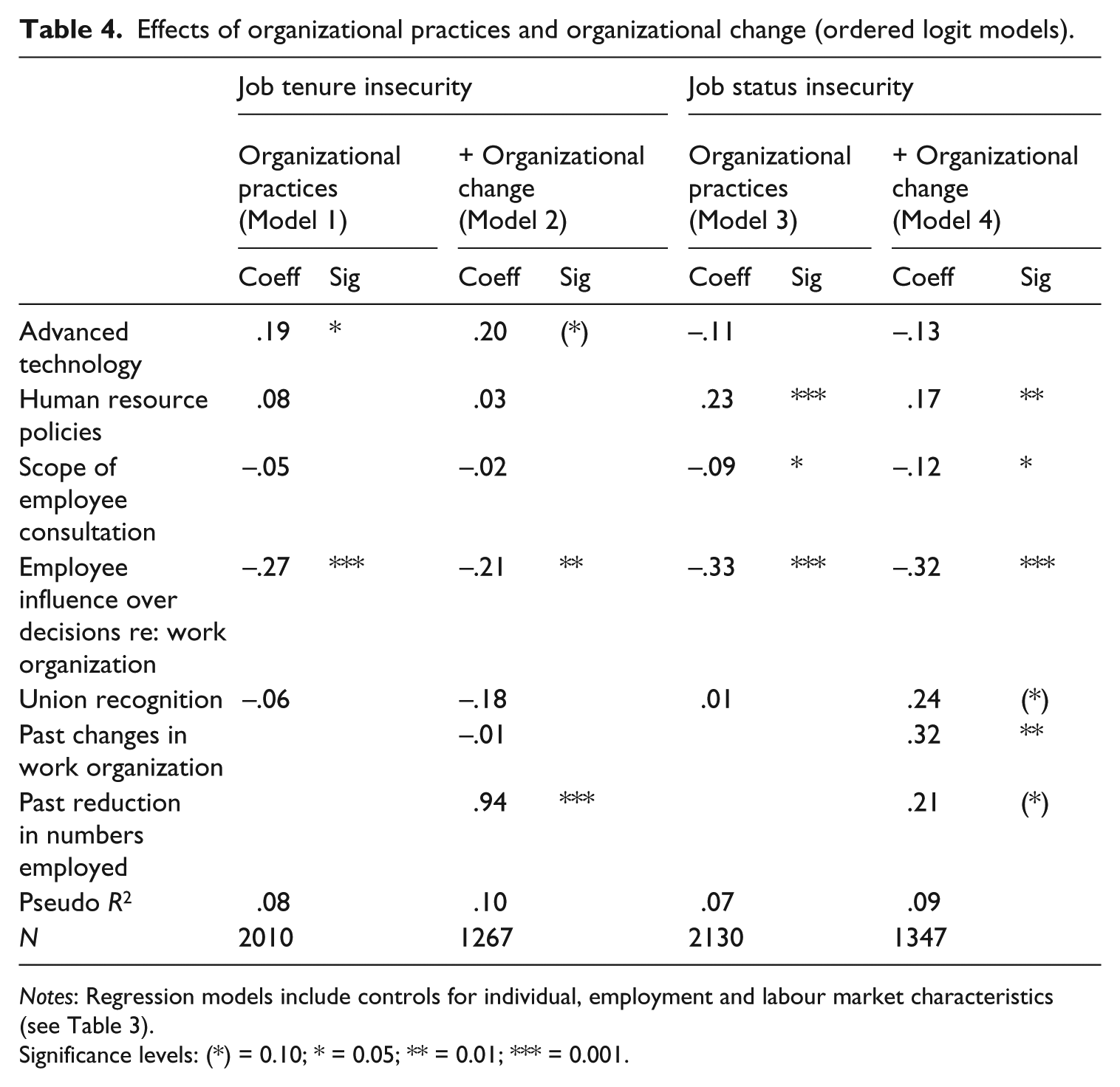
Turning to the empirical results, the effects of the organizational practice variables, controlling for the individual, employment status and labour market factors, are shown in Models 1 and 3 of Table 4. It is notable that advanced technology and managerial human resource practices had quite distinct implications for the different types of insecurity. As predicted, high technology settings were associated with greater job tenure insecurity. We find no association, however, between technology and job status insecurity. The opposite pattern emerges with human resource management practices: they are significantly related to job status insecurity, but do not have an effect on job tenure security.
The view that employee participation could reduce anxieties relating to insecurity was strongly confirmed. Higher employee participation was important for reducing both job tenure and job status insecurity. Employee influence over decisions about work reorgan-ization was associated with reduced job tenure insecurity. Both scope of consultation and employee influence over work reorganization were significantly associated with lower levels of job status insecurity. Union recognition, however, had no effect in reducing either type of job insecurity (and this remained the case even when the other participation variables were omitted). Indeed, it was marginally associated with higher job status insecurity.
Organizational change
It was anticipated that employee job insecurity would be sharpened at times of organizational change, which can reduce staffing requirements and threaten long-standing work practices. Those who had been employed in the organization for at least three years were asked whether there had been ‘a change in the way work was organized’ and whether ‘there was a reduction in the number of people doing this sort of work’. The focus on people employed in the organization for several years considerably reduced sample numbers. In general, however, the pattern of effects found in Table 3 for the individual, employment and labour market characteristics was similar for the sub-sample to that found for the full sample, suggesting that it was broadly representative. 2
Effects of individual, employment and labour market characteristics (ordered logit models).
Notes: Data for TTWA unemployment and industry employment level variables were drawn from the Labour Force Survey (LFS).
UE, unemployment; TTWA, travel to work area.
Significance levels: (*) = 0.10; * = 0.05; ** = 0.01; *** = 0.001.
The second and fourth models shown in Table 4 give the effects of organizational change over and above that of individual, employment and organizational characteristics. It can be seen that workforce reductions had a strong effect on job tenure insecurity, and also a weaker effect on job status insecurity. Changes in work organization, in contrast, had no impact on job tenure insecurity, but an even stronger impact on job status insecurity than workforce reductions.
Effects of organizational practices and organizational change (ordered logit models).
Notes: Regression models include controls for individual, employment and labour market characteristics (see Table 3).
Significance levels: (*) = 0.10; * = 0.05; ** = 0.01; *** = 0.001.
Theories of participation frequently suggest that it reduces anxieties at times of work reorganization. This was examined by introducing interaction terms between the two principal forms of workplace change and the indicators of participation (Table 5). Although trade union recognition had no direct influence in reducing job tenure insecurity, it did prove significant in moderating the effect of workforce reductions. Moreover, both employee influence over work reorganization and union recognition had significant moderating effects on job status security. Employee influence over work reorganization reduced anxieties stemming from changes in work organization, while trade union recognition diminished anxieties arising from reductions in workforce numbers.
Interaction effects on job insecurity of organizational practices and employee participation 2012 (ordered logit models).
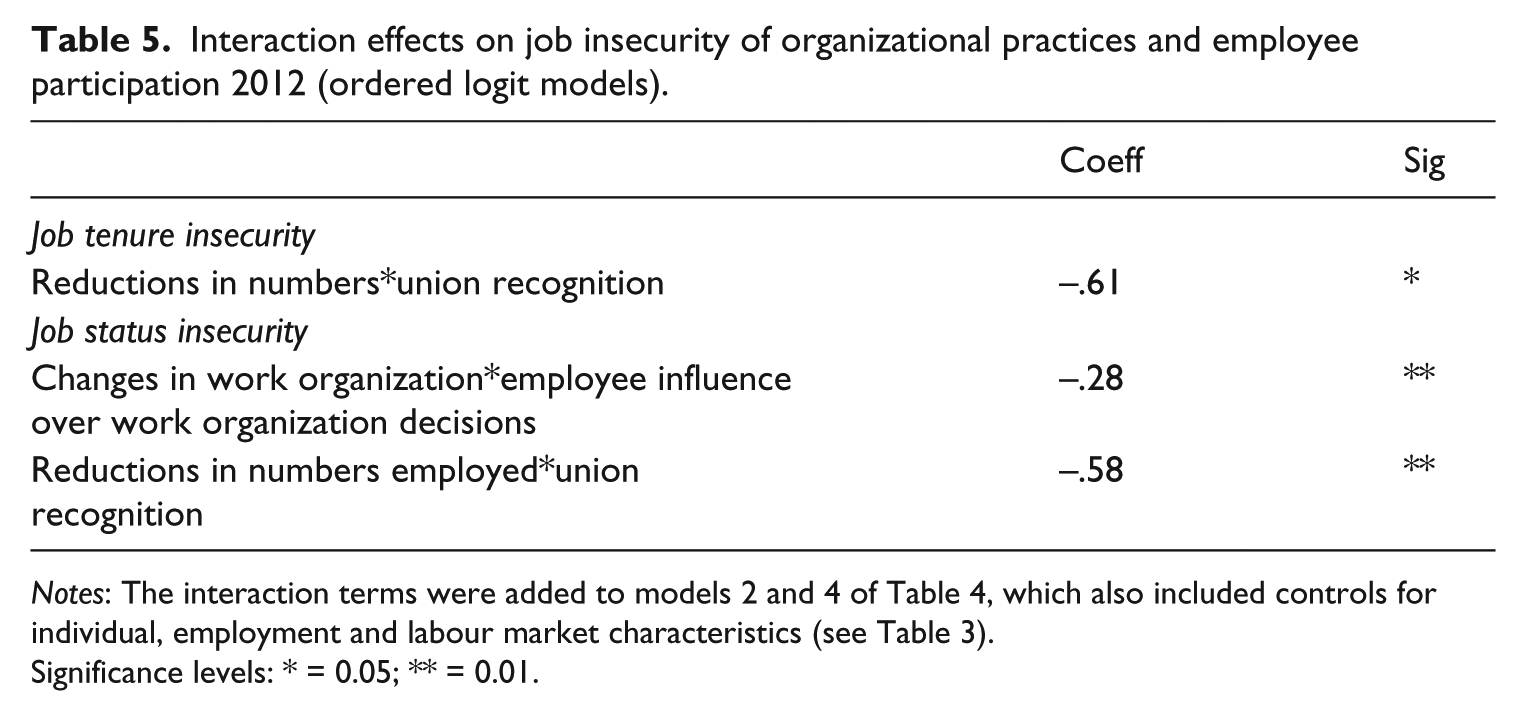
Notes: The interaction terms were added to models 2 and 4 of Table 4, which also included controls for individual, employment and labour market characteristics (see Table 3).
Significance levels: * = 0.05; ** = 0.01.
Conclusions
We have highlighted the importance of the conceptual distinction between two types of job insecurity, developing the perspective initiated by Greenhalgh and Rosenblatt (1984), and brought new evidence about their prevalence and determinants. The primary focus of past research on job insecurity has been on fear of loss of employment (or job tenure insecurity). We have argued that this has led to a neglect of a rather different type of job insecurity (job status insecurity) that involves a perceived threat to valued features of the job. It relates to insecurity about personal treatment by superiors, as well as the loss of important job characteristics such as skill, task discretion, task interest and pay. We have shown that it is a distinct form of job insecurity that has independent effects in reducing employee well-being. Both types of job insecurity had risen significantly from the beginning of the millennium to 2012. However, in 2012, there was some evidence that the prevalence of job status insecurity was even greater than that of job tenure insecurity. We confirmed the importance of distinguishing the two types of job insecurity by showing differences in the way they are related to individual, employment and labour market characteristics. While our evidence involves the restrictions on causal inference inherent in a reliance on cross-sectional data, in contrast to most earlier studies we have been able to take some account of individual heterogeneity by introducing controls for personality traits.
With respect to the determinants of job tenure insecurity, our evidence provides support for several factors that have been highlighted in earlier literature: in particular, age and contract status. Employees older than 35 were significantly more worried about losing their jobs. This arguably reflects greater concern about family responsibilities among the middle aged and a worry about skill obsolescence. The evidence highlighted the strong negative effects of temporary contract status, which have been well-established by past research. The importance of labour market conditions was also confirmed: those who had had a recent spell of unemployment or who were in industries that had seen particularly sharp employment losses since the recession were particularly likely to feel that their jobs were at risk.
In other important respects, however, our findings differed from earlier research. First, it has frequently been argued that job insecurity is strongly class-related; indeed, it has been viewed in some of the literature as an essential constituent of class differences. We found that, while this indeed had been the case in the mid-1980s, by 2012 class differences in employment security had been eroded and there was no longer a significant class differential. This is consistent with the view that, since the late 1990s, many once secure professional and managerial jobs have become increasingly vulnerable.
Second, while the public sector has been commonly viewed as providing exceptionally good job security, it was notable that by 2012 employees in the public service industries had significantly higher levels of job tenure insecurity than those in private sector industries. This new phenomenon doubtless reflected the cost-cutting programmes introduced by governments to reduce the deficits incurred in the wake of the banking crisis of 2008.
Third, we show that the nature of organizational context was also important for job tenure insecurity. While the theoretical importance of advanced technology for job displacement and indeed for the shape of the occupational structure has received considerable attention, it is a factor rarely considered in empirical analyses of job insecurity. Our evidence suggests that insecurity was greater in high-technology organizations, presumably due to their more frequent implementation of new automated procedures and the consequent effect of the progressive elimination of traditional job tasks on employees’ perceptions of personal risk of job loss. Another factor contributing to job tenure insecurity was working in an organization that had experienced downsizing in recent years: awareness of staff reductions appears to have led to increased anxiety among the remaining workforce.
Turning to job status insecurity, there were some notable differences in the factors associated with higher insecurity. Age and contract – which were important with respect to job tenure insecurity – had no significant effects. Conversely, class position, which no longer had a relationship to job tenure insecurity, nonetheless had considerable implications for job status insecurity. Routine, semi-routine and even lower supervisory and technical employees were significantly more worried about their positions within the organization than those in higher occupational classes. Class involves major asymmetries in decision-making power, with those in lower class positions having substantially less control over disruptive change to their working practices and employment conditions. It was notable too that, in contrast to the case for job tenure insecurity, job status insecurity was particularly high in organizations with more sophisticated human resource management policies and it was affected by whether or not organizations had engaged in the reorganization of work.
At the same time, there were some common factors associated with the two types of insecurity. Job status insecurity was also higher in organizations affected by downsizing. The fact that downsizing has persisting implications for the anxieties of the existing workforce with respect to both job tenure and job status insecurity may be important in helping to explain the ‘survivor’ phenomenon whereby even employees who have kept their jobs in organizations that have reduced their staffing levels tend to have worse longer-term health than those in organizations that have not been similarly affected (Vahtera et al., 2004). Further, in common with job tenure insecurity, job status insecurity was particularly high in the public service industries, reinforcing the view that there had been a marked deterioration in the quality of public sector employment.
Finally, it is notable that, in both cases, the existence of effective forms of employee participation was an important factor reducing insecurity. In the case of job status insecurity, this was partly due to its direct effect but also to the way it moderated the effects of both staffing reductions and organizational change. Moreover, while trade unionism had no direct effects in reducing job insecurity, it did prove a significant moderator of the anxieties generated by staffing reductions.
Our evidence on the factors associated with the two types of insecurity has potentially important implications for both management and government policy. While advances in technology, new managerial productivity practices and public sector restructuring may threaten a substantial long-term increase in job insecurity, their effects could be at least partially offset by a stronger policy emphasis on increasing employees’ involvement in decision-making at work. The positive role of participation in reducing anxieties are likely to arise from its effectiveness in decreasing uncertainty, enhancing trust in management, increasing the sense of procedural fairness and providing a means for employees to influence the details of decisions. Our results indicate that if policies to raise levels of employee effort and achieve greater workforce flexibility are to be compatible with a work environment that is supportive of employees’ psychological and physical health, they will need to be accompanied by measures to enhance employee participation in decisions that affect their work lives.
Footnotes
Funding
The Skills and Employment Survey 2012 was funded by the ESRC/UKCES Strategic Partnership (RES-241-25-0001), with additional support from the Wales Institute of Social and Economic Research, Data and Methods.