



Abstract
Counting is foundational to success with mathematics. In this synthesis, we analyzed 17 studies about counting-focused interventions for preschool and kindergarten students with mathematics difficulty or at-risk of mathematics difficulty. All interventions addressed several components of counting, including stable order, one-to-one correspondence, and cardinality. After students participated in a counting-focused intervention, results indicated moderate-to-strong proximal effects and positive transfer effects. Computer game-based counting interventions without instructional strategies had no significant effects on preschool students. Modeling, guided practice, feedback, and multiple representations (i.e., hands-on or virtual) were the most common instructional strategies used within the interventions.
Counting is an integral part of preschool and kindergarten mathematics instruction because counting helps young students understand number concepts (Berch, 2005; Hinton et al., 2015). Due to the cumulative nature of mathematics, counting is considered essential for other mathematics skills (e.g., comparison, simple addition, and subtraction; Nelson & McMaster, 2019). During preschool and kindergarten, proficiency in early numeracy, which includes counting, accelerates growth in mathematics achievement (Aunio et al., 2015; Aunola et al., 2004). However, students who enter kindergarten with limited skills in counting perform below average throughout kindergarten compared to students with stronger knowledge of counting (Geary et al., 2012). Thus, it is essential for students to understand counting at an early age.
Counting
Counting consists of five principles: stable order, one-to-one correspondence, cardinality, abstraction, and order irrelevance (Gelman & Gallistel, 1978). The first three principles are essential for counting (Çakir, 2013). Students should know number names in a stable order (i.e., “one, two, three, four…”) and follow the established counting sequence with the number words (Slusser & Sarnecka, 2011). Stable order is often the first verbal numerical activity for young students, who often learn stable order through songs, rhymes, chants, or stories (Powell & Fuchs, 2012).
Stable order is combined with one-to-one correspondence, the second principle, to count objects in a set. With one-to-one correspondence, students apply a number name to each item only once (Powell & Fuchs, 2012). One-to-one correspondence involves partitioning, in which the objects that have been counted are separated from the objects that have not been counted. As each object is partitioned, the object is assigned with a number name, and each number name is said in order (i.e., stable order) and only used once. When given a set of objects, successful counting involves both stable order and one-to-one correspondence (Çakir, 2013).
The third counting principle, cardinality, involves understanding that the last count of a set of objects represents the total of the counted set. For example, as a student counts four objects as “one, two, three, four,” the count of “four” represents the total number of objects in the set. After counting a set of objects, often adults will ask “how many” to determine whether students understand the counting principle of cardinality (Muldoon et al., 2003). Stable order, one-to-one correspondence, and cardinality are all essential for success with counting.
Beyond the essential counting principles, the principle of abstraction allows students to count a set of unlike objects (e.g., a set of pencils, markers, staplers, and candy). Understanding of this principle allows students to count a wide range of objects in various contexts. Finally, order irrelevance suggests that the order of counting (i.e., left to right, right to left, random) does not matter (Çakir, 2013). Although abstraction and order irrelevance can be helpful in developing counting skills, in this synthesis we focused on the first three counting principles because of their essential role in successful counting.
Importance of Counting
Successful application of the counting principles is crucial because counting opens up cognitive resources for more complicated mathematics (Aunola et al., 2004; Gersten & Chard, 1999; Martin, 2011). For example, students who learn to count forward and backward proceed to understand the concepts of more and less (i.e., quantity comparison; Batchelor et al., 2015; Dyson et al., 2015). Furthermore, students who show an understanding of addition and subtraction by counting one or two more numbers start to use the number line for addition and subtraction and then gradually incorporate these skills into additive single-digit word problems (Cohen & Sarnecka, 2014; Nelson & McMaster, 2019). Counting in kindergarten enhances the development of strategies related to arithmetic principles (i.e., addition and subtraction) in first grade (Lefevre et al., 2006; Stock et al., 2009) as well as third grade (Jordan et al., 2009). Further, counting in kindergarten (e.g., stable order forward or backward) is a strong predictor of essential mathematics skills in the seventh grade (Koponen et al., 2019).
Counting also enhances a student's awareness of number relationships (Baroody, 2006; Baroody et al., 2009; Dyson et al., 2015). For example, knowing the next number in a counting sequence helps students see how much “one more” is, and knowing the order of the count sequence allows students to determine the greater of two numbers (Clements, 1984). Counting also shows students the connection between symbolic (i.e., written numerals; 1, 2, 3) and nonsymbolic representations (i.e., numbers of objects, pictures, or dots; Le Corre & Carey, 2007). Results from some studies suggest that counting fosters students’ mapping between symbolic and nonsymbolic skills (Chan, 2020; Friso-van Den Bos et al., 2018).
Finally, counting assists younger students in broadening their quantitative skills (Dyson et al., 2015). For example, when counting a set of objects, students should understand that each object corresponds to a unique number and that the number increases in a predictable sequence (i.e., 1, 2, 3, … 9, 10). In addition, students can use counting to understand the pattern of place value, which is different from the first nine numbers (e.g., 10, 11, 12, …). Through this process, students can recognize patterns in numbers and develop a sense of number magnitude, which helps them compare and order numbers.
Even though counting is a foundational mathematical skill, only 60% of students demonstrate expertise with counting at the end of kindergarten (Flores et al., 2023; Stock et al., 2009). Additionally, researchers have highlighted that preschool and kindergarten students who struggle with counting skills have difficulty with complex mathematics skills in the later grades (e.g., arithmetic operations; Geary et al., 1999; Hannula-Sormunen et al., 2015; Jordan et al., 2009). Overall, these findings suggest it is essential to emphasize counting in preschool and kindergarten (Nguyen et al., 2016).
Students With Mathematics Difficulty (MD)
Researchers vary in how they define mathematics difficulty within mathematics intervention studies (Powell et al., 2020; Stevens et al., 2018). In this synthesis, we used the term mathematics difficulty (MD) to describe students who demonstrated persistent low performance in mathematics. We defined MD based on specific criteria, which included a cut-off percentile indicating below-average performance in mathematics (e.g., 10th, 25th, 35th, or 40th percentile; Aunio et al., 2021; Bailey et al., 2020; Barnes et al., 2016), evidence of persistent low performance in mathematics over time (Doabler et al., 2016), or identification by teachers as having MD (Clarke et al., 2016a).
In the early elementary grades, students who struggle with any component of counting, such as stable order, one-to-one correspondence, and cardinality, tend to exhibit below-average mathematics performance (Desoete et al., 2009; Dowker, 2005). Geary et al. (1999, 2009) demonstrated that students with MD often use ineffective counting strategies, which results in miscounting or counting the same items twice. Butterworth (2010) reported that students with MD often experience difficulty with cardinality or determining how many things are in a set. Additionally, students with MD struggle with stable order and one-to-one correspondence more than without MD (Geary et al., 2007). As a result, students with MD may lack foundational and flexible counting knowledge (Aunola et al., 2004; Gersten et al., 2005).
As mentioned, counting principles are important for understanding number relations (e.g., quantity comparison and skip counting) as well as number operations (e.g., addition and subtraction facts), which are crucial parts of early numeracy. Without developing proficiency with counting, it is difficult for students to easily compare numbers or solve arithmetic problems (i.e., other parts of early numeracy). Furthermore, counting is also a strong predictor of students’ mathematics understanding in middle school (Hannula-Sormunen et al., 2015; Koponen et al., 2019).
Early numeracy not only encompasses counting but also number relations and number operations. Therefore, researchers often use counting measures or more distal early numeracy measures to identify students with MD related to early numeracy. For example, Paliwal and Baroody (2018) assessed counting skills through counting and cardinality tasks (a subtest of a measure), a proximal measure used to identify students with MD. In contrast, Barnes et al. (2016) used a more distal measure to assess students’ early numeracy that included items related to counting, number relations, arithmetic, and measurement to identify students with MD.
Previous Syntheses and Meta-Analyses
Previous syntheses and meta-analyses have primarily addressed early numeracy interventions that focused on numbers (i.e., knowledge of numbers; e.g., verbal and object counting), number relations (i.e., how the numbers are connected with one another; e.g., comparison), and arithmetic operations (i.e., how numbers can be taken apart and put together; e.g., addition and subtraction). We describe several of these efforts in the following paragraphs. Of importance for this study, we identified no syntheses and meta-analyses focused exclusively on counting skills.
Related to early numeracy, Kroesbergen and Van Luit (2003) conducted a meta-analysis of 58 studies of mathematics intervention for students with MD at the elementary level. The author team excluded studies in which the sample had a mean age higher than 12 years old. The authors focused on three domains of intervention: early numeracy (e.g., counting skills), foundational skills (e.g., addition and subtraction facts), and problem-solving strategies. The results showed that the most effective interventions for students with MD focused on early numeracy and other foundational skills.
Also with a focus on early numeracy, Mononen et al. (2014) synthesized 19 studies that analyzed the effectiveness of the pedagogical components of interventions for students ages 4–7 with or at risk of MD. The authors investigated the core and supplemental instruction of early numeracy interventions including verbal and object counting, subitizing, comparison, and numeracy-related logical abilities. Mononen et al. reported that early numeracy interventions with explicit instruction improved the early numeracy skills of students at risk of MD.
In a meta-analytic review, Wang et al. (2016) investigated the program effectiveness of early mathematics interventions implemented with prekindergarten and kindergarten students. The results of their synthesis of 29 studies indicated a significant treatment effect for intervention programs that targeted single content (e.g., only numbers or operations) compared to the studies focused on multiple content (i.e., numbers, operations, geometry, algebra, measurement, and data analysis). Additionally, Wang et al. reported that intervention programs that used explicit instruction for prekindergarteners were slightly more effective than those used with kindergarten students. In another meta-analysis, Nelson and McMaster (2019) examined early numeracy interventions (e.g., counting skills, magnitude comparison, simple addition and subtraction, and subitizing) with preschool, kindergarten, and first-grade students with MD. The findings demonstrated that interventions incorporating counting with one-to-one correspondence skills were more effective.
Charitaki et al. (2021) conducted a meta-analysis of early numeracy interventions for students ages 5–8, focusing on three domains of early numeracy: numbering (e.g., verbal counting, knowing number sequences, resultative counting, subitizing, and estimation); relations (e.g., magnitude comparison); and arithmetic operations (e.g., addition and subtraction facts). The research team concluded that interventions using explicit instruction and those incorporating the concrete-representational-abstract (CRA) framework (i.e., objects, pictorial or drawing representation, and numerical symbols) demonstrated moderate effectiveness. Furthermore, interventions that focused on number sequence and magnitude comparison yielded greater effect sizes.
Purpose and Research Questions of the Present Study
When reviewing previous research, we identified no syntheses that exclusively addressed counting-focused interventions for preschool and kindergarten students with MD. Previous research has highlighted the significance of preschool and kindergarten as a critical window for mathematics intervention (Nelson & McMaster, 2019), emphasizing the importance of foundational mathematics skills like counting. A comprehensive review of the current literature on counting-focused interventions for preschool and kindergarten students with MD can give researchers and practitioners insight into how to best support these students in developing counting skills. We asked the following research questions:
What are the effects of counting-focused interventions implemented with preschool and kindergarten students with or at risk of MD? Which instructional strategies are used within counting-focused interventions for preschool and kindergarten students with or at risk of MD?
Method
Search Procedure
We conducted a comprehensive review of studies published from January 2000 to January 2023 that focused on counting-focused interventions for students with MD. We chose this date range because, in 2000, the National Council of Teachers of Mathematics (NCTM) published their Principles and Standards for School Mathematics, which helped lead national conversations about mathematics expectations for students. The review included a search of the literature via four databases: Academic Search Complete, APA PsycINFO, Education Resources Information Center (ERIC), and Education Source. We limited our research to peer-reviewed journals and used the following combination of search terms: “learning disab*” OR “learning disorder*” OR “math* disab*” OR “math disorder*” OR math* difficult* OR “low* perform*” OR delay* OR strugg* OR “at risk” OR dyscalculia, “early childhood” OR “young children” OR preschool OR “pre school” OR kinder*, math* OR numeracy OR “number sense” OR “number concepts” OR “stable order” OR “one to one correspondence” OR “1 to 1 correspondence” OR “number identification” OR “number naming” OR “cardinality OR “cardinal numbers” OR “counting.”
This search resulted in the identification of 5,297 studies, yielding a total of 3,357 studies after de-duplicating (see Figure 1). We reviewed the 3,357 studies in two phases. In the first phase, we reviewed titles, keywords, and abstracts to eliminate studies that were clearly outside of the scope of this review. As a result of this process, a total of 3,260 studies were not considered for further review because the study was (a) on a topic irrelevant to education, (b) assessment development research, (c) case studies, (d) longitudinal studies, (e) background articles, or (f) teacher training.
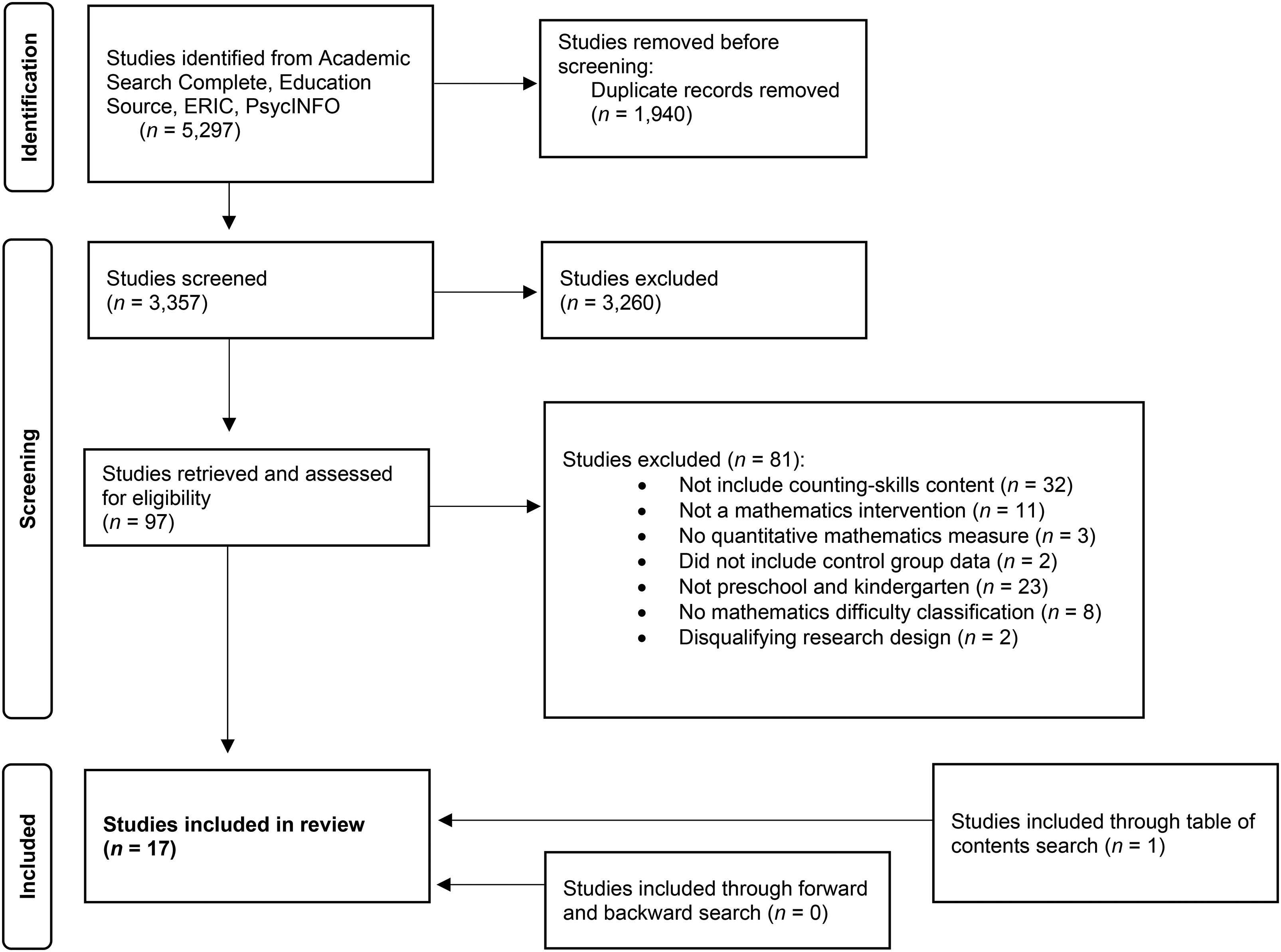
PRISMA diagram.
In the second phase, we conducted a full-text screening of the remaining 97 articles and determined that 81 studies did not fully meet the inclusion criteria. For example, studies did not include a counting-focused intervention (e.g., Aragón-Mendizábal et al., 2017; Sood & Jitendra, 2013), did not include participants who were at risk for MD (e.g., Foster et al., 2016), or did not include the control group (e.g., Salminen et al., 2015). Ultimately, via the database search we identified 16 studies to include in the present review.
We also searched the reference lists of relevant reviews and coded articles. Finally, we performed hand searches of recent issues of relevant journals, such as Journal of Learning Disabilities, Remedial and Special Education, Journal of Research on Educational Effectiveness, Early Childhood Research Quarterly, The Elementary School Journal, and Journal of Early Intervention. We identified one article from the hand search that met inclusion criteria and, therefore, increasing to 17 the total number of studies in the review.
Inclusion Criteria
We included studies that met the following inclusion criteria:
Authors utilized either an experimental design, employing random assignment to participants of a group, or a quasi-experiment design with a nonrandomized group assignment. Furthermore, each study included at least one treatment group and one control group to allow for a comparison of outcomes. To maintain the rigor of the review, studies using single-group (e.g., without any control group), single-case designs, case studies, and qualitative research design were excluded. Studies that included a control group but did not include that group while analyzing the data were also excluded (e.g., Salminen et al., 2015). Given that the focus of the study was to evaluate an intervention targeting the improvement of counting, cardinality, and one-to-one correspondence skills, specifically emphasizing the principles of counting, we included studies in which 50% or more of the intervention components focused on counting skills as studies focused on counting-skills intervention effects. We separated the studies that included counting skills with other early numeracy skills as combined counting skills and other early numeracy intervention effects. Studies were excluded if they did not incorporate any component of counting principles in their intervention content, such as spatial relation (e.g., Sood & Jitendra, 2013), simple arithmetic problems, and number lines without implementing any counting skills (e.g., Aragón-Mendizábal et al., 2017). Participants in the study exhibited MD or were considered at risk for MD based on specific criteria. These criteria included a cut-off percentile indicating below-average performance in mathematics, evidence of persistent low performance in mathematics over time, identification by teachers as having MD, or identification using a screening assessment specifically designed to identify individuals with MD. Participants were in either preschool or kindergarten. Studies were published in an English-language peer-reviewed journal.
Coding Procedures and Reliability
We developed a codebook based on recommended quality indicators for intervention-related research in special education (Cook et al., 2015). We extracted the following information: (a) study information (i.e., publication year, type, location of the study); (b) research design (i.e., randomized control trial and quasi-experimental); (c) participant characteristics (i.e., age, grade, sample size, MD identifications with specific criteria); (d) intervention components and dosage (i.e., intervention contents, frequency, and group size); (e) instructional strategies (e.g., explicit instruction [i.e., modeling, guided practice, feedback, and independent practice], multiple representations, concrete representational abstract framework, mathematics vocabulary, cognitive or meta-cognitive strategy, self-regulation, and use of technology); (f) dependent measures (i.e., researcher-developed or standardized, and proximal or distal); (g) effects sizes (i.e., p value, Hedges’ g); and (h) study quality.
In the intervention components section, we coded intervention contents, such as counting skills (i.e., stable order, one-to-one correspondence, cardinality), other counting skills (e.g., verbal counting or finger counting), and other specific intervention components (e.g., comparison, operations and algebraic thinking, number and operations in base 10, measurement, and geometry). We coded study quality on a scale of 1 and 0 (i.e., 1 = yes, and 0 = no) within the presence of the following components: data on fidelity of implementation, description of participants’ demographics, description of control conditions, description of intervention agents, data on attrition, and effect size data.
Coding Reliability
The first author served as the first coder for all coding, and the third author, a doctoral student, served as a second coder and independently coded five randomly selected articles (i.e., 30% of the included studies). The first author provided a 1 hr training for coding procedures to the third author. Reliability was calculated as [agreements
Results
Overall, 17 studies met the inclusion criteria for this synthesis. Table 1 provides each study's identifying information and a brief description of each intervention. Studies were published between 2000 and 2022. Ten studies (59%) were conducted in the United States with all participants randomly assigned to conditions. The remaining seven studies took place outside of the United States; among these, the researchers used a randomized-control design in four studies and a quasi-experimental design in three studies. Sample sizes ranged from 12 to 1,251 participants, with a total of 719 participants from preschool (n = 5) and 5,151 from kindergarten (n = 12).
Study Characteristics and Intervention Information.
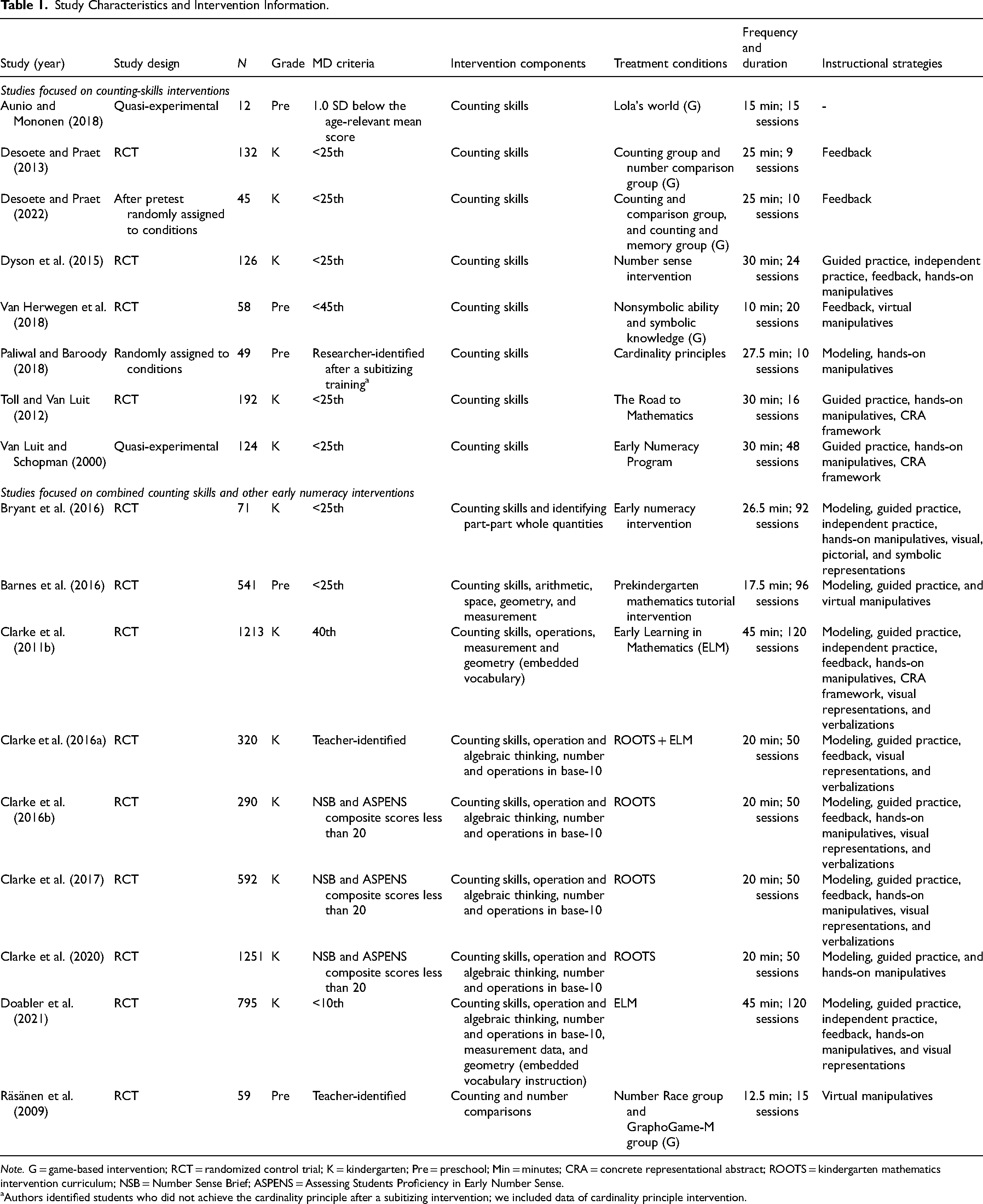
Note. G = game-based intervention; RCT = randomized control trial; K = kindergarten; Pre = preschool; Min = minutes; CRA = concrete representational abstract; ROOTS = kindergarten mathematics intervention curriculum; NSB = Number Sense Brief; ASPENS = Assessing Students Proficiency in Early Number Sense.
aAuthors identified students who did not achieve the cardinality principle after a subitizing intervention; we included data of cardinality principle intervention.
To be included in this review, students had to experience MD. In 11 out of the 17 studies, students were identified with MD or as at risk of MD through mathematics screening criteria. For example, Dyson et al. (2015) identified students with MD using the number-sense screener (Jordan et al., 2010, 2012) and selected those who scored below the 25th percentile. In three studies, the authors identified MD based on students’ low scores (i.e., composite scores less than 20) on two tests conducted by researchers. In another three studies, MD was identified by researchers (Paliwal & Baroody, 2018) or teachers (Clarke et al., 2016a; Räsänen et al., 2009). Paliwal and Baroody tested students after implementing 5 weeks of subitizing intervention, and those who did not understand the concept of cardinality were identified as students with MD for the cardinality principle intervention. In contrast, Clarke et al. (2016a) and Räsänen et al. (2009) asked classroom teachers to nominate the students who needed additional support to enhance their mathematics skills.
Based on the presence of the Council for Exceptional Children (CEC) quality indicators (Cook et al., 2015), we calculated a quality indicator percentage for each study. Overall, study quality ranged from 0.50 to 0.96, with an average quality indicator proportion of 0.76.
Intervention Effects
In 12 of the 17 studies, the authors used a combination of researcher-developed measures and standardized measures to measure student-level effects. Two studies included only researcher-developed measures (Desoete & Praet, 2013, 2022); the remaining three studies included only standardized measures (Aunio & Mononen, 2018; Toll & Van Luit, 2012; Van Luit & Schopman, 2000). We extracted a total of 62 effect sizes from the 17 studies. A total of 47% of the studies (n = 8) implemented counting-focused skills (i.e., more than 50% of the intervention contents focused on counting); the remaining studies implemented a combination of counting-focused and other early numeracy skills.
Studies Focused on Counting-Skills Intervention Effects
Table 2 summarizes the intervention effects of the studies in which the authors implemented counting-focused interventions without other early numeracy topics within the intervention. Of these eight studies, three used researcher-developed measures, three used standardized measures, and the remaining two studies administered a combination of researcher-developed and standardized measures. Within these studies, four implemented paper-based interventions, and four implemented computer games as a mathematics intervention for students with MD (Aunio & Mononen, 2018; Desoete & Praet, 2013, 2022; Van Herwegen et al., 2018). All but two of the studies included two treatment groups (Toll & Van Luit, 2012; Van Luit & Schopman, 2000). In the following paragraphs, we provide a brief description of each of these eight studies.
Intervention Effects.
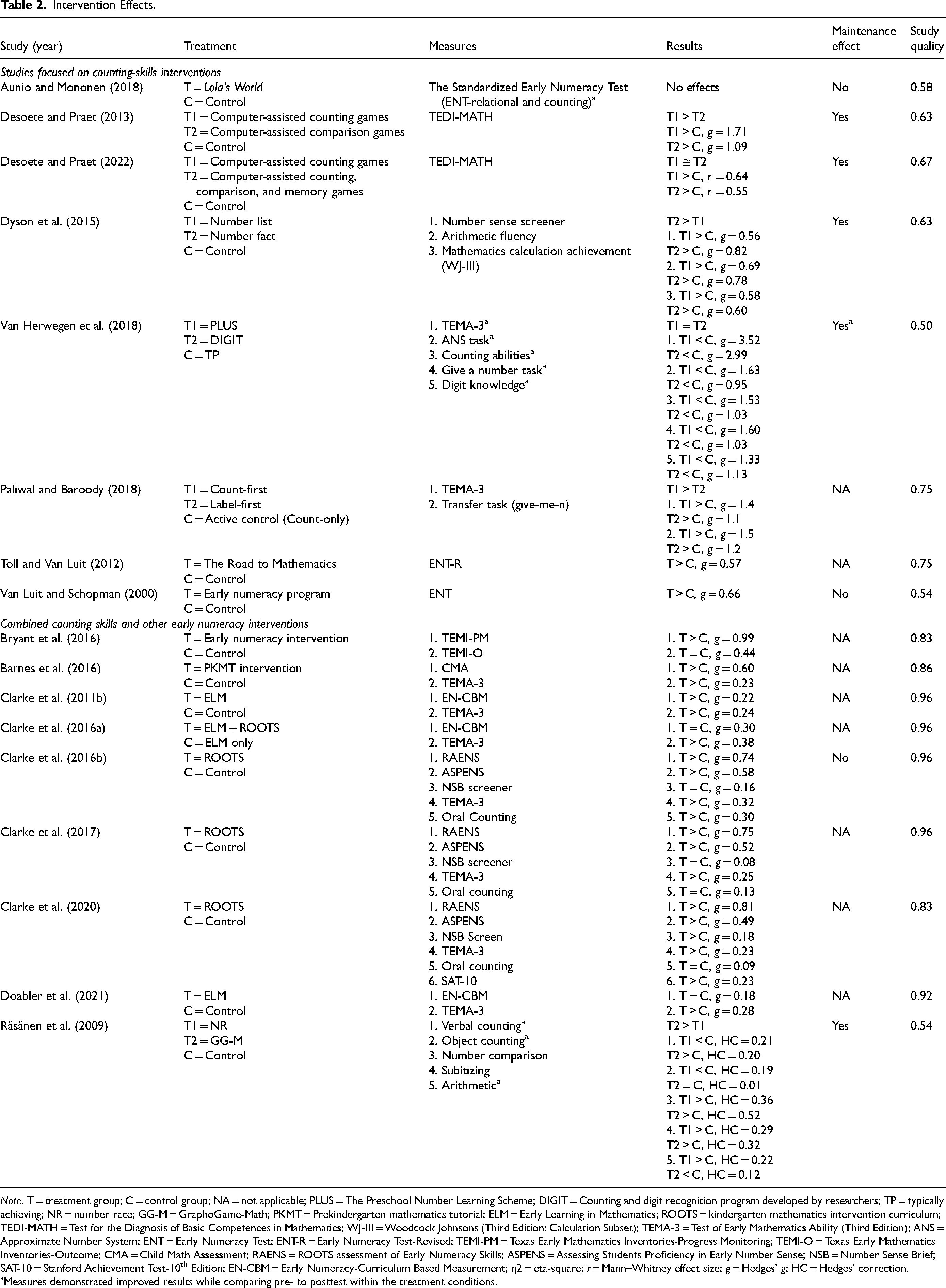
Note. T = treatment group; C = control group; NA = not applicable; PLUS = The Preschool Number Learning Scheme; DIGIT = Counting and digit recognition program developed by researchers; TP = typically achieving; NR = number race; GG-M = GraphoGame-Math; PKMT = Prekindergarten mathematics tutorial; ELM = Early Learning in Mathematics; ROOTS = kindergarten mathematics intervention curriculum; TEDI-MATH = Test for the Diagnosis of Basic Competences in Mathematics; WJ-III = Woodcock Johnsons (Third Edition: Calculation Subset); TEMA-3 = Test of Early Mathematics Ability (Third Edition); ANS = Approximate Number System; ENT = Early Numeracy Test; ENT-R = Early Numeracy Test-Revised; TEMI-PM = Texas Early Mathematics Inventories-Progress Monitoring; TEMI-O = Texas Early Mathematics Inventories-Outcome; CMA = Child Math Assessment; RAENS = ROOTS assessment of Early Numeracy Skills; ASPENS = Assessing Students Proficiency in Early Number Sense; NSB = Number Sense Brief; SAT-10 = Stanford Achievement Test-10th Edition; EN-CBM = Early Numeracy-Curriculum Based Measurement; η2 = eta-square; r = Mann–Whitney effect size; g = Hedges’ g; HC = Hedges’ correction.
aMeasures demonstrated improved results while comparing pre- to posttest within the treatment conditions.
In a later study (2022), Desoete and Praet conducted a similar intervention with the Counting and Comparison treatment groups and a control group. In the Counting treatment group, the students performed the same task as in the earlier study. In addition, students in this condition learned to compare organized and nonorganized stimuli (e.g., animals or dots). In contrast, the Comparison group included counting, comparison, and working memory components. At first, the students learned to count stimuli (i.e., animals or dots), then compare those stimuli, and after that, they needed to answer a question related to the place or color of those stimuli. The authors reported that two treatment groups demonstrated similar results in a proximal measure and significantly improved mathematics performance compared to the control group (Counting, ES = 0.64, Comparison, ES = 0.55).
Van Herwegen et al. (2018) similarly implemented two games, PLUS and DIGIT, and included typically achieving students as a control condition. In the DIGIT game, students learned to recognize the number symbols, count numbers with digits and pictures, match the numbers to words, and apply the cardinality principle. In the PLUS game, students learned to match the same number of quantities and the concepts of less and more. Both treatment groups improved their counting skills compared to pre- to posttest in counting, approximate number system task, and give a number task measures, with no differences between the two game interventions. However, the control group outperformed the treatment groups on all measures at the posttests.
For maintenance effects, the authors of six studies reported collecting maintenance data. Data was collected from 3 to 24 weeks after the intervention was implemented. Four studies reported having significant positive maintenance effects, and two studies did not show any impact (Aunio & Mononen, 2018; Van Luit & Schopman, 2000).
Combined Counting Skills and Other Early Numeracy Intervention Effects
Table 2 provides a brief description of the intervention conditions and results for nine studies in which authors included counting and other early numeracy components within an intervention. As such, the treatment component of these studies focused on counting skills and the early numeracy content (e.g., number comparisons, operation and algebraic thinking, number and operation in base 10, arithmetic, geometry, and measurement). All nine of these studies used a combination of researcher-developed and standardized measures, and all had one treatment and control condition except two (Barnes et al., 2016; Räsänen et al., 2009).
Clarke et al. (2016a) reported that the treatment group outperformed the control with a moderately significant effect in a distal measure (ES = 0.38) compared to the proximal measure (ES = 0.30) at the posttest, which was similar to Doabler et al. (2021; ES = 0.28 [distal], ES = 0.18 [proximal]). Similarly, at the posttest, Clarke et al. (2011b) reported small-to-moderate effects with an effect size of 0.22 in the proximal and 0.24 in the distal measures while comparing the treatment to the control group. Clarke et al. (2016b) had a moderately significant effect on the oral counting measure (ES = 0.30). The results of Clarke et al. (2016b, 2017, 2020) illustrate that the treatment group outperformed the control group in most of the proximal and distal measures. However, Clarke et al. (2017, 2020) did not report any significance for the oral counting measure (ES = 0.13 and 0.09, respectively) compared with the control group.
Instructional Strategies
As described, we coded for the use of three instructional strategies in the intervention: explicit instruction, multiple representations, and the use of technology. Not surprisingly, the studies included in this synthesis incorporated several of these instructional strategies. The most common was explicit instruction, reflected in the 15 out of 17 studies (88%). Within these studies, we examined the use of key components of explicit instruction, including teacher-led modeling, guided practice or independent practice opportunities, and feedback provided within modeling and practice. For a comprehensive overview of the instructional strategies, refer to Table 1.
Explicit Instruction
In the studies that used explicit instruction, nine (53%) used teacher-led modeling: Teachers explained a clear goal and modeled the activity for the students to follow. For instance, Paliwal and Baroody (2018) implemented step-by-step modeling while teaching preschool students the concept of cardinality. At the beginning of the modeling, the researcher mentioned that they would show the students how to count and find the total number in a set (i.e., cardinality). After that, the researcher presented the pictures of elephants and said, “There are three elephants: one, two, and three.”
Another component of explicit instruction is guided practice or independent practice. Eleven (65%) studies used guided practice, during which teachers and students worked together to complete a task. The teachers played a guided and stimulating role and asked clarifying questions. For instance, researchers represented pictures of elephants and mentioned, “There are three elephants, let's count them together.” After that, the researcher counted them as “one, two, and three” by pointing to one elephant at a time, and students would practice with the researcher. In another study, teachers implemented guided and independent practice while teaching concrete and verbal counting to the students. For example, teachers presented four objects for themselves and four objects for the students. The teachers counted the objects as “one, two, three, and four” and asked the students to do the same. While students successfully followed the teachers, the teachers asked them to count on their fingers independently.
Most of the studies (n = 9) that included explicit instruction also incorporated feedback in different ways, such as corrective, academic, and virtual feedback. For instance, teachers provided academic feedback to the students when needed within the instruction or in practice time (Doabler et al., 2021). In another study, after students completed the task, teachers gave corrective feedback based on their students’ performance (Van Herwegen et al., 2018). Desoete and Praet (2013, 2022) incorporated virtual feedback because it was a technology-based intervention. The computer game software gave visual (e.g., a smile or crying face) and auditory feedback (e.g., a big applause or sobbing sound) to the students based on their work.
Multiple Representations
Aside from explicit instruction, authors use multiple representations in 13 (76%) studies, which included hands-on manipulatives, virtual manipulatives, or visual presentations. Example of hands-on and visual manipulatives used across studies included cardinality charts, five- and 10-frame cards with dots (Dyson et al., 2015), cookies, elephants’ toys (Paliwal & Baroody, 2018), blocks, pawns, fingers (Toll & Van Luit, 2012), fruits (Van Luit & Schopman, 2000), connecting cubes, and base-10 materials (Bryant et al., 2016; Clarke et al., 2017).
Use of Technology
The third instructional strategy we coded for in this synthesis was the use of technology. Five out of the 17 studies used technology (29%). Most of the authors used feedback and virtual manipulatives as a technology-based instructional strategy. Virtual manipulatives included blocks, dots, and objects displayed on the computer screen and incorporated with the instruction while doing the mathematics tasks (e.g., Barnes et al., 2016; Räsänen et al., 2009; Van Herwegen et al., 2018). One of the technology-based interventions, a computer game (Aunio & Mononen, 2018), did not incorporate any instructional strategy. The students played the game independently, while their teachers observed their enthusiasm and supported them with any technical difficulties that arose.
Discussion
The purpose of this synthesis was to provide a review of counting-focused intervention effects for preschool and kindergarten students with MD. We also investigated the instructional strategies used within the interventions. Our review yielded 17 intervention studies that met our inclusion criteria. In the majority of the studies, the students participating in intervention outperformed the students in a control group, with varying effect sizes.
Intervention Effects
Authors reported mixed effects on proximal and distal measures. Interpreting and comparing the intervention effects between studies was not straightforward due to the various research designs used. Furthermore, some authors employed active control conditions while others included passive control conditions. Additionally, in some studies, the control condition consisted of typically achieving students, making it difficult to compare their performance to that of a treatment group of students with MD.
Studies Focused on Counting-Skills Intervention Effects
Eight studies implemented an intervention focused primarily on counting skills. Four studies reported implementation of a paper-based intervention and the remaining four implemented a computer game-based intervention. In all four paper-based studies, the authors reported strong positive effects on both proximal and distal measures with both kindergarten and preschool students. For instance, authors reported strong significant effects on proximal measures, such as a task about giving a specific number of objects (Paliwal & Baroody, 2018), a number sense measure (Dyson et al., 2015), and distal measures, such as TEMA-3 (Paliwal & Baroody, 2018), a measure of arithmetic fluency (Dyson et al., 2015), and an early numeracy measure (Toll & Van Luit, 2012).
These positive results indicated participants not only improved in counting but also applied counting knowledge to other mathematics skills, such as comparison and arithmetic fluency, which is promising. This transfer of a simpler mathematics skill (i.e., counting) to a more complex mathematics skill is similar to the findings of other intervention studies with students with MD (Fuchs et al., 2009, 2014).
Across computer game-based studies, authors reported strong proximal effects among kindergarten participants, whereas preschool students did not demonstrate any significant effects on either proximal or distal measures. For example, authors reported strong positive effects on procedural counting (e.g., counting up, counting on, and counting from), conceptual counting (e.g., cardinality), and simple arithmetic (Desoete & Praet, 2013, 2022), which were subtests of a proximal measure administered to kindergarten participants. On the other hand, Aunio and Mononen (2018) implemented a game-based intervention with a relatively small sample of preschool students. Notably, the authors included only distal measures, which demonstrated no positive effects while comparing the treatment group to the control group. However, there was a slight improvement in the treatment group's counting skills from pre- to posttest performance.
Similarly, Van Herwegen et al. (2018) reported no treatment effects for participants with MD while comparing treatment to the control group but did observe improved results in pre- to posttest comparisons on the proximal and distal measures. This may be due to the comparison between MD participants and typically achieving students. The author team also noted a maintenance effect for the treatment group while comparing posttest to follow-up. These results suggest that preschool students with MD may demonstrate relatively slow improvement compared to kindergarten students in their counting skills through computer game-based intervention. This finding corroborates prior research, which also noted mixed findings for computer game-based mathematics interventions (Brezovszky et al., 2019; Cheung & Slavin, 2013). Due to the small sample sizes in our studies, the results are only suggestive.
Finally, maintenance data were collected in six of the studies; the majority of these results demonstrated positive findings, suggesting that the intervention effects were maintained over time. This finding is important given that intervention effects often fade substantially after the ceasing of intervention (Bailey et al., 2017; Kang et al., 2019). We note, however, that the duration of the collected maintenance data varied widely, ranging from 3 to 24 weeks; this variation may complicate the interpretation of the long-term intervention effects.
Combined Counting Skills and Other Early Numeracy Intervention Effects
Across the nine studies that included counting within the intervention but did not focus exclusively on counting, authors reported moderate-to-strong proximal and distal effects among participants. Two studies included preschool students (Barnes et al., 2016; Räsänen et al., 2009), whereas the other seven included kindergarten students. At preschool, researchers reported small-to-moderate positive effects on proximal measures, such as a measure of early math knowledge (Barnes et al., 2016) and verbal counting (Räsänen et al., 2009), and moderate effects on distal measures, such as arithmetic skills and TEMA-3.
At kindergarten, authors reported small-to-moderate positive effects on proximal measures, such as measures of early numeracy (Clarke et al., 2011b, 2016b, 2017, 2020) and oral counting (Clarke et al., 2016b). Researchers also indicated moderate-to-strong positive effects on distal measures, such as TEMA-3 and ASPENS (Assessing Students Proficiency in Early Number Sense; Clarke, Gersten et al., 2011; Clarke et al., 2011b, 2016a, 2016b, 2017, 2020; Doabler et al., 2021) for the kindergarten students. However, despite the predominantly favorable outcomes observed across most studies, some authors reported no effects on some proximal measures (i.e., Clarke et al., 2016b, 2017, 2020; Doabler et al., 2021). This pattern of results, with both significant and nonsignificant findings, from within a single study has also been noted in other intervention studies focused on students with MD, particularly when the author team administered more than five outcome measures (Fuchs et al., 2013, 2014).
Within these nine studies, two studies administered maintenance tests. Räsänen et al. (2009) administered a maintenance test 3 weeks after the intervention and demonstrated positive effects on a proximal measure. Clarke et al. (2016b) administered a maintenance test after a 24-week intervention implementation, compared the treatment group to the control group on a distal measure, and reported no significant differences, indicating that the intervention effects faded over time (Bailey et al., 2017; Kang et al., 2019). These results collectively suggest that interventions combining counting skills with early numeracy strategies may not yield substantial enhancements in counting skills. However, such interventions could result in transfer to other mathematical skills (e.g., number comparison and arithmetic fluency) that are supported by the study of the predictive utility of counting skills (Jordan et al., 2009; Koponen et al., 2019).
Beyond significant intervention effect sizes, the magnitude of effect sizes is also important for determining meaningful practical impacts. When assessing the effect sizes based on Hedges’ g, typical interpretation involves small (0.2), moderate (0.5), and large (0.8) effects (Zach, 2021). Though the magnitude of the effect for combined counting skills and other early numeracy was small, it does not necessarily mean that the combined counting skills and other early numeracy interventions had minimal effect. Other factors are involved here, such as sample size and the types of outcome measures (Henson, 2006). Furthermore, the combined counting skills and other early numeracy studies may have demonstrated small effect sizes due to the focus on multiple components within the intervention as well as the use of multiple outcome measures to understand the impact of the intervention. Considering all these factors, the nuanced impacts of counting and other numeracy skills are regarded as effective in terms of their practical implications.
Instructional Strategies
For the instructional strategies, we coded for use of explicit instruction, multiple representations, and technology because previous syntheses and meta-analyses provided evidence that these practices are evidence-based instructional strategies used by researchers while implementing an intervention with students with MD (Charitaki et al., 2021; Fuchs et al., 2021; Kroesbergen et al., 2004; Li & Ma, 2010; Mononen et al., 2014; National Mathematics Advisory Panel [NMAP], 2008; Ran et al., 2021; Schumacher et al., 2017).
Not surprisingly, most of the studies used components of explicit instruction, which has been determined to be effective with students with MD (Bryant et al., 2008; Kroesbergen et al., 2004; NMAP, 2008). These findings aligned with existing literature reviews of early numeracy interventions (Charitaki et al., 2021; Mononen et al., 2014; Wang et al., 2016). Studies that yielded positive effects incorporated several of the essential components of explicit instruction (Hughes et al., 2017): modeling, guided practice, independent practice, and feedback.
Additionally, many studies included multiple representations, such as hands-on and virtual manipulatives, or visual representations. Several studies employed the CRA framework. This use of multiple representations has been noted in other reviews of early numeracy interventions (Charitaki et al., 2021; Mononen et al., 2014) as well as mathematics interventions focused on more complex mathematics content (Bone et al., 2021; Bouck & Long, 2023).
Another instructional strategy that we identified was the use of technology, which was present in five of the studies. Within these technology-based programs, virtual manipulatives were commonly featured, overlapping with the instructional strategy of using multiple representations. Virtual manipulatives included blocks, dots, and objects displayed on the computer screen and incorporated with the instruction while doing the mathematics tasks (e.g., Barnes et al., 2016; Van Herwegen et al., 2018; Räsänen et al., 2009). Although the research base in this area is still emerging, other reviews have noted that the use of technology was associated with improved mathematics performance of students with MD (Li & Ma, 2010; Ran et al., 2021).
Limitations
Before providing recommendations for research and practice based on our findings, we note several limitations to this synthesis. First, because of our strict inclusion criteria, we excluded all single-case studies and experimental studies without a control group. This limited a number of studies, especially for preschoolers. We excluded single-case designs because we wanted to compare intervention effects to a no-intervention comparison condition; however, future reviews may want to include single-case designs in a review of counting-focused interventions.
Second, we included only studies with participants with MD or at risk of MD, and relied on author teams to describe their process for identifying MD. With differences in the identification of MD (e.g., teacher identification, score below a specific cut-point, or lowest performance in a class), the sample of participants with MD in this review is variable. This, however, is usually the case with reviews of mathematics interventions for students with MD (Powell et al., 2020; Stevens et al., 2018).
Third, we excluded studies in which the participants were identified with autism, developmental delay, or an intellectual disability because we wanted to focus on students at risk for learning disability. Many other syntheses of mathematics intervention have also excluded participants in this way (e.g., Jitendra et al., 2018). Finally, we did not include dissertations as we aimed to rely on research evaluated through the peer-review process.
Implications for Research and Practice
Our results suggested that most counting-focused interventions are efficacious in improving the mathematics performance of students with MD or at risk of MD. This leads to several implications for researchers and practitioners. First, given the relatively limited number of randomized-control studies focused on counting with preschool students with MD, researchers should prioritize conducting additional research in this area. Second, researchers may want to investigate which instructional strategies (e.g., explicit instruction, multiple representations, or use of technology) are most important in the design and delivery of counting-focused interventions for young students.
Besides evaluating counting-focused intervention effects, it is essential to look at the improvement in other early numeracy skills, including quantity comparison and arithmetic. The results of our synthesis suggest that intervention has positive transfer effects beyond only counting. For example, instructional strategies aimed at helping students grasp counting also supported improvements in their quantity comparison skills. Furthermore, the assessment tools used may have accurately identified these skills, providing a more comprehensive perspective on early numeracy development. This allows us to analyze how different elements of instruction and assessment (i.e., intervention) impact students’ overall growth. In the future, researchers might consider looking at students’ early numeracy knowledge beyond counting.
Practitioners can utilize the results of this synthesis in various ways. Teachers should provide young students with many opportunities to learn the counting principles. Authors teams did this in a number of ways, including focusing on stable order (e.g., verbal counting, counting on, skip counting), one-to-one correspondence (e.g., object or picture counting, and naming numbers), and cardinality (e.g., counting a set of objects or pictures). Further, as teachers provide counting-focused instruction, they should consider using instructional strategies like explicit instruction and multiple representations. We noted several types of representations used across interventions, including hands-on and visual manipulatives (e.g., cardinality charts, five and 10-frame cards with dots, blocks, fingers, connecting cubes, and base-10 materials) and virtual manipulatives (i.e., blocks or any objects displayed on the computer screen). In contrast with explicit instruction and multiple representations, for which there is a strong research base, teachers may want to consider whether the use of computer game-based activities is appropriate for their young students, despite the more limited research base in this area.
Conclusion
The primary goal of this synthesis was to investigate the effects of counting-focused interventions for preschool and kindergarten students with MD or at risk of MD. Results demonstrated moderate-to-strong immediate effects among participants. Furthermore, participants were able to apply their counting knowledge to other mathematics skills, as evidenced by improvement in different standardized measures. However, computer game-based counting intervention had limited significant effects on preschool students. Finally, about one-third of the authors reported maintenance effects, and the majority of these studies indicated the intervention effects were maintained over time.
Our second goal was to analyze the instructional strategies used within the interventions. Modeling, guided practice, and feedback were the most common instructional strategies found in this synthesis. Moreover, hands-on and virtual manipulatives were used frequently across counting-focused interventions. In conclusion, interventions that incorporated with modeling, guided practice, feedback, and multiple representations (i.e., hands-on or virtual) significantly improved students’ counting skills.
Footnotes
Declaration of Conflicting Interest
The authors declared no potential conflicts of interest with respect to the research, authorship, and/or publication of this article.
Funding
The authors received no financial support for the research, authorship, and/or publication of this article.
