




Abstract
This study investigated the role of domain-specific and domain-general factors in predicting early literacy skills in Italian children. A sample of 239 first-grade students was evaluated using a broad neuropsychological battery to assess their cognitive skills. The results showed that phonological awareness, rapid automatized naming, speed of processing, and attentional control all played a role in predicting reading and writing abilities. These findings support the importance of considering not just domain-specific language skills, but also domain-general cognitive skills when identifying children at risk of difficulties in reading and writing. The study supports the adoption of a multifactorial-probabilistic model to accurately diagnose specific learning disorders.
Literacy skills play a crucial role in modern societies, strongly influencing not only academic and professional success but also broader life outcomes (Carneiro & Gordon, 2013; Pape et al., 2011). Yet, recent data show that a wide share of the school-age population does not master reading and writing successfully. In Italy, even though the majority of the researchers found the prevalence of a learning disorder to be 2.5% to 5% of the school-aged population (e.g., Barbiero et al., 2012, 2019), learning difficulties seemed to affect a wider percentage of children, with 10%–15% of regularly schooled children classified as “poor readers” or “poor writers.” This is a critical issue as children with low literacy skills are at high risk of poor academic performance, as well as mental health, behavioral, and social difficulties (Ghisi et al., 2016; Livingston et al., 2018).
Given the importance of addressing poor literacy performance, early screening of children at risk of developing learning difficulties is crucial. Effective screening protocols enable teachers and clinicians to implement personalized training for each child (National Early Literacy Panel, 2008). In Italy, only recently has the need for tools and protocols suitable for the early identification of Italian-speaking children with learning difficulties received targeted attention (Associazione italiana dislessia, 2009). Several more or less extensive screening batteries (e.g., Fanari & Orsolini, 2014; Marotta et al., 2008; Stella & Savelli, 2011) or observational questionnaires have been implemented in the last two decades. The late formulation of effective and validated screening tools is partly due to the nebulousness surrounding the aetiology of the learning disorders.
Reading Predictors
Domain-Specific Predictors
The early screening protocols were mainly based on a theoretical model that posits phonology at the base of reading success and failure (Griffiths & Snowling, 2001; Vellutino et al., 2004). Research has also recognized the critical role of phonological development in acquiring written language (Hulme et al., 2015; Snowling et al., 2019). According to these researchers, reading descends from the increasingly automatic identification of groups of linguistic units (i.e., graphemes, syllables). Indeed, accumulating evidence suggests that different phonological structures influence the development of phonological awareness (Melby-Lervåg et al., 2012). For example, Snider (1995) noted: “Children become aware of larger linguistic units (words and syllables) before they become aware of smaller linguistic units (phonemes)” (p. 444). Thus, phonemic awareness is the last ability to develop, with onset-rime awareness serving as an intermediate stage (Konza, 2011). The causal link from phonological awareness to success in learning to read has been extensively discussed, with strong evidence supporting this relationship (Castles & Coltheart, 2004).
Phonological working memory is also a significant predictor of literacy difficulties (Baddeley, 2003; Gathercole & Baddeley, 1993). Deficits in phonological awareness and short-term memory can hinder the development of sublexical processes, which are crucial for literacy acquisition in alphabetic writing systems (Daucourt et al., 2018). It is widely recognized that children with dyslexia speaking different languages struggle with phonological awareness skills (Landerl et al., 2013). For example, Ziegler et al (2010) analyzed the predictive role of phonological awareness across different orthographic systems and found that its impact varies with orthographic depth. Thus, in transparent orthographies like Italian, the predictive role of phonological awareness is lower than in opaque orthographies like English. Moreover, its predictive role diminishes after the first year of schooling in transparent orthographies.
Landerl et al (2019) found that rapid automatized naming (RAN), rather than phonological awareness, consistently predicts reading fluency across different orthographies. Moreover, other studies have found that RAN is a predictor of not only reading speed but also reading accuracy development (Kirby et al., 2010; Swanson et al., 2003). Further, RAN has been shown to be related to reading comprehension (Arnell et al., 2009; Johnston & Kirby, 2006), indicating its broad role in reading (Araújo & Faísca, 2019; Huschka et al., 2021).
Domain-General Predictors
While the roles of phonological awareness and RAN are well documented (Manolitsis et al., 2009; Norton & Wolf, 2012; Schatschneider et al., 2004; Schmitterer & Schroeder, 2019; Torppa et al., 2007; Wolff, 2014), other cognitive skills also contribute significantly to early literacy (Burgoyne et al., 2019; Moll et al., 2014, 2016; Pasqualotto et al., 2024; Varvara et al., 2014). Efficient text decoding requires visual attention distribution on the page to select appropriate graphemes while inhibiting orthographic competitors (Grainger et al., 2016; Lallier et al., 2013; Vidyasagar, 2013). Thus, inhibition is crucial for selecting the correct phoneme for a grapheme and suppressing phonological competitors (Frisson et al., 2014; Ziegler et al., 2014). Cognitive flexibility is also important for building cross-modal connections and switching between various dimensions of written content such as phonology, morphology, semantics, and syntax (Blair & Razza, 2007; Colè et al., 2014; Georgiou & Das, 2016; Peng et al., 2019; St Clair-Thompson & Gathercole, 2006).
Longitudinal studies have shown that slow auditory attentional shifting in pre-readers at risk for dyslexia significantly predicts future reading impairments in primary school (Blockmans et al., 2023; Boets et al., 2008, 2011; Franceschini et al., 2012). For instance, Franceschini et al (2012) demonstrated that early attentional abilities, measured before reading acquisition, can predict later reading skills. Recent research further highlights the role of auditory attentional shifting, showing that it influences the learning trajectories of symbol-speech sound correspondence and modulates neural sound tracking in children with and without dyslexia (Guerra et al., 2024). Indeed, impaired attentional control in dyslexia has been linked to greater deficits in reading fluency and reduced activation in the typical left-hemisphere phonological and orthographic reading networks (Chyl et al., 2021).
Additionally, some domain-general deficits related to cognitive control are associated with developmental dyslexia (Pasqualotto & Venuti, 2020; Varvara et al., 2014), especially deficits in visual attention (for recent reviews, see Tang et al., 2023; Valdois, 2022). Such deficits can affect letter identification, letter position coding, processing of letter strings in parallel, and programming of eye movements, all of which are necessary for developing automatic word recognition and reading skills. Beyond visual attention deficits, weaknesses in cognitive control, such as poor working memory or deficient inhibitory processes, have also been identified as associated with dyslexia (Johann et al., 2020; Morris & Lonigan, 2022; Peng et al., 2019.
However, some meta-analyses and systematic reviews suggest that domain-general cognitive skills do not predict reading skills beyond foundational literacy skills such as phonological processing and comprehension. For example, Quinn and Wagner (2018) found that while there were large correlations between cognitive components (such as working memory and processing speed) and decoding and linguistic comprehension, a direct pathway from these cognitive skills to reading was not supported. A recent meta-analytic review by Peng et al (2022) demonstrated that children with developmental disabilities (DD) showed deficits across processing speed, inhibition, switching, working memory, and visuospatial skills. However, this review also found that domain-general skills may make unique contributions to reading difficulties beyond decoding and language comprehension, but their influence is limited when foundational literacy skills are accounted for.
Spelling Predictors
Writing, specifically spelling, is a complex skill that relies on multiple cognitive processes (Brown & Ellis, 1994; Ellis, 2016). Similar to reading, it involves both domain-specific and domain-general cognitive abilities.
Domain-Specific Predictors
Phonological awareness is a critical domain-specific predictor for spelling. Numerous studies have demonstrated a strong relationship between phonological awareness and spelling skills (Galuschka et al., 2020; Moll et al., 2014). For example, orthographic knowledge, involving understanding the conventions and rules of written language, significantly contributes to spelling accuracy (Apel, 2011; Ehri, 2014). Morphological awareness, the understanding of word structure and the ability to manipulate morphemes, is also essential for spelling skills (Grigorakis & Manolitsis, 2021).
Rapid automatized naming (RAN) has been extensively studied as a predictor of reading skills, but its role in spelling is also significant. RAN is an independent predictor of word spelling (Georgiou et al., 2012; Savage & Frederickson, 2006). Several studies indicate that RAN supports the development of orthographic representations of words, but its relationship with spelling varies across languages with different orthographic complexities (Georgiou et al., 2016; for a recent meta-analyses, see Chen et al., 2021). A study by Huschka et al (2021) on German children revealed that while RAN components like pause time and pause time consistency were significant predictors of reading fluency, they did not predict spelling performance, highlighting the complex nature of spelling development.
Domain-General Predictors
More domain-general cognitive functions, such as working memory, cognitive flexibility, and inhibitory control, are crucial predictors of spelling (Kim & Park, 2019). Working memory, in particular, is essential for holding and manipulating information during the spelling process (Swanson & Berninger, 1995; Vanderberg & Swanson, 2007). Studies have shown that working memory capacity is related to spelling performance (DeBono et al., 2012). Cognitive flexibility, the ability to switch between different tasks or mental processes, is important for spelling because it allows children to switch between different linguistic rules and apply them correctly (Berninger et al., 2008; Drijbooms et al., 2015; Quinlan et al., 2012). Inhibitory control, which is the ability to suppress irrelevant information and stay focused on a task, plays a significant role in filtering out inappropriate lexical representations at the word level, grammatical structures at the sentence level, and irrelevant ideas at the text level (Altemeier et al., 2008; Kellogg et al., 2013).
From this short review, it is evident that both domain-specific and domain-general cognitive skills play crucial roles in the development of reading and spelling abilities (Costa et al., 2018; Daucourt et al., 2018; Ruffini et al., 2024; Ziegler et al., 2020). However, the existing literature shows variability in how these predictors impact literacy outcomes across different languages and orthographies. Therefore, despite the wealth of research, there is still a need to explore these relationships in the context of the Italian language, which has been relatively understudied. The present study aimed to fill this cap and contribute to the literature on the relationship between reading and reading-related linguistic and cognitive skills, focusing on Italian, an understudied language. The study involved a sample of 239 Italian-speaking children from the Trentino area in northern Italy.
Aims and Hypotheses of the Current Study
The first aim was to determine whether poor readers and spellers exhibit significantly lower performance in phonological awareness, attentional control, and visual-auditory integration skills than their typically developing peers. To achieve this, we administered a large battery of standardized tests. We hypothesized that poor readers and spellers would show deficits not only in speech-sound processing skills (i.e., phonological awareness) and visual-to-phonological mapping (RAN) but also in attentional control capacities. We specifically predicted that these skills, measured during the first half of the first grade (T1), would effectively discriminate between “poor” and “typically developing” readers/spellers at the end of the first year (T2).
The second aim was to investigate the potential causal links between the cognitive skills assessed during T1 and literacy performance (reading and writing) at T2. Specifically, we were interested in the extent to which literacy skills depend on phonological awareness, rapid naming, and attentional control. We hypothesized that these cognitive skills measured at T1 would predict literacy outcomes at T2.
Methods
Participants
A total of 239 Italian first graders, aged from 5 years to 6 years and 11 months (mean age = 6 years and 3 months; SD = 5 months), of both sexes, who were enrolled in elementary public schools participated in the study. Children were recruited through three primary schools in Trentino's urban area. Parents and/or guardians of all the participants received a detailed explanation of the procedure of the study and provided a signed informed consent, in accordance with the Declaration of Helsinki.
All the children were native Italian speakers with normal or correct-to-normal vision and hearing abilities. The children's IQs were within the normal range (IQ > 85). Children with any psychological, neurological, or medical diagnoses, such as specific language impairment (SLI), attention-deficit/hyperactivity disorder (ADHD), autism spectrum disorder (ASD), epilepsy, or other relevant neurological and medical conditions were not included in the analysis. Notably, in Italy, the diagnosis of SLD can only be made starting at the end of second grade.
Exclusion criteria for participation in the study were the following: motor or cognitive impairment and children whose parents/guardians did not sign the consent form. As a result, 10 non-native Italian speakers, one student with intellectual disability, and three students whose parents/guardians did not sign the consent form were excluded from the final sample of 239 children.
Based on standardized scores obtained in the text reading task (Cornoldi & Colpo, 1998) and/or the writing task (Sartori et al., 1995) at T2, children were divided into two groups: “Poor” and “typically developing” (TD) (see Statistical Analysis below). The “Poor” group included children who scored lower than −1.5 SD from the expected value for their age and level of schooling in either or both tasks, resulting in 57 children in the “Poor” group. The “TD” group consisted of 172 children who did not meet this criterion.
Procedures
Children's reading-related predictors and the development of their reading skills were measured at two distinct time points (see Table 1). The first measurement (T1) occurred during the first half of the first grade, specifically in early January, after 3 months of formal schooling. During this period, all children were classified as emergent readers. The second measurement (T2) took place at the end of the academic year in June, by which time the children had transitioned to beginning readers. This allowed us to assess their reading abilities after receiving additional formal instruction and practice throughout the school year. Trained clinical psychologists administered the tests.
Study Design and Assessments.
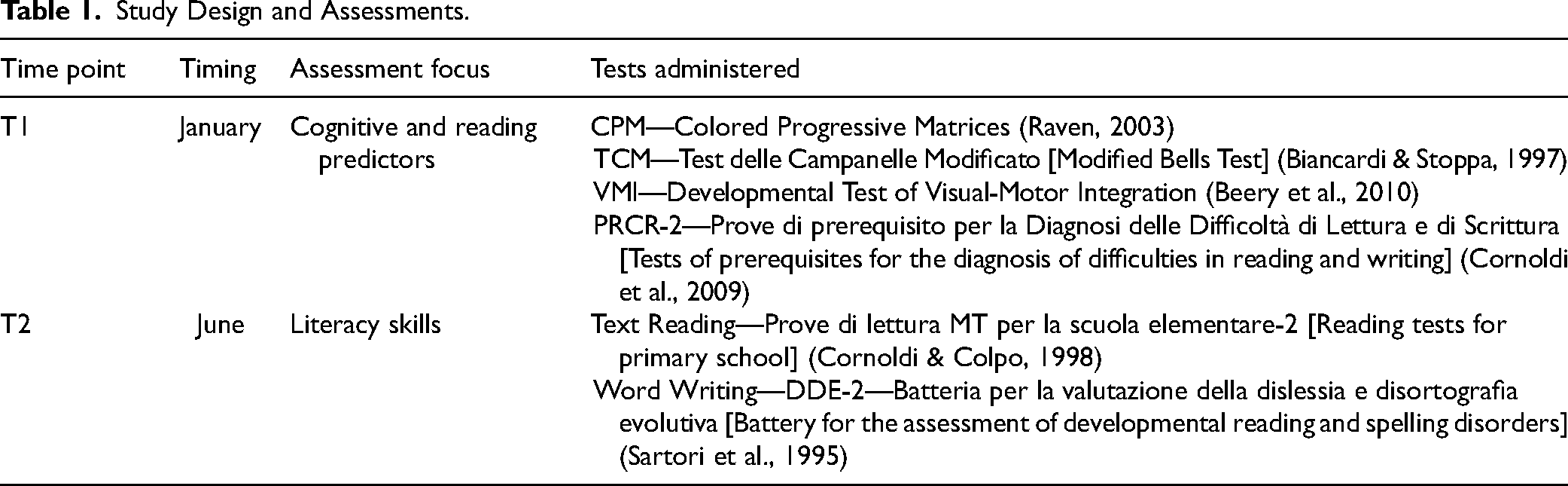
Most of the tests were administered individually, with the exception of the fluid intelligence, text comprehension, and writing (spelling) tasks, which were administered collectively. Tasks were administered in a pseudorandom manner (IQ, comprehension, and writing abilities were always assessed before the individual testing began). The individually administered tests were conducted in a 60-min session in a quiet room at the children's school, with breaks provided to avoid fatigue and ensure high-quality performance.
Tools
The assessment protocol included standardized cognitive-linguistic tests to evaluate IQ, literacy skills, visuo-spatial attention, and visual-motor integration skills (see Table 1 for an overview). Raw data from all tasks were converted to standardized scores (z-scores or standard scores) according to age and/or schooling, except for phonological awareness, which was expressed in percentiles.
A short description of the tests used at each time point is provided below.
T1
Colored Progressive Matrices
Fluid intelligence (Gf) was assessed using a nonverbal multiple-choice IQ test: the Raven's Colored Progressive Matrices (CPM; Raven, 2003). The CPM evaluates the ability to form perceptual relations and to problem solve by analogy, irrespective of culture, language, and formal schooling. The task was administered collectively, and the scores were converted using the normative data for collective administration (see Italian standardization of the booklet form; Belacchi et al., 2008). Test–retest reliability is typically reported as being between 0.80 and 0.90, indicating strong reliability. For instance, Cotton et al (2005) found an internal consistency of 0.89 (p < .001) and split-half reliability of 0.91 (p < .001) in their sample of primary-school children.
Test delle Campanelle Modificato
Visuo-spatial attention was measured through the Test delle Campanelle Modificato [Modified Bells Test] (Biancardi & Stoppa, 1997) barrage task. In this task, children are required to localize and quickly check the targets (i.e., images of bells) among distractors (i.e., familiar figures such as houses, horses). The stimuli are pseudo-randomly organized, and each sheet contained 35 targets.
Two types of z-scores are produced: the score given by the sum of the targets (bells) found in the first 30 s for each of the four sheets that compose the test (fast score), and the score obtained by counting the total number of targets found in 120 s (slow score). TCM shows good test–retest reliability, approximately 0.85 (p < .01), and internal consistency with values generally ranging from 0.75 (p < .05) to 0.85 (p < .01) (Biancardi & Stoppa, 1997).
Developmental Test of Visual-Motor Integration
The Developmental Test of Visual-Motor Integration (VMI; Beery et al., 2010) was used to assess how children integrated their visual and motor skills. During this paper-and-pencil task, the child was asked to copy a sequence of geometric shapes of increasing difficulty. The untimed task has to be hand-scored by the examiner: each correct reproduction of a geometrical shape is scored as 1 point. The administration included two supplemental tests: Visual Perception—VP and Motor Coordination—MC, which investigated visual analysis/visual-spatial ability and motor coordination, respectively. The interrater reliability of 0.92 (p < .01), internal consistency of 0.96 (p < .001), and test–retest reliability of 0.89 (p < .01) demonstrate the strong psychometric properties of the measure (Beery et al., 2010).
Prove di Prerequisito per la Diagnosi delle Difficoltà di Lettura e di Scrittura
The Prove di Prerequisito per la Diagnosi delle Difficoltà di Lettura e di Scrittura [Tests of prerequisites for the diagnosis of difficulties in reading and writing] (PRCR-2; Cornoldi et al., 2009) is one of the most widely used Italian tests for assessing literacy skills predictors in children. The battery allows for examining specific predictors of literacy abilities and the partial processes involved in reading/writing activities. The test investigates six areas: visual analysis, scanning from left to right, auditory discrimination and rhythm, sequential auditory memory and auditory fusion, visuo-auditory integration, and visual globality. In the current study, we examined the following areas:
Visual Analysis
- Test of the “semi-circles.” The task consists of three series of 10 cards on which are represented graphic symbols that vary in orientation and structure. The child is asked to look carefully at one item at a time, because after a few seconds the item will be covered, and they will have to reproduce it by drawing it on the response sheet that was given to them before. - Letter recognition. This test assesses visual analysis and spatial orientation. The child is asked to identify and check the letter equal to the target letter among a set of distractors. - Naming of objects (RAN of objects). This test evaluates the ability to move efficiently from left to right under optimal conditions of stimulus distinctiveness, linguistic competence, and the speed of naming objects. Drawings of 30 different objects are presented in rows of six. The child must name the objects following the direction from left to right and top to bottom. An error score, corresponding to the number of errors (omissions and inversions), and a speed score, corresponding to the time (in seconds) required to complete the test, are provided. - Naming of intertwined objects. Using the objects from the RAN of objects subtest, this test presents the objects in a slightly overlapping, intertwined format. It is a timed subtest that evaluates the correctness, the order of the fixations, and the visual-perceptual ability to distinguish the figure from the context-background. Error scores and speed scores are recorded. - Naming of pointed objects. This task uses the same objects as the previous subtests but arranged in two lines with dots above them. It measures the measures the child's ability to fixate on specific targets, while ignoring the distractors. The child is asked to name the targets (eight for each line), which are the objects that are placed under the dot. An error score and a speed score are assigned. - Visual search of two letters “B” and “L.” The barrage test consists of a matrix of 300 capital letters in which the target letters “B” and “L” are randomly distributed. The child is asked to cross out all the target letters they encounter, proceeding neatly from left to right and from top to bottom, without ever going back. The total number of errors and the time in seconds are taken into account. - Visual search of the letter sequence “TOC.” The test consists of a matrix of capital letters in which the TOC sequence appears several times in random order. The total number of errors and the time in seconds are taken into account. - Nonword repetition. The test involves phonemic discrimination and short-term memory of phonemes and meaningless words (i.e., nonwords). The child is instructed to listen carefully to the meaningless word spoken by the examiner and to repeat the stimuli exactly as they heard it, without modifying it in any way. The subtest is untimed. All the nonwords are repeated one by one. - Phonetic segmentation test. Phonological awareness was tested using an untimed measure that assesses the child's ability to segment words into their component sounds. The test consists of three parts: (a) identification of the first and last phoneme from a list of 10 pronounced words; (b) the score (Part 1 and Part 2); and (c) the proper phonetic segmentation in which the examiner orally presents words of three to four phonemes and the child is required to segment the word by pronouncing the individual phonemes in the exact sequence (Part 3).
Serial Scanning From Left to Right
Auditory Discrimination and Rhythm
The psychometric characteristics of PRCR-2 (Cornoldi et al., 2009) are adequate, with good reliability and concurrent and predictive validity coefficients. Specifically, reliability coefficients range between 0.61 (p < .05) and 0.89 (p < .001), and construct validity coefficients range between 0.19 (p < .05) and 0.35 (p < .01).
T2
At the second assessment time point, children’ literacy skills were evaluated using two different tasks:
Text Reading
Prove di Lettura MT per la Scuola Elementare-2 [Reading tests for primary school] (MT-2; Cornoldi & Colpo, 1998). This timed age-standardized text-reading task was used to measure ecological context reading. Participants are asked to read aloud—as fast as accurately as possible—a short text passage of 140 syllables. A text reading score is indexed by calculating the mean between the accuracy and fluency scores.
Word Writing
Batteria per la valutazione della dislessia e disortografia evolutive [Battery for the assessment of developmental reading and spelling disorders] (DDE-2; Sartori et al., 1995). Children are required to write (without any time limits) 48 words that vary in terms of orthographic complexity and frequency of use. This spelling task provides correctness scores, expressed as number of correct responses, in writing words.
Both the MT-2 and the DDE-2 batteries are widely recognized as gold-standard tools for assessing reading and spelling skills in the Italian population, as supported by the Consensus Conference for Learning Disorders (Associazione italiana dislessia, 2009; Lorusso et al., 2014). Both tools exhibit good test–retest reliability, with Spearman's Rho values of .56 (p < .05) and .97 (p < .001) for the MT-2 and DDE-2, respectively. Additionally, they demonstrate adequate construct validity, with Spearman's Rho values of .24 (p < .05) for the MT-2 and .39 (p < .05) for the DDE-2.
Results
Statistical Analysis
Statistical analysis was conducted using the SPSS (Statistical Package for Social Sciences; IBM), version 16.0. Based on the standardized scores obtained in the text reading task (Cornoldi & Colpo, 1998) and/or the writing task (Sartori et al., 1995) at T2 (i.e., at the end of the first year of primary school), the children were divided into two subgroups. The first group, named “Poor,” included children who scored lower than −1.5 SD from the expected value for their age and level of schooling in either or both tasks (n = 57). Children who did not meet this criterion were assigned to the “typically developing” (TD) group (n = 172).
Descriptive statistics of the participants’ background were presented in Table 2. The sample was adequately homogeneous in terms of six (112 males and 117 females) and age. Specifically, 25 females and 32 males were included in the “Poor” group, while 92 females and 80 males were included in the TD group. There were no significant differences between the two groups in terms of age (p = .89) and fluid intelligence (age: p = .89; IQ: p = .16). However, the literacy performance of the two groups differed significantly in both the text reading task and the writing test.
Descriptive Statistics of the Two Groups.
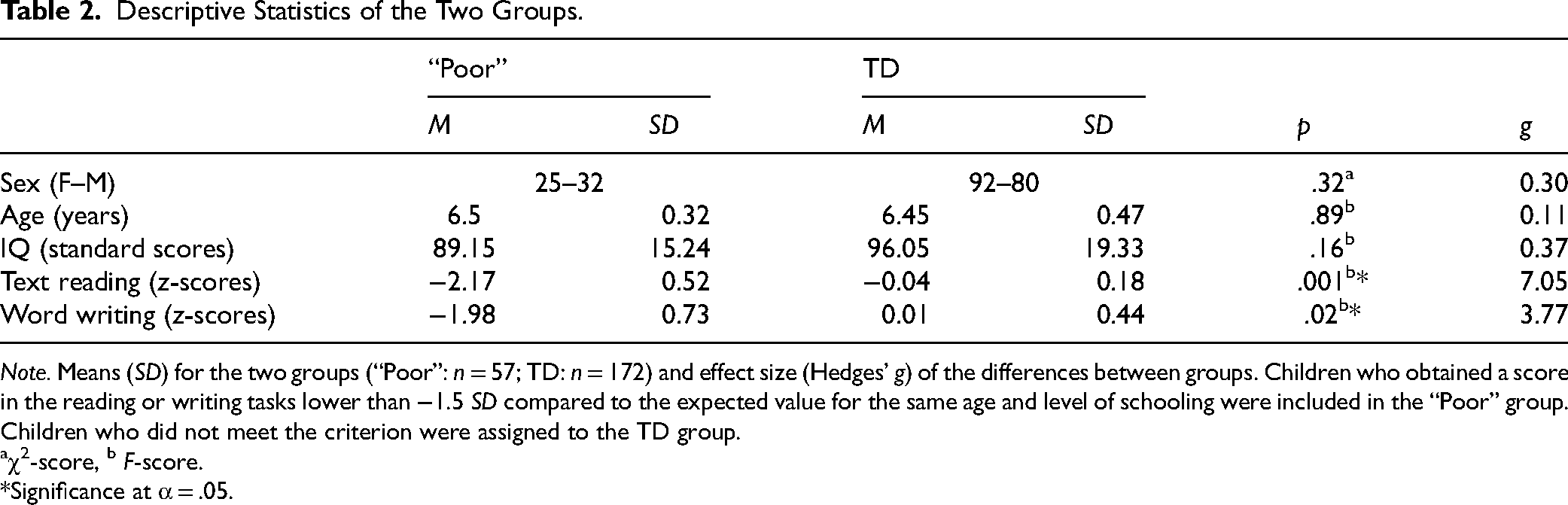
Note. Means (SD) for the two groups (“Poor”: n = 57; TD: n = 172) and effect size (Hedges’ g) of the differences between groups. Children who obtained a score in the reading or writing tasks lower than −1.5 SD compared to the expected value for the same age and level of schooling were included in the “Poor” group. Children who did not meet the criterion were assigned to the TD group.
χ2-score, b F-score.
*Significance at α = .05.
The following analyses were conducted to further explore the cognitive deficits at T1 in future poor readers or spellers and to predict reading abilities at T2 based on reading-related cognitive skills measured at T1. These analyses include t-tests for unpaired samples and hierarchical regression analyses, respectively, to identify key predictors and understand the development of literacy skills.
Cognitive Deficits at T1 in Future Poor Readers or Spellers
Using several t-tests for unpaired samples, differences in the performance on the tests administered at T1 (i.e., literacy predictors) between “Poor” and TD children were analyzed (see Table 3). The standardized scores (z-scores) were corrected according to Bonferroni's method for multiple comparisons (significance at <.05).
Performance at T1 for “Poor” and TD Children.
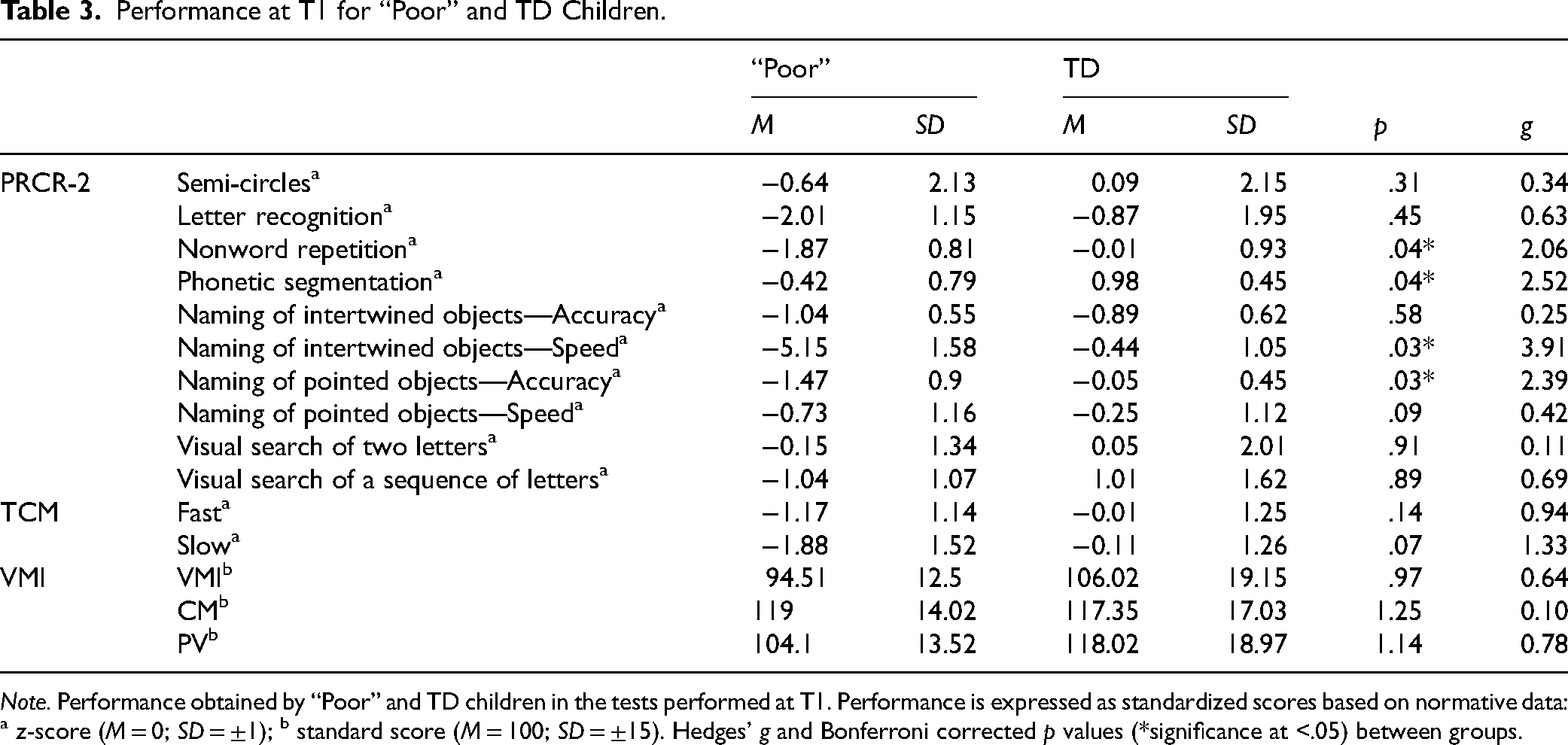
Note. Performance obtained by “Poor” and TD children in the tests performed at T1. Performance is expressed as standardized scores based on normative data: a z-score (M = 0; SD = ±1); b standard score (M = 100; SD = ±15). Hedges’ g and Bonferroni corrected p values (*significance at <.05) between groups.
The results highlighted which tests played a predominant role in distinguishing between “Poor” and TD readers/spellers. Specifically, the “Poor” group performed significantly lower than the TD group in the following subtests of PRCR-2: Phonetic segmentation (“Poor” M = −0.42, SD = 0.79; TD = 0.98, SD = 0.45, p = .04); Nonword repetition (“Poor” M = −1.87, SD = 0.81; TD = −0.01, SD = 0.93; p = .04); the Speed score of the Naming of intertwined objects (“Poor” M = −5.15, SD = 1.58; TD = −0.44, SD = 1.05, p = .03); the Accuracy score of the Naming of pointed objects (“Poor” M = −1.47, SD = 0.9; TD = −0.05, SD = 0.45, p = .03). In addition, there was a trend in the score for the speed of this test (“Poor” M = −0.73, SD = 1.16; TD = −0.25, SD = 1.12, p = .09). Indeed, the nonword repetition and the naming tasks require higher attention load (i.e., attentional control) than the phonetic segmentation task as they encompass the processes involved in active memory (Nonword repetition) and shifting between selective and divided attention (Naming).
Furthermore, although there was no statistically significant difference between the two groups, the results revealed a trend toward significance in the slow score of the barrage task (TCM_accuracy) (“Poor” M = −1.88, SD = 0.52; TD = −0.11, SD = 1.26, p = .07).
Predicting Reading at T2 From Reading-Related Cognitive Skills at T1
Since we demonstrated that “Poor” children at T1 already showed deficits in attentional control and phonological awareness skills, we further explored the possible link between children's performance in the cognitive tasks administered at T1 (i.e., mid-first year) and the literacy skills at T2 (i.e., the end of the first grade) across our entire sample of children (N = 239), regardless of our a priori group classification of being at risk of a reading/spelling disorder.
Two separate hierarchical regression analyses were performed of each dependent variable (text reading and word writing) to investigate whether cognitive skills measured at T1 influenced later reading and spelling performances.
In the first step, age and IQ were included to control for possible confounding effects. In the second step, Nonword repetition and Phonetic segmentation were added. These two subtests of the PRCR-2 were introduced with the aim to detect the contribution to later literacy performance of the phonological awareness skills. The Nonword repetition task is also a short-term memory measure. In the third step, Naming of intertwined objects and Naming of pointed object were added to assess the effects of rapid lexical retrieval, processing speed, and the ability to separate target objects from distractors in challenging perceptual situations (i.e., overlapping images of objects).
The two hierarchical regression analyses, using the scores of the PRCR-2 as the independent variables and text reading and word writing as the dependent variables, led to the following results (see Table 4). For text reading, none of the demographic variables significantly predicted reading performance at T2, F(2, 236) = 2.011, p = .471, r2 = .009. This indicates that controlling for gender and IQ did not alter the relationships between the variables of interest. Phonological awareness skills at T1 uniquely explained 9% of the variance in text reading, F(4, 234) = 4.754, p < .001, ΔR2 = .101. The change in R2 was significant, F(1, 234) = 15.86, p < .001. Specifically, performance on the Nonword repetition subtest made a greater contribution to the prediction (p = .001) than the Phonetic segmentation task (p = .038). Adding the scores on Naming of intertwined objects and Naming of pointed objects to the regression model explained an additional 25% of the variance, F(6, 232) = 9.573, p < .001, ΔR2 = .149; this change in R2 was significant, F(2, 232) = 12.471, p < .01. Specifically, both subtests significantly contributed to the model (p = .045 and p < .001, respectively).
Hierarchical Regression Analysis.
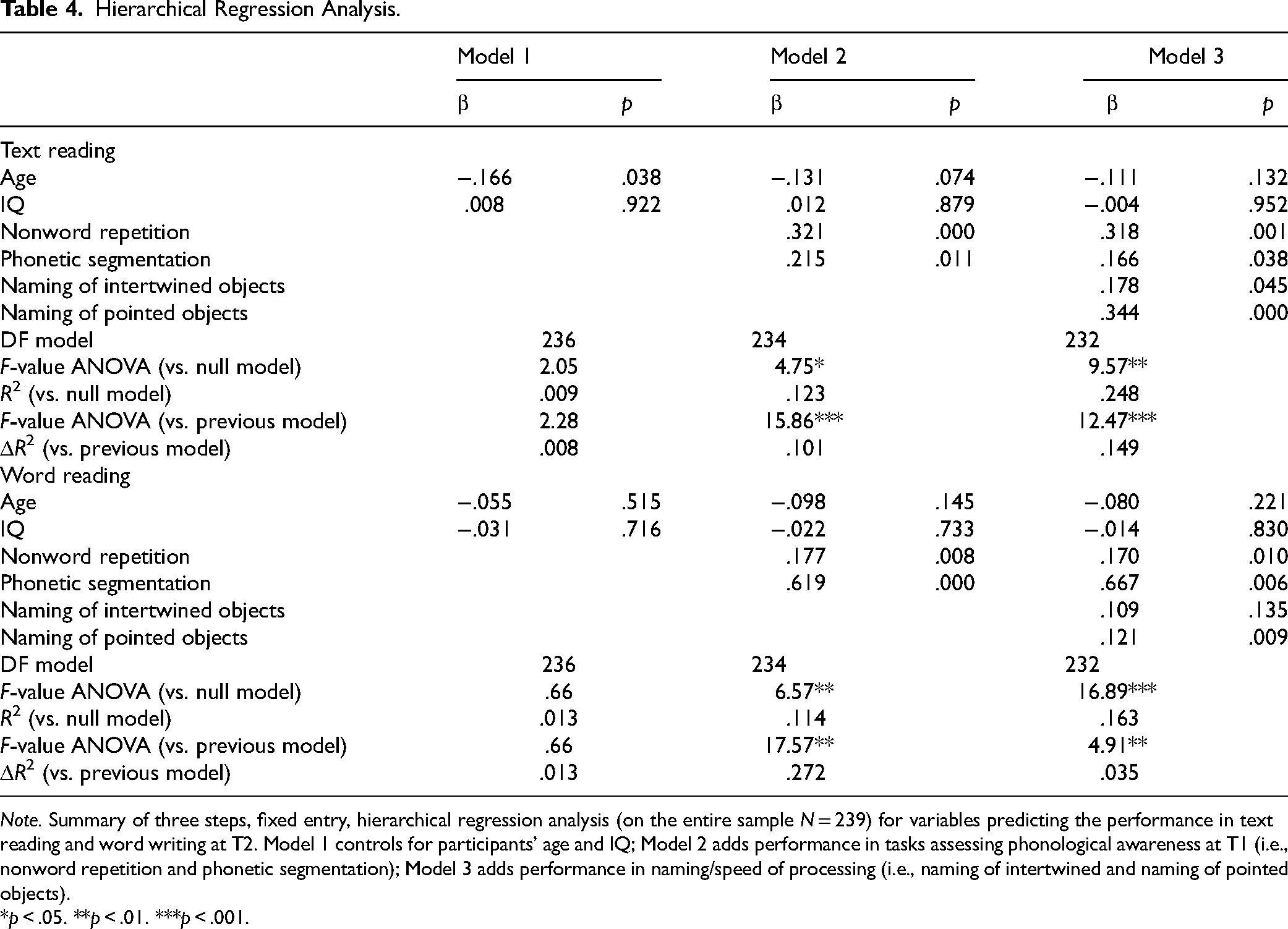
Note. Summary of three steps, fixed entry, hierarchical regression analysis (on the entire sample N = 239) for variables predicting the performance in text reading and word writing at T2. Model 1 controls for participants’ age and IQ; Model 2 adds performance in tasks assessing phonological awareness at T1 (i.e., nonword repetition and phonetic segmentation); Model 3 adds performance in naming/speed of processing (i.e., naming of intertwined and naming of pointed objects).
*p < .05. **p < .01. ***p < .001.
For word writing, the regression analyses showed that IQ and age, introduced as control variables in the first step, accounted for a nonsignificant proportion of the explained variance, F(2, 236) = 0.661, p = .851, r2 = .009. Phonological awareness skills at T1 explained 11% of variance, F(4, 234) = 6.572, p < .001, ΔR2 = .272, and this model provided a better fit of the data, F(1, 234) = 17.574, p < .001. In particular, both scores contributed equally to the prediction (Phonetic segmentation: p = .006; Nonword repetition: p = .010). Finally, the addition to the regression model of the scores in the tests assessing naming and attentional capacities explained an additional 16% of variance, F(6, 232) = 16.892, p < .001, ΔR2 = .035. This change in R2 was significant, F(2, 232) = 4.92, p < .01. Important, only performance on the Naming of pointed objects test made a significant contribution to the prediction (p = .009), whereas performance on Naming of intertwined objects did not (p = .135).
These results indicate that in novice readers, the ability to read and write efficiently depends on the ability to manipulate sounds of the language, rapidly access the lexicon, and flexibly allocate attention (i.e., processing speed) that the child exhibited one year earlier.
Discussion
Learning to read is a complex process that is accomplished earlier and more easily in transparent orthographies, such as Italian, with highly consistent letter-sound correspondences compared to opaque orthographies characterized by a high percentage of irregular and inconsistent spellings (Seymour, 2005; Ziegler & Goswami, 2005). Since the level of orthographic transparency has been demonstrated to influence the acquisition of the written language and to modulate the expression of the learning disorders, in this study we investigated which early language and cognitive markers better discriminate between poor readers/spellers and typically developing peers. For this reason, two groups of children were formed on the basis of their performance on text reading and writing tasks at the end of first grade. Additionally, we examined the existence of specific predictive paths between reading-related capacities and literacy skills among Italian-speaking children at T1.
In line with existing studies on literacy predictors (Lyytinen et al., 2017; Schatschneider et al., 2004; Torppa et al., 2010), our findings revealed a consistent pattern of domain-specific deficits in children who were later identified as poor readers/spellers. In particular, typically developing children outperformed “Poor” children on two tasks assessing phonological awareness skills: Phonetic segmentation and Nonword repetition. Notably, the Nonword repetition test also involves a high load of executive resources since it requires an efficient mechanism of short-term memory of phonemes and meaningless words. We also demonstrated that “Poor” children in Grade 1 already showed a deficit in visual-to-phonological mapping skills (RAN), as well as serial visual search and visuospatial attentional control at T1. Specifically, future poor readers and spellers performed significantly lower on the Naming of intertwined objects and Naming of pointed objects tasks administered at the beginning of formal literacy instruction. These findings indicated that not only language-specific but also domain-general cognitive abilities were impaired prior to the development of inefficient literacy skills. Moreover, the causal role of these skills in emerging literacy abilities was confirmed by the results of the multiple regression analysis run on the entire sample, regardless of any a priori classification of the future difficulties in reading and writing. Both performance on phonological tasks (Phonetic segmentation and Nonword repetition) and tasks requiring efficient attentional control mechanisms was found to be related to the onset of literacy difficulties. Interestingly, the skills related to the rapid and efficient orienting of attention while inhibiting distractors (as assessed by the Naming of intertwined objects and Naming of pointed objects tasks) appeared to be the crucial ones in predicting performance on the literacy tasks, whereas the mere naming task (RAN of objects) was not significant. In fact, the analysis of Step 1 (phonological skills) and Step 2 (naming and attentional control) of the regression models revealed a fundamental result: after accounting for the effect of phonological skills on future reading and writing abilities (9% and 11% of the variance, respectively), attentional control variables explained a significantly larger portion of the variance in future reading skills (25%) compared to phonological skills. Additionally, they explained a similar portion of the variance in future writing skills (16%). These results confirm recent longitudinal studies suggesting the importance of domain-general mechanisms, particularly attentional control, as predictors for future literacy skills (Burgoyne et al., 2019; Franceschini et al., 2012; Peng et al., 2019; Tobia & Marzocchi, 2014).
Moreover, the presence of risk factors common to reading and spelling disorders is in line with what was introduced by the Diagnostic and Statistical Manual of Mental Disorders, fifth edition (DSM-5A; American Psychiatric Association, 2013), which eliminated distinct labels for each type of learning disorder in favor of a single diagnostic category called specific learning disorder (SLD). This multidimensional approach emphasizes the existence of more general dimensions that are transversal to different diagnostic categories, particularly dyslexia and dysorthographia. Recognizing the role of other cognitive factors in literacy acquisition is consistent with a growing number of studies showing higher global deficits in higher-order cognitive mechanisms in individuals with reading and spelling difficulties, particularly when there is a deficit in decoding (Lallier et al., 2013; Menghini et al., 2010; Moll et al., 2016; Peterson & Pennington, 2012; Varvara et al., 2014).
Literacy skills involve numerous processes, making it difficult to identify a single indicator that predicts the onset of an SLD in isolation. As stated by Rakhlin et al (2014): “Despite their fundamental role, phonological skills are clearly not sufficient for the development of fluent reading and accurate spelling” (p. 2).
In conclusion, adopting a multifactorial probabilistic model of SLD does not diminish the fundamental role played by domain-specific deficits in the aetiology of this disorder, but rather provides the opportunity to develop and validate effective educational curricula and intervention protocols. Understanding how at-risk children's early literacy capacities develop in each language and the factors explaining this development is crucial for clinicians and educators by providing insights into effective reading readiness programs (Ziegler et al., 2020).
Limitations
The following limitations of the current study bear mentioning. First, the assessment battery administered at T2 was limited to two tasks (i.e., text reading and word writing). A more in-depth characterization of the reading and spelling profile of the participants would require other standardized tests. However, our assumption was that text reading should be considered the most ecologically valid task, since it not only requires word-level decoding and lexical strategies but also semantic and syntactic processes.
Second, a major limitation of the study was that cognitive predictors were assessed only once at study onset. This design choice precluded the identification of potential interactive relations between cognitive skills and reading development over time. Longitudinal data would provide a more dynamic understanding of how these predictors influence literacy acquisition.
Finally, the generalizability of the results is subject to certain limitations since our sample comprised only Italian-speaking first graders. Therefore, our findings can be generalized specifically to the language under investigation and, possibly, to other languages with similar consistent orthography. Although we hypothesize that our findings may be generalized to text reading in different orthographies, the influence of each predictor would likely vary with the transparency of the alphabetic system.
Footnotes
Acknowledgments
We thank the schools and children for their participation, as well as the clinical psychologists of the ODFLAB of the University of Trento.
Consent to Participate
Informed consent was obtained by parents prior to participation to the study.
Consent for Publication
Parents provided written informed consent for the publication of any associated data and accompanying images.
Data Availability Statement
The data that support the findings of this study are available from the corresponding author upon reasonable request.
Declaration of Conflicting Interests
The author(s) declared no potential conflicts of interest with respect to the research, authorship, and/or publication of this article.
Ethical Approval
The University of Trento Ethics Committee approved the study, and the entire research was carried out in accordance with the principles of the Declaration of Helsinki.
Funding
The author(s) received no financial support for the research, authorship, and/or publication of this article.
