




Abstract
This article critically reviews the UN Strategy and Guidance on Hate Speech as examples of practice and uses them as a springboard to engage with the current legal framework. In doing so, it considers not only international human rights law but the related fields of international criminal and humanitarian law. Building upon the UN Strategy and Guidance, whilst also informed by their shortcomings, the article offers a definition and typology of ‘hate speech’ firmly rooted in the rigours of the rules of interpretation, as crystallised in the Vienna Convention on the Law of Treaties. The law-based approach ensures more transparency, certainty, and predictability of the law of free speech and its limitations. As such, it should also garner the support of more States, the primary duty-holders in international human rights law and lead to a more holistic approach to countering ‘hate speech’, thus achieving the aims of the UN Strategy.
Keywords
INTRODUCTION
There has been a flurry of activity in the UN aimed at addressing the phenomenon of ‘hate speech.’ 1 The publication of the 2019 ‘UN Strategy and Plan of Action on Hate Speech’ (UN Strategy) responded to the ‘alarming trends of growing xenophobia, racism and intolerance, violent misogyny, anti-Semitism and anti-Muslim hatred around the world’. 2 To ensure its effective roll-out, the UN issued the ‘Detailed Guidance on Implementation for United Nations Field Presences’ (Guidance) a year later. 3 In so doing, the UN committed to coordinating global and domestic efforts to counter ‘hate speech’ by supporting the work of UN missions in the field.
As UN policy documents, both the UN Strategy and Guidance are welcome additions to the debate on and understanding of the phenomenon of ‘hate speech’. They help develop institutional capacity within UN missions, as well as assist States and other stakeholders in crafting responses to the human rights challenges posed by ‘hate speech’. 4
Both the UN Strategy and Guidance provide a broad definition of ‘hate speech’ that encompasses all instances of ‘lawful’ and ‘unlawful hate speech’. 5 The Guidance also builds on the work of the non-governmental organisation ARTICLE 19's ‘hate speech’ pyramid, which categorises ‘hate speech’ into three levels: the top level, intermediate level, and bottom level of the pyramid. 6 The Guidance then applies the test set forth in the UN Office of the High Commissioner for Human Rights (OHCHR)'s Rabat Plan of Action on ‘the prohibition of advocacy of national, racial or religious hatred that constitutes incitement to discrimination, hostility or violence’ (‘Rabat Test’ and ‘Rabat Plan of Action’, respectively) to assess the severity of such ‘hate speech’. 7 The Rabat Plan of Action is a compilation of the conclusions reached at a series of regional expert workshops, organised in 2011 by the OHCHR, focusing on religious discrimination in the context of the prohibition of advocacy of national, racial, or religious hatred that constitutes incitement to discrimination, hostility, or violence, as set forth in Article 20(2) of the International Covenant on Civil and Political Rights (ICCPR). 8 According to the Guidance, the Rabat Test should help distinguish ‘unlawful hate speech’ that may require a criminal sanction (generally corresponding to the top level of the ‘hate speech’ pyramid), from ‘unlawful hate speech’ that may deserve a civil or administrative law sanction (generally corresponding to the intermediate level of the ‘hate speech’ pyramid), and ‘lawful hate speech,’ which is protected as free speech (corresponding to the bottom level of the ‘hate speech’ pyramid). 9
This article discusses the current law and practice of countering ‘hate speech’. It reviews the UN Strategy and Guidance as examples of practice, and uses them as a springboard to engage with the current legal framework on how to effectively counter ‘hate speech’. In doing so, the article considers not only international human rights law but the related fields of international criminal and humanitarian law. Building on the UN Strategy and Guidance, whilst informed by their shortcomings, the article offers both a definition and typology of ‘hate speech’ which is firmly rooted in the rigours of the rules of interpretation as crystallised in the Vienna Convention on the Law of Treaties (Vienna Convention). 10 In conclusion, it proposes returning Article 19(3) of the ICCPR—the law on permissible restrictions to free speech—to its rightful place, that is, back at the centre of this discussion.
Some may wonder why the UN Strategy and Guidance need be legally scrutinised, given that they are clearly framed as policy documents, and the Guidance is specifically intended for internal use within UN missions. This article counter-argues that the UN does not operate in a vacuum. UN missions engage directly with States and civil society. 11 Indeed, one of the Guidance's stated commitments is specifically to support UN Member States. 12 The stance UN missions take will thus contribute to the national (and international) discussion on what constitutes ‘hate speech’.
Furthermore, as UN policy documents currently being implemented in the field, they may also play a role in the formation of State practice – one of the elements of customary international law and a factor to consider in the contextual and systemic interpretation of treaties. 13 Depending on their quality, the extent to which they seek to state existing law, and their reception by States, among other factors, the UN Strategy and Guidance may shed light on the existence and content of (emerging) norms on ‘hate speech’. 14 Hence why, in spite of their being policy documents, it is opportune to embark on this inquiry.
‘LAWFUL HATE SPEECH’, ‘UNLAWFUL HATE SPEECH’ AND THE ‘HATE SPEECH’ PYRAMID
As a preliminary, it should be noted that this article uses the term ‘hate speech’ in the same way it is used in the UN Strategy and as interpreted in the Guidance—to cover all instances of ‘lawful hate speech’ and ‘unlawful hate speech.’ 15 Their inter-relationship is represented below, in Figure 1. 16 Incitement, which will also be discussed below, is a subset of the broader category of ‘unlawful hate speech’.
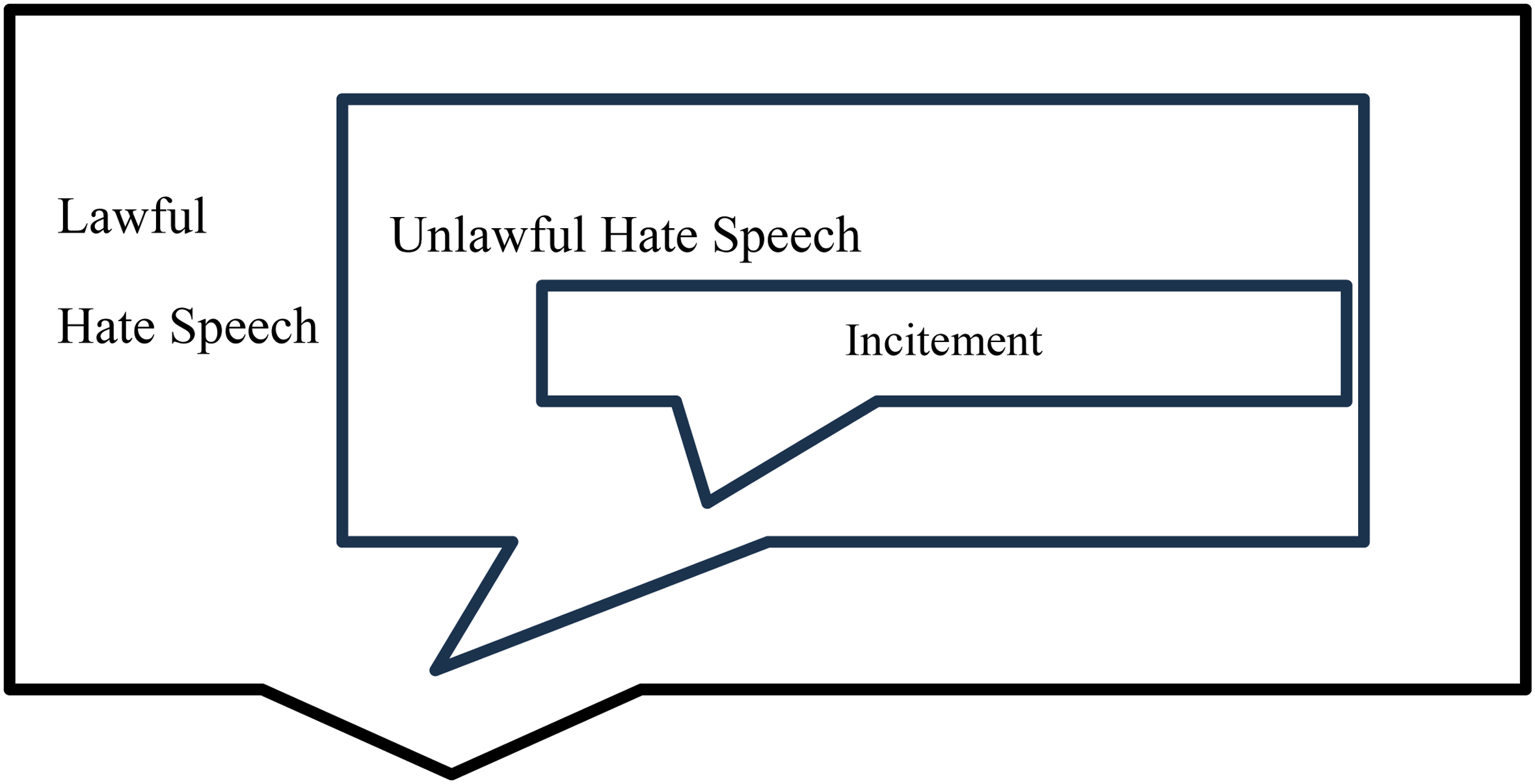
‘Hate speech’.
In line with the Guidance, the term ‘unlawful hate speech’ covers all instances of ‘hate speech’ that may or should be prohibited under international law. 17 Conversely, the term ‘lawful hate speech’ is used to cover instances of ‘hate speech’ which, though of concern in terms of tolerance, are ‘merely’ offensive, shocking, or disturbing and are protected as free speech (and not subject to legal limitations). 18 Such instances may still need to be countered by less intrusive measures, such as national policies, strategies, or education aimed to promote tolerance in society. 19 Examples of what the Guidance considers ‘unlawful hate speech’ and ‘lawful hate speech’ are further discussed below.
The Guidance also reclassifies ‘unlawful hate speech’ and ‘lawful hate speech’ into a ‘hate speech pyramid’, according to its severity. For ease of reference, the diagram depicting this pyramid is reproduced in Figure 2 below. 20
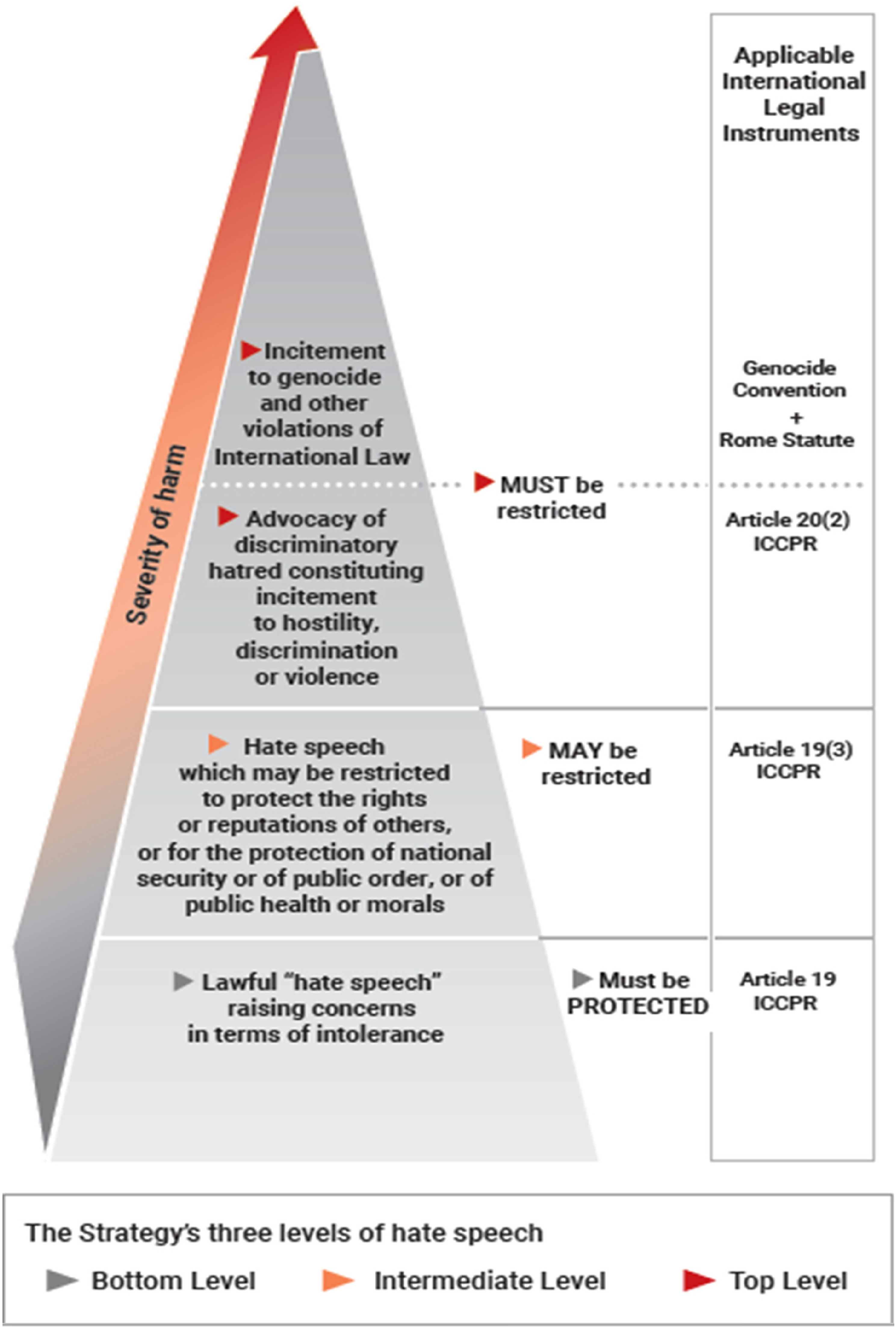
The ‘hate speech’ pyramid.
To maintain clarity in this discussion, the article follows the structure of the ‘hate speech’ pyramid, systematically addressing each speech act mentioned, starting from the top of the pyramid and working its way down. It also elaborates on the speech acts listed in Article 4 of the International Convention on the Elimination of all forms of Racial Discrimination (ICERD), which the Guidance classifies at the top level of the ‘hate speech’ pyramid, but which are omitted in its figures and tables (see, for example, Figure 2 and the Annex). 21 When reference is made to specific forms of ‘unlawful hate speech’, the article relies on the terminology of the law as laid down in Articles 19–20 of the ICCPR and Article 4 of the ICERD—propaganda, advocacy, incitement, and dissemination. Because of the breadth of the discussion, covering ICCPR, ICERD, and relevant international criminal and humanitarian law treaties or customary law, this article excludes an analysis of the regional human rights frameworks. 22 Nonetheless, reference is made to some of the jurisprudence of the European Court of Human Rights (ECtHR), where pertinent.
The aim of the UN Strategy is to mobilise States and other stakeholders (including the UN itself) to take effective measures in addressing the worldwide surge in ‘hate speech’, considered to be ‘a menace to democratic values, social stability, and peace’.
23
It thus commits to, amongst others, monitoring and analysing ‘hate speech’.
24
In taking a multi-disciplinary approach to countering ‘hate speech’, the UN Strategy defines it broadly to cover any kind of communication in speech, writing or behaviour, that attacks or uses pejorative or discriminatory language with reference to a person or a group on the basis of who they are, in other words, based on their religion, ethnicity, nationality, race, colour, descent, gender or other identity factor.
25
One plausible explanation for this broad definition is that human rights treaty bodies have interpreted these protected characteristics (or grounds of discrimination) contextually, reading Article 20(2) of the ICCPR in light of the general prohibition against discrimination set forth in Articles 2(1), 3 and 26 of the ICCPR. 29 Therefore, the Guidance incorporates a list of identity factors, encompassing not only nationality, race, or religion, but also colour, sex, language, political or other opinion, national or social origin, property, birth, or other status’. 30 Similarly, for instance, the ECtHR – which routinely adopts the evolutive interpretation or ‘living instrument’ approach in its judgments – has held that discrimination based on, for instance, sexual orientation, is as serious as discrimination based on race, origin, or colour, and, therefore, also a protected ground. 31
The counter-argument to the contextual interpretation and, the author submits, the stronger argument is that, in the specific case of Article 20(2) of the ICCPR, which lays down an exception to the right to freedom of expression, what qualifies as ‘hate speech’ based on grounds of discrimination must be interpreted restrictively. This is in line with general rules of interpretation and the ultimate purpose of the ICCPR, which equally upholds the interdependent rights of freedom of expression and freedom not to be discriminated against—values that both the UN Strategy and Guidance seek to protect. 32 In other words, while protecting the right of victims of ‘hate speech’ not to be discriminated against, the law is restricting the speaker's right to freedom of expression. A delicate balancing of rights is thus called for, and an extensive interpretation of Article 20(2) – the exception – would jeopardise this balance. The consequences of this will be more fully discussed below, in the context of the related Article 19(3) of the ICCPR. 33
Turning to the other relevant provision of international human rights law, Article 4 of ICERD stipulates, in relevant part, that States:
Shall declare an offence punishable by law all dissemination of ideas based on racial superiority or hatred, incitement to racial discrimination, as well as all acts of violence or incitement to such acts against any race or group of persons of another colour or ethnic origin, and also the provision of any assistance to racist activities, including the financing thereof; Shall declare illegal and prohibit organizations, and also organized and all other propaganda activities, which promote and incite racial discrimination, and shall recognize participation in such organizations or activities as an offence punishable by law; Shall not permit public authorities or public institutions, national or local, to promote or incite racial discrimination.
34
Article 4 thus prohibits, inter alia, ‘incitement to racial discrimination’ and ‘incitement to racial violence’ but not incitement to hostility. It is also solely focused on preventing and countering ‘hate speech’ (and other acts) based on race, as defined under Article 1 of the ICERD, to cover colour, descent, or national, or ethnic, origin. While, like the ICCPR, the ICERD's definition of race covers nationality, unlike the ICCPR, it excludes religion. From a legal point of view, the UN Strategy's generic choice of language, ‘incitement to discrimination, hostility and violence’, as just shown, is imprecise.
In an attempt to provide clarification, the Guidance explicitly notes that the definition of ‘hate speech’ in the UN Strategy is not a legal one. Instead, the Guidance rationalises it by interpreting ‘hate speech’ so as to cover both ‘lawful’ and ‘unlawful hate speech'. The Guidance also restates the main provisions on incitement in international human rights law, clearly citing relevant treaties, such as the ICCPR, the Convention on the Prevention and Punishment of the Crime of Genocide (Genocide Convention) and the Rome Statute of the International Criminal Court (Rome Statute). Figure 3 shows the similarities and differences of the treaties’ provisions on ‘unlawful hate speech’, including on incitement.
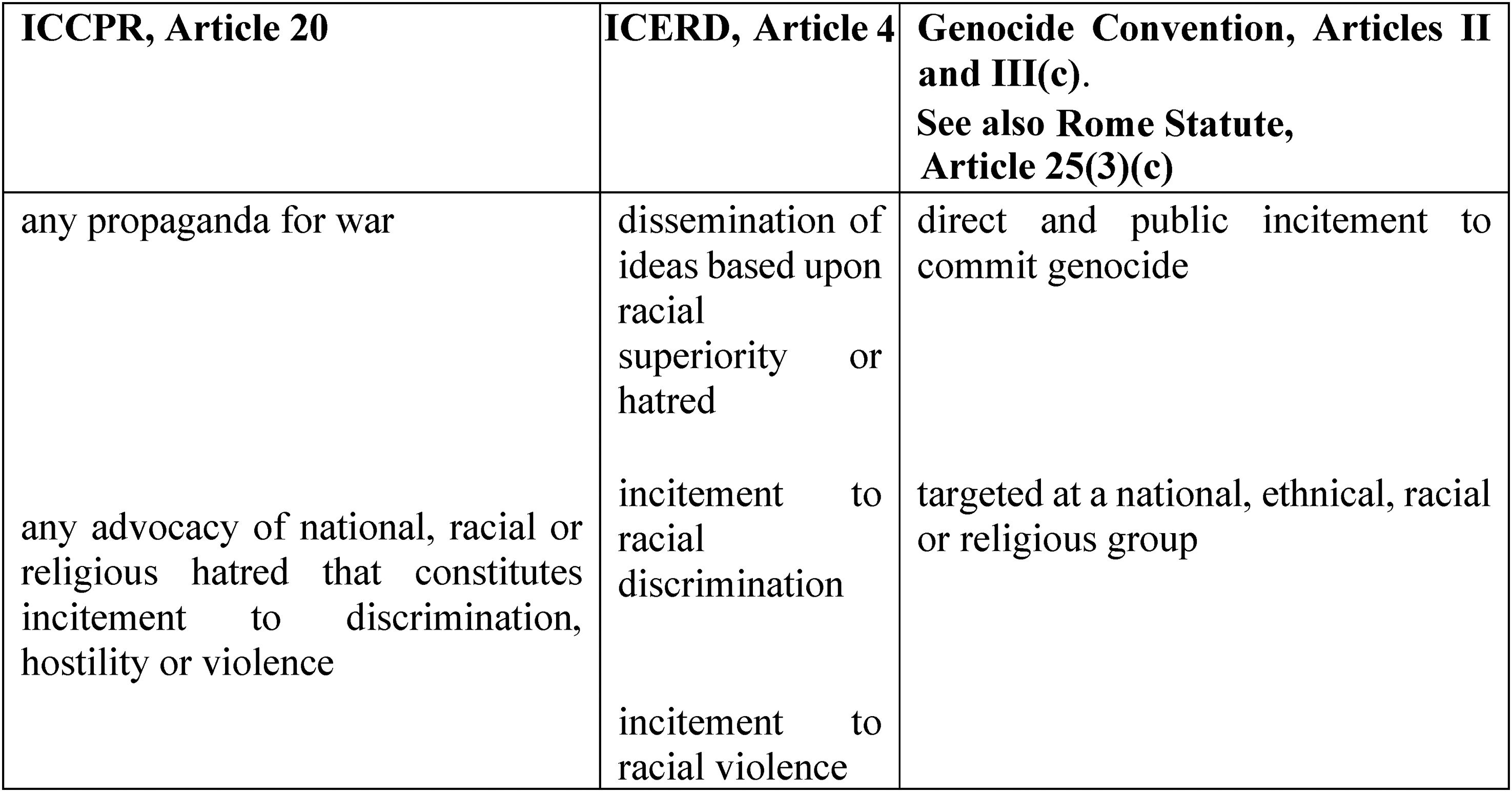
Comparing the ICCPR, the ICERD, and the Genocide Convention on ‘unlawful hate speech’.
Compared to the UN Strategy, the Guidance delves deeper and distinguishes between three categories of ‘hate speech’ according to their severity, which, it contends, are all covered by the UN Strategy. 35 To do this, it relies on the ‘hate speech’ pyramid (Figure 2). 36 It is of note that ARTICLE 19's ‘hate speech’ pyramid was informed by its own policy work in the field and it was also influenced by suggestions made by the UN Special Rapporteur on Freedom of Opinion and Expression. 37
Under the rubric of ‘unlawful hate speech’, the Guidance differentiates between the more severe instances of ‘unlawful hate speech’ requiring criminal sanction (and possibly civil or administrative ones) which are at the top of the pyramid, the less severe cases requiring ‘legal restrictions’, whatever that may be, which are at the intermediate level, and those which are the least grave, and are protected as ‘lawful hate speech’, at the lower level of the pyramid. 38 This is reproduced in the Annex. The Guidance seemingly implies that the severity of the sanction ‘unlawful speech acts’ attract is somehow dependent on the potential gravity of the harm they (may) cause. This is a reasonable inference.
Most of the Guidance is on the ‘hate speech’ pyramid classification which addresses the criminal law sanction only in the context of the top level of the ‘hate speech’ pyramid, and not when the intermediate or bottom levels of the ‘hate speech’ pyramid are considered. 39 It is unclear, on its face, if the intermediate level of the ‘hate speech’ pyramid also covers the use of criminal sanctions. 40 While in one part, the Guidance states that the criminal law sanction is only to be used if the speech acts meet the Rabat Test, its Table 1 (see the Annex) is ambiguous and could be read otherwise. 41
Reserving the top level of the ‘hate speech’ pyramid for the toughest sanction—the use of the criminal law, would be in line with the views of UN treaty bodies, special procedures, and the recommendations made in the Rabat Plan of Action. 42 The latter stresses that only the gravest forms of advocacy of national, racial, or religious hatred that constitute incitement to discrimination, hostility, or violence should attract a criminal sanction. 43 The less grave forms are to be sanctioned by civil or administrative law, or by measures other than legislative. 44
However, for practitioners, it is difficult to contemplate when, for instance, direct and public incitement to genocide would not warrant a criminal sanction (a possibility allowed for in the Guidance), especially as it is penalised under international criminal law, as will be discussed in the next section. 45 It is also unclear why the Rabat Test should be applied at all. Not penalising it would contravene the rules of international criminal law, the lex specialis, 46 which aim to combat impunity for perpetrators of international crimes, including the crime of direct and public incitement to genocide.
A similar issue arises with regard to ‘advocacy of hatred constituting incitement to discrimination, hostility or violence’, because the Guidance also states that ‘less grave forms’ (of such advocacy) should not be sanctioned by criminal law. 47 First, the Guidance defines ‘advocacy’ as requiring ‘an intention to promote hatred publicly towards the target group’ and ‘incitement’ as creating ‘an imminent risk of discrimination, hostility or violence against persons belonging to targeted groups’. 48 This appears to be in line with the UN Special Rapporteur's definition of these terms. 49 Second, a plain reading of the terms ‘advocacy’ and ‘incitement’ indicates that they require intent, even if the intent as to the ensuing consequences (‘advocacy of hatred’ versus ‘incitement to discrimination, hostility or violence’) differs. 50 Intent refers to a person's state of mind with which they knowingly act or fail to do something. 51 In light of both the doctrinal definitions and ordinary meanings of ‘advocacy’ and ‘incitement’, there is a strong argument that there cannot, in practice, be any circumstances in which advocacy of hatred constituting incitement to discrimination, hostility, or violence is not criminalised.
In conclusion, while, in theory, the use of the ‘hate speech’ pyramid and the Rabat Test to assess the gravity of ‘hate speech’ appears reasonable, the practical application of these tools is complicated. Why would one build a pyramid, to then take it down, block by block, by applying the Rabat Test? The Guidance leaves these questions unanswered. The author opines that, if circumstances arise in which there is unintentional direct and public incitement to commit genocide or advocacy of hatred constituting incitement with no intent, one cannot legally speak of direct and public incitement to genocide, nor of advocacy of hatred constituting incitement to discrimination, hostility, or violence.
The article now turns to critically reviewing each category of the ‘hate speech’ pyramid and the speech acts that, according to the Guidance, fall under them.
According to this typology, the top level of the pyramid, the most serious category of ‘hate speech’, covers direct and public incitement to commit genocide, 52 and any advocacy of national, racial, or religious hatred that constitutes incitement to discrimination, hostility, or violence. 53 It also covers the speech acts laid down in Article 4 of the ICERD which include dissemination of ideas based on racial superiority or hatred, incitement to racial discrimination, and incitement to acts of violence against any race, or group of persons of another colour or ethnic origin (collectively ‘Article 4 Speech Acts’). 54 As the Guidance itself acknowledges, it adopts verbatim the typology first suggested by ARTICLE 19. 55
DIRECT AND PUBLIC INCITEMENT TO COMMIT GENOCIDE—AND INCITING CRIMES AGAINST HUMANITY, AND ORDERING WAR CRIMES?
Public and direct incitement to commit genocide is, indeed, one of the most serious forms of ‘hate speech’, and an international crime codified in, amongst others, the Genocide Convention. 56 The legal requirements for this crime are that the speaker must directly and publicly incite the commission of genocide and have the intent to directly prompt or provoke other persons to commit genocide. 57 International criminal tribunals have noted that what is required is specifically urging another person to take immediate criminal action, rather than merely making a vague or indirect suggestion. 58
Yet, this is not the only speech act that is prohibited under international criminal law and which could fall under this top level of the ‘hate speech’ pyramid. Incitement to violence or incitement to commit crimes as a form of persecution, a crime against humanity, is also prohibited in international criminal law. 59 Such incitement (when coupled with other legal requirements) has, on occasion, been found to be a means through which persecution as a crime against humanity was committed. 60 The crime of persecution involves the denial of fundamental rights contrary to international law by reason of the identity of the group. 61 Put in criminal law parlance, incitement to violence may constitute the actus reus of the crime against humanity of persecution. 62
Similarly, ordering—which often takes the form of speech—the commission of any of the grave breaches of the four Geneva Conventions and their Additional Protocol I, is also punishable in international criminal law as a mode of liability. When such orders target protected persons under international humanitarian law based on their identity (as was the case in the 1990s conflicts in the Former Yugoslavia and in Rwanda), they may also qualify as ‘unlawful hate speech’. 63 Thus, the fact that these speech acts also amount to international crimes under various international treaties and/or customary international law renders them all the more egregious. The author is therefore of the view that these speech acts are comparable in gravity to those listed at the top level of this pyramid and should be considered as grave. Practitioners must be aware that, though they are not explicitly included in the ‘hate speech’ pyramid, they are equally serious.
ADVOCACY OF NATIONAL, RACIAL OR RELIGIOUS HATRED THAT CONSTITUTES INCITEMENT TO DISCRIMINATION, HOSTILITY OR VIOLENCE
Given the attention it has garnered in recent years, it was to be expected that the Guidance would highlight the prohibition of ‘any advocacy of national, racial or religious hatred that constitutes incitement to discrimination, hostility or violence’, set forth in Article 20(2) of the ICCPR. The wording of this provision is somewhat convoluted: it reads ‘[a]ny advocacy of national, racial or religious hatred that constitutes incitement to discrimination, hostility or violence shall be prohibited by law’.
The Human Rights Committee (CCPR)'s case law on this provision is scant. Indeed, a number of more recent communications before the CCPR that would have been pertinent have been decided on the basis of other provisions, or considered inadmissible. This prevents any substantive contribution to the discussion on what kind of speech act constitutes this prohibition in practice. 64 Most CCPR decisions relate to Article 19(3), rather than Article 20(2). 65 This may be why the Guidance relies extensively on the work of non-governmental organisations and the Rabat Plan of Action. In this regard, it is noted that the definition of both advocacy and incitement provided in the Guidance is persuasive. 66 Yet, there are issues which continue to surface and unclarities that this article now attempts to unpack.
First, while Article 20(2) of the ICCPR only prohibits advocacy amounting to incitement based on grounds of nationality, race, and religion, as discussed above, the Guidance suggests that incitement based on grounds other than these should be prohibited under this provision of the law. 67 There may well be valid reasons why the Guidance adopts this position, for instance, because of the treaty bodies’ practice of applying evolutive interpretations in their general comments or recommendations, and in decisions on individual communications. In the case at hand, it allows the Guidance to expand the scope of this provision to include grounds other than the closed list of nationality, race, and religion. For the reasons already discussed above, however, this argument is unpersuasive. 68
Second, the Guidance does not distinguish between, on the one hand, advocacy of hatred constituting incitement to violence, and, on the other hand, incitement to discrimination or hostility. Article 20(2) of ICCPR mentions three factors, namely, violence, discrimination, and hostility. It is therefore opportune to examine the meaning given to these terms, in order to discern more finely the various forms of incitement covered by this provision. Additionally, this examination can also ascertain whether these terms allow for distinctions in severity.
Discrimination is the factor most authoritatively defined in the law. The ICERD itself defines discrimination based on race, and the CCPR partly based its own definition on ICERD's: any distinction, exclusion, restriction or preference which is based on any ground such as race, colour, sex, language, religion, political or other opinion, national or social origin, property, birth or other status, and which has the purpose or effect of nullifying or impairing the recognition, enjoyment or exercise by all persons, on an equal footing, of all rights and freedoms.
69
Taking all these considerations into account, it can be argued that it is worthwhile to distinguish between, on the one hand, incitement to violence, and, on the other, incitement to discrimination or hostility, given the differing degree of harm that may potentially be caused to the targeted person or group. Moreover, conceptually speaking, there is an argument to be made that incitement to violence is graver than incitement to discrimination or to hostility, given that the risk of incitement to violence leading to physical or psychological harm to the person is more grievous than that leading to their discrimination or to hostility against them. In most cases, incitement to discrimination or hostility is likely to lead to less serious consequences for the targeted individual, unless such incitement amounts to psychological harm which is tantamount to violence.
The counter-argument relies on the customary law prohibition of racial discrimination and, arguably, of its incitement, thus rendering it as grave as incitement to violence. Some scholars contend this prohibition has gained ius cogens status. 73 Interestingly, Article 7 of the Universal Declaration of Human Rights (UDHR), which may also be considered customary law, states that ‘[a]ll are entitled to equal protection against any discrimination in violation of this Declaration and against any incitement to such discrimination.’ 74 This could certainly be evidence demonstrating that the duty to counter incitement to (racial) discrimination is of customary law nature, and, hence, binding on all States. As such, it could, indeed, be serious enough to be included in the top level of the ‘hate speech’ pyramid. However, it is beyond the scope of this article to carry out an exercise into the customary law or ius cogens nature or otherwise of the prohibition of incitement to (racial) discrimination.
To summarise, it would have been helpful if the Guidance had provided an explanation for the inclusion of all grounds of discrimination under Article 20(2) of the ICCPR, contrary to the text's wording. Additionally, further distinguishing between the types of incitement listed would have enhanced the clarity of the Guidance and contributed to the legal understanding of this provision.
RACIST ‘HATE SPEECH’
Turning to the Article 4 Speech Acts that, according to the Guidance, also amount to the gravest forms of ‘unlawful hate speech’, the Guidance faithfully replicates the Committee on the Elimination of Racial Discrimination (CERD)'s prohibition of the following speech acts: (1) all dissemination of ideas based on racial superiority or hatred, (2) incitement to racial discrimination, and (3) all acts of violence or incitement to such acts against any race or group of persons of another colour or ethnic origin, including the financing thereof. 75 It is clear that Article 4 of the ICERD, unlike Article 20(2) of the ICCPR, covers more than one type of speech act. Similar to Article 20(2) of the ICCPR, however, the scope of Article 4 faced controversy during the drafting process and attracted numerous State reservations. 76
As Figure 3 shows, some of the terminology used in the ICCPR and ICERD is similar. Both contain a mandatory prohibition of incitement to discrimination or violence. Nonetheless, as mentioned above, the ICCPR is limited to advocacy to hatred (constituting incitement to discrimination, hostility, or violence) only on the grounds of nationality, race, and religion. 77 Meanwhile, the ICERD is solely focused on the ground of race. Notwithstanding CERD's suggestion to extend the interpretation of ‘race’ to include colour, ethnic or national origin, and descent, it would still be difficult to argue convincingly that the prohibition of incitement based on the ground of religion is also covered by Article 4 (unless there is evidence of multiple forms of discrimination).
Furthermore, Article 4 of ICERD also proscribes the dissemination of racist ideas. Based on a plain reading, ‘dissemination’ means the ‘act or process of disseminating or spreading something.’ 78 This implies that no intent on the part of the speaker is required. It is clearly a low threshold and, arguably, goes against the underlying principle of the Guidance, that only the more severe cases of ‘unlawful hate speech’ should be criminally sanctioned, and this only where, amongst others, there is proof of intent. 79 Nevertheless, looking at the discussion on the ‘hate speech’ pyramid in the Guidance, the simple act of spreading racist ideas is considered one of the gravest forms of ‘unlawful hate speech’ which should be criminalised. 80 This raises the question whether it should be considered as severe as the speech acts qualified as incitement (or advocacy of hatred) which require intent. The Guidance does not assist in understanding why dissemination of racist ideas should be classified as one of the most severe forms of ‘unlawful hate speech’.
One possible reason for this is that the Guidance relied upon CERD's earlier reading of Article 4, which required States to criminalise all Article 4 Speech Acts. 81 This interpretation has since been somewhat nuanced, however, as is discussed below. 82 Another possibility, based on other parts of the Guidance, is that it excludes the criminal law sanction in the case of the dissemination of racist ideas absent intent. 83
ICERD also refers to ‘incitement to discrimination or violence’, and not ‘advocacy amounting to incitement’ as Article 20(2) of the ICCPR does. Is ‘incitement’ in the ICERD different from ‘advocacy constituting incitement’ in the ICCPR? From a plain reading of the texts, this author is of the view that the former is broader because it is not qualified by the term ‘advocacy’. Incitement under Article 4 of the ICERD can thus take the underlying form of advocacy, but also of threats, insults, or other speech acts.
84
This is supported by a review of CERD's more recent decisions on individual communications, which have also considered the following types of speech acts to amount to incitement to racial discrimination:
‘exceptionally/manifestly offensive character’ of statements and deference of the speaker to Hitler and his principles (during a march in commemoration of the Nazi leader Rudolf Hess) which amounted to ‘incitement, at least to racial discrimination [against Jews], if not violence’;
85
statements containing ideas of racial superiority, depicting ‘generalized negative characteristics of the Turkish population denying the Turks living in Berlin ‘respect as human beings’, and amounting to incitement to racial discrimination against the Turks in Berlin (a former Berlin senator and director of the German Central Bank stated, in an interview with a magazine, that the Turkish population in Berlin was neither able, nor willing, to integrate into German society, that the ‘Turks are conquering Germany […] through a higher birth rate, and that he would not mind if they were East European Jews with an IQ about 15 per cent higher than that of the Germans’).
86
words that could be understood as degrading and insulting to persons of Somali descent, based solely on their ethnic or national origin, contained in a letter sent to a daily newspaper by a Danish politician (opining that consulting Somalis on a bill to criminalise female genital mutilation offences was similar to consulting the association of paedophiles on whether they have any objections to a prohibition against child sex or asking rapists whether they have any objections to an increase in the sentence for rape);
87
the term ‘nigger’ as a nickname ‘probably with reference to a shoeshine brand’, though not designed to demean or diminish its bearer (who was neither black nor of indigenous descent), could be offensive and insulting given it was placed on a grandstand of an important sporting ground.
88
Interestingly, CERD also found breaches of Article 4, without specifically stating whether they were incitement to racial discrimination or violence, or dissemination of racist ideas in the following cases:
To conclude, the Guidance does not shed much light on these issues. It is unclear whether it effectively differentiates between the dissemination of racist ideas and incitement, generally, in Article 4 of the ICERD, and between incitement under Article 4 of the ICERD, on the one hand, and advocacy of hatred constituting incitement under Article 20(2) of the ICCPR, on the other.
The Intermediate Level of the ‘ Hate Speech’ Pyramid— What Are Article 19(3) Speech Acts?
Turning to the intermediate level of the ‘hate speech’ pyramid, the Guidance includes ‘hate speech’ that may be limited under certain conditions, as provided in Article 19(3) of the ICCPR (collectively ‘Article 19 Speech Acts’). 89 The language of the ICCPR expressly indicates that the exercise of freedom of expression carries with it ‘special duties and responsibilities’. 90 Restrictions to free speech are permissible if they meet the following cumulative conditions: they are: (i) provided by law; 91 (ii) for the respect of the rights or reputation of others, for the protection of national security, or of public order (ordre public), or of public health, or morals; 92 and (iii) necessary to achieve a legitimate purpose (Article 19(3) Test). 93 In the context of proving necessity, restrictions to freedom of expression must also conform to the test of proportionality. 94 To the extent that such restrictions are warranted, the least intrusive means must be employed. 95
This test applies to limitations to freedom of expression in all possible cases. 96 Nonetheless, while the facts of the individual communications before the CCPR have routinely been assessed against this objective tripartite threshold of lawfulness, proportionality, and necessity, such assessments involve a subjective weighing of competing considerations, including the value assigned to one right over another in the particular case.
It is hard to understand how the broad category of Article 19(3) Speech Acts falls within the intermediate level of the ‘hate speech’ pyramid, without further discussing what type of speech act one is talking about. Would this cover, for instance, advocacy to hatred based on gender or political affiliation, grounds not mentioned under Article 20(2)? As noted above, generally recognised rules of interpretation of human rights texts often allow for an evolutive interpretation of rights and a narrow interpretation of restrictions. 97 This allows for the inclusion of prohibited grounds of discrimination other than those explicitly included in the treaty. There is also a case to be made that such speech can be so sanctioned based on a contextual interpretation of the ICCPR, which would allow this provision to be read in light of its other non-discrimination provisions, namely, the ICCPR's Articles 2(1), 3, and 26.
Yet, it can be argued that, as discussed above, the specific protected grounds set forth in Article 20(2) of the ICCPR should not be interpreted in an evolutive manner, given this provision lays down an exception to the right to free speech. 98 Instead, incitement based on other protected grounds should be countered by relying on a purposive interpretation of the ICCPR's Articles 2(1), 3, 19(3), and 26, in light of the recognition of ‘the inherent dignity and the equal and inalienable rights of all members of the human family’. 99 This would provide equally sufficient protection for victims of ‘unlawful hate speech’ based on grounds other than those explicitly included in Article 20(2) of the ICCPR.
As to the way in which the ‘hate speech’ is conveyed, the language of Article 19(3) is not limited by terms such as, for instance, ‘incitement’, ‘advocacy’, ‘propaganda’, or ‘dissemination’ – the key terms of Article 20 of the ICCPR and Article 4 of the ICERD. It thus covers all forms of speech, whether or not it amounts to incitement, advocacy, threats, insults, or orders. In practice, the speech acts falling under this intermediate level can be as serious as those classified at the top level of the ‘hate speech’ pyramid. While the Guidance suggests that Article 19 Speech Acts may attract ‘legal prohibitions’, it is not clear what these are, and how the Article 19(3) Test and the Rabat Test would then interact. Are they to be applied cumulatively? The Guidance seems to suggest so. What this means in fact and the significance of Article 19(3) of the ICCPR is further discussed below. 100
The Bottom Level of the ‘ Hate Speech’ Pyramid— Free Speech
Finally, proceeding to the bottom level of the ‘hate speech’ pyramid, this is meant to cover free and legal expression which includes the dissemination of expression that is offensive, shocking, or disturbing. According to the Guidance, it covers the condoning or denial of historical events, including crimes of genocide, or crimes against humanity, blasphemous speech, and disinformation, misinformation, and malinformation (unless it also constitutes incitement to hostility, discrimination, or violence under Article 20(2) of the ICCPR). 101 Yet again, such a classification is too broad and encompasses speech which can be more serious than the Guidance suggests. For instance, while it is true that the CCPR has held that ‘memory laws’ that criminalise the expression of opinions about historical facts are incompatible with freedom of expression, it is equally relevant that the ECtHR has declared inadmissible applications alleging a violation of the right to freedom of expression when this involved Holocaust denial. 102 Some scholars also consider the denial of genocide (even if it does not amount to incitement) serious enough to be ‘the tenth stage of genocide’. 103 Arguably, such speech could equally constitute ‘unlawful hate speech’ under the Guidance's ‘hate speech’ pyramid.
Similar arguments can be made with regard to the notions of misinformation, disinformation, and malinformation, also discussed in the Guidance, even when they fail to meet the threshold of incitement to discrimination, hostility or violence under Article 20(2) of the ICCPR. ‘Misinformation’ has been understood to mean information that is false but the person who is disseminating it believes it is true, while ‘disinformation’ is defined as information that is false, but the person who is disseminating it knows it is false. 104 Disinformation is thus a deliberate, malicious, lie. 105 In criminal law parlance, this points to knowledge and intent. ‘Malinformation,’ which is also named in the Guidance, is information that is based on reality (based on truth or on some truth), but ‘used to inflict harm on a person, organisation or country’. 106
In the case of both disinformation and malinformation, there is an argument to be made that the knowledge and intent of the speaker to actually disinform or malinform may already indicate that this is a speech act that is graver than suggested in the Guidance. This could be so even when it fails to amount to incitement, a circumstance that the Guidance acknowledges would render it graver. 107 The distinction between the intent to harm (in this context, the intent to discriminate or cause violent injury) in cases of malinformation and some cases of disinformation, on the one hand, and lack of intent in all other cases, on the other, was also stressed in the UNESCO report referenced in the Guidance. 108 Why the Guidance considers these forms of speech acts, even if they fall short of incitement, to be relatively harmless is again unclear. While it goes beyond the scope of this article to inquire into what kind of intent is required in such cases, intent remains an important factor to assess gravity of speech acts. 109
The Forgotten Provision— Propaganda for War
Article 20(1) and (2) of the ICCPR were conceived of and drafted at the same time and for the same purpose (collectively ‘Article 20 Speech Acts’). 110 It is thus surprising that the Guidance ignores the prohibition on any propaganda for war, as set forth in Article 20(1), even though this provision protects persons targeted because they belong to a different State (or nation) from the speaker, and would thus qualify as ‘hate speech’ linked to identity factors. Because to date there are no rulings by the CCPR on speech amounting to propaganda for war, this article turns to the works of eminent jurists to assist in the analysis. 111
Relying on the ICCPR's travaux préparatoires, scholars have opined that propaganda for war covers both incitement to war 112 and the ‘repeated and persistent expression of an opinion’ to create ‘a climate of hatred and lack of understanding between the peoples of two or more countries, in order to bring them eventually to armed conflict’. 113 A proposed working definition is the ‘intentional, well-aimed influencing of individuals by employing various channels of communication to disseminate, above all, incorrect or exaggerated allegations of fact’, including ‘negative or simplistic value judgments’ which are comparable to ‘provocation, instigation or incitement’. 114 These suggested definitions cover more than direct incitement to war. The drafters wished to codify not only a prohibition of incitement to war or violence but also the creation of ‘a climate of hatred’, which they considered its antecedent. 115 What ‘a climate of hatred leading to war’ exactly means remains unclear given there are no examples provided in the literature. 116 Considering the Second World War atrocities that prompted this provision, one cannot exclude the possibility that this was envisaged to cover situations of vitriolic hate campaigns and discrimination against groups, similar to Nazi Germany's hate campaign and systemic discrimination against the Jews in the 1930s.
According to both the ordinary meaning of the term and doctrinal definitions, intent, the willingness to create or reinforce an urge to go to war, even if there is no objective, concrete, threat of war, is also required for propaganda for war. 117 Indeed, intent is a requirement of propaganda in both social and cognitive sciences and in legal studies. 118
Additionally, the consensus among scholars is that the drafters actually intended only international armed conflicts to be covered. Thus, the ‘war’ in propaganda for war refers to violent use of force in international armed conflict which are contrary to international law, that is, wars of aggression. 119 The CCPR has been reluctant to broaden this interpretation to cover civil wars. 120
However, a plain reading of the text supports the view that any propaganda for war, whether it is an international or a non-international armed conflict, is prohibited. Therefore, according to the rules of interpretation, one does not need to resort to the treaty's travaux préparatoires. 121 Indeed, there is a strong human rights-based argument to be made that the protection of persons to be free from acts of propaganda for war should not be limited by a strict interpretation of the ICCPR. This is strengthened by a teleological interpretation of the treaty, based on the principles proclaimed in its Preamble, including that of the maintenance of international peace. 122 Non-international armed conflicts may, at times, also rise to the level of a threat to international peace itself. 123 This point is especially pertinent when most current conflicts in the world are non-international in nature, and most victims of war, and, by extension, propaganda for war, are victims of non-international armed conflicts. 124
Of course, in practice, the level of intensity of the violence would have to be such as to amount to more than mere propaganda for civil unrest, or riots by opposition groups, or non-state armed groups. 125 This would necessarily limit the scope of use of this provision to the gravest forms of internal violence. In the event that the violence does not amount to a non-international armed conflict, the author opines that there would be the possibility to sanction such acts as advocacy to incitement to violence under Article 20(2), or, more generally, as an Article 19(3) Speech Act, if they meet the requirements of those provisions.
All in all, the threshold for a speech act to constitute propaganda for war is high. Nonetheless, the author contends that its seriousness, when it occurs, would qualify its classification at the top of the ‘hate speech’ pyramid.
RETHINKING THE ‘HATE SPEECH’ PYRAMID—ARTICLE 19(3) OF THE ICCPR AS THE KEYSTONE
At this juncture, the question arises whether the ‘hate speech’ pyramid, as a tool to implement the UN Strategy, serves its purpose. Implementation becomes even more complex when considering the Guidance's suggested interaction between the ‘hate speech’ pyramid and the Rabat Test. As demonstrated earlier, adhering to the Guidance's approach – which is, at best, a policy instrument – without reference to the applicable legal framework, may result in anomalies.
It is therefore opportune to reflect on the interplay between Articles 19 and 20 of the ICCPR, and the relationship between the ICCPR and the ICERD. Beginning with the ICCPR, a contextual reading of Articles 19 and 20 shows that the explicit prohibition of Article 20 Speech Acts does not preclude States from prohibiting equally serious expressions, provided they can demonstrate the legitimate interest that justifies such action. 126 Otherwise, Article 19(3) would become superfluous.
A look at the drafting history of Articles 19 and 20 of the ICCPR confirms this view. The speech acts prohibited under Article 20 of the ICCPR were included in a separate provision, not because they did not fall under Article 19(2)-(3). Rather, this was a compromise formula that reflected the ideologically conflicting positions held by States on the issue of balancing limitations to freedom of expression (Article 19(3)) and the general prohibition of discrimination (Articles 2(1) and 26). 127 Records of the debates within the UN Human Rights Commission, under whose auspices the early treaty negotiations took place, show that some States considered that there was no need to specifically prohibit incitement to racial hatred (as it was initially formulated) and that the limitation provision in Article 19(3) covered this prohibition. 128 Other States thought that, given the then-recent history of fascism, national socialism, and totalitarianism, a specific provision prohibiting propaganda for war and incitement to racial hatred was necessary to effectively tackle such ‘evil’ at the roots. 129 The compromise eventually found was to keep Article 19(3) concise, include a new provision to prohibit (though not criminalise) advocating national, racial, and religious hatred that constitutes incitement to discrimination, hostility, or violence, and to place the reformulated provision directly after Article 19(3) on limitations to freedom of expression. 130 This reading of Articles 19(3) and 20, in the light of their travaux préparatoires, also indicates that they are complementary. 131
In the same vein, CERD has recently noted that the Article 19(3) Test of lawfulness, necessity, and proportionality should also apply to racist speech that is criminalised. 132 In this author's view, while Article 4 of ICERD is the lex specialis with regard to racist ‘hate speech’, the principles that underlie Article 19 of the ICCPR govern any limitation to free speech, including racist ‘hate speech’ under CERD. 133 This interpretation reflects CERD's more recent interpretation of its Article 4 which relies heavily on its context. Indeed, its chapeau makes specific reference to ‘the principles embodied’ in the UDHR, which include, inter alia, Article 19 on freedom of opinion and expression, Article 7 on equal protection against all forms of discrimination and its incitement, and Articles 29 and 30 on the general limitations on human rights protections. 134 Article 4's chapeau also refers to ICERD's own Article 5, which explicitly mentions the obligation of States to guarantee the right of everyone to enjoy, amongst others, the right to freedom of opinion and expression. 135
In practice, this would mean that if they meet the Article 19(3) Test, ridicule, slander, or insults based on racial discrimination or racial violence can legally be sanctioned. Similarly, advocacy or threats which do not amount to incitement to discrimination, hostility, or violence under Article 20(2) of the ICCPR, could be sanctioned under Article 19(3), if its test is met. Incitement or advocacy to hatred constituting incitement on grounds other than nationality, race, and religion, would likewise also fall under this provision, as well as cases of genocide denial or disinformation, misinformation, or malinformation. In all cases, though, any limitations to freedom of expression, because they are exceptions, should be narrowly construed to uphold the object and purpose of the ICCPR. 136
In conclusion, Article 19(3) is a broad and catch-all provision that permits limitations to free speech, and does not lend itself to easy classification. One could even take a step further and posit that, conceptually, Article 19 Speech Acts encompass both Article 20 Speech Acts and Article 4 Speech Acts. This is supported by the recent interpretations of both the CCPR and the CERD. The sole distinction lies in the fact that Article 20 Speech Acts must be prohibited (and sanctioned) by law, whereas Article 19 Speech Acts do not require such legal sanction. 137 Put differently, Article 19(3) Speech Acts should not be classified within the intermediate level of the ‘hate speech’ pyramid, but, rather, placed at the centre of any model used to assess the severity of speech, and whether it should, or could, be limited.
Indeed, looking at the human rights framework in its entirety, one notes a certain logic to the law. Article 19(3) of the ICCPR is key to this logic. In practice, this means that any kind of speech act must meet the Article 19(3) Test for it to be considered ‘unlawful hate speech’ and before it can be sanctioned. 138 If it does not, the speech act is protected as ‘lawful hate speech’, even if it is insulting or insidious. Meanwhile, if it does, one would need to further consider whether the particular speech act falls under the mandatory prohibitions of Article 20 of the ICCPR or Article 4 of ICERD. If it does not, the act could still potentially be sanctioned as an Article 19(3) Speech Act.
CONCLUSION
This article has shown that while the UN Strategy and Guidance highlighted the usefulness of adopting a holistic approach to counter ‘hate speech’, the shortcomings found within their four corners detract somewhat from their efficacy.
First, one cannot overlook egregious ‘unlawful hate speech’ acts such as propaganda for war, incitement to violence as persecution, a crime against humanity, and ordering the commission of grave breaches of the Geneva Conventions, while downplaying the gravity of other ‘hate speech’, such as genocide denial or spreading disinformation or malinformation. This is of concern given the current armed conflicts and the spread of disinformation and propaganda in the world, including on social media. 139 Adopting a systemic, integrated approach to ‘unlawful hate speech’ in human rights, international criminal and humanitarian law, where feasible, is thus advisable.
Second, while it is usual in human rights law to adopt progressive stances based on an evolutive interpretation of the law, 140 this is problematic when two equally fundamental rights are at play. In the case at hand, these are the right not to be discriminated against based on identify factors and the right to free speech. Granted, as policy instruments, the UN Strategy and Guidance need not be bound by the law: they may go beyond it and take a progressive position, or rely on emerging trends to push their human rights agenda. Yet, as shown above, extensive interpretations disbalance the delicate mechanism set up in Articles 19(3) and 20 of the ICCPR. Moreover, applying the rules of interpretation of international law, this article has demonstrated that one can rely on stronger legal bases to reach the same recommendation made in the Guidance: sanctioning advocacy of hatred amounting to incitement to discrimination, hostility or violence based on all grounds of discrimination.
Third, the Guidance's suggestion to adopt both the ‘hate speech’ pyramid and the Rabat Test to classify and assess the gravity of ‘unlawful hate speech’ is equivocal and unfortunately complicates an already complex topic. It fails to acknowledge, for instance, that certain ‘unlawful hate speech’, including direct and public incitement to commit genocide, must be criminalised in line with international criminal law and humanitarian law as the lex specialis when the rules on ‘hate speech’ in these legal regimes appear to be conflicting. 141
It is true that the Rabat Plan of Action (and the Rabat Test) has been referenced in UN General Assembly and Human Rights Council resolutions and by the ECtHR. 142 Based on this, and considering that the Rabat Plan of Action was based on extensive consultation with experts across the globe, and is of high quality, it does appear authoritative. The author submits, nonetheless that it is, possibly, a form of teaching of the most eminent jurists, a subsidiary source of law. 143 It is not (yet) binding on States. The criminality of direct and public incitement to commit genocide and advocacy of hatred constituting incitement to discrimination, hostility, or violence should therefore not be made subject to the Rabat Test, unless proof of State practice showing its acceptance is (further) amassed.
Fourth, this article has shown that it is worth distinguishing between the various forms of Article 20 Speech Acts and Article 4 Speech Acts, and between incitement under the ICERD regime and advocacy of hatred constituting incitement under the ICCPR. This distinction is useful in identifying such speech acts' various degrees of gravity.
Lastly, this article proposed placing Article 19(3) of the ICCPR—the law on permissible restrictions to ‘hate speech’—back at the centre of this debate. This will not only simplify the discussion on how to classify and distinguish between ‘unlawful hate speech’, ‘lawful hate speech’, and the sanction they attract (if any), but it should also re-focus the discussion on legal rules which are in force, rather than aspirational goals which are, as of yet, not binding on States. This will ensure transparency, certainty, and predictability of the law of free speech and its limitations. It will also garner support of more States, the primary duty-holders in international human rights law and, in turn, ensure a holistic approach to countering ‘hate speech’ with due regard to the right to free speech, thus achieving the aims of the UN Strategy. 144
Footnotes
Declaration of Conflicting Interests
The author declared no potential conflicts of interest with respect to the research, authorship, and/or publication of this article.
Funding
The author received no financial support for the research, authorship, and/or publication of this article.

ANNEX
Correction (February 2024):
Article updated online to correct few minor textual corrections.