




Abstract
This article reflects on intersections between intergenerational equity, children's rights and the rights of future generations. Recent climate cases involving children and youth are considered, and the fact that few rely on the UN Convention on the Rights of the Child (CRC) is analysed. It is emphasised that intergenerational rights are children's rights – children are a crucial link between current and future generations. In particular the principle of the best interests of the child, which is widespread in national legal systems, should be relied upon more frequently in climate cases. Arguments can be made that failing to accord sufficient attention to children's rights and interests in climate policies violates the best interests principle. Relying on the CRC may increase the chance of successful outcomes in environmental and climate cases; progressing the right to a healthy environment for all. It will also ensure that adequate attention for children's rights is embedded in such cases.
Keywords
INTRODUCTION
The climate crisis is viewed by many as the largest global threat to human rights. A 2022 report by the Intergovernmental Panel on Climate Change outlined that global warming due to human activity has already guaranteed irreversible damage. 1 Without adequate mitigation policies, it has been projected that global warming will accelerate towards 3.2°C by the end of the century. 2 Children across the world will be amongst those most seriously affected by this crisis. 3 The UN International Children's Emergency Fund (UNICEF) stated in 2015 that ‘[t]here may be no greater, growing threat facing the world's children – and their children – than climate change.’ 4
The impact of the climate crisis on the rights and interests of children 5 is devastating. The survival of over one billion people under the age of 18 is severely threatened, as they live in countries at extremely high risk in the climate crisis. 6 Added to this, almost all of those under the age of 18 will be exposed to at least one climate and environmental hazard (that is, shock, or stress related to heatwaves, water scarcity, cyclones, or flooding). 7 Children born in 2020 will experience an enormous increase in extreme weather events – up to seven times greater than people born in the 1960s. 8 Putting the intergenerational divide into context, youth climate advocate Greta Thunberg remarked that though the year 2050 feels very distant right now, by then young people such as herself will likely still have half their lives to go. 9
In spite of this, political action to mitigate the climate crisis is seriously lacking. Only 16 out of 197 countries were recorded in 2018 as currently meeting the climate goals of the 2015 Paris Agreement. 10 This binding agreement acknowledges climate change as ‘an urgent and potentially irreversible threat to human societies and the planet’. 11 It aims to ensure that countries collectively work to limit global warming to well below 2, preferably to 1.5 degrees Celsius. It has provided the basis for litigants around the world to challenge their governments in court on inadequate climate mitigation policies. Many have done so using human rights arguments. There have been extensive efforts to engage international human rights law in relation to the climate crisis – and the environment more broadly – such as a 2022 UN General Assembly resolution, 12 and a draft General Comment of the UN Committee on the Rights of the Child on children's rights and the environment with a special focus on climate. 13
The temporal nature of the climate crisis (the most significant threats to human rights will come in the future) means that litigants in climate cases are increasingly relying on the principle of ‘intergenerational equity’. It is based on the premise that we have inherited the Earth from previous generations, and that we have an obligation to pass it on to future generations in good condition.
14
Davies emphasises that ‘consumption now creates costs for future generations.’
15
The principle of intergenerational equity has a long history across various cultures. It was elaborated in the context of international law by Brown Weiss in 1989. She describes that the basic premise of the principle is that: [A]ll generations are partners caring for and using the Earth. Every generation needs to pass the Earth and our natural and cultural resources on in at least as good condition as we received them.
16
Because of the existential threat caused by the rapidly worsening climate crisis, intergenerational equity is probably the most significant concept in human rights in this century. ‘Equity’ in the climate crisis is often used synonymously with justice or fairness. 17 There are nuances to each term, and others have considered this elsewhere. 18 Nevertheless in this article, which seeks to position children's rights squarely within intergenerationality, the terms intergenerational ‘equity’ and ‘justice’ will be taken to mean broadly the same thing – fairness in resource use across generations. 19
International equity (also referred to as intragenerational equity) refers to fairness between nations, and requires that the international burden of mitigating the climate crisis should be distributed fairly. It has been perhaps the more prominent concept in practice, as – in the here and now – the main question is the obligation on each State to curb emissions, considering that countries ‘differ in their contributions to climate change, their vulnerability to the effects of climate change, and in their ability to mitigate the causes of climate change’. 20 Industrialised, wealthy, northern States have been responsible for extensive carbon emissions and therefore have a greater obligation to decrease their emissions. Less industrialised countries in the Global South have endured colonisation and limited resources and consequently have a lack of mechanisms to cope with the increasing number of devastating effects derived from global warming, such as drought and rising sea levels. 21
It is the premise underlying the United Nations Framework Convention on Climate Change (UNFCCC) 22 which established an international environmental treaty. It was signed by 154 States in 1992, with the aim of combatting ‘dangerous human interference with the climate system’, including through targeting greenhouse gas emissions. 23 There are of course unanswered questions about what exactly international equity may entail for each country. Liston outlines that, when it comes to climate litigation, the lack of clarity in relation to the fair share of each State in this regard has undermined the ability of litigants to hold States to account in respect of the goal of the Paris Agreement. 24
Understanding intergenerational equity is however perhaps even more important than international equity, considering the temporal issues involved in the climate crisis. Yet it is also unclear what the principle of intergenerational equity actually means in practice. One very notable detail is the inclusion of children's rights in intergenerational arguments in climate cases. Perhaps somewhat surprisingly, the relationship between those two factors has not, however, been elaborated in any detail either in the cases themselves or in academic literature. There are a number of possible reasons for this. As ‘children are the future of any society’, 25 they are often seen solely in terms of their future potential, which tends to diminish the value placed on their present experiences and capacities. Adults frequently struggle to respect them as important actors and rights holders in the present. 26 Also there has been a tendency to conflate the concept of intergenerational equity with the concept of ‘future generations’ which is often taken to mean those ‘yet to be born’. This concept of future generations is of course vital in the fight against climate catastrophe, and can be argued to include children. John Knox, then-United Nations Special Rapporteur on human rights and the environment, stated in a 2018 report that ‘[w]e do not need to look far to see the people whose future lives will be affected by our actions today. They are already here’. 27
It is argued in this article that greater attention should be accorded to children's rights and interests in defining intergenerational equity; the term should not just include those yet to be born, but also those who are children now. Confusion over the overlapping concepts of intergenerational equity, future generations, and the position of children runs the risk of failing to include the children's rights framework in climate cases. The principles of the UN Convention on the Rights of the Child (CRC) – such as the principle of the best interests of the child – have enormous potential for environmental litigation. It is important then to emphasise children as the link between the present generation and those yet to be born. We must accord due attention to the specific situation, and overlapping interests (and members), of these groups. Not only will this be important for giving children's rights and interests the status they deserve in a context where they are worst affected by the crisis at hand, it will also likely progress rights-based arguments in climate cases and possibly increase the chance of successful outcomes.
This article in particular aims to examine the position of children's rights in intergenerational justice arguments, and to theorise children's rights as a vehicle for a more holistic and effective understanding of intergenerational rights to secure law and policy changes for climate action. In Section 2, the ways in which the temporalities of the climate crisis create obstacles for legal, political, and human rights frameworks are considered. The position of children within these temporality issues is outlined. Section 3 considers the position of children in the theory of Weiss Brown's elaboration of the principle of intergenerational equity, and the ways in which the rights of future generations have been enshrined in law. In Section 4, the children's rights framework is outlined, which will note that the CRC is not often invoked in climate cases. It is argued that greater use should be made of the framework – and in particular the ubiquitous best interests principle – in climate cases. Although it is far from the only children's rights principle, it is particualrly useful because it is accepted and prominent at the international level and enshrined in the laws of numerous countries. Reliance on the best interests principle in climate lobbying and litigation is important because it may increase chances of a successful outcome, but also because it is important to take a children's rights based-approach in climate action.
FUTURE GENERATIONS, CHILDREN AND THE CLIMATE CRISIS
The concept of intergenerational relationships is not new – many of the world's cultural, religious and philosophical traditions place great value on it. A 2013 report of the UN Secretary-General stated that ‘nearly all human traditions recognise that the living are sojourners on Earth and temporary stewards of its resources.’ 28 In particular, Indigenous peoples have placed strong emphasis on the need to protect the environment across generations. It is often said that Indigenous communities understand their resources in terms of generations, placing emphasis on ‘seven [generations] before and seven after’. 29 Various religions, such as Catholicism, also emphasise intergenerational relationships. 30
In scholarship, however, authors generally struggle with the term ‘generation’. Some use it to refer to those yet to be born, and refer to the ‘present generation’ as those who are here. 31 Scholars frequently give the impression that there is clarity about what the terms ‘generation’ or ‘intergenerational’ mean. 32 As Spijkers points out, however, laypersons would not consider baby-boomers and millennials to be part of the same generation. He therefore advocates referring not to ‘generations’ but rather to ‘present people and future people’. 33 It seems that an understanding of the word ‘intergenerational’ which does not specify time parameters is generally preferred in academic scholarship and elsewhere. Weston emphasises that a definition of the term intergenerational which is ‘unrestricted in time’ appears to be the most accepted. 34 The Earth Charter of 2002 for example, which is a charter to guide the transition to sustainable development, affirms the need to ‘[s]ecure Earth's bounty and beauty for present and future generations’ 35 without any temporal perimeters.
There is frequent reference in matters of intergenerational equity therefore to future generations. Yet this has also proven difficult to define. For the purpose of the Maastricht Principles on the Human Rights of Future Generations, future generations are defined as ‘those generations that do not yet exist but will exist and who will inherit the Earth’. 36 A number of academic commentators, however, consider the definition of future generations to encompass children. 37 In the Neubauer case the German Supreme Constitutional Court suggested protecting ‘future generations’ involved those alive ten years from the year the case was decided (2021). 38 Other cases have likewise encompassed children in the notion of future generations. 39 Slobodian points to an increasing tendency ‘to include living people as well as the unborn’. 40
One reason for the difficulties in defining future generations is that present and future generations are not neatly divided, but rather inherently intersecting and interdependent. When children are born they depend on their elders. Later, those elders will enter old age and depend on the young.
41
Parfit identified that intergenerational justice is extremely hard to theorise within our northern, individualist paradigm.
42
The individual legal personality of people present now is the basis for our laws and morals. Winter outlines Parfit's point as follows: His argument is that it is significant that my father met my mother. For that is why I am. Without that synchronicity, I would not be. And while that is now a matter of history, such synchronicity is morally significant, because it means we cannot predict the individual identities of future generations of people. Without identities, we cannot form sets of contractual obligations and duties with these unknown people, even though we know with some certainty, individual people will exist in the future.
43
In the legal context this has resulted in difficulties with elaborating the specific rights of future generations, and a reluctance by courts to do this. Claims for restitution are not usually made by individuals alleging that there will be harms in the future, but rather by those who are the descendants of victims of injustice; for example by those litigating for compensation on the basis that their relatives or ancestors suffered harm. 44 Litigants recently achieved agreement with the government of Canada for example to compensate First Nations victims of its discriminatory child welfare system. 45
Discrete movements focusing on intergenerational justice have been around for some time – since 1997, Foundations for the Rights of Future Generations 46 was founded by a group of European students concerned about the future. This movement was not focused on children but rather issues relating to the future such as the environment and employment. 47 The climate crisis has, however, undoubtedly brought broader attention to intergenerational issues. This in turn has prompted deeper consideration of the position of children within intergenerational justice. One catalyst for this has been child and youth climate activism. Then-16-year-old Greta Thunberg became the figurehead of global youth activist efforts in 2018 when she mobilised the #fridaysforfuture movement, 48 resulting in greater attention to the position of children as those who will likely inherit a climate catastrophe in the near future. The prominence of child and youth activism has meant that, as a stand-alone right to a healthy environment has been given increasing legitimacy at UN level 49 (notably in 2021 by UN Human Rights Council 50 and in 2022 by the UN General Assembly 51 ), the position of children has been accorded greater attention.
INTERGENERATIONAL EQUITY
The Influence of Weiss Brown
The reference to future generations (if not intergenerational equity) had already been included in international agreements before the work of Edith Brown Weiss, 52 yet her work was a turning point for thinking in the area. In Fairness to Future Generations was published in 1989, 53 and the approach of Brown Weiss to ‘intergenerational equity’ sought to provide contemporary analysis in relation to the difficulties associated with recognising the rights and interests of future generations. It aimed to provide a basis for relevant policy decisions relating to legal rights and obligations, and did this by moving from rhetoric about intergenerational equity to constructing a more practical framework through which to approach moral obligations to future generations. Brown Weiss proposed four criteria to guide the development of the principle of intergenerational equity. First, she argued there should be a fair distribution among generations of the benefits of using natural resources, so that those in the present are not disadvantaged by a focus on future needs, and vice versa. Next, she stated that the present generation should not predict the needs of the future; rather it would be anticipated that those in the future would be assumed to have their own value system. Third, she opined, the guidelines for action in the present should be reasonably clear and simple. Finally, these guidelines for action should be, in general, acceptable to different traditions and political systems.
Arising from these four criteria, she proposed what she referred to as conservation ‘principles’. She believed that intergenerational equity required the conservation of options (that is, a diversity of the natural and cultural resource base should be maintained to be enjoyed by future generations), conservation of quality (the conditions of the planet should be maintained between the generations), and conservation of access (the legacy of previous generations should be maintained). Brown Weiss included these principles for both mitigation and adaptation in the climate crisis. She then elaborated a number of obligations, such as a ‘duty to prevent disasters, minimi[s]e damage and provide emergency assistance’. 54
As with other authors, ultimately the primary focus in her work is on future generations, and their rights in that chain of generational relationships.
55
Children are not prominent in her thesis, rather they appear to be included as part of the category of ‘present people’ as a whole. Later, she did emphasise that ‘children are the first embodiment of the interest of future generations’;
56
that they have ‘intergenerational rights to a robust environment’; and that adults have a duty to preserve options for them and to protect the quality of resources. Adults, she added, also have the obligation to develop ‘a normative framework for protecting the environmental interest of children and through them the interest of future generations’.
57
Furthermore, Brown Weiss emphasises a ‘fundamental belief in the dignity of all members of the human society and in [an] equality of rights, which extends in time as well as space’,
58
expressing human solidarity which clearly encompasses children and adults in any time period. Brown Weiss describes our environmental obligations as follows: [W]e, the human species, hold the natural and cultural environment of our planet in common with all members of our species: past generations, the present generation, and future generations. As members of the present generation, we hold the earth in trust for future generations. At the same time, we are beneficiaries entitled to use and benefit from it.
59
It can be seen here that children could be considered part of either present or future generations. The paradox of intergenerationality is that it appears to be impossible to put parameters on the terminology that we use. The position of children in intergenerational equity is likely the best example of this. One could make a distinction between those who are here at present and those who have yet to be born to distinguish between present and future generations. Yet approximately 250 children are born per minute in the world 60 and would therefore have transitioned from one category (those yet to be born) to another (the present generation) in less time than it takes to read this paragraph! A baby born in 2023 will be part of the ‘future generation’ in 2053 as a 30-year-old; but so too will the 40-year-old who lives to 2053 (they will be 70 years old). These existential points illustrate just how interconnected and interdependent all humans are on earth and across time. These points also perhaps outline just why relationships between intergenerational equity, children's rights, and the rights of those yet to be born are difficult to elaborate on (although this has been attempted in Figure 1 below). 61
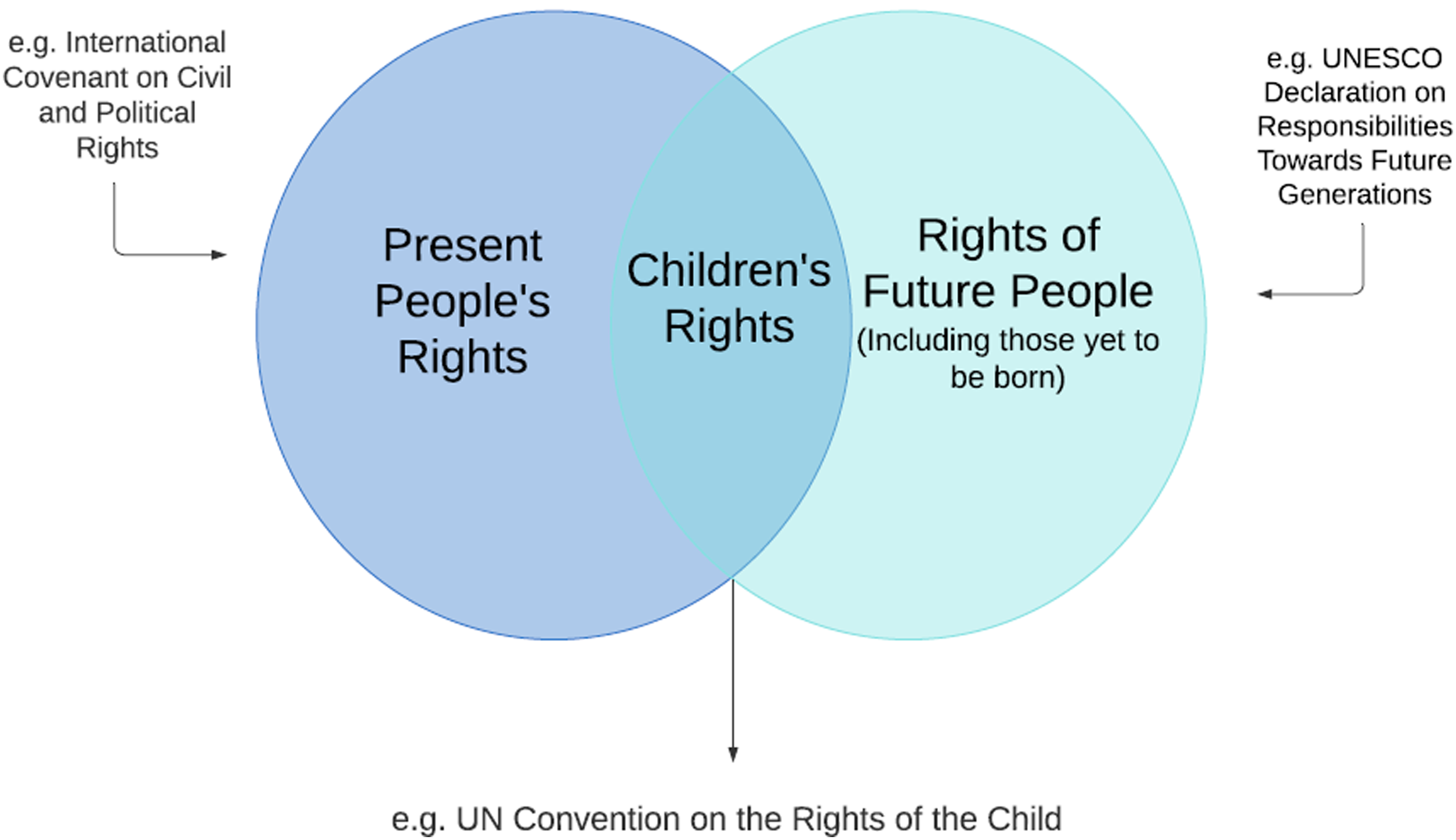
Intergenerational equity and children’s rights.
Since Brown Weiss elaborated the concept of ‘intergenerational equity’ in 1989, 62 the principle has become more prevalent in international discourse. It is primarily a political inclination, which has been the subject of much sociological, philosophical, and political science examination. Yet it has influenced the drafting of numerous legal instruments, and has received ever greater attention in the 2020s, with the drafting of various instruments designed to respond to the worsening climate crisis. Nevertheless, the elaboration of intergenerational justice has generally not extended in a substantial way to encompass children. Nolan, for example, refers to the ‘thus far under-explored relationship between children's rights and future generations’. 63 Relevant literature generally falls into two camps. It may provide elaboration of what equity means for the future, without specifically considering children (for example. Brown Weiss). It alternatively takes ‘intergenerational justice’ to refer to the need to mitigate environmental problems to enhance children's rights, but does not consider a definition of the term, nor what it means for children. 64 The term then appears to serve in this context as a rhetorical device to emphasise the importance for children of a right to a healthy environment. Such literature is of course important for understanding various elements of environmental justice. Yet inadequate attention to the nuance of the relationships, intersections, and divergences of future generations and present children, as pointed out by Nolan, may risk an under-theorisation of rights both for future generations and children in key areas of international human rights law. 65
This under-theorisation is also evident in more recent international standards. In 2020, as noted above, the Human Rights Council released a resolution urging States to realise the rights of children by recognising the right to a healthy environment in domestic legislation, and ensuring the rights of both present and future generations. 66 In June 2021, the UN CRC committed to the drafting of a General Comment on children's rights and the environment with a special focus on climate change. 67 It was released in 2023. 68 The General Comment aims to provide guidance to States on what constitutes a child-rights approach to environmental issues and the legislative, administrative, and other measures which must be taken to achieve this. It elaborates substantive, procedural, as well as heightened obligations pertaining to children, and is informed by the science relating to climate change and its effects on human rights. 69 Added to this, the UN Committee on Economic, Social and Cultural Right is drafting a General Comment on sustainable development and the International Covenant on Economic, Social and Cultural Rights (ICESCR). Both initiatives aim not just to respect, protect, and fulfil the right to a healthy environment, but also to shed light on concepts such as intergenerational equity. 70
It is unclear how helpful these documents will be in explicating the position of children in relation to the concepts of intergenerational equity and future generations. The Human Rights Council resolution refrained from elaborating on what the term ‘future generations’ means in relation to the right of children to healthy environment. Similarly, the General Comment on children's rights and the environment with a special focus on climate change, released in 2023, remains very vague on definitions. The Committee ‘recognizes the principle of intergenerational equity and the interests of future generations’, 71 but does not elaborate on the details of the principle. The Committee continues ‘While the rights of children who are present on Earth require immediate urgent attention, the children constantly arriving are also entitled to the realization of their human rights to the maximum extent.’ 72 It seems then that the Committee is making clear reference then to the relationship between present children and future children – generations are in constant motion. Nevertheless it would have been desirable to have a greater elaboration and definition here of the concept of intergenerational justice and how it relates to children's rights.
It could be argued that this General Comment is not the place to elaborate on this, as General Comments must cover a broad range of issues. Nevertheless, it is notable that greater attention to children's environmental human rights is not resulting in a clearer definition of this group in the context of intergenerational equity. The lack of clarity in these documents arguably constitutes a missed opportunity to concretise a key concept (and an increasingly important tool) in human rights law. Even as the notion of the rights of future generations garners greater attention in the legal arena, still the position of children is neglected, and this may affect whether children's rights arguments are used in litigation, as outlined in Section 4.
The reference to future generations (if not intergenerational equity) had already been included in international agreements before the work of Brown Weiss. As Slobodian notes, ‘future generations [appear] in treaties, judicial decisions, and national constitutions.’ 73 The environment has been on the international agenda since the 1972 UN Conference on the Human Environment in Stockholm positioned it as a major global issue. That year, the Stockholm Declaration was adopted, proclaiming the goal of defending and improving the human environment ‘for present and future generations’. 74 The conference joined the environment and development together as a holistic issue. 75 References to the welfare of ‘future generations’ continued to the 1990s. The United Nations Framework Convention on Climate Change established (as noted above) an international environmental treaty in 1992, with the aim of combatting ‘dangerous human interference with the climate system’. Article 3(1) states that ‘[t]he Parties should protect the climate system for the benefit of present and future generations of humankind’.
It was, however, the 1987 report of the UN World Commission on Environment and Development (WCED), popularly known as the Brundtland Commission Report on Our Common Future, which gave the concept of intergenerational equity its first concrete meaning in international law. 76 It stated that in order for socioeconomic development to be sustainable, it should be ensured that ‘it meets the needs of the present without compromising the ability of future generations to meet their own needs.’ 77 This statement, and the subsequent work of the WCED, contributed to the development of the 1992 Earth Summit which produced the Rio Declaration on Environment and Development and its companion Agenda 21. 78 Both documents refer to the well-being of ‘present and future generations’. There is also a dedicated UNESCO Declaration on Responsibilities Towards Future Generations, 79 adopted in 1997, which refers to the obligation ‘to bequeath to future generations an Earth which will not one day be irreversibly damaged by human activity’. The 2015 Sustainable Development Goals (SDGs) – a collection of 17 global goals to be achieved by 2030 designed to achieve a better and more sustainable future, established in 2015 by the UN General Assembly – refers to ‘future generations’, where States express their intention ‘to protect the planet from degradation […] so that it can support the needs of the present and future generations’.
There is therefore a plethora of references to the rights of future generations across numerous instruments, some of them binding in nature. Davies and others opine that these references to the rights of future generations may indicate an emerging norm in customary international law. 80 Added to this, the rights of future generations have arisen in national laws as well. It is estimated that ‘intergenerational rights to a healthy environment are protected by the constitutions of 74% of the world's nations.’ 81 Here we also see prevalence of the phrase ‘future generations’. The German Constitution, for example, makes reference to recognising ‘responsibility toward future generations.’ 82 As we have seen however, ‘future generations’ is frequently taken to mean those yet to be born which risks obscuring the position of children in the generational spectrum. It may also be downplaying the potential of the rights of children to progress intergenerational justice, particularly in the legal sphere.
The legal obligations which may result from the principle of intergenerational equity (which, as noted above, is usually taken to mean the rights of future generations) are, for the most part, as yet unclear. Attapatu points to the fact, however, that equity (that is, justice through equitable decisions) underlies the principle, and equity is common to many legal systems. 83 The International Court of Justice has referred to the role of equity in international law in the Jan Mayen case 84 for example, describing it as a basis for justice, fairness, and legal reasoning. In the past number of years, litigation has arisen as a route through which to achieve change in climate policies. Setzer and Higham identified internationally over 2,000 ongoing or concluded cases on climate change litigation as of May 2022. 85 There have been 103 applications filed before 15 international or regional bodies. 86
Cases which preceded the current (that is, post-2019) phenomenon of child/youth climate activism, such as Minors Oposa in the Supreme Court of the Philippines 87 and Demanda Generaciones Futuras v Minambiente in the Supreme Court of Colombia, 88 relied heavily on arguments relating to future generations. 89 There have since been increasing references to issues of generational rights in climate cases taken by those over 18 years. In the domestic German case Neubauer and others v Germany, applicants argued that the failure of the State to mitigate the climate crisis constituted a disproportionate burden on future generations. 90 The German Supreme Constitutional Court agreed. 91 In Earthlife Africa Johannesburg v The Minister of Environmental Affairs and others, 92 the South African High Court determined that, when conducting an environmental review of a power plant, climate change is an important consideration. The Court referred to the constitutional right to have the environment protected ‘for the benefit of present and future generations, [including by securing] ecologically sustainable development and use of natural resources while promoting justifiable economic and social development’. 93 There are, therefore, instances of courts upholding arguments relating to future generations.
Yet using such arguments in litigation remains difficult for several reasons. As noted above, the law is usually designed to deal with past harms, not projected incidents yet to come. 94 In Teitiota v New Zealand, 95 for example, the Human Rights Committee held that no violation of the right to life was established in a case where an island will soon likely be submerged and become uninhabitable. The Committee accepted that Kiribati would likely be rendered uninhabitable in 10–15 years as a result of sea-level rise. However, it did not accept that it would be an acceptable limit in terms of a timeframe sufficient for ‘intervening acts’ by the government of Kiribati to protect its citizens. The Committee opined that this was purely speculative in nature.
Arguing that children's rights are being violated in the present in such circumstances holds much potential. Children in the present will possibly have legal standing, and can argue that they have already suffered harm, even if that harm is a failure in the present to consider their interests in the future. These are two factors which will usually be necessary for accessing courts and other climate justice forums. It is therefore important to consider whether greater emphasis should be placed on the children's rights framework in climate and other environmental rights cases.
INTERGENERATIONAL RIGHTS ARE CHILDREN'S RIGHTS
The term intergenerational justice is used rhetorically even in a legal context, usually to refer to ‘future people’. It is the basis for many climate cases. Research indicates that only around half (54%) of decided climate cases (outside the US - 245 cases) had outcomes favourable to climate action. 96 Can the CRC/children's rights framework be used as a vehicle for a more effective use of ‘intergenerational rights’ to mitigate the climate crisis?
The UN Convention on the Rights of the Child
To understand the potential for engaging children's rights in climate litigation, it is necessary to consider the UNCRC. The CRC is a human rights treaty aimed at protecting, promoting, and fulfilling the rights of children everywhere. It is all but universally ratified – there are 195 signatories to this founding children's rights text. This comprehensive instrument covers the full spectrum of rights – civil and political, as well as economic, social and cultural rights. It does not explicitly reference intergenerational equity, but it is the only UN human rights treaty directly linking the right to health to the environment. Article 24(2)(c) directs States to recognise the right of children to the enjoyment of the highest attainable standard of health and, in particular, to take appropriate measures to combat disease and malnutrition ‘taking into consideration the dangers and risks of environmental pollution’. It also includes rights specific to children, including the right to be heard, the right to play, and the principle of the best interests of the child.
As presented in Figure 1, children's rights can be positioned as a key component within the picture of intergenerational rights. The international human rights framework more broadly (for example, the ICCPR and ICESCR) can be crucial for tackling numerous environmental rights issues such as the right to water (UNCESCR, Articles 11 and 12). There is, as outlined above, an emerging framework for the rights of future people (whether born or yet to be born). Instruments such as the UNESCO Declaration on the Responsibilities Towards Future Generations will gain increasing ground in the coming years as courts recognise the legitimacy of protecting such rights. 97 The children's rights framework, then, sits in the centre; an important bridge between the two, involving principles which are firmly embedded and accepted internationally, such as the principle of the best interests of the child (CRC, Article 3).
However, there is surprisingly little in-depth reflection on the potential of the CRC for progressing the principle of intergenerational equity. The draft General Comment No. 26 references intergenerational equity, but refrains from providing a definition of the concept of future generations. Nor does it attempt to elaborate on the relationship of future generations to children. 98 As the children's rights framework is now so accepted however it is clear that emphasising the children's rights element of the principle of intergenerational equity holds great potential for grounding the principle in legal efforts.
The most promising route is likely via the principle of the best interests of the child under Article 3 of the CRC. 99 The right of children to have their best interests included as a primary consideration in matters affecting them is a crucial right for a group who frequently have decisions about their interests made by adults. The importance of the principle is demonstrated by the fact that it is, of CRC rights, the one which is most incorporated in domestic law systems. Lundy and others found that incorporation of this right at national level was widespread. 100 It is also a ‘general principle’ of the CRC; that is, all other CRC rights must be interpreted bearing it in mind. 101 The principle is therefore very prominent in both national and international law. The Children's Rights International Network points out that the principle is the most-cited Article of the CRC by courts. 102
There is one element of the best interests principle which may be particularly useful if invoked in litigation, and that is the procedural element. The UN CRC in its General Comment No. 14 on the Right of the Child to Have His or Her Best Interests Taken as a Primary Consideration 103 outlines that the principle of the best interests of the child is a threefold concept: it is a substantive right; a fundamental, interpretative legal principle; and finally, a rule of procedure. This latter element could be used very pragmatically in climate litigation. The principle can serve as a tool to ensure that States adopt procedures which place children in a prominent position in decision making. It has been argued for example that the procedural element facilitates the European Court of Human Rights (ECtHR) to apply the principle in all cases, regardless of the right in question. 104
It is clear that the principle of the best interests of the child has in the past been used in ways that have been unduly paternalistic. 105 The principle gives the impression that adults know best, and that adults will make decisions about children's interests. It has been used in some proceedings to stifle children's own views and wishes. 106 However, in the context of climate law and policy, the best interests principle draws attention to children's interests rather than other interests – the perceived national interests of economic development, for example. It can be used alongside other principles, such as the right of children to be heard, to ensure that children's rights and interests are engaged in a policy or a legal application in a holistic way. This is vital, as it is challenging for children to access environmental justice mechanisms. 107 The broader range of children's rights, such as the right of children to development, may not always be accessible in litigation however, as such rights may not be enshrined in the national legal framework of a particular country. 108 In such circumstances they may not be justiciable then, particularly in countries with dualist legal systems. For this reason, the principle of the best interests of the child is the primary focus of this section due to the scope of the piece, although it is acknowledged that there is a broad tapestry of children's rights which could and should be drawn upon in environmental and climate litigation and advocacy. It should also be noted that there is, amongst academics and practitioners, increased attention to applying the children's rights framework within strategic litigation involving children. 109
Part of the power of the best interests principle is its wide reach in terms of public policy and law making. The CRC Committee outlines that the best interests of children must be a primary consideration in all decisions, 110 and this should of course be taken to include government policies relating to issues such as activities impacting the climate and the environment more broadly. In fact, it could be argued that children's interests should be given even higher priority in relation to the environment as compared with other issues, as children will be disproportionately affected by the climate crisis. This was emphasised by the then-Special Rapporteur on Human Rights and the Environment, who opined in his 2018 report on children's rights and the environment that States have heightened obligations to protect children from environmental harm, including through regulation of private actors such as businesses. 111
In practical terms, the principle requires that first, information and data must be gathered on the topic to determine the scope of a particular problem affecting children's rights. The CRC Committee states that: ‘Collection of sufficient and reliable data on children, disaggregated to enable identification of discrimination and/or disparities in the realisation of rights, is an essential part of implementation.’ 112 Children's rights and interests, including their participation, must then be built into climate and development strategies as early as possible. 113 The Committee outlines in General Comment No. 14 that these best interests assessments should be underpinned by the CRC general principles, and be based on input from children and other stakeholders. 114 The Committee also states that children's rights impact assessments are a vital component of reflecting on the best interests of children in a given issue. Children's rights impact assessments involve ‘predicting the impact of any proposed law, policy or budgetary allocation which affects children and the enjoyment of their rights.’ Child impact evaluations – evaluating the actual impact of implementation – must also be conducted. 115
This points to extensive obligations on States to ensure that the best interests of children are adequately considered in environmental matters concerning them. Research conducted in 2020 by UNICEF, however, indicates that most States do not explicitly give primary consideration to children's rights and interests in climate policy-making. In only 34% of 103 countries with new or revised climate plans (Nationally Determined Contributions – a requirement under the Paris Agreement) could those plans be classed as ‘child sensitive’. 116 This figure highlights then that there are many States which are falling well short of the CRC standards outlined above. They could therefore be subject to litigation and other justice mechanisms in an effort to improve States’ climate mitigation policies, using the principle of the best interests of the child as a key argument. There is great potential for engaging the procedural element of the principle. Although General Comments are not binding on States, they provide crucial guidance on implementation of CRC principles. Many States are failing to conduct basic assessments of children's best interests. The description by the Committee of the extent to which States must consider children's best interests on environmental matters, including through the gathering of statistics and of children's views, can elaborate in a climate case the extent to which States are failing to engage in basic implementation of the key CRC principle. This could potentially increase the chance of a success in a climate case, thereby progressing the right to a healthy environment and the obligation on States to curb emissions.
Recent Climate Cases and Children's Rights
The use by children and youth (and adult allies) of the courts to litigate governments’ climate policies has already begun. These applications and cases have harnessed human rights and have increasingly engaged concepts relating to children/youth together with the principle of intergenerational equity. Parker and others examined the Sabin Centre for Climate Change Law's database of climate litigation, identifying 32 climate cases led by or involving children/youth by May 2021. 117 Surprisingly few cases have referenced the principle of the best interests of the child, or children's rights more broadly, in spite of the involvement of child litigants. 118
One of the earliest applications in the modern suite of climate cases was in the US, where non-profit organisation Children's Trust began to file lawsuits across the United States in 2011, engaging children and youth as litigants. They argued, amongst other things, that the failure to adequately mitigate the climate crisis invoked constitutional rights of children, and that the public trust doctrine should be applied to the atmosphere. This doctrine is based on ancient Roman civil law and English common law, 119 and is the principle that certain resources are preserved for public use, and that the government has a duty to protect them. In the most recent manifestation of these petitions in 2020 (Juliana 120 ) a Ninth Circuit panel held that the plaintiffs lacked standing to sue, though the case continues through further applications. 121 The principle of the best interests of the child does not seem to have engaged in Juliana. The lack of attention to the children's rights framework is unsurprising, as the US remains the only State not to have ratified the CRC.
In countries where the CRC has been ratified however (that is, all other countries) it similarly appears that litigants’ arguments rarely make reference to the principle of the best interests of the child. In Australia, children and youth made attempts to prevent coal mining in the case of Sharma. 122 In this (ultimately unsuccessful) 123 tort law-based application, the applicants argued that the relevant legislation should be interpreted as involving the need to ‘ensur[e] a healthy environment for the benefit of future generations. 124 The Court did not conduct a best interests analysis of the mining plans, nor did it order the government to conduct such an analysis. 125 In the 2016 case People v Arctic Oil, 126 a children/youth organisation challenged oil licences approved by the government as violating the right to a healthy environment under the Norwegian Constitution, (which references the rights of future generations). 127 Despite the incorporation of the CRC in both jurisdictions, the CRC does not appear to have been invoked in these applications. The ongoing Canadian case of La Rose 128 involves a petition by children/youth aged 10 to 19 (seven of whom are Indigenous), who argued that that they have public interest standing to represent their rights and the ‘rights of all children and youth in Canada, present and future’. 129 Interestingly they invoke a right to equality, as this is enshrined in section 15(1) of the Canadian Charter of Rights and Freedoms. Again, the case does not invoke the CRC, although domestic constitutional rights are engaged.
International human rights law petitions have had greater emphasis on the best interests principle. This is likely because international law is naturally going to be relied upon more in international petitions, and the best interests principle is prominent in the CRC as the key international children's rights instrument. In the Duarte Agostinho application
130
to the ECtHR, six Portuguese children and youth (who live in an area prone to deadly wildfires) argue that the inadequate climate policies of 33 European States violate their rights under the European Convention on Human Rights (ECHR). The applicants allege violations of the right to life (Article 2), the right to private and family life (Article 8), and non-discrimination (Article 14). Although the principle of the best interests of the child is not explicitly included in the ECHR, the ECtHR has held that it is an obligation of States to ensure that the best interests of children are adequately considered in matters affecting them.
131
In their application, the complainants refer once to the best interests principle, stating that: The Court's assessment of these risks […] must be undertaken bearing in mind the precautionary principle, the concept of intergenerational equity, and the requirement (under Article 3(1) of the UN Convention on the Rights of the Child) that the ‘best interests of the child’ must be ‘a primary consideration.’
132
As of 2023, the applicants’ representatives have submitted responses to the State responses, after drafting more thorough elaboration on the alleged breaches of the best interests principle. 133 The ECtHR will decide if the application proceeds to a full hearing, and if it does the principle will of course be given further legal elaboration, and therefore legitimacy in relation to climate cases.
The best interests principle featured strongly in a 2019 climate petition to CRC Committee. Greta Thunberg and 15 other children filed a petition with the Committee arguing that the five respondent States had breached their CRC obligations due to their failure to adequately mitigate climate change. 134 The CRC, covering as it does the full spectrum of rights, facilitated the children/youth provided a strong vehicle through which to argue breaches of numerous children's rights. The best interest principle (Article 3) was amongst the provisions invoked. The others were the right to life (Article 6); the right to health (Article 24), and the right of Indigenous children to their own culture (Article 30). The applicants requested in the petition that the Committee on the Rights of the Child adopt as one of their recommendations for relief that States ‘make the best interests of the child a primary consideration, particularly in allocating the costs and burdens of climate change mitigation and adaption.’ 135 The Committee declined to examine the petition on its merits, due to a failure to exhaust domestic remedies, though it established important precedent in recognising State responsibility for transboundary harm. 136 In its pronouncement, the Committee did not mention the best interests of the child. There would likely have been significant attention accorded to the best interests principle however if the application had been heard on its merits, considering its prominence as a principle of the CRC.
In 2022, the applicants next petitioned the UN Secretary General, asking that he announce that the climate crisis constitute a global level 3 emergency, to match the level of UN response adopted for the coronavirus pandemic. 137 The children/youth based their arguments on ‘international human rights law’, 138 yet they explicitly referenced neither the CRC, nor the best interests principle. Neither is there any reference to the best interests principle in the 2021 petition by Haitian children to the Inter-American Commission on Human Rights to redress human rights violations stemming from toxic trash disposal in their residential area. 139 The Inter-American Convention on Human Rights does not make direct reference to the best interests principle, which may go some way towards explaining why the applicants refrained from relying on it. Article 19 of that instrument makes reference however to the right of children to protection required by their status. The Inter-American Court too sometimes makes reference to the CRC and the best interests principle, as it did in its Advisory Opinion on children in the context of migration. 140 It is notable then, and perhaps surprising, that the CRC was not invoked in the Haiti petition.
On surveying climate cases with child litigants it is evident that there is a distinct lack of engagement with the CRC, including the best interests principle. One reason for the lack of prominence of the CRC in such cases is likely that there is increasing reliance on the right to a healthy environment. This is because it is fortunately increasingly recognised in the constitutions of many States. Another reason is likely the varying extent to which the best interests principle (and the CRC more broadly) can be invoked in court across differing legal systems. The CRC has not been incorporated into domestic law in some countries, particularly in dualist States. Courts (particularly those in common law jurisdictions) often remain resistant to the claim that States have an obligation to implement the best interests principle in policy-making. 141
Another possible reason for refraining from using the CRC or the best interests principle is that whilst some (perhaps most) of the litigants in these child/youth cases are under the age of 18, some are youths over the age of 18. It perhaps appears undesirable to rely on the CRC – an instrument enshrining the rights of those under 18 years – in these circumstances. Children's rights arguments would apply to the situation of some of the applicants, but not all. This is the case in Duarte Agostinho, as amongst the applicants are those over and under 18 years. The dilemma of how to manage children's rights in the context of claims by litigants over and under the age of 18 points to the need for greater work theorising the intersections between CRC rights and the rights of youth over the age of 18. The CRC does not elaborate on what happens to children's rights when applicants become older than 18, and when they are partnered with applicants over 18 in the same application. Whether it is a practical obstacle, a theoretical obstacle or both is an area that requires examination. The need for clarity in climate cases containing a mix of litigants over and under age 18 makes it all the more important to provide legal analysis on the issue.
It is also possible that the concept of ‘intergenerational equity’ – which, as noted above, is frequently taken to exclusively refer to ‘the rights of future generations’ – is in some way distracting from the realisation of the potential usefulness of CRC rights, and particularly the potential of the best interests principle. The preference for future generation arguments is evident from analysis of the case law. Donger examined the 33 child/youth-focused climate applications filed before 2021 which reference rights, 142 and establishes that 90% of the arguments advanced in these applications refer to intergenerational equity, while less than 10% refer to the best interests principle. 143 Nolan makes the point that the term ‘future generations’, when included in national Constitutions, is frequently left undefined. 144 The legal representatives of litigants may wish to avoid reliance on the argument that children should be included in ‘future generations’. Yet legal representatives in such cases could consider whether the principle of the best interests of the child could be used alongside arguments relating to the rights of future generations. Children's rights could be employed as stand-alone arguments as an additional tool, considering the CRC is embedded in the law of most States (although there may be reluctance by courts in dualist countries to apply unincorporated international law instruments).
There are some indications that children are being included more explicitly in recent climate cases. Twelve children in Austria are at present challenging Austria's Federal Climate Protection Act on the basis that it violates the constitutionally guaranteed rights of children and the fundamental right to equality before the law. 145 The Austrian Federal Constitutional Act on the Rights of Children refers in Article 1 both to the best interests principle and consideration of intergenerational equity. 146 It seems that inclusion of the principles of the UN convention on the rights of the child (such as the best interests principle, the right to be heard, and so on) remains the exception in climate cases. Extensive research is required however on the ever-increasing amount of child and youth- related climate petitions, to establish trends in this type of litigation from a children's rights perspective.
CONCLUSION
There is great urgency if humanity is to mitigate the climate crisis to protect present and future generations, however one might define them. Since Brown Weiss elaborated a concept of ‘intergenerational equity’ in Fairness to Future Generations in 1988, 147 it has become prevalent in international discourse. Brown Weiss did not explicitly consider children in her concept, however, and since then the children's rights framework has evolved and the CRC has been ratified by (almost) all States. Moreover, children and youth have made their voices heard and become amongst the leaders fighting for climate justice.
Human rights, intergenerational rights, and the rights of future generations are all being employed at present to legally tackle the climate crisis. The CRC, as the primary children's rights instrument, should guide all climate justice efforts involving children. 148 By invoking the principle of the best interests of the child in child/youth-led climate litigation, the point will be made that States must give adequate consideration to the ways in which laws and policies affect children, now and in the future. The principle is already featuring in international climate cases, although there is scope for it to be much more prominent, particularly at the domestic level. It should be considered a key component of the principle of intergenerational equity and a bridge between the interests of those in the present and in the future.
In many climate and environmental rights petitions it appears that litigants could have relied on the CRC, and particularly the best interests principle, and did not do so, but rather invoked the rights of future generations. This could be due to a number of reasons. The rights of future generations may be embedded in their Constitutions, and the principle of the best interests of the child may not. It may be inconvenient where many young applicants are over 18, as children's rights arguments may not be perceived as applicable to them.
Yet failure to rely on children's rights arguments may constitute a missed opportunity. The procedural approach to the best interests of the child (rather than the application of the concept as a substantive right) means that the principle can potentially be applied in all cases irrespective of the right at issue. 149 This will likely increase the chances of success in a case, but also ensure that the case is firmly based in the children's rights framework. The more that applicants across the globe invoke the principle, the greater the chance that it will be upheld in a climate case. Success would ensure that the particular rights and needs of children will be given the necessary attention in the climate crisis. Such success in climate cases will, of course, progress human rights as a whole at the most challenging time for humanity.
Footnotes
Declaration of Conflicting Interests
The author declared no potential conflicts of interest with respect to the research, authorship, and/or publication of this article.
Funding
The author would like to gratefully acknowledge funding from the Ragnar Soderberg Foundation (grant number R20/18).
