




Abstract
When the United Nations Universal Periodic Review was established in 2007, it was stressed that it should complement the work of the United Nations treaty bodies. At the same time, fears were expressed that similarities between the two procedures might lead to potentially problematic duplications or contradictions among them. To shed light on whether this is the case, this article devises a framework to assess the degree to which human rights bodies provide duplicating or contradicting recommendations to States. Focusing on the case of torture, it creates an original database of recommendations delivered to 14 countries in the years 2012–2016. Results show that duplications are frequent and provide opportunities to States to use the Universal Periodic Review to contest the implementation of treaty bodies’ recommendations. Contradictions are limited, although when they occur, they create room for States to selectively choose which recommendations to implement.
INTRODUCTION
When the Universal Periodic Review (UPR) was established in 2007 as a peer review process wherein United Nations (UN) Member States examine each other's human rights performance, great emphasis was placed on the fact that it should not duplicate, but rather complement the work of the UN treaty bodies. 1 Treaty bodies are expert-based, semi-judicial mechanisms that provide authoritative interpretations of international human rights law, while the UPR is a political, State-led mechanism whereby States deliver recommendations to each other. Despite their differences, a partial overlap between the functions they perform caused several observers to wonder whether the UPR would merely duplicate the work performed by the treaty bodies or, in the worst-case scenario, even contradict or undermine it. 2 What could be the impact of repetitions and contradictions on State compliance with the recommendations received? Would repetitions bring any added value? In the case of contradictions, would States follow the expert advice of the treaty bodies or rather the UPR recommendations?
Despite such widespread worries, no empirical research has been conducted thus far to assess whether the UPR encroaches on the work of the treaty bodies, nor on the consequences of possible overlaps for the effectiveness of the UN human rights machinery. This article takes a first step to explore this matter, by developing and empirically applying a framework to assess the extent to which the UPR and treaty bodies deliver duplicating or contradicting output. In doing so, it is the first to develop an original framework to categorise recommendations and decisions by partially overlapping mechanisms, based on the extent to which they raise the same issues and propose the same solutions. The categorisation is developed in a way that makes it relevant not only for the UPR and treaty bodies, but also for the study of overlapping activities by other monitoring mechanisms, within and beyond the UN context or the human rights domain. In addition, this article identifies patterns in the way States respond to recommendations that either duplicate or contradict each other. To support this analysis, the article employs the empirical case of torture and other forms of ill-treatment, as further discussed in Section 3.
3
Specifically, it focuses on recommendations on torture by:
the main treaty body dealing with issues of torture, namely the Committee against Torture (CATc); three other treaty bodies that regularly raise issues of relevance for the mandate of the CATc, namely: the Human Rights Committee (HRCttee), the Committee on the Elimination of Discrimination Against Women (CEDAW), and the Committee on the Rights of the Child (CRC); and the UPR.
The article is organised as follows. Section 2 presents key background information and briefly reviews the existing literature on the UPR and the treaty bodies. Section 3 provides the context for the case study of torture by clarifying the concept of ‘torture’ and the extent to which the norm of torture is contested by States. Section 4 assesses the complementarity of the human rights mechanisms and proposes a categorisation of recommendations and decisions by these mechanisms into five categories, based on the extent to which they overlap on issues of concern and recommended solutions. The article then traces and categorises all recommendations and decisions delivered by the UPR and relevant treaty bodies to 14 UN Member States on issues of torture, in the period 2012–2016. Section 5 presents the findings of the study, highlighting States’ response to overlapping recommendations by tracing the acceptance patterns of UPR recommendations. Drawing from these findings, Section 6 discusses the consequences of overlaps for the complementarity of human rights mechanisms and the relevance of the article's findings, in light of the existing academic literature. The final section presents conclusions.
The empirical results of the study show that duplications take place to a large extent, not only between the treaty bodies and the UPR, but also between different treaty bodies. Although the duplication of recommendations by multiple bodies may increase their political strength, a problem arises. Whilst States have the possibility to express their support or lack thereof for UPR recommendations, this is not possible with respect to recommendations and decisions by the treaty bodies. Hence, when States decline to implement UPR recommendations which duplicate those by the treaty bodies, they implicitly reject the treaty bodies’ guidelines. Additionally, while contradicting recommendations are scarce, they do occur, providing evidence of a lack of coordination between these mechanisms and creating opportunities for States to choose their preferred course of action. Finally, a high number of non-overlapping recommendations are delivered, which appear helpful in providing a more complete coverage of the various human rights issues faced by States.
THE UN TREATY BODIES AND THE UPR
UN treaty bodies are committees of independent experts monitoring States’ implementation of the ten major UN human rights treaties. Their main tasks consist of assessing State performance in implementing the respective treaty (State reporting procedure), receiving individual complaints, conducting country inquiries in case of serious suspicions of severe human rights violations in a State Party, and publishing General Comments on the interpretation of treaty provisions. This article focuses specifically on the State reporting procedure and decisions on individual complaints, because General Comments are not directed at specific States and country inquiries have not been employed extensively so far, particularly by the CATc.
The State reporting procedure is a process through which the treaty body committee assesses State performance based on information collected by means of a State self-assessment report and additional information by other UN and non-UN sources. 4 After the treaty body has assessed the information, a ‘constructive dialogue’ is held, during which a delegation from the reviewed State presents their report and committee members express their concerns and recommendations for improvement. The committee's views and recommendations are published in a document called Concluding Observations. Several of the treaty bodies, including those studied in this paper (with the exception of the CRC), have also adopted a formal follow-up procedure whereby States are requested to report to the committee on the implementation of the recommendations received within one year. Conversely, individual communications are complaints brought by individuals alleging that a State Party has committed a violation of the treaty concerned. If the State Party acknowledges the authority of the treaty body to receive such complaints, the committee examines the case and delivers its decisions on whether the State has violated treaty provisions. 5
In contrast, the UPR is a peer review in which UN Member States discuss each other's human rights performance and issue recommendations for improvement. Its procedural functioning is roughly similar to that of the State reporting procedure of the treaty bodies. First, information is gathered on the State's internal situation, by means of a State self-report and additional information by UN and non-UN sources. 6 Second, the State's performance is discussed during an ‘interactive dialogue’ between a delegation from the reviewed State and a Working Group composed of UN Member States, during which individual member States may ask questions and issue recommendations for improvement. 7 The final report is adopted during a plenary meeting of the Human Rights Council, and contains a summary of proceedings and a list of recommendations. 8 Unlike in the case of the treaty bodies, where the Concluding Observations are endorsed by the whole committee, each UPR recommendation is attributed to the country that has issued it, rather than to the whole Working Group. In the UPR, reviewed States are then required to indicate whether they support (‘note’) each recommendation. 9 Although reporting on the implementation of previous recommendations is encouraged, there is no formal follow-up procedure to UPR recommendations.
A considerable body of literature has been dedicated to the treaty bodies and the UPR. Several works have reflected on the treaty bodies’ functioning and challenges. 10 In particular, Cees Flinterman has highlighted the possible problems created by overlapping mandates by multiple treaty bodies, the importance of consistency in their jurisprudence, and the desirability of balancing their work with that of the UPR. Other scholars have focused more explicitly on the treaty bodies’ effectiveness and ability to generate compliance with human rights, 11 stressing, for example, the need for complementarity between treaty bodies’ and UPR recommendations in order to increase compliance. 12 Some studies have also analysed the quality and effects of State reporting, 13 and the degree of expertise and independence of committee members. 14 Finally, some scholars have shed light on developments such as the various processes for treaty body revision, 15 the most recent of them being the 2020 treaty body reform process, which included discussions on the need for reducing duplication amongst treaty bodies. 16
Being of more recent creation, much of the scholarship on the UPR deals with its establishment 17 and its functioning, focusing specifically on certain countries or regions, 18 the involvement of non-State actors in the UPR, and how it differs from their involvement in the UN treaty bodies, 19 or the occurrence of particular inter-State dynamics that partially distinguish the UPR from treaty monitoring bodies, such as naming and shaming, 20 mutual learning, 21 or human rights norm fragmentation. 22 An increasing number of scholars have focused on the peer review's potential to bring added value to the global human rights landscape and achieve concrete results. In particular, Rhona Smith highlighted a need for better coordination between the UPR and other UN human rights monitoring mechanisms, including the treaty bodies, while Noelle Higgins shows how the UPR can help advance the protection of certain rights that are not extensively covered by the existing treaties, such as minority and indigenous rights. 23
Despite the vast literature on the two mechanisms, few comparisons of their functioning and output exist. Exceptions include studies by Valentina Carraro, 24 Felice Gaer, 25 and Nigel Rodley. 26 Specifically, based on their experiences as treaty body members, Rodley and Gaer argue that although the two mechanisms hold the potential to work in a complementary manner, risks of duplication and contradictions clearly exist. Carraro similarly highlights that one of the conditions for these mechanisms to generate compliance with international obligations is to deliver high quality recommendations, and this goal is best achieved if the two systems function complementarily.
Although empirical comparisons between the UPR and the treaty bodies are scarce, the potential risk of the UPR's encroachment on the work of the treaty bodies has been the object of considerable scholarly debate. The literature mostly echoes the fears expressed by Gaer and Rodley, namely that the UPR may duplicate or dilute the work of treaty bodies by excessively simplifying their output, 27 while Suzanne Egan, 28 Eric Tistounet, 29 and Jasper Krommendijk 30 acknowledge a lack of coordination among treaty bodies, which may cause overlaps and contradictions. In particular, Eric Tistounet shows that, in the period between 1995 and 1997, different treaty bodies provided contradicting interpretations of similar human rights provisions.
More broadly, recent literature has increasingly focused on the parallel existence of overlapping human rights bodies, including, but not limited to, the UN system. Examples of this are Erik Voeten's 31 and Emilie Hafner-Burton's 32 overviews of the global and regional human rights regimes; Courtney Hillebrecht's 33 study on overlaps between the Inter-American human rights system on the one hand, and UN treaty bodies and UPR on the other; Solomon Ebobrah's 34 work on the complementarity between institutions in the African human rights system; and Laura Gómez-Mera's 35 work on human trafficking. Theoretically, most of these works conceive of human rights bodies as part of a regime complex, namely a set of partially overlapping and non-hierarchically ordered instruments that monitor or regulate the same issue area. The literature emphasises that the existence of regime complexes generates consequences for two sets of actors: first, the decision-makers involved in the activities of the regime (for example, government officials); second, the institutions composing the regime complex.
With regard to the consequences of regime complexes on decision-makers’ strategies, it is widely acknowledged that the existence of different organisations regulating the same issue can give rise to forum shopping, 36 particularly when the obligations and/or output emanating from these organisations are not entirely coherent with each other. When engaging in forum shopping, actors selectively choose which commitments to fulfil, or which recommendations to follow. This can, in turn, lead States to use ‘one institution to escape or invalidate a legal obligation in another institution’. 37 States may even pit one organisation against the other and engage in regime shifting, 38 which occurs ‘when challengers to a set of rules and practices shift to an alternative multilateral forum with a more favourable mandate and decision rules’. 39
Scholars also highlight that the existence of regime complexes has consequences on the institutions composing the regime. In the best of circumstances, institutions in a regime complex will reinforce each other, strengthening inter-institutional cooperation and their mutual effectiveness. 40 As Judith Kelley argues, this is particularly the case when the organisations’ output is aligned. 41 Yet, deficiencies might arise when bodies act in an uncoordinated, or even contradictory manner, providing States with opportunities to bypass their obligations in the forum that provides the least desirable output. Finally, institutions within a regime may simply coexist, without posing as either an obstacle or an advantage for each other. 42
This article adds to the existing body of knowledge from a conceptual, methodological, and an empirical perspective. As regards the former, previous comparative studies on the UPR and the treaty bodies, as well as studies on non-UN human rights mechanisms, have highlighted the possibility of them encroaching on each other's work, and the importance of their complementary functioning in order to stimulate human rights compliance. However, a framework that verifies the extent to which these bodies function in a complementary manner had yet to be developed. In order to fill this gap, the present article contributes to the literature on the UPR and the treaty bodies, but also, more broadly, to studies on regime complexity, by developing a framework to categorise recommendations by international human rights mechanisms. This framework is based on the extent to which the mechanisms deliver overlapping output; in other words, raising the same issues and proposing the same solutions. Similarly, and as a consequence of the lack of an existing framework, an empirical assessment of the extent to which the UPR and the treaty bodies actually deliver overlapping output is also missing. By means of a case study on torture, this article provides a first illustration of the degree to which the UPR and the treaty bodies issue overlapping recommendations, and how States respond to these phenomena. Finally, while remaining an empirical study, this article sheds light on the extent to which the inter-State and inter-institutional dynamics highlighted in theoretical regime complexity literature occur in the case of the UPR and the treaty bodies.
Whereas the empirical scope of this paper is limited to a selected number of cases, the framework is developed in such a way that it can be applied to other human rights issues and other human rights mechanisms within and beyond the UN context. With some possible adaptation, such a framework will be equally applicable outside of the human rights field.
THE CONCEPT AND DEFINITION OF TORTURE
Scholars have thoroughly elaborated on the concept of torture in the UN system, with particular reference to the way torture is defined in the Convention against Torture (CAT). 43 While this section does not have the ambition to provide an elaborate discussion of the definition of torture, it will briefly consider its main features in order to outline the conceptualisation employed in this article.
On the basis of the definitions provided by Article 1 of the CAT and Article 7(2)(e) of the statute of the International Criminal Court, Manfred Nowak identifies a set of essential criteria to define torture, namely
infliction of severe pain or suffering; by or at the instigation of or with the consent or acquiescence of a public official; on a powerless person under the custody or direct control of the perpetrator; and with intention and for a specific purpose, such as extraction of a confession or information, intimidation, punishment, coercion, or discrimination.
44
Which specific acts, then, constitute instances of torture, and which obligations arise for States in respect of it? The CAT prescribes that States Parties must take all necessary measures ‘to prevent acts of torture in any territory under [their] jurisdiction’.
45
Among others, it stresses the non-refoulement principle, torture prevention training for law enforcement personnel, the inadmissibility of evidence extracted by torture, and the systematic review of interrogation and prison rules. The CATc's General Comment No. 2 specifies in greater detail what issues are to be included within the remit of the CAT: States bear responsibility for the conduct of non-State actors if they ‘know or have reasonable grounds to believe that acts of torture or other forms of ill-treatment are being committed’ by them,
46
applying this principle with relation to gender-based violence, including ‘rape, domestic violence, female genital mutilation, and trafficking’.
47
Finally, by looking at the CATc jurisprudence, it can be noticed that the committee considers some additional issues as pertaining to the scope of the Convention, such as coerced sterilisation of individuals who cannot express their full and informed consent, 48 criminalisation of same-sex relations, 49 and all forms of violence, such as violence against children. 50
On the basis of the interpretation of torture provided by the CATc, this article groups recommendations and decisions relevant to torture in four-issue categories:
torture (core issues, for example, legislation on torture, inadmissibility of evidence obtained from torture, fight against the impunity of perpetrators, victims’ rights to complain and obtain redress);
51
violence against different groups (for example, women, migrants; same-sex couples); criminal justice system (for example, conditions of detention, juvenile justice); and other (human trafficking, transitional justice, anti-torture training).
This categorisation is employed to structure the empirical analysis of the article and illustrate how recommendations by the UPR and the treaty bodies are distributed across these categories. The analysis of this article might thus reveal specific subject matters within the remit of the CAT that are more likely to lead to conflicting interpretations by different bodies or that, to the contrary, are dealt with in a relatively straightforward manner by all bodies involved.
Torture is an ideal case for such an exploratory study for two reasons. First, it is a human rights issue for which extensive systems for protection and prevention are in place at the global level. The CATc is the treaty body in charge of monitoring the implementation of the CAT, which entered into force in 1987 and currently counts 171 State Parties. 52 Additionally, several other treaty bodies touch upon issues that are of relevance to torture, in particular the HRCttee, because it monitors the whole set of civil and political rights, including torture; the CEDAW, as it frequently deals with issues of violence against women, which are frequently raised by CATc as well; and the CRC, for the same reason with relation to children. Within the UPR, torture is the fourth most-raised issue, with over 4,500 recommendations concerning torture having been issued in the period 2008–2016, corresponding to the first and second cycles of the UPR. 53 The fact that torture is so frequently raised in the context of the treaty bodies and the UPR ensures the availability of a large number of recommendations for each country analysed.
Second, whereas some human rights issues such as Sexual Orientation and Gender Identity (SOGI) rights are highly contested, while some others – such as the right to education – enjoy almost universal support, 54 torture is a moderately contested case. Torture is part of the jus cogens – that core of international law principles from which no derogation is possible – and States do not challenge its prohibition in principle. Yet, contestation occurs regarding which acts and practices constitute torture. For example, several countries, including the United States, denied that the enhanced interrogation techniques employed during the war on terror constituted instances of torture. 55 It might be assumed that the more an issue is contested, the higher the number of conflicting recommendations it is likely to receive and vice versa. Hence, a moderately contested issue such as torture allows for the exclusion of extreme cases.
ASSESSING THE COMPLEMENTARITY OF HUMAN RIGHTS MECHANISMS
Research design and categorisation of output
This section introduces the categorisation developed in this article to classify recommendations by the UPR and the treaty bodies, depending on the extent to which they overlap. It subsequently outlines the way the analysis for this article has traced States’ response to these different types of recommendations.
This article identifies five categories of recommendations based on the extent to which they raise the same issues and/or solutions, 56 as outlined in Table 1. These categories are duplications, major overlaps, differences in degree, contradictions, and no overlaps. The following paragraphs will describe each category and provide illustrative examples of how recommendations fall into each category.
Categorisation of recommendations.
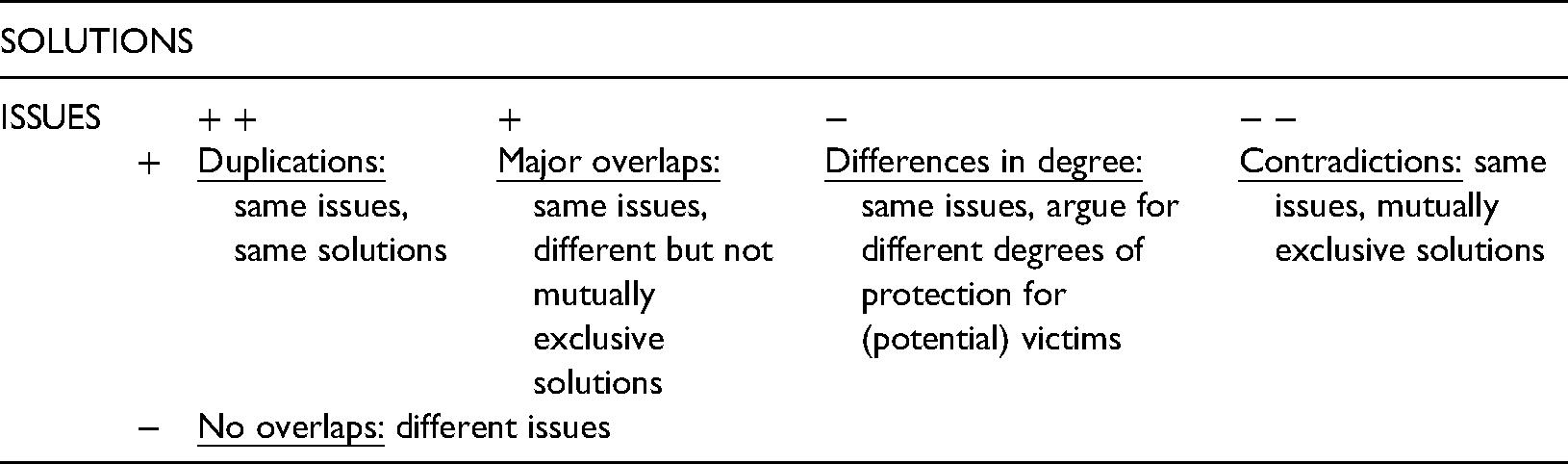
Categorisation of recommendations.
On the one hand, recommendations may touch upon entirely different issues, thus creating cases of no overlaps.
When recommendations touch upon the same issues, they may differ in regard to the solutions they propose to the same countries. First, if the bodies advance the same solutions, duplications arise. When coding the recommendations, this definition was narrowly applied, only including recommendations that were almost identical to each other. An example of a duplication is found in recommendations by the HRCttee and CATc to Denmark: the HRCttee recommended to ‘include[e] torture as a distinct offence in its Criminal Code’. 57 In almost identical words, CATc recommended ‘to make torture a punishable offence per se […] naming the offence of torture as distinct from other crimes’. 58
Second, recommendations may propose different, yet mutually non-exclusive solutions to the same problems (major overlaps). For example, both the CATc and CEDAW delivered recommendations to Venezuela regarding national legislation on femicide, with CATc recommending to ‘[i]ncorporate the crime of femicide into the law and ensure its full and effective enforcement’, 59 while CEDAW asked the country ‘to reconsider the definition of femicide in the reform of the Act in order to ensure that it is in accordance with international standards’. 60
Third, some recommendations may identify the same problematic issues, but disagree on the degree of protection to be accorded to targeted individuals. This article terms this category differences in degree. An example, also reported below in Section 5.3, is provided by CEDAW requesting Canada to ‘abolish the practice of solitary confinement’, 61 whereas CATc recommended the country to limit its use. 62
Fourth, recommendations may also contradict each other: contradicting recommendations provide mutually exclusive advice on how to tackle certain issues, or explicitly disagree on whether the State under review has a problem in a specific area. For example, as will be discussed in Section 5.4, several countries during Kazakhstan's 2014 UPR recommended that the reviewed State adopt legislation criminalising violence against women, while recommendations by the CATc and CEDAW issued in the same year imply that such legislation already exists. 63
In a second step, this article identifies the responses that States give to the recommendations received. States cannot formally reject any recommendations by the treaty bodies: while it is widely accepted that Concluding Observations have no legally binding nature, the treaty obligations to which they refer are legally binding, and committees provide authoritative interpretations of human rights treaty provisions. 64 For these reasons, States’ acceptance of Concluding Observations is deemed implicit. In contrast, the implementation of UPR recommendations is entirely voluntary, and States have the possibility not only to express their support or simply ‘note’ recommendations, but also to deliver an official statement to accompany their acceptance or non-acceptance of these recommendations. This feature reflects the different nature of the two reviewing mechanisms: on the one hand, the highly political, State-led system of the UPR and, on the other hand, the treaty bodies’ expert-based mechanism with quasi-judicial authority.
Against this background, two scenarios may take place when a State is being reviewed by the treaty bodies and the UPR. Most notably, the State may ‘note’ a UPR recommendation which duplicates or presents a major overlap with one delivered by one or more treaty bodies or, vice versa, it may support one which shows a difference in degree or a contradiction with a treaty body recommendation. This article terms these phenomena clashes. Clashes might prove problematic, as they, at least in principle, provide States with an opportunity to indirectly reject a recommendation by a treaty body. Nigel Rodley raised this concern back in 2012: ‘insofar as States might feel free to reject a recommendation made by another State [in the UPR], what would be the effect if that rejected recommendation was in fact, explicitly or implicitly, the same as one made by a treaty body in its concluding observations on the State under review?’. 65 As previous research has shown, the noting of UPR recommendations is indeed often a good predictor of their non-implementation, even though a minority of noted recommendations are eventually implemented. 66 This article traces the existence of clashes between UPR and treaty bodies, highlighting the extent to which State responses in the UPR contradict States’ implicit acceptance of treaty bodies recommendations.
To map the extent to which the UPR and the treaty bodies deliver the aforementioned types of recommendations, this study focused on the case of torture. Empirically, the research analysed three types of source material, namely UPR recommendations, Concluding Observations by treaty bodies, and decisions on individual complaints by treaty bodies. For the purpose of case selection, these sources were divided into two sub-categories: main sources (relevant for case selection) and additional sources. Main sources included Concluding Observations and decisions on individual complaints by CATc – the main treaty body dealing with issues of torture – and torture-related recommendations by the UPR. Additional sources included Concluding Observations and decisions on individual complaints by the treaty bodies which, in addition to CATc, deal most frequently with issues relevant to the scope of the article: HRCttee, CEDAW, and CRC. Recommendations from these bodies were included whenever they touched upon issues of relevance to the scope of the CAT, in the timeframe for this analysis (see below).
The analysis was performed on all UN member States for which, in the period 2012–2016, all three types of main sources were available. 67 This time frame corresponds to the full second cycle of the UPR. When relevant Concluding Observations and decisions on individual complaints were found for the additional treaty bodies mentioned above, these were also included. Their absence was, however, not a sufficient reason to exclude a State from the analysis, as torture is not the main focus of these committees. These criteria led to the selection of 14 countries as case studies (belonging to all of the five UN regional groupings): 68 Australia, Burundi, Canada, Denmark, Finland, Kazakhstan, Mexico, the Netherlands, the Russian Federation, Spain, Sweden, Switzerland, Tunisia, and Venezuela. This corresponded to a total of 14 UPR reports, 40 Concluding Observations (15 by CATc, 8 by HRCttee, 11 by CEDAW, and 6 by CRC), and 43 decisions on individual complaints (37 by CATc, and 6 by HRCttee), as reported in Appendix 1. 69 Besides the aforementioned documents, addenda and additional declarations by States were employed in the analysis of UPR output, as they reported the States’ responses to the recommendations received.
This article adopts as unit of analysis the number of instances in which recommendations delivered to the same country fell into a certain category. For example, if Canada received four recommendations in the UPR, of which one duplicated a recommendation by the CATc, one contradicted a recommendation by the CRC, and two did not overlap with any other recommendations received by Canada, this would count as N = 1 duplications, N = 1 contradictions, and N = 2 no overlaps. Recommendations were coded manually by the author of this article, on the basis of the categorisation outlined above.
RESULTS
In what follows, the empirical findings of this article are presented. The findings are summarised in Table 2 and discussed more extensively in the following sub-sections.
Summary of findings.
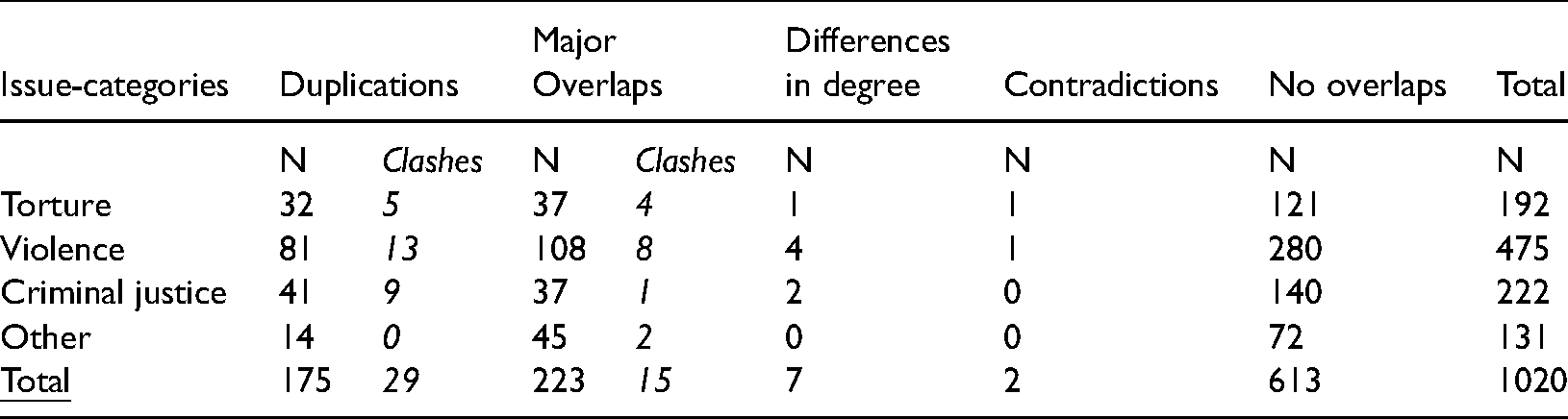
Summary of findings.
Duplications occur when 2 or more recommendations identify the same problematic issues and propose the same solutions towards the same country. In the cases studied in this article, 175 duplications were found, corresponding to 17.16% of the total (1020).
In the issue-category ‘torture’, 32 instances of duplications were found (16.67% of the total within this issue-category). Of this number, 16 cases correspond to duplications between 1 treaty body and the UPR, 5 to duplications between more than 1 treaty body and the UPR, and 12 to duplications that occur only between treaty bodies. An example can be found in recommendations delivered to Canada, requesting the country to incorporate all provisions of the CAT into national legislation. CATc recommended ‘that the State Party incorporate all the provisions of the Convention into Canadian law’. 70 Likewise, France in the UPR recommended Canada to ‘ensure the full transposition into national law of the provisions of the CAT’. 71
Duplications occurred in 81 instances in the ‘violence’ category (17.05%). 36 duplications took place between 1 treaty body and the UPR, 19 duplications between more than 1 of these bodies and the UPR, and the remaining 26 occurred just between these treaty bodies. For example, several countries in the UPR (France, United Kingdom, Spain, and Canada), as well as the CATc, recommended Australia to put an end to the forced sterilisation of persons with disabilities. 72
Duplications in the ‘criminal justice’ category took place in 41 cases (18.47%) and involved 1 treaty body and the UPR in 15 cases, multiple treaty bodies and the UPR in 10 cases, and various treaty bodies with each other in 16 cases. During the reviews of Burundi by CATc and HRCttee, both committees employed almost the same wording when discussing the maximum duration of police custody: CATc stated that Burundi should ‘amend its Code of Criminal Procedure to reduce the allowable duration of police custody to 48 h’, 73 while the HRCttee argued that the country ‘should amend the Code of Criminal Procedure in order to align it with the [International] Covenant [on Civil and Political Rights] by setting the allowable period of police custody at 48 h’. 74
The ‘other’ issue-category is rather heterogeneous, including issues which do not explicitly fit within any of the other categories, but which however fall within the mandate of the CATc. 14 cases of duplications were found, pertaining to human trafficking (10.69%), of which 11 occurred between the UPR and 1 treaty body, and 3 between different treaty bodies. An example of this category is the instance in which both the HRCttee and Sri Lanka recommended Denmark to continue its efforts to fight human trafficking. 75
Major overlaps
Recommendations presenting major overlaps identify the same problematic issues, while proposing different, non-mutually exclusive solutions. Major overlaps took place in 223 instances, representing 21.86% of the total.
Under the ‘torture’ label, major overlaps occurred in 37 cases (16.59% of the total within the ‘torture’ issue-category), just slightly above the number of duplications in the same category. Specifically, the UPR delivered major overlaps with a treaty body in 26 cases, and with multiple treaty bodies in 5 cases. 6 major overlaps took place exclusively among treaty bodies. For instance, both Uruguay (UPR) and CATc delivered recommendations to Kazakhstan concerning the non-admissibility of evidence obtained by torture in criminal proceedings. These recommendations present a major overlap, as Uruguay's recommendation asks Kazakhstan to ‘[i]ntensify the efforts to not allow, in practice, the use as evidence [of] confessions obtained under the use of torture or by other illegal methods’, 76 while CATc provides a more detailed recommendation asking the country, among others, to ‘[i]mprove the methods of criminal investigation to end practices whereby confession obtained as a result of torture and ill-treatment is relied on as proof in criminal prosecution’. 77
In the category of ‘violence’, major overlaps took place in 108 cases (22.74%). 39 major overlaps occurred between the UPR and 1 treaty body, 35 between the UPR and 2 or more treaty bodies, while the remaining 34 took place only between treaty bodies. For example, CEDAW and 4 countries in the UPR (Uzbekistan, Cuba, USA, and Chile) made recommendations to the Netherlands to combat and/or prohibit violence against women. 78
As regards ‘criminal justice’, major overlaps took place in 37 instances (16.67%), of which 20 cases related to overlaps between the UPR and 1 treaty body, 6 to overlaps between the UPR and multiple treaty bodies, and 11 to overlaps between treaty bodies. For instance, CATc and 3 countries in the UPR (Holy See, Uzbekistan, and Rwanda) recommended Australia to improve conditions in its detention facilities, albeit using different wording and posing attention to specific sub-issues. 79
Finally, major overlaps occurred within the ‘other’ category, for a total of 45 instances (34.35%). Of these, 25 were cases of major overlap between 1 treaty body and the UPR, 14 consisted of major overlaps between 2 or more of treaty bodies and the UPR, and 6 were major overlaps between 2 or more treaty bodies. When reviewing Denmark, both the HRCttee and Mexico (UPR) raised the issue of granting residence permits to victims of trafficking. However, while the HRCttee asked Denmark to revise the conditions for issuing these permits, the recommendation by Mexico was focused on residence permits for child victims of trafficking.
Differences in degree
Differences in degree arise when recommendations identify the same problematic issue, but argue for different degrees of protection to be accorded to (potential) victims. They occurred in 7 cases (0.69%). More specifically, once in the ‘torture’ issue-category (between CATc and HRCttee); 4 times in ‘violence’ (twice between CATc and the UPR; once between CATc and HRCttee; and once between CRC and the UPR); and twice in ‘criminal justice’ (between CATc and CEDAW; and between CATc and the UPR).
In relation to ‘torture’, when reviewing Sweden, the CATc stated that acts of torture should not be subject to any statute of limitations. Rather, these acts should always be prosecutable, regardless of how much time has passed since the act was committed. 80 Conversely, the HRCttee took a different approach by advising Sweden to incorporate into its Criminal Code ‘an appropriate statute of limitations for the grave crime of torture’. 81
In the case of ‘violence’, an example of recommendations aiming at different degrees of protection concerned differing views expressed by CATc and HRCttee in relation to Kazakhstan's use of diplomatic assurances. The CATc defines diplomatic assurances in the following way: The term ‘diplomatic assurances’ as used in the context of the transfer of a person from one State to another, refers to a formal commitment by the receiving State to the effect that the person concerned will be treated in accordance with conditions set by the sending State and in accordance with international human rights standards.
82
The CATc adopts a clear stance against diplomatic assurances, arguing that these are not sufficient to guarantee the safety of the individuals concerned. Indeed, the CATc requested Kazakhstan to ‘[r]efrain from the use of and reliance on diplomatic assurances, which should not be used to alter the absolute prohibition of non-refoulement’ 83 and reiterated this principle when deciding on two individual complaints against Kazakhstan. In contrast, the HRCttee adopts a markedly different approach, when recommending Kazakhstan to ‘exercise utmost care in evaluating diplomatic assurances’. 84
Finally, two recommendations expressing differences in degree were found in the issue category ‘criminal justice’. The first took place between two treaty bodies, on the issue of detention. Whereas the CEDAW urged Canada to ‘abolish the practice of solitary confinement’, 85 the CATc requested Canada to limit its use. The second example related to the detention of minors and took place between the CATc and the UPR. On the one hand, the CATc requested Denmark to protect children when placed with adults. Taking the protection of minors a step further, Thailand and Honduras, as UPR-recommending States, asked Denmark to stop placing minors in detention with adults, thus aiming for a stronger degree of protection.
The analysis revealed that in the cases studied in this article different treaty bodies and the UPR, at times, argue for different degrees of protection to be accorded to (potential) victims. Perhaps surprisingly, in all instances, concerned States participating in the UPR took a bolder stance than the treaty bodies. The findings also suggest that the CATc took a more cautious approach than the CEDAW in regard to the use of solitary confinement, while advocating for a more progressive approach than the HRCttee in relation to the acceptability of a statute of limitations for acts of torture and the use of diplomatic assurances.
Contradictions
Contradicting recommendations identify the same issues as problematic, yet show that recommending bodies either disagree on how to solve these issues, or on whether the country under review has a problem in that area. Only 2 contradictions were observed (0.2%): 1 in the ‘torture’ issue-category (CATc-UPR) and 1 in the ‘violence’ category (CATc-CEDAW-UPR). Both cases involved disagreement on whether the concerned State had a problem on a specific issue. No cases were found in which the different bodies recommend mutually exclusive solutions to the same problem.
The first contradiction came down to the following. When deciding on an individual complaint against Tunisia in May 2016, the CATc found evidence of a violation by the country when it came to providing redress to a victim of torture. 86 In contrast, a UPR recommendation delivered to Tunisia by Japan implied that the country was doing well on the issue of redress and should simply continue that way. 87 The UPR recommendation was however delivered in May 2012, so it cannot be excluded that the situation in the country worsened within the 4-year period of time.
The second contradiction related to Kazakhstan's adoption of legislation on violence against women. During Kazakhstan's October 2014 UPR, India, Portugal, and Sierra Leone recommended that the reviewed State adopt legislation criminalising violence against women. However, recommendations by the CATc (November 2014) and the CEDAW (February 2014) 88 implied that such legislation already existed, despite the reviews having taken place in the same time frame as the UPR session. This contradiction may be due to the different levels of knowledge of Kazakh legislation, or to different interpretations thereof between the UPR and the treaty bodies.
No overlaps
Recommendations which did not overlap constituted the majority in all issue-categories, for a total of 613 cases (60.1%).
In the category ‘torture’, this occurred in 121 instances (63.02% of the total within this issue-category). For example, several recommendations delivered by the CATc were not picked up by other mechanisms. These included the right of victims to obtain redress, which in the case of Venezuela was raised exclusively by the CATc. In the ‘violence’ category, recommendations did not overlap in 280 cases (58.95%). For a number of reviewed countries, violence against children was raised only in the UPR (States under review: Denmark, Finland, Mexico, the Netherlands, Spain, and Tunisia) or the CRC (Russian Federation). As in the 2 previous issue-categories, non-overlapping recommendations constituted the majority of cases concerning ‘criminal justice’, namely 140 instances (63.06%). As an extreme example, in the case of Kazakhstan, 19 instances of no overlaps were observed in the case of detention-related recommendations, dealing with issues as wide-ranging as suicide prevention in prisons (HRCttee) or granting international observers access to prisons (UPR). As in the previous issue-categories, recommendations had no overlap with each other in over half of the cases in the ‘others’ category. The CEDAW was the only body recommending Mexico to compile disaggregated data on the phenomenon of human trafficking. The existence of wide areas of non-overlap among these different bodies may originate in the fact that the treaty bodies and the UPR possess very different types of expertise on human rights and on specific country situations, leading them to focus on different issues.
Clashes
As discussed in Section 2, reviewed States in the UPR are required to respond to each of the recommendations received, expressing their support or lack thereof (‘noting’). In contrast, States cannot reject any of the recommendations or decisions by the treaty bodies. This article terms clashes as situations in which States, by supporting or noting a recommendation in the UPR, create a conflict with the implicit expectation that they will implement recommendations and decisions by the treaty bodies. Here, two scenarios were specifically envisioned: States can ‘note’ UPR recommendations which duplicate or present major overlaps with those by the treaty bodies, or they can support recommendations that contradict those by the treaty bodies. As Table 2 shows, clashes only occurred in the case of duplications and major overlaps, meaning that only the first of the two envisioned scenarios took place.
In the case of duplications, clashes occurred within all issue-categories with the exception of ‘others’, for a total of 29 clashes (16.57% of all duplications). In proportion, the issue-category in which most clashes occurred is ‘criminal justice’ (9 clashes, corresponding to 21.95% of duplications in the ‘criminal justice’ issue-category), followed by ‘violence’ (13 clashes, 16.05%) and ‘torture’ (5 clashes, 15.63%). An example of a clash arising from duplications can be found in the above-discussed case of Canada (Section 5.1), where both the CATc and the UPR recommended the country to incorporate the CAT into national legislation. In this case, Canada noted the UPR recommendation and specified in the addendum that they did not intend to incorporate the CAT into national law. 89
Regarding major overlaps, clashes took place to a lower extent as compared to duplications, with a total of fifteen clashes (6.73% of all major overlaps). Moreover, clashes occurred in all issue-categories with the exception of ‘others’. More specifically: four within ‘torture’ (10.81%), eight within ‘violence’ (7.41%), and one within ‘criminal justice’ (2.7%). An instance of overlapping recommendations delivered to the Netherlands by the CEDAW 90 and the UPR 91 (the recommending States were Uzbekistan, Cuba, USA, and Chile) provides evidence of a particular type of clash – which may be termed a ‘selective’ clash – in which the State under review notes a recommendation delivered by some countries, while supporting the same recommendation when delivered by others. The CEDAW and the four aforementioned countries recommended the Netherlands to combat and/or prohibit violence against women. These recommendations were noted when delivered by Uzbekistan and Cuba, yet accepted when delivered by Chile and the USA – with all four UPR recommendations being delivered during the same UPR session in May 2012. 92 Of the 14 countries which were the objects of this study, the Netherlands was the only one to display this type of behaviour. The causes of such selective acceptances are unclear, however, it does not seem far-fetched to assume that the country under review decided to note the recommendations coming from countries with which it does not have strong diplomatic ties, while accepting those by States with which it is in a friendlier relation. 93
WHAT ARE THE CONSEQUENCES FOR THE COMPLEMENTARITY OF UN MECHANISMS IN THE FIGHT AGAINST TORTURE?
The previous section provided evidence of the extent to which the pre-identified typologies of recommendations were observed in the reviews of 14 UN Member States by the UPR and various treaty bodies in the period 2012–2016 on issues falling within the scope of the CAT. The findings of this study have shown that in all issue-categories, the majority of recommendations presented no overlaps with each other, although the number of duplications and major overlaps was very high. Duplications and major overlaps took place extensively between the UPR and the treaty bodies, which is not surprising, considering that States regularly consult the relevant Concluding Observations before formulating their UPR recommendations. In addition, duplications took place between various treaty bodies. In particular, the CATc and the HRCttee, on several occasions, employed almost identical wordings in their Concluding Observations.
Some disagreements between reviewing bodies as concerned the degree of protection to be offered to (potential) victims were observed. While these numbers are small, they do indicate that the parallel existence of multiple reviewing mechanisms provides some opportunities for differing interpretations of human rights standards.
Only two contradictions were found. These are instances in which one body deems the State under review to be in violation of a certain treaty provision, while the other body does not. No cases were furthermore found in which different bodies recommended conflicting solutions to the same problem. These findings fall quite in line with those by Tistounet, who concluded that treaty bodies mostly do provide coherent interpretations of treaty provisions, even though occasional discrepancies arise. 94
Finally, duplications and major overlaps gave rise to some clashes. Specifically, States under review regularly took note of UPR recommendations which largely resemble those delivered by treaty bodies. Interestingly, no clashes were observed when it comes to contradictions or differences in degree.
Results from this research thus only partially confirm the concerns expressed by several scholars and practitioners that the parallel existence of the treaty bodies and the UPR would give rise to coordination problems between the output of these mechanisms. 95 Although duplications can introduce problems, the occurrence of contradictions was scarce, and in multiple areas the two mechanisms delivered non-overlapping recommendations. In addition, the findings of the study show that overlaps were not only introduced by the UPR vis-à-vis the treaty bodies, but frequently occurred among different treaty bodies.
Yet, does the existence of duplications, overlaps and contradictions matter at all for the way States approach these instruments? Section 2 identified a set of consequences that regime complexes may have on decision-makers’ strategies. While a precise assessment of the extent to which UN bodies in the fight against torture give rise to each of these instances is beyond the scope of this article, observing State acceptance of the UPR recommendations can give us some insight into which of these scenarios may be taking place.
By analysing patterns of States’ acceptance and non-acceptance of the UPR recommendations, combined with the additional explanatory notes that often accompanied non-acceptances, it appears that States are inclined to follow the advice that better falls in line with their preferences, thereby engaging in forum shopping. Indeed, findings from this article have shown that States use the possibility to note the UPR recommendations to signal which course of action they do or do not desire to undertake. For example, when the CATc and the UPR (Luxembourg and Slovenia) disagreed on whether Australia should put an end to the practice of processing asylum applications in offshore centres (UPR) or should simply improve the protection of asylum seekers in those centres (CATc), Australia noted and declared it would not further consider the UPR recommendations. In this way, while Australia did not necessarily signal that the conditions in those centres would improve, it certainly indicated the intention of keeping the centres operational. The practice of noting UPR recommendations equally seems to provide States with room to evade obligations deriving from the treaty bodies. States, as remarked earlier, cannot decline to implement recommendations and decisions by the treaty bodies. Nonetheless, when they note a UPR recommendation that duplicates one by a treaty body, they implicitly refuse to implement the respective treaty body recommendation. This practice may, in turn, be seen as a type of regime shifting, with governments engaging progressively more with the State-friendly UPR, and progressively less with the treaty bodies. Whilst the UPR boasts a 100% State participation, UN data shows that, as of January 2016, 37% percent of reports to treaty bodies were overdue. 96 Finally, the Dutch practice of selectively noting and supporting almost identical UPR recommendations, depending on which country issued them, reinforces previous claims on the highly political nature of the UPR, where bilateral relations between countries play a central role. 97
To what extent, then, do the duplications, overlaps and contradictions identified in this article place these institutions in a reinforcing or mutually undermining relationship? It is yet to be seen whether duplications or major overlaps are more likely to lead to the implementation of recommendations than cases of no overlap. However, the fact that the UPR – a highly political mechanism – regularly picks up recommendations by the treaty bodies seems to at least increase the chances that these recommendations are implemented. As Carraro argues, ‘when a State accepts a recommendation in the UPR setting, the accepted recommendation becomes a political commitment taken with a fellow country’. 98 Therefore, there are reasons to believe that duplications and major overlaps may, after all, be good news for the UN human rights system. Nonetheless, there is a caveat – the potential positive effects of overlaps are only likely to occur if recommendations are supported by the State under review, rather than only noted. It is precisely the explicit acceptance of a UPR recommendation that increases its political power and its likelihood of being implemented. This was the scenario anticipated by Rodley, 99 who feared the possibility of such clashes taking place. The possibility of rejecting human rights recommendations deriving from treaty bodies may well undermine their aura of authoritativeness, creating a pick-and-choose culture within the UN human rights system.
Additionally, contradictions were perhaps the most feared possible outcome of the parallel existence of multiple UN human rights mechanisms. Clearly, when two or more bodies contradict each other, it can be expected that this will not only damage their credibility, but also create opportunities for States to choose in which direction to move forward. The analysis of this article has demonstrated, however, that disagreements between the UN human rights mechanisms were scarce, at least in the cases studied.
Finally, the fact that many instances of no overlap between recommendations were observed shows that the different mechanisms cover gaps left open by one another, making sure that, taken together, the recommendations delivered to States cover an ample spectrum of human rights issues. This reflection falls well in line with arguments by Noelle Higgins, 100 who noted how the UPR provides a chance for the rights of minorities and indigenous people to be included in the periodic examination of States’ human rights performance, as prior to the existence of the peer review there was no ad hoc State reporting system that covered the matter.
CONCLUSIONS
This article set out to devise a strategy to assess the extent to which the UPR and the treaty bodies provide overlapping recommendations to States, and the way in which States respond to such situations. Applying this framework to the empirical case of the fight against torture, it created an extensive database of recommendations delivered by different UN bodies to 14 countries in the period 2012–2016. Furthermore, the database recorded how States responded to these recommendations, focusing, in particular, on States’ practices of noting or supporting UPR recommendations that overlapped with those delivered by treaty bodies.
The analysis divided torture-related issues into four issue-categories, namely
torture; violence against different groups; criminal justice system; and other.
It uncovered that, in all issue-categories, over half of the recommendations did not overlap with each other. However, the combined proportion of duplications and major overlaps between recommendations was remarkably high in all cases. Clashes took place to some extent in all issue-categories.
The empirical findings of this article have revealed that, while duplications and major overlaps may indicate the existence of possibly pointless repetitions between these mechanisms, such repetitions do not necessarily need to damage compliance with recommendations. Rather, the fact that the UPR picks up recommendations coming from the treaty bodies likely adds political pressure to them, thus aiding their implementation. The possibility offered to States in the UPR to decline their support for the recommendations received may still indirectly damage the treaty bodies when the noted recommendations originally stem from them. The absence of overlaps in a high proportion of cases also indicates that there is added value in the existence of parallel mechanisms, as issues that are not being picked up in one forum are at least being raised in another. These findings fall well in line with arguments by Ebobrah, 101 in relation to the African human rights system, who stressed that successful complementarity between institutions requires a delicate balance between specialised actions by each of these bodies, accompanied by mutual support and cooperation to achieve common goals.
Finally, recommendations arguing for different degrees of protection seem to provide evidence of ongoing debates among UN bodies regarding the interpretation of human rights provisions. Alternatively, they might indicate a lack of coordination between different treaty bodies, which are unaware of each other's interpretation of specific issues. Recommendations expressing differences in degrees and/or contradictions are also likely to create opportunities for States to choose their preferred course of action, and possibly damage the credibility of the UN human rights machinery. This seems to confirm the concerns raised by academics and practitioners regarding the fragmentation of human rights norms caused by the existence of multiple bodies – even though, in the cases studied in this article, disagreements among different bodies took place in a small minority of cases.
It is to be noted that the analysis only focused on recommendations falling within the scope of the CAT, thus limiting its potential for generalisability. Arguably, performing the analysis on more controversial issues or on rights that are not of an absolute nature may deliver different results.
Additionally, due to its focus on the development of a framework to categorise recommendations on the one hand, and its empirical application on the other, this article cannot draw conclusions on the extent to which overlapping activities by human rights mechanisms impact State compliance with human rights recommendation. A full-fledged answer to these questions can only be provided by a large-scale empirical analysis at country-level and touching upon multiple human rights issues, tracing the extent to which each recommendation is complied with, and why. Hopefully, this will be the subject of future research in this area.
Footnotes
Acknowledgments
For highly helpful feedback and suggestions, the author warmly thanks Suzanne Egan, Damian Etone, Hortense Jongen, Giuliana Monina, Mahmood Monshipouri, Christine Neuhold, Manfred Nowak, and Cecily Rose. Vera Karagiannidou and Shaya Javadinia provided excellent research assistance.
Author's Note
This study was carried out at the Ludwig Boltzmann Institute of Human Rights, Vienna, Austria and at Maastricht University, Maastricht, The Netherlands.
Declaration of Conflicting Interests
The author(s) declared no potential conflicts of interest with respect to the research, authorship, and/or publication of this article.
Funding
This work was supported by the Dutch Research Council under Grant number 446-17-006.

Notes
Overview of Cases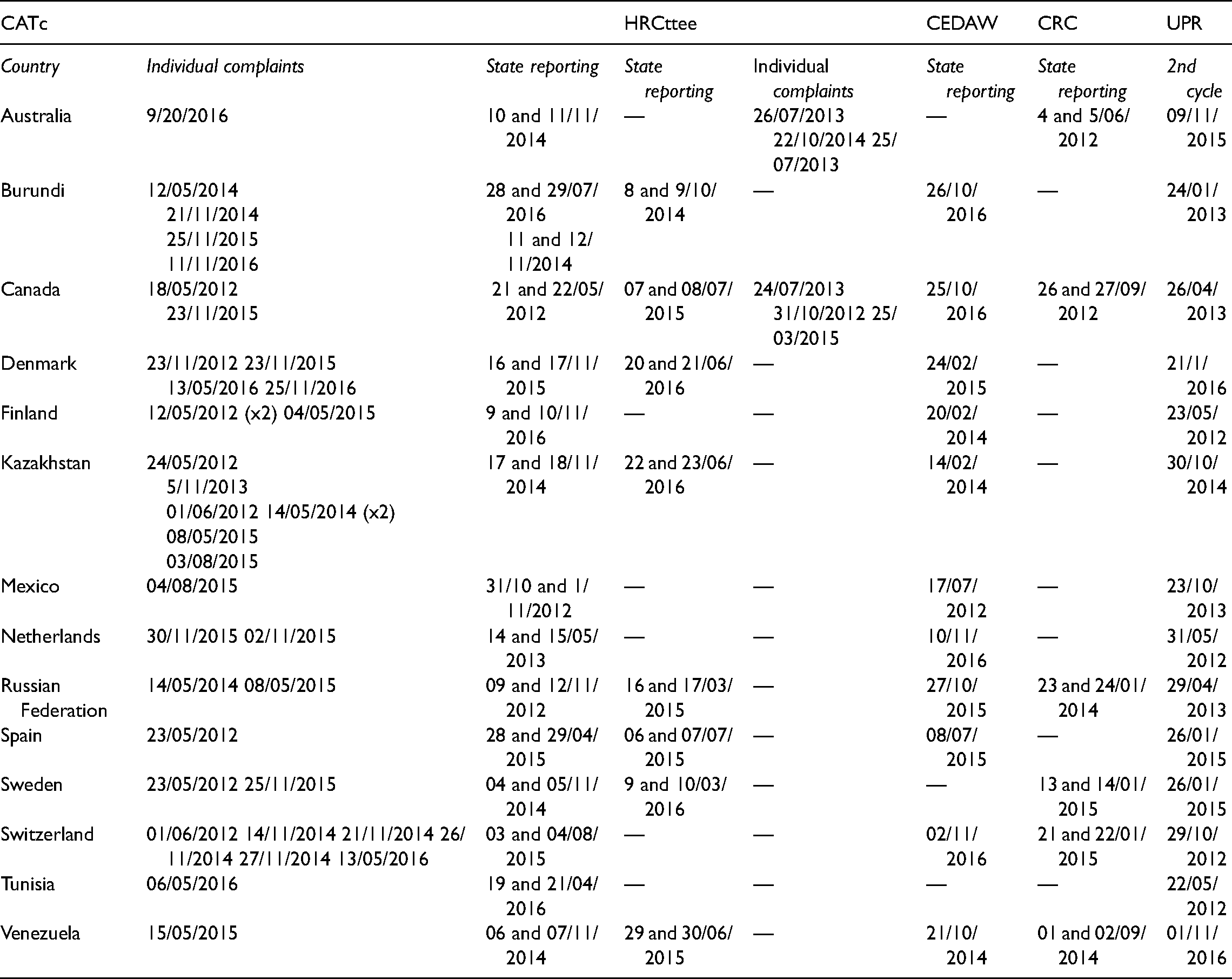
CATc
HRCttee
CEDAW
CRC
UPR
Country
Individual complaints
State reporting
State reporting
Individual
complaints
State reporting
State reporting
2nd cycle
Australia
9/20/2016
10 and 11/11/2014
—
26/07/2013
22/10/2014 25/07/2013—
4 and 5/06/2012
09/11/2015
Burundi
12/05/2014
21/11/2014
25/11/2015
11/11/201628 and 29/07/2016
11 and 12/11/20148 and 9/10/2014
—
26/10/2016
—
24/01/2013
Canada
18/05/2012
23/11/2015 21 and 22/05/2012
07 and 08/07/2015
24/07/2013
31/10/2012 25/03/201525/10/2016
26 and 27/09/2012
26/04/2013
Denmark
23/11/2012 23/11/2015
13/05/2016 25/11/201616 and 17/11/2015
20 and 21/06/2016
—
24/02/2015
—
21/1/2016
Finland
12/05/2012 (x2) 04/05/2015
9 and 10/11/2016
—
—
20/02/2014
—
23/05/2012
Kazakhstan
24/05/2012
5/11/2013
01/06/2012 14/05/2014 (x2)
08/05/2015
03/08/201517 and 18/11/2014
22 and 23/06/2016
—
14/02/2014
—
30/10/2014
Mexico
04/08/2015
31/10 and 1/11/2012
—
—
17/07/2012
—
23/10/2013
Netherlands
30/11/2015 02/11/2015
14 and 15/05/2013
—
—
10/11/2016
—
31/05/2012
Russian Federation
14/05/2014 08/05/2015
09 and 12/11/2012
16 and 17/03/2015
—
27/10/2015
23 and 24/01/2014
29/04/2013
Spain
23/05/2012
28 and 29/04/2015
06 and 07/07/2015
—
08/07/2015
—
26/01/2015
Sweden
23/05/2012 25/11/2015
04 and 05/11/2014
9 and 10/03/2016
—
—
13 and 14/01/2015
26/01/2015
Switzerland
01/06/2012 14/11/2014 21/11/2014 26/11/2014 27/11/2014 13/05/2016
03 and 04/08/2015
—
—
02/11/2016
21 and 22/01/2015
29/10/2012
Tunisia
06/05/2016
19 and 21/04/2016
—
—
—
—
22/05/2012
Venezuela
15/05/2015
06 and 07/11/2014
29 and 30/06/2015
—
21/10/2014
01 and 02/09/2014
01/11/2016