




Abstract
Referendums and popular initiatives have proliferated in many parts of the world as part of the effort to improve the quality of democracy and enhance citizen participation in policy making. However, even before the surge of populist nationalism in the 2010s, referendums have become a sort of weapon to restrict various rights. Furthermore, the juxtaposition between ‘the will of the people’ and human rights has once again brought back the classical criticism against direct democracy that it constitutes ‘a tyranny of the majority’ that could erode minority rights. With these concerns in mind, this paper is written to analyse the dissonance between human rights referendums and international human rights law through a positivist lens. The overall goal is to determine whether States have an ex ante obligation to prevent a referendum on a subject matter that is contrary to human rights.
Keywords
1. Introduction: The dilemma of direct democracy vis-à-vis human rights
On 7 November 2000, the people of Alabama cast their ballot to decide whether they would be in favour of a constitutional amendment repealing the prohibition of interracial marriage in the constitution. Although this prohibition was already rendered obsolete by the US Supreme Court in Loving v Virginia, 1 the referendum was still required by law to remove the provision from the constitution. In the end, the majority supported the amendment. However, it is worth noting that 40.51% voted against interracial marriage, which is quite a significant percentage. 2
This was not the first time a referendum on human rights was held. In Liechtenstein, voters rejected women’s suffrage three times in 1968, 1971 and 1973. 3 Finally, in 1984, the effort to enfranchise women in that principality passed with a narrow margin of 119 votes. 4 There were even referendums with a subject matter that is flagrantly intended to limit the exercise of a certain right, such as the 2009 Swiss minaret referendum in which a large majority of 57.51% supported a constitutional ban on the construction of new minarets. 5 Furthermore, in recent times, there are various referendums being held on human rights matters that are still subject to extensive controversy under the jurisprudence of international human rights law, such as the 2015 Slovenian same-sex marriage referendum, 6 the 2018 Irish abortion referendum, 7 and the 2018 Irish blasphemy referendum. 8
When the result of these sort of referendums is favourable in the eyes of human rights defenders, it will usually be applauded. 9 However, ‘the will of the people’ does not always align with international human rights law. Furthermore, referendums may also intentionally be called by a populist party to provoke a clash with international law, including international human rights jurisprudence. 10 Back in 1992, the Swiss Democrats launched a popular initiative titled für eine vernünftige Asylpolitik (‘for a sensible asylum policy’) to summarily deport asylum seekers who entered the country in a clandestine manner without any possibility of appeal. This initiative was later invalidated by the Swiss Federal Parliament due to the finding that it violates the prohibition of refoulemen t. 11
This raises the issue of whether States are legally allowed to hold a referendum whose subject matter could lead to a direct violation of international human rights law. When such a proposition is approved by the majority, it will create a dissonance between ‘the will of the people’ and human rights. The State will consequently face a predicament. On the one hand, ‘the people have spoken’ and States are at least politically bound to adhere to the result, if not legally in the case of a binding referendum. On the other hand, States are also under the international obligation to respect human rights, and they are not allowed to invoke domestic provisions (including referendum results) to justify an infringement. In fact, human rights activists have begun to adopt a sceptical approach towards human rights referendums in general, since in their view human rights should not be subject to the whim of the people. 12
With this dilemma in mind, the goal of this article is to analyse the dissonance between referendums and international human rights law through a positivist lens. For this reason, the term ‘human rights’ in this article refers to rights that are enshrined and protected by international human rights treaties. While this particular issue could also be tackled from a normative perspective, there is still a lack of scholarly literature that approaches the dissonance from a purely legal angle. This article intends to not only fill this particular gap, but also initiate a discussion on how human rights referendums need to be tackled from the perspective of international human rights law.
As a note, the subject matter of a referendum might have either direct or indirect impact on human rights. The former refers to immediate impact emanating from the implementation of the subject matter itself. 13 For instance, a subject matter proposing the automatic expulsion of clandestine asylum seekers would immediately impact the rights of undocumented migrants if it were to be implemented. Meanwhile, the latter means that the impact is not an immediate result of the implementation of the subject matter in question. The impact is often regarded as unintentional and it could be generated through a complex pathway. 14 As an illustration, in 2018, the Taiwanese electorate voted against the planned nuclear power phase-out. 15 While the implementation of the result could conceivably have a nonimmediate impact on, for example, the right to private life or health of various individuals near existing power plants, an immediate impact would not be produced the moment the planned phase-out was cancelled. This article only covers referendums whose subject matter could lead to a direct detrimental impact on human rights, and thus the term ‘human rights referendums’ in this article refers to such a measure.
This article is structured as follows. It starts by laying out a typology for human rights referendums in Section 2. In Section 3, the article clarifies why human rights referendums are particularly problematic when compared with an ordinary legislative bill. Subsequently, Section 4 assesses the compatibility of referendums with international human rights law. It consists of the clarification of the status of referendums per se under international human rights law, the identification of legal complications that could arise in the compatibility assessment, and an analysis of these difficulties in light of the typologies of human rights referendums and the jurisprudence of international human rights law. Based on this, this article determines the scope of State obligation in the case of a human rights referendum: the primary question in this regard is whether they have an ex ante obligation to prevent a human rights referendum from happening or whether they are only bound ex post facto to not implement the detrimental result. The review is conducted on an abstract level; in other words, it clarifies the law in a generalised manner without focusing on a particular case.
2. Typology of human rights referendums
Before digging into the main substance of the dissonance between human rights and vox populi, it is essential to clarify the typologies that are used for the legal analysis in this article. There are two sorts of typologies that will be laid out in this section: typologies for referendums in general and typologies that are specifically geared for human rights referendums. These typologies will be useful in encapsulating all the nuances that exist in the history of referendums.
2.1. General typology of referendums
The term ‘referendum’ has been loosely defined as ‘a device of direct democracy by which the people are asked to vote directly on an issue or policy’. 16 It is different from elections that are organised to vote for a person or a party who will represent the people in decision-making. 17 Historically, the practice of holding a public vote to determine the will of the people on a certain issue could be traced back to the Landesgemeinde system in Switzerland in the Middle Ages, or even further, to the practice of direct democracy in ancient Greek and Roman societies. 18 With the increasing pace of democratisation in the 20th century, referendums have spread to many parts of the world. 19 The number of referendums held also increased significantly during the Third Wave of Democratisation. Indeed, as was observed by Laurence Morel, there were almost 900 nationwide referendums held in 1980-2008, which is nearly three times higher than the number in the 1950-79 period (362 referendums). 20
At the same time, referendums have diversified to such an extent that the word has become a catch-all term for various forms of public vote. 21 The terminologies themselves are rich in variety. 22 As an illustration, various scholars distinguish the term ‘plebiscite’ from referendum, since it is deemed to be outside of the legal order, held only when it is convenient and characterised by the lack of free and fair competition between the different options (mostly due to its misuse by Napoleon and Hitler). 23 However, in Australia, the term ‘plebiscite’ simply means a public vote on a matter that does not affect the national constitution, in contrast with referendums. 24 The term itself has been used in a neutral context, such as the Carinthian plebiscite in 1920 that was intended as an exercise of self-determination and led to the division of the former Duchy of Carinthia into Austrian and Slovenian zones. 25
Despite the lack of a uniform terminology for public vote, political scientists have developed various forms of typology to encapsulate the nuances that are present in different systems all over the globe. 26 Claes de Vreese adapted the existing typologies into one that includes four types: compulsory/binding referendum (referendum that must be held by law, such as referendums to amend the constitution or to join an international organisation), rejective/facultative referendum (referendum on a law that is already passed), initiative/direct referendum (referendum on a subject matter that was introduced by citizens) and advisory/plebiscite referendum (referendum initiated by the government for consultative purposes). 27 However, this typology might be criticised due to the possibility of an overlap. For instance, rejective referendums are often held after a group has collected enough signatures, and in that case such referendums could also qualify as initiative referendums.
Since this research is intended to assess State obligation with regard to human rights referendums, the typology choice needs to be narrowed down based on the binding nature of the referendum. There are two possible typologies in this regard: ex ante and ex post facto typologies. An ex ante typology is based on whether the government is legally bound under national constitutional law to hold a certain referendum. This typology consists of two types: ‘compulsory’ and ‘facultative’ referendum. 28 As explained by Maija Setälä, the former refers to referendums that are obliged by the constitution, whereas the latter is ‘triggered only at certain political actors’ request’, such as ‘by a certain number of citizens, by an actor in the representative government, or by local or regional governments’. 29 Meanwhile, ex post facto typology focuses on whether the government is legally bound to implement the result of the referendum. It also consists of two types: ‘binding’ and ‘consultative’ referendum. 30 Eventually, the particular typology that is used in the legal analysis of this article will depend on whether the state has an ex ante or ex post facto obligation.
2.2. Typology specific for human rights referendums
The subject matter of referendums varies greatly. In the context of human rights referendums, it could range from women’s rights to freedom of religion, LGB rights and migrant rights. There was also a referendum in Switzerland that could have led to the violation of the right to an effective remedy had it been approved, namely a 2008 initiative proposing to subject naturalisation decisions to a public vote. 31 Due to this variety, a typology specifically tailored for human rights referendums is also required.
Based on the history of referendums, there are three types of human rights referendums that are currently possible: referendums with a subject matter incompatible with jus cogens, referendums with a subject matter limiting a certain right, and referendums with a subject matter repealing a limitation or emancipating a group. The first two types are concerned with negative obligations; in other words, if the proposition of the referendum were to be approved, it would lead to the violation of the obligation to respect a certain right. There is, however, a fundamental difference between the two, since jus cogens norms can never be derogated in any circumstances, whereas other human rights could be subject to a limitation if the legal grounds for it are fulfilled. Meanwhile, the third type is concerned with positive obligations to fulfil the right of a certain group. As an illustration, a compulsory referendum called to grant voting rights to a disenfranchised minority constitutes a positive measure intended to fulfil the right to political participation of a certain group.
3. Human rights referendum: Particular source of concern?
Having clarified the typologies of human rights referendums, the question that needs to be addressed now is why a human rights referendum is particularly problematic when compared with an ordinary legislative bill detrimental to human rights. In the following section, it will be demonstrated that a human rights referendum is qualitatively different and thus it warrants special attention. First, a human rights referendum poses the risk of direct juxtaposition between the will of the people and human rights as a consequence of populism. Second, a human rights referendum lacks safeguards as compared to an ordinary parliamentary bill. Finally, the holding of a human rights referendum itself implies that human rights could be subject to the whim of the people.
3.1. Populism, vox populi and the risk of direct juxtaposition
Referendums have been touted as a way to enhance the democratic element in the decision-making process. 32 However, even before the surge of populist nationalism in the 2010s, 33 referendums have already been misused by authoritarian leaders to legitimise their power, including Adolf Hitler in Nazi Germany and Saddam Hussein in Iraq. 34 In more recent times, referendums have been appropriated by populist actors to enter mainstream politics through the mantra of ‘returning power’ to the hands of the people. 35 Consequently, these sort of actors have deliberately launched referendums that pit the people not only against the ‘corrupt elite’, but also against the international legal order as a whole. 36 In Switzerland, for instance, right-wing populist parties (such as the Swiss People’s Party) have intentionally launched provocative popular initiatives with the goal of delegitimising international law and highlighting the ‘encroachment’ of ‘foreign judges’ upon national sovereignty. 37 This includes referendums whose subject matter could violate international human rights law. 38
Furthermore, populism appeals to the most primordial identity, and it has embraced the idea of ‘tribalism’ and ‘us vs. them’ mentality. 39 Consequently, populism has resulted in the holding of referendums with a subject matter that targets or erodes minority rights, particularly those that are deemed to be ‘unpopular’. 40 The 2009 Swiss minaret referendum is an example of a populist backlash against increasing Muslim immigration. 41 Similarly, the 2018 Romanian same-sex marriage prohibition referendum has been alleged as an effort to divert attention from the anti-corruption effort in the country by harnessing populist conservative sentiment against LGBT minorities, although this referendum ultimately failed due to low turnout. 42
This sort of referendum practically puts the fate of a certain group in the hand of the majority of the electorate. In fact, one of the most commonly expounded criticisms of referendums is that such a practice could lead to the ‘tyranny of the majority’.
43
In Switzerland, a bastion of direct democracy, the approval of the 2009 minaret referendum has been regarded as an indication that the ‘wise’ rule of the majority could very well degenerate into a tyranny.
44
Maya Hertig Randall even observed that: The acceptance of a series of popular initiatives clashing with the rule of law and Switzerland’s human rights obligations or other international treaties of fundamental importance seems to be part of a general trend pointing to an increased success rate and a changing function of the popular initiative in the Swiss legal order.
45
Thus, referendums pose the risk of juxtaposition between the will of the people and human rights (including minority rights). In this regard, what distinguishes referendums from a mere parliamentary bill is that there is a direct risk emanating from referendums, since they directly carry the weight of ‘the will of the people’ behind them. Few fully democratic governments dare to contravene the people’s voice, even if the referendum itself is consultative, 47 as it could constitute a political suicide and a ‘betrayal’ of democracy. Furthermore, overturning the decision of the people would feed populist sentiment against ‘the privileged elite’ or ‘the enemy of the people’. For instance, when the Federal Supreme Court of Switzerland refused to apply a new constitutional provision on the expulsion of foreign criminals that was voted by the majority, right-wing populist politician Christoph Blocher was quick to proclaim that ‘[T]he parliament, the people and the cantons have been deprived of their legislative power. It is a real silent coup’. 48 He also pandered to the populist sentiment by stating that ‘direct democracy reduces the power of the political class, who is trying by all means to exclude the people’. 49 This example demonstrates the risk that referendums could be misused as a tool to legitimise the violation of human rights in case of a collision between the rule of law and direct democracy. 50
At the same time, one might retort that the juxtaposition risk is also present in ordinary legislative bill. Members of the legislature too are elected by the people, and thus an ordinary legislative bill is also supposed to be representative of the will of the people. Furthermore, an outcome detrimental to human rights could also emanate from an ordinary legislative bill. David Altman, for instance, admitted that citizen-initiated mechanisms of direct democracy always have the risk of bringing ‘irresponsible results’, and yet ‘this can also be claimed with regard to representative democracy itself’. 51
This research is not intended to delve into the empirical question of whether an ordinary legislative bill does truly represent the will of the people. 52 It is also not the purpose of this article to empirically determine whether mechanisms of direct democracy are more reflective of the will of the people compared with legislative measures in a representative democracy. 53 Nevertheless, as observed by Liubomir Topaloff, ‘referendums produce a conflict between competing sources of legitimacy — elected representative bodies on the one hand, and direct popular votes on the other’. 54 In fact, an argument that is often espoused in favour of referendums is that ‘the popular will is more accurately expressed’ therein when compared with an ordinary legislative bill. 55 As a consequence, the juxtaposition risk seems to be much more pronounced in referendums, since citizens would have a direct say on a subject matter, and a proposition detrimental to human rights could then be legitimised through a direct appeal to vox populi as pronounced in the referendum result. Furthermore, members of a representative body are often branded as the ‘elites’ whose interests are not aligned with those of the people, 56 and thus an effort to legitimise a legislative bill violating human rights would face difficulty in directly appealing to vox populi in the way that a referendum could.
3.2. Lack of political safeguards
Another fundamental difference between a referendum and a legislative bill is the existence of political safeguards. Such safeguards could normally be found in ordinary legislative procedures; as observed by Daniel Moeckli: Decision-making in parliament is characterised by mechanisms of deliberation (such as commission meetings and expert hearings), bargaining processes promoting compromise, and further safeguards (such as public voting) that tend to protect the interests of minorities.
57
These sorts of safeguards are noticeably lacking (or at least insufficient) in a referendum. In Switzerland, for instance, the traditional ex ante political solutions are simply to hold a lively debate and bring forward parliamentary counter-proposals.
58
In Randall’s view, The approval of the ‘anti-minaret initiative’ has undermined the assumption that the political process offers sufficient safeguards to avoid collisions between popular sovereignty and the rule of law and to prevent direct democracy from degenerating into a tyranny of the majority
59
Plebiscitarian procedures (…) impoverish the tool box of democratic politics by eliminating the space for postvoting reasoning and compromise-finding in the institutional framework of representative democracy. They privilege the fast, impulsive snapshot reaction generated by passions and visceral instincts over the more time-consuming balancing of interests and the typically lengthier process of persuasion through argument. As a consequence, consistency is not required: voters can simultaneously opt for lower taxes and greater expenditures, or for cheaper gas and stricter environmental standards.
60
3.3. Symbolic power of the law
The problem with human rights referendums is not only concerned with the fact that they could lead to a detrimental outcome and that they could incur damage to the human rights system. The law is not a mere bundle of substantive and procedural rules that are intended as a system of control. It also has a symbolic element to it. As observed by Mauricio García-Villegas: The law is […] a cultural system of meaning as well as a system of instrumental controls. Its force lies not only in the threat or reward it promises but also in its ability to produce speech that people perceive as legitimate, true, and authoritative.
62
Based on this line of thought, it could also be argued that the holding of a referendum on minority rights would create a chilling signal that minorities are subject to the ‘tyranny of the majority’ and that they should just comply or even ‘assimilate’ in case the majority decide otherwise. The message becomes even more serious when the referendum is proposing a measure that is contravening a jus cogens norm. It would spread an unacceptable message from the perspective of the rule of law that it is legitimate to deviate from peremptory norms (such as the prohibition of torture or genocide) if the public dictate it to be that way.
4. Compatibility of referendums with international human rights law
Having explained why human rights referendums are particularly problematic from a political and legal perspective, this section will now turn to the assessment of the compatibility of human rights referendums with international human rights law.
4.1. Status of referendums under international human rights law
The practice of holding a referendum is not precluded by international law. 63 It could even be assumed that international human rights law is friendly to the practice of holding referendums in general, since human rights favour citizen participation in the political sphere as enshrined in Article 21 of the Universal Declaration of Human Rights (‘UDHR’) and Article 25 of the International Covenant on Civil and Political Rights (‘ICCPR’) on the right to equal participation in political and public affairs.
Nevertheless, States are still required to adhere to international standards in holding free and fair referendums. Article 25(b) of the ICCPR states that every citizen has the right: To vote and to be elected at genuine periodic elections which shall be by universal and equal suffrage and shall be held by secret ballot, guaranteeing the free expression of the will of the electors.
4.2. Difficulties in referendum review under international human rights law
There are two difficulties that need to be addressed before assessing the compatibility of human rights referendums with international human rights law. The first difficulty is concerned with compulsory referendums. Various legal systems require approval by the electorate to effectuate an amendment to the constitution, and as a result the repeal of a constitutional provision violating human rights would also be subject to this requirement. If the electorate voted against it, the violation would persist. At the same time, under international law, it has long been established that States cannot invoke national law or even constitutions to justify infringement of international norms.
67
The Human Rights Committee also reaffirmed in General Comment 31 that: Although article 2, paragraph 2 [of the ICCPR], allows States Parties to give effect to Covenant rights in accordance with domestic constitutional processes, the same principle operates so as to prevent States parties from invoking provisions of the constitutional law or other aspects of domestic law to justify a failure to perform or give effect to obligations under the treaty.
68
There is also a purely academic question that could arise in the case of a compulsory referendum. If it is assumed that Liechtenstein had ratified the ICCPR in 1976 and the CEDAW in 1981, 69 the 1984 Liechtenstein women’s suffrage referendum would have constituted a violation of Article 25(b) of the ICCPR and Article 7(a) of the CEDAW, since only males were allowed to participate in the referendum. 70 However, such a referendum is constitutionally necessary to enfranchise women. This creates a paradox, since one has to hold a referendum in order to ensure compliance with these provisions, but at the same time the conduct of such a referendum is not in line with international human rights law. Nevertheless, there is currently no concrete case where such a paradox is manifest, and thus it remains in the realm of academic speculation.
Meanwhile, the second difficulty relates to the question of whether States have an ex ante obligation of preventing a human rights referendum, or whether they only have an ex post facto obligation of not implementing a result that is detrimental to fundamental rights. This difficulty would especially affect civil rights referendums, as the holding of the referendum in itself has been claimed as a violation of the non-discrimination obligation or other civil rights obligations. 71 At the same time, it could also be argued that it is not the referendum per se that is contrary to international human rights law, but rather one of the potential results. Based on this line of thought, it could be claimed that under international human rights law, a referendum only has to satisfy the requirements of Article 25(b) of the ICCPR and other related provisions to be legal. In order to tackle this particular difficulty, it is necessary to assess human rights referendums in light of their typologies and their compatibility with international human rights law, which will be explored in the following subsections.
4.3. Referendum contravening jus cogens
In July 1992, a popular initiative titled für eine vernünftige Asylpolitik was submitted to the Swiss Federal Government. It proposed a constitutional amendment that would summarily deport asylum seekers who entered the country in an irregular manner without any possibility of appeal. Such a subject matter is incompatible with the norm of non-refoulement, since the lack of appeal would leave no room for the refugees concerned to be protected from torture or inhumane or degrading treatment in the country where they would be deported back to. 72
Despite the debate among legal scholars, 73 the Swiss Federal Council considered the norm of non-refoulement to have attained a jus cogens status under international law. 74 Consequently, in 1996, this popular initiative was declared to be invalid by the Swiss Federal Parliament in accordance with the recommendation of the Swiss Federal Council. 75 In the view of the Council, peremptory norms are of ‘fundamental importance’ to the Rechtsstaat, and the violation of such a norm would undermine it and create irreparable damage. 76 To prevent this case from reoccurring, jus cogens as a limitation to popular initiatives was subsequently enshrined in Article 139(3) of the Swiss Constitution in 1999. Since then, a proposed popular initiative that is deemed to be incompatible with peremptory norms will be invalidated entirely or in part. 77 In the view of Erika de Wet, this provision serves as a ‘reliable way of protecting jus cogens norms of international law within the domestic legal order’, and it functions as an ‘emergency brake’ with the aim of ‘securing respect for core international obligations at all times’. 78
The vernünftige Asylpolitik case demonstrates an example of how ‘the will of the people’ and non-derogable fundamental rights could actually collide. Under Swiss constitutional law, the clash is handily avoided by the decision to invalidate the proposed popular initiative, although the Swiss practice is still striving for an international-law friendly interpretation in accordance with the in dubio pro populo principle (when possible, popular initiatives should be interpreted in such a way that its invalidation could be avoided). 79 Meanwhile, the enshrinement of the jus cogens emergency brake in the Swiss Constitution has guaranteed that, as observed by Erika de Wet, ‘the core values of the international community remain beyond the reach of the will of the people (unless the constitution itself is amended to reverse this position)’. 80
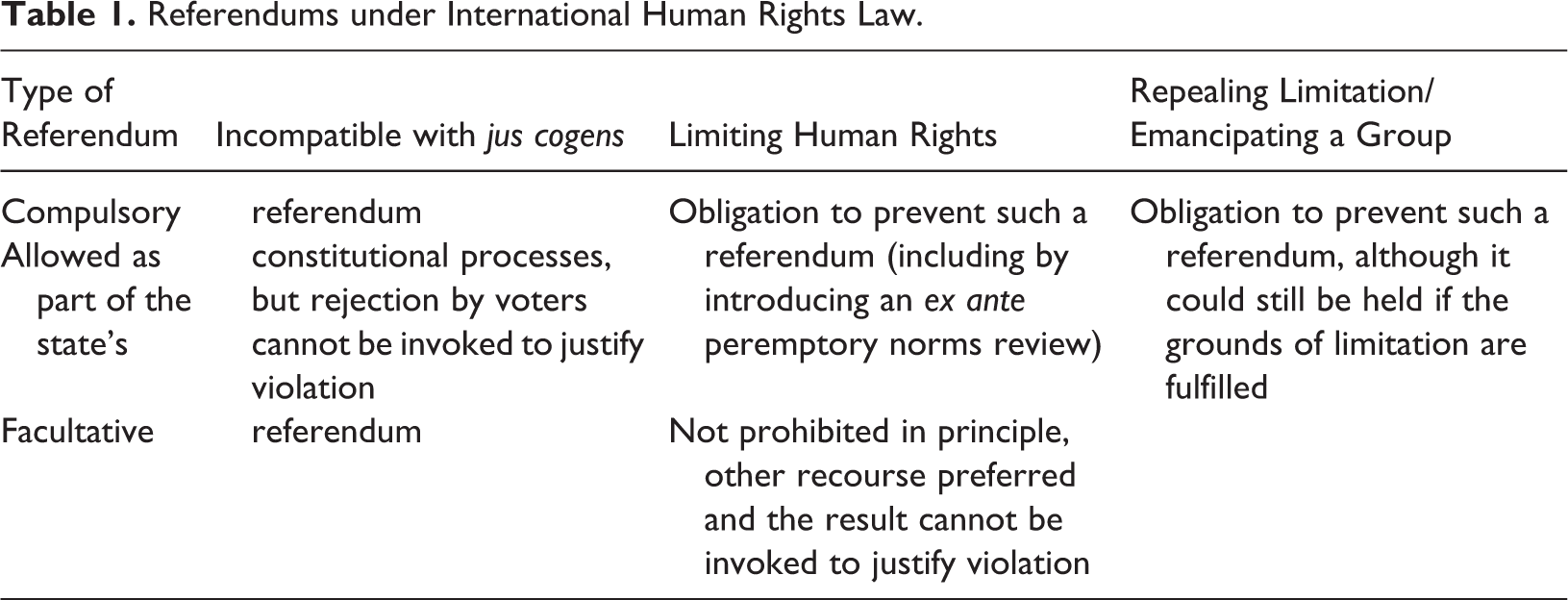
As for the approach of international human rights law to this matter, jus cogens norms can never be set aside in any situation no matter how many crowds could be mustered against them. Furthermore, if a State has become a persistent objector to a jus cogens norm (such as South Africa during the apartheid era), that State is still not exempted from that peremptory norm. 81 Consequently, even if a human rights violation is constitutionalised through a referendum, it can never be invoked to derogate from jus cogens, and the uncompromising approach of international law in accordance with Article 27 of the Vienna Convention of the Law of Treaties (‘VCLT’) remains in place. 82
With regard to the question of ex ante or ex post facto obligation, international human rights conventions are silent on whether a referendum on peremptory human rights norms is permissible. Despite this, it is possible to invoke a reductio ad absurdum approach similar to the reasoning of the International Court of Justice (‘ICJ’) in the Bosnian Genocide case. In that case, the ICJ was faced with the question of whether States are under the obligation to not commit genocide under the Genocide Convention. Article I of that Convention only requires States Parties to prevent and punish acts of genocide, and there is no explicit provision which binds States to refrain from committing genocide themselves.
83
Nevertheless, the ICJ ruled that: It would be paradoxical if States were thus under an obligation to prevent, so far as within their power, commission of genocide by persons over whom they have a certain influence, but were not forbidden to commit such acts through their own organs, or persons over whom they have such firm control that their conduct is attributable to the State concerned under international law. In short, the obligation to prevent genocide necessarily implies the prohibition of the commission of genocide.
84
4.4. Referendum limiting human rights
With respect to referendums with a subject matter limiting a right, the Bosnian Genocide argument could also be invoked to argue that States are obliged to prevent such referendums, including by introducing a mechanism of ex ante control. 89 In this case, however, there is a slight nuance. Under international human rights law, various rights are subject to limitation provided that the prerequisites of each individual article are fulfilled. 90 For instance, under Article 18(3) of the ICCPR, the right to freedom of religion could be restricted provided that the limitations ‘are prescribed by law and are necessary to protect public safety, order, health, or morals or the fundamental rights and freedoms of others’. 91 Hence, in addition to a jus cogens control, a referendum that is proposed to limit this right needs to be subject to a review of whether the grounds of limitation are fulfilled, regardless of whether it is a compulsory or facultative referendum. If the proposed subject matter is found to have satisfied the grounds of limitation, the referendum is compatible with international human rights law.
When the referendum has a subject matter that is discriminatory against a certain protected group, global human rights conventions other than the ICCPR will also apply simultaneously. Suppose that a referendum is proposed to ban interracial marriage in the constitution. The Bosnian Genocide argument could be invoked not only for the ICCPR, but also for Article 2(c) of the CERD to argue that there is an ex ante requirement to reject such a proposal. Under this Article, States Parties are bound to: […] take effective measures to review governmental, national and local policies, and to amend, rescind or nullify any laws and regulations which have the effect of creating or perpetuating racial discrimination wherever it exists.
92
As a note, there are also referendums in which the subject matter is still controversial under international human rights law, such as abortion, same-sex marriage and blasphemy. This particular sort of referendum would be subject to a ‘plurality of answers’ from various judicial and quasi-judicial actors. In the jurisprudence of the European Court of Human Rights, these subjects would even fall under the margin of appreciation of States. 94 Consequently, it is rather difficult to contend against the legality of these sort of referendums under international human rights law, although the preceding arguments could still be invoked to argue for the existence of an ex ante human rights control for any sort of referendums.
4.5. Referendum repealing limitation/emancipating a group
Meanwhile, for a referendum that is compulsory to set aside a limitation or to grant rights to a certain group (such as the 2000 Alabama interracial marriage referendum), international human rights law seems to be permissive of such a referendum. Article 2(2) of the ICCPR establishes that: Where not already provided for by existing legislative or other measures, each State Party to the present Covenant undertakes to take the necessary steps, in accordance with its constitutional processes and with the provisions of the present Covenant, to adopt such laws or other measures as may be necessary to give effect to the rights recognized in the present Covenant.
95
Where there are inconsistencies between domestic law and the Covenant, article 2 requires that the domestic law or practice be changed to meet the standards imposed by the Covenant’s substantive guarantees. Article 2 allows a State Party to pursue this in accordance with its own domestic constitutional structure […].
97
However, as has been previously mentioned in Section 4.2, the effort to repeal a violation could reach an impasse if the electorate in a compulsory referendum voted against it. In order to tackle this difficulty, one would have to determine whether Article 2(2) of the ICCPR contains an obligation of means (requiring States to undertake certain steps irrespective of the outcome) or obligation of result (concerned with the attainment of a desirable outcome). 99 According to Manfred Nowak, the fact that this Article requires States to adopt legislative or other measures could imply that this Article contains an obligation of means. However, in his view, the provision is too vague and cautiously worded, and that it is not really different from an obligation of result, especially due to the presence of wordings such as ‘the necessary steps’ and ‘in accordance with its constitutional processes’. 100 Furthermore, the existence of the term ‘to give effect to the rights’ indicates a result that is to be achieved. Therefore, it seems that this Article is concerned with an obligation of result.
The consequence of this is that despite the ICCPR’s willingness to grant a leeway to States in adhering to national constitutional arrangements in the effort to give effect to a right, an impasse that is caused by it cannot be invoked as a justification for violation. The Human Rights Committee reaffirmed this uncompromising view in General Comment 31, in which they found that the obligation under Article 2(2) of the ICCPR is ‘unqualified’ and ‘of immediate effect’. 101 Based on this, it could be maintained from a practical perspective that States need to avoid compulsory referendums in the effort to secure their obligations under the ICCPR. When such a referendum is unavoidable, they would have to vigorously campaign for human rights in order to avoid protracted violation.
As a comparison, at the Inter-American level, the Inter-American Court of Human Rights seems to be willing to grant more leeway. In its ground-breaking advisory opinion on 24 November 2017, the Court recognised same-sex marriage as a fundamental right. 102 At the same time, the Court acknowledges the fact that States Parties might experience institutional and political difficulties in granting marriage equality. Consequently, States are not expected to legalise same-sex marriage immediately as long as they continue to promote reforms ‘genuinely’ and ‘in good faith’. 103 This implies that a compulsory constitutional referendum to legalise same-sex marriage would be considered as part of the ‘reform’ needed to achieve marriage equality. 104 Even if the result is rejected, the Court could understand the arduousness in the endeavour as long as the referendum was held ‘genuinely’ and ‘in good faith’.
As for facultative referendums that are organised to propose the repeal of a limitation or the emancipation of a certain group, such referendums fall outside the scope of the term ‘in accordance with its constitutional processes’ under the ICCPR. While it could be argued that international human rights law is completely neutral on this matter, States remain subject to the obligation to repeal laws that are not in line with international human rights law as soon as possible, 105 and holding a non-compulsory referendum on this matter would simply prolong the violation and could put States in an unnecessarily awkward situation if the electorate voted against it (Table 1).
Referendums under International Human Rights Law.
5. Conclusion
The issue of the legality of human rights referendums under international human rights law is highly complex in nature. Nevertheless, this article has achieved its purpose in demonstrating States’ obligations with respect to different typologies of human rights referendums. Based on these findings, it could be concluded that States need to undertake a more active approach towards human rights referendums. Human rights do favour popular participation and are friendly towards the holding of a referendum. However, when human rights or jus cogens norms are at stake, States cannot just sit idly by when a referendum proposing a violation is tabled. They would need to create an ex ante human rights review mechanism for all sorts of referendums. That review needs to be undertaken by an independent body, such as a council of state or an independent human rights commission or court.
An ex ante human rights review mechanism could be further strengthened by the introduction of a constitutional provision to outlaw referendums with a subject matter infringing jus cogens. One example is Article 139(3) of the Swiss Constitution, which prohibits the introduction of a popular initiative violating peremptory norms. On top of that, an ex post facto judicial mechanism is also highly essential as a last resort. In case there was an oversight during the ex ante procedure, independent judges could play a significant role by reviewing the legality of the referendum or the implementing measure. 106
The existence of these safeguards is necessary not only to ensure State compliance with its human rights obligations, but also to prevent an awkward situation where ‘the will of the people’ is directly juxtaposed with minority rights or even human rights law in general. As concluded by Moeckli, ‘human rights are the lifeblood of democracy and their effective protection is a prerequisite for its very existence’. 107 If human rights can simply be quashed by the will of the majority, democracy would degenerate into an ochlocracy or ‘government by mob’. Furthermore, such a juxtaposition creates a risk of dissonance between national constitutional law and international human rights law. Particularly awkward would be the scenario when the violation of a right or even jus cogens norm is being enshrined in the constitution; as was aptly concluded by the Swiss Federal Council, such a situation would undermine the Rechtsstaat itself.
Footnotes
Acknowledgements
The research for this article was conducted at the Human Rights Centre of Ghent University. The author would like to thank Professor Eva Brems for her extensive insight and comments on the drafts of this paper.
Author note
Ignatius Yordan Nugraha is a PhD Research Fellow at Hasselt University and an Affiliate Researcher at the Human Rights Centre of Ghent University.
Declaration of conflicting interests
The author declared no potential conflicts of interest with respect to the research, authorship, and/or publication of this article.
Funding
The author received no financial support for the research, authorship, and/or publication of this article.
