




Abstract
Local governments around the world have been engaging with international law and policy at an exponential intensity, with prominent engagement in climate change, migration and more recently human rights. This engagement cannot be adequately understood within the terms and framework of positive international law alone. This contribution aims to map and create a grounded typology of local government engagement with human rights, encompassing both activities within their localities and outside - at national, international or transnational scales. The article introduces local governments’ engagement in the Formation of Human Rights, Implementation of Human Rights, Defence of Human Rights, Coordination of Human Rights, Dissemination of Human Rights and the Contestation of Human Rights as empirical ideal types that have emerged from data through grounded theory. Analysing this engagement from the perspectives of both positive international law as well as legal pluralism, with specific focus on the New Haven School of Law, the article argues that local governments are now at the core of a newly formed norm-generating community. Local governments engage with local and international actors and processes both within the rules of inclusion of contemporary international law-making - seeking to expand these norms to include local governments themselves - but they also contest and challenge the very rules of the game in the first place, and resort to creating “human rights in the city” as a body of norms parallel to international human rights law. Whether we accept a pluralist understanding of international law to include local governments and their human rights engagement, or whether we consider these developments to be outside international law, forming a parallel normative order in the legal pluralist sense, local government engagement with human rights has already succeeded in reaching and influencing many established international actors and has already infiltrated recent instruments of positive international law.
Keywords
1. Introduction
Cities in Northern Europe founded the Hanseatic League in the 12th century to facilitate regional economic, diplomatic and military cooperation, ‘rather autonomously from the Holy Roman Emperor or the Electors or princes to which they were formally obliged’. 1 Nijman explains how the executive organ of this League, the Hansetag, ‘adopted rules on trade and safe navigation routes [which] then bound all member-cities; these rules influence[d] the development of the maritime law of nations’. 2 Transnational norm-generation by cities existed before the notion of the (nation-)State became the primary lens through which we understand the world and international law. While cities have long predated the existence of States, today’s positive international legal order considers local governments to be nothing more than administrative units within a State’s internal organisation, and as such no more than ‘State organs’. 3
In contrast to this categorisation in positive international law, local governments historically, and today with a renewed proactivity upon globalisation, urbanisation and decentralisation, have been engaging with the development of international norms. Human rights, facing difficult times, have been a field which local governments have increasingly taken ownership of. 4 Local governments, defined by the UN as the lowest tier of general public administration within a State, 5 have long stepped out of the boundaries of competence they were thought to be confined in. 6 They engage in foreign relations autonomously from the State in whose territory they are located, 7 establish transnational city networks to facilitate international cooperation and representation, 8 set standards and sign charters, 9 declare themselves human rights cities, symbolically ratify international human rights treaties, 10 report to the UN on their progress on the SDGs, 11 and take public positions opposing their national governments on issues of international law. 12 The city network C40, named in reference to its State-counterparts G6 and G20, has been engaging with international institutions as prominent as the World Bank, with whom it has special funding agreements setting minimum standards for cities wishing to join in, exercising ‘a form of legislative function’. 13
With insights from international legal theory, legal pluralism, and the original and ‘New’ New Haven School of International Law, this article argues that local governments around the world have today become the core of a ‘norm-generating community’ in Berman’s terms. 14 This article offers a typology of city engagement with human rights (understood in a broad sense, including practice and discourse along with international human rights law), grounded in empirical research. The empirical desk research included social media analysis and a close reading into normative documents created by city networks and international organisations on the issue. Field research consisting of 5 months included participant observation in meetings of international organisations and city networks, and twenty four interviews with officials of ten local governments (in Turkey, Brazil and South Korea), officials of transnational city networks, international organisations, civil society organisations, and with academics. The resulting typology explicates local governments’ engagement in the Formation of Human Rights, Implementation of Human Rights, Defence of Human Rights, Coordination of Human Rights, Dissemination of Human Rights, and Contestation of Human Rights (Table 1). Local governments engage with human rights both within the systemic rules of inclusion of international law, seeking to expand these rules to allow official participation of local governments, but they also engage with these rules of inclusion, in contestation of them. If an observer of such engagement has a conservative understanding of the international legal system, only few instances of engagement (those that play out within the rules of the system), will be taken into account. Most of this vast engagement will then be considered outside the realm of human rights, developing a body of normative engagement that can be called ‘human rights in the city’. This body of norms and practices are inspired by, but develop in parallel to established international human rights law (as a result of local governments’ general exclusion from international legal processes), nevertheless interacting with and influencing the latter through a dissemination of their elements amongst local, national, and international actors. These parallel orders would reflect the classical sociological definition of legal pluralism. Alternatively, with the New Haven School approach, understanding the international legal system as a larger, more inclusive, pluralist system surpassing traditional State-centricism, it is possible to reflect more freely on the complete range of engagement conducted by local governments with the system and norms of international law. In an iterative process, depending on how ready international law will be to consider the contestation created by local governments, the international legal system will either further pluralise to accommodate the challenges and critique posed to it, or remain restrictive and push local governments into their parallel alternative normative order. Regardless of outcome, local governments have developed into a norm-generating community in international law, furthering pluralism, with their ultimate influence on positive international law to be evaluated in the coming years.
A Typology of Local Government Engagement with Human Rights.
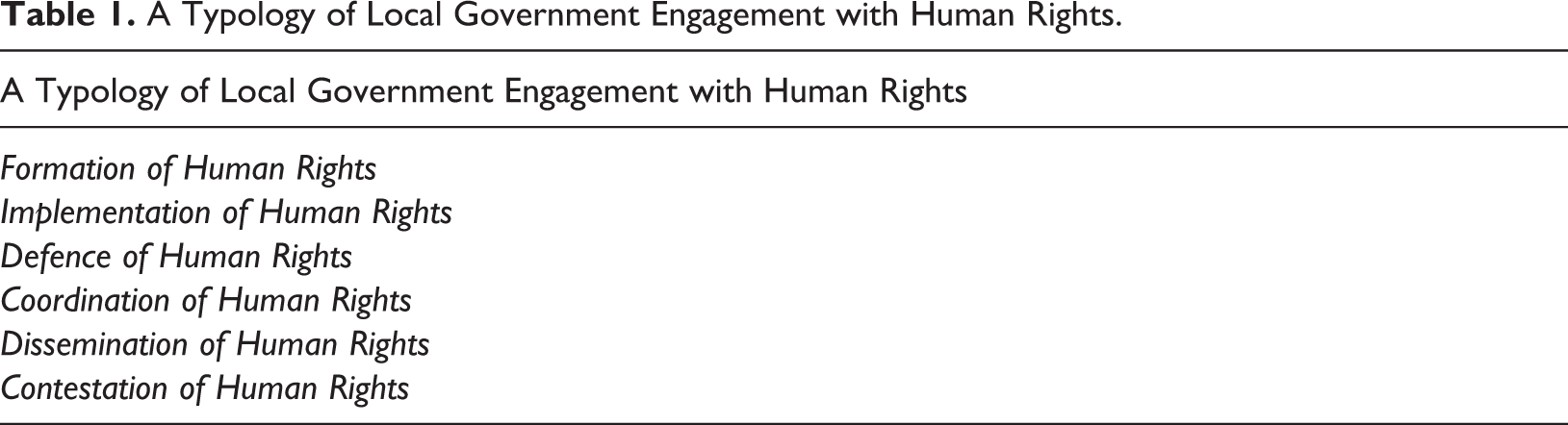
To explicate these findings, this article first provides a brief overview of varying understandings of legal pluralism that are relevant for this analysis (Section 2), followed by an introduction to the critiques of human rights and the relevance of the rise of local governments to these critiques (Section 3). Section 4 offers a picture of the status of local governments in the current international legal system, as State organs as well as non-State actors (‘NSAs’). Section 5 introduces a typology of their engagement with international law, while Section 6 provides an analysis of this engagement.
2. Legal pluralism and the new haven school of thought
The term legal pluralism has been developed and used throughout the last decades in many different understandings within different disciplines, such as anthropology, sociology, political science, and law. 15 As the most efficient way to distinguish between different conceptualisations, Twining suggests asking the question: ‘The plurality of what?’ 16
The most dominant conceptualisation of legal pluralism, rooted in the anthropology and sociology, has been that of ‘a situation in which two or more legal systems coexist in the same social field’ 17 or, ‘the coexistence of different normative orders within one socio-political space’. 18 Thus, under this notion, there is a plurality of normative (or legal) orders applying to a given space and time. ‘Law’ under this conception covers normative orders outside the ‘official’ or ‘State’ legal system, 19 which is considered only one type of normative order among many others (official or positive legal systems; customary normative systems; religious normative systems; economic/capitalist normative systems; functional normative systems and community/cultural normative systems). 20
Although earlier literature focuses primarily on the coexistence of, and interactions between State and at least one type of non-State law, recent literature has also taken up the legal pluralism between different official legal orders. The development of the notion of ‘constitutional legal pluralism’ for instance, has evolved from the study of the sui generis legal order within the European Union, with its multiple national and supranational constitutional systems coexisting with varying degrees of success in cooperation, coordination and coherence. 21 A further conceptualisation, ‘international legal pluralism’ 22 refers to the proliferation of NSAs and the emergence of new sub-fields of international law that might apply collectively to a given situation.
Staying with international law as our subject of study, the New Haven School has gone a step further, to look beyond different categorisations of sub-fields, and to observe a complex system of intertwined norm-generating communities contesting over alternative imaginations of the law, which in turn have different levels of persuasive power and authority. 23 This process is very similar to Koh’s ‘transnational legal process’, which is non-traditional (discarding distinctions between the public/private and domestic/international), non-Statist, dynamic and normative. 24 Norms are created, interpreted, challenged and enforced – travelling, as they change, among different international actors and governance levels – within a constant multi-directional process. 25
The original Cold War-era New Haven School understood pluralism in the field of political science as a ‘theory which opposes monolithic State power and advocates instead increased devolution and autonomy for the main organisations that represent man’s involvement in society’. 26 Led by Myres McDougal, Harold Lasswell, and Michael Reisman, the New Haven School, along with some legal pluralist writings of Robert Cover, articulated that law’s normative power does not solely flow from coercive power, but that law is ‘constantly constructed among various norm-generating communities’. 27 Today’s reality of State and non-State communities generating norms demonstrating varying degrees of formality, coercive power, and persuasive authority reflects the world these scholars have described. 28 Normative claims brought forward by actors, whether international legal persons or not, have the capacity to open up a debate on the articulation of legal norms, and in most successful cases, these norms can be incorporated into positive, official legal systems. 29 This pluralist process offers higher chances for error correction, and brings a wider field of legal imagination and articulations to the attention of other actors. 30 Berman argues that ‘international human rights are now an important element of global legal consciousness, […] because of a long process of rhetorical persuasion, […] and other forms of ‘soft law’ slowly changing the international consensus, not because of positivist decree’. 31
Levit, in an example of ‘New’ New Haven scholarship,
32
demonstrates ‘bottom-up international law-making’ inter alia through the example of Berne Union’s ‘General Understanding’ on export credit insurance being adopted as binding by the WTO.
33
More recently, the development of the right to housing has been successfully pushed forward by urban actors, particularly by United Cities and Local Governments (‘UCLG’) (world’s largest city network) and the Habitat International Coalition (a coalition of urban civil society organisations). Marcenko describes how local governments became a central actor, together with the UN Habitat programme as well as the UN Special Rapporteur on the issue, in assembling the right to housing and the concept of security of tenure.
34
The Preamble of ‘Cities for Adequate Housing: A Municipalist Declaration’ reflects a perfect example of local governments’ educated engagement in these normative processes: Building on the milestones of the New Urban Agenda of Habitat III (Quito, 2016) and the momentum of ‘The Shift’, a global initiative on the right to housing, the signatory cities below take part in this High-Level Political Forum of the United Nations to follow up on Sustainable Development Goal 11 […], with the support of UCLG […], the Office of the High Commissioner for Human Rights, and Leilani Farha, UN Special Rapporteur on the right to housing.
35
[L]ocal’ norms are always contested, even within their communities, and ‘local’ actors may well invoke ‘non-local’ norms for strategic or political advantage. In addition, local actors deploying or resisting national or international norms may well subvert or transform them, and the resulting transformation is sure to seep back ‘up’ so that, over time, the ‘international’ norm is transformed as well.
37
3. Local governments and challenges against human rights
Since their codification following World War II, human rights have faced criticism from many different groups, which could be briefly summarised in the following list: 39 Criticism against their roots in liberal Western ideology, 40 their claim of universality (led primarily by cultural relativists), 41 their legalistic nature, being too technical – or abstract and aspirational rather than practical and close to the people, 42 their individualistic and adversarial character, rather than a community-based approach, 43 their State-centric shortcomings in addressing privatisation in service-provision, 44 and their effectiveness, (failing to protect those most in need of it). 45
Much of this criticism is linked to the State-centric and top-down image of human rights law, especially through arguments that human rights do not accommodate local community values and cultural differences and thus lack ownership and effectiveness. According to these critics, overreliance on the State, its institutions and on legal incorporation of treaties into domestic law as the primary tool for rights realisation proves ineffective when other actors or norms have higher local legitimacy than the State and human rights.
46
This state-centric and legalistic approach neglects the potential of NSAs in communicating and realising rights in culturally appropriate ways and creating ‘grassroots support for rights’.
47
In this perceived clash between the public and the private, the State and non-State actors, local governments constitute an ideal bridge between (and fitting into) the two notions,
48
simultaneously demonstrating the shortcomings of the distinction. The preamble of the European Charter on Safeguarding Human Rights in the City (signed by more than 400 local governments), for instance, elaborates: Why, on the threshold of the 21st century, a European Charter for Human Rights in the City? The Declaration of Human Rights (1948) is universal. […] The European Convention (1950) offers what we call a legal guarantee. However, there exist many rights which are still not ‘effective’ and the citizens find it difficult to see their way through the labyrinth of legal and administrative procedures. How to give a better guarantee? How to act more effectively? […] This is where the City comes in.
49
Local government engagement could provide a response to critiques of human rights in many ways. Local governments are argued to be uniquely placed to localise human rights 58 and bridge the gap between the universality and cultural relativism poles. They are actors often able and willing to travel between physical and discursive spaces of the local and international levels, and offer hands-on experience on the realisation of human rights, relevant for the international community when codifying human rights norms capable of tangible protection. With their pragmatic perspectives, 59 they also might bring together different actors and segments within localities (Coordination of Human Rights), and establish human rights as a normative basis for co-habitation in the city, diffusing its adversarial rights-holder vs duty-bearer nature. Of course, none of this positive potential negates the flip side of decentralisation and localisation, namely that local governments can also opt to use their competences and abilities to take regressive stances against the requirements of human rights. 60 However, considering the lack of scholarship mapping the positive potential of local engagement with and for human rights, regressive policies of local governments will be outside the scope of this article. Regardless, any human rights violations by local governments would fall under Implementation (which includes the element of responsibility), while any alternative imaginations of human rights that seem detrimental to its essence would constitute Contestation of Human Rights.
4. The status of local governments in international law: The dual sub-state and non-state character
From an international legal perspective, local governments’ engagement with international law consistently reflects the unique nature of local governments as both (sub-)State and non-State actors, the positions constituted in each case by varying proportions of these two identities. 61 Their classification as (sub-)State actor is based on the law on state responsibility, where actions and omissions of State organs can be attributed to the State. 62 What constitutes a State organ is determined according to the internal organisation of the State. 63 Local governments, while possessing varying degrees of autonomy from central governments, are considered State organs in the constitutions of modern nation-States. 64
This classification, while insufficient in explaining all normative engagement of local governments with international law, offers nevertheless some venues to understand the relevance of local government practice. As discussed under Formation of Human Rights in Section 5, local governments could be considered to contribute to the development of State practice and opinio juris, elements of customary international law under Article 38(1)(b) of the Statute of the International Court of Justice (‘ICJ’). 65 Some literature on the topic discusses the possibility of sub-State actors producing State practice. 66 A thorough analysis of local governments’ possible contributions to the development of State practice and/or opinio juris, is yet to be made. Whether other primary sources of international law, treaties and general principles of law, would ever recognise local governments’ contributions from a positive legal perspective, is another question only time and further research can answer. Also worthy of future research is the position of local governments with special status, such as some Belgian cities with capacity to enter into international treaties 67 and City States (such as Berlin, Hamburg, Geneva, Zurich, Singapore). 68
Coming to the concept of the ‘non-State actor’ (‘NSA’), despite the multi-actor and pluralist roots of international law and relations, 69 State-centric positivism, referencing the infamous ‘Westphalian Order’ (forgetting that the Treaty of Westphalia was signed by cities as well) has long accepted States as sole subjects, and other entities as objects of international law. 70 The conception of international legal personality as State-exclusive has however changed at the latest with ICJ’s Reparations for Injuries Advisory Opinion, establishing that the UN enjoyed a limited kind of international legal personality, in order to fulfil its obligations in accordance with the needs and functioning of the international order. 71 Following international organisations; individuals, peoples, multi-national companies, armed non-State groups, and NGOs have been considered for their role and status in international law, and referred to, collectively, as non-State actors. 72 Without entering into the discussions regarding the shortcomings and the State-centricity of the term itself, 73 this article utilises it for the purposes of foregrounding the autonomous activities of local governments as opposed to their activities as a State organ (their sub-State character). Parallel to the pluralisation of actors in international law, the last decades have also witnessed a decline in the usage of traditional forms of law listed in Article 38(1) of the ICJ Statute as sources of international law, and an increased preference for non-binding commitments, guidelines, or so-called ‘soft law’. 74 International law-making capacity, once accepted as a prerogative of States, is now hesitantly considered to be shared, at least by other recognised subjects of international law, such as international organisations.
Local governments have fallen largely outside the literature on NSAs, most probably due to their position within the organisation of the State, as opposed to the other actors mentioned above. However, their engagement with international law and human rights cannot be explained by their (sub-)State character alone, and parallels the engagement of other, more familiar NSAs. Local governments have for instance been creating normative commitments that bridge the realms of policy, discourse and law, while using the format and language of international law to varying degrees. The European Charter for Safeguarding Human Rights in the City, 75 the Global Charter-Agenda for Human Rights in the City, 76 the 10 Principles of the European Coalition of Cities Against Racism, 77 the Belfast Declaration/Charter of Healthy Cities, 78 The Mayors’ Marrakech Declaration adopted in parallel to the Global Compacts for Migration and Refugees, 79 Cities for Adequate Housing: The Municipalist Declaration for the Right to Housing and the Right to the City, 80 the Manifesto of the Forum of the European Local Communities Engaged in Refugees’ Welcoming and First Inclusion, 81 and the Global Green New Deal endorsed by C40 in collaboration with the Fridays for Future Movement and other stakeholders for climate, 82 constitute only a fraction of norms generated by local governments and their networks. Some of these normative documents entail the language of rights and obligations, discuss their own legal value and bindingness, and foresee internal and external monitoring mechanisms for the tangible commitments they entail. 83 This parallels the proliferation of codes of conduct and principles of good governance produced by transnational companies (‘TNCs’) and major international NGOs. 84 Similarly, local governments are enjoying a recent, gradual inclusion into mainstream State-centric law-making mechanisms, as discussed in Formation of Human Rights, similar to the processes of the slow inclusion of actors such as IOs, TNCs and NGOs, at least as stakeholders, in negotiations and adoptions of international norms. Both the autonomous norm-generation and the inclusion in state-centric law-making mechanisms allow local governments to participate in the contestation and development of international norms in a general sense. The contestation and development however concerns not only the creation of norms but also their realisation, as local governments develop and adopt non-legal means of realisation and implementation through various innovative means, 85 just as civil society contributes to the localisation of international norms and the creation of ownership among local communities. 86 Additionally, just as accountability of TNCs and armed opposition groups was the main entry point for discussion of such actors in international law, 87 the more conservative international organisations such as the UN Human Rights Committee (‘UNHRC’) started to look at local governments first from the prism of their human rights obligations. 88 Whether local governments could ever obtain international legal personality, which would entail the capacity to hold independent rights, obligations, as well as the prerogatives of law-making and law-enforcement (legal standing before courts), and how this question is dependent on different constitutional dispensations and local government competences around the world, are questions worth tackling, attracting increasing and well-deserved attention by international and constitutional lawyers. 89
5. A typology of local government engagement with human rights
Following a grounded data collection process from desk and field research (consisting of 24 interviews with officials of 10 different local governments in Turkey, South Korea, and Brazil, of NGOs, international organisations and city networks, as well as participant observation in 5 major meetings of city networks and international organisations) this typology has been created with an intention of offering a systematic – albeit non-exhaustive – mapping of the rich normative engagement of local governments with human rights and international law. This data was collected as part of the Cities of Refuge project exploring the role of human rights as law, praxis and discourse in the reception and integration of refugees by local governments in six European countries and in transnational fora. 90 Desk research was conducted into international organisations’ resolutions on local governments and human rights, publications and social media activity of transnational city networks, and of policies and legislation of local governments involved. Qualitative data collected through field research does not claim any generalisability, nor is it based on a representative sample of local governments. Instead, the grounded theory approach allows for the deduction of certain ideal types from the data, followed by theoretical sampling to achieve a saturation point in which no new types of engagement were emerging from new data. 91 As is the limitation of typologies in general, this typology will not be able to cover every form of city engagement, and will resort to some degree of simplification. Nevertheless, such a mapping can arguably contribute to the research on cities and international law by offering scholars a contemporary overview of the normative engagement of local governments.
Frug and Barron pioneered scholarship mapping local government relationships with international law, focussing somewhat conservatively on the subject-object distinction in international law, placing cities as objects regulated by the law, and stressing the dangers of a possible recognition of their actorhood. 92 Aust on the other hand, in his dissertation ‘Das Recht der Global Stadt’ identified three general forms of internationalisation of local governments’ activities: horizontal networking between local governments, vertical cooperation between local governments and international organisations, and the reference in local politics and legislation to international norms. 93 Marx et al. presented the different functions of local governments in localising fundamental rights within EU system, as rule-maker, rule-intermediary, service provider, policy supporter and policy coordinator. 94
Looking into previous literature on localisation of human rights, though not necessarily the role of local governments, Merry famously coined the term ‘vernacularisation’ in understanding how international norms travel and are made familiar to local contexts by ‘translators’ or middle-(wo)men familiar to both the local and international social fields. 95 De Feyter explored the success of the language of rights (over alternative discourses) in shifting domestic power balances and the role of these local struggles in reconstituting global human rights norms. 96 Hoffman, discussing the relationship between decentralisation, legislation and the realisation of the Convention on the Rights of the Child, linked a normative approach regarding domestic implementation of international treaties to the concept of localisation of human rights. 97 He argued that a normative rather than regulative approach to legal integration, in the context of decentralisation, would enable ‘interpretative communities’ 98 and help create a ‘cultural acceptance’ of the norms avoiding overreliance on individual judicial claimants, improving overall realisation. 99
This typology will contribute to the existing debates in a number of ways. First, as local governments’ engagement with international law and human rights is expanding exponentially, this typology will be able to present a more up-to-date picture of the complexity and reach of the engagement. This typology will also opt out of the subject-object discussion and the rigid focus on the form (legislation, discourse etc) and fora (local vs international etc) of engagement, and look instead into what the engagement constitutes substantively for human rights. In mapping only local government activity, the typology does not cover how the locality serves as an ‘arena’ or ‘hub’ for human rights localisation, 100 where local actors interact with each other and contest the meaning of human rights without the direct engagement of the municipality.
5.1. Formation of Human Rights
The Formation of Human Rights entails the incidents in which local governments have sought opportunities to directly contribute to official processes of law-making at the international level, joining States and international organisations. Normative formulations by local governments in fora not including central governments are included under the category Contestation of Human Rights. Perhaps the most significant of events demonstrating Formation were the processes leading to the codification of the content of the Right to Housing. 101 In the Habitat conferences, the Global Campaigns for Secure Tenure and Urban Governance, and in other formal and informal processes, local governments played a significant role in co-creating the positive legal content of the right to adequate housing. 102
Less self-evident and more difficult to track, local governments could potentially be contributing to the development of customary international law, through the production of (sub-)State practice as well as opinio juris, as discussed in Section 5. Instances falling under Defence of Human Rights, of local governments pushing back on national policies regressing human rights sometimes gain international attention and response, which could constitute opinio juris when analysed retrospectively.
The incorporation of SDG 11 in the Agenda 2030 and the Sustainable Development Goals, as well as the lobby for and the subsequent inclusion of the role for local governments in both the Global Compacts for Migrants and Refugees are examples worth mentioning, although they may constitute soft law created through State-centric processes rather than binding law. Local governments’ Formation of Human Rights only mirrors and adds to their efforts and successes in other fields of international law, such as international environmental law, with their success of incorporating the role of local governments in the text of the Paris Climate Agreement, 103 in addition to being a driving force behind its adoption process as a whole. 104
5.2. Implementation of Human Rights
Perhaps the least controversial and most ubiquitous engagement with human rights concerns local governments implementing human rights. ‘Implementation’ here, aligning with the sub-State character of local governments, refers to the efforts to realise established positive international (rather than domestic) legal norms created in a State-centric manner.
Some of the most significant examples of this engagement are those relating to the practice of so-called ‘Human Rights Cities’ with prominent trailblazers such as Rosario, Buenos Aires, Utrecht, Graz, Barcelona and Gwangju. 105 Many cities, large and small, have symbolically ratified international treaties, and even created local enforcement policies which have been much more successful than national ones. 106 San Francisco for instance, has incorporated CEDAW into one of their local ordinances, implementing the Treaty within its jurisdiction ever since. 107 Graz has adopted the CRPD, and made institutional changes including the establishment of a council responsible for its implementation. This council has made a call for recommendations on this issue, collecting hundreds of recommendations from the citizens of Graz, which were analysed, categorised, and brought together in a local implementation plan of the CRPD for the city of Graz. 108 The Human Rights Cities project in Turkey led by the Raoul Wallenberg Institute and the Association of Municipalities of the Turkic World guide local governments in conducting human rights-sensitive strategic planning and budgeting. 109 Local ombudspersons, anti-discrimination offices, or simply enacting local policies and legislation with reference to (international) human rights law, are all different forms in which implementation can take place.
Local governments’ human rights obligations were also in the agenda of important international bodies such as the Council of Europe Congress of Local and Regional Authorities, which created a set of human rights indicators at the local level; 110 and the United Nations Human Rights Council (UNHRC) adopting resolutions on the role of local governments in the promotion and protection of human rights. 111 The latter confirmed that local governments do indeed have obligations under international human rights law and that ‘any failure to comply with these responsibilities will entail their liability under national law as well as international responsibility of the State as a whole’. 112 As such, the Council emphasises the sub-State character of local governments, reminding that ‘the State is one single entity, regardless of its unitary or federal nature and internal administrative division’. 113 The Council holds that only the State can enter into international obligations, be brought before international courts, and submit reports on their progress to treaty bodies; although States and local governments possess ‘shared and complementary duties’, 114 which requires local governments to enjoy the ‘necessary powers and financial resources’ in order to realise the State’s international obligations that fall within their constitutional competences, while the State retains primary responsibility. 115
As can be expected, this implementation also entails varying degrees of interpretation of international norms. When local governments give content to rights, it can at times be difficult to distinguish Implementation from Formation of Human Rights, especially when it comes to the development of the customary content of the norm. The development of customary international law and the interpretation of treaty obligations are both dialectic processes in which the implementation (in a certain way) or non-implementation of a norm can ex post facto be considered an alteration of that norm or the crystallisation of another.
5.3. Defence of Human Rights
At times, local governments engage with human rights not in their capacity as an administrative State organ, but in their particular local identity (non-State, rather than sub-State). This can be observed best when cities take rebellious stances towards national governments and their policies, in Defence of Human Rights. Such defensive positions arise both within local government competences in a certain domestic constitutional context and extra-legally. 116 Local governments may act in a space of legal ambiguity or silence, using it strategically in their favour to stand up for human rights; 117 stay within their explicit legal competence but go out of their way to make a pronounced stance in Defence of Human Rights; or even step outside their legal constitutional competences in order to take a stance. To clarify, this typology considers an act as Defence of Human Rights when the stance taken is public, political, and aims to stand against any law, policy or discourse considered to be in violation with human rights. Whether this stance then reaches success in altering that law, policy or discourse, or whether it is within the local government’s constitutional competences to react in such a way, is not of consideration.
In the area of refugee reception and integration, local governments have taken proactive stances, such as Utrecht in the ‘Bed, Bad & Brood’ discussion with the Dutch national government. When in 2012 the national government prohibited municipalities to provide services to undocumented migrants, many Dutch municipalities including Utrecht protested against this decision, 118 leading to the European Committee on Social Rights to decide in 2014 that this practice would violate Netherlands’ obligations under the European Social Charter. 119 Utrecht is also prominent for protests it hosted and organised when the Dutch government declared Afghanistan a safe country and started planning deportations of Afghani persons in the country. 120
When the former Italian Minister of Interior Affairs Salvini declared that Italy would not accept any further boats carrying migrants and refugees rescued in the Mediterranean sea, southern Italian cities such as Palermo, Naples, Messina and Reggio Calabria expressed protest and defied the policy, saying that they were ‘ready to disobey Salvini’s order and allow Aquarius [the migrant rescuing ship] to dock and disembark in their sea ports.’
121
The Mayor of Palermo, Leoluca Orlando stated: Palermo in ancient Greek meant ‘complete port’. We have always welcomed rescue boats and vessels who saved lives at sea. We will not stop now. […] Salvini is violating the international law. He has once again shown that we are under an extreme far-right government.
122
5.4. Coordination of Human Rights
A type of engagement with human rights that is quite ubiquitous, though not necessarily as public as Defence, is the local Coordination of Human Rights. Local governments, in times of decentralisation, privatisation and globalisation are often in the difficult position of being responsible for the provision of more services with less resources, struggling in a competitive market in its commercial activities. However, the local government’s unique proximity to and likely awareness of the locality’s and citizens’ needs, as well as its potential to be well connected with local actors such as businesses, civil society, national institutions’ local offices, hospitals, schools, universities and vulnerable persons provide invaluable tools to overcome the challenges of human rights realisation for the local government. 123
In line with the principle of good governance, local governments often consult stakeholders before developing policies in response to complex situations relating to human rights. While Implementation of Human Rights refers to local governments’ more traditional legalistic role as duty-bearers; the Coordination of Human Rights, in line with the notion of governance rather than government, focusses on local governments’ role as leaders, facilitators, and collaborators, where rights realisation is a shared duty of the community. Sometimes, local governments initiate or facilitate the creation of ‘horizontal governance structures’ 124 by bringing a large variety of local stakeholders together in a series of meetings, such as was the case of the Danish city of Odense, for the purposes of developing strategies and partnerships towards the realisation of refugees’ fundamental rights and their integration into the city. 125 Whether decentralisation is a result of official legislative and administrative steps or a simple practical reality, such Coordination of human rights can be an efficient way of addressing multiple issues holistically. In Turkey, while local governments are not officially assigned responsibilities on the realisation of human rights of refugees 126 situated in their territories, municipalities nevertheless find themselves in situations in which large numbers of refugees are in need of urgent protection of their rights, with the national government unable to provide all necessary services. Consequently, local governments team up with international, national and local actors, to create projects of service provision for refugees. 127 For instance, the International Organisation for Migration has partnered with Kecioren, Adana Metropolitan and Sanliurfa Metropolitan Municipalities, in order to fund and staff ‘one-stop shops’ for refugees and migrants in town, within the premises of the municipality. 128 Here, staff hired by IOM register, assist and guide applicants to specialised municipal bureaus, possible employers, schools, specialised organs of the central administration represented in the town. 129 The ultimate objective of the project is for the municipality to take over the one-stop shop at the end of the project, and continue its services. This way, guidance for refugees and migrants, a function previously unfamiliar to the municipality, is introduced to the bureaucracy, and in the meantime essential services are provided. Ankara Metropolitan Municipality on the other hand leads a project funded by UNHCR, in which the municipality, after consulting local businesses on the current needs and priorities of the job market, has built a large facility aimed to provide Turkish language education followed by vocational training with certification to around 500 refugees and locals at all times. 130 The facilities include classrooms, day care for the children of the attendees, psychological support, conference rooms (that are open for public use of the locals), and modern machines to be used in technical vocational training.
In some instances, municipalities are less active in direct provision of services to refugees and thus realisation of human rights, but they cooperate with local NGOs who have organically developed to fill that void in earlier stages. In Sisli (a district municipality of Istanbul), two primary NGOs provide services to refugees and migrants while the municipality provides free basic healthcare, a welcoming environment and general oversight. 131 In another prominent example, Sultanbeyli Municipality in Istanbul – in order to avoid problems with regards to the legal competences of the municipality for providing services to refugees, and to work around the general trend for foreign funding in Turkey to be given to NGOs instead of administrative entities – has created an ‘Association for Refugees’ based in two large facilities run by international as well as local funding; providing healthcare, language education, psychological care, legal support, vocational training and childcare. 132 The centre functions under an administration consisting of municipal officials and persons hired independently, and runs with the concerted efforts of international organisations, the national government, charities, chambers and other stakeholders. 133
5.5. Dissemination of Human Rights
The Dissemination of Human Rights points at how local governments are key actors in spreading the norms, values, practices, the essence of human rights and rights-based thinking. This happens both within their territory and also in interactions with other actors of the international community, especially other local governments, which will be discussed in turn.
When engaging with actors outside their territory such as other local governments and city networks, local governments use their unique hands-on experience to provide persuasive and practical guidance on how to best create fair, sustainable, inclusive communities. Much of the engagement within city networks consists of the exchange of best practices, peer-to-peer learning, and networking, during which agendas and priorities compete. Here, local governments previously unaware of their role in human rights realisation – for instance those working with concepts such as good governance or sustainable development – become exposed to and sometimes won over by the concept of human rights in the city. Elements of human rights in the city, as well as conceptions of the role of cities in international law thus travel within and among spaces of interaction for local actors, and gain ground depending on the persuasiveness and persistence of the advocacy. Barcelona and its presence in city networking is a perfect example for this engagement. With more than 30 years of experience in implementing a human rights policy, Barcelona is an honoured guest at any meeting of transnational city networks, and often an initiator, organiser and/or a host. 134 Municipal officials of Barcelona share their experience, strategies, and conviction that human rights are a hard obligation for local governments and not just a matter of taste. 135 Expressing this firm belief and backing it up with successful practices, Barcelona becomes a role model for upholding human rights in the city for other local governments with less resources and experience. 136 Gwangju’s role, as the first human rights city in South Korea, is similar within the Korean and Southeast Asian context. Hosting the World Human Rights Cities Forum for eight consecutive years and lobbying with the national government as well as other local governments, Gwangju has contributed significantly to Seoul and other Korean cities becoming human rights cities, and the government of South Korea sponsoring the role of local governments to be included into the agenda of the UN Human Rights Council. 137
There are countless examples of this Dissemination of Human Rights, in its essence, values, usefulness for the local administrations and its feasibility in practice, which can be observed in any international meeting in which local governments advocating human rights are present. Dissemination gains its power from being an identity and interest building process. 138 Through interactions with other actors, local governments may adopt human rights as part of their values forming their identity, and start seeing human rights realisation as being in their interest. As such, Dissemination directly contributes to the Contestation of Human Rights by local governments.
Dissemination within the territory of the local government refers to localising and increasing ownership of human rights within the local administration and among the citizens of the locality. Providing specialised training or conducting focus groups with different departments of the administration, as is the case in cities such as Barcelona, Vienna, Maltepe and Cankaya can, for instance, increase awareness and ownership among personnel on the human rights implications of the policies they implement. 139 Steps like these are often essential if a local administration aims to achieve sustainability of a human rights policy and the rights-based approach in the administration. 140
Local governments can however contribute to the creation of a culture of human rights within their locality, amongst citizens. Some cities such as Vienna and Graz provide human rights education for their citizens, sometimes for those as young as nursery aged children. 141 Local acceptance and ownership of human rights become especially important when human rights require local governments to take unpopular decisions such as allowing and protecting a gay pride parade in Gwangju, 142 or accepting and providing essential services to refugees from Syria in Gaziantep (Turkey). Expressing ideals akin to human rights in a culturally-sensitive language, the Mayor of Gaziantep Fatma Sahin, stated in an interview that ‘as [a matter of] humanity, as [a matter of] the rights of neighbours, we cannot be expected to be indifferent to it, to ignore it when there is a fire with our neighbours, when there is a tragedy of humanity’. 143 Using the concepts of humanity and the Islamic and ancient Turkish value of ‘rights of neighbours’ the Mayor reaches out to her constituency in concepts that are familiar and sacred to them, contributing to a localised understanding of human rights.
5.6. Contestation of Human Rights
The final type of local engagement with human rights constitutes Contestation of Human Rights. Local governments, individually and in cooperation with other actors, contest elements of established international law and positive human rights law as they stand. Contestation focuses most of all on (1) the State-centricity of international law-making concerning human rights, (2) the specific content of the positive human rights norms, (3) the State-centricity in the prerogative to enter into human rights obligations, and (4) the State-centric notion of citizenship which conditions the protection of individuals’ rights on being documented, registered and lawfully present in a State’s territory. This contestation may be explicit and outspoken, in opposition to a dominant actor’s more regressive policy, in which case it might also constitute Defence of Human Rights, though not all Defence will bring into question the established system of international human rights law. Pronouncements on how the local government has a right to regulate a human rights issue, at times surpassing domestic competences of the local government, can constitute ‘jurisdictional assertions’ as Cover terms, competing for authority with other claims of jurisdiction, challenging dominant (State) assertions on human rights. 144 Local and regional governments in Spain implementing universal health care policies covering undocumented migrants despite national government and Constitutional Court efforts to illegalise such efforts arguing on inequality and an unconstitutional stretch of local competences, have for instance succeeded in gaining a pronouncement by the CESCR that Spain may not impede with local governments realising human rights to a higher extent than the national average. 145
When authors of a Contestation wish to persuade the international community and achieve a change in (a part of) the dominant understanding of human rights, they may interact with other actors and disseminate their understanding. But Contestation can also be a quiet one, such as a quiet resistance in refusing to follow national government policies violating human rights, within the territory of the locality, such as the practice of Sanctuary Cities in the US refusing to cooperate with national policies requiring them to provide information on undocumented migrants that could lead to their deportation, which constitutes a contestation based on the premises that persons without documentation deserve protection and that local authorities have a say in determining and providing such protection at times against the central government position. 146
Other examples of contestation of (1) the State-centricity of human rights law-making are for instance the drafting, signing and ratification by local governments of the European Charter for Safeguarding Human Rights in the City, the Global Charter-Agenda for Human Rights in the City, the Cities for Adequate Housing: A Municipalist Declaration on the Right to Housing and the Right to the City, the Marrakech Mayors Declaration: Cities Working Together for Migrants and Refugees and numerous other normative documents created and adopted by city networks and local governments. 147 Formulated in a manner demonstrating deliberate and advanced legal drafting techniques, and imitating a form of inter-State law-making, the creation of these documents arguably reflect local governments’ frustration with their lack of access to the scene of international law-making. Second, (2) local governments, in creating these documents, generate new human rights norms and alternative contestations of existing ones. For instance, the European Charter mentioned above enshrines a ‘General Right to the Public Services of Social Protection’, the ‘Right to the Environment’, the ‘Right to Harmonious and Sustainable City Development’, the Right to Movement and Tranquility in the City’ and the ‘Right to Leisure’ all of which are new to positive international human rights law. 148 Third (3) local governments also commit, in even the most official means available to them, to international norms that their respective States have not chosen to be bound by, contesting that entering into international obligations are a State-exclusive prerogative. Local governments in the United States symbolically ratifying the CEDAW convention when the US has not ratified it, and adopting the Convention into their local legislation, is one such example. 149
On a last note (4) local governments also contest the State-centric notions of citizenship linking rights to lawful presence within State borders and nationality. The Global Charter-Agenda states [a]ll Charter-Agenda provisions apply to all city inhabitants, individually and collectively, without discrimination. For purposes of this Charter-Agenda, all inhabitants are citizens without any distinction. […] A city inhabitant is any person that lives within its territory even if without fixed domicile.
150
6. How local government engagement pluralises international law and human rights
How do we understand such vast and complex engagement of local governments with human rights? First, it is fit to make an empirical observation. The introduced types of local government engagement with human rights relate to the system of international law in and challenge it in different ways. While some forms of engagement could be considered to communicate with the system of international law within its own terms, they nevertheless seek to pluralise that system, and upgrade the status of local governments in it to establish them as internationally relevant actors 153 with the possible future implication of international legal personality. Some kinds of engagement on the other hand challenge the very fundaments of international law, such as its State-centricity, rules concerning inclusion, exclusion and participation of actors other than the nation-State, and its systemic rules on sources and law-making. Most engagement with human rights falls somewhere in a spectrum between the two poles of accepting a State-centric international legal system and contesting its very fundaments.
To offer a few examples of local governments’ engagement within the rules of the traditional international legal system; local governments engage in the Implementation of Human Rights as State organs, implementing States’ human rights obligations within their local jurisdiction, and in the Formation of Human Rights, by contributing to the accumulation of State practice and opinio juris as internal elements of the State. They may however also foreground their autonomy and non-State character by seeking a separate seat at the table when international agreements are negotiated in State-centric law-making processes as part of Formation. They may also pursue Implementation of norms that their States have not expressed consent to be bound by, that were however established in traditional State-centric ways. These latter two attempts will often go unnoticed by the conservative international lawyer.
There are many types of engagement that substantially challenge the fundaments and functioning of international law, creating alternative or complementary understandings of what human rights and international law are, and how they should be realised. For instance, in the Contestation of Human Rights local governments challenge the State-centricity of law-making and the capacity to enter into obligations, the State-centric understanding of citizenship, as well as the overreliance on the legal status of individuals for the protection and realisation of their human rights. Accordingly, some local governments and networks of local governments have produced serious amounts of norms 154 in order to protect and realise human rights in their localities to a better extent than national governments. Though State-dominated processes such as the work of UNHRC have addressed this engagement in passing, there is yet no thorough unpacking of what the quasi-legal norm-creation and commitments by local governments means for legal theory. 155 Local governments engaging with human rights will often not choose between the two strategies but instead resort to both seeking involvement in traditional international legal processes and also to creating their parallel body of practice on ‘human rights in the city’ – focussing more on the latter when there is higher frustration and impatience regarding the expectation towards the State-centric system to recognise and include them.
Second, how the international lawyer interprets local government engagement will depend on the observer’s subjectivity. If the observing international lawyer has a more traditional or conservative understanding of the international legal system, some few forms of engagement may catch this observer’s attention, who might at most consider such questions as legal personality or human rights accountability for local governments. Most local government engagement will however be pushed outside the strict borders of international law under this observer’s perception, and will develop in parallel to international law, perhaps even into a separate normative order that could be titled ‘human rights in the city’. As discussed in Section 2, legal pluralism has different conceptualisations in different disciplines. While the common definition with its sociological roots refers to the parallel existence of more than one normative order in a given space and time, scholars of international law and relations, such as the New Haven Scholars have also used the term to describe a single normative order – the international legal order for instance – that was nevertheless pluralist in its nature. Excluding local government engagement from the scope of international law would thus reflect the classical, sociological definition of legal pluralist describing multiple parallel normative orders. An international lawyer understanding the ‘international legal system’ as more inclusive and pluralist however, may prefer the New Haven School approach, recognising that local governments (together with city networks, local NGOs and other actors working on the relationship between local governments and international law) have become a norm-generating community. This article supports this second approach, as then the complete array of local government engagement with international law can be taken into account as opposed to being dismissed as too radical or ‘non-law’. Even seemingly radical contestations of human rights carry important and valid criticism for international law. Additionally, even if the observer considers current local human rights engagement to fall outside the scope of positive international law, there are already instances in which local government activities have seeped into more mainstream international legal processes and the work of central international organisations. 156
7. Conclusion
While mapping city engagement with human rights is challenging, it is nevertheless not as challenging as attempting to provide a summary representing of all possible implications of and perspectives of analysis for this engagement. Many important questions remain unasked or unanswered. Empirical inquiries into how much human rights influence local government behaviour, or into the extent to which local governments’ engagement with human rights improves effectiveness of rights realisation on the ground are both highly topical. One could also scrutinise the imbalance of legal, financial and political power among different local governments and their capacity to engage with and influence the development of the growing body of norms which can be called ‘human rights in the city’, discuss whether (state) consent in international law is decaying 157 and local governments’ contribution to it, or the significant role of academia and civil society in influencing the choices of action and eventual commitments of local governments.
The clearest lesson to be taken away by scholars of human rights and international law following this article is the following: local governments have become actors relevant and important for the protection and promotion of human rights. When they engage with human rights, they pose a critique to traditional international law and human rights, whether this is done by seeking to engage with this normative system by participating within its own terms, or by challenging the norms of belonging and norm-generation in the first place. Whether we take a stricter legal positivist perspective when looking at this engagement, or a broader socio-legal lens, local engagement with human rights has implications for both the content of human rights – in the creation of a body of norms that could be called ‘human rights in the city’ – and also for participation in international law. Even if the growing body of norms and practices making up ‘human rights in the city’ is not considered international law, there have already been instances of their influencing traditional international legal processes and thus positive international law, such as the content of Human Rights Council resolutions, the right to housing codifications and CESCR Country Reports. 158
Local governments engaging with human rights are best understood as a norm-generating community as Berman of the ‘New’ New Haven School describes, creating norms and jurisdictions, with or without official authority to do so, to contest both their position in the system of international law and also the content and creation of the norms at stake. The complex pluralism in normative engagement ‘poses a particular challenge for law because law often seeks certainty and tends to assume fixed boundaries between those who are within and those who are without.’ 159 However, norms in the international legal system have always been challenges and propositions at some point in time, put forward by persons or entities falling within or outside the body of the ‘State’. As such, discarding the norms, practices and principles that constitute ‘human rights in the city’ will keep hidden from eyes the factors, processes and actors behind the development of international law, as well as the contestations that fail to become the dominant position in the law. It will be highly interesting to continue observing what influence this normative engagement by local authorities will have on the general development of human rights and international law.
Footnotes
Author's note

Declaration of conflicting interests
The author declared no potential conflicts of interest with respect to the research, authorship, and/or publication of this article.