




Abstract
The principle of subsidiarity is viewed as the cornerstone of the protection of human rights. Internationally, it is primarily the responsibility of states to ensure that human rights are respected and protected on a domestic level and any international protection mechanism is only supplementary. At the domestic level, apex courts in a country also provide only subsidiary protection of human rights, which must first and foremost be protected by lower level courts. Subsidiarity has two facets: the obligation of lower courts to directly apply human rights and the corresponding deference of higher courts to that application. Little attention has been given so far to how domestic subsidiarity of human rights works in practice and how human rights are in fact applied by the primary level of court systems. This article uses Czechia as a case study to test the hypothesis that if lower courts apply human rights, then there is a lower chance that the Constitutional Court, as an apex court, will find a human rights violation in that particular case. By statistical analysis of hundreds of decisions of Czech courts this hypothesis is confirmed. The findings are indicative that subsidiarity actually works in practice.
1. Introduction
The current buzzword in international protection of human rights is “subsidiarity”. Subsidiarity is inherent in any decision-making of international human rights law. 1 Numerous domestic jurisdictions also employ human rights subsidiarity as a functional relationship between apex courts and lower courts. But does subsidiarity actually work in practice? Do primary level courts actually apply human rights law? And does the application of human rights law at lower jurisdictional levels matter, in the sense that human rights are indeed then protected at the lowest level and the apex courts do not need to remedy the rights violation?
The aim of this study is to examine the relationship between lower courts and an apex court in a particular jurisdiction, which can inform us about how subsidiarity works in practice at the lowest levels of a judicial system. The main hypothesis of this research is that when human rights have already been invoked by lower courts, the apex court is less likely to find a human rights violation. Human rights thus could and should be already used by first and second instance courts. They should not be considered foreign or irrelevant to decision-making at this level of jurisdiction. This hypothesis was tested on the example of Czechia, through a statistical analysis of hundreds of decisions of first and second instance courts.
This article starts with a general outline of the principle of subsidiarity, which forms the theoretical background of the hypothesis. A section on methodology describing how the data, that is decisions of courts, were obtained, and a brief description of the compiled dataset, follows. The subsequent main section tests the hypothesis by statistical analysis of the decisions included in the dataset.
2. Subsidiarity of human rights
2.1. Subsidiarity in International Law
The principle of subsidiarity has its origins in the teachings of Aristotle and later in Catholic social theory. 2 Evans and Zimmermann describe subsidiarity as ‘primarily a decentralising principle, which favours decentralised decision-making over centralised decision-making’. 3 The substance of subsidiarity is that decision-making at a higher level does not necessarily encroach on decision-making at the lower level. In the context of human rights decision-making, this facet of subsidiarity transforms into deference of higher courts to decisions taken by lower courts. 4 Yet, subsidiarity also has another facet: in order to be fully operative, subsidiarity requires that lower courts actually apply human rights.
The principle of subsidiarity of human rights is well known at the international level. The European Court of Human Rights (hereinafter “the ECtHR”) has recently been a vocal proponent of the concept. 5 Robert Spano, judge at the ECtHR, describes the present situation as the age of subsidiarity. 6 The principle of subsidiarity is currently viewed as the cornerstone of the protection of human rights in Europe to such an extent that the Preamble of the European Convention on Human Rights (hereinafter “the ECHR”) is to be amended to explicitly mention subsidiarity. 7 Subsidiarity as applied by the ECtHR traditionally means deference in its review, exemplified in particular by the use of the doctrine of the margin of appreciation. 8
In a number of cases, the ECtHR has stressed another facet of subsidiarity. In Ťupa v the Czech Republic, the ECtHR stated that ‘subsidiarity and the effective protection of rights at the national level are two sides of the same coin. In order for subsidiarity to be fully operative, it is necessary for the domestic authorities to effectively protect human rights at the domestic level.’
9
Later in Fabris v France, the Court noted that ‘a corollary of the principle of subsidiarity’ is the obligation of domestic courts to examine, with particular rigour and care, arguments of a party regarding the ‘rights and freedoms’ guaranteed by the Convention.
10
Similarly in Paposhvili v Belgium, the Grand Chamber made clear that it was not its task to conduct its own assessment of whether there would be a violation of Article 8 because of the impact of expulsion on the applicant’s family life: In that connection the Court considers that this task not only falls to the domestic authorities, which are competent in the matter, but also constitutes a procedural obligation with which they must comply in order to ensure the effectiveness of the right to respect for family life.…the machinery of complaint to the Court is subsidiary to national systems safeguarding human rights.
11
2.2. Subsidiarity in municipal law
The same concept of subsidiarity also works in some domestic jurisdictions between apex courts and lower courts. This can be called domestic subsidiarity. An example is Czechia, which has been chosen as a case study in this research. According to Article 4 of the Czech Constitution, human rights are protected by the whole judicial system. The Czech Constitutional Court has repeatedly stressed that the lower courts must apply human rights as interpreted by the Constitutional Court and the ECtHR and interpret ordinary laws in a way that complies with the Constitution, which includes human rights (‘interpretation of law that conforms to the Constitution’). 15 Consequently, the Constitutional Court subscribes to the theory of the so-called ‘radiating effect’ of human rights (‘Ausstrahlungswirkung’) by which human rights permeate the whole legal system and ordinary laws must be interpreted taking into account human rights. If lower courts fail to comply with this obligation in its proceedings, the human rights of the party concerned are violated. 16 As far as the competence of ordinary courts is concerned, there is no obstacle to their direct use of and reference to human rights, including provisions of international treaties and case-law of both the Constitutional Court and the ECtHR. Czechia thus represents a jurisdiction where the concept of subsidiarity is present in the relationship between the Constitutional Court and lower courts. For this reason, it makes for a good case study for examining the practical effects of the concept.
Another example where subsidiarity applies internally is Germany. The German Constitutional Court also holds that ordinary courts must take account of fundamental rights in the Constitution and also the case-law of ECtHR, when interpreting and applying domestic law. 17
Subsidiarity can thus be described, in general, as a type of relationship between higher courts and lower courts. One of its facets, which can be called ‘positive subsidiarity’, requires lower courts to apply particular standards, in our case human rights. Another facet then implies that higher courts should defer to the lower court judgment if human rights were applied diligently and in good faith.
Positive subsidiarity is based on another role subsidiarity plays in the relationship between higher and lower entities, including courts. The role has been described in theory as ‘societies of higher order must support lower-order societies’. 18 In this sense, a higher court lays down general principles applicable in given circumstances in its case law. These principles should then be applied by the lower courts to the concrete facts of individual cases. If they do so properly and in good faith, then the higher court will defer to their decisions. This second dimension of subsidiarity thus places the responsibility for effective protection of human rights lower in the court system and closer to individuals. The aim is to achieve better and faster protection of human rights.
The insistence of international and higher courts on this positive facet of subsidiarity can also be viewed in the context of compliance with human rights standards. By inducing domestic and lower courts to use human rights, better human rights compliance can be achieved. The application of human rights law by domestic courts is an important part of securing compliance with international judgments 19 as well as domestic apex courts’ judgments. Kosař and Petrov argue that domestic authorities, and in particular courts, act as diffusers of the ECHR by spreading the effects of the Strasbourg case-law. 20 However, better compliance could also be achieved in more indirect ways. Positive subsidiarity could equally be a tool for acculturation of human rights norms. Acculturation is a process of adopting the beliefs and behavioural patterns of the surrounding culture. 21 Thus judges would use human rights not only because they should do so, because of the principle of positive subsidiarity, but simply because they see around them that it is customary, and thus part of the judicial culture, to do so.
Overall, positive subsidiarity insists on effective protection of human rights at primary levels of court systems. If human rights violations occur, they should be remedied as early in the procedure as possible. That is advantageous for everybody (such as victims and states) not only from the point of view of achieving justice, but also from an economical perspective, as less resources are spent. The ideal situation would be that human rights violations are remedied as soon in the process as possible, that is by a first instance court, which would apply human rights to the matter before it. Moreover, violations of human rights can happen by the very actions of lower courts, through misinterpreting the human rights of the parties or by ignoring their human rights altogether.
As a result of positive subsidiarity, human rights should be applied first by lower courts. If they are used, the second facet of subsidiarity should become effective and the higher court should then defer to the judgment of the lower court. Consequently, there should be dependence between lower courts using human rights and the upper court finding a violation or no violation of the applicable human right. The aim of this article is to examine how these practical implications of the concept of subsidiarity work in the practice of one jurisdiction.
Despite the stated importance of the application of human rights by lower courts, little research has been done so far to find out the extent to which human rights are indeed applied at the primary level of court systems. 22 So far, studies have focused only on the use of human rights by apex courts. 23 As Kosař and Petrov have observed, ‘the role of lower courts is less visible and often underestimated’. 24
This article chooses Czechia as a case study and by empirical analysis of hundreds of decisions of Czech first and second instance courts, it maps the use of human rights at the primary level of the court system in that country. The aim is to examine the relationship between the Constitutional Court and the lower courts in the use of human rights. My hypothesis tested in this research, is that there is dependence between lower courts using human rights in the reasoning of their decisions and the outcome of the case before the Constitutional Court. It is suggested that if there is any dependence found, such a finding indicates that domestic subsidiarity works in practice and makes a real impact. If the higher courts’ approach encourages the application of human rights by the lower courts, and the lower courts indeed apply human rights, fewer human rights violations will be found by the apex court. The following section briefly introduces the relevant aspects of the Czech court system and further explains why Czechia was chosen as a case study.
3. Czechia
Czechia has four levels of jurisdiction. District (86 altogether) and regional (eight altogether) courts operate as courts of first instance. Appeals are heard by regional courts if a district court was the court of first instance or by a high court (of which there are two altogether) if a regional court was the court of first instance. These are the courts that are studied in this article. In most situations (a notable exception relevant to this study being family law decisions and decisions on pre-trial detention) appeals on points of law to one of the two supreme courts in Czechia are possible. Appeals on points of law in judicial review proceedings of administrative decisions are heard by the Supreme Administrative Court. The Supreme Court has jurisdiction to hear appeals on points of law in all other areas of law, including civil and criminal. In all cases, a physical or legal person can subsequently lodge a constitutional appeal to the Constitutional Court against a final decision – that is against a decision of a supreme court if an appeal on points of law was possible in those proceedings or against the decision of an appellate court, if it was not possible.
Human rights in Czechia are primarily protected by the Charter of Fundamental Rights (hereinafter “the Charter”), which forms part of the Czech Constitution. It includes all the usual human rights that are also protected at the international level. Moreover, according to the established case-law of the Constitutional Court, international human rights treaties to which Czechia is a state party, are also part of the Constitution and their self-executing provisions are directly applicable in the domestic legal system. As has been noted, the Constitutional Court obliges ordinary courts to consider and apply human rights law when relevant to the case before them.
There are several reasons why Czechia was chosen for this study. First, in Czechia the Constitutional Court has embraced the concept of subsidiarity in its case-law. In several cases it has made clear that its deference to the decisions of lower courts is conditional on their proper assessment of the issues. 25 As such, both facets of the principle are, at least formally, present in the relationship between the Constitutional Court and the lower courts. Therefore the practical impact of the principle in reality can be studied.
Second, the ECHR is directly applicable in Czechia and the Constitutional Court encourages its direct use by lower courts. Studying human rights application in Czechia therefore includes studying the application of the ECHR. Czechia can then also be a valuable source of information on the question of implementation of the ECHR and the overall effectiveness of the ECHR at the national level.
Also from the point of view of the ECHR, Czechia is a high compliance state. The number of violations found by the ECtHR per population are below the average 26 and the rate of compliance with judgments finding a violation is amongst the highest. 27 The Czech Constitutional Court is a gatekeeper to lodging an application at the ECtHR, because a constitutional appeal is, with some very limited exceptions, always the last domestic remedy to be exhausted. If subsidiarity works in the relationship between the Constitutional Court and lower courts, it could be argued that this is one of the reasons that Czechia is a high compliance state: positive subsidiarity, when all courts embrace human rights, induces better human rights compliance by courts themselves and in general since human rights interferences by other public bodies can be remedied by courts.
4. Methodology used in this study
Two time periods were chosen for the empirical study in order to allow comparison across time, namely 2005 and 2015 (the latter being the most recent year when the research began). It was anticipated that a time span of ten years would allow an assessment of the impact of changes underway in Czechia at that time as a result of, for example, entry to the European Union in 2004 and the introduction of human rights courses into legal education in the early 2000s.
First, all decisions of the Constitutional Court from 2015 (3858 decisions) and 2005 (2640 decisions) were reviewed. As any person can lodge a constitutional appeal, the sample included a substantial portion of cases that did not raise any human rights issues (many constitutional appeals essentially request the Constitutional Court to act as a court of fourth instance). These cases had to be filtered out because the relationship between the Constitutional Court and the lower courts in terms of human rights application can only be studied where there is a human rights aspect to the case. In order to apply objective criteria to this filtering exercise, I relied on the assessment of the Constitutional Court itself and selected only those where the Constitutional Court found that a human right was at play.
This test was considered to be met in two circumstances. First, when there was a judgment in the case (finding a violation or no violation), that is the Constitutional Court itself considered it necessary to issue a decision on the merits of the case. Second, when there was substantive human rights reasoning by the Constitutional Court even though the case was ultimately dismissed as manifestly ill-founded (and thus inadmissible). Cases declared inadmissible for other reasons were deemed irrelevant and therefore omitted.
As regards the manifestly ill-founded cases, substantive human rights reasoning was usually displayed by references to previous case-law of the Constitutional Court. In some cases it was clear from the reasoning that the Constitutional Court considered a human right to be in play but concluded that the way the case was decided by the lower courts did not result in a human rights violation. Further, several manifestly ill-founded cases were sifted out of the dataset where the only issue identified by the Constitutional Court was a lack of sufficient reasoning by the lower courts. In that case, one could hardly expect that the ordinary court would refer to human rights saying that its own reasoning of the judgment is sufficient.
By this method, 231 decisions of the Constitutional Court from 2005 were selected and 398 decisions from 2015. Decisions of district, regional and high courts reviewed by the Constitutional Court were then collected. These dated, save for a very few exceptions, from the years 2003-2004 and 2013-2014, respectively. It was not possible to collect decisions corresponding to six decisions of the Constitutional Court from 2005 and four decisions from 2015. 28 As a result, data analysis was conducted only in respect of 225 decisions of the Constitutional Court from 2005 and 394 decisions from 2015. This returned the dataset described in the following section.
5. The dataset
From the years 2003-2004, there were 306 decisions in the dataset. 82 of these were from district courts, 181 from regional courts and 43 from high courts. From the years 2013-2014, there were 558 decisions in the dataset. 178 of these were from district courts, 323 from regional courts and 57 from high courts. As explained above, these decisions were handed down in cases where these Constitutional Court subsequently identified a relevant human rights aspect. It could therefore be expected that human rights reasoning or references to human rights would be present in the decisions of the lower courts.
The following Table 1 show the number of references to a human right, to the case-law of the Constitutional Court (CC) and to the case-law of the ECtHR in the decisions for each level of jurisdiction as well as the percentage from all the decisions (last column).
The first column “Rights” lists the number of explicit references to a provision of the Charter, the ECHR or any other international human rights treaty in the part of the decision where the lower court gives its own assessment of the case. It is clear that in these cases human rights have been used by the lower courts. A “reference” to a human rights provision includes cases where the court mentioned a particular right by name (for instance the right to private life) without making an explicit reference to a particular provision in the Charter, ECHR on any other human rights instrument. In practice, the majority of references to an international human rights treaty were references to the ECHR (27 out of 40 instances). The other quoted treaties included the Convention on the Rights of the Child (10 instances), the Hague Convention on the Civil Aspects of International Child Abduction (2 instances), the Convention against Torture and Other Cruel, Inhuman or Degrading Treatment or Punishment (1 instance) and the Convention for the protection of Human Rights and Dignity of the Human Being with regard to the Application of Biology and Medicine: Convention on Human Rights and Biomedicine (1 instance).
The second, third and fourth columns of Table 1 show the number of references to the case-law of the Constitutional Court, the ECtHR or either of the two. The Constitutional Court and the ECtHR themselves apply human rights (in the case of the Constitutional Court, either the Czech Charter or an international human rights treaty, or in the case of the ECtHR, the ECHR). References to their case-law are therefore necessarily indirect references to human rights provisions. It was found that in the majority of cases lower courts referred to case-law, rather than a particular human right by name. To ignore these cases would therefore have excluded a large portion of decisions relevant to the issue examined in this article. In other words as an application of a human right by a lower court for the purposes of the statistical analysis in the following section was meant either a direct reference to human rights by the court in its decision or a reference to a case-law of either the Constitutional Court or the ECtHR.
The column “Right or case-law or both” shows the number of references to either a human right or case-law or both in the decision. The figure shown in this column is used in the statistical analysis described in the subsequent sections of this article as it represents the decisions in which a lower court applied human rights reasoning.
The last column only shows the number of decisions in the dataset.
It is immediately obvious from the Table 1 that direct references to human rights were not very prevalent in either time period. Direct references to human rights in the reasoning of the studied courts appeared in 8% of cases in 2003-2004 and 11% of cases ten years later. If references to case-law in 2003-2004 are added, the total number of human rights references rises to 14%. There is however a significant rise in the use of case-law in the years 2014-2015 compared to the period ten years earlier: 27% compared to 9%. This suggests that judges became much more at ease with using case-law of the Constitutional Court, and to a more limited extent case-law of the ECtHR. This increase could be partly explained by the growing breadth and quantity of the case-law. However the better explanation, in my view, is increased institutional acceptance of the use of case-law. In the 1990s there was still a prevalent opinion in Czechia that in the tradition of continental law systems (as opposed to common law systems) it was improper to use case-law in the reasoning of the court. It was argued that each judge had to interpret the law by himself and that case-law did not have any precedential or even normative value. That, however, started to change towards the end of the 1990s. 29 The change is demonstrated by the increase in the frequency of the use of case-law.
Application of human rights by lower courts.
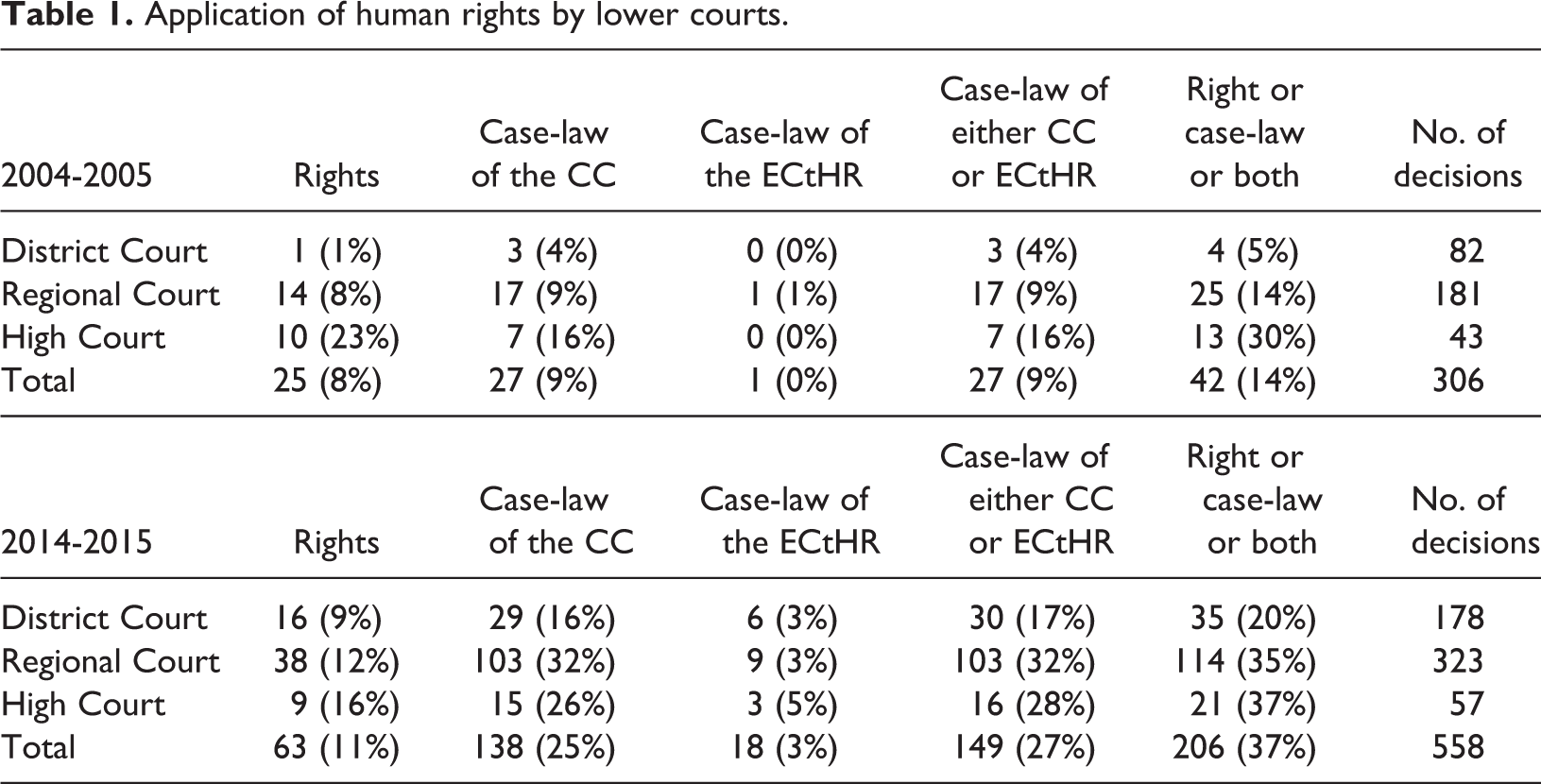
It is particularly interesting to note that references to case-law are more common than references to human rights provisions. This observation is valid for 2003-2004, although the difference is slight. It is much more visible in 2013-2014 (three times as many references to case-law than human rights provisions). The obvious explanation is that case-law is much more concrete compared to human rights provisions. Even though it would probably be more correct to refer to the specific human rights provision first and then rely on its interpretation by the Constitutional Court, the courts often do not waste time on references to the very generally-worded human rights provisions. From a practical point of view this is not surprising as such a reference adds little value when there is case-law that deals precisely with the relevant issue. In any case, this trend further supports the theory of the normative value of case-law even in continental legal systems. Courts often use the case-law in a similar way to a provision of a law, that is, as a rule.
Overall, if we also include case-law, we can conclude that the use of human rights has grown from 2003-2004 to 2013-2014. It can thus be said that human rights have become more embedded in the time span of ten years from 2004.
In this context, it is important to underline that human rights were legally a novel idea in Czechia after the democratic revolution in 1989. This posed a difficulty for the whole system. Lawyers (including judges) had never been trained in human rights. Law schools themselves adopted human rights in their curricula quite late. Modules specifically concerning human rights, the case-law of the Constitutional Court and the ECtHR appeared only in the 2000s. Increased education should lead to more common use of human rights. Further, for the lawyers trained earlier, the process of internalisation of human rights norms necessarily takes some time. Risse and Sikking, building on political science theories, created a model in which internalisation of international human rights norms was understood as a process of socialisation achieved in three stages. It is only after some time of moral-consciousness raising, argumentation, dialogue and persuasion that institutionalisation and habitualisation is achieved. 30 Indeed, it seems that the results of the process of institutionalisation of human rights in Czechia within the lower levels of the court system were observable only in the second decade of 21st century.
6. The relationship between the lower courts and the Constitutional Court
This section tests the hypothesis that there is dependence between the lower court applying human rights and the outcome of the case at the Constitutional Court. In particular, this hypothesis provides that human rights violations are found by the Constitutional Court more often when lower courts do not use human rights and that it is less probable that a violation by the Constitutional Court will be found if they do.
In order to confirm or reject this hypothesis, a null hypothesis, that is that a finding of a violation by the Constitutional Court does not depend on the variable of lower courts using human rights in that case, was tested.
Because the data form a 2x2 contingency table, I used the odds ratio and Fisher factorial test for the statistical analysis. Odds ratio represents the ratio of chances that the result will be a non-violation if there was a reference to a human right as opposed to no reference to a human right. The odds ratio thus tells us how many times it is more likely that the Constitutional Court would find a violation when lower courts do not use human rights as opposed to when they do. The odds ratio is equal to one if the variables are independent (in that case the odds are the same). The Fisher factorial test is based on this premise and its null hypothesis is that the odds ratio is equal to one, meaning that the variables are independent. Because the hypothesis is that a reference to a human right is more likely to result in no violation found by the Constitutional Court, a one-sided test was used. If the null hypothesis is rejected the alternative hypothesis is accepted, which is that the chance of a non-violation is higher where the lower courts referred to a human right. It is customary in social sciences to set the type I error to 5% (the probability of rejecting a null hypothesis if it is true). Setting the type I error lower would considerably increase the chances of committing a type II error, that is not rejecting the null hypothesis even though it is not true. Consequently, if the p-value is smaller than 0.05, the null hypothesis is rejected in favour of the alternative hypothesis.
Since the Constitutional Court takes into account the entirety of the previous proceedings, the use of human rights by any of the courts previously dealing with the case should make a difference. An ignorance of human rights at first instance could be remedied on appeal or even by the Supreme Court deciding an appeal on points of law. On the other hand, use of human rights by the first-instance court could be sufficient, and there might be no reason for an appellate court to use them also. It might only agree with the assessment by the lower court. Consequently, the conducted data analysis considered as a use of human rights the application of a human right by any of the courts which had examined the case prior to the Constitutional Court.
It was thus not possible to ignore decisions of the Supreme Court or the Supreme Administrative Court even though they were not the primary subject of the research. The tables below distinguish between cases that reached the Constitutional Court without being heard by the Supreme Court and those in which there was a decision by the Supreme Court. In criminal and civil matters, not all cases must first be reviewed by the Supreme Court before a constitutional appeal can be lodged. In family law matters, an appeal on points of law is excluded so none of the cases in the dataset were heard by the Supreme Court.
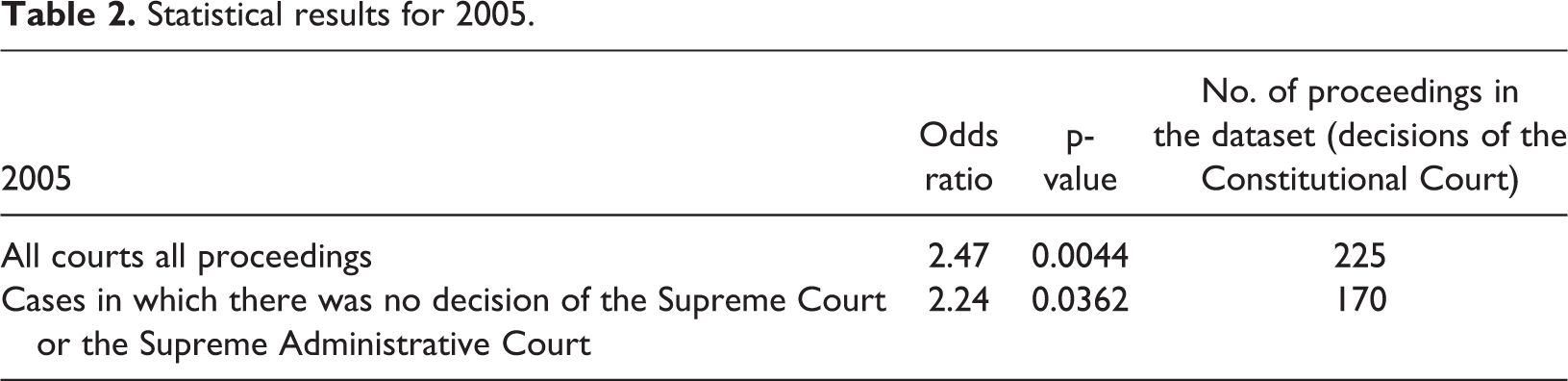
As can be seen from Tables 2 and 3, the null hypothesis that there is no dependence between lower courts using human rights and a finding of a violation or no violation by the Constitutional Court was rejected both in 2005 and in 2015. Importantly the same results were reached both for the group of cases which were heard by the supreme courts and those which were not. The results therefore cannot be dismissed on the basis that they were influenced by the supreme courts using human rights. The data thus confirms the hypothesis that violations occur more often when courts ignore human rights in the reasoning of their decisions.
Statistical results for 2005.
Statistical results for 2015.
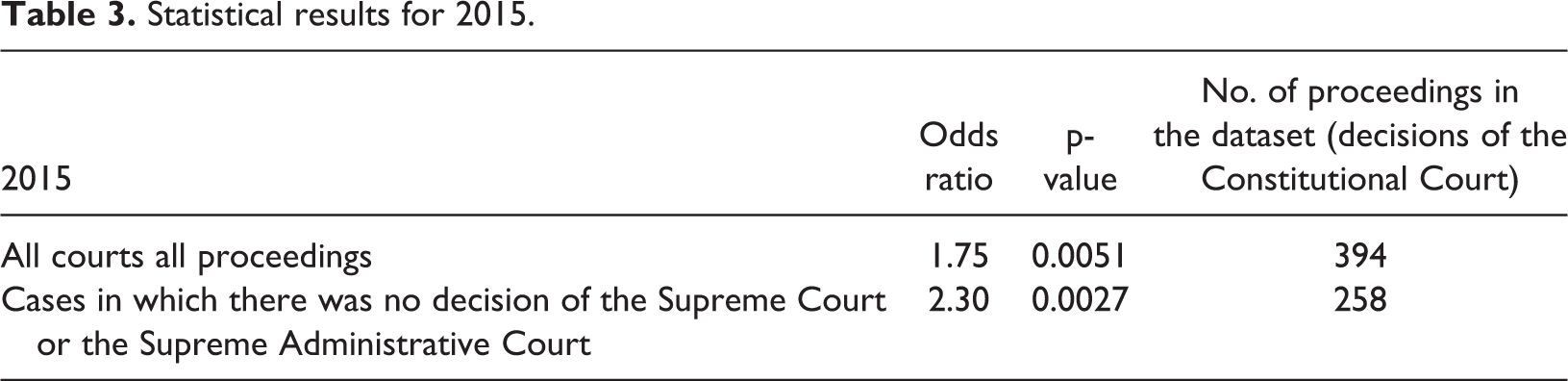
Consequently, a conclusion can be made that human rights matter already at lower levels of jurisdiction. Even in proceedings where supreme courts were not involved there is dependence between the lower courts using human rights and the Constitutional Court not finding a violation. Use of human rights by the lower courts decreases the chance of the Constitutional Court interfering in the case. This could either mean that the Constitutional Court indeed applies deference or that the lower courts got it right in the view of the Constitutional Court. Either way, the use of human rights by the lower courts makes a difference and is not irrelevant. If the lower courts embrace human rights reasoning, apex courts do not then need to interfere with a final and enforceable decision of those courts. This result indicates that positive domestic subsidiarity works in practice and has an impact.
The data show that even judges of first-instance and appellate courts should not shy away from applying human rights because their use means fewer violations of human rights found by the Constitutional Court. Consequently, even judges at the lowest levels should be trained to identify a human rights issue in the cases before them and apply human rights.
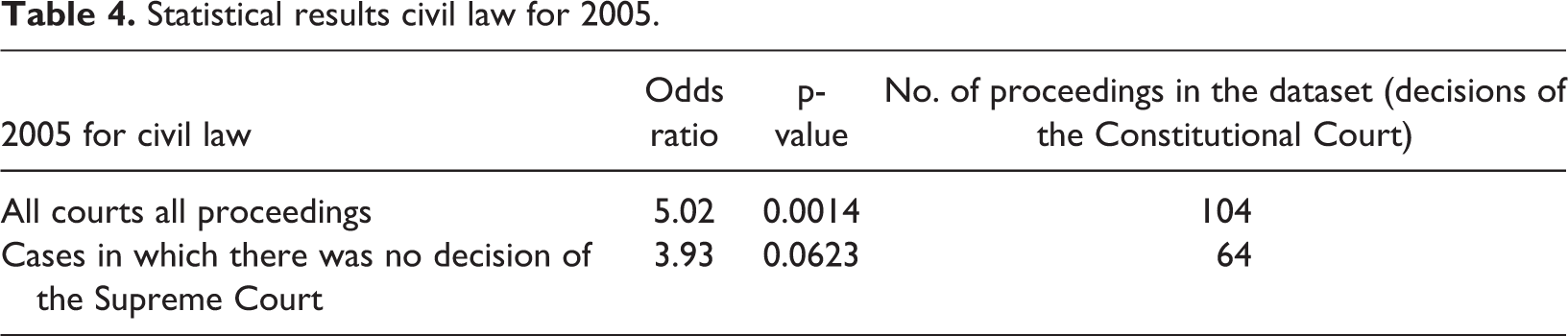
Separate tests were run in both years regarding the different types of proceedings, that is civil and criminal law. Separate tests were not conducted for family law or administrative proceedings because there were not enough observations of violations at the Constitutional Court in order to run the statistical tests (the test did not have sufficient power) even when the two time periods were grouped together. 31 The aim was to find out whether the overall results were influenced by strong results in one type of proceedings. If so, further analysis would be required.
The Table 4 –7 above also confirm our hypothesis across the different types of proceedings, with the exception of the criminal law field in 2015 (Table 7). This could however be explained by an insufficient number of observations, because if the number of observations is increased while keeping the same odds ratio, the test rejects the null hypothesis. 32 Consequently based on the odds ratio, we could also reject the null hypothesis in favour of the alternative hypothesis (dependence).
Statistical results civil law for 2005.
Statistical results criminal law for 2005.
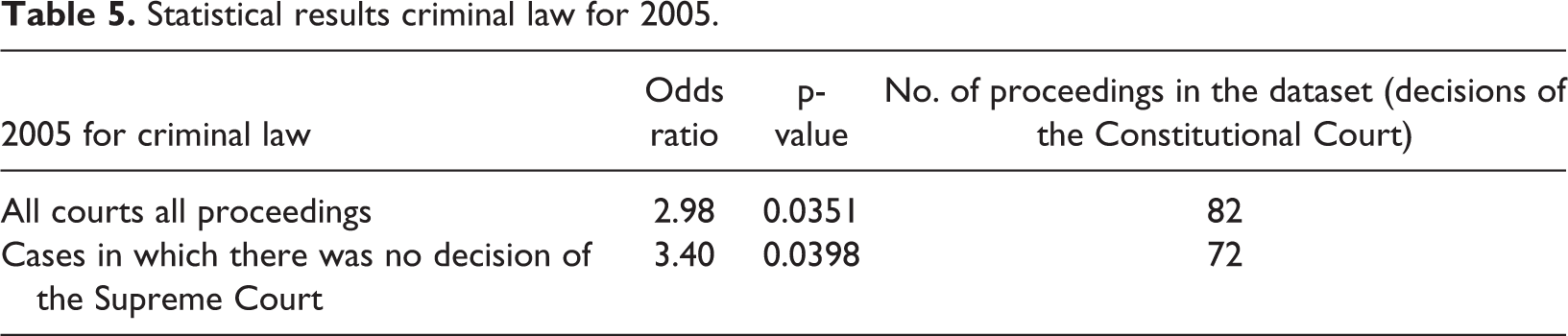
Statistical results civil law for 2015.
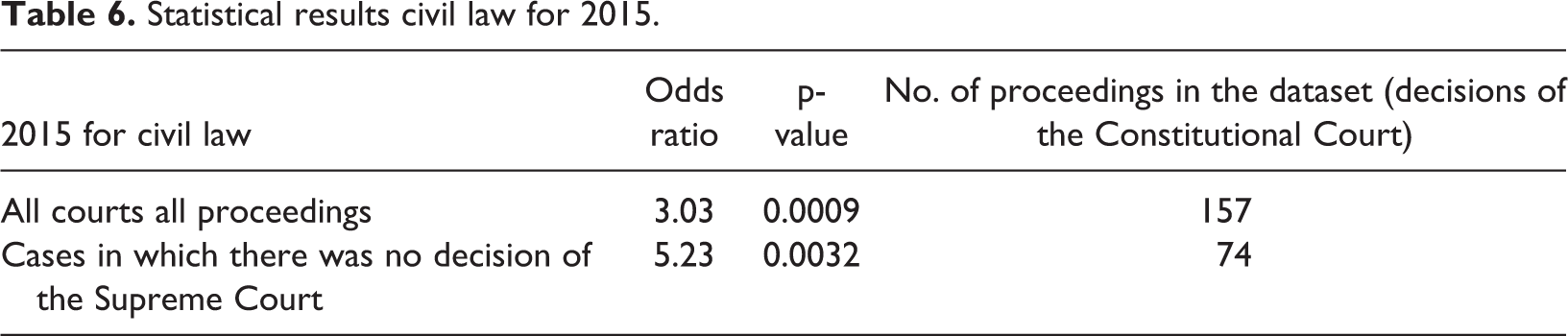
Statistical results criminal law for 2015.
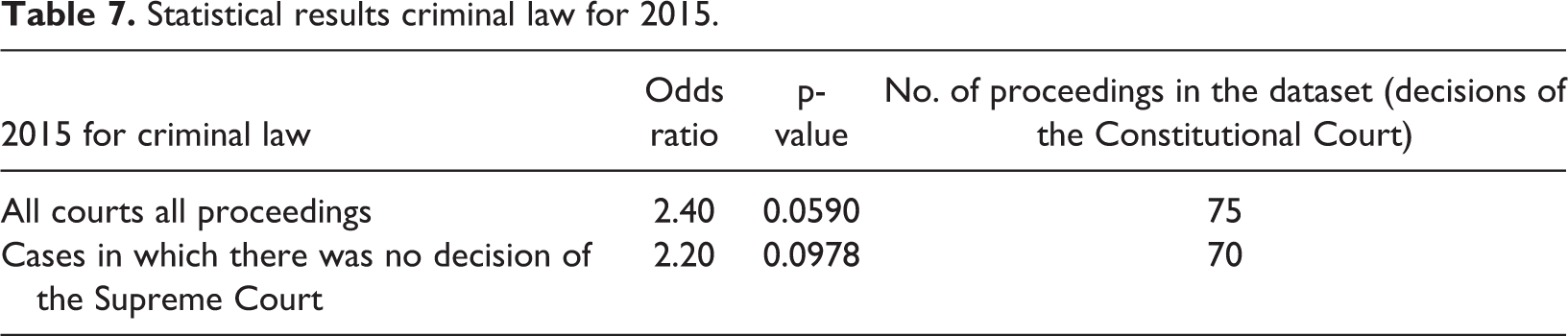
Even though the statistics confirmed the hypothesis, those cases where human rights were used by the lower courts but there was still a violation found by the Constitutional Court were examined in further detail.
In 2015 there were 15 cases where the Constitutional Court found a violation despite a regional court using human rights and four judgments of a violation despite a high court using human rights. 33 Out of these 19 cases, in seven instances there was developing case-law 34 or the courts were faced with conflicting case-law of the Constitutional Court and the Supreme Court 35 . In eight instances there was only superficial use of human rights 36 or clearly wrong use 37 and only in four instances did the Constitutional Court disagree and assess the human rights issue in a different way. 38
The initial qualitative analysis of the cases showed that there were two primary reasons for a violation found by the Constitutional Court despite the lower court using human rights. First, the use of human rights was only superficial and done in passing. This highlights the need for a proper good faith assessment of the human rights issue, which is indeed part and parcel of the doctrine of positive subsidiarity. Superficial use of human rights, most likely intended to show that a party’s argument was not completely ignored, is not sufficient.
The second reason was the existence of conflicting or unsettled case-law on the issue under consideration. As a result, the lower courts did not have enough guidance to apply human rights properly at the time of their decision. This observation suggests that it is indeed important for apex courts and international courts to have clear case-law including clear standards to be applied in similar cases. Therefore it seems that the trend, found in the practice of the ECtHR, to give a general framework for future similar cases in order to assist the domestic courts is the correct approach. For instance, when the ECtHR lists factors relevant for the balancing exercise 39 or more generally factors for an assessment of a human rights issue 40 it gives a clear and predictable guidance that domestic courts, including primary level courts, can use.
It transpires that only in a small fraction of cases does the Constitutional Court have a different view on the human rights question despite the lower courts undertaking a proper human rights assessment. Accordingly, it can be said that it is only in a small fraction of cases that lower courts, despite trying, get it wrong from the point of view of the Constitutional Court.
Overall, the data show that if lower courts fulfilled their duty arising out of positive subsidiarity and applied human rights, the Constitutional Court will be less likely to intervene with their final judgment. Both the quantitative and qualitative analyses imply that subsidiarity in domestic practice seems to work.
7. Conclusions
In conclusion, the data from Czechia show that using human rights at the lowest level of the court system matters and that subsidiarity seems to work in domestic practice. The statistical analysis confirmed dependence between the lower courts using human rights and the outcome of the case at the Constitutional Court. If the lower courts apply human rights, there is less chance that the Constitutional Court will find a violation.
These findings provide another reason to support the practice of apex courts that insist on positive subsidiarity and try to make even the lowest levels of courts pay attention to human rights. If lower courts do so, it is less likely that the apex court will then quash their decisions on the basis that there has been a human rights violation. This means that parties to proceedings with a human rights aspect will not need to wait years for a final decision. The use of human rights by the lower courts thus improves the effectiveness of the court system because a final and enforceable decision is less likely to be quashed by the apex court. Since using human rights even at the very lowest level of jurisdiction makes a difference, first-instance court judges should not hesitate using them.
The findings also support the validity of the process efficacy logic in that the quality of process has an impact on the quality of the outcome. 41 Provided, of course, that we assume that the outcomes reached by the apex courts are correct. From one perspective they clearly are, because apex courts have the final say on the matter and therefore formally they are the correct results. Furthermore, in Czechia both the Constitutional Court and the ECtHR are perceived by the general public as the courts where justice can be achieved so their results are also in general perceived as more just than decisions of other courts in the judicial system. 42 Therefore they may not be the correct results only formally but also results that are viewed as just. The importance of a fair procedure as a value in itself should not be underestimated, yet what matters at the end most is that justice is done and not only seen to be done. 43
Obviously not every use of human rights by the lower courts is sufficient to protect their decisions from being overturned. A closer look at the decisions showed that superficial use of human rights by lower courts is not good enough for the apex court to show deference to the decision taken. There must be a sincere and thorough assessment of the human rights issue.
Overall, the example of Czechia shows that the insistence of the Constitutional Court that lower courts use human rights in their reasoning, and thus its encouragement of positive subsidiarity, results in fewer human rights violations being found by the Constitutional Court. As already hypothesised, the fact that human rights are increasingly used by its whole court system might explain why Czechia is a high compliance state vis-à-vis the ECHR. Therefore the findings of this research could also be an argument in support of positive subsidiarity in relationship between apex courts 44 and lower courts in those jurisdictions, which do not use that concept.
Finally, the findings also support the utility of international courts, in particular the ECtHR, insisting on positive subsidiarity. Former president of the ECtHR, Dean Spielmann observed that ‘the centre of gravity of the Convention system can be lower than it is today, closer in time and space to all Europeans’. 45 By insisting that even primary level courts apply human rights that centre is indeed very close to ordinary Europeans.
Footnotes
Acknowledgements
The author would like to thank all the colleagues who gave their valuable comments and his student research assistants.
Declaration of conflicting interests
The author(s) declared no potential conflicts of interest with respect to the research, authorship, and/or publication of this article.
Funding
The author(s) disclosed receipt of the following financial support for the research, authorship, and/or publication of this article: The research leading to this article has received funding from the Czech Science Foundation under project No. 16-07776 S (The application of human rights by first and second instance courts).