




Abstract
Despite growing awareness of the importance of the role of Non-Governmental Organisations (NGOs) in monitoring international human rights law, there is as yet little analysis of the heterogeneous nature of NGOs and of the relationships between NGOs engaging with the United Nations (UN). This socio-legal analysis was drawn from 26 interviews with key stakeholders across the UN, Governments and NGOs. The article analyses, problematises and maps the NGO role, presenting a taxonomy with six categories of NGOs engaging with UN human rights bodies - international facilitative, gatekeeper, imperialist, domestic self-sufficient, domestic dependent and Governmental Non-governmental Organisations (GONGOs). It also considers the role of National Human Rights Institutions in engaging with the UN, vis-à-vis the NGO role. A preferred NGO model of engagement according to those in the UN receiving NGO reports is presented. The article concludes that NGOs play a pragmatic role in addressing limitations of the UN human rights system, and a normative role in contributing to global democratisation and governance.
Keywords
1. Introduction
There is an ever-increasing awareness of the importance of the role of Non-Governmental Organisations (NGOs) in monitoring international human rights law. An area where they make an essential contribution is in State reporting to UN treaty bodies and to the Human Rights Council’s Universal Periodic Review (UPR) 1 but as of yet there is very little understanding of the variety of roles played by NGOs engaging with UN bodies and the relationships between them. From having a very limited consultative role provided for in Article 71 of the United Nations (UN) Charter, 2 NGOs have evolved as key actors in the UN human rights system. The UN Office of the High Commissioner for Human Rights (OHCHR) has noted that the work of some of the UN human rights bodies is: ‘…inconceivable without civil society input, which adds to the relevance and credibility of the conclusions and recommendations resulting from the experts’ deliberations.’ 3
The key role played by NGOs in UN human rights State reporting mechanisms is the provision of information and contributing to the development of relevant, appropriate recommendations. 4 In their role of providing critical information, NGOs hold governments to account on their human rights obligations. As the Human Rights Council observes: ‘Allowing voices to be heard, even when they express criticism or unpopular views, is key to holding decision makers to account and to ensure that policies are reviewed, lessons learned and improvements made.’ 5
The following conclusion by Keith in her chapter in the Oxford Handbook of Empirical Legal Research, in which she synthesises and analyses empirical legal research on international human rights instruments, provides strong validation for the research questions and empirical methodology selected for this research: The role of NGOs and INGOs seems to offer a tremendous opportunity for future study, but researchers need to reach beyond simple counts of organizational membership to examine empirically the processes and contexts through which these organizations influence compliance.
6
Drawing on data from 26 semi-structured interviews, what emerged in the process of that research were observations on how NGOs function and the complexity of, and variety in, NGO roles and the relationships between them. Existing literature offered theories and models relevant to NGO roles, but these did not adequately relate to NGOs’ engagement with key UN bodies. There is sometimes a tendency to deify NGOs - their idealism, 7 their adherence to their ‘cause’, 8 and the importance of their moral authority. 9 The title of Willetts’ book famously described NGOs as ‘the Conscience of the World’. 10 However, there has also been some concern for NGOs’ legitimacy and accountability. 11 Given that NGOs have been identified as important, if not critical, actors in the UN human rights system, it is germane that we critically examine them in more detail.
This article seeks to illustrate the current situation with reference to types of NGOs, their functions, characteristics, relationships and dependencies. It paves the way for NGOs to identify themselves in this taxonomy and reflect on their role and networks, and should generate further critique and discussion.
In this article, Section two briefly establishes the empirical methodology used in the study. This is followed in Section three by an overview of the previous literature on NGOs and the development of the NGO role at the UN. Section four introduces the NGO taxonomy with six categories of NGOs as follows: international facilitative; gatekeeper; imperialist; domestic self-sufficient; domestic dependent; and Governmental Non-Governmental Organisations (GONGOs).
Section five considers the role of National Human Rights Institutions (NHRIs) in engaging with the UN vis-à-vis the NGO role. Section six discusses broader considerations around the expectations of NGOs in UN human rights State reporting, including their roles in democratising and governance. Section seven concludes and identifies opportunities for future research to further develop understanding of the NGO role.
2. Methodology
The need for empirical research in understanding the NGO role in international human rights law has been well established. 12 As such, this socio-legal study was based on empirical data from 26 semi-structured interviews carried out in 2015 and 2016 with stakeholders identified as relevant to the NGO role in UN human rights State reporting, using a purposeful sampling approach. 17 of these were international interviewees based in Geneva, including staff of the UN Office of the High Commissioner for Human Rights (OHCHR), State representatives on the HRC, treaty body independent experts and international NGOs. The findings presented in this article are largely drawn from the international interviews. As discussed below, the research also involved an Australian case study to allow for an in-depth analysis of the role of domestic NGOs; however, it is important to note that all 17 international interviews discussed the global context rather than the Australian context. They spoke about general trends in UN reporting, sometimes drawing on specific examples from particular jurisdictions around the world.
Australia was selected as a case study as it has at times had quite an antagonistic relationship with UN treaty bodies, in particular Australia’s review by the Committee on the Elimination of Racial Discrimination (CERD) in 2000. 13 However, it has been more disposed towards positive engagement with the UPR and has also been elected to the Human Rights Council in 2018. Another reason for selecting Australia is that NGO engagement with the UN on human rights issues is particularly important for States such as Australia that are not part of a regional human rights framework. This is compounded by the fact that Australia is the only Western democracy lacking a constitutional or statutory Bill of Rights. As a result, the role of the UN processes in advancing human rights issues in Australia is unusually significant, thus warranting examination. In terms of analysing the NGO role, Australia is a suitable selection as it has an informed human rights NGO sector with strong internal networks, although stymied somewhat by funding shortages, 14 and recurrent gagging clauses in funding. Some features of NGO engagement with the UN may be common across the Western European and Other Groups (WEOG) States. 15 These States are seen as geographically diverse but more homogenous in terms of culture, political approach and economic development. 16 In any case, the taxonomy was largely drawn from international interview data however, where findings were more generalisable.
The remaining nine interviews were conducted with Australian interviewees including representatives from government, domestic NGOs and the NHRI. The interviews were conducted in accordance with the ethics requirements for the project, which included the option of anonymity – selected by some interviewees. 17 The interviews were transcribed, then codified and analysed using NVivo qualitative analysis software. The author also used observational methodology during trips to the UN in Geneva in April 2015, November 2015 and August 2016 to observe the reviews of a number of States in sessions of treaty bodies and the UPR. As a qualitative study, a constructivist approach was deemed to be most suitable. 18 From an epistemological perspective, a constructivist approach assumes that reality is socially constructed - the researcher constructs knowledge from a variety of views, rather than discovering it. 19
State reporting has been selected for analysis here as a cornerstone of the UN human rights system. It has a broad scope compared with individual complaints mechanisms under the treaties, mechanisms which are sometimes not widely used. 20 Moreover, the HRC’s adoption of a State reporting mechanism by way of the UPR as the cornerstone of its institution building package has brought a renewed focus to the importance of State reporting. Previous literature on NGOs in international law has not generally focused on State reporting but rather has been dominated by the NGO role in drafting international law and in litigation. 21 There is also significant interest in the ‘naming and shaming’ role of NGOs, 22 but the key international legal mechanism frequently used by NGOs – that of State reporting – is less analysed.
3. The story of NGOs
International law was traditionally seen as the law primarily governing relations among States and States have traditionally been viewed as the primary, if not the only actors in, and subjects of, international law. 23 A key limitation of traditional State-centric theories is in understanding the role of non-State actors, including NGOs. 24
The coining of the term ‘Non-Governmental Organisations’ is most commonly linked to Article 71 of the UN Charter which mandated the UN Economic and Social Council to make ‘suitable arrangements for consultation with non-governmental organizations which are concerned with matters within its competence.’ 25 Although the UN more commonly uses the umbrella term ‘civil society’, 26 this article focuses solely on NGOs and their role in UN human rights State reporting mechanisms. Despite being a commonly used term, there is a lack of consensus on the definition of NGO. 27 For the purposes of this article, NGOs of interest are NGOs that engage with UN human rights mechanisms and as such, the following UN definition provides a working definition: ‘…a non-profit, voluntary citizens’ group which is organized on a local, national or international level…. Some are organized around specific issues, such as human rights…’ 28
NGOs began as minor actors in the UN system, both in scope and in quantity, but the number of NGOs has rapidly increased since the UN was established in 1945. There were an estimated 330 international NGOs in 1914, rising to 2,300 NGOs by 1970. 29 The 60s and 70s saw the establishment of some of the most high-profile human rights NGOs such as Amnesty International and Human Rights Watch, which were established in 1961 and 1978 respectively. 30 By 2017, there were 69,282 international non-profit organisations, including national NGOs with an international focus. 31 Smith attributes the rapid increase in NGOs to three things – the rise of new actors and issues on the international agenda post-cold war, developments in technology that enabled information exchange and travel, and the increased resources available to NGOs. 32 The increase in NGOs also coincided with the adoption of new UN human rights treaties and associated monitoring opportunities for NGOs. Several authors point to the high-profile involvement of NGOs in UN human rights world conferences in the 1990s as an important turning point in NGOs’ role within the UN system, 33 and much of the literature post-dates this. 34 Studies of NGOs in international human rights law really only began to emerge in the late 1990s. Not only was there high participation by NGOs, for the first time there were also a significant number of more grass-roots level NGOs, rather than international NGOs. 35
Concomitant with this growth of NGOs was the challenge to traditional State-centric theories of international law, including the challenges brought by globalisation. 36 Literature and theories relating to non-State actors and international civil society developed. 37 Theories such as transnationalism were used to explain NGO behaviour and relationships. 38 Transnationalism refers to economic, social and political linkages between people or institutions across the borders of nation-states. 39 A type of transnational theory relevant to this article is Koh’s transnational legal process theory - a dynamic process by which public and private actors, including States, international organisations and NGOs, interact in domestic and international fora to make, interpret, enforce and internalise international law. 40
Transnationalism also emerged in social sciences modelling of transnational advocacy networks in the 1990s to explain international NGO behaviour and relationships. 41 These models demonstrated that international human rights norms are used by networks of transnational and domestic activists who effectively socialise States to accept and comply with such norms. Risse-Kappen proposed a transnational model to explain NGO behaviour, focusing on international NGOs and networks but with less recognition of domestic NGOs. 42
This emphasis on international networks and NGOs mirrors the initial focus at the UN, which was on engagement with international NGOs as reflected in Article 71 of the UN Charter. 43 There was pressure from NGOs to change this, and a recognition of the important role played by more grass-roots level NGOs at the early 1990s World Conferences. 44 As a result, ECOSOC Resolution 1996/31 recognised in its preamble ‘the need to take into account the full diversity of the non-governmental organizations at the national, regional and international levels.’ 45 Resolution 1996/31 also provided for a three-level hierarchy of NGO status for accreditation purposes and specified the nature of activity in which each level could engage. The highest level of accreditation is ‘general consultative status’, reserved for large international NGOs. 46 These tend to have broad geographical reach; 47 examples include, Greenpeace International, and Oxfam International. 48 Therefore, although a wider range of NGOs were included by Resolution 1996/31, a hierarchy was also introduced, with international NGOs at the top.
The focus in the literature on international NGOs and transnational advocacy networks changed as more domestic NGOs emerged and engaged with the UN system. Following the transnational model, two subsequent models were significant in academic literature – the spiral model and the boomerang model. First published in 1999, the spiral model still remains influential in human rights research. 49 In the spiral model, diffusing international human rights norms depends on domestic and transnational networks using international regimes to bring issues to the attention of Western governments and citizens. 50 Keck and Sikkink’s boomerang model was perhaps less widely adopted by scholars than the spiral model, but is more cognisant of the role of domestic NGOs. 51 It uses the boomerang as a metaphor for the interaction between domestic NGOs and INGOs, who put pressure on the government in question. 52
None of these models and theories - boomerang, spiral and transnational legal process – engage directly and specifically with the UN human rights mechanisms nor do they resonate closely with the author’s findings and observations – hence the development of the taxonomy presented in this article. Nonetheless, elements of the models and theories summarised above are evident in the NGO role in State reporting and provide good explanations for some aspects of the role. For example, using UPR State reporting to bring issues to the attention of Western governments resonates with the fundamental concept of the spiral model. In the boomerang model, the interaction between international and domestic NGOs is reflected in the taxonomy of NGOs and the relationships between them, as presented in this article. Koh’s transnational legal process also includes elements relevant to the current research, such as the actors’ roles in enforcing and internalising international law and the concept of a ‘repeated process of interaction and internalization’ through which international law acquires its ‘stickiness’. 53 The cyclical nature of State reporting to UN treaty bodies and to the UPR is a ‘repeated process’. However, Koh’s perception of the NGO role appears to be litigation focused, rather than cognisant of the NGO role in the more commonly used UN human rights State reporting per se, and the spiral and boomerang models resonate more with the ‘naming and shaming’ work of NGOs, rather than using UN human rights mechanisms.
More recent literature has questioned some of the underlying assumptions about the concept of global civil society, 54 and the importance of transnational networks. Both Simmons and Merry have proposed that whilst transnational networks may be critical in the case of a repressive regime, in most States; domestic actors are the most significant. 55 This has been borne out by recent research which has found that coalitions of domestic NGOs can be most influential in UN State reporting mechanisms. 56 Merry also argues that NGOs can act as intermediaries so that international law can be adapted as a ‘localized globalism’. 57 Again, elements of these theories are relevant to the NGO role in State reporting, such as their understanding of the importance of the role of domestic NGOs, reflected in the taxonomy presented in this article.
4. NGOs in UN State reporting – What and how? A taxonomy
Based on the author’s observation of the NGO role in UN State reporting, interview data, 58 and relevant literature and reports, the following taxonomy of NGOs was developed, see Diagram 1. Sometimes NGOs fit into more than one category, and / or perform functions that can be identified with more than one category. Although the words ‘domestic’ and ‘international’ are used in the taxonomy, these could sometimes be interchanged with the word ‘regional’.
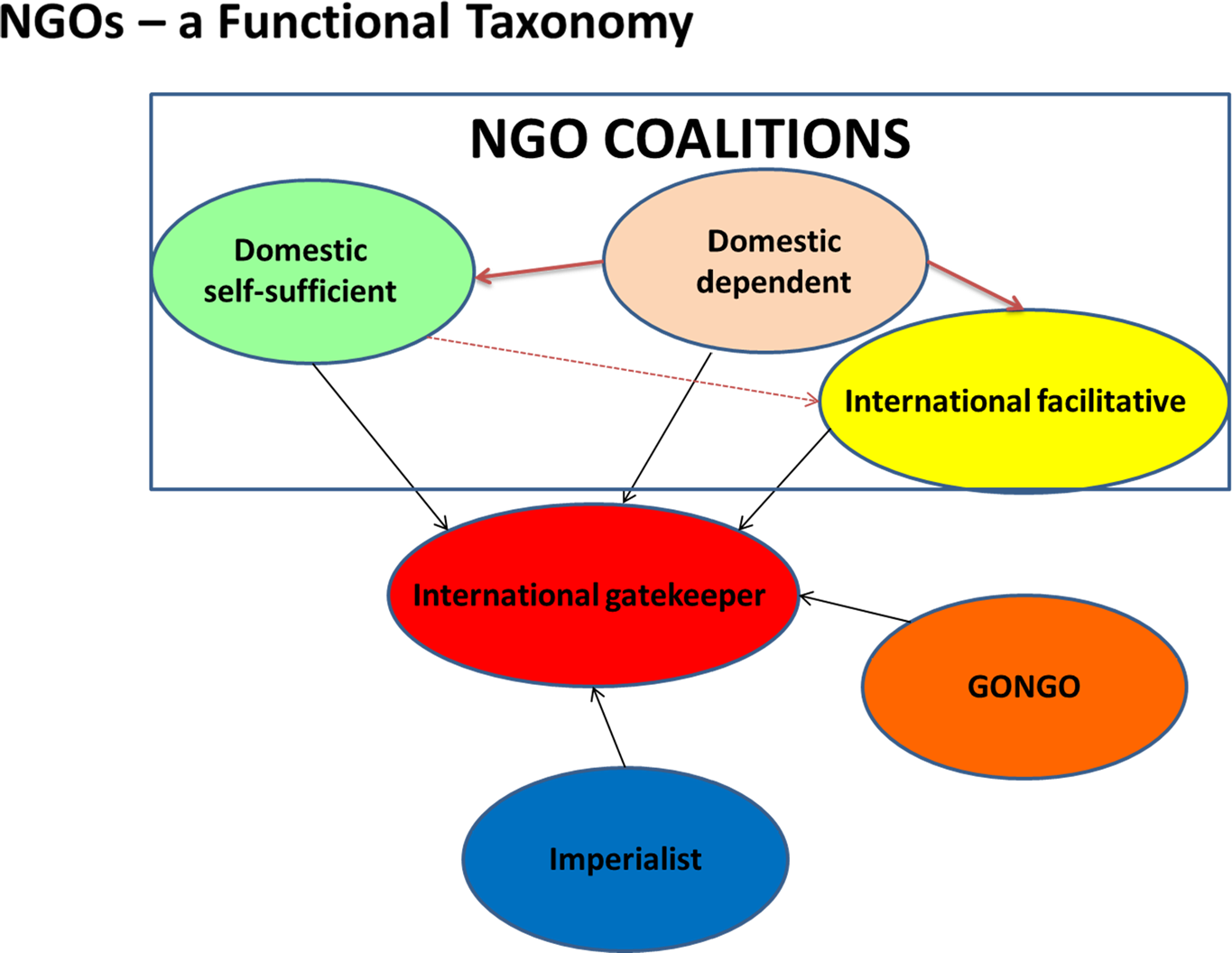
Proposed NGO taxonomy and networks.
The taxonomy offers a way of better understanding and analysing NGOs and their roles and relationships with each other based on a number of factors including function(s), capabilities and behaviours. The six categories of NGOs will each be discussed in turn in the context of NGO engagement with UN human rights State reporting (treaty bodies and the UPR), predominantly at an international level, but occasionally drawing on data from the Australian case study by way of illustration. A preferred model of engagement, based on interviews with those receiving reports, is presented in Diagram 2.
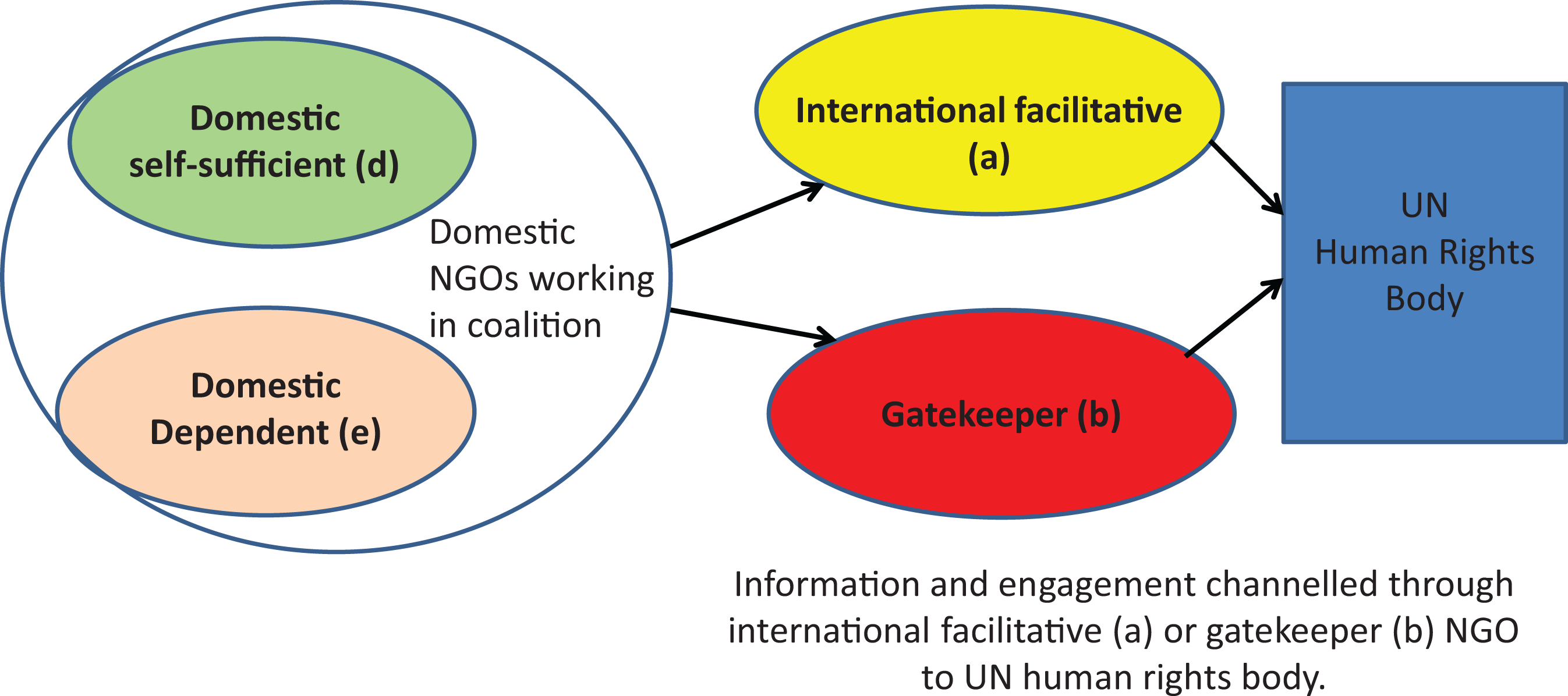
Preferred model.
a) International facilitative
International facilitative NGOs play a useful role, both for UN bodies, and for domestic NGOs. These NGOs often have a presence in Geneva where the HRC and treaty bodies sit in session. They use their expertise, knowledge of the system, and networks to facilitate engagement between domestic NGOs and the UN bodies. They may provide training to domestic NGOs, arrange interpreting and set up meetings with Committee members in the case of treaty bodies, or government representatives in the case of the UPR. Sometimes they can provide resources such as report drafting or editing, and financial support and resources to domestic NGOs. They are mostly used by domestic dependent NGOs (e), although some domestic self-sufficient NGOs (d) are aware of the benefits of collaborating with international facilitative NGOs.
Examples of international facilitative NGOs, interviewed for this research, include the Centre for Civil and Political Rights (CCPR Centre), International Service for Human Rights (ISHR), the International Movement Against all forms of Discrimination and Racism (IMADR), Minority Rights Group, and Edmund Rice International. Some of these NGOs work more closely with specific UN bodies; for example, the CCPR Centre works with the UN Human Rights Committee. Others work on thematic issues such as minority rights, women’s rights or children’s rights and therefore may work more closely with the most relevant treaty body but will also engage with other treaty bodies and the Human Rights Council. For example, ISHR has a particular focus on supporting human rights defenders and engages with the UPR, treaty bodies, and other UN and regional human rights bodies.
59
The CERD Committee members and OHCHR staff interviewed had a positive perception of the role played by these NGOs: I think the very important role that the international NGOs, for example the Minority Rights Group, can fulfil is bringing together across continents and countries, issue-based groups…those organisations do it in a way that is respectful of national contexts and fully integrates them. So yes, I think the role of international NGOs has changed significantly.
60
Traditionally international NGOs were about relating through the national NGOs to the international system and by now, with the sorts of communications we have available, and with the capacity that exists with most national, if not local NGOs…beyond some initial orientation, a lot of that is no longer required.
61
However, what is clear is that international facilitative NGOs do not speak on behalf of domestic NGOs without their consent, nor do they manage, control or restrict the engagement of domestic NGOs. This is what differentiates them from either gatekeeper (b) or imperialist (c) NGOs. International facilitative NGO representatives were clear in interviews that they are experts on how the UN system works, but not on the human rights situation in-country and as such they rely on domestic NGOs: …for some of the very technical questions, we think it is important for the Committee to have direct contact with the affected communities, and if it is a very technical question, I am not at all an expert in all of these countries. And so the people from the country need to speak about that and I can help them to understand what it is all about and to prepare. But then they are the main source of information and not just information but analysis too in terms of what could be helpful for recommendations.
62
I should mention that we…are a big NGO and we are known to them. So when we work with a partner, just by giving a stamp, it’s just a way to give credibility. You know the NGO world, you have a lot of crazy people going around, you have a lot of political NGOs, and biased stuff going on, so if we were to analyse that, I would say that that is one of our main roles here. Because we are not first-hand providers of information because we have to rely on partners – we do have missions I mean we are on the ground too but we have to find local partners, to train them to put in shape what they know, to use human rights vocabulary.
63
b) Gatekeepers
Gatekeeper NGOs can at times play a role similar to the international facilitative NGOs (a) but differ in that they exercise more control over other NGOs within UN human rights State reporting mechanisms. In particular, they can act as a gatekeeper by being prescriptive about access to UN human rights bodies or related meetings, by controlling access and potentially preventing access to them.
One example of a gatekeeper NGO in the case of treaty bodies is International Women’s Rights Action Watch (IWRAW) which acts as gatekeeper for the Committee on the Elimination of Discrimination Against Women (CEDAW). According to an interview with an OHCHR staff member, IWRAW can provide some financial support for NGOs to travel to Geneva. IWRAW also provide compulsory training for engagement with the CEDAW Committee and allocate speaking time among NGOs. 64 It was reported that those NGOs who are not funded by IWRAW or do not feel they require training are still obliged to attend as that is how speaking times are allocated and IWRAW ensures there will not be duplication in presentations. 65 Some UN treaty bodies, such as CERD, do not have a gatekeeper NGO. In this case, an internal body such as the Secretariat within the OHCHR plays a gatekeeper role by liaising with NGOs, potentially filtering out NGO information and arranging informal NGO briefings.
Gatekeepers, whether NGOs or part of the UN system, arise out of a perceived need. As noted above, there has been an exponential growth in the number of NGOs over the past seventy years, many of them seeking to engage with the UN system and there is a practical need to manage this engagement. OHCHR staff and treaty body interviewees consistently referred to the deluge of information they receive from NGOs, which is impossible for them to read. This is better managed in the UPR where the Secretariat selects input from civil society reports for inclusion in the Stakeholder Summary Report they prepare for the UPR Working Group on each State under review and in allocating NGO speaking times at the adoption of the UPR report. 66 This makes the logistics of the exercise easier but there could be disadvantages, such as certain human rights concerns being omitted, or simplified.
It can also be argued that gatekeeping arises due to the lack of regulation of the NGO sector. Although the Economic and Social Council has a system of NGO accreditation, it is not generally required for NGO engagement with human rights State reporting mechanisms, 67 with the exception of the two-minute speaking opportunity at the adoption of the UPR working group report.
An example of a gatekeeper NGO in the UPR is UPR-Info. 68 UPR-Info acts as gatekeeper NGO for its own pre-sessions where NGOs and other civil society actors are brought together with representatives from States’ Permanent Missions to present on the human rights situation of States prior to their UPR. Similar to IWRAW, UPR-Info takes expressions of interests for speaking slots at these pre-sessions and manages the format, duration and logistics of the sessions. 69 The pre-sessions and UPR-Info’s management of the associated logistics were seen as useful by government representatives, for example: ‘The pre-sessions are extremely useful because they come simultaneously and it gives you ample opportunity to verify information, even with the State under review on a bilateral basis and to prepare well in advance.’ 70
However, a domestic self-sufficient NGO (d) interviewee found the co-ordination by UPR-Info a little frustrating, particularly when the domestic NGOs were well organised and working in coalitions.
71
They would have preferred to manage their own presentation, rather than be managed by UPR-Info. Nonetheless, it was acknowledged that UPR-Info plays a useful role: There was a vast number of permanent missions and ambassadors and representatives present, which was fantastic, and I can imagine that in countries where they did not have the kind of coalition we did, it would be incredibly useful in marshalling that and bringing people together…They didn’t appear to have any kind of advocacy role, it was more of a functional role in terms of providing the format and being an information conduit, which I think is important.
72
c) Imperialist
A number of interviewees expressed concern about what the author terms imperialist NGOs in the taxonomy. These are the international NGOs who present information on the human rights situation within a given State, often without domestic NGO permission or adequate consultation with them. They are often Western NGOs and do not necessarily have a presence in the State under review. The risk of international legal imperialism in international civil society has previously been identified, 73 and is a critique of many popular civil society movements, including feminism which has been described as steeped in the story of imperialism and its racial assumptions. 74 The concept of imperialist NGOs is more acknowledged in the international development sector than in the human rights sector: 75 ‘Donors have gained the power to set the development agenda and NGOs have slowly become Trojan horses for global neo-liberalism.’ 76
In some cases, international facilitative (a) and imperialist NGOs (c) can play a similar role. For example, international NGOs may be required in some areas of the UN where they have more access due to having ECOSOC general consultative status. Also, where there is weak civil society in a State both international NGOs fill that gap by submitting a report based on their research.
As discussed above, initially there was a strong focus on international NGOs in the UN system and there were fewer domestic NGOs with the capacity to engage with the UN system. However, this is less often the case now. One CERD Committee member expressed scepticism of imperialist NGOs, stating: ‘…these globalised entities have secured a position for themselves in a space between NGOs and States…where international NGOs persist in trying to fill that hole, I’m not convinced it’s useful.’ 77 Another had seen a similar trend: ‘…you know there are very big NGOs and you know some of them are international NGOs and when you are a small NGO, you can be frightened, sometimes they want to take you under their wing, but I think the NGOs also need to be independent.’ 78
Interviewees were generally reluctant to name any particular NGO in the imperialist category but large high profile international NGOs appeared to be examples. Limited co-operation with other NGOs is one of the features of imperialist NGOs. One domestic NGO interviewee explained that a large international NGO working in Australia ‘will do its own report and their internal bureaucracy doesn’t lend itself to working in coalitions.’ 79
There is evidence of the existence of imperialist NGOs in the UPR. 80 Baird, analysing the involvement of international NGOs in the UPRs of Pacific States, found that their submissions were more plentiful than local and regional NGOs and that they focused on formal limitations of rights rather than actual violations. 81 She urged such international NGOs to ensure that they are not distorting the authentic local NGO voices but rather to support national Pacific NGOs to ensure their concerns are reflected in the UPR. In other words, she was urging them to behave more like international facilitative NGOs (a) than imperialist NGOs (c).
Such NGOs might consider the advice of Hortsch, writing about Amnesty International and accountability who concluded: Principle #1: It is crucial for Human Rights lawyers and organizations to be clear about their “voice”. Human rights organizations must be clear about whether they are speaking for, speaking with, or speaking as the group in question. They should also be clear on when it is best to refrain from speaking so others may be heard.
82
d) Domestic self-sufficient
Many interviewees, including government representatives, the Australian NHRI and international NGOs, attested to the expertise of some domestic NGOs. These NGOs are both experts in the domestic human rights issues and are experienced in using the UN human rights bodies. They actively engage with UN human rights State reporting mechanisms. They generally have (or can source) the funds to travel to Geneva and recognise the benefits of using international networks, such as international facilitative NGOs, although they are not reliant on them. Domestic self-sufficient NGOs may lead or play an active role in domestic NGO coalitions. Although they could submit their own reports, they recognise the benefits of working in coalitions – such as the UN’s preference for coalition reports, the added legitimacy it brings, and the longer-term benefits of developing networks and partnerships for advocacy work. From the Australian case study, the Human Rights Law Centre and the National Association of Community Legal Centres (NACLC) are examples of such NGOs.
Even where domestic NGOs are self-sufficient, they may have to co-operate with gatekeeper NGOs (b) or may have their views heard more effectively by liaising with an international facilitative NGO (a): All the information is coming from domestic NGOs, all the credible information is coming from domestic NGOs or individuals and…it is often funnelled appropriately through an international NGO which just happened to have the presence and the skills.
83
e) Domestic dependent
International interviewees spoke about domestic dependent NGOs – those who require other NGOs to assist them in engaging with the system. They can work with domestic self-sufficient NGOs (d) and / or with international facilitative NGOs (a) in coalitions, or they can use international facilitative NGOs (a) to engage directly with the UN. The international facilitative NGOs interviewed identified that domestic dependent NGOs often require training and assistance to engage with UN bodies. For example, the groups experiencing discrimination and human rights abuses may have a number of access barriers, such as lower levels of education, less funding and less language skills. International facilitative NGOs will also sometimes help draft or edit the domestic dependent NGO’s reports to UN human rights bodies.
Where this assistance has not been available or availed of, and domestic dependent NGOs have submitted reports directly to the UN body, this can be a source of frustration. This was commented on by OHCHR staff and treaty body members interviewed. One interviewee gave an example of receiving three NGO reports ‘each quite long and not very good, sometimes confusing’. 84 In these cases, in the absence of any supports from the UN bodies due to their lack of funding, engaging with domestic self-sufficient NGOs (d) and international facilitative NGOs (a) can be mutually beneficial. With increasing technology and access to information and networks, the number of domestic dependent NGOs can be expected to decrease, or they could quite rapidly become domestic self-sufficient (d).
An issue that arose in interviews in relation to domestic NGOs was the lack of representation of Aboriginal and Torres Strait Islander peoples 85 and ethnic minority groups. Although such NGOs could fit the (d) ‘domestic self-sufficient’ category, NGOs in category (d) are described as actively engaging with UN human rights State reporting mechanisms and possibly leading or playing an active role in domestic NGO coalitions. Therefore, this discussion is included the category (e) ‘domestic dependent’ as it relates to exclusion.
One Australian NGO representative felt that some issues of concern to Aboriginal communities are not adequately reflected in the NGO coalition reports. 86 Also, Australian government interviewees expressed concern at the lack of representativeness of those who engaged with their 2015 process of consultation with civil society organisations for the next CERD report. 87 They explained that although their Department has a database of around 80 civil society organisations, only about 15 actively engaged in the combined consultations on the government’s draft reports to CERD and the Committee on Economic Social and Cultural Rights (CESCR): ‘…to be honest what did strike us at the time was that we had a group of peak bodies and human rights bodies but around the table there were no Indigenous groups, we didn’t have ethnic community groups, CALD 88 community groups…’. 89
This is despite being the very groups to whom these Conventions would be most applicable as groups who experience racial discrimination, and some of whom experience socio-economic inequality. Another Australian government department representative described consulting initially with a wide group of NGOs before narrowing down to a core group in order to finalise the Government Report to the UPR. The author asked whether that core group included representatives from Aboriginal and Torres Strait Islander communities: No, I think the answer’s no to that. That’s probably reflective of the relationship we’ve had with some of the Indigenous NGOs in the past and that some of the representatives of some of those organisations, I’m thinking of the First Nations Congress, have not been the most productive and tend to, even in the open sessions, tend to be the more adversarial and generally less constructive.
90
f) Governmental Non-Governmental Organisations (GONGOs)
Two interviewees referred to ‘fake NGOs’ in their interviews. 91 For example, a treaty body interviewee said: ‘One problem is you sometimes get NGOs who are basically co-opted by the States as well. 92 We had NGOs from one particular South American country which were more supportive of the government than the government themselves were!’ 93
The interviewees gave the impression that this was not a regular occurrence and that where such NGOs did present information, treaty body members simply filtered it out. Therefore, GONGOs appear to be an occasional irritant in treaty body reporting and their content can be easily identified by the independent experts and promptly disregarded.
GONGOs are not quite so easily dismissed in the more politicised UPR environment. Billaud writes that in Venezuela’s first UPR, 80 per cent of ‘civil society’ contributions came from Communal Councils praising government policies. 94 Rather than dismiss these, the Secretariat grouped them together so they could be referred to collectively in various sections of the stakeholder summary report. This is concerning for two reasons. Firstly, including these GONGO-like inputs in the stakeholder summary report undermines the purpose of this report, which is to provide credible and reliable information on the human rights situation in the State under review, highlight the main issues of concern and suggest recommendations. These elements of the stakeholder summary report could, of course, be ignored by recommending States who may be able to identify that the sources may not be independent. Secondly, it has already been established that States may protect their allies in the UPR. 95 Drawing on favourable information from the official UN stakeholder summary document provides a film of legitimacy for this tactic.
De Frouville has identified the ever-increasing presence of GONGOs at the UN, which he describes as “servile NGOs”. 96 He identifies two main categories of GONGO – those which intervene in conflicts between states and the “laudatory and imitative NGOs”. The latter resonates with the GONGOs described by interviewees for this research. While ECOSOC Resolution 1996/31, which broadened NGO engagement at the UN to include regional and national NGOs, is generally seen as a positive development, de Frouville argues that this was one of the factors which enabled GONGO participation at the UN. A more important question is whether GONGOs are actually influential and effective. As discussed above, preliminary conclusions here are that they are unlikely to influence treaty bodies but could be influential in a more politicised environment such as the HRC. This question merits further research.
Diagram 1 shows how the various types of NGOs typically engage. The arrows indicate that all NGOs must gain access to UN bodies through the international gatekeeper NGO, if one exists. Domestic dependent NGOs are likely to engage with those with more expertise - domestic self-sufficient NGOs and international facilitative NGOs. The dotted line indicates that domestic self-sufficient NGOs may choose to engage with international facilitative NGOs for strategic purposes but are not reliant on them. The rectangle indicates the most common collaborators in NGO coalitions – various combinations of domestic and international NGOs, with the exception of GONGOs and imperialist NGOs.
In interviews with UN Committee members, OHCHR staff and government representatives on the HRC, the model in diagram 2 emerged as the preferred model of engagement. Most UN interviewees were more comfortable receiving information from an established international NGO but often expressed a preference for information received from NGOs ‘on the ground’. If domestic NGOs channelled their information through more established, often Geneva based NGOs, this was seen as an ideal solution. In interviews, international facilitative NGOs (a) and gatekeeper NGOs (b) were either neutral on this preferred model or very supportive of it, some domestic self-sufficient NGOs expressed frustration at international NGOs’ perceived need to ‘manage’ them.
5. Nation Human Rights Institutions (NHRIs)
As they are not NGOs, NHRIs cannot be included in the NGO taxonomy but they arguably play a similar role to that of NGOs in UN human rights State reporting by providing critical information to supplement that provided by the government. NHRIs therefore warrant consideration in this discussion.
NHRIs are gaining importance as stakeholders in international human rights law, including in State reporting mechanisms. 97 It has been even suggested that NHRIs have been ‘steadily supplementing’ the NGO role in reporting procedures in recent years. 98 If they are in fact encroaching on the role of NGOs, this may be problematic if, as discussed further below, NGOs are contributing to global governance and democratisation. Many NGOs are grass-roots organisations and many are membership organisations. NHRIs are not, and whilst they should be independent of governments according to the Paris Principles, they are nonetheless government funded and often a State or semi-State agency or similar. 99
During the course of this research specifically on the role of NGOs in monitoring international human rights law, the topic of NHRIs and their relationship with NGOs was ubiquitous in interviews. This was surprising as NHRIs had, in fact, been deliberately excluded from the remit of the project in order to necessarily limit the scope. Nonetheless, as the author adopted a constructivist approach, as outlined in the Methodology section, the ubiquitous nature of interview data on NHRIs led to the inclusion of NHRIs in this analysis.
It has been established that international NGOs have been crucial for the global diffusion of NHRIs,
100
but little other discussion of the relationship between the two types of entity. While the Australia case study presented a very harmonious and complementary relationship between NGOs and the NHRI, some international interviewees indicated that this was not always the case. One CERD Committee member interviewee made the following observation: There is a galloping race to relate to NHRIs, and I think sometimes that needs a little bit of a breath taking and I believe very strongly that particularly in the North, the role of NHRIs has not been sufficiently thought out or articulated where there are already strong NGOs articulating human rights issues. I think that’s quite problematic because in effect, the same way as international NGOs can compete with domestic NGOs, the NHRI can be competing with national NGOs.
101
6. NGOs in UN State reporting – Why?
Having established the ‘what and how’ of NGO engagement with UN human rights State reporting mechanisms, it then remains to consider ‘why’ NGOs have a role in this system. Why, in a State-centric system, in which there is little legal basis for an NGO role, are NGOs nonetheless important actors? Two accounts of the NGO role will be posited here and the two are not mutually exclusive. The first is a pragmatic account. Fundamentally, as an under-resourced system, the key role of NGOs is to provide critical information to UN human rights bodies and in that regard, NGOs fill a gap in the system. Many interviewees saw the NGO role as one of holding governments accountable, providing information on the human rights situation on the ground and helping to develop suitable recommendations. The NGO role increased for a number of reasons, including the fact that once the UN human rights framework had begun to become established, the scrutiny of treaty bodies moved from a more linear analysis of whether legislation had been put in place to give effect to treaty obligations, to a more nuanced examination of whether the laws were effective and whether people ‘on the ground’ had enjoyment of their rights. This is where NGOs make an important contribution.
The second account is a normative one. It is based on the expectation that involving NGOs contributes to a democratisation of the UN human rights system and is a form of governance. This is not necessarily separate from the first account. An independent expert from one of the treaty bodies in their interview described the NGO role as a form of ‘participative democracy’.
103
The HRC in resolution 27/31 recognised the ‘crucial importance of the active involvement of civil society in promoting good governance, including through transparency and accountability, which is indispensable for building peaceful, prosperous and democratic societies.’
104
These are high expectations of NGOs. Willetts has previously argued that the expansion of the NGO role in the UN system led to a conversion from a system of interstate diplomacy to one of pluralist governance,
105
and Falk described civil society networks as a form of global governance.
106
Rather than represent a form of global governance, it is proposed here that they participate in global governance as part of a network of actors. Ku sees this as an element of governing in a global environment: States no longer govern alone in the global environment; they are assisted by IOs [International Organisations] and NGOs in discharging their responsibilities. In fact, the global governing environment is one where major actors work together to leverage their capacities by working with other actors— even actors quite different from themselves.
107
At an international level also, an OHCHR interviewee was aware that globally some groups could be excluded in engaging with UN bodies. They identified that it is a challenge to make sure that no domestic NGOs are ‘locked out’ of that system by not being part of a coalition, concluding ‘I suspect there are some domestic NGOs who don’t get a voice in the system’.
109
While being part of a coalition has advantages such as increased resources, legitimacy and networks, it also risks the dilution of minority issues or marginal voices. In general, as demonstrated in the taxonomy and diagrams 1 and 2, it is clear that some NGOs are more likely to have their voices heard at the UN than others. Gatekeeper NGOs have significant power in this regard. Furthermore, in general UN staff, Committee members and government representatives have a preference for receiving information from international NGOs, although some would like international NGOs to act as a conduit for domestic NGOs. GONGOs can clearly distort the NGO voice and imperialist NGOs must guard against this also. It has previously been recommended for example, that domestic NGOs should be given priority speaking rights at the adoption of the UPR report for their country.
110
…voice is about meaningful conversation and power…Power suggests that the conversation makes a difference: Our voices are heard and have some impact on the direction of the process and the decisions made.
111
At a domestic level, consultation has been identified as an important institutionalised means for members of minority communities to participate in public policymaking, providing a forum for them to voice their concerns and not just participate as individuals in an electoral process skewed towards majority representation. 113 Therefore the lack of representation is problematic from a human rights perspective, and in terms of the democratisation and governance expectations of NGOs, described above. It is acknowledged that there is a lack of minority representation in politics and government, 114 therefore ensuring adequate representation in Non-Governmental Networks is particularly important.
A diverging opinion by some scholars is that Indigenous NGOs engaging with the UN can become colonised. Corntassel posits that by engaging with the UN, groups begin to limit their other political activities and conform to the dominant norms of UN structures, becoming a part of the system, removed from their grass-roots movements. 115 An NGO interviewee made a similar point, arguing that Indigenous leaders who became very engaged with the UN were no longer in touch with local communities and therefore could not purport to represent them. 116 In addition, some international literature acknowledges that the NGO concept is a Western one in origin and may be foreign to many Indigenous communities and in many developing countries. 117 Whilst some authors have explored concepts such as Indigenous social movements, 118 and Indigenous engagement with the UN in general, 119 Indigenous peoples’ engagement with mainstream UN human rights mechanisms, and associated national consultations and NGO coalitions, remains underexplored.
7. Conclusion
This article has presented a taxonomy and network of NGO engagement with UN human rights State reporting mechanisms, illustrating the heterogeneous nature of NGOs and the relationships between them. Emerging from a socio-legal study including 26 semi-structured interviews with stakeholders engaged with treaty bodies and the UPR, was a spectrum of NGOs. There are those which criticise governments and hold them to account, namely: international facilitative NGOs (a), imperialist NGOs (c), domestic self-sufficient NGOs (d) and domestic dependent NGOs (e). At the other end of the spectrum are those which are co-opted by systems and governments, namely GONGOs (f) and gatekeeper NGOs (b). The anomaly is NHRIs, which of course are not NGOs but play a similar role to domestic self-sufficient NGOs (d).
The article has also mapped the engagement, or lack thereof, between the various categories of NGOs in the taxonomy as a way of enhancing our understanding of NGO roles and relationships. It has identified the preferred model for NGO engagement with UN human rights State reporting by those in the UN receiving the information as coalitions of domestic self-sufficient NGOs (d) and domestic dependent NGOs (e), channelling information through international facilitative NGOs (a) or gatekeeper NGOs (b), where these exist.
In terms of why the NGO role in UN human rights State reporting exists, it is posited that there are two complementary accounts of the NGO role – it addresses limitations of the UN human rights system and contributes to global democratisation and governance. A number of opportunities for future research spring from this article, including further analysis of representation of minorities in NGO coalitions and government consultations, and further exploration of the role of NHRIs vis-à-vis NGOs. Whether, and how, the taxonomy might be applied to NGO activity in other mechanisms within the UN human rights system and indeed to other areas of international law, presents opportunities to further our understanding of NGOs.
Footnotes
Acknowledgements
The author wishes to acknowledge Professor Holly Cullen, Dr Philipp Kastner and Mrs. Anastasia Crickley for their useful comments on a draft of this article. She is also grateful to Professor Stephen Smith for facilitating contact with some potential interviewees and to all of those who generously gave of their time to participate in interviews for this research.
Declaration of conflicting interests
The author(s) declared no potential conflicts of interest with respect to the research, authorship, and/or publication of this article.
Funding
The author(s) disclosed receipt of the following financial support for the research, authorship, and/or publication of this article: To carry out this research, the author is grateful for receipt of the Leah Jane Cohen Bursary from Graduate Women (Western Australia) and the Australian Government's Australian Postgraduate Award (APA).