




Abstract
In nonlinear acoustics, higher-order-in-time equations arise when taking into account a class of thermal relaxation laws in the modeling of sound wave propagation. In the literature, these families of equations came to be known as Jordan–Moore–Gibson–Thompson (JMGT) models. In this work, we show the global existence of solutions relying only on minimal assumptions on the nonlocal damping kernel. In particular, our result covers the until-now open question of global existence of solutions for the fractionally damped JMGT model with quadratic gradient nonlinearity. The factional damping setting forces us to work with non-integrable kernels, which require a tailored approach in the analysis to control. This approach relies on exploiting the specific nonlinearity structure combined with a weak damping provided by the nonlocality kernel.
Keywords
Introduction
We consider the fractionally damped Jordan–Moore–Gibson–Thompson (JMGT) equation:


Equation (1.1) is a special case of the models of nonlinear acoustics derived in Kaltenbacher and Nikolić (2022b) (see also; Jordan, 2014) based on incorporating the average of two generalized Cattaneo heat flux law proposed by Compte and Metzler (1997) in the set of governing equations of acoustic propagation. The first equation in (1.1) can be conveniently rewritten as an integro-differential equation with an appropriate kernel as follows



Equation (1.2) is supplemented by zero-Dirchlet boundary conditions and appropriate initial data, discussed in Section 3.
The study of the initial-boundary value problem of (1.1) (alternatively, (1.2)) with zero-Dirichlet data and sufficiently regular initial data has thus far focused on questions of local existence in a Hilbertian setting and asymptotic behavior (e.g., rate of convergence as
The general idea for the well-posedness proofs for the nonlinear problem in the absence of quadratic gradient nonlinearities (


Interest in long-term behavior of solutions for the JMGT equation with fractional damping is more recent and was shown only for a linearized version of fractional JMGT equation and for a restricted family of kernels in Meliani and Said-Houari (2025a). Among the restrictions on the kernels found in Meliani and Said-Houari (2025a) is the need for exponentially decaying kernels, or at least

When the convolution kernel

The related relaxed Westervelt equation:

As for equation (1.4), whose prominent feature is the quadratic gradient nonlinearity:

Our goal in this work is to show that the fractional damping is strong enough to prevent the formation of this blow-up and that we can show global boundedness of the solution for small enough data.
In this work, we use a similar bootstrapping idea as Racke and Said-Houari (2021) to prove global existence of solutions for small enough data.
Our work answers the fundamental question of whether fractional damping is strong enough to produce sufficient smoothness for a solution to exist globally. Indeed, in equation (1.2), no damping can be extracted from the term
Organization of the Paper
The rest of the paper is organized as follows: in Section 2.2, we discuss the main assumptions made on the nonlocal damping kernel and relevant properties of convolutions. The main result of the paper (Theorem 3.1) is presented in Section 3. Section 4 is then devoted to the proof of Theorem 3.1 through energy arguments. Appendix A provides a local well-posedness result for the initial-boundary value problem related to (1.2) with a source term
Preliminaries and Assumptions
In this section, we introduce a few notations, and list some necessary assumptions on the kernel
Notations
Throughout the paper, the letter
We assume throughout that

Assumption on the Kernel
In order to state and prove our main result, we make the following assumptions on the kernel
We assume that

We intend here to show that a kernel
A real function
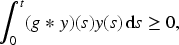

Note that

We recall the result from Nohel and Shea (1976, Corollary 2.2), which is fundamental in establishing the strong positivity of many kernel classes discussed in the literature.
A twice differentiable function

Lemma 2.4 in Kawashima (1993) and Lemma 2.9 in Cannarsa and Sforza (2011)
Suppose that

Although the Abel kernel (1.3) is our primary example of interest, Assumption 1 is sufficiently general to encompass a broad class of kernels arising in the modeling of acoustic and visco-elastic phenomena. We mention here some of these kernels which verify Assumption 1:
The exponential kernel
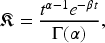
The exponentially regularized Abel kernel (along the lines of that found in Messaoudi et al. (2007))
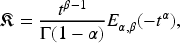
The fractional Mittag–Leffler kernels encountered in the study of fractional second order wave equations in complex media in Kaltenbacher et al. (2024b)
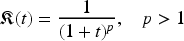
The polynomially decaying kernel

Elliptic Regularity Estimates
We recall here a useful elliptic regularity result to be used in establishing the necessary energy estimates; see, for example, (4.17) below.
Let

If instead

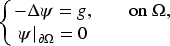
Consider the following elliptic PDE

We conclude the preliminaries section by introducing an important lemma that we will use to establish a uniform bound of the total energy of the solution; see Proposition 4.1. This lemma was proved in Strauss (1968, Lemma 3.7).
Let


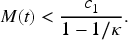
In this section, we present the main results of this paper and explain the strategy of the proof. For the convenience of the reader, we recall here the initial-boundary value problem under consideration:

Let us introduce the space of solutions used in the statement of Theorem 3.1:

Let




The seemingly peculiar form of the requirement on the source term

Discussion of the Main Result
Before moving onto the proof, we briefly discuss the statements made above in Theorem 3.1. Theorem 3.1 proves the existence of global-in-time solution to (3.1) for small enough data. The main difficulty in showing a global existence result lies in proving that the nonlocal term Showing the large-time asymptotic behavior solutions is an interesting problem which strongly depends on the type of the kernel
The proof of Theorem 3.1 is given in Section 4.
Proof of Theorem 3.1
The proof of Theorem 3.1 will be done though a bootstrap argument. We define first the energy associated to (3.1) as



We define the associated dissipation rate



Our starting point in the analysis is the following energy estimate:
We have for all


We intend to test the first equation of system (3.1) by
Thus, multiplying the first equation of (3.1) by
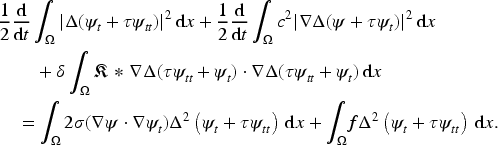
One of the main challenges in closing the estimates for the nonlinear equation is controlling the norm
Define


Then

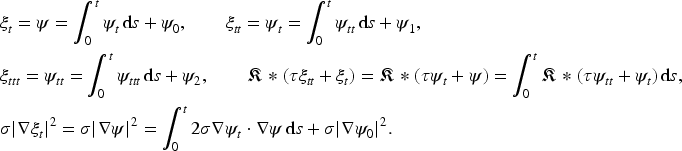
To simplify the study of the equation of

Exploiting the similarity in structure between (3.1) and (4.8), we give a first estimate for the functional

We have for all


Applying the Laplace operator
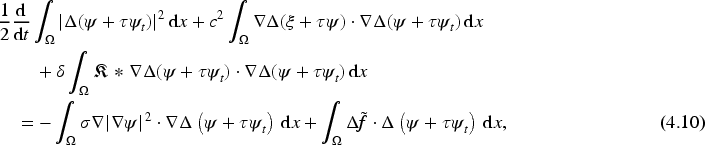
Exploiting the first equation in (4.8) (adding

Now, collecting the inequalities (4.4) and (4.9), we show that although we are in the critical regime, the convolution term helps to gain a dissipative term that is crucial in controlling the nonlinearity and closing the energy estimate. This result is contained in the following lemma.
We have for all

Taking advantage of Lemma 2.2, we obtain

We show through the following lemma that the
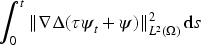
Let


For convenience of notation for this proof, let

We start with the relation




For the second bound, we rely on the triangle inequality

Let the Assumptions of Theorem 3.1 hold. Then, for all time

It suffices to estimate the terms



Thus, going back to (4.15), we obtain

We now turn our attention to the term

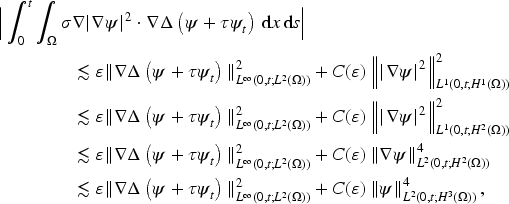


Let


Conclusion
In this work, and even though we are in the critical regime in terms of the coefficients, we have shown that fractional damping is sufficient to ensure global existence for the nonlinear JMGT equation with quadratic gradient nonlinearity when the problem data are small. We also ensure that the solution’s energy remains small as time goes to infinity. A natural future question will be to study the precise asymptotic behavior as time goes to infinity. In particular, we would like to know under which conditions on the problem data and on the memory kernel, the solution’s energy decays, and to determine the corresponding decay rate.
Future work will also be tasked with proving the global existence of the fractional JMGT equation with Westervelt nonlinearity (i.e.,
Footnotes
Acknowledgments
The authors are grateful to the reviewers for their time and careful reading of the manuscript. We especially appreciate their suggestion to include reference  and comments which allowed us to relax an earlier constraint on the initial data. More generally, their thoughtful comments and suggestions have led to significant improvements in the manuscript.
Funding
The research was conducted while M.M. was a postdoctoral researcher at the Institute of Mathematics of the Academy of Sciences of the Czech Republic. His work was supported by the Czech Sciences Foundation (GAČR), Grant Agreement 24-11034S. The Institute of Mathematics of the Academy of Sciences of the Czech Republic is supported by RVO: 67985840. M.M. is currently supported by ERC Synergy Grant PSINumScat—101167139 at the University of Bath.
Competing Interest
The authors declared no potential conflicts of interest with respect to the research, authorship, and/or publication of this article.
Appendix A. Local Well-Posedness Result
We present in this appendix, the results concerning the local well-posed of (3.1). The proof is largely inspired from that of Meliani and Said-Houari (2025b, Theorem 3.1) with changes made to accomodate the quadratic gradient nonlinearity.