Chemotaxis describes the intricate interplay of cellular motion in response to a chemical signal. In the slab geometry, the motion takes place between two infinite membranes. Like in previous investigations, the asymptotic regime of high tumbling rates is of particular interest. This work provides local existence and uniqueness of solutions to the kinetic equation and shows their convergence towards solutions of a parabolic Keller–Segel model in the asymptotic limit. In addition, convergence rates with respect to the asymptotic parameter are established under additional regularity assumptions on the problem data. Particular difficulties in the analysis are caused by vanishing velocities in the kinetic model as well as the occurrence of boundary terms.
Scope. In this paper, a kinetic model for chemotaxis and its diffusion limit are studied in slab geometry, which is of relevance for the propagation of bacteria when passing membranes or small slabs of porous media, soil or biological gels (Bhattacharjee et al., 2021; Gaveau et al., 2017; Sadr Ghayeni et al., 1999). Numerical studies for chemotaxis in slab geometry can be found in Carrillo and Yan (2013); Gosse (2013). Corresponding diffusion limits have been considered in Bal and Ryzhik (2000) in the context of radiative transfer. In slab geometry, the particle density is a function of one space and one velocity variable which, in contrast to Hillen and Stevens (2000); Keller and Segel (1971); Patlak (1953), varies continuously between . The kinetic equation hence does not degenerate into a system of two coupled hyperbolic equations.
Main results. The focus of this paper lies on a rigorous asymptotic analysis for chemotaxis in slab geometry. In particular, the following results are established:
local well-posedness of a kinetic model for chemotaxis in slab geometry and a priori estimates for solutions which are explicit in the asymptotic parameter;
convergence to solutions of a one-dimensional Keller–Segel system in the diffusion limit of vanishing asymptotic parameter and quantitative convergence rates.
Similar to previous work, energy-estimates and fixed-point arguments are used to establish existence and uniqueness of solutions to the kinetic model and to prove convergence to solutions of the limit system. To the best of the authors’ knowledge, these results can, however, not be deduced from previous work: The assumptions in Chalub et al. (2004) do not allow to treat scattering operators of the form considered here and the work (Bal & Ryzhik, 2000) does not include the nonlinear coupling to the equation for the chemoattractant. The results of Hillen and Stevens (2000) are valid for a discrete velocity model, but do not generalize to the case of slab geometry with continuous velocities. As mentioned in Perthame (2007), the asymptotic analysis for the kinetic chemotaxis model is in line with that for the radiative transfer equation. The analysis thus follows a similar approach as outlined in Bardos et al. (1988); Dautray and Lions (1993); Egger and Schlottbom (2014) and derives suitable extensions to chemotaxis in slab geometry.
Outline. In Section 2, the notation is fixed and the kinetic model under consideration is stated. Assumptions are introduced and the main results of the paper are displayed. Their proofs are given in Sections 3 to 5. Section 6 provides a review of some details in the proofs and discusses some possible extensions of the presented results.
Preliminaries and Main Results
Notation
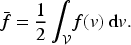
Let , , denote the spatial domain. We write , , for the usual Sobolev spaces defined on . Similar notation is used for functions defined on other domains. Scalar products will be denoted by . The range of velocities is and describes the phase space. Note that any function can be interpreted as a function by constant extension . The bar symbol is used throughout to indicate that functions do not depend on velocity . The same symbol is used for the velocity average of a function , i.e.,
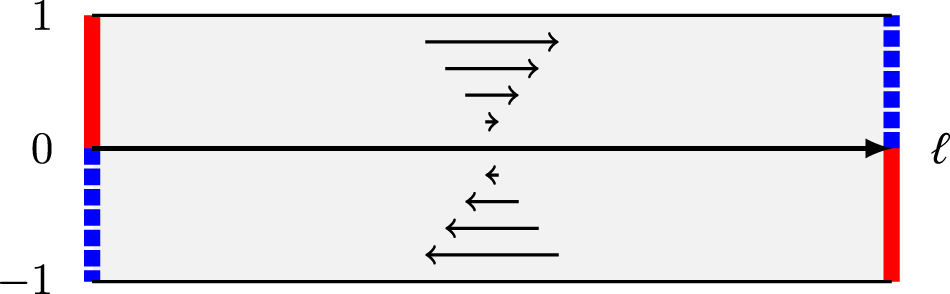
Following Dautray and Lions (1993), in- and outflow boundaries of the phase space are defined by
and is set; see Figure 1 for an illustration. By the product rule for differentiation and the fundamental theorem of calculus, one can see that
for sufficiently smooth functions defined on . We write for the space of functions defined on whose th power is integrable with respect to the measure . Given , and denote the Bochner spaces of functions defined on with values in some Banach space equipped with the usual norms; see Evans (2010) for instance. For brevity, sometimes is written for , when the meaning is clear from the context. The spaces consists of all functions which are -times continuously differentiable with respect to time.
Phase space and in-/outflow boundaries , depicted in (red, solid) and (blue, dotted), respectively.
Model Problem and Main Assumptions
The differential equations governing the kinetic chemotaxis model to be considered in the rest of the manuscript assumes a specific choice of the turning kernel and are given by Chalub et al. (2004); Othmer and Hillen (2002)
Recall that denotes the velocity average of the population density , whereas the concentration does not depend on naturally. The two equations are complemented by the boundary and initial conditions
The boundary and initial data are thus chosen independently of the velocity . This facilitates the analysis in the asymptotic regime but could be relaxed to and with functions of order (1) in that are in and satisfy similar assumptions as . The presented argumentation considers different time horizons and asymptotic parameters with fixed, and makes use of the following assumptions which provide existence of sufficiently regular classical solutions to the model (2) to (5) that then allow the derivation of quantitative convergence rates.
The parameters and are given constants. Furthermore with for a.a. . The initial data satisfy , , and the two boundary data . The same notation is used for the linear extensions w.r.t. of the boundary data to functions . In addition, the compatibility conditions , , and are required to hold for .
Main Results
Under the above conditions, existence of a unique regular solution of the problem can be established and corresponding a priori bounds can be derived. Their explicit dependence on the parameter will be of importance for the asymptotic analysis later on.
Let Assumption 1 hold. Then, there exists a time horizon such that for any the system (2) to (5) has a unique solution
Moreover, the following a priori bounds hold with a uniform constant :
The existence of a unique solution will be established via fixed-point arguments and results about the linearized evolution problems corresponding to the two differential equations. The bounds for the solution are derived by careful energy estimates and interpolation arguments. The detailed proof is presented in Section 3.
The second main result of the paper is concerned with the behavior of solutions in the asymptotic limit . The main findings can be summarized as follows.
Let Assumption 1 hold and be the solutions of (2) to (5) on , as provided by Theorem 2, for a sequence . Then weakly in and in , where is the unique weak solution of the Keller–Segel system
with motility and chemotactic coefficient
and with boundary and initial conditions
If, in addition, , then the asymptotic error is bounded by
with a constant that can be chosen independent of .
The verification of the above assertions relies on the a priori bounds of Theorem 2, the extraction of convergent subsequences, a weak characterization of solutions to the limit system, and an extension of the arguments used in Egger and Schlottbom (2012, 2014) for the analysis of the radiative transfer equation. The detailed proof of Theorem 3 is presented in Sections 4 and 5.
The presented results are local in time. From the global well-posedness of the limit problem in one space dimension, one would expect that they should be valid for . However, a different analysis as the one presented below would be required to establish global existence of the kinetic model and to exclude finite time blow-up due to the quadratic non-linearity. The same challenges appear in the limit problem, and could be addressed by additionally establishing positivity of solutions and proving uniform -bounds as in Egger and Schöbel-Kröhn (2020); Toshitaka Nagai and Yoshida (1997). Another way to obtain global-in-time results is to replace the nonlinear coupling term in (2) by for a suitable bounded function , which acts as flux limiting. Such models were recently introduced to avoid nonphysical blow-up behavior and were shown to attain global solutions (Perthame et al., 2019); also see Bellomo and Winkler (2017); Burger et al. (2006) for the related analysis of the flux-limited Keller–Segel model in multiple space dimensions. The analysis presented in the next section can be generalized to this case, and the estimates of Theorems 2 and 3 then hold globally in time.
Proof of Theorem 2
The existence of a unique solution to (2) to (5) will be proven by constructing a fixed-point of the mapping , where solves the linearized equations
together with the boundary and initial conditions (4) and (5), now required for and instead of and . Also recall that denotes the velocity average. Before proving the assertions of Theorem 2, some preliminary results about the two linear problems (12) and (13) defining and are collected. Throughout the proofs, and denote constants that only depend on the problem data, in particular, the upper bounds , for the asymptotic parameter and the time horizon.
Linearized Diffusion Equation
An application of standard results for parabolic differential equations provides the following statements.
Let Assumption 1 hold. Then, for any and for with , Equation (13) has a unique solution , additionally satisfying the initial and boundary conditions on and on . Moreover, for any ,
with depending only on and the bounds for the problem data in Assumption 1. In the case that , one can choose .
The function satisfies
with , , and on . The conditions of Assumption 1 show that and . Existence of a unique solution and the first bound then follow from known maximal parabolic regularity of the heat equation; see Augner (2024); Dore (1993). By formally differentiating (13) in time, one sees that also satisfies (14) and (15), now with and . By Assumption 1 and the regularity of , bounds for and can be established, which leads to the estimate for the time derivatives.
Linearized Kinetic Equation
As a next step, existence of a unique solution to (12) is established for appropriate boundary and initial conditions. The functions , are assumed assumed given at this point.
Let Assumption 1 hold and let . Then for any and as given by Proposition 5, Equation (12) has a unique solution with derivative , satisfying on and on .
Similar to before, define , which can be seen to satisfy
with , , , and homogeneous inflow boundary conditions on . This can be written as an abstract Cauchy problem
on the Hilbert space , with right hand side , and densely defined linear operator , with domain
for all , where ; this shows that is dissipative (Cazenave & Haraux, 1998, Prop. 2.4.2). From Agoshkov (1998, Thm. 3.5), one can deduce that for any and , the equation has a unique solution , and one concludes that is m-dissipative. Hence generates a strongly continuous semigroup of contractions (Cazenave & Haraux, 1998, Thm. 3.4.4). From the assumptions, one further sees that and , which implies the existence of a unique classical solution to (18) and (19); see e.g. Cazenave and Haraux (1998, Prop. 4.1.6). The function then is a sufficiently regular solution of (12) satisfying the required initial and boundary conditions. Uniqueness follows from the linearity of the problem.
Since generates a semigroup of contractions, one also obtains the bounds
Inserting shows that this simple estimate is, however, not uniform in . A refined analysis is thus required to obtain sharper a priori bounds.
A priori Bounds for Linearized Equations
As a next step, additional bounds for the solution of (12) and (13) are derived, making explicit the dependence on . To do so, we assume is given with and define the weighted norm
By careful application of the estimates of Proposition 5 and additional energy estimates for the linearized kinetic equation (12), the following assertions are obtained.
Let , and be given. Then for every with that is bounded according to (20), the solution of (12) and (13) satisfies the bounds of Theorem 2 with a constant that only depends on the bounds for the problem data in Assumption 1 and .
The estimates (f) to (h) of Theorem 2 for the function follow readily from Proposition 5. To derive the improved bounds for , Equation (16) is tested with .
Using the integration-by-parts formula (1) shows that
The second term on the right hand side can be absorbed into the left hand side of this inequality. By application of Grönwall’s inequality, one immediately obtains
From and the assumptions, one obtains . Using Hölder and Young inequalities, one can further estimate
The last bound follows from previous estimates for , the assumptions on the problem data, and the estimate , which again is a consequence of Hölder’s inequality. The definition of implies that . Note that the constants can be chosen independently of and .
The estimates (a) to (c) in Theorem 2 for the function then follow from the triangle inequality. The remaining bounds are established by a consideration of a formal differentiation of (16) and (17). Then is a mild solution of
with , , and . By the assumptions, one has and . By similar arguments as used before, it can further be shown that
An application of the energy estimate (21) to then yields . By rearranging (16) and using the previous bounds, one further obtains . The estimates (a), (b) and (d), (e) of Theorem 2 for then follow by the triangle inequality and the assumptions on the problem data.
Existence of a Unique Solution
As noted in the beginning of Section 3, a fixed-point argument will be used to establish existence of a solution to the system (2) to (5). To this end, fix a sufficiently large and denote by , the mapping that assigns to a given in
the solution of the linearized Equations (12) and (13) with the required initial and boundary conditions. Propositions 5 and 6 show that this mapping is well-defined. The goal is to show that is a self-mapping and a contraction on whenever is chosen small enough in relation to . Note that choosing sufficiently large will also ensure that is non-empty.
Step 1. Let and denote the solution of (12) and (13). Further set . Then from the estimates derived in the proof of Proposition 8, one sees that
with constants , that can be chosen independent of and . By choosing and independent of , one obtains . Moreover, it is clear by construction that and it satisfies the required initial and boundary conditions. Hence is a self-mapping on for this choice of and .
Step 2. Let be given and , be the corresponding solutions of the system (12) and (13) with the required initial and boundary conditions. Then the two functions and satisfy (14) and (16) with , , and , and with homogeneous initial and boundary conditions. The estimates of Proposition 5 and the continuous embeddings of and show that
with a uniform constant independent of and . Using the a priori bounds on solutions of the linearized equations obtained so far, one can then further estimate
and in a similar manner, one obtains
By combination of the estimates derived in the proof of Proposition 8, one thus obtains
Note that is again independent of and but depends on . For , one further has . Hence is a contraction on for this choice of .
Step 3. In summary, it was shown that is a self-mapping and a contraction on whenever is chosen sufficiently large in absolute terms and sufficiently small in relation to . For , the set is nonempty and closed. The existence of a unique fixed-point in then follows readily from Banach’s fixed-point theorem. In addition, any fixed-point of also is a solution of (2) to (5), and vice versa. This yields existence of a unique solution on .
A priori Bounds
By construction, also is a solution of the linearized equations (12) and (13) with and satisfying the required initial and boundary conditions. The bounds in Theorem 2 then follow immediately from the ones of Proposition 5 and Proposition 8. This concludes the proof of Theorem 2.
Proof of Theorem 3, Part 1
It is now shown that solutions of the kinetic chemotaxis model (2) to (5) converge in an appropriate sense to the unique solution of the Keller–Segel system (6) to (10).
Keller–Segel System
To begin, some properties about solutions to the limit system are summarized, which are required later on. A pair of functions is called a weak solution, if
satisfy (7) pointwise a.e., (9) and (10) in a trace sense and (6) in a weak sense, i.e.,
for all and for a.a. . Note that the solution components , here depend on time, while the test function is independent of time.
Let Assumption 1 be valid. Then (6) to (10) has a unique weak solution. If, in addition, , then as defined in (8) belong to and
Existence of a unique local weak solution and up to some time depending only on the problem data has been proven in Egger and Schöbel-Kröhn (2020). Further note that the regularity of carries over to , immediately. The additional regularity of the solution is established by bootstrapping. For completeness, the main arguments are briefly sketched: Interpolation estimates (Roubíček, 2013, Lemma 7.8) provide . Maximal regularity (Dore, 1993) for (7) then yields , and hence using interpolation (Amann, 1995, Thm. III.4.10.2). By embedding (Di Nezza et al., 2012, Thm. 8.2), one then obtains . From this and previous bounds, one thus concludes that . Standard parabolic theory then shows ; see e.g. Evans (2010, Thm. 7.1.5). Now let and denote the time derivatives of the two solution components. Then formally differentiating (7) in time shows that
with source term , initial data and boundary data . From Evans (2010, Thm. 7.1.5) it can be concluded that . Differentiation of (6) further yields
with . From the previous estimates, one can infer that . By formally differentiating (9) and using (6), one obtains
with data and . By parabolic regularity, one thus concludes that , which yields and . From Equation (6) and the regularity of , one finally obtains .
For the first component, the above notion of a weak solution is equivalent to requiring and validity of the variational identity
for all with ; see Roubíček (2013) for instance. This equivalent definition of a weak solution will be used later on in the proofs.
Convergent Subsequences
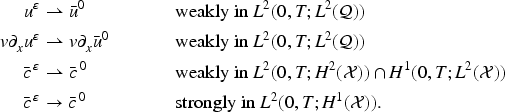
Due to the uniform bounds provided in Theorem 2, a sequence of solutions can be extracted which converges to an appropriate limit.
Under the assumptions of Theorem 2, there exist functions
and a sequence of solutions to (2) to (5) such that with one has
Moreover, the limit function satisfies the initial and boundary conditions stated in (10).
The assertions about and follow immediately from the estimates of Theorem 2, the Banach–Alaoglou Theorem (Conway, 2019), the Aubin–Lions compactness lemma (Roubíček, 2013, Lemma 7.7), and the continuity of the trace operators in space and time. By the uniform bounds for , one further obtains a subsequence and a limit such that and weakly in . From the weak lower-semicontinuity of norms and the estimates of Theorem 2, it can further be deduced that
which implies . Uniqueness of the weak limit shows that which implies .
As part of the analysis in the next subsection, it will be shown that the limit also has a weak time derivative and satisfies the initial and boundary conditions (9).
Further Properties of the Limiting Functions
To conclude the proof of the first part of Theorem 3, it remains to show that the limit functions provided by Proposition 11 are indeed a weak solution to the Keller–Segel system (6) to (10).
Step 1. From the linearity of the Equations (3) and (7), and the assertions of Proposition 11, one can immediately deduce that satisfies (7) and (10).
Step 2. The following auxiliary result is needed for the analysis of the kinetic equation. Let with be given. Then, from (2) and (4),
For abbreviation the notation and is used in the following. By the uniform bounds for , one sees that with . The first part in the last integral can be split into
The first term on the right-hand side converges to . Since strongly in , the last term converges to zero with . Using (1) and (2), the remaining term in the identity above can be rewritten as
By combination of these results and those of Proposition 11, one concludes that
Step 3. By definition of and in (8), the previous results, further yield that
This shows that the limit provided by Proposition 11 satisfies (26). In particular, the distributional time derivative satisfies
for all . From the regularity of and , it can be infered that
This shows that belongs to and, hence, is a weak derivative. Moreover, the variational identity (25) holds for a.a. .
Step 4. By combination of (25) and (26), one can immediately see that . Now let denote the trace operator for . By use of the integration-by-parts formula (1), one obtains
This shows that the trace operator is continuous as a mapping between these spaces. Proposition 11 suggests that weakly in , and hence weakly in . Since on , it can be inferred that on , and since is independent of , one further concludes that on in a trace sense. In summary, it was thus shown that satisfies the initial and boundary conditions (9), and hence is a weak solution of (6) to (10).
Step 5. Since every sequence of solutions to (2) to (5) for has a subsequence which converges weakly to a weak solution of (6) to (10) and since the weak solution to this problem is unique according to Proposition 9, this establishes weak convergence with for any sequence of solutions. This concludes the first part of the proof of Theorem 3.
Proof of Theorem 3, Part 2
In this section, the quantitative convergence rates announced in Theorem 3 are established. Following standard arguments (Dautray & Lions, 1993; Egger & Schlottbom, 2014), the solutions are decomposed as
Estimates on and the two remainder terms and are established in the sequel to conclude the proof of the theorem.
Step 1. From the regularity of the limit solution provided by Proposition 9, it can be deduced that , , and are uniformly bounded. In addition, one has
As a consequence, some of the terms in the following investigations will vanish.
Step 2. Using the equations defining and , one sees that satisfies
together with homogeneous initial and boundary conditions. From standard a priori estimates for parabolic equations (Evans, 2010), one thus obtains
It therefore remains to establish the appropriate bounds for the second remainder .
Step 3. From the equations defining , , and , one sees that solves
with , , and initial value . Following the arguments in Egger and Schlottbom (2014), a split is conducted with solving the same system, but with homogeneous boundary conditions, and satisfying the equations with homogeneous right hand side and homogeneous initial conditions.
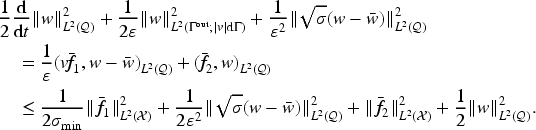
Step 3a. As a preliminary result, bounds for are established, elaborating explicitly on the dependence on . To do so, multiply (32) with by , which yields
Integration over , application of the integration-by-parts formula (1), and of the inhomogeneous boundary and homogeneous initial conditions for yields
By Hölder’s inequality, one sees that
for any , and Jensen’s inequality further yields for any . By combination of these estimates, one concludes that the last term in the second line of (35) is non-positive. Since , the inequality then simplifies to
For the last step, the trace theorem and the uniform boundedness of according to Step 1 were used. By letting , one obtains
Since is bounded, one further has , which is the desired bound for the first component of .
Step 3b. The rate for is based on a bound on the right hand side of (32). The definition of shows that . Further using (7), one can rewrite
Using the formula (8) defining , , and , one sees that
and hence . Noting that the function can be treated like the term in the system (16) and (17), the energy estimate (21) thus gives
for any . From the bounds for , one obtains . The right hand side (37) may be split into . From the bounds for and , one immediately obtains that . Using Hölder and triangle inequalities, the remaining term can be estimated as follows
By previous a priori estimates, one can bound and . Using the equation defining , the definition of , and the left identity of (30), the two terms involving differences can be further bounded by
In the last step, the bound for from before was used. In summary, one thus gets
Inserting this into the energy estimate for and applying a Grönwall inequality then leads to the uniform bound .
Step 3c. A combination of the previous estimates shows that
From the definition of and the uniform bounds for , one then gets
From the arguments of Step 2, one concludes that as well, which proves the convergence rates stated in Theorem 3.
Discussion and Possible Extensions
This articles establishes well-posedness of a kinetic chemotaxis model in slab geometry and convergence to a drift–diffusion system of Keller–Segel type in the asymptotic limit. The results are valid on a finite time interval with depending on the problem data. As mentioned in Remark 4, the results can be extended to if flux limiting is used in the chemotaxis term. We expect the global in time results to remain valid also without flux limiting, which however requires a different analysis. The results in this work can be extended quite naturally to related chemotaxis models on networks which were introduced as mathematical models for dermal wound healing (Bretti et al., 2014) or the growth of slime molds (Borsche et al., 2014). The fact that the velocity space involves a whole interval here means that agents can actually move at different speeds. Such systems have been studied numerically in Borsche et al. (2016). The asymptotic analysis for somewhat simplified coupling conditions has been derived (Philippi, 2023), and corresponding results for the limiting Keller–Segel model on networks were obtained in Borsche et al. (2014); Egger and Schöbel-Kröhn (2020).
Possible topics for future research include the extension of the results derived in this paper to more complex interaction mechanisms, involving multiple species, different chemo-attractants, or more complex coupling mechanisms; see Bitsouni and Eftimie (2018); Emako et al. (2015); Ren and Liu (2020) for some recent work in this direction. The design of asymptotic preserving numerical schemes for chemotaxis in slab geometry and related models on networks, in a similar spirit to Carrillo and Yan (2013); Gosse (2013); Natalini and Ribot (2012), would be a topic for future research.
Footnotes
ORCID iDs
Herbert Egger
Kathrin Hellmuth
Matthias Schlottbom
Funding
The authors disclosed receipt of the following financial support for the research, authorship, and/or publication of this article: KH acknowledges support of the German Academic Scholarship Foundation (Studienstiftung des deutschen Volkes) as well as the Marianne-Plehn-Programm. HE and NP are grateful for support by the German Research Foundation (DFG) through the Collaborative Research Center TRR 154.
Conflicting Interests
The authors declared no potential conflicts of interest with respect to the research, authorship, and/or publication of this article.
References
1.
AgoshkovV. (1998). Boundary value problems for transport equations. Birkhäuser.
2.
AltW. (1980). Biased random walk models for chemotaxis and related diffusion approximations. Journal of Mathematical Biology, 9, 147–177. https://doi.org/10.1007/BF00275919
3.
AmannH. (1995). Linear and quasilinear parabolic problems: Volume I: Abstract linear theory. Springer Science & Business Media.
4.
AugnerB. (2024). LP-maximal regularity for parabolic and elliptic boundary value problems with boundary conditions of mixed differentiability orders. Journal of Differential Equations, 388, 286–356. https://doi.org/10.1016/j.jde.2023.12.037
5.
BalG.RyzhikL. (2000). Diffusion approximation of radiative transfer problems with interfaces. SIAM Journal on Applied Mathematics, 60, 1887–1912. https://doi.org/10.1137/S0036139999352080
6.
BardosC.GolseF.PerthameB.SentisR. (1988). The nonaccretive radiative transfer equations: Existence of solutions and Rosseland approximation. Journal of Functional Analysis, 77, 434–460. https://doi.org/10.1016/0022-1236(88)90096-1
7.
BellomoN.WinklerM. (2017). A degenerate chemotaxis system with flux limitation: Maximally extended solutions and absence of gradient blow-up. Communications in Partial Differential Equations, 42(3), 436–473. https://doi.org/10.1080/03605302.2016.1277237
8.
BhattacharjeeT.AmchinD. B.OttJ. A.KratzF.DattaS. (2021). Chemotactic migration of bacteria in porous media. Biophysical Journal, 120, 3483–3497.
9.
BitsouniV.EftimieR. (2018). Non-local parabolic and hyperbolic models for cell polarisation in heterogeneous cancer cell populations. Bulletin of Mathematical Biology, 80, 2600–2632. https://doi.org/10.1007/s11538-018-0477-4
10.
BorscheR.GöttlichS.KlarA.SchillenP. (2014). The scalar Keller–Segel model on networks. Mathematical Models & Methods in Applied Sciences, 24, 221–247. https://doi.org/10.1142/S0218202513400071
11.
BorscheR.KallJ.KlarA.PhamT. N. H. (2016). Kinetic and related macroscopic models for chemotaxis on networks. Mathematical Models & Methods in Applied Sciences, 26, 1219–1242. https://doi.org/10.1142/S0218202516500299
12.
BrettiG.NataliniR.RibotM. (2014). A hyperbolic model of chemotaxis on a network: A numerical study. ESAIM. Mathematical Modelling and Numerical Analysis (ESAIM. Modelisation Mathematique et Analyse Numerique), 48, 231–258. https://doi.org/10.1051/m2an/2013098
13.
BurgerM.Di FrancescoM.Dolak-StrussY. (2006). The Keller–Segel model for chemotaxis with prevention of overcrowding: Linear vs. nonlinear diffusion. SIAM Journal on Mathematical Analysis, 38, 1288–1315.
14.
CarrilloJ. A.YanB. (2013). An asymptotic preserving scheme for the diffusive limit of kinetic systems for chemotaxis. Multiscale Modeling & Simulation, 11, 336–361. https://doi.org/10.1137/110851687
15.
CazenaveT.HarauxA. (1998). An introduction to semilinear evolution equations. Clarendon Press, Oxford.
16.
ChalubF.MarkowichP.PerthameB.SchmeiserC. (2004). Kinetic models for chemotaxis and their drift–diffusion limits. Monatshefte für Mathematik, 142, 123–141. https://doi.org/10.1007/s00605-004-0234-7
17.
ConwayJ. B. (2019). A course in functional analysis. Springer.
18.
DautrayR.LionsJ.-L. (1993). Mathematical analysis and numerical methods for science and technology (Vol. 6). Springer-Verlag. p. xii+485. ISBN 3-540-50206-8; 3-540-66102-6. https://doi.org/10.1007/978-3-642-58004-8
19.
Di NezzaE.PalatucciG.ValdinociE. (2012). Hitchhiker’s guide to the fractional Sobolev spaces. Bulletin des Sciences Mathématiques, 136, 521–573. https://doi.org/10.1016/j.bulsci.2011.12.004
20.
DoreG. (1993). regularity for abstract differential equations. In H. Komatsu (Ed.), Functional analysis and related topics (pp. 25–38). Springer. ISBN 978-3-540-47565-1.
21.
DormannD.WeijerC. J. (2006). Chemotactic cell movement during Dictyostelium development and gastrulation. Current Opinion in Genetics & Development, 16, 367–373.
22.
EggerH.SchlottbomM. (2012). A mixed variational framework for the radiative transfer equation. Mathematical Models & Methods in Applied Sciences, 22, 1150014. https://doi.org/10.1142/S021820251150014X
23.
EggerH.SchlottbomM. (2014). Diffusion asymptotics for linear transport with low regularity. Asymptotic Analysis, 89, 365–377.
EggerH.Schöbel-KröhnL. (2020). Chemotaxis on networks: Analysis and numerical approximation. ESAIM: M2AN, 54, 1339–1372. https://doi.org/10.1051/m2an/2019069
26.
EmakoC.de AlmeidaL. N.VaucheletN. (2015). Existence and diffusive limit of a two-species kinetic model of chemotaxis. Kinetic and Related Models, 8, 359–380. https://doi.org/10.3934/krm.2015.8.359
27.
EvansL. C. (2010). Partial differential equations (2nd ed., Vol. 19). American Mathematical Society. Graduate Studies in Mathematics, p. xxii+749. ISBN 978-0-8218-4974-3. https://doi.org/10.1090/gsm/019
28.
GaveauA.CoetsierC.RoquesC.BacchinP.DagueE.CausserandC. (2017). Bacteria transfer by deformation through microfiltration membrane. The Journal of Membrane Science, 523, 446–455. https://doi.org/10.1016/j.memsci.2016.10.023
29.
GosseL. (2013). A well-balanced scheme for kinetic models of chemotaxis derived from one-dimensional local forward–backward problems. Mathematical Biosciences, 242, 117–128. https://doi.org/10.1016/j.mbs.2012.12.009
HorstmannD. (2003). From 1970 until present: The Keller–Segel model in chemotaxis and its consequences. I. Jahresbericht der Deutschen Mathematiker-Vereinigung, 105, 103–165.
LauffenburgerD. A. (1991). Quantitative studies of bacterial chemotaxis and microbial population dynamics. Microbial Ecology, 22, 175–185.
36.
NataliniR.RibotM. (2012). Asymptotic high order mass-preserving schemes for a hyperbolic model of chemotaxis. SIAM Journal on Numerical Analysis, 50, 883–905. https://doi.org/10.1137/100803067
37.
OthmerH. G.DunbarS. R.AltW. (1988). Models of dispersal in biological systems. Journal of Mathematical Biology, 26, 263–298. https://doi.org/10.1007/BF00277392
38.
OthmerH. G.HillenT. (2002). The diffusion limit of transport equations II: Chemotaxis equations. SIAM Journal on Applied Mathematics, 62, 1222–1250.
39.
PatlakC. S. (1953). Random walk with persistence and external bias. The Bulletin of Mathematical Biophysics, 15, 311–338. https://doi.org/10.1007/BF02476407
40.
PerthameB. (2007). Transport equations in biology. Birkhäuser Verlag.
41.
PerthameB.VaucheletN.WangZ. (2019). The flux limited Keller–Segel system; properties and derivation from kinetic equations. Revista Matemática Iberoamericana, 36, 357–386. https://doi.org/0.4171/rmi/1132
42.
PhilippiN. (2023). Asymptotic analysis and numerical approximation of some partial differential equations on networks [PhD thesis]. TU Darmstadt.
43.
RenG.LiuB. (2020). Global existence and asymptotic behavior in a two-species chemotaxis system with logistic source. Journal of Differential Equations, 269, 1484–1520. https://doi.org/10.1016/j.jde.2020.01.008
44.
RoubíčekT. (2013). Nonlinear partial differential equations with applications (2nd ed.). Birkhäuser/Springer Basel AG. p. xx+476. ISBN 978-3-0348-0512-4; 978-3-0348-0513-1. https://doi.org/10.1007/978-3-0348-0513-1
45.
Sadr GhayeniS. B.BeatsonP. J.FaneA. J.SchneiderR. P. (1999). Bacterial passage through microfiltration membranes in wastewater applications. The Journal of Membrane Science, 153, 71–82. https://doi.org/10.1016/S0376-7388(98)00251-8
46.
Toshitaka NagaiT. S.YoshidaK. (1997). Application of the Trudinger–Moser inequality to a parabolic system of chemotaxis. Funkcialaj Ekvacioj, 40, 411–433.
47.
WuD. (2005). Signaling mechanisms for regulation of chemotaxis. Cell Research, 15, 52–56.