




Abstract
More than a special issue, this endeavor serves as a sourcebook and provocation amplifying embryonic but interlinked sites of inquiry: LatinXness in Spain and its vital conversation with US LatinX studies as well as Iberian studies. LatinXs share historical and cultural connections to the Spanish and American empires. The contemporary period marks a significant moment on both sides of the Atlantic, as Spain now houses Europe’s largest LatinX population and the shifting ground of LatinXness exceeds the United States as well as a North-South axis of analysis. With an eye toward being wide-ranging, bringing forward fresh insights, and offering a crucial reference for an expanding area of interest—transatlantic LatinX studies—this undertaking provides historical contexts, defining moments, conceptual parameters, and critical approaches that appraise how Spain’s sociocultural and intellectual climate has fully entered a LatinX epoch. The exploration faces a cluster of questions: What do current characterizations of Spanishness invigorate when it admits a long ignored—and inseparable—LatinX foundation? What constitutes Spanish national currency when animated by LatinX bodies and imaginations? What is Spain—and what is Europe—to LatinXness and the Global South? What kind of new Spain—and new Europe—emerge from LatinXness and Global Southness? Collected here are original arguments and contributions—academic articles, think pieces, critical conversations, poetry, and creative nonfiction—orienting us on central thematic concerns that include: new directions and perspectives in transatlantic LatinX studies; the idea of Europe and Europeanness from Spain’s southernmost archipelago, the Canary Islands; LatinX nonhuman origins at the Royal Botanical Garden in the Spanish capital; the history, uses, and dissemination of the Panchito/Panchita racial slur; Madrid’s twenty-first century LatinX Spanish language, migration, and culture; present-day brown drag performance and practices; Afro-Spanish-Colombian poetry and politics; rurality, depopulation, and LatinX repopulation in Aguaviva, Spain; diasporic bodies and expressions of identity through movement; and movement in translation, X equivalencies across bodies, geographies, and languages. The volume, as a whole, is an entry point into LatinX studies and Iberian studies marshaling ideas and thinking tools that may be veering toward a new field of study.
Keywords
In January 2023, a new epistemic shift in the study of Spanish citizenship, national community, and memory pressed forward via radical alternatives sparked by LatinX artistic practices and creative forms of expression. The Peru-born, Madrid-based artist Sandra Gamarra Heshiki was selected as the Spanish pavilion’s protagonist for the sixtieth Venice Biennial (elDiario.es, 2023). She became the first non-Spanish born artist slated to represent the southern European country at the 2024 Biennale di Venezia. The event is “the world’s oldest and most prestigious international exhibition of contemporary art” (Farago, 2022). A few years prior, the innovator served as Peru’s delegate at the 2009 Venice Biennale. Gamarra’s conceptual art, together with her unresolved ruptures of the present, were called upon by a bold Spanish compass turning to racialized and sidelined populations for national representation.
An overview of Gamarra’s visual oeuvre reveals that she sculpts a muddled “identity to objects or images that we may feel we know well” (Phaidon 100, n.d.). Her sensibilities break many molds. Gamarra shatters coherent articulations and chronologies, ideological expectations, and governmental interests in clear-cut Peruvian or Spanish social memberships. As historian, art critic, and curator Agustín Pérez Rubio gauges, she navigates life as a “mestizo Latina,” a mixed-race subject, and, in Japan’s rhetoric of race, as an “ainoko [betweener, hybrid],” konketsuji (mixed-blood child/offspring), and haafu (half) (Pérez Rubio, 2021: 65; Okamura, 2017: 41). Gamarra—a product of Spanish and Japanese empires and cultures that are “obsessed with purity of blood and lineages”—must “deal with day-to-day life in the Spanish capital” as well (Pérez Rubio, 2021: 65). In the context of the peninsula’s back-and-forth diasporic migrations, cultural practices, and allegiances, Gamarra propels viewers to probe how these parts fit together. What does it mean to think about Spain, to represent and confer legibility to that world, to Spanish peoplehood, to Spanishness, and to its national traits and traditions from a fractured and dispersed LatinX history?
LatinX history, as archived in the Spanish capital, is unequivocally “X.” LatinX, approached conceptually in this volume, is not limited to Latino/a bodies from Latin American-descended countries. The term is also not employed to exclusively signal gender and sexual diversity (cf., Milian, 2017, 2019a, 2019b, 2023). There is variance in how LatinX and Latinx are put together and utilized throughout this special issue. They appear in upper or lowercase: X/x. The two descriptors are “correct.” LatinX, as exercised in these opening pages, references the Latin and the X that totter about—and are in disarray. Both are “a harbinger of two compounded configurations—Latin and X—dual directional levels of signification. LatinX suggests a break—a force that requires a synthesis of joining Latin and X, which complicates and makes space for discussions that do not solely rely on binary configurations” (Milian, 2019a: 2). Satisfactory solutions, or semiotic closure are not advanced. The X that splitters from the Latin—and any X that is overlooked, rejected, indefinable, and severed from the world—has a clear purpose in helping us make “something” out of a devalued interpretive “nothing.”
X and Xness—“something” that emerges, that is unidentified and unexplainable, and that is somehow conjured and engrained in everyday signs, symbols, and interactions—are pursued, found, and untangled here. Xness signifies an orbit of ideas and values gaining power and legitimacy from an anonymous, unknown mass of people and regions who have been ascribed with infantilization, subhumanity, darkness, textures, sounds, smells, non-history, and underdevelopment. But X—and Xness—do not linger “there,” in “extravagant abjection,” to borrow from literary scholar Darieck Scott’s phraseology, and its revelatory set of misrepresentations (2010: 10). LatinXness is a site of recuperation and survivalist epistemology (2010: 1).
Even so, a decisive—but no less problematic and polemical—place has been assigned, in plain sight, to LatinXness in Madrid. This objectification takes concrete form at the city’s ethnographic Museum of the Americas, which houses more than 12,000 artifacts. Paintings from Spain’s former colonies are on view there too, though this country’s premier cultural institution, the Prado Museum, considered them, for centuries, as “second-class art” (Jaggi, 2019). The Museum of the Americas’ objects have rather ambiguous and arbitrary title cards from floor to floor. It is as though ethico-political thinking, conversations, and action on museum practices and responsibilities, the repatriation of looted cultural heritage, the reburial of human remains, and the return of funerary belongings and sacred artefacts—to say nothing of the future of the Western museum—have never been voiced or made their way to the desks of art galleries’ administrators, curators, trustees, and their proxies (see Deliss, 2020; Redman, 2016; Szánto, 2020; Thurner and Pimentel, 2021). Indigenous dead body parts still serve a “scientific” objective and continue to be on display at this storehouse of human remains from the Americas (cf., Wiener, 2021a, 2021b). As recently as May 2023, a poster in a glass case at this Museum announced that two undated “Reduced Human Heads” belonging to Peru’s “Jíbaro Indians”—from inventory number 88/5/1,70.214—were “pieces under study” and unavailable for public viewing. These pieces under study, more than “500 years [after] Western epistemic hegemony,” are still considered people to be studied by “Western professionals making sense of the rest of the world for a Western audience” (Mignolo, 2015: xiv; xxxiii).
The message this venue suggests, as art historian Marisa González de Oleaga and anthropologist Fernando Monge have it, is: “Discover America in Madrid” (2007: 283). The more pressing point might be: Discover How Spain became “Spain” in Madrid via triumphant and nationalist architecture and institutions, coupled with its Hispanidad culture industry and the reproduction of hegemonic myths. Historian Ada Ferrer observes that Christopher Columbus cradles the United States’s origin story both in popular lore as well as a panoply of scholarly accounts (2021: 15). His arrival does not officially figure in the chronicling of Spain’s national beginning. Yet it is tied to Spain’s chronology of Spanish becoming. The Christopher Columbus Monument, close to Spain’s National Library, looms prominently in Madrid (see Carrillo, 2021).
The Museum of the Americas is far removed from the city’s illustrious landmarks like the Prado, the Plaza de Cibeles, and Retiro Park. This tourist-rich area is now recognized by the United Nations Educational, Scientific, and Cultural Organization (UNESCO) as the “Landscape of Light” (UNESCO, 2021). The agency honored the popular grounds as a World Heritage Site in 2021. Historian Izaskun Álvarez Cuartero told El País that the Museum of the Americas “is like on another continent” (Marcos, 2023). “It seems that you have to cross an ocean to get there,” she added, since the structure is located on the highway’s edge, in an avenue with an intentional name: Reyes Católicos (as in Ferdinand and Isabella, the Catholic Monarchs, a title granted by Pope Alexander VI in 1496). It is a devalued, low-priority, and an obviously neglected building—“it doesn’t look like a museum, not even a house-museum” (ibid). It is the second state museum that received the fewest visits in 2022, with 63,651, only ahead of the Casa de Cervantes in Valladolid (21,006) (ibid). To continue with this article’s rich insights: “it seems that time has stopped” inside the museum, right with the colonial and exhibitionary gaze (ibid).
Immediate and crucial things are unfolding in contemporary Spain, one that exceeds the country’s oft-cited rhetorical fusion of its formative three ethnic and cultural groups: Christians, Muslims, and Jews. What do current characterizations of Spanishness activate when it admits a long ignored—and inseparable—LatinX foundation? A Spanish/LatinX convergence sets in motion such ruminations as: What constitutes Spanish national currency when animated by LatinX bodies and imaginations? What are LatinX’s origins in transit? Given its expanse, plenitude of possibilities, and lack of guarantees in definite forms and continuity, what is a LatinX inheritance?
Gamarra’s mission and purpose, Pinacoteca migrante—“Migrant Art Gallery”—will require a walk through the six rooms that her work will occupy at the Biennale. The consequences of Spanish colonization are at her project’s heart. She will rebuild a new museum—undoing its institutional structures and hierarchies, nineteenth-century canons of knowledge production, and their status in civil societies and social norms. The untold story of Spanish public museums will surface, altering the institution’s modus operandi, as Gamarra actualizes an official archive of the living present and new learning processes. Her contribution will reframe “the landscapes of the ex-colonies hidden in museum basements to talk about the territories’ invasion and appropriation” (elDiario.es, 2023). The “Migrant Art Gallery” will give attention to other nonhuman components of LatinX life and creation, as pollution and the extraction of natural resources will be highlighted—“putting an end to a large garden of silenced monuments” (ibid).
A critical reception to the manifold directions of global LatinX identifications and their ties to Spain has doubtlessly become manifest. The indigenous world, the mestizo world, the provisional LatinX world, the Global South’s speculative meta-worlds, the ethnographic and artistic museum worlds, the ecological world—in short, Gamarra’s hatching of new worlds and power relations made in Spain—are inescapably accounted for in Spain. They artistically and politically confront an intertwined colonial history, elevating Spanish silences. Gamarra’s art magnifies how these migrants are also socially located as domestic minorities in Spain (cf., Spickard, 2013). Her visible world points to the role and impact of racialized diasporic communities and their present circumstances. The blurring of the geographic, socio-historical here and there has a quotidian relevance to the experiences and assertions of Spanish national identity as well as LatinX articulations and mutations in the Global South.
LatinX circulations, motley modes of inquiry, interactions, and networks outmaneuver pure and settled geographies. LatinXness unmistakably starts from somewhere. This somewhere—a bundled up anywhere, a sense of place-cum-placelessness, a historical somewhere, an off the beaten track elsewhere with many future itineraries and contexts—is the orientation for a speculative and human geography: the Global South. What kinds of LatinXness arises in this polyvalent Global South? What is Spain—and what is Europe—to LatinXness and the Global South? To voice this question means to also ask: what kind of new Spain—and new Europe—emerge from LatinXness and Global Southness? Do we have enough space—and do we have enough place—for the intensity of Xness? Gamarra demonstrates how twenty-first century LatinX Spain has become a social, cultural, and intellectual center that needs to be vigorously added to the general body of LatinX studies. Her inclusion marks a huge ideological rupture on the Spain of her time and of our own.
If Gamarra’s role at the Biennale seemingly takes us to an educated and cultured high-brow niche, the Miami-based Latin Academy of Recording Arts & Sciences, who awards the Latin Grammys, disseminates the mass character of LatinX pop at a world scale. The Latin Academy hosted its 2023 red-carpet music ceremony in Sevilla, Spain rather than in the United States, or the Spanish capital, for that matter. Madrid is at the forefront in brewing up and anchoring a music-, election-, and Spanish-language-driven Hispanidad that decenters Miami’s role as the global capital of the “Latin” industry. This Hispanidad platform has been mobilized by Spain’s far-right political figures, pundits, and television as well as radio program “analysts”—commonly summarized with the catchphrase “la derecha mediática” (cf., Cadena COPE [1979–], Radio Intereconomía [1994–], El gato al agua [2005–], El programa de Ana Rosa [2005–], Es la mañana de Federico [2009–], TRECE [2010–], and Okdiario [2015–], as cases in point). Right-wing and extreme far-right politicians from the People’s Party (PP) and Vox are at the “vanguard” of a very old and paternalistic—yet pop and current—rehashing of an Hispanidad with LatinXs in it (see voxespana.es, 2021). Isabel Díaz Ayuso—Madrid’s conservative president for the PP who is described as “the most advanced disciple of Trumpism in Spain” (Boyle, 2020; see Sánchez-Cuenca, 2020)—is the public face and main proponent of the capital city’s Hispanidad (cf., Milian, 2023).
Juan Manuel Moreno Bonilla, the PP’s Andalucía president, is ushering in Hispanidad to Sevilla, a city popularly and historically recognized as Spain’s “gateway to the Americas.” Sevilla—or, “the heartland of flamenco,” per UNESCO, who in 2010 declared it an “intangible cultural heritage of humanity”—plays an intermittent starring role in Spain, depending on the transatlantic relationships that need to be exploited (UNESCO, n.d.). Since Sevilla Expo ’92, a universal exposition coinciding with Spain’s commemoration of Columbus’s quincentenary, the region has not housed any other global event of this magnitude. The Latin Academy’s rationale for bringing the Latin Grammys to Sevilla—to serve as a bridge to Latin America and Spain—echoes Expo ’92’s goals (cf., RTVE, 2023). Spain’s official narrative has not changed in three decades, and it is difficult to task a massive pop culture event with this kind of long-lasting diplomatic mission. The Latin Grammys are from everywhere and nowhere: they have no nation.
And yet this is where Barcelona-born flamenco/pop/reggaeton+/genre-braking megastar Rosalía—née Rosalía Vila Tobella—comes in. She has singularly, commercially, and spectacularly brought attention to a new and daring sonic visualization of what, and who, is a Latin and Spanish artist. She pushes the limits of what Spanish traditional music boundaries should be, igniting the question of what a LatinX Catalanidad, a LatinX Gitanidad, and a LatinX Hispanidad could be. Rosalía made it to the world stage by singing primarily in Spanish, and she made it to the Latin Grammys by creating a transatlantic iconography that many are trying to put their finger on (cf., Carrión, 2021).
It is time to understand Rosalía as a global LatinX artist, as it is hard to imagine the Latin Grammys in Sevilla without her stardom. She now joins the trinity of women who have received more Latin Grammys, alongside Shakira and Natalia Lafourcade. She is a Miami-based Spanish voice, heightening the need to unravel the Xness of Spaniards in the United States. This marks the first time that the Latin Grammys have been taken outside the Americas. This new international context is about the outspread of Latin pop in Europe. Recall Spain’s Eurovision cultural representation by Cuban-born singer Chanel Terrero in 2022. Her song “SloMo,” in Spanglish, earned third place. Terrero’s success veers toward a trend of Spanish representation without Spanish-born nationals, a formula previously reserved for national soccer and basketball teams.
[Stories]
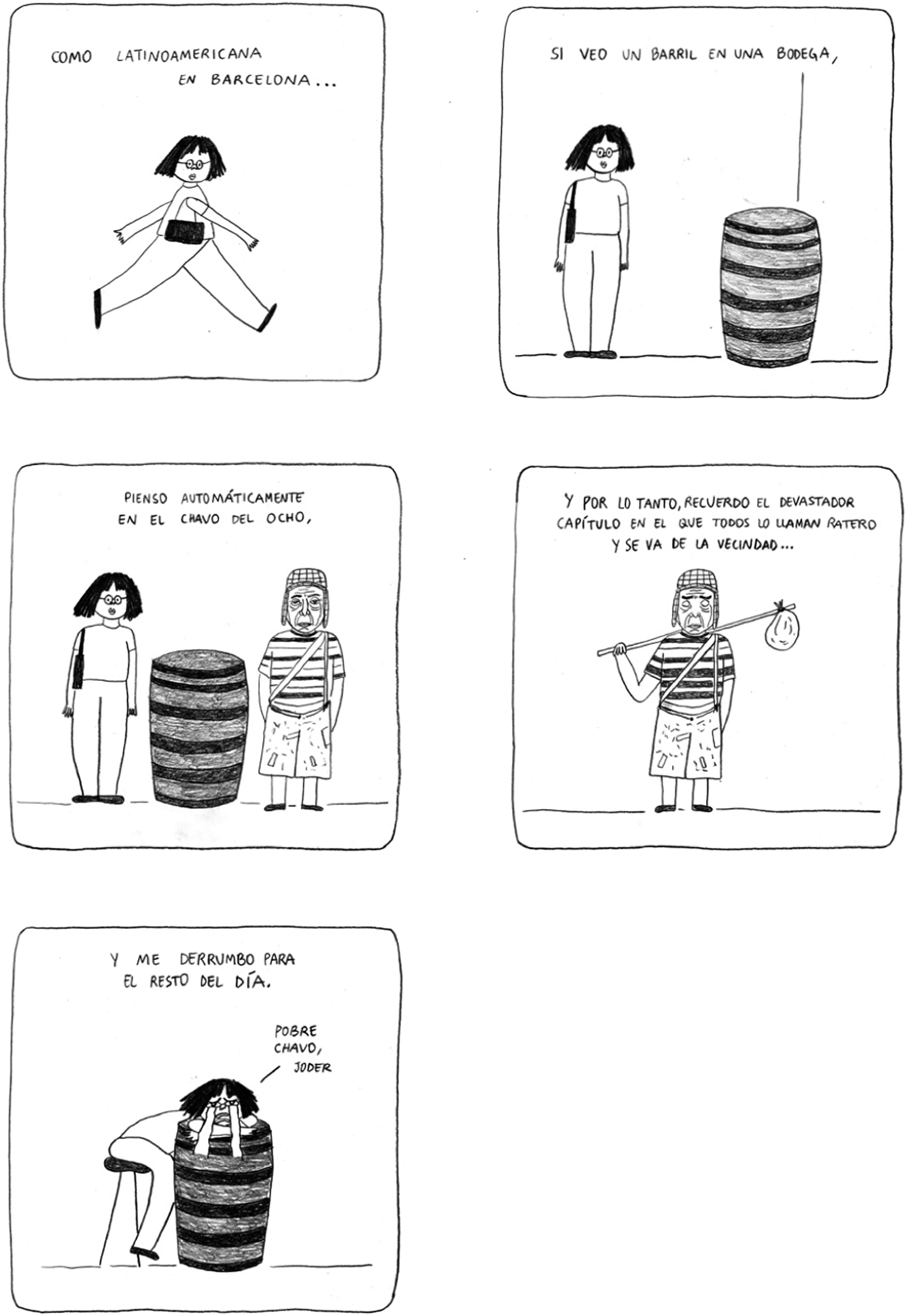
El Chavo illustrations by Rocío Quillahuaman (2023). Used by permission.
Barcelona-based illustrator and memoirist Rocío Quillahuaman (2023) alerts us to the accessibility of Latin American popular culture icons outside the American hemisphere. Her Instagram account thrives with 202,000 followers (and counting). She captures episodic autobiographical moments and reveries of personal interest that observe, sketch, and record LatinX urban backdrops in Spain at any given moment. Her 29 May 2023 post depicts Quillahuaman taking a stroll in her fast-paced city. She comes across barrels that are used for storing and aging wine and spirits. But her initial association is not with the Iberian Peninsula’s winemaking tradition. The wooden containers, instead, bring flashbacks of el Chavo, the fictional orphan who lives inside a barrel and is always peckish for a ham sandwich in the El Chavo del Ocho Mexican television sitcom. “As a Latin American in Barcelona,” Quillahuaman narrates, “if I see a barrel in a wine shop, I automatically think of El Chavo del Ocho. I remember the devastating episode where everyone calls him a thief and he leaves the neighborhood. And I fall apart for the rest of the day. Poor guy, damn” (Quillahuaman, 2023). She sympathizes with el Chavo, ruminating about the abjectedness and survival of the eight-year-old boy who doesn’t quite fit not only in the courtyard of the Mexico City working-class vecindad (neighborhood) that he lives in, but also in broader society.
Airing from 1973 to 1980, El Chavo del Ocho was dubbed into fifty languages. By 1975, it had an estimated 350 million viewers (Osorio, 2020). The show lives on as a phenomenon, and reruns can be seen regularly in various countries. Quillahuaman renews an interest in Roberto Gómez Bolaños’s creation in contemporary culture and reworks el Chavo through her drawings. El Chavo keeps Quillahuaman company in her Barcelona vecindad, as she zeroes in on the sitcom’s affective influence via scattered online networks. As of 27 December 2023, her post had garnered upwards of 14,440 likes and 177 comments. A Beijing-based follower remarked: “In Andalucía El Chavo was part of 1990s childhood. In my house we didn’t miss a single episode. My mother and I, to this day, still use the famous phrases from the series  ” (Quillahuaman, 2023). Another Instagram fan added: “As a child I laughed a lot seeing el Chavo, now at 33 it makes me very sad, there are a lot of little chavxs out there on Latin American streets and that sucks!
  ” (ibid). For education scholars Daniel Friedrich and Erica Colmenares, el Chavo resists “all sorts of closures”—becoming a rhizomatic Chavo, an unforeseen Chava, Chave, or ChavX, a LatinX child from elsewhere, beyond itself, that does not exhaust us, since there are more “Chavos not yet produced” (2017: 6–7). We may be talking about the same ChavX—and not. What other aspects of LatinX iconography shape Quillahuaman’s artistic vision in the retelling of her personal accounts of life and happenstance? Her illustrated life writing and digital archive enter and exit narratives of deracinated ChavXs. Quillahuaman attests to how Latin America’s cultural past is living and moving—a part of ChavXs’ historical moment as well as their pop culture formations and proclivities.
Europe’s LatinX global culture is far from a blurry sight. Spain has fully entered a LatinX epoch. LatinXness is coevally happening on both sides of the Atlantic. These dual directional common traits gear toward a host of reflections that impact the content and form of LatinX studies as much as Iberian studies. LatinX studies—a pluralistic, interdisciplinary, and open field—is evolving. The importance, force, and magnitude of LatinXs will be instructive to see and engage with in these two intersecting and overlapping fields: (i.) on Peninsular studies, an area with traditionally defined national and intellectual boundaries, and (ii.) on Iberian studies, which draws on ties with Portuguese cultural history; recognizes Spain’s four official national languages, Basque, Catalan, Galician, and Spanish; and stresses non-peninsular territories. As Iberian cultural studies scholar Germán Labrador Méndez expounds: “the very definition of contemporary Spain is at stake, both with regard to the Latin American world and in relation to Peninsular studies as a discipline” (2022: 76). These fields, in other words, are in the making. They are well placed to address this challenge and undertake the comparative work. LatinX and LatinXness, after all, defy geographical unity.
The context just mentioned is the spirit behind these pages. “Transatlantic LatinX Studies, Iberian Studies, and The Global South” is the fruit of a one-day symposium organized by The Program in Latino/a Studies in the Global South at Duke University (LSGS) during spring 2023. The common basis for the intellectual exchange—titled “LatinX Studies, Europe, and The Global South”—was shaped as follows: Taking the Global South as a cardinal direction, conceptual geography, and epistemological framework, this gathering explores the new global whereabouts, genealogies of thought, and flows of LatinX studies. What are the fields’ multiple sources and heuristic theories, its Southern starting points and everyday practices, its trajectories and histories, alongside its affinities and innovations? Who—and where—are the new assemblages and interlocutors of a fugacious and widening LatinX studies? These are some of the critical points of departure that will be examined, as we sound off ideas and canvass LatinX studies’ dispersals, imaginings, discrepancies, and transitions. The theoretically-oriented contributions will be linked with LatinX interlocutors across the Atlantic. As Radiotelevisión Española—or RTVE (2022)—has imparted, Spain houses Europe’s largest Latino/a/e/X community, while common headlines announce that Madrid has become more “Hispanic American” (Peinado, 2022). The Spanish capital is now regarded as an unofficial capital of Latin America, or the “Miami of Europe”—rivaling Miami and New York (Minder, 2022; López Letón, 2022; Santiago, 2023; Jhala, 2023). By thinking through interdependent configurations of LatinX studies and its dislocations, the goal is to forge new propositions for the new demands of twenty-first century global LatinX studies.
This encounter had a basic endeavor: to explore fresh and unexpected ideas in big and small ways, to see how they mingled and impacted our research and modes of thinking, to follow the spontaneous threads of each LatinX direction, and to adumbrate the beginnings of what is clearly becoming a globally entangled LatinX studies. As partners in conversation and collaboration, we willfully lacked final answers, paying detailed attention to this event’s detours. A special issue proved urgent in light of the timely conversations that were being generated across geographies, academic departments, and disciplinary conventions. This volume’s contents are not proceedings from the LSGS gathering.
“Transatlantic LatinX Studies, Iberian Studies, and The Global South” ventures into new avenues of creativity, alignments, and parallel junctures in LatinX inquiry. The collection is fortified by hemispheric American studies, English, gender and transgender studies, Iberian cultural studies, Latin American studies, Latino/a/e/X studies, performance studies, Romance studies, and the vast spectrum of “new,” loose, indefinable, and underexplored elements of LatinX practices. LatinXs in the United States and Europe share historical and cultural connections with the Spanish and American empires. Lawyer and sociologist Laura E. Gómez more pointedly references US Latinos as “the product [of] two successive waves of colonization, first by Spain and then by the United States, which has significant implications for how they have experienced racism and racialization in the United States” (2020: 9). She adds: “It simply does not make sense to speak of ‘Latinos’ or the ‘Latino population’ in a Latin American country or anywhere else in the world. ‘Latinos’ has purchase in the American racial and cultural landscape and should not be used to refer to persons outside the boundaries of this country” (ibid). This position makes sense when weighing rights and distributive justice in a nation-state. The sociohistorical reality reveals that the category Latino is unavoidable in Spain. It circulates in marginalized, inferiorized, and racialized ways—overlapping with the US Latino term and its history of subjugation and alienization.
This LatinX uncertainty may be what Colombian American philosopher Eduardo Mendieta (2012) was steering toward, a little more than a decade ago, with his use of a Latino identification. Even though Latino is a US-grounded “social, political, racial, cultural, and linguistic reality,” he cuts through this specificity since the “Latino quest,” for him, “is just beginning” (153; 166). Mendieta finds that “‘Latino’ identity does not just link me to a past, to a history, to a particular memory, but also, and perhaps most importantly, to a future, to a project, to what is not yet. When I claim that ‘I am Latino,’ and when I fill out a box in any official form that says ‘Hispanic,’ I am de facto making a prospective, future oriented claim” (156). This Latino horizon anticipates LatinXness as something different. It foregrounds a LatinX future that has unknowable and unstable parameters, warrants rethinking and readjustments, resists uneven power relations, and adopts an openness of being and living. LatinXness becomes more and more diffused and supplemented with meanings. To that end, US and Spanish academics, researchers, performers, poets, and activists crossed paths, as co-conspirators, to fill in some of the blank spaces of US and Spanish LatinXness. LatinXness is put in play through diverse modes of analysis in multiform contexts. Academic essays, anecdotal theoretical narratives, interviews, performance, poetry, works- and thoughts-in-progress are some of the registers we encounter and interact with in our own lives—paving the way for processes of knowing. Our approach is no different in sifting through the abundant layers of LatinXness that we are seeking to grasp.
Evolving demographic transformations, trends, + cultural shifts
Spain has been generally described—up until the twentieth century’s closing decades—as a nation of emigration, not immigration. LatinXs are Spain’s largest immigrant group. “Madrid, Increasingly Hispanic American: Almost 60% of Immigrants Come from Spanish-Speaking America,” is how El País relates it (Peinado, 2022). Approximately 280,000 Latin Americans live in the Spanish capital, mostly in neighborhoods that have been designated as Madrid’s “Latino Triangle”: Carabanchel, Puente de Vallecas, and Ciudad Lineal (Reina, 2023). Outside this triad, a fourth area—the Cuatro Caminos neighborhood in the Tetuán district—also stands out for its large Latin American community, characterized by a significant Dominican presence. The Spanish media have used three descriptors for this purlieu: “Barrio Latino,” “Bronx de Madrid” (“Madrid’s Bronx”), and “Pequeño Caribe” (“Little Caribbean”), all carrying different connotations. Comparisons to the Bronx are made by Spain’s mainstream press when discussing crime rates and this environ’s perceived insecurity (Tineo Durán, 2020: 11). “Latino” and “Little Caribbean” are employed in unconstrained ways, from violence to celebrations of Tetuán’s distinctive culinary scene (De Vega, 2021; Hervás, 2013). These Latino portrayals diverge from the predominantly negative depiction of Dominicans who are marked by preconceptions of “the Bronx,” or “American and international shorthand for the failures of urbanity” (L’Official, 2020: 2). Madrid’s Bronx is based on racist misrepresentations of “America’s ‘inner-city’” as an urban iconography full of “poverty, unemployment, building deterioration, and urban disinvestment” (ibid).
Per Spain’s National Institute of Statistics (Instituto Nacional de Estadística, INE), the country’s total population in 2023 stood at slightly more than 48 million, of which 6 million were foreign nationals (INE, 2023). About 1.5 million Latin American migrants make Spain their home at this time (Cueto, 2022; INE, 2023). LatinXs are migrants as well as nationalized or Spanish-born citizens. Sociologist Victoria Prieto Rosas and geographer Antonio López Gay periodize the different mobilities from the Americas in two timespans: “The first period, which is associated with […] the flow of Latin Americans to Spain, spanned from 1990 to 1999. The second period covers the expansion of the flow, which began in 2000 and ended in 2008 when the flow initiated its decline” (2015: 1–2). Between 1998 and 2007, Spain witnessed an economic and migratory boom, with immigration representing more than 50% of employment growth in labor sectors like construction, tourism, and domestic work (Royo, 2020: 125). Two-thirds of the properties constructed in Europe were built in Spain during this same time frame—giving us an idea of the nation’s growth and demand for migrant labor (Boyle, 2020).
Francisco Godoy Vega (2023), a Madrid-based Chilean curator, teacher, and poet, counters this standard chronology of current Latin American migratory beginnings in Spain. Going back to the conquest, he speaks of modernity’s first forced migration of Indigenous subjects. He recalls the first Taínos who were forcibly brought to Spain and baptized in April 1493 in Barcelona Cathedral. “We didn’t arrive here in the 1990s with Spain’s integration into the European Union’s economic community and all the Latin American migration boom that occurred then,” he proclaims. “We didn’t arrive in the 1970s with the exiles from the Southern Cone’s dictatorships, we’ve been present since 1492” (39). Godoy Vega’s insight merits an explanatory detour. This relocation, as historian Nancy E. van Deusen documents it, began in the 1490s via the enslavement and forced migrations of an estimated 650,000 Indigenous people throughout the Americas and the transatlantic Iberian world (2015: 2). She centers on the thousands of “global indios”—to use van Deusen’s term—that arrived at the Spanish Kingdom of Castile between 1493 and 1580. Some were sold in Sevilla under labels like “muchacho (boy), obispo (perhaps a reference to the slave’s master, a bishop), and una niña (a young girl)” (ibid). Indigenous servants and slaves resided in Sevilla, but hundreds lived with their masters in the villages and towns of Almería, Baeza, Cádiz, Ciudad Real, Granada, Madrid, Toledo, and Valladolid (3). Van Deusen raises two poignant concerns: “How did Castilians in villages and cities grapple with the ethnographic observations of returning travelers, the images of feathered men and women, and the incredible tales they heard about so-called brutish peoples? How did they reconcile this cultural imaginary with the flesh and blood indio slaves and servants in their midst” (169–170)? The conditions, themes, and problems behind these preoccupations still resonate, as the bodies of exploitable and “undomesticated” migrants continue to operate under an “Indian” symbology.
Some 1990s snapshots reveal Spain’s less-than-welcoming reception of Latin Americans. The first hate crime was officially recorded in 1992, just as the country’s “first wave of immigrants,” as some call it, was taking hold, and as Hispanists celebrated Columbus’s quincentenary (cf., Murray, 2018; St. John, 2017). Lucrecia Pérez Matos, an Afro-Dominican migrant, was killed in an abandoned Madrid nightclub by neo-Nazis. The building was being used by other unhoused peoples who were also from the same Caribbean island. Pérez had relocated there after being dismissed from a job as a domestic worker that only lasted twenty days. “I fired her because she was just no use at all. She didn’t know what a faucet was, or a bathtub, or an elevator,” Pérez’s former employer told reporters (Nogueira, 2012)—callously inferring a primitive, empty-headed, and disposable low-wage worker in life as much as death. Pérez’s murder punctuates—as N. Michelle Murray, a contemporary Spain scholar, has written—the “reactions some nationals have to Otherness even within seemingly cosmopolitan Spain” (Murray, 2018: 60). The country’s “first wave of immigrants” casts light on racialized and exploitative labor, paired with the beginning stages of the peninsula’s reliance on domestic and care work (see Fairless, 2023; Gutiérrez-Rodríguez, 2010; Martínez Bujan, 2010; Zamora López et al., 2017).
Documentaries like Helena Taberna’s Extranjeras (“Foreign Women,” 2003) captured a portrait of a shifting multicultural Spain that lacks a single and facile story line. Taberna’s film takes shape from gendered, autobiographical, and interrelated perspectives, keying into what cinema studies scholar Alisa Lebow pegs as a “cinema of we” (2012: 3). Women from China, Bangladesh, Poland, Ukraine, Romania, Ecuador, Peru, Dominican Republic, Colombia, Venezuela, Syria, Morocco, the United States, Iraq, Algeria, Sudan, Senegal, have a principal role in the narration of Madrid’s life. Extranjeras underscores literary scholar María Caballero Wangüemertʼs conjecture that “the immigrant—as a protagonist or an indispensable secondary player—[is] part of the [Spanish] national scene, on a journey of no return” (2009: 139; see Guillén Marín, 2017). And even though broad projects since the nineteenth century have set out to homogenize Spain’s cornucopia of foodways into a singular and recognizable national cuisine, as food studies scholar Lara Anderson (2013) has elucidated, what became an “Other” culinary scene materialized from the growth in migratory patterns, too. Latin American dishes like chupe (Peruvian shrimp chowder); bandeja paisa (a hearty Colombian meat platter); ceviche (a marinated seafood dish); and arepas (Venezuelan and Colombian corn patties) became a popular feature, spreading, as the BBC summarizes it, “through main city streets, with Madrid taking the lead” (Cueto, 2022). “Dominican hairdressers, Ecuadorian money transfer centers, and South American grocery stores” opened as well, (ibid)—making the Spanish capital, as Araceli Masterson-Algar’s research on the transnational networks of Ecuadorian migrants in Madrid evinces, “Europeʼs Ecuadorian capitalˮ (2016: 2). Between 2000 and 2004 alone, one to three million Ecuadorians “left the country with Spain as their primary destination, followed by Italy and the United States,ˮ prompting Masterson-Algarʼs paramount concern of “how Ecuadorian residents make the city,ˮ especially when taking into account its “unequal accessˮ (3–4).
LatinXness also appears in Spain’s artistic creations and from a variety of angles. Subtle depictions in Spanish cinema tease out a shift that incorporates LatinX sounds—music, accents, frequencies—objects, names, and “looks.” Film director, screenwriter, and producer Pedro Almodóvar, Spain’s most internationally awarded cineaste, demonstrates that he is, on equal terms, a good listener, as he organizes his movies’ musical experience and cross-cultural movement through Madrid’s LatinX spaces. The “Almodóvar discography,” as film researcher Kathleen M. Vernon calls his soundtracks (2013: 387), famously includes the voices of Brazilian singer-songwriter Caetano Veloso, Costa Rican-born Mexican singer Chavela Vargas, and the Afro-Spanish music of Concha Buika. His use of diegetic and non-diegetic sound “reveal[s] a mending of Hispanic cultures” and “weaves together pan-Hispanic cultural markets” (Ochoa, 2014: 130; 139). But Almodóvar’s LatinX soundscape exceeds music. He blends diverse accents and characters with a “Latin flavor” (Zavala-Garrett, 2020: 177). This Latin vibrancy is attached to thespians who are part of the “Almodóvar brand,” like Argentine actor Cecilia Roth—going beyond a fixed national origin. Take note of Penélope Cruz’s presence in his films. By becoming a public icon—a “chica Almodóvar,” an Almodóvar girl—she “has effectively refigured her Spanish qualities into international Mediterranean Latina features” (D’Lugo, 2013: 420). Almodóvar’s Mediterranean Latin looks—accompanied with Hollywood’s Latin looks as well as Miami’s Latin Hollywood imaginary—usher in volatile and unrestrained prototypes for ungrounded LatinXness more than veridical Latina/o corporeality.
How has Madrid’s X reached Almodóvar, and how is Spain’s LatinXness exported and projected through the director’s global screenings? A dialogue in Volver (2006), a comedy-drama focusing on three generations of women, imparts that the Madrid neighborhood one of the characters lives in has “lots” of Dominicans and Chinese—giving us an inkling of the city’s diversification. In it, actor María Isabel Díaz, the first “Cuban Almodóvar girl,” plays Regina, a Cuban migrant who assists her friend and neighbor, Raimunda (Penélope Cruz), in decisive moments. As film scholar Steven Marsh has commented upon, “Regina’s presence […], as an undocumented immigrant, an ‘illegal alien’ uncannily placed within the national body, recalls the situation of the new immigrants to Spain and the changing body politic of Spanish demographics” (2009: 352). Latin American geographies bespeak a topography where something else is opened up for what film critic A.O. Scott diagnoses as Almodóvaria: “a mixture of devastation and euphoria, amusement and dismay that deserves its own clinical designation” (Scott, 2009). Characters in All about My Mother (1999) mention Argentina and El Salvador. Volver adverts to Spanish migrations in Venezuela, a site of business investments in Broken Embraces (2009). The plane in I’m So Excited! (2013) heads to Mexico City.
Even when muted, LatinXness is palpable in Almodóvar’s work through a tangible materiality that permeates and advances his plots. Broken Embraces, a film about a film, subtly zooms in on Mexican, Central American, and Caribbean souvenirs, such as the hand painted crosses from the Americas, and not the liturgical symbols from Spain or Italy, thereby centering LatinX popular aesthetics in Madrid’s homes. These protective, colorful crosses, like the ones from La Palma, El Salvador, were informed by liberation theology, a Latin American spiritual movement that reinterpreted and countered Eurocentric religiosity from the perspective of the region’s marginalized communities. Almodóvar’s domestic materiality brings about the house’s visual language and identity through curated objects that touch—and bring value to—one’s life. Artist Aursa Satz and curator Jon Wood (2009) frame this assemblage—or what we can call the importance of Almodóvar’s things—as “articulate objects.” They “cannot truly impersonate, adopt another persona, get under the skin of a role; it remains ultimately porous as a penetrable site of projection. One might say it ‘de-personates,’ by taking on the traits of another body without truly incarnating them” (16). What LatinX stories do these crosses, as articulate objects in Europe, carry in the context of interventions and civil war displacements? Almodóvar’s sound and soundless LatinX representations, however fleeting, can be deemed as “trans-territorial Hispanic” (D’Lugo 2013: 412). His simultaneously deterritorialized and rooted sensibility intertwines with LatinX’s “X.” Almodóvar’s X is global, not purely Spanish, and reaches theaters that transcend the peninsula.
The 2000s saw the birth of LatinX radio stations—pioneered by Radio Babel, América Stereo, Radio Mundial, Radio Caribe, Hispana, and Fiesta FM—leading to the “Latin Americanization” and “Caribbeanization” of Madridʼs FM dials (Ruiz Trejo, 2014: 92). These stations’ first broadcasters came from Colombia, Ecuador, the Dominican Republic, and Venezuela, followed by announcers from Bolivia, Paraguay, and Peru (94). LatinX-music making popped up as migration experiences and hardships became a part of Spain’s sonic landscape. Barcelona, as an example, witnessed the emergence of Che Sudaka, a band founded in 2002 by Argentine and Colombian musicians. Che Sudaka’s rhythms are a blend of punk, reggae, hip-hop, and ska. One of their well-known compositions is their Spanish remake of Sting’s classic, “Englishman in New York” (1987). The undocumented performers at the time inverted Sting’s visa-carrying, cultural alienation—turning his song, in effect, to new music. They christened it “Sin Papeles” (“Without Papers”), intimating a detour in the path and geography of New York and its associations with Ellis Island to Europe and the Mediterranean, and vocalizing this shift in sound and culture from an “illegal” migratory status in Europe that is tracked down and criminalized (cf., Bermúdez, 2018). Spain’s catalogue of a LatinX soundscape shows how musicians make sense of—and hear themselves sound out—irreversible transformations in a changing city, nation, and continent.
The group’s first name evokes both revolutionary leader Ernesto “Che” Guevara and an Argentine saying. Its rectified last name, Sudaka, a homophone for “Sudaca,” mirrors the colloquial derogatory term for South Americans in Spain. One should be all ears, though. Sudaka—with a “k”—is not the same as the contemptuous Sudaca with a “c.” The “k” signals a politically engaged use—a “constant state of fusion due to the borderless nature of the global cultural project” (Bermúdez, 2018: 130). The “sudaca” imaginary is so potent that recent efforts bring to the fore—and subvert—its objectionable content. A writer’s residency and workspace, Sudakasa—punning on “sudaca” and “casa,” “a house of coexistence that vindicates migrants and, in particular, sudacas” (Público, 2023)—debuted in Guadalajara, Spain in 2023. Migrant, decolonial, and anti-patriarchal writing will be the bedrock of their plans (cf., Sudakasa, n.d.). Queer Chicana feminist theorist Gloria Anzaldúa’s words from “Speaking in Tongues: A Letter to Third World Women Writers” resounds with this proposition also (Anzaldúa, 2009: 26–35; see Wiener, 2023b). The project is not finished, but the aim is to remodel a large farm shed to accommodate short stays and intensive workshops for South American literary and cultural producers. This effort is led by writers, editors, and migrant artists including Gabriela Wiener (Peru), María Fernanda Ampuero (Ecuador), and Claudia Apablaza (Chile), whom many refer to as the “new boom” of Latin American women writers (García Higueras, 2023). Che, Sudaca, and Sudaka are full of oppositions, heading in another direction.
The 2008 and 2013 financial crisis “scared away both Spaniards and foreign residents,” with the former choosing to relocate predominantly to France, Germany, and the United States (Arteta, 2017; see Bermudez and Oso, 2022; Hornillo, 2017; Lafleur and Stanek, 2017; Torres, 2022). Spain initiated the Voluntary Return Program (Plan de Retorno Voluntario) during this downturn. Under this policy, “unemployed non-European Union residents who want[ed] to return home [had] the right to receive half their unemployment benefit upon departure and half upon arrival in their home country” (García Ballesteros and Jiménez Blasco, 2013). From 2008 to 2011, an estimated 15,000 people returned to their homelands through this incentive. But as sociologists Sònia Parella Rubio, Alisa Petroff, and Olga Serradell Pumareda have appraised (2014), migrants residing in Spain demonstrated a high degree of resistance to this “voluntary” return despite the recession and financial turmoil.
Since then, the nation has partially recovered: “The Return of Immigration to Spain” is how a CaixaBank brief phrases it (Mestres Domènech, 2020). Migrants, refugees, asylum seekers, and guest workers make up this influx. Statistics from the European Asylum Support Office show that Spain received more asylum requests than any of its European Union allies (Martín, 2020). The European Union Agency for Asylum (EUAA) reports that 2022–2023 applications from Venezuelans, Colombians, and Peruvians were on the rise, “up by more than half (52%) compared to the same period in 2019, before the COVID-19 pandemic” (EUAA, 2023). Spain lodges most of the requests seeking protection. The Guardian accounts that asylum applications in Europe “from Central Americans are up 4000% in a decade. […] Belgium is now third behind Spain and Italy as the most popular European country for Salvadorans” (Boffey and Jones, 2019). Roughly 5% of those petitions are approved (Martín, 2020). Of the approximately 6 million migrants in Spain, about half a million are undocumented, with 77% of them being Latin American: Colombians (93,304), Hondurans (71,064), Venezuelans (50,449), and Peruvians (30,119) (Sánchez, 2023; Pérez-Nievas et al., 2021: 1137).
As migrant, domestic worker, and activist Edith Espínola makes known, a person who is without papers is vulnerable “to precarious jobs” and “to accepting whatever” (Soledad, 2020). Espínola, from Paraguay, migrated without papers—in the middle of the financial crisis. Holding a degree in business administration, she was forced into domestic work when she moved to Spain in 2009 (Rosati, 2018a). Espínola remarks that “migrant women or women who are nationalized […] continue to feel like migrants due to the country’s structural racism. We support the care and lives of others, and yet we continue to be exploited and abused” (Rius, 2020). Espínola is a spokesperson for the #RegularizacionYa campaign. This initiative began on 13 April 2020, in the midst of the COVID-19 global health crisis, with a public letter to the government. The platform solicited the permanent and unconditional regularization status for all migrants and refugees living in Spain (#RegularizacionYa, 2020). #RegularizacionYa’s missive demanded a change in the immigration paradigm by centering on migrants’ and refugees’ lives and focusing on their rights—gaining the backing of more than 1,000 groups and nonprofit organizations (Jáuregui, 2020).
Spain’s LatinX online practices show how racialized groups assemble and interact with each other. Hashtags spotlight migrant platforms as digital epicenters for recognition, information, citizen journalism, sociality, common aims, and collective action. By way of illustration, the entry #nothingtocommemorate (#nadaquecelebrar) opposes the Spanish National Day celebration on 12 October. This national holiday is also known as Hispanidad Day, and shares close associations with Christopher Columbus’s arrival in the Americas. Afro-feminist writer and educator Desirée Bela-Lobedde (2018) describes community interaction and solidarity during a pivotal moment of hashtag-activism: #EstadoEspañolNoTanBlanco, a call in 2016 to give visibility to a #NotSoWhiteSpanishState. Bela-Lobedde notes that the spontaneous pictures and real-time communication that surfaced under this hashtag provided her with a sense of belonging (2018: 158). Poet and journalist Paloma Chen (2023) reports on an anti-racist hashtag movement in Valencia: #AmigaMigranteSiSupieras, or #MigrantFriendIfYouOnlyKnew. The phrase compels migrant women to learn about and advocate for their rights (Chen, 2023). These networked spaces by Spain’s racialized populations frame intellectual thought, discussions, and debates as well as mobilize for their exigencies. As media studies scholar Sarah Florini insists, their constantly evolving online roles give credence to how “marginalized users have much to teach us about technology, and not simply about marginalization” (2019: 6).
The naturalization process for migrants requires that “some groups originating from countries that share past colonial ties with Spain—mostly Latin American countries—benefit from a fast-track access after only two years of residence” (Lobera, 2021: 1226). This policy contrasts that of other foreigners who must wait for “a qualifying period of ten years of prior legal residence […] to be entitled to claim the Spanish nationality” (ibid). The 2007 passage of the Historical Memory Law (Ley de Memoria Histórica) afforded “the descendants of Spaniards in exile to apply for Spanish nationality—a way of giving recognition to the victims of the Civil War” and Francisco Franco’s dictatorship (1939–1975) in Spain (Vega-Durán, 2016: xv). “Many people who were until then considered foreigners, mainly from Latin America and Europe, thereby became Spaniards, and a number of them decided to move to Spain, further contributing to the pluralism of Spanish identity” (ibid). Social scientists Santiago Pérez-Nievas, Guillermo Cordero, and Marie L. Mallet-García submit that “Spain might represent a more favorable environment for the integration of minorities of Latin American origin. The common language, greater cultural proximity, and postcolonial bonds between Spain and Latin American countries […] might represent advantageous conditions that create a more favorable context of reception” (2021: 1139). These LatinX “advantages” warrant scrutiny. The authors gloss over the imperative for Spain to grapple with—and reconcile—its colonial legacy of exploitation and the ongoing hardships LatinX migrants face in present-day Spain.
Joining the military and voting are two embodiments of formal national citizenship, and LatinXs who qualify in exercising these political rights in Spain are no exception. Not unlike US military efforts to recruit minoritized populations, the Spanish Armed Forces—the Army, Navy, and Air Force—similarly look to LatinX groups for national security and enlistment. But whereas the US military accepts applications from undocumented migrants, the Kingdom of Spain requires legal residency. In 2023, the government announced 3,400 openings in the Armed Forces, a job opportunity that garnered some attention because “the spots were also open to citizens from 18 Latin American countries” (Europa Press, 2023). There is a cap on how many foreigners can serve, as Spaniards are prioritized on most job openings. Some scholarly investigations focus on LatinXs’ capacity to serve the Spanish Armed Forces loyally and dutifully, since Spain’s national interests may differ from LatinX migrant-citizens, whose sense of national belonging might diverge from Spanish-born service members (Arribas et al., 2019). All the same, a recruitment page for the Ministry of Defense appeals to this population with the message: “If you are Hispanic American or Equatorial Guinean and want to learn a profession while working, your future is in the Spanish Armed Forces. Here you can find a stable job and improve your degree of integration into Spanish society” (Ministerio de Defensa, 2021). To qualify for this position, this announcement goes on, “you must be a citizen of one of the following countries: Argentina, Bolivia, Costa Rica, Colombia, Chile, Ecuador, El Salvador, Guatemala, Equatorial Guinea, Honduras, Mexico, Nicaragua, Panama, Paraguay, Peru, Dominican Republic, Uruguay, Venezuela.” The exclusion of Cubans and Puerto Ricans stands out. The imperial wound might explain Cuba’s absence. Long prized as the “pearl of the Spanish empire,” Spain fought three wars to maintain the colony and finally met defeat in 1898 (see Ferrer, 2021). As historian Lorrin Thomas (2010) has pointed out, the “Puerto Rican citizen” is juridically nonexistent. It would be geostrategically thorny—gauche, even—for Spain to recruit US citizens.
Spain’s national demands extend, as well, to its political system and electoral gains based on LatinX voter turnout. As part of their electoral tactics in recent years, Spain’s major political parties have been eagerly wooing LatinX voters. Politicians have been, as a headline proclaimed, “on the hunt for a million and a half Latino voters” (del Barrio and Galarza, 2023). “We love you, we adore you, we need you, Hispanics, in Madrid,” is how Ayuso, Madrid’s president, has met her constituency of “new Madrilenians” at rallies (Díaz, 2023). A mix of Argentines, Colombians, Cubans, Dominicans, Ecuadorians, Peruvians, and Venezuelans makes up this voting bloc—about ten to thirteen percent of Spain’s electorate (Hernández, 2023). “Latino voters,” or interchangeably, “votos hispanoamericanos,” are broken down by nationality—as in, Argentines for Ayuso, or Dominicans for Ayuso—but they are still treated as a monolith demographic, a Hispanic bloc that can be molded into Ayuso’s unifying Hispanidad agenda. Venezuelans are the largest growing constituency and the most politically mobilized—leaning, in the last few years, toward rightwing political representation (Domínguez et al., 2021). It has been postulated that Spain’s “Latino vote” will end up having the same relevance as in the United States, with the next decade’s projections indicating an increase in nationalized Spaniards from Latin America (ibid). Conservative politicians have “a certain perception” that Latino voters in Spain “may share similar values regarding family models, a more conservative religious vision” (Hernández, 2023). Spain’s “immigrant Evangelical vote” has earned media coverage, but the Latino vote in Spain, as in the United States, comes from different ideological dispositions and life experiences (see García, 2022; Peinado, 2023b). Vox usually highlights immigration as a national Spanish threat. But the far-right party is now bringing up the concept of “ethnic Hispanicism” to draw LatinXs to their Hispanic table. A new Vox jargon is also emerging with the “Latino vote.” Vox exclusively talks about the “Iberoesfera” (“Iberosphere”) concept—an economic, cultural, and political project seemingly working toward a transatlantic conservative order (Fernández-Vázquez and Lerín Ibarra, 2022: 64).
With these assumed policy preferences and voting trends, political aspirants add merengue, bachata, and reggaeton rhythms to their outreach activities. These events—never mind their playlists—are unusual in Spanish campaigns, “where it is rare to segment and label the electorate by their nationality, a more frequent strategy in other European countries or in the United States” (Peinado, 2023a). Links have been made to US presidential races, from Viva Kennedy to Todos con Biden, who continually turn to that North American nation’s largest ethnoracial population for support (ibid). Historian Benjamin Francis-Fallon reminds us that prior to the 1960s the US Latino vote was nonexistent “because—at least, as a subject of national political analysis and policy conversation—the ‘Latino’ did not meaningfully exist. And the ‘Latino’ did not yet exist because the ‘Latino vote’ did not yet exist” (2019: 3). Francis-Fallon complicates things: both “Latino” and the “Latino vote” are sociopolitical constructions with a deep impact. What proves to be trenchant public policy for LatinXs in Spain, who are also separated from the Spanish mainstream and have yet to arrive in that nation’s political landscape? Political persuasion by both US democrats and republicans during election season relies not just on homogenizing Latinos. Performing “Latinness” via code-switching in Spanish and English, misusing Spanish, and engaging in other “cringeworthy efforts,” as NPR alluded to them, has been enacted to bond with LatinX voters (Meraji, 2019). Such actions have been dubbed as “Hispandering”: to pander to Hispanic/Latino/a/X communities (Morin, 2019).
Spain’s “hispanoamericanos” become a LatinX electorate through the peninsula’s sonic “Hispandering.” Speaking Castilian Spanish to Spanish-speaking Latin Americans is not the issue in these contests for power, as much as depending on a medley of tropicalizing sounds—“Latin American music” (Palomino, 2020)—to reproduce an exalted sense of a Spanish nation and Spanish citizen-subjects vis-à-vis non-Spanish citizen-migrants tinged with “New Worldness.” The unexpected turn—the sudden sounds—of Spanish au courant politics deliver us to LatinXness. LatinXness can be discerned, as cultural historian Pablo Palomino (2020) prompts, through an aesthetic label like “Latin American music.” “The history of this category suggests that Latin America, as a region, is in fact the result of the sedimentation of projects—diplomatic, aesthetic, political—that ‘invented’ it,” he asserts (2). It is fitting that this genre represents these political acts of inclusion and exclusion. Yet these same politicians promote tax cuts and private business, having a social impact: “Madrid has the second-highest rate of school segregation in Europe, [where] the rich kids [are] with the rich kids. The poor kids with the poor kids” (Boyle, 2020). But as writer Brendan Boyle (2020) probes: “What chance does any society have of promoting and embracing diversity, when economic lines are so clearly drawn from such a young age”? What is a Spanish agenda in connection to the LatinX? How exactly are the socioeconomic and cultural needs of diverse LatinX constituencies being fulfilled?
In Spain, LatinX history is twisted, and told without LatinXs in it. This tension of belonging and alienation is manifested in popular Hispanidad mediums like Nacho Cano’s Malinche: The Musical (2022)—“the love story that changed the world” (Making Malinche: A Documentary by Nacho Cano, 2021). Cano, a member of the famous 1980s music group Mecano, gained fame as one of the main faces of the Movida Madrileña. This movement by Madrid’s youth pushed a sparkly and colorful aesthetic of excess, sexual liberation, pop sounds, hedonism, drugs, and parties that voiced a new freedom post-Franco’s dictatorship (cf., Fouce and del Val, 2013; Lechado García, 2013; Nichols and Song, 2014). Malinche is a recycled strain of Mecano’s old practices that rely on horrifying moments in the Americas and Africa without ethical or sociopolitical reflection. Mecano’s songs like “El blues del esclavo” (1988, “The Slave’s Blues”) touch on slavery as the prime attractor, a radio friendly tune for casual listeners. Cano specializes in placing before us grim historical contexts as consumer products. He has preempted criticism by adding disclaimers in the CD’s liner of “El blues del esclavo” and calling his interpretation a “historical disfiguration” (Bermúdez, 2018: 54). Cano’s Malinche is another historical disfiguration, marketed, and rebranded as though it were a Disney production. And, as one media outlet pointed out, Malinche’s Spanish cast tops the bill at 95% (Life and Style, 2022).
Malinche, Doña Marina, or Malintzin is a well-known historical and mythic figure from the sixteenth century. Her multilingual proficiency in Yucatec and Nahuatl, the languages of Mayas and Aztecs, made her a key resource for Spanish conquistador Hernán Cortés and Aztec emperor Moctezuma. She could “manipulate courtly language[,] which in Nahuatl ha[d] its own grammar[,]” and possessed a “clear-sighted understanding of the Mexica political arrangements” (Townsend, 2006: 14). This made her history’s most famous translator. Per historian Camilla Townsend, Malinche “catapulted to the very center of the drama of two continents colliding: she became translator and mistress to Hernando Cortés during his effort to conquer Mexico, and thus she negotiated with Moctezuma and his successors on behalf of Cortés until—and even after—the Spaniards held the reins of power” (2006: 2). In recreating a colonial romance, Cano simplifies and sanitizes the story. Malinche: The Musical becomes a celebration of sexual desire and miscegenation. “The whole history of humanity has been a succession of conquest after conquest after conquest. But usually they never fused. Just in this case, that happened. […] There was something different. There is a new race with a lot of … flavor,” Cano avers (Making Malinche: A Documentary by Nacho Cano, 2021). Malinche—or, the “pragmatic Malintzin,” as Townsend calls her (10)—made choices at different times in her life for survival and not just for carnal pleasure. Malinche is relegated to unknowability, an “X” that arises from Cano as mediator and Cano as Malinche’s transatlantic interpreter.
The musical “translates” the violent history of colonization into a “karaoke” show, complete with English subtitles so that no one in the audience misses out on the lyrics. The performance of a sonic Hispanidad community takes hold, and a renewed sense of collective nationhood flows via interactive Spanish pop history. The main recurring theme, “México mágico” (“Magical Mexico”), starts with the line “México grande, libre México” (“Mexico great, free Mexico”), echoing Franco’s motto “España, una, grande y libre” (“Spain, one, great, and free”). An obsolete and nationalistic spirit that continues through to the end, as the musical closes with the cast urging the audience to repeat the refrain, “Viva, México. Viva, España” (“Long live, Mexico. Long live, Spain”). These chants are appropriate for a political rally more so than for a musical, unless the play in question has a political agenda. In fact, Ayuso was present at the premiere and the PP party has supported the project directly and helped promoting it (cf., Caballero, 2021; Somos Madrid, 2023).
Cano recycles the hackneyed narrative that Indigenous people thought man and horse were the same thing. Oral histories from multiple Indigenous groups rebut the mere idea that they could not differentiate between human and beast as a colonial fallacy. A type of stallion had already been in existence in the Americas (see Johnston, 2019; Larson, 2023; Sullivan, 2023). Maya writings note that Spaniards did not grasp the cosmological component of many Indigenous tribes: a person always has an animal counter spirit protecting them. The national myth of Tecún Umán recounts how the K’iche’ leader and Guatemalan hero fought conquistador Pedro Alvarado and allegedly pierced the Spaniard’s horse instead of Alvarado, thus giving fiat to this fable (see Lovell and Lutz, 2001; Sam Colop, 1996). Within Mesoamerican cosmologies, if one kills the horse, one will also kill the human. Indigenous peoples made use of the equine animals, too. The editors of The Peru Reader discuss how in 1539 the “Spanish invaders found their technology thrown back at them as the young Manco Inca rallied his troops on a stolen stallion” (Starn et al., 2005: 7).
Cano is a purveyor of pop Spanish nationalism, merchandising a one-sided history. He picks and chooses his version of events not to orient the Atlantic’s two shores in new avenues of interpretation, but to set up a popular use of the past where Spain’s Spanishness is the teaching subject that trumps anything else. Malinche awakens the spirit of pop Francoism (Martínez, 2001). Coined by writer Guillem Martínez (2001), this term references mainstream culture of the 1970s and 1980s as an escape valve for dissatisfied youth. Struggles against Francoism’s impunity are reduced to a spectacle. With pop Francoism’s resurgence, Malinche underscores the ongoing lack of accountability for Spain’s colonial past. Violence and blood are obscured, providing sheer gratification for some and bitter pleasure for others.
As Malinche’s second season began, Cano declared that countries like Ecuador, El Salvador, Mexico, and Peru should be grateful for a Spanish invasion “because if it’d been the English, they wouldn’t have left a single person alive” (El Rastreador, 2023). Cano should not be easily dismissed, as he intends to take Malinche to the United States and Mexico—or, put another way, in bringing his Spanish Malinche to America. “We always import great Broadway productions. It’s time for us to export them too,” he’s been quoted as saying (Serrano, 2022). The musical’s second season made history in Spain for having performances in English—trial runs—during the weekends in Madrid. It is not implausible to assume that a theatrical production like “Christopher Columbus: The Musical” is not far off on the horizon as Malinche’s prequel.
LatinX Spain, brownness, + the Machu Picchu imaginary
Cano’s musical is hardly a rigorous intellectual provenance for LatinXs in Spain. But brown indigenousness—or what can be thought of as brown sudacaness, a marronidad sudaca—is a nascent but central concept that is being disseminated as well as becoming a part of Spain’s LatinX milieu. Peruvian writer and journalist Gabriela Wiener contests notions of an abjected brownness by responding to—as the great performance studies theorist, José Esteban Muñoz, conceived of it—a brownness that “arrives at us” (2023: 3). Wiener, based in Madrid, delineates states of brown Othering in a New York Times op-ed, in Spanish, entitled “Orgullo marrón” (“Brown Pride,” 2020). In it, she speaks of her brushes with brownness, expressly through the innuendo that she take a bath because of the presumed dirt on her brown skin. “I don’t know how many times I’ve had to say, ‘I’m like this’ to people who’ve felt a seemingly legitimate curiosity about the gradient of browns that capriciously goes up and down on my epidermis,” she admits (Wiener, 2020). Wiener’s brown beginning echoes Mexican American essayist Richard Rodriguez’s and Anzaldúa’s struggles with their dark complexions, which are also a source of brown affirmation (Anzaldúa, 1983, 1987; Rodriguez, 1982, 2002). “It would never have occurred to me a few years ago to call myself brown,” Wiener acknowledges. “In the racist collective imagination, it is a color treacherously associated with dirt, even excrement. […] A few years ago, a racist person became famous in Peru because he insulted another individual by calling her ‘door-colored’” (Wiener, 2020).
“Is brown pride possible, a door-colored pride,” she presses—surrendering herself while giving substance to it. “Door-colored pride” at this particular moment is a twofold system of ostensibly inconsequential representation: it attests to the tertiary color and the appearance of the custom-made door, let us say, since not all doors retain their natural wood hue. Doors and brownness are critical entryways. How do they open and close? What is let in and what is turned away? Door-colored pride can be made up and revised as one moves along in the world. Brown, Wiener concludes, is a category that must be recovered by indigenous descendants in Spain and beyond. “This is our moment,” she writes (Wiener, 2020). Wiener stands firm for brown subjects who have been oppressed and, from Peru’s pigmentocracy, labeled “morenos, trigueños, cobrizos, cholos.” Her brownness is multi-sited: it is “a brown skin that codes me as Indian in Spain and ‘door-colored’ in Peru,” a skin tone that “people associate […] with caca” (Wiener, 2023a: 45). This scatological language, consigned to brown bodies, likewise emulates how US LatinXs have been textured as an excremental matter out of place (cf., Márez, 1996; Milian, 2013). Wiener detonates, disperses, and enlarges these terms, awaiting different compositions of brownness. Brown identifications are simultaneously unfolding in Argentina with the Identidad Marrón collective (Brown Identity), founded in 2015, and where Muñoz’s important The Sense of Brown (2020) has been published as El sentido de lo marrón: performance y experiencia racializada del mundo (2023) (see del Vigo, 2023; Identidad Marrón, 2021; Lezcano, 2022).
Rocío Quillahuaman embraced Wiener’s category of thought, titling her memoir Marrón (“Brown,” 2022). Brownness, for her, stems from a traumatic episode where she attempted to expunge it from her life. “When I was a teenager,” she confides, “I scrubbed my skin so hard, with so much force and anger, that I ended up tearing off a piece of skin and bleeding” (2022: 103). Quillahuaman sketches moments when brownness was hurled against her: when her supposed resemblance to other LatinXs is pointed out (103); when her skin tone would warrant unsolicited comments (104); and when she would receive gratuitous remarks about the colors of clothing that best complement her (107). High school anxiety seeped into Quillahuamanʼs family life, making her feel as the only brown one among her sisters, and feeling out of place (107).
Personal memories and family ties take center stage in “El drag es marrón: fantasías familiares” (“Drag Is Brown: Familial Fantasies”), a performance by Madrid-based artist Gad Yola, who was born in Peru. Her performance, also an upcoming documentary, shares a common brownness with three other Latin American drags. Their brownness is a sign of pride, community, and action. “We share stories of migration because we are brown. That’s how the idea for the show was born,” declared drag King Rolla (Pacheco González and Sandoval, 2022: 136). It is striking that the three named interlocutors at the forefront of interpreting and producing a living theory of brownness are all Peruvian. This South American population has a strong and established presence in Spain. Their brownness draws from—and is bound together by—a rich mix of genres and media environments: a newspaper column (Wiener), an illustrated memoir (Quillahuaman), and a collective drag performance (Gad Yola). A variety of human circumstances link up with flexible modes of social communication that new brown situations require.
Brownness may be an informed opinion, a life narrative, and a performance. And it can also be a sound, a listening experience, as the song “Spanish Pound Town” (2023) professes. The ditty, an ode to brown female sexuality, is carried out by rapper LaBlackie and reggaeton singer Ms Nina. LaBlackie was born in Catalonia to a Spanish mother and a Tanzanian father, while Ms Nina migrated from Argentina to Southern Spain in the early 2000s. Their remake of African American rapper Sexxy Redd’s “Pound Town” (2023) celebrates the large derrieres associated with racialized women’s sexualities. Big black and brown butts—usually gazed at as hypersexualized, sexually deviant, and primitive—are proudly equated with chocolate (cf., hooks, 2015). LaBlackie and Ms Nina awaken the senses by telling listeners that their buttocks taste like ColaCao, Spain’s most iconic, familiar, and comforting cocoa-powder drink since 1945. ColaCao has been traditionally associated with the banalization of the country’s colonial practices and labor exploitation in Equatorial Guinea (Palardy, 2014: 44). The brand’s signature radio jingle included the lines: “Yo soy aquel negrito, del África tropical, que cultivando cantaba la canción del ColaCao…” (“I’m that little black man from tropical Africa, who while farming was singing ColaCao’s song”). “ColaCao cannot be understood without its advertisements, even though some of them would be controversial and difficult to broadcast today. […] The vast majority of Spaniards remember” this jolly advertising tune (San Esteban, 2019). LaBlackie and Ms Nina’s riff on this inherited sound melodically transforms ColaCao—resignifying the brand’s imaginary through their LatinX sexual empowerment. Miami, Argentina, and Barcelona are present in a song through a brownness and dark brownness that stands for appreciation, pleasure, and celebration of their bodies.
If US LatinXs contend with the meanings of the American empire, their deracination, and their homogenized societal positioning as “Mexicans,” LatinXs in Spain are confronting and wrestling with Spain’s colonial memory; Eurocentrism; and their popular amalgamation as “Machu Picchus.” These problematic standings, as Godoy Vega affirms, are “much more colonialist forms of racism” (2023: 11) than they have experienced in Latin America. The diffusion of the Spanish slur “Machu Picchu” is deployed affectionately and aggressively in daily life, Wiener evinces (2021a: 163). Machu Picchu is a mass-produced punchline, as the Spanish sitcom Aída (2005–2014) portrayed it (see Pao, 2014). There, a rather reticent Ecuadorian character, portrayed by Spanish Japanese actor Óscar Reyes, was called “Machu Picchu”—embodying the Inca complex in Peru’s Cusco region for the Iberian world. Ironically, Reyes’s background makes him more Spanish than “Machu Picchu,” but the markings, features, and characteristics—the “aesthetic work,” to summon cultural theorist David Lloyd (2019)—is arranged. As a racial and political formation, this aesthetic regime of representation bears “the signifying scars of unfree existence,” imparting a racial system of education where individuals and communities “confront their efforts at undominated living” (11–12). Quillahuaman broaches the topic of how this restrictive Machu Picchu imposition patterns Spanish life and power dynamics. She chronicles: “The racist stereotypes present in shows like Aída with the character named ‘Machu Pichu’ were not only dangerous for the perception that people in Spain had of us, but also for our identity” (2022: 164). Being “Machu Picchu” is part of the job, as is laughing at/with humans labeled “Machu Picchu,” who have to take the “joke.”
The Machu Picchu imagination affixes itself to a broad LatinX body politic, where a LatinX brownness arises from a racialized indigeneity en masse. A viral video spread in March 2023 where Adriana, a Venezuelan, was verbally and physically attacked by two inebriated Spanish women during a car accident. They were driving in the opposite direction, crashing head-on into Adriana’s vehicle. The incident escalated, as one of the Spanish women struck Adriana and repeatedly insulted her by calling her the deeply racialized pet name: Machu Picchu. She turned the collision into another disaster—an event for zealous abuse—showing tangibly how racial thought is at work in contemporary Spain and how everyday language reproduces it. “You’re a ‘Machu Picchu,’ a moron, a fucking indigenous person. Here in Spain you’re a fucking piece of trash,” the aggressor taunted her, with an inflamed “patriotism” and sense of impunity (Reinosa, 2023). Peru’s global tourist attraction and a seemingly “race-neutral,” “universal” UNESCO patrimony site transforms into a racial epithet, an Othered figure of “Humanity.” Just moving through the world in this racial schema has the capacity to spark violence. Machu Picchu’s linguistic presence is a blueprint—a regime—for how to visualize, map, classify, and demean the LatinX “race” in Spain.
We brush alongside a version of racist practices—what anthropologist and linguist Jane H. Hill calls “folk theory”—wherein “folk theoreticians […] interpret the world without a second thought” and share “a single set of folk ideas about race and racism. It is ubiquitous and it is taken for granted” (2008: 5–6). What does it mean to become the static visual proxy, to incarnate the physiognomy, and to be subjected to the heteronomy of “Machu Picchu”? What is a Machu Picchu temporality? How does one sense Machu Picchuness? Machu Picchu’s vernacular presence, enunciation, and semiotic pressure set up a Spanish national idiom for distinctions like European/indigenous, colonizer/colonized, civilized/primitive, and modern/nonmodern.
Historian Mark Rice (2018) informs us that Machu Picchu’s name in Quechua was Willkallaqta, and that it most likely served as a royal estate for Inca leaders—a country retreat, as archeologists hypothesize, for the ruler Pachacuti in the fifteenth century (see Starn et al., 2005). It “remains a key example of Inca architecture and urban design from an era when the empire reached the peak of its political and cultural influence, and its Intihuatana stone, a ritual marker of the sun’s movements, is one of the best preserved in Peru. However, Machu Picchu was far from the most historically important site in the Inca realm. Machu Picchu remained inhabited until the 1550s. After that, depopulation due to disease and Spanish efforts to resettle the area’s population in new towns left Machu Picchu largely abandoned. […] Rural settlement and use of the site persisted throughout the colonial era and into the twentieth century” (Rice, 2018: 10). Despite its renown, Rice details that the site is defined “by its relative absence in Peruvian history over three centuries. […] Machu Picchu is arguably more famous for being ‘forgotten’ than known” (2).
Transnational tourism facilitated its global prominence, Rice explains. It played a central role in encouraging the nation to embrace Machu Picchu and the indigenous culture it represents, after 1911, as “few felt a direct connection to the Inca past symbolized by Machu Picchu” (2). Peruvianness—or, a “problematic national representation [that] forge[s] symbols of a new Peru” (6)—is enacted there. Machu Picchu is a symbol “within and outside of Peru as a representation of its Andean culture” (4). It had to be “Incafied” through an imagined and authenticating inauthentic past, just as the LatinX has to be reimagined by being placed in the past and under Spanish control. The complex inscribes contradictory, imagined, and distorted perspectives on Andeanness/Peruvianness/Indigenousness. It is the central site—the “heritage”—for the Peruvian and non-Peruvian LatinX outcast population in Spain.
The colloquial presence of Machu Picchu carnality creates a brown, diasporic LatinX cultural heritage that brings Latin America’s unavoidable past and present into Spain’s inescapable current era. “You’re a ‘Machu Picchu’” is an accusation that is supposed to silence and that attaches itself to LatinX “tribal” clusters in Spain. Just like the site’s indigenousness, being “Machu Picchu” in Spain is based on constructions of “Indian looks” that attempt to “keep the Native in the past, easily recognizable, simple, and essentially separate and different from ‘us,’” undern art historian Erica Lord’s optic (2009: 310). The time some Spaniards imagine, elicit, and ideologically inhabit—the past—serves to frame the present by subordinating LatinXs. This state of affairs exposes an immediate X quandary: LatinX Machu Picchus are rendered nonindigenous indigenous to the Spanish nation. Departing from its once dominant imperial order, which engineered a matrix of racial mixture, mestizXs and mestizaje have no place and are inconsequential to this new Machu Picchu logic. These Machu Picchu moments—or, diligent Machu Picchuing—overlook the LatinX body’s fluidity and transgressions. They lay bare Spanish ethnocentrism and immutable worldview, eclipsing how LatinXs make sense of their place in this European geography. To put it more strongly—and in Sandra Gamarra’s captivating thinking—“There’s a point where the boundaries between the terms ‘copy,’ ‘fake,’ and ‘mestizo’ become blurred. We could even say that the mestizo—the mestizo person—is a fake: a fake ‘Westerner’ or a fake native” (López, 2021: 215). Yet the mestizX Western knockoff, much like the LatinX body standing as a Machu Picchu replica, touch and alter Spanishness, casting doubt on Spain’s “authentic” provenance.
For Muñoz, “the brownness that we share is not knowable in advance” (2020: 2). One might say that the Xness we share and participate in is equally unknowable beforehand. Both brownness and Xness are what becomes of the diaspora, whose contemporary, minimalist lexicon—brown, X—may seem as deceptively non-descript. Muñoz’s powerful exegesis on brownness is worth consulting: “‘Brown commons’ is meant to signify at least two things. One is the commons of brown people, places, feelings, sounds, animals, minerals, flora, and other objects. How these things are brown, or what makes them brown, is partially the way in which they suffer and strive together but also the commonality of their ability to flourish under duress and pressure. They are brown in part because they have been devalued by the world outside their commons. Their brownness can be known by tracking the ways through which global and local forces constantly attempt to degrade their value and diminish their verve. But they are also brown insofar as they smolder with a life and persistence: they are brown because brown is a common color shared by a commons that is of and for the multitude” (2). Sensing brown—as it is thrown at an X subject, as it is “made brown by law” (3)—tasks person X with perceiving and mulling over direct and indirect things. Sensing brown is to make sense of how one has been browned—or, in Spain’s context, Machu Picchued. Brown is birthed in any direction: from an event, an encounter, a situation as well as from emotions, pleasure, and displeasure. How brownness is trafficked and transmitted from Spain, our matter at hand, makes visible additional regions of brownness, steering us toward ideas on LatinX’s visual connections, power relations, patterns, and racial economies.
New maps for LatinX studies and Iberian studies
The pieces gathered in this issue showcase the following themes: (i.) new directions and perspectives in transatlantic LatinX studies (María DeGuzmán); (ii.) the idea of Europe and Europeanness from Spain’s southernmost archipelago, the Canary Islands (Nilo Palenzuela); (iii.) LatinX nonhuman origins at the Royal Botanical Garden in the Spanish capital (Claudia Milian); (iv.) the history, uses, and dissemination of the Panchito/Panchita racial slur through food, botany, and popular culture (Ana Ugarte); (v.) Madrid’s twenty-first century LatinX Spanish language, migration, and culture (Dagmary Olívar Graterol); (vi.) contemporary brown drag performance and practices (Elia Romera-Figueroa and Gad Yola); (vii.) Afro-Spanish-Colombian poetry and politics (Silvia M. Serrano and Yeison F. García López); (viii.) rurality, depopulation, and LatinX repopulation in Aguaviva, Spain (Raquel Vega-Durán); (ix.) diasporic bodies and expressions of identity through movement (Chenta Tsai); and (x.) movement in translation, X equivalencies across bodies, geographies, and languages (Eva Obregón Blasco). The essays are free-standing, a cluster of dialogues that can be read in any sequence. The works of Madrid’s most promising and versatile decolonial artists—Gad Yola, Yeison F. García López, and Chenta Tsai—appear in English for the first time, translated by Eva Obregón Blasco. All considered, this assortment of scholarly exploration—think pieces, academic essays, critical conversations, poetry, creative nonfiction—goes beyond the exigencies of conventional academic publishing. It veers toward unfettered ways of thinking anew and broadening LatinX studies and Iberian studies in approaches that may be gesturing toward a new field of study.
Our starting place is María DeGuzmán’s prospective/retrospective reading of her first book’s groundbreaking contributions. DeGuzmán published her enduring monograph, Spain’s Long Shadow: The Black Legend, Off-Whiteness, and Anglo-American Empire (2005) nearly two decades ago. Applying a West–East axis to her analysis, her study delved into how US identity formation as “American”—twinned with one of its hegemonic pillars, “the Anglo canon”—has been sustained vis-à-vis unacknowledged figures of Spain and Spaniards (xii). The production of un-American Otherness emblematizes Spanish difference—a “more than two-hundred-year-old story of dependence”—where Spain has been “Orientalized, racialized, and primitivized […], not in some historically ‘objective’ fashion but as a vanquished imperialist over and around whose abjected body the Anglo-American empire might be erected” (xxiv; xxv). Spain and Spaniards are part of a larger grammar that commingles with LatinXs. DeGuzmán contends: “The drama of the repulsion of and attraction to figures of Spain has evolved to include Latinas/os and the Spanish language itself” (xxi). She elaborates, “The racial term ‘Hispanic’ created by Anglo-America to mark all those US citizens with Spanish descent of any kind, as well as anyone from Latin America, refuses to differentiate between generations, language groups, cultures, identities, and identifications” (xxii).
DeGuzmán’s incisive triangulation of LatinXness/Spanishness/Americanness, which implies the presence of an elusive “Hispanic” kinship, reverberates and is worth revisiting. As claimed by the Pew Research Center, Spaniards are the ninth-largest Hispanic-origin group living in the United States (Mohamad et al., 2023). Pew’s statistics indicate that “from 2010 to 2021, the population with origins from Spain increased 40%, growing from 710,000 to 990,000” (ibid). These numbers underscore bidirectional movements of Spaniards to the United States and LatinXs from all parts of the Americas to Spain. If LatinXness/Spanishness/Americanness all coincide and have been living so approximately to each other in America—and in Spain—at what point do they become distinctive if they remain so entangled? How have American studies and Latino/a/X studies responded to the provocations presented in DeGuzmán’s work? How does Spain’s Long Shadow’s exegesis speak to us here and now?
DeGuzmán goes to the heart of this query in her piece, “Spain’s Long Shadow: The Black Legend, Off-Whiteness, and Anglo-American Empire: A Retrospective,” where she broadens LatinX studies’ scope through four apertures for future inquiry that will bring in new generations of interlocutors, readers, critics, and scholars. As we move through the twenty-first century, DeGuzmán’s propositions “conduct readers toward a deliberation of how the growing presence of a wide range of LatinX populations in Spanish territory, alongside other migrant populations from the Philippines, North Africa, and sub-Saharan Africa, is actively producing culture. This growing presence and cultural production also stand to make an impact on the curricular offerings and programs of Spanish universities, however resistant and/or frustratingly slow academic institutional change may be.” Thinking about the scholarly work of transatlantic LatinX studies, as well as its institutional settings and culture, entails reflecting on the primary mission of higher education, knowledge acquisition, curricular design and pedagogy, and best practices. DeGuzmán’s examination captures this momentum of activity and paradigm shifts. She nourishes new and creative ideas, possibilities, and collaborations.
Nilo Palenzuela surveys artistic knowledges revolving around the Canary Islands in “Europe: Passages or Reflections.” He focuses on processes of internal and external discursive formation—Canarian and European, islander and foreigner, local and tourist—in this archipelago of volcanic origin. Consisting of eight islands on the Atlantic Ocean, the Canaries are off the African coast, on Spain’s southernmost part—bearing European, African, and New World influences. The Canaries have been, for centuries, as visual cultural theorist Francisco-J. Hernández Adrián alerts us, “imagined by Europeans as mythical, wondrous, and monstrous sites” (2008: 173). Since the start of the conquest in 1402, they are a colonial remnant that has had great significance “in the history of the Spanish monarchy and of European overseas expansion and colonization” (Fernández-Armesto, 1982: 4). The testing of new navigation techniques, the establishment of external political power, and extractive colonialism in the Canaries before new conquests in the new world have led environmental historian Alfred W. Crosby to submit 1402 as the birth of European imperialism (cf., Crosby, 1984). “Possession of the Canary archipelago,” as geographer James J. Parsons evaluated, “gave Spain the strategic key to the Atlantic world, ideally situated as a way station to the Indies. The 11,000-foot-high peak of Tenerife (Pico de Teide) conveniently marked the route” (1983: 447). If, as historian Felipe Fernández-Armesto conjectured, the Canaries’ colonization can be regarded as “as an episode in a long history of expansion”—one that presses us “to know exactly where it fits in that history” (1982: 1)—we are just as compelled to understand where and how this region’s annals fit with what became the New World. Canarians—or “isleños,” “isleñXs” (islanders, islander Xs)—have had an “almost unbroken current of migration from the archipelago to the New World from the time of Columbus,” including relocation to what is now the US Southeast and Southwest: Florida, Louisiana, and Texas (Parsons, 1983: 449; Din, 1999). This region’s record will seem familiar to those from “‘frontier’ societies,” as Fernández-Armesto noted, but also to others who “will see the Canaries as the first terrain of encounter, conflict, and coexistence between a relatively ‘advanced’ civilization of European colonists and a relatively ‘backward’ culture of indigenous primitives” (2).
Palenzuela’s title—“Europe: Passages or Reflections”—is a theoretical prelude that invites us to search and to join the author in the histories of artistic expression and intellectual movements, the histories of displacements, and the histories of “mapping the subject” (Pile and Thrift, 1995) through the transient meanings and myth of “Europe.” Are these processes of meaning making passages, as in moves through sociocultural awareness, or reflections, along the lines of mirroring and enacting something like the possibility, or impossibility, of becoming “European”? Do these directions elicit passages through time and the sociocultural anonymity—the unknowability—of the Canarian subject in the creation process of “European” space? What are the characteristics of passages as a textual practice of interpretation, multiple significations, and restatements, or reflections as a speculative activity investigating the webs of colonization, insularity, and power? Whichever journey is undertaken and, depending on the observer, what does one discover in Palenzuela’s hermeneutic atlas, a “wayfinding” that analytically traverses the Canaries—the region, landscapes, bodies, persons, and subjectivities—through geographical discourse (Pile and Thrift, 1995)? For Palenzuela, the Canary Islands remains a place in the “African archipelago in the Atlantic that ‘retain[s]’ the memory of a different origin.” He explores the idea of Europe and Europeanness in Canarian thought, while also articulating the enduring significance of the European continent within the Spanish imaginary. Spaniards are “forever obsessed with becoming part of Europe.” The pursuit to be—and to become—European situates the Canarian, the Spaniard, and the LatinX subject even, on the outside. Being inside and outside—or on the “Outsider-Insider dialectic” that Palenzuela presents—propels Spaniards toward an obsession where European strivings require ongoing efforts. Europe is abstract and concrete, transparent and obscure.
The region, Hernández Adrián urges, is “an important precedent in the theorization of a critical site, a multiple insular site where reality (administered by Europe, that ‘ipseic’ ‘master discourse’) is reclaimed as local imagination and used to respond to the inhumanity of imperial sovereignty” (Hernández Adrián, 2008: 180). Insularity in this sense tackles contexts, narrative enclosures, and concepts of remoteness and “islandness.” It theorizes Atlantic and Caribbean spaces “across inter-imperial territories under the geopolitics of […] imperialisms” (2008: 168; cf., Hernández Adrián, 2009, 2024). To reckon with the idea of Europe and the idea of progress means to confront other historical sequences, geopolitical spheres, and border epistemologies: the idea of Africa, the idea of the Canary Islands, the idea of Latin America, and ideations on “alternative” geographies (see Mudimbe, 1988; Mignolo, 2005, 2000). The Canaries also dot the limits of the Schengen Area. European Union territories outside the European continent are key to maintaining neocolonial extractivist practices and geopolitical power dynamics. The European Commission is aware of this significance, classifying the Canaries in 2004 as one of nine “outermost regions” with great potential to benefit the European Union (ec.europa.eu, n.d.). The islands’ location, “otherworldly” geological composition, and volcanic landscapes are instrumental for the European Space Agency and the training of geologists, astronauts, and space engineers. In this “outermost region,” what is registered as alien, and who becomes the new “useful and adaptable native” (Hernández Adrián, 2008: 174) in the Europeanization of “the beyond”?
Thinking about what Europe is, is not, and may be from philosophical, social, and cultural perspectives warrants engagement with historical paradoxes. Palenzuela’s trajectory confronts the Canarian idealized vision of Europe and its eventual demystification as the two world wars unfolded. Canarians adopted “European” lifestyles in the late 1950s before their Spanish mainland counterparts. Franco’s dictatorship started to abandon its autarkic economic policies in the mid-twentieth century to embrace capitalism. The Canaries were used to attract American and European tourism, as little changes were implemented in mainland Spain. The once colonized archipelago unexpectedly became more “modern” and “European” than its former metropolis for several years. This phenomenon signaled that European likeness did not hinge on geographical location and nationality alone.
Where does global LatinXness fit in this Atlantic triangle of Spain, Europe, and the Canary Islands? How is the LatinX subject—that blurred background—mapped in relation to these coordinates? What might a conceptual approach to the Canary Islands with a global LatinX cartography look like? While Palenzuela does not take up LatinXness in his discussion, there are openings for considering how Canarian artistic expressions evoke LatinX impulses that stretch from non-Western marginality, the visuality of Otherness, and “alternative” traditions, to experimentation as well as factors on production, reception, and circulation. If CanarianXness has been exported, with its “originary” socioeconomic and political experience of what theorist David Theo Goldberg calls “racial europeanization,” how has the idea of Spanishness been molded and solidified through Canarians and LatinXs, two overlapping Latined figures of difference and “race” (2006: 333–334)? Both seemingly come from a tradition of being under historical development and on “Europe’s externality, the colonial outside” (332). The question becomes, as Hernández Adrián has asked, not so much where is Europe located, but what is its relation and collocation with its many exteriors (2008: 180)? What, and how, do these distanced CanarianX and LatinX populations currently “contribute, especially in the popular imaginary, to the extensions of racial meanings and to thinking critically about racial structuration, racist exclusions, and social markings” (Goldberg, 2006: 334)?
“The Canary Islands were the first great experiment in the Spanish language outside of Spain and this greatly influenced how it ended up being spoken in Latin America,” is how historian Manuel Hernández puts its detonation in the world (Cueto, 2021). For this reason, “linguists do not hesitate to affirm that ‘there’s no Spanish more European than that of the Caribbean and there is no Spanish more Latin American than that of the Canary Islands’”(ibid). The grip of the Spanish language is unavoidable, but what is more alluring here is the complementarity of aural LatinXness, a paralanguage that deviates from a Spanish or European project. Because of transits, Palenzuela tells us, “‘natives’ are construed through translation, invention, and the exciting interchange between the inside and the outside.” But LatinX is not so discernible, and neither is Canarian Xness—both present, but at the opposite end of the Spanish and European spectrum.
Literary theorist Hamid Dabashi propounds that “we need to change the interlocutor with whom we discuss the terms of our emerging worlds. We should no longer address a dead interlocutor. Europe is dead” (2015: 10). Dabashi’s conclusion takes into account the new metaphors, knowledges, political language, and epistemic references that are warranted for emerging worlds. Non-Europeans ought to “address the only interlocutor that has been left to all of us: a fractured and self-destructing world” (23). What surfaces are passages—or reflections—marshalling new existentialist explorations that cannot turn away from Palenzuela’s core question: “Are ideas about Europe and its evolving identities appearing now in the form of violence or customs and border control?” When—and how—does Europe come to pass in our contemporary moment? How does it pass through X bodies? Europe is a political agenda, a security strategy, and an official space exercised through project Frontex, the European Border and Coast Guard Agency. “Europe begins to exemplify what happens when no category is available to name a set of experiences […] The European experience is a case study in the frustrations, delimitations, and injustices of political racelessness,” Goldberg appraises (2006: 335–336). The idea of Europe survives in the new global order, in the production of the European Union’s border, in exclusions, human rights violations, and “dehumanizing rationalizations” (Goldberg, 2006: 332; cf., Campesi, 2022).
Claudia Milian’s “LatinX Genesis: On the Origin of a Mongrel Species” acquaints us to the Mesoamerican acocoxochitl, what became known, worldwide, as the dahlia, named as an homage to Swedish botanist Andreas Dahl. The essay parses out the dahlia’s transplanting, in 1789, from Mexico to Spain, where, two years later, the flower first bloomed in Madrid’s Royal Botanical Garden (Real Jardín Botánico, RBG). The bulbous plant’s presence in the RBG parallels the emergence of LatinXness, as the flower and the human are joined by an originary X. These fraught LatinX geneses materialize from the exoticizing, touching, retouching, and engineering of this flower—processes marking the plant’s scientific history in its European cultivation. Becoming a LatinX historical figure as well as a figure in transit, the dahlia is an unanticipated life form heralding the LatinX world that was under way. “Extricated and isolated from its context,” Milian writes, “it was ‘rectified’ upon arrival, created to always be seen, and to be displayed again and again. Yet it has an intellectual purpose, obliging us to inquire about what exactly we are looking at.”
Dahlias were a roaring success in the nineteenth century, turning into the focal point of European gardens. Since then, they have been greatly modified, with more than 50,000 cultivated varieties. Botanist Paul D. Sorensen has commented how the plant is “so familiar that few are aware of its nativity in Mexico. Most persons learning this for the first time express considerable surprise, usually having thought the dahlia to have originated in Europe” (1970: 123). Contemporary politics in Madrid have pressed their own claims on the dahlia, linking its beginning to the Spanish capital. The Mesoamerican flower has been replanted and uprooted according to what has best suited local agendas.
At the beginning of the twenty-first century, for instance, several of Madrid’s mayors from the PP began a behind-the-scenes campaign to reclaim the dahlia’s “Spanishness.” One government official declared that the dahlia “could well be Madrid’s most native flower,” while the head of the city’s Parks and Gardens division insisted on planting more dahlias, since the city was indebted to them and “Madrid is this flower’s homeland” (Fraguas, 2002). In 2002, the Spanish capital built, only to destroy three years later, several daliedas—gardens dedicated to the dahlia’s cultivation and exhibition—to accommodate a tunnel for the M-30 multilane highway (Fraguas, 2005). By 2005, political priorities had shifted, and 4,700 dahlias from more than 138 varieties were purged. But Madrid’s dahlia was politically resurrected once more, when the Dalieda de San Francisco was inaugurated in 2007 by the city’s conservative mayor, Alberto Ruiz-Gallardón. Containing about 700 dahlias from more than fifty varieties, this garden’s lifespan lasted until 2016. The dahlias were removed to accommodate roses, seen as more “adaptable” and “flourishing more often” (madrid.es, n.d.). What burgeoned in this situation is the LatinX dahlia. Seemingly less productive and unyielding, the LatinX dahlia does not bend to the Spanish capital’s manipulation of time and seasons. Its extirpation from Madrid’s urban nature and public parks—backyards that foster a sense of community and a shared sense of purpose—demonstrates its disposability and unclinging, illusory Spanishness. Its life forms collide with Spanish tropes and political platforms—and the gap between flora and government figures is enacted. The dahlia’s overgrown Mesoamerican residue lingers. Its “Mesoamerican Spanishness” is returned to where it “belongs”: the labs, greenhouses, and terraces of Madrid’s RBG.
Milian’s intent is in line with how LatinX Otherness and nonhuman Othernesses fit and do not fit together; how they’re playful and subtle; how they remain inadequate and imperfect. “How do dahliXness and LatinXness interact,” she inquires. “The dahlia is a historical figure not yet thought about, thought with, related to, or written about. It has not been present in the LatinX present, and it is not present in the LatinX past.” But what about its future and real-life engagements? Where might nonhuman LatinXness take us? What does the excavation of X’s and X’s nature help us grasp? At its root, the query instigates the fundamental philosophical question—“What is X?”—but it digs deeper, as LatinX and the dahliX have no words to help them but imagination, new stimuli, and experimental grounds.
Ana Ugarte’s contribution, “All Things PanchitX: Peanuts, Biopolitics, and The Global South” is the first scholarly work to unravel the “Panchito” term, a pejorative reference to Latin Americans in Spain. This long-overdue undertaking on LatinX naming builds on two salient questions. “What,” Ugarte asks, “do Panchito’s tropological and material dimensions tell us about the articulations of LatinXness in Spain? Conversely, how do the Panchito matter(s) discussed here inflect US articulations of LatinXness?” Untying this knot of Spanish, Latin American, and US interrelations, she walks us through botanical life, nonhuman networks and materialities, soundscapes, the US South, and the Global South to create a biography of the peanut as a legume, a crop, a product, a snack and comfort food, an allergen, and a derogatory marker. The peanut’s moniker, Panchito, is a signifier for the peanut tapas served with drinks in Spanish bars and a personification for Spain’s LatinX inhabitants with a darker complexion. It is as though the conceptual geography of the Global South is populated and unified by slurred races who, under the Global North’s distinctive eyes and symbolic framework, should acquiesce to names like Machu Picchu, Panchitos, Conguitos, sudacas, and more. There is not a single nucleus for the Panchito imaginary, and this is the strength and versatility of Ugarte’s capacity to draw expansively on the different cultivations of nomadic PanchitXness.
Carried far, wide, and deep, Panchito/Panchita/PanchitX circuits cannot be downplayed or ignored. Nothing is taken for granted under Ugarte’s perusal. The familiar Panchito without a last name is worthy of etymological, social, and cultural study. The question is not who exactly is the literal Pancha or Pancho, but who has not been absorbed by PanchitXness? Panchitos may be disdainful, but they’re also pleasurable, and they show up in surprising places, like in Spain’s first cocktail bar, the Museo Chicote in Madrid. It opened in 1931 by Pedro Chicote, a former bartender at the Ritz Hotel. Chicote’s high-quality mixed drinks were renowned, and his art deco establishment was frequented by legendary writers, artists, and celebrities like Salvador Dalí, Bette Davis, Ava Gardner, Ernest Hemingway, Grace Kelly, Sofia Loren, and Frank Sinatra. When Chicote’s cocktail book, El bar americano en España (“The American Bar in Spain,” 1927) was published, the “Panchito-smash”—consisting of rum, mint, seasonal fruit chunks, grenadine syrup, sugar, and ice—was featured among the mixologist’s spirited concoctions (135). The Panchito-smash’s main ingredient, rum, associates it with another beverage from the cocktail canon, the “Cuba Libre” (“Free Cuba”) which made its debut in 1900. This iconic drink’s abridged name takes after Cuba’s rallying cry for independence from Spain: “Viva Cuba Libre.” The Cuba Libre does not appear in Chicote’s drink book, as the purveyor shied away from any mention of Spain losing control over the Caribbean island. Cocktail culture and drinking practices form part of national culture as well as social identification. Chicote’s practical recipes, just like cookbooks, “become an important source of information about mentalities, customs, ideas, daily life, technical developments” and so on (Notaker, 2017: ix). From peanuts, colonization, slavery, music, and poetry to an accumulation of utterances, class and racial markers, humor, and US politics: the lives of these legumes and humans are not from some bygone era. This provocative range converges and ensnares meaning.
If Latin America is the PanchitX’s originary location, Ugarte sets up ways for entering and thinking about Spain’s current time, which is inseparable from both LatinX and PanchitX. But what might it mean—and what is enforced—when one can grasp so much “clarity” about a LatinX’s location in Spain from the semiotics and materialities of the Panchito, Panchita, PanchitX that are brought to life? What is PanchitX’s function in LatinX Spain? Or, to add another question to this mix of asymmetries: How is the seeming homogeneous difference of the Panchito understood through Panchita gendered experience, or its interrelation among Panchito and PanchitX communal identities?
The Madrid theater company Sin Papeles (“Without Papers”) enacts contemporary LatinX living history, where one of its recent plays, “Las Latinas son…” (“Latinas Are…”), was staged. The performance, written and acted by group of migrant women living in Spain, makes known that Latinas are not powerless. One scene ends with a character being called a “Panchita de mierda”—a “fucking Panchita,” or, on similar footing, a “shitty Panchita,” as Ugarte reminds us—leaving the audience with a sense of familiarity and discomfort (Teatro Sin Papeles, 2020). “Las Latinas son…” challenges Panchita’s supposed conformity and linguistic illegibility due to their New World Spanish. The titular ellipsis invigorates the PanchitX’s value. But it is not the audience who fills in that punctuation’s “blank.” The tone, volume, and intention of what and who “Latinas Are…” under this role-playing depends on the PanchitX speaker’s continuous interjections—a resistance that can also be rephrased and interrogated as “Las Panchitas son…” (“Panchitas Are…”).
Ugarte brings to mind an incident when writer Gabriela Wiener was disparaged by a Spanish feminist woman calling her “a fucking Panchita.” Shitty Panchita and fucking Panchita “vividly reveal taboo body parts, actions, and excretions that culture demands we conceal, whether by covering with clothing, shrouding in privacy, or flushing down the toilet” (Mohr, 2013: 6–7). Wiener, like the actors of “Latinas Are…,” are all women. A cursory Google search in 2023 yields 13,700 results for “Panchita de mierda,” indicating that PanchitXs are not devoid of experiencing sexism. If one amends the search—substituting the feminine “a” for Panchito’s masculine “o”—the number drops to 4,700 entries. This stark difference exposes the inherent gender bias and antagonism within this racist term. Panchitas are, seemingly, more infamously obscene. If Panchitas are shittier, then no one gives a shit about them. To be more shitty also means to be shitless, but not in the idiomatic sense of being greatly and helplessly frightened. Panchita shitlessness, in Anzaldúan terms, determinedly reorients the fecal matter by writing and representing the self differently—radically. “I Want To Be Shocked Shitless” is how Anzaldúa crafted this new kind of inspiration, writing, and transformation through a sudden but unremitting shitless state, which is being productively shocked to an extreme and indefatigable degree (Anzaldúa, 2009: 23). In an overcrowded world of PanchitXness, Ugarte’s considerations bring urgency to how PanchitXs come to be known and consumed.
Dagmary Olívar Graterol’s preliminary inquiry, “Latinxs in the House? Latinx Migration and Culture in Madrid,” builds on her previous work researching and editing El Otrx: arte, cultura y migración en la ciudad de Madrid (“The Other X: Art, Culture, and Migration in the City of Madrid,” 2021). That monograph was led by the Cultural Association YoSoyElOtro, cofounded by Olívar Graterol. She has been mapping the presence and contributions of racialized artists and cultural workers with migrant origins since 2016. This cadre composes what Olívar Graterol designates as the “Otrx”—“Other X”—in the Spanish capital. She charts Madrid’s LatinX population and creative activity on her own terms. Olívar Graterol interrogates: Why Madrid? What are the city’s racial logics? How does the Spanish capital articulate, embody, and maintain its structural whiteness? Who is this “Otrx” with a capital “O” and a lowercase “x”? Is the miniscular, otherized “x” in “Otrx” equivalent to LatinX’s towering “X”?
Olívar Graterol’s “x” takes a dissident and political stance. This x challenges the authoritative norms established by Spain’s royal language academy, the Real Academia Española (RAE), founded in 1713. RAE “chronicles and oversees the evolution of the Spanish language” (Jones, 2023). “A musty Madrid institution,” as the New York Times referenced it, RAE remains “the chief arbiter of all things grammatical” in the Hispanophone world (Malkin, 2010). Literary and film scholar Alberto Medina scaffolds an understanding of RAE through the political philosophy of regalism, in which “the priority of the monarch over the church in general and the pope in particular” reigns supreme (2013: 79). An eighteenth-century achievement, RAE's “‘cultural’ project” was inseparable from regalism insofar as “a very particular relationship between the academicians and the King” ensued (86). RAE's founder, Juan Manuel Fernández Pacheco, Marquis of Villena (1650–1725), petitioned the monarch “for every member of the Academy to be invested with the honorific of ‘Royal Servant’” (ibid). It is possible, Medina goes on to say, that “the language used by the Marquis […] is tainted by a purely formal quality and a need to flatter the king, but still, it looks like a detailed script for the new role that was being imposed,” as RAE ceased to be “an independent institution but mere servants of the king” (ibid). Medina assesses RAE as “a regalist nest” that puts into question “the ‘neutrality’ of its cultural purpose” (89). His précis is apt, for it takes us to RAE’s components, wherein “the Academy implicitly establishes another goal […]: turning the vulgo [ordinary people] into gente discreta, in other words, common people into responsible citizens who would be able to contribute to the ‘reputation and luster’ of the nation” (90). RAE’s construction of a functional Spanish citizenship with a patriotic linguistic sense of purpose is what interests us. Although Medina claims that RAE’s “institutionalization of language implied the self-discipline of a speaker always necessarily unsure about the use of his mother tongue, always looking for the approving gaze of the father” (92), the ones who are invariably marked as illegitimate and incoherent speakers of Castilian Spanish, are, as Olívar Graterol advances, the Other X. Her Otrx LatinX stimulates us to view the world through this undisciplined X that does not submit to the political dimensions, rules, and tutelage of RAE’s regal linguistic sphere.
Olívar Graterol’s comments pore over the normative but derisive glossary that RAE configures for Other X migrants via epithets like Panchito and sudaca. She clues us on how RAE “sees” Spain’s LatinX populations. The Academy anchors a linguistic infrastructure through appellatives that are not just emblematic of our present, but that by virtue of institutional association, preserve and guarantee these slurs’ intellectual, political, and sociocultural afterlives. RAE opens up a pathway to Othering, disempowerment, and exclusion in Madrid’s daily life. LatinXs in Spain are subjected to this hegemonic verbal slap against their Global South skins on a regular basis. “Panchito” is the LatinX’s “family name” for Otrxs of every kind. RAE’s clutch cannot be easily discarded. Its glottopolitical power over the entire Spanish-speaking world influences language users and learners, markets, trends, contexts, discourses, and public debates (Paffey, 2012). As linguist Darren Paffey tells it, RAE’s “rescaling and expansion of standardization practices … transcend the nation-state paradigm in pursuit of a ‘total Spanish’ shaped by panhispanic norms” (2012: 1). RAE’s Madrid-born Panchito may be global and “panhispanic,” but it is an unruly Other X, as Olívar Graterol intimates, and an intractable PanchitX as Ugarte theorizes it. The lowercase x and the uppercase X are slippery—sliding into one another as language and Spanish history connect. Who gets to be “Spanish”? Who becomes “PanchitX”?
“Wild tongues can’t be tamed, they can only be cut out,” writes Anzaldúa in her magnum opus Borderlands/La Frontera: The New Mestiza (1987: 76). Olívar Graterol’s outline dialogues with Anzaldúa. ChicanX linguistic struggles are a resource for Otrxs in Spain who refuse to be muted under RAE’s weight and official opposition to the LatinX term. Yet paradoxically the ChicanX, the LatinX, and the Spaniard are all conglomerated at a time when “Spanish has been further devalued as a Third World language of Spanish America,” as decolonial theorist Walter D. Mignolo has evaluated (2015: xviii). Anzaldúa defies a unifying language—dwelling in, after all, the overlapping and fluctuating “borderlands/la frontera.” She enumerates ChicanX “living languages” through eight registers: “(1) Standard English; (2) Working class and slang English; (3) Standard Spanish; (4) Standard Mexican Spanish; (5) North Mexican Spanish dialect; (6) Chicano Spanish (Texas, New Mexico, and Arizona have regional variations); (7) Tex-Mex; and (8) Pachuco (called caló)” (Anzaldúa, 1987: 77). She assists Olívar Graterol’s articulation of the Otrx’s language, what becomes another kind of “wild” Spanish communication—a ninth “border tongue” to Anzaldúa’s initial eight—in Spain. Olívar Graterol intervenes in Anzaldúa’s Borderlands/La Frontera, crossing out “el español chicano” (Chicano Spanish) and substituting it with “Latinx,” birthing an analogous “LatinX Spanish.” That Chicano Spanish is still visible and discernible in Olívar Graterol’s emendation shows us a foundation, a kindred idea that supports LatinX diasporic bastardy, and an illegitimacy that is not foreign to a multitude of LatinX subjects. Spain’s LatinX Spanish brings in those who may be outside the field of vision of the ChicanX Southwestern borderlands. It is a LatinX illegitimacy far and wide—a LatinX Spanish spoken by LatinX bastards and that uproots Spanish from Spain and Castilian from Castile.
What provisional categories, what wild tongues, and what endless interpretive possibilities account for the contemporary X subject in present-day Spain? LatinX Spanish mixes and remixes the US-Hispanic Southwestern borderlands by making Spain another “living border” with living beings where the peninsula’s shifting terrain is redefined, resignified, and culturally remapped (Flores and Yúdice, 1990). Transatlantic LatinXness in motion reconstitutes itself. Dualisms map out the route of groups seizing control of language, self-differentiation, and taking up the onus to gain visibility and forge their communicative needs. Take, for example, Senegalese actor and writer Lamine Thior, who titled his solo performance “Españul” (2023). This term is employed by Senegalese individuals who were born or raised in Spain. Its governing idea connotes an in-betweenness, incompleteness, and ungroundedness that is not fully either of its two protagonists: Spanish or Senegalese. Madrid-based Venezuelan poet Hilda V. Pérez Rodríguez orients her sense of identification as “extrañola” (2022: 6; 87; cf., Korriche, 2023: 57). Pérez Rodríguez’s eXtrañola conjoins the words española (Spanish nationality) and eXtranjera (foreigner), recoding herself and intensifying Spain’s new citizenry of X outliers. This linked designation, eXtrañola, is a stepping stone anticipating something—an “eXtra” something—that is indeterminate and beyond Spain. One might say that LatinX subjects must be known and re-known through their acts of revising, naming, and renaming themselves, eluding clean-cut recognition.
Interviews spur this special volume as an immediate, public engagement with intellectual and cultural mavens outside university frameworks. These open-ended interactions form far-reaching modes of scholarship through collaborations that highlight the social and interactive dimensions of knowledge. The two interviews featured in this issue attest to LatinX’s fertile ground and sensing of the world: (i.) Elia Romera-Figueroa’s exchange with artist Gad Yola; and (ii.) Silvia M. Serrano’s discussion with Yeison F. García López. Performance studies theorists Tiina Rosenberg, Sandra DʼUrso, and Anna Renée Winget (2021) approach the interview as varied styles of research, writing, and meaning-making. They think of it as an “eclectically academic” method that bears witness to, and shapes, the histories of feminist, lesbian, trans, and queer identifications in twenty-first century performance (3). Exchanges with artists, they observe, do not just proffer an offstage look into the world of performance. Critical interviews are a record of the present, a pedagogical means, and a tool that assists “performance-as-research students, early career performance artists, and theater practitioners, who commonly look to those already practicing for practical knowledge” (Rosenberg et al., 2021: 3). They act as “historical documents, and provide crucial source-materials for future researchers” (ibid). The interview genre, as literary scholars Anneleen Masschelein and Rebecca Roach manifest, is a multiform, transient, and slippery hybrid “practice” in the literary field that offers up “a key means of constituting publics, subjects, and authorship” (2018: 170). Interviews also lay out another depth: they function as an introduction to new horizons, integrate personal knowledge, and equip us with a more advanced inquiry of specialized topics appealing to different readers, critics, and thinkers.
Elia Romera-Figueroa’s “Madrid Is Browning: A Conversation with Gad Yola” evinces the artist’s explanatory care for how she obtains, creates, and produces practical thought, side by side with her processes of decolonial becoming. Our interlocutor enters, joins, holds her own, and intensifies the LatinX studies and Iberian studies scholarly conversation. Gad Yola’s social media role is reflected in this exchange not only by virtue of her energetic online presence, information flow, and networks but also through what she opens up: bold conversation, new streams of discussion, and a public language. Hashtags, keywords, and media account handles are an integral part of interactive online communities and digital literacies that clue us in on the turning points of our moment. Gad Yola’s internet platforms and reflections are in line with what film and media scholar Roopika Risam considers as postcolonial digital humanities intervening in and recalibrating the digital cultural record, one that is “in danger of telling the story of humanity from the perspective of the Global North alone” (2019: 6). Her decolonial praxis is prominent online. Gad Yola pushes us to extend our scholarship to digital arenas more keenly, where a “praxis of connection” germinates, to evoke media anthropologists Sahana Udupa and Ethiraj Gabriel Dattatreyan’s usage (2023). This matter of course engages “in research that utilizes technologies of connection to build relationships beyond the academy toward fostering new collectivities capable of addressing various manifestations of coloniality” (Udupa and Dattatreyan, 2023: 9).
Gad Yola’s Peruvian/Spanish/LatinX representation of the world, sites of inspiration, formation, and imagination, as well as the knowledge she occasions, are a springboard for the different but complementing contours of drag itineraries and strategies of empowerment. Her drag embodiments dialogue transatlantically with cultural studies scholar Lawrence La Fountain-Stokes’s (2021) theoretical perspective of translocas in diasporic Puerto Rican and LatinX domains. The translocas neologism registers an array of drag and transgender performance. His cultural vocabulary has in mind “insane women, effeminate homosexuals, drag performers, or transgender subjects” and their political and aesthetic enactments (2). The “trans-” prefix conveys “transgender, transvestite, transformista, and transsexual,” forming a nexus with the “translocal, transglocal, and transnational” (12). It merges with “multiple key Latin American, Caribbean, and Latinx theoretical terms that account for cultural fusion and negotiations, albeit not necessarily in relation to gender and sexuality,” including foundational categories of analysis like transculturation, transmodernity, trans/actions and trans/acting, and transculture (13).
La Fountain-Stokes clarifies that loca “stands in its most common etymological sense for ‘madwoman’ in Spanish, but also means ‘effeminate man’ or ‘queer,’ similar to English-language usages such as ‘pansy,’ ‘nelly,’ ‘fairy,’ ‘Mary,’ and ‘queen’ and to other Spanish-language terms such as marica, mariquita, and maricón, which are diminutive and augmentative variations of the proper name María” (ibid). Transloca bodies are transformed as “an art form, a cultural representation, an embodied personal experience, or a social movement for the recognition of our basic human rights” (2–3). As a type of praxis, they deploy “nonhegemonic, antihomonormative, and antitransnormative queerness” (9). Drag and trans performances “challenge, reconceptualize, and transcend gender roles and sexual identities in the Americas, to present new forms of masculinity and femininity, and to envision non-gender-binary identities and practices” (15). The loca “diagnosis”—and, as La Fountain-Stokes suggests, keyword—is a transgressive model of critical recovery. Gad Yola’s pliable transformations initiate explosive LatinX genealogies on the Atlantic’s two sides.
Silvia M. Serrano’s “Biographical-Poetic Journeys: A Conversation with Yeison F. García López” follows. Her collaborative effort initiates thinking on the author’s rhetorical strategies, intellectual and cultural influences, and the role of what he conjures as “biographical-poetic journeys.” As a literary impulse, this sensibility connects art and life—subject and knowledge—when there is a dearth of public narratives and accounts like García López’s in his main setting, Spain. His matter of scrutiny unlocks an understanding of global Afro-LatinX timelines. Embarking on a fluid approach to subjectivity that blends and gains existence from literary forms, García López calls to mind poet Audre Lorde’s (1982) narrative version, not necessarily chronological, of her Afro-Caribbean life stories through what she conceived as biomythography. “Neither autobiography, biography, nor mythology, biomythography is all of those things and none of them,” poet Elizabeth Alexander tells us—“a collaged space in which useful properties of genres are borrowed and reconfigured according to how well they help tell the story of a particular African-American woman’s life. Biomythography both refers to each of its eponymous genres and defines itself in its present moment. […] With biomythography Lorde names a new genre, creating a larger space for her myriad selves” (1994: 696–697). García López’s autobiographical and poetic acts exceed their own genre limitations. Fluid and transitional, a biographical-poetic journey is not defined or confined by a stable selfhood or social location. It progresses into biographical-poetic journeys, in the plural—a political work receptive to revision, unearthing the Othernesses that usher in a poetic language and aesthetic forms.
Serrano presents the dynamics of Madrid’s contemporary urbanity and global migrations through a “transatlantic LatinX Latinity (LatinXness)” that circumscribes García López’s poetic affinities and assortment of intersecting X’s. If brownness, variations of the Spanish language, and the malleability of Latinness detonate the ambiguity and provisionality gyrating around Latino/a/e/X ontological bodies, it is also conceptual LatinXness—with its operative “Xness”—that compels us to deal with the abstractions and problem areas around this subject matter and diasporic networks (Milian, 2013: 6). Transatlantic LatinX Latinity—or LatinXness—is an analytical model that sifts through the poet’s lived experiences as a migrant. His African-descended and Colombian heritage—paired with his interactions, participation, and frictions in the heart of the Spanish capital’s everyday—are portals for understanding the crises and historical events of García Lopez’s time. His LatinXness of fragmentation and multiplicity converges with and is informed by Madrid’s ever expanding LatinX Latinities: Afro-descendant, Asian, Eastern European, Gypsy-Roma, and Latin American communities.
García López reinterprets and reconstructs experiential knowledge, summons a self in transition, and patterns a critical something that is pieced together from what has been previously observed and chronicled: unsettled and unsettling lived experience as thought and expression. For anthropologist Edward M. Bruner experience and expressions launch “the anthropology of experience,” a method that treats “how individuals actually experience their culture, that is, how events are received by consciousness” (1986: 4). Experience encompasses “sense data, cognition, feelings, and expectations. […] Lived experience as thought and desire, as word and image” (4–5). Inevitable fissures and tensions among reality, experience, and expressions arise, constituting a key problematic (7). This context and its specificities are a productive backdrop when thinking about the historical bodies, epistemologies, as well as creative endeavors by US writers “of color” currently having contemporary prominence and relevance in Spain—intellectual moorings that filter the weight of the Spanish past in the shaping and reshaping of transatlantic LatinXness.
Serrano’s interview references how García Lopez’s AfroColombianness and AfroSpanishness zigzag through and recapture durable historical dualities that conceptually span the twentieth century: W. E. B. Du Bois’s concept of double consciousness (1996) and Anzaldúa’s wide vision of Chicano/a/X border identities, two thunderous foundational perspectives that are based on their lives. These canonical theories of resistance and survival transcend their US context of production, as their correlation opens the door to García Lopez’s “racial identity and territorial identities” in Spain. Du Boisian double consciousness and Anzaldúan borderlands arrive in time for this Southern European future, clarify Spain’s historical moment, and become a diasporic knowledge that forges a continuity of thought.
Building upon and reworking Du Bois and Anzaldúa from a transatlantic Hispanophone context linked to the Spanish empire takes a life of its own. García Lopez brings a new genealogy of continuities—new continuities in hermeneutic problems, problems of exclusion and domination, problems of living as a sociological problem, problems of the present, problems with what is livable and unlivable—through black and LatinX “life” as a historically produced and shifting category of analysis (cf., Blencowe, 2012). His cultural and political project of poetics develops into “poesis, a making and re-making both of the past and of the future” (O’Leary, 2009: 2). García Lopez’s unfolding poesis—speculative poesis—looks forward to future problems. But what have Anzaldúa and Du Bois left unnoticed, unanticipated, and unthought? Put another way, where lies the separation and what is the interrogative relationship around their lines of thought? What is LatinX Spain’s own speculative version of what is thinkable and unthinkable, of imagining the peninsula’s new LatinX grounds of possibility? What LatinX theories and comparative lexicon from Spain will resonate with US LatinXness? How is Spain’s literary canon being reconfigured through its minoritized LatinXs as well as the “unknown”—the “minor” works of US LatinX cultural and intellectual thought—that is being brought to light and perspectivally fused with new Spanish LatinX literary practices? Transatlantic LatinX collective memory is playing out in this canon-forming process and cultural transformations.
Raquel Vega-Durán’s essay, “The Third Vertex of the Latinx Triangle: Latin America and the Repopulation of Rural Spain,” pivots on Spain’s rural town of Aguaviva. As the Washington Post described it, the small community stands out due to its remoteness and transformation into a “global village” (Anderson, 2006). Instead of “sinking and shrinking,” Aguaviva became an epicenter populated by Argentines and Romanians recruited by its town mayor, Luis Bricio, who “dug into his own pocket in April 2000 and flew 6,300 miles to Buenos Aires” (ibid). Vega-Durán turns to the documentary Aguaviva: La vida en tres maletas (2004, “Aguaviva: Life in Three Suitcases”) to analyze how “empty Spain” surfaces and how regional constructions and expectations of rurality from its citizens and LatinX “guests” are represented in this work.
Vega-Durán’s scrutiny of hospitality, cultural differences, and adaptation hints at an existentialist preoccupation by Aguaviva and LatinX residents: What are we—the Spanish “we” and the differentiated Latin American “we”—doing here? What does the future look like for “the local” and “the foreigner” inhabiting what becomes unfamiliar territory? This unfamiliarity creates a shift in Aguaviva, as it is in a state of transition, cultivating its own local-cum-global “X-ness”: an X that is uncertain about the meaning of agrarian life; the significance of the village’s land and productivity; and an instability that is also pointing to a rather distressing Spanish future. Aguaviva, the rationale goes, needs agricultural workers—“rural” bodies—to toil the land. As residents comment in the film, nobody wants to work the soil. Industries, factories, stores, and viable forms of employment are nonexistent.
Locals and foreigners concur with how Aguaviva’s rurality is lived and experienced. José Luis, from Argentina, says: “There’s nothing, no work, nothing. […] There’re no stores, no movie theater, nowhere to walk.” “Why did they bring them if there’s no work,” a male Aguaviva dweller asks rhetorically, chuckling in irony and sighing in exasperation. Even children are Othered. A scene portrays them greeting this same resident politely, who ignores them. He speaks to the camera instead, punctuating, “They’re foreigners too.” To simplify: foreigners of all ages prove useless—they almost seem like leisurely migrants. They do not contribute to the upkeep of the land and to Aguaviva’s needs. Yet immediate questions persist: What does it mean to place the value of Aguaviva’s revitalization, its common sense of purpose, survivability, and longevity on LatinX and foreign bodies, or the alien, in unvarnished terms? What is LatinX rurality and development?
Geographer Michael Woods argues that contemporary village life is made up of a rural mosaic that is a work in progress. He advances the notion of the “global countryside” as a hypothetical space. Despite being in the middle of nowhere, one of the global countryside’s central characteristics is that it “is both the supplier and the employer of migrant labour” (2007: 492). In this sense, Aguaviva houses the aspirations for the local and the migrant. Aguaviva: La vida en tres maletas is an important narrative that documents rural Spain’s changing composition, as Vega-Durán shows. The film touches on a question that implicates everyone: How do you imagine, interpret, and live a better way of life in Spain with LatinXs in it?
Near the film’s conclusion, a fairly lengthy scene takes us to an emotional but rather abstract event. It depicts the elderly townsfolk, mostly women, walking and burying one of their own in Aguaviva’s municipal cemetery. No one weeps, yet the backdrop is a not-so-subtle reminder of death, mourning, lament, change, substitution. But whose end—and whose beginning—is this? It is the remains—the scraps, fragments, and pieces—of the living that stand out and make Aguaviva adrift. Those who remain are in the process of becoming something else within Aguaviva’s presumably neat cycle. The ones left out of this shot offer the most provocative non-genealogical becomings—“becoming […] as an ongoing differing of difference” (Conley, 2005: 24). Recruited Romanians in this milieu who call Aguaviva home are Other X margins that have been Latined. “You could say we foreigners create a new … atmosphere,” Dorel, a Romanian migrant, says. Argentines, Romanians, and Uruguayans are very good friends, he elaborates. They talk with each other, helping each other out. “We’ve been able to have an exchange of cultures. It’s very interesting. There are people with whom you can talk about their countries, their cultures, their history. It’s a beautiful thing.” Dorel speaks of his interior journeys, shifts, new cultural literacies, and affinities—a LatinedX kinship from the trajectories of a multiplicity of bodies that also makes it transformational. Spain’s rural spaces, as Vega-Durán inspects it, are far from “empty.” One wonders why this Spanish rurality, in medias res, is continuously reproduced as empty—an empty signifier that, despite the plethora and vigor of its living Xness, is filled in by a withering Spanishness.
Nonbinary Taiwanese-Spanish multimedia artist, writer, musician, and architect Chenta Tsai’s dazzling creative nonfiction essay, “The Liverwort Who Wanted to Take Root,” theorizes fluid personal experience in novel, witty, and fascinating ways. The inner life of their work, as fleshed out in their perceptive autobiographical enterprise, Arroz tres delicias: sexo, raza y género (“Three Delights Fried Rice: Sex, Race, and Gender,” 2019), draws from what they narratively replay there as “vital experiences” (24; 39). Short- or long-lived events take on a vital role—having weighty and indispensable purposes akin to those of vital organs and vital signs—fundamental for survival. Recall American philosopher William James’s well-cited words at the Harvard YMCA in 1895: “Is life worth living? It all depends on the liver” (quoted in Kaag, 2018).
It all depends here on Tsai’s titular liverwort. The prefix of their living representative connects to the liver, one of the body’s critical organs. The small, moss-like plant earned its name because early herbalists believed it resembled a lobed liver: its etymology comes from the Greek hepaticus, meaning “liver,” and the Anglo-Saxon wort or wyrt for “plant” or “herb” (Hicks, 1992: 6). It was believed that this flora, which “usually form[s] an inconspicuous part of the vegetation,” was beneficial in treating liver ailments (3). Most liverwort thrives in wet or moist microhabitats: they have no roots. Said otherwise, they have a rootless existence. But “who cares about such tiny plants, when it takes so much work to identify them,” as the Missouri Department of Conservation asks (Missouri Department of Conservation [MDC], n.d.)? It goes without saying that our author does care, making the reader ponder about their symbolic context in botanical form. Tsai does not make it interpretively easy when it comes to “identity.” The definitive roots that irreverently but soberingly show up here are those of someone’s hair. Tsai botanify and debotanify themselves, to make use of literary scholar Christy Wampole’s alluring descriptor (2016: 2). They are and are not root-seekers, they transplant themselves differently, they have rootless roots. The liverwort is a fictional organ, permitting our chronicler to jettison the boundaries of the physical body into oblivion.
Tsai’s self is open to experimentation, and the world is a hermeneutic playground. One foot is planted in the physical world—its limits, absurdities, contradictions—and the other in the unknown. New names are intrinsic to their imaginative praxis of constantly becoming. Tsai reminds us of their repurposing of the noxious and not so arbitrary language of our time—snatching a trinity of insults and penning their public persona as “Putochinomaricón” (“FuckingChinesefag”)—the open secret to their analytic power, the tools of their reasoning, attentiveness, and defiance. What is purely and rigidly Spanish, and what is authenticatingly and unbendingly Chinese in LatinX Spain? Tsai amplifies the Xness of “the migrant” by calling attention—it bears reiterating —to the reappearing “migrant” in these figurations: a migrant X (“unx que migra”); a child X (“unx niñx”); and a racialized X (racializadx). No formal names are necessary for the unnamed and misnamed. “The migrant” is the boundary, the unknown, the X that must bureaucratically, socioculturally, politically, and intellectually wait to be known. “For many people,” notes Tsai in their memoir, “it is incomprehensible that a ‘racialized’ person can be anything else” (15). Ditto for the migrant and mobility, both fraught from the start. They write in this special issue: “We know there is no single way to migrate. Nor is there a single narrative that fully defines a diaspora; instead, there are diasporas and migrants.”
Asians in Spain who may or may not be migrants are locked in “chinitud”—Chineseness—an extraordinarily racialized excess of meaning, impressions, and alienation. “Well, I’m Spanish, but my face is Chinese. […] As a kid I thought I was inferior to others because of Chineseness,” professes veterinarian Carla del Olmo, the daughter of a Spanish father and Chinese mother, in journalist Susana Ye’s documentary Chiñoles y bananas (2016). Anthropologist Andrea Louie propounds that “Chineseness” is an open, multifunctional signifier applied in motley scenarios. It is employed as “an inclusive and exclusive concept, empowered as racial discourse, used to reinforce a sense of rootedness [.… It] can be stretched to include the many people of the diaspora, and at other times to distinguish one group within the category from another” (2004: 21). “Chinitud,” as a differentiating factor from an assumed homogeneous Spanishness, engenders another matter, “chiñoles.” Chiñolas, chiñoles, chiñolxs is a portmanteau coined by businessman Shaowei Liu, founder of the Facebook group “Chiñoles: second generation Chinese in Spain” (Chen, 2018). The term resonates for “the children of Chinese migrants who were born in Spain to define a generation that straddles Asian and European culture” (Rosati, 2018b; see Chen, 2022).
This dualist vision underscores how people of Chinese descent in Spain shatter the myth of a single and stable common origin, negotiate their twoness, and pose new modes of difference and interactions. Regional identifications are updated too, as graphic designer Quan Zhou Wu, born in the Andalusian city of Algeciras, attests. Dubbing herself “Andaluchina,” she enshrined and globalized this designation with the publication of her second graphic novel, Andaluchinas por el mundo (“Andalusian-Chinese Women around the World,” 2017). Ye, who conceives of herself as “alicanchina”—hailing from Alicante, a city in Valencia, and China—also confirms how reflective terminology and acts of self-recognition counter erasure and operate as a conspicuous articulation of the metamorphosis and fragmentation that Spanishness is undergoing.
If Filipnxs are “The Latinos of Asia,” as sociologist Anthony Christian Ocampo has gauged, Tsai’s prolific cultural and digital platforms, theoretical ruminations, and metaphysical inquiries point to more generative “puzzling cases” in Spain: the making of more borderlands LatinX Asians in Europe (2016: 4). Tsai brings into action a dynamism and illuminating necessity behind their Chinese, Spanish, and English blended assemblage as “Spanchinglish” (2019). This designation elicits—to borrow from literary and cultural studies scholar Yeon-Soo Kim—“historical struggles and an alternate sense of belonging” that move swiftly from “binaries to manifold, situational potentials, from nation-states to transnational alliances, and from opposition to resiliency in change” (2022: 352). But as Tsai discusses in their contribution, Spanchinglish is more granular and transports additional moving parts—espanchinglish, espanglish, chinglish, espanchiñol—extending the borderlands. Yet the Other X is invariably praised for speaking Spanish “very well […] as if it were a compliment, something to be proud of” (Tsai Tseng, 2019: 21)—an approval that relies on a slumberous but authoritative language that looms over “the migrant.” Meanwhile, “the migrant,” as Tsai expresses, is not alarmed by which language is “the best” and living up to its grammatical standards. They labor industriously to create their own referents (2019: 38).
Tsai removes us from the logics of the physical world, not for coherence, but to bring us back, in creative tension, to their many-sided, flexible X’s and intricate identifications. Yet their transformations remain illegible and simplified to constructs that are affixed to “the nearest integer,” as they infer. “It’s a me rounded up to the nearest integer,” is how they briefly but precisely present this new problematic of becoming through mathematical entities. Math, as is well known, is a field of science that centers on objects, properties, reason. The self, under this angle of vision, propositions to be recounted, approximated, inserted, multiplied, and theorized through integers, which are round positive or negative whole numbers without fractions and decimals. There is value in—and there’s “something” to—being rounded to, or sliding into, the nearest “whole.” To which alternative directions and paths do these integers point? What solutions, or mathematical truths, do we encounter?
The explanatory power of this mathematical exercise hinges on, to paraphrase philosopher Hartry Field, “mathematical anti-realism,” which is to say a purely “disquotational sense” (1988: 58). Field contests classic numbers by charting a “disquotational truth” and diagrams this statement: “‘---’ is true.” By doing so, he anticipates something “cognitively equivalent,” different blanks in inverted commas that almost duplicate the former: “---.” For ‘---’ and “---” to move forward, they both need to be filled in. The two formulations correspond, as they are “(equivalent by logic plus the meaning of ‘true’)” (ibid). Definitive truths are illusory. Tsai molds another openness of being for the material body, something that is transient, differently designed, to be figured out, and substantiated otherwise. The common maxim “do the math” is a new maneuver in meaning. The ‘same’ situation may arise for the “same” material body, but one’s calculations and conclusions need to be redone, for the truths behind them are not so obvious and undertake infinite formulations and outcomes. What is math—and what is “identity”—in the semblant world of appearances?
Tsai’s self, which can be put together as ‘self’ and a “self” to bring back and animate Fields’s schema, involves another reflexive pattern: an ‘I’ and an “I” as “objects of reflection” (Butler, 2005: 15). ‘I’ and “I” inflect each other differently. Each one seeks to give an account of itself; exceeds its own capacities for narration; and includes the conditions of its own social genesis, to recapitulate and use philosopher Judith Butler’s approach to the living places of “I” (2005: 8). Taking narrative form, ‘self’ and “self” are reshaped. They have “no story of its own that is also not the story of relation—or set of relations—to a set of norms,” as Butler observes (ibid). Tsai’s being through integers is detonated by how their selfhood is imagined, designed, and redesigned.
Eva Obregón Blasco’s “On Transplanting Iberian LatinX” focuses on the works that were originally written in Spanish and that she translated into English for this special volume. Her critical, creative, and experiential gesture can be read as narrative inquiry: life writing that is attuned to permeable notions of selfhood, adopted homelands, ethnic formations, social contexts, signs, cultural resonances, and innovative modes and sites of collaboration. The seed of her meditation lies in one of Madrid’s community gardens, Esta es una Plaza. Her fecund communal garden—or, translation bounty—comes with botanical instructions to create and cultivate “something.” This greenery has an “X” starting point, for what to plant is left up to the transplant: the X subject in movement—in transition—seeking out other possibilities, interactions, histories, contexts. “The relationship between life and purposiveness, seemingly obvious yet almost beyond the grasp of the intellect,” observes theorist Walter Benjamin, “reveals itself only if the ultimate purpose toward which all the individual purposivenesses of life tends is sought not in its own sphere but in a higher one” (1996: 255). Translations “beyond the grasp of the intellect”—if not beyond words—require meaning-making as much as sense-making, making sense of what one senses.
Obregón Blasco accords the significance of X’s for the translator as well as for the translations. What kinds of choices were made in delivering these unintelligible and pliable X’s? Our translator lets us in on her process and the decisions she faced. Translation goes beyond the realm of language and moves to encounters with punctuation marks. Obregón Blasco’s discloses that she prioritizes fluidity in her deletion of García Lopéz’s commas in the original Spanish. As she textually retrieves them in her essay here, we are also attracted by the possibilities of what she is restoring for X’s in translation. Obregón Blasco’s new LatinX grammatical subject, in English, is punctuating something else: another kind of relation. The commas that were there in Spanish—meaning, the “commas” or the blank spaces that are now there in English—imply the “migration” from one language and format to the next and withstand the palpability of Xness.
Where do these translations have their roots? Better yet, how do they “feel rooted,” as the translator poses? And what affectively roots these translated works? Obregón Blasco’s multi-distributed root system animates her meta-analysis. She takes us to the bonds in life as well as the afterlife, to root systems above ground and underground, and to cultural practices across borders, to offer us not merely a smooth and readable translation, but to build new systems of reference that sort through X’s subtle aspects of experience in this garden she entrusts to our care (cf., Clément, 2015). What does exploring the garden do for X origins and for X foreign matter? What do gardens mean for translating Xness? Garden X in Country X appears as the new ecology for deracinated LatinXs where projections, hopes, and sensibilities root new X “natures.”
Capital X: The idea of Madrid (or Madrid as “method”)
Spain’s presumed coherence and how that uniformity collides with the growing presence of LatinXness have been tracked through key moments, social demands, minglings, tensions, and even strangeness in diverse geographies that constitute Iberia. Chances are the reader may sense and catch something else: the Spanish capital as a referential origin, as a methodological direction, and as a slice of life in this volume’s infrastructure and introductory comments. What Madrid is doing here is a matter of interpretation and practice. Madrid’s X has reached Almodóvar. Acocoxochitl’s—or the dahlia’s—X has made it to Madrid. The RAE is in Madrid’s center. The Museum of the Americas is also in Madrid—although on the sidelines. This volume’s thinkers, writers, artists, and translator are mostly Madrid-based. The cover illustration, inspired by El Rastro, provides a portrait of Madrid. This is not to say that developments and entanglements with political domains and power relations are only happening within Madrid’s boundaries. As an insight and research method, engaging with the Spanish capital of our time forces us to ask what it means, how it functions, and what it produces.
Yet at no point was Madrid imagined as a shared and unifying intellectual and cultural orientation for the LSGS symposium, or for this volume. Madrid as a “method” was unforeseen, unplanned, and uncoordinated. Perhaps contributors are trying to comprehend and unleash the city’s Xness, one that has always been there and whose rationality is tapped through historically omitted X’s. The Spanish capital fosters global intangibles with a capital X: nonnegotiable X’s, the LatinX now. LatinX’s breakthrough allows us to see Madrid in a particular historical course of development this millennium. The experience of Madrid happens not only through the empirical centrality of the Spanish capital, but also through what we can conceive as the experience of Madrid as “Capital X,” as Milian’s essay here alludes to it. Madrid’s historical preeminence is displaced by disjointed X’s. It is increasingly impossible to think about Madrid exclusively through the prism of Spanishness and Hispanidad. Madrid, or LatinX’s Capital X, is being rethought by the rest of the world in Madrid. If America has been commonly understood as an experiment, the same can be said for Madrid, unsettled by LatinX circulations and modes of inquiry. Madrid’s hierarchical ordering of the world is undergoing dislocation, dissection, and disorientation.
A note on the cover image, or the objects of experience: VenidaDevenida’s “Snapshots of Madrid’s Rastro”
This Cultural Dynamics cover turns the viewer’s gaze toward a constellation of LatinX social bodies and LatinXness, while questioning reoccurring motifs and habitual patterns of meaning. Titled “Snapshots of Madrid’s Rastro,” the illustration was created by VenidaDevenida, an art collective formed by Ana Olmedo and Elena Águila. The piece is informed by a cluster of signs and symbols encountered in the triangular maze and cultural terrain that is Madrid’s oldest flea market, running since 1740. The Rastro has an endless proliferation of artifacts, vintage tchotchkes, clothes, and collectibles—turning it into a bustling, public exhibition space. This journal’s image is filled by a visual rhetoric of Spanishness and Otherness: Curro, the mascot for Sevilla Expo ’92; the Conguitos figures for dark and white chocolate; a Spanish produce sticker for peeled bananas; a Grammy; a Mafalda comic book; the RAE’s Diccionario de la lengua española (“Dictionary of the Spanish Language”); peanut shells; Churruca’s Panchitos; and a poster for the Museum of the Americas. VenidaDevenida’s creative activity incorporates the scope of topics assembled in this volume through objects that are visible everywhere and in ordinary life. Their pervasiveness—as well as their “tradition” of Otherness and objectification—compels the humans behind these objects to write themselves into history everyday.
A rich catalogue of representations with salient narratives operates here, and more streams of interpretation are encouraged. We stray away from presenting a complete and unified body of thought around the image. These artifacts are out in the world, and they are not innocuous. How do we critically examine them when the context that produces them does not situate them as signifiers of a colonialist and racist past? We are inclined to reflect on two quintessential stars from the pop canon that appear: Mafalda, a global comic strip about the titular character that debuted in 1964, and the original Conguitos mascot logo for Spain’s chocolate-covered peanuts that were launched in 1961. They both give a general sense of historical perceptions and misperceptions, along with the spectrum of impersonations in yellow-, brown-, or blackface. They push us into the realm of ethico-cultural perspectives.
A rendering of an actual comic book cover by Joaquín Salvador Lavado—or, simply, Quino—Mafalda is sporting a monochromatic yellow dress, yellow socks, and a yellow bow on her hair. She is drawn with slanted eyes, as she looks at South America with Africa and Western Europe on the horizon. Mafalda and the globe are on the same scale. She casts the Asian as outside these continents, yet simultaneously appears to search for them in these geographies. The theatrical slanting of the eyes reproduces a common form of yellowface, while potentially defying, if not mocking, the anti-Asian world. But why resort to this facial modification and this kind of racial knowledge in kiddie form? The character’s qualities—worldliness, political savviness, sarcasm, and rebelliousness—might assist us in laboring through this conundrum. They urge some contemplation involving the Asian subject as the Cold War escalated. The conflict in Vietnam served as the hotbed of an East-West struggle for domination. Young people across the world challenged this geostrategic agenda. In her cultural history of the Mafalda comic strip, Isabella Cosse posits that Latin America’s political and cultural upheaval during the 1960s “questioned the hegemony of the United States and made it possible to imagine a new world order” (2019: 3). This alternative arrangement resisted the erasure and vilification of Asians. Mafalda’s unsettling gesture harbors more than meets the eye.
Mafalda, the collectible comic strip, has a place in El Rastro. Quino’s character invites consumption that goes beyond humor or a facile racial register. Yet Mafalda is almost on the cover’s margins. The visual iconomy underpinning this issue propels us to not just read about a particular ensemble of enduring problems. It is the driving force behind taken-for-granted media images, cultural representations, and the routinized, material forms that those who are “sealed into thingness” (Fanon, 2008: 170) undertake, as political philosopher Frantz Fanon theorized it. Conguito is centered in “Snapshots of Madrid’s Rastro.” But the cover’s portrayal is not an attempt to consign ourselves to—or glorify—the language and the visuality of the past and its extension into the present moment. The objects animating VenidaDevinda’s work speak to the visuality and troubling politics of Spain’s sociocultural landscape. El Rastro’s excess and textures impact lived experience, and it is in this location, too, that one encounters the saturation of blackface memorabilia that US collectors have termed “Negrobilia.”
One of Spain’s most popular sweets—Conguitos—have a roaring marketing success unquestionably tied to a strong brand identification with its representative symbol: a dark brown anthropomorphic figure. The Conguitos display doll pops up, in assorted iterations, as a secondhand commodity in El Rastro. Conguitos mean “Little Congolese,” and connote “‘small’ Congo,” as writer and activist Lucia Asué Mbomio has elucidated, to say nothing of “the fact that the Belgian Congo was the site of one of the greatest genocides in recent history, with forced labor and the mutilation of human beings” (Ortuño, 2020). Conguitos are owned by Spain’s oldest chocolate-making factory, Lacasa, otherwise known as “the Spanish Willy Wonka” (Taulés, 2020). Many have a soft spot for them: an estimated 30 million bags of Conguitos are consumed each year (ibid).
Literary and film scholar Diana Palardy substantiates that “the original Conguitos were caricatures of spear-wielding African natives, [while] modern-day Conguitos are anthropomorphic blobs that lounge around swimming pools in an atmosphere of fun and leisure. Even though the advertisers have gradually disassociated the product from its ‘primitive’ origins, they continue to benefit from the nostalgia generated by the original name and logo” (Palardy, 2014: 38; cf., Jones, 2019). In her telling, Conguitos’ version of blackness arises from Africa’s presence in the media vis-à-vis pan-Africanism and the economic and political independence of many African nations. “During this time period,” Palardy puts across, “Spaniards became fascinated with representations of other cultures and events such as the 1960 fight for political independence in the Congo that appeared in the international news. This overall interest in the Other was also sparked in part by the increased liberalization of the Spanish economy, growing exposure to films and literature from abroad, and expansion of the tourism industry. In this respect, the construct of blackness served as a means of symbolically overcoming the isolationism of Franco’s autarchical regime” (39). Conguitos are a historical referent to US anti-black racism on the one hand, and a Franco-designed racial innocence on the other.
The white chocolate Conguitos mascot was added to Lacasa’s visual catalogue in 2000. Clearly not all Conguitos are the same. The racial connotations of the 1960s icon and Spanish ingestion in the form of candy—“the edible and delicious black subject” (Tompkins, 2012: 1)—are always open to questions. This Spanish icon for dark chocolate—which some, including Conguitos’ chocolate maker, find “adorable”—mimics constructions of sambo’s unifying features as nonhuman (Ortuño, 2020). Sociologist Shirley Ann Tate’s analysis (2020) of global sambo configurations offers some fruitful parameters for interpreting these caricatures’ stereotypical dissemination in advertising and mass entertainment. Cultural investments in sambo’s “marketing of racial difference as commodity” demonstrate what Tate calls a “white sambo psyche,” particularly in advertising circles where the blackface image is tied to sweets (61; 1). The sambo takes form as “dark-skinned, big-eyed and […] having large red lips, the prototypical white sambo minstrel. Sambo links to sugar and chocolate and points to Africa, the Caribbean, and American colonies” (60). Conguitos are suitable here, for as Tate submits, a market in commodity racism for children inculcates a love for sweets that “goes hand-in-hand with learning one’s place as dominant or inferior, as lacking ‘race’ or racialized” (ibid). Children have a centrality in popular culture and racism is masked within it. There’s a darkness at work: Conguitos’ life span coincides with growing up side-by-side with other children, an intimacy of sorts that transforms the offensive representation into a cute, if not comforting teddy bear.
In the wake of the Black Lives Matter Movement and as US corporations removed racist images, Spanish consumers petitioned to retire Conguitos (Hsu, 2020; Ortuño, 2020). “The problem with the adorable Conguitos figure is that it is only adorable for people who are not black. There was a ‘They called me Conguito in school too’ Facebook group once and it wasn’t exactly funny,” Mbomio has said (Ortuño, 2020). The cover’s illustration is a literal representation of a plastic Conguito—with its severed top-half on a scale, almost trashed, but it still has value—at an El Rastro kiosk. The ersatz mascot is indicative of something that is fifty-fifty: half dead, half alive; half there, half missing; half intruding, half removed; half legible, half unintelligible; half predictable, half unpredictable. Something that is partially desired, and partially avoided. This is not to say that only half of Conguitos matter. Clearly the whole thing is off, the whole thing is wrong—indeed, the whole thing is false. But we still need to defy it and think about its other parts, as it is all a full site of interrogation.
Unending
This special issue attempts to capture a sense of the emerging problematics, new research directions, and the imminent futures shaping transatlantic LatinX studies. With rigor and jouissance, it expands on LatinX’s manifestations and sojourns—materially, conceptually, and metaphorically—in the Americas. The volume ends and begins things with an incitation: where—and how—does Spain fit in LatinX epistemologies and speculative futures?
Footnotes
Acknowledgements
This issue is made possible by the collaborative research vision, hard work, energy, and enthusiasm of The Program in Latino/a Studies in the Global South at Duke University; The Global Latinidades Project at the University of California, Santa Barbara; and The UNC Latina/o Studies Program. Special thanks—and a special mention—to Eduardo Contreras, Michaeline Crichlow, María DeGuzmán, Francisco-J. Hernández Adrián, Nicholas R. Jones, Eva Obregón Blasco, Ben V. Olguín, Richard Rosa, VenidaDevenida; Harrison “Dell” Williams; and our community of contributors for joining us in this intellectual voyage and making this volume come to fruition.
Declaration of conflicting interests
The author(s) declared no potential conflicts of interest with respect to the research, authorship, and/or publication of this article.
Funding
The author(s) received no financial support for the research, authorship, and/or publication of this article.