




Abstract
In recent years, attention has been drawn to infrastructure groundbreaking ceremonies and their ritual and political effects. However, infrastructure ceremonies in China, the world’s largest builder and supplier of infrastructure and the ‘nation of rites’, are somehow overlooked. Using insights from infrastructure and ritual studies, and leveraging narratives from Chinese official media, this study aims to explore how infrastructure rituals shape the sociopolitical significance of infrastructure as technical artefact. Through the Chinese case, we find that three elements of infrastructure ritual narratives (time, demands, and relations) are focused, restructured, and amplified. These elements are then interwoven into broader sociopolitical narratives spanning various eras of modern Chinese history. Our aim is to provide a perspective for a deeper understanding of the sociopolitical production of infrastructure meanings through the case of Chinese ceremonies.
In recent years, China’s infrastructure investment and construction worldwide have sparked discussion about development models, geopolitical effects, and financial impacts. Given the very tangible results of China’s strength in infrastructure construction – 7 of the 10 largest global infrastructure contractors are Chinese companies 1 – the intangible effects and cultural meanings of such constructions are easily overlooked. Despite the dominance of glass, concrete, and steel shaping urban landscapes, and amid rapid modernization, traditions and rituals still perform important functions of collective identity and political culture in China.
This article attempts to observe the sociopolitical significance of China’s infrastructure investment and construction through the lens of ritual theory. Infrastructure is generally defined as public facilities and services, which include roads, bridges, airports, water supply, electricity supply, and telecommunications, providing transportation, energy, and communication. Infrastructure is primarily material or artefact with specific (technical) functions. At the same time, these ‘public utilities are both material and symbolic’, and large-scale political collectives are somehow built through the symbolic process of infrastructure. 2 This study further argues that infrastructure, as a dynamic symbol, has sociopolitical values that should be operationalized through rituals so as to be focused, restructured, and amplified in three dimensions: time, demands, and relations. These values are embedded in the larger sociopolitical narratives of different periods.
Technical systems, especially tangible infrastructures, are often believed to amplify human influence. They modify our perceptions of time and space and play a crucial role in shaping sociopolitical relationships and identities. 3 This is partially due to the ‘supernatural’ imagination of infrastructure in its most original sense as functional architectures – because of its superhuman technical capacity and the visual impact of its immense scale. 4 The tangibility and intangibility of infrastructure offer the opportunity for producing significant technopolitical function and implication – technopolitics implies ‘the strategic practice of designing or using technology to constitute, embody, or enact political goals’. 5 In this approach, we therefore attempt to further balance material and symbolic (tangible or intangible) perspectives by taking a material departure from concrete infrastructures and their functions (e.g. bridges, railways, and energy facilities) on the one hand. On the other hand, the realm of ritual theory offers a cultural lens, helping us understand how infrastructure projects symbolically shift between the tangible and intangible aspects of identity and politics.
Ritual is a repetitive, formative collective activity that aims to convey a sociopolitical narrative with certain values. 6 This activity often draws on procedural performances and speeches, as well as the supernatural or supra-human associations embedded in them, to advance its agenda. 7 In recent years, scholars have found from Dutch and Russian cases that ceremonies play a prominent role in the management of infrastructure time schedules, in enhancing communication within infrastructure project organizations, and in highlighting responsibility and commitment. 8 Here, infrastructure ceremonies often refer to activities around infrastructure sites, such as ribbon cutting, speeches by VIPs, or children’s performances, where certain agendas are carried out through dramatic enactment. However, these studies have been analysed from the perspective of management studies, with less attention to the politics of technology nor through a cultural lens of ritual study. At the same time, there has not been sufficient, in-depth analysis of how rituals are used as a means of generating and promoting a technopolitical agenda for infrastructure in a country such as China, where rituals are highly valued for their long history.
Traditionally, China considers itself a nation of rites. Rituals were so vital that for centuries major sociopolitical arrangements in Chinese history had to be facilitated by ceremonies and rituals with certain supernatural overtones. For example, during the Ming dynasty (1368–1644
By analysing the Chinese case with the help of Chinese media materials, firstly, we find that rituals as a process of ‘rites of passage’ focus and amplify the sociopolitical significance of the technical function of infrastructure. Essentially, the symbolic nature of these rituals is rooted in conveying values and meanings via tangible mediums. 10 Chinese official actors in our case studies, the top-tier official media, employed rituals to integrate the country’s infrastructure development achievements into broader sociopolitical narratives, thereby aiding in sculpting collective identities throughout varying phases of China’s modernization journey. Secondly, we identify three elements in rituals that make possible the transformation of the purpose of rituals – that is, the transformation of infrastructure from a technical function to a nation-building instrument: (1) generating temporal metaphors, (2) meeting sociopolitical demands, and (3) (re)generating group relations.
Theoretical framework
To address the study’s two research questions, we begin by discussing the theoretical paradigms of infrastructure studies and ritual theory, specifically in the context of China. Starting from the general sociopolitical implications of infrastructure as a technical system, we then focus on the necessity of integrating infrastructure studies with ritual theory. We argue that the meaning of infrastructure must be focused and amplified on the restructuring platform of ritual. In the second section, based on existing research and the empirical materials, we propose a framework for infrastructure rituals aimed at focusing on and amplifying the sociopolitical meanings of particular infrastructures, a framework that incorporates the three elements of time, demands, and relations.
Infrastructure and ritual: Focusing and amplifying symbols
This subsection addresses the first research question, that is how is infrastructure ritualized to create meaning in a broader social agenda? Infrastructure serves as a foundational network, encompassing both tangible materials and symbolic imagery. It plays a dual role: on the one hand, it enables the flow and spatial exchange of goods, people, and ideas; on the other hand, it transcends its physical form, representing an ‘aesthetic order’ that evolves from mere technical objects to rich symbolic meanings. 11
This process of moving from technical objects to symbolic meanings (or aesthetic order) brings to light the identity and cultural revelations in the context of international/regional politics and political communication. Unlike mere technical objects, the systemic and platform nature of infrastructures facilitates the convergence of diverse groups. It fosters dependency relationships based on functional demands, and these connections play a pivotal role in shaping group identities. 12 To operationalize the formation of these relationships in interaction practices, the meaning of infrastructure should be concretized initially. 13
In response to this concretization of sociopolitical meanings, a large number of infrastructure studies have focused on the empowerment or disempowerment of specific groups of people by analysing infrastructure at the anthropological community level, the utility of technology myths, technological optimism, and technology for national or identity purposes at the national policy level, or the role of information and communications technology (ICT) infrastructure in rituals to enhance the attractiveness of a country. 14 Among these, the more notable ones are the few studies that in recent years have analysed the significance of infrastructure through ribbon-cutting ceremonies. From these studies, it is evident that ceremonies play a pivotal role in highlighting the sociopolitical importance of infrastructure, be it related to time management or future commitments.
Furthermore, the significance of the focused infrastructure will be dramatically amplified by the ritual as well. This amplification results from restructuring, also known as ‘liminality’. According to Arnold van Gennep, this is a process where ritual elements become ‘equalized’ or ‘undifferentiated’. It means that ritual items are divorced from their initial technical meanings, and are given a new dimension of relevance. 15 In this sense, ritual is an activity that creates and recreates reality. 16 The amplification of the material vehicle as value and meaning to a greater symbol of sacredness than the artefact itself is a part of Durkheimian definition. In Victor Turner’s view, on the other hand, ritual is a cultural process in which participating elements are identified and time and status are restructured. The cultural process of being identified and restructured drives the procedure of amplification and sublimation of the meaning of the infrastructure in the rituals. 17
To illustrate, a 2006 report in China’s People’s Daily highlighted the opening ceremony of the rehabilitated border road between Tajikistan and Uzbekistan. During this event, Tajikistan’s president elevated the road’s status, portraying it in the ritual tableau as a symbol of national unity, economic growth, and international relations. 18 Ritual operations as such address our research question 1 about the ritual purpose of infrastructure.
On this basis, our article presents an analytical framework to address research question 2: using the case of China, through which elements are infrastructure rituals able to focus and amplify the sociopolitical significance of infrastructure?
Time, demands, and relations: An analysing framework
Having clarified the connotation, role, and purpose of infrastructure and ritual, we now turn to the integration of the two theoretical domains using the empirical material. This integration aids in constructing a theoretical framework to guide analysis and address our research question 2, namely, how the purpose and its procedure (focusing and amplifying) can be carried out. As previously noted, rituals act as focuser and amplifier of values or meanings. We argue that rituals of infrastructure achieve the focusing and amplification of value through the following three elements.
Time
This integration link in terms of time is the most noteworthy one. Infrastructure’s pivotal role lies in altering the time of movement of people or things directly (e.g. roads, railways, and airlines) or indirectly (e.g. energy infrastructure generates electricity and fuel to provide the speed of movement and transmission of people, things, and information). Concurrently, rituals convey a potent sense of temporal markers. A salient example of this is the termly revision or repetition of anniversaries by communities of their key historical events or legends. 19 In the Chinese case addressed in this article, such ‘time’ coupling is reflected in the narratives of infrastructure rituals and can relate both to how these facilities change micro-time (i.e. mobility time) and to infrastructure as some sort of developmental milestone to change macro-time (i.e. national historical time). 20
Demands
Demand usually represents people’s desire to acquire certain goods, services, or sensations. The formalized collective activity of ritual attempts to satisfy human emotional demands or emotional energy. 21 Echoing this, infrastructures, as intrinsically technical facilities or systems, are not only technical objects, but also function at the level of emotional needs and desires – ‘they encode individual and social dreams’, and at times become spiritual ‘infrastructure fetishes’. 22
As mentioned earlier, rituals play a role in focusing and amplifying these dynamics. Variations in infrastructure representations across historical phases, or shifts in their emphasis by China’s media over time, present the process by which the demands of socio-economic development are dynamically selected, focused, and amplified.
Relations
Relation refers to a state of relatedness between people or things. By satisfying human emotional demands through technical functions, infrastructure rituals consolidate and deepen the pattern of human relations that surrounds infrastructure. The movement and transformation of this pattern of relations is a process of restructuring elements with rituals or, to use Émile Durkheim’s terminology, integrating society. Ritual provides continuity not only in the temporal dimension but also in the relational dimension, offering the possibility of redefining and reconnecting roles. 23 Such dynamics have enabled China to reposition its infrastructure narratives across its historical timeline. For example, before reform and opening up, the narratives of China’s overseas infrastructure rituals emphasized the revolutionary stance in the Cold War. 24 Conversely, during the reform phase, these narratives leaned more towards technological collaboration and bolstering trade ties. 25
Drawing from existing scholarly works and empirical data, this segment offers preliminary insights into the stated research questions and the conceptual framework addressing them. Starting from the technical basis of infrastructure, we delve into the intertwined relationship between infrastructure and the associated ritual narratives across varying Chinese contexts.
Methodology
This section explicates why this study analyses China’s infrastructure rituals through media texts and the methodology used to examine these contents. Mediated rituals are performative media phenomena that serve to sustain and mobilize collective emotions and solidarity based on symbolization. 26 While daily use of infrastructure shapes public perceptions, only a minority have the opportunity to personally participate in infrastructure rituals. Besides, daily perceptions are mostly fragmented. Hence, media stories become crucial for the broader population to grasp the technopolitical nuances of infrastructure. As a result, the focus of this article is on how the official Chinese media covered the groundbreaking ceremonies.
We select reports from the People’s Daily as the subject of observation, given its status as China’s premier official newspaper. Its coverage can represent, to some extent, the most influential technopolitical narration in China.
The collected content is divided into three historical periods: the pre-reform period from 1949 to 1978, the reform and opening-up period from 1979 to 2012, and the period from 2013 (the year when the Belt and Road initiative was launched) to the present. By implementing qualitative coding research methods, 1626 reports from 1 October 1949 to 10 May 2022 were collected in the People’s Daily database using the keywords ‘groundbreaking ceremony’ (奠基仪式) and ‘opening ceremony’ (开工仪式).
The coverage is required to explicitly involve groundbreaking and opening ceremonies for transport, energy, communications, manufacturing, and services infrastructure projects within China or internationally where China is engaged in construction. Upon filtering out reports not directly referencing infrastructure projects or lacking ceremony descriptions, our sample comprised 540 reports covering 322 ceremonies. This breaks down to 137 reports from 1949–78, 337 from 1979–2012, and 66 from 2013–22. The last 73 years are chosen as the period of study because on the one hand, it is the length of time since the establishment of the People’s Republic of China (PRC). On the other hand, it is a period of relatively stable history in China after wartime, during which infrastructure development has been implemented and well documented.
In terms of methods of narrative analysis, we integrate thematic analysis and grounded theory approaches. Thematic analysis is a more flexible qualitative research method than grounded theory that usually prefers inductive and hierarchical coding. 27 Both approaches are embodied in practice in a step-by-step process of abstraction, such as semantic condensation from paragraphs to sentences, from sentences to phrases, and from phrases to concepts. In comparison, grounded theory places more emphasis on ‘substantive theory’ generation, whereas thematic analysis is more tolerant of deductive data presentation. 28 This study blends the interaction of both inductive and deductive directions: it provides direction for the condensation of storylines based on literature and empirical data (i.e. the purposes of rituals listed in the literature section: focusing, restructuring, and amplification of ritual meanings and values) and thereby answers research question 1. On the other hand, it looks for ways in which infrastructure rituals focus and amplify particular values through inductive stepwise abstraction and thematic construction through our analytical framework (i.e. time, demands, and relations), by drawing on the three-level coding approach of grounded theory, and hence answering research question 2.
Findings
The target newspaper’s reports on ceremonies in selected periods were coded sentence by sentence. From these reports, phrases related to infrastructure and associated emotions were extracted, forming the ‘open coding’ phase. Through the logical abstraction and dimensioning of these open codes, axial coding, or categories, with logical progression was generated. Based on these axial codes, we identified three core categories, termed ‘selective codes’, which form the structure of the narrative mechanism of the infrastructure ritual, as illustrated in Figure 1.
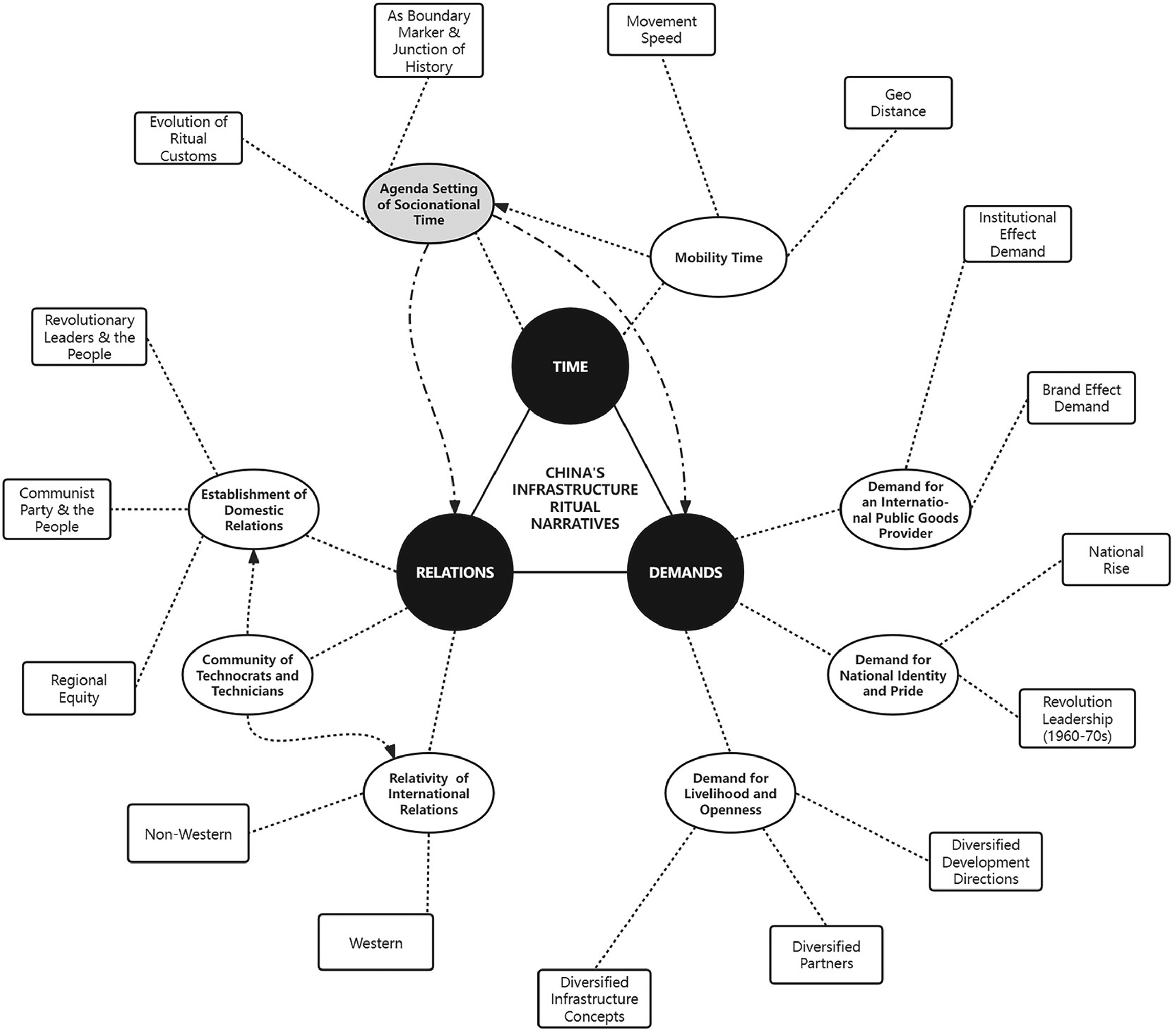
The mapping of codes.
Time and its alteration: The functional origin of infrastructure
The alteration of time scales is one of the primary characteristics of infrastructure. Primarily, this refers to shifts at the micro or technical level – particularly in mobility time – such as the alteration of the mobility time of people and things by transport infrastructures and the change of the receiving time of information by telecommunications infrastructures.
Mobility time
Technical artefacts and systems have not only enhanced human capabilities but also reshaped our perception of time and space. Consequently, the temporal significance of infrastructure becomes the functional basis and amplified value of infrastructure rituals. This category is subdivided into the ‘reduction of mobility time’ and the ‘reduction of geographical distance’. With the completion of cross-border projects such as the Guangzhou–Shenzhen–Hong Kong Express Rail Link and the Hong Kong–Zhuhai–Macao Bridge, the ‘one-hour living circle’ in the Greater Bay Area has taken shape, changing the concept of time and space in the region and bringing cities closer together.
29
Agenda setting of socionational time
Beyond its physical understanding, time also emerges from social construction. Objects are temporal in this socially constructed sense. 30 The narratives in infrastructure rituals focus on this social constructionist perspective, transitioning or amplifying the technical aspect of time towards a broader national context. This (dis)connecting and projecting of macro-time is reflected in two subcategories: infrastructure as ‘boundary marker & junction of national history’, and infrastructure as the ‘reflection of evolution of ritual customs’.
In terms of the first subcategory, Turner, in his study of the Ndembu, found that elements of ritual were referred to as chijikijilu, meaning signposts, or boundary markers. 31 Such boundary markers are used to delineate the temporal and relational boundaries between the actors and histories involved in the rituals. In China, after the transportation infrastructure enters the liminality of the ritual, by evoking memory and reality, it shifts from merely altering movement time to symbolizing national epochs, drawing lines between historical phases of new and old China.
Here, railway is given significance in the rite of passage by restructuring the temporality of Chinese history, or, Chinese time. Just as the invention and application of the railway symbolized a monument to the world’s Industrial Revolution, railway’s role in modern Chinese history transcends the technology itself. Initiated during the late-imperial era alongside European colonial influences, China began the process of railway construction. The failures and setbacks of this process transformed the railway into a symbol of national resurgence. The People’s Daily’s ritual narratives on the railways built after 1949 echo such rationale and chronologically sever the link between the present and the ‘century of humiliation’ of the past. Through such paths, infrastructure rituals restructure the meaning of time on a technical scale and sublime it to a patriotic and nation-building scale: The construction of the Chengdu–Chongqing Railway has been advocated for more than forty years, from the feudal Manchu-Qing dynasty, the Beiyang warlords, the Sichuan warlords, and the KMT reactionary government. Who did not call for the construction of a railroad? For over four decades, the people of Sichuan Province have witnessed not the arrival of sleepers or rails, but the transformation of promising railway construction plans into nothing more than broken promises. . . . Now, the doubters have seen clearly, and they believe that the people’s government is fully capable of building the Chengdu–Chongqing Railway with its own strength. People’s long-standing aspirations have become reality.
32
In contrast, post-1979 reforms ushered in an era where construction efficiency took precedence. The People’s Daily in this period pointed out the significance of time and cost savings for economic construction. The form of the rituals was no longer the main concern in conveying meaning, but was shifted to the practical utility of the infrastructure. At the same time, such utility has also been elevated in the narrative to the level of government integrity and administrative efficiency: This kind of ceremonies seems to be very lively and extraordinary, but it has no practical significance. It is just a waste of money and human labour. A considerable amount of money is thus wasted on ‘making scenes’ and on the banquets. People will poke our backbones. It is thus better to dispense with such rituals. Necessary ceremonies should also be simplified.
34
Fulfilling demands
The fulfilment of various social needs by infrastructure comes from the expectations it carries with its technical functions. Rituals must also meet the demand for human emotional energy. This section shows how rituals emphasize and magnify values tied to infrastructure, reflecting the evolving provision of infrastructure and demands of Chinese society. Infrastructure embodies the promise of a brighter future for its users. 35 In the Chinese context, this balance between supply and demand has evolved over social time in three main ways: demand for national identity and pride, demand for livelihood and openness, and demand for international public goods provision. Discourses in infrastructure rituals, in turn, focus and amplify the value and significance of this demand in the national narrative as well as in political legitimacy.
Demand for national identity and pride
Patriotism and national construction have been one of the primary political agendas shared by Chinese political elites since the collapse of the Chinese empire in the early 20th century. A plethora of ritual performances served as the platform for these constructions, with infrastructure offering essential support in the form of vital props for these rituals. In the official Chinese national narrative, when the People’s Republic of China was established in 1949, it was faced with a wasteland of ruins. After half a century of wars, China’s industrial capacity was perceived to be significantly below global benchmarks. Industrial incompetence and the deficit of infrastructure became one of the hallmarks of China’s imperial and Republican governance failures and their lack of legitimacy. Tangible infrastructure accomplishments, notably in transport and heavy industry, were visualized and restructured in rituals to bolster national identity and instil confidence in the PRC. To address this demand, infrastructure rituals highlighted China’s newfound capabilities, particularly the infrastructural capacity to build industrial facilities. Another form of transport has to be mentioned here: The construction of China’s first 10,000-tonne ocean liner began today at Dalian Shipyard, which enables China’s shipbuilding industry to leap into the advanced ranks of the world. … The construction of the 10,000-tonne ocean liner was a major event in China’s shipbuilding industry and shipping business, which is a distinctive sign of the rapid advancement of the technological level of China’s shipbuilding capacity.
36
Demand for livelihood and openness
With the development of China’s capacity for infrastructure construction, the problem was no longer one of ‘haves or have-nots’. In the early timeline of the People’s Republic, China’s heavy industry achieved rapid and visible outcomes as a result of drawing on the Soviet model of development. But as with the Soviet Union, in the 1970s, the technical capabilities of China’s infrastructure fell short in addressing the broader economic demands, primarily because it was not able to provide adequate livelihood and light industrial infrastructure relevant to the lives of ordinary people.
Changes in the sociopolitical agenda also had to be refocused and restructured in the infrastructure rituals. To achieve this refocusing, infrastructures (i.e. livelihood and soft infrastructures), which embody a different value orientation, were brought into the arena of ritual performance. In the absence of urgent softer infrastructures capable of meeting new demands, the value and significance of these expected infrastructures became the main focus and target of restructuring in this period of infrastructure ritual narratives. We identify three aspects.
The first is the diversified development directions. As mentioned in the earlier paragraph, after three decades of the functioning of infrastructure centred on heavy industry, China’s mono-infrastructure model made its economy significantly vulnerable. Infrastructure only becomes visible when it fails or is lacking.
38
This vulnerability spurred a rising demand for varied infrastructure types in the infrastructure rituals of this period. The focus of the development paradigm shifted from heavy infrastructure to light infrastructure. This shift is embedded in an economic revitalization strategy with an overarching development orientation for this period. Liu Tinghuan, the Deputy Governor of the People’s Bank of China, stated that the government’s preferential policies aimed at fostering the bank card industry have been effectively materialized through the establishment of a dedicated industrial zone. This strategic initiative has successfully congregated a diverse array of bank card enterprises, thereby refining the industrial division of labour, cultivating a tightly knit industrial chain, and facilitating economies of scale via the pooling and sharing of resources. Such a comprehensive approach not only serves as a potent catalyst for the rapid development and maturation of the bank card sector but also acts as a magnet to draw both domestic and international financial and IT corporations with affiliations to bank cards.
39
Third, infrastructure concepts in 1980s China have become more diverse and inclusive, with a wide range of partners and investors bringing in different types of infrastructure. This includes not just traditional categories, but also projects focused on the provision of livelihoods and light industry. The importance of diversity and human connection in infrastructure has been reframed and highlighted in the People’s Daily, suggesting that infrastructure can be restructured to align with various value frameworks. This broader understanding of infrastructure also embraces the concept of soft infrastructure, which emphasizes the cultural and social aspects of infrastructure 41 rather than that of machines. 42
The pattern of demands for diversified functions of infrastructure during the period of reform and opening up has expanded the boundaries of the definition of infrastructure. Meanwhile, the diversification of the ritual narrative’s focus on infrastructure, coupled with the sublimation of the values stemming from it, underlines the gradual shift in China’s view of infrastructure to the institutional level, providing a new creative basis for the narratives of infrastructure rituals for the next national period.
Demand for an international public goods provider
Since 2013, international infrastructure project inaugurations have overtaken domestic ones in terms of media coverage. Such a shift in media coverage demonstrates the significance of ‘China construction’ within the Belt and Road Initiative framework, emphasizing the mutual benefits that China envisages for itself and its partner nations. In the official Chinese media narratives, the infrastructure ceremonies of this period began to focus on and amplify the branding effects. High technology, high standards, frameworks of regional cooperation, and entrepreneurship are restructured under the branding messages of China’s infrastructure projects, which are believed to have become an important basis for China’s image during this period. Prajin Juntong [the then Transport Minister of Thailand] outlined the vision of the Thai–Chinese railroad project to the reporter: ‘When Chinese railroad technology is applied and successful here, it will have an exemplary effect on other neighbouring countries. This will bring greater opportunities for the export of Chinese technology and Chinese standards’.
43
Generation of relations
Rituals, as collective activities imbued with distinct values, play a pivotal role in shaping and reshaping various patterns of relationships through the ritualization of props. As described in the previous two sections, the technical functions of infrastructure being focused and restructured in ceremonies not only (re)shape different time and space, but also address different sociopolitical supply and demand dynamics, serving the formation of specific relation networks. In this section, the rituals highlight and amplify the relational value of the infrastructure.
Establishment of domestic relations
Infrastructure, as a technical system, not only shapes relationships through its technical attributes but also notably fosters a community of technocrats during its construction. For instance, the technical elements of the Wuhan Yangtze River Bridge, the PRC’s first major domestic transport infrastructure, are focused on the generation of relations and restructured into a relational hub that aggregates different technical groups: Our famous bridge experts, engineers, professors, university students, excellent bridge workers, and long-trained administrators will all be clustered here to work on construction. People regard the Wuhan Yangtze River Bridge project as a bridge university of the best kind, in which they will write a new page in the history of Chinese bridge construction and lay a solid foundation for the future bridge industry in China.
46
In contrast, during the reform period, domestic relations, due to the lack of livelihood infrastructure, ceremonies increasingly highlighted the potential of infrastructure to address economic disparities among different regions. The macro-narrative fades and the focus of attention in the ritual shifts to emphasize the importance of infrastructure in helping to lift specific individuals out of poverty. Specific infrastructures are restructured and amplified as a means of narrowing the gap between the rich and the poor: This is a beneficial project to help minority regions develop and utilize resources and support poverty alleviation in Xiangxi in western Hunan Province. . . . An elderly member of the Tujia ethnic group named Peng Mei happily told the journalist: Baojing County is a state-level poverty-stricken county. She remembered when she was a teenage girl that Wanmipo Hydropower Station was to be built. Now, as she nears the age of 70, she has at long last witnessed the fruition of this project.
48
The relative nature of international relations
In terms of the regeneration of international relations, the driving effect of the techno-population is also noteworthy. From an international perspective on projects undertaken during the Cold War, narratives pertaining to infrastructure rituals simultaneously focused on and amplified the perceived value and anticipated role of China – under the leadership of the Chinese Communist Party and bolstered by technological assistance from the Soviet Union – China could perform as a promising force within the global communist revolution. 49 On the other hand, the relativity created in the process of infrastructure assistance to the Third World under the banner of the world revolution also reinforces the imaginary of the West as an object of revolution, in comparison to the revolutionary friendship created by the socialist camp in the process of technology cooperation. 50
Since the early 1980s, the primary focus of international infrastructure narratives has shifted to emphasize reconciliation and cooperation between China and Western countries, particularly in the realm of infrastructure. This change occurred during a critical period of reform and economic development. Western investors, previously on opposing sides of infra-political debates, resumed their technological collaborations with China. With the implementation of the reform and opening-up policy, infrastructure ceremony narratives began to underscore the significance of Western technological assistance in realizing China’s goal of the ‘four modernizations’. Consequently, this development led to the establishment of new patterns in international infrastructure practices, introducing a broader temporal perspective that differed from past frameworks. 51
Conclusion
Drawing on the case of China, we depict the political and cultural practices of infrastructure of the world’s largest infrastructure powerhouse. The preceding cases show that at the empirical level, the analysis demonstrates to us how the People’s Daily, a premier voice of Chinese officialdom, portrayed the sociopolitical implications of infrastructure as a technical system in their ritual narratives. These narratives are then anchored within the macro-context of Chinese nation-building and developmental policies. At a theoretical level, the case studies enrich our understanding of the mechanism of infrastructure rituals in terms of their function, purpose, and symbolism. Specifically, they illuminate the focusing, restructuring, and amplification of infrastructure-specific sociopolitical values through the manoeuvring of time, demands, and relations, as shown in Figure 2.
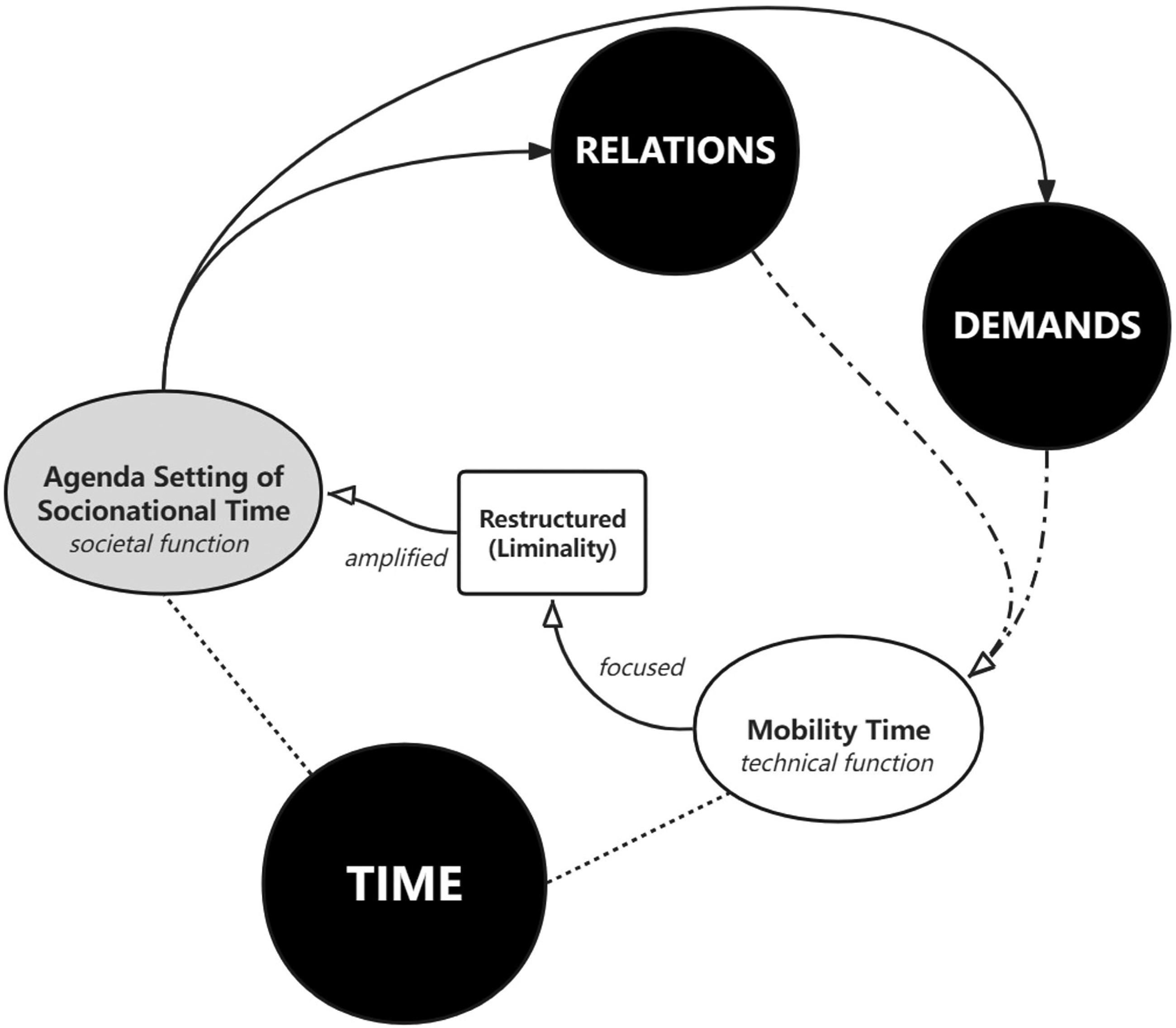
Narrative logic and theoretical structure of China’s infrastructure ritual narratives.
Firstly, the study finds that time is the most essential dimension of infrastructure rituals, as well as the basis for other dimensions. On the theoretical level, existing studies have concluded that space compression and just-in-time production demonstrate ‘the imbrication of time with infrastructure with particular clarity’. 52 Infrastructure in rituals is restructured and amplified in two temporal subcategories, mobility time and socionational time. Through the liminality of the rites of passage, infrastructure as ritual artefact is withdrawn from its original technical functions and restructured under a new framework of value. These values are then amplified through a series of ritual narratives and performances. This process enhances our understanding of how infrastructure rituals deal with the time element of infrastructure.
Whereas at the empirical level, the narratives of infrastructure rituals show that rituals’ appropriation of the time-function of infrastructure contributes to the delineation of the historical time boundary between China’s past and the present. This delineation serves as a foundational pillar for fostering domestic patriotic nation-building. The metaphor here helps to legitimize Chinese officialdom in the early years of revolutionary success: by evoking historical memory, it actively offered the possibility of severing ties with a humiliating past, positioning infrastructure achievements as emblematic of a promising future.
Secondly, the infrastructure incorporated into the ritual narratives can facilitate different supply and demand in different socionational times. Infrastructure can generate expectations and promises. 53 This supply-and-demand relationship between expectation and commitment echoes the time metaphor. On a theoretical level, rituals should promise participants something about future states and situations, while the technical capabilities of infrastructure underpin the possibility of realizing such promises. The technical functions of infrastructure (e.g. transport functions, energy functions, and production functions) can be decomposed and restructured in ritual narratives as promises to people in different historical contexts. Such commitments must be amplified and highlighted by the process of ritual.
In China’s infrastructure ritual narratives, infrastructure as ritual artefacts promises three combinations of supply and demand for different socionational times: national identity and living standard demands in a context of infrastructure abundance or scarcity, as well as mechanistic and institutional demands after infrastructure has achieved a surplus at the physical level.
Thirdly, infrastructure rituals lay the foundation for creating a set of norms that guide infrastructure practices, subsequently moulding the relational dynamics within human society. Infrastructure, as a relational hub, not only reflects the connected relationships that are centred on it but also creates new relationships based on this connectivity as well as its technical functions. 54 In both the national and international contexts, audiences are constantly reminded of how rituals are able to construct different patterns of relationships through the focusing, restructuring, and amplification of time and demands.
In summary, this article offers a perspective in comprehending the cultural and sociopolitical significance of China’s infrastructure practices, and a further step forward in infrastructure studies by answering the two research questions in these ways.
Answer to research question 1: the technical significances of infrastructure are focused and restructured in the liminality of rituals, then the ritual narratives and performances amplify the values and significances of these infrastructures, so that these values can be embedded in China’s larger national narratives about development and sociopolitical agendas.
Answer to research question 2: the process of such focusing, restructuring, and amplification is being implemented under the framework of three key elements of infrastructure’s intrinsic properties: time, demands, and relations.
Overall, this study has provided a framework for understanding how infrastructure rituals focus on, restructure, and amplify specific values associated with infrastructure. The study highlighted the importance of time, demands, and relations in the ritual narratives, offering a deeper understanding of China’s infrastructure development and how the cultural and sociopolitical significance of that development has contributed to China’s nation-building in the context of the country’s economic achievements over the past decades. We hope these findings may be applied to broader contexts in future global infrastructure studies.
