




Abstract
This article investigates the increasing development–security conflict in China’s immigration management through the case of a policy trial regularizing Vietnamese labour migration in two Guangxi border cities. China’s border regions host low-income immigrant labourers from neighbouring nations. In the 2010s, China launched a series of policy initiatives to regulate temporary and irregular migrant flows. Based on fieldwork and policy research, this study analyses the development and early implementation of this trial, with a focus on state perspectives. It shows how state actors mobilize migrant temporariness and other policy tools within a negotiation process that aims to resolve tensions between developmental policy aims for transnational economic integration and a drive towards securitizing cross-border mobility. I conclude that state actors fail to reach a balance between the conflicting development and security concerns. I also argue that China’s current risk-averse policy environment makes the development–security policy conflict in its immigration management more difficult to resolve. My findings contribute to our understanding of contemporary Chinese policymaking, including immigration policymaking, as well as to the literature on the development–security nexus in temporary labour management schemes.
Keywords
About a dozen Vietnamese men and women are eating lunch in front of their Chinese labour agent’s office, when Wang (a pseudonym), an official with the human resources department of this border city in south-west China, stops by for an impromptu inspection. Wang disapproves of the scene, claiming that it poses a public safety risk, but does not take action against the informal restaurant. He knows that the workers from Vietnam have to spend hours waiting for the approval of a monthly Chinese residence permit allowing them to legally work within the town and adjacent economic development zones. Monthly permits are a feature of the cross-border labour migrant regularization trial in this area. 1 The trial, launched in 2017, allows two Guangxi border cities to welcome migrants who previously were irregular migrant workers. These migrants alleviate the labour shortage in the area’s large sugar cane processing sector and in manufacturing plants.
The tension between commercial and security interests, previously less prominent at the Guangxi border with Vietnam, has intensified. On the one hand, the regularization trial, highly anticipated by officials like Wang, ‘fits with central government priorities’ 2 such as deeper integration of China with Southeast Asian economies under the China-led Belt and Road Initiative. On the other hand, central authorities remain ambivalent about the entry of ordinary foreign labour into the Chinese labour markets at a time of growing state concern with irregular migration.
Foreign labour migrant management is a relatively new issue for the Chinese state, since domestic low-income labour has largely catered to China’s developmental needs. Following the rapid increase of foreign migration after China’s accession to the World Trade Organization in 2001, the state has focused on attracting highly educated professional talent which is considered beneficial to China’s economic transition; China’s immigration framework does not permit most forms of low-income migration labour. However, as China’s working-age population shrinks, labour market demand for less-educated foreign nationals to fill niche markets and local labour shortages has emerged, from Japanese call centre workers and Filipino domestic workers to Southeast Asian agricultural workers.
China now faces a dilemma in the management of labour migration: how to increase control over incoming temporary labour migration, while maintaining a flexible, low-cost source of labour? 3 This study asks the question of how Chinese state actors resolve conflicting developmental and security concerns in their management of temporary labour migration. Specifically, to what extent do policy tools such as legal limits on duration and location of stay allow them to reconcile these tensions? The study investigates these questions through the case of special economic zones (SEZs) along Guangxi Province’s border with Vietnam. China’s emerging policy response speaks to the wider literature on temporary labour migration policy design and implementation.
There has been a distinct developmentalist bias in China’s reform-era immigration regime, with the state paying relatively little attention to immigration security. This started to change following the growth of immigration and the well-documented politicization of African trader communities in Guangzhou, which led to more restrictive local immigration control. 4 The 2012 Exit and Entry Administration Law, China’s main immigration management law, reflected growing interest in immigration control as seen by the inclusion of sections on national security and irregular entry, residence, and employment. 5 The National Immigration Administration, China’s first national-level immigration agency was established in 2018, and the Administration has prioritized strengthening border control and centralizing the management of borders. 6
This increased central state interest in managing international mobility has reached Chinese border areas which have experienced long-standing cross-border labour mobility, much of which is short-distance and circular. Prior to the increase in cross-border labour migration in the south-west over the last decade, cross-border unregistered marriage migration was the primary target of immigration control. 7 The arrival of economic integration strategies such as the Belt and Road Initiative in the borderlands show the tensions between these top–down development plans and local mobility practices, where an increase in investment accompanied by added control can interrupt existing cross-border social and economic ties. 8
This article situates the regularization trial in the context of China’s ongoing state immigration management reforms. As with temporary labour programmes in other parts of the world, the Guangxi trial was developed in response to increasing security concerns around irregular migration. Like those schemes, the trial shows the tensions between commodifying labour and increasing limits on cross-border mobility. The dynamics have changed circular border mobility patterns, leading to hiring problems for employers and stricter bifurcation between regular and irregular labour flows. I show how these unintended outcomes of the trial are aggravated by national security authorities’ use of short-term residence permits to signal and maintain control over a newly visible and controversial migration flow. The case of the Guangxi trial demonstrates that, in the context of political negotiation and conflicting policy goals, security-oriented actors’ use of policy tools such as temporariness severely impedes developmental goals.
I argue that the development–security policy conflict is more difficult to resolve in China’s risk-averse policy environment, which favours security-oriented immigration measures. My findings contribute to the literature on Chinese migration, including border migration, Chinese policy implementation in the Xi Jinping era, as well as to previous findings on the development–security nexus in recent temporary labour migration programmes: while researchers have documented the negative effects of increased securitization on migrant rights and circular movement, limits on migrants’ duration of stay are generally not seen as hurting the developmental aims of receiving countries.
In the following, I review relevant labour migration research before introducing the Guangxi case. I then use policy and interview data to analyse development–security dynamics during the planning of the regularization trial and its first years of implementation. Finally, I conclude with a discussion of the implications of these findings for the fields of temporary labour management and Chinese immigration border policy.
Development and security in state responses to labour migration
States around the world consider foreign labour migration management to be a balancing act between developmental and security concerns. While including foreign migrants in the lower tiers of the labour market is associated with social and political costs, economic incentives for these schemes remain strong due to factors such as demographic change and labour market segmentation, leading states to balance employer interests against opposing actors. Giving migrants temporary or ‘time-delimited’ migration status has been a major ‘tool’ for nation states to control labour migrant entry and settlement. 9 Early post-war temporary low-income labour migration or ‘guest worker’ programmes primarily focused on supporting businesses’ access to low-cost foreign labour. These programmes are generally considered to have ‘failed’ at keeping migrants temporary, leading to unintended large-scale migrant settlement or increased irregular migration flows, with research documenting how policymakers failed to grasp the complex social nature of migrant behaviour. 10 To prevent such outcomes, a new generation of temporary labour migration programmes, starting from the 1990s, has generally been smaller in scale and scope, with more state involvement. They combine the search for these economic benefits with stricter conditions attached to residence and tend to have a dual aim of alleviating labour shortages and reducing irregular migration. 11
This new type of temporary labour schemes, also called ‘circular’ when it includes policies on rotation and repeated movement, has been presented by policymakers as an optimal or ‘win-win’ solution for solving the tension between development and security: they seem to reconcile the interests of actors who want to control or limit migrant settlement, while providing employers with flexible labour. Though research has mainly focused on how temporary labour migration programmes have made migration management in Western Europe and settler states such as Canada and Australia more restrictive, such programmes have also become widespread across Asia, with temporariness of contracts and stay, usually in the range of several years, as their key features. 12
However, research into these programmes has found that – as with earlier schemes – considerable gaps between intention and reality remain. Firstly, high expectations of control require temporary migration to be increasingly ‘securitized’. 13 States can accomplish this by making use of non-state actors such as employers and brokers to further monitor migrant mobility or by embedding temporary labour programmes in special legal regimes within economic zones, thereby adding another layer of migrant selection and further limiting the risk of unexpected sociopolitical impact. 14 Despite the considerable investment this requires, there is little evidence that these programmes reduce irregular movements, while limiting the duration of legal stay tends to decrease migrant circularity compared to that in areas of free cross-border movement. 15 More convincing is the large body of evidence documenting a trade-off between the level of restrictions and the protection of migrant rights, with workers in highly securitized programmes more vulnerable to exploitation. 16
Secondly, the security–development nexus is affected by the politics surrounding temporary labour migration programmes. The tension between admitting foreign labour migrants and the aim of fully controlling their movement can mean that state actors responsible for temporary labour migration control tend to be confronted with ‘often incompatible goals’. 17 Changing national security priorities, administrative rivalries or conflict, and public opinion can exacerbate such tensions, leading to the variety of policy designs and outcomes that have marked these schemes in recent decades. Depending on local political circumstances, states choose to restrict temporary labour migration to migrants from particular ethnic or cultural groups or from countries that are considered a lower security risk, to particular economic sectors, or states tighten oversight of migrant return following any controversy. 18
Compared to the documentation of the impact of restrictive policy tools on migrant rights and security outcomes, the ways in which relevant state actors use these tools in policy development and implementation, including during policy testing and adjustment, have been relatively understudied. Less attention has been given to the developmental impact of recent temporary labour migration policies, with programmes generally considered able to recruit enough migrant workers to fulfil economic aims. The case of the Guangxi regularization trial, as a new temporary labour migration programme in China that strengthens immigration control in a border region with previously relatively free circular migration, puts state actors’ use of these tools and their effects centre stage.
Border mobility and foreign employment in China’s south-west
China’s rapid and uneven development has been fuelled by large-scale internal migration to coastal regions. As China’s domestic labour force becomes older, more mobile and increasingly educated, labour-intensive agriculture and manufacturing sectors in the north-east and south-west border regions of the country face labour shortages. Guangxi, a province-level autonomous region in China’s south-west with the third-lowest GDP per capita among Chinese provinces in 2019, is home to the fourth largest domestic outmigration population in China. Employers in the region increasingly rely on seasonal or longer-term labour migrants from bordering countries such as Vietnam. 19
The China–Vietnam border displays the permeability of many Asian borders, which divide people who often share deep cultural and socio-economic ties. 20 Heavily militarized in the decade following the 1979 Sino-Vietnamese border war, border management was relaxed following the normalization of diplomatic relations in 1991, with numerous mountainous border crossings gradually reopening in the following years ‘as land mines were removed’. 21 To regularize post-Cold War cross-border mobility in a period when it was difficult to obtain personal passports, administrative border zones were established nationwide. Local residents registered in these areas can apply for border resident passes that allow them to legally cross the border and stay in a neighbouring state’s border regions for one to seven days at a time, depending on the locality.
These local exit–entry regulations have provided the Sino-Vietnamese border population with economic advantages during decades of rapid growth. In recent years, registered border crossings by residents living close to land borders made up about a third of the total of border crossings in and out of China. Economic activity is facilitated by dozens of border checkpoints opened specifically for Vietnamese and Chinese border resident pass holders. While foreign nationals working in other parts of China generally hold work visas linked to an employer and are required to have a university education and relevant work experience, in border areas foreign nationals usually use their border resident passes which permit some types of economic activity but not long-term employment, or they work irregularly. Easy cross-border mobility and loosely enforced duty-free import quota have brought about significant cross-border economic integration, with Guangxi regularly generating the highest cross-border trade value of any Chinese border region. In the 2000s, a boom in Southeast Asian mahogany red wood trade attracted significant migration from other parts of China to the Guangxi borderlands.
The Guangxi–Vietnam border has a relatively small manufacturing sector but is strategically located between the Pearl River Delta – China’s manufacturing powerhouse – and Southeast Asia. Since the early 2000s, China’s south-western border zones have been included in several national economic strategies aiming to close the development gap between inland and coastal areas. Policies for regional economic integration, such as the Belt and Road Initiative, also include border development as a goal. SEZs provide the regulatory environment for investment from coastal regions to these areas. Despite frequent diplomatic tension between the two nations, policymakers consider the mostly stable and predictable China–Vietnam land border more suited to government-sponsored development plans than Myanmar’s conflict-ridden border. 22
By framing policy requests within these central initiatives, local government actors can lobby for a special economic zone or a specific policy – a key feature of China’s reform-era policy development. Two cities – Dongxing (pop. 160,000), located on the shores of the Gulf of Tonkin, and Pingxiang (120,000), which is connected to Vietnam by land and rail – were designated ‘key development and opening-up experimental zones’ (重点开发开放试验区) in 2012 and 2016, respectively (see Figure 1). 23 Pingxiang was granted further policy innovation privileges in cross-border investment and trade in 2019, when it became part of the Guangxi Free Trade Zone. The cross-border labour regularization policy was pioneered in these two cities.
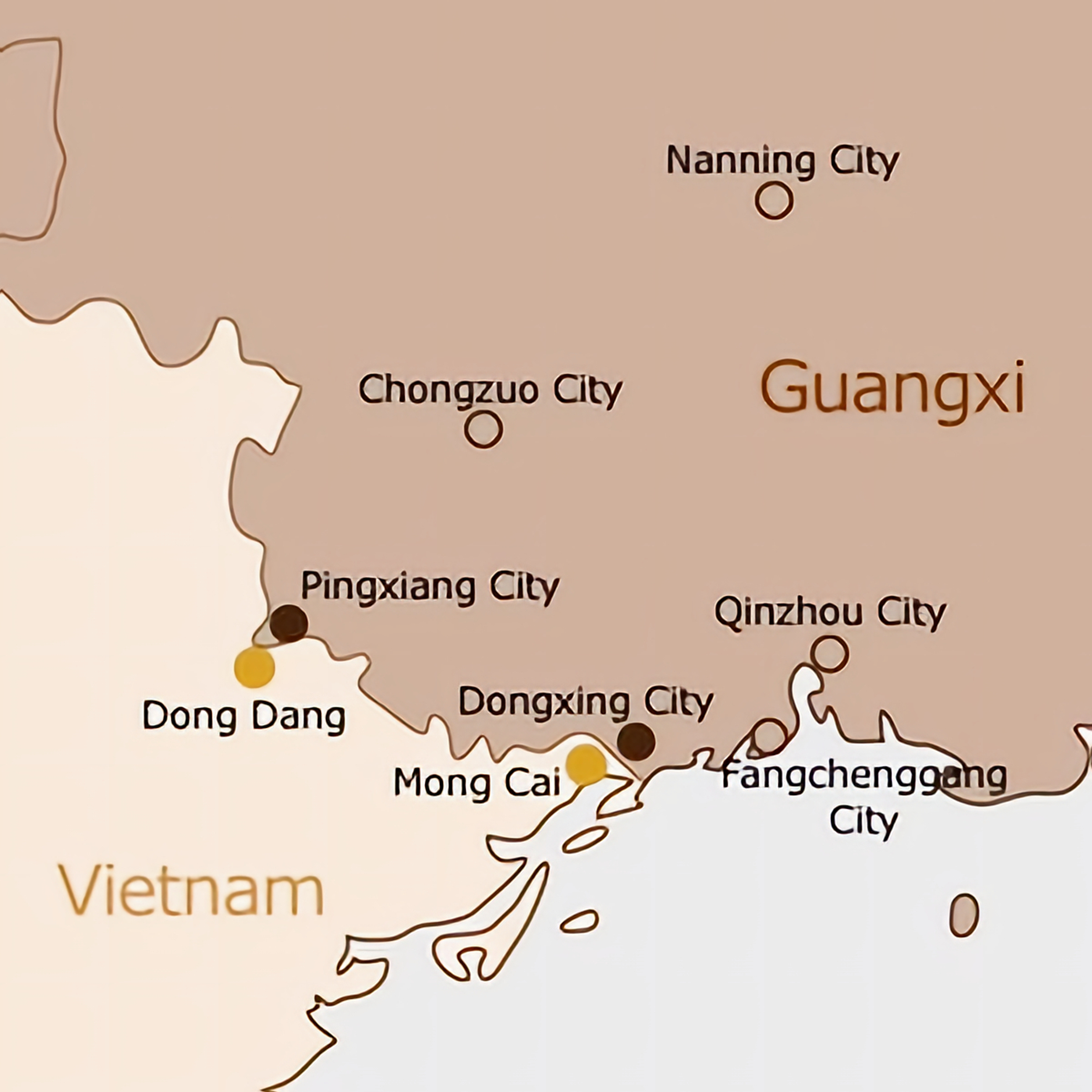
Guangxi border area.
Since 2010, the number of border area labour migrants working in non-seasonal jobs has sharply increased to accommodate growing demand for manufacturing labour. 24 Migrants increasingly come from areas further away from the border. While not much data are available, a survey completed in the Yunnan border city of Ruili, where cross-border dynamics are similar to those in Guangxi, found that only 28 per cent of a sample of cross-border labour migrants were from borderland areas. Whereas women from nearby areas previously dominated circular labour migration in Guangxi, this ‘new pattern of migration’ is more diverse. 25 In addition, increasing numbers of foreign labour migrants have migrated beyond border provinces to China’s coastal provinces, where their irregular immigration status is more precarious but salaries are higher. One credible source estimates that there are 100,000 irregular Vietnamese labour migrants in China. 26 Meanwhile, local residents’ outward labour migration has increased following an economic downturn in the border region due to tightened anti-smuggling law enforcement, combined with rapid improvement in infrastructure. This trend consolidated demand for cross-border migrants in the region’s large agricultural sector and emerging manufacturing zones.
The Guangxi regularization trial’s recent start makes it well-suited for studying the development and initial implementation of a pioneering policy. The relative absence of border security restrictions at the time of research allowed me, a foreign researcher, to conduct field research among local government actors in this region.
Methodology
This research uses a variety of qualitative data – 45 interviews combined with policy analysis – to gain insight into the trial and its complex sociopolitical embedding. First, I conducted 25 interviews with local stakeholders (7 officials, 8 labour brokers, 6 employers, and 4 researchers), which took place in experimental sites Dongxing and Pingxiang, the border city Chongzuo, and the Guangxi regional capital Nanning in May 2019 and December 2019 to January 2020. A letter of introduction stating my status as a visiting PhD researcher at a Chinese institution helped me gain access to border city-level employment and border security officials. However, interview access to security officials was limited. I compensated for this limitation by interviewing two immigration policy researchers working within public security research institutions who were familiar with the regularization trial.
In addition to these interviews, I conducted semi-structured short interviews with 20 residents in the Pingxiang area, focusing on their perceptions of Vietnamese labour migration and the ongoing policy trial. For these interviews with residents, which helped me triangulate findings, I sought out people in different urban, semi-urban, and rural parts of the trial area. I also talked with Vietnamese migrants at government service centres and employment sites who spoke Mandarin. However, this analysis focuses on Chinese perspectives on the trial, rather than Vietnamese migrant experience or the make-up of migrant communities. 27 Shortly after my last visit, the policy trial was suspended due to COVID-19 border disruptions.
Finally, I analysed policy documents and official discourse on the trial in government and state media between 2015–20. Official debate, when accessible, is a key source for gaining insight into the political process that plays out during Chinese policy experimentation. Shifting state discourse is also an important aspect in the securitization of immigration, making such discourse relevant to the study of immigration management.
Developing a temporary labour migration programme at the Guangxi border (2015–2017)
Over the last two decades, Guangxi authorities condoned irregular labour migration to improve regional economic development. As a result, reliance on Vietnamese migrants increased in labour-intensive sectors. My experience on the ground was that local populations and officials generally welcomed this new labour force, describing migrants as culturally similar, hardworking, and willing to work in undesired jobs. However, central authorities perceived the increase of non-seasonal labour migration into the border zones, and further into China, as a security risk. Local authorities in Guangxi responded by framing labour migration as a tool to achieve national development goals. They successfully lobbied national authorities to launch a policy trial regularizing these new flows of labour migrants.
A laissez-faire approach to Vietnamese migrants in the border area labour market
As local workers moved away in greater numbers, Vietnamese migrants became a key part of the labour force at the Guangxi border. Migrants mostly work in labour-intensive jobs that Guangxi locals are no longer willing or available to do. The locals would only consider doing the same jobs for higher pay in the coastal areas. Border residents are more inclined to go into business as cross-border traders or retailers, economic activities that interviewees described as more desirable due to their relative independence. Locals associate agricultural and factory work with ‘cheap’ Vietnamese labour migrants willing to do exhausting work. Only one interviewee saw young Vietnamese employed in service jobs as competing with local workers. The cross-border migration flow shows how, even in a relatively underdeveloped part of China, ‘social borders’ around different types of labour solidify to create a demand for outside labour. 28
This segmented labour market solidified as labour recruitment networks expanded. Building on earlier waves of Vietnamese marriage migrants and business travellers, cross-border kinship networks which were created facilitated seasonal agricultural work and expanded into an intermediary market recruiting workers from neighbouring provinces and other parts of northern Vietnam for hundreds of Guangxi processing and manufacturing companies. In a typical year prior to the start of the regularization trial, about 10,000–15,000 Vietnamese labour migrants worked in the Pingxiang area, with the figure multiplying during the sugar cane harvest. Compare this with ‘about 20,000–30,000’ employable locals. 29 Circular migration was considered the norm for both agricultural and other workers. While many migrants work in China for multiple years and local economic planners count on their labour supply, permanent settlement was not usually considered an end goal, except in the case of marriage.
Policymakers and members of the public cite cultural proximity with Vietnamese migrants as the main rationale for a lack of tension surrounding the labour trial. According to the same official Wang mentioned earlier, there would be more conflicts between locals and migrants if migrants did not share a similar ‘Southeast Asian culture’. However, only part of the rural cross-border population can communicate with Vietnamese border residents in a similar dialect. Outside rural areas, daily interaction between migrants and locals is limited. In the last decade, increased demand for migrants in manufacturing plants has increased this divide. As in Yunnan, more workers now work and live at employment sites at the Guangxi border and speak little or no Mandarin. 30
Around 2010, Guangxi’s laissez-faire approach to the increase in Vietnamese labour migration came to the attention of regional- and national-level public security authorities and attracted criticism for its ‘soft’ approach towards irregular migration. 31 Local authorities were held responsible for ‘chaotic’ labour recruitment, which led to unregulated fees and labour conflicts, and for the increase in Southeast Asian migrants taking up irregular residence in border areas and other parts of China. 32 Public security officials estimated that Guangxi ‘led the nation’ in irregular migration and that a majority of irregular Vietnamese labour migrants entering the country in Guangxi ended up in Guangdong, creating extra work for public security there. These complaints led to pressure on Guangxi border authorities to control irregular migration, with arrests of irregular labour migrants increasing an average of 20 per cent annually from 2010 onwards. 33 In response, some Guangxi officials started to consider regularization as a solution for controlled labour migration, inspired by Yunnan’s Dehong Prefecture, where cross-border labour has been managed through local regulations since 2014. To maintain economic stability and cross-border labour flow without running into continuous conflict with higher-level authorities, they had to break with previous ‘non-policy’. 34
Guangxi’s developmentalist framing of Vietnamese labour regularization
In Chinese policymaking, experimental policies are the outcome of negotiations between central policymakers and subnational actors, often in response to a regulatory failure. Experimental policies do not have a fixed timeline, and their impact on future policy varies case by case. 35 In the Guangxi cross-border labour trial, local officials framed their demands for expanding Vietnamese labour mobility in the context of China’s national strategy for border development. In their requests, they offered a mix of economic and security-based rationales: SEZs would require growing labour supply; relatively cheap foreign labour could enhance the competitiveness of these traditionally ‘left-behind’ areas; and regularizing existing migrant labour would address growing border security concerns. Because China’s existing immigration laws do not allow for foreign low-income labour, securing central-level approval for labour regularization would be a significant policy innovation.
National-level research delegations to the Dongxing SEZ, at the time the only national-level zone in the region, became aware of local-level interest in securing the regulation of migrant labour. A mini-trial of 10 employers in Dongxing provided ‘first-hand experience’ for a State Council Development Research Center team to evaluate. 36 This led to the inclusion of a single-line statement in the 2015 State Council strategy for border development allowing ‘the employment of foreign nationals in accordance to regulations’ in border region SEZs, with the Ministry of Human Resources and Social Security as the responsible government authority. 37 This national-level document was subsequently invoked at every step in the regularization trial’s development.
The early phase of the regularization trial focused on its developmental potential. After cross-border labour regularization received central approval, local government actors started to openly discuss the key role that previously irregular Vietnamese workers were playing in areas of their economy, calling for speedy implementation because the ‘labour dividend’ accruing from cross-border migrants willing to do tiring work for salaries 20–30 per cent lower than the local average might run out in a decade. 38 Demand for such workers will continue to rise, one official with the department of commerce writes, to fulfil the development goals of the SEZs. 39 They also calculated that lower salaries and social insurance payments for foreign workers would allow employers to save respectively RMB 1454 and RMB 779 a month per worker – as compared to the cost of hiring a worker from China’s eastern provinces or a Guangxi local.
In 2016, a bilateral cooperation mechanism between Guangxi and its four bordering Vietnamese provinces (Quảng Ninh, Lạng Sơn, Cao Bằng, and Hà Giang) became active at regional and city levels. A subsequent 2017 Guangxi regional work plan detailed the regularization trial, ending a period in which regional authorities had remained passive to local-level requests for policy support. The region’s commercial authorities, also in charge of SEZ development, were made responsible for overseeing the policy.
The 2017 strategy strikes a balance between economic development and border security. It describes Vietnamese migrants as a ‘beneficial complement’ to Guangxi’s local labour market, who should receive ‘maximum convenience’, while also requiring local authorities to exercise ‘maximum control’ over irregular mobility. The plan stipulates that workers are eligible for half-year residence permits, and it requires employers to police migrant employees. If successful, the regularization trial was slated to be scaled up to the entire border region by the end of 2018. 40
In this phase, officials who were interviewed recalled a sense of optimism and described the trial as a step forward in China’s evolution to becoming an immigration destination. 41 ‘2017 was kind of a big year for us as the autonomous region started to make policies’, the already-mentioned human resources official Wang told me. 42 The national-level experimental status of the SEZs made it possible to receive various policy benefits, among which the regularization trial was considered the most noteworthy. Following central approval, local and regional leaders ‘highly prioritized’ it. 43 However, the policy’s momentum also meant local migration management would be subject to increased higher-level government surveillance. In what interviewees described as a shift towards a ‘subtler’ relationship with higher levels of government, local authorities balanced local commercial interests, such as the demand for flexible cross-border agricultural labour, with the expectations of superiors who decided the trial’s future. 44
Implementing cross-border labour regularization (2017–2019)
Human resources, exit–entry, and special zone management authorities were the main actors implementing the regularization trial in the border cities. While a large amount of cross-border labour migration has been regularized since 2017, implementation varies within the trial area and irregular migration persists. I show that central public security authorities wanted local authorities to further strengthen control over migrant mobility, rejecting requests for policy relaxation. This emphasis on immigration control destabilizes the existing circular labour migration dynamic, making it harder for employers to hire migrants while paradoxically creating new irregular networks.
Post-trial mixed effects on cross-border labour migrant flows
In 2019, two years after the implementation of the regularization trial, its effects on the ground were mixed. State media and government reports enthusiastically cited examples of coastal businesses that relocated to Guangxi for its affordable Vietnamese labour, but economic development had not been revitalized by the SEZs’ advantageous policies. Officials described economic development as ‘alright’, ‘not great’, or, at best, in a ‘stable’ state. 45 Implementation was difficult because national public security authorities refused to issue the half-year work permits that the 2017 plan had announced. Instead, migrants continued to cross the border and apply for a new residence permit on a monthly basis. The planned scale-up of the trial area in 2018 did not materialize, indicating that central authorities considered expansion premature.
For employers, the regularization trial made hiring Vietnamese employees ‘legal but harder’. 46 Enforcement efforts focused on bigger employers, such as the sugar cane processing factories, and new companies moving to the SEZs. Workers had to leave their company for several days a month to renew their permit, leaving less time for work, while the monthly cost of renewal (RMB 120) was significant for low-wage workers. The turnover rate was high because each month migrants could choose whether or not to return to the company, or even whether to return to China at all. The strict mobility management of workers resulted in migrants frequently quitting within a month. Companies that had relocated to Guangxi because of the special zone incentives and cheaper labour costs had difficulty training and retaining Vietnamese employees. 47
Despite strengthened management over the Vietnamese working population – ‘we now know their identity and what they are doing’, as one official put it 48 – work permit enforcement varied throughout the trial zone. According to researchers’ estimates, most Vietnamese workers in the Pingxiang City area now have work permits, and authorities claimed that the regularization trial has greatly reduced hiring difficulties. In 2018, 145,000 monthly permits were issued to workers at over 500 companies, although monthly numbers highly fluctuated. Work permits were less common among Vietnamese working in agriculture and construction outside the Pingxiang urban area. As a 30-year-old native of adjacent county Longzhou explained: ‘We are not Pingxiang. They are a city, and . . . they have these policies. We just smuggle.’ 49 Reflecting the leniency of Vietnamese authorities in issuing border resident passes, a migrant woman in Pingxiang interviewed and quoted in a state media report stated that she was from Hanoi, officially not part of the trial area. 50 Regularization rates in Dongxing were much lower, likely due to differing border pass regulations that allow border migrants to stay for three days at a time (versus one day in Pingxiang).
Another impediment to successful implementation was identifying eligible workers. There was confusion over whether workers in agriculture, the sector with the largest labour shortage, qualified for the trial. In May 2019, officials told me that farms with a legal representative could participate in the trial, but by December the trial applied to industrial and service workers only. Central authorities required the trial to be limited to industrial activities in line with economic upgrading goals for the area, and local officials claimed that there had never been Vietnamese workers engaged in agriculture in China. However, intermediaries explained that for these types of work, local employers continued to rely on irregular migrants, or used work permits registered at another type of company.
During the regularization trial, residents and intermediaries noted intensified border management in urban and rural trial areas. More employers were fined for hiring Vietnamese workers without permission, and unregistered migrants were detained unlike in the past when police issued warnings to unregistered workers before dropping them off at the border. A new border information system, part of a nationwide upgrade of border equipment, detected overstaying on a border resident pass automatically. ‘If you’re still working illegally and you get caught, you are put on a blacklist and can’t enter China for five years,’ explained one intermediary. 51 Controls at checkpoints policing the inland border of the border area were also tightened. While it became more important to meet the legal residential requirements of a border resident pass, monthly work permit or a passport visa, the enforcement of irregular employment regulations remained uneven. 52
Some migrants were positive about the regularization. A middle-aged migrant from Lạng Sơn who had worked in a wood processing plant in Pingxiang for about 10 years summarized her experience of the change, saying: ‘I no longer need to be scared of the police.’ 53 Previously border crossings were often communally organized for safety, but now workers were able to go back home for a holiday or into town for the night. Overall, the changes in labour and border management increased the difficulty of border crossings, making a negative impact on migrant flows. As the risks of overstaying on a border resident pass increased, circular workers who previously crossed the border frequently now had to follow permit rules. Intermediaries noted that the most qualified Vietnamese workers had options beyond Guangxi, for instance switching to newly opened factories on the Vietnamese coast (often Chinese-owned). Others tried to stay under the radar altogether by going ‘irregular all the way’ and staying in China for longer periods, especially if they planned to seek work in other parts of China. The trial deepened an ongoing trend of bifurcation between regular and irregular border migration, with those unable to maintain regular status – previously they were mostly brides – limited in their mobility and rights while in China.
Securitizing the cross-border labour trial
In the first years of the trial’s implementation, the developmental benefits of an increase in cross-border labour were limited. Local actors complained that border security concerns were outweighing economic goals. However, as the trial progressed, central authorities asked for further control measures over migrant mobility. Most notably, the National Immigration Administration had to be convinced that local authorities had sufficient control over irregular recruitment practices before extending the duration of residence permits. National immigration authorities were said to worry about increased regular migration in the border zones leading to more irregular migrants moving toward China’s coastal regions: ‘Once they are in, they will move throughout the country. Who will be responsible for that?’ 54 National-level employment authorities also expressed concerns about guaranteeing minimal interference with local employment and migrant rights.
Addressing central authorities’ concerns became a key priority for local government actors, leading to ‘constant changes in the rules’. 55 In January 2019, the Pingxiang City government published a new plan to further co-opt labour intermediaries and employers – who had partially persisted in their previous roles in the informal migrant labour ecosystem – into the policy trial, by increasing their responsibility for migrant behaviour and movement in China. Intermediary companies could be given one of four statuses: (A) recommended, (B) regular, (C) warned, or (D) suspended. 56 It became common for both agents and firms to temporarily lose their hiring qualifications due to violations. SEZ authorities developed a smartphone app through which authorities, employers, and intermediaries would be able to track workers. The new plan also featured migrant rights such as equal pay more prominently. Because foreign ordinary workers currently have no way to participate in Chinese social insurance, employers continue to save on labour costs. A newly developed commercial insurance for cross-border workers covers compensation and treatment in case of injury for RMB 23 per month, a fraction of social insurance payments (for comparison, payments in Guangxi are equivalent to a quarter of salary costs).
Besides adjusting implementation, some local officials continued to lobby for policy relaxation. An article by two Dongxing officials in an influential Beijing-based party policy journal argued that the regularization trial offered broad lessons to China’s approach to labour immigration. The authors criticized the national labour migration regulations as ‘seriously outdated’ in their focus on highly skilled immigrants and that the regulations restricted small businesses from hiring foreigners. 57 Pointing to Japan, Korea, and the EU, the officials called for an overhaul of national foreign employment regulations and simplified procedures for current border area cross-border labour trials.
By the end of 2019, Pingxiang’s tightened management of the regularization trial started receiving recognition from regional and national authorities. Delegations from the State Council, National Immigration Administration, and the National Development and Reform Commission visited the trial area. During a December 2019 visit, the Commission praised Pingxiang’s human resources department for developing commercial insurance for Vietnamese workers. 58 Guangxi’s border management, previously criticized for being soft on irregular migrants, was endorsed by the Guangxi party leadership for its control of irregular migration. 59 In 2019, delegations from Yunnan and Inner Mongolia and an international delegation from Mongolia visited Pingxiang to learn about the trial. The border city of Jingxi was expected to be included in the trial, and several bigger cities along the border, such as Qinzhou and Beihai, also expressed their interest.
Border city officials were hopeful that permit restrictions would be relaxed, and that the regularization trial would be expanded and eventually regularized. However, security concerns remained. A regional-level official involved in the trial described the situation as a matter of ‘security interests over economic interests’, and that these were unlikely to be resolved quickly. 60 At the local level, central instructions to treat cross-border labour mobility as a security risk sat uneasily with local experience in these areas. The prioritization of border security over local development risked alienating locals and migrants who were used to decades of flexible cross-border mobility. Local economic officials were uncertain about the developmental benefits of the special economic zones and managed ‘both upper-level requirements and the demands of the populace’ through selective implementation. 61 However, it is only when central security concerns are met that policy space for temporary labour migration can be safeguarded.
Discussion
Though small in scale, by experimenting with temporary labour migration China has joined the ranks of countries that actively recruit foreign migrants for temporary employment in specific, less compensated parts of the labour market. The very existence of the regularization trial showcases central authorities’ willingness to innovate in a sensitive policy area. Although China, often defined by its large population, is considered unlikely to relax restrictions on foreign labour migration nationwide any time soon, the trial is an official acknowledgment of foreigners’ role in the lower segment of the labour market in parts of the country. However, in the first years of the trial, as different state actors negotiated its terms, they failed to resolve the development–security conflict, resulting in a partial, securitized implementation of the trial at the expense of developmental goals. Placing the Chinese case in a comparative context helps explain this outcome, while illuminating the limits of temporary labour migration policy tools such as migrant temporariness and legal exemption regimes.
Firstly, the Guangxi regularization trial shows how globally prevalent policy tools in managing the tension between developmental and security concerns are also part of the policy repertoire of Chinese state actors, who conservatively adapt them to Guangxi’s border context. The trial’s 2017 design features a doubly restrictive ‘zoning’ of the trial area, superimposing the legal exemption regime of the new SEZs on the existing exceptional regulatory context of the borderland area by allowing only Vietnamese border residents working in the special economic zones to participate in the trial. While social unrest has not been significant, the bilateral set-up allowing only Vietnamese nationals from border regions to apply for worker permits is an instance of limiting temporary labour to groups deemed to be a lower security risk. The trial’s planned six-month permit length put it at the short end of common time-delimited work permits.
During implementation, the national immigration authorities continued to require monthly renewal of workers’ residence permits, unwilling to extend their length of stay to six months. In doing so, the National Immigration Administration, whose mandate includes both development and security-related immigration affairs while remaining part of the public security apparatus, prioritized the goal of reducing irregular migration. Development-oriented state actors, especially at the local level, in turn resorted to security measures to secure the immigration agency’s approval. The locally developed 2019 regulations strengthened management over private actors such as employers and intermediaries, while the trial was restricted to industries considered to be in line with economic upgrading plans, rather than those with the most urgent labour needs.
Secondly, confirming earlier findings, these policy restrictions had an impact on migration flows. In its pre-regularization phase, Vietnamese border residents and other migrants who overstayed were able to move back and forth either independently or with help from the irregular intermediary industry, maintaining a relatively high degree of spontaneous circularity. Requiring migrants to renew permits on a monthly basis, however, resulted in an extremely managed form of circular migration. Given international experience on how temporariness interferes with employers’ need for labour force stability, it is unsurprising that, as an extreme case of securitized temporary labour migration, the high regularization threshold led to high migrant turnover, dissatisfied employers, and other unintended ‘substitution effects’, 62 including selective implementation, increased irregular migration and redirected migration flows to other areas.
Taken together, the first years of the Guangxi trial show that state actors, in their efforts to address conflicting policy aims, advanced a security-oriented approach that negatively impacted developmental outcomes. In the context of the policy trial, control-oriented policy instruments became moves in an ongoing policy negotiation ‘game’ between the National Immigration Administration and other state actors.
63
Development-oriented actors further securitized the trial, accepting short-term developmental costs, with the aim of a more liberal long-term outcome once the border policy ecosystem was considered sufficiently secure. Reflecting the increase in central oversight of border area development and control within the SEZs, a return to the local state’s previous role in facilitating irregular labour was no longer possible. Instead, development-oriented actors had to accept the uncertain long-term impact of extreme migrant temporariness on migration flows
However, whether central security authorities will allow the length of work permits to be extended depends on uncertain factors in China’s wider policymaking context. In terms of immigration issues, these include an increased concern about the security risk of irregular migration at the national level, and the progress of controversial institutional reforms around the military-to-civil transition of China’s border guards. Overall, a generally risk-averse policy environment that has resulted in reduced policy innovation and increased centralization, a well-documented trend under the Xi Jinping administration, plays a role. 64 Risk-averse immigration management results in new resources and influence favouring security goals, while liberalizing aspects of the state’s immigration agenda are repeatedly stalled or face limited implementation. The Guangxi labour trial, as a legally indeterminate experimental policy, illustrates this trend, highlighting the increased incentives to securitize rather than promote economic development.
Finally, the Guangxi labour trial provides further evidence that border area successes in achieving transnational economic integration invite increased central state scrutiny. In the case of Guangxi cross-border mobility, local state actors were willing for years to re-purpose the existing border migrant regime by tacitly including new flows of labour migrants, even those not from border zone areas. Relatively under-regulated in the past compared to China’s north-western and north-eastern borders, the Guangxi border is now transitioning to a more standardized national border management, further shifting the power balance from local officials to central officials. This trend intensified when the COVID-19 pandemic broke out and managing irregular migration became a top national priority, speeding up the ongoing securitization of irregular border migration documented in this article. 65
As tensions between nation-building and local cross-border cultures at China’s south-western borders are transformed by new economic, geopolitical and demographic realities, it is important to go beyond the ‘border resident perspective’ 66 dominating Chinese border migration literature to study how these new trends impact border migration and its governance. The Guangxi regularization trial contributes to the global study of temporary labour migration by highlighting the risks of overly relying on securitizing policy measures during policy development. As China’s immigration management system expands and modernizes, it increasingly displays a global tendency towards ‘securitization and marketization [to go] hand in hand’. 67
